To hell with Britain: news from all over

Department of Religious Freedom: A Dutch court ruled that a woman does not have the right to wear a colander on her head in her passport and driving license photos. And just to be clear, that’s not because she’s a woman. A man doesn’t have that right either.

That strikes me as fair enough, but the story’s more complicated than it appears. We’re talking about religious freedom here.

The woman in question, Mienke de Wilde, was (this was in August, when the story appeared in the press) considering an appeal the the European Court of Human Rights. She’s a law student and I’m sure she’ll learn a lot from it. And talk about having something to put on your resume . . .

Irrelevant photo: If I remember my wildflowers correctly, this is a thistle. Gorgeous, isn’t it?

Dutch law bans headgear in identity photos but people can claim an exemption on religious grounds, and de Wilde was claiming one. She’s a Pastafarian, a member of a religion whose members worship an invisible, undetectable god, the Flying Spaghetti Monster, who created the universe. They wear colanders on their heads as a tribute to the god, although they consider it disrespectful to explain their beliefs without wearing full pirate regalia.

Why? “Because He becomes angry if we don’t,” the U.K. Pastafarian website says. I should probably have read the Dutch site, but I don’t read Dutch and don’t trust Lord Google to translate anything this important.

Since I’m short on pirate regalia, I’ll leave a full explanation of Pastafarian beliefs to someone with a better wardrobe, but I can at least say that believers are expected to be nice to all sentient beings and to eat a lot of pasta.

Pastafarianism is recognized by both the New Zealand government and the spell check system on my toy typewriter. The Dutch court didn’t exactly say it isn’t a real religion. It said, with the sobriety of which only a court is capable, “It may be the case that the colander is considered a holy object for Pastafarians, worn in honor of the Flying Spaghetti Monster, but there is no obligation to do so. In fact, Pastafariansm has no obligations or restrictions.”

That does seem to be true. Pastafarianism’s short on obligations and don’ts. The church originally had ten I’d Really Rather You Didn’ts, but two got lost, so now it has only eight. As far as I can tell, it doesn’t demand or forbid much of anything. Except that  business about the pirate costume.

Department of Shhhh, This Is a Library: A librarian called in a bomb hoax to delay his plane because he was running late. That held it up for 90 minutes, but he still didn’t make it and was arrested when he got abusive with airline staff.  

Kind of changes your image of librarians, doesn’t it?

Department of Corporate Overreach: Procter & Gamble is trying (or at last reading, in August, was trying) to trademark some bits of the alphabet soup spread by text messaging, including LOL, WTF, NBD, and FML. I’ll translate those for the acronymically impaired: laughing out loud, what the fuck?, no big deal, and fuck my life.

The applications went to USPTO–the U.S. Patent and Trademark Office.

Is P&G going to release a product called Fuck My Life? If so, can I sit in on the meetings where they work out a marketing strategy? Please?? I really need to be there and I promise to take notes and report back.

Sadly, it looks like all they want to do is use the letters to advertise existing products so that the millennial generation will think they’re cool. Or whatever today’s equivalent of cool is. Hot. Lukewarm. Fried. Acronymed. I’m 103 and exempt from having to be cool, hot, or anything in between.

The truth is that I never was cool but I no longer give a fuck (which just might make me cool–who knows?). It’s one of the lovely things about getting older, and we can reduce that to an acronym if my language offends anyone: INLGAF.

The USPTO asked P&G for clarification (I’ll bet they did), but according to the Independent, the BBC, and the Guardian, P&G declined to comment to the press.

Of those three, only the Guardian was willing to spell out what all the acronyms stand for. The others hid behind asterisks and “too rude to spell out.”

I think I said this before, back when the Royal Mail trademarked the shade of red it uses on trucks and mailboxes, but I never got around to doing anything about it: I’m going to trademark the word and. That means every time anyone else uses it, they have to put a little ™ (meaning trademark) sign beside it. Otherwise I get to sue them.  

Department of Truth in Blogging: That last paragraph contains a bit of urban mythology. When I worked as an editor, I ran into one or two writers who were convinced that if they mentioned a brand name they had to add ™ to avoid lawsuits and other forms of apocalypse. They didn’t. We didn’t. You don’t. Companies use the symbol to show that they’re claiming the word as a trademark. An R in a circle means roughly the same thing only more so, but WTF, let’s skip the details–they’re boring. The claim only matters to you if you’re another company in more or less the same field and want to use the word / name / phrase / color /acronym.

Department of Friendly and Accessible Government: Britain’s minister for immigration Twitter-blocked two applicants who, in desperation, tweeted her to ask for help when the Home Office wouldn’t reply to their appeals or to letters from their MPs. One was a citizen trying to prevent his long-term partner from being deported to Australia. The other was a citizen trying to get British passports for his Filippino-born adopted (and already British) children. The snag is that they have Filippino passports with their pre-adoption names. To change their names on the Filippino passports, the family would have to take the kids out of school and move to the Philippines, then he’d have to re-adopt the kids. It could take up to 18 months.

What the hell, people and their needs are all so complicated. It’s simpler just to block them.

Department of Endless Updates: Britain’s Home Office has updated its immigration rules 5,700 times since 2010. Or that was the number as of late August. That means they’ve more than doubled in length. They’re now 375,000 words long.

By way of comparison, the minimum length of a novel these days is (give or take a few ands or a the’s) 40,000 words. Most are between 60,000 and 100,000.

At least seven times, new guidelines were issued a week after the last ones were issued.

Judges and lawyers are tearing at their wigs in frustration. One said, “The changes are often hurried out, which means they can be badly written. They can be very difficult to understand, even for judges and lawyers.”

Another called it (with typical British understatement) “something of a disgrace.”

Department of Urban Wildlife: In August, New York City subway crews found two goats on the tracks of a Brooklyn subway line that was closed for repairs. The goats grazed their way down the line–I’d like to say happily but I wasn’t there and even if I had been I don’t know goats well enough to read their mood. But graze they did, right alongside the electrified third rail, until they were tranquilized and moved to a rescue center in New Jersey, where, even though I’m not there and et cetera, I’m absolutely sure they’re happy.

The area where they were found is close to some slaughterhouses and the goats are thought to have escaped from one. So yeah, good food, a nice wide river between them and the slaughterhouse? They’re happy.

Department of Technological Wonders: An article about policing the Notting Hill Carnival mentioned that the police aren’t going to use facial recognition software again this year. They tried it out for two years running and among other successes it managed to confuse a young woman with a balding man.

I struggle to recognize people–it’s called face blindness and I was endlessly relieved when I found a name for it that wasn’t Ellen’s clueless. But mixing up a young woman and a balding man? Even I’m not that bad.  

Department of Archeology: A 90,000-year-old bone fragment found in a Siberian cave turns out to be from a teenager whose DNA contains fragments from a Neanderthal mother and a Denisovan father.

Denisovans? They’re a recently discovered member of the human family tree and not much is known about them yet. The National Geographic says they were “a sister group of the Neanderthals, splitting from a common ancestor some 390,000 years ago. They likely lived until around 40,000 years ago, around the time when Neanderthals were also starting to fade away.”

This is the first evidence that the two groups interbred and raises the possibility that the lost groups weren’t wiped out by conflict or competition with modern humans, who arrived in Eurasia some 60,000 years ago,  but absorbed into the population.

Department of Lucrative Language: Antonio Horta-Osorio, chief executive of the Lloyds Banking Group, announced that “our differentiated, customer-focused business model continues to deliver with our multi brand, multi channel approach, cost leadership, low risk positioning, investment capacity and execution capabilities positioning us well for sustainable success in a digital world.”

He gets paid £6.4 million a year to say stuff like that.

Department of Modern Royalty: Once upon a time, a dispute over royal succession would’ve ended up on the battlefield or with a nice, quiet assassination. Today, someone who thinks he was cheated him out of Monaco’s throne is suing France for 351 million euros. The switch from one branch of the Grimaldi family to another took place in 1911, and France was, in fact, involved. 

Louis Jean Raymond Marie de Vincens de Causans said, “I want the truth to come out and this injustice perpetrated by France on my family to be put right.”

And, incidentally, he wants 351 million euros. And a few extra names, because six doesn’t seem like enough for someone of his caliber.

Department of Police Being Soft on Crime: The German police rescued a man who was being chased by a baby squirrel. When the police arrived, the man was being chased down the street, but the chase ended with the squirrel suddenly lying down and going to sleep.

Police officer Christina Krenz said that “squirrels that have lost their mothers look for a replacement and then focus on one person.”

The squirrel was taken into custody and instead of being charged is now a police mascot. It’s going to grow up thinking this sort of thing is acceptable behavior.

Department of Terrorist Threats: A man traveling from Belfast to London to see his father, who was starting treatment for cancer, missed his flight when airport security refused to let him take his wheelchair repair kit on the flight. The toolkit had some wrenches (called spanners in Britain), some spare wheel nuts, and medicine for diabetes.

When he challenged security over it, saying he needed the tools in case his wheels broke and so he could adjust his chair to fit into the car he’d rented on the other end,  they said the wrenches could be used to “dismantle the plane.”

I didn’t make that up.

Okay, how about if the cabin crew looked after the toolkit until he left the plane?

Nope.

Could it go with the luggage?

Sorry, there was no time for that.

His partner publicized the incident on social media, and that had no connection to the apology he later received from the airport. The airport has agreed to make a donation to a disability charity, which is nice but doesn’t strike me as being anywhere close to enough.

I admit, I’m not sure what would be.
The Clameur de Haro and the legacy of feudalism

In August, Rosie Henderson, a douzainer in Guernsey–that’s an elected official–invoked a medieval law, the Clameur de Haro, to stop a roadwork project that she felt would “endanger pedestrians and motorists alike.” Invoking the law involved going down on one knee on the roadworks site, clasping her hands, and in the presence of two witnesses saying, “ ‘Haro! Haro! Haro! A l’aide mon Prince, on me fait tort.”

Then the claim had to be registered in court, which (this being Guernsey) is called the Greffe.

The words of the clameur translate to “Haro! Haro! Haro! [That doesn’t seem to translate.] Come to my aid, my prince, I have been wronged.” The prince in question is thought to be Rollo, the first Viking ruler of Normandy (roughly 860 to 930 C.E., or A.D. if you prefer). He was also called Rolf and as an adult became too heavy for any horse to carry. So what with him being long since dead and all, even if he was likely to help anyone he couldn’t be expected to get there in a hurry.

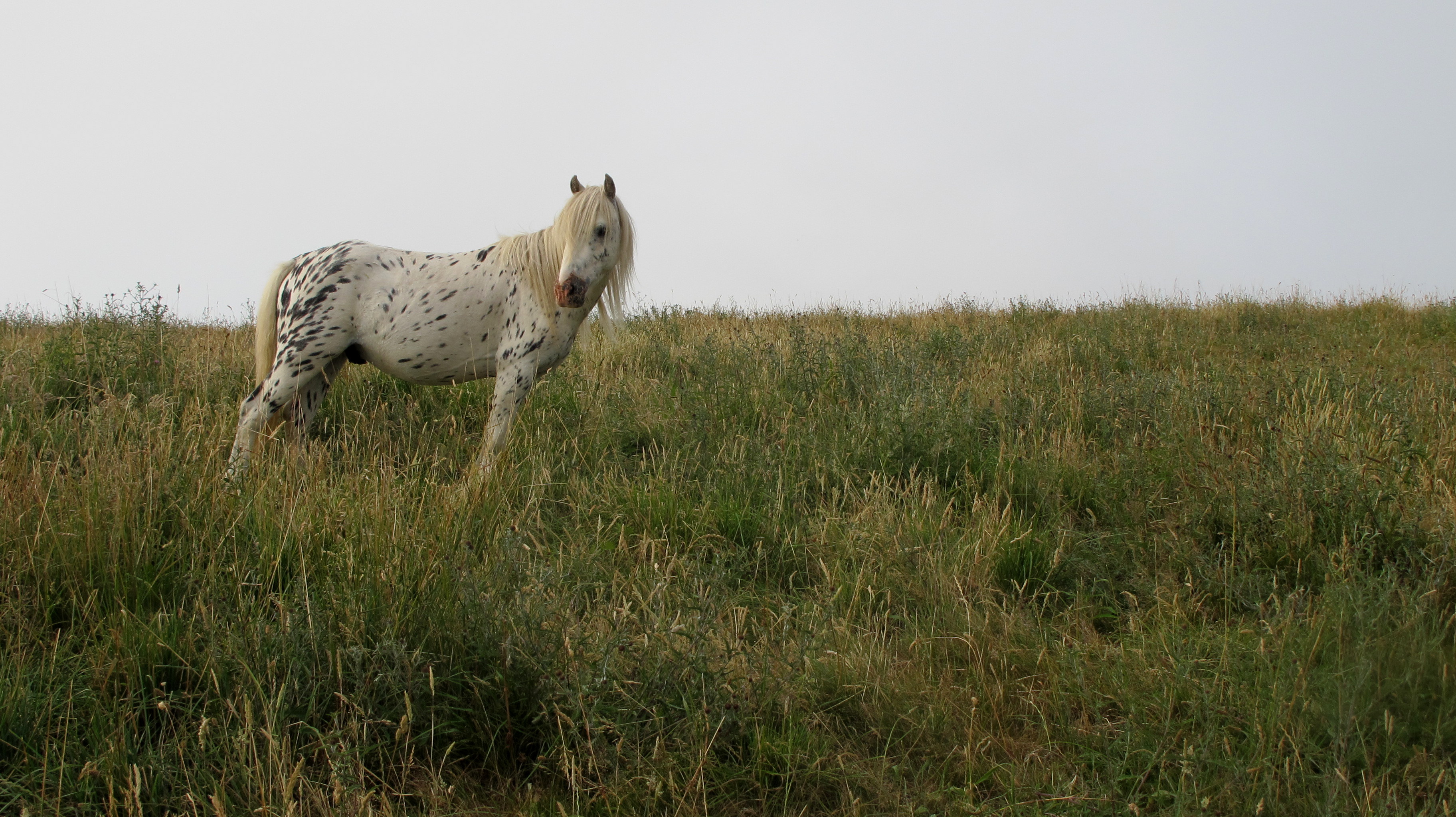
Semi-relevant photo: A wild pony on the cliffs in Cornwall. This is one of the many horses Rolf (or Rollo, if you like) couldn’t ride. Not just because he was too heavy but because by the time this horse was born he was too dead.

I’m tempted to explain this business of calling on a long-dead, horseless prince (or duke–there’s no record of him using either title, or any at all) by saying that tradition’s a powerful force in Britain, but we’re talking about Guernsey, which isn’t Britain. We’ll dive down the rabbit hole of the island’s relationship with Britain about midway through the post, but for now knowing that Guernsey isn’t Britain is enough and we’ll skitter on before anyone has a chance to ask questions.  

In one version of the way clameur works, the complainant, known as the criant, also has to invoke the Lord’s Prayer. Other explanations don’t mention that. If you plan on clameur-ing, you might want to do the Lord’s Prayer part just to be safe, although what invoke means in this context isn’t clear–or at least it isn’t clear to me. Do you recite it? Do you mention it? Do you remind the people around you of its existence? Whatever you do, I recommend doing it once in English and once in French, because I’m not sure which language you’re supposed to be working in. Or in ‎Guernésiais, the regional language, which 2% of the population speaks fluently and 3% understands. (That could be 3% on top of 2% or it might include it. Does it really matter?)

Citizen’s Advice recommends getting legal advice before messing around with the clameur, so if you’re wise (not to mention well funded) you’ll have someone who can lead you through the details.

As soon as the amateur dramatics are out of the way, building work has to stop until the court decides whether you’ve been wronged. Assuming, of course, that the people on the building site understand what you’re doing and don’t just shrug you off as some random nutburger.

If the work doesn’t stop, the person being asked to stop it risks a fine. The person invoking the clameur also risks a fine if they’re found to have raised it incorrectly. The injunction lasts a year and a day, just like the curses and assorted other spells that we find in fairy tales.

The clameur dates back to the tenth century and works only in Guernsey and Jersey, a.k.a. the Channel Islands. It was meant to work as an injunction when someone’s possession of a piece of land was interfered with, which is why the Greff threw out Henderson’s plea the next day: The land is owned by the state and the clameur is only applicable to land (or as the court put it, an immovable object) in the criant’s posssession.

Henderson argued that the state holds the land for the people. She is, inarguably, a person, so it’s a fair argument even if it didn’t win. 

New as the clameur is to me, it seems to be old news in Guernsey and Jersey. It even has its own website, which comes with its own warning, “Content researched from historic texts. May contain errors or opinions contrary to legal practice of judgment and case law. . . . For research only. Seek legal advice from advocates.”

It may also contain peanuts. People with allergies to either nuts or the law should consult a physician before opening.

While they’re doing that, why don’t the rest of us trace this bit of weirdness back in time? Because some things can’t be understood any other way. Or to rephrase that, it’s time to dive down the rabbit hole I mentioned earlier.

We’ll start in medieval times. The Channel Islands are a part of Normandy, which makes a kind of geographical sense. They’re 20 miles off the French coast, so if they’re going to belong to anyone other than themselves, they might as well be assigned there.

Then 1066 rolls around and the TV flashes a reminder to William the Conqueror (a.k.a. William the Bastard) that the show he’s been waiting for is about to begin: It’s time to invade England. He invades and becomes King of England, and since (as Duke of Normandy) he already owns Guernsey and Jersey, they’re now possessions of the English crown. And of the Norman duke, who’s the same person.

It takes some work for a modern brain to accommodate the idea that a person and a state aren’t separate things at this point, and that the English king and the Norman duke are the same guy. In case you’re having trouble with this, allow me to make it worse: The current queen reigns over the Channel Islands as the queen but is also their duke. Channel Islands royalists will toast her as “the queen our duke.”

Only they’ll capitalize both queen and duke.

They may or may not be sober when they do that. I don’t know much about toasts.

Between 1204 and 1214, King John (that’s of England) lost control of his lands in northern France but kept control of the Channel Islands. In 1259, this was formalized in the Treaty of Paris: England gave up its claim to any land in France and France gave up its claim to the Channel Islands. The Islands, however, continued to be feudal possessions of the English king and were never absorbed into England–or into its successor kingdoms, Great Britain and the United Kingdom.

The treaty didn’t keep England and France from continuing to fight over them, but let’s not get into that level of detail.

Because the islands weren’t absorbed into England, they kept some of their customary Norman law while both England and France moved on (although for all I know England  has other thousand-year-old laws, unrepealed and unused, on its books).

The islands have their own parliaments and responsibility for their own finances, although they’re not constitutionally independent. What, you ask (or probably should ask), does that mean? It’s a good question, to which you’re not likely to find get a good answer because the government(s) admit(s) that it’s murky.

According to the Ministry of Justice,” the Guardian writes in a desperate effort to make sense of the situation, “ ‘the constitutional relationship between the Islands and the UK is the outcome of historical processes, and accepted practice. . . . The most recent statement of the relationship between the UK and the islands is found in the Kilbrandon Report. It acknowledged that there were areas of uncertainty in the existing relationship and that the relationship was complex. It did not try to draw up a fully authoritative statement.’ “

In other words, after almost a thousand years, we’re still trying to figure it out.

The U.K. is responsible for the islands’ defense and for international relations.  The islands have their own flags and print their own version of the pound. Scotland prints its own pound as well, and you meet various degrees of disapproval when you spend them in England, although they’re legal tender. All Scottish pounds spent south of the border are sent back to Scotland by way of a fleet of carts pulled by rottweilers, and all English notes spent in Scotland are sent south by return dog, so that the only notes given as change in either nation are the geographically correct ones. It’s anyone’s guess how much it costs, in both cash and dog food, to do this.

I shouldn’t be allowed out in public. Someone’s going to believe that bit about the dogs. Anyway, we weren’t talking about Scotland. Could we please stay on track here?

When Britain joined the European Union, the Channel Islands didn’t, but they did join the E.U. customs territory. Any citizen of the islands is a British citizen and, since Britain is (at the moment and for at least the next twenty minutes) part of the E.U., is also a European citizen. But only citizens with close family ties to the U.K. have the right of free movement within the European Union.

If you’re not confused yet, you’re not following this. And it gets worse:

Under the UK Interpretation Act 1978, the Channel Islands are deemed to be part of the British Islands, not to be confused with the British Isles. For the purposes of the British Nationality Act 1981, the ‘British Islands’ include the United Kingdom (Great Britain and Northern Ireland), the Channel Islands and the Isle of Man, taken together, unless the context otherwise requires.”

In other words, the British Isles and the British Islands are two different things. Unless the context demands that they all get up and run around the chairs until the music stops, at which point the one who doesn’t find a chair is out. If, however, it speaks Norman French it can call on a long-dead prince, who may actually be a duke, to bring an extra chair and the game stops until he does. Which takes a while, because he can’t ride a horse.

What’s the economy of the Channel Islands based on? Tourism’s a major industry, but in the 1960s the islands reinvented themselves as an offshore financial center, which both are and aren’t regulated by Britain but aren’t regulated by the E.U. We’ll skip lightly over the claims that they’re money laundering centers–goodness gracious, who could believe such a thing anyway?–and say that after some maneuvering a 2018  anti-money laundering bill that required British overseas territories to publish a list of company owners registered there managed, at the last minute, to exclude the Channel Islands. Much (I have to assume) to the relief of the Channel Islands, or at least those with money planted there invisibly. 

For the sake of simplicity (you have no idea how much more complicated this could get) and because they’re the political subdivisions, I’ve been talking about the Channel Islands as Guernsey (population 63,026) and Jersey (population 100,080), but a few other inhabited islands and some uninhabited ones are part of the package: Alderney (population 2,000), Sark (population 600), Herm (population 60), Jethou (population 3), and Brecqhou (population not given).

The absence of population numbers for Brecqhou may or may not have something to do with it being privately owned (you want to talk about feudal) by twin brothers, and our tour of the rabbit hole isn’t complete without a quick glimpse of the place.

Since 1993 . . .  Brecqhou has been owned by the Barclay brothers, the co-owners of The Daily Telegraph newspaper and former co-owners of The Scotsman. The brothers bought the island for £2.3 million in September 1993. . . . Since the purchase the Barclays have been in several legal disputes with the government of Sark, and have expressed a desire to make Brecqhou politically independent from Sark. They drive cars on the island, and have a helicopter, both of which are banned under Sark law.”

The argument about Brecqhou’s independence or otherwise from Sark has to be based on feudal law and precedent–things like seigneurial rights and fiefdoms and letters of patent.

In 2008, the island held its first election after 400 years of feudal rule, and the Independent describes the brothers’ relationship with the island’s elected representatives as one of simmering tensions.

The brothers complained that there was no true democracy on Sark. Their opponents claimed the brothers wanted to “turn the island into a personal tax haven through propaganda and coercion.” The whole thing ended up in (a U.K.) court and in 2014 the twins lost. A House of Commons committee reported, that same year, that the tension between the brothers and the elected government “threatened to blight” the island’s future.

Our tour ends here. It’s already gone on longer than I meant it to. You leave the rabbit hole by way of the gift shop–a joke that’s gone stale in Britain but that the National Trust reminds us regularly hasn’t yet gone out of date. Apologies for not coming up with something fresher. 

Stale news from Britain

Racing News: The Great Knaresborough Bed Race took place in June. It follows the tradition of bizarre British festivals, although it’s different from a lot of them in that it asks contestants to stay sober. The rules say all runners have to stay sober until after the race.

Each team is expected to provide:

A bed decorated in the theme for the year

An audible air horn / hooter

A helmet for the passenger

A life jacket for the passenger

Irrelevant photo: A California poppy in Cornwall.

The beds have to be this height, that width, and some other length. They have to have wheels. The wheels have to meet so many specifications that I passed out reading them and had to be revived by two shih tzus and a cat, who wanted supper or they’d have let me solve my problem all by my unconscious self. The beds also have to float, because they’re going to cross the River Nidd. And they have to have ropes attached, although the ropes can’t be attached to any person. The ropes allow the runners can pull the bed when they start swimming.

All beds have to keep to the left except when they’re overtaking. Overtaking means passing. It is not the opposite of undertaking. English is a very strange language. Do not discuss this while swimming a bed across the river Nidd.

The whole thing sounds terrifyingly well organized.

Inevitably, the official video shows people in fancy dress, which means in costume, which, this being Britain, means a fair number of men dressed as women. 

No, I don’t know why they do that. It’s just something men do here. And just so we’re clear, these aren’t drag queens. Drag queens have flair. These are straight guys and they’re aiming for the Cinderella’s stepsister look. Maybe that’s what they think women look like.

The race (as I said above; pay attention, please) took place in June. If you join in next year, do send photos.

Social Media: While we’re talking about being late with a piece of news, last January the Conservative Party held a training session for its Members of Parliament. The idea was to help them use social media to present themselves to their constituents as real people so that younger people would love them and instantly run out and vote for them, even before an election was called. Several MPs responded by rushing out and posting frozen pictures of themselves standing in the kind of expensive buildings where politicians do business. They did not look like real people. They may not have been real people. I didn’t rush out and vote for them, but then I’m not in any of their constituencies and I wouldn’t have voted for them anyway. But I’m just saying, it didn’t work for me.

Then in March, Conservative MP Bob Blackman got so real that he posted an article claiming that the sexual abuse of white British children was part of Somali culture. It didn’t go over well and he said (I’m paraphrasing) that he was sorry if he’d hurt any feelings. That translates roughly to I’m sorry you got your feelings hurt when I stated the truth with less tact than I might have but gee isn’t everyone touchy these days?

Blackman uses social media so fluently that he joined a number of Islamophobic Facebook pages but when contacted about it by Vice said he didn’t know he’d been added and removed himself.

One of the groups, Britain for the British, is (or was–this happened in May) “administered by British National Party supporter Steven Devlin. It features numerous comments which praise Hitler, and many more which wish violence upon Muslim Mayor of London Sadiq Khan, accusing him of being an ‘Islamofascist’ and ‘traitor,’ and hoping that he dies.” 

Does it strike anyone other than me as a bit odd that a site where any number of people praise Hitler consider fascist an insult? Or is it only an insult when you add Islam to it?

If the party has held any more social media training sessions, it’s managed to keep them out of the news.

Snakes: This past summer has been unusually hot by British standards, and that’s led to an unusual number of snake sightings.

First, a quick review of the native reptiles. The BBC reports that “England is home to grass snakes, adders and smooth snakes, and to common lizards, sand lizards and slow-worms, slug-eating legless lizards.” The only one that’s poisonous is the adder, and they’re more of a worry for dogs than people.

Not that dogs worry much.

According to the Forestry Commission, “Adders have the most highly developed venom injecting mechanism of all snakes, but they are not aggressive animals. Adders will only use their venom as a last means of defence, usually if caught or trodden on. No one has died from adder bite in Britain for over 20 years. With proper treatment, the worst effects are nausea and drowsiness, followed by severe swelling and bruising in the area of the bite. Most people who are bitten were handling the snake.”

Some people don’t worry much either, and should.

I’m still trying to understand why the slow worm is a legless lizard instead of a snake. It looks like a snake and it quacks like a snake, but a lizard it is.

“It is illegal to kill or injure any of [the reptiles], with fines of up to £5,000 and six months’ imprisonment for offenders,” the BBC says.

But forget all that. A fair number of non-native snakes have been sighted this summer, according to the Guardian. A boa constrictor was spotted on a London street, wrapping itself around a pigeon. 

In Exeter, a man found an 8-foot (or 2.4-meter, if that works better for you) python in his bathroom, asking to borrow his razor and shaving cream. It seems to have escaped from a pet store in the building and found its way to his bathroom through the plumbing. It wanted to shave off its beard, give itself a new name, and start a new life.

About that “seems to have.” I’d have thought a store would know if it was missing an 8-foot python, but the article I read said “apparently.” Maybe shaving the beard worked–they didn’t recognize it as the 8-foot snake they were missing.

Meanwhile (or before, of afterwards) back in London, a woman woke up to find a 3-foot- (1-meter-) long royal python curled up next to her in bed. And a runner found a baby boa constrictor in the bushes just before a race. What was the runner doing in the bushes? Relieving himself, as the paper so delicately puts it.

He hasn’t peed since.

And finally, a royal python that’s probably pregnant is (as I write this, which means was as you read it) missing in Manchester, although she may be hiding somewhere in the apartment of the woman who thinks she owns her.

Manchester’s a long way from where I live, but Exeter’s not much more than an hour’s drive. I’m hoping the python hasn’t learned to drive.

An estimated 2 million snakes live as pets in Britain. Pythons and corn snakes are particularly popular.

Egg Throwing: And finally, to follow up on our theme of old news and bizarre contests, Deb (who’s popped up in the last three posts) sent me a link to a contest held in 2010, and since it’s news to me (and probably to you), it’ll do. A Lincolnshire egg-throwing contest wasn’t content with the traditional way of throwing eggs, where you take the egg in your hand, pull your hand back, and launch the thing as far as you can. This one introduced trebuchets.

A trebuchet? It’s a medieval weapon developed to launch stones during a siege. You put a heavy weight on one end of the arm, pull the unweighted end down, load a stone in its basket, and let fly. Do this often enough and you can break down a city wall and massacre the residents. 

Fun, fun, fun.

So yes, it’s a kind of catapult,but one with with a long range. I’d never heard the word till I moved to Britain.

Did I say it was medieval? It was, but it was used in China as early as the fourth century B.C.E. (That’s B.C. in [Britishism warning] old money.) Only it wasn’t called a trebuchet there. What a surprise.

You don’t have to call it a trebuchet if you don’t want to. Call it a catapult. What matters here is that it’s not meant to launch an egg.

In the competition, the target–every throwing or launching competition needs a target–was a person. I’m going to guess that each team had to supply its own, but understand that I’m making that bit up.

The BBC reported that “World Egg Throwing Federation president Andy Dunlop said 4,000 people were expected to attend the event, which has a total of 200 participants.”

The World Egg Throwing Federation? It does exist, you can find it on Facebook, and you can even watch a video of a launch that was banned from competition because it used a tube that appears to turn the egg into a shoulder-launched anti-aircraft missile.

The site comments, “Banned attempt at trebuchet competition. Disqualified because 1. Its not a trebuchet. 2. Its illegal to construct a shoulder launched egg launcher having a range of 1200 yds. (The Police complained)”

Can we stop for a minute, though, and talk about the World Egg Throwing Federation president? That is a position, kiddies, that a person can be proud of. Put it on your resume and you’ll be guaranteed interviews. I’m not saying anyone will hire you, but they will want to see what you look like.

You’ll do even better if you follow the advice offered by my partner, best known as Wild Thing: Change that title. Anyone can be a president. You want to be the Great Hen. Even if you’re male.

The link I gave you above leads to a 2010 contest, but the contest continues year after year. Why would something this important stop? I could give you a link to the more recent one but since we’re dealing in stale news this week, we’ll stay with 2010.

And now a bit of background on my research into this story. Understand first of all that no amount of research is too silly for me to undertake. When Deb first mentioned the contest, she misremembered it as a gravy throwing competition. Her brain apparently contained one egg throwing and one gravy wrestling competition and the combination led to a short circuit, producing a gravy throwing competition.

When I googled the phrase gravy throwing competition, I  found videos on how to throw a gravy boat–not as in now to launch it across a field but as in how to put a lump of clay on a potter’s wheel and make one. It was disappointing, but we can salvage something out of this: If your village is looking for a good fundraiser, you won’t find any others holding gravy throwing contests. There will be some problems to work out, but I can almost guarantee  press coverage. Great press coverage. And please, send me an invitation.

But back to egg throwing: I wrote about this festival before, but it was in the context of the presence of beer at summer festivals. (If you think I remember what I’ve written, you have no idea how my mind works and you can consider yourself lucky.) I can’t think how this happened, but in the earlier post I missed the trebuchets.

That earlier post led Fragglerocking to drop me a line about egg jarping–an Easter tradition from the northeast of England. I was going to wait for Easter to tell you about it, but since you brought it up I’ll drop it in here. 

“Well what do you expect from soft southerners?” she wrote in response to I can’t remember what–something soft and southern. Possibly chocolate eggs. “Up here where we hold the Annual Egg Jarping Championships every Easter, we’re still using hard boiled proper non-fake eggs!”

To jarp (is it a verb?), one contestant holds a hard-boiled egg with the pointed side up. The other one brings another hard-boiled egg down on it so the pointed sides crash. The winner has an undented egg. The loser cleans eggshell off the floor. If neither egg breaks, the players trade roles and try again. No beer is involved and you don’t have to organize an entire village or town to do it, although you can.

What do you do if they both break? For all I know, that’s physically impossible, but just in case, I recommend making sandwiches.

While I was googling egg throwing (I just love the research I do for this blog), I found an article on last May’s convention of the U.K. Flat Earth Society–a group of people dedicated to the idea that, evidence be damned, you can believe whatever you want. It should be getting wildly popular these days, what with folks making up their own facts, although they have more of a sense of humor than most of the people who don’t demand evidence before dedicating themselves to a set of beliefs.

The reason Lord Google led to to it was that the conference included a three-hour presentation about the earth being shaped like an egg. I’m not sure how you fill three hours with that, but I’ll admit to having known people who could fill three hours with less. And I won’t mention any names because they’d only call me.

The Tolpuddle Martyrs

We’re going back to the England of the 1830s, with all its romance, not to meniton its mud and its misery. But first, a health and safety warning, because England—or Britain, really—of the twenty-first century just loves its health and safety warnings: Our trip will be heavy on mud and misery and light on romance. We’ll be in a rural area. If you’re not familiar with farm animals, please understand that they are not pets. Above all, do not pet the bull. He has no sense of humor, even if you borrow the U from bll and move in into humour. Please stay with the group. Waterproof shoes are not required but are recommended. Above all, don’t do anything stupid.

Good, with that out of the way, here we are in the 1830s and, as a newspaper article from the British Library archive puts it, the life of an English farmworker is “dismal. Rent and a basic diet of tea, bread and potatoes would cost a typical family 13 shillings a week. But exploitative landowners, given land by the Enclosures, paid their workers as little as 9, 8, even 7 shillings.”

Screamingly irrelevant photo: a geranium.

Enclosures? You can catch up on that by going to an earlier post about hedges, which were used to enclose the fields. Scroll down to the section on history, then scroll another few paragraphs below the subhead and you’ll find a bit about enclosure. I’ve been on a history binge lately.

Or you can skip the background and simply understand that farmworkers weren’t getting paid enough to keep their families fed a very minimal diet of starch and caffeine.
Helping produce this general misery were the Corn Laws, which were in force from 1815 to 1846. They taxed and restricted the import of grain, keeping prices high. That was great if you were selling the stuff and a disaster if you were trying to buy it on 9 shillings a week. Or on 7. (Corn, just so this makes sense to everyone–or as to many people as I can manage, anyway–is British for grain.)

Not many years before the time we’re visiting, the Swing Rebellion had swept through southern and southwestern England. Rebellious farm workers and craftsmen demanded higher pay, lower tithes, an end to rural unemployment, and a few other things along those lines. Barns were burned. Farmers were threatened. The well-fed (to generalize) were frightened. The rebellion ended with 19 executions, 500 people transported, and none of the rebels’ demands met.

It was a perfect set-up for another uprising.

But that’s not what happened. What took place in Tolpuddle isn’t the sort of tale that makes a good action movie. No barns were burned. No one went to a Shao Lin temple to meditate for six years and emerge able to do flying kicks and avenge the evil landowner who murdered their mother/father/entire family/pet bull.

There weren’t even any drunken fistfights. The central people involved were Methodists, which meant they didn’t drink.

What happened was that in 1833, in Tolpuddle—a village in Dorset—a handful of men founded the Friendly Society of Agricultural Labourers, whose goal was to stop the lowering of agricultural wages. It wasn’t an uprising, it was an attempt to organize.

What’s a friendly society? A mutual aid group. I haven’t been able to date the first ones in Britain, but one website dates them, with criminal vagueness, to the Industrial Revolution. Most were very local, although a few started out that way and then expanded. Some involved no more than a few families. Members paid in a small amount each month and could count on help if someone got sick or died—or sometimes even if a cow died, which when a family’s livelihood hung by so thin a thread could be almost as catastrophic as a wage-earner dying.

This was a time when most people had somewhere between very little and nothing at all to fall back on. If things went wrong, they could become vagrants—homeless beggars. And if that doesn’t sound bad enough, vagrancy was illegal. So, as far as I can tell, was compassion except in small and humiliating doses. What help was offered came from the parish, which translates to local government, and it was miserly, punitive, and given at the discretion of the local gentry.

To modern ears, the Tolpuddle group sounds more like a union than a friendly society, but the categories were still fluid. And the organizers may well have thought that putting together a friendly society was safer than organizing a union. Unions had been illegal as recently as 1824 and were still considered reckless, revolutionary, dangerous, and several other scary adjectives.

Modern writers tend to talk about the group as a union. It’s always simpler in retrospect.

The group’s members took an oath that if any master reduced wages, all members of the society would walk out. They also swore not to tell anyone the group’s secrets and agreed that anyone who did would be hunted out of the society, not just locally but throughout the country.  As far as I can tell, the group was strictly local, but that’s the wording they used. They had ambitions, I guess.

Initiates also had to wish that their souls would be “plunged into eternity” if they broke their oath. Within three months, some 40 people had sworn, and at least one of them must have plunged his soul into eternity, because a local landowner and magistrate, Squire Frampton, heard whispers about the group and wrote to the home secretary for advice about how to respond. The home secretary recommended prosecuting the leaders under the Unlawful Oaths Act of 1797, an obscure law that outlawed secret oaths.

To understand the squire and the home secretary’s reaction, remember that not only was the Swing Rebellion in the very recent past, the French Revolution was also still alive in their minds. I have no idea if it was alive in the minds of Tolpuddle’s farmworkers, but the people who considered themselves the farmworkers’ betters were haunted by the fear that something similar could happen in England’s green and hungry land.

In February 1834, three months after its founding, six members of the friendly society were arrested. As far as I can establish, the group had done nothing more dangerous than gather members, swear oaths, and exist. But swear a secret oath they had, and all six were convicted and transported to Australia. The jury, the BBC notes, was made up of “farmers and the employers of the labourers under trial.”

It was all very efficient, and it backfired. After the conviction, the six became popular heroes, known as the Tolpuddle Martyrs. A huge meeting and a march were held in their defense (one site calls it the first mass trade union protest) and a petition for their pardon gathered 800,000 signatures. And not on the internet. Remember paper? Copies of the petition had to be passed from hand to hand and then delivered physically to whoever it was addressed to in government. And since quills–or even birds–hadn’t been invented yet, it had to be signed with sharpened dinosaur bones.

The most imaginative part of the campaign involved a call to prosecute the Duke of Cumberland—who just happened to be the King’s brother—under the Unlawful Oaths Act, since as head of the Orange Lodges of Freemasons he’d also taken a secret oath. Hey, if one secret oath was illegal, weren’t they all?

In the meantime, the families of the transported men were destitute and applied to the parish for relief. The people deciding whether they were worthy of it included none other than the man who’d set the prosecution in motion, Squire Frampton. To no one’s surprise, they were turned down. Unions across the country raised money to sustain them.

In 1836, the six were pardoned and returned to England. Only one, James Hammett, re-settled in Tolpuddle. The other five eventually emigrated to Canada, which must have promised a kind of freedom they couldn’t imagine in Dorset, and in one of those little ironies that history’s so good at, they settled on land which would have been snatched from its original settlers, the Indians.

So who were the Tolpuddle Martyrs? Five of the six were Methodists, and their leader, George Loveless, wasn’t just a Methodist but a preacher. Methodism had begun in the previous century and had become a powerful force among working people. It preached the priesthood of all believers, and that led some of those believers to decide that if god valued them, so should their employers.

The sixth, Hammett, wasn’t a Methodist, hadn’t been at the initiation ceremony, didn’t move to Canada, and had been arrested once before, for theft. He may (or may not–who can tell at this point?) have allowed himself to be convicted to protect his brother. He seems to have been an outsider in an otherwise tight-knit group.

After the Tolpuddle prosecution, the National Archive says, “the harsh sentences discouraged other workers from joining trade unions, and many of the nationwide organisations, including the Grand National Consolidated Trades Union, collapsed.” But in spite of that, union memebership continued to grow and by the 1850s and 1860s trade unionism was again on the rise.

Today, the Tolpuddle Martyrs are commemorated by a museum and a yearly festival. I haven’t gone, but judging from the festival posters it encompasses sober political discussion, open mics, and concerts by groups that this year included the Barstool Preachers.

I just had to work their name in. I doubt the five Tolpuddle Methodists would have approved.

But we’ve been serious long enough, so let’s talk about place names: Before we’d heard of the Tolpuddle Martyrs, my partner and I drove through the area reading the signs that pointed to nearby towns and villages and laughing hard enough to make ourselves a hazard on the road. In addition to Tolpuddle, we found Affpuddle, Briantspuddle, Piddlehinton, Piddletrenthide, Puddletown, the River Piddle, Tincleton, and Throop.

Throop didn’t fit the theme, but somehow that only made it funnier.

My friend Deb swears that Little Piddle, Upper Piddle, and Lower Piddle are around there somewhere. I don’t doubt that she’s right but we, sadly, missed them.

*
My thanks to Emma Cownie for mentioning the impact of the Corn Laws on food prices in this period. And to Richard for dropping me a line about Lord Byron’s speech about frame breakers. I haven’t gotten my claws into that yet, but if you have no idea what I’m talking about (and why would you?), it’ll all make sense eventually.