
Gather round, kidlets, because we’re going to take medieval England, Scotland, and France and bring them all together in a little-known battle, the Battle of Neville’s Cross.
Why should you care? Because you can amaze your friends and relatives by droning on about something they never heard of. And because it proves the old adage that history doesn’t repeat itself but it does rhyme.
Who adaged that? I’m not sure, but when Americans don’t know who to attribute a quote to 73.6% of them will pick Mark Twain, and I spent most of my life in the US, so it must’ve been Twain.
And since 74.5% of all statistics are invented on the spot, you can trust me on that.
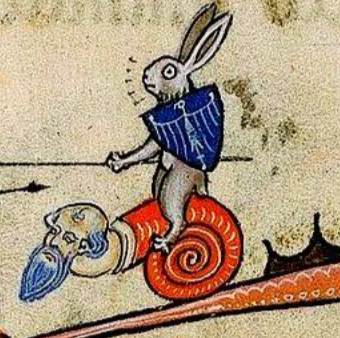
Um, no, the rabbit, the snail, and the bearded guy weren’t part of the Battle of Neville’s Cross, but they are medieval. I don’t know what it was all about, but those medieval monks made some strange choices of what to paint in the margins of the books they illustrated. Or from
The background
Enough with the intro. Let’s get to work. We’ll go back to 1346, As usual, England and France were at war, in this case the Hundred Years War.
And we thought we had problems today. All we have to deal with are a few forever wars.
Scotland was still its own country then and sat where it always has, to the north of England, which both countries found awkward. Since France was fighting England, it was Scotland’s ally. If you’re following this by laying out playing cards, distribute your kings so Edward’s with England, Philippe’s with France, and David’s with Scotland.
Edward had invaded France to lay siege to Calais, and for that he needed 15,000 men.
Is that an accurate count? I have no idea. On the one hand, medieval chroniclers used large numbers as a poetic way of saying a lot. On the other hand, by now historians could well have worked their way through old scrolls and added up the number of ships the soldiers sailed in, coming up with a less poetic if more reliable reckoning. Your guess here is as good as mine, which is to say, not very good. Let’s sneak away and start the next paragraph–
–which makes the point that Philippe, clever man, had noticed that a lot of English soldiers were in France and that worried him, so he wrote to David and said, basically, this would be a great time to you to attack England, because we’ve got all their fighters on this side of the Channel bothering the hell out of us.
“I implore you to remember our friendship and our treaties,” he wrote, “and to strike as hard at England as you can.” England, he said, was a “defenceless void.”
Those historical rhymes
Why did I mention that quote (allegedly) from Mark Twain at the beginning? Because the setup reminds me of Netanyahu whispering in Trump’s ear, Iran’s a sitting duck. We’ll drop a handful of bombs–mostly yours–that’ll take out their whole leadership, and in a few days the country will crumble.
If David was any brighter than Trump, I haven’t seen evidence of it. Philippe dangled the lure and David bit. Yes! England is a defenseless void! The Strait of Hormuz is ours!
Sorry, wrong lure. For the sake of clarity, neither Scotland nor northern England has or ever had a Strait of Hormuz. Metaphor. Figure of speech. Poetic license, even in prose. History rhymes but it doesn’t exactly repeat itself.
Anyone who wants to leave a comment rhyming Strait of Hormuz with anything at all is more than welcome to.
Admittedly, the parallel to the Iran War doesn’t entirely work. Iran is the weaker power and has ended up with, if not all the cards, at least one hell of a strong hand. Back in 1346, England was the stronger power. Still, there’s that lure dangling in front of a king. There’s the promise of an easy win.
So in October, David invaded England with an alleged 12,000 men, first doing a little storming and a little ransoming and sacking, followed by a bit of resting, because looting and sacking is tiring work. Then an English force of (allegedly, remember) 6,000 men crept through the morning mist and stubbed its collective toe on a Scottish raiding party, which ran back to David to say, “The English are coming, the English are coming.”
What did David do? Got out of bed crabbily and said, according to an anonymous fourteenth-century account, “O man, that cannot be, because in England there are no men left but monks and canons, brothers and priests, swineherds and shepherds, cobblers and skinners; but all the knights are with their king overseas.”
The battle and the money
It doesn’t sound like David lost any advantage by being (a) wrong and (b) slow on the uptake. Contemporary letters describe the two armies as staring at each other across the moor for the next five hours. They did eventually fight, though, and we’ll skip over the details. Historians have struggled to reconstruct them anyway. What matters is that the Scots lost, some 2,000 of them died, and David was wounded and captured. An assortment of Scottish earls, barons, and important whatevers were also captured. If you’re still working with playing cards, just throw a handful of Scotland’s on England’s pile.
As a result, England occupied most of Scotland below the Forth and Clyde rivers, and David spent eleven years as an English prisoner (a comfortable one) before he agreed to ransom himself to the tune of 100,000 marks, which is in the neighborhood of 39 million 2017 pounds–in other words, a shitload of money.
Since he wasn’t carrying that much cash and bank cards hadn’t been invented, Edward accepted the royal equivalent of an I.O.U. and in 1357 David returned home. Scotland paid several ruinous installments, but eventually David proposed handing the throne to Edward or his son in return for canceling the debt.
Instead, the Scottish Parliament canceled the agreement and David died without an heir. He was followed onto the throne by his nephew, the first of the Stewart kings.
France fought the English only in France, not on English soil.
Aren’t you glad you know that?


Tought you might like this as a side step, about the man who captured and had custody of King David after the. battle :) only 5 paragraphs, the rest is other history.
LikeLiked by 1 person
Thought not tought sorry.
LikeLiked by 1 person
Sounds good–especially the 5 paragraphs part. I’ve been short on time and attention span lately. Thanks.
LikeLiked by 1 person
Dear Ms Hawley,
While I make it an absolute rule never to sully my bifocals with the trivialities of the amateur blogosphere, three separate colleagues dropped printed copies of your essay into my departmental pigeonhole this morning, presumably out of genuine concern for my arterial pressure.
I write to you from my study, where I’ve spent the past thirty-seven years labouring to bring rigorous order to fourteenth-century Anglo-Scottish border logistics. To say I found your little précis distressing would be an understatement on par with calling the Black Death an inconvenient rash.
First, you address your readership as “kidlets”. One does not initiate a discourse on feudal martial strategy as though one is distributing wet flannel wipes at a toddler’s crèche. History isn’t a parlour game; it’s a solemn cross-examination of documentary remains.
Second, your blithe confession that “your guess here is as good as mine” regarding troop dispositions caused me actual physical pain. Madam, your guess is unquestionably appalling, but mine is supported by forty-two linear feet of Wardrobe debentures and exchequer pipe rolls. We don’t simply “sneak away to the next paragraph” because the palaeography becomes demanding! King Edward III didn’t assemble 15,000 men by tossing coins into a well; he had purveyance officers, royal commissions of array, and indentured captains. If you’d spent even a solitary Tuesday sifting through the Rotuli Scotiae, you wouldn’t be flinging casual numbers about like a bingo caller at a seaside pier.
Third, your geopolitical parallels. Donald Trump? The Strait of Hormuz? I very nearly choked on my Earl Grey. To graft modern Middle Eastern naval chokepoints onto King David II’s autumn campaign is presentism of the most garish, vulgar variety. Philippe VI didn’t “dangle a lure” like an unscrupulous property speculator; he invoked the solemn, reciprocal feudal obligations codified in the Treaty of Corbeil. King David wasn’t merely “getting out of bed crabbily”; he was acting under the strategic misapprehension that the northern March was devoid of magnate leadership.
Furthermore, to suggest that the English army merely “stubbed its collective toe” on the Scots in the morning mist is a grotesque insult to Ralph, Lord Neville, Henry Percy, and William de la Zouche, the Archbishop of York. His Grace the Archbishop didn’t don mail over his cassock and ride through the Durham drizzle to have his tactical counter-reconnaissance trivialised as domestic clumsiness with furniture.
Then we arrive at your financial assessment: “a shitload of money”. Is this truly what passes for economic historiography across the Atlantic? The 100,000-mark indemnity specified in the 1357 Treaty of Berwick was a masterclass in fiscal strangulation, meticulously calculated to exhaust Scotland’s bullion liquidity without precipitating an immediate default that might invalidate the hostage covenants. It wasn’t an “I.O.U.” scribbled on the back of a tavern slate; it was a sovereign instrument secured by twenty noble youths surrendered into English custody.
Finally, your total silence regarding the manuscript illumination you carelessly appended to your text. You drop an image of an armed leporid mounted upon a gastropod with the head of an elder, and you don’t even offer an exegesis! Did you imagine it was a doodle? It’s a quintessential mid-fourteenth-century drollery exemplifying mundus inversus (the world turned upside down). The rabbit, whose proverbial cowardice is exhaustively catalogued across the Anglo-Norman bestiary tradition, bearing a lance whilst astride a human-headed snail, is a biting contemporary visual satire on chivalric impotence and the moral degradation of knights terrified of domestic vermin. To present such a magnificent survival of gothic marginalia without decoding its sociopolitical semiotics is intellectual negligence of the highest order.
I recommend you seek out an offprint of my 1994 monograph, Grain Requisitions and Pack-Mule Attrition in Tynedale, 1340-1350 (Volumes I through IV). I suggest you digest it thoroughly before you next attempt to explain high medieval statecraft to the public.
Yours with profound exhaustion,
Dr Alistair Sterling-Hetherington, MA (Oxon), DPhil, FRHistS
Senior Research Fellow in Anglo-Scottish Marcher Logistics
Honorary Keeper of the Neville Pipe Rolls
Department of Medieval Diplomatic and Feudal Administration
The London Institute for Historical Scrutiny
LikeLiked by 1 person
Garish? Vulgar? Sir, you flatter me.
LikeLiked by 1 person
I grew up five miles from Neville’s Cross and was taught about the battle at junior school. There is a road in Neville’s Cross called “Butchers Race”. I was told that the English cavalry, mounted on big horses, chased the Scots cavalry, mounted on small ponies. With the height advantage, the English were able to butcher the Scots when they caught up with them.
LikeLiked by 1 person
Ouch. I wonder–and I base this on some of the nonsense I was taught as history–if that’s true. I didn’t try many sources for battle details. It’s been a tough week and one reason I picked this topic out of the pile was that I could write it without having to look far. I just trusted the one that said details of the battle were sketchy and tottered cheerfully on.
LikeLike
Fascinating info. Thank you. But I must admit “History doesn’t repeat itself but it does rhyme” makes no sense to me. It most certainly DOES repeat itself, as the Age of The Robber Barons reappearing Over Here is just one shining example. And the only rhyme seems to be to keep repeating the same expletive.
LikeLiked by 1 person
I think if we keep repeating expletives–and why wouldn’t we, given the situation–it counts as repetition, not rhyming. But what the hell, the song “Wabash Cannonball” rhymes shore with shore, which is either rampant cheating or if a well-known song does it, legit. So I won’t quibble.
Much.
LikeLiked by 1 person
Ellen Hawley has outdone herself this time! History with a healthy dose of bone dry wit! – dh
LikeLiked by 1 person
Ahem, she send her thanks.
LikeLike
OK, I’ll give it a shot … ahem …
There once was a Straight called Hormuz
Which never caused much of a buzz.
There Gollum did find it
One Ring for to bind it
(and said)
We loves it, my Presious, we does.
LikeLiked by 1 person
It gave me a good laugh, especially having to rhyme Hormuz with boooz. And dragging Lord of the Rings into the mayhem.
LikeLiked by 1 person
:D
LikeLiked by 1 person
Oops … ‘Precious’ :D
LikeLiked by 1 person
While sailing the Strait of Hormuz,
I drank a whole crate of warm booze,
It’s great to go cruising,
Sun bathing and boozing,
The length of the Strait of Hormuz.
Jeannie
LikeLiked by 1 person
It works. I rhymed it with yesterday’s news, but the idea of any recent news left me too depressed to go on.
Thanks.
LikeLike
Some interesting parallels. Taking important men hostage used to be a good money-raising venture in the Middle Ages (think of King Richard-the-Lion Heart).
LikeLiked by 1 person
It did indeed. I’ve never seen anything about when, how, and why that stopped. It would be interesting to know. Did countries suddently find themselves feeding un-ransomable nobles they couldn’t get rid of?
LikeLiked by 1 person
Perhaps it died out when nobles stopped leading their troops in person. Hostage taking is alive and well in many parts of the world (The Middle East and Mexico springs to mind) just not kings and nobles.
LikeLiked by 1 person
Good points.
LikeLiked by 1 person
On the continent it slowly stopped with the introduction of the “Landfriede”. It put an end to the age old ransom thing, that was (ab)used by knights (“Strauchritter”). From some point onwards it was not an accepted knightly deed any more, but just a crime. To be a victim of Hostages / ransom taking was not limited to noble men, but also rich merchants were taken hostage.
LikeLiked by 1 person
The rich merchants, I assume, weren’t taken in battle but when they traveled?
LikeLike
Of course, hence the importance of “Geleit”, safe passage.
A “knight” (Strauchritter) would declare “Fehde” say to the Reichsstadt Nürnberg, declaring that they owed him, or someone else for whom he does the incasso, money. So he has the right to take some Nurembergian burgers hostage, and make the city pay. Still a number end 15th, beginning 16th century (Thomas von Absberg).
LikeLiked by 1 person
My thanks.
LikeLike
All nice and dandy, but why, oh why should someone in his or hers right mind even consider to conquer Scotland ? What is there ? Scots. Sheep. Haggis. Bog water they call “wiski” or something. The Romans did not go there, Hadrian’s Wall stands for a good reason where it stands. They should have tossed David and his ilk back over the wall.
LikeLiked by 1 person
Instead of arguing that one out with you, I’ll just step aside and let the Scots go after you–if they choose, that is.
LikeLike
You forgot their ability to bear a grudge, (the wicked English were always entirely to blame, if you ignore the selective way history is presented and the Barnett formula of today). Their king James VI couldn’t leave Scotland quickly enough when he became James I of England.
It is beautiful, though.
LikeLiked by 1 person
Lots o’ countries have a gift for carrying a grudge. Just get a bunch of Englishers going about the French. Or the–oh, hell, fill in the blank any way you want. But I shouldn’t limit myself to the English. History isn’t about the past, or maybe only partially about the past. In pretty much any country you can name, I’d bet kids are taught history as a patriotic exercise. I know I was in the US.
LikeLike
You’re right, Ellen. The “decisive” battle of Waterloo is, I believe, an minor skirmish to the French.
Jeannie
LikeLiked by 1 person
Really? Now that’s interesting!
LikeLike