
Gather round, kidlets, because we’re going to take medieval England, Scotland, and France and bring them all together in a little-known battle, the Battle of Neville’s Cross.
Why should you care? Because you can amaze your friends and relatives by droning on about something they never heard of. And because it proves the old adage that history doesn’t repeat itself but it does rhyme.
Who adaged that? I’m not sure, but when Americans don’t know who to attribute a quote to 73.6% of them will pick Mark Twain, and I spent most of my life in the US, so it must’ve been Twain.
And since 74.5% of all statistics are invented on the spot, you can trust me on that.
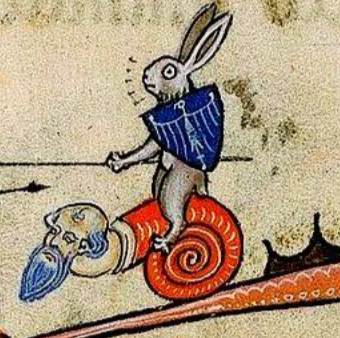
Um, no, the rabbit, the snail, and the bearded guy weren’t part of the Battle of Neville’s Cross, but they are medieval. I don’t know what it was all about, but those medieval monks made some strange choices of what to paint in the margins of the books they illustrated. Or from
The background
Enough with the intro. Let’s get to work. We’ll go back to 1346, As usual, England and France were at war, in this case the Hundred Years War.
And we thought we had problems today. All we have to deal with are a few forever wars.
Scotland was still its own country then and sat where it always has, to the north of England, which both countries found awkward. Since France was fighting England, it was Scotland’s ally. If you’re following this by laying out playing cards, distribute your kings so Edward’s with England, Philippe’s with France, and David’s with Scotland.
Edward had invaded France to lay siege to Calais, and for that he needed 15,000 men.
Is that an accurate count? I have no idea. On the one hand, medieval chroniclers used large numbers as a poetic way of saying a lot. On the other hand, by now historians could well have worked their way through old scrolls and added up the number of ships the soldiers sailed in, coming up with a less poetic if more reliable reckoning. Your guess here is as good as mine, which is to say, not very good. Let’s sneak away and start the next paragraph–
–which makes the point that Philippe, clever man, had noticed that a lot of English soldiers were in France and that worried him, so he wrote to David and said, basically, this would be a great time to you to attack England, because we’ve got all their fighters on this side of the Channel bothering the hell out of us.
“I implore you to remember our friendship and our treaties,” he wrote, “and to strike as hard at England as you can.” England, he said, was a “defenceless void.”
Those historical rhymes
Why did I mention that quote (allegedly) from Mark Twain at the beginning? Because the setup reminds me of Netanyahu whispering in Trump’s ear, Iran’s a sitting duck. We’ll drop a handful of bombs–mostly yours–that’ll take out their whole leadership, and in a few days the country will crumble.
If David was any brighter than Trump, I haven’t seen evidence of it. Philippe dangled the lure and David bit. Yes! England is a defenseless void! The Strait of Hormuz is ours!
Sorry, wrong lure. For the sake of clarity, neither Scotland nor northern England has or ever had a Strait of Hormuz. Metaphor. Figure of speech. Poetic license, even in prose. History rhymes but it doesn’t exactly repeat itself.
Anyone who wants to leave a comment rhyming Strait of Hormuz with anything at all is more than welcome to.
Admittedly, the parallel to the Iran War doesn’t entirely work. Iran is the weaker power and has ended up with, if not all the cards, at least one hell of a strong hand. Back in 1346, England was the stronger power. Still, there’s that lure dangling in front of a king. There’s the promise of an easy win.
So in October, David invaded England with an alleged 12,000 men, first doing a little storming and a little ransoming and sacking, followed by a bit of resting, because looting and sacking is tiring work. Then an English force of (allegedly, remember) 6,000 men crept through the morning mist and stubbed its collective toe on a Scottish raiding party, which ran back to David to say, “The English are coming, the English are coming.”
What did David do? Got out of bed crabbily and said, according to an anonymous fourteenth-century account, “O man, that cannot be, because in England there are no men left but monks and canons, brothers and priests, swineherds and shepherds, cobblers and skinners; but all the knights are with their king overseas.”
The battle and the money
It doesn’t sound like David lost any advantage by being (a) wrong and (b) slow on the uptake. Contemporary letters describe the two armies as staring at each other across the moor for the next five hours. They did eventually fight, though, and we’ll skip over the details. Historians have struggled to reconstruct them anyway. What matters is that the Scots lost, some 2,000 of them died, and David was wounded and captured. An assortment of Scottish earls, barons, and important whatevers were also captured. If you’re still working with playing cards, just throw a handful of Scotland’s on England’s pile.
As a result, England occupied most of Scotland below the Forth and Clyde rivers, and David spent eleven years as an English prisoner (a comfortable one) before he agreed to ransom himself to the tune of 100,000 marks, which is in the neighborhood of 39 million 2017 pounds–in other words, a shitload of money.
Since he wasn’t carrying that much cash and bank cards hadn’t been invented, Edward accepted the royal equivalent of an I.O.U. and in 1357 David returned home. Scotland paid several ruinous installments, but eventually David proposed handing the throne to Edward or his son in return for canceling the debt.
Instead, the Scottish Parliament canceled the agreement and David died without an heir. He was followed onto the throne by his nephew, the first of the Stewart kings.
France fought the English only in France, not on English soil.
Aren’t you glad you know that?

