The Battle of Neville’s Cross

Gather round, kidlets, because we’re going to take medieval England, Scotland, and France and bring them all together in a little-known battle, the Battle of Neville’s Cross.

Why should you care? Because you can amaze your friends and relatives by droning on about something they never heard of. And because it proves the old adage that history doesn’t repeat itself but it does rhyme.

Who adaged that? I’m not sure, but when Americans don’t know who to attribute a quote to 73.6% of them will pick Mark Twain, and I spent most of my life in the US, so it must’ve been Twain. 

And since 74.5% of all statistics are invented on the spot, you can trust me on that.
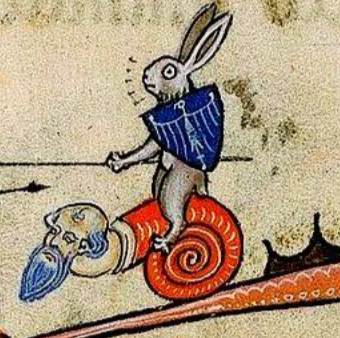
Um, no, the rabbit, the snail, and the bearded guy weren’t part of the Battle of Neville’s Cross, but they are medieval. I don’t know what it was all about, but those medieval monks made some strange choices of what to paint in the margins of the books they illustrated. Or from


The background

Enough with the intro. Let’s get to work. We’ll go back to 1346, As usual, England and France were at war, in this case the Hundred Years War. 

And we thought we had problems today. All we have to deal with are a few forever wars. 

Scotland was still its own country then and sat where it always has, to the north of England, which both countries found awkward. Since France was fighting England, it was Scotland’s ally. If you’re following this by laying out playing cards, distribute your kings so Edward’s with England, Philippe’s with France, and David’s with Scotland. 

Edward had invaded France to lay siege to Calais, and for that he needed 15,000 men. 

Is that an accurate count? I have no idea. On the one hand, medieval chroniclers used large numbers as a poetic way of saying a lot. On the other hand, by now historians could well have worked their way through old scrolls and added up the number of ships the soldiers sailed in, coming up with a less poetic if more reliable reckoning. Your guess here is as good as mine, which is to say, not very good. Let’s sneak away and start the next paragraph–

–which makes the point that Philippe, clever man, had noticed that a lot of English soldiers were in France and that worried him, so he wrote to David and said, basically, this would be a great time to you to attack England, because we’ve got all their fighters on this side of the Channel bothering the hell out of us. 

“I implore you to remember our friendship and our treaties,” he wrote, “and to strike as hard at England as you can.” England, he said, was a “defenceless void.”


Those historical rhymes

Why did I mention that quote (allegedly) from Mark Twain at the beginning? Because the setup reminds me of Netanyahu whispering in Trump’s ear, Iran’s a sitting duck. We’ll drop a handful of bombs–mostly yours–that’ll take out their whole leadership, and in a few days the country will crumble.

If David was any brighter than Trump, I haven’t seen evidence of it. Philippe dangled the lure and David bit. Yes! England is a defenseless void! The Strait of Hormuz is ours!

Sorry, wrong lure. For the sake of clarity, neither Scotland nor northern England has or ever had a Strait of Hormuz. Metaphor. Figure of speech. Poetic license, even in prose. History rhymes but it doesn’t exactly repeat itself. 

Anyone who wants to leave a comment rhyming Strait of Hormuz with anything at all is more than welcome to. 

Admittedly, the parallel to the Iran War doesn’t entirely work. Iran is the weaker power and has ended up with, if not all the cards, at least one hell of a strong hand. Back in 1346, England was the stronger power. Still, there’s that lure dangling in front of a king. There’s the promise of an easy win.

So in October, David invaded England with an alleged 12,000 men, first doing a little storming and a little ransoming and sacking, followed by a bit of resting, because looting and sacking is tiring work. Then an English force of (allegedly, remember) 6,000 men crept through the morning mist and stubbed its collective toe on a Scottish raiding party, which ran back to David to say, “The English are coming, the English are coming.” 

What did David do? Got out of bed crabbily and said, according to an anonymous fourteenth-century account, “O man, that cannot be, because in England there are no men left but monks and canons, brothers and priests, swineherds and shepherds, cobblers and skinners; but all the knights are with their king overseas.”


The battle and the money

It doesn’t sound like David lost any advantage by being (a) wrong and (b) slow on the uptake. Contemporary letters describe the two armies as staring at each other across the moor for the next five hours. They did eventually fight, though, and we’ll skip over the details. Historians have struggled to reconstruct them anyway. What matters is that the Scots lost, some 2,000 of them died, and David was wounded and captured. An assortment of Scottish earls, barons, and important whatevers were also captured. If you’re still working with playing cards, just throw a handful of Scotland’s on England’s pile.

As a result, England occupied most of Scotland below the Forth and Clyde rivers, and David spent eleven years as an English prisoner (a comfortable one) before he agreed to ransom himself to the tune of 100,000 marks, which is in the neighborhood of 39 million 2017 pounds–in other words, a shitload of money. 

Since he wasn’t carrying that much cash and bank cards hadn’t been invented, Edward accepted the royal equivalent of an I.O.U. and in 1357 David returned home. Scotland paid several ruinous installments, but eventually David proposed handing the throne to Edward or his son in return for canceling the debt.

Instead, the Scottish Parliament canceled the agreement and David died without an heir. He was followed onto the throne by his nephew, the first of the Stewart kings.

France fought the English only in France, not on English soil.

Aren’t you glad you know that?

The Hundred Years War in two thousand words

Taking a long view, the Hundred Years War (1337–1453) started a few hundred years before the count begins, in 1066, with a careless invasion of England. You know how these things happen. You look across the ocean and see a country that needs a king. Sure, it’s got some guy who says he already is king, but it so clearly needs you as king, because let’s face it, you don’t want to stay home and be nothing more than a duke. So you invade and become both a king and a duke. 

Sounds good. You just planted the seeds of a war that won’t blossom for centuries. 

You do have problems, of course. One is that between your kingdom and your dukedom lies that body of water you were looking out over, so you can’t just hop on a bus to move between them. Another is that your dukely self owes fealty and loyalty and several other -ties to a king who isn’t you: the French king.

It’s all a bit awkward, but even so it’s lucrative, and it won’t become a serious problem until after you die, and that makes it somebody else’s problem. 

In case your dual identity as king and duke has left you confused, I’ll clarify: you’re standing in for William the Conqueror today, and what with being dead and all, you now drop out of the picture and we move on to everyone who follows you.

Irrelevant photo: Valerian growing in a neighbor’s hedge.

More kings

The tension between being a duke in one place and a king in another will continue and be made more complicated by the nobility’s habit of marrying only people whose families have land and power and titles, all of which are inherited. High-end medieval marriages are supposed to cement alliances, and they probably do in the short term, but they also lead to disagreements over who gets to inherit what. They also blur the line between (in this case) what’s English and what’s French.

Hold onto that idea of conflict. We’ll get to it, but first let’s dredge up an example of how those lines get blurred. In 1154, when he becomes king of England and duke of Normandy, William the C’s great-grandson Henry II is already the count of Anjou and duke of Aquitaine. So he has four titles and three of them are in France, although his top-ranking title is English. That makes him not only the king of France’s theoretical equal but also the most powerful of the king of France’s subordinates. Under those circumstances, it can’t be simple figuring out who bows and who gets bowed to. It may depend on whose living room they’re in and whose TV they’re going to watch. Not to mention who’ll make the popcorn.

At times, the French king has direct control over less of France than the English king does, although (this being feudalism and all) the English king always plays second fiddle to the French king for those French lands, and it can get dangerous when the second fiddle is powerful enough to challenge the first violinist. So the French kings do what they can to strip away English holdings in France. In return, the English do what you’d expect: try to hang onto them. 

This is a time bomb, and it’s going to explode only a few episodes into the miniseries. But since I promised you a 2,000-word limit, we’ll skip a lot of the details.


Dynastic marriages

Let’s go back to those marriages and the conflicts they plant. Edward III of England is the nephew of Charles IV in France because all the appropriate people married other appropriate people. You wouldn’t expect them to marry (gasp) commoners, would you?

When Charlie dies, he doesn’t have a male heir, and French law won’t accept a (more gasps) female on the throne. So the French barons unroll the genealogical charts and–eek!–the closest male heir is the king of England.  Right. They unroll a few more inches of chart and find a cousin, Phillip, who’s not only certifiably male but French.

Eddie protests. France argues that Ed’s claim to the throne comes through his mother and, what with being female and all, she couldn’t transmit the right to a crown she couldn’t claim herself. 

After a bit of grumbling, Eddie caves–at least, that is, until Phil takes away one of his French toys, Gascony, at which point Eddie decides he really is the king of France. He takes the title King of France and the French Royal Arms. 

Why France and its royal arms are separate things is beyond me, but he’s convinced that they are and that he’s king of them both. The year is 1337. The Hundred Years War is about to start, although nobody’s calling it that yet.


War

For a while, the war goes well for the English. Eddie stirs up enough of the discontented nobility to make war on the cheap, because even when the English aren’t fighting, France still has to. Parts of the country become ungovernable–or at least Paris can’t govern them. The local lords can.

It’s in this period that England has the victories at Crecy and Poitiers that wander happily through the fields of English memory, often without much in the way of context, leaving the impression that it’s always summer, the wildflowers are always in bloom, and England always prevails. 

But don’t trust me too far on that business of English memory. I’m not English and I imported my memory from elsewhere. What you can trust is that the early signs are all good from the English point of view. They do major damage to the French economy and at Poitiers take the French king (not Phillip; by now it’s John II, or John the Good) prisoner, forcing him to sign a treaty so unfavorable to France that the country repudiates it.

Short digression: I’m having a little trouble figuring out why he’s John the Good, unless it’s because his primary enemy was Charles the Bad and it does make for some pleasing symmetry. John not only signs a bad truce, he marries his daughter to his bitter enemy (would you marry your kid to someone called John the Bad?) then doesn’t come through with her dowry, giving Charles even more reasons to be bad. And if that’s not enough, he gives some of Charles’ lands to his (that’s John’s) constable, no doubt causing further unhappiness in  his daughter’s home. He looks like a shady character to. But John the Good he is. 

Different era, different standards. 

Somewhere in the midst of all that, the Black Death sweeps through and conquers everything it damn well wants. 


Peace, and then more war

Starting in 1360, we get nearly ten years of peace, which breaks down when France and England back different claimants for the throne of Castile. Which, I remind you, is in Spain. You’d think that would make it irrelevant, but you’d be wrong. 

This is why I’m going light on the detail. My hair would catch fire if I spent too much time with this stuff. 

The French and the English start fighting again. The English launch raids into French territory. The French, in alliance with Spain, raid English cities along its south coast. France narrows England’s French possessions down to a strip along the coast.

Everyone’s tired and takes a couple of decades off. Mostly. They give serious thought to a lasting peace and say, “Nah, let’s not.” 

And this is where another English victory wanders triumphantly into the National Memory Banks: Agincourt. It’s all going so well that the English are within spitting distance of taking Paris.

In response, the splintered French powers meet to form an alliance against England. But instead of forming an alliance, though, one side assassinates the leader of another side and the French end up signing a treaty that will lead to the English king marrying the French king’s daughter, because these marriages work out so well for everyone, right? The English king will also inherit the French throne once the current king–who’s already not well–dies, and the English king will be regent for the French king while he lives. That disinherits the dauphin–the French heir–who was the guy who messed up that three-way meeting.

The muse of history (that’s Clio, in case you want to invite her to your next party) laughs at their plans. The English king dies before the French king, which leaves a nine-month-old, in all his wisdom, in charge of both countries. 


But it’s not over yet 

The south of France backs the dauphin against the baby king, Joan of Arc rides in on her pony, winning a victory for the French, and the dauphin is crowned. France now has two kings. One speaks French, the other (I’m guessing) has yet to speak a full sentence.

Joanie’s captured, tried, and burned for heresy. The French take Paris back. A truce is negotiated. The English indulge in a little last minute sacking and looting, since that’s what medieval warfare’s all about. The truce is abandoned. 

Are you starting to feel hopeless about this thing? Just imagine how people felt at the time. 

The French take back all of France except for Calais. Effectively, although not officially, the war’s over. 


Why do we care about any of this?

Many reasons. 

Since the war’s been fought on French soil, and since civilians are fair game (unlike, ahem, in our enlightened times), France has been devastated. All that looting and pillaging has had a massive impact on France. 

And even where they’re not looting and pillaging, soldiers are like a plague of locusts. They need to eat, and guess who gets to feed them? Local people, and payment is not guaranteed. That felt not only in France but also in southeast England, where English armies were been stationed before they shipped out. 

In England, though, most ordinary people feel the impact primarily in the form of taxes, and there’ve been a mass of them. War’s expensive. All those taxes led, among other things, to the Peasants Revolt.

They also led to Parliament becoming more powerful, because each time the king introduces a new tax, Parliament has to wave its magic feather to approve it. As gets Parliament stronger, the king gets weaker. 

Another way for the king to raise money has been to increase the number of nobles, and by the end of the war the size of the nobility has tripled and the crown’s created new ranks–esquire and gentleman.

It all brings in money. It’s also never enough. By the time the war ends, the English treasury is just about empty. 


Nationalism

Throughout the war, assorted kings and the church have drummed up a patriotic frenzy, as governments do when they have a war brewing. Among other things, this has led to the country adopting St. George as its patron saint. Hell, he’d been a soldier, hadn’t he? What could be better? 

The problem with patriotic frenzy, though, is that it turns against the leader who loses a war. You’ll find a box of historical examples by the door. Grab a handful on your way out. They’re both instructive and sobering. This particular patriotic frenzy, according to the BBC, which knows all, “had much to do with the outbreak in the mid-1450s of civil war (the ‘Wars of the Roses’). The recovery of the lost lands in France long remained a wishful national aspiration.” No one introduced the slogan Make England Great Again, but that’s only because the baseball cap hadn’t been invented.

Both England and France came away with an increased sense of nationhood and an increased indulgence in nationalism, not to mention a habit of looking down on each other. The English are still snippy about the French, and as far as I can tell with my limited French, the French are the same about the English, although they haven’t gone to war with each other lately. 

One final, and surprising outcome is the development of diplomacy. You wouldn’t expect such a mess of a war to lead to that, but it did. Experience began to be recognized as a surprisingly useful quality in negotiations. 

Who’d have thunk?

*

I’m now fifty-two words over my limit. If you send me a self-addressed, stamped envelope, I’ll send your money back.