Are rabbits native to Britain?

According to documentary evidence, the rabbit’s history in Britain goes back no further than the Norman conquest. That makes them not native, although if you look in the right places you can find humans in Britain whose family histories don’t go back any further but still claim to be 600% British. 

Why should they be native when the rabbit’s considered an import? That’s too deep for a mere blogger to unravel, so let’s skip it. Instead, I’ll tell you what I do know about rabbits in Britain.
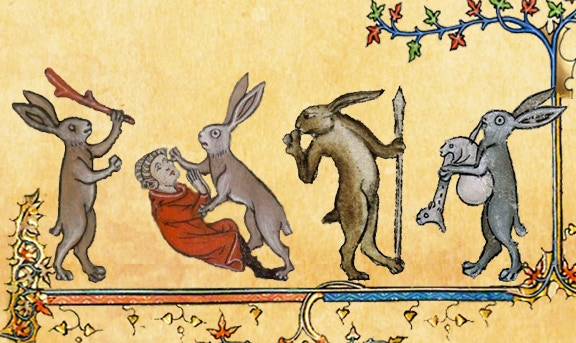
Medieval illustration: the rabbits take their revenge


The evidence

I mentioned documentary evidence, but what about the non-documentary kind? Isn’t it possible that the lack of documentary evidence is a result of rabbits’ low literacy rate? 

Of course it is. One of history’s rules is that if you don’t write or get someone to do the writing for you, you don’t leave much in the way of documentary evidence. 

However, a bit of non-documentary evidence is available. Archeologists (who do write) have found evidence of British rabbits from way back in Roman times. It takes the form of a single bone.

Given rabbits’ gift for multiplication, how is it that if they were here that early they didn’t populate the land and leave many bones behind? Because what’s been found is one bone, from one rabbit, and even a rabbit needs help from another rabbit. Of the appropriate sex. So this rabbit didn’t have the opportunity and might’ve been somebody’s pet. The clue to that is in the bone itself: rabbits in hutches will eat their own feces. (If you’re visiting from a language other than English, that’s a polite way to say shit. Which you may already know, in which case I apologize.) Wild rabbits will do that but not as often. Either diet will show up in the bone structure.

Isn’t it wonderful how many things you learn here, and how little use you have for them?


Back to documentary evidence, then

One of the earliest mentions of rabbits in Britain comes from 1176, when a landowner on the Isles of Scilly didn’t pay the church its tithe–think of the tithe as a kind of divine tax–on his rabbits because he thought “tithes were not payable on things of this kind,” suggesting that rabbits were still rare enough that the landowner thought somebody would fall for that reasoning.

Fast forward a bit and in 1235 Henry III gave Geoffrey Despenser ten live rabbits from his park at Guildford. A few years later, he sent men to collect 30 or 40 rabbits from Guildford, but only if it wouldn’t deplete the warren. So these are still critters to be careful with.

It wasn’t until 1240 that rabbits appeared on the menu as part of Henry’s Christmas feast. They were very much a luxury, costing four or five times more than chickens. Rabbit warrens were guarded against poachers, foxes, and anything else that would be happy to eat a rabbit without paying. 


The Black Death

And there we stay, with rabbits the preserve of the wealthy, the titled, and the entitled, until  the Black Death docked in Britain and multiplied more efficiently than rabbits. (The dates on that are  1346 to 1353; you’re welcome.) Somewhere between a third and two-thirds of the population died. With the cold-blooded irony that history specializes in, this improved life for the survivors. Land was going begging, improving the lives of the peasantry. And laborers could say, “Sorry, your lordship, but the iron law of supply and demand dictates that I have to charge more than I did last year, and that you have to pay.” 

Let’s not get into the efforts to keep wages down–that’s another story and you can find it here, in another of my posts. (Sorry. If I don’t promote this stuff, who will?) We’re following the rabbits instead, so let’s note that in the 14th and 15th centuries they were showing up on the tables and in the bellies of wealthier peasants and that aspiring craftsmen were wearing grey rabbit fur. 

And that leads us to mention sumptuary laws, medieval efforts to keep everyone in their place and dressing the part. The intent of the 1363 law was to control “the excess of dress of people beyond their estate, to the very great destruction and impoverishment of the land.” 

Still, that gray rabbit fur that aspiring craftsmen wore wasn’t the truly fancy stuff. Henry VII tucked his royal self into bed wearing something involving black rabbit fur, and specialty warrens raised only silver-gray or black rabbits.


Hunting and poaching

By this time, rabbits were at long last doing what rabbits do best, which is to breed and to eat, and manorial accounts start to mention complaints about the lord’s rabbits damaging crops and land. 

Did that mean the riff-raff could hunt them to control the numbers? The hell it did. In 1390, a law banned poaching and hunting by laborers and artisans. This was after the 1381 Peasants Revolt, and the fear–or the excuse; take your pick– behind the law was that while pretending to hunt they’d “make plots and conspiracies of rebellion” against the king.

The ban was extended to the use of “hounds and ferrets, hays, nets, hair-pipes, cords and all other devices to take or destroy beasts of the forest, hares or rabbits, or other sport of gentlefolk.”

So everybody stayed in their place, garbed in clothing appropriate to their station. The gentlefolk enjoyed their protected sport, destroying the beasts of the forest, without competition from hungry lowlifes. And the rabbits bred like mad, to the point where government guidelines now list them as a pest. They cause some £100 million of damage in a year and most of the country is a rabbit-clearance area, meaning people are obliged–theoretically–to kill wild rabbits on their land.

What really happens in Britain. And elsewhere

Two guys working at a bike shop in Bury St. Edmunds got bored back in September of 2017 and decided to cremate a mouse. (“As you do,” as people in Britain say when someone’s done something strikingly odd.)

They ended up doing £1.6 million worth of damage. It took twelve fire crews–sixty firefighters–seven hours to put out the fire.

As of late June, they were still out on bail. None of the articles I read said what happened to the mouse. We can only hope its ashes were handled with appropriate respect.

*

Irrelevant photo: I’m not sure what we’re looking at here. Possibly honesty. That’s the name of a plant, not a comment about me admitting that I’m not sure.

Since Notes is about Britain, let’s talk about something that has nothing to do with it: a translation of Game of Thrones into Spanish.

Before the series ended, the upcoming plot twists in Game of Thrones were more tightly protected than the deliberations of Britain’s cabinet–which is setting the bar about as close to the floor as possible–so translators were given something like twenty seconds to translate an hour’s episode. The actors who spoke the translation got a further twenty seconds and then had to swear that they’d forgotten every line they spoke.

As a result, in a not-so-recent but crucial scene, when a character called out, “She can’t see us” (he was talking about a dragon, but you don’t really need to know that) the harried translator supplied the actor with a set of sounds that don’t form a word in Spanish: sicansíos, which is pronounced, very roughly, see-can-SEE-oss. The reason that’s a rough approximation is that any attempt at phonetic spelling in English is doomed.

The actor didn’t have time to say either “what??” or “this doesn’t make sense.” He just voiced the sounds and moved on. The hounds of hell and the twenty-second time limit were nipping at his heels. What else was he supposed to do?

Now, one of the nice things about Spanish is that you can look at a set of syllables that make no sense and at least know how to pronounce it. In English, the whole thing would come to a screaming halt while the actor said, “Look, I’m not arguing about whether this mess makes sense, but will somebody at least tell me how to say it?”

The papers (maybe that should be singular; I haven’t read them all) claim sicansíos might just replace no nos puede ver.

For about twenty seconds.

*

And since we’re on the topic of things that have nothing to do with Britain, a survey in the U.S. asked some three thousand people if Arabic numerals should be taught in the schools. Roughly two-thirds said no.

Why? The survey did’t ask, but I have to assume it’s because they’re Arabic. And, you know, Islamic. And likely to turn our children terroristical.

So what are Arabic numerals? They’re the standard mathematical symbols, starting with 0 and going up to 9, that infiltrated our schools centuries ago and are no doubt responsible for the sorry state of the world today. They combine in infinite patterns and they terrorized me during my school years, right up to the time I was old enough to drop math.

I still wake up screaming, although at least one of my math teachers was (as far as I could tell) a very nice person. But even I will admit that Arabic numerals are a lot easier to work with than Roman numerals. Ever try adding MCLII to XIIL? If Roman numerals are the alternative, yes, Arabic numerals should be taught.

Arabic numerals were actually developed by Indian mathematicians but they spread to Europe from the Arab world, picking up their name along the way.

Another survey, in 2015, asked people if they supported bombing Agrabah, the imaginary city where the Disney film Aladdin was set. I don’t have an overall number, but 30% of Republicans and 19% of Democrats thought it would be a good idea. I know that’s a minority, but my friends, I despair.

*

The shop in our village closed last year, as shops have in lots of British villages, in large part because people can order their groceries online and have them–or something vaguely like them–delivered to their door. So what’s it like to order groceries online?

Funny you should ask, because a recent newspaper article surveyed some of the more unlikely substitutions that stores had made when they didn’t have what the customer ordered. Top marks go to Tesco, which didn’t have a birthday candle shaped like a five and sent two twos and a one instead. They didn’t include any plus signs, so that would make the kid well over a hundred.

Asda was out of lemon juice and sent a lemon cake.

An unnamed supermarket sent Petit Filous yogurt instead of petit pois–small green peas–and spring onions instead of spring flowers.

Tesco sent printer paper instead of paper napkins.

An Australian Woolworths sent popcorn instead of potatoes.

All of which combines to make one reason I’ve never ordered groceries online. Of course, it helps that I can still drive and have to time to wander dazedly through the aisles myself, wondering where they moved the flour the last time they re-disorganized the place and how many candles it takes to add up to five if I’m working in Roman numerals instead of Arabic ones. And whether spring onions make an appropriate gift for a five-year-old.

The people who fill the orders apparently can override the substitutions the computer suggests, but if they’ve gone comatose with either boredom or overwork and don’t notice that anything odd has happened, they (very understandably) won’t.

*

When did rabbits first come to Britain? It’s been assumed that the Normans brought them, but one lone bone found in a Roman palace has destroyed that belief. They were here when the Romans were and they dressed in sandals and itty bitty little suits of leather armor.

They tried the feathery helmets but the style just didn’t work for them, what with their long ears and all, although I have it from a reliable source that they liked the look a lot and envied the humans who wore them.

*

Who owns England? Half of the land is owned by 1% of the population. Homeowners (nationally, that’s 62.5 % of the population) all rolled in together own 5%.

Now we come to the odd bit: how you find the proportion of homeowners–you know, that 62.5% that looks so convincing in the last paragraph. Based of Lord Google’s predictive text, you find it by asking for the proportion of homeowners who own their own home.

I’ll give that a minute to land in your brain and detonate.

I’d have thought 100% of homeowners owned their homes, but I’m a word person. I never have been good at math. It’s 62.5% and the other, um, is it 37.5% of homeowners? I can’t explain what they own, if it’s not their homes, that puts them in the homeowners category. But, um, yeah, I’m sure the number’s accurate, I just can’t be sure what it’s a number for. And, what the hell, if it isn’t accurate, just substitute some other number. If you’ve seen one number, you’ve seen ‘em all.

What other rash assumptions did I make about land ownership? I assumed the aristocracy and landed gentry had long since doddered off into richly deserved irrelevance. Silly me. They own at least 30% of the land–possibly more, since 17% of the land is unregistered, meaning it’s probably (information on land ownership is fiendishly hard to find) inherited and has never been bought or sold. The owners are, many of them, the descendants of the Norman barons, still holding what their ancestors seized in 1066. It’s impressive, in a screwed up sort of way.

Another 18% is owned by corporations, 17% by “oligarchs and City bankers,” 8.5% by the public sector. Less than 2% each is owned by conservation charities, the royal family, and the Church of England.

If that adds up to more or less than 100%, recalculate it in Roman numerals and it’ll work out perfectly.

Farmers don’t seem to have been broken out into a separate category. I don’t know why or what that means. I do know that farming itself breaks down into many categories and may be harder to define that it sounds like it would be. If you keep pet llamas or rescue donkeys–or, I assume, horses–your land’s considered agricultural.

*

A British judge asked to be excused from jury duty on the grounds that he was scheduled to preside over the trial he was being called for as a juror. So he wrote the central summoning bureau, explaining his predicament.

They refused his appeal and told him to apply to the resident judge.

“But I told them,” he said, “ ‘I am the resident judge.’ ”

They didn’t see a problem with that.

He finally phoned them and they let him off with a slap on the wrist.

*

Former foreign secretary Boris Johnson was paid more than $160,000 for two speeches in March. For one of them, that came to £40,000 an hour. As the old song says, it’s nice work if you can get it.

He had to apologize to the Commons for breaching its rules by being late in declaring £52,000 of outside income in addition to not declaring an apparent 20% interest in a property in Somerset.

He’s maneuvering to be the next prime minister now that Theresa May has finished stabbing herself in the back. For the most part (I haven’t read the morning headlines yet) this involves keeping his mouth shut so he doesn’t say anything exceedingly silly while the other candidates admit to drug use and lack of drug use and make promises to cut taxes on the rich–or occasionally not to. One did his best to cozy up to Larry the Cat, 10 Downing Street’s resident cat, who’s outlasted more than one incumbant. 

Larry walked away. 

Boris hasn’t yet promised to bomb Agrabah, but I’m waiting.

*

Can you stand one more story about British politics? The person who was in charge of Grenfell Tower when it burned was invited to talk to a housing conference.

What’s Grenfell Tower? An apartment building that has become shorthand for, among other things, the arrogance of people whose bureaucratic decisions affect other people’s lives and deaths. The building went up in flames when a faulty refrigerator set the cladding–which is British for siding–on fire, spreading the fire unbelievably quickly to the entire high rise (or tower block if we’re speaking British).

Residents had been pointing out safety violations in the building for years and were ignored, because what did they know? Besides, it costs money to fix things. Seventy-two people died in the fire.

What was he asked to speak about? Safety.

When some of the survivors raised hell, he withdrew.

Some days it’s hard to be any more unlikely than reality.