Unknown's avatar

About Ellen Hawley

Fiction writer and blogger, living in Cornwall.

Of chatbots and culture wars and imaginary incidents

One of Britain’s reputable papers (and with five words, I’ve already eliminated several) had an incident involving chatbots, and the tale’s worth retelling because it tells us a lot about the age we’re stumbling cluelessly into. Or maybe that’s the drain we’re being washed down. Or–well, it’s Supply Your Own Metaphor Week here at Notes, so I’ll leave you to come up with your own while I waddle onward.

One of the Guardian’s reporters got an email asking about an article that ChatGPT had cited but that wasn’t showing up on the paper’s website. The email’s writer wanted to know what had happened to it and the journalist went hunting. It was on a topic they reported on,so it sounded likely enough although they couldn’t remember the specific article or find it anywhere, so they asked other people in the office to turn the paper’s electronic pockets inside out and see if it fell out. Maybe it was in there with the shredded kleenex and the linty mint.

Irrelevant photo: camellia

It wasn’t. Because it had never been written. It turns out that AI not only invents facts–something I trust you’ve heard by now–but it also invents sources, and it can be convincing when it does. The nonexistent article was a good enough invention that the journalist hadn’t been able to say, “No, I never wrote that.” They easily could have. 

If you think it’s scary living in a world where a lot of people feel entitled to curate their own selections of alternative facts to back up their pre-existing worldviews–well, it’s about to get a whole lot weirder. And, I expect, scarier.


Imaginary drag queen teaches hallucinatory sex ed class

Did anyone mention alternative facts? The Daily Mail, GB News, and Fox News all reported that a drag queen appeared as  a guest speaker at an Isle of Man schooll and told “11-year-olds there are 73 genders–and made a child who said there are ‘only two’ leave the class.”

Seventy-three? Stop it, guys. I can’t count that high. If this goes on, I’ll have to give up my leadership position in the Gender Hyperawareness and Conservative Freakout Society.  

The story went on to say that “one teacher is also said to have had to teach pupils in Year 7 and 8 how to masturbate.”  

How old are kids in years seven and eight? Eleven to thirteen. Since it’s been a long time since I was anywhere close to that age, I asked Lord Google how old kids are when they begin to masturbate. The top-ranked answer was from the National Institutes of Health (that’s in the US) and said two years old. The next one said three. In fact, most of the articles I found were geared toward calming the parents of toddlers and preschoolers, saying, essentially, It’s okay. Kids that young discover that there’s something interesting where their legs come together and they’re not shy about exploring it

That wasn’t what I’d been looking for, but it did back up my hunch that kids don’t really need to be taught how to masturbate, although by the time they’re eleven to thirteen they may need reassurance that what they’re doing–or at least imagining–isn’t so different from what other people do and imagine.

But that’s not the point. The point is, that although the article I quoted is real and can still be found on the Daily Mail’s website, the facts were invented. The flap the reporting caused led to an investigation of the incident, which found that the incident never happened. 

But who waits for that? As soon as the story went public, people working at the school were deluged with threats and demands for staff to be fired, arrested, and executed–not necessarily in that order. 

What triggered the story? A man who does occasionally do drag spoke to kids “gender neutral language and the concept of gender in the LGBTQ+ environment.” He wasn’t in drag, though. So the question is, if a person has done drag, can they be allowed out in public in non-drag or do they have to be freeze-dried, vacuum packed, and kept in storage until the political winds shift? For the safety, you understand, of all 73 genders of our children.

As for the kid who said there were only two genders, the closest I’ve found to the incident was one kid who was taken out of the room by a teacher over some sort of behavior issue. 


The problem of defining drag in Britain

Cranking up the British about men in drag is going to be harder than cranking up Americans, because drag has a solid mainstream history here. Every Christmas panto season starts, and these are shows for kids, with the lead female role always (over)played by a man and the lead male role almost always played by a woman. It’s a thing. Among straight people. Is that drag or is it only drag if a man (over)dresses like a woman outside of a panto?

What, while we’re at it, does a woman dress like? I’m wearing jeans, a turtleneck, and an old sweater.

On our first visit to Britain, we watched a race where a lot of the runners were in costume. It’s a thing here. Give people a chance to run five miles dressed  as bananas or phone booths and they’ll, ahem, run with it. So in among all the bananas and phone booths and chickens were men dressed as ballerinas and nurses. Not the contemporary kind of nurses who wear practical uniforms, but the old-fashioned ones in white dresses and caps, who (I gather) inhabit the fantasies of some unspecified number of non-nurses. My gaydar insisted that the runners in nurses’ uniforms were straight. But even if my gaydar was off–it was tuned in a different country, after all–no one much cared. It was just another race through the streets of an English city. Enjoy the show, everyone.

So where do pantos and dress-up end and drag begin? 

I don’t know, dear. You tell me.


The problem of defining copyright and privacy

Now that artificial intelligence scrapes information out of every corner of the internet so that it can tell you, in perfectly grammatical prose, that the pope is made of custard, defining copyright and privacy is going to be as problematic as defining drag. Or more so.

Copyrighted material is probably being used to train AI systems. The word probably is part of that sentence because AI’s neural networks aren’t available for your average gawker–or even your non-average one–to examine, so no one knows what they’ve been reading, but a couple of AI systems have, embarrassingly, hacked up copyrighted photos from Getty Images, complete with the watermark Getty prints over the photos so that users will have to pay for a clean copy. 

Yes, there’s a lawsuit involved, but it’s about the smallest edge of the problem. Still to be discussed is the amount of personal data that’s being collected–and potentially disclosed–without people’s consent and the use of copyrighted material to train chatbots.


But speaking of privacy

Teslas have an in-car camera that Tesla assures the world “is designed from the ground up to protect your privacy.” Because customer privacy “is and will always be enormously important to us.” 

So important that from 2019 to 2022 Tesla employees were sending each other clips of, oh, you know, interesting stuff in people’s garages; road incidents, a man walking up to his car naked; you know, ordinary, everyday stuff that would embarrass no one. 

What are the camera’s limits? I’m not sure, but I’ve read that a Tesla parked in the right spot outside someone’s house could, potentially, film whatever’s going on inside through the window. 

One owner is suing Tesla. Some Chinese government compounds and residential neighborhoods have banned the cars. 

The moral of this story is that if someone goes out of their way to tell you how carefully they’re protecting your privacy, they’re calling your attention to a problem.

Archeology in Britain

Have you ever read about an archeological dig and wondered how history’s layers get buried? Is the planet stealing soil from someplace and using it to hide the past? Do we keep the same amount of soil but does the wind blow all those layers of dirt over the past’s leavings? And if it does, why doesn’t it unbury an equal amount of history someplace else?

A book I stumbled across recently–Digging Up Britain: a new history in ten extraordinary discoveries, by Mike Pitts–finally answered the question for me, at least in part. A city, Pitts tells us, accumulates people–people who weren’t born there; people who don’t live there. While they’re there, they work, they trade, they eat, they drink, they sleep, and they do much of that within walls if they can. 

Most of those activities involve physical objects, so the city brings in wood and stone for its buildings, and tiles, slates, or reeds for its roofs. It brings in food for its, um, food. Okay, the rhetorical pattern’s breaking down here. We’ll sneak away without anyone noticing. It brings in leather and metal and fabric (or the raw materials to weave fabric) and everything else that you can think of and I haven’t.  

Irrelevant photo: The north Cornish coast

“Goods are also exported and people leave, but with time and decay, the city gains more than it loses. One generation’s walls become the rubble foundations for another’s. Every leather offcut, rusted nail, broken cup and lost penny finds its way into the teeming earth. Slowly, imperceptibly, the ground rises, covering the traces of the past.”

Well, yes, now that he’s planted the picture in my head, it’s a screamingly obvious one. The cause isn’t space dust. It’s people moving stuff from one place to another and wandering off without it. 


London

Pitts goes on to talk about some of London’s biggest ground-lifting events. Roman London had two fires that can still be spotted in layers of red earth. One of those would’ve been set during Boudica’s rebellion, when she burned London and two other cities to the ground. Then, when 1666’s Great Fire of London finally burned itself out and it was time to rebuild, stone was hauled in and a new city rose on the leveled remains of the destruction.

The biggest leveling of walls, though, was the blitz–the bombing of London during World War II–and when Pitts reaches this point, he focuses on a small area where two excavations found particularly rich Roman artifacts: On the night of May 10, 1941, bombing “disrupted” 8,000 streets, killing more than 4,000 people and seriously injuring 1,800. It wiped out most of the block he’s interested in, where there’d been 350 businesses “crammed into a warren of high Victorian terraces and narrow alleys.” They included cafes, a bookseller, a tailor, a dentist, accountants, and a postage stamp perforator.

Who knew there even were postage stamp perforators? I assumed that got done by some sort of machinery working where and when the stamps were printed. Or that someone with pointy little teeth came along and–

Never mind. Not much was left of the street, and in 1952, when it was redeveloped, the area was opened to archeologists just before an office building went up on the site. The digging had uncovered an underground temple to Mithras, and it was taken apart, and reconstructed (badly) above ground and facing the wrong way. And then in 2012, when the 1952 building was torn down and something newer and shinier was about to be built, archeologists got in there again, only with more time to do their job. What they found was “like a library of random news from across Roman London.” The area had been used as a dump, and archeologists love dumps. It turned out to be “the most productive single excavation of a British Roman site in modern times,” and included a horde of wood-and-wax tablets recording, for the most part, business transactions. It gave them a glimpse into the city before it had the grand public buildings we associate with Roman towns. This was a town in its early stages. 

The success of that second dig was made possible by a change in the relationship of archeologists and developers.


Archeologists and the construction industry

One of the major ways the past gets uncovered in Britain is that someone comes along with heavy-duty construction equipment and starts digging. They’re not hoping to find, say, a Roman villa or a Bronze Age settlement. In fact, they’re hoping not to. They want to build a parking ramp or a shopping mall. 

Until 1990, archeologists were dependent on the goodwill of the developers for access to their sites. Before that, if a developer stumbled into something of archeological importance, and if they didn’t sweep it under the metaphorical rug fast enough, archeologists had to rely on a mix of diplomacy, goodwill, and the public pressure set off by media coverage to get access. Because archeologists mean delays, and delays cost money.

In a showdown between history and national heritage on one side and money on the other, it’s not often that history and heritage win, but they did win when the foundations of Shakespeare’s Rose Theatre were discovered by accident. A media storm set off a celebrity storm, which in turn set off a wider public storm, and under that pressure a delay was organized and the new building eventually went up over the theater’s foundations, which are now covered in water to keep the ground from cracking.


Irrelevant but interesting bit of information 

Exploration of the theater’s foundations brought us the news that hazelnuts were the popcorn of Shakespeare’s day. The shells were everywhere. 


The relationship changes

After the battle to save the Rose, things changed, and it kills me to say anything good about Margaret Thatcher’s government but I’m going to have to: they’re the ones who introduced Planning Policy Guidance 16–Archaeology in Planning, called PPG16 by its friends and admirers. 

PPG16 is a guidance paper that requires anyone building anything that needs planning permission–and in Britain, that’s just about any building at all–to consider its  impact on archaeology. According to Heritage Daily, PPG16’s impact was unintentional, but lovely, so I don’t have to be particularly nice about Thatcher’s government: they didn’t mean to do something good; they were just trying to shut everybody up.

Heritage Daily  describes the events at the Rose as an omnishambles, with “leading actors, including Sir Ian Mckellen and Dame Peggy Ashcroft, facing down the developers’ bulldozers, standing alongside archaeologists, the general public and local children waving placards declaiming, ‘Don’t Doze the Rose.’

“Faced with this highly public demand that the historic site be protected, the Environment Department, under Secretary of State Nicholas Ridley, proved utterly incapable of formulating a coherent policy to dig the developer Imry Merchant and the Government out of the mire. “

In the end, they cobbled together a system that had local and national governments, developers, heritage professionals, and the public working together to preserve whatever could be preserved in place, and to record, and sometimes move, whatever couldn’t be. It didn’t make developers or free-market purists happy, but it did keep politically damaging incidents like the Rose from happening again. 


The impact on archeology

All this meant archeology had to change. The profession came into this period as a mix of local heritage organizations, professors, and museums. None of them were equipped to meet the schedules or use “the same language as the architects and developers whose plans the system was designed to facilitate,” Heritage Daily says. 

After PPG16, “Archaeology as a discipline found itself putting on a suit, becoming a profession and sitting down in planning meetings with architects and developers to discuss fitting in an excavation alongside the other building site preparation and ground works.”

“It’s not perfect, but . . . once PPG16 and the concept . . . was in place, pipeline surveys and large scale infrastructure projects like Heathrow Terminal 5 and HS1, the Channel Tunnel Rail Link, did offer the chance to develop practice and sample large transects of landscape to sometimes startling effect.”

Some years ago, not far from where I live, a new sewage line uncovered enough Cornish history that the archeologists involved organized a presentation in the village hall, and it was packed. That was my first hint of the working relationship between archeologists and the construction industry, and I was impressed.

One of the finds they talked about was a series of Christian and pre-Christian burials. You could tell them apart because the Christians were buried so that they’d be facing east when they rose on–what is it? Judgment day? Whichever. If it happens, I’m sure someone will have set an alarm clock, so I don’t need to worry. Anyway, they were supposed to rise from their graves and be facing east. The non-Christians, on the other hand, were buried with grave goods–things they’d used in life and would, presumably, want in the next one. Or maybe the goods were a way for the living to grieve and pay tribute. Who can know at this distance in time? Whatever the reason, that’s how they buried their dead. 

But the archeologists had found a few people who were hedging their bets–or at least whose descendants were. They were buried facing east but also with grave goods. Whichever way the afterlife played out, they’d be ready.

In Pitts’ last chapter, he mentions an enlargement of the A14 (that’s a road) near Cambridge that’s been a particular gift to archeology. They’ve uncovered ancient villages, industrial zones, religious monuments, 15 tones of bones and artifacts, pottery kilns, field layouts and more, all of which could so easily have been dug up, scattered, and lost to history.

A king, three MPs, and a former prime minister walk into a blog post…

Let’s catch up with the news from Britain. 

King Charles–

No, not the King Charles who looks like his mustache is trying to get away from him. That’s Charles I and he was killed in a long-gone civil war. Also not the King Charles who looks like Bob Dylan in his older, seedier incarnations. That’s  Charles II. We’re talking about the bland looking and entirely mustacheless Charles III, who was supposed to go to France on a state visit and do I have no idea what there. Pose for pictures. Shake hands. 

No. You don’t do that when you’re a king, do you? You get bowed to. 

Would the president of republican France (revolution; La Marseillaise; you remember all that stuff, right?) bow to a king and what does the king do if he won’t? How many diplomats would it take to cut a way through that thicket?

Irrelevant photo: a hyacinth

Sadly, we’re not going to find out because the visit’s been called off. Too many strikes in  France. Too many protests. It’s postponed until “calm returns.”

That’s doubly disappointing because unionized public sector workers had already announced that they wouldn’t be rolling out the red carpets or hanging the flags that a state visit demands, so we also won’t get to find out what a state visit’s like in the absence of red carpets.

But let’s use the moment to remind ourselves that a few very real somebodies really do have to roll out red carpets if they’re going to be in place at the right time. In this case, the somebodies work at France’s National Furniture Service and they–or at least some of them–are on strike and said in a statement, “We ask our managers to point out to the ministry of culture that any request for furnishings will be seen immediately by workers as a provocation.” 

Their managers didn’t say anything like that, however. They said the carpets had already been delivered and nonunion workers would roll them out.

Who should we believe? We’ll never know how the story would’ve ended, but we could compromise and say that there might’ve been a bit of grandstanding on both sides.

I do like that line about any request being seen as a provocation, though. It lays the groundwork for quiet negotiations.


How different is it in Britain?

To the limited extent that I understand Britain after having lived here for 18 years, the country likes to think of France as a volatile, strike-prone, and generally unBritish sort of place, but the similarities are as striking as the differences lately. I got as far as asking Lord Google “who’s on strike…” and he intuited the rest of my question by adding (I couldn’t help but think, wearily) “…today in the UK?” So yes, we’re a tad strike-prone ourselves these days. The long-running strikes by nurses’ an ambulance paramedics’ are on hold while they vote on the government’s well-under-the-rate-of-inflation offer–an offer made after the government spent months swearing it wouldn’t and couldn’t offer more than a peanut butter sandwich and a bourbon cream biscuit. 

But even in their absence, the list of late-March strikes (ongoing, upcoming, and recent) is long and included bus drivers, professors (a.k.a. university lecturers), junior doctors (they’re not all particularly junior, but that’s what they’re called anyway), rail workers, passport office workers, teachers, and–sorry, I’ve lost track. Others. 

Most of those are government employees or people whose jobs are linked to the government tightly enough that when the government zips up its wallet, no settlement beyond the level of a bourbon cream is possible. And as the government keeps telling us, its wallet is staying firmly zipped because raising pay is inflationary, and they just can’t have that. We’re in a cost-of-living crisisl. This is no time to add fuel to the fire. People will learn to live on what they have.

*

So what have Members of Parliament learned to live on? Two of them, former health secretary and general laughing stock Matt Hancock and disgraced former chancellor Kwasi Kwarteng, told the representative of a non-existent South Korean company that they’d charge £10,000 a day to join its international advisory board and help its “clients navigate the shifting political, regulatory and legislative frameworks” in the UK and Europe. 

Kwarteng also offered to set up a meeting with Boris Johnson, the “best campaigner you will ever see.”

A third MP, Graham Brady, chair of the Conservative Party’s powerful 1922 Committee, settled for a measly £6,000 a day plus £500 an hour, but he did say he wouldn’t be able to advocate for the company. On the other hand, he could offer it advice about who to approach in government. 

Nothing about any of that is illegal as long as the MPs declare the income, the proper magic feathers are waved over the appropriate paperwork, and the correct formulas are spoken in broken Latin. 

As the old song says, it’s nice (and completely non-inflationary) work if you can get it.

The sting was set up by the unpredictable and inspired campaign group Led by Donkeys.


How about Boris Johnson?

He wasn’t part of the sting–why bother?–but pound for pound he leaves these guys in the dust. In the (more or less) six months since he was run out of office, he’s pocketed just short of £5 million in outside earnings.

Outside of what? Why his £84,000 salary as an MP, of course. And hs assorted expenses. That puts his outside earnings at something like £25,000 a day, much of it for giving speeches.

Why would anyone want to listen to him? Sorry, the world’s a much stranger place than I can possibly take in, never mind explain, but I will say that paying the man to speak doesn’t guarantee that anyone listens.


Who else has outside earnings?

If you pile all our current MPs in a heap and empty their pockets (let me know in advance if you can; I’d love to take pictures), you’ll find that in the past year, collectively, they earned £9.6 million outside of their MPs salaries. That’s up from a mere £6 million in the 18 months prior to that. 

Of this year’s take, 90% went to Conservatives.

You can sort the numbers out differently, though. If you look at how many MPs from which parties held second jobs in their desperate efforts to make ends meet in inflationary times, it works out like this: Among the Conservatives, some 43% work second jobs. Or at least, Open Democracy classifies the work as second jobs, although a lot of it looks like freelancing to me. Never mind. I’m quibbling. Among Labour MPs, that’s 38%. Among Scottish National Party MPs, it’s  34%. Among Liberal Democrats, it’s 57%, and among the Democratic Unionists it’s 37%.

Be gentle with those last two percentages, though. Open Democracy gave the last bits of data in absolute numbers and I turned to Lord Google for help in percentifying them. It’s risky, leaving me to transport numbers from one location to another, so I’m not offering money-back guarantees.  

One of the mysteries of British editing is that not everyone seems to notice how useful it is to put statistics into parallel formats. I don’t get it. But never mind that. We’re close enough to see that the parties indulge roughly equally but that the big earners are the Conservatives.

None of those numbers include rental income or shareholdings, presumably because making money that way doesn’t take up an MPs valuable time or influence their policies, so it’s okay if they’re invisible. Or maybe gentlemen are expected to make their money that way, so no one keeps track.


But the government’s not standing idly by…

…while the country falls apart. It’s going to step forward decisively and ban the sale of nitrous oxide, better known as laughing gas and give the police extra super-powers to test for it. Experts say the ban’s disproportionate and likely to do more harm than good, but what do they know? Something needs banning and by gum, this is indeed something.


In the meantime, elsewhere in the solar system

. . . an asteroid big enough to wipe out a city has slipped between the orbits of Earth and her moon without hitting either one. It was approached by representatives of a doomsday cult and invited–even begged–to make full physical contact, but after a brief study of Earth and its inhabitants declined to get involved. 

*

An update on Hafiza 

Afghan artist Hafiza Qasimi has arrived in Germany on a three-year visa and is preparing to take part in an exhibition of Afghan artists and spend three months living and working in an artists village. In these days when most of what we hear is the sound of relatively safe countries slamming their doors in the faces of refugees, I’m happy to celebrate the freedom and safety of one brave human being. I only wish the opportunity didn’t come to us so rarely.

Nasal sprays as a defense against Covid

Let’s start with some stuff that may be useful before we let ourselves have any fun. (Dessert comes last, kids. Eat your liver.) Some nasal sprays not only minimize the chance of catching Covid but may be also a useful treatment if you do get it.

New discovery? Only to me, it turns out. They’ve been around a while and the earliest study I found dates back to 2020–relatively early in the pandemic, when precious little in the way of protection was available and many front-line medical workers took to using them.

The sprays use iota-carrageenan. The bit I’m about to quote (it’s from the link just above) uses a brand name for the stuff. “Carragelose is a sulfated polymer from red seaweed and a unique, broadly active anti-viral compound. It is known as a gentle yet effective and safe prevention and treatment against respiratory infections. Several clinical and preclinical studies have shown that Carragelose® forms a layer on the mucosa wrapping entering viruses, thereby inactivating them, and preventing them from infecting cells.”

Got that? The useful words are “anti-viral,” “effective,” and “safe.”

Irrelevant photo: primroses

“Seaweed” isn’t particularly important but it is interesting. I’ve never squirted seaweed up my nose before. At least not while sober.

How often do you use it as a preventive? One study had medical workers using it four times a day, and it did decrease the odds of their catching Covid.

Another study had people using it three times a day and measured the number of people with Covid antibodies. By that standard, it was 62% effective. It also found that people who used the spray were less likely to develop symptoms than people in the control group. 

A third study reported the stuff to be 80% effective. It also describes Carragelose as a derivative of red algae. Don’t ask me. The article explains the mechanism this way: “The natural active ingredient forms a protective film as a physical barrier and prevents viruses from infecting the mucous membrane by introducing their genetic information into the membrane cells and propagating.”

The early studies were limited by the lack of testing early in the pandemic. They couldn’t be sure that they hadn’t included asymptomatic carriers or people already in the early stages of symptomatic Covid, leaving the numbers a bit wobbly.

The spray is effective against other viruses as well. It’s available under a number of brand names. Ask Lord Google about iota-carrageenan nasal sprays to find out what’s available wherever you live. 

Having read all that, I rushed out and bought a set of hers-and-hers nasal sprays for the household and started using mine in–well, in the random way that you (or at least I) do when you’re defending yourself against an invisible enemy. Is it here? Is it there? Is it under the piano? We don’t have a piano, but what level of human density demands that I shoot seaweed up my nose? I didn’t stop wearing a mask, since 60 to 80% is not 100%, although, damn, I was tempted. And as luck would have it, I now have Covid. That’s not what you’d call a ringing endorsement. It’s also a damn good example of irony. But I’m a sample of 1, which is to say, I’m not statistically significant, even if I am somewhat significant to my own self. I’m not sure where or when I caught it, so I don’t know if I was using the spray at the time. Quite possibly not.

I’m now using it in the hope that it’ll keep the case milder than it might be without it. I’m on the mend and expect to be in the clear  soon. I was pretty addled for the first couple of days (that still qualifies as a mild case) but I’m functional enough now to update and post this, although I’m not sure how competently I’ve done it. Whether nasal seaweed has anything to do with my rate of improvement  we’ll never know, since you don’t get to go back, pick a different path, and compare outcomes. 

Make your own decisions, folks. I’m not here to sell you anything.


Long Covid news

This is a bit tentative, but research suggests (sorry–we can’t use a stronger verb there) that vaccination may make long Covid shorter and less severe. The problem is that studies weren’t able to set up randomized trials. Too many people they had access to had already been vaccinated. But several studies hint that “Covid-19 vaccines might both protect against, and help treat, the symptoms of long COVID, with the proviso that more good quality evidence is needed.”

It’s not a smoking gun, but then we weren’t actually trying to shoot anyone.

A different study says that the omicron variant is less likely to lead to long Covid than the initial variant–what they call the wild-type virus, as if we’re in the process of domesticating this beast.

I don’t know. Maybe we are. 

The study has its limits, one being that long Covid can only be diagnosed by checking off a series of symptoms–there’s no test for it. The other is that the participants were mostly young and healthy. But for what it’s worth, where the initial version left people who had Covid 67% more likely to develop long Covid symptoms than the uninfected, omicron leaves the two groups equally prone to them.

Which if you read the fine print says other things can cause the symptoms of long Covid–another thing that makes it so damn hard to measure.

And finally, a study reports that having Covid can lead to face blindness–called prosopagnosia if you’re trying to impress someone. It’s counted as one of a range of neurological problems long Covid can cause. The good news for me is that I don’t have to worry about that one–I’ve had it for years.

Ha. Fooled you there, Covid.


And finally…

…for dessert, we get to have the fun I promised. Some genius has developed exactly the thing a pandemic-haunted world has been longing for–glow-in-the-dark Covid tests

Yes, kids, if your Covid test runs away, all you have to do is turn out the lights and there it’ll be, glowing away under the armchair. 

Life is good. Or if it isn’t, exactly, it usually beats hell out of the alternative.

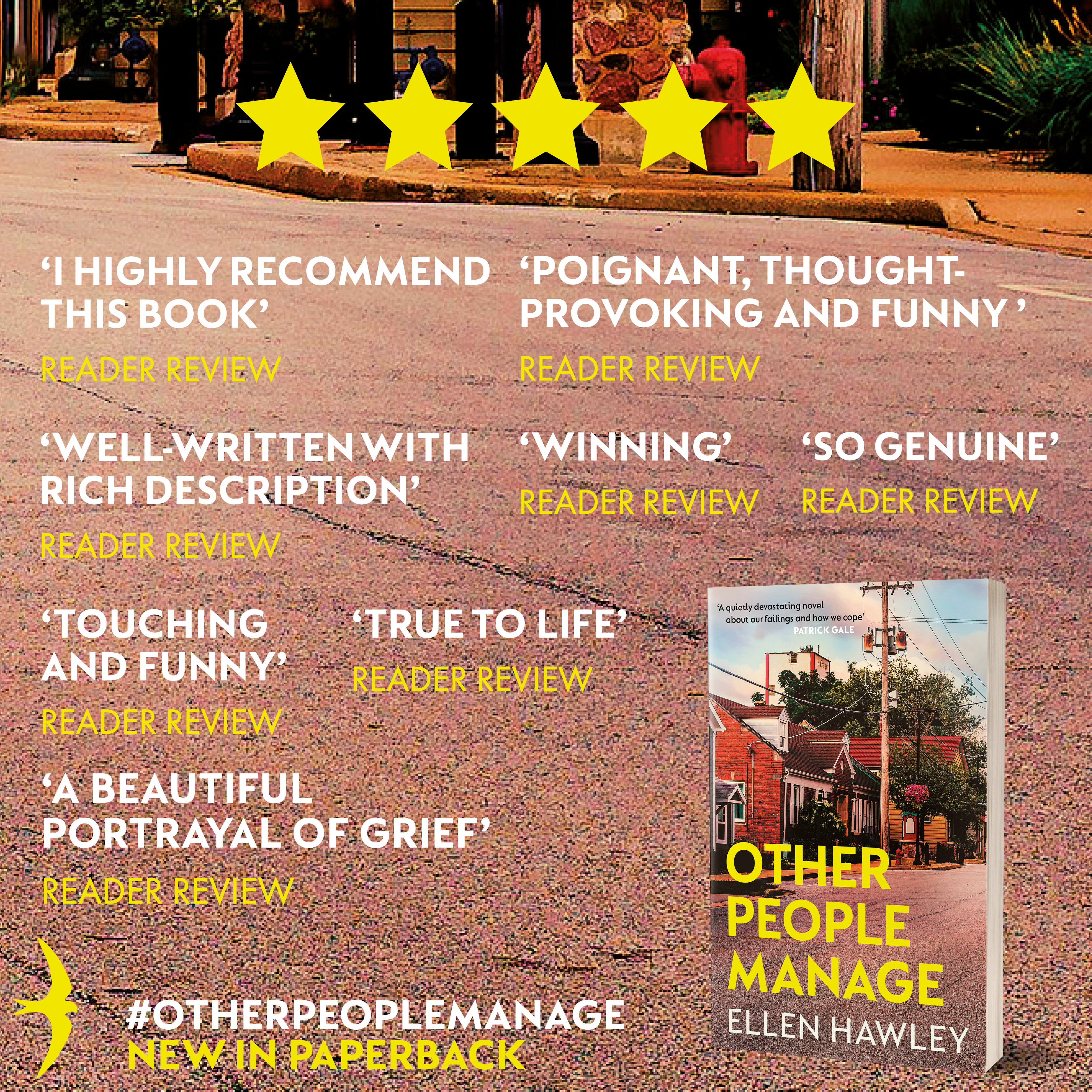
Other People Manage, now available in paperback

It’s out in paperback. You can find it here. Or here. Or elsewhere. Be creative.

“A tender and beautiful addition to the literary canon, and a mirror for LGBT readers.”
                                                                                                   – Joelle Taylor
 
“A story that is painful and difficult at the same time that it is deeply rewarding”
                                                                                            – David Huddle
 
“A quietly devastating novel about our failings and how we cope.”
                                                                                            – Patrick Gale
Other People Manage is a novel about hard-earned, everyday love. It’s about family, about loss, about the pain we all carry inside and the love that gets us through the day. It’s frequently funny, at times almost unbearably moving, and above all extraordinarily wise.* 
 
It begins in 1970s Minneapolis, with Marge and Peg meeting at the Women’s Coffeehouse. They stay together for decades but live in the shadow of a tragedy that struck early in their relationship. Then Peg dies, leaving Marge to work out what she has left in her life and if she still belongs in the family she’s adopted as her own.


  • I didn’t write that–I’m quoting–but however weird it is to hear someone call me wise, I do love it. E.H.

The last invasion of Britain

When was Britain last invaded? 

Sorry, no, it wasn’t in 1066. It was in 1797, France landed troops in Wales, and it played out more as farce than as pivotal historical moment. 

This was toward the end of the French Revolutionary wars, when Britain and France were at war, so invading Britain wasn’t an unreasonable thing to do. The French were backing a hoped-for Irish rising against the English, and invading Britain would make a nice diversion. 

Irrelevant photo: Primroses on a frosty morning.


What didn’t happen and what did

The original plan was to land troops in Cornwall, Bristol, Newcastle and–most importantly–Ireland, the last landing planned with the help of the Irish revolutionary leader Theobald Wolfe Tone, who’d convinced revolutionary France that with its help Ireland could free itself of British domination. Before it got far, though, the project was already looking shaky. The raid on Cornwall was canceled, the raid on Newcastle was foiled by the weather, and the ships carrying 15,000 troops to Ireland were also dispersed by the weather and limped back to Brest. 

That left the expedition to Bristol–four ships carrying 1,400 soldiers under the command of William Tate. Why it wasn’t called off is anyone’s guess. 

Tate’s orders were “to bring as much chaos and confusion to the heart of Britain as was possible; to recommend and facilitate a rising of the British poor against the government; but whenever and wherever possible, to wage war against the castle, not the cottage.” 

Disciplined troops might have managed that distinction between castle and cottage, but Tate didn’t have disciplined troops. Over half were newly released prisoners and the rest (including Tate) didn’t have a whole lot of military experience. 

That made no difference to Bristol, because they never got there. The weather was against them and the ships landed instead near the mighty metropolis of Fishguard, Wales. I can’t find population figures for 1797, but the 2021 census reports a population of 3,421, up 2 from the 2011 census. It’s a fair guess that the place had 6 or 8 fewer people in 1797.

The ships actually landed outside Fishguard, not in the metropolis itself, dropping off Tate and his soldiers and sailing back to France and out of our story. 

Tate got down to business and sent out patrols and they set to work looting people’s houses. It’s a well known way of getting cottage-dwellers to support your cause. And since a Portuguese ship had run aground not long before, both houses and cottages were well stocked with brandy. Or in a different telling, wine. 

Okay, brandy turns out to be distilled wine. Lord Google just whispered that in my ear. The things I learn writing this blog.

Before long the soldiers were well stocked with brandy themselves and (I’m guessing here) roaring drunk. One is said to have shot a clock.

Take that, you sumbitch. You won’t try that again, will you?

I’ll guess again and say that had something to do with the brandy.

According to legend, they also cooked some geese in butter and got food poisoning. Now, goose cooked in butter may not be kosher but there’s no reason the soldiers would have known about that or cared if they had, and also no reason that eating goose cooked that way would give you food poisoning. We’re probably missing a piece of the puzzle but I’ve checked under the couch and it’s not there, so let’s go with what we’ve got and not complain. For either one reason or both, a good number of them incapacitated themselves.

One source questions whether the troops were even armed, raising the possibility that they counted on capturing weapons.


Meanwhile in the other corner…

…was mighty Fishguard. What did it have by way of defense? The Fencibles, for one thing. They sound like something that could be sold illegally in a back alley but weren’t. They were a militia that could be called up for local service. Their members didn’t have much in the way of training and lived at home, so mobilizing them was slow and probably chaotic, but eventually they gathered at the local fort. Then they abandoned the local fort, marching off in the direction of greater safety, away from the French. On the way, they met the better trained Pembrokeshire Yeomanry Cavalry–professional soldiers–who gathered them up, turned them around, and organized everyone into a night raid on the French position.

At this point, I’m thinking, Hey, night attack. Guerrilla warfare. That’s novel stuff for the era. Shows you what I know. They stumbled along a country lane in the dark with the volume on their fifes and drums turned up to max, alerting (no surprise here) the French, who (as far as I can figure out) took up ambush positions, at which point the British thought better of that night attack idea and marched back the way they came.


Does anyone come out of the tale looking competent?

Yes: the local people, who gathered with scythes and pitchforks and rounded up French scouts and stragglers, killing at least one. The local cobbler, Jemima Nicholas, captured a dozen or so while armed with nothing more than a pitchfork.

Did she really capture a dozen soldiers, however drunk, food-poisoned, and badly trained, using only a pitchfork? Who knows. We’re dealing with legend here. She captured some. Presumably she had a pitchfork. She wasn’t a woman to mess with and became a local hero.

Because so much of what happened comes to us by way of legend, though, I’m having trouble putting together a coherent account, so I’ll step back a bit and tell the story from a distance: Local people and British soldiers (back, presumably, from their earlier retreat) lined the crest of the hill, looking to the French like a couple of thousand soldiers–an impression helped along by the local women’s custom of wearing red dresses and tall black hats, which were a fair match for British army uniforms, at least if you didn’t get too close. In fact, the French outnumbered the British but didn’t know it. 

Among the French, discipline was evaporating. Or had evaporated earlier, when all that the brandy signed up. Or it had never been present to evaporate. Tate sent a messenger to Fishguard with a note:

“The circumstances under which the body of French troops under my command were landed at this place renders it unnecessary to attempt any military operations, as they would only lead to bloodshed and pillage. The officers of the whole corps therefore intimated their desire of entering into a negotiation upon principles of humanity for a surrender. If you are influenced by similar considerations, you may signify the same to the bearer. In the meantime, hostilities shall cease.

“Health and respect,

“Tate, Chef de Brigade”

The British bluffed, demanding an unconditional surrender, and got it. The French surrendered and were imprisoned, which seems like an unkind response to someone who signs their note “health and respect.”


And then?

Then some of the French soldiers broke out, stole a yacht belonging to Lord Cawdor–the officer they’d surrendered to–and like the ships that had carried them to Wales, sail out of our story, no doubt savoring the occasional sweetness of life’s little ironies.

The building where the surrender was signed became a pub–but not immediately.

After that the story gets serious. Even here at Notes, that sometimes happens.

In 1798, a rebellion did indeed break out in Ireland, but by then the French would only commit enough forces to make minor raids along the Irish coast. Tone landed in Donegal with 3,000 troops and was captured. He was sentenced to be hanged but killed himself before the British got a chance.

Who lived in early medieval England? 

We’re programmed to imagine early medieval England as a land of straw-haired Anglo-Saxons–so much so that an article debunking that belief is illustrated by (you guessed it) a picture of a straw-haired young woman wearing a leather headband and gazing soulfully up at the clouds. 

But before I go on, let’s define the early medieval period. English Heritage opens the doors at around the year 410 and tossing the drinkers out onto the street in 1066, which means it runs from the end of Roman rule to the Norman invasion. You could call it the Anglo-Saxon period without losing too many points on your essay, even though what you’re about to read messes with the standing assumptions about Anglo-Saxon England. You could also call it the Dark Ages, but you’ll lose points. It’s got more zing but it’s gone out of fashion. 

Irrelevant photo: hellebore


That straw-haired image

The stereotype we bought into–and forgive me if I pretend I can talk for all of us–grows out of having read that the Anglo-Saxons invaded that big central chunk of Britain we call England, pushing its earlier residents, the Celts, to the margins.

The margins? That’d be Scotland, Wales, and Cornwall. 

Since the Anglo-Saxons were Germanic tribes, we can call Central Casting and tell them we need blonds–lots of tall, warrior types and a few wistful maidens.

Why the gender imbalance? Because we were taught the Anglo-Saxons came as warriors–big, blond guys with big, blond swords.

The archeologists who gave us that story did it in good faith. They were working with the tools they had. They’d dig up an early medieval village or graveyard, find Anglo-Saxon artifacts, and not unreasonably deduce that Anglo-Saxons lived there. But turn a few calendar pages and before we know what hit us, science has given them new toys to work with. In other words, the next generation of archeologists could work over the same ground but now sequence DNA and read tooth enamel well enough to identify people’s tribes and know where the tooth enamel- wearer had grown up, and that’s made the picture of early medieval England and the Anglo-Saxons more complicated. 

The article that pushed me down the road toward this blog post opens (once you get past that blond-haired maiden) by questioning the assumption that everyone in early medieval English villages looked alike or talked the same way. It’s based on a DNA study of 460 people from sites across northern Europe, 278 of them from the southern and eastern English coasts. 

The Anglo-Saxons and the Celts

The first change to the traditional story is that the Anglo-Saxons (or the incomers, anyway, whatever we’re going to call them) don’t seem to have driven the Celts out. Instead, the two groups settled down alongside them and played house: Many people in these settlements were of mixed heritage. 

The study did find evidence of mass migration into the British Isles after Roman government ended, but it wasn’t a migration of warriors. These were families.

Now let’s shift to a different article. It’s about the same study but juggles a few different details. It doesn’t talk about Celts and Anglo-Saxons but people of WBI (western British and Irish) and CNE (continental northern European) heritage. If you want the percentages from various communities, that’s where you’ll find it. I hope you know better than to look to me for numbers when they’re avoidable.

But the genetic makeup of the communities wasn’t limited to Celts and northern Europeans. One skeleton–a girl of about eleven, found in Updown (yes, seriously), in Kent–had two-thirds CNE ancestry and one-third West African ancestry. The modern grouping most closely related to her African ancestors would be the Esan and Yoruba peoples in southern Nigeria. 

How’d they show up there? Trade, probably. Early medieval England wasn’t an isolated place, ad traders often exchange more than just the goods they’re selling. They exchange culture, language, DNA.

Updown Girl was buried with her family members and with grave goods similar to theirs, like any other village girl, since that’s what she was, in a manner we still call Anglo-Saxon for lack of a better term. 

Why am I looking for a better term? Because the culture we still think of as Anglo-Saxon and that we used to assume was brought over whole by the Anglo-Saxon tribes seems to have belonged to a hybrid culture–the kind that grows up when cultures meet and mix. We don’t know what that mixing was like; we can only infer it from DNA, tooth enamel, and the goods people were buried with.

Grave goods and social patterns

The second article says, “Grave goods seem to have played only a very limited role in the signalling of different ancestries–assuming that was what was intended–and where it is seen, that signalling was dependent on biological sex.” In other words, you can’t tell from the goods people were buried with who was of primarily CNE (or Anglo-Saxon) ancestry and who was primarily WBI (or Celtic), although men whose ancestry was primarily WBI–what we’d call mostly Celtic–were more likely to have been buried with grave goods primarily WBI than women were.

How come? Dunno. Any answer will be wild speculation. If I was writing historical fiction, I could have fun with that, although someone somewhere would inevitably think it was fact.

The archeologists found that the two groups–the WBI and the CNE–didn’t generally keep themselves separate and people soon had mixed ancestry. The patterns varied from settlement to settlement, but all of them change our assumptions of what Anglo-Saxon means. It’s beginning to look like a culture adopted by a group of genetically mixed people rather than something brought over whole by invading tribesmen.

As the first article–the one with the straw-haired maiden–puts it, “Early Anglo-Saxon culture was a mixing pot of ideas, intermarriage and movement. This genetic coalescing and cultural diversity created something new in the south and east of England after the Roman empire ended.”

For people who believe in racial purity, the science of DNA must be a real pain in the backside.

An update on Afghan artist Hafiza Qasimi

Back in August, I posted about Hafiza Qasimi, an artist whose work and studio had been destroyed by the Taliban and who was trying to escape so she could work again. Artists in Germany were raising the money Germany requires before they could even consider her for a visa. The full story is here.

Today–International Women’s Day as it happens–I learned that Qasimi has been granted her visa and could be in Germany as early as next week. To everyone who donated money, who would’ve donated money if they could have, who helped publicize her situation, and who wished her refuge and safety, thank you. She’s going to make it.

Britain’s great salad crisis, and other news from Britain

As I write this, the UK’s in the midst of a salad shortage. The critics are talking mostly about the tomatoes, but if you listen carefully (keep the noise down out there, will you?), you can hear the lettuces and all their salady friends singing backup.

What’s happening is that tomatoes are scarce, and if you find any on the store shelves they’re expensive. They’re also, as Hawley’s Small and Unscientific Survey informs us, sorry looking specifmens. 

How short are the shortages? Not long ago, I was in my local supermarket looking for what I call an eggplant and the British call an aubergine. When I couldn’t find it, I asked a guy stocking sliced meats nearby if I could ask him a fruit-and-veg question.

“We haven’t got any,” he said wearily.

Since the fruit and veg section wasn’t completely empty, I told him what I was looking for anyway and he pointed them out. He seemed to be relieved to get rid of me without hearing any more moaning about tomatoes.

Irrelevant photo: Lesser celandine–one of the first wildflowers of the season, currently appearing at the base of a hedgerow near you. Or if not near you, at least near me.

So where’d the tomatoes go? As usual, the answer depends on who you ask. Everyone agrees that cold weather in Spain and Morocco are part of the problem. Most will add that growers in Britain didn’t plant much–or anything–this season because at this time of year they have to grow the tender little beasts in heated greenhouses and high energy prices have made that somewhere in between not economically viable and too depressing to even hallucinate about. 

You could add, if you like, that climate change will be doing this sort of thing regularly and we might want to, ahem, think about that. Or you could skip that and ask the weary guy in the supermarket what’s happened to the tomatoes, hoping to get an answer you like better. 

UK growers will add that they’re being put off not only by high fuel prices but by the low prices that supermarkets are willing to pay them. Consumers will choke on their turnips and ask what low prices the growers have in mind, exactly, because prices have gone up to maybe-I’ll-make-you-a-salad-for-your-birthday levels.

Why am I talking about turnips? We’ll get to that.

Some people will add that Brexit has a lot to do with the shortages. It’s made the UK more difficult and more expensive to export to, so sellers move it to the back of the line (or queue if you’re British), and when a product is scarce guess who drops off. Reports from France say they have no shortages of salad veg, although the prices have gone up. 

But as any British news addict can tell you, Brexit was supposed to let the country negotiate more favorable trade deals than it had in the EU. What happened? My impression is that it hasn’t been a screaming success. The new deal with Morocco has apparently made us harder to trade with, not easier, again moving us to the back of the line. 

Sorry, I don’t know the details of the deal and don’t have the oomph it would take to chase them down, that’s why I dropped in a well-worn apparently. I trust they’re suitably absurd.

Since we’ve been having shortages of fairly random products for some time now (I work at our village shop and it makes me aware of how random they are, and how frequent), we could expand the question and add that the just-in-time business model means any hiccup in the supply chain (Covid, anyone?) will lead to shortages of all sorts of products.

It wouldn’t be hard to find people who’ll add that it’s not a viable long-term strategy to depend as heavily as the UK does on India, China, and other countries that produce goods cheaply and ship them long distances. 

But back to our salad crisis: The environment minister, Therese Coffey, is trying to guide us through it by encouraging us to eat less imported food and cherish our turnips, which grow locally in whatever ridiculous weather we throw at them. 

Are we cherishihng them? Well, the head of an organic vegetable box delivery company is all for eating locally but said, “Winter turnips are an abomination. . . . We don’t grow them. Wouldn’t want to inflict them on our customers.”

Coffey’s intervention hasn’t quieted the tomatoratti, but that’s okay, she didn’t expect to. The government strategy is to keep us making jokes about turnips until warmer weather comes, when the government will claim credit for the victorious return of salad. Any day now, they’ll point that the shortage started under Tony Blair and was Labour’s fault. 

*

To ease us through these trying times, the Guardian devoted a two-page spread to recipes that substitute everything short of socket wrenches for tomatoes. You can, it turns out, make a red pasta sauce out of carrots, celery, butternut squash, and beets–or as the British call them, beetroot. Add vinegar, olive oil, honey, onion, and garlic. Cook everything, blitz it, add fine herbs, and then, whatever you do, don’t serve it to me. I’d get as much joy out of cooking my spaghetti with red food coloring.

You could also forgo the redness and make a sauce involving butternut squash, egg yolks, and yogurt. Or one that uses onion, carrots, ground beef, toasted oats, and black pudding.

I know, I shouldn’t dismiss this stuff without trying it, but I’ve been cooking long enough and I’ve lived in Britain long enough to have learned–or to think I’ve learned–when to look a recipe in the eye and say, “Sorry, but the kitchen is closed for repairs.”

Is it a cheap shot to make fun of British cooks and their recipes? Probably, but they do seem to get carried away with themselves. I mean, surely there are a hundred non-tomato ways to serve noodles without resorting to beets or black pudding. And I don’t say that to diminish Britain as a nation. It’s a wonderful country and I hope it survives the current government, but that doesn’t mean I have to retire my taste buds.

I’d love to give you a link to the article but I couldn’t find it online. Do you suppose someone thought better of it?


And since we’re talking about British politics…

I haven’t written about the Monster Raving Loony Party since early in my blogging non-career, when I had only three followers. Now that I’m up to four, one of which is a lawnmower company that subscribed but never hits Like, so I have to assume they don’t read the posts–

Where were we? Surely it’s time to detour back to that most British of political parties.

The Monster Raving Loonies were formed 40 years ago, in, um, whatever year that was (it’s 2023 now, in case that helps), when David Sutch ran in a Bermondsey by-election under the name Screaming Lord Sutch. 

He’d been running since the 1960s, primarily as a way to publicize his music, although you could probably say that his political non-career eclipsed his musical one. 

Or skip the “probably. Of course you could say it. The question is, would you be right? I haven’t a clue. The point is that this time it was different: He wasn’t running as one lone loony, he was at the forefront of an entire party of loonies.

In its 40 years, the party’s run candidates in 76 by-elections (they’re the off-schedule ones that happen when an incumbent dies or is convicted of larceny and needs to be replaced) and in every general election. Its candidates have included R. U. Seerius, the Flying Brick, Bananaman Owen, Mad Cow-Girl, Sir Oink A-Lot and Lady Lily The Pink. Not one of them has won and the party’s current leader, Howling Laud Hope, says that any candidate getting too many votes will be kicked out.

Embarrassingly, some of its policies have become law, including pet passports (adopted in 2000), a change to pub opening hours (adopted in 2005), and giving the vote to 16-year-olds (okay, only in some elections and only in Scotland and Wales, but still). The last change must’ve been too much for the party, because it’s now calling for 5-year-olds to be given the vote. 

The country’s current political state doesn’t make a good argument for adult competence, so I could be won over on this one. 

Howling Laud Hope now describes his party as the official think tank of Parliament.

It’s proposing a high-speed rail line to the Falkland Islands and “a year off from listening to our politicians.”

In 1985, the Conservative government tried to shoo the Loonies off the national stage by making candidates put up a deposit that they’d only get back if they won 5% of the vote. The Monster Raving Loonies coughed up the cash. 

How seriously should we take the party? In 2019, one perennial candidate announced that he wouldn’t be running this time because December was “a bloody stupid time for a general election.” On the other hand, John Major described Screaming Lord Sutch as by far his most intelligent opponent.

What’s the party’s future looks like? Screaming Lord Sutch died in 199 and the current chair is in his 80s (which I have to say looks younger all the time), so it might be time to talk about a replacement.

“We might just elect someone’s parrot,” Howling Laud Hope said.

A quick history of the Cornish pasty

If Cornwall and Devon go to war–and nothing’s too crazy these days–it will be about either who baked the first pasty or who knows the right way to make a cream tea. You’ll agree, I’m sure, that these are reasonable things for neighboring counties to shed blood over, but they may have to wait until people aren’t quite so distracted by the cost of living crisis that the important things slip past them unnoticed.

In the meantime, allow me, please, to stoke the fires of cultural warfare by exploring, in my usual even-handed way, the history of the Cornish pasty. Or possibly the Devon pasty. 

We’ll skip that business about cream tea for now.

Irrelevant photo: a hellebore

What’s a pasty?

Basically, a semicircular pie made of beef, potatoes, onions, and turnips, only the turnips are called swedes. It might just possibly have other stuff as well, but before we get to that let’s dive down the closest rabbit hole and ask why turnips are called swedes.

According to one gardening catalog’s website, “The swede is thought to have been introduced into Britain around 1800. It is said that King Gustav of Sweden sent the first swede seeds as a gift to Patrick Miller (1731 – 1815) of Dumfries and Galloway, and that this act resulted in the vegetable being called ‘swede.’ ”

The website also says they’re called rutabagas in the US, from a Swedish word meaning thick root. Well, maybe and maybe not. I grew up in New York and remember turnips being called turnips, although I don’t remember that we ate them. Rutabaga, I think, is a regionalism. Or else calling a turnip a turnip is a regionalism. But that’s the wrong rabbit hole, so we’ll back out before we get stuck.

A different gardening catalog site says the swede is “bigger, tougher skinned, yellow fleshed and much hardier than a turnip.“ So basically, by this definition they’re the same thing but different.

You needed to know all of that, right? Now we’ll leave the rabbits and their burrow in peace and get to something vaguely resembling the point. 

Before Britain left the European Union, the Cornish pasty got protected status from the EU, meaning that if a pasty wasn’t made in Cornwall, it couldn’t claim to be a Cornish pasty. Or, since no pasty makes claims on its own behalf, the person selling it couldn’t make that claim.

To translate that into handy bureaucratese, “At least one stage of the production, processing or preparation of the product must currently take place in Cornwall.”

If I’m reading that correctly, you could run the length of Cornwall with a potato and a knife and just as you’re about to cross the Tamar River into Devon cut the potato in two, then use one or both halves to make a pasty in Devon, and still call the result a Cornish pasty, although you’d have gone to a lot of trouble without getting much benefit from it.

Besides, Cornwall left the EU along with the rest of Britain, so the pasty lost its protected status. I admit, that’s well down the list of problems Brexit caused, but the Devon pasty never had protected status to lose, so if we’re keeping score that’s one point for Cornwall. Unless you’re a Brexiteer, in which case you’ll give that point to Devon anyway.


Do pasties always have beef, potatoes, and whatever?

As far as most people are concerned, yes. If someone asks for a pasty, they’re expecting beef, potato, onion, and swede, wrapped in pastry and crimped along the edge. You might slip in a bit of carrot or five army-green peas, but I understand they’re controversial. These days, though, you can also buy cheese and onion pasties, vegan pasties, gluten-free pasties, steak and stilton pasties. In Padstow, I’ve even seen apple pasties and chocolate pasties in displayed shop windows. 

The tourists don’t know any better, but Cornwall’s patron saint, Piran, is in despair and rumor has it he’s taking applications from other counties, hoping they’ll show more respect for their traditional foods.


Was that always what was in a pasty?

Of course not. Where’s the fun in writing about something that has a simple history? If we go back to medieval times, we can find recipes that use venison, beef, lamb, seafood, and eels, flavoring them with gravies and fruits. 

Okay, someone else can find the recipes for us. I’ll surprise no one if I admit to relying on secondary sources. 

Were those the first pasties, then–the pasty pioneers? Once again, of course not. Those are the ones that got written down. Folk pasties, like folk songs, had to make their way in the world without benefit of written records. 

In addition to their having been written down, what tells us that these aren’t folk pasties is that only the rich (along with a lucky poacher or two) ate venison. So if ordinary folk ate pasties–and they probably did–that’s not what they wrapped their pastry around, and if you’ll follow me further into the realm of guesswork, I’m going to assert that they used whatever they had, because most people lived on the edge. Food was scarce. They made what they could out of what they had. And before 1586, that wouldn’t have included potatoes because they hadn’t reached Britain yet. They’re a New World import.

The ordinary Cornish pasty–what we could call the folk pasty, although no one else does–first becomes visible with the rise of the Cornish mining industry in the 1700s. Pasties were filling enough to keep a miner going through a hard day’s work at a time when not even the wildest of wild-eyed radicals were suggesting the 8-hour day or the 5-day week. 

The website of the Cornish Pasty Association (of course there’s Cornish Pasty Association) tells us that “the wives of Cornish tin miners would lovingly prepare these all-in-one meals to provide sustenance for their spouses during their gruelling days down the dark, damp mines.”

I won’t argue with dark or damp, but I will argue with the double L in grueling because I’m American by birth and spelling. I’ll also argue about every last pasty being prepared lovingly. Some wives and husbands were loving. Others were disappointed and bitter. A few were baffled or indifferent or repelled. Either all or almost all were exhausted, which takes a good bit of the love out of cooking, and sometimes out of love itself. Still, make them they did, because carryout (or takeout, or whatever you want to call it) hadn’t been invented, and neither had disposable income.

In everything I’ve read about miners and pasties, no one’s bothered to mention whether the bal maidens–the women who worked above ground at the mines–also ate pasties. It’s always the men eating and the women cooking. Interesting, isn’t it? 

Bal? It’s the Cornish word for mine. 


The shape

The standing belief is that the reason pasties were (and are) shaped like a capital D was to allow miners to hold the crust at one end with a work-grimed hand, then throw that final piece away. Arsenic was a presence in Cornish mines–so much of it that in the nineteenth century mining companies dug it out and sold it as a pesticide, and it was from that humble start that arsenic went on to power many a British mystery. How else was a mere woman to kill her husband?

That business about holding the pasty by the crust isn’t an established fact, though. Some people argue that miners carried their pasties in muslin bags, or in paper ones, and used the bags to hold the pasty while they ate. At least one photograph supports the argument, and it only makes sense considering that they had to not only carry their pasties to the mine but set them down someplace filthy until lunchtime.

According to legend, miners used to leave the final piece of crust for the knockers, who were–well, I can’t find a reliable source for this, so let’s go with WikiWhatsia. Knockers lived underground and were about two feet tall, with big heads, long arms, wrinkly skin, and white whiskers. They dressed like miners and were mostly benevolent. If you listened to their knocking, they could help you find productive seams. They could warn you of an impending collapse. They could also steal your tools or put out your candle. So a bit of crust from your pasty? Sure. You’d want these guys to like you. 

How did these creatures exist if they were all guys and all had whiskers? One strand of belief held that they were the spirits of miners who’d died underground. Another held that they were the ghosts of Jews who worked the mines in the eleventh and twelfth centuries–or possibly earlier.

Yes, kids, we’re getting deep into the land of unsubstantiated legend here. Some tales have Jews coming to Cornwall in ancient times–ancient enough that you can throw a few Phoeniceans into the conversation and not have it get any stranger than it already is. Others have Jews working the mines in the decades leading up to 1290, when Edward I spoiled the fun by expelling all the Jews from England.

Unsubstantiated as they are, you will find the word Jew in a few Cornish place names. Penzance, for example, has a Market Jew Street. Speaking as a marginally Jewish Jew, I’ve never figured out whether I should be offended by that or not. On a balance of probabilities, my guess is that I should, although I’m not exactly, just deeply weirded out.

Academic guesswork holds that these names are the descendants of unrelated Cornish words, which as the Cornish language was lost became corrupted to match local legend. 

The presence of Jews in Cornwall can’t be documented before the eighteenth century.

Didn’t think we’d get here from pasties, did you?


Oggy oggy oggy

While we’re chasing after unsubstantiated beliefs, this would be a good time to chase after the chant “Oggy, oggy, oggy.” 

Authoritative sources are too smart to weigh in on this, but Lord Google led me to sources offering various explanations: An oggy is a pasty–a corruption of a Cornish word for pasty. (At least it didn’t end up as Jew.) Or else the chant came from (gasp) those pesky Devonians, trying once again to claim the pasty as their own. Or it’s what the miners’ wives called down the pit when the pasties they were baking on the surface were ready to eat. (Take that with a cup or three of salt. The shafts were deep and the miners were likely to be working far from the entrance. You could call, “Oggy” all you wanted, they wouldn’t be likely to hear you.) Or it’s what pasty sellers on the streets called to drum up business.

Whatever it meant and wherever it was heard, the correct response if you hear it is, “Oi, oi, oi.”

Somehow or other it ended up as a Welsh rugby chant.

Do you begin to understand why it’s easy to think no Jews were involved in the making of Market Jew Street?


So who gets to claim the pasty, Devon or Cornwall?

An account book in Plymouth (that’s in Devon) mentions pasties in either 1509 or 1510. But a Cornish website cites earlier mentions, one involving Great Yarmouth and another St. Albans Abbey. Neither is in Devon. Neither is in Cornwall either, but they do undermine the value of that Plymouth mention. 

Take that, Devon.

A BBC article notes, with the print equivalent of a straight face, that a Cornish chronicler of the pasty claims that ancient Cornish cave paintings depict the pasty.

Does Cornwall have ancient cave paintings? Well, no, but let’s not let that ruin a good argument.

Okay, go ahead, rule out the cave paintings. That leaves us with some written records–more of them than I mentioned–but no one’s going to prove much about the pasty’s origins by citing written records. And we weren’t doing all that well with the unwritten ones, were we? It’s entirely possible that no one’s going to prove anything at all. Devon’s case isn’t strong. And Cornwall’s isn’t either, but we’ll say that quietly if you don’t mind. I live in Cornwall. I have to be careful.

None of that is likely to stop the rush to war, but I did try.


Yeah, but what about that cream tea?

Oh, that. We’re out of space. I’ll have to refer you to that notorious non-expert, me, for an explanation