Unknown's avatar

About Ellen Hawley

Fiction writer and blogger, living in Cornwall.

Mask mandates and individual liberties

The number of in-flight clashes between passengers and airline crews in the U.S. increased lately. 

Clashes over what? Masks. Safety instructions. The crews infringing on passengers’ individual liberties and inalienable right to assault flight attendants.

The FAA–that’s the Federal Aviation Administration–logged 1,300 reports between February and some unspecified time, presumably in early May. Before that, it took ten years to collect that many incident reports. So either there’s something in the snack packets they’re handing out or some portion of the population’s gone feral.

What happens to airline passengers who tear their masks off, throw their mashed potatoes, and hurl miniature liquor bottles at flight attendants? They’re fined, and the fines can be hefty. Four people are facing fines of $70,000 each. (They have thirty days to appeal, which is why the wording there is a bit weasley.)  An Alaska state senator was banned from Alaska Airlines flights for “violating [the airline’s] mask policies,” which I think translates to refusing to wear a mask. Or possibly eating it in mid-flight. Because sometimes a person just has to stand up for her liberties. 

In spite of the recent changes in mask mandates, masks are still required on planes and in airports in the U.S. 

Irrelevant photo: Yet another rhododendron. They stay in bloom for a long time. It’s not my fault that I’ve been posting a lot of them.

What else has increased?

The number of British children swallowing magnets has grown  fivefold in the past five years. That probably means five times as many kids swallowed magnets in the past year as swallowed them five years ago, but you can’t trust me around numbers, which is why I’m tiptoeing through the words.

In about half the cases, the kids need surgery because the magnets didn’t find their own way out.

How do we explain the increase? Are magnets more attractive than they were five years back? Are they coming out in new flavors or is someone advertising them to kids on the cartoon shows? Are the kids swallowing one magnet and before they know what’s happened it’s convinced others to jump in and join it? You know what magnets are like.

The most likely answer is None of the Above. Kids are also swallowing coins and button batteries. This is why the relevant experts spend so much time fussing at parents about kids’ nutrition. Get them to eat their broccoli and it’ll distract them from those lovely magnets. If nothing else, they won’t have the time to look through the cabinets and kitchen drawers.

Toys that use magnets are legally required to display a warning, but the thing about kids young enough to swallow them is that for the most part they can’t read. The oldest kid to have swallowed a magnet was sixteen. He or she has an excuse, though: Laws be damned, lots of manufacturers don’t display the warning.

So would a warning stop a sixteen-year-old who wanted to swallow a magnet? All my instincts say no. I was sixteen once. Tell me not to swallow a magnet and I just might’ve swallowed it to prove my point. Whatever my point would have been. It could easily not have been clear to me either.

It’s when kids swallow multiple magnets that the situation, in all seriousness, gets dangerous. So kids, if you’re going to swallow a magnet, please, it’s one to a customer. 

Have you ever wondered why my career in public health messaging didn’t go anywhere?


And what’s decreased?

A German car parts maker called Mahle is working on an electric car engine that doesn’t use rare earth metals. In other words, this may be a sustainable engine that’s actually sustainable. 

It also doesn’t use magnets. Hands up: Who knew that the current crop of electric cars does use magnets? 

Okay, you’re smarter than me. I didn’t have a clue. If my keys start flying out of my pocket and gluing themselves to cars as I walk past, I’ll know why. 

In addition to being more sustainable, the new design is more efficient and longer lasting. It uses (I’m going to quote here, because I haven’t the faintest fucking idea what they’re talking about) “powered coils in its rotor, transferring power to the spinning rotors using induction, which means they never have to touch and that the motor has no surfaces that will wear out.”

The won’t wear out part I understand completely. Also the not touching part, and the keys not flying out of my pocket part. Also the part about the rare earth metals. Because the thing about rare earth metals is that–well, see, they’re rare. 

Do you ever have one of those days when you feel like you have to explain everything?

The cars should be less expensive than the current breed and the batteries should last longer. They’re expected to go into production in two and half years. And if you feel an itch to explain that business with the rotors, you don’t need to. The truth is I almost understand it, which is enough for me to get buy. It’s just that I don’t trust myself to turn it into anything more reader friendly.


And what’s happened that has nothing to do with the arbitrary theme I’ve imposed?

Somebody broke into Arundel Castle, in West Sussex, recently and stole about £1 million worth of goodies before the cops got there.( They tripped a burglar alarm on the way in but were fast enough for that not to matter.) I’m not sure you need to know this, but in case you do, the castle’s in West Sussex and is–for reasons I’m not going to try to understand, never mind explain–the ancestral seat of the Dukes of Norfolk. Which is a whole ‘nother place from Sussex. Maybe it’s traditional among the English aristocracy to sit their ancestral seats in places other than the sites cited in their titles. How would I know? 

What you do need to know is that if anyone tries to sell you a golden set of rosary beads, they might not be as good a buy as they seem. They belonged to Mary Queen of Scots–she was clutching them when she was executed–and will be pretty recognizable. 


Indentured servitude and slavery in Britain & its colonies

Now that discussions about structural racism are more widespread than they used to be, every so often I see someone mentioning that whites were brought to the New World as indentured servants. If you listen carefully, you’ll hear a whisper underneath the argument. It says, “We had a hard time too but we’ve gotten over it. So what’s your problem?”

Sometimes you don’t have to listen all that carefully. The whisper gets a little shouty.

So let’s look at the condition of indentured servants in the American colonies. I know I’m supposed to be doing British history here, but I’m limiting myself to the British colonies, so I don’t even have to cheat. 

Irrelevant photo: a rose


Indentured servants in Virginia

We’re talking about the seventeenth century, when indentured servants got to be that way by agreeing to a deal: passage to the New World in exchange for a fixed number of years working for a master–usually between four and seven years. During that time they got housed and fed and clothed and so-forthed. And they got worked–hard, with no choice about what they did or whether they did it. They didn’t get to leave. They didn’t get to choose who they worked for: Their contracts could be bought and sold, and they were. At the end of their contracts, though, they got a freedom package (also called freedom dues–take your choice). 

We’ll come back to that in a minute.

In the Virginia Colony, some half to two-thirds of the settlers arrived as indentured servants. By some estimates, half the European immigrants to the thirteen colonies came under indentures. That needs a time period tucked into it, but I don’t have one. Sorry. That’s what you get for reading a non-historian. 

People agreed to indentures for a variety of reasons. The first was that the passage to the New World was only slightly less affordable than a seat on the space shuttle. (I know; they’re not up for sale, but you get the picture.) 

The second was that at the end of the Thirty Years War England’s economy was depressed and both skilled and unskilled workers were desperate enough to take the gamble. Seven years’ work in exchange for meals and a new start someplace else? Sign me up.

The Thirty Years War? It ended in 1648 and lasted a nice, even thirty years. They’d have ended it sooner but were afraid of being sued for false advertising.

The third reason draws us into the understanding that the choice to enter indentured servitude wasn’t always made freely. A person might have a debt to pay off or be a prisoner who accepted indentured servitude as an alternative to a prison sentence.

The system was perfect for a country–that’s Britain–that was anxious to get rid of undesirables: beggars, debtors, convicts, “disorderly persons,” the defeated soldiers of this war or that. 

And the colonies were hungry enough for indentured servants that people were sometimes kidnapped and sold as indentured servants. Occasional undesirables from other countries were scooped up and indentured as well.

In Virginia, at least, the law gave some protection to indentured servants–or at least to some of them–but if you’d been one you might not have felt particularly protected. Indentured servants faced harsher punishments for breaking the law than non-indentured people did, and their contracts could be extended for serious infractions, which included running away or getting pregnant. 

That last infraction probably only applied to women, and it was perfectly reasonable. You know what women are like about getting pregnant. They’ll do it just to spite people.

On the other hand, if indentured servants survived first the passage and then the number of years they were contracted for, they got that freedom package, which would also have been specified in their contracts. It might have been 25 acres of land, a year’s worth of corn, tools, a cow, new clothes. Not all of those at once, I think–that’s a list of possibilities–but whatever they got might have put them in a better position than the newly arrived immigrant who’d spent everything on his or her passage.

Emphasis on might. That’s one historian’s take on it. Another one I’ve read disagrees. That’s the problem with the past. You can’t go back and check.


Categories of indentured servants

Indentured servants who’d entered into their contracts voluntarily were treated better than the ones who hadn’t. They could own property, testify in court, trade. The law offered some protection from abuse, although I don’t know how effective it was, but even so their contracts could be bought and sold without them having a word to say about it. 

The involuntary indentured servant faced a whole different system, although the details would vary from colony to colony. They might be forbidden to leave home without a pass. By way of punishment for running away, their indentures might be extended or their freedom dues reduced. They might be branded. In Maryland, they could be executed. 

At times, suspicious-looking characters who couldn’t prove they were free were arrested as runaways.

Mark Snyder, in his paper on the education of indentured servants in colonial America, counts the experience of indentured servitude as dismal and the success stories of those who served out their indentures as few and far between.


Apprenticeship

How was indentured servitude different from apprenticeship? The most obvious difference is that apprentices were children and indentured servants, adults. The apprentice was bound to a master craftsperson and couldn’t leave but was owed an education in the craft. The indentured servant was there to work and presumably knew enough of a craft, whether skilled or unskilled, to be made use of. The two systems overlap, though. Both apprentices and indentured servants were bound by a contract. Both had, at least theoretically, agreed to the deal–or in the case of an apprentice, a parent or some other adult had agreed for them. 

But apprenticeship had set the pattern that indentured servitude followed.


Slavery

The first African slaves were brought to Virginia in 1619 (the colony was founded in 1606), and initially the law didn’t have a category for them and they were sold as indentured servants. But they hadn’t entered into a contract–they’d been kidnapped from Africa and then stolen from Portuguese ships by privateers. 

Some of that first group of slaves did eventually become free, but not all. Even the number of people in the group is vague–twenty to thirty. Some fell out of recorded history, but in 1640 one became visible when was sentenced to a lifetime of slavery for rebelliousness. What form that rebelliousness took I don’t know. He was called John Punch, his original name having been hung, drawn, and quartered. Even then slaves were separated from their histories, their languages, and their names.

While they were still (legally speaking) indentured servants, any children they had were born free, but after Virginia’s first slave laws were passed in 1661 a court ruled that children born to enslaved mothers were the property of the slave owner. 

Massachusetts passed its first slave laws earlier than Virginia, in 1641. Massachusetts later became a center of anti-slavery sentiment and organization, but initially it was allowed slavery, as all thirteen colonies did. It didn’t abolish slavery until 1783.

With these new laws, landowners now had a source of labor that didn’t walk free in four to seven years, that didn’t have to be given land and tools and whatevers, and that didn’t have the small legal protections of indentured servants. And whose children were pure profit.

Basically, slavery was more profitable and indentured servitude was on its way out. And since slaves were a visibly distinct group, this quickly became a race-based caste system, which wove itself so deeply into the culture that–at least to many people who weren’t on the wrong end of it–it seemed like the natural order of things.


Finding the line between slavery and indentured servitude

Now let’s take a quick look at England in 1659, when Oliver Cromwell was the Lord Protector. [Oops. For a correction that dates and deaths and Cromwells, see below, in the comments.] The king–the one who came before Cromwell–was dead. The king-in-waiting was alive but sulking because he wanted a throne and couldn’t have it yet. And a group of royalist former soldiers had petitioned parliament: 

Four years earlier, they’d been sent to Barbados–an English colony, even if it’s not one we’ve been following–as indentured servants after having taken part in a failed royalist uprising. They complained that in spite of the assurances they were given their condition was, essentially, slavery. They were sold for more than half a ton of sugar each and were put to work in the sugar mills and furnaces.

Parliament debated their petition. One MP argued that indentured servants were “civilly used” and had horses to ride. Most of the work, he said, was done by Black slaves and so (he didn’t need to say) that was okay. 

Another–one of parliament’s leading republicans–argued that the petitioners had been treated barbarously. A third objected to the buying and selling of men, but only when it applied to white ones. That race-based caste system had already taken root. And a fourth reminded the house that the men had all agreed to be sent to the colonies. 

After a day’s debate, nothing was resolved and, in a triumph of parliamentary process, the issue was forgotten. 

When slavery was finally abolished in most of the British empire, in 1834, the freed slaves were not compensated as indentured servants had been. But the slaveowners were, for the property they’d lost.

Britain borrowed £20 million–about 5% of the country’s gross domestic product–for that compensation. According to the Treasury, the country only finished paying off the loan in 2015. 

By 1834, as you will have already figured out, the thirteen colonies had become the United States and gone their–or its–own way. The U.S. didn’t free its slaves until 1863, although in practice freedom was slow in coming and didn’t reach Texas until 1865. As for compensation, some land was distributed to former slaves under an army field order, and the army lent the new landowners some mules, but the program was reversed under President Johnson, who followed Lincoln, and the land was returned to the former slave owners.. 

That was the end of any compensation to former slaves in the U.S. and it’s why Spike Lee calls his movie production company Forty Acres and a Mule. 

The story of indentured servitude continues when British colonies looked around for a source of cheap labor to replace slaves, but we won’t follow it there, at least in this post.


Is it safe for vaccinated people to go maskless?

In the US, the Centers for Disease Control announced that it’s safe for people who’ve been fully vaccinated to dance through the world naked–

Sorry. Not naked. Maskless. Which after a year and more of pandemic feels like the same thing. So this might be a good time to ask, What the hell’s going on? 

Let’s turn to an article in the Conversation that breaks it down manageably. It’s not a long article or a difficult one, and it’s well worth reading, because I’m going to boil it down until all that’s left is a thick syrup.

First, the vaccines we have for Covid are more effective than anyone had the right to expect. Much more effective. But they–or at least most of them–don’t provide sterilizing immunity. (There’s a chance one does but we’re not there yet.) 

To translate that, they don’t stop the virus from entering our systems, they only stop them from getting us sick. That’s less than ideal because it leaves open the possibility that we can pass on the disease.

Irrelevant photo: cornflowers

At the moment, it looks like the vaccines make fully vaccinated people less likely to spread the disease, but the numbers aren’t in yet. They’re outside, running around in the wet grass and refusing to come in for dinner. Or supper. Or whatever you call that meal. And Covid numbers are particularly hard to call home. It has to do with the disease’s habit of spreading while people don’t have symptoms.

Never mind that, though. What we need to know is that it’s hard to make those numbers behave and that scientists are working on it and that dinner’s going to be cold. Nothing’s certain, but a couple of studies hint at fully vaccinated being able to spread the disease–which means they’re able to spread new, more infectious variants. 

That is highly inconvenient but it doesn’t mean that vaccination’s pointless. Vaccination protects the vaccinated person, and it may mean they’re less likely to spread the disease. Less likely isn’t the same thing as incapable of, but it’s an improvement over what we had at this time last year.

The article (remember the article?) ends by saying, “The . . . relaxed guidelines on masking are meant to reassure vaccinated people that they are safe from serious illness. And they are. But the picture is less clear-cut for the unvaccinated who interact with them. Until near herd immunity against COVID-19 is achieved, and clear evidence accumulates that vaccinated people do not spread the virus, I and many epidemiologists believe it is better to avoid situations where there are chances to get infected. Vaccination coupled with continued masking and social distancing is still an effective way to stay safer.”

Boiled down to a thick syrup, that says masks still make sense. 


An update on viruses and human DNA

A study published in the Journal of Virology found no evidence that Covid integrates its genetic material into human DNA. An earlier study had found it doing that in petri dishes, but in real life–

Okay, think of this as computer dating. You exchange a few messages with someone, maybe you have a Zoom date. You establish that they can hold a coherent conversation and that they’re not a cat (that’s either good or bad, depending on who you are and what your preferences happen to be). Then you meet and think, I can’t spend an hour with this person, never mind my life. 

That’s what it was like for the Covid virus. In the petri dish, mingling genetic materials looked like a good idea. In person though? 

Nope. 

Some viruses do fall in love with us, and human DNA is a palimpsest of useless bits of genetic material left behind by bugs we danced a couple of numbers with back–oh, it might’ve been as early as when life was simple and we still had hairy bodies. The bits of genetic code don’t make us sick. They don’t make us better. They just sit there remembering old times.

That integration is called a chimeric event. And a palimpsest is something with layers of meaning, buried history, like a canvas that’s been painted over but the old brushwork is still there, under the surface. That bit of not particularly useful knowledge comes to us courtesy of the Cambridge Dictionary. https://dictionary.cambridge.org/dictionary/english/palimpsest

For anyone who’s spooked by the idea that MRNA vaccines might integrate themselves into our DNA, this new study should be good news: Covid doesn’t seem to love us. But for anyone trying to figure out why some people test positive for Covid long after they’ve gotten rid of the infection, it may not be good news. Chimeric events had been suggested as an explanation. Take that away and we’re left with the possibility that they might be getting reinfected and the question of whether they continue to be infectious.


How to vaccinate 108% of your population

The island of Nauru has injected 108% of its adult population with at least one dose of the AstraZeneca vaccine.

How’d they do that? They included foreign visitors, coming up with a total of  7,392 people. The island has been free of the virus, but every visitor brought the risk of an outbreak, so this comes as a real relief.


Online gamers researching Covid

Thanks to game designers embedding a citizen science project inside a game called EVE online, players are helping researchers learn about Covid and the immune system. The idea is to look at the blood cells of people who have Covid and eventually sort out why some people get severe cases and how Covid makes us sick. 

Thousands of gamers have been looking for patterns in groups of cells and have fed 120 million data submissions into Project Discovery. That amounts to decades of data analysis, and each submission also teaches the program to learn the process so that it can be automated in the future. 

The game’s popular, something I can prove by telling you that I’ve never heard of it.

How’s the new Covid variant affecting Britain?

If nothing changes before June 21, England will lift all its restrictions on social gatherings. 

Unless, of course, it doesn’t. Because since that date was penciled in, something has changed: We’ve got a new Covid variant and anyone who’s even marginally awake is nervous about it. On the other hand, anyone who’s even marginally in government is nervous about not ending the Covid restrictions. Because the national mythology of the moment is that We’re on Top of This.

With capital letters.

The new variant’s the one that’s devastating India, although it’s up for grabs still whether its impact is because of conditions in India or because of the variant itself. It’s also up for grabs whether it’s turning into Britain’s dominant variant because it spreads more easily or because it’s been lucky. 

Irrelevant photo: bluebells

I’m getting ahead of myself, though. I said England would lift the last restrictions if nothing changes, but the government may already have changed its mind about the parts of the country where the variant’s spreading most quickly. 

Or it may not have.

You have to love this government. It’s a gift to satirists and wiseacres everywhere. 

What’s happened is that the government website changed its Covid recommendations but did it quietly, with none of the usual trumpeting and drumming and press releasing. No one made an announcement. No one told local governments that things were changing. 

No one told local residents. It didn’t even call out the morris dancers. And nothing happens in this country without morris dancers.

You can see already how effective the changes are likely to be.

The website now carries advice for Bedford, Blackburn, Bolton, Burnley, Hounslow, Kirklees, Leicester, and North Tyneside. Stare at that list long enough and you’ll figure out that it’s dangerous to live in a town or city that starts with a B.

But never mind that. What’s the advice? Don’t enter or leave those areas unless you really, really have to. And if you  live in one of them, don’t meet people indoors unless you really, really have to. And get tested. And to get vaccinated. And to keep 2 meters away from people unless you share a kitchen table with them or have included them in that imaginary relationship called a bubble, into which you may or may not be able to fit a kitchen table.

Is that just friendly advice or is it a legal requirement? Initially, it wasn’t clear, but the government’s now said it’s just advice. You should feel free to ignore it if you want, because if the variant causes a spike the government will need someone to blame and there you’ll be, in all your beauty and convenience.  


How worried should we be about the variant?

The chief medical officer of Wales says we should be worried. Even though the Pfizer and AstraZeneca vaccines are effective against it, they seem to be less effective than they are against the Kent variant. And they’re noticeably weaker if you’ve only had one dose of vaccine instead of two. 

All of that is to the extent that data’s available. 

The votes aren’t all in yet even on whether the new variant spreads more quickly than the Kent variant–the one we used to worry about because it spreads more quickly than the one it replaced. But this isn’t one of those competitions where the audience gets to vote. We have to wait for the judges and they don’t like to just pick a side and stick with it. They want information. 

You know what scientists are like. Fussy, fussy, fussy. So don’t turn off your TV set just yet.

In the meantime, Public Health England says that 12.5% of the close contacts of a person with the new variant will get infected. For the Kent variant, that was 8.1%. That’s called the secondary attack rate.

No, I’d never heard of it either.

That makes it look like it spreads more easily, but we haven’t gotten to the buts yet. 

  • But they have compared the vaccination status of those contacts.
  • But they have compared how close those close contacts are. 

Once the buts get factored in, the variant may not be quite as transmissible as it looks right now, but the early signs are that we should pay attention to this. Even if it’s not quite as bad as it looks, it could still be pretty damn bad. 

*

One of the things that worries me is that government actions are weighted toward avoiding the kind of serious illness that clogs hospitals and threatens to collapse the National Health Service. I don’t advocate an onslaught of serious Covid, but I’m very aware of the dangers of milder Covid, and of long Covid, and of isolated cases of Covid. I’d like us to avoid them too if anyone’s taking orders, thanks. I’m not happy about avoiding only the worst outcomes.


The political side of it all

A screwup in the test and trace system (or the £37 billion test and trace system, as the paper where I found this reminds me) might have opened a door for the new variant when it was still sampling the air in the country and deciding whether to settle here. A coding error meant that information about positive cases didn’t get passed to local authorities, so they couldn’t follow up on them. 

Did that make a difference? We’ll probably never know but it seems like it would. For three weeks, some 700 people, plus the people they shared a kitchen table, bubble, or work changing room with, weren’t contacted, so unless they got actively sick they felt free to float through the world shedding germs.

The number of missing cases was highest in one of those areas starting with a B, Blackburn with Darwen, which has one of the biggest outbreaks, but it also affected other places starting with B, including Blackpool, Bristol, Bath, and York.

Sorry: Byork. 

The government assures us that the screwup only lasted a short time and it handed out large if irrelevant numbers related to the number of people it had traced. 

Go back to sleep. Everything’s fine. 

*

Meanwhile, a government minister is urging people not to go to Spain unless they really, really want to. And I mean really seriously badly want to.

Okay, what she actually said was without an “urgent family reason and so on,” but my version is what people who really seriously badly want to go will hear, because Spain’s lifted its restrictions on visiting Brits and Britain’s put Spain on the amber list of countries–the ones that aren’t recommended but where no one’s going to do anything to stop you going if you really seriously think you have a compelling reason, such as wanting to eat paella. 

When I say no one’s going to stop you, though, what I really mean is that no one’s going to stop you unless the situation changes while you’re there and you come home to find that you have to go into a very expensive quarantine. But no one ever thinks that’ll happen to them. 

*

In spite of the new variant, England lifted its mask mandate for school kids. Interestingly enough, a pre-print report from Public Health England included data on the spread of the new variant in the schools.

In the final edition, that page had vanished

Cue accusations of political meddling.

Cue denials of political meddling. 

Cue end of post.

The great British Flake shortage

Britain is headed into the ice cream season and we’re nose to nose with a shortage of flakes. 

No, not people who lock themselves out of their houses and get in by involving half the people they know, three neighbors, and half a dozen cops, then discover that they’d left a downstairs window open for the cat and could’ve climbed through.

Not that kind of flake. There’s no shortage of that kind anywhere. We’re talking about one of the basic food groups of British cuisine: Cadbury’s 99 Flakes, a folded chocolate stick that gets stuck into the top of a soft-serve ice cream cone. The manufacturer says the shortage is caused by a spike in demand.

I

Irrelevant photo: a camellia. 

reland reports that it’s facing the same crisis, and I can’t speak to how that affects Ireland but I won’t rule out the possibility that Britain will collapse without 99 Flakes, that civilization (such as it is) will end, or that rioting will break out everywhere an ice cream truck plays its prefabricated song. 

So why’s the 99 Flake called a 99 Flake? No one knows. The maker has a theory, though:

“In the days of the monarchy in Italy, the King had a specially chosen guard consisting of 99 men, and subsequently anything really special or first class was known as ’99’ — and that is how ’99’ Flake came by its name.” 

On the other hand, that could be total bullshit.


The obligatory cat story

In March, a London to Manchester train was delayed by a cat on the roof. The train was taken out of service, the passengers were–is decanted the right word?

Sure it is: The passengers were decanted onto a different train, which left for Manchester with all of them on board, because you know what humans are like once they get an idea into their heads, they just had to get to Manchester. And the cat–being a cat–stayed right where it was, thanks, and refused to comment on what it was doing or how it got there.  

Someone created a makeshift platform for it and when it was damn well ready–some two and a half hours after it was spotted–it got down and left. Staff at Euston station described it as swaggering off.

In a massive public relations failure, no one offered to open a can of cat food for it. 

The cat had been dangerously close to 25,000 volts of electricity (what other than electricity would there be 25,000 volts of?) running through the overhead lines, which is why no one got up there with it to convince it down.


And the obligatory lockdown story

A stationery store and workshop in London handed out blank postcards asking people to send their lockdown secrets in anonymously. When I last checked, some 1,200 people had sent in cards.  It’s probably more by now.

A few excerpts: 

“We got married in lockdown so we wouldn’t have to invite you.”

“I’m a bisexual woman and I haven’t told my friends or family.”

“I hide bars of chocolate in an old Oxo tin.”

“I haven’t had sex in seventeen months.”

“I haven’t worn a bra for three months.”

“He may be a Tory bastard but I can’t help but have a thing for Rishi.”

“I love my leg hair.”

“I take really long baths with snacks and a drink and maybe a movie. It’s the only room in the house with a lock.”

“It has been so long now literally everything turns me ooon.”

Britain meets Napoleon and they fight a few wars

The Napoleonic Wars dragged on for some 15 years, and although you can draw a neat line between them and the wars with revolutionary France that came before them, it’s not an important line for our purposes. All told, the wars went on for some 23 years.  

Which is a long damn time for the people who had to fight them, for the people at home, and for the person who’s trying to winnow it all down to one or two thousand words. What do you say we focus on the wars’ impact on Britain? Even there we can only slide along the surface. 

What were the wars about? In part they were about France overthrowing a king, along with the aristocracy that used to flutter around him, setting up a republic in its place. That set the ruling classes in the rest of Europe on edge.

Screamingly irrelevant photo: An African violet

But the wars were also the European powers fighting over who was going to be king of the mountain. 

King of the mountain?That’s a kids’ game, or at least it is in the US. It’s simple: Kid A pushes the usually unsuspecting Kid B off of something and pretends it’s a game instead of just Kid A being a jerk. The only rule is that Kid A has to yell, “I’m the king of the mountain.”

Kid B usually retaliates, but Kid A’s expecting it and is harder to push off. Kid A also has a habit of being bigger than Kid B.

Yeah, we knew how to have good, innocent fun when I was young.

The mountain, in the case of both the Napoleonic Wars and the wars with revolutionary France, wasn’t just Europe, though. It included the seas, everybody’s colonies, and international trade. Which is a bigger mountain than we ever fought for when I was a kid. 


Eeek! Revolution!

Before we go on, though, we need to nod a little more deeply to the French Revolution, because it scared the pants off the British ruling class. Remember how I said It had overthrown a king and his fluttering aristocrats? It also killed him. Mind you, England had done the same thing some time before, but it had sewn a new king securely onto its throne and was playing nice again, leaving revolutionary France out there on its own among the European powers. 

As Roy Strong puts it in The Story of Britain, “Everywhere the French army went the old order of things crumbled.” 

Scary stuff if your income and possibly existence depends on the old order. So the British upper classes looked at Britain’s restless and impoverished industrial and farm workers, as well as at its skilled artisans who had no political representation, and thought, You know, we could have a problem here.

And in fact they did. All three of those groups were demanding change. And once things start to change, you can’t control the direction they go in, can you?

The obvious solution wasn’t to pay them better or expand the right to vote but to keep them in line more effectively. An assortment of repressive laws were passed: Habeas Corpus was suspended in 1794. (If you’re in the mood for a translation, Lord Google has obligingly led me to a dictionary.) The next year, they passed the scary-sounding Treasonous Practices and Seditious Meetings Acts and a few years after that the more gently named but equally extreme Combinations Acts. Associations of workers were now illegal. Criticizing the king was treason. 

The acts weren’t enforced often, but they didn’t have to be: They drove the radical movement underground, and there we’ll leave it. It’ll dig their way out later. It’s not up to us.


The military

It’s bad manners to write about war and not talk about blood, gore, strategy, alliances, and fighting, but my manners are pretty awful and we’re going to skip the battles, the shifting alliances, and the peace treaties. They’d only make you dizzy and I’ve already gotten dizzy for you. Why should we both suffer? By way of a summary: Britain’s interests were centered on keeping its power at sea, protecting its colonies (not as in protecting them from harm but as in protecting them from some other power snatching them away), and protecting trade. 

The fighting was both land- and sea-based, and it spread across Europe and reached into Asia, Africa, and the Americas. In The Story of Britain, Roy Strong says the nature of warfare changed. Armies became citizen armies, drawing in a huge chunk of the fighting-age male population.

That Britain’s power was mostly at sea didn’t keep it from expanding its own army and fighting on land as well. In the past, its army had been made up of professionals and mercenaries. Now it drew in men from every class, every religion, every region. In 1789, Britain had 40,000 soldiers. In 1814, it had 250,000.

If you add the volunteers training to repel an invasion, you’ll get 500,000 people carrying weapons. (That may or may  not include the navy. Toss a coin.) Strong says it was the first time the population of the British Isles had been “forged together in martial unity on such a scale.” Basically, that’s a lot of people swinging their support behind the war. 

In the last paragraph, I casually mentioned the possibility of a French invasion. Did you spot that? If you take a quick run through British history, you can hit Control C on “Britain was worried about a [             ] invasion,” then in some random number of places hit Control V and fill in the blank with the appropriate country. Think of the time you’ll save in case of an actual invasion. You’ll be an entire sentence ahead of everyone else.

I can’t swear that the fear of an invasion has always been justified, but it often was, and in 1803 Napoleon had gathered his Army of England in Calais–that’s on the French side of the English Channel–where they dipped their booted toes in the sea and chanted, “I’m the king of the mountain.”

Did any country ever do more to provoke a war?

No, you can’t believe everything I say here. Salt water does terrible things to leather, so that’s a pretty good hint that I’m messing around. But a French army genuinely was sitting on the coast in Calais, eyeing Britain and justifying Britain’s long-standing fears. 

Britain responded to its fears by building fortifications along the coasts, organizing militias, and spreading rumors: The French were digging a tunnel under the Channel. The French were coming on a fleet of rafts powered by windmills. The French were coming in balloons.

No, that I didn’t make any of that up. And France really did consider the balloon plan. These were the early days of hot-air ballooning. 

The invasions never happened. They were sidelined by other, more important battles, by a peace treaty, by the weather, by a test fleet of barges sinking.

Still, even invasions that don’t happen cost money, and these–at least the ones after 1803–were funded by the Louisiana Purchase. That was when the U.S. bought French land and made it part of the U.S. It was funded with a loan from a British bank, Baring Brothers, which basically means that the British were funding the invasion of Britain.

But hey, that’s capitalism for you. There was money to be made.

I had to go to WikiWhatsia for that, but it’s too good to pass up. It’s decently footnoted and seems to be legit.

The invasion finally foundered on sharp rock of British control of the Channel.


The money

But it’s not only invasions that cost money, so do all the other bits and pieces involved in waging war–food, weapons, ships, those defensive towers along the coast, and anything else you can think of. Britain raised its taxes. Food prices rose drastically. Unemployment went up, which the opposite of what I’d expect during a war, but this one put a crimp in trade and also happened at a time when labor-saving machinery was being introduced on a large scale. 

You can multiply all that by some suitable number after Napoleon closed European ports to British trade. Bankruptcies grew, and so did the price of grain. So did industrial unrest and food riots. 

Some people joined the army out of sheer desperation. They were cold, they were hungry, and if they joined upnthey could at least get themselves fed.

What happened to the wives and families left behind when married men enlisted? According the British Library, they earned what they could, they turned to the parish for the little help it gave, or they starved. The Duke of Wellington weighed in against recruiting married men because it would “leave their families to starve.”

He lost that battle.

The later years of the Napoleonic Wars were marked by strikes, riots, and attacks on all that lovely labor-saving machinery that put people out of work. In Yorkshire and Lancashire, the militia was called in not to fight Napoleon but to put down dissent.

When the war ended, the taxes that had been imposed to pay for the war didn’t go down and returning soldiers flooded the labor market. All that fed into the Peterloo Massacre and assorted efforts to raise pay and win the vote for ordinary people. 


The settlement

You probably know how the movie ends: France lost. Think of Napoleon’s troops slogging through the Russian snows, defeated by General Winter. Think of Waterloo. Hell, think of rabbits if you like. It’s your mind. Napoleon was exiled. He slipped out of exile and raised an army. He lost again. He was exiled again and eventually he died, as we all do sooner or later. Turn the page.

What happened to everyone else? The peace did a careful job of maintaining the balance of power in Europe–it lasted for forty years–and land grabs outside of Europe were solidified. Britain got Singapore, Malaya, the Cape of Good Hope, Malta, Guiana, Trinidad and Tobago, and St. Lucia. Its hold on India was, for the time being, unchallengeable. 

The cult of Britain’s king and queen expanded beyond court circles and became a focus of popular patriotism, with the king cast as the father of the nation (so what if he went mad every so often?) and the queen as the model of British womanhood. And the aristocracy, having entered into the Napoleonic Wars a hard-drinking, hard-gambling, dissolute bunch, emerged pinched and puritanical. 

Some day I’d love to understand how those changes sweep through a culture or a class.

According to Strong, it was a matter of having seen what happened to the aristocracy in France and recasting itself as deserving of respect–and all the more so because its right to rule continued to be under attack at home. 

In 1802, Debrett’s Peerage sorted through the aristocracy and presented it as a more visibly coherent group than it had been. And the growth of public schools–those weren’t schools for the likes of you and me but for the upperest of the upper crust–brought the sons of the aristocracy together, unifying their attitudes and experience, forming lifelong networks that reinforced their awareness of themselves as a class that was meant to rule.

Yeah, I know. It makes me want to throw things too.

What did people do during lockdown?

Well, Gareth Wild completed a six-year labor of love, which was to park in every space in his local supermarket’s parking lot. Or–since he’s British–car park, which makes it sound like a place our cars go to play on the swings. It’s not. It’s a flat stretch of pavement marked out with yellow lines and it’s almost as much fun as it sounds like it is.

Gareth Wild is a man who lives up to his name. 

He went about this methodically, not just parking here and there but studying a satellite view of the car park. He made color-coded diagrams and spreadsheets.

Or possibly just one spreadsheet. I hope you’ll forgive me if I exaggerate. It’s the excitement of the thing. 

In a tweet, he explained his method: “Rather than walking around the car park counting each space and exposing myself as a lunatic, I used the overhead view to mark out a vector image to make it easier to identify each space.”

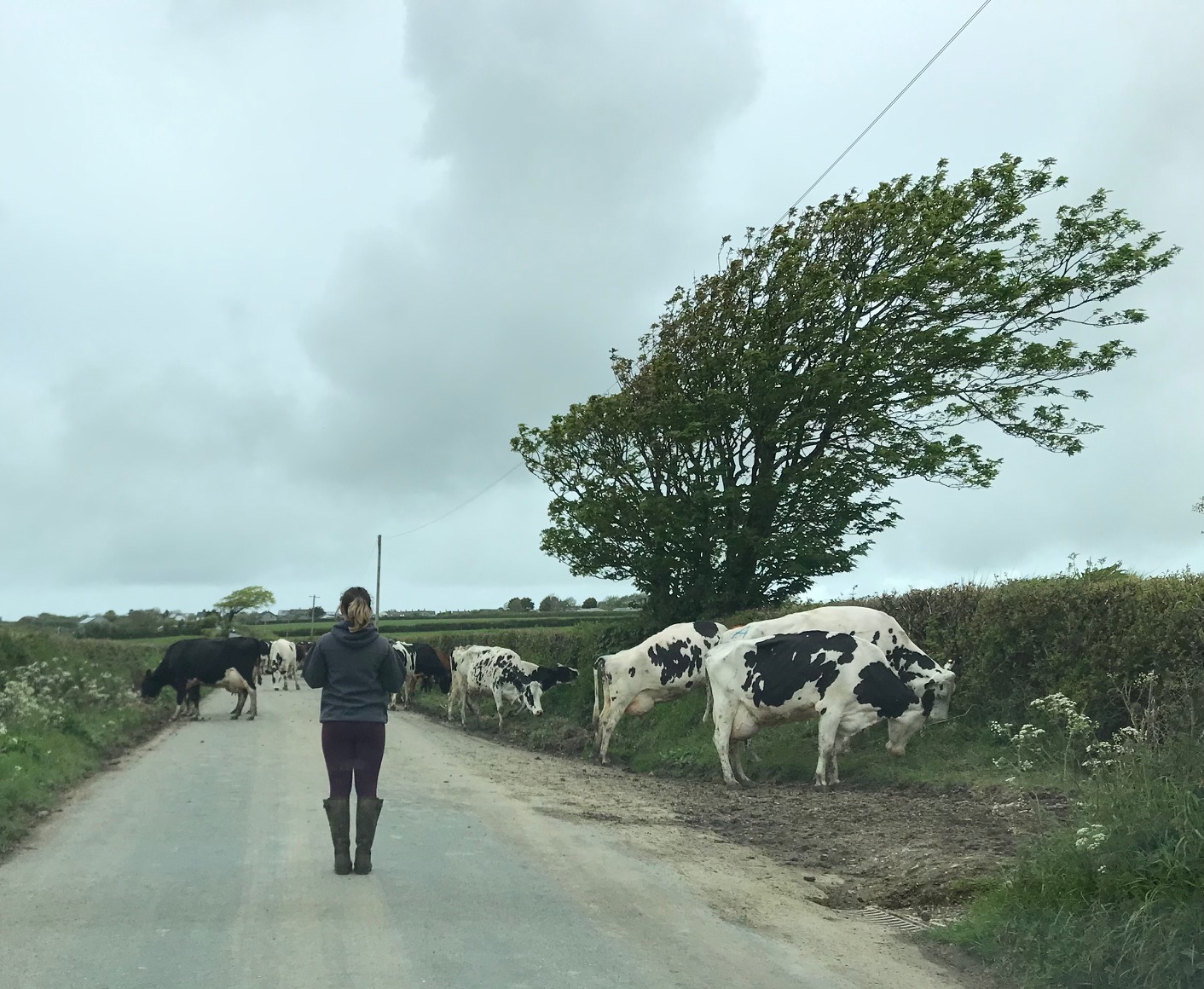
A vaguely relevant photo, since I’ve mentioned cars, and by extension driving. This is a traditional Cornish traffic jam: cows being moved from one field to another. They weren’t in any kind of a hurry.

The parking lot/car park has 211 spaces. I’m going to assume that doesn’t include the handicapped spaces or motorcycle spaces, which he couldn’t use. He’s got kids, so he could legitimately use the parent-and-child spots.

Don’t you learn wonderful things here? Hasn’t your world become richer and your brain stranger?

And what else did people do during lockdown, Grandma?

Other people used the various lockdowns to drink at home. In England and Wales, 2020 alcohol deaths hit a twenty-year high, climbing almost 20% higher than the year before. Blame the way the pandemic disrupted their work and social lives if you like. 

That doesn’t mean everyone ended their evenings shitfaced on the living room floor, but a substantial number of people did take to hazardous drinking at home. 

For what it’s worth, a similar thing seems to have happened during the bubonic plagues. Emphasis on seems, because no one was tracking the numbers. The evidence is anecdotal.

Although the government didn’t shut down the places where people gathered to drink completely, the authorities in 1665 London (by way of example, since it’s the only one I have) did give them a nasty look, calling them “the greatest occasion of dispersing the plague” and decreeing that they had to close by 9 pm.

That included coffee houses, reasonably enough. It wasn’t about people drinking but about gathering. At night. 

The plague worked the night shift. Before 9, everyone was safe enough.

That information about the plague is, I admit, hanging from a thin Covid hook, but it was the authors of the study who put it there. Presumably they decided that Covid sells. I’m only taking advantage of their opportunism and then blaming them.

*

In the U.S., some baffling number of people used lockdown to collect trading cards, which drove up the prices. Boxes of first-edition base set Pokemon cards (whatever that means) have sold for as much as $400,000. So speculators rush around to stores and buy up whole inventories–a deck might sell for a couple of dollars–then break up the sets and resell the more expensive cards online. They can go for a few hundred dollars.

What’s the connection to lockdown? People have too much time on their hands, maybe. And the people who don’t have too little money have too much. My best guess is that no one’s collecting the cards because they care about them. They’re collecting them to sell to people who are buying them because they think they’ll be worth more tomorrow. Or to put that a different way, everyone’s collecting them because other people are collecting them. 

Not that I actually know that. Maybe someone loves them enough to spend $400,000 on a set. We are a strange species, as I’ve said before–and I’m sure you wouldn’t have noticed it yourself if I hadn’t.

In an effort to make sure the U.S. lives up to its reputation as well armed and completely insane, a disagreement over trading cards in a Wisconsin store (a Target if you know the U.S. retail landscape) ended with a man pulling a gun on four other men in the parking lot. 

No shots were fired, no Pokemon characters were injured, and the guy with the gun had a permit, so it was all okay, but Target suspended sales of trading cards in stores, at least temporarily. They’ll still sell them online where it’s harder to shoot people.

*

In Britain, the proportion of people working from home more than doubled in 2020, but they’re still a minority of working people. About a quarter of people who work were working from home at some point in the week. 

Or more accurately, at some point in the week they answered the survey question. Compare that to 2019, when it was 12.4%. 

That was unevenly distributed. In London,that  was 46.4%, and in the most expensive suburbs it was 70%. If you wondered why Covid has landed hardest on people with the least money, you can start here. It’s not the only reason, but it’s door you can walk through to find the others.


And what happens when lockdown ends?

When lockdown ends, all the fun moves to the black market in fake test and vaccination certificates. Researchers found 1,200 sites selling them worldwide. By now, I’d bet on that number having gone up. If you’ve got £25 (or more) and an itch to pass yourself off as safe to be around, you can buy one. Police in Connecticut ended up with a whole box of fake vaccinations cards from an anti-vaxx rally. Whether someone was there to sell them to a likely crowd or was nobly giving them away I have no idea.

As for the fake test certificates, they’re showing up at borders, where people use them because they’re faster, cheaper, and more certain than genuine Covid tests. Unless you get caught.

*

Britain’s traffic-light system for labeling countries safe, risky, and Very Scary to visit has created the usual chaos

The environment secretary said people could travel to countries on the amber list. (If you speak American, that’s the yellow warning light.) Then the prime minister said people shouldn’t visit them unless they had pressing reasons. Then the Foreign Office said it was safe to visit 20 amber-list countries and it had published the list on its website, so there. 

That’s 20 out of how many countries are on the amber list? Lord Google tells me 170 countries are on the amber list. He also tells me the world contains 195 countries at the moment. And that 43 countries are on the red list and 12 on the green list.

Lord Google’s math is worse than mine. And I set a high standard. As does the U.K. government, but at least I’m not pretending to run a country.

Is it safe to lift Covid restrictions?

The latest Covid statistics from Britain are both cheering and worrying, although they’re starting to tip toward worrying. 

Nothing’s ever simple, is it?

On May 12, the country had only 11 Covid deaths and 2,284 cases. Compare that to January 22, when 1,401 people died of Covid and January 8, when the country had 68,053 cases. (Deaths peak a bit later than cases, which is why I seem to be cheating here.)

Some 67% of the British population is at least partially vaccinated. 

That’s the cheery part. So why don’t I just shut up and celebrate?

Blame those pesky experts. Also the pesky data they work with. And more to the point, blame the government–I’d think something was missing from my day if I didn’t–which dithered about whether to quarantine travelers coming in from India and about changing its let’s-all-proclaim-lockdown-over-and-be-happy plans.


Irrelevant photo: Ornamental cherry blossoms. We tried growing non-ornamental cherries. The birds didn’t even bother to say thanks.

Stephen Reicher, from Sage, the government’s science advisory group, is warning that the government has to be prepared to not to “dither and delay as in the past” if it turns out that one of the Indian variants has figured out how to sidestep the vaccines. He talks about acting hard and fast, which–well, unless the government gets a politico-personality transplant, isn’t in the cards.

Three of the Indian variants are known to be in the U.K., and one of them in particular is keeping the scientists up at night. It’s called B.1.617.2 by people who can remember that it’s called that, and in a week the number of cases showing its profile doubled in Britain. 

Sorry, It didn’t double, it more than doubled, although we’re not talking about a big block of people yet. A few days back, it was 520. What’s worrying is that it could be more transmissible than the Kent strain of the virus, which is the one that used to keep scientists up at night. Possibly as much as 50% more transmissible.

To some scientists, the tea leaves are looking frighteningly similar to the ones they saw before the Kent variant caused a surge in December of last year.

Come Monday, pubs and restaurants will get the okay to serve people indoors, and indoors among maskless people is exactly where the Covid virus likes to come out and play. So that adds to the worry.

Other restrictions are on a let’s-get-rid-of-these-soon list, including working from home if at all possible. And the travel industry’s been pushing hard to get people going on vacations again. Or on holiday if you speak British.

The new system to allow overseas travel involves traffic lights. Red, yellow, green–all those soothingly familiar colors. Arrive from a red-light country and you go into the kind of hotel quarantine that signals We’re Serious about This. Right after you mixed in the airport with people coming from green-light countries, who get to take a test and go home. 

What’s on the test? Three math questions, one logic question that the government will get wrong, and the old standby, Who was buried in Grant’s tomb? (The answer’s below.)

Any virus that violates the rules will pay a fine. 

Assorted scientists are warning that viruses don’t play by the rules and that it’s very hard to collect fines from them. 

Will the government back away from the planned reopenings? It’s dithering. 

The assumptions behind this are: 1. that 72% of the population will be vaccinated by August or will be protected by having recovered from Covid. 2. that most of the deaths will occur in people who’ve been vaccinated, since although the vaccines are startlingly effective none of them gives 100% immunity–not even against hospitalizations and deaths, although early reports said they did. No one’s to blame there. We’re learning as we go, every last weary one of us.


Controlling the variant

One way that Britain’s hoping to keep control of the variant is by intensifying the vaccination programs in areas where clusters are found. I have no argument with vaccinating more people, but there’s a two-week delay between vaccination and a decent level of protection, this isn’t an immediate solution.

On top of that, although the vaccines provide a much greater level of protection than we had any right to expect, they’re not like having your big sister or brother ride the school bus with you. In other words, they don’t give you 100% protection against either bullies or Covid. And when we’re talking about numbers as large as, say, the population of a country, a 2% gap in the protection can end up affecting a lot of people. 

So even though we don’t have any indication yet that B.whatever-whatever can run faster than the vaccines, its transmissibility alone means it’s dangerous. 

Modelers are warning about the possibility of a third wave of infections that could be larger than last January’s. If, that is, the new variant’s as transmissible as they fear.

Am I worried? I’m not losing sleep, but I wouldn’t advise anyone I love to start a travel business right now. Or to eat indoors at a cafe or pub. Because there’s no way to eat or drink without taking that damn mask off, and busy as scientists have been since the pandemic hit, they haven’t sunk their teeth into a solution to that problem.


WHO weighs in on a related topic

The World Health Organization has warned that vaccinations are “life-saving, but on their own, they are not enough.” 

That’s in response to the US’s optimistic and (I think) mistaken decision that fully vaccinated people don’t have to wear masks in many indoor settings. 

According to WHO’s Mike Ryan, “Relaxing measures and taking away mask mandates should only be done in the context of considering both the intensity and transmission in your area, and the level of vaccination coverage.

“Even in situations where you have high vaccine coverage, if you’ve got a lot of transmission, then you wouldn’t take your mask off.”


Collapsing the curve or watching it skyrocket

Almost from the beginning of the pandemic we heard the phrase flattening the curve. It was one of those word clusters–a bit like herd immunity–that we came to think we understood because we’d heard so often. Or read it.

Well, a new approach to modeling the epidemic says that if you make enough changes at a crucial stage, the curve doesn’t flatten, it collapses. In other words, you get to lace on your big muddy boots and stomp the little bastard. 

And if you miss that crucial time? 

Um, yeah. You have a massive damn outbreak on your hands. Or feet, if we want to hang in there with the boots metaphor. 

The most interesting thing is that the modelers couldn’t come up with a scenario that put the results anywhere between those two extremes.

One of the most powerful ways to control an epidemic is to test known contacts of infected people (which of course means finding them first and quarantine them if they test positive). But there’s a limit to how many people you can trace and test every day. If the number of cases goes past that limit, the disease spreads and congratulations, you’ve just lost control of your epidemic.

The key is to act early and decisively. (See above, Mr. Johnson.)

“A policy that would have worked yesterday will not only take much longer to take effect, but it may fail entirely if it is implemented a single day too late.” Björn Hof, the central mind behind the modeling, said: “Most European countries only reacted when health capacity limits became threatened. Actually, policy makers should have paid attention to their contact tracing teams and locked down before this protective shield fell apart.”

What Hof didn’t say but what seems to be implied here is that Britain’s strategy of lifting restrictions anytime the virus settles down to a less threatening level is self-defeating and leads to another spike later on. 


All right, gloomy guts, how about some good news?

Okay. In animal trials, a nasal spray vaccine has created sterilizing immunity. That’s the kind of immunity that (in words of one syllable) could wipe this bug from the face of the earth–or at least from your lungs. It would stop you from getting Covid and it would stop you from giving it to someone else. 

The current vaccines can’t go that far. They minimize the risk, and with it they minimize transmission, but they don’t eliminate it.

The vaccine needs only one dose, you don’t have to look away while someone pokes a needle into your arm, and it doesn’t have to be transported at temperatures so cold that sound freezes from the air and thoughts shatter. You probably wouldn’t want to deep fry it, but you don’t need to refrigerate it either. 

But it’s still got a series of trials to go through before we can get our mitts on it. Keep your eye on this one, though. It sounds promising.

*

A cheap Covid test is being developed that reports back in four minutes and is 90% accurate. 

This one can work with either a nasal swab or a saliva sample and it’s actually a bit more accurate with saliva samples, meaning people could stop sticking thin objects up their noses. 

Didn’t our mothers all warn us not to stick things up our noses? Do you have any idea what we’re messing with, using swabs to test ourselves?

It can also spot infections in the early stages, which is important since that’s when they’re most contagious.

Have I written about this one before? I’ve lost track. It seems like some fast, accurate test is always in development. And then we hear nothing more about it. I’m hoping we’ll hear more about this one.


So who is buried in Grant’s tomb?

Grant is buried in Grant’s tomb. (That’s Ulysses S., Union general during the Civil War and later president.) 

When I was a kid, some hundred or so years ago, we used to ask each other this. Repeatedly. Maybe we thought the answer would’ve changed. I don’t know if kids in New York still do it. Grant’s tomb is along the Hudson River, begging for kids to use it as the base of stupid questions. 

I haven’t tried the question on anyone in a British airport. I probably should. 

Strange British Festivals: The World Custard Pie Championship

To prove that the pandemic is nothing to mess around with, the 2020 World Custard Pie Championship–like so many other non-essential events–was canceled.

But was the contest truly non-essential or was that just the decision of some self-serving, soulless sort with a scrub brush for a brain? Did they consider its obvious cultural, political, and academic importance? 

Ah, well, let’s not be too hard on self-serving, soulless scrub brushes. It’s been a rough year for everyone.

And it doesn’t matter anymore, because barring a major step backward in the U.K.–that’s pandemically speaking, of course–the competition will take place in 2021, so let’s learn what we can about the details, quick before it’s too late to enter. 

Irrelevant photo: A camellia, I think. In fact, I’m reasonably sure. Of course it’s a camellia. What else would it be? A snowmobile?

The World Custard Pie Championships fits nicely into the category of strange traditional festivals that England (or maybe that’s Britain) is so good at, even though this particular tradition is no older than fifty or so years. That makes it modern, at least by British history standards, but it’s a good enough imitation to fool my filing system. 

And if someone would help me sort out whether these festivals are a particularly British thing or a particularly English one, I’d be grateful. I’m sure it would help me understand the country better. Are people this strange in Scotland, Wales, and Northern Ireland?


Origins, rules, & important stuff

The origins of most truly traditional traditions have been lost by now, but since this one’s a newcomer–a nontraditional tradition–we can document it: Coxheath, Kent, needed to raise money for a village hall and came up with the idea of inventing a tradition. Or at least that’s my interpretation. I’m reasonably sure no one put it that way when they were sitting around the pub figuring out what to do.

The pub’s also my interpretation. I’m convinced that these traditions all started in the pub. Even before pubs were invented.

How does the championship raise money? It costs £60 for a team to compete and £40 to set up a stall. Unless you’re selling food and drink, in which case that’ll be £80, thanks. If a town can keep its festival going for a few years and get itself some publicity, it’ll raise enough to buy a bucket of paint or three. 

By now the custard festival’s had enough publicity for teams to fly in from around the world. Or so the website says. They manage not to say how many teams have flown in. Two’s enough to justify a plural.

The rules are simple. Each team’s made up of four people and they line up and throw pies at someone–I assume it’s another team. Using their left hands. I’ll go out on a twig and guess that if you’re left handed you throw with your right. If you’re ambidextrous, you’re disqualified. If you’re amphibious, you can throw from under water, but it won’t be an advantage–at least not in terms of scoring. You’ll be a hit with the crowd, though.

Scoring? Your points depend on where your pie hits your opponent–six points for a pie in the face, three if it hits from the shoulder up, and one for any other body part. 

If you miss three times, you lose a point. 

The judges’ decisions are final. 

Throwing pies at the judges when you don’t like their decision is frowned upon, but they don’t say that for fear of putting the idea in some suggestible person’s empty little head. And yes, having to throw with your nondominant arm is a perfect excuse for not being good at it.

Unlike dwile flonking, you don’t have to be drunk to do this, but this being England (or should I say, “This being Britain”?), you’re more than welcome to show up dressed in something silly. Or as they put it in British, in fancy dress. Don’t wear anything you’re attached to, though, because by the end of the day everyone’s wearing custard.

And now the bad news: They don’t use real custard–it’s not the right consistency–and the formula for whatever they do use is a closely guarded secret. Presumably, neighboring towns are just dying to poach the festival and that’s all that stops them. The only ingredients they’ll admit to are flour and water. The Calendar Customs website recommends not eating whatever it is.

The contest’s usually held in May or June, but this year, with the number of vaccinated people going up and the number of Covid cases (“so far,” she said nervously) staying low, it’s been rescheduled for September 21. 

They’re expecting 2,000 pies to be thrown. The day begins around noon with a wet sponge competition for kids, who as any fool knows can’t be trusted with pies.

*

Some time ago Autolycus suggested that I might want to write about another great British tradition, rhubarb thrashing, and I did try, but I couldn’t find enough information to go on. Besides, it’s a perfectly sensible game where two people stand inside trash cans and whack at each other with rhubarb  sticks, and where’s the laugh in that?

Why more isn’t written about it remains a mystery. It’s one of those rare subjects where Lord Google offered me no more than a single page of links, most of which were to a kids’ program, the BBC’s mysteriously named Blue Peter, which decided many and many a year ago that this was what the kiddies needed to know.

Those kiddies have now grown into adults. If you want to know what’s wrong with the world, look no further.

I am, as always, grateful for people’s topic suggestions, even when I don’t end up writing about them. Some–like rhubarb thrashing–just don’t lead anywhere, but you never know. Some are glorious.

Why some folks who recovered from Covid keep testing positive

At some point during the pandemic, the good folks who comb through Covid tests noticed that a certain number of people who’d recovered from Covid kept testing positive, although further testing couldn’t find any live virus in their systems. Now a study offers us a theory about why that might be happening.

But before we go on, remember that this is a theory. Repeat after me: It’s a theory, it’s a theory, it’s a theory.

Ready? In simplified form, since that’s as much of it as I can handle, bits of Covid’s genetic sequence can embed themselves in human DNA, getting there by a process called reverse transcription. Don’t worry about what it’s called, though. I only mention it so it’ll have a name and we can call it when lunch is ready.

Irrelevant photo: Daffodils by a stream. Photo by Ida Swearingen.

Before you come unglued about the idea of Covid embedding itself in your DNA, understand that it doesn’t mean Bill Gates is embedding himself so he can send you instructions to buy his latest product or divorce your–or his–wife. Something like 8% of our DNA is made up of sequence fragments left there by ancient viruses. That sounds eek-ish, but they do nothing more than sit around looking ancient. And if you know how to read them, interesting. They’re not responsible for diseases or divorces or anything else beginning with D.

Now if they were retroviruses, they’d use a position in our DNA to replicate and make us sick, but Covid isn’t caused by a retrovirus, so if it’s there, it’s doing nothing.

Take a deep breath. The situation isn’t any worse than it was a minute ago. 

From there on everything gets complicated, but I did escape away with this much information: 1, It’s not yet clear how common reverse transcription is with Covid; 2, if it’s happening at all, it might mean that some Covid immunity gets integrated at the cellular level (that would cause a good thing); and 3, it might also be responsible for the autoimmune responses that show up in long Covid (that would cause a bad one).

Warning: The study’s still controversial, with some scientists yelling–in a more academically appropriate way–”This is bullshit and it’s feeding into people’s fears.” Make of it what you will. I suggest tucking a sprig or two into your hat and waiting to see what it’s done in a month or six.


Covid and evolution

You’ve probably heard people say Covid will become less deadly over time. Didn’t the plague? Didn’t, after the Spanish flu epidemic, the flu?

Mmm, well, maybe. There are two problems with the argument. The first and biggest is that evolution’s random, driven by a combination of pure dumb chance and the pressures put on it by outside circumstances. So as any given disease evolves, it could become milder and it could become more deadly. Or could become neither and change in other ways–ones we care about less.

But that’s old news. The second problem with the argument is newer and more interesting. A group of necrophiliacs–

Sorry, a group of scientists studied the bodies of 36 sixteenth-century bubonic plague victims and compared their immune markers with those of people living in the area today. The modern residents showed a greater genetic resistance to the plague than the sixteenth-century bodies did.

“This suggests these markers might have evolved to resist the plague,” said Paul Norman of the Colorado School of Medicine. 

Because it’s not only diseases that evolve: So do we. And if the study’s correct, so did we. Or at least so did the people of that particular town.

If you want to get whacked with the full scientific verbiage, the article says, “Among the current inhabitants, the team found evidence that a pathogen, likely Yersinia pestis which causes bubonic plague, prompted changes in the allele distribution for two innate pattern-recognition receptors and four Human Leukocyte Antigen molecules, which help initiate and direct immune response to infection.”

Got it?

Me neither. That’s why quotation marks were invented.

The good news here is that humanity can adapt to massive medical threats. The bad news is that, even if some of us have genes that will protect us against Covid, we can’t know in advance who’s got ‘em and who doesn’t. And for those genes to spread through the population would take I’m not sure how many generations and many deaths, which would unsentimentally eliminate those of us who don’t have ‘em. 

In short, if you can get vaccinated, do. 


Does vaccination either stop or slow the spread of Covid?

A study that followed vaccinated and unvaccinated hospital employees found that vaccination dramatically reduces asymptomatic Covid infections. In fact, the change was enough that a pretty dry writeup of the study used the word dramatically. The word didn’t wander into this paragraph because I was struggling to keep us all awake.

So what? So it means that vaccinated people will be dramatically less likely to pass on infections. If you don’t get them, you can’t give them. 

How dramatic a change are we talking about? A week after getting their second shot (or jab if you speak British), vaccinated people were 90% less likely than their unvaccinated co-workers to have asymptomatic Covid.

In that case, how soon will the pandemic be over? 

Um, yeah.

A group of infectious disease modelers at Northwestern University are playing with the numbers and trying to figure that out for the U.S. alone. Their projections are lining up nicely with the numbers reported from the real world, so they’re worth listening to. Basically, the number of Covid deaths and the number of severe cases are going down. That’s the vaccination program at work. 

Rochelle Walensky, of the Centers for Disease Control, said, “The models forecasted some really good news, and an important reminder. The reality is it all depends on the actions we take now.”

Basically, she says, controlling the pandemic depends on people getting vaccinated–quickly.

Is forecasted a real word? Yup. To forecast has two past tenses, depending on what mood it’s in when it gets out of bed. Forecast is one and forecasted is the other.

You can’t always forecast which mood it’ll be in. 

I didn’t know that either.

“The results remind us that we have the path out of this,” she said, “and models once projecting really grim news now offer reasons to be quite hopeful for what the summer may bring.”

But the modelers warn that this doesn’t mean all restrictions should be lifted at once. Surges are still possible, and new variants are a threat. 

They don’t specifically mention this, though, so I will: Until vaccines get to the rest of the world, no country is safe. 

Which leads me to this: As of May 6, 44% of the US population and 51% of the UK population had been vaccinated. Compare that to 9.4% in India, 4.4% in all of Asia, and below 1% in all of Africa. Which is an elaborate way of saying even the safest of us is a long way from safe. 

Appeals to our higher nature are fine, but the desire for self-preservation’s a powerful force and always worth a mention. 


Long Covid

Long Covid has a new name: Post-Acute Sequelae of SARS-CoV-2–or PASC to its friends. 

Why does it need all that? Because in my experience, when the medical community can’t cure something, they rename it. 

Since I’m claiming to have experience, I’d better cite my qualifications. I lost four years of my life to some sort of post-viral exhaustion that was so vaguely defined it had to be diagnosed by picking two symptoms from List A and three from List B. Or maybe it was one and four. Either way, I watched the syndrome go through two or three name changes before I stopped keeping track. 

The experience means that I’m more afraid of long Covid than I am of the severe form of the disease, although I won’t argue that we should all feel that way. 

I’d like to think the new name’s a sign that long Covid’s being taken seriously, and if the number of articles about it are a measure of seriousness it just might be, but being taken seriously isn’t the same as anyone knowing how to cure it. Or even knowing what causes it. 

Long Covid lands on people who had severe Covid and on people who had nothing more than a mild case. And this next bit is news to me: It also shows up in people who had asymptomatic cases. It can range from mild to debilitating to horrific. In one study, less than a third of people with long Covid had fully recovered five months after they left the hospital, although that’s a skewed study because it only follows people who were hospitalized. 

A different study found that nearly half the people hospitalized with Covid felt they hadn’t fully recovered after seven months. Either that study or a different one (forgive me, I get dizzy when I’m around numbers for long) says one person in ten will have Covid symptoms months after recovering from the disease itself. 

This is all still new territory. Expect the numbers to be contradictory. No one even has a fixed definition of long Covid, so you’ll find the game being played by different rules in different studies. And the playing field keeps changing size. In fact, some studies are working with cards and others are convinced it involves a ball. 

It’s not clear yet who’ll get long Covid. Working-age women are the most likely, but men can get it, old people can get it. Young adults and kids can get it. No one seems to have a demographic Get Out of Long Covid Free card. 

An article from Yale University says we are “facing the prospect of a chronic condition without diagnostics or therapeutics. We are facing a post-viral condition of potentially historic proportions and are almost completely in the dark about the underlying mechanism.”

It goes on to talk about lives that are changed overnight, about long Covid’s disproportionate impact on minority communities, and “a health care system that can offer no substantive assistance.” Not to mention long Covid’s “financial toxicity”–and since the article comes from the U.S., people’s loss of health insurance.

Yeah. It scares the hell out of me.