Mrs. Baggit Struggles to Keep Britain Tidy

The first time Wild Thing and I visited the U.K., Maggie Thatcher was the prime minister and whatever ministry was in charge of roadsides had planted them with metal signs saying, “Mrs. Baggit Says, ‘Keep Britain Tidy.’”

That bit of brilliant public relations was finished off with a picture of a tied-off bag with a face—Mrs. Baggit’s, presumably, happily stuffed with garbage. It was impossible not to connect her image with Mrs. Thatcher’s, and some small part of my brain continues to insist, in spite of all evidence to the contrary, that Thatcher’s real name was Maggie Baggit.

Irrelevant Photo: Rose Behind Bars, by Ida Swearingen

irrelevant Photo: Rose Behind Bars, by Ida Swearingen

We did a lot of driving on that trip, so we spent a lot of time looking at the signs and finding funny voices to quote them in.

“Mrs. Baggit says…”

Mrs. Baggit had a lot to say on that trip, all of it scold-y, although I can’t remember exactly what it was anymore. Except, of course, for “Keep Britain Tidy.”

To understand why that kept us amused, you need to know that tidy sounds different to an American ear than to a British one. To me, tidy is fussy. It’s small. All I have to do is think about it and I want to make bitsy motions with my fingertips, as if I’m cleaning up a dollhouse. As far as I can tell, none of that is true in the U.K. It’s just a word here. It means neat and doesn’t make your fingers do funny things in the empty air, although H. tells me the Mrs. Baggit part sounds fussy.

I should stop here and admit that when I started that last paragraph I was going to speak for an entire nation: For us (us here being all Americans—every last differentiated, argumentative one of us) tidy is fussy. Then some minimal sense of modesty (not to mention accuracy) caught up with me and I thought it might be nice if I didn’t mistake my mind for the mind of an entire, not to mention large and varied, country, even if I did grow up and live most of my life there. So I’ve backed off a bit. But I still hold that it has different overtones to an American ear than to a British one. That much, I think, is fair.

Language is like that. We think of it as a solid, but it’s not. It’s one of those slow liquids, like Silly Putty, that changes shape depending on what holds it, or who.

So how successful was the campaign? I never saw British roadsides before it started, so I can’t make a comparison, but I know this much: If you look for litter here, you’ll find it. And if you don’t look for it, you’ll find it anyway. I’ve seen places with more, but Mrs. Baggit hasn’t stopped the litterbugs mid-throw.

And who in their right mind thought she would?

Driving in Cornwall: When Good Technology Turns Bad

My spies tell me that sat navs are called GPSes in the States, but in spite of my last post about keeping my American vocabulary pure I’m going to write about them as sat navs, because I’m writing about the way they work here. And also because the idea of purity in language is complete and total bullshit and I don’t want to take myself too seriously on this subject.

I needed a spy network to pin down the word GPS because I never needed one when I lived in the U.S. Or, well, yes, I could have used one during the five years that I drove cab, but they didn’t exist yet, so the thought I need that couldn’t exist either.

Not that I’d have spent the money on one.

I’m a technophobe. I’m a techno-I-don’t-need-it, but even I have conceded that in Cornwall I need a sat nav. Or, to be entirely accurate, I don’t need one myself but will steal Wild Thing’s now and then. She’s a major prophet of the Church of We Need All the Techno We Can Get, so this seems (to me) like a reasonable arrangement.

Irrelevant Photo: Boscastle, Evening.

Irrelevant Photo: Boscastle, Evening.

Now in Cornwall, and probably in the rest of Britain, before the invention of sat navs, people would leave home with a set of directions to a place they’d never been before and 70% of them were never seen again. On a dark night, you can see the faint gleam of their headlights passing like ghosts, still looking for a house called Craggy Bottom, which was supposed to be on an unmarked road somewhere off the A39.

The incident that made me a sat nav user was looking up directions to a meeting on MapQuest or Google Maps or something like that and reading, “Turn right on unmarked road.” Which unmarked road? They couldn’t tell me. Because that’s the thing about unmarked roads: They’re unmarked. It’s one thing if a friend says, “Turn after you pass the bungalow with the brown egg box out front,” but internet directions won’t give you that level of detail.

But sat navs have their own problems. First, you become dependent on them. They tell you to cross the roundabout, third exit, and you cross the roundabout, third exit. The next time you come the same way, do you remember that? Hell no. You need the sat nav again.

But the second problem’s more serious. In parts of Cornwall, they don’t work. Some years ago, Wild Thing and I were walking the dog past a ford and waved down a guy in a delivery van as he was about to leave a paved (and unmarked) road and go up an unpaved, washed out axle-breaker of a vague memory of a former road.

“You can’t get up that,” we told him.

“The sat nav says.”

I don’t think he quite finished the sentence. He had that blank, terrified look of someone who wasn’t taking in anything we said. Part of it would have been our accents—we couldn’t seem any less local if we carried signs saying “We’re not from around here”—and part of it would have been sat nav dependence. The rest, though? When a man doesn’t take in what a woman’s saying, it’s hard not to go back to the words man and woman and think, hmmm.

But never mind. We told him only a four-by-four could handle the hill he was about to go up. We told him he’d wreck the van. He told us the sat nav said.

We shrugged and watched him cross the ford and start up the hill. If a van can look fatalistic, I tell you, his did.

He was lucky. It was a rainy year and the mud was slick, so he didn’t get far enough up the hill to wreck an axle. He slid back, still looking blank and terrified, and he drove back the way he’d come. On foggy nights, I’ve seen his headlights pass me like ghosts, still following directions from his sat nav.

This kind of thing happens all over the country. Sat navs send massive damn trucks down streets that are so narrow they get stuck.  Really they do. They send cars down stairs. Some of the problems you couldn’t predict, but some of them—well, the truly crazy thing is that people do what they’re told. And yeah, I know I shouldn’t laugh but when I see some of the pictures I laugh anyway. It’s the oldest joke humanity knows: Somebody falls down. Follow the link and see if you don’t do the same.

We’re not, all told, a very nice species.

And maybe our sat navs know that, because with the detached serenity of gurus, they’ll spend hours talking us through the mazes we’ve laid down on the surface of the earth and call roads, and then, with no warning, they turn on us. Wild Thing’s first one did it in the middle of the Tamar Bridge—a long, high bridge connecting Devon and Cornwall.

“Turn left,” it commanded.

We came out of our sat nav trance and decided maybe that wouldn’t be a good idea, so she escalated.

“Turn left immediately.”

There really is a lot of water under the Tamar Bridge. And I’m not much good with either heights or water. We turned the sat nav off. It already had a history of going wild when we crossed the moors. If you’ve read the Brontes, you probably know about the moors as a metaphor for something wild and free and frightening, and our sat nav was in tune with all that. It would tell us, “In 18 yards [and it was always 18 yards], turn right.” Or left. In 18 yards, though, there was no road, only hedge. It had an image of us, I guess, breaking loose and driving wild and free across the fields.

Wild Thing retired it and bought a new one whose quirks are more predictable. But even so, near Scorrier both our new sat nav and everybody else’s try to kill people so consistently that the county’s put up a sign, in a panicky set of colors that they use for nothing else, saying, “Turn off sat nav.” The highway entrances were rerouted at some point and sat navs seize the opportunity to send cars the wrong way down exit ramps onto the wrong side of the highway.

So yeah, you need one around here. And you never turn your back on it.

Taking the Train to London, or Adventures in Choice

I took the train to London.

That shouldn’t be the opening sentence of a tale, but bear with me, because I had choices to make.

Arrival time. Okay, sane enough thing to choose, but arrival time wasn’t so much about the time I needed to be in London but how much time I needed to allow for delays so I could be sure I’d get to London by the time I needed to be in London. Train problems? Let’s say half an hour. Tracks? Same. Signalling problems? File that with tracks. No floods at the moment. Someone throwing themselves on the line? Hours. Everything stops while the police do the whole crime-scene routine and finally release the train and its traumatized driver to finish the run.

Wild Thing and I were on a train once when this happened. After that, it’s something you calculate. Or decide not to calculate, which is what I did. I’d take my chances.

Irrelevant photo. The coast near Fowey, Cornwall.

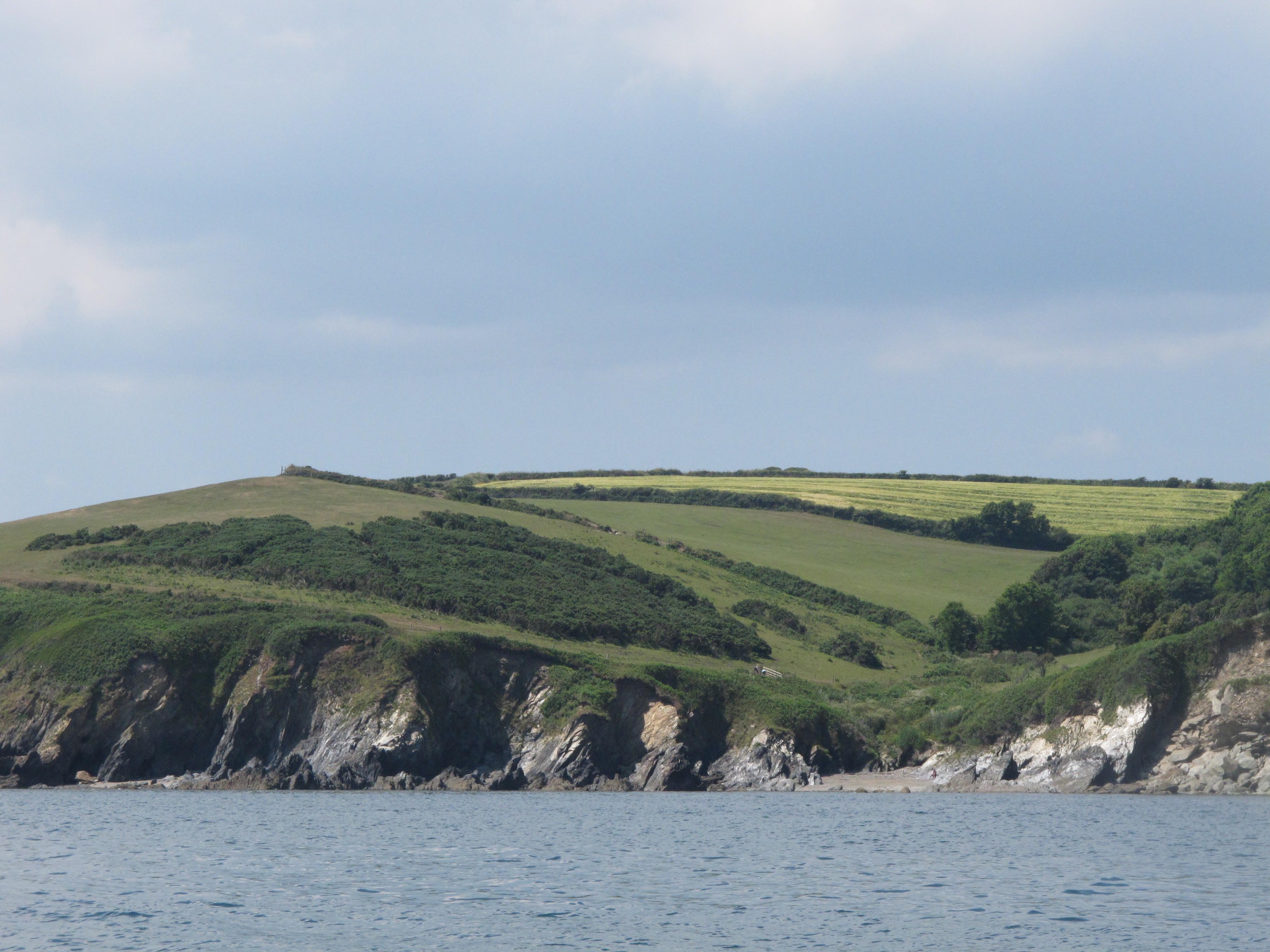
Irrelevant photo. The coast near Fowey, Cornwall.

Having weighed all of this and chosen a time, I had to choose a website. Google offered me over 40 million results. I confess, I didn’t check them all, but every one of the promotions I did read claimed to be cheap, cheapest, cheaper, or more discounted, better looking, and thinner than all the others. I compared. I contrasted. I did my best impression of a careful shopper. But this wasn’t just about comparing sites, because trains on a single route are priced differently. Why? Because the train companies want to make us crazy. Not to mention because finding the cheapest possible ticket is a full-time job and most of us don’t have the time and dedication, so—hmm; they wouldn’t be making money from making us crazy, do you? Anyway, the question wasn’t just what time I wanted to be in London, allowing for as many delays as I was willing to allow for, but how much I was willing to pay to arrive at the time I wanted to arrive, or how willing I was to get there earlier or later if I wanted to save a few quid.

On the train I chose, the 11:40, the cost of an advance ticket with no rail card ran from £46 to £46. I was grateful to have done my comparison shopping, because it was going to save me big bucks. That was, of course, before taking into account that many of the web sites charge for using a credit card, using the web site, using your own keyboard, and breathing air. I bought my ticket from the train operator, First Great Western, which is what I would have done if I hadn’t done my comparison shopping.

Another confession here: I do have a rail card, and I use it, which reduced the cost of the ticket by quite a bit. It had damn well better, because I have to pay to have it. But that’s a whole ‘nother story.

I made more choices: Quiet coach? Noisy coach? Morris dancing coach? Forward facing or rear facing seat? Aisle or window? Inside out or upside down? Enter your credit card details and prepare to be boarded by pirates.

My tickets came the next day.

On the day I was traveling, I left an extra half hour to get to the station because I live in the country and it’s easy to get caught behind a tractor or a herd of cows. I got caught instead behind a garbage truck, which is less romantic. It lumbered its way along the highway at ten miles under the speed limit, but eventually I found a straightaway and passed. But in Exeter, traffic was backed up to—well, it was backed up to where it’s always backed up to and I thought I’d allowed for it but I hadn’t.

If you miss your train, you can always buy a last-minute ticket for the next train, I told myself.

This was supposed to spread inner peace throughout my being, but I’ve read about the cost of last-minute tickets, so it didn’t. No one understands the pricing system, but we all understand that buying last-minute tickets is insane. Everyone complains and agrees that we’re getting ripped off.

I fretted about the traffic, reminded myself that I could buy a last-minute ticket, fumed about the cost, bumped forward a few car lengths, checked the time, rehearsed parking problems I hadn’t had yet, and generally enjoyed my tour of Exeter. Which, if you’re in the mood for it, is a beautiful city.

I wasn’t in the mood. It was ugly.

At the station, I used a phone-in/credit card system to pay for my parking. The alternative was to plug the machine with more coins than any normal human is physically able to carry. The phone-in system gave me another choice: I could pay for 48 hours and be pissed off because I needed—allowing for brake problems and signal breakdowns on the return trip—let’s say 28 hours, or I could pay for 24 hours and risk a ticket. I wasn’t offered the choice of 24 hours plus four. Having chosen to measure in days, I seemed to be stuck measuring in days.

I paid for 48 hours was pissed off.

I had ten minutes before the train was due and stopped at the departures board. Where I didn’t find the 11:40.

Now, I raise numerical incompetence to the level of high art, so the night before I’d checked the departure time on my ticket at least three times. It might have been more. I don’t really trust myself to remember the number three. Still, I was almost sure my train left at 11:40, but there I stood before a board listing exactly two London trains, and one at 11:55 and the other was at 12:13.

Fine, I thought. Either I’ve mixed up the time or it’s been rescheduled. Just get on the 11:55 and don’t worry.

And even as I heard myself think that, I remembered newspaper articles about people catching the wrong train for one reason or another and having to pay the full, absurd, last-minute fare as well as a penalty fare. Punch “wrong train ticket” into Google UK and you get 3,480,000 results. Approximately. The 8 or 10 thousand (okay, the 1 or 2) that I checked personally are testimony to how intricate and incomprehensible the system is. People write in and ask, “What happens if I catch the wrong train?” and are warned about penalties and unpaid fare notices and the possibility of prosecution.

Do not get on the wrong train, the saner part of my brain warned.

It’ll be fine, the other part said. I’m always being taken for a tourist. I’m expected to be an idiot.

The last two statements were true—my accent is unchangingly American—but the first was not, so I thought I’d ask the man at the ticket barrier about my train. He’d helped me and half a dozen other people get through when we put in the wrong ticket and the barrier didn’t open. You should understand that every passenger gets two tickets, and they look almost identical, but only one of them opens the barrier, so it makes sense to pay someone to stand there to keep people moving through.

Sort of. I seem to remember reading the privatizing the trains was going to get rid of inefficiencies. And give us choice, which is a good thing because it gives us choice. But those are serious issues, so never mind.

Before I had time to bother him, I spotted another column of numbers on the board. Numbers are like that for me. They can be right in front of me and stay invisible.

The new column was the time the trains were scheduled, and there was my 11:40, delayed until 12:13. I left the man at the ticket barrier in peace and made my way to track 5. Which I checked twice, although the London train’s always at track 5.

The later train, the 11:55 pulled in, but those of us who were booked on the 11:40 couldn’t get on without incurring the wrath of First Great Western and of the Great God of Railway Tickets, who is an angry god and afflicted with obsession-compulsive disorder, so lo, although we looked on longingly, we waited.

The train doors closed. The train sat. It sat a while longer. A man got off, pursued by the angry and, I should mention, invisible God of Railway Tickets.

“I got confused,” he said to the milling crowd.

He was not fined or penalized or beheaded, presumably because the wheels hadn’t yet turned.

I have no idea how he found out he was in the wrong train. Maybe he tried to claim his reserved seat and found someone else had a better claim.

A couple with tickets for the later but earlier train—that’s the 11:55 in case I’ve confused you as much as is appropriate to this tale—appeared but weren’t allowed to board because the doors had closed. The platform guard told them they were required to be on the train two minutes prior to departure.

They argued: They’d used the elevator that allows the disabled to cross the tracks, and it was slow.

It is slow. I’ve used it when my partner was recovering from ankle surgery.

“The doors close two minutes prior to departure,” the platform guard said.

The train started to roll, ending the argument. They now had two useless tickets. They could return them for a refund, minus a booking fee, but they couldn’t use their tickets on our earlier but later train because they weren’t for that train. They either had to go home and forget the whole thing or buy two outrageously expensive last-minute tickets.

Thank god privatization freed us from the stranglehold of bureaucracy.

I don’t know what they did because I headed for the café, where I bought a cup of tea to take on board, because the café on the platform gives you a full cup but if you buy it on board a full cup is too dangerous—you get about three-quarters.

Don’t ask.

I passed a man whose tee-shirt said, “Forever Delayed.” I figured him for a regular rider.

Our train pulled in. My seat was in the last row, just in front of the train manager’s compartment, so I got to eavesdrop on the conversation when a woman knocked on the door and asked if he’d sign her ticket so it would be accepted on a later connecting train.

He did. What would happen, I wondered, to all the people who hadn’t ask him to do that? Maybe, knowing a train was delayed, the train managers would be kind. And maybe not. Maybe since the system is now broken up, they wouldn’t know that a train run by another company was delayed.

Two women ahead of me began a cross-aisle conversation about whether one of them would get to Gatwick in time to catch her flight. She was Spanish-speaking, and I got into the conversation half to help out and half for the pleasure of speaking Spanish. Her connection was tight and she was worried.

I knocked on the train manager’s door, and he talked her through the two trains she could catch—one direct but later, the other a involving a transfer but earlier. He recommended the later, easier train, but she was too worried about her flight to take the risk. We discussed platforms and staircases and the name of the stop where she had to change trains, all in a mixture of English and Spanish.

Mercifully, we the gaps in our vocabularies didn’t match.

Although she lived in Spain, she was from Colombia and her Spanish was as beautiful and easy to follow as any I’ve heard. She was also extremely tense. If she missed her flight, her ticket would turn to ash.

The train manager printed out two bits of paper that looked like cash register receipts, detailing her route. I asked if he needed to sign her ticket and he said no.

I didn’t ask if he really needed to sign the last woman’s.

After the Colombian woman left the train, I got into a conversation with the man in the seat next to me. He lives in Plymouth and his wife travels to London for two days each week. He’d become a ticket geek, he told me. The cheap tickets are released twelve weeks ahead of time, so he’s up early on Saturdays to buy one before they sell out. We’d both read that it’s sometimes possible to lower the cost of a trip by booking separate tickets on a single train—Exeter to Reading, say, and then Reading to London, all without getting off the train. He’d never gone that far. It’s a system that begs you to make mistakes. I’d end up putting myself on different trains, or on the same train on different days.

“Choice,” he said, shaking his head.

It is indeed a wonderful thing.

Everyday Driving in Cornwall: Who Backs Up?

In response to my most recent post, “The Emmets Come to Cornwall,Motherhen wrote, about driving English lanes, “I often reverse when it’s not my turn, just to save time.”

My turn? I thought. Do we all agree about whose turn it is?

In her experience, yes. In mine, not always.

If you haven’t been to Cornwall, though, you need some background. The roads are narrow enough that in places cars going in opposite directions share a single lane. And it’s a narrow lane. So two drivers will sometimes end up radiator to radiator and have to wrestle with one of life’s deep philosophical questions: Who backs up?

A narrow street in Fowey, Cornwall.

A narrow street in Fowey, Cornwall.

I learned to drive in the U.S of get-out-of-my-way A., and my early experience of British driving destabilized me deeply. Forget about driving on the wrong side of the road. Forget about the steering wheel being hidden on the right-hand side of the car, where I kept forgetting to look for it. Forget the narrow roads, even. They were nothing. What threw me was the courtesy drivers showed each other. I’d see two lanes of traffic merging into one and they’d slot into each other as neatly as the sides of a zipper, with no one jockeying for position. Or I’d see some poor soul stuck in a side road, waiting to cross a lane of traffic, and someone would stop and let her or him across.

Now, that is mind-scramblingly amazing. And impressive. It takes the competitive sport of driving and turns it into a cooperative enterprise.

Back in Minnesota, long before I’d been destabilized by British driving, I got so pissed off at a driver who wouldn’t let me in when two lanes were merging that I allowed his car to slice open my wheel well rather than back down. I was holding out for that zipper arrangement and he was holding out for a him-first arrangement. And in case I’m in danger of sounding noble here, the one-from-each-lane arrangement favored me as surely as the him-first arrangement favored him. But he was driving what I remember as a very large a pickup and I was driving a VW beetle. If his pickup was even scratched, I couldn’t see it. Interestingly enough, neither of us stopped and neither of us reported an incident. I’m not sure what he was thinking, but I didn’t want to explain my part in it to anyone, least of all my insurance company.

The papers here carry the occasional road rage story, and people are duly horrified. And people I know have met some true nutburgers on the roads (as, come to think of it, have I), but all that, I think, is outweighed by the cooperation.

On the other hand, yeah, it’s still the real world, isn’t it? It’s never all sunshine and light. Mr. Slice-my-wheel-well-open has relatives on this side of the water. Where a bit of road has a sign giving priority to oncoming traffic, they ignore it. Where they’re closer to a wide spot, they still want the other driver to back up. Where an oncoming car’s already in a narrow stretch, they enter it—not because they just came around a corner and didn’t have time to react but because they own the world and the rest of us had damn well better make way. So although I’m usually happy to back up, it becomes a point of honor not to. I had a standoff here as well, but it’s a longish tale, and I’ll write about it another time.

Other people I know feel the same way. H. told me a tale about doing refusing to back down in Camelford—a narrow town with serious traffic and two spots that pinch two-directional traffic to a single lane. She turned off the engine, turned up the radio, and made herself comfortable. When T. got into a standoff, he unfolded the newspaper on his steering wheel and poured a cup of tea from the thermos he’d had the foresight to bring along. Mr. Slice’s cousin must’ve been mad enough to chew his steering wheel and spit the pieces.

*

Note: I’ve been writing madly since I started this blog, and posting twice a week. It’s been great and all that, but Wild Thing reminds me that there’s an entire world outside this house and away from the computer screen. Which is kind of funny, since I remember times when it’s taken two cats, one dog, and a small, fierce person to detach her from her own screen. But in the interest of sanity, and of seeing what’s left of the sun before winter snatches it away, I’m going to post once a week for a while. I’m not sure how long “a while” is, but least in theory I’ll post on Fridays.

The Emmits Come to Cornwall

Summer in Cornwall and the place is full of emmits.

What’s an emmit? A tourist—or in British English, a holidaymaker. And it’s not a compliment. In Cornish, it means ant, and when I asked a friend why tourists were ants she said, “It’s because they line up on the cliffs and look out to sea.”

I’ve never seen ants line up on the cliffs and look out to sea, but I’ve only lived in Cornwall for eight and a half years and all sorts of things happen around here that I don’t know about, never mind understand.

I can’t remember who told me that, but I suspect it was the same person who, when I asked what twee meant, said, “It means”—brief pause here—“twee.”

After that, I bought a dictionary of British English, and just to be on the safe side, one of British slang. Twee, they tell me, means “affectedly quaint.” They don’t mention this, but it does also means “twee.” You just can’t argue with that.

The beach at sunset

The beach at sunset

Anyway, the place is full of emmits. And that’s good, because now that the mines are closed and the seas are damn near fished out, the tourist industry makes up a huge part of the Cornish economy. Emmits rent cottages and flats and rooms. They buy art and ice cream and little plastic spades for the beach. They buy groceries and funny hats and touristy stuff that they’ll throw out in six months. So we need them.

They also drive us nuts.

Wild Thing was driving to Boscastle last week, on a narrow road that for most of its length is too narrow to have lane markings. But that doesn’t mean it isn’t wide enough for two cars to pass. In the winter, we barely slow down to pass each other. But summer brings us traffic jams. The car in front of Wild Thing stopped every time it saw an oncoming car.

This isn’t a bad thing to do, really, and Wild Thing and I are the last people who should be snotty about it, although that doesn’t stop us. When we first came here, we snuggled our rented car into many a hedge and cowered there while other drivers judged the width of the road for us. Not because we’re not timid drivers—we’ve both driven cab for serious lengths of time—but because we weren’t used to the roads. The lanes (where there were lanes) were narrow and almost every turn was blind, on top of which we were driving on the wrong side of the road. It was better to pull over and annoy everyone than to scrape another car.

Now that we’re part of the everyone who’s being annoyed, though, it’s easy to forget all that.

Eventually, the emmit-driven car ahead of her met another emmit-driven car and both of them stopped, each waiting for the other driver to judge the distance. For several long minutes, it looked like a World War I battlefield, with both sides dug into their trenches and no one able to gain ground. Wild Thing was about to get out and ask if she could drive the closer car past when, finally, someone inched forward and, at long last, the deadlock was broken.

She told the story yesterday, when M. and M. and J. all dropped by our house, and J. said that there was plenty of room for two cars to pass. Except, she added as a sort of footnote, in a couple of places.

That’s what we’re like, the everyone the emmits annoy. There’s plenty of room except where there isn’t. What’s the problem? A car and a bus can pass in most places, we agreed, and so can a car and a tractor. You’d have thought it was a highway, the way we talked.

I should now confess that when I’ve written for Americans planning to drive in Britain, I’ve suggested pulling over on the narrowest of roads if the driver’s not sure there’s space to pass. It may drive us nuts but we don’t want an accident either.

Do you notice how neatly I’ve slipped into saying we? Wild Thing and I, with our unreconstructed American accents, don’t think of ourselves as emmits anymore.

When I put emmit into Google to double-check the spelling (I worked as an editor for much longer than I worked as a cab driver, so yeah, I would do that), I was first led to a Wikipedia entry that claimed the word was ancient British. I wasn’t sure what that meant, since ancient British was several languages, so I looked further. Under the spelling emmet, though, I found an entry that defined it as (and I’m quoting from memory), “Holidaymakers who sit their fat asses down on our beaches.” I thought about providing a link but figured someone would edit that out pretty quickly. It now says nothing about beaches or fat asses, but it does say some of the “local Cornish Folk” use the word to describe anyone who hasn’t lived here for twenty-five years.

It’s okay. I drove cab. Believe me, I’ve been called worse.

Diversions

Wild Thing and I were driving to Launceston on an A road the other day, but before I write about the diversion I have to go on a digression: An A road is a main road, but out here, surrounded by sheep and cattle and windfarms, main road doesn’t mean four lanes and truck stops. It means two full lanes and a white line to divide them.

So there we were, looking at a field with sheep and Dartmoor ponies, when traffic came to a dead halt.

Not a main road

Not a main road

Now, patience isn’t one of Wild Thing’s virtues, but we waited—mostly because I was driving—and after a while the cars ahead were waved onto a narrower side road, heading north (more or less; nothing here runs in a straight line) when we’d all been heading west. The A road was blocked by a police car, so we figured there’d been an accident. Either that or someone decided a nice diversion would thin the herd. It’s hard to know what causes other people to do what they do. But I should take you on a second digression here: When there’s an accident in the US, as far as I can tell the priority is to keep traffic moving, but here they treat the accident site as a crime scene and traffic can go choke on its own exhaust because it’s not the first thing in anyone’s mind. So you might as well shut off the engine and watch the ponies, because you’ll be there for a while.

I’d already done that, so now I started the engine back up and followed the cars ahead, down a beautiful, narrow road that went in the wrong direction, passing trees, wildflowers, oncoming traffic, and bottlenecks where everything slowed to a crawl. Which is fine if you’re not in a hurry and know the area. We ticked both boxes (as they say here), so all we had to do was drive until we picked up a (more or less) parallel road heading (more or less) west, which would get us to Launceston the back way. If you’re a stranger and without a sat-nav, though, all you can do is follow the car in front, if there is one. And if you end up in their driveway, you have to hope they invite you in for a cup of tea and a glance at a map. Because the rest of the diversion isn’t likely to be marked. No one will have had time, and did I mention that traffic isn’t the top priority? You’ll come to intersections and have to take a wild guess, and since nothing goes straight these can be very wild. But eventually you’ll arrive somewhere, and if it’s not where you wanted to go you can at least plan a route.

Our line of cars was led by a motorhome (sorry: that would be called a caravan), and when you see one of these in Cornwall you can pretty well guess that the driver’s used to driving something narrower and lives where the roads are wider. So at every bottleneck we all slowed to a crawl while the motorhome white-knuckled its way past an oncoming car or cowered in the hedge while some truck or tractor driver crept past.

I shouldn’t be unsympathetic. I did all that when I was new here. And have I mentioned that the road was narrow? Two cars would fit past in most places if the drivers know what they’re doing, but if trucks and tractors and nervous drivers come into the equation somebody has to find a wide spot and pull into it before traffic can move on.

Third digression: They do narrow roads really well around here. I once saw a motorhome stuck in between two houses in a village where the road takes a sharp bend and the houses are built right up to its edge. The driver was walking from one side to the other and rubbing his head. When I went back a few months later, the motorhome was gone and the houses were still standing, so either he disassembled the thing and reassembled it on the far side or found a way past.

Anyway, we bumped around Launceston for a while and a few hours later we left the back way. It was still full of trucks—big honkin’ semis. And they’re not called trucks here. They’re articulated lorries.