Did the Roman Empire stick its nose into Cornwall?

When I first moved to Cornwall–the southwestern tip of Britain–friends told us, “The Romans never got this far. They stopped in Exeter.” They sounded so certain that I never thought to cross-check that with reality–or with the internet, which isn’t quite the same thing but on a good day might be in conversation with it. If I had, I’d have learned that a small Roman fort in Nanstallon–yes, that’s in Cornwall–was excavated between 1965 and 1969. I moved here in 2006 and–c’mon, my math is bad but even I can figure out which came first. 

In other words, some Roman presence has been documented since the 1960s. I mention that not to make my friends sound silly–anyone who puts up with me can’t be all bad–but to establish the common belief that Cornwall escaped Roman occupation.

More recently, three additional Roman forts have been found in Cornwall, as well as one possible Roman-influenced villa and a few random finds that indicate trade, influence, presence, or whatever you like along those lines. They change the picture, although we can argue about how if you like.

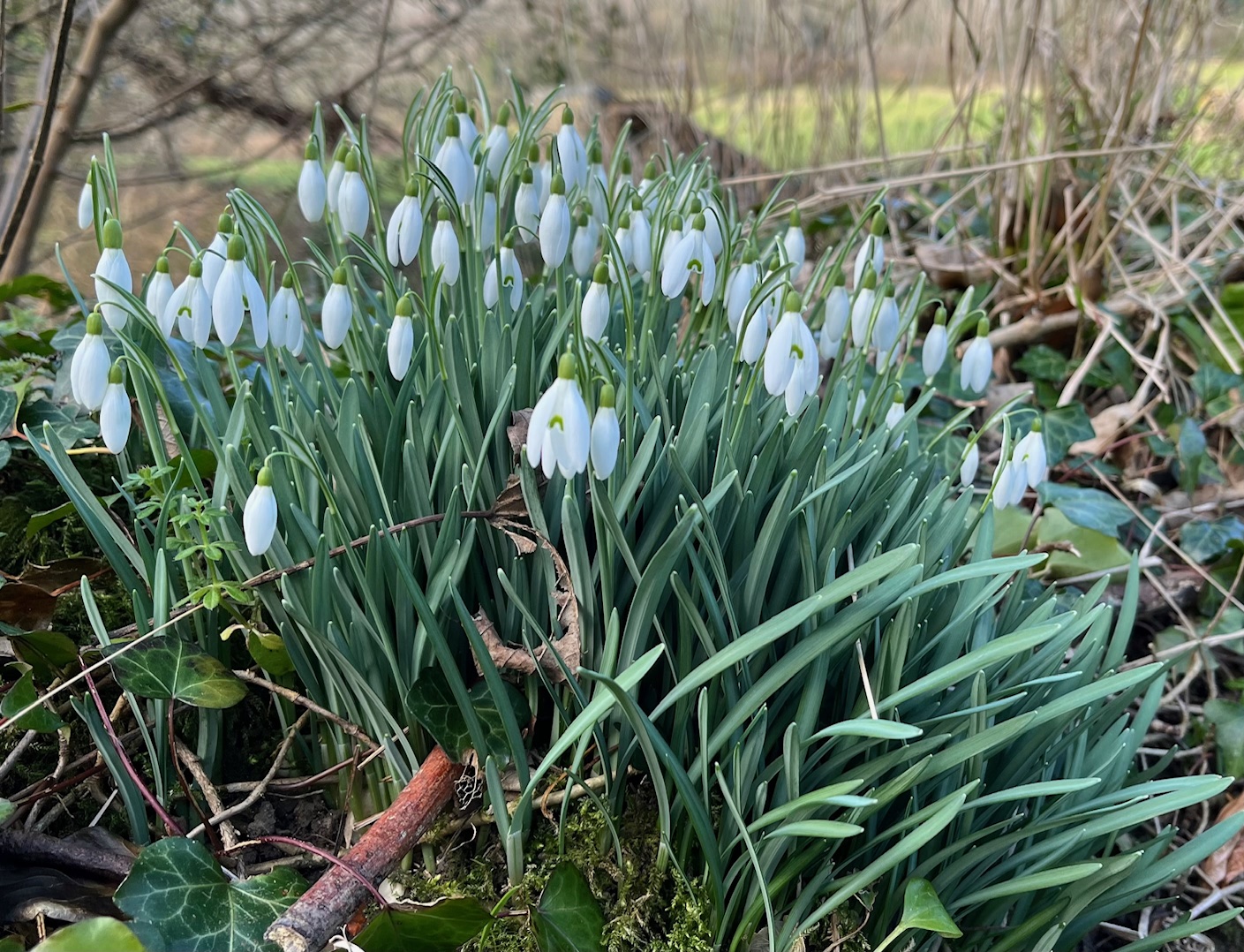
Irrelevant photo: Snowdrops–one of the very early spring flowers. Or depending on how you count these things, winter flowers.


What do we know about the Romans in Cornwall? 

Not much, even with four forts and one possible Roman-influenced etc. Cornwall didn’t make it into Rome’s written accounts–at least not the ones that survived–so we have to rely on archeology, which in turn relies on interpretation. However well educated that interpretation may be, it leaves gaps.

Archeology also relies on digging in the right place and a lot of Cornwall is still un-archeologized.

With all those hesitations in place, the Roman presence looks like this: they came, they saw, they left–right after they broke some pottery, lost some coins, and built some forts and one possible Roman-influenced etc. Or most of them left anyway. The exception to that is one fort and an associated civilian town, which were occupied into the third or fourth centuries, not just for a small handful of decades.

The other forts might have been abandoned because the soldiers were needed in other places more urgently–to deal with uprisings, invasions on the far borders of the empire, efforts to conquer more territory, anything of that sort.


What was Rome doing in Britain anyway?

Britain had minerals, and Rome wanted them. It also had good hunting dogs (yes, seriously) and people, who could be enslaved. Yeah, the good old days. Don’t you just long for them? On top of that, Rome’s emperor, Claudius, wanted a nice little conquest to puff up his CV: it would keep the Legions on his side. 

The Legions? They were the core of his army. If they weren’t happy, they’d make sure that he wasn’t either.

So in 43 CE Rome invaded, but they landed a long way to the east of Cornwall, and a number of hostile tribes and heavy fighting stood between them. We won’t slog through all of that, just say that the nearest major military base (and later Roman civilian settlement) really did end up being in Exeter, which is 45 miles from Cornwall’s border, only they didn’t have cars back then, and the highway hadn’t been built, so those 45 miles were longer than they are now. And part of the route went over moors, which would’ve been hard traveling, so stretch those miles out a little more, please. 


And in Cornwall?

The forts Rome did build in Cornwall weren’t just near the mouths of rivers, they were also close to some of those nifty minerals I mentioned. Cornwall’s best known for tin and copper but has a few other minerals as well. One article mentions silver. Another talks about iron. As I researched this, AI popped up to add slate to the list, and I’ll tell you just the tiniest bit smugly that slate is not now and never has been a mineral. * 

For the record: this blog is written by a human. Every so often I wonder what an AI program would come back with if I asked it to write something in my style, but I haven’t asked. I’m not sure I want to know.

Enough of that. Tin was particularly important in both the Bronze Age (no tin, no bronze) and later, when it was needed to make pewter. Add lead to tin and you can make lovely tableware, jewelry, and statuettes, all of which the Romans liked. While you’re at it, you can give any number of people lead poisoning.

The forts were also close to the mouths of rivers, where they could control (or protect) shipping. I’m going to quote Mike Baskott, an archeologist who gave a fascinating talk to the Rame History Group (Rame’s a Cornish village), “The Romans in Cornwall.”  The talk is online and the speaker’s name isn’t on it, but someone from the group was kind enough to supply it. I’ve drawn heavily from Baskott’s talk. What he said about the forts’ location near rivers is this:

“To me this indicates a strong interest in the protection and policing of maritime trade and indeed in other areas of Britain it can be shown that the Roman navy were responsible for the transport of minerals. Since time immemorial, carriage by water has always been more economical than transport by land.” 

He speculates that part of Cornwall might have been a Roman military zone “under Imperial control.”

The soldiers who occupied the Cornish forts probably weren’t legionaries but auxiliaries–soldiers from other parts of the empire, recruited from tribes Rome had already conquered. Talk about recycling, right? You conquer one people and get them to conquer (or at least help conquer) the next one. 

Why would anyone want to be part of that? Because an auxiliary got paid. And whatever was left of him after 25 years of auxiliaring got a plot of land to farm, along with Roman citizenship for himself and his family.  **


The Cornish experience of the Romans

We know even less about the Cornish experience of the Romans than we do about the Roman presence in Cornwall, but we can piece together a few things. The Roman pattern was to integrate the upper echelons of conquered peoples into Roman civilian and military structures, so we can assume that in Cornwall they’d have combed through those upper echelons for anyone willing to do business. 

An archeologist for the National Trust who gives her name only as Nancy (what is it with these self-effacing archeologists?) argues that the Romans ran into serious resistance in the southwest, an area that includes Cornwall. Look at Devon, the county you have to pass through to reach Cornwall unless you swim. Or sail. Compare the number of forts with the number of undefended villas. Lots more forts than villas. Hmmm. She talks about Devon as the Romans’ version of Afghanistan–a place where the army bogged down. 

Would the same have been true in Cornwall? I’ll give you a definite maybe on that. So far, we can count four forts and only one possible Roman-influenced villa, but we shouldn’t stretch that evidence too far as we reach for a conclusion.

The Cornish had traded with mainland Europe long before the Roman invasion, so this was hardly their first exposure to outsiders, although the sheer number who came with the army would’ve been a shock, as would, Baskott says, ”the Roman army’s use of prefabricated building materials up to 4 to 6 metres in height. . . . The sheer logistical power of the Army, with cartloads of timber, metalwork weaponry and provisions moving backwards and forwards from barges moored at the new dock on the river would have been amazing.” 

But let’s set Roman ruins aside and look at the Cornish ones. What they show about ordinary life doesn’t indicate big changes in the period we’re talking about. Before the Romans showed up, people lived in round communal houses set in enclosed hamlets that were probably occupied by extended family groups. They farmed and their economy was based on barter, not currency. They built massive defensive ditches and ramparts around hill forts. 

Who were they defending against? Dunno. Baskott talks about “other communities who might raid for cattle and slaves.” They also say social standing would’ve been measured in cattle or sheep.

Is this something they’ve determined from what they’ve found or are they importing the social structures of other cultures at a similar level of complexity? I don’t know, but I thought I’d toss a pinch of doubt into the recipe. 

What changed after the Romans came? Not much. Most people continued to live in the old way, although in some places their houses took on a less communal pattern. Some of Cornwall’s hill forts were abandoned during this period. Others weren’t. And some that were abandoned were re-occupied, still during the Roman occupation. 

What does any of that mean? Fuck if I know. 

Baskott adds his own dash of doubt: “When making . . .  comments about settlement patterns I am somewhat cautious, so little excavation work has gone on in the County [that means Cornwall] that where sites have been thoroughly examined . . . these are likely to set the pattern for the whole and therefore the picture can be canted or warped.” 

So let’s not pretend to know more than is actually known.


Fine then. What do we know? 

Less than we’d like. More than we did. The Romans did have a presence, and soldiers, in Cornwall and they were after its minerals. For the most part they didn’t stay long, and even where they did they don’t seem to have had much impact on Cornish life. That makes Cornwall very different from England, where the inhabitants became Romano-British. Cornwall’s residents continued to be Cornish, as did their language.

——————

* I don’t use artificial intelligence to research or write these posts, or for anything else, but since I’m being snooty about AI’s mistakes I should, in the interests of fairness, admit that I once edited a kids’ book whose author tried to slide corned beef in as a grain product. Since this was long before AI existed, I feel safe in assuming that the author was human. And a fool.

** A warning to anyone here who reads English as a second language and wonders why I sometimes use words that can’t be found in the dictionary. I mess around with language. It keeps me from hanging out on the street corner and getting into trouble. Auxiliaring isn’t a word, or not one any dictionary recognizes. It’s me turning the noun auxiliary into a verb to hint at the dreariness of spending 25 years in the Roman army in the hope of still being able to farm by the time you get your plot of land.

Orkney: a bit of history

Orkney isn’t the first place that comes to mind if you’re looking for the center of Britain. It’s small, it’s an island, and it’s way the hell up north in a country whose political and cultural center is way the hell down south. What’s more, it’s sitting in the middle of a lot of water, which is what islands like to do, and the currents around it are fierce. But in Neolithic times, it was a center–maybe the center. It originated a type of pottery called grooved ware that spread across Britain and was the must-have thing of the late stone age. It built the first henges–those stone rings with ditches around them that dot the British landscape–and they also spread south. And yes, they did that before Stonehenge.


The Neolithic

Who were the people behind all that? They arrived, who knows why, from mainland Scotland, bringing their domesticated animals, their grain, and their knowledge of how to farm. Like any early farmers, they would’ve supplemented their diet with whatever they could gather, hunt, or fish. They replaced (or possibly absorbed; I don’t know) a small population of hunter-gatherers who’d reached the Orkneys first, and they set up a society successful enough to last through 60 or 70 generations and to build monuments that are still impressive today. 

Deceptive photo: This isn’t from Orkney. It’s from Cornwall–the opposite end of the country. Sorry. I’d rather cheat than steal other people’s photos.

Their lives wouldn’t have been easy. Most people who survived childhood died in their 30s and few lived to be 50, but somehow or other this relatively small group of people found time to build massive henges and tombs as well as make that elegant pottery. 

Initially they lived in isolated farmsteads but grew into a tribal society, possibly with an elite ruling class, but that implies the possibility that they might’ve lived without one. Until we hear something definite, it’s your choice. Personally, I’ve had it with ruling elites and I’m going for an egalitarian structure. 

We know a lot of this because for the past 20 years archeologists have been excavating the Ness of Brodgar, an Orkney site that was used by those 60 to 70 generations of late Stone Age residents that I mentioned a paragraph or three back. Or if it makes them sound more modern, Neolithic residents. Now the archeologists are about to rebury everything they dug up so painstakingly, and eventually I’ll get around to explaining that, but first, how long does it take to get through 60 or 70 generations? 

About as long as it took to get from the Norman Invasion of England to last Monday afternoon. So offhand I’d say they were more reliable than we are today.


The Ness

The Ness of Brodgar–that bit that’s been explored–covers six acres and only the top level has been excavated. It may be 5 meters deep in places, with newer structures on top of older ones. Tempting as it must be to find out what’s underneath, the only way to do it would be to destroy the top layer and the archeologists have held back. By covering it up, they’ll leave it to later generations of archeologists who, with luck, will have the tools to explore it without wrecking what’s on top. 

There’s another reason to cover it up: the kind of stone it was built with erodes with long exposure to air. 

In the layer they have excavated they’ve found dozens of buildings, including  temples, outbuildings, and kitchens, all linked by paved paths and surrounded by a wall. It’s built on a narrow bridge of land, so you wouldn’t have been able to go around it. You either went in or you turned back.   

Some of the stones, although not whole walls, were painted.

Did I mention that it rubs elbows with two impressive stone circles, the Ring of Brodgar and the Stones of Stenness? Impressive as they are, though, archeologists talk about them as peripheral. The temple complex–the Ness itself–was the most important piece of work. Or as one archeologist put it, “By comparison, everything else in the area looks like a shanty town.”

Archeologist Colin Richards describes it this way: “The walls were dead straight. Little slivers of stones had even been slipped between the main slabs to keep the facing perfect. This quality of workmanship would not be seen again on Orkney for thousands of years.”

Fans of the Ness say it rivals Hadrian’s Wall and Sutton Hoo for for both size and sophistication. Archaeologist Nick Card warns us never to “underestimate our Neolithic ancestors and what they were capable of.”

The Ness doesn’t seem to have been a settlement. It was a gathering place–a ceremonial center–for people from across the Orkneys.

How come Orkney just turned into a plural? It’s made up of some 70 islands. About 20 of them are inhabited these days. So we’re talking about a group of scattered people who would have come to the Ness to exchange ideas and objects, to hold rituals and ceremonies (no one has a clue what their belief system was), and to celebrate. Or as one article put it, to party.


And what happened next?

A lot of stuff, but since this is prehistory we don’t know most of  it. Around 2,300 BCE, some thousand years after building began, the place was abandoned, apparently after a big feast–more than 600 cattle were slaughtered–and the Ness hung out a Closed sign. 

Did a new religion take the old one’s place? Did power shift, drawing everyone’s attention to some other location? Can I think of a third possibility to round out the rhythm of the paragraph? Dunno, dunno, and no.

By the late Iron Age, the Orkneys had become part of the Pictish kingdom, and by the close of the Pictish era Celtic Christian missionaries began to show up. Then the Vikings came and, as WikiWhosia has it, “The nature of this transition is controversial, and theories range from peaceful integration to enslavement and genocide.” Which is one hell of a range.  

Whatever happened, Norwegians–or Vikings if that’s a more familiar way to think of them–settled in the Orkneys and farmed and pretty much took over. Christianity packed its bags and left. Harald Hårfagre–Harald Fairhair–annexed both the Orkneys and Shetland, making them an earldom. We’re going to dance through this lightly and get out fast, but we can probably learn a lot about the culture from the names of a couple of rulers: Thorfinn Skull-splitter; Eric Bloodaxe.

See why we’re leaving?

According to the Orkneyinga Saga, the islands became Christian in 995, when Olaf Tryggvasson summoned the earl, Sigurd the Stout, and said, “I order you and all your subjects to be baptised. If you refuse, I’ll have you killed on the spot and I swear I will ravage every island with fire and steel.”  

So Sigurd said, “Yeah, what the hell, I always wanted a bit of water sloshed on my head. What do we eat when we’re Christians?” and that was that. Or to tell the story a different way, details about the islands’ conversion to Christianity are elusive. 

Fast forward to the fifteenth century, when the king of Norway, Denmark, and Sweden (we’ll call him King I) used Orkney as a guarantee that he’d pay his daughter’s dowry when she married the king of Scotland (that’s King II). So far, so good, but despite being the king of three countries and a whole raft of islands, King I was broke and he didn’t pay, so presto change-o, King II got the Orkneys, which became Scottish. 

That’s feudalism for you. The rich play chess, using the land and its people as game pieces.

You see what I mean about ruling elites?

The shift brought an influx of Scottish settlers and the islands are Scottish to this day, but have retained a lot of Scandinavian influence.

Evolution of the British diet

Let’s start in the Neolithic Period–the New Stone Age, around 4,000 BCE–because that’s when my alarm clock woke me up this morning. By the time I got myself and the cats fed, it was 3,000 BCE and time to feed the dog. More to the point, though, Britons had started building Stonehenge and we’re going to draw heavily on the archeology of the place. 

Why Stonehenge? Because at nearby Durrington Walls archeologists have found a settlement from the same period where people gathered and feasted and left all sorts of clues to what they were eating. 

A very rare relevant photo: This, my friends, is food, although not Neolithic. The leeks (at the back) are grown in Cornwall. I can’t vouch for the others but there’s a good chance the cauliflower was as well. The red cabbage? Possibly. The plastic box? Not edible.

The Mesolithic and Neolithic eras

In the Mesolithic Era–the Middle Stone Age–people were hunting and fishing and gathering, as they continued to do in the Neolithic. So they ate meat, fishy-type things, roots, leaves, mushrooms, fruit, and whatever was available and not poisonous. 

Even then they knew that poisonous was bad. The probably knew it better than we do.

But once they got to the shiny New Stone Age, not the boring old middle one, people had domestic animals (they were brought to Britain from Europe–or what would later be called Europe). So Britons were raising sheep, cattle, and pigs, and they were growing wheat and barley. They could add all that to whatever they hunted, fished, and foraged.

The official date for the beginning of farming in Britain is 4,000 BCE, and it marks the beginning of the Neolithic, although some enterprising soul found evidence of wheat being in Britain a couple of thousand years earlier. The current best guess is that it was brought by traders and not farmed locally. What’s now the English Channel was still land, so Britain was attached to Europe and people wouldn’t have had to get their feet wet to drop by the neighbors’ place with a sack or two of wheat.

Okay, we don’t know what happened. All we know is that some has been found. Have fun making up your own story. The rest of us can go back–forward, actually–to the Neolithic. 

At Durrington Walls, archeologists have found some 38,000 discarded bones, which came from at least 1,000 animals. Some 90% are pig bones, most of the rest are cattle. By analyzing the bones and teeth they’ve put together a picture of what happened there, and they don’t indicated year-round eating. Many of the pigs were slaughtered when they were around 9 months old, and since they would’ve been born in the spring that indicates midwinter eating. This fits with Stonehenge’s alignment with the midwinter (and midsummer) sun. Ditto with the alignment of timber monuments at Durrington Walls itself. 

Meat was left on many of the bones, indicating an abundance of food. This was feasting, not everyday eating. 

The animals weren’t raised locally. Some came from Wales, some from Scotland, some from northern England. I’m not sure that’s the full list. 

What else would they have eaten? These were people who raised grain but not on a large scale. They’d have also gathered wild plants and hunted. Milk products would’ve been part of their diet–about a quarter of the pottery fragments show evidence of dairy products–although they would mostly have been processed ones, not milk itself, since the people were lactose intolerant: they couldn’t digest unprocessed milk. They’d have made the milk into cheese, yogurt, and butter, and there’s some evidence of milk in one of the timber circles, so it may have been an offering to the god of milk digestion, which is why we can now buy lactose-free milk in the supermarkets. 

Don’t put too much weight on the last part of that sentence, okay? I made it up and I’ve learned not to take anything for granted.

It’s easier to find evidence of the meat people ate than the fruit and veg, which don’t leave bones behind. That may be why the myth of a meat-heavy paleo diet caught on. It’s also why that part of the discussion is sketchy.

Moving on

By the time we get to the Bronze Age (that’s 2200 to 800 BCE, give or take a few hundred years on either side), people were growing a wider range of crops. We can add peas, beans, and spelt (a form of wheat) to both their fields and their menus. People were crystalizing salt from seawater. And at least those who could afford to would’ve had metal cooking pots. 

Once we move into the Iron Age, which runs from the end of the Bronze Age until the Romans invade in 43 CE, we–or, more accurately, those clever archeologists–find the first chicken bones in Britain. 

For most people, though, grain–wheat and barley–would probably have made up the bulk of their diet, so figure bread, porridge, beer. Add to that–and this is my addition; I can’t quote a source for it–whatever they could pull out of the water or off the land: fruits, nuts, leaves, flowers, tubers, fish, and game. But don’t forget the beer. This is England we’re talking about. The earliest evidence of beer is from 400 BCE. 

The general assumption is that the Roman invasion brought wine and grape vines to Britain, but amphorae–those Roman jars with pointy bases–have been found at some late Iron Age sites, suggesting that wine and olive oil were imported earlier than that. More than one British tribe traded with the Romans.

The Roman invasion

The Romans brought rabbits, pheasants, brown hare, dates, cabbages, leeks, onions, turnips, grapes, walnuts, garlic, pepper,basil, thyme, and other goodies to Britain.

Wait, though. Thyme grows wild here, and if you ask Lord Google if it’s native he’ll say yes. Ask if it was imported by the Romans and he’ll say yes again. Ask if he’s contradicting himself and he’ll stop speaking to you. My best guess is that yes it was imported and then yes, it went wild. That makes it sort of native. 

Actually, what does native mean? How far back do you want to go? Think about it long enough and your mind will melt. Leeks are native enough that they’re a national plant of Wales. The story is that King Cadwallader had his soldiers tuck a leek in their helmets so they could identify each other when they fought the Saxons. Since the average modern leek weighs a third of a pound (that’s 150 grams; Lord Google knows stuff like that and if he’s still speaking to you is happy to share), it’s a safe bet that the leeks of the time were smaller, lighter, and less absurd when worn in a helmet. 

(In the version I found when tracing leeks via Wales instead of via England, Phoenician traders introduced them. The Romans don’t get a mention. It’s all a little hazy if you go back far enough.)

You won’t get the full list of foods the Romans introduced here–there were more than 50 and I can’t count that high–but others include Alexanders (a forerunner of celery which has also gone wild), figs, apples, pears, cherries, cucumbers, lentils, dill, and fennel. And edible dormice, which they, um, ate. (The hazel dormouse is native to Britain–whatever native means.)

Some of these foods would have made their way to Britain with traders before the invasion, but the pace would have picked up once you had Roman soldiers and administrators on the island, along with whatever other Romans came in their wake and the Britons who adopted Roman ways.

The Middle Ages

The next big bump in food diversity comes in the Middle Ages, when the Crusades brought Europe smashing into the Middle East. The new foods included sugar, dates, raisins, figs, pepper,cinnamon, cloves, nutmeg, ginger, saffron, cardamom, coriander, cumin, garlic, turmeric, mace, anise, caraway, and mustard. Some of those had come over with the Romans and, presumably, dropped out of use when the Romans packed up and left. 

Spices and sugar were the wildest of luxuries and not for the likes of us. Most or all the novelties stayed on the tables of the elite. Grain was the mainstay of peasants’ diet. Look around the internet and you’ll get the usual raft of contradictory information, but leeks and cabbage get a mention. Meat was probably rare. Hunting was restricted to the aristocracy, and often fishing as well. They would probably have still been able to forage wild berries and leaves–and possibly nuts. It would’ve all been regulated by local feudal arrangements.

And after that

Domesticated (as opposed to wild) carrots wandered into England in the Tudor era. Wild carrots are edible but woody. The seeds and flower heads are also edible but the plant’s easy to mistake for poisonous things like hemlock, so don’t try this at home, kids.

The Tudor era (1485 – 1603; you’re welcome) also brought turkeys, or at least the first record of them being raised here. It also brought potatoes, cauliflower, tomatoes, and rice. The tomato was treated with suspicion for a couple of hundred years–it was poisonous; it wasn’t poisonous but was best eaten in hot climates; it would kill aristocrats. 

That belief about tomatoes killing aristocrats didn’t arise because tomatoes are the stereotype of the wild-eyed anarchist. It came from the action of a tomato on a pewter plate: the acid in the fruit will leach out the lead, giving the eater lead poisoning. When I read that, I was prepared to argue that the aristocracy used silver plates and it was only lower down the scale that you found pewter, but (annoyingly) I seem to have been wrong.

The first description of red cabbage in England dates to 1570. A couple of sites I find credit the Romans for introducing it to Europe in (are you sitting down?) the 14th century. I’ve found white cabbage being credited to both the Romans and the Celts. I’m sure there’s someone out there who credits interplanetary explorers with its spread across the galaxy.

The internet’s a strange old place. Let’s move on.

Pineapples were introduced in 1600 but weren’t cultivated in Britain until 1700. (They’re not a great fit for the climate.) They were very much a prestige item for the upper class. Coffee and tea were introduced in the 1600s, giving insomniacs something to blame in the middle of the night. Instant coffee was invented in Britain, by the way, in 1771. It has been improved and reformulated in multiple countries and decades and still tastes terrible.

Broccoli joined the party in 1700, chocolate bars in 1847, and canned baked beans in 1886. Or 1869. Who cares? They were hyped as a luxury and sold by Fortnum & Mason for £2 a can–the equivalent of £170 in 2019 pounds. If you need that in US dollars, it’s a lot of money. By 1924, the price had settled down to 12 shillings–the equivalent of £25. Yeah, I know. Baked beans. The hype may explain the central place they still hold in British hearts and stomachs.

Something has to. 

I don’t usually post more than one photo, but I was afraid you wouldn’t believe me about baked beans. Look at that label: “not a want but a need.”

Food was rationed during World War II, and rationing lasted until 1954. That may or may not be where Britain got its reputation for bland, repetitive, snoozeworthy food, but it certainly helped. On the other hand, people’s diets were healthier than they are today, if a lot less fun, and the poor ate better than they had before rationing. 

When rationing was lifted, burger bars opened around the country, selling hamburgers and milkshakes. Chinese restaurants opened, followed by Indian ones. (Keep complaining about immigration, people. It’s brought the wonders of the world to your doorstep.) 

You’ll notice that we’ve shifted from what’s grown and what’s cooked at home to food cooked outside the home. The 1950s mark the beginning of eating out being fairly common.

Spaghetti landed in Britain in the 19th century and was ignored until the 1960s, when it became the height of sophistication. It was rare enough that the BBC got away with an April Fool’s Day spoof documentary on the spaghetti harvest, showing a family cutting strands of spaghetti from bushes and laying them in the sun to dry. Not a few people got in touch to ask where they could buy spaghetti a bush.

Which seems like a good place to leave you. Be respectful of your spaghetti, please. A lot of work went into picking it. 

Was Iron Age Britain matriarchal?

No one can give us a solid answer, but we do have some hints. A group of geneticists and archeologists have analyzed a cluster of burials in Dorset and report that they show a matrilocal society. In other words, the women stayed in the village and the men moved out when they married, being replaced by men from outside, who married in. 

The tribe–the Romans called them the Durotriges; we don’t know what they called themselves–didn’t cremate their dead, which was unusual for the time and place. From around 100 BCE–more or less 150 years before the Romans invaded–they buried them in the hills around their farmsteads, leaving an important resource for archeologists.

Who cares? Pretty much everyone who was involved in the arrangement, and I can’t think why we shouldn’t as well, because it tells us a lot about the roles of the men and women. Or–hell, let’s throw out a patriarchal habit that’s so deeply ingrained it’s damn near invisible and say “the roles of the women and men.”  

Semi-relevant photo: This is Fast Eddie, who’s relevant only because we’ve been told (sort of) that women with power become childless cat ladies.
Okay, I’m stretching it, but hey, he’s a great cat and I needed a photo to drop in here.

Does it matter who stays and who goes? Yup, it does. The partner who stays in place has the unbroken support of an extended family. The one who comes in comes as an outsider and an individual, without that built-in support. They may acquire it over time, but they may not. And if the tribe considered land as something a person could own–they were farmers, so let’s guess that they did–then land ownership is likely to have been held by the person who stayed in place. It’s awkward, taking land with you. So it would presumably have been passed down through the female line.  

Matrilocality also means–or at least hints–that women would have the primary shapers of the group’s identity. 

It’s kind of mind-boggling, isn’t it? 


How do they know any of this?

DNA. Mitochondrial DNA is passed down from mother to daughter, making matrilocality relatively easy to trace. The Y chromosome is passed from father to son. Everything else is a grab-bag.

Geneticist Dr. Lara Cassidy, said, “This was the cemetery of a large kin group. We reconstructed a family tree with many different branches and found most members traced their maternal lineage back to a single woman, who would have lived centuries before. In contrast, relationships through the father’s line were almost absent.

“This tells us that husbands moved to join their wives’ communities upon marriage, with land potentially passed down through the female line. This is the first time this type of system has been documented in European prehistory and it predicts female social and political empowerment.”

The find casts a new light on smaller samples from other cemeteries, where the same pattern shows up: most of the individuals trace back to a small set of female ancestors. Dan Bradley, a professor of population genetics, called it “a widespread phenomenon with deep roots on the island.” 


This changes the way earlier information is interpreted

The first thing it changes is the earlier discoveries of Celtic women buried with what archeologists call rich grave goods–what we might call stuff–mirrors, combs, the occasional chariot. The standard interpretation is that these were the burials of high status women. Fair enough, but that tells us nothing about why they had high status and I’d bet a chocolate cake that most people reading it will think, Right: wives of important men, just like most people would write men and women, as I started to in the second paragraph, instead of women and men. Old, nearly invisible thought patterns, underlining the importance of men, the peripheral status of women. But if the village’s continuity was in the hands of its women, it’s not unlikely that much of the power was as well. Or–let’s go out on a limb and see if we fall off–possibly all the power. 

It’s a safe limb to go out on, because we can’t know. So don’t take the possibility as fact but don’t dismiss it either. We do have some facts that make it look likely. The Durotriges men were buried with a joint of meat and maybe a pot with something to drink on their way to the  afterlife. Many of the women were buried with mirrors, combs, jewelry, and the occaisonal sword. 

All this comes with a reminder that being buried with expensive stuff may or may not indicate that the person was a leader. To make that leap, we need to go back to those Greek and Roman texts, which takes us neatly to the next paragraph:

The second thing the new findings change is how we read what Greek and Roman writers said about pre-Roman (or Iron Age if you prefer) Britain. The Britons, inconsiderately, didn’t develop a system of writing, so yeah, they didn’t leave written records. We have to depend on what outsiders wrote.

The written sources tell us the Romans were shocked to find women in positions of power. They inherited wealth, led battles, and practiced polyandry–the flip side of polygamy, with the woman having more than one husband. Going both further back and to Celts outside of Britain, ancient Greek writers said women’s and men’s tasks “have been exchanged” and Celtic women acted as “political judiciary.” (That last quote is from an article in The Conversation, not an ancient Greek source. I’m leaving you to figure out what political judiciary means.) 

For a long time that was widely dismissed on the theory that the Romans overstated British women’s freedom and power to make the country sound barbaric. Because surely we can’t take that literally? It upends too many of our assumptions. But this latest find makes it look like they were reporting accurately. It undermines the idea that pre-Roman Britain was a land where men were hairy-chested warriors and women stayed home and did what a much later culture expected them to do. You know, look in their mirrors, comb their hair, and stay the hell off those chariots.

Were all early societies matrilocal or matriarchal, then?

Nope. Early Bronze Age Orkney was patrilocal: the men stayed put and the women moved to other communities. And early iron age Hallstatt graves in Austria showed men and women equally achieving high status. Middle Iron Age British burials show men and women having equal status. Age seems to have been more important than gender in giving them status.  

A rampage back through 150 British and European genome studies in light of the Dorset findings shows the diversity in mitochondrial DNA declining over a period that spans the Stone, Bronze, and Iron ages. To translate that, increasing numbers of women stayed in place as time went very slowly on. 

None of this gives us a simple picture, or even a decisive one, but it does mean that patriarchy hasn’t been in place since forever and isn’t built into our DNA.

Bathing in the middle ages

You how everybody says people in the middle ages didn’t bathe? Well, ahem, they did, and I seem to have contributed my small bit to our collective misbelief. Apologies. I fell for an urban myth.


So they did wash?

They did. They understood that water was wet, that dirt was dirty, and that if they brought the two together in the right way they could walk away clean.  

There were problems, however. They didn’t have hot water waiting around for them. Water in its natural state–in other words, as it comes from the well, the lake, the river, or the ocean–has this habit of being cold. And since the first recorded stove in Europe (or possibly anywhere else–please don’t complicate this) was built in 1490 in Alsace, we can pretty safely say that they were stuck heating water over an open fire if they wanted it in anything other than its natural state.

But we’re not done yet. Water has another habit: It’s heavy, and if you can’t convince it to come to the place you want it, you have to carry it. In other words, a lot of work was involved in getting clean.

Medieval illustration of people bathing. With thanks to  Going Medieval, which I’ve borrowed this from. I don’t usually do that, but medieval illustrations are out of copyright. Great website. You’ll find a link elsewhere.

The simplest way around the problem was to bring yourself to the water. The human body may be something like 60% water, but it has legs and people used those legs to carry themselves to whatever user-friendly body of water was nearby. Then they tossed themselves in. That would’ve been more appealing, though, in the summer than the winter. England isn’t the Arctic but it does get cold enough to make even a quick dip off-putting. So people also washed at home, even if it did mean carrying the water.

For most people, washing at home meant pouring water (cold or warm) into a basin and taking a cat bath–water, cloth, rub till clean, done. It’s still a good bit of work but it limits the amount of water you need. Some might’ve had wooden tubs they could set by the fire for the occasional bath.

People also washed their hands and faces before meals. 

The rich could afford full, luxurious baths, involving wooden tubs, servants carrying warm water, a large cloth tented over the top of the tub, and scented herbs to enhance the, ahem, bathing experience–thyme, sage, things like that. Breathe out, relax, let the hard work of oppressing the peasants fall from your shoulders.

Ahhhh.

King John (1199 – 1216; you’re welcome) liked a bath well enough that he traveled with a his own personal bathtub–and the attendant who was in charge of it. (Making sure all that water was heated and carried at the right time would’ve taken some choreography, so I don’t expect that would’ve been a simple job.)

As for wealthy monasteries (they weren’t all wealthy, although some were fabulously so), they often had piped-in water–a signal of how much it mattered.


Soap

Medieval Europe had soap, something the Romans, for all their bathhouses and their reputation for cleanliness, did not. The Romans oiled their skin then scraped away the oil and the dirt with it. 

Luxury soap came to medieval Europe from the Middle East, brought by Crusaders and traders. The Crusades created an earthquake in the Middle East and we’re still feeling the aftershocks, but they brought Europe a lot of nice stuff and some startlingly wonderful ideas, including Arabic numbers, which first made it to Europe in the 10th century and swept away the clunky Roman system. 

But we were talking about soap: France, Italy, and Spain began manufacturing the stuff, and eventually England did too. Most people, though, made it at home.


Bathhouses

So much for washing at home. Your average medieval town or city would’ve also had a bathhouse, and these were social places as much as get-yourself-clean places. Many were built next to bakeries to take advantage of the heat from the ovens. In medieval illustrations, you can find people sitting in large wooden tubs, eating from boards placed across them to form tables. So yes, social spaces.

Southwark (that’s in London, although at the time it wasn’t) had 18 bathhouses. 

But wait. While many bathhouses were just bathhouses, some were brothels. Yes, you could take a bath and all that, but you could do a lot of other things as well. You know how it is: in a culture where people are expected to go around wearing clothes, once they take them off they start getting all sorts of ideas. All those lovely bathhouses in Southwark? They were concentrated there exactly because it wasn’t part of London, with its laws and regulations. They were called the stews, and they were brothels. Most of them were owned by the Bishop of Winchester. 

C’mon, an honest cleric has to make money somehow, doesn’t he?

I can’t swear that all the Southwark baths were brothels, but most of them were.

But again, most bathhouses were places to take a bath. The sources I’ve looked at don’t agree on how often people would have visited or how likely they were to heat their wash water at home. They’re drawing on very partial information and putting it together in the best way they can. I’m happy to stay on the sidelines and let them slug it out. 


So why have we believed medieval people didn’t wash?

You notice how neatly I swept you up into the mistaken belief system I just abandoned? Of course you believed what I did. I know I’m not the only damn fool around here.

I can come up with several reasons we fell for that.

One, sanitation genuinely was an issue. In the later middle ages, in the interest of cleaning things up, a lot of towns built public latrines, but let’s not get carried away with how much of an improvement that made. What were the most convenient places to build them? Why, on bridges so the water could take the waste downstream. Problem solved, right? All that nasty stuff goes away, and the system works as long as no one upstream had the same plan and the people downstream can’t find  you. 

When this becomes a national strategy, you won’t want to use the river for your drinking and bathing water and you might want to worry about your water table.

Two, the sources that have come down to us are both partial and contradictory, but some writers warned against excessive bathing. In her Going Medieval post, the historian Eleanor Janega argues that this was less about bathing that “hanging out naked in bathhouses with the opposite sex.” Which was sinful. 

You can leave your money at the door and the bishop will collect it, thanks.

(Janega’s website is both informative and good reading.) 

On the other hand, at Medievalists.net, I read that medieval English writers considered the Vikings overly concerned with cleanliness since they took a bath once a week.” But the site also acknowledges sources that show bathing as “part of daily activity” and that health manuals “explained that it was important to keep the entire body clean.”

At least for medical writers, bathing was something to approach with caution. It could relieve indigestion and stop diarrhea, but if you did it wrong it could lead to weakness of the heart, nausea, or fainting. Excessive bathing could lead to fatness and feebleness. One writer advocated bathing in the spring and winter but not, if possible, in the summer.

Autumn? Sorry, all these centuries later the jury’s still out on that.

Three, we have documents making it clear that assorted saints and extreme religious sorts didn’t bathe, or didn’t do it often, but Janega (yes, her again; she’s handy) argues that this was about denying themselves a worldly pleasure in the quest for salvation: get dirty for god. So instead of canceling out the sources that say people bathed regularly, this reinforces them.

Or it may.

Westminster Abbey required its monks to take a bath four times a year, which, um, may not sound excessive to us. What does it mean, though? Hard to say. It might’ve been a minimum, addressed to the dirty-for-god types. It might’ve been the general expectation, which some people exceeded. But they did pay a bath attendant two loaves of bread a day plus £1 a year, which makes it sound like he worked year round.

Four, from around 1500 to 1700 (public health warning here: this paragraph is thinly researched), Europeans came to believe that water spread disease– especially warm water, which opened the pores and let all those nasties in. Given the state of the rivers, they may have been onto something. That bit of information made its way down to modern ear and we treated it like butter on warm bread and spread it back a few extra centuries.

*

I’m indebted to 63mago for challenging my lazy assumptions on medieval cleanliness and sending me down what turned out to be an interesting rabbit hole. 

A quick history of the English longbow

England’s not-at-all-secret weapon against the French during the Hundred Years War was the longbow, and if you believe whatever gunk artificial intelligence scrapes off the internet floor, it’s a symbol of English pride. Which makes this a good place to mention that it came to England by way of Wales.

A very rare, nearly relevant graphic: An archer and some dead guy., both in the style of the Bayeux Tapestry, which depicts the Battle of Hastings, which in turn is mentioned below. Courtesy of a free app that lets you design your own Bayeux-style Tapestry. No skills in needlework required. Are you worried that you might use your time too usefully? I heartily recommend this app. You can get lost in it for hours while accomplishing next to nothing.

A bit of background

Longbows have been around since neolithic times. Or paleolithic. Or–well, choose your source. A long time. That’s close enough for our purposes. So if England can’t claim to have originated it, neither can Wales. But it was the Welsh who brought it to the attention of the English by shooting them with it when they invaded, starting in the eleventh century and continuing into the thirteenth.  

Once it had Wales under its control, England conscripted Welsh archers into its armies to help invade Scotland, and it adopted the weapon itself, encouraging the English to train with it.

Did I say “encouraged”? I lied. Starting in 1252, all English men between 15 and 60 were required to train with the longbow once a week. Since the average lifespan of a man in the Middle Ages was 49, that meant he was required to train for 11 years after he died. Life wasn’t easy back then, and it doesn’t look like death was either. 

Why all that training? You can’t just pick up a longbow and expect to be any good with it. You train. And you train some more. And you keep in shape by doing some more training. The effect on the muscles and bones is powerful enough that archeologists can spot archers by looking at their skeletons, assuming they’re well preserved. 

Archers were so important to England’s armies that when Edward I (1272 – 1307; you’re welcome) banned all sport on Sundays, he made an exception for archery. All that emphasis on training explains why so many places in England are incorporate the word butts into their names: butts were the fields where men practiced archery. 

The longbow vs the crossbow

A longbow stood around six feet tall, making it taller than most men of the period, and a skilled archer could shoot a dozen or more arrows a minute. A crossbow might get off two or three shots in that time. (Those numbers will change depending on what source you consult; I’m going with conservative estimates.) 

At distances, the longbow wouldn’t have been as accurate as the crossbow, but if a mass of longbowmen were shooting at a mass of advancing horsemen or foot soldiers, they wouldn’t need whites-of-their-eyes accuracy. They’d shoot off a mass of arrows that fell close together on a tightly packed enemy.  

The longbow was cheaper to make than the crossbow, and its arrows flew almost as fast, which translates to hitting almost as hard. They could penetrate medieval armor. And they didn’t need the support team that helped a crossbowman cock the weapon and maintain it.

Crossbowmen were paid well, which if you happened to be counting up your pennies to see if you could fund an invasion of France would weigh heavily in favor of the longbow. 

Weighing against the longbow was the muscle power involved in drawing it. Factor in the archer’s exhaustion after marching and fighting and “only 10% of medieval archers would be effective at a range of 200 yards after just a week of campaigning,” according to an article from the John Moore Museum.  

Although the crossbow looks high-tech compared to the longbow, it dates back to 650 BC China. It spread from there to Europe, although it seems to have dropped out of use between the 5th and 10th centuries, when the French began using it again in sieges and at the Battle of Hastings, where the Normans conquered England, although if there’s a picture of one in the Bayeux Tapestry I haven’t spotted it. It continued to be the preferred military weapon in Europe for a good 500 years. Only England committed itself to the longbow. 

The Hundred Years War

With all that out of the way, what happened when the longbow went up against the crossbow? The Hundred Years War is our test site.

The Hundred Years War,  you should understand, lasted from 1337 to 1453, which is not a hundred years. The extra years came from one of those supermarket sales–116 for the price of 100. Who could resist, even if the extra 16 did go moldy in the refrigerator? The conflict was about land–how much of France France got to control and how much England could claim–and whether the English king could claim the French throne.

Yeah, I should do a post about it one of these days.

At the Battle of Crecy (1346), the English (longbow) defeated a much larger French force (crossbow, wielded by Genoese mercenaries). Popular belief holds that the crossbow shots fell short because the archers’ bowstrings were wet. 

Wasn’t it raining on the English too? Well, yes. Weather doesn’t play favorites and wet bowstrings lose some of their elasticity regardless of the bow they’re strung on. I’ve met people who say the English kept their bowstrings dry under their hats. I’m doubtful, since as soon as they came out they’d start picking up moisture, but feel free to choose the story you like and stand by it. It was a long time ago and no one’s likely to prove you wrong. Before you choose, though, I should toss in an alternative theory: the crossbowmen misjudged their distance because they were facing the sun. 

The sun does play favorites.

We do have an established fact, though: the French cavalry charged through their own bowmen, which didn’t improve their effectiveness or their health. According to one account, French knights hacked down the crossbowmen when they got in the way. Because bowmen were commoners and knights were aristocrats, or at the very least gentry, so what the hell, no one was going to hold them to account. 

The English held off 16 cavalry charges, spilled a lot of blood, and won a blue ribbon and history’s congratulations to the victor.

But let’s not slog through all 116 years battle by battle. I’m easily bored. We’ll jump to the Battle of Agincourt, in 1415. Again, smaller English army, larger French (and German, but never mind that) one. Longbow vs. crossbow. Rain, although nobody seems to talk about its effect on the bowstrings here. French knights getting killed mid-charge by a hail of arrows. English victory. 

More to the point of this post, longbow victory.

And after that?

The role of the crossbows shifted primarily to defensive warfare. If you wanted to defend a castle (or anything vaguely castle-like–a city wall might work) against a siege, the crossbow’s longer range would be useful.

But both gave way to the musket and the gun. The longbow was last used in warfare in 1644 during the English Civil War–in Scotland.

What was the English Civil War doing in Scotland? It’s complicated. And it’s a whole ‘nother story. Let’s settle for saying that it was a war that broke a lot of rules. 

Before it lost out to gunpowder, though, the longbow played a role not just in warfare but in fucking with feudalism. Nobles and all their friends and relations had been the bedrock of the military, with their horses, their armor, and their swords. They were the knights–the essence of power. Then along came these commoners with their relatively cheap-ass bows and guess who was more powerful.

That wasn’t enough to put an end to feudalism, but then a social and economic system doesn’t end from one lone change. It was a teaspoonful of sand poured onto the scales, where it joined an assortment of others. And I’m sure it put many a knightly nose out of joint.

Life in a medieval house

Ever looked at a picture of some centuries-old house–or for that matter, at the real thing in all its hand-built glory–and gotten all misty-eyed, wondering what it was like to live there? Well, thanks to a street of 650-year-old houses and a plan to update them, we can inch a little closer to the answer. The update plan led to a newspaper article. The newspaper article led to my hunch that you might be interested in reading about it.  

The houses are owned by Wells Cathedral and for all their 650 years they’ve been lived in by the singers in the cathedral choir. They’re on what’s believed to be the most complete and continuously occupied medieval street in Europe.

So what’s it like to live there? Cold. According to one resident, “The windows leak £10 notes every time you put the heating on . . . and [enough with the metaphors] the roof leaks actual water.”

Irrelevant photo–except that it was cold enough overnight to leave frost on the fields.


The original houses

When they were first built, the roofs wouldn’t have leaked, but the windows surely would have let the cold air in. And the warm air out if any was available. Before chimneys, smoke from the hearth had to find its own way out, taking any available warmth with it, so if an airtight house had been possible it would’ve been a health hazard. 

Even with the leaks, though, indoor life was smoky. That was a problem for anyone who relied on breathing, but if you wanted to preserve your–or someone else’s–voice it would be particularly problematic, which may be why Wells Cathedral was ahead of the curve. Chimneys weren’t common until the 16th or 17th centuries, but chimneys were added to the choristers’ houses in the 15th century, along with water pipes. 

This meant that, cold or not, the houses would’ve been miracles of convenience. So let’s set aside our notions of comfort. They’re not a good match for the era we’re talking about.

The houses originally had two rooms each and were built for single men.

Men? Yes. The choristers were all male, with boys singing the soprano parts. The buildings housed altos, tenors, and basses. I’m not sure where the kids lived. They were small. Maybe someone stacked them in a cupboard when they weren’t in use.

It wasn’t until the Reformation that the cathedral broke through some walls to double the houses’ size and make room for families, and it wasn’t until very recent times that soprano parts have been opened up to girls and (gasp) grown women–and even now (I believe) that’s only true in some choirs. 

If the houses weren’t built for families, does that mean pre-Reformation choristers were expected to be celibate? Apparently so, with the emphasis on expected.

Before the houses were built, the choristers lived in town, and the idea was that corralling them in one place would keep them from worldly temptations, by which the churchly fathers meant sex. It must not have worked (I know: that surprises you), because in 1459 (the houses were first occupied in 1348) the church added a bridge to the cathedral so that on their way to work the singers wouldn’t have to rub shoulders, even briefly, with real people and all the temptations they presented. 

As the current cathedral dean explained it, “They started to get into trouble with what they termed ‘incontinence,’ which meant getting involved with women.” A BBC video tour and explanation, which is worth watching, also mentions problems with singers not showing up on time. Move them all next door to the cathedral, though, and they couldn’t say, “I’d have clocked in an hour ago but traffic was backed up halfway to Bristol.” 

The singers ate in a common dining room. That lets us imagine strong community bonds among people working and eating together and living next to each other. It also lets us–or me anyway–imagine living with the constant presence of some busybody, either another singer or a church official, tracking everyone’s comings and goings, watching for the faintest hint of a sex life. 


The current houses

The current residents don’t own or rent the houses, and not all the residents are singers; some are cathedral employees of various other sorts. The houses are what’s called grace and favour houses. They come with the job. 

At some point kitchens were added, but residents say the sense of community remains.

The cathedral has gotten a grant of £4.4 million for repairs but needs to raise an additional £1.9 million to start the project. Which is, in case you haven’t noticed, a lot of money. 

Is it worth it? The cathedral’s dean would argue that it is. “The roofs are failing,” he said. “The guttering is failing. The windows are failing. If we don’t look after this treasure, we’re going to lose it. The stakes are that high.”

A new theory about Stonehenge

The recent discovery that one lone piece of Stonehenge was brought some 700 kilometers, either overland or by sea, from northern Scotland has led to a new theory about the monument’s purpose: that it might’ve been built to unite the island’s early farming communities at a time of cultural stress. 

The monument’s stones come from Wiltshire, Wales, and Scotland. And they were set in place some 5,000 years ago, when (I remind you) the art of trucking hadn’t yet been perfected. Or invented. 

Even the most conveniently located stones had to be hauled more than 20 kilometers, so this was already a major commitment. I’d hesitate to move those beasts from my neighbor’s front yard to mine, and we’re within spitting distance of each other. So 20 kilometers? I’ll pass, thanks.

What I’m saying here is that a society committing to haul huge stones over long distances screams for an explanation. I mean, it’s not like the local shops had run out of stone.

Semi-relevant photo: I doubt much in this photo has changed since Stonehenge was built. Except that cameras were invented.


Cultural stress

The theory we’re playing with here belongs to archeologist Mike Parker Pearson, and the cultural stress he’s talking about is the arrival of a group of people who were new to Britain and are believed to have introduced metalworking to the island.. They’re known to us as the beaker people, after–um, sorry, we’re sort of going in circles here–the distinctive decorated beakers they made. 

What’s a beaker? In this case, a piece of pottery. The beakers were important enough that they buried them with their dead.

What do we call the earlier inhabitants? Good question and not one I can answer. All I’ve seen them called is Neolithic farmers, which is kind of generic but, sorry, I don’t make the rules, I only make fun of them.

The beaker people migrated into Britain from Europe, and the two cultures would have met, rubbed elbows, and–

Well, we have no idea what they did. Got roaring drunk, told each other lies, and traded songs? Fought? Circled each other warily? Could’ve been any of that, or all of it at different times. They don’t seem to have slaughtered each other, though. Not only have fewer markers of violence been found on skeletons from this period than on skeletons from the Neolithic, there’s also not much evidence of the extensive burning or destruction that would go along with warfare.

This is roughly the time when Stonehenge was built. Or, to be more accurate about it, rebuilt. If you’d lived near Stonehenge for a few thousand years, it would’ve been like having a family member who couldn’t leave the living room furniture in one place and also had to repaint, redecorate, and reconfigure regularly. And convinced everyone to pitch in. In other words, the place was changed significantly over time. What we’re talking about is the version of Stonehenge that we know. Let’s call it Stonehenge 2.0.

Parker Pearson’s theory is that it was built to bring people together–or “assert unity.”

If you want backing for that theory, consider the stone from Scotland. Unlike its more photogenic friends, it lies flat, not because it fell and hasn’t been set upright but because it was meant to be that way. And northeastern Scotland has a number of stone circles where the stones that were set in place that way. So the builders seem to have brought down not just a huge, heavy stone but a tradition.


What happened next

As usual when we’re talking about archeology, we don’t know the whole story, but in this case we get a particularly confused picture. The Neolithic farmers tended to cremate their dead, keeping them safe from the nosy archeologists who they knew would eventually come snooping around. That means we don’t know who lived where or when. 

What we do know is that the beaker people ended up largely (and slowly) replacing the original inhabitants, creating a 90% shift in Britain’s collective DNA. 

It’s easy to think that had to do with conquest and slaughter, but (see above) we have no evidence of that. It could’ve had to do with climate change, disease, ecological disaster, or any combination of those. It could also–convincingly, to my mind–be the result of a much smaller population getting absorbed into a larger one.

What can be documented is that for some 500 years the two cultures lived parallel lives while carrying out an extensive cultural exchange. Then, after some 300 to 500 years, they started having significant numbers of children together. 

No, I can’t explain that either. Maybe we’re talking about two unbelievably shy cultures.

“Just before the point where we can infer interbreeding,” according to Dr Selina Brace, “there was a hybrid culture between what came before and what came after. It is almost like it takes them a few hundred years to iron it out, but then they find an accord and develop this set of ideas that incorporates both cultures into something that they can all subscribe to.”


What that meant for Stonehenge

The beaker people found a new use for Stonehenge. Or at least, they found one that archeologists can track: it became a place to bury the prestigious dead. Interestingly enough, DNA indicates that the burials were all from the beaker people, not from the culture that build Stonehenge and not from the mixed descendants of both groups. 

How that went down with the builders we’ll never know.

*

I normally post on Fridays and this was supposed to post on December 27. It didn’t. Because I screwed up. What the hell, no one’s paying attention, are they?

Lambert Simnel and the princes in the tower

The line between history and farce wears thin in places, and with that bit of pseudo-profundity as a starting point, let’s talk about Lambert Simnel, pretender to England’s throne who was crowned Edward VI of England.

Sort of.

The coronation took place in Ireland, not in England, and you won’t find his name on any list of English monarch. He was ten years old when he was crowned and still had to ask permission if he wanted to stay up last enough to watch his favorite shows. 

The usual irrelevant photo: a Cornish hedge


The backstory

Simnel’s claim to the throne–or given his age, the claim made in his name–was that he was one of the princes in the tower. (If you’re about to yell that he never claimed that, stay with me. We’ll get there.) In the meantime, though, remember the princes in the tower? When they were 9 and 12 years old when they were imprisoned by their uncle Richard for the crime of being inconvenient. Or to take Richard’s side of the tale, for their protection.

Not long after that, their uncle became King Richard III.

The older boy had a decent claim to the throne–so decent that he was already King Edward V, although his coronation hadn’t been held yet. So yes, if you’re his uncle and want to be king, a pre-existing king who’s still alive is inconvenient. As is his younger brother, another Richard, who was next in line if Eddie turned up dead.

That makes a good and coherent story, and it’s the one most of us (if we’ve heard about them at all) know. But what happened to the kids isn’t 600% clear, leaving plenty of space for rumor and fantasy to do their work. 

But before I go on, an interruption: Names will be flying around here like bats at sunset. A lot of the actors have the same names, which any fiction writer can tell you is a bad idea. If you can keep them all straight, I admire you. If you can’t, don’t worry. Just keep up as best you can and nod when everyone else does. You’ll be fine. We’re overstocked on Richards and if you want a bargain on the name, this is the time to get out your wallet.

To be fair to Richard-the-Uncle, he didn’t invent locking up and crown-stealing. There was a lot of it going around. We’re dancing at the edge of the Wars of the Roses, when two branches of the Plantagenet family, Lancaster and York, fought over who was going to be the king of the mountain–or more accurately, of England. So an Edward locked up a Henry and took his crown, along with all that it symbolized. The Edward married an Elizabeth, offending a Richard, which I only mention to confuse us all. 

The couple had kids.

Are you still with me?

Henry’s supporters broke him free and re-crowned him. At best, that’s awkward. Once should be enough for any monarch. Edward fled with his brother, the Richard we were talking about earlier–the one who would later be king himself.

The alarm just went off, reminding me that it’s 1471.

The Edward we were talking about a minute ago popped up again, bringing an army with him. He defeated the Henry, killed his son and heir, and locked Henry back into the tower, which was getting a lot of use. 

Henry then proceeded to die, either of melancholy (the official explanation) or because he was murdered (the rumor), or possibly of some undiagnosed disease (an easy guess given this period). Take your pick. What matters is that being dead he could no longer be king, and the same could be said of his son, and that was the end of the Lancastrian line, leaving Edward as king, his son Edward as heir, and his son Richard as the backup band, or as they called it then, the heir presumptive.

See what I mean about the names?

In 1483 Edward (that’s the king) died, having named his brother Richard protector of his heir Edward. Richard-the-Brother took control first of Edward-the-Heir and then of Richard-the-Backup-Band, and had an assortment of people executed, including at least one stray Richard. 

And we still haven’t gotten around to Lambert Simnel.

Before Edward-the-Heir’s coronation could be held, the boys were declared illegitimate (don’t ask; it doesn’t really matter) making Richard-the-Uncle the next in line.

Ta da! I give you King Richard III.

The princes went from luxurious quarters in the tower to prison in the tower. They were seen less and less and then not at all. No one accused Richard of killing them until much later, when the Tudors were in power and Richard-the-Evil-Uncle suited their narrative. He probably did have it done, but it was a long time ago and definitive proof is out of reach, although a few hundred years later the skeletons of two boys of about the right age were found in the tower. 


Finally, we get to Lambert Simnel

In 1485 Richard III died in a battle with Henry Tudor, who then became Henry VII. Henry could claim a place on the Lancastrian family tree, although it was too far from the trunk to make him an obvious candidate, and he married a descendant of the Yorkist line, the oldest sister of the princes who were no longer in the tower, which you’d expect to put the Wars of the Roses to rest.

But you know how hard it is for people to let these things go. A young boy popped up, claiming to be the Richard who’d been in the tower and who had, he said, escaped and been on the run. Soon afterward, though, he claimed to be Edward, the Earl of Warwick, who’d also been in the tower. If either claim was true, it made him one of the last surviving males on the York family tree.

Except that  he probably never claimed to be Richard. The Richard story didn’t surface until some hundred years later, and over that length of time people’s memories tends to grow hazy. So all that business about the princes in the tower was irrelevant. I apologize. I was having too much fun to leave them out. What we have to do now is forget Richard. We have too many of them anyway. The boy claimed to be Edward from the start. Let’s focus on that.

Edward had been imprisoned in the tower. He was rumored to have died, but look, here was a boy of about the same age with a striking resemblance to some of the Yorks and a good tale about his escape, not to mention the backing of some important surviving Yorkists. Who was to say it wasn’t him?

These days, pretty much everyone. The agreement is that he was Lambert Simnel. Nothing’s known about his mother, but his father was a carpenter. Or possibly a cobbler. Or–well, something along those lines. Not an aristocrat. He was probably from Oxford and was spotted by a priest, who was yet another Richard, unless his first name was William. His last name was Symonds . Or Simons. Or else Simon. 

Listen, don’t try to keep all this straight. It’ll only end in tears. Let’s just call him the priest. He spotted a resemblance between this handsome body and–oh, hell, whoever the last Yorkist king was. (Edward IV, but it won’t be on the test.) The story goes that the priest groomed the boy to be a stand-in for the lost Yorkist heir, then took him to Ireland–a  Yorkist stronghold. By now the boy’s backers included John de la Pole (if you’re watching Wolf Hall, you’ll have heard the family mentioned); assorted survivors of a failed Yorkist rising in 1846; and Warwick’s aunt, Margaret of York, the dowager duchess of Burgundy. That’s worth underlining, since it’s impossible to keep these people straight: the aunt of the boy Simnel was claiming to be backed his claim to be her nephew. 

They had him crowned in Dublin as Edward VI. The Vth, remember, is the one who’d been imprisoned in the tower and then disappeared. 

Somewhat awkwardly, the Edward he was claiming to be was still alive and Henry had him paraded through the streets of London, but communications being what they were his appearance failed to go viral. Those who noticed didn’t care. Those who cared didn’t notice. 


What do you do after an irrelevant coronation?

By now we have Lambert/Edward crowned but without a country to rule, so there was nothing to do but invade England, which is what his puppet-masters did in 1487, with 2,000 Flemish mercenaries paid for and shipped to Ireland by Margaret-the-Aunt; some Irish troops (all I know about them is that they were poorly supplied and took the worst of it); and a few English supporters.

Most of England’s nobles were as interested in joining a rebellion as they were in catching the plague. They didn’t join. And Henry had been gathering troops to invade Ireland, whether to deal with the Simnel’s backers or because the English never could resist invading Ireland I don’t know. I think the former, but either way, it meant he had troops at hand and was able to react quickly. 

The king–you will have already figured this out by now–won. Assorted people were executed. Symonds was spared that because he was a priest but was imprisoned for life. 

And Simnel? He was a kid who’d been used by adults. Henry pardoned him and put him to work, first in his kitchens and later as a falconer. You’ll find at least some historians arguing that Henry never used more cruelty than could be helped. You could also argue–and I’m tempted to–that it might have pleased him to have a pretender to the throne working as a servant in his kitchen, but that’s pure speculation.

Not much is known about Simnel’s later life. He might have married and might have had a son, Richard Simnel (every third boy was name Richard), who became a canon of St. Osyth’s Priory in Essex during the reign of Henry VIII. 

Even Simnel’s name is uncertain. The one we’re using is the one that stuck. 


And now for the important stuff

First, Simnel did not give his name to the simnel cake, which predates him. I can’t swear that his name didn’t come from the cake. 

Never heard of simnel cake? That’s a sign you’re not British. It’s–umm, it’s a cake. Unless someone offers you a slice, what more do you need to know? In its earliest incarnation it was a sweet bread. At that stage, cake meant something breadlike involving sugar, butter, fruit, nuts–you know, that sort of thing.  

Second, in the process of invading England the Yorkists–some 8,000 of them–landed on the 50-acre Piel Island.  

They faced no resistance and they didn’t stay long, but they behind a bit of local legend: an unsubstantiated belief that the Kings of Piel are Simnel’s descendants, along with a battered, high-backed wooden chair, which sits in the island’s only pub and is the King of Piel’s throne. Any hapless visitor who sits in it has to buy a drink for everyone who happens to be there at the moment.

The legend has two problems: Simnel was around ten, which is young to have descendants, and the kings aren’t each other’s descendants. The title goes to whoever runs the pub. Still, when each new publican becomes king, he gets a rusty helmet and a saber and a bucket of beer poured over his head.

The Pilgrimage of Grace & Bigod’s Rebellion, or dissolving the monasteries part 3

Our most recent slogs took us through Henry VIII’s dissolution of England’s religious houses and then through the Lincolnshire Rising, which was an effort to restore the monasteries. But keep your muddy boots on, because we’re not done yet. We’ve still got the Pilgrimage of Grace to get through.

Need a recap before we head off? Henry VIII took England out of the Catholic Church (kings could do that sort of thing then: I believe this, so you will too) and confiscated the property and income of the monasteries, nunneries, friaries, and etcetaries, which he fed to his ever-hungry treasury. 

He put down a rebellion in Lincolnshire quickly but it led to a larger rising in neighboring Yorkshire, called the Pilgrimage of Grace, and that’s where we’re heading now. It was led by a well-connected lawyer, Robert Aske.  

How well-connected? He was the grandson of a baron and a third cousin to Jane Seymour, who had recently married Henry of the Six Wives. So quite.

Irrelevant photo: Montbretia. It’s invasive as hell, but it’s beautiful.


Before we get to what happened, though, let’s talk about why

Religion was the primary spark for the rebellions–people weren’t happy to walk or be chased away from the religion that had shaped their lives–but other elements fed into them as well. One was Thomas Cromwell’s attempts to increase the central government’s control in the North. I’m guessing this was more important to the gentry and aristocracy than to the common people. Folks who have some power aren’t usually happy to see it moved someplace else. 

Cromwell? He was Henry’s minister and (you could at least argue) his brains. He’s also the central character in the BBC’s fantastic series Wolf Hall. I leave it to you to decide which of those things is the most important.

Sorry, where were we? Other elements that fed into the risings. The church and its buildings played an important role in poor and rural communities. This wasn’t just about religion but also charity, jobs, education, and what health care and care for the elderly there was. Closing the monasteries put an end to that. 

Also the harvest had been bad the year before, so food prices had risen, and the Enclosure Movement meant landlords were taking away some peasants’ access to common land and pushing others off the land entirely, leaving them homeless and impoverished. That had started long before Henry and went on long after he was dust, and it had flat out nothing to do with the dissolution of the monasteries, but y’know, when people are feeling the pinch their anger can go in all sorts of directions.

Okay, it had a bit to do with the monasteries: the poor had been able to turn to them for a handout, and no one had a plan in place to fill that gap when they closed.

You can find a bit about the enclosure movement about halfway through this link. I really do need to write a separate post about it.

But before we get all starry eyed about the church and the good it did, remember that it was also a very rich landlord and fierce about dictating what people had to believe and how they could live their private lives–or what we might think of as private, although I’m not convinced they’d have seen it the same way.

For all that, the tone of the rebellion was heavily religious. To quote Robert Aske (remember him? leader of the rebellion?), “And that ye shall not come into our pilgrimage for no particular profit to your self nor to do any displeasure to any private person but by counsel of the commonwealth nor slay nor murder for no envy but in your hearts put away all fear and dread and take afore you the Cross of Christ and in your hearts His faith, the restitution of the church, the suppression of these heretics and their opinions by all the holy contents of this Book.”


The Pilgrimage

When the Lincolnshire rising disbanded, the government disbanded its army as well (England didn’t have a standing army until much later on), so when the Pilgrimage of Grace began, Henry’s government was sitting around with its proverbial thumb up its nose, unprepared for Aske to march into York with 30,000 armed–well, let’s say people. By some accounts, it was 30,000 men, but one of the fun side-effects of sexism in the English language is that it’s hard to tell when “men” means men and when “men” means people. In a popular rising, my best guess is that a wide swath of the population would’ve been swept up, including (gasp, horror!) women.

If you don’t keep your eye on those women, they’ll just show up everywhere. 

But let’s not get bogged down there. On October 24, Aske and 30,000 men and possibly not-men marched into York and restored the religious houses that had been closed. 

It’s worth knowing that Aske’s was a higher class of uprising than the Lincolnshire one, by which I mean that it had better connections. Not only was Aske a gentleman, his supporters included a baron and an archbishop, as well as some survivors of the Lincolnshire rising.

The rebels were divided into three hosts, and the one under Aske’s leadership engaged in no looting and no violence, although this wasn’t passive resistance. They did take at least one city. Still, the other hosts weren’t as well disciplined, threatening violence if local lords wouldn’t join them, and I assume making good on their threats although I haven’t been able to dig out any details. 

Rebel numbers continued to grow and rebellions to pop up in new localities. In Cumberland, a rising was led by captains called Charity, Faith, Poverty, and PIty.

Facing them all were the Duke of Norfolk and the Earl of Shrewsbury, with 12,000 men between them. The rebels now had 40,000, um, humans. Or maybe that’s 8,000 and 30,000. Or 27,000. Numbers were as liquid as spelling back then. Take them as a poetic way of saying a lot or people and a lot more people.

Whatever the head count was, the king’s forces were massively outnumbered, which is why Norfolk negotiated with the rebels, promising safe conduct for two delegates to meet the king, so off the delegates trotted–one rebel and one peacemaker–to Henry’s court, where he told them he knew more about religion than mere commoners but offered them a pardon if they’d hand over ten ringleaders. 

Back north they rode, reporting that Henry had found their demands “dark and obscure,” so rebel representatives hashed out a clarified set of demands at Pontefract Castle, which they’d seized. These were 24 Articles to the King,” also called “The Commons’ Petition.”  

They handed these to Norfolk to pass on to Henry, and Norfolk promised them a general pardon, a parliament that would be held at York within a year, and a reprieve for the abbeys until the new parliament could meet and discuss the matter. 

The rebels were divided over whether to trust Norfolk’s promises. Aske thought they could. Others were wiser, because (either at this point or earlier–I’ve lost track) Norfolk wrote to the king, “I beseche you to take in gode part what so ever promes I shall make unto the rebels for sewerley I shall observe no part thereof.” 

Sewerly? My best guess is that it means surely. Spelling? Liquid, and a thin one at that. 

That division within the rebel ranks was at least to some extent and division between the aristocrats and the commoners, with the aristocrats being more trusting and the commoners more realistic.

In early December, at Aske’s urging, the rebels disbanded and Aske was invited to court for Christmas, where he was well received.


Bigod’s Rebellion

Now we move on to Cumberland, where we find Bigod’s Rebellion, led by Sir Francis Bigod and John Hallam, a captain of the 1536 rebellion, neither of whom believed the promises the Pilgrims had been given. 

Unlike the bulk of the rebels, who were Catholic, Bigod was an evangelical–a full-blown Protestant–and all for England leaving the Catholic Church but not for Henry installing himself in the Pope’s place. I’d love to connect that to the rest of the post but I haven’t found a link. Still, it’s interesting and I’m leaving it in.

This new group of rebels planned to capture Hull, Scarborough, and the Duke of Norfolk, who they’d force to mediate with the government. For the sake of clarity, that’s two towns and a duke. I’m doing mix and match here.

But the gentry had survived two rebellions with their hind ends intact and weren’t in a mood to gamble on a third, and although commoners did rise, their risings were sporadic. They eventually converged on Carlisle, where they were defeated in February 1537. 

Norfolk hanged 74 rebels. His orders had been to cause such dreadful execution to be doon upon a goode number of th’inhabitants of every town, village and hamlet . . . as well by the hanging up of them in trees as by the quartering of them and the setting up of their heddes and quarters….as may be a fearful spectacle.” 

He stopped short of quartering.

At this point, reprisals for the earlier rebellions started.  All told, 216 people were executed, including Aske and assorted lords, knights, abbots, monks, and parish priests. And I’d assume a lot of common folk. One of Henry’s goals was to divide the gentry from the common people, which worked, with the gentry sitting in judgment and commoners (with the exception of the lords, knights, and so forth) being judged.

When Robert Aske was tried, his own brother was on the jury. Only one of the people who were tried was found innocent.


So what, if anything, do we learn here?

Like every medieval revolt I’ve read about, the participants in these were noisily loyal to the king. How could they not be? Unless you were backing some alternative kingship candidate and had planted a sword in a stone, opposing the king was more or less unthinkable. No alternative form of government had been imagined. So the goal wasn’t to get rid of the king but to let him know his people’s true situation and get rid of bad people around him (Cromwell was the focus of attention there). If they could do those two things, he’d govern justly. 

But kings were famously jealous of their power and not quick to hand any of it over to a bunch of upstarts. Commoners were threatening because there were so damn many of them and because they were everything the aristocracy looked down on–and feared if they had any sense. On the other hand, aristocrats, being closer to the center of power, were a different sort of threat. The biggest of the feudal lords still saw themselves as ruling under the king while the king saw himself as ruling, period–or if you want to be appropriately British about this, full stop. 

This takes us back almost full circle to the paragraphs about what elements fed into the rebellion, but now we’re looking at it from the other side: it wasn’t just religion that shaped Henry’s response. It was about centralizing power.

Did any of these rebellions stand a chance of success, then? 

It depends on how we define success. They couldn’t have taken power, but then they never imagined they could. That simply wasn’t a goal. They were trying to influence the king, and they did chalk up some successes that are worth noting alongside their more obvious devastating losses. 

  • The collection of the October subsidy–a major grievance–was postponed. 
  • The Statute of Uses was partly negated by a new law.
  • Four of the seven sacraments that the Ten Articles left out were restored, inching the Church of England away from outright Protestantism.
  • A royal proclamation of 1538 promised an onslaught on heresy, by which we should understand outright Protestantism. In practice, I’m not sure it amounted to an onslaught, but it did require the name of the printer and author on any book, which was designed “to auoide and abolish suche englishe bookes as conteine pernicious and detestable errours and heresies.” It put author and printer at greater risk.

In a sideways sort of way, those changes bear out something my parents used to say. They were union organizers back in the day and believed no strike is ever lost. It’s possible that no rebellion is either.

*

If you want a timeline–and I got lost enough moving between one article and the next that I was grateful for this one–take a look here