The Lincolnshire Rising, or dissolving the monasteries part 2

Last week we slogged through the dissolution of England’s monasteries (and nunneries and friaries and so-fortharies) under Henry VIII, and it might’ve looked, to the casual reader, like everything fell neatly into place for ol’ Henry: the order went out, the courts assessed the money and the goodies and handed them over to the treasury, and the nuns, monks, and friars were sent out into the world to manage as best they could with the pensions they were given. A couple of hundred people were executed for opposing the changes, but in the great scheme of things that hardly counts as major opposition, especially after a few hundred years.

It didn’t all fall into place that easily, though. Henry faced some widespread opposition, starting in October 1536 and centered on Yorkshire and Lincolnshire. If you don’t know your English geography, what matters is that they’re both up north, because the center of English politics has long been in London and more generally in the south. So think of this as happening in No-one-ever-pays-attention-to-usLand. 


Irrelevant photo: a geranium


The spark

There were two uprisings, and I won’t get as far as the second one this week. Sorry–it’s been that kind of week.

The first started in the town of Louth. Some royal commissioners showed up–those folks who went through a monastery’s belongings and claimed them for the crown–and one made a comment that may have been seen as a threat by the less-educated among the clergy. “Look to your books or there will be consequences.” In addition, new regulations had been introduced that affected the clergy, and taxes that affected secular folk. And people were looking not just at the closing of the religious houses but at the confiscation of  of all that expensive church-ware, some of which had been donated by local families, who therefor had a proprietary feeling about it. 

It’s worth noting that it was only the well-to-do who could donate, say, silver to a church or monastery, but ordinary people participated in grassroots fundraising that might touch up a saint’s statue that was looking weary or do something along those lines, so they too would have a sense of ownership.

As a result, three things happened. the vicar of Louth preached what one website calls an inflammatory sermon; a cobbler, Nicholas Melton, who came to be known as Captain Cobbler, seized a registrar and burned his papers; and a larger group of people held the commissioners hostage at a nunnery.

If you want to know the aim of these early uprisings, look at the documents they destroyed. Literacy was growing but still limited, and committing things to paper was a form of control. Destroy the list of what a monastery owned and it was easy to believe that you might just stop it from being confiscated.


But before I go on

I try not to use Wikipedia, because its entries change and it’s subject to the occasional fit of madness before the editors swoop in to correct it, but I couldn’t find articles with any depth to them anywhere else. So I’m leaning on it heavily here. I believe we’re on safe ground. 

Fair enough? Lets go on.


The rebellion

Before long, a full-scale revolt had broken out. The rebels came from several towns and converged on the city of Lincoln, where they dragged the diocese’s chancellor from his bed and beat him to death. We can probably take this as an indication that they weren’t in a good mood.

They sent a list of complaints to the king, and these focused on both taxes and religion. They objected to at least one of  Henry’s tax strategies, the Statute of Uses, and they demanded an end to taxation in peacetime. They also objected to the dissolution of the monasteries and to the Church of England’s first statement of its doctrine, the Ten Articles, and demanded that heretics be purged from the government, that the treasures in local churches be protected, and that they have the right to continue worshipping as Catholics. 

Henry dismissed the rebels as “rude and ignorant common people” and their entire county as “one of the most brute and beastly of the whole realm,” so we can safely guess he wasn’t in a good mood either.

Who took part? Some 40,000 people, with the support of the gentry. Their opposition to the Statute of Uses  speaks to the gentry’s involvement, since it involved tax on the inheritance of land, but the number of people up in arms says the rebellion had support from people well below the level of the gentry.  

The protest–or rebellion, or whatever you want to call it–lasted from October 1 to October 4, when the king warned the rebels to go home or face the Duke of Suffolk and however many armed men he’d mobilized by then. By October 14, most of them had left Lincoln.

Why do they date the end of the protest to October 4, then? Sorry, you’re on your own there. I have no idea. What I can tell you is that after the protest broke up, the vicar of Louth and Captain Cobbler were captured and hanged, and over the next 12 days other leaders were executed, including a lawyer and a former monk–although he might not have considered himself former. An MP–that’s a member of parliament; you’re welcome–was not only hanged but also drawn and quartered for his involvement. The Tudors were nothing if not over the top about executing people.

Did that end of the tale? It did not. It led to a larger rebellion, the Pilgrimage of Grace. But for that, tune in next week.

Dissolving the monasteries

If people know anything about Henry VIII, it’s that (in descending order): he had six wives (divorced, beheaded, died; divorced, beheaded, survived), he left the Catholic Church in a huff, and (sharp descent here) he dissolved the monasteries. 

Let’s talk about the monasteries.

Dissolving religious houses wasn’t new. For centuries, smaller monasteries either had blinked out of existence on their own or were dissolved so their endowments (their revenue-generating lands and churches) could be redistributed to other religious houses or used to fund colleges. Beyond pissing off some manageable number of people, that wasn’t controversial. What was  new under Henry was the scale. And the purpose. 

Oh, and where the money went.


Irrelevant photo: sunset

The why? of it all

First off, we’re using monasteries here as shorthand for not just monasteries but also abbeys, convents, and any religious houses that I’ve forgotten. It’s inaccurate and sexist but it’s simpler. Forgive me. 

If you roll all those religious houses together, you’ll have the wealthiest institution in Tudor England, owning a quarter of the country’s cultivated land and a lot of expensive bling, because devotion to god worked better when it was surrounded by gold and silver and jewels. 

All that bling was not only expensive, it was important. How would anyone know you had wealth if you didn’t show it off? It was what people and institutions did with it.

This being a time when wealth was measured not in bitcoins but in land and expensive objects, it was almost inevitable that Henry would cast his eye in the direction of those monasteries. His government was permanently short of money (blame wars–they’re expensive–and, um, lifestyle issues), and the monasteries not only had all those riches, they were aligned with the pope, who was now Henry’s enemy, what with Henry jumping into that huff and leaving the church, so they were a base of power capable of opposing him.


The mechanics of dissolution

In 1536, Henry’s government went after monasteries that had an income of less than £200 a year and fewer than 12 “inmates.” Sorry–not my word. They were probably counting nuns, monks, or friars but not their servants. They were closed down and their buildings, land, and money went to the crown. 

To give a sense of what £200 was worth, you could’ve bought 42 horses or 160 cows with it. It was the daily wage of 6,666 skilled artisans–or of one working for a long damn time. 

Then in 1539, the government moved against the larger monasteries, and by the next year they were being closed at the rate of 50 a month. The land and buildings of both large and small houses were sold and the bling–the movable assets–auctioned off.

In the first stage of dissolution, the confiscated buildings weren’t badly damaged, although lead was stripped from the roofs (it was valuable stuff), glazing was removed, and bells melted down. The plan was to sell or use the buildings themselves, and some of the buildings were repurposed for grand homes. You’ll still find stately homes called SomethingOrOther Abbey, and yes, they were once abbeys. 

In the later stages of the dissolution, orders went out to pull down the buildings: “Pull down to the ground all the walls of the churches, steeples, cloisters, fraters [refectories], dorters [dormitories], chapter houses.” This wasn’t cheap. The cost of tearing down Furness Abbey was 10% of the money raised by selling its property. 

Many of the buildings were partially pulled down and left to decay. Today, they make scenic ruins and people pay admission to wander through, take selfies, brush up against a bit of history, and then buy tea and sandwiches. 


The courts

All this confiscating and selling created a major administrative headache, and in 1535 the Court of Augmentation was set up to sort through the monasteries’ assets and income. Then in 1540, the Court of First Fruits and Tenths took charge of money the monasteries had once sent to Rome, because the end of the monasteries didn’t mean the end of the payments people owed them. 

What were first fruits, though? The first year’s profits that the new holder of a benefice owed the church. (A benefice was a church office that brought revenue to the person who held it.)  And the tenths? The 10% of each year’s income that the benefice’s holder owed the church each year until forever. All that had to be assessed, catalogued, dealt with.

The courts were part of Thomas Cromwell’s work of replacing the king’s medieval household administration with something we’d recognize today as a civil service. 

The treasury came out of the dissolution some £1.5 million richer. That would’ve been lifetimes of work by those skilled artisans we were talking about.


The monks, nuns, and servants

That accounts for the income, the bling, and the land and buildings, but it leaves the people who made their lives in the monasteries unaccounted for. So let’s do numbers. Some people love numbers. 

Roughly 14,000 monks, nuns, and friars were de-monked, de-nunned, and de-friared when the monasteries closed. If they cooperated, they received pensions. If they didn’t–well, some 200 people were executed for opposing the dissolution. 

I haven’t found a number for the servants who were now out of jobs and I don’t know if they were counted.

Monks and canons typically received a pension of around £5 or £6 a year, which was roughly what a chaplain was paid.

What’s a canon? I had to look it up. “A member of the chapter of (for the most part) priests, headed by a dean, which is responsible for administering a cathedral or certain other churches.”

Did you really need to know that?

The heads of religious houses did better, and as in everything else at this time, connections mattered. Family mattered. One abbot who was close to Cromwell received £100 a year–roughly the income of a rich country gentleman. Cooperation also mattered. Those who played along might be allowed to wander out into the secular world in possession of some of the house’s bling or cattle.  

Nuns–you won’t be surprised to learn–got less, sometimes no more than £1 a year. Even after the convents closed, they weren’t allowed to marry, although some did anyway. But many found no choice but to return to their families. Convents had long been refuges both for women who didn’t want to marry and dumping grounds for the unmarriageable daughters of the gentry and middle-ranking families. Both groups of women were likely to be seen as  burdens if they returned home. 

As for the servants, there would’ve been more of them than of monks or nuns. Sawley Abbey’s 18 monks had 42 servants–farmhands, plumbers, cooks, kitchen boys, carpenters, grooms, masons, laborers, and washerwomen.  

A monastery would also have had a steward–far higher up the scale than a washerwoman but still a servant–who managed legal relationships and relations with the outside world. 

With the closing of the monasteries, the servants who lived there, as many did, would have been homeless in addition to unemployed. Some dissolution commissioners made provision for them–which implies that some didn’t. At Furness Abbey, the servants were owed a good bit of back pay, and the commissioner made sure this was paid, although they got nothing, as far as I’ve read, beyond that. 

Almsmen living at the abbey received a cash settlement. 


Gain and Losses

Although the politically well connected and the backers of Henry’s reforms were in the best position to profit from the sales of land and buildings, traditional Catholics also bought up property. This created a group of wealthy families whose interests now lay with keeping the Church of England in place. Even when Mary took the throne and restored the Catholic Church, she couldn’t re-establish the monasteries. Whether you count that as a gain, a loss, or simply clever politics depends on your point of view.

The closing of the monasteries created some concrete problems that no one seems to have planned for. The monasteries had been home to massive libraries–collections of illuminated manuscripts. But the printed book was replacing the hand-copied one, so who needed those old things? Some were saved but many were destroyed.

Monastic and convent schools had educated boys and girls (separately of course, you barbarian), and the church had offered one of the very few ways a bright boy could climb out of poverty. With the closing of the monasteries, the schools closed.

The church also ran hospitals, and many of these were attached to monasteries. Those were lost. 

Let’s not let the word hospital fool us, though. It shares a root with hospitality, and not all hospitals dealt with illness. In England and Wales, 47% housed the poor and elderly. Another 12% housed poor travelers and pilgrims and 10% cared for the non-contagious sick. The rest housed lepers.

Monasteries also gave alms in the form of money or food to the poor. Not enough to keep them from being poor, mind you, and not enough to make a dent in their own riches, but when people are hungry–and this was a society full of people living on the edge–food is food.

No one made plans to replace any of this.


Nursery rhymes

According to legend, the nursery rhyme about Little Jack Horner come from this time. 

Little Jack Horner
Sat in the corner,
Eating a Christmas pie;
He put in his thumb,
And pulled out a plum,
And said ‘What a good boy am I!

Thomas Horner was (allegedly) steward to Richard Whiting, the last abbot of Glastonbury, and before the abbey was destroyed Whiting was supposed to have sent Horner to London with a huge Christmas pie with the deeds to a dozen manors hidden inside. Because if the Court of Augmentations couldn’t find them, they couldn’t claim them. Possession is nine-tenths and all that.

Again supposedly, Horner opened the pie somewhere along the way and stole the deeds to the manor of Mells, in Somerset, which had lead mines, making the plum in the rhyme a play on the Latin plumbum, meaning lead. 

A Thomas Horner did become the owner of the manor, but that doesn’t prove he found it in a pie and doesn’t explain why he’s called Jack.

Exporting segregation: Black G.I.s in Britain during World War II

The best-known stories about American G.I.s in Britain during World War II involve white soldiers, who the British liked to say were over overpaid, overfed, oversexed, and over here. Not long ago, I met someone who quoted that to explain why he didn’t know what part of the US his American grandfather came from. 

But there’s another story about U.S. soldiers in Britain: over the course of 3 years, some 240,000 Black U.S. soldiers passed through Britain and their situation was complicated, not because Britons didn’t welcome them but because they did. 

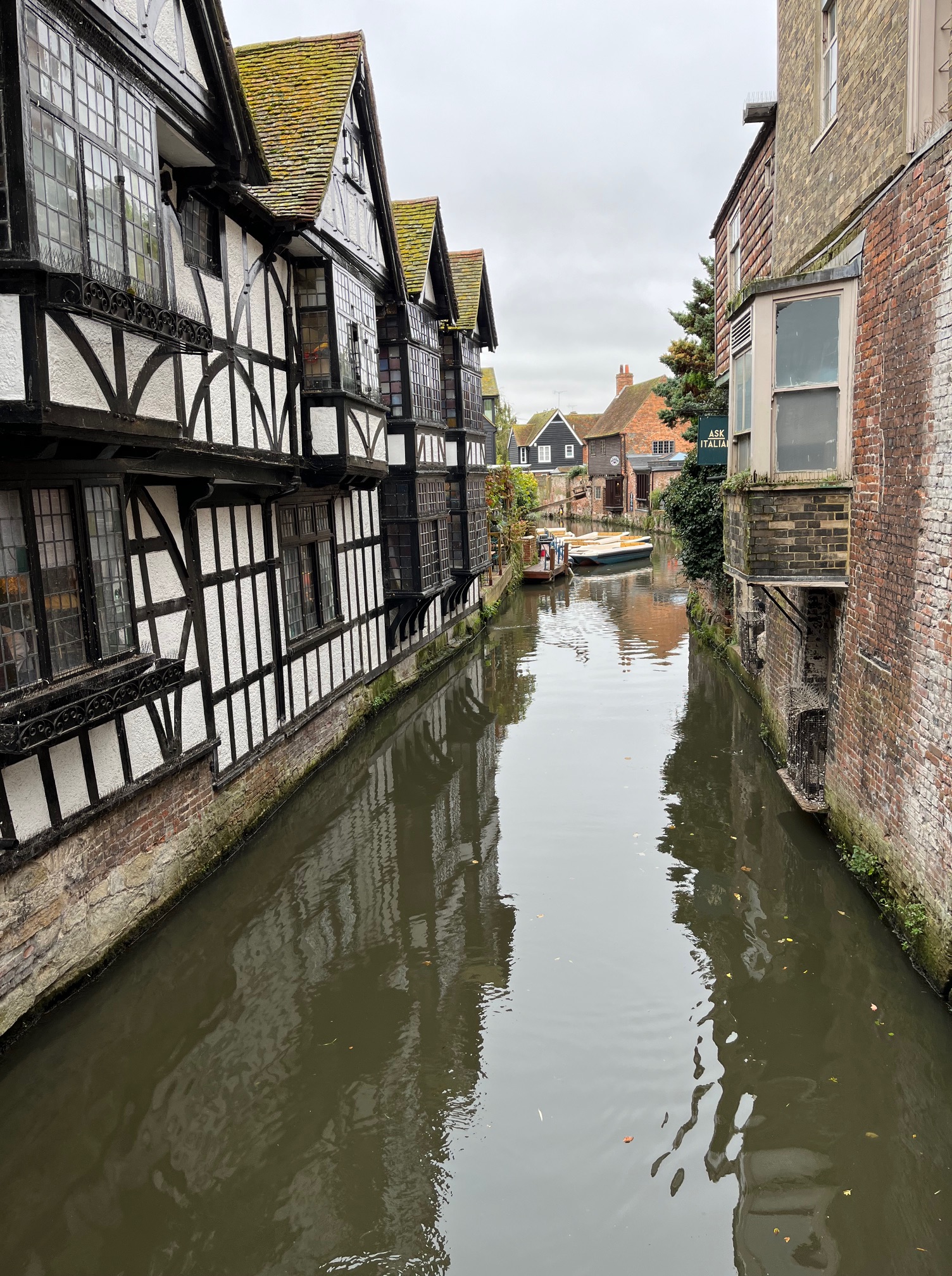
Screamingly irrelevant photo: The river Something or Other, flowing through Canterbury’s city center


The segregated army

Let’s back up. Hang around here long enough and you’ll get used to that. The US Army was segregated until 1948, three years after the end of World War II, so during the period we’re talking about Black and white soldiers served in separate units. They had separate barracks or camps along with separate hospitals or wards, blood banks (yes, seriously), medical staff, and recreational facilities. 

The US military didn’t consider Black soldiers fit for combat, so they were limited to support roles. They drove, cooked, cleaned, built roads and buildings and air bases, unloaded supplies, dug ditches, and worked as mechanics, generally under white officers. The few Black soldiers who did become officers could only command Black troops, and Black soldiers faced all the harassment you’d expect–and depending on how low you set your expectations, probably more.

In case anyone needs it, here’s the ten-second summary of US segregation: America’s southern states were segregated by law. Blacks and whites had separate drinking fountains, separate schools, and separate pretty much everything else. And whatever was for white people got more money–a lot more money–than what was for Black people. Those laws were enforced not just by the police and the courts but by terror. To cross the line that separated Black and white was to risk your life–at least if you were Black. This is what the federal government was carrying over into the armed forces. 

But segregation wasn’t just about separating the two groups, it was about enforcing inequality. By way of example, unlike white soldiers, Black soldiers weren’t allowed to marry women they formed relationships with overseas, which added to the number of children abandoned by their G.I. fathers.

Now we get to the contradictory–which is to say the interesting–part: for all that Britain brought segregation to its colonies, it had no color line at home. That doesn’t mean it was free of racism. When the US first proposed bringing over Black troops, Anthony Eden, the secretary of state, objected on the grounds that Black people weren’t suited to the climate. 

Britain had some 8,000 identifiably Black citizens at the time, and they seemed to survive the climate well enough, but never mind that. Sometimes you grab the first argument that flits past, and after that there’s nothing to do but keep a straight face and repeat it. 


A quick interruption

What does identifiably Black mean? Over the course of several centuries, a lot of Britons with Black ancestors were absorbed into an overwhelmingly white population and no longer counted as Black. Many of them wouldn’t have known of any reason not to count themselves as white. So we’re talking about whoever was visible. 

By way of contrast, in the US at the time, the one-drop rule held that if you had any Black ancestry at all (“one drop of blood”)–and of course if anyone knew about it–you were considered Black. 


The two systems collide

With that out of the way, let’s go back to the British government: it was a reluctant host. James Grigg, the secretary of state for war, wrote in a memorandum labeled “to be kept under lock and key, ”that “the average white American soldier does not understand the normal British attitude to the colour problem, and his respect for this country may suffer if he sees British troops, British Women’s Services and the population generally drawing no distinction between white and coloured. . . . 

“This difference of attitude might clearly give rise to friction. Moreover, the coloured troops themselves probably expect to be treated in this country as in the United States, and a markedly different treatment might well cause political difficulties in America at the end of the war.”

Why was that kept under lock and key? Probably because Britain was in no position to object to an American plan. It depended on the US to fund the war effort. So while Grigg chewed on his fingernails, the US brought its soldiers over, and it brought US-style segregation with them.

Where Britain did manage to draw the line was at enforcing segregation: that would be up to the US. On occasion, that left Britain trying to keep segregation from being imposed on Black soldiers from British colonies.

Isn’t it interesting how something starts out looking like it’ll be clear but turns out to be murky as hell?

Black American soldiers were generally welcomed by the local population, most of whom had never met a Black person before. As George Orwell put it, “The general consensus of opinion appears to be that the only American soldiers with decent manners are the Negroes.”

Orwell may have been making a political point there, but people with no name recognition at all are quoted (anonymously) saying roughly the same thing. A West Country farmer said, “I love the Americans, but I don’t like those white ones that they have brought with them.” And when white G.I.s gave the landlady of a pub grief for serving Black soldiers, she’s reported to have told them,”Their money is as good as yours and we prefer their company.”

Some businesses, however, did refuse Black customers for fear of losing white soldiers’ business. So the picture wasn’t unmixed. 

Before I go on, let’s be clear: Britain wasn’t free of racism. A cricketer from the West Indies who lived in Britain in the 1920s said that “personal slights” were “an unpleasant part of life in Britain for anyone of my colour.” At the end of World War I, a race riot kicked off over fears that demobilized troops from the empire would take white Britons’ jobs. And at the end of World War II, when Black people from the West Indies moved to Britain in large numbers and looked for places to live, they found signs saying, “No blacks, no Irish, no dogs.”

But during the war, the British generally welcomed Black soldiers, and the raw racial hostility that white troops brought with them seems only to have made that welcome more pronounced. 

An element of nationalism probably fed into that as well. Britons didn’t want to be pushed around by the US–the rising imperial power.


So what happened?

Not every white G.I. in Britain was a racist, but those who were were outraged by what they found, which turned everything they’d taken for granted on its head. Not only were Blacks occupying spaces they expected to be exclusively white, they were dancing with white women and going out with white women. For a segregationist, this was the ultimate horror–the thing segregation was supposed to defend against: a Black man with a white woman.  

No, seriously. Within living memory–mine, since you ask–the question that was supposed to demolish any white support for the civil rights of Black Americans was, “Yeah, but would you want your sister to go out with one?”

Gasp, wheeze, end of argument. How could anyone accept that?

If the situation in Britain was a pressure cooker, it blew that little valve on the top more than once, with violence sometimes being set off by white soldiers, sometimes by military police, and at least once by Black soldiers marching into the nearby town that was off limits to them but not to white soldiers. 

In Bamber Bridge, Lancashire, white troops tried to establish a color line in the village and locals responded by putting “Black Troops Only” signs outside the village’s three pubs. 

Maybe you have to be as old as I am, as well as from the US, to be tickled by the quiet genius of local people saying, Fine, you want a color line? We’ll draw it here and you’re on the wrong side. 

In June 1943, still in Bamber Bridge, an argument started between MPs and a Black serviceman outside a pub. Local people and British servicewomen took the side of the soldier. Somebody brandished a bottle. An MP (that stands for military police, by the way, not member of parliament) brandished his gun. The MPs drove away, gathered reinforcements, and later that night ambushed the Black soldiers. A melee broke out, fought mostly with billy clubs, bottles, and cobblestones, but one Black soldier was shot, after which 200 Black soldiers gathered and confronted their white officers. The unit’s only Black officer had calmed the situation until a dozen MPs showed up with jeeps and a machine gun, at which point the Black soldiers seized most of the available arms and fought the MPs for several hours. 

The incident ended with one man dead, several injured, and a hefty number of Black soldiers (32, I believe) convicted of everything from ignoring orders to mutiny. Still, Historic UK counts it as a “turning point in handling racial tension within the military.” Specifically, “A subsequent overhaul led to the removal of racist officers from the trucking units and the introduction of black officers into the MP units.” 

There were also violent confrontations in Launceston, Cornwall; Tiger Bay, Wales; and Leicester. You can ask Lord Google for details if you want them. In the meantime, we’ll jump to what happened at Combe Down, Somerset, where Leroy Henry, a Black soldier, was accused of rape, found guilty by a court martial, and sentenced to death 

That might’ve been the end of it, but a local baker was shocked by the lack of evidence against the man and started a petition, which 33,000 people from the area signed. A national newspaper picked up the story. This was just before D-Day and southern England was packed with troops. It wasn’t a good time for a scandal, and General Eisenhower overturned the conviction. Leroy Henry returned to his unit–and survived the war.


So was James Grigg right?

You’ve forgotten James Grigg already, haven’t you? The secretary of state for war who said (among other things) that seeing a country without a color bar might cause political trouble when Black soldiers returned home. Well, around a third of the leaders of the US Civil Right Movement of the 1950s and ‘60s were World War II veterans. That doesn’t say they all spent time in Britain and it doesn’t say they needed to stand on British soil to imagine a life free of segregation. But the experience of Black soldiers in Britain surely added a few drops of water to the rivers that–help! my metaphor’s in danger of going wrong here–rose so powerfully in the postwar US, washing away segregation’s legal structure. 

That flood didn’t solve all our problems, as you will have noticed if you live there or follow US politics at all, but it did move history forward by an inch or three.

*

I’ve relied heavily here on a BBC TV documentary, Churchill: Britain’s Secret Apartheid. If you can find it, it’s well worth your time.

Church and state in medieval England: Thomas Becket and Henry II

Medieval England had two mutually dependent centers of power, the church and the state. The state relied on the church for legitimacy. It was church ritual that turned a proto-king into a real one–someone who people believed had a god-given right to ruleAnd the church? It held land and riches, it had a near-monopoly on education and literacy, and people believed in it. All that gave it massive political clout. But it relied on the state’s network of laws and law enforcement.

So, two mutually dependent centers of power, and predictably, they didn’t always line up neatly. Take the tale of Thomas Becket and Henry II.

A rare relevant photo: the pulpit in Canterbury Cathedral


First, let’s get the name straight

When I first heard of Becket, he was called Thomas a Becket, which turns out not to have been his name. When he was born, he was called Thomas Beket. Spelling was a liquid back then. Somewhere along the line, he picked up a stray C. It looked good and he kept it. As Archbishop of Canterbury, he was known as Thomas of Canterbury. As a saint, he was (and I guess is) called Saint Thomas.

Then came Henry VIII, Anne Bolyn, England’s break with the Catholic Church, and all that stuff, and since Becket had thrown his weight behind the church and against a king when they came into conflict, he went decisively out of fashion. So in 1538, Cromwell (Henry’s brains as well as his tough guy) decreed that Saint T was to be known as plain old Bishop Becket.

In 1596, another Thomas, Thomas Nashe, a satirist and poet, added the a to Becket’s name.

Why’d he do that? It slotted in nicely with names in the Robin Hood legend (think Alan a Dale), which was popular right about then, and it made him sound like some rural bumpkin. In other words, this was the Anglicans making fun of the Catholics. 

The name stuck and by the 18th century the nifty rhythm of the a Becket form was clattering around after Tom Beket like a cluster of tin cans tied to his belt. Because regardless of its original intent, it does sound nice.

These days, people seem to have gone back to Thomas Becket, and in the interest of high-minded neutrality we’ll call him that. 


Henry and Becket

Becket was born in 1118 to Norman parents, and this was soon enough after the Norman invasion for that to place him among the elite. Ah, but his parents were merchants, so he was a long step below the elite of the elite, the aristocracy. He got an education (not a given back then), and after a detour as a city clerk and accountant went to work for Archbishop Theobald. 

Before we go on, though, a warning: you’ll want to keep your archbishops separate from your archdeacons in this paragraph, because it has an excess of arches. Becket pleased Theobald (the archbishop) well enough that he was appointed archdeacon of Canterbury. That’s not as good as being an archbishop, but even so it brought him both power and money. Three months after that, he became Henry’s chancellor and confidant. That was in addition to being archdeacon, so Becket now held two posts, both of them important. 

Becket was, according to the accounts I’ve read, skillful and energetic and gifted at getting people to like him, although he does seem to have neglected the less glamorous work of archdeacon in favor of his job as chancellor, best buddy, and right arm to the king. 

He showed himself to be the king’s man when the church and state came into conflict over something called scutage, which was part of that impenetrable knot of relationships that defined feudalism. Basically, it was money that the holder of a fief could pay instead of sending knights to fight for the king. The church held fiefs that had to produce knights or money, and Becket, taking the king’s side, charged the church a high rate.  

To make this more sensitive, this was a period when the church was pushing for greater power relative to kings, who’d previously had considerable control over the church. This is called the Gregorian Reform, and I never heard of it either. Henry was holding out against the changes, claiming what he considered his ancestral rights. And Becket backed him. He was very much the king’s man.


Then it all went sour

When Theobald died, what could make more sense than for Henry to make Becket the new archbishop? He’d be the king’s man inside the church.

Henry tried to persuade Becket to accept the post and Becket tried to persuade the king hat the story wouldn’t end well if he did. Becket lost the argument and was duly made archbishop, at which point he stopped being the king’s man and became the church’s, taking its side in conflicts with the king–first in a disagreement over tax, later over the issue of whether the church or the state would try clerics who were accused of crimes. 

In Europe–and in England before the Norman conquest–the church tried clerics, and their punishments were generally lighter than lay people faced. No death penalty, no mutilation. 

Becket’s argument was that the church already punished clerics and they shouldn’t be punished twice for the same crime. Henry’s was that clerical crime was rife and encouraged by church protection. Basically, though, this was about power.

The conflict came to a head in 1164, with the king claiming several of what he considered his traditional rights. He forbade the excommunication of royal officials and any appeals to Rome. He claimed the revenues of vacant church sees the right to influence the election of bishops.

Becket, having initially accepted this, then registered his disagreement and appealed to the pope, who–no surprise here–took the church’s side. 

Henry’s next move was to summon Becket to a trial. By a state court. And guess whose side it would be on. Becket, being no fool, fled to France, where he lived for six years. By way of spitting in Becket’s and the pope’s collective eye, Henry had the archbishop of York crown his son crowned as co-king, although the archbishop of Canterbury traditionally had the right to crown the king. 

Becket responded by excommunicating a bunch of people.

England, by this point, had more or less withdrawn from obedience to the pope, and in case this isn’t confusing enough I should mention that in addition to a pope, the church had an antipope–a kind of spare pope in case the original went flat. 

Sorry–I thought that was funny but it’s not accurate. Both pope and antipope claimed to be the one true pope. Let’s say it was a messy period in church politics and leave it there.

The pope backed Becket’s excommunications, and excommunication was serious stuff in the middle ages. It could cut a person or an entire nation off from church functions. Since we’re talking about a nation, it meant churches could be closed, people refused the sacraments, and churchyards closed to burials. It meant a country full of people who couldn’t take the sacraments, so they’d believe they were being denied their trip to heaven when they died. This is just the kind of thing that can trigger rebellions. 

So the king allowed Becket to return to Canterbury, but beyond that nothing was settled, and Becket excommunicated a few more people, including the archbishop of York, and refused to re-communicate the ones he’d already excommunicated. 

Henry had what’s known in high academic circles as a runnin’ hissy fit and said– 

Well, he said something. According to the Britannica, “He berated his household for being a pack of ‘miserable curs and traitors’ who stood idly by while a ‘low-born priest’ treated their king with contempt.” But according to Edward Grim, who was an eyewitness to Becket’s killing although not to the hissy fit, Henry said, “What miserable drones and traitors have I nurtured and promoted in my household who let their lord be treated with such shameful contempt by a low-born cleric!”  

We’re not done yet, though. According to Peter O’Toole in the 1964 movie Becket, he said, “Will no one rid me of the meddlesome priest?” Or maybe that’s “turbulent priest.” Go watch the film yourself if you want to get it right. It’s clearly the authoritative version, but I can’t be bothered. 

Whatever Henry said, four knights trotted off to Canterbury, where they killed the archbishop. 


Becket’s afterlife

No, not that kind of afterlife. We’re talking about the verifiable kind:

Within days, people were making pilgrimages to Becket’s tomb in Canterbury cathedral–or so says the Britannica, although I have trouble believing anyone constructed a tomb that quickly. Let’s not fuss over details, though. Miracles were quickly attributed to him. Pilgrims came. 

Henry (wisely) swore he never wanted Becket killed, and the next year he–that’s Henry, not Becket–showed up in Canterbury, allowed himself to be whipped by bishops while he prayed for forgiveness, and was duly absolved. His decision to do that might’ve had something to do with a revolt led by his sons and backed by France, which he claimed was a result of Becket’s killing.

And the knights who did the deed? They were excommunicated but asked for forgiveness and were sent to fight in the Crusades for fourteen years. 

Three years after Becket’s death, he was made a saint and people believed that the spot where his blood was spilled would heal the sick, and Canterbury remained an important goal for pilgrims until Henry VIII broke with the Catholic Church and had Becket’s tomb taken down, his bones burned, and his name erased from the service books.

A service book, in case this is all as foreign to you as it is to me, is “a book published by the authority of a church body that contains the text and directions for the liturgy of its official religious services.”

For all that, he wasn’t fully erased. These days, the cathedral burns a candle where Becket’s tomb once stood, and his name is engraved on the floor to mark the spot where he was killed.

Britain’s blue plaques–or how to make history snooze-worthy

Britain isn’t short on history, and it isn’t short of the impulse to celebrate it. Or at least some of it. The part of it that fits the dominant narrative, whatever that is at the moment. One of the least effective ways it’s found is the blue plaque scheme, which attaches–yes, you guessed it–blue plaques to walls commemorating people you may or may not have heard of. 

To learn more about this fascinating project, let’s quote Historic England, one of the assorted organizations that run the scheme: It “celebrates people from all walks of life who have made a significant contribution to human welfare or happiness; and/or have made an exceptional impact in their field, community or on society at large.”  

English Heritage, on the other hand, which runs the scheme in London, has it celebrating “the links between notable figures of the past and the buildings in which they lived and worked.”

We won’t get in between those two explanations. They can settle their differences in whatever way they find fitting.

Irrelevant photo: The Bude Canal on a (rare) sunny day. Apologies for the photo quality. It seems to be a WordPress problem that’s cropped up in the last few weeks.

The scheme

In British, scheme doesn’t imply anything scheming or underhanded. A scheme’s a plan–something systematic, and this particular scheme has been around for a while. The first plaques were put up in 1867. Since then, the London part of it has been handed from one organization to another. Unless you work for one of them, I’m reasonably sure you don’t care which they are. The national scheme is run by Historic England. But smaller cities don’t have to feel left out: they can find some local group to put up their own blue plaques.

The plaques say things like, “________ lived here from _______ to ___________.” Some of them say what the person did. A few don’t–you’re expected to know. Either way, the focus is on the here-ness of it all. It’s a low-key way of saying, Listen, dunderhead, you’re on a historic site. Be impressed.

Or something along those lines. Maybe they’re really saying, We’re so rich in history that all we need to do is put up a small blue plaque to commemorate it. Eat your heart out, foreigners. 

It’s all in the interpretation, isn’t it?

I’ve seen a Charles Dickens-related plaque that commemorates a house that used to stand someplace near where the plaque now is. It struck me as a bit forlorn.

Not all the plaques commemorate English or British figures. One of the earliest commemorates Napoleon III, who lived in exile in London, where he slotted himself neatly into high society. 

The people they commemorate are also not all famous. Commemoratees include a theatrical wigmaker, the woman who taught ju-jitsu to the Suffragettes, a bare-knuckle boxing champ, a homing pigeon, and Dolly the Sheep–the first animal to be born by cloning.


Unofficial plaques

But nobody gets to set a limit on blue plaques, and it’s possible–even legal–to put up unofficial ones. 

In Norfolk, the Common Lot theatre group discovered that only 25 of the city’s 300 blue plaques commemorated women and set out to remedy the imbalance, commemorating rebel women of Norwich. Their women they commemorate include:  

  • The 16-year-old Emma de Gaudar, who’s said to have held Norwich Castle against a siege by William the Conqueror
  • The butterfly collector Margaret Fountaine
  • Suffragette Mabel Clarkson, who became a lord mayor of Norwich and a city councillor before women achieved the vote
  • Dorothy Jewson, the first female Labour MP, who attended Norwich High School for Girls
  • Women thrown out of a Quaker meeting house for being profane and opinionated for talking about women’s rights
  • And the former location of a ducking stool for women accused of witchcraft

In Hull, Alternative Heritage set up a plaque saying, “Our brand of mavericks and creatives decided to celebrate Hull’s history, whether factual or fictitious.”

I could get to like these people.

They go on to say, “Official English Heritage plaques can only be commissioned for a proposed recipient 20 years after their death, through strict criteria. But what about the living legends and stories that make our city special today? Here at Drunk Animal Creative Studio, we designed a series of our own plaques, fittingly titled ‘Alternative Heritage.’

“Our plaques celebrate our history, from Hull’s charismatic folk to lore spread in playgrounds. Whether factual or fictitious, the contents of the plaques come straight from the heart of Hull.”

So what have they put up? One plaque says, “Goodbye, 2020. You won’t be missed.” Another says, “On this spot, 1918. Alf hugged his wife for the first time in four years. He was lucky – thousands across the country never got to hug their loved ones again.”

Their site includes a map of plaques around the city and a form you can use to propose a plaque.


The Liz Truss plaque

The reason I got started on blue plaques is that someone’s put up a blue plaque outside the shop where the lettuce that outlasted Liz Truss was bought.

What am I talking about? Liz Truss is Britain’s shortest-serving prime minister. In less than two months, during 2022, her bare-knuckle budget proposed doing everything Conservative politicians had talked about but hesitated to do in any unrestrained way: slash taxes and spending without worrying about how the numbers would add up. In next to no time at all, the country was teetering on the brink of recession. The pound tanked. The markets had multiple nervous breakdowns. The cost of government borrowing shot up. Mortgage deals fell through. People who ran pension funds–or who had pensions in those funds–came unglued.

Headline writers, on the other hand, had a field day. 

Truss’s popularity fell so low they had to dig trenches in the newsroom floor. Then some genius at one of the newspapers bought a head of lettuce, dropped a blond wig on it, and trained a live cam at it, asking who’d last longer, Liz or Lettuce.

The lettuce, famously, won. And is now commemorated with a highly unofficial blue plaque of its very own. Truss, meanwhile, is promoting a book about how to save the West. The rest of the world, presumably, isn’t worth bothering with.

How well is it selling? In its first week (I haven’t found more recent data), it was 70 on the bestseller list, behind an air fryer cookbook and RuPaul’s memoir, with 2,228 copies sold. Given the name recognition you get as a former prime minister, that’s not great, although I’ll admit it leaves my novels in the dust. On the other hand, I’m not followed by pictures of lettuce the way she is.

Skara Brae and neolithic Britain

Every last one of us was born too late to visit neolithic Britain. Sorry. Most of us wouldn’t handle it well anyway. But we can get a surprising glimpse of late stone age life from the island of Orkney, off the northeast coast of Scotland. 

These days, Orkney’s located almost exactly in the middle of nowhere, at least if by nowhere you mean a lot of water, but back then it seems to have been the center of a civilization, if for no other reason than that it was a midway point between northern Europe and Britain. For that, being in the middle of a lot of water is useful.

Not much is known about stone-age boats, but we can pretty well guess that traveling in one made a stop on a long voyage welcome. The break would’ve let people indulge in a neolithic cultural exchange, which I’m going to guess involved food, fresh water, alcohol, gossip, songs, gifts, and possibly an era-appropriate ritual or three.

I tossed in the rituals because Orkney’s rich in sites that hint at them, and every one of them involved an immense amount of labor. You don’t do all that if they don’t matter to you and if you don’t have time and energy to spare. 

Irrelevant photo: hemp agrimony

Skara Brae

Around 5,000 years ago, a group of people built a village on Orkney that’s now called Skara Brae. What they called it is anyone’s guess. A lot can get lost in 5,000 years, including a name. The people who lived there farmed, hunted, and fished.

The village is older than Stonehenge, older than the pyramids, and older than me. It was inhabited for something along the lines of 650 years and abandoned for reasons we can only guess at, but for us what’s significant about it is that at some point it was covered over by sand, which preserved it until a storm swept the sand off in 1850, uncovering an archaeologist’s dream.

The village is a circle of stone-built, single-room houses linked by roofed passages, with one larger building that according to one article might’ve been a workshop, although I can’t help wondering if it wouldn’t have been a place for everyone to gather. The walls were made of two layers of stone with insulation in between and the roofs were slate. Each house had a hearth, two beds outlined by stone slabs, which would have kept the bedding in place, and what are called dressers because–well, they have to be called something. To me, they look more like stone bookshelves, although this was a bookless, writingless world, so let’s stick with dressers. It’s chilly up there. People would’ve worn clothes, although that might not have been what they stored on them. They could’ve stored useful stuff, beautiful stuff, things they didn’t want to step on in the dark–say the neolilthic equivalent of Lego pieces.

For some fabulous photos, follow the link.

The houses also had tanks set into the floor. One house had an indoor toilet, although since plumbing was still a long way in the future that might not have been a great idea. I wasn’t there, so I can’t know.

Around the settlement, archaeologists have found dice, jewelry, tools, carved stone objects (objects here meaning things that are mysterious to us), and pottery in a style that spread to mainland Britain, supporting the argument that Orkney was an important site in the culture–a place that led the way. What hasn’t been found is weaponry, and the village wasn’t in an easily defended spot, arguing that this was a time and place of peace.

Not far from Skara Brae are two stone circles, The Ring of Brodgar and the Stones of Stenness; a chambered tomb, Maes Howe; and an assortment of unexcavated sites that hint at being ceremonial, burial, and settlement sites. The places that have been excavated show evidence of feasting–lots of feasting.

I won’t try to take you through the details of the excavations. I wouldn’t trust myself to get it right anyway. Follow the links if you want to know more. You’ll find lots of measurements and layouts. Or else settle for knowing that a lot went on in this seemingly isolated spot. 

So, did this important cultural center contribute the Stonehenge altar stone that’s recently been spotted as having come from somewhere in northeast Scotland or the Orkneys? It would make sense. They built similar monuments, but no. Orkney’s been ruled out and the search for the source of the altar stone goes on.

Are foxhunters an ethnic group?

A pro-foxhunting group, Hunting Kind, says it’ll be going to court to prove that fox hunters are an ethnic minority, which they’re convinced will protect their hunts from the barbarian anti-foxhunting hordes. The group’s chair argues that people who support foxhunting suffer persecution by animal rights extremists and that their hunts are an extension of natural selection because they only kill the foxes that are old or weak or slower than a pack of dogs. Or who, you know, overindulge in suicidal ideation. 

“I can tell you for a fact [foxhunting] is not cruel,” he said, “because I take no delight in the suffering of an animal.”

Point proven, then. 

The group claims it meets the five qualifications for an ethnic group: 

  • A long and shared history of culture which is distinct from wider society
  • Distinct customs of their own
  • A common geographical origin
  • Common ancestors
  • Common language or literature

Irrelevant photo: a begonia

Where’d the five points come from? I haven’t been able to trace them to any source. The 2021 census says a person’s ethnicity “could be based on” culture, family background, identity or physical appearance. That’s four and sounds kind of tentative.

The Law Society says its “usually been used to refer to long shared cultural experiences, religious practices, traditions, ancestry, language, dialect or national origins.” That’s seven and not what you’d call rock solid.

Basically, ethnicity’s a hazy term. But let’s not get hung up on how many characteristics it takes to solidify a bunch of people into an ethnic group. What’s striking here is that the desire to be one speaks to a longing on the part of a privileged group to be certified as unprivileged so it can claim the privileges of the unprivileged.

Did I lose anyone on the hairpin turns back there? 

Are foxhunters privileged? Well, foxhunting started out as an aristocratic passtime. In its current form, it dates back to the 19th century and was strictly for the upper crust. These days the hunts are marginally more democratic: you don’t have to be an aristocrat but you do need deep pockets. As George Monbiot explains it, “Not everyone who hunts today is a member of the aristocracy–far from it. But this is the way in which you aspire to become one. To look posh you buy a Land Rover, green wellies, a tweed hat and a waxed jacket: the livery of field sports. You buy a house in the country. You get yourself a horse and you join the hunt.”

You can see why they long to be certified as society’s victims.


A bit of history

Farmers have long had it in for foxes. They attack some of the smaller farm animals and they have beautiful fur. It doesn’t do to be too beautiful, friends. I’m telling you. In this case, it led to fur envy: the aristocrats could wear that fur themselves and tell themselves they looked foxy in it. But it wasn’t until the 18th century, with the decline of the country’s deer population, that fox hunting turned into a sport. Because, hey, if they could go out hunting deer they had to kill something, didn’t they?

What happened to the deer? Well, history just loves irony. England’s landowners–a rich and powerful class of people–discovered they could make more money by getting rid of those annoying people who lived on the land and farmed it. They enclosed the land, making smaller fields and raising sheep in them. It’s called the enclosure movement. Cue massive displacement and poverty, not to mention political unrest, but never mind all that, there was money to be made.

In enclosing the land, they got rid of the places deer liked to breed. It wasn’t the most important result, unless you’re a deer, but it left a wealthy group of people in need of something to kill. And there was the fox, who had no hand in all this, with its beautiful coat and inconvenient need to eat. 

To turn up the volume a bit, along came the Industrial Revolution, with its improved network of roads and its new network of railroads, making the countryside more accessible to would-be hunters living in towns and cities. For a few days, they could pretend to be country gentlemen. 

Or gentlewomen. 

Awkwardly for anyone who argues that foxhunting is about pest control, the enthusiasm for foxhunting led to a shortage of foxes, which led to huntmasters buying pests for the hunters to eliminate. They were imported from France, the Netherlands, and Scotland, and in England organized gangs stole them from land that happened to be well stocked. 

Does any of that make them an ethnic group? Well, England’s aristocracy is inbred enough to have a common set of ancestors, but we just shifted ground there from foxhunters to the aristocracy as a whole. They have a few words or phrases the rest of us wouldn’t bother using but they’re stuck sharing their basic language, literature, history, and geographic origins with the rest of us. 

Not me, of course. I wasn’t born in Britain, but there aren’t enough of me to make them an ethnic group. 

Stonehenge: the story keeps changing

Want to change history? You have two choices: do something that changes the future or change the way we see the past. Neither one is easy, but a group of scientists studying the Stonehenge rocks have managed to change the way historians understand late stone age Britain

If you read much about Stonehenge, you’ll probably read about sarsen stones first–the uprights and the massive crosspieces that sit on top of them, forming the outer circle. They were hauled a mere 16 miles. On the other hand, they weigh an average of 25 tons, so however hard you worked last week I’m pretty sure you didn’t do that.   

Once you’re done being impressed, you’ll read about the bluestones–the stones that form the inner circle–which came from 140 miles away, in Wales. Before the invention of smartphones, which would at least have let the people who dragged them document the challenge.

Think about doing that without a single online follower leaving a Like. Where’s your incentive?

The bluestones weigh between 1 and 3 tons. 

A rare relevant photo, with thanks to K. Mitch Hodge, who made it available online at Unsplash.

What most of us wouldn’t have read about is the altar stone, but it’s the one that’s making headlines and retroactively changing history. 

In spite of its name, there’s no reason to believe it was ever used as an altar. It’s lying flat and it must’ve reminded someone of an altar. The name stuck, but don’t get carried away with the idea. 

The new information is that the stone traveled something like 500 (or 350, or 800) miles to play its part in Stonehenge–that’s pretending it went in a straight line–from what’s now Scotland, somewhere around the neighborhood of Inverness, John O’Groats, and Orkney. It’s a big neighborhood, but someone will be out there even now working to narrow it down. 

Why does that matter? Because it tells us that late stone age Britain (known to its friends as neolithic Britain) was a lot more connected than anyone knew. And it tells us that whatever function Stonehenge had, it had it for a whole lot more people than any recent residents suspected. 


Moving the stones

How did they get the stone from Scotland to the Salisbury Plain? It’s tempting to think, No problem. Just plop that beast on a boat, but we’re talking about a 6-ton stone. In a boat built in the late stone age. That might not comply with health and safety guidelines. Personally, I’d think two or three times before I jumped in and started to paddle.

Information about ocean-going boats in this period seems to be pretty limited, but they’d have been small and a little sticker on the side would’ve said, “Not recommended for the transport of any stone above 1 ton in weight.” 

Evidence of cross-Channel trade between Britain and Europe has been found, and that meant boats–it’s wet out there, people–but the evidence consists of lighter things like pottery, axes, and cattle. 

Okay, I admit, cattle aren’t light. But compared to the stones we’re talking about? You could lift two of them before breakfast.

The experts are still arguing about how the stones were transported. One experiment tried to move the equivalent of the bluestones across the Severn on rafts. They sank. 

The Severn? Most likely body of water on the way from Wales to Wiltshire, currently playing host to some large stones that future archeologists will try to explain in some marginally rational way.

That doesn’t prove it can’t be done, only that it couldn’t be done the way they tried to do it. Neolithic people would’ve had a lot more experience with neolithic boats than even the best modern-day experimental archaeologist. With so little known about late stone-age boats, it’s all guesswork. So we can’t rule out boats.

But there’s another compelling reason to take the stone overland. An archaeologist who wasn’t involved in the study explained it this way: “If you put a stone on a boat out to sea, not only do you risk losing the stone–but also nobody can see it.” 

But if we spend a few years dragging it the length of Britain, people along the route will get involved. Maybe they’ll help drag it a few miles. Maybe they’ll make us a nice cup of–

No, sorry, we’re centuries too early to get a nice cup of tea. Or even instant coffee, and forget about that frothy, expensive stuff folks have fallen for. We might be offered some nettle tea, though. It’s supposed to be good for sore muscles and arthritis. The island’s rich in nettles, and after hauling that stone we’re rich in sore muscles. We’re also building up the prerequisites of future arthritic problems. So whatever it tastes like, drink that tea and look happy. These people are being hospitable.

Most settlements will lay on a feast, or share what they can if it’s been a bad year. They’ll make us feel welcome and speed us on the next leg of our journey. And with each stop, more people will feel involved with the project. They helped pull that stone. They welcomed the people who delivered it. For generations, people will talk about it. 

The stone, the expert said, will become “increasingly precious . . . as it travels south.”

If dragging a 6-ton stone the length of Britain sounds impossible, I refer you to a BBC documentary–sorry, the name sank into the sludge that passes for my memory–about the bluestones. The presenters somehow got an entire class of primary school kids to pull a stone very much like the bluestones using nothing more than ropes and (if my memory isn’t playing tricks on me) a wooden sledge and logs for it to roll across. Maybe thirty ordinary kids, none of them even close to full grown. And the stone slid across the ground as if that’s what it had in mind all along. 

Admittedly, the ground was flat and it wasn’t full of boulders or forests, but it does show what plain old muscle power can do. 

One objection to the land route theory is that it’s hard to coordinate that many people, but teamwork would’ve been an integral part of any late stone-age community. And they wouldn’t necessarily have seen the length of time involved as a problem. They might’ve seen it as something like a pilgrimage. 

Getting places in a hurry is a relatively modern obsession.

The terrain wouldn’t have been easy, but the idea that Britain was wall-to-wall forest is, apparently, a myth. 

One theory holds that the stones could’ve been moved to Wiltshire by the glaciers, but finding a stone from Scotland wrecks this. 

“From Orkney, I can’t see a way that the stone hikes a ride on half a dozen glaciers in the right order to end up on Salisbury Plain,” a geologist said.

But forget about moving the stones. How did they set them upright?

An archeologist who’s raised the 12-ton cap stone on neolithic tomb using wooden levers said it’s easy, 

So if you buy a Stonehenge from Ikea, those are your assembly instructions.

*

If all that doesn’t sound like enough work, Stonehenge was built in several stages, each one involving a different configuration. I won’t take you through all them but it must’ve been like living with someone who insists on moving the furniture every few thousand years, only the furniture is multiple tons of rock and soil. 

We’ll probably never know what went on there or why, but we’re pretty safe saying that whatever it was, it was important. To a lot of people.

The Battle of Cable Street 

Now that Britain’s racist riots are–I hope–behind us, this might be a good time to look back at what happened on London’s Cable Street in 1936.

The background? (If you stay here long, sooner or later you’ll end up slogging through a bit of background.) Hitler held power in Germany and Musolini ditto in Italy. The British Union of Fascists, led by Oswald Mosley, claimed to have 50,000 members, and I’m not saying it didn’t, only that we’re taking their word for it and–oh, hell, it was a long time ago and for our purposes doesn’t really matter. It was big and it was most definitely fascist, complete with the antisemitism, the black shirts, the salute, and the violence. It had a gang of toughs known as the Biff Boys. 


Screamingly irrelevant photo: everlasting pea

The roots of antisemitism

Antisemitism was the Islamophobia of the era (in case you’re tempted to tell me that’s antisemitic, keep in mind that I’m Jewish), and it has deep roots in Britain. We could go back to 1290, when Edward I expelled the Jews from England, but let’s start instead at the turn of the twentieth century, when some of the people who opposed the Boer War (1899 to 1902; I had to look it up) blamed it on the Jews–they were imperialists, financiers, bankers, and capitalists. Not long after that, they were blamed for World War I (because they were financiers etc.) and the Russian Revolution (because they were communists). 

One of the oddities of antisemitism is that the Jews appear as both capitalist bloodsuckers who control the world and communist revolutionaries who want to overthrow the capitalist bloodsuckers who control the world. Basically, it works like this: if you see a problem, the Jews caused it. 

But antisemitism wasn’t all name calling and finger pointing. It was respectable. At University College London, in the name of improving the country’s genetic stock, Karl Pearson opposed Jewish immigration and argued that attempts to improve “inferior races” were a waste. Among other things, his work provided an intellectual grounding for the Nazis’ race theories.  

I focus on Jews here because we’re talking about antisemitism, but to be fair he was generous about handing out inferior race labels. 

Clubs and institutions–think golf clubs and things of that sort–had quotas to limit the number of Jewish members they’d accept. That continued into the 1960s. 

In the early 1930s, fascism was also respectable, not only for its antisemitism but because it offered a bulwark against communism, which in the midst of the Great Depression was a powerful force. Fascism appealed to industrialists who were desperate to keep their workers in line and to aristocrats, who’d lost considerable power–and along with it, money–to the industrialists. Again, to be fair, it didn’t appeal to all of them, but some went for it.

Take, for example, a 1934 headline in the Daily Mail, reflecting the opinions of its aristocratic owner, Harold Sidney Harmsworth, 1st (ahem) Viscount Rothermere: “Hurrah for the Blackshirts!” Harmsworth saw fascism as the wave of the future, was enthusiastic about Hitler and Mussolini, and opposed votes for women and wrote, “The fact is that quite a large number of people now possess the vote who ought never to have been given it.” 

Archibald Ramsay, son of the Earl of Dalhousie, founded the Right Club,  whose logo was an eagle killing a snake with the initials P.J., standing for “Perish Judah.” 

As an article by Adam J. Sacks points out, any hereditary aristocracy has a built-in affinity with theories about pure blood. “Even today,” he writes, “adoptees into aristocratic families in the UK are ineligible to inherit titles or properties.”

Oswald Mosley himself was a baronet. As titles go, it’s minor-league, but hey, it’s one more title than I have.

Or want.

But why should we spend our time with baronets, viscounts, and other riffraff when we can talk about the king? Edward VIII was openly pro-fascist. After he gave up the throne, he told Hitler, “We are derived from the same race with the blood of the huns flowing in our veins.” He’s on record as having told the Nazi high command “that continued heavy bombing will make England ready for peace.” 

Sacks sums it up by saying, “There is hardly a major British institution that was left untouched by fascism, from the Bank of England to the Daily Mail to the House of Commons. . . . If there is a story to be told about Britain and fascism, let it be this: while the people of Britain stood up to the Nazis, the British ruling class were in many cases enthusiastic collaborators–and found justification for being so in their own aristocratic roots and worldviews.”


The British Union of Fascists

Mosley overdid the violence at a couple of BUF rallies, where his Biff Boys beat up hecklers badly and more to the point, visibly, and he lost some of his support. That led him to refocus, organizing in a handful of working class neighborhoods. In 1935, the BUF newspaper said, “We are now the patriotic party of the working class.”

Led by a baronet.

One of the things they did was hold threatening open-air meetings on the fringes of the East End, which in the 1930s was a mainly Jewish neighborhood, and forget that noise about Jewish bankers and financiers, the people here were poor. Soup kitchens had lines outside every night.. And to double down on the parallel between antisemitism and Islamophobia, many of the Jews were immigrants. 

Individual Jews were attacked on the street, shopkeepers were threatened, antisemitic slogans were painted on walls. One or two of the articles talk about the residents feeling like they were living under siege.


Enough with the background. What happened?

Mosley announced that the British Union of Fascists would march through the East End, in uniform. 

The Jewish People’s Council against Fascism and Anti-Semitism–the JPC–circulated a petition asking for the march to be stopped. Within two days they’d gathered 100,0000 signatures and the petition was presented to the Home Secretary, who said goodness, no, he couldn’t interfere with freedom of speech or movement. Instead, he sent a police escort (6,000 in one telling, 10,000 in another) to keep protesters from interfering with the march.

The JPC started organizing to do exactly that–interfere. Various sources credit slightly different combinations of groups for this, but let’s go with the counter-demonstrators being from the Jewish and Irish communities, from trade unions, and from the Independent Labour and Communist parties. More respectable Jewish organizations were urging the Jewish community to stay indoors and avoid confrontation. This was very much an action of the left, and the crowd that turned out on the day was big enough to block Gardiners Corner at Aldgate. The estimates I’ve seen range from 100,000 to 300,000. 

The march was made up of 3,000 Blackshirts, and they waited near the Tower of London for the police to clear them a path, which they tried to do by charging the crowd on horseback and wading in with batons. They’d beat the crowd onto the pavement and more people would stream onto the street. Four tram drivers abandoned their trams where they blocked the road.

Meanwhile around the Tower of London, fights broke out between Blackshirts and antifascists. 

Eventually, the police gave up on clearing a path and redirected the march to Cable Street, a narrow street leading to the docks. (In one telling, this was Mosley’s decision.) A combination of Jews and Irish dockers barricaded the street. (The final third of Cable Street was predominantly Irish.)

When the police broke through the barricade, they were faced with a second barricade and while that slowed them down women threw things at them from upstairs windows. 

Eventually the police retreated and told Mosley to head his march in the opposite direction and disperse. 

A member of the Jewish community later said, “I was moved to tears to see bearded Jews and Irish Catholic dockers standing up to stop Mosley. I shall never forget that as long as I live, how working-class people could get together to oppose the evil of fascism.” 

Another said, “it was amazing because we saw Jews, Orthodox Jews with long silk coats and soft felt hats and the sidepieces standing shoulder to shoulder with Irish Catholics, dockers and Somali seamen. . . . They all felt there was a need to be out there to stand on that particular day.” 

A third said, “In Stepney nothing had changed physically. The poor houses, the mean streets, the ill-conditioned workshops were the same, but the people were changed. Their heads seemed to be held higher, and their shoulders were squarer–and the stories they told! Each one was a ‘hero’–many of them were. . . . The ‘terror’ had lost its meaning. The people knew that fascism could be defeated if they organised themselves to do so.”

The acclaim wasn’t universal. Time magazine described it as an “anti-Fascist rampage . . . which turned out to be London’s biggest riot in years.”  

By the end of the day, 85 people had been arrested, 79 antifascists and 6 fascists. Many of the antifascists were beaten by the police and some were sentenced to hard labor. What happened to the fascists who were arrested I don’t know.

Cable Street marked a turning point for the British Union of Fascists. The leaders turned on each other. Some resigned. The organization didn’t collapse but it did lose momentum. It also lost Mussolini’s financial support, which had been substantial. In 1940, not long after the start of World War II, Mosley and other leaders were in prison.

Who were the Bluestockings?

You’ve just been dropping into the 18th century. You are a) privileged, b) clever, and c) female. That letter C) is going to cause you trouble. And you can expect some grief from the end parenthesis as well. You’re expected to be mindless, pretty (if possible), and above all, childbearing. After that–well, there is no after that. That’s your role. Abandon hope, ye who expected more out of life.

The rational creatures in your world are all male. Just ask one if you don’t believe it. If you think you’re also rational, you’ll have a hard time convincing anyone of it, and you’ll cause all sorts of social embarrassment by trying. 

Any form of ambition will also cause embarrassment.

You will, of course, have been educated, but only to be a wife and mother, to manage a prosperous household, and to be decorative–fashionable, demure, graceful, and several other adjectives. You will have learned reading, embroidery, music, dancing, drawing, a little history and geography, maybe a bit of French. Just enough to make yourself agreeable to men and above all, marriageable.

Irrelevant photo: Montbretia. It’s pretty but it’s invasive.

Those are the limits of your expectations, so let’s shift to the past tense. I don’t want to trap you back there for too long. Or myself. I’m about to hyperventilate.

Did I make any of that up because I’m a childless cat lady? Sadly for the people who lived through that era–and sadly for our era, which inherited a surprising number of assumptions from theirs–no. By way of example, the statesman Lord Chesterfield wrote to his son in 1748 that women “are only children of a larger growth; they have an entertaining tattle, and sometimes wit; but for solid, reasoning good sense, I never knew in my life one who had it, or who reasoned and acted consequentially for four-and-twenty-hours together.”

With a bit more generosity, Dr. John Gregory wrote in A Father’s Legacy to his Daughters (1774), “If you happen to have any learning, keep it a profound secret, especially from men, who look with a jealous and malignant eye on a woman of cultivated understanding.”

This is the world the Bluestockings came from and whose conventions they both broke and stayed within. 


The conventions they broke

The Bluestockings were never a formal organization. They were a social and intellectual circle made up for the most part of affluent English ladies, and they’re best known today for having hosted gatherings where men and women spoke on equal terms about literature, art, history, philosophy, science, foreign affairs, and pretty much anything except politics. And as Margaret Talbot puts it in the first article I linked to, England made room for them with, “a kind of condescending, self-congratulatory gallantry.” 

They hosted some of the age’s top talent, including Samuel Johnson, Edmund Burke, David Garrick, Horace Walpole, and other men of letters, aristocrats with a literary bent, diplomats, painters, politicians. In short, people who mattered.

But they were more than simply hostesses. These were highly educated women at a time when the doors of any serious school were closed to girls and women. Some were self-educated. Some were educated at home by unconventional parents. But having attained an education against all the odds, they were shut out of most of the public spaces, such as coffee houses, where men discussed the issues of the day. The only way they were going to be part of those discussions was to bring the discussions into their homes. Hence the hostessing.

The men they invited had something to gain as well. Gatherings that discussed serious subjects were in sharp contrast to the usual social evenings of their class, which involved drinking, cards (of course for money, silly), and, as Talbot puts it, getting up to “sexual shenanigans.” That helps explain why the Bluestockings offered lemonade and tea instead of booze.

But the Bluestockings did more than just host salons. Many of them went on to write novels, criticism, history, classical scholarship, and endless letters. Letters were the social media of the day. Others worked as translators. One of them, Elizabeth Montagu, published an essay that was influential in establishing Shakespeare as a central figure in England’s national identity. The essay first appeared anonymously and after it became a smash hit (in the small circles where these things could be smash hits) it was republished under her name. 

Publishing was more than just a way to participate in the national conversation. It was one of the few fields where a woman could keep the money she earned. She couldn’t go into business or own property in her own name, but she could publish. 


The conventions they kept

But far from throwing all conventions out the window, they lived the conventional lives of ladies of their class, running their households and caring for aging parents, as women were expected to. Elizabeth Carter, whose translation of Epictetus held its place as the standard translation for the next century, is described by Gibson as “always careful to present herself as the perfect woman: meek and modest, diffident and self-effacing, completely unthreatening to male authority.” 

She could make a pudding as well as she could translate ancient Greek.

And then there was class. As ladies of their class were meant to be, they were snobs. One, Hannah More, had helped a working class woman publish her first book of poems, and when the book was successful enough to bring in some money she pressured the author to put her money in a trust administered by More and another upper-class Bluestocking, because how could “such a Woman” be trusted with her “poor Children’s money?”

(As you can see from the quotes, they didn’t break the conventions around capitalization either. They capitalized anything they damn well pleased.)

Another tale involves conventions around both class and women’s bodies. And religion. When the widow Hester Thrale married her daughter’s music teacher, her Bluestocking former friends were toxic about it. He was of the wrong class, he was foreign born, and he was Catholic. She was giving in to passion, and they were above passion. As one wrote, “Overbearing Passions are not natural in a ‘Matron’s bones.” 

Part of the problem with passion was that their intellectual claims rested on their respectability. One whiff of scandal and the whole structure might collapse. The rest of the problem was that in their world women were thought of as physical and men as intellectual, and in order to emphasize women’s rationality, they saw themselves as standing outside their bodies. That made them refined and respectable. That was the basis for equal treatment. Lose that and they were back to being just babymakers.


Their name

The name Bluestockings came not from what the w\omen wore but from a single man at one of those salons–or so the story goes. A botanist, Benjamin Stillingfleet, was invited and didn’t bother to change from the blue worsted stockings he wore in the field to the white silk stockings upper class men wore to formal occasions. Or else he was invited and declined because he didn’t have the appropriate clothes and his hostess told him to come “in his blue stockings.”

Or else–as one article claims–the respectable stockings were black, not white. It doesn’t matter and I can’t be bothered chasing that down. My money’s on white. Believe whatever version you like. Believe them all if you can manage. Either way, the story has nothing to do with what the women wore. The women accepted and used the term. 

Later, when their time had passed, Bluestocking became an insult–something to call a woman with intellectual ambitions and unbecoming opinions. And the radicals who might would’ve been sympathetic to their inherent feminism overlooked them as elitist and conservative. 

Still, history didn’t erase them. The Bluestockings had an effect on Jane Austen, Mary Wollstonecraft, and much later Virgina Woolf, and through them, on us.

Nothing is lost. I swear it to you.