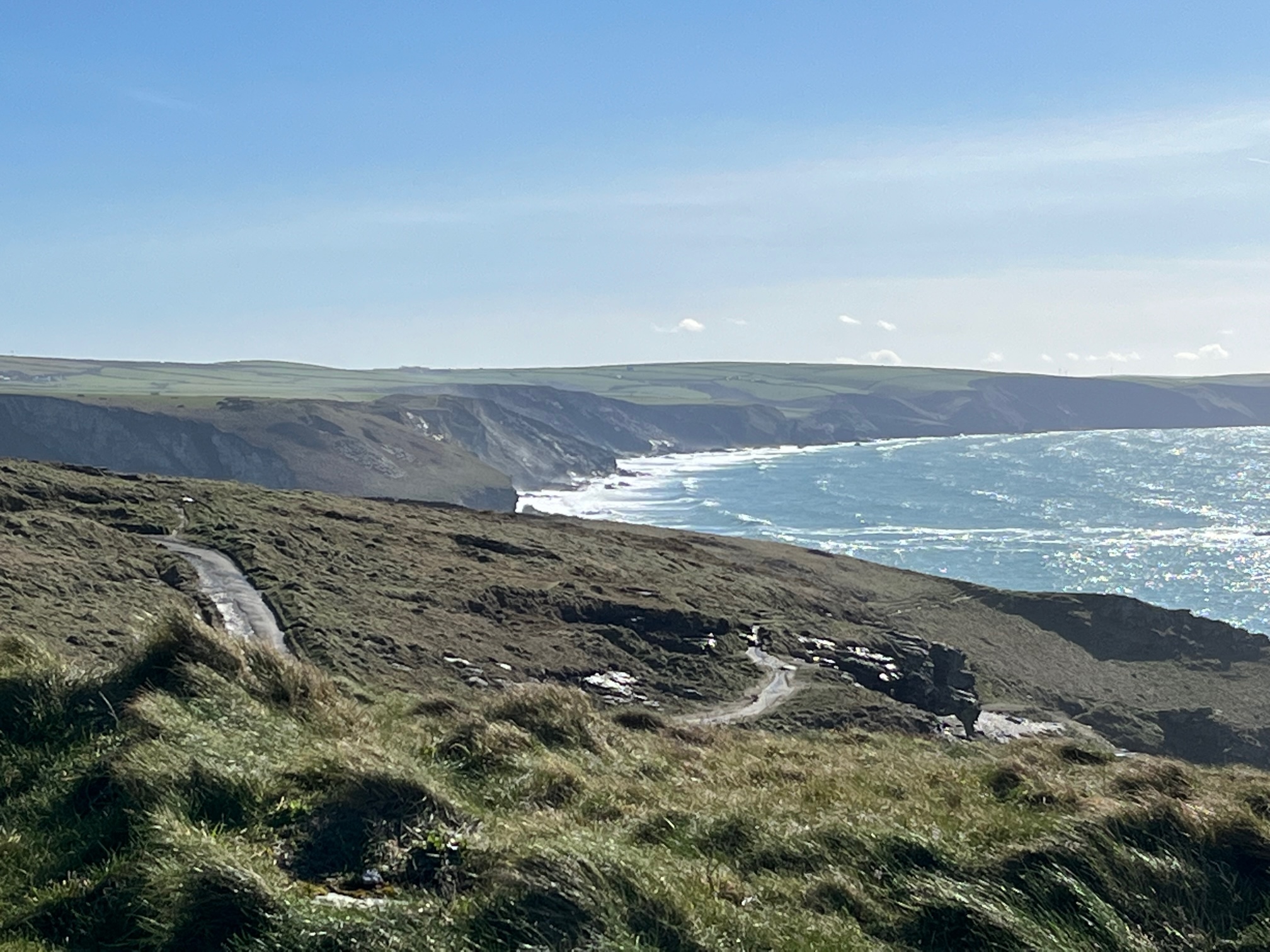
Who lived in early medieval England? 

We’re programmed to imagine early medieval England as a land of straw-haired Anglo-Saxons–so much so that an article debunking that belief is illustrated by (you guessed it) a picture of a straw-haired young woman wearing a leather headband and gazing soulfully up at the clouds. 

But before I go on, let’s define the early medieval period. English Heritage opens the doors at around the year 410 and tossing the drinkers out onto the street in 1066, which means it runs from the end of Roman rule to the Norman invasion. You could call it the Anglo-Saxon period without losing too many points on your essay, even though what you’re about to read messes with the standing assumptions about Anglo-Saxon England. You could also call it the Dark Ages, but you’ll lose points. It’s got more zing but it’s gone out of fashion. 

Irrelevant photo: hellebore


That straw-haired image

The stereotype we bought into–and forgive me if I pretend I can talk for all of us–grows out of having read that the Anglo-Saxons invaded that big central chunk of Britain we call England, pushing its earlier residents, the Celts, to the margins.

The margins? That’d be Scotland, Wales, and Cornwall. 

Since the Anglo-Saxons were Germanic tribes, we can call Central Casting and tell them we need blonds–lots of tall, warrior types and a few wistful maidens.

Why the gender imbalance? Because we were taught the Anglo-Saxons came as warriors–big, blond guys with big, blond swords.

The archeologists who gave us that story did it in good faith. They were working with the tools they had. They’d dig up an early medieval village or graveyard, find Anglo-Saxon artifacts, and not unreasonably deduce that Anglo-Saxons lived there. But turn a few calendar pages and before we know what hit us, science has given them new toys to work with. In other words, the next generation of archeologists could work over the same ground but now sequence DNA and read tooth enamel well enough to identify people’s tribes and know where the tooth enamel- wearer had grown up, and that’s made the picture of early medieval England and the Anglo-Saxons more complicated. 

The article that pushed me down the road toward this blog post opens (once you get past that blond-haired maiden) by questioning the assumption that everyone in early medieval English villages looked alike or talked the same way. It’s based on a DNA study of 460 people from sites across northern Europe, 278 of them from the southern and eastern English coasts. 

The Anglo-Saxons and the Celts

The first change to the traditional story is that the Anglo-Saxons (or the incomers, anyway, whatever we’re going to call them) don’t seem to have driven the Celts out. Instead, the two groups settled down alongside them and played house: Many people in these settlements were of mixed heritage. 

The study did find evidence of mass migration into the British Isles after Roman government ended, but it wasn’t a migration of warriors. These were families.

Now let’s shift to a different article. It’s about the same study but juggles a few different details. It doesn’t talk about Celts and Anglo-Saxons but people of WBI (western British and Irish) and CNE (continental northern European) heritage. If you want the percentages from various communities, that’s where you’ll find it. I hope you know better than to look to me for numbers when they’re avoidable.

But the genetic makeup of the communities wasn’t limited to Celts and northern Europeans. One skeleton–a girl of about eleven, found in Updown (yes, seriously), in Kent–had two-thirds CNE ancestry and one-third West African ancestry. The modern grouping most closely related to her African ancestors would be the Esan and Yoruba peoples in southern Nigeria. 

How’d they show up there? Trade, probably. Early medieval England wasn’t an isolated place, ad traders often exchange more than just the goods they’re selling. They exchange culture, language, DNA.

Updown Girl was buried with her family members and with grave goods similar to theirs, like any other village girl, since that’s what she was, in a manner we still call Anglo-Saxon for lack of a better term. 

Why am I looking for a better term? Because the culture we still think of as Anglo-Saxon and that we used to assume was brought over whole by the Anglo-Saxon tribes seems to have belonged to a hybrid culture–the kind that grows up when cultures meet and mix. We don’t know what that mixing was like; we can only infer it from DNA, tooth enamel, and the goods people were buried with.

Grave goods and social patterns

The second article says, “Grave goods seem to have played only a very limited role in the signalling of different ancestries–assuming that was what was intended–and where it is seen, that signalling was dependent on biological sex.” In other words, you can’t tell from the goods people were buried with who was of primarily CNE (or Anglo-Saxon) ancestry and who was primarily WBI (or Celtic), although men whose ancestry was primarily WBI–what we’d call mostly Celtic–were more likely to have been buried with grave goods primarily WBI than women were.

How come? Dunno. Any answer will be wild speculation. If I was writing historical fiction, I could have fun with that, although someone somewhere would inevitably think it was fact.

The archeologists found that the two groups–the WBI and the CNE–didn’t generally keep themselves separate and people soon had mixed ancestry. The patterns varied from settlement to settlement, but all of them change our assumptions of what Anglo-Saxon means. It’s beginning to look like a culture adopted by a group of genetically mixed people rather than something brought over whole by invading tribesmen.

As the first article–the one with the straw-haired maiden–puts it, “Early Anglo-Saxon culture was a mixing pot of ideas, intermarriage and movement. This genetic coalescing and cultural diversity created something new in the south and east of England after the Roman empire ended.”

For people who believe in racial purity, the science of DNA must be a real pain in the backside.

A quick history of the Cornish pasty

If Cornwall and Devon go to war–and nothing’s too crazy these days–it will be about either who baked the first pasty or who knows the right way to make a cream tea. You’ll agree, I’m sure, that these are reasonable things for neighboring counties to shed blood over, but they may have to wait until people aren’t quite so distracted by the cost of living crisis that the important things slip past them unnoticed.

In the meantime, allow me, please, to stoke the fires of cultural warfare by exploring, in my usual even-handed way, the history of the Cornish pasty. Or possibly the Devon pasty. 

We’ll skip that business about cream tea for now.

Irrelevant photo: a hellebore

What’s a pasty?

Basically, a semicircular pie made of beef, potatoes, onions, and turnips, only the turnips are called swedes. It might just possibly have other stuff as well, but before we get to that let’s dive down the closest rabbit hole and ask why turnips are called swedes.

According to one gardening catalog’s website, “The swede is thought to have been introduced into Britain around 1800. It is said that King Gustav of Sweden sent the first swede seeds as a gift to Patrick Miller (1731 – 1815) of Dumfries and Galloway, and that this act resulted in the vegetable being called ‘swede.’ ”

The website also says they’re called rutabagas in the US, from a Swedish word meaning thick root. Well, maybe and maybe not. I grew up in New York and remember turnips being called turnips, although I don’t remember that we ate them. Rutabaga, I think, is a regionalism. Or else calling a turnip a turnip is a regionalism. But that’s the wrong rabbit hole, so we’ll back out before we get stuck.

A different gardening catalog site says the swede is “bigger, tougher skinned, yellow fleshed and much hardier than a turnip.“ So basically, by this definition they’re the same thing but different.

You needed to know all of that, right? Now we’ll leave the rabbits and their burrow in peace and get to something vaguely resembling the point. 

Before Britain left the European Union, the Cornish pasty got protected status from the EU, meaning that if a pasty wasn’t made in Cornwall, it couldn’t claim to be a Cornish pasty. Or, since no pasty makes claims on its own behalf, the person selling it couldn’t make that claim.

To translate that into handy bureaucratese, “At least one stage of the production, processing or preparation of the product must currently take place in Cornwall.”

If I’m reading that correctly, you could run the length of Cornwall with a potato and a knife and just as you’re about to cross the Tamar River into Devon cut the potato in two, then use one or both halves to make a pasty in Devon, and still call the result a Cornish pasty, although you’d have gone to a lot of trouble without getting much benefit from it.

Besides, Cornwall left the EU along with the rest of Britain, so the pasty lost its protected status. I admit, that’s well down the list of problems Brexit caused, but the Devon pasty never had protected status to lose, so if we’re keeping score that’s one point for Cornwall. Unless you’re a Brexiteer, in which case you’ll give that point to Devon anyway.


Do pasties always have beef, potatoes, and whatever?

As far as most people are concerned, yes. If someone asks for a pasty, they’re expecting beef, potato, onion, and swede, wrapped in pastry and crimped along the edge. You might slip in a bit of carrot or five army-green peas, but I understand they’re controversial. These days, though, you can also buy cheese and onion pasties, vegan pasties, gluten-free pasties, steak and stilton pasties. In Padstow, I’ve even seen apple pasties and chocolate pasties in displayed shop windows. 

The tourists don’t know any better, but Cornwall’s patron saint, Piran, is in despair and rumor has it he’s taking applications from other counties, hoping they’ll show more respect for their traditional foods.


Was that always what was in a pasty?

Of course not. Where’s the fun in writing about something that has a simple history? If we go back to medieval times, we can find recipes that use venison, beef, lamb, seafood, and eels, flavoring them with gravies and fruits. 

Okay, someone else can find the recipes for us. I’ll surprise no one if I admit to relying on secondary sources. 

Were those the first pasties, then–the pasty pioneers? Once again, of course not. Those are the ones that got written down. Folk pasties, like folk songs, had to make their way in the world without benefit of written records. 

In addition to their having been written down, what tells us that these aren’t folk pasties is that only the rich (along with a lucky poacher or two) ate venison. So if ordinary folk ate pasties–and they probably did–that’s not what they wrapped their pastry around, and if you’ll follow me further into the realm of guesswork, I’m going to assert that they used whatever they had, because most people lived on the edge. Food was scarce. They made what they could out of what they had. And before 1586, that wouldn’t have included potatoes because they hadn’t reached Britain yet. They’re a New World import.

The ordinary Cornish pasty–what we could call the folk pasty, although no one else does–first becomes visible with the rise of the Cornish mining industry in the 1700s. Pasties were filling enough to keep a miner going through a hard day’s work at a time when not even the wildest of wild-eyed radicals were suggesting the 8-hour day or the 5-day week. 

The website of the Cornish Pasty Association (of course there’s Cornish Pasty Association) tells us that “the wives of Cornish tin miners would lovingly prepare these all-in-one meals to provide sustenance for their spouses during their gruelling days down the dark, damp mines.”

I won’t argue with dark or damp, but I will argue with the double L in grueling because I’m American by birth and spelling. I’ll also argue about every last pasty being prepared lovingly. Some wives and husbands were loving. Others were disappointed and bitter. A few were baffled or indifferent or repelled. Either all or almost all were exhausted, which takes a good bit of the love out of cooking, and sometimes out of love itself. Still, make them they did, because carryout (or takeout, or whatever you want to call it) hadn’t been invented, and neither had disposable income.

In everything I’ve read about miners and pasties, no one’s bothered to mention whether the bal maidens–the women who worked above ground at the mines–also ate pasties. It’s always the men eating and the women cooking. Interesting, isn’t it? 

Bal? It’s the Cornish word for mine. 


The shape

The standing belief is that the reason pasties were (and are) shaped like a capital D was to allow miners to hold the crust at one end with a work-grimed hand, then throw that final piece away. Arsenic was a presence in Cornish mines–so much of it that in the nineteenth century mining companies dug it out and sold it as a pesticide, and it was from that humble start that arsenic went on to power many a British mystery. How else was a mere woman to kill her husband?

That business about holding the pasty by the crust isn’t an established fact, though. Some people argue that miners carried their pasties in muslin bags, or in paper ones, and used the bags to hold the pasty while they ate. At least one photograph supports the argument, and it only makes sense considering that they had to not only carry their pasties to the mine but set them down someplace filthy until lunchtime.

According to legend, miners used to leave the final piece of crust for the knockers, who were–well, I can’t find a reliable source for this, so let’s go with WikiWhatsia. Knockers lived underground and were about two feet tall, with big heads, long arms, wrinkly skin, and white whiskers. They dressed like miners and were mostly benevolent. If you listened to their knocking, they could help you find productive seams. They could warn you of an impending collapse. They could also steal your tools or put out your candle. So a bit of crust from your pasty? Sure. You’d want these guys to like you. 

How did these creatures exist if they were all guys and all had whiskers? One strand of belief held that they were the spirits of miners who’d died underground. Another held that they were the ghosts of Jews who worked the mines in the eleventh and twelfth centuries–or possibly earlier.

Yes, kids, we’re getting deep into the land of unsubstantiated legend here. Some tales have Jews coming to Cornwall in ancient times–ancient enough that you can throw a few Phoeniceans into the conversation and not have it get any stranger than it already is. Others have Jews working the mines in the decades leading up to 1290, when Edward I spoiled the fun by expelling all the Jews from England.

Unsubstantiated as they are, you will find the word Jew in a few Cornish place names. Penzance, for example, has a Market Jew Street. Speaking as a marginally Jewish Jew, I’ve never figured out whether I should be offended by that or not. On a balance of probabilities, my guess is that I should, although I’m not exactly, just deeply weirded out.

Academic guesswork holds that these names are the descendants of unrelated Cornish words, which as the Cornish language was lost became corrupted to match local legend. 

The presence of Jews in Cornwall can’t be documented before the eighteenth century.

Didn’t think we’d get here from pasties, did you?


Oggy oggy oggy

While we’re chasing after unsubstantiated beliefs, this would be a good time to chase after the chant “Oggy, oggy, oggy.” 

Authoritative sources are too smart to weigh in on this, but Lord Google led me to sources offering various explanations: An oggy is a pasty–a corruption of a Cornish word for pasty. (At least it didn’t end up as Jew.) Or else the chant came from (gasp) those pesky Devonians, trying once again to claim the pasty as their own. Or it’s what the miners’ wives called down the pit when the pasties they were baking on the surface were ready to eat. (Take that with a cup or three of salt. The shafts were deep and the miners were likely to be working far from the entrance. You could call, “Oggy” all you wanted, they wouldn’t be likely to hear you.) Or it’s what pasty sellers on the streets called to drum up business.

Whatever it meant and wherever it was heard, the correct response if you hear it is, “Oi, oi, oi.”

Somehow or other it ended up as a Welsh rugby chant.

Do you begin to understand why it’s easy to think no Jews were involved in the making of Market Jew Street?


So who gets to claim the pasty, Devon or Cornwall?

An account book in Plymouth (that’s in Devon) mentions pasties in either 1509 or 1510. But a Cornish website cites earlier mentions, one involving Great Yarmouth and another St. Albans Abbey. Neither is in Devon. Neither is in Cornwall either, but they do undermine the value of that Plymouth mention. 

Take that, Devon.

A BBC article notes, with the print equivalent of a straight face, that a Cornish chronicler of the pasty claims that ancient Cornish cave paintings depict the pasty.

Does Cornwall have ancient cave paintings? Well, no, but let’s not let that ruin a good argument.

Okay, go ahead, rule out the cave paintings. That leaves us with some written records–more of them than I mentioned–but no one’s going to prove much about the pasty’s origins by citing written records. And we weren’t doing all that well with the unwritten ones, were we? It’s entirely possible that no one’s going to prove anything at all. Devon’s case isn’t strong. And Cornwall’s isn’t either, but we’ll say that quietly if you don’t mind. I live in Cornwall. I have to be careful.

None of that is likely to stop the rush to war, but I did try.


Yeah, but what about that cream tea?

Oh, that. We’re out of space. I’ll have to refer you to that notorious non-expert, me, for an explanation

What was life like in Viking England?

English histories don’t ignore the Vikings. Who could? As raiders and as invaders, they left a mark that’s hard not to notice. But although the histories I’ve read mention the chunk of England the Vikings ruled, they treat it as if it was surrounded by an electric fence–they walk the perimeter, touch a quick finger to the wire, but then shy away to talk about the real England, which is (why, of course) the one the Anglo-Saxons ruled.

Well, screw that. Let’s go trespassing. I want to know what life was like in the Danelaw.


The what?

The Danelaw–the part of Britain ruled by the Danes (or Vikings, or Norse–it was all fluid at this point) and where Danish law was in force. It filled north, central, and eastern England (England didn’t exist yet as a political entity, but let’s use the name anyway) and included London. In other words, this was a big chunk of land. For a while there, it extended up into Scotland as well.

If you want to look like you know something no one else does, you can also spell it Danelagh or Danelaga. The price for that is that no one will know what you’re talking about. I don’t recommend it.

Irrelevant photo: Azalea blossom. In January. Indoors, I admit, but even so…


How’d the Danelaw get there?

Most of us first got to know the Vikings through cheesy movies, TV shows, and comic books. (Yes, we’re a high-culture lot around here.) They were raiders with horns on their helmets and they came in long, narrow boats, smashing, grabbing, and terrorizing. They were big, they were hairy, and they were scary.

Except for the business about the horns, that’s not untrue, but it’s also not the whole truth. 

Okay, I can’t vouch for the big and hairy part. They might not have been bigger or hairier than anyone else on the scene. Scary, though? Definitely. 

The rest of the story is that they were also settlers (or immigrants, or invaders–take your choice), farmers, craftspeople, and traders. They timed their raids to the agricultural year, because they were needed at home for the planting and harvesting. 

The raids weren’t England’s first experience of the Vikings. Britain and Scandinavia had a history of trade, and if you want to find cultural similarities, start by looking at England’s Sutton Hoo ship burial. But whatever the relationship was, no one wrote about it, leaving the Vikings to appear in the eighth century as raiders along the English coasts.

In the ninth century the Vikings shifted from raiding to settling in what became the Danelaw, replacing the Anglo-Saxon kings and landlords. It would be fair to say that they weren’t neighborly about those replacements. 

They settled most heavily in York and four other towns (they’re called the five boroughs, and York was dominant) and less heavily in rural areas. Some of them intermarried with the local population, so that it wasn’t long (at least in historical terms) before no clear genetic line could be drawn between Dane and non-Dane.

Not that they knew about genes, but everyone knew about sex. 

In some ways, the incomers adapted to the country they’d conquered. Buildings, for the most part, didn’t take on a Scandinavian style. Scandinavian runic writing disappeared. The incomers converted to the Christianity of Anglo-Saxon England fairly quickly, although a paper from the University of Leeds (sorry–I can’t find the author’s name) notes the difference between conversion and the more gradual process of Christianization and argues that “conversion might not be so much a matter of individual conscience as a question of social and political expediency.” In other words, the formal changes happened faster than the deeper ones. No surprise there.  


Language

Discussions about the Vikings’ impact swerve pretty quickly into language. In a period that didn’t leave us much evidence, it’s one of the things that can be traced. So place names get mentioned. The endings -by (village or farmstead), -thorpe (new village), -thwaite (meadow), and -dale (valley) mark a Viking presence. Personal names get mentioned. You can’t tell from a person’s name whether they were of Danish or Anglo-Saxon descent or a mix of both, Word borrowings also get mentioned.

Word borrowings? Tuesday and Wednesday are on loan from the Norse gods, although I’m cheating a bit since it was the Anglo-Saxons who brought more or less the same gods into English before they converted to Christianity. In contrast, Old English outright stole egg, steak, law, die, bread, down, fog, muck, lump, scrawny, and a long list of other words, and we’ve had them long enough that no one’s likely to ask for them back. Skirt, cake, freckle, neck, moss, sister, window, knife, smile, seat, gift, cross, leg, husband, law, and wrong are also ours illegally. So are words that start with SK, like sky and skin. Possession is 90% of the law. 

Most of those linguistic thefts were of everyday words, arguing (according to one article) that the two peoples lived side by side, passing a cup of flour and a bucket of words over the fence, as needed. They fall into a category of words a language can’t have too many of: nouns, adjectives, that sort of thing. If we have multiple words for tan (and if you’ve ever worked in the garment industry you know how many we have), the language can absorb that. But English somehow borrowed the word they from Old Norse (it was originally a masculine plural, but English got bored and made it gender neutral). Pronouns, it turns out, fall into a different category: the language chokes, coughs, and spits if it has multiples of them. The transfer (according to that same article) seems to testify to a close relationship between speakers of the two languages. In fact, the two languages may have been mutually intelligible–they’re both Germanic–which surely would’ve helped.

Compare all that to the French words that entered the language after the Norman conquest. We have more borrowings from French than from Norse, but they’re about high culture, hunting, law, cooked food as opposed to uncooked animals, and government, not about ordinary things like window, smile, knife, and seat.

Old Norse might have still been in use when the Normans invaded but it had probably dropped out of use by the twelfth century. Its speakers had been absorbed into the general population. 

Some academics argue that modern English is a descendant of the Vikings’ language, Old Norse, rather than of the Anglo-Saxon language, which I learned to call Old English. Other academics say, “Bullshit,” only more politely and at greater length. We’ll keep our hands in our pockets and let them fight that out, okay? May the best argument win.


Law

This is another place where the Vikings’ impact can be traced. With a lovely sense of irony, we stole the word law from them, along with by-law. The by there means “town.”

Central to the Viking legal system was the Thing–or in some spellings, Ting: a representative gathering that served as both legislature and court. (If you have nothing better to do, try googling “What is a thing?”)  

Someone accused of a crime could be brought before the Thing, with people stating what they believed to be the facts of the case. Or claimed to believe. Or–well, we’re an imperfect species. That hasn’t changed. 

A law-sayer would explain what the law had to say about the crime, and a jury or 12–or 24, or 36, if the case was important enough–would decide whether the accused was guilty or innocent. A person who was found guilty could be fined or outlawed–banished to the wilderness, denied help from friend and family, and fair game for his (or presumably her) enemies. 

When the old gods held sway, disputes could also be settled with duels, but Christianity put an end to that, introducing the civilized practice of the ordeal by fire. If you could grab a piece of iron out of boiling water and walk nine paces with it, you were innocent. Ditto if you could walk twelve paces over red-hot iron and not have infected wounds three days later. 

To be fair–and I do occasionally want to be fair–having introduced the ordeal by fire, Christianity later abolished it, but it took a while, and left a lot of burned feet.

Even after the Norman invasion, as late as the twelfth century, the old Danelaw area was recognized as having a customary system of laws that was different from the formerly Anglo-Saxon part of England’s.


Social structure

Viking women were freer than most women of their age. They could own land, divorce a husband, and reclaim their dowries if a marriage broke apart. With their men so often away pillaging, their role in the family was a powerful one, and some seem to have fought beside the men. 

All that is ripped wholesale out of discussions of Scandinavia, but it’s a fair bet that it carried over into Viking England. 

Solid evidence about women’s role is sketchy, though. Until recently, the assumption was that the invaders were men and that when they settled down they married local women. Recently, though, metal detectorists have found enough Scandinavian women’s jewelry to convince at least some experts that a fair number of women either journeyed with or later joined the men.

The strong impact of Old Norse on English also argues for the presence of Norse women. Language is transferred primarily in the home. A bilingual household is less likely to preserve the incomers’ language.

Or so the theory goes.  

Poor farmers also had more independence in Viking England than they did in Anglo-Saxon England. On the other hand, both the Vikings and the Anglo-Saxons held and traded slaves, so poor farmers weren’t at the bottom of the social scale. 

Nothing’s ever simple, is it? 

I could–in fact, I will–toss a handful of words at you that mark the Viking social structure: sokeman (a small farmer with more independence than the English equivalent), wapentake and sulung (units of tax assessment, which tells us that yes, these big, hairy people did have a governmental structure), jarl (which became earl), riding (an administrative unit that continued into the 1970s). The words hint at social changes that would’ve been significant to the people living through them.

What else do we know about the Danelaw? It experienced growth in industry–mass-produced metalwork; pottery that was thrown on a wheel and glazed–and that may have been due to increased trade.

It’s not much, is it?


And then what happened?

Viking and Anglo-Saxon England fought. Anglo-Saxon England paid Viking England not to fight. Everybody fought some more. People were born. People died. Everyone got mixed together in complicated patterns. A handful of English kings were Scandinavian. The last Anglo-Saxon king, the unfortunate Harold–he of the arrow in the eye–had Norse ancestors. 

The closer you get, the more complicated the picture is. You think you can draw a clean line between two groups of people and two cultures, but you can’t.  

Welcome to the real world.

Why the Normans invaded England–not to mention how

The usual path to the Norman invasion runs through the invaded country and begins with Edward the Confessor–very nearly the last of the Anglo-Saxon kings. But you know what? We’re not taking that route. We’ll go through France and start with a French king named Louis the Stammerer.

Louis had reason to stammer. He’d secretly married a woman his father, Charles the Bald, hadn’t selected. (Bad prince. Daddy’s very displeased with you.) He and his contraband wife had two sons with boring names, then Charles the Bald had the marriage annulled and got Louis the Stammerer married to a woman he–that’s Charles the Bald–had chosen. They had one son, Charles, later known as Charles the Simple, who wasn’t born until after Louis the Stammerer died. 

Have you ever wondered whether the introduction of family-based last names improved life? Using only the evidence we have on hand, I’d argue that it did.

Charles the Simple was considered the legitimate heir, since officially speaking an annulled marriage was rolled backwards until it had never happened, but it was a long time before C the S could do much more than eat, shit, and cry, which is another way of saying that even after he’d gotten himself born it took a while before he was any sort of political force. That left a blank spot and Wife Number One–the annulled wife–stepped into it: In 879 she maneuvered her sons onto the throne as joint rulers. 

Want to make your own Bayeux Tapestry? You can do it online, thanks to Leonard A-L, Matieu, and Maria, whoever they are. Thanks, folks.

The brothers and the successors

The country the brothers were supposed to rule–that’s France, in case you’ve forgotten–had been beset by Viking raids for something like forty years and had been alternately fighting the raiders and buying them off. Neither approach worked for longer than forty minutes.

When the second of the co-kings died, France’s nobles installed Charles the Fat as king. We’re up to the year 884 now. Charles the Fat was the son of Louis the German, which isn’t particularly relevant but I can’t leave out anyone who has a good name. 

C the F wrecked his reputation by not just paying the Vikings to end their siege of Paris (so far, so familiar) but also suggesting they go raid Burgundy instead. That did it for C the F and the nobles installed someone who was competent enough but had a dull name but had no family ties to previous kings. That problematic DNA meant he couldn’t be real a king, so to hell with competence, after ten years they got rid of him and installed Charles the Simple, who’d had the wisdom to emerge from an approved womb. He was nineteen.

To say Charles was simple wasn’t to say he was simple minded. It meant he was direct. Even so, the act he’s remembered for wasn’t his own idea but his nobles’: He made a treaty with a Viking chief who’d stayed in France after the siege of Paris and was using it as a base to conduct even more raids. The deal was that the Viking–Rollo the Walker–would recognize Charles as his king, convert to Christianity, marry Charles’s daughter, and stop with the raiding. In return, he was to become duke of the land now known as Normandy–from Norman: the Norsemen; the Vikings–and make it into a buffer state against future Viking raids. 

Before formalizing the agreement, Rollo puffed up his fur, showed Charles how scary he was, and did some last-minute renegotiation, but he did put an end to the Viking raids on France and build a stable, Viking-inflected state in France.

From there Charles the Simple passes out of our story and we’ll follow Rollo for a few minutes, because he’s the three-times great-grandfather of William the Conqueror, the guy who invaded England.  


Rollo

What do we know about Rollo? Not bloody much. He lived, he raided France, he became the Duke of Normandy and the three-times-great etc. of someone much better known. And he died.  He was known as Rollo the Walker because–so rumor had it–he was too big to ride a horse. A trash-inflected web site that leans heavily toward explaining the history behind a marginally historical TV show tells me he was (or was said to be) 2 meters (that’s 6½ feet) tall and 140 kilos (that’s 308 pounds) in weight.

Well, other than weight what would he be 140 kilos in? Debt? Love? But don’t blame the trash-inflected site for that phrasing. It’s mine. I’d change it to something more graceful but I’d rather make fun of myself.

If you’re a fan of not knowing much about public figures, Rollo’s your guy. When archeologists opened the tomb of Rollo’s grandson and great-grandson, hoping to establish where Rollo himself came from (Norway? Denmark? Jenny Craig’s Weight Loss Clinic?), the bodies they found were some 200 years older than grandad/great-grandad himself. 

Does it matter? To us, no. All we care about is that we’ve gotten the Normans settled into France, where they intermarried with the local population, integrated into the French power structure, and curled up in bed with a nice cup of hot chocolate. 


The invasion

Okay, I’ll be honest with you: chocolate hadn’t made its way to Europe yet, and maybe that’s why William the Bastard–later known as William the Conqueror, which he probably preferred–got restless at being nothing more than the duke of Normandy, so that when Edward the Confessor died, having neglected to produce an heir, William decided to be a king in England as well. I mean, why not? Didn’t he have  a marginally credible tale linking himself to Edward’s empty throne? 

The problem was that another contestant lived closer and parked his hind end on it before William could, leaving an invasion as the only way to claim the fancy chair. 

But invasions aren’t simple, so let’s go through the steps he had to take. First, he counted up the forces he could call on–his vassals and all their knights and assorted foot soldiers–and decided they weren’t enough, so both he and the vassals scooped up mercenaries, either paying them or promising them plunder in England. Wars were a business opportunity back then. Aren’t you glad we live in enlightened times? 

The next step was to get everyone across the Channel, which is wet, even on a calm day.

Knowing we’d ask how he did that, English Heritage maintains a site telling us how to invade England. This isn’t a security risk. It’ll only help the modern invader who knows how to scroll technology back to what was available in 1066. 

William needed enough ships to get 7,000 men across the channel. Or 5,000 to 8,000 if we go with a different source. Either way, it was more men than you’d want to invite home, even if they hadn’t been the kind of thugs you’d hesitate to let in the door.

Quick interruption: The combination of endemic sexism and the English language have, historically speaking, encouraged people to say “men” when they mean people, leading to no end of confusion, but this was a testosterone-soaked adventure and the men involved were biologically male. I can’t swear that there wasn’t a woman or two tucked into the invasion force, but they’d have been either add-ons or well hidden. (Yes, there is a history that’s only recently being uncovered of women going to war in disguise. That doesn’t mean one joined William, but I’d raise the possibility even if it’s for no better reason than to mess with our assumptions.)  

Not all those men-of-the-male-persuasion would’ve been knights or even foot soldiers. To function, an army needed servants of various kinds. Nothing was automated or prepackaged. Everything that was done had to be done by hand. And it needed sailors–people who know how to keep the ships right side up. 

In addition to all those people, William had to make room for the knights’ horses, because if you take away the horses, knights weren’t knights anymore. So let’s say 2,000 horses, And all those people and horses had to be fed and watered or they’d be no use to anyone. And the humans had to have alcohol or they’d get grumpy.

Or maybe they didn’t all have alcohol, but William did. He brought wine. 

He also needed space for weapons, armor, and tempers. With all those mercenaries, you can figure that not everyone knew each other, liked each other, acted the same way, or spoke the same language, so we can pour a few regional and national rivalries into the human mix and stir in some alcohol. 

I’m convinced they had alcohol.

By now we’re probably talking about 700 to 800 ships. One chronicler wrote that William had 3,000 ships, but we can take that as a poetic way of saying “a shipload of ships.” Even using the lower number, though, it really was a lot of ships and Normandy didn’t have enough, so they had to build them. You can see little figures in the Bayeux Tapestry cutting the trees to make the planks to construct the ships that lived in the house that Jack built.

Sorry. My mind skipped a groove there. The story has no Jack. That’s a children’s rhyme.


What happened next?

The fleet sailed. The fleet landed. The invaders took over the country. But this wasn’t a case of one population overrunning another, it’s is a tale of one elite displacing another, leaving the people on the bottom of the heap in place so they could keep working to support the people at the top. Without people at the bottom, the country wouldn’t be worth having. So all but a handful of Anglo-Saxon nobles lost their land and William’s most important followers gained it. Job done.

How well did William’s less important followers–the foot soldiers and mercenaries–do? The details of how spoils were divided is a bit hazy, but rank weighed heavily in the process. It’s a fair bet that the foot soldiers who lived through the fighting were better off than they would have been if they’d stayed home, but they wouldn’t have vaulted up the social ladder. To each according to his station. 

So William’s key followers were paid off in land, but they weren’t given the power that in other situations would have gone along with it. The land was William’s to hand out, but the people he gave it to held it at his pleasure. In other words, he could also take it away. He’d created a highly centralized state, with himself–surprise, surprise–at the top. 

*

Following the Norman invasion from the Norman perspective has made me realize that in most of the respectable histories–at least until recently, when the pattern’s started to break apart–tales of colonization and invasion are told from the invader’s perspective. New Zealand? Start with England and Captain Cook. The Americas? Africa? Asia? Start in Europe. Ireland? Start in England. The Norman invasion, though? This tale starts in England. That may be heavily flavored by my own limitations, because I don’t read French well enough to tackle anything above the level of a comic book, and they’re more work than they’re worth, but working through the process from this direction reminds me how much nationalism and other biases shape what we accept as history and how easy it is to forget there’s more than one way to tell the tale.

A US tradition invades Britain, and other news

The British are (generalization warning here) touchy about cultural imports from the US, and some people are downright sniffy about them. Halloween? I can’t get through the fall without someone telling me that not all that long ago kids wouldn’t have dreamed of going door to door asking for candy. So it’s interesting no one has yet felt the need to remind me about Black Friday’s roots in the US, although it was brought over far more recently than Halloween candy. Maybe that’s because it involve shopping, bargains, and adults, so it slots into the culture with fewer rough edges. But an import it is. 

Irrelevant photo: I almost remember the name of this, but that’s not quite enough. It’s a flower, and I didn’t grow it.


Black what?

The Black Friday tradition started in the 1950s, and it wasn’t until 2010 that the US shipped it to Britain. If you’re in the mood, you can blame Amazon for either the introduction or the delay. I’m always happy to blame Amazon–for anything. Still, it wasn’t until Asda joined the mayhem, in 2013 (or 2014 on other websites), that Black Friday really took off in Britain. 

The tradition–for you few happy souls who have no idea what I’m talking about–is that stores slash their prices massively on the day after Thanksgiving (that’s always a Friday), and when shoppers get a whiff of those bargains they go mad. Periodic post-Black Friday headlines in the US involve crowds breaking down doors or trampling innocent grannies in their frenzy to get to the discounted whatevers before they run out. 

What’s it like in the UK? Well, now that Black Friday’s safely in this year’s rearview mirror, let’s check in with a study by the oddly named British consumer group Which? that (or which) nibbled the numbers behind some 200 supposed Black Friday discounts and came back with the news that 86% of the items were either cheaper or no more expensive in the six months before they went on sale. To put that in simpler terms, they weren’t a bargain. A full 98% were either cheaper or no more expensive at other times of the year. None–0%–were cheaper on Black Friday alone.

Don’t you just love a deal? 

Some retailers raised their prices just before Black Friday so they’d be telling the truth when they claimed to have cut the price. 

Which?’s retail editor, Reena Sewraz, said, “It’s rarely the cheapest time to shop and you’ll probably find the things you want are the same price or cheaper as we head towards Christmas, the New Year and beyond.”


The history of Black Friday

If I’ve taken the fun out of bargain hunting, let’s talk about where the name Black Friday came from. 

Hawley’s Small and Unscientific Survey tells us that the most widespread explanation is this: The shopping day after Thanksgiving is when stores count on crossing over from the red (debt) into the black (profit). But Hawley’s Small and Unscientific etcetera also reports that this isn’t the only tale around.

An alternative explanation, from no less a source than the Britannica, is that it originated in Philadelphia in the 1960s, when the police used the phrase to describe the chaos created by masses of suburban shoppers descending on the city to start their Christmas shopping. 

It wasn’t a compliment.

But we can go back further than that and trace the history to the 1951 edition of that rivetingly titled magazine, Factory Management and Maintenance, which wrote about workers’ habit of calling in sick the day after Thanksgiving. 

“‘Friday-after-Thanksgiving-itis’ is a disease second only to the bubonic plague in its effects,” it said in an editorial. “At least that’s the feeling of those who have to get production out, when the ‘Black Friday’ comes along. The shop may be half empty, but every absentee was sick —and can prove it.” 

The editor recommended using the day as a bargaining chip in union negotiations, since employees were taking the day off anyway. 

“Shouldn’t cost too much,” he (and odds are a 1951 editor was a he) wrote.

For all you would-be union negotiators out there, there’s a lesson in this: If they’re happy to give you something you didn’t think to want, be suspicious. 


Another way to invade England

In France, a group called the La Mora Association is recreating one of the ships William the Conqueror sailed in. They plan to sail it across the channel in 2027, more or less the way William the C did in 1066.

William came over with (probably) 14 vassals–that’s vAssals–who brought an average of 60 vEssels each. Probably. One chronicler says W the C had 3,000 ships. Modern estimates are in the neighborhood of 700, 800, or 1,000. Still, that’s a lot of floating boatage.  

The ships would have been Viking-style longships–those long, narrow things with both a sail and oars, not to mention a dragon head. At least mostly. The Bayeux Tapestry shows a few, but it doesn’t show all 700, not to mention 3,000.  

Whatever they looked like, the ships carried something like 7,000 men and 200 horses, plus armor, weapons, shields, bacon (no, bacon was not used as a weapon; yes, bacon is the beginning of a new category), hard-baked bread, cheese, dried beans, and wine. Plus water and feed for the horses. 

The men were a mix of knights, foot soldiers, and servants. It would’ve taken a lot of servants to keep an army functioning. And a lot of beans.

When the recreation of W’s ship sails, it will leave the weaponry, the horses, and most of the men behind, along with the other 999 ships. And its crew will set a different tone than W’s did.

“We want this to be a symbol of Franco-British friendship,” the association’s president said.

Is he aware of how that worked out last time? 

Well, yes. He even knows about Brexit. But he thinks the ship can, “in the wake of Brexit . . . reunite our two countries,” although my best guess is that the rhetoric comes after the fascination with building an eleventh-century ship, using historic techniques, on the basis of not much more than a picture in a 230-foot-long tapestry and some reproductions of viking ships in a Danish museum. 


And in another story very marginally related to ships . . .

Want to vote on the word of the year? You’re too late, but Oxford Languages did open the contest to the public–sort of–so you had your chance.

Having learned from the Boaty McBoatface fiasco (or glorious success, depending on your point of view), in which the public voted in their gazillions to name a serious research ship Boaty McBoatface, forcing the serious research organization sponsoring the contest to publicly overrule them, this contest’s sponsors gave us three choices and only three choices:  metaverse, #IStandWith, and goblin mode. 

Zzzzzzzzzz.

But hey, after its snooze-making fashion, it is democratic. 

Who Elizabeth I really was: a conspiracy theory from English history

If you’re in the mood for a good conspiracy theory–one that’s unlikely to boost your blood pressure–then come with me to Tudor England. Or to nineteenth-century England. Or to Bisley, in Gloucestershire, next May Day. Or last May Day. We’re dealing with a tradition here, so it doesn’t matter what year we show up. 

Let’s start in Bisley. It’s easier to get to than Tudor England. 

On May Day, instead of picking a May Queen and dressing her up with a flowery crown, Bisley picks a boy and dresses him up like a Tudor-era girl. 

We can link that to the nineteenth century because that’s when Bram Stoker–the guy who wrote Draculawandered into Bisley one May Day and couldn’t help asking why the boy was wearing out-of-date skirts. 

This being the nineteenth century, the boy didn’t say, “I’m nonbinary and what’s it to you, nosyface?” before going merrily on his whaleboned way. Or awkwardly, given what it must’ve been like to move in those clothes. Instead, villagers told Stoker a local legend.


If you get as far as the end of the post, you’ll discover that that this photo is entirely relevant, and Li’l Red is, as you can see, horrified.

The legend

The story starts when Elizabeth I was 9, or in another version of the tale 10. (People may not have been able to imagine being nonbinary back then, but numbers could.) Either way, she wasn’t yet Elizabeth the I, so let’s call her Elizabeth the 0, or just plain Elizabeth. 

Whatever we call her, she, her governess, and her guardian were sent to Bisley to get them away from the plague that was rampaging through London. But you can’t fool fate, can you? According to the legend she died there, although not necessarily of the plague.

Exit Elizabeth.

That created something of a problem for the governess and guardian, since their job wasn’t just to educate her and keep her out of trouble but also to keep her alive, and Daddy–a.k.a. Henry VIII–could be unforgiving. So they did what any rational pair of babysitters would do and found the nearest red-headed kid of roughly the same size–who just happened to be a boy named Neville–and swapped him for the defunct princess.

You believed every word of this until I said his name was Neville, right? Anyone would. And so, of course, did Henry when he came to visit. Aristocratic parenting not being a hands-on activity in that period, he couldn’t tell the difference. Even when the kid said, “Hello, Father. I’d like to be called Neville from now on. Have hormones been discovered yet?”

Liz-Neville and their two puppeteers stayed out of London for a year–time enough, presumably, to turn a village boy into an intimidatingly well-educated princess.

Eat your ‘eart out, ‘Enry ‘Iggins. 


Spreading the tale

That–minus a few embellishments–was the tale Stoker was introduced to, and he did what writers do, which was to put it on paper and push it as far out into the world as he was able, which may not have been all that far since I only heard the tale recently. But never mind, we are where we are and we’ve heard it now. He included it in his book Famous Imposters.


The Evidence

Every good conspiracy theory needs evidence, and this one reminds us Elizabeth never had children and never married. It reminds us she wore heavy makeup, wigs, ruffs, and large clothing that kept people at a distance so they wouldn’t notice that she had, oh, say, a five o’clock shadow.

She trusted either very few doctors or only one (the number depends on which website she was relying on at the moment, or possibly which one I was) and she insisted that there be no post-mortem on her body, even though she’d be dead by the time they performed it.

And at least one contemporary had the impression that Liz and her former governess and guardian had some secret promises between them. 

It relies, silently, on people who have trouble accepting that one of England’s most famous monarchs had no Y chromosome.

Legend has it that 300 years after the alleged swap, a local minister found an unmarked grave on the grounds of the house where Elizabeth and Co. lived, and it held a skeleton of a child in opulent Tudro-era girl’s clothing, but he reburied it someplace else and, conveniently, no one’s found it.

To date, Elizabeth’s grave hasn’t been dug up to demonstrate that its occupant is female.


Is there any chance this is true? 

I’d say the odds of it being true are roughly the same as the odds that I was swapped for a cat in infancy. 

Meow.

The Corn Laws: food, money, and political power

As today’s post opens, the Napoleonic Wars are being fought over in Europe somewhere. Think blood, mud, Russian winter, and the Duke of Rubber Boots.* But all that is off stage. We’re in Britain, where the Corn Laws are about to be passed, and they won’t make sense until we talk about the price of corn. And about farmers and landowners and political power. And hunger. In fact, nothing makes any sense until we talk about everything. 

Sorry, that’s just how it works.

I’m more American than British, as you’ll know by now if you’ve been around here for long, but this is English history, so when I type “corn” I don’t mean the stuff I’d normally call corn, which in British is maize. I’m going all pseudo-British on you and using it to mean any old grain. So corn is the country’s most important food just now. And by now, of course, I mean during the Offstage Wars involving Mr. Rubber Boots, Napoleon, and Russia’s most efficient officer, General Winter. Corn’s so important that for a long time Britain’s been eating more of it than it grows, relying on imports to make up the difference.

But the Offstage Wars have interrupted those imports, so farmers have stepped in and patriotically grown more of the stuff than they used to. And government has stepped in and encouraged them. And throughout the wars, the price has stayed high, since no one’s been around to undercut it. If you’re a farmer, it’s a nice arrangement.

Sooner or later, though, every war ends, and whoops, the Offstage Wars did, just this minute, throwing everything out of whack. Back in 1812. corn cost 126s. 6d. a quarter. Now, in 1815,  it costs 65s. 7d. We won’t bother with the complicated math it takes to understand that: What you need to know is that the price has dropped. Drastically. 

Oh, hell, you want to get below the surface of the numbers, don’t you? Fine, we’ll break them down. Don’t blame me if we can’t get them back together. 

Screamingly irrelevant photo: Li’l Red Cat, helping with the laundry.


The math

A quarter, an s. and a d. are long-dead measurements that everyone but us knows how to work with, since we’re dropping in from another era. An s. is a shilling and a d. is a penny, because shilling starts with S and penny doesn’t start with d. The d. wandered in from Latin, because the Romans had a coin called a denarius. It hasn’t been used since the third century BCE.

You can see how much sense this is going to make, right?

You need 12 pence to make a shilling and 20 shillings to make a pound, although for reasons I can’t begin to understand when they calculate the price of corn no one wants to shift from shillings to pounds, they just keep stacking up the shillings until they tip over. Only people who’ve lived with the system can explain it, but it seems so natural to them that they won’t understand why we want an explanation so don’t ask. 

That’s the money side of things, but we’re not done. A quarter is eight bushels. Its full name is quarter-hundredweight, which is sensible enough since it is a quarter of a hundredweight. Hang onto that, because it’s the only bit of sanity we’ll have until we escape this paragraph and possibly for some time afterward. A hundredweight doesn’t weigh a hundred of anything–or if it does, it’s only by accident: It’s 112 pounds, or 8 stone. 

Just to complicate the situation, in the US a hundredweight weighs a hundred pounds, but its use is limited to livestock, some kinds of grain, paper, concrete additives, and a few other things with obvious similarities. They’d use it more widely but it’s too confusing having a hundredweight weigh a hundred pounds.  

How much grain is in 8 bushels? Enough to cover my living room floor nicely, thanks. 


Grain prices, farmers, and a few other things

I know. Sometimes it seems like we’ll never get to the point, but here we are. It’s 1815, the Napoleonic Wars are over, and imported grain has made its way back into the country, knocking the price down. The farmers who stepped in and patriotically grew more grain  are patriotically stepping up and complaining  about the loss of what was effectively a monopoly. 

Who are we talking about when we talk about farmers? Most importantly, large landowners, and it’s the aristocracy who own most of the land. The only respectable way to be rich is to make your money from land. Below them, though, and still in the category are the farmers who rent from them or who own smaller amounts of land. But it’s the large landowners who matter, because they have the political clout, so when they tell the government to get off its hind end and protect them from these unpatriotic imports, the government duly gets off its hind end and passes the Corn Laws, which tax imported grain so that it’s no longer cheaper than patriotic British grain. 

Hold onto that thought while we look at the kind of country the government’s governing. 

The end of the war brings several changes in addition to the danger of grain prices falling. For one, former soldiers have come home and a lot of them can’t find work. In England’s textile towns, wages fall but the taxes that were introduced to support the war don’t, they walk into the peacetime years like zombies. 

The country enters a postwar depression. 

Britain’s also turning from a rural country into an industrial one. Huge numbers of people who can’t make a living in the countryside pour into the cities, desperate for work. The cities aren’t prepared to house them, though, and people are packed in on top of each other. Sanitation verges on nonexistent. That’s not, strictly speaking, relevant, but helps us understand what life was like, so let’s leave it in. Wages, hours, and working conditions in the factories (and elsewhere) are terrible, and strikes are illegal: The Combination Acts mean you’re risking three months in prison if you and your co-workers walk off the job in any organized way, or even if you prepare to. Or even, as they say in Texas, if you’re fixin’ to get ready to prepare to.

You’re still welcome to quit your job individually and go starve somewhere if you like.

No, I’m not being dramatic. People live close enough to the margin that we’re often talking about eating or not eating. Or ending up in the workhouse, which sets you a very small step above starvation.

When the 1816 harvest is bad, grain prices go up and food’s in short supply, but the government doesn’t get off its hind end for this, because people who can’t afford bread don’t have political power. The Corn Laws keep the price of imports high.

Food riots break out. They’re one of the few channels discontent can pour itself into.

Petitions are legal, though, and  between January and August 1842 the House of Commons is the lucky recipient of 467 of them against the Corn Laws. They carry a total of 1,414,403 signatures. The Commons also receive 1,953 petitions in favour, carrying 145,855 signatures. In case that went over your head, that’s fewer signatures for the laws than against, but they’re better signatures, with pricier accents, so they carry more weight.

The Corn Laws are a focus of demonstrations as well. Two examples:

In 1817, a hunger march left Manchester for London. The marchers were called Blanketeers, and the march was broken up along the way. Only one marcher reached London to hand in their petition, but since he’s reported to have two very different names, he may be mythical.

Repeal of the Corn Laws was also one of the demands of the rally on St. Peter’s Field, which became known as the Peterloo Massacre. https://notesfromtheuk.com/tag/voting-rights/ 


The opposition

You don’t gather over a million signatures or pull off marches and rallies without some sort of organization, and you can usefully break the opposition into two groups: One is the middle class and led by the richer and more powerful part of it. The other is made up of industrial and agricultural workers. By way of examples, on the respectable side is the Anti-Corn Law League, which mobilizes the industrial middle class against the landowners. The less respectable opposition comes from groups like the Sheffield Mechanics’ Anti-Bread-Tax Society, which gets a mention since its name saves me a lot of explaining. Both groups are working for the same change but their interests aren’t identical. 

What business people want is free trade: Get rid of those damn tariffs and business will expand endlessly in this best of all possible worlds. That will expand employment, lower the price of bread, make British agriculture more efficient, and promote international peace through trade contact. It will turn straight hair curly unless you want it to work the other way around and cure all ills of body and soul. 

I didn’t make up that business about international peace, even if it sounds like I did. The business with the hair, though? That’s questionable.

For the working class, this is about bread costing less so they can eat more. 

I’ll get out of the way and quote Ebeneezer Elliot, called the Corn Law Rhymer, who said, “The people will soon enough discover the frightful extent of the chasm which separates them from every man who has a decent coat on his back.”

Which should also remind us that this is a time when having a decent coat marked you as middle class. 

For both groups, it’s about political power. 


Support for the Corn Laws

The argument in favor of the Corn Laws is that, as one petition puts it, they “protect the British agriculturist from competition with the continental corn grower” and “could not be repealed without imminent danger to the best interest of the country.” 

Besides, if the price of bread drops, wages will also go down, so what’s the point? For landowners, there’s a finite amount of profit to be made and this is about whose pocket it’ll land in, theirs or the industrialists’. The people will be hungry either way: That’s a given.


Repeal

After much agitation and argument, the Corn Laws are repealed in 1846, not long after the start of the Irish potato famine. That’s enough for many sources to link the two, but as early as 1841 the prime minister, Robert Peel, had been looking at whether the price of European grain was high enough that imports wouldn’t hurt British farmers. At least one historian sees it as a case of the famine giving Peel a reason to end a policy whose value he isn’t convinced of.

The price of bread doesn’t fall dramatically, although it does fall a bit, and the potato famine goes on until 1852, largely unaffected by the repeal. Ireland loses a quarter of its population to starvation, disease, and emigration. 

What does repeal change? By one estimate, landowners’ income drops by 3% and workers and industrialists gain 1% in spending power. 

Where’d the other 2% go? Remember what I said about curly hair? It went into hair products.

Britain enters the era of free trade. For policy wonks, that’s the most important thing about agitation around the Corn Laws. For rebellion wonks, the importance lies in the campaign itself. Both the middle class and the working class are finding ways to organize, and to push for political power. The working class is organizing for a lot more than that, with wages and working conditions high on the list. 


* If you’re not British you’ll need a translation of that Duke of Rubber Boots crack. High rubber boots are called Wellingtons.  The style was introduced by Wellington, but the originals were leather riding boots. They weren’t made in rubber until 1856. 

It could be on a quiz some day.  

A quick history of slavery in Britain: It’s not all abolitionists

If you’re playing free-association games with British history, slavery isn’t the word most likely to pop into your mind, but–sorry, folks–it’s an important part, if a contradictory one, and we don’t get to skip over it. 

Okay, you’re right, a lot of histories do exactly that, but we won’t. Break open a case of self-congratulation if you would.

The slave trade

England’s official involvement in the slave trade began in 1663, when it got royal approval. (Scotland was its own country at this point. We’ll start calling the place Britain in a minute.) The royal in question was Charles II. You know the one: long, curly hair (or wig; what do I know?); mustache; looks a bit like Bob Dylan in his older, creepier phase. He gave the Company of Royal Adventurers of England Trading into Africa a monopoly on transporting slaves from the west coast of Africa to be sold in England’s American colonies. 

Irrelevant photo: Osteospermum

Did he know what he was sanctioning? He’d have been hard put not to. The monopoly was for “the buying and selling, bartering and exchanging of, for, and with any negro slaves, goods, wares and merchandizes whatsoever to be vended or found’ in western Africa.”

That does kind of spell it out.

Over something like 150 years, England was responsible for transporting millions of people into slavery. How many millions? By one estimate, 3.1 million, although only 2.7 million arrived. The rest died in what’s called the middle passage–the trip from Africa to the Americas.  

If you want to translate that to money–and since the slave trade was all about money, we should–between 1630 and 1807 Britain’s slave traders made a profit of about £12 million. In today’s money, that would be–

Okay, grab a calculator and sit down with a nice cup of tea. For the sake of convenience, we’ll use the 1807 pound. A hundred of them would be worth £10,218.33 in 2022. So £12 million of them? To use advanced mathematical terms, that’s a shitload of money. 

Aren’t you glad you had that calculator? Enjoy your tea.

By another estimate, between 1761 and 1807 traders based in British ports sold 1,428,000 captive African people and pocketed £60 million from the transactions, which might translate to £8 billion in 2022 pounds. Yes, it’s a different total. On the other hand, it’s measuring a different aspect of the business. Either way, it’s still a shitload of money.

The colonies and the plantations

England–or Britain once Scotland was folded in–didn’t limit itself to trading in slaves. It established colonies in America and the Caribbean, and their economies depended on slave labor to produce sugar, cotton, coffee, rum, and the miracle drug of the time, tobacco. As a random indicator of how important they were, in 1750, sugar made up a fifth of all Europe’s imports. 

So slavery was a lucrative business, although historians argue about exactly how lucrative. Some will tell you it fueled the industrial revolution. Others will tell you its impact is overestimated. They got to the dress-up box first and and monopolized the historian outfits, so no one’s going to take my opinion seriously, but that won’t stop me: I toss my inconsiderable weight onto the side that says it was a major factor.

What’s certain is that money made from slavery flowed into British industry, that British ports grew rich on the trade, and that banks and insurance companies did business with slave traders and plantation owners and prospered.

But Britain itself didn’t have slavery, did it?

Yes it did. Also no it didn’t.

Once England–or a bit later, Britain–got involved in the slave trade and in the industrial-strength slave system that made American and Caribbean plantations so profitable, it was more or less inevitable that slaveholders would bring their servants when they returned home, and since they’d been slaves at the start of the voyage, they were still slaves once they landed. And again more or less inevitably, the slaveholders would give some of those slaves to relatives as gifts, and sell others. 

There was a difference, though. Slavery didn’t weave its way into the British economy the way it did in the colonies–it was more the embroidery than the cloth itself. Still, that some number of people did hold slaves can be traced through the newspaper ads they placed when their slaves escaped.

That situation held until 1772, when one slave called James Sommersett escaped, was captured, and was put on a ship bound for Jamaica, where he was to be sold, but before the ship could sail his case was taken up by an abolitionist and brought to court, which ruled that no English law allowed for one human being to enslave another.

The court freed Sommersett and declared that from there onwards, “as soon as any slave sets foot upon English territory, he becomes free.” 

It was a powerful precedent–and it didn’t apply to the soil of the British colonies. 

So if we draw a nice thick line around Britain itself, we can, in all semi-honesty, do what a fair number of histories do and bounce past the slavery itself to focus on Britain’s Abolitionists. Break out the trumpets. Celebrate.

And they’re worth celebrating. They’re not all entirely pure–who is?–but they kept up what must’ve felt like a hopeless fight for many years. On the other hand, they’re not the whole story and shouldn’t be used to sweeten the taste of Britain’s involvement with slavery.

Some of the tendency to avoid talking about slavery comes from a belief that history is a patriotic exercise that should make people feel good. Slavery, though? Come on, it was such a downer. But history isn’t an energy drink, designed to send you out into the world high on caffeine, carbonation, and patriotism. At its best, it’s an effort to look square in the eye of what was. If we can do that, we’ll also learn a startling amount about what is.

So: Slavery had been abolished only on home turf, and it continued to be an important part not only of the empire but of Britain’s home turf–something we can see not just by looking at the numbers I dragged in earlier but also, oddly enough, by looking at the act that finally abolished it in Britain’s colonies.

The Slavery Abolition Act of 1833 . . . 

. . . extended the ban on slavery to Britain’s colonies, freeing some 800,000 people of African descent–and it ordered payment to their former owners for the loss that caused them. 

Once the country committed to that, though, it had to figure out how much each former slaveholder had lost. So the government set up a commission, which evaluated each claim and, coincidentally, created a detailed picture of who owned how many slaves and what work the slaves did. If you trawl through the records, as historians have been doing lately, you’ll find the ancestors of William Gladstone, David Cameron, George Orwell, Graham Greene, Elizabeth Barrett Browning, and endless other well-known figures. They’re a reminder of how deeply slavery was woven into not just the country’s economy but into its culture and politics. Many of Britain’s richest families trace their fortunes back  to the slave trade, although not all of them are anxious to do any tracing just now. It’s an awkward and uncomfortable thing to know, let alone acknowledge publicly. But if you find one of those blue plaques that mark historic places and it tells you Sir William Ragbottom was a West India merchant or planter, you’re looking at a fancy phrase for someone who made his money from slavery.

But slavery went deeper than that, because it wasn’t just the great families who were involved. One of the surprises hidden in the archives is the number of small-scale slaveholders the commission recorded–middle class people who didn’t own plantations but owned a few slaves and rented out their labor. These included vicars, manufacturers, and lots of widows, many of whom would’ve inherited slaves from their husbands, along with the clocks and the candlestick holders. I can’t help thinking some financial advisor was running around the country saying, “What could be a safer way to invest your money?”

It wasn’t only safe, it was respectable.

Geographically, slaveholders ranged from Cornwall to the Orkneys, so the association wasn’t limited to the port cities.

By the time the commission was done, it had catalogued every owner who claimed compensation, and every slave, and the government paid out £20 million to the slaveholders for their loss. That was 40% of the government’s 1834 budget and in 2015 would’ve amounted to something like £16 or £17 billion.

Why don’t I give you a more up-to-date equivalent? Because I don’t trust myself around numbers–somebody always ends up getting hurt. We’re all better off if I just snatch someone else’s calculations, okay?

The slaves weren’t compensated. They also weren’t exactly freed. They were shifted into a transitional form of slavery that used a different name but left them far from free. And for that tale, I’ll refer you to an earlier post.

When England decriminalized heresy

Before we can talk about when heresy stopped being a crime in England, we have to talk about when heresy became a crime. And before we can do that, we have to talk about what heresy was. Or is, if you like. And before we can do that in any thorough way, we need to gather up all the time the world has available and use it to study the subject.

Which we’re not going to, predictably enough. We’ll take the shortcut. 


Heresy

For heresy to exist, you need orthodoxy: a set of fixed beliefs–preferably religious and powerful–to not believe in. Or since no one will know what you believe unless you make it public, to disagree with. No public disagreement, no heresy. 

Mind you, you don’t have to be the person making your disagreement public. Some other helpful soul can do that for you. It may or may not match any belief you recognize, but good luck proving that. However it happens, the public ingredient has to be added if we’re going to follow the recipe.

Although multiple religions have their battles over orthodoxy, the word heresy is heavily linked to Christianity, although its root comes from a word with no particular negative connotations that meant cult. From its early days, though, the Catholic Church got to work deciding what the one and only correct set of beliefs was and organizing a way to divide correct beliefs from heretical ones, at which point heresy became ba-a-a-ad.


Irrelevant photo: I thought, given the topic, we might need something nice to look at. These are begonias.

In spite of that, believers kept coming up with new and more interesting heretical beliefs. Consult Lord Google on the subject and he’ll lead you to lists: the top 10 heresies of Christianity; the 6 great heresies of the Middle Ages; the complete list of heresies in the Catholic Church. The internet loves lists, especially numbered ones. 

I don’t particularly. We’ll skip them. 

If you’re serious about this, you’ll make a distinction between heresy and schism. I’m not and we’ll skip that too.

I know. You’re disappointed. But let’s define heresy: Canon Law–the ecclesiastical law of medieval Europe–defined it as “error which is voluntarily held in contradiction to a doctrine which has been clearly stated in the creed, and has become part of the defined faith of the church,” and which is “persisted in by a member of the church.”


Heresy as a crime

It’s a big jump, though, from heresy being something the church isn’t happy about to heresy becoming a criminal offense. The first step toward that–

Hang on. Can you step toward a jump? Oh, probably. That’s close enough not to mess up my metaphor. 

Onward.

The first step is that state and religion have to meet, mate, and intermingle their DNA. Be careful when someone proposes that, no matter how many good intentions the proposal’s dressed in. It gives religion the state’s power in punishing heresy and the state a claim to god’s endorsement, which in theory at least means it can’t be challenged. On anything. Because god said so. Neither of those things has, historically speaking, brought out the best in the people involved. 

Before Christianity mingled its DNA with state power, back when it was itself a persecuted minority religion, it advocated freedom of conscience and freedom of speech. Once it merged with the state and saw the error of its ways, freedom of conscience lost its appeal and it started to impose its views on everyone, since they were, by definition, the right ones.

But even if you have the authority to stamp out heresy, how do you establish who the heretics are? Let’s quote from T.M. Lindsay’s “Heresy” in the Encyclopedia Britannica, 9th edition, which is in turn in the online encyclopedia. Theodora, (The link’s above if you want it–or if you don’t.)

“Pope Innocent III [1198  to 1216] declared that to lead a solitary life, to refuse to accommodate oneself to the prevailing manners of society, and to frequent unauthorized religious meetings were abundant grounds of suspicion; while later canonists were accustomed to give lists of deeds which made the doers suspect: a priest who did not celebrate mass, a layman who was seen in clerical robes, those who favoured heretics, received them as guests, gave them safe conduct, tolerated them, trusted them, defended them, fought under them or read their books were all to be suspect.” 

To be on the safe side, lay people could follow Pope Alexander IV’s advice and simply not argue about matters of faith. Basically, they could shut up and believe what they were told.

The church had its own laws and legal system, and it could inflict churchly punishments on people–things like excommunication–but you know how sometimes you just feel the need to hit things with a larger hammer? It was like that, and as early as the fourth century, you’ll find Christian emperors putting heretics to death, and as time whent on we can add torture to the list of risks heretics faced. Or people presumed to be heretics.

By the thirteenth century, witchcraft was getting mixed up with heresy (it all had something to do with the devil, so why not?), and by the fifteenth century the belief had taken root deep enough in the culture that when Protestants started rejecting Catholic beliefs, witchcraft never made the reject list. 


But weren’t we supposed to talk about England?

Sorry, yes, we were. I was trying to find a starting point for heresy being a crime and ended up on a European tour, but let’s come back to England. 

In 1401, Henry IV introduced de Heretico comburendo into common law, allowing a diocesan to sentence a heretic to burn at the stake without consulting the synod or the crown. 

What’s a diocesan? As far as I can figure out, the bishop in charge of a diocese. What’s a synod? A church assembly of one sort or another. Listen, this isn’t my world and that’s the best I can do at short notice. The point is, the diocesan could pronounce sentence on his own say-so, and the sheriff then had to light the match, or its era-appropriate equivalent, since matches hadn’t been invented. So church and state were joining hands in getting rid of those pesky heretics, who kept cantering past, in spite of centuries of effort to keep everyone inside the orthodox corral.

What’s common law? Oh, please. You don’t want to get into that. At least not now. Can we just pretend we know what we’re talking about and move on? What matters is that being condemned as a heretic was enough to get you killed. For both church and state, that worked well until–

You know how I said that in order to have heresy you have to have orthodoxy? Well, this business about killing heretics became problematic when the definition of orthodoxy turned from a solid to a liquid–in other words, during the Reformation. When England was Catholic Protestants were heretics. But then England became Protestant, and Catholics were the heretics. But nothing’s ever quite that simple, because more Protestantly Protestants were also heretics. And just when you thought you had all that figured out, England went Catholic again. Then it went Protestant again. Then it fought a civil war but both sides were Protestant, by which time everyone was so dizzy they had to sit out a few dances.

While they’re out from underfoot, let’s backtrack a bit: Under Elizabeth I (Protestant) heresy laws were repealed, but the authorities could still dig out that old bit of common law, de Whatsitum in Latinensis,  and get the sheriff to light the match. Which still hadn’t been invented. So the repeal was incomplete.

In 1612, Edward Wightman was burned at the stake for heresy. This happened when James I and VI was the king (Protestant, and he was a single person, not two, in spite of all the numbers he had to drag around). Wightman was the last person burned for heresy in England, but he didn’t know that and for a long time no one else could count on it either.

Now we move forward again. Our dancers have recovered, the civil war’s over and the king’s Protestant. The country’s therefore Protestant, as is parliament. But wait, the king’s heir is Catholic.

Let’s pause there for a moment. The king still had the power to tip the country from  one church into another and no one in power can be sure they wouldn’t be looking at a pile of dry wood and a sheriff fingering his imaginary matchbox when power shifts. They don’t know that Wightman’s the last of his particular brand of martyr.

I know, I’ve changed tenses. Doesn’t it all feel exciting in the present tense?

So in 1677, parliament abolishes burning at the stake as a punishment for heresy. This effectively decriminalizes it. And, not incidentally, takes away a powerful weapon that any future Catholic government, should there be one, could use against their nervously and publicly Protestant selves.

To placate the bishops in parliament, they allowed bishops and ecclesiastical courts to continue punishing heresy, blasphemy, and atheism under ecclesiastical law, but not by death. 

Defenses of the freedom of conscience were in the air, but they weren’t what moved the lawmakers. Self-preservation was.

A quick history of the Chartist movement

Britain’s Chartist movement was one of those inspirational failures that people who try, against all the odds, to change the world love to talk about. They remind us not to count the game as lost until several generations after our deaths. At which point we can pretty well count on not knowing or caring who won.

Okay, that was more downbeat than I meant it to be. The Chartists lost but in some very real ways they also won. 


The basics

The Chartist movement began in 1838 with a People’s Charter, drafted by the London Working Men’s Association. It demanded six things:

  • Universal manhood suffrage. At a time when women had only recently been invented, that could almost pass for everybody having the right to vote. 
  • Electoral districts of equal size, meaning all voters would have equal influence. Or that was the theory anyway, and it was quite radical at the time.
  • Voting by secret ballot. That’s right–it hadn’t been instituted yet.  
  • Yearly elections for Parliament.
  • Abolition of property qualification for Members of Parliament.
  • Payment for MPs, which would open up the position to people who worked for a living.

The goal was to give working people political power. In other words, the charter gathered an impressive list of enemies. 

The ideas weren’t entirely new–you can find a lot of them threaded through English history–but it was new that in spite of some middle-class and gentlemanly leaders, the movement’s base was in the working class.

Irrelevant photo: It’s been a while since we’ve had a cat photo, hasn’t it? This it L’il Red Can, who’s no longer so little but can’t seem to escape his name. He is entirely apolitical.

The background

The movement began at a time when political reform was in the air, aggravating many an allergy among the aristocrats’ delicate breathing systems, since the aristocracy still held political power, although economically they were being eclipsed by industrialists.

In response to much popular campaigning, the 1832 Reform Act had made a few gestures in the direction of cleaning up the electoral system. It gave the vote to small landowners, (some) tenant farmers, (some) shopkeepers, and (some of the more solvent) householders even if they didn’t actually own the property they lived in. It also got rid of a fair number of rotten boroughs–constituencies where almost no one lived but that sent representatives (controlled by the local landowner) to Parliament. 

The Reform Act meant some 200,000 more men could vote, but that was out of a population of maybe 10 million. Admittedly, that included children and women, who so clearly wouldn’t know what to do with a vote if they fell over one, but it still left a lot of men voteless.

This was also a time of economic woe: 1837 and 1838 were depression years. Think low pay, hungry people, and unemployment, all aggravated by an 1834 law that replaced the earlier system of relief for the poor with workhouses. They’d be cheaper. They’d be more efficient. They’d get beggars off the street, attack the moral failings that led people to be paupers, and encourage them to work. 

Doesn’t that sound familiar? 

So, no more handouts just because you were out of work and starving during a depression. The poor would go into workhouses,  families would be separated, their lives would be controlled, and they would be set to work under deliberately harsh conditions.  

Semi-relevantly, the government that introduced this was led by Earl Grey, who gave his name to that elegantly flavored tea. 

It was also a time of rebellion. The Swing Rebellion and movement to defend the Tolpuddle Martyrs were in the recent past.

So working people weren’t in a good mood and it wasn’t irrational for them to think that if they could vote they’d be represented in Parliament in proportion to their numbers, and that would bring about a more just organization of society.

It hasn’t exactly worked out that way, but it made sense at the time. 


The story

The Chartist movement centered on a petition that gathered more than 1.2 million signatures at a time when petitions were pieces of paper (you remember paper?) and had to be passed from hand to hand and delivered as actual physical objects.

You remember physical objects?  

To gather those signatures, speakers fanned out across the country, addressing actual groups of people (you remember people?), and all of this running around and meeting and speaking built an organizational framework that brought together English, Scottish, and Welsh radicals, as well as Irish supporters of Home Rule, making it not just a movement of working people but a fully national one. 

Inevitably, different parts of a coalition will pull in different directions, and the most important one was what to do if (or as many expected, when) Parliament rejected the petition. Call a national strike? Rely on moral force? Rely on physical force?

The question hadn’t been settled by the time Parliament rejected the petition, and it probably couldn’t have been. Some coalitions are hard to hold together and talking doesn’t resolve all disagreements. Riots broke out, some of which were intended to turn into full-scale uprisings and at least one of which was set off by Birmingham’s authorities banning gatherings and then breaking up the one that happened–not to mention arresting two of the more moderate leaders.

But let’s not slog through this battle by battle, attack by retreat, riot by gathering. Soldiers were called out. People were arrested–550 of them in 1839 and 1840. People were killed. Leaders were convicted of treason and sentenced to be hanged, drawn, and quartered–a sentence so out of keeping with the times that in the face of protests it was commuted to the harsh mercy of transportation to Australia.  


Parts 2, 2 ½,  and 3

The second petition was delivered in 1842. It had twice the number of signatures and Parliament was impressed enough to say, “Why should we care about you? You can’t even vote.”

Okay, that’s not an exact quote but it does catch the spirit of their response.

Violence broke out here and there, and respectable opinion held the Chartists responsible for it, but around the country wages were being cut and in response workers were going out on strike. This was the beginning of what was known as the Hungry Forties. Some Chartists inevitably would’ve been involved, but the strikes were more spontaneous than organized.

No union movement existed to support them, and none lasted long.

Having said that, though, at least one source talks not about strikes but about a general strike–one that had not just economic but also political demands: the adoption of the Charter.

After that we get six years of Chartist energy pouring into model communities of various sorts, generally involving equal ownership of land or assets. Some were trying to make their participants eligible to vote so they could elect MPs to represent them.

A third petition made the rounds and was presented in 1848–a year of revolution in continental Europe. Presenters claimed it had 5.75 million signatures. Three days later, the Commons Committee for Public Petitions said it had counted all the signatures and found fewer than 2 million, some of which–including Queen Victoria’s–were obvious forgeries. 

Feargus O’Connor–an MP, a Chartist elected to Parliament to represent Nottingham, and the person who’d presented the petition–said three days wasn’t enough time to count all the signatures.

Was so too, the committee said.

Was not never, O’Connor said. 

And those aren’t exact quotes either.

O’Connor challenged another MP to a duel, then withdrew the challenge.

It was not the finest moment of the Chartist movement.

The petition–to no one’s surprise–was rejected. A few riots followed and a planned rebellion failed. Almost 300 Chartist leaders were arrested and sentenced to transportation or long imprisonment, although death sentences were again commuted. 

Chartism didn’t die on the spot, but between internal divisions, questions about the petition’s validity, repression, and a better economic situation (which at least one source says didn’t trickle down to rank and file Chartists and therefore was unlikely to have had an effect) it was never again the force that it had once been.


Women in the Chartist movement

The Chartist leadership was male, and to the limited extent that women’s right to vote was discussed, the movement backed away from it–on some people’s part because of the assumptions of the day (women belonged at home; women needed the vote almost as much as soldiers needed water wings) and on others’ because it would make the movement too controversial and open it to ridicule, since the idea of women voting was inherently absurd. 

Even so, women got involved. They came from families; they had families of their own. The vote was a weapon that might improve their families situation, even if they didn’t get their own hands on the weapon. So they attended meetings. They raised money. They organized tea parties and boycotted anti-Chartist  shopkeepers. 

A few women leaders did emerge, although they never became as well known as the men. 

I know. You’re shocked. 

Mostly, though, the women worked within their socially acceptable role, pushing its edges outward, and none of what they learned at those edges was likely to have been lost.

Sometimes it’s the right time for that and sometimes it isn’t, and sometimes it depends on what each individual can do. But never underestimate the women who don’t break out. They start out by making tea and worshiping heroes and the next thing you know they want to vote and be heroes themselves.  


The aftermath

Chartism continued in one form or another for some ten years after the third petition, but its high point had passed. Some of its leaders–and probably if less verifiably, some of its followers–took their skills to other campaigns. 

The right to vote did expand, but the government wasn’t in any kind of a rush about it. Before 1918, only 58% of adult men could vote. That year, property restrictions were abolished for men and women over 30 were given the vote–but they still had to own property. It was 1928 before women could vote on equal terms with men.

As for the other demands:

  • The secret ballot was introduced in 1872.
  • These days, constituency borders are regularly redrawn to keep them of roughly equal size–sometimes controversially, but the principle is there. I’d love to tell you when that started, but I got bored witless before I found an answer.
  • The property qualification for MPs was abolished in 1857, but it didn’t become a paid job until 1911. 

That only leaves one of the Chartists’ demands unmet: yearly elections for MPs.

*

In addition to the links, I’ve also relied on David Horspool’s book The English Rebel