What did people do during lockdown?

Well, Gareth Wild completed a six-year labor of love, which was to park in every space in his local supermarket’s parking lot. Or–since he’s British–car park, which makes it sound like a place our cars go to play on the swings. It’s not. It’s a flat stretch of pavement marked out with yellow lines and it’s almost as much fun as it sounds like it is.

Gareth Wild is a man who lives up to his name. 

He went about this methodically, not just parking here and there but studying a satellite view of the car park. He made color-coded diagrams and spreadsheets.

Or possibly just one spreadsheet. I hope you’ll forgive me if I exaggerate. It’s the excitement of the thing. 

In a tweet, he explained his method: “Rather than walking around the car park counting each space and exposing myself as a lunatic, I used the overhead view to mark out a vector image to make it easier to identify each space.”

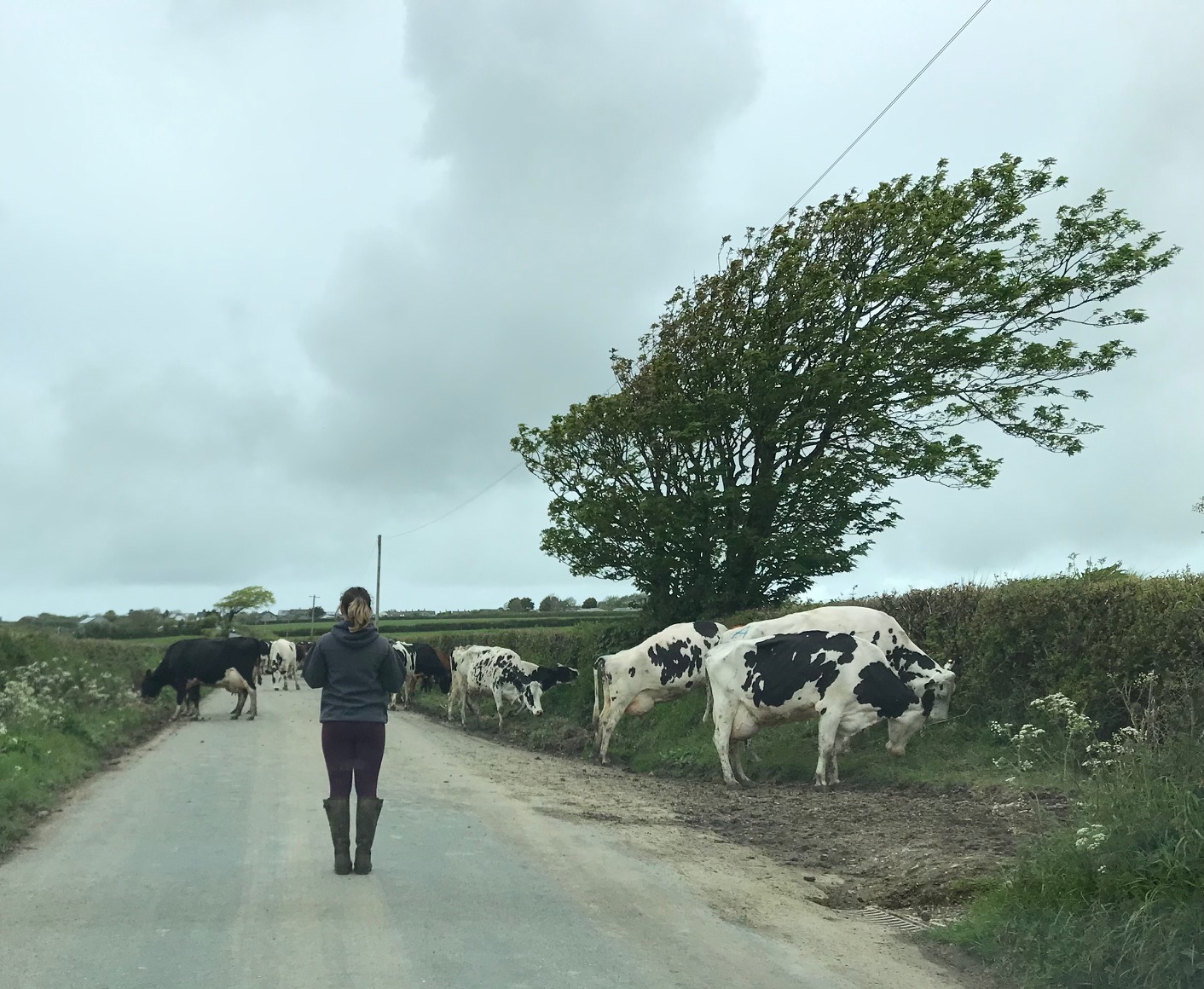
A vaguely relevant photo, since I’ve mentioned cars, and by extension driving. This is a traditional Cornish traffic jam: cows being moved from one field to another. They weren’t in any kind of a hurry.

The parking lot/car park has 211 spaces. I’m going to assume that doesn’t include the handicapped spaces or motorcycle spaces, which he couldn’t use. He’s got kids, so he could legitimately use the parent-and-child spots.

Don’t you learn wonderful things here? Hasn’t your world become richer and your brain stranger?

And what else did people do during lockdown, Grandma?

Other people used the various lockdowns to drink at home. In England and Wales, 2020 alcohol deaths hit a twenty-year high, climbing almost 20% higher than the year before. Blame the way the pandemic disrupted their work and social lives if you like. 

That doesn’t mean everyone ended their evenings shitfaced on the living room floor, but a substantial number of people did take to hazardous drinking at home. 

For what it’s worth, a similar thing seems to have happened during the bubonic plagues. Emphasis on seems, because no one was tracking the numbers. The evidence is anecdotal.

Although the government didn’t shut down the places where people gathered to drink completely, the authorities in 1665 London (by way of example, since it’s the only one I have) did give them a nasty look, calling them “the greatest occasion of dispersing the plague” and decreeing that they had to close by 9 pm.

That included coffee houses, reasonably enough. It wasn’t about people drinking but about gathering. At night. 

The plague worked the night shift. Before 9, everyone was safe enough.

That information about the plague is, I admit, hanging from a thin Covid hook, but it was the authors of the study who put it there. Presumably they decided that Covid sells. I’m only taking advantage of their opportunism and then blaming them.

*

In the U.S., some baffling number of people used lockdown to collect trading cards, which drove up the prices. Boxes of first-edition base set Pokemon cards (whatever that means) have sold for as much as $400,000. So speculators rush around to stores and buy up whole inventories–a deck might sell for a couple of dollars–then break up the sets and resell the more expensive cards online. They can go for a few hundred dollars.

What’s the connection to lockdown? People have too much time on their hands, maybe. And the people who don’t have too little money have too much. My best guess is that no one’s collecting the cards because they care about them. They’re collecting them to sell to people who are buying them because they think they’ll be worth more tomorrow. Or to put that a different way, everyone’s collecting them because other people are collecting them. 

Not that I actually know that. Maybe someone loves them enough to spend $400,000 on a set. We are a strange species, as I’ve said before–and I’m sure you wouldn’t have noticed it yourself if I hadn’t.

In an effort to make sure the U.S. lives up to its reputation as well armed and completely insane, a disagreement over trading cards in a Wisconsin store (a Target if you know the U.S. retail landscape) ended with a man pulling a gun on four other men in the parking lot. 

No shots were fired, no Pokemon characters were injured, and the guy with the gun had a permit, so it was all okay, but Target suspended sales of trading cards in stores, at least temporarily. They’ll still sell them online where it’s harder to shoot people.

*

In Britain, the proportion of people working from home more than doubled in 2020, but they’re still a minority of working people. About a quarter of people who work were working from home at some point in the week. 

Or more accurately, at some point in the week they answered the survey question. Compare that to 2019, when it was 12.4%. 

That was unevenly distributed. In London,that  was 46.4%, and in the most expensive suburbs it was 70%. If you wondered why Covid has landed hardest on people with the least money, you can start here. It’s not the only reason, but it’s door you can walk through to find the others.


And what happens when lockdown ends?

When lockdown ends, all the fun moves to the black market in fake test and vaccination certificates. Researchers found 1,200 sites selling them worldwide. By now, I’d bet on that number having gone up. If you’ve got £25 (or more) and an itch to pass yourself off as safe to be around, you can buy one. Police in Connecticut ended up with a whole box of fake vaccinations cards from an anti-vaxx rally. Whether someone was there to sell them to a likely crowd or was nobly giving them away I have no idea.

As for the fake test certificates, they’re showing up at borders, where people use them because they’re faster, cheaper, and more certain than genuine Covid tests. Unless you get caught.

*

Britain’s traffic-light system for labeling countries safe, risky, and Very Scary to visit has created the usual chaos

The environment secretary said people could travel to countries on the amber list. (If you speak American, that’s the yellow warning light.) Then the prime minister said people shouldn’t visit them unless they had pressing reasons. Then the Foreign Office said it was safe to visit 20 amber-list countries and it had published the list on its website, so there. 

That’s 20 out of how many countries are on the amber list? Lord Google tells me 170 countries are on the amber list. He also tells me the world contains 195 countries at the moment. And that 43 countries are on the red list and 12 on the green list.

Lord Google’s math is worse than mine. And I set a high standard. As does the U.K. government, but at least I’m not pretending to run a country.

Is it safe to lift Covid restrictions?

The latest Covid statistics from Britain are both cheering and worrying, although they’re starting to tip toward worrying. 

Nothing’s ever simple, is it?

On May 12, the country had only 11 Covid deaths and 2,284 cases. Compare that to January 22, when 1,401 people died of Covid and January 8, when the country had 68,053 cases. (Deaths peak a bit later than cases, which is why I seem to be cheating here.)

Some 67% of the British population is at least partially vaccinated. 

That’s the cheery part. So why don’t I just shut up and celebrate?

Blame those pesky experts. Also the pesky data they work with. And more to the point, blame the government–I’d think something was missing from my day if I didn’t–which dithered about whether to quarantine travelers coming in from India and about changing its let’s-all-proclaim-lockdown-over-and-be-happy plans.


Irrelevant photo: Ornamental cherry blossoms. We tried growing non-ornamental cherries. The birds didn’t even bother to say thanks.

Stephen Reicher, from Sage, the government’s science advisory group, is warning that the government has to be prepared to not to “dither and delay as in the past” if it turns out that one of the Indian variants has figured out how to sidestep the vaccines. He talks about acting hard and fast, which–well, unless the government gets a politico-personality transplant, isn’t in the cards.

Three of the Indian variants are known to be in the U.K., and one of them in particular is keeping the scientists up at night. It’s called B.1.617.2 by people who can remember that it’s called that, and in a week the number of cases showing its profile doubled in Britain. 

Sorry, It didn’t double, it more than doubled, although we’re not talking about a big block of people yet. A few days back, it was 520. What’s worrying is that it could be more transmissible than the Kent strain of the virus, which is the one that used to keep scientists up at night. Possibly as much as 50% more transmissible.

To some scientists, the tea leaves are looking frighteningly similar to the ones they saw before the Kent variant caused a surge in December of last year.

Come Monday, pubs and restaurants will get the okay to serve people indoors, and indoors among maskless people is exactly where the Covid virus likes to come out and play. So that adds to the worry.

Other restrictions are on a let’s-get-rid-of-these-soon list, including working from home if at all possible. And the travel industry’s been pushing hard to get people going on vacations again. Or on holiday if you speak British.

The new system to allow overseas travel involves traffic lights. Red, yellow, green–all those soothingly familiar colors. Arrive from a red-light country and you go into the kind of hotel quarantine that signals We’re Serious about This. Right after you mixed in the airport with people coming from green-light countries, who get to take a test and go home. 

What’s on the test? Three math questions, one logic question that the government will get wrong, and the old standby, Who was buried in Grant’s tomb? (The answer’s below.)

Any virus that violates the rules will pay a fine. 

Assorted scientists are warning that viruses don’t play by the rules and that it’s very hard to collect fines from them. 

Will the government back away from the planned reopenings? It’s dithering. 

The assumptions behind this are: 1. that 72% of the population will be vaccinated by August or will be protected by having recovered from Covid. 2. that most of the deaths will occur in people who’ve been vaccinated, since although the vaccines are startlingly effective none of them gives 100% immunity–not even against hospitalizations and deaths, although early reports said they did. No one’s to blame there. We’re learning as we go, every last weary one of us.


Controlling the variant

One way that Britain’s hoping to keep control of the variant is by intensifying the vaccination programs in areas where clusters are found. I have no argument with vaccinating more people, but there’s a two-week delay between vaccination and a decent level of protection, this isn’t an immediate solution.

On top of that, although the vaccines provide a much greater level of protection than we had any right to expect, they’re not like having your big sister or brother ride the school bus with you. In other words, they don’t give you 100% protection against either bullies or Covid. And when we’re talking about numbers as large as, say, the population of a country, a 2% gap in the protection can end up affecting a lot of people. 

So even though we don’t have any indication yet that B.whatever-whatever can run faster than the vaccines, its transmissibility alone means it’s dangerous. 

Modelers are warning about the possibility of a third wave of infections that could be larger than last January’s. If, that is, the new variant’s as transmissible as they fear.

Am I worried? I’m not losing sleep, but I wouldn’t advise anyone I love to start a travel business right now. Or to eat indoors at a cafe or pub. Because there’s no way to eat or drink without taking that damn mask off, and busy as scientists have been since the pandemic hit, they haven’t sunk their teeth into a solution to that problem.


WHO weighs in on a related topic

The World Health Organization has warned that vaccinations are “life-saving, but on their own, they are not enough.” 

That’s in response to the US’s optimistic and (I think) mistaken decision that fully vaccinated people don’t have to wear masks in many indoor settings. 

According to WHO’s Mike Ryan, “Relaxing measures and taking away mask mandates should only be done in the context of considering both the intensity and transmission in your area, and the level of vaccination coverage.

“Even in situations where you have high vaccine coverage, if you’ve got a lot of transmission, then you wouldn’t take your mask off.”


Collapsing the curve or watching it skyrocket

Almost from the beginning of the pandemic we heard the phrase flattening the curve. It was one of those word clusters–a bit like herd immunity–that we came to think we understood because we’d heard so often. Or read it.

Well, a new approach to modeling the epidemic says that if you make enough changes at a crucial stage, the curve doesn’t flatten, it collapses. In other words, you get to lace on your big muddy boots and stomp the little bastard. 

And if you miss that crucial time? 

Um, yeah. You have a massive damn outbreak on your hands. Or feet, if we want to hang in there with the boots metaphor. 

The most interesting thing is that the modelers couldn’t come up with a scenario that put the results anywhere between those two extremes.

One of the most powerful ways to control an epidemic is to test known contacts of infected people (which of course means finding them first and quarantine them if they test positive). But there’s a limit to how many people you can trace and test every day. If the number of cases goes past that limit, the disease spreads and congratulations, you’ve just lost control of your epidemic.

The key is to act early and decisively. (See above, Mr. Johnson.)

“A policy that would have worked yesterday will not only take much longer to take effect, but it may fail entirely if it is implemented a single day too late.” Björn Hof, the central mind behind the modeling, said: “Most European countries only reacted when health capacity limits became threatened. Actually, policy makers should have paid attention to their contact tracing teams and locked down before this protective shield fell apart.”

What Hof didn’t say but what seems to be implied here is that Britain’s strategy of lifting restrictions anytime the virus settles down to a less threatening level is self-defeating and leads to another spike later on. 


All right, gloomy guts, how about some good news?

Okay. In animal trials, a nasal spray vaccine has created sterilizing immunity. That’s the kind of immunity that (in words of one syllable) could wipe this bug from the face of the earth–or at least from your lungs. It would stop you from getting Covid and it would stop you from giving it to someone else. 

The current vaccines can’t go that far. They minimize the risk, and with it they minimize transmission, but they don’t eliminate it.

The vaccine needs only one dose, you don’t have to look away while someone pokes a needle into your arm, and it doesn’t have to be transported at temperatures so cold that sound freezes from the air and thoughts shatter. You probably wouldn’t want to deep fry it, but you don’t need to refrigerate it either. 

But it’s still got a series of trials to go through before we can get our mitts on it. Keep your eye on this one, though. It sounds promising.

*

A cheap Covid test is being developed that reports back in four minutes and is 90% accurate. 

This one can work with either a nasal swab or a saliva sample and it’s actually a bit more accurate with saliva samples, meaning people could stop sticking thin objects up their noses. 

Didn’t our mothers all warn us not to stick things up our noses? Do you have any idea what we’re messing with, using swabs to test ourselves?

It can also spot infections in the early stages, which is important since that’s when they’re most contagious.

Have I written about this one before? I’ve lost track. It seems like some fast, accurate test is always in development. And then we hear nothing more about it. I’m hoping we’ll hear more about this one.


So who is buried in Grant’s tomb?

Grant is buried in Grant’s tomb. (That’s Ulysses S., Union general during the Civil War and later president.) 

When I was a kid, some hundred or so years ago, we used to ask each other this. Repeatedly. Maybe we thought the answer would’ve changed. I don’t know if kids in New York still do it. Grant’s tomb is along the Hudson River, begging for kids to use it as the base of stupid questions. 

I haven’t tried the question on anyone in a British airport. I probably should. 

Why some folks who recovered from Covid keep testing positive

At some point during the pandemic, the good folks who comb through Covid tests noticed that a certain number of people who’d recovered from Covid kept testing positive, although further testing couldn’t find any live virus in their systems. Now a study offers us a theory about why that might be happening.

But before we go on, remember that this is a theory. Repeat after me: It’s a theory, it’s a theory, it’s a theory.

Ready? In simplified form, since that’s as much of it as I can handle, bits of Covid’s genetic sequence can embed themselves in human DNA, getting there by a process called reverse transcription. Don’t worry about what it’s called, though. I only mention it so it’ll have a name and we can call it when lunch is ready.

Irrelevant photo: Daffodils by a stream. Photo by Ida Swearingen.

Before you come unglued about the idea of Covid embedding itself in your DNA, understand that it doesn’t mean Bill Gates is embedding himself so he can send you instructions to buy his latest product or divorce your–or his–wife. Something like 8% of our DNA is made up of sequence fragments left there by ancient viruses. That sounds eek-ish, but they do nothing more than sit around looking ancient. And if you know how to read them, interesting. They’re not responsible for diseases or divorces or anything else beginning with D.

Now if they were retroviruses, they’d use a position in our DNA to replicate and make us sick, but Covid isn’t caused by a retrovirus, so if it’s there, it’s doing nothing.

Take a deep breath. The situation isn’t any worse than it was a minute ago. 

From there on everything gets complicated, but I did escape away with this much information: 1, It’s not yet clear how common reverse transcription is with Covid; 2, if it’s happening at all, it might mean that some Covid immunity gets integrated at the cellular level (that would cause a good thing); and 3, it might also be responsible for the autoimmune responses that show up in long Covid (that would cause a bad one).

Warning: The study’s still controversial, with some scientists yelling–in a more academically appropriate way–”This is bullshit and it’s feeding into people’s fears.” Make of it what you will. I suggest tucking a sprig or two into your hat and waiting to see what it’s done in a month or six.


Covid and evolution

You’ve probably heard people say Covid will become less deadly over time. Didn’t the plague? Didn’t, after the Spanish flu epidemic, the flu?

Mmm, well, maybe. There are two problems with the argument. The first and biggest is that evolution’s random, driven by a combination of pure dumb chance and the pressures put on it by outside circumstances. So as any given disease evolves, it could become milder and it could become more deadly. Or could become neither and change in other ways–ones we care about less.

But that’s old news. The second problem with the argument is newer and more interesting. A group of necrophiliacs–

Sorry, a group of scientists studied the bodies of 36 sixteenth-century bubonic plague victims and compared their immune markers with those of people living in the area today. The modern residents showed a greater genetic resistance to the plague than the sixteenth-century bodies did.

“This suggests these markers might have evolved to resist the plague,” said Paul Norman of the Colorado School of Medicine. 

Because it’s not only diseases that evolve: So do we. And if the study’s correct, so did we. Or at least so did the people of that particular town.

If you want to get whacked with the full scientific verbiage, the article says, “Among the current inhabitants, the team found evidence that a pathogen, likely Yersinia pestis which causes bubonic plague, prompted changes in the allele distribution for two innate pattern-recognition receptors and four Human Leukocyte Antigen molecules, which help initiate and direct immune response to infection.”

Got it?

Me neither. That’s why quotation marks were invented.

The good news here is that humanity can adapt to massive medical threats. The bad news is that, even if some of us have genes that will protect us against Covid, we can’t know in advance who’s got ‘em and who doesn’t. And for those genes to spread through the population would take I’m not sure how many generations and many deaths, which would unsentimentally eliminate those of us who don’t have ‘em. 

In short, if you can get vaccinated, do. 


Does vaccination either stop or slow the spread of Covid?

A study that followed vaccinated and unvaccinated hospital employees found that vaccination dramatically reduces asymptomatic Covid infections. In fact, the change was enough that a pretty dry writeup of the study used the word dramatically. The word didn’t wander into this paragraph because I was struggling to keep us all awake.

So what? So it means that vaccinated people will be dramatically less likely to pass on infections. If you don’t get them, you can’t give them. 

How dramatic a change are we talking about? A week after getting their second shot (or jab if you speak British), vaccinated people were 90% less likely than their unvaccinated co-workers to have asymptomatic Covid.

In that case, how soon will the pandemic be over? 

Um, yeah.

A group of infectious disease modelers at Northwestern University are playing with the numbers and trying to figure that out for the U.S. alone. Their projections are lining up nicely with the numbers reported from the real world, so they’re worth listening to. Basically, the number of Covid deaths and the number of severe cases are going down. That’s the vaccination program at work. 

Rochelle Walensky, of the Centers for Disease Control, said, “The models forecasted some really good news, and an important reminder. The reality is it all depends on the actions we take now.”

Basically, she says, controlling the pandemic depends on people getting vaccinated–quickly.

Is forecasted a real word? Yup. To forecast has two past tenses, depending on what mood it’s in when it gets out of bed. Forecast is one and forecasted is the other.

You can’t always forecast which mood it’ll be in. 

I didn’t know that either.

“The results remind us that we have the path out of this,” she said, “and models once projecting really grim news now offer reasons to be quite hopeful for what the summer may bring.”

But the modelers warn that this doesn’t mean all restrictions should be lifted at once. Surges are still possible, and new variants are a threat. 

They don’t specifically mention this, though, so I will: Until vaccines get to the rest of the world, no country is safe. 

Which leads me to this: As of May 6, 44% of the US population and 51% of the UK population had been vaccinated. Compare that to 9.4% in India, 4.4% in all of Asia, and below 1% in all of Africa. Which is an elaborate way of saying even the safest of us is a long way from safe. 

Appeals to our higher nature are fine, but the desire for self-preservation’s a powerful force and always worth a mention. 


Long Covid

Long Covid has a new name: Post-Acute Sequelae of SARS-CoV-2–or PASC to its friends. 

Why does it need all that? Because in my experience, when the medical community can’t cure something, they rename it. 

Since I’m claiming to have experience, I’d better cite my qualifications. I lost four years of my life to some sort of post-viral exhaustion that was so vaguely defined it had to be diagnosed by picking two symptoms from List A and three from List B. Or maybe it was one and four. Either way, I watched the syndrome go through two or three name changes before I stopped keeping track. 

The experience means that I’m more afraid of long Covid than I am of the severe form of the disease, although I won’t argue that we should all feel that way. 

I’d like to think the new name’s a sign that long Covid’s being taken seriously, and if the number of articles about it are a measure of seriousness it just might be, but being taken seriously isn’t the same as anyone knowing how to cure it. Or even knowing what causes it. 

Long Covid lands on people who had severe Covid and on people who had nothing more than a mild case. And this next bit is news to me: It also shows up in people who had asymptomatic cases. It can range from mild to debilitating to horrific. In one study, less than a third of people with long Covid had fully recovered five months after they left the hospital, although that’s a skewed study because it only follows people who were hospitalized. 

A different study found that nearly half the people hospitalized with Covid felt they hadn’t fully recovered after seven months. Either that study or a different one (forgive me, I get dizzy when I’m around numbers for long) says one person in ten will have Covid symptoms months after recovering from the disease itself. 

This is all still new territory. Expect the numbers to be contradictory. No one even has a fixed definition of long Covid, so you’ll find the game being played by different rules in different studies. And the playing field keeps changing size. In fact, some studies are working with cards and others are convinced it involves a ball. 

It’s not clear yet who’ll get long Covid. Working-age women are the most likely, but men can get it, old people can get it. Young adults and kids can get it. No one seems to have a demographic Get Out of Long Covid Free card. 

An article from Yale University says we are “facing the prospect of a chronic condition without diagnostics or therapeutics. We are facing a post-viral condition of potentially historic proportions and are almost completely in the dark about the underlying mechanism.”

It goes on to talk about lives that are changed overnight, about long Covid’s disproportionate impact on minority communities, and “a health care system that can offer no substantive assistance.” Not to mention long Covid’s “financial toxicity”–and since the article comes from the U.S., people’s loss of health insurance.

Yeah. It scares the hell out of me. 

Covid’s silver lining: another Zoom call goes wrong

If the pandemic cloud has a silver lining, it’s Zoom, which gives us such wondrous ways to screw up.

On the day that his party–the Republicans–launched a state campaign against distracted driving, an Ohio state senator, Andrew Brenner, participated in a Zoom call, and being a master of the technology he didn’t trap himself in a cat face and have to assure members of the state’s controlling board that he wasn’t a cat. No, he started the call in a parked car, showing his very own human face. Then he left the call for a few minutes and reappeared in front of a homey background. 

He’d have been fine if it hadn’t been for the seatbelt he was wearing. And the way he fixed his eyes straight ahead as if he was driving and turned his head from time to time as if he was changing lanes. And the moments when the background wavered and a road appeared beyond what looked very much like a driver’s side window, which had also appeared. 

The meeting was, of course, live streamed to the public. 

No, we don’t take in the real scandals of our age, but give us a politician in a seatbelt pretending to be at home and we sink our teeth in until they hit bone.

Irrelevant photo: rhododendron

“I wasn’t distracted,” Brenner said before digging his hole a little deeper by adding that “I’ve actually been on other calls, numerous calls,, while driving. Phone calls for the most part, but on video calls I’m not paying attention to the video. To me, it’s like a phone call.”

Which is why he did all the cloak and dagger stuff to look like he was someplace other than in his car. 

I suppose, since we’re talking about Zoom, that I have to mention another call that went wrong: Canadian MP William Amos showed up at a virtual parliamentary session stark screaming naked except for a strategically placed mobile phone. He was, he said in his apology, changing out of his jogging clothes when his laptop camera turned on. He’s patriotically placed, you’ll be glad to know, between the Canadian and Quebec flags.


. . . And bringing those two themes together

Have you ever had one of those problems that you can’t get anyone to pay attention to, no matter what you do? Geoff Upson, in New Zealand, had been tried to get some Auckland potholes filled and when he ran out of sane solutions he spray-painted penises around them–at last call about a hundred of them, some in neon paint.

I’d love to tell you that they’ve now been filled, but instead Auckland Transport activated the police on the grounds that penises distract drivers, making them a safety risk. 

No, not owning one. Seeing one painted on the road. 

They also said that it’s dangerous to paint on the road. They have your best interests at heart, Geoff. 

No word on whether the potholes have been filled. 


. . . And having nothing to do with any of that

A Belgian farmer moved a stone that was in his way and accidentally added a thousand square meters of France to his country.

In 1819, after Napoleon’s defeat, the Belgian-French border was marked out with a line of stones that had the date on them. If that makes it sound like the French-Belgian border’s a low-key sort of thing–well, I’ve never been there but that’s the impression I got too. It also sounds like the farm might be an international operation, at least some of the time. Intentionally or not. 

Two things kept this from being an international incident: One is that the countries aren’t at war. The other is that in 2019 the stones were geo-localized, so the wandering stone could be moved back to its original spot, although I expect the farmer wasn’t happy about it. 

*

Six years ago, developers in London illegally knocked down the 1920s Carlton Tavern. This kind of thing happens regularly. Generally the developers say, “Oops, wasn’t that what we were supposed to do?”then pay a fine and go on to build what they wanted to. But this time some 5,000 people and a couple of local politicians organized a campaign.

To make sense of this, you have to understand that the building’s owners and the people who wanted to save the place aren’t the same folks. The owners asked for planning permission to convert the building to ten flats, which in American means apartments, and they didn’t get it. English Heritage–that’s an organization dedicated to preserving, um, you know, English heritage–was set to give the building listed status, which is a form of protection for buildings with historical significance, but two days before it came through the bulldozers knocked the place down.

A leader of the campaign said, “We had a suspicion . . . that they would do something, so we asked English Heritage to think about listing it. They took a plaster cast of every tile, and documented everything.”

That meant the local council–that’s the neighborhood government–could and did order the developers to rebuild it, brick by brick by brick. A few parts were reclaimed from the rubble, the rest were re-creations.

The Carlton reopened in April and is being run by Homegrown Pubs. One of the people involved said, “The pub tells its story from the half-broken fixtures that we’ve got. You can see bits of broken wood–it’s not all perfect, which we really love because it gives character and charm to the building.”

James Watson from the Campaign for Pubs said, “I never imagined that I would see a planning inspector order a developer to put back what he’d just knocked down, to look exactly as it was. I thought the developer would get a slap on the wrist, a £6,000 fine. It has set an incredibly useful precedent. Other planning inspectors will remember it, and so will developers.”

Watson also said that most developers are smart enough not to just send in the bulldozers. They “take some tiles off the roof and let the rain in. The beams rot, it collapses, and they say to the council, ‘This is a derelict site that needs to be rebuilt as flats.’ “ 

Why do pubs need protecting? They’re not just places to sit from 10 a.m. until you’re shitfaced, although up to a point you can do that in them. They also play a role in holding communities together. They’re a kind of public living room. But for a combination of reasons, running a pub is an increasingly hard way to make a living, so they’re disappearing from the British landscape. A few are being bought out by and run as community-owned businesses, which have the advantage of not needing to make a profit.

Your feel-good story for the week

A department store chain, H & M, has introduced a free service that allows men to borrow a job interview suit, free, for twenty-four hours. 

“Research shows that it takes less than one second for an employer to judge your ability based on your appearance,” according to an H & M manager. Hence the program’s name: One/Second/Suit. You don’t even need to dry clean it when you’re done. You send it back in pre-paid packaging and they’ll take care of that before the next person gets it.

If anyone offers a parallel service for women, unfortunately I haven’t heard about it.

The Covid chronicles: Is herd immunity still possible?

With Covid raging in India and Brazil, it’s a strange time to be talking about herd immunity, but a cluster of scientific articles are doing just that. 

How many people need to be immune to a disease in order for the population as a whole to be protected? The answer varies with the disease. For measles, which is very contagious, the estimate is 95%. Vaccinate that many (or wait till they get sick and grow their own immunity) and the other 5% will get protection simply from not being around anyone covered with itchy little spots. 

For the initial Covid strain, the best guess was that herd immunity would come when 70% of the population was immune. But as a planet, we handled the disease so badly that we’re not dealing with that strain anymore. Instead, we have a small raft of more contagious strains, so the bar we have to jump over before we reach herd immunity has probably gone from–oh, let’s say waist height to shoulder height. 

Oh, yes, lucky us.

Irrelevant photo: Wood anemones.

So far, the countries with widespread vaccination programs also have groups of people who refuse to be vaccinated–that’s in addition to some who for medical reasons can’t be. They also have groups who for social and political reasons haven’t been reached. The US and UK haven’t done as well at vaccinating ethnic minority groups as they have at vaccinating whites. When I last checked, in April, Israel had gotten only dribbles of vaccine to the occupied territories, saying they weren’t its problem.

And most importantly, the world at large has done a shit job of getting vaccine to the poorer countries. So all those pools of unvaccinated people are where the disease will spread and mutate and create new variants, each of which carries in its itty bitty little pockets the possibility of outrunning the vaccines that those of us who are vaccinated are so relieved to have. 

Israel has vaccinated just upwards of 60% of its population and has in large part returned to normal life, but that normality depends on keeping its borders largely closed and wearing masks indoors. Countries like New Zealand and Australia, which have in large part stamped out the virus, rely on tight border control and strict quarantine. How long they can or have the will to keep those barriers in place remains to be seen.

One article (the link’s above) says that the trick will be keeping restrictions in place once case and hospitalization numbers drop. Primarily, it says, these will be Covid tests and masks. 

And just so’s you know: There’s no agreed-upon definition of herd immunity. I’m going to skip the details and say only that this doesn’t make the conversation about it any clearer. For a sensible discussion, go here.

Some of the articles I’ve read say we’re unlikely to ever completely eliminate Covid. In countries that have been heavily (but not completely) vaccinated, it’s likely to continue circulating and causing deaths, but at dramatically lower rates.  

Sorry. It’s not the knock-out punch we were all hoping for, but it’s a hell of a lot better than the alternative.  

Dr. Anthony Fauci tells us not to worry about herd immunity.

“People were getting confused and thinking you’re never going to get the infections down until you reach this mystical level of herd immunity, whatever that number is.

“That’s why we stopped using herd immunity in the classic sense. I’m saying: Forget that for a second. You vaccinate enough people, the infections are going to go down.”


The search for a Covid pill

At least three of the big drug companies are working on pills to keep mild Covid from turning into severe Covid. If they succeed, they’d make Covid’s continued presence in our lives a hell of a lot more manageable.

The first days after the virus moves into a human host are its busiest. It sets up housekeeping in a cell and creates a family to admire its work. And then the family spreads out, setting up housekeeping in new cells. And so forth. It multiplies like mad, and that’s when we’d need to drop that little pill–you know: the one that doesn’t quite exist yet–down our throats to disrupt the sequence. 

Researchers have trolled through existing drugs, hoping to find one that would, by chance, do the job but so far haven’t come up with anything. Hence the search for new ones.

One that’s in development is a protease inhibitor, which would interfere with the enzymes the virus needs to multiply. (No, don’t ask me. I’m just playing parrot here.) Drugs that treat AIDS and hepatitis C are protease inhibitors, in case that gives you the same illusion of understanding that glowed so nicely in my brain until I realizes I didn’t really understand a thing.

Other drugs in development target the virus itself. That does’t glow quite as nicely and I’d love to say more about the process but that’s all I’ve got, although I can repeat that they’d disrupt the virus’s ability to replicate itself.

The companies are hoping to have the first of the drugs on the market by the end of the year. And they may end up being used in combination to keep the virus from evolving some form of resistance. 

Don’t give up, folks. We’ll get through this, even if life isn’t quite the same as it used to be.

It wasn’t perfect then either, was it?

The Wallpapergate scandal goes free range; welcome to Nannygate

I hope you don’t mind a quick dip into political sleaze, because I do enjoy a good scandal and here in Britain we have one that’s going free range. Just before an election. Yes, friends, Wallpapergate is turning into Nannygate which is turning into Personal Trainergate.

I’ll stop gloating for a paragraph or two and translate for myself: Boris Johnson is being investigated for asking Conservative Party donors to pay for his and his partner’s £200,000 refurbishment of the prime ministerial residence, but that’s a few-days-old scandal. Now it’s now come out that he also approached donors to pay for his and his partner’s nanny and his personal trainer

I did use the phrase “the couple’s nanny,” but no, the nanny doesn’t take care of the couple, although if she (and I’m making assumptions there, I know) did she might’ve saved them from their wallpaper. But no such luck. She’s there to take care of their kid, who’s a year old. 

I won’t get into the whole nanny thing. Really. I won’t. I’m putting on mittens to limit my typing. 

Irrelevant photo: speedwell–a wildflower

It all makes me wonder, though, if Johnson also tried raising funds to pay for a food taster and a herald to blow the trumpet when he’s coming into a room. If he has, it hasn’t hit the headlines yet, but I’m ruling nothing out. 

The latest of Wallpapergate is that Conservative Party staff members have been told to hand over all communications that relate to it. They’ve been threatened with criminal charges if they don’t, which has a certain irony since their boss isn’t being threatened with criminal charges, although the email they were sent did say, “You are put on notice that this is a criminal investigation.”

Johnson is said to have taken out a personal loan to pay back whatever money was borrowed to cover  the renovations of his flat, although he’s dodged questions about when he did that. The loan he received hasn’t been declared, and neither has whatever he borrowed or solicited and then repaid. That signals trouble, although I have no idea how deep.

Prime ministers are given £30,000 to wipe away all visible traces of their predecessors, so that leaves only £170,000 to repay. 

To put that in perspective: If you worked a 40 hour week at the London minimum wage, which is higher than the national one, you’d take home something in the neighborhood of £17,000 a year, so if you didn’t frivvel that away on groceries and rent or anything else, it would take ten years to save that up. 

At the London real Living Wage of £10.85, you’d take home something like £22,000. 

Johnson, on the other hand, makes £150,000 a year as prime minister. That means he’s licking the underside of the top 1% of British earners, but he’s apparently told friends that he needs to make twice that just to keep his head above water. Rumor says he’s broke, although you might want to wait until the music stops and the numbers have all tried to grab the chairs that are left before you decide what to believe on the subject.

*

But I mentioned elections, so let’s talk about them: All across the country we’ve got local elections coming up on Thursday, and they’re being taken as a test of the impact all this is having on the electorate. Whether it’s a fair test is arguable. I’m not sure how much national politics translate to local elections. 

Some pundits speculate that the mythical man in the pub (and I’m reasonably sure they do mean the man) doesn’t care about Wallpapergate. What I’ve noticed, though, is that most of the Conservative newspapers seem to have turned against Johnson on this. I haven’t a clue how it’ll go or what it’ll mean. 

In Scotland, though, the elections will decide whether there’ll be another referendum on leaving the United Kingdom and joining the European Union. That referendum, if it’s held, will either be sanctioned by the British government or it won’t be. And if it isn’t, it’ll either be held anyway or it won’t be. I think that covers all the possibilities.

It’s going to be interesting here for a while.

The Wallpapergate scandal

First, a warning: Actual wallpaper is involved in Wallpapergate–massively ugly wallpaper, in my opinion highly biased opinion–but no actual gate is known to be part of the story. If there were a gate, though, it would be a very expensive gate, a high-end type of gate, because this is about Boris Johnson and his partner, Carrie Whatsit, spending something in the neighborhood of £200,000 to redecorate the apartment that prime ministers live in. 

Whose money were they spending? That’s where it gets interesting. Initially it seems to have been from major Conservative Party donors, but when the nosy neighbors–also known as the rest of the country and specifically a former aide who he’d first confided in and then pissed off–started honking and quacking about it, he paid it back.

Apparently. All he’s saying right now is that he paid for it personally. He’s not saying when he did that, although he has been asked.

Irrelevant photo: Wallflowers

Prime ministers are given a budget of £30,000 to redecorate the prime ministerial apartment when they move in, and you might think a person could manage with that in a pinch. The Johnson-Whatsit household could not. So, hands up, please: How many of us (al) have £200,000 worth of spare change rattling around in our pockets and (b) would use it to redecorate an apartment we don’t own and don’t have a lease on? An apartment we could be kicked out of the minute the political winds start blowing from some new direction? 

Yeah, preliminary polling predicted the count would go that way.

Maybe Johnson and Whatsit are counting on a long political and residential tenure–a kind of thousand-year Reich, only with wallpaper.

The story starts, as nearly as I can figure out, with Johnson and Whatsit moving into the prime minister’s apartment and declaring it a “John Lewis furniture nightmare.” 

I need to stop and translate that for readers who don’t live in Britain. John Lewis is a department store, and it’s either upmarket or downmarket, depending on what street you entered the market from. If you came in on the street not just used but owned by people who’d be mortified to have the same couch as anyone else, then John Lewis is downmarket. 

Johnson and Whatsit very much came in on that end. 

But I could be wrong to call the piece of furniture we’re talking about a couch. Maybe it’s a sofa. Or a davenport. Or–oh, hell, I’ll never understand the linguistic clues to class that make British English such a minefield. I do know that key objects have different names depending on your pedigree and your bank account. And that it’s all horribly important and completely insane. And may all the gods of snobbery help you if you get one of them wrong among the people who came into the market from Unique Sofa Street, because they take this (not to mention themselves) very seriously. 

Stop giggling. They do. So consider their embarrassment if they find out they’re sitting on a couch that any Tom, Dick, or Theresa May could buy. 

Theresa May was never really one of their crowd, but in fact she wasn’t responsible for buying the couches. Silly thing that she was, she left the furniture alone when she moved in and focused on trying to govern the country. I can’t say I was impressed by her idea of how that should work, but I will give her credit, belatedly, for not trying to make it involve wallpaper.

The Johnson-Whatsit wallpaper is said to cost in the neighborhood of £800 a roll. And of course you need a couch and curtains to match the wallpaper, and a rug to clash with the wallpaper, and all manner of other stuff in startling patterns. The funniest of the photos seems to have disappeared from the internet, but as I remember it, it involved overwhelmingly patterned wallpaper, a couch screaming to itself in the same pattern, and a person who was almost camouflaged by it all. Someone who wasn’t me described the style as Victorian bordello. I’ll take their word for it since I’ve never been to a Victorian bordello–I was born far too late–but they may be doing bordellos an injustice.

[Late addition: You can find a photo here.] 

I do understand that tastes differ, but if I moved into a place that looked like their post-renovation apartment does, I’d pay a lot of  money to make it stop. And I could do it for less than £200,000. All I’d need is a few cans of white paint and a wrecking ball.

So what happens next? I don’t mean furnishings-wise, because the couple seem happy enough in their house of horrors. I mean what happens politically

Well, the Electoral Commission will be investigating whether Johnson broke any of the laws about political financing. That should be fun, even though the commission’s investigations don’t usually end up with criminal charges. 

What all this proves–if anything–is that it’s not the big-league scandals that set the national alarm clock ringing–the ones where the people running the government hand huge contracts to their friends, who then bungle the work and are thanked for it and get more contracts. Those hit the headlines regularly and we roll over and go back to sleep. The ones that wake us up are the wallpaper, the snobbery about stores most of us can’t afford to shop in. It’s not that the others are hard to understand, but this is on such a human scale. We’re watching a panto, that over-the-top British theatrical form where there’s always someone to boo and hiss.

They’re not behind us (as the audience yells at a panto). They’re right in front of us. We can’t take our eyes away.


News from the Department of Unexpected Results

Belgium is facing a different kind of crisis: It needs people to eat more potatoes. The country normally exports them, but the Department of Unexpected Results reports that because of the pandemic a lot of potatoes went unexported.

What’s going on here? Do people eat fewer potatoes during pandemics? Does exposure to Covid reduce people’s carb cravings? Do people only eat potatoes when they’re away from home? Tempted as I am to toss you a few off-the-top-of-my-head answers, these questions are too important for that. What we need here is a serious study. While—we hope–someone’s doing that, let’s treat the issue gently and try not to break anything. In other words, let’s not speculate.

And while we’re waiting for the results of those studies, why not make yourself a nice portion of potatoes? You’ll help improve international relations and fight Covid, all in a single act, with no intermission. The Belgians like their potatoes deep fried, with mayonnaise, but you’re welcome to eat them any which way. 

My thanks to Be Kitschig for alerting me to this crisis. 

*

Young kids in Ireland and the U.K. responded to the recent lockdowns and school closures by reading longer, more difficult books. That comes from a survey of a million kids, who are reading fewer books but more challenging ones. And they’re understanding them. They’ve had more time to read and the little stinkers are surprising everyone by actually doing it. 

Then they get into secondary school–in the U.K. that happens when they’re around eleven–and after the first year the improvement stopped dead. 

Okay, admittedly, there hasn’t been time to follow the same kids from primary to secondary school. This is a different batch of kids we’re talking about. But is something about being in secondary school killing off kids’ interest in reading, even when they’re not in the building? The answer is a resolute I don’t know, but the study’s author is calling for schools to make more time for kids to read and for secondary schools to encourage kids to read harder books.

Still, we take our good news where we can find it these days: Young kids are voluntarily reading harder books. It’s a safe guess that they’re doing that because they’re enjoying them. And that’s got to be a good thing.

No, vaccinated people do not shed spike proteins

The latest thing in nut theories–if it hasn’t been superseded by a newer one, and you’ll have to forgive me if I limp along behind this stuff–is that it’s dangerous for women who are still menstruating to even be around people who’ve been vaccinated.

Why’s that? So the little vaccy-things jump out of the vaccinated Person V and into still-fertile Person non-V, implanting some version of Rosemary’s baby that’s been updated to look like Bill Gates?

Quite possibly, with just the tiniest touch of exaggeration.

Utterly irrelevant photo: This is for all you British mystery fans out there. If you remember a detective called Campion, this is the flower he named himself after. It’s a wildflower–a.k.a. a weed–and grows wherever it damn well pleases. It stays in bloom for a good part of the year and is a cheery little beast. This is the red campion, in spite of being pink. It also comes in white.

The theory is that the vaccines shed the spike protein. (Please don’t ask about the mechanism for that.) Someone who described herself as a cosmic doula posted an Instagram video saying, “Women in their menstruating years are experiencing severe side effects from people around them having received this jab.” They miss their periods. They have excruciatingly painful periods. Post-menopausal women start to have periods. Cats flee from them.

Okay, I made up the bit about the cats, but you have to admit it’d be upsetting.

Someone on Facebook who likes to Capitalize stuff she Considers Important listed the side effects of being around a Vaccinated Person as bleeding, hemorrhaging, passing clots, irregular periods, miscarriages, severe cramps, abnormal pain, post-menopausal periods, and decidual casts.

Most of these things aren’t fun but they’re also not signals that an asteroid is headed for earth or that Bill Gates has implanted his own DNA into the Covid vaccines, which will turn us all into non-rich versions of him. They happen, even in non-pandemic times.

In other words, call me when men start having periods. You’ll have full attention. Until then, I’m not impressed.

Gynecologist Dr. Jennifer Gunter said, “Neither of the Pfizer or Moderna vaccines . . . nor the Johnson and Johnson vaccine . . . can possibly affect a person who has not been vaccinated, and this includes their menstruation, fertility, and pregnancy. Let me be very clear. The COVID-19 vaccines cannot affect anyone by proxy.”

So she’s no fun at all. And cats flee from her.


Vaccination and pregnancy

If we’ve had our fun now, and if the cats have crept back into the room, allow me to mention a study of 35,000 women that says the Moderna and Pfizer vaccines are safe for pregnant women–not to mention the people standing next to them. Their rates of complications, miscarriages, and premature births were the same as the rates for those things before the pandemic. 

The vaccines may also be safe for pregnant men, but it was hard to find a large enough pool for the researchers to follow. For the time being, guys, you’re on your own.

Longer-term follow-up is needed, but pregnant women face a higher risk of severe Covid and hospitalization than non-pregnant women in their age groups, although their babies don’t seem to be affected.  

The Johnson & Johnson vaccine was released too late to have been included in the study.


Yeah, but what are we immune to?

A new study says that the Covid vaccines activate–

Oh, hell, this is complicated, so you’re going to have to pay attention, okay?  The immune system has these cells that we’ll call helper T cells, although when they appear in court they’re known by their formal name, CD4+ T lymphocytes. And to distinguish themselves from the defendants, they wear those strange, lawyerly wigs that distinguish British barristers from the normal run of human beings. But never mind all that. We’re friends here and we can afford to be informal and wigless. Helper T cells it is.

The study says that once activated by either of the two mRNA vaccines (those are the Pfizer and the Moderna), the helper T cells will recognize any of the current Covid variants and slaughter the little bastards. 

Okay, that’s not a direct quote. I get carried away with the opportunity to slaughter small and bloodless things that have no apparent nervous systems so I can do it in good conscience. 

The activated helper T cells may also protect us against one of the coronaviruses that causes the  cold. 

Sorry, not all colds. Just one form.

This is important because our antibodies are cute little things but they’re not as smart as T cells and sometimes need a phone call to tell them where to go and what to do when they get there. 

But before we get too excited, first this was a small study and second it may only mean that they’re able to prevent the variants from causing severe illness, not to prevent all infections.  


The Pfizer upgrade

If all goes as expected, the Pfizer vaccine will soon be easier to ship. Up to now, it’s had to be kept at the temperature of dry ice, meaning a country needed one hell of an infrastructure to use it at all. In its new form, an ordinary freezer will keep it safe. 

It’s also one of the more expensive vaccines on the market, so making it easier to ship won’t solve all the problems involved in getting it where it’s most needed.

How’s it stacking up against the variants?

Pfizer’s CEO, Albert Bourla, said “We have already data for the UK [variant]—I hate using the countries, but people know them like that—which is very prominent in Israel… efficiency was 97 percent.

“We have data from South Africa, with the South African variant, and overall the efficacy was 100 percent. And also have data from Brazil. And it looks also this is very well controlled.”

You’ll notice that he didn’t give us any numbers from Brazil. Let’s assume there’s room for improvement.

It takes, he said, 100 days to tweak a vaccine so that it’s more effective against a worrying variant. 


The search for a universal vaccine

So will there ever be a Covid vaccine that doesn’t need tweaking? 

Possibly, and I suspect I’ve written about it before but it’s not as if I pay attention to what’s going on here. That’s your job.

One has shown encouraging results in animal studies. It targets a part of the virus that seems stable–in other words, it doesn’t mutate–and indications are that it will protect against multiple coronaviruses, not just Covid. So it could–potentially, remember; we’re not there yet–protect against coronaviruses that have yet to make their way into our lives, and also against multiple cold viruses.

And it can be produced cheaply. If you brewed it in a keg the size of your car’s gas tank (or petrol tank if you’re speaking British), it would cost $1 a dose. That’s compared to $10 a dose for the mRNA vaccines like Pfizer. 

But if production is ramped up, you won’t be brewing it in your car’s gas tank, or even (Prohibition-style if you know your US history) in your bathtub. You’ll be using industrial-scale tanks and it’ll be a whole lot cheaper. 

“If you have two or three or four, pretty soon you get enough vaccine to immunize everybody in the world,” according to Dr. Steven Zeichner of the University of Virginia, in Charlottesville.

The vaccine’s designed to attack a part of the Covid virus called viral fusion peptide, which sounds like it’s going to blow something up but is just another damn peptide, not a nuclear weapon.

When in your life did you hear the word peptide as much as you have this past year? 

This particular peptide is a universal coronavirus part. That means you can get from any used parts dealer, any junkyard. Etsy has it. I’d mention Amazon but I’m carrying on a one-person boycott so I won’t. It’s a part of the spike protein that hasn’t shown any changes so far and that’s unlikely to show any in the future. It’s like the headlight that’s used on this year’s model and also the 1957 model. 

Or so Zeichner says, and he knows more about this than I do–which wouldn’t be hard. Let’s say he knows considerably more than I do and trust his judgement on this. After all, he did have enough sense not to bring junkyards or headlights into the discussion. I’m to blame for that.

Even if he turns out to be wrong and under pressure from the vaccine the peptide does mutate, we will have been given some breathing room.

This doesn’t have to be a new vaccine. Existing vaccines will be able to incorporate the target as they add new tweaks.

But a universal vaccine isn’t ready for human studies yet. For one thing, in animal tests it prevented severe symptoms but not infection. The developers want to tinker, retune the engine, give it a new set of tires, do all those things that will make it more lethal to coronaviruses. The preliminary data, they say, are exciting, but these are the very early stages still.

A nice British scandal

Who doesn’t love a good scandal? And Britain’s rich in them right now. They’re buzzing like flies around the rumpled head of our prime minister. We have so many that–metaphor switch here–it’s like standing in front of a dessert buffet with a too-small appetite and a too-small plate. 

To translate that, I can’t cover them all, so let’s focus on the Covid-related one: Before the third lockdown, Boris Johnson allegedly said, “No more fucking lockdowns. Let bodies pile high in their thousands.” 

Allegedly? Well, yes. The source of the quote is, so far, unnamed, and Johnson denies having said it before changing the subject, but it’s being taken seriously and the subject doesn’t stay changed for long. 

You can probably guess, even without following British politics closely, that letting the bodies pile up isn’t a popular stance. 

I’m sure someone in government is looking for the source of the quote even as I type. Back in October, someone leaked government plans for a lockdown and an inquiry was ordered so that blame could land somewhere. To date, the culprit remains unnamed. More recently, families of people who died of Covid have been calling for an inquiry into the pandemic’s mishandling and the government’s said it doesn’t have time for that sort of hindsight. Haven’t these families noticed that we’re still in a crisis? 

Irrelevant photo: Wild primroses with violets.

However, there is time for an inquiry into top civil servants taking outside jobs that may be conflicts of interest. There’s also time for an inquiry into who leaked text messages between Johnson and a businessman in which Johnson promised to change some tax rules the businessman had complained about. There won’t–if Johnson & Co. can help it–be an inquiry into the exchange of messages itself. 

After all, there’s only so much time a government can devote to inquiries.

Sorry to have passed up the other scandals. They look delicious, but it’s not nice to be greedy.


Yeah, but what are we doing about Covid?

A taskforce–we’re still in Britain in case you folded your map away–has been told to find two new drugs that will stop mild Covid from progressing to severe Covid. If that makes it sound like someone’s misplaced the drugs and they’d show up if you’d just move the couch away from the wall for me, please–well, that’s probably not what they have in mind. 

You can shove the couch back in, thanks. It hides the dust.

The drugs they’re looking for have to be something people can take at home instead of in the hospital, and they have to come in either tablet or capsule form. 

What’s the difference between a tablet and a capsule? Does it matter? They’re both pills. If you’ll just shut up and swallow one, by tomorrow you won’t remember which it was.  

When he announced the task force, Johnson said experts expect another wave of Covid later in the year. In spite of which, and in spite of the possibility that the pills dropped into the heating ducts and won’t be found until years from now when the whole system’s torn out and replaced, no one’s adjusting the steps toward easing the country out of lockdown. The economy must be revived. Let the bodies–

No, he’s not going to repeat that particular quote. And I hope we’re not in that dire a position this time around. Almost 47 million people have had at least one dose of a vaccine. That’s out of a population of almost 67 million. In precise percentages, that’s a lot of people. But it’s not a suit of armor. If another pandemic wave comes, it does no good to tell the newly bereaved, “Well, nowhere near as many people died this time around.”  

How likely is the taskforce to succeed? I don’t know, but I do know that it isn’t the world’s only group working on the problem. With luck, someone will get there, and whoever shows up first–and second and forty-eighth–I’m prepared to applaud.

*

So how vulnerable is the country?

Professor Adam Finn, of the Joint Committee on Vaccination and Immunisation, expects a third wave this summer. He considers the country vulnerable and says the dates for easing lockdown may need adjusting.

Britain’s vulnerabilities include new Covid variants, the still-large number of unvaccinated people, and the inevitable breakthrough cases among the vaccinated. The number of deaths expected in that wave vary from 30,000 to 100,000, depending on what software the statisticians rely on. The time when the wave’s most likely to hit also varies. What does seem to be solid is that another wave will come.

You remember that Greek myth about Orpheus going down to the underworld to bring his love Euridice back to the land of the living? He’s told not to look back at her until they’re above ground, and he doesn’t until he comes into the sunligh. Then he looks back, but she’s still in the shadow of the underworld and, damn, you blew it, Orph, so back she goes, yelling, “You damn fool, you never did think of anyone but yourself,” the whole way down.

We need to think about that tale as countries emerge from the underworld. Don’t let yourself believe you’ve solved the problem just because you feel the sunlight on your own silly skin. 

*

That noted non-scientist our prime minister, however, says there’s nothing in the data to show that everything can’t go ahead exactly as planned. 


And meanwhile–

A nurse in Manchester, Karen Reissman, was fined £10,000 for protesting the 1% raise that the government saw fit to give the nurses it spent months applauding. She’d handed in a risk assessment for the protest, but the Manchester police decided the rally was breaking Covid rules anyway.

“Somebody calculated that if I used my 1% rise, it would take me 56 years to pay the fine off,” Reissman said.

Believe me, the fine will be appealed.

Real-world information on Covid vaccine effectiveness

For the first time, we have some real-world data about how effective the Covid vaccines are. The good news is that a very small percent of fully vaccinated people get sick. The bad news is that the vaccines aren’t  a three-hundred percent effective suit of armor against serious disease. Or even quite one hundred percent.

Among the 77 million fully vaccinated people in the US, the Centers for Disease Control reports 5,800 Covid cases. That’s somewhere in the neighborhood of 0.0001%. Of that group, 7% were hospitalized and 74 died, and damn it I wish they’d give statistics either entirely in percentages or entirely in absolute numbers to dopes like me could compare them. I can get as far as saying that most of the cases have been either mild or asymptomatic. If you can translate, leave me a comment. Even if your answer’s wrong, I’m not likely to know. 

Infections in vaccinated people are called breakthrough infections, and it would be unusual if they didn’t happen. They were found in all age groups, although 40% were in people who were 60 or older, 65% were in women, and 29% were asymptomatic. 

Irrelevant photo: apple blossoms

So far, they haven’t identified what, if any, risk factors incline vaccinated people toward getting Covid or which (if any) variants are more likely to be involved, but believe me, someone’s staying up late crunching numbers. It’s also not clear how the asymptomatic cases were noticed, since it’s unusual to test fully vaccinated people who show no symptoms. It could be that they were hospitalized for other reasons and a Covid test was run as part of the admissions routine. Whatever the reasons, though, we can assume that the number of asymptomatic infections is an underestimate.

But didn’t they tell us that the vaccines were 100% effective against severe Covid? Yup, they did, and they weren’t lying to us. The odds of a fully vaccinated person getting a severe infection are so small that the sample would’ve had to be insanely large for a case to have surfaced. The people who ran the trial gave us the numbers they had. As real-world information comes in, those numbers change. That’s the annoying thing about the real world. Every so often, it doesn’t line up with our predictions.

I get a rightwing newsletter in my inbox every so often–it’s been interesting so I don’t unsubscribe, although I’m not the person they have in mind–and it’s fond of reporting on cases of people catching Covid after being vaccinated. The tone leans heavily toward See? We told you it didn’t work. If I could, I’d compare that 0.0001% of breakthrough infections with the percentage of unvaccinated people who catch Covid in the US, but we’ll need a person with some minimal mathematical competence to work it out. I asked Lord Google but he was in one of his moods. If you’d like percentages on many unrelated things, I can point you in the right direction. 

The conclusion, if you want one to put in your pocket and take it home, is that the vaccines aren’t 110% effective and we still need to be careful, but we can let go of the anxiety. The numbers are on our side here and the anxiety isn’t helping anyway.

There’s nothing like someone telling you not to be anxious to make you less anxious, is there?

The additional conclusion is, keep the mask. Even if you’re vaccinated, you can still spread the disease. You’re less likely to–if you have an asymptomatic case you’re likely to have a lower viral load–but you can still do some damage. Other people share this world with us. Try not to do them any more harm than you can help.


What’s the story on vaccines and blood clots?

The two vaccines that have been linked to very rare incidents of blood clots are based on a single technology–one they share with the Russian Sputnik V vaccine. Basically, they take an adenovirus–that’s a virus that causes colds–deactivate it, and turn it into a chariot for the vaccine to ride in on.

Vaccines are hopelessly vain. They can’t resist a grand entrance. Horses, polished metal catching the sun, noise, dust, cameras. 

The clotting problem seems–and we’re still at the stage of seems–to be related to that damn chariot. 

The clots happen in veins in the brain, in the abdomen, and in arteries, and at the same time the person’s level of blood platelets fall, and those platelets are the beasties that help our blood clot. We end up with blood clots happening at the same time as hemorrhages, which in everyday English means bleeding. That’s kind of like an elevator going up and down at the same time. 

Normally, you’d pour an anticoagulant called heparin into a person with a blood clot forming in scary places, but when you pair the clots with hemorrhages, you can’t do that.

What are the signs that a person’s getting a serious reaction to one of the vaccines? Severe headaches, abdominal or leg pain, or shortness of breath within three weeks after vaccination.

Every article about this says the clots are very rare. 

How rare is very rare? Last I checked, 222 cases had been linked to the AstraZeneca vaccine in Europe and Britain, along with 18 deaths. That’s out of 34 million people who’ve gotten the vaccine. Most of those were in women who were–okay, not young but under 60, which looks younger all the time. In the US, the Johnson & Johnson vaccine has been linked to 6 cases out of 6.8 million people who were vaccinated with it.

So how rare are the clotting problems? About the same as the chance of being struck by lighting in the UK in any year you choose. And that’s in a country that, by comparison with the American Midwest, doesn’t get a hell of a lot of lightning.

The risk of Covid, though, is no small thing. 

And if you’re inclined to roll the dice by going unvaccinated, the risk of having a blood clot after a bout of Covid is 8 times higher than after getting the AstraZeneca vaccine. The risk of clots after Covid is 100 times higher than after a normal infection.


Covid immunity and prior infections

And vaguely related to that is the news that having had Covid doesn’t give young people full protection from another bout of it. That’s from a study of 3,000 healthy U.S. Marines who were between 18 and 20 years old and unless the regulations have changed since last I looked had radically and irrelevantly short hair.

Even though the marines had antibodies, they didn’t have the level of protection that the vaccine offers: 10% got reinfected. That compares with 50% who hadn’t had an earlier infection, although in the previously infected group 84% of the infections  were asymptomatic or mild compared to 68% in the previously uninfected group.

The numbers of infections and reinfections were higher than would be likely outside of a military base because of the cramped living conditions and close contact.

The advice to people who’ve recovered from Covid is to boost your immunity with a vaccine.