How to block a road

Our friend J. lives on a back road, which since we’re in Britain is called a lane, but what matters isn’t what it’s called but that it’s narrow and has two ninety degree bends where anything bigger than a little red wagon risks getting stuck forever. It also fords a small, unimpressive stream which can rise enough that driving across it would be really, really stupid.

I may have exaggerated those bends by just the smallest amount. If a normal car couldn’t make the turns, the hamlet would have been cut off for centuries and evolved its own language and customs. And probably its own form of government. So yes, an average-size car with a competent driver who’s used to our roads will be fine. If the driver’s an emmit, though—that’s a tourist, to give you the short definition—a normal car won’t get stuck but the emmit may go paralytic with fear and have to be rescued by someone local who has a calm manner and a gentle voice.

Delivery vans can also get through, and residents have been known to order who knows what-all off the internet: groceries, anvils, sex toys—the same odd mix of the necessary and the even more necessary that people throughout Britain rely on the internet to bring into their lives.

A delivery truck blocking the lane. I'd have missed it, but J. pointed out that it says, "Expert Logistics" on the side. Great logistics, there, folks. Photo by Duncan Walker.

A delivery truck blocking the lane. I’d have missed it, but J. points out the lettering on the side: “Expert Logistics.” Great work on the logistics, there, folks. Photo by Duncan Walker.

But even though delivery vans have been known to enter the hamlet and leave unharmed, tales circulate of larger trucks getting stuck on the bends and—well, the longer the story circulates, the longer the truck is caught on the bend and the more complicated the rescue becomes. By the time the story drifts to the far edges of the parish, houses will have to be demolished and put back together again, stone by stone by stone, and half a dozen tow trucks and rescue vehicles will be stuck as well. They’ll be there for months. Possibly years. A campsite has been set up to house them.

When J. talked about what happens on the lane, she mentioned both trucks and lorries. If you don’t know what the difference is, don’t look to me to clarify the situation because I don’t either. I could look it up but something about the murkiness of the British/American miscommunication appeals to me.

On the morning I started writing this, I had to drive down the lane and through both bends because the police had closed off what we call the main road (anyone who doesn’t live here would call it a back road) after an accident. That made the lane the shortest way around the roadblock. No trucks were caught in either bend. No rescue vehicles were stranded. So I can testify that the road’s open after whatever the last rumored incident was–whenever it may or may not have happened.

I’ve said this before, but it bears repeating: We have no secrets in the village, but we do have a lot of inaccurate information. I’ve also written about this particular set of bends and rumors before. The reason I’m coming back to it now is that J. and A., who also lives on the lane, are trying to get it designated a quiet lane so that sat-navs (make the GPSs if you’re in the U.S.) won’t be able to direct drivers down it. Because right now they do, even when a different route would be easier. Even when it would be not only easier but shorter.

Why do they do it? Because, as the kids where I grew up used to say. (The italics are there because they said it in italics. And that was before any of us knew what italics were.) Once because was the answer, the conversation was closed and logic wouldn’t help. No appeal was possible.
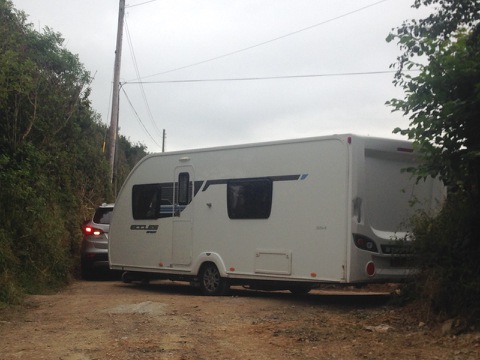
More trouble, same lane. Aren't you glad not to be the driver? Photo by Duncan Walker.

More trouble, same lane. You begin to get a sense of the problem here, right? Photo by Duncan Walker.

One grocery delivery outfit tells its drivers to follow their sat-navs no matter what, so even if they know a route’s insane, they follow them. In Cornwall, that can be lethal, and I mean that literally. Sat navs can take you the wrong way down a highway exit ramp. Less lethally but more locally, some of them will take you up a washed-out, unpaved road that will eat your axles for an appetizer and then come back for your springs and your window glass. I wouldn’t be surprised to learn that if you gave your sat-nav an address in Ireland it would take you straight into the ocean. Because, hey, it is the most direct route.

Are the grocery delivery drivers supposed to keep their foot on the accelerator as the water rises? I don’t know. All I can tell you is that they follow their sat-navs around those two tight, stone-walled bends, although there’s a much simpler way to get almost anywhere. Because, like anyone else, they want to keep their jobs.

So here’s this quiet little settlement plagued by drivers who don’t want to be there and who are sporting that panicked, I-have-a-sat-nav-but -where-the-hell-am-I? look.

A. has committed herself to fixing that. She can be a real terrier, and a terrier’s what’s needed for this. She’s already called a couple of the sat-nav companies and gotten the lane taken off their list of ways to get from point A to point everywhere else. But to back all the companies down, the road has to be designated a quiet lane and the parish council has to impose a twenty-mile-an-hour speed limit.

Last I heard, J. and A. were headed for a parish council meeting and it will be taken care of.

But that won’t entirely solve the problem, because sat-navs don’t update themselves. Their owners have to update them. Which involves paying money—something people may quite reasonably not want to do since they already paid money for the damn things and if they’re not broken, why throw more money at them?

We actually did update a sat-nav once. The update wrecked it. Or maybe the problem was connected to that sledge hammer. Me, though? I blame he update.

So—if I understand the situation—the current generation of sat-navs may have to die before the problem will be solved.

Even so, the hamlet’s closer to a solution than places with equally difficult roads but no resident with the skills, the energy, and the commitment to back down half a dozen sat-nav companies and a grocery delivery service. Trucks will get stuck in those places. Rescue vehicles will pile up behind them. Rumors will grow, but they’ll do that anyway.

All of this leads me to a question: What’s going to happen when driverless cars are turned loose on our roads? My partner, Wild Thing, has macular degeneration and has had to quit driving, so we have a more than intellectual interest in driverless cars. Is she going to end up in a car that decides the best route home is up an unpaved road that will eat one axle and both front doors? Or that takes her down the exit ramp to the A30–Cornwall’s main highway? Or to Ireland by way of the Atlantic Ocean?

She has enough vision left to see where she is, and I’m assuming passengers will be able to stop driverless cars somehow, and maybe even reprogram the route. But what happens to passengers with no vision? Do they have to wait until the feel the water rising? Will the driverless car need a driver? A navigator? An editor? Is all the work focused on how the cars follow the road and avoid accidents instead of on the routes they’ll follow?

An improbable link about surgery in Guatemala

I don’t do reblogs here, and I’m sparing even about linking to other blogs. I normally limit my links to posts that are tightly related to my topic. Which is–oh, hell, what is my topic?

Never mind. We don’t have to know that just now. What matters is that I have several reasons to link to this one at Zipfslaw:

  1. The post introduces an organization called Surgicorps, which provides surgery–in this case in Guatemala–to people who wouldn’t have a hope in hell of being treated in any other way. And in case anyone’s interested, no I don’t believe medical treatment should depend on goodwill, volunteers, and charitable donations, but in many parts of the world (including, mentioning no names, if you’re poor enough in one of the richest countries) it does just now.
  2. The post gives us all a chance to donate money to keep the group going. If you’re interested, follow the link above and look for the link in the post.
  3. The post is a fascinating look at language and interpreting.

Even if you’re not in a position to donate or aren’t inclined to, it’s worth your time.

How people find a blog, part 4(ish)

It’s that time again, kids—the time when I dig deep into the questions people type into search engines that lead them, however bizarrely, to Notes from the U.K. I’ve left actual quotes in lower case, as search engines do.

Let’s start with:

Old favorites

The most common question I get is why Britain is called Great Britain. Sometime in June, as Britain wobbled toward the referendum on whether leave the European Union, questions about this went through the roof.

Admittedly, I have a low roof, but still, they increased noticeably. I’m not sure if this is because I became more active online (I started answering questions on Quora, which may have convinced search engines that I actually know something or may be completely irrelevant) or because people wanted to be reassured of the greatness of the place that, without the European Union, would be all on its own again. If it’s the latter, I disappointed them, because all great means in this context is big. I doubt anyone changed their vote because of that, but it’s worth knowing.

The question came in an assortment of forms. The most interesting was, “whistle great britain called great britain.” I’m going to guess that’s predictive text. Why do people keep using predictive text?

Irrelevant photo: a dry stone wall, with lichen. Or if you want to see it as a metaphor, feel free.

Irrelevant photo: a dry stone wall, with lichen. Or if you want to see it as a metaphor, feel free.

One person wanted to know “why are we no longer called great britain?” We are, dear. It’s just that there’s this whole set of overlapping names for the landmass, the country, and the component nations. If by the time people reach the end of the list they’re too tired to say “Great Britain” and settle for a breathy “Britain,” it’s no wonder.

A small but steady number of people want to know about lemon drizzle cake—a post I completely blew and should take down but never remember to. It’s not the only recipe I’ve posted, but does anyone want to know about baking powder biscuits, or scones? Nope, it’s always lemon drizzle cake.

A fair number of people wanted to know about storms that hit the U.K. and Ireland in 2015 or 2016. I may (or may not) have amused them, but I doubt I told them what they want to know. But search engines don’t distinguish between information and a simple mention. Sorry, folks.

Another question that comes up each time is about lawyers and their wigs. The most interesting of these was “do british lawyers own their wigs?” (I’ve added the question mark, although search engines leave it off. I just can’t help myself.) The answer, of course, is no. They just grab one out of a box as they go into court, hoping the last wearer didn’t have head lice, then throw it back in when they leave. It’s sort of like the dress-up box in a preschool. If they run short—too many lawyers one day and too few wigs—the last one has to grab a dry mop and set it on his or her head. Sometimes a wise guy will sneak in a bridal veil and someone will be stuck wearing that—and someone will not necessarily be female. In both cases, everyone pretends not to notice the difference.

Of course they own their own wigs.

I just went back to read my original post about lawyers and wigs. I did manage to answer the question. Even though, keep in mind, that when I wrote it no one had asked it.

Every so often, someone will vary the question and ask about judges and wigs, but mostly it’s about lawyers.

One question was whether British barristers feel foolish wearing them. (The wigs, in these questions, are always described as silly. I won’t argue with that.) I’m not a lawyer and I don’t know, but I’m guessing that after a while you stop thinking much about it. I once wore a gorilla suit. I felt extremely silly. But you know, if I’d worn it a second time, I’d have felt less silly.

I made an extremely short gorilla, in case you need to know that.

Whenever I review the search engine questions, I’ll find a handful of Americans who wanted to know what the British think of them. Mostly they want to know if the British hate them (settle down, folks; the rest of the world doesn’t spend all its time thinking about you), but one wanted to know “what brits love about americans.” As far as I can tell, it’s the accent.

One person wanted to know about tourists who hated England. I’m sure you could find a few out there. For everything (turn, turn, turn, if you’re old enough to remember the song) there’s someone out there who hates it.

Another person wanted to know what British sprouts are. This is probably about eating brussels sprouts at Christmas. And if it isn’t, that’s what they landed in the middle of anyway.

Next topic:

Sex

Someone wanted to know about “Britain aunties hot.” I’m guessing that’s about sex, not weather. I’m also guessing they didn’t find what they were looking for here, but who’s to say what gets another human being going? As long as they don’t bother me or anyone else who isn’t interested, that’s fine.

Another search was for “sex maniac american english.” This may be about language—do we use the same phrase? Yes, dear, I believe we do. Or it could be about a person. Or—. Oh, stop. I don’t want to know.

Someone wanted to know about a British sex scandal in 2015. I’m sure there was one but I can’t think what it was. I’m pretty sure I didn’t write about it.

Tea

Now that fewer people smoke, what should follow sex if it’s isn’t tea? The most charming of these questions read, “dropped by to have a nice cup of tea.” Since they didn’t physically do that, I’ll guess the phrase was all they could reconstruct of something they once read. I have a post that uses the phrase “a nice cup of tea.” Link made. The search engine congratulated itself and went home for the day.

Several people seem to have been looking for a poem about—or possibly called—tea on the lawn. One wanted an explanation, others were only looking for it. I tried Bartleby, which is good at tracing down literary references, and I got nowhere. I began to suspect that some class somewhere had an assignment involving the poem and googling is what passes for research these days. (Damn, I sound old. And crabby.)

Anyone know the poem?

After a week or two, the queries disappeared.

Boaty McBoatface

This was another popular item. Queries included: “boaty mcboatface not the titanic” (unarguably true, even if I don’t know what it means), “where are the answers to boaty mcboatface post?” (I’m not sure; where are the questions?), and several references to Boaty McBoatface and Blackadder. I seem to have become an official Boaty McBoatface site. I couldn’t be prouder.

Weather

Someone wanted to know how cold it gets in Cornwall. Answer: not very. That’s not a scientific measurement, so how about this? In the ten years I’ve lived here, I’ve seen it drop below freezing at night, but not all that often. I can’t remember a day when it didn’t rise above freezing. I won’t swear that it’ll always be like that, but ten years seems like a fair sample.

Searches that made sense

People looked for anglophile blogs, for Americans in Cornwall blogs, for Americans in Britain blogs. A couple of people, bless their hearts, typed in my name and The Divorce Diet, which (she said casually) just happens to be my most recent novel. It was only a few people, but they makde me feel good.

Strange searches

“thanksgiving.hoo.” No idea what this means, but I expect they landed on a post about Thanksgiving. Hoo, boy.

Now that I’ve bumped those two words up against each other, if anyone else googles thanksgiving.hoo, that’s where they’ll land.

“gotten manor isle of wight.” I googled this and didn’t find my blog, but I may not have gone deep enough. I can’t reconstruct the sentence that brought gotten close enough to manor to set off sparks, but I’m sure it’s buried in here somewhere. Several Gotten Manors exist around the country, along with at least one Gotton Manor.

“lonetransparency.blogspot.” I googled this and ended up on Pinterest. Want a pair of transparent socks? Or a shot glass shaped like a cowboy boot? That’s what I found there.

“cornish story book with work camp.” Googling this brought up a bunch of storybook links, including one featuring the Famous Five—a series of British kids’ book that includes the worst line of dialogue ever written: “Woof woof,” said Timmy.

Timmy, in case you’re worried, is a dog.

I know, if you’re British and over I’m not sure what age, you probably have a warm spot in your heart for the Famous Five books, and I don’t want to be either culturally insensitive or just plain snotty, but they’re really, truly, completely awful. “ ‘Woof woof,’ said Timmy”? Come on.

“shiner book uk.” I have no idea what this means. Neither does Google, which asked if I wanted shiner bock. Oddly enough, another question was about “shiner bock uk.” Which seems to be a beer, although Google also offered me stain removing powder.

Strange searches that almost make sense

Someone typed in, “improving myself and the lord’s house.” If this turned up on a religious bloggers site, it would make sense. Here, though? I don’t do religion. I don’t do self-improvement. I don’t mind if other people do as long as they don’t get all evangelical on me. I can only assume that the search engines are developing a sense of humor.

One person typed, “remembering latin grammar.” I never knew any Latin grammar to remember or forget but may have used the phrase Latin grammar in writing about a few absurdities that have been imposed on English because they echo Latin grammar.

Damn. I’ve used the phrase again, increasing the chances of muddying some poor soul’s search for information about Latin grammar. Whoever you are, I apologize.

Someone else was looking for “notes from the avon and somerset police.” Sigh. If you need a matchmaker, don’t use a search engine. I did mention the Avon and Somerset police. My blog title uses the phrase notes from. Put the two together and you have something other than what the person was looking for.

And finally, “strunk and white lawnmowers.” Bizarrely enough, I know exactly what this one’s about. It has to do with the distinction (in American but not British English) between that and which, which (not that) the grammar reference by Strunk and White illustrates with a couple of sentences about lawnmowers.

How strange is it that someone with a lousy memory can pull that out of the murky depths, without having to look it up? I didn’t remember writing about it, but I did, and if you want to find it, it’s here.

How to flood a road

I used to copy edit for a magazine whose editorial standards—I’m trying to be diplomatic here, and that’s never easy—were less than stratospherically high. (This doesn’t sound like it’s about floods, but we’ll get there. Stay with me.) Editing for them was hack-and-slash work whose goal was to create something marginally coherent. I’d clear out the irrelevancies, bolt in a few bits of basic grammar, then run like hell before the whole structure fell in.

One day, because it was grammatically correct, I zipped past a sentence that said, “Water here has no choice but to run downhill.” I’d gone three sentences further on before I ground to a halt and thought: Wait a minute. What does water do someplace else? Stop and ask directions?

I deleted it and I’ve gotten more than my share of laughs from it over the years.

Irrelevant photo: thrift growing on the cliffs.

Irrelevant photo: thrift growing on the cliffs.

Imagine how I felt, then, when I found out the writer really did know something, even if he didn’t say it in a way that gave the rest of the human race a shot at learning from him: The structure of the underlying rock in the area he was writing about—a part of southern Minnesota—doesn’t allow water to filter into the ground easily, so most of it runs off.

It has no choice but to run downhill.

Well, water in Cornwall (and possibly the rest of the country, but I don’t want to go out on a limb here) has no choice but to run downhill. Some of it filters into the ground, but less than I’m used to. During the time I lived in Minnesota, I saw a six-inch rain and a ten-incher. The streets flooded, the roof leaked, the neighbors got out hammer and nails and started building an ark, and our street, which I’d have sworn was as flat as an ironing board, turned out to have a dip where the water gathered and the parked cars bobbed around in the (literal) wake of a passing bus.

Over by the University of Minnesota campus, two people canoed down the street.

In north Cornwall, we can get that kind of drama (minus the canoe) out of two inches of rain. Or one if it comes down fast enough. Especially if it falls on saturated ground. And boy, have I learned to recognize saturated ground.

So my definition of a heavy rain has changed. Even the rain gauge we bought here reflects that: In Minnesota, our rain gauge went up to six inches. Here, it tops out at two.

What happens in a heavy rain here? Drive the back roads and you’ll see water pouring off the fields, often in small waterfalls. Wild Thing once saw it bubbling up through the pavement itself. Some of that water will flow into the ditches and through them to the nearest river and some of it, in the absence of a ditch or in the presence of a blocked ditch, will flow down the road so that the road itself becomes part of the drainage system.

But before it gets to that nearest river I mentioned, some of it will form scenic little lakes in low spots on the roads, most of them shallow enough to drive through but a few of them deep enough to kill an engine. One rainy year, a low spot on the way into our village claimed two cars. The drivers either didn’t notice the flood until they were already in it (that happens surprisingly easily, especially in the dark or just after a blind curve) or they misjudged the depth.

And when the water makes it to the rivers? They rise quickly. This is hilly country, and water around here—oh, I can’t help myself—has no choice but to run downhill. Even tame little streams can go feral and flood roads, houses, bridges, fields, villages, towns. Every so often a car gets swept off the road, and people drown. It’s nothing to fool around with.

Wild Thing and I had to drive to Plymouth once just after a heavy storm, and the roads were flooded in several places. Wild Thing grew up in Texas and Oklahoma and is used to fords. She claims her parents had her wade across so they could see if it was safe for the car. She never did get swept away, so we can’t prove child endangerment. I’m guessing the water wasn’t as high as she thought, but I don’t know that for a fact.

Me, though? I grew up in New York City and my idea of what to do when the water rises is go home and eat bagels.

So even though I was driving, Wild Thing was the one who had to decide if we could get through. An orange traffic cone was bobbing around in one flooded bit, and I did have second thoughts about going through it. And third thoughts. But she swore we could get through and we did, in spite of how low our car is.

By the time we came back, the flood had drained away and the Tamar—the river that separates Cornwall from the rest of the country, which had been out of its banks—had already dropped. The writer who taught me about water and choices might well have added that it also has no choice but to flow downstream.

Nine reasons I ignore SEO

Let’s start with basics. SEO is short for search engine optimization. Bloggers (along with other people, but never mind them) obsess about it. Our goal is to lure in innocents who are searching the internet. Won’t you step into my parlor, said the blogger to the fly. Won’t you read 107 of my posts and hit Follow and stay here forever, thus bumping up my stats.

Stats? They’re the things that tell you how many people read what bits of your blog, and what country they’re from, and assorted other stuff, and they’re never high enough. We all want more, more, more.

So to get more people to stop by, you try to make yourself as visible to search engines as possible. You optimize yourself. You dig a niche out of the crumbling riverbank of the internet. Or maybe that’s the crumbling riverbank of what was once your creativity. The metaphor’s a little crumbly itself, but I’ll come back to that issue about creativity. You do all sorts of stuff, some of which borders on the corporate (all that stuff about becoming a brand) and some of which works at least some of the time.

Yet another irrelevant photo

Yet another irrelevant photo: flowers.

If you’re good at it, you provide what searchers looking for and they’re happy and either stay or come back, and you’re almost happy, although your stats are still never high enough. Addiction’s like that. You check your stats and see that your views have shot up. Or that they haven’t, in which case you tweak your S. You maximize your O. You tone down that pesky E.

You check your stats again. You remind yourself that yesterday’s stats won’t have changed but you check them again anyway. Because addiction’s like that.

I do check my stats, partly because I’m addicted and partly because the questions that lead people to my blog can be bizarre and finding a particularly good one adds a dash of insanity to my day. The insanity I generate on my own isn’t half as much fun. But the serious SEOing? I’ve read about it. In spire of what I’m saying here, I’ve appreciated the advice and learned from some of it. I’ve even made good use of some of it. But it has a way of taking over your brain. So although I’m not arguing that anyone else should follow my example, for the most part I ignore it.

Before I go on, I might as well admit that as I wrote this I couldn’t help imagining people arguing with me. So if you want to, argue with me. Or agree. It’ll make an interesting discussion. And to the people who write about SEO and do it well, I do appreciate what I’ve learned from you. It’s just that taking it too seriously was threatening my writing.

Why am I offering you nine reasons? Because the internet loves numbered lists. Offer people three reasons they shouldn’t use nail files, eleven ways to charm wild rabbits, or five reasons to paint their walls midnight blue, and they’ll click on that link. Or a certain number of them will. Even though they’ve been terrified of rabbits since childhood, their landlord does the painting and only buys white, and because their English isn’t great they only understand file in the context of papers and file drawers, so nail file makes no sense to them. But it’s a list. It involves numbers. The just have to click.

So. I ignore SEO because:

  1. I hate numbered lists. They’re about simplicity, and life isn’t simple. The interesting stuff—and most of the good jokes—involve complexity. It’s true that numbered lists are a nifty organizing tool, but honestly, people, they’re not the only one. They’re overdone.
  2. What people are looking for from numbered lists, whether they know it or not, is advice. I don’t give advice.
  3. If I do give advice, it will be in a moment of weakness and highly suspect. I advise you to ignore it. I have your best interests at heart here.
  4. SEO is about niches and I don’t exactly have a niche. Travel? Not really, although travelers may be interested. Expat? Expats are nothing but immigrants with a coating of education, money, culture, invisible ethnicity, or some combination of the above. If other people want to call themselves expats, fine by me, but I’m an immigrant. Google immigrant blog, though, and you’ll find one or two, but mostly you’ll find sites campaigning against immigration or offering information and advice about how to immigrate. Immigrant blog is not a niche. Besides, people trying to immigrate are so desperate for a toehold in this hostile world that making jokes about it from my own safe position borders on the obscene. Or forget borders. It’s planted dead center in the middle of it. Is this a humor blog, then? There’s something dismal about hanging a sign above your work saying, “This is funny.” When I worked as an editor and a cover letter told me the enclosed was a humorous article, I counted myself forewarned. It wasn’t. Ever.
  5. Even if we were to decide that in spite of everything Notes is to some extent an expat blog (I read several, and a couple of them are funny; others are worth reading for other reasons), that doesn’t mean expats are the only people I want to talk to. Or even the main group. I write for anyone who’ll laugh at my jokes, anyone who wants to know about living in Britain, anyone who wants to read about the oddities of living in a culture that isn’t your own. There aren’t enough people in those categories as it is, so why narrow things down? I know, I know: When you define your target audience you’re not limiting it. If you know where to find your audience, you can address it. Book publishing works on the same principle. You write a cover letter or book proposal and say, “This book will appeal to 36-year-olds who have never had a manicure and who didn’t wash their dishes yesterday.” Niche marketing holds that men don’t want to read about a woman protagonist, whites don’t want to read about blacks, adults don’t want to read about children, straight people don’t want to read about gays, etc. etc., ad fucking nauseum. To sum that up, dominant groups don’t want to read about non-dominant ones. It you’re in the non-dominant group, you’re niche. If you’re in the dominant group, you’re mainstream. Unless of course a niche book breaks out, at which point we all worship it. What am amazing writer to have done that. What wisdom. What a gift it is to be so deeply rooted in a vibrant culture. Do you spot just a touch of irony in that? [If this weren’t a numbered list I’d start a new paragraph here, so take a small breath.] I have yet to find the niche that makes me think I’ve found mine. Niche-ing makes sense in some situations: if you write about blogging; about food; about parenting, which is usually code for mothering; about travel; about books; about writing; about transgender issues; about hunting wild mushrooms in Maine; about politics or a given political outlook—about any established or sharply defined category. But some of us sprawl between categories. Some of us write in small categories and want to break out of them. It doesn’t necessarily mean we’re not focused—we may keep a tight focus on our awkward topic. But we don’t fit neatly into an established category, and I, at least, don’t want to narrow what I’m doing in order to fit.
  6. (And this is, really, the main issue) I don’t want my writing controlled by my efforts to game the search engines. Again, I have no quarrel with people who do. It works, and it’s a legitimate choice. To maximize my page views, I could, in theory, find out what people want to read and then write about it, repeating the key words in all the key places. I get a steady flow of people, for example, wanting to know why Great Britain is called Great Britain. They push my page views up and I like this because (a) it makes me feel good and (b) I’m hoping that when my next book starts making the rounds, the blog will convince a publisher to consider it with just a bit more respect, so my stats may have an impact on something of more use in the world than my silly damn ego. People also want photos of cats. And dogs. The appetite for them is endless. Should I be sitting at my computer, then, and wondering what else people want and how I could produce it? Possibly, but if I do, will I be able to keep my writing sharp enough to make it worth reading? To the extent that Notes works, it depends on me making myself laugh. That’s not an easy river to channel, and it dries up altogether when I give too much thought to what people think and whether I’m making them happy. Which leads to:
  7. The only reason I can keep this blog fed is because early on in the process of creating it I stopped giving a rip. I ignore much of what I learned about writing, and a good part of what, in turn, I taught. And if you were a student of mine, whatever I taught you I taught in good faith. We all change, and maybe I needed to learn it before I could set it aside. But I apologize anyway. What exactly am I ignoring? I haven’t checked in with the rules in my head long enough to be sure. These days, I pretty much let myself sit at the keyboard and riff. I can’t do that and worry about SEO. I won’t complain about people who do as long as they can do it with some subtlety, but it’s not going to work for me.
  8. If you read about SEO long enough, someone will tell you to think of yourself as a brand. I am not a brand. I’m a writer. I’m a cantankerous human being. I’m any number of other things, but I’m not a brand.
  9. I did say nine, didn’t I? I lied. It has a better resonance than eight. And I’m sure the search engines like it better.

A quick visit to political absurdity

In these dark times, it’s comforting to know that the waters of political absurdity are forming such a gorgeous ocean.

In the U.S., the Republican convention’s in full swing. Ohio—the state that hosts the city (Cleveland) that’s hosting the convention—allows people to carry guns openly and to carry concealed weapons if they have a permit. Mind you, the police can’t stop someone and ask if they have a permit for a concealed weapon. They can only ask if they have some other reason to stop them—say a tail light that’s burned out.

What would the police do without burned-out tail lights?

I’ve read that the Black Lives Matter movement is boycotting the protests outside the convention, feeling that their movement was being hijacked by the protest organizers, but I’m guessing that both the city government and the police were already edgy about the Black Lives Matter movement anyway, and became more so after cops were shot in several cities. The shootings don’t seem to have been by movement activists but they were surely related to the anger that fuels the movement.

So let’s guess that Cleveland’s cops, and possibly the city government, are less than happy knowing that firearms are washing around legally.

So what does a nervous city do? It establishes a zone around the convention center and bans a variety of other things there, including toy guns, umbrellas with sharp tips, knives, ropes, and tennis balls. It sounds like the weapons from a game of Clue (or Cluedo, in British). Inside the convention center, the Republican Party itself has banned fresh fruit. And canned fruit. And—what will the National Rifle Association say?—real guns.

So, to sum up, you can carry a real gun near the convention center but not a toy gun. Or a tennis ball. And you cannot attack the candidate with a sharpened banana.

Update: I just read that when a number of armed blacks (as opposed to armed whites) began showing up on Cleveland’s streets, the head of the police union asked the governor to suspend the right to carry arms openly. “I don’t care if it’s constitutional or not,” he’s quoted as saying.

I have some sympathy for cops operating in a world that’s awash in guns, but this serves as a reminder that very little in the U.S. is racially neutral.

In a deep bow to the state of the world’s economy, the convention’s being held in the Quicken Loans Arena. Quicken Loans is a mortgage lender. I don’t know that there’s anything dodgy about it, but I can’t get the phrase subprime loans out of my head. I’d weep if I weren’t laughing so hard.

Meanwhile in the U.K., Boris Johnson—one of the leaders of the Brexit campaign, whose career briefly looked like it was over when his fellow Brexiteer Michael Gove destroyed his chance of being Prime Minister—held his first press conference since being appointed foreign minister. It was a bumpy ride. He was asked if he planned to apologize for the less than diplomatic thing he’s written and said about world leaders. What did he say? In the one comment that’s (more or less) quoted, he called Obama half Kenyan and a hypocrite. We’ll let that stand in for the rest. Having followed Johnson a bit in the papers, I have no doubt there’s plenty more.

In addition to his diplomatic skills, Johnson’s known for playing fast and loose with the facts—he lost his first journalism job for faking a quote and went on to make a career out of exaggeration, distortion, and various other forms of inaccuracy—and reporters took him on for some of the “outright lies” he’d written. I’m not sure who I’m quoting there. Presumably one reporter, not all of them.

Fun. But not half as much fun as his references to the crisis in Egypt, by which he apparently meant the crisis in Turkey. And in case you think it was a slip of the tongue, he said it twice.

So that’s Britain’s new foreign minister. Turkey, Egypt, you know, what’s the difference? They’re all a bunch of foreigners.

Sleep well tonight, my fellow citizens of planet earth. The world’s in good hands. And I’ll be back on Friday with something less political.

Driving in Britain: courtesy and narrow roads

British drivers are—at least to an American eye—amazingly considerate. Where two lanes narrow down to one, they merge in turn like the two sides of a zipper instead of edging each other out. When you’re stuck on some side street and losing hope that you’ll ever be able to cross the closer lane of traffic and turn into the far lane, someone will hold back and wave you across. And when the road’s too narrow for two cars to pass, most drivers will pull over if they’re close to a wide spot and see a car coming toward them, or they’ll back up if they know a wide spot is behind them.

You’ll notice, though, that I left myself some wiggle room in that first sentence: I said, “at least to an American eye.” If I’m reading the tea leaves correctly, British drivers believe that [other] British drivers are rude, thoughtless, and hovering every second on the brink of lethal road rage.

Irrelevant photo: a stone circle at Minions.

Irrelevant photo: a stone circle at Minions.

They also—again, if I’m reading the tea leaves correctly—believe that the sky’s not as high as it used to be. But it’s hard to truly know what other people believe. That’s why I turn to tea leaves. I started buying loose tea not long ago, so I’m ready to check the tea leaves for an answer any question.

I do not, however, guarantee accuracy.

But even given my low standards for courteous driving, there’s always someone who’ll break the pattern, and I met him on a very back road some years ago.

It was the kind of road that hasn’t been graded (that, I think, is an Americanism; it means scraped until the humps fill in the potholes and you can drive it without jarring your fillings loose) since Henry VIII was in power. It also had stone walls on both sides and they were are set very close to the road. And for a long stretch, it had exactly one lane to accommodate traffic that ran in two directions. A lot of roads in Cornwall are like that, but this was a particularly narrow one.

I was halfway down it when another car showed up and instead of waiting for me to reach the end of the narrow stretch the driver drove straight at me. Since we were on the only straight road in Cornwall, he either saw me or was driving with his eyes closed. I assume he thought he could make me back up.

When roosters lay fried eggs he could. I kept going and when we were within pitching-a-fit distance of each other, I pulled as far toward the hedge as I could and turned the engine off. And there we sat. If I’d had a deck of cards, I’d have laid out a game of solitaire on the dashboard, but the best I could do was turn on the radio and stare serenely out into space. Eventually, he pulled as far to the left as he could and started nosing past me. Anything so he didn’t have to back up. There’s a bumper sticker around here that says, “Welcome to Cornwall. Your car’s not as wide as you think it is.” Well, mine is as wide as I think it is, and so was his, and I folded my wing mirror in but even so I wasn’t sure we wouldn’t both end up wearing each other’s paint jobs. And that was before his car tipped gently toward mine as his wheels rode up on a (really, very narrow) grassy stretch beside the road.

At this point I rolled my window down and said, “Are you okay?”

It was a serious question.

He stopped inching and said, “What did you say?” and if I’d wanted a fight I could have had one at a discount, although I can’t see how either of us would have gotten out of our cars unless we’d poured ourselves out the windows.

I repeated what I’d asked, and I don’t remember that he answered me, but he turned away and started inching again, and eventually he got past me and I started my engine and left.

I don’t’ know what, if anything, that tells you about driving in Britain. But it does tell you not to take cultural generalizations too seriously. Even when they’re true, you can always find an exception.

Gay marriage, romance, and village life

Wild Thing and I got married a couple of weeks ago. It was a Wednesday morning and we wore jeans and running shoes (and, yes, other stuff), which is probably enough to tell you we didn’t make a big production out of it. We’ve lived together for thirty-nine years now. We’ve had a civil partnership for—um. I’m not sure how long. Eight years? Let’s pretend it’s eight years. I’m probably wrong. Something larger than five but still in the single digits. Neither of us knows when the anniversary is. Sometime in the fall.

I was the one who suggested converting our civil partnership to a marriage, even though I’m not a fan of marriage. As far as I’m concerned, if you want romance, go live together. Skip the confetti. Don’t ask for  blessings from either church or state. Skip the ceremony, save the money, don’t even want the presents. For me, marriage is tainted by its long history as a property arrangement and as a way to control people’s sexuality. I won’t argue that you should agree with me, I’m just reporting on how I see it.

A surprisingly relevant photo: This is a flower.

A surprisingly relevant photo: This is a flower.

But as we get older, the realities of state recognition have started to matter. If one of us is hospitalized, we want the other one to be automatically recognized as the person in charge. Sure, we can draw up legal documents and we have, but how many of us have them in our back pockets when we need them?

Civil partnership gave us all that within the borders of the U.K., but recognition is iffier when we travel.

What really decided it, though, is that we probably won’t die in tandem. Since we’re spread across two countries and the U.S. doesn’t recognize civil partnerships formed abroad, converting our civil partnership to a marriage seemed like a practical decision. It will leave the survivor less of a mess at a time when she’ll have more than enough to deal with.

Cheerful, aren’t I? But y’know, we’re getting older. We think about these things.

I was reluctant—I was married a hundred or so years ago and didn’t like the woman-as-appendage feeling it gave me—but practicality won out.

An old romantic, that’s me.

I might as well admit at this point that when gay marriage first became a viable political possibility my brother asked me what I thought of it.

I want it to pass, I said, so I can take a principled stance against it.

It was a good joke and it leaves me with the itchy feeling that I need to explain myself.

I wasn’t going to tell anyone—and I mean anyone—but blabbermouth told J. Then I told J. not to tell anyone. But telling people is one of the things J. loves in life, so this was unkind. Then we told someone else and I went back and lifted the ban on telling people and—well, it went from there.

J. wanted to have a party.

No party.

J. wanted to be a witness.

We didn’t need witnesses. All we had to do was sign some papers.

J. wanted to throw confetti and see me to wear a white dress.

I haven’t worn a dress since I went into court for my divorce—wait, let me count—forty-four years ago. Or a skirt, thanks. And I only wore whichever it was then because I was intimidated. And because it was a long time ago, when slacks weren’t as widely accepted.

J. back to wanting a party.

No party.

Two days later, I saw J. again and seized my chance.

“What makes you think it’d be me wearing the dress?” I asked.

I didn’t get an answer, but that was okay. It took me two days to come up with the question. I didn’t really need an answer.

That’s the thing about gay marriage, though. You don’t know what to count on. You just have to stand back and see how the couple’s going to play it.

Somewhere along the line, one of us told G., who I sing with sometimes, and I’d blame blabbermouth but it was probably me. So G. and some other people from singers night gave us a card and a dwarf magnolia to plant in the back yard, and for all that I wanted to keep the whole thing to ourselves, I was touched and, irrationally, began to feel less reluctant.

What can I tell you? We’re social animals and we’re not entirely rational. If we even get that close.

When Wild Thing made the appointment with the registrar, we were told that we’d have to prove that we are who we think we are (are you still with me here?), so we’d need to bring two forms of identification. A passport and a driver’s license would do, but because Wild Thing has macular degeneration and no longer drives, she’d need something official with our address—a recent utility bill or bank statement, for example.

Both of which have gone paperless. And no, she couldn’t just print them off. It had to be on letterhead.

No problem, she figured. She’d go to our local bank branch and ask them to print it. But the branch can’t do that anymore. The central office no longer trusts them with paper. Who knows what they’d do with it? The only way to get a printed statement is to call some central office somewhere and wait a week to ten working days while a scribe in the back office writes it out by hand with a quill. By this time, of course, we didn’t have a week, never mind ten days.

Wild Thing begged. She explained. She was her most charming and desperate.

The woman at the central office said she’d talk to someone. Then she called back. She’d put a rush on it.

How much of a rush? We couldn’t be sure. Wild Thing gathered alternative papers. A letter from the NHS. A—oh, never mind the list. Everything she could find. It made quite a stack. We had no reason to think any of them would be good enough.

I started thinking about my parents’ tales about their own wedding. They were already living together, which—well, this would have been early in the early 1940s, I think. You didn’t do stuff like that openly then. They were working for the same union, in the same building, and took different subway trains to work so they’d show up at different times.

They fooled no one. Their co-workers would look at their watches and nod knowingly.

They’d have gone ahead and gotten married but my mother’s divorce wasn’t final. When it was, they went to City Hall on their lunch hour and discovered that the office they needed was on its own lunch hour.

They went back the next day and got married, borrowing a ring from someone and giving it back as they left the office. Their honeymoon was on the subway on their way back to work. They stayed together more than 50 years and were very close. So I grew up thinking that ceremony isn’t everything. In fact, I sort of assumed it was an annoying nuisance.

If Wild Thing and I couldn’t get married on the date we’d planned, at least we’d be part of a tradition. And we’d have a good story.

J. stepped in.

Bring a council tax statement, she said.

Onto the stack the council tax statement went, and on Wednesday off we went with all of it, wearing our best denims. Or at least our clean ones.

We saw a deputy registrar who chatted as she worked her way through the form: identification, names, dates of birth, all that stuff. Any previous names. Would I spell that?

I would. I’d meant to keep my own name when I got married that first time but didn’t take whatever steps would have made that possible in those dark days when a woman had to fight to keep her own name, so it was changed for me, which didn’t help with that woman-as-appendage feeling I mentioned.

The deputy registrar, Wild Thing, and I chatted about people who don’t like their names and people whose names end up being popular names for dogs.

We do it with such good intentions, she said.

You couldn’t help liking the woman, although I’ll admit we didn’t try.

Would you confirm your gender? she asked.

You do have to ask these days, I said.

She said she did have to, and some people got angry about it. A few offered to prove their gender, which was more than she actually needed.

The world’s gotten complicated, if it ever was simple. Some people do get pissed off about it.

She asked if either of us was changing her name.

Not a chance.

Eventually we got around to my father’s middle name.

Kropotkin.

Would I spell that?

Well, yes, I would. Slowly.

We’d already discussed Wild Thing’s middle name and why she hates it. I don’t have a middle name, which could be a discussion all on its own but wasn’t. My father’s, though, seemed to call for some explanation. We were having such a nice visit. And she was such an easy person to talk to.

My father’s parents were Russian revolutionaries, I said. Which is an exaggeration but it’s what I found myself saying. What they really were was Russian Jewish radicals. They didn’t actively foment revolution. For one thing, they were busy raising four (at the time they emigrated) kids, and trying to feed and clothe and educate them, which is enough to keep most people, radical or otherwise, occupied. For another, I’m not sure revolution was on the agenda when they were still Russia, and I don’t think they’d have felt at home in the parties that wanted a revolution.

When they got to the U.S., I went on, they felt free to name their kids anything they damn well wanted to, and my father was their first American-born child so they named him after a Russian anarchist prince, Peter Kropotkin.

Talk about middle names that aren’t easy to carry through life. I learned to use his middle initial only when I filled out school forms. Using his full middle name gives me an odd, can-I-really-do-this? feeling.

She printed out the form, all of us signed it, and that was it. We were married.

By way of a honeymoon, we went to the supermarket and picked up some fruit. We were getting low. It’s summer. We like fruit.

When we got home, J. and A. had broken into our house, with M.’s help, and left a banner, a balloon, flowers, fruit, vegetables, cards. The kitchen table was practically overflowing. Our brave dogs—our watch-shih tzus—had done nothing to guard the house. And when J. and A. had trouble with the key, the neighbor gave them a hand.

So much for security.

We now had enough fruit to start a fruit stand. Every time I looked at the kitchen table, I started laughing all over again.

We put some of it away and took ourselves to lunch at the local café, which sent us home with a massive piece of carrot cake as a wedding present. They were afraid, I think, that the marriage wouldn’t be valid if we didn’t have cake.

So here we are, and I’m happy to report that nothing’s changed except that we’ve been eating more fruit than usual. Friends have snuck a bit more celebrating in on us, including F. showing up with a one-week anniversary present and friends throwing flower petals.

Not long ago, M. asked Wild Thing—teasing her, I think—which of us is the wife.

The answer is, neither of us. Or in a pinch, both of us. Or the same one who was before we got married, which goes back to the first answer: no one. It’s not about our legal status,  it’s not about who plays what role. It’s about the relationship.

As Britain leaves the European Union, part 2

The bizarre news just keeps on coming.

On Wednesday, I learned that although one of the big complaints about the EU was the fishing quota, the National Federation of Fishermen’s Organisations has announced (now that the vote’s been taken) that fishing quotas aren’t likely to be any larger after a Brexit. “The reality is that most of our stocks are shared with other countries to some degree or another,” the organisation said.

I wonder if it would have made a difference if they’d said that before the vote. Quite possibly not. It’s not like a huge number of people make their living fishing anymore, but the fishing quota was a highly emotional issue that seemed to stand in for a lot of more amorphous resentments.

Also on Wednesday, Nigel Farage, the rubber-faced head of the U.K. Independence Party, which has been pushing for a way out of the EU for years, made a triumphant speech to the EU Parliament, telling them, among other things, that none of them had ever held a real job. Behind him sat Lithuania’s European Commissioner—a heart surgeon—holding his head in his hands.

And on Thursday? The Labour Party continued its self-inflicted meltdown, with MPs doing their best to publicly humiliate their elected leader. Meanwhile Boris Johnson, the leading Brexit campaigner and frontrunner for leadership of the Conservative Party, announced that he wasn’t in the race. Why? No idea. Speculation around here is that either (a) he’s trying to preserve his reputation by letting someone else figure out what to do next or (b) someone knows something juicy about him.

I’m not sure it’s relevant, but he and Michael Gove have been so close through this campaign that the shoulder seams on their suits were stitched together, and Gove’s wife accidentally sent an email that she meant for Gove to a member of the public instead.

Who forwarded it to the press. Who did what the press does and published it.

I’d like to break in here and remind everyone—and I speak as a fiction writer—that you really can’t make this stuff up. If you do, no one will read it. It’s too damned improbable.

What did she tell him? Among other things, not to sign on as a supporter of Boris’s campaign until he got a specific job offer.

Senior civil servants are worried that a new body to coordinate the Brexit strategy won’t have the expertise or the resources it needs. You’d think someone would’ve been exploring the possibilities long before the referndum, but apparently not. Instead they seem to have said, “Hey, if it happens we’ll just, you know, wing it.” Only they probably didn’t sound quite so American.

As Gary Younge points out in a long article on how this all happens, the country effectively lacks both a government and an opposition.

And finally, in a completely different country, the president of Belarus has urged citizens to “get undressed and work till you sweat.” Or maybe he told them to develop themselves and work till they sweat. According to the Guardian, in Russian develop yourselves sounds a lot like get undressed. My Russian, unfortunately, doesn’t include either get undressed or develop yourself, although I can say “hello,” “how are your grandparents?” (which might actually be great-grandparents; it’s all a little hazy), and “this is a beautiful day today” or something equally awkward involving day and beauty. None of which is even remotely helpful. It sounds massively improbable that the two phrases would sound so much alike, but take a look at what’s happening in Britain and you’ll see why I’m prepared to believe pretty much anything.

Anyway, citizens have started posting pictures of themselves naked at work with strategically placed work-related equipment. As one Instagram user said, “The president said this was necessary.”

Patriotism, my friends, takes many forms. As does protest. And satire? That’s only limited by the human imagination.

As Britain leaves the European Union

What’s going on with Brexit, you ask? It’s been strange over here, and it’s getting stranger.

First the prime minister set up a referendum on whether Britain should leave the European Union. Why? Because he wanted to shut up the anti-EU wing of his party, the Conservatives. Clever move, Dave.

Then the whole thing went wrong, the Conservative Party dissolved into an internal arm wrestling match, and the country voted to leave the EU. Clever Dave announced that he’ll resign as soon as someone in his party wins the arm-wrestling match, which is now about who gets to replace him.

Bye, Dave.

Moody and irrelevant photo: a man watching the fog roll in.

Moody and irrelevant photo: a man watching the fog roll in.

Then the MPs who belong to the Labour Party, who you’d think would be out celebrating the Conservative-on-Conservative war, called for a vote of no confidence in their own leader, Jeremy Corbyn, who they’ve hated from the time he was elected because he’s from the left wing of their party and they’re not. They blame him for not making a stronger case for staying in the EU.

Corbyn, who was elected by a large majority of the party membership, refused to resign. The Labour Party dissolved into an internal arm wrestling match. Actually, it started when Corbyn was first elected, but it’s gotten worse now.

In the meantime, the Scottish National Party announced that it will demand a second referendum on Scottish independence. Most of Scotland voted to stay in the EU and now they want to leave the UK so they can.

Then they read the small print on something or other and announced that the Scottish Parliament has the power to stop the UK’s exit.

Who knew that? Apparently no one.

A petition calling for a second referendum got so many signatures that the government web site that was hosting it broke down. In almost no time, it had several million signatures. Then a bunch of them turned out to be bogus. Still, that leaves a hell of a lot that aren’t.

It turns out that the petition was started by someone who supported the Leave campaign but didn’t expect it to win. It was hijacked, he said, by Remain supporters.

Well, yes, dear. both sides of that sword were sharpened.

Dave—who, you remember, is resigning—says he won’t make the formal moves that will trigger the British exit. He’ll leave it to his successor. But the EU is calling on the UK to get on with it and end the uncertainty. They’re not in a good mood about all this, and they’d like the UK out of the room, please. The sight of us is bringing back ugly memories. But no one can trigger the Leave process except the country that wants to leave and that country–us–is stalling.

One of the promises of the Leave campaign was that if Britain left, it would save so much money that it could spend £350 million a week on the NHS, which is seriously underfunded at the moment. A few days after the vote, however, all references to that disappeared from the campaign’s website. The top Leave campaigners have all developed amnesia and don’t seem to remember saying that.

Meanwhile, the pound’s fallen to either a 30-year low or a 31-year low, depending on when you turned on your radio. The stock markets have gotten hives.

Polish immigrants reported being handed leaflets telling them to leave now. Assorted other incidents of harassment against Muslims, Poles, and in one incident foreigners in general have been reported, although in that particular incident there may not have actually been any foreigners present. A man in the supermarket started yelling about foreigners and questioning people about where they were from.

Keep in mind that when I say harassment of Muslims and Poles and foreigners, what I really mean is people who might be Muslims or Poles or foreigners, because it’s not always easy to tell. The same thing happens when people start pushing gays around: A few extra people who aren’t gay always get swept in because someone thinks they might be.

It’s hard to tell who to hate these days, you know? This may actually be good, because it reminds people who aren’t in any of those categories what it’s like to be the target of that kind of venom. Some very ugly forces have been unleashed in this campaign.

A lot of the Leave campaign was about “taking our country back.” Who from? It was a kind of fill-in-the-blank slogan. From whoever you think took it from you. For some people, that was an urban elite, because this was a heavily anti-elitist campaign—run by an urban elite who hope to take power from a different urban elite. For other people, it was foreigners, or Muslims, or Poles, or Eastern Europeans in general, or Asians or Africans, or people whose ancestors were Asian or African. It took some of the ugliest threads of the culture and brought them out into the open. Suddenly they felt respectable. Want to yell at foreigners in the supermarket? Want to yell at a young Muslim woman on the bus? The country just told you you could.

It didn’t, but never mind. A certain number of people feel like it did.

The part of the Leave camp that I’m sympathetic to is made up of people whose lives have been bulldozed by globalization. Steady jobs disappeared, industries have moved abroad, and people are left broke and lost and angry. They want to take their country back too. Unfortunately, I don’t think they’ll get it. Not this way.

According to a Guardian article, the Bank of America and Pimco, which I never heard of before, are “warning their clients that the gulf between rich and poor could add to the anti-establishment backlash,” and they consider the Brexit vote part of that.

The queen, by the way, is due for an automatic £2.8 million raise in pay unless the formula that calculates what taxpayers owe her is changed. That’s not related to leaving the EU, but I thought I’d toss it in anyway.

Here in Cornwall, where money’s tight and the EU has invested a lot and where the vote leaned heavily toward Leave, the Cornwall Council turned to the national government asking if they’d match that investment. Part of the Leave campaign’s promise was that once the UK didn’t have to pour money into the EU, it could be spent here.

To which I can only say, don’t count on it. The NHS won’t be getting any £350 million a week. If Cornwall gets any equivalent of the EU investment, I’ll be surprised, she said in a massive display of understatement.

One of the main Leave campaigners, Boris Johnson, wrote in the Telegraph that, basically, nothing good will change and only the bad things—the British involvement with the EU’s bureaucracy—will drop away.

And no one will get colds or flu again, ever.

I’m paraphrasing heavily, but I think I’ve caught the spirit of the column.

Commentators are starting to comment that the Leave campaigners don’t have a plan. We might have been wise to ask them about that a bit earlier, although I doubt it would have changed the vote.

I haven’t written about the referendum until now because it was hard to find anything funny about it. Now, though? It’s still not funny, but the situation’s weird enough to give me something to work with.

I apologize for not giving you links. There are too many. I’m overwhelmed. And in no time they’ll be outdated. In fact, I’m publishing this before my usual Friday deadline because it’ll be out of date otherwise.

Fasten your seatbelts, kids. I don’t know if it’s going to be bumpy, but it’s going to get very, very strange. E.A. posted a photo on Facebook of a man holding a sign that says, “Perhaps it wasn’t a good idea to hold a referendum with the same people who came up with ‘Boaty McBoatface.’ “