As Britain leaves the European Union, part 2

The bizarre news just keeps on coming.

On Wednesday, I learned that although one of the big complaints about the EU was the fishing quota, the National Federation of Fishermen’s Organisations has announced (now that the vote’s been taken) that fishing quotas aren’t likely to be any larger after a Brexit. “The reality is that most of our stocks are shared with other countries to some degree or another,” the organisation said.

I wonder if it would have made a difference if they’d said that before the vote. Quite possibly not. It’s not like a huge number of people make their living fishing anymore, but the fishing quota was a highly emotional issue that seemed to stand in for a lot of more amorphous resentments.

Also on Wednesday, Nigel Farage, the rubber-faced head of the U.K. Independence Party, which has been pushing for a way out of the EU for years, made a triumphant speech to the EU Parliament, telling them, among other things, that none of them had ever held a real job. Behind him sat Lithuania’s European Commissioner—a heart surgeon—holding his head in his hands.

And on Thursday? The Labour Party continued its self-inflicted meltdown, with MPs doing their best to publicly humiliate their elected leader. Meanwhile Boris Johnson, the leading Brexit campaigner and frontrunner for leadership of the Conservative Party, announced that he wasn’t in the race. Why? No idea. Speculation around here is that either (a) he’s trying to preserve his reputation by letting someone else figure out what to do next or (b) someone knows something juicy about him.

I’m not sure it’s relevant, but he and Michael Gove have been so close through this campaign that the shoulder seams on their suits were stitched together, and Gove’s wife accidentally sent an email that she meant for Gove to a member of the public instead.

Who forwarded it to the press. Who did what the press does and published it.

I’d like to break in here and remind everyone—and I speak as a fiction writer—that you really can’t make this stuff up. If you do, no one will read it. It’s too damned improbable.

What did she tell him? Among other things, not to sign on as a supporter of Boris’s campaign until he got a specific job offer.

Senior civil servants are worried that a new body to coordinate the Brexit strategy won’t have the expertise or the resources it needs. You’d think someone would’ve been exploring the possibilities long before the referndum, but apparently not. Instead they seem to have said, “Hey, if it happens we’ll just, you know, wing it.” Only they probably didn’t sound quite so American.

As Gary Younge points out in a long article on how this all happens, the country effectively lacks both a government and an opposition.

And finally, in a completely different country, the president of Belarus has urged citizens to “get undressed and work till you sweat.” Or maybe he told them to develop themselves and work till they sweat. According to the Guardian, in Russian develop yourselves sounds a lot like get undressed. My Russian, unfortunately, doesn’t include either get undressed or develop yourself, although I can say “hello,” “how are your grandparents?” (which might actually be great-grandparents; it’s all a little hazy), and “this is a beautiful day today” or something equally awkward involving day and beauty. None of which is even remotely helpful. It sounds massively improbable that the two phrases would sound so much alike, but take a look at what’s happening in Britain and you’ll see why I’m prepared to believe pretty much anything.

Anyway, citizens have started posting pictures of themselves naked at work with strategically placed work-related equipment. As one Instagram user said, “The president said this was necessary.”

Patriotism, my friends, takes many forms. As does protest. And satire? That’s only limited by the human imagination.

As Britain leaves the European Union

What’s going on with Brexit, you ask? It’s been strange over here, and it’s getting stranger.

First the prime minister set up a referendum on whether Britain should leave the European Union. Why? Because he wanted to shut up the anti-EU wing of his party, the Conservatives. Clever move, Dave.

Then the whole thing went wrong, the Conservative Party dissolved into an internal arm wrestling match, and the country voted to leave the EU. Clever Dave announced that he’ll resign as soon as someone in his party wins the arm-wrestling match, which is now about who gets to replace him.

Bye, Dave.

Moody and irrelevant photo: a man watching the fog roll in.

Moody and irrelevant photo: a man watching the fog roll in.

Then the MPs who belong to the Labour Party, who you’d think would be out celebrating the Conservative-on-Conservative war, called for a vote of no confidence in their own leader, Jeremy Corbyn, who they’ve hated from the time he was elected because he’s from the left wing of their party and they’re not. They blame him for not making a stronger case for staying in the EU.

Corbyn, who was elected by a large majority of the party membership, refused to resign. The Labour Party dissolved into an internal arm wrestling match. Actually, it started when Corbyn was first elected, but it’s gotten worse now.

In the meantime, the Scottish National Party announced that it will demand a second referendum on Scottish independence. Most of Scotland voted to stay in the EU and now they want to leave the UK so they can.

Then they read the small print on something or other and announced that the Scottish Parliament has the power to stop the UK’s exit.

Who knew that? Apparently no one.

A petition calling for a second referendum got so many signatures that the government web site that was hosting it broke down. In almost no time, it had several million signatures. Then a bunch of them turned out to be bogus. Still, that leaves a hell of a lot that aren’t.

It turns out that the petition was started by someone who supported the Leave campaign but didn’t expect it to win. It was hijacked, he said, by Remain supporters.

Well, yes, dear. both sides of that sword were sharpened.

Dave—who, you remember, is resigning—says he won’t make the formal moves that will trigger the British exit. He’ll leave it to his successor. But the EU is calling on the UK to get on with it and end the uncertainty. They’re not in a good mood about all this, and they’d like the UK out of the room, please. The sight of us is bringing back ugly memories. But no one can trigger the Leave process except the country that wants to leave and that country–us–is stalling.

One of the promises of the Leave campaign was that if Britain left, it would save so much money that it could spend £350 million a week on the NHS, which is seriously underfunded at the moment. A few days after the vote, however, all references to that disappeared from the campaign’s website. The top Leave campaigners have all developed amnesia and don’t seem to remember saying that.

Meanwhile, the pound’s fallen to either a 30-year low or a 31-year low, depending on when you turned on your radio. The stock markets have gotten hives.

Polish immigrants reported being handed leaflets telling them to leave now. Assorted other incidents of harassment against Muslims, Poles, and in one incident foreigners in general have been reported, although in that particular incident there may not have actually been any foreigners present. A man in the supermarket started yelling about foreigners and questioning people about where they were from.

Keep in mind that when I say harassment of Muslims and Poles and foreigners, what I really mean is people who might be Muslims or Poles or foreigners, because it’s not always easy to tell. The same thing happens when people start pushing gays around: A few extra people who aren’t gay always get swept in because someone thinks they might be.

It’s hard to tell who to hate these days, you know? This may actually be good, because it reminds people who aren’t in any of those categories what it’s like to be the target of that kind of venom. Some very ugly forces have been unleashed in this campaign.

A lot of the Leave campaign was about “taking our country back.” Who from? It was a kind of fill-in-the-blank slogan. From whoever you think took it from you. For some people, that was an urban elite, because this was a heavily anti-elitist campaign—run by an urban elite who hope to take power from a different urban elite. For other people, it was foreigners, or Muslims, or Poles, or Eastern Europeans in general, or Asians or Africans, or people whose ancestors were Asian or African. It took some of the ugliest threads of the culture and brought them out into the open. Suddenly they felt respectable. Want to yell at foreigners in the supermarket? Want to yell at a young Muslim woman on the bus? The country just told you you could.

It didn’t, but never mind. A certain number of people feel like it did.

The part of the Leave camp that I’m sympathetic to is made up of people whose lives have been bulldozed by globalization. Steady jobs disappeared, industries have moved abroad, and people are left broke and lost and angry. They want to take their country back too. Unfortunately, I don’t think they’ll get it. Not this way.

According to a Guardian article, the Bank of America and Pimco, which I never heard of before, are “warning their clients that the gulf between rich and poor could add to the anti-establishment backlash,” and they consider the Brexit vote part of that.

The queen, by the way, is due for an automatic £2.8 million raise in pay unless the formula that calculates what taxpayers owe her is changed. That’s not related to leaving the EU, but I thought I’d toss it in anyway.

Here in Cornwall, where money’s tight and the EU has invested a lot and where the vote leaned heavily toward Leave, the Cornwall Council turned to the national government asking if they’d match that investment. Part of the Leave campaign’s promise was that once the UK didn’t have to pour money into the EU, it could be spent here.

To which I can only say, don’t count on it. The NHS won’t be getting any £350 million a week. If Cornwall gets any equivalent of the EU investment, I’ll be surprised, she said in a massive display of understatement.

One of the main Leave campaigners, Boris Johnson, wrote in the Telegraph that, basically, nothing good will change and only the bad things—the British involvement with the EU’s bureaucracy—will drop away.

And no one will get colds or flu again, ever.

I’m paraphrasing heavily, but I think I’ve caught the spirit of the column.

Commentators are starting to comment that the Leave campaigners don’t have a plan. We might have been wise to ask them about that a bit earlier, although I doubt it would have changed the vote.

I haven’t written about the referendum until now because it was hard to find anything funny about it. Now, though? It’s still not funny, but the situation’s weird enough to give me something to work with.

I apologize for not giving you links. There are too many. I’m overwhelmed. And in no time they’ll be outdated. In fact, I’m publishing this before my usual Friday deadline because it’ll be out of date otherwise.

Fasten your seatbelts, kids. I don’t know if it’s going to be bumpy, but it’s going to get very, very strange. E.A. posted a photo on Facebook of a man holding a sign that says, “Perhaps it wasn’t a good idea to hold a referendum with the same people who came up with ‘Boaty McBoatface.’ “

Do people really say “spiffing”?

A. tells me she wants to be a character in my blog. I didn’t think I had characters in my blog, just people I hide behind initials, but I like to make people happy when I can. So here’s a scene, complete with characters.

I was at the pub recently on singers night, and during the break A. and C. and I were standing around talking. As nearly as I can reconstruct the conversation, C. asked A. (apropos of I have no idea what; possibly nothing), “Are you spiffing?”

A. looked, I think, surprised but said yes, she was spiffing.

Irrelevant photo: Find the walker. Find the beach, for that matter.

Irrelevant photo: Find the walker. Find the beach, for that matter. I love fog, which is lucky since we get a lot of it.

An interruption here: Since I’m turning people into characters, I can abandon my limited point of view and say that A. didn’t just look surprised, she was surprised. She was also amused and ready to go along with a joke.

C. turned to me and asked if I was also spiffing.

And here we get another interruption (what would this blog be without interruptions?), because we’ve got to consider the word spiffing. It made me think I’d fallen into a 1920s English novel. I can’t remember hearing anyone say the word before, ever, so when I started to write this scene I pulled out the small collection of dictionaries that made it across the Atlantic with me or that I’ve bought since I moved here. (Before I retired, I worked as an editor, so it made sense to have more than one dictionary. I miss the ones I left behind.)

My American dictionary doesn’t include any variation on spiffing, and I was ready to declare the word a Britishism, but then I tried my two British dictionaries and they didn’t have it either. None of them are particularly good dictionaries, mind you, but still, that says something about the word, doesn’t it? The only places I found it were: 1, In NTC’s Dictionary of British Slang, which gave me spiffed out (dressed up; polished up nicely), spiffing (excellent), and spiffy (clean and tidy; excellent), but it didn’t say anything about their origin. And 2, in British English A to Zed (what could be more British than a zed?), which gave me spif(f)licate (to knock the hell out of; to destroy). I took that for a word origin, although I still don’t see how you get from there to excellent etc.

Then I went online. The Online Etymology Dictionary says: “1853, of uncertain origin, probably related to spiff ‘well-dressed man.’ Uncertain relationship to spiff (n.) ‘percentage allowed by drapers to their young men when they effect sale of old fashioned or undesirable stock’ (1859), or to spiflicate ‘confound, overcome completely,’ a cant word from 1749 that was ‘common in the 19th century’ [OED], preserved in American English and yielded slang spiflicated ‘drunk,’ first recorded in that sense 1902.”

Preserved in American English? Excuse me, but the only time we’d use the word in the U.S. (and again, remember, I’m omniscient for the duration of this post) is when we want to sound faintly ridiculous. And even then, we’d only use it in one sentence, which we could only say in one of three contexts. It goes as follows: “We’ve got to spiff this place up before

  1. your parents
  2. the landlord, or
  3. the police

get here.”

Or, okay, I’ll contradict myself: We might say something was pretty spiffy. But again, only if we wanted that slight tang of absurdity.

Spiffing, though? Never.

As a point of information, when an online search engine offered to translate spiffy into any of the world’s many languages, I couldn’t resist taking it up on the offer. I chose Spanish first and then French, because I actually speak those.

Almost. To be completely honest, I only speak French if you have some imagination and a flexible definition of the word speak, and even if my Spanish is workable it’s a long way from perfect, but for the purposes of one word that should be close enough. I’d stand a fighting chance of comparing the translation to reality. Or at least to a dictionary.

The search engine translated spiffy as spiffy. In both languages.

Thank you, oh great googlemaster. That was tremendously helpful, but it slowed our scene down, so let’s go back to our conversation. You remember our conversation? A. and C. and me in the pub on singers night?

C. turned to me and asked if I was spiffing. My mind went into that overdrive thing minds sometimes do when they’re asked a question they can’t process. The word spiffing, it said to itself, and to me since I was eavesdropping helplessly, cannot exist outside of 1920s fiction set among aristocratic twits who lounge around holding tennis rackets and drinking martinis. It can therefore only be used by or about people who are English, aristocratic twits, and born around 1900. You are none of these things, therefore you cannot be spiffing.

My mind didn’t stop to notice that C. isn’t any of those things and that A. is only one of them, English, but minds are like that under pressure. Or mine is. It focuses very narrowly and is very, very strange.

Without consulting me (and since we’ve wandered again, I’ll remind you that the question was “Are you spiffing?”), my mouth said, “No, I’m American.”

Which was as true as it was irrelevant.

That pretty well took care of the break. We’d eaten our sandwiches and had our conversation and those of us who’d taken cheese sandwiches had spread the grated cheese that hadn’t made it to our mouths in a nice even pattern on the carpet. That happens every week. We spif(f)licate [knock hell out of] the sandwiches and the next week (or presumably, day) the carpet’s clean again. I have no idea how they get it up. Or why they think carpet’s a good idea.

They could, in theory, slice the cheese instead of grating it, but it would be un-British.

How to pronounce British place names

A handful of British place names are spelled the way they’re pronounced. Britain, for example. Also England, Scotland, Cornwall, and Northern Ireland. Even Wales, although it could just easily be Wails or Wayles. But then Britain could be (and as a last name actually is) spelled Britten. And Cornwall could be Kornwall. It derives from the Cornish word Kernow, so you could make a pretty fair case for it.

I won’t go on. Are there any words in English that can’t be spelled at least one other way?

Never mind. The situation’s complicated enough without me making it worse, because once you brush those few clear place names out of the way, you’re reduced to guesswork.

Irrelevant photo: I'm not sure what these are, but they're in bloom right now.

Irrelevant photo: I’m not sure what these are, but they’re in bloom right now.

It was in response to a post about the British sense of humor that Dan Antion suggested I write about the war between the pronunciation of British place names and their spelling. Who wouldn’t get the connection? The whole island’s having a good laugh at the rest of the world. When no one’s listening, they say things like, “Har har, all those foreigners think Derby is pronounced Derby.”

How do they pronounce Derby? Why Darby, of course.

Why don’t they spell it Darby? Because, as the kids used to say where I grew up, and don’t look for anything as boring as an explanation to follow that because. There is none, and that’s the point. The adult world didn’t make sense and because was as good an explanation as the kids gave. Or got, I suspect. Things were the way they were. If you pushed the kids (and I did once or twice; I was the kind of kid who just had to), they’d escalate to a frustrated “just because,” which was followed by a silent but strongly implied you idiot.

And so it is with English spelling. It’s spelled that way because it’s spelled that way.

As an aside (and I’ll get to our topic eventually), my first Google search on the subject took me to a web site whose headline was, “English spelling is easy.” Sez whoo? (Or hoo. Or even whou.) English spelling not only isn’t easy, it isn’t even marginally sensible. All those kids being taught phonics? When they find out that nothing in English works phonetically, they’ll never trust a human being again.

All that creates enough of a problem when we’re wrestling with words we recognize—you know: tough, though, thought—but with place names the problem’s magnified. Because the country’s always throwing new ones at you, and an outsider doesn’t stand a chance.

Outsider, by the way, means citizens and foreigners alike. As far as pronouncing place names go, you can wave your birth certificate or your naturalization papers all you want, but they won’t help. Once you leave your familiar ground behind, you’re an outsider.

Time for a few examples.

Dan wrote, “In an earlier post of mine, about the doors at Barkhamsted Reservoir, my friend in England commented: ‘Here in the U.K. it would be spelled Berkhampstead (there is such a place!) and still pronounced Barkemstead!’ I’ll never understand. I’m blaming England for the way the people near Boston pronounce Woburn, Massachusetts (woo-burn).“

And in case you think spellings change when names cross the Atlantic while the pronunciation stays the same, you’re wrong: You can’t find consistency even there. The British Birmingham is pronounced Birming-am: the American one is Birming-ham. The spelling stays the same.

In response to Dan’s comment, John Evans wrote, “I used to live in the West Midlands, which includes the county town of Warwick (famous for its castle). This is pronounced Worrick. However, even British people don’t know how to pronounce the names of places that aren’t in their own locality. Thus, one day a truck driver from Lancashire (NW England) on his way to Warwick stopped and asked me ‘Is this the road to War-wick?’ He would have done any American proud—apart from his broad Lancashire accent, that is.

“And Barnoldswick in Lancashire is of course pronounced Barlick!”

Val, from Quiet Season, wrote, “In Shropshire they’re still arguing about whether Shrewsbury is pronounced shroosbury or shrowsbury, and some people still argue over whether a scone is pronounced skone or skon.”

Think she’s exaggerating? In 2015 the BBC staged a debate on how to pronounce Shrewsbury and invited people to vote. I’m sure they had a huge audience and even more sure that everyone went on pronouncing it exactly the way they had before.

Around here, Widemouth Bay is pronounced Widmuth. You hear that and think you see a pattern, don’t you? Silly you. Sandymouth is pronounced Sandymouth. A bit further away, in Devon, you’ll find the town of Teignmouth, pronounced tin-muth. The River Teign and its valley, though, from which the town took its name, are pronounced teen. The local authority (that’s the government) is teenbridge. I’d have sworn there was a third pronunciation, tane, but D., who told me about this to begin with, swears there are only two. Sad, isn’t it? I so wanted three, but what can you do?

Instead of going on to give you a list of absurd spellings, I’ll give you a few links, because the work’s been done for me. Several times over. For starters, you can look at BBC America and Anglotopia. If that’s not enough, google “pronunciation British place names.” Have fun.

In the meantime, let’s go in a different direction and talk about the spelling system that led to this mayhem. A few thousand years ago, when I was younger, someone explained it to me by saying that English pronunciation was still a liquid when its spelling was turned into a solid, and it’s the mismatch that did all the damage: The spellings stayed fixed while the pronunciations flowed away from them. As liquids will.

Or at least, abandoning my metaphor, the spellings changed more slowly than the pronunciations.

In the interest of minimal honesty, the explanation I actually got didn’t include the metaphor and may have been clearer that way, but it was less fun. According to what I now read, however, the process wasn’t that simple. The English Spelling Society has a fascinating web site on the history of English spelling and traces our current spelling back to Geoffrey Chaucer (who died in 1400, in case you don’t have that date fixed in your brain). Before then, everything that mattered in the country was written in French. Chaucer wasn’t responsible for the shift to English but he was around to give it a good hard shove. Thanks, Jeff.

Or Geoff. This is English. Who’s to say?

Chaucer’s English isn’t an easy read for—well, me for one, and let’s pretend briefly that I’m typical of something: the modern English-speaking reader in this case. But the Spelling Society seems to think his version was better than what followed. The scribes and clerks of the day were used to writing French, so they imported French spellings—double, table, and centre, for example. And if that didn’t make things murky enough, when the first English printing press was imported, printers came over from Belgium to run it, and since English wasn’t their first language they added some spelling errors, including, the article says, spelling a word pronounced eny as any. Plus they were paid by the line (and sometimes, more altruistically, wanted to lengthen a line to make the margins look better), so they might spell hed head, or fondnes fondnesse, and so forth.

(An interruption here: The article said they made spelling errors, but since no particular spelling was either right or wrong at the time, just more or less readable, I suspect they’re importing a modern concept to the discussion.)

The article goes on from there—read it on the web site; it’s not long and it is fascinating—until by the time the first Elizabeth was on the throne people were spelling words pretty much any way they wanted to. Which eliminates the need for spelling tests but slows down a person’s reading speed until they feel like a driver in a very thick traffic jam.

(They as a singular gender-neutral pronoun, by the way, isn’t something new. It was in common use until sometime in the nineteenth century. You needed to hear that today, didn’t you?)

We’ll skip a few important steps and jump ahead to Samuel Johnson’s groundbreaking dictionary of 1755, in which he struggled heroically to standardize the mess he’d been handed and—well, folks, here we are. I doubt most of us would have done any better, given what he had to work with, but Derby is still pronounced Darby.

Why? Just because.

Driving in Britain: road signs and narrow roads

When I first started driving in Britain, it was white-knuckle work. Not because I’m a timid driver. I drove cab for five years back in Minneapolis, which  wasn’t a war zone, I admit, but it was and is a city, and the winter driving in particular could be hair-raising. Still, nothing prepared me for British driving.

The part I thought would be hard, keeping the car on the left, turned out to be the easy part, since that’s where all the other cars were and it’s easy enough to stay with the herd. When there’s no herd it was sometimes harder, but if there’s no one around you’ll do the least damage if you turn into the wrong lane. What was hard? Among other things, finding the steering wheel. More than once, I opened the passenger door, prepared to slip behind the wheel and drive, and instead stood there blankly thinking, Somebody stole my steering wheel. Who’d steal my steering wheel?

Look, I’m not responsible for what goes on in my head. As long as I refrain from acting on it, everything’s okay.

Screamingly irrelevant photo: A couple of people asked what the china cottages I wrote about looked like, and what I did with the ones I didn't send to my friend. Here are the ones I have left.

Screamingly irrelevant photo: A couple of people asked what the china cottages I wrote about in my boot sale post looked like, and what I did with the ones I didn’t send to my friend. Here are the ones I have left. The two with the brown roofs are replicas of the one labeled “Shakespeare’s cottage.” Apparently, he lived in three houses and they all looked alike.

I had similar moments with the seat belt, when I’d be groping in mid-air wondering where it had gotten to. (FYI: In British, that would be got to. I have no idea why.) L.’s husband, she told me, spent a lot of his driving time slamming his hand into the door when he wanted to change gears.

But those are moments. They pass. The roads though? They go on for as long as you’re driving, and if you want to get philosophical about it you could argue that they go on regardless of whether you’re driving or not. So let’s talk about the roads.

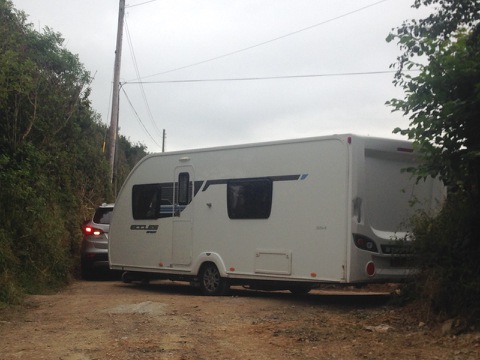
Before my first trip here, I had no idea how narrow British country roads could be. At every blind turn (and oh, does this country have a lot of them), I was convinced some big damn truck was going to come barreling toward me with half its wheels—and half its everything else—on my side of the road. Because where the roads are seriously narrow, people can’t help driving down in the middle. And in other places, they could but they don’t. Or they don’t always. Its standard practice around here to shave a bit of the curve off two particular stretches of road. They don’t happen to be blind, but still, it’s not a great habit.

It took a long time, but I’m finally used to narrow roads. I’ve stopped expecting trucks to appear in my lane. I can drive the hour and a quarter to Plymouth, where Wild Thing goes for eye treatments (which are working, thanks for asking; there’s a limit to what they can do, but they’re doing what’s possible; six cheers for the NHS, and cheer fast before the government succeeds in wrecking it) without feeling like it’s a big deal. I suspect I could do it without getting out of bed.

But I’ll admit to being thrown by a sign I noticed on a recent trip: Oncoming traffic in middle of road.

The first question I have about this is why it’s worth noting. Even by British standards, the roads in Cornwall can get narrow—something I know because I see panicky British tourists plastering their cars to the hedges while oncoming drivers breeze past, barely bothering to slow down because what the hell, there’s at least an inch to spare. But in most of the places where that happens, you won’t find an Oncoming traffic in middle of road sign. So why put one in this particular spot?

Which was, just for the record, in Devon, not Cornwall, but still, it wasn’t in what I’ve learned to think of as a particularly narrow spot, although once upon a time it would have scared me brainless.

The second question is what they expect me to do what about it. Screaming comes to mind. Some people might want to pray. But neither of those reliably avoids, or even minimizes, an accident.

I can’t answer either question—don’t you love how much you learn from this blog?—but I can happily waste a bit more of your time considering it.

An age or two ago, when I asked what people would like me to write about, Terri suggested British road signs and I tried to be at least mildly amusing on the subject but bored myself silly. I’m not sure I’m being wildly amusing this time around, but I’m still awake, and that’s a good sign, so let’s keep going.

British road signs fall into three categories.

Comprehensible signs

You see a sign that says 30 and you pretty much know you’re looking at the speed limit. Or you see a graphic that shows an intersection, a curve, two lanes turning into one. You can follow those. Or you see words: Ford; Reduce speed now; Slow. Useful but boring, so let’s move on.

Comprehensible (but only if you sent away for the secret decoder ring) signs

A lot of these are standardized European Union signs, which are wordless so that they’re equally incomprehensible in all of the many languages spoken throughout the union. Once you get used to them—well, I won’t say they make any intuitive sense but you can begin to think they do. A circle with a slash through it? Of course that means you can resume the national speed limit. The fascinating thing here is that you just know a whole committee of people spent hours—did I say hours? I meant months, and they felt like lifetimes—talking about what graphics people would intuitively understand. And then finally they looked at each other, said, “Screw it,” and settled on these, after which they went out for a drink.

Make that several drinks. They needed them.

Just to be clear, I’m not blaming them. They were handed an impossible and necessary task. Standardizing the signs makes sense. Making the signs wordless makes sense. Unfortunately, whatever solution you come up with will be absurd.

One of my favorites in this category made me think at first that I was being told to push my car off a pier when, in fact, I was being warned not to drive off one. But after a while, as long as you’re not in the car when it goes over, you begin to figure these things out.

If Britain leaves the EU this summer, a whole ‘nother committee will convene to discuss what to replace them with, because the old ones will be politically tainted. I can hardly wait to see what they unleash on us.

Eccentric signs

Some of my favorites in this category are the signs that warn you about road closures, because the people who write them are paid by the word (it’s the only explanation) and I’ve been a freelancer myself so I understand what they’re going through. They say things like, “We’re really very sorry about this, but we’re going to have to close this road between the hours of 9 p.m. and 6 a.m. on Sunday 3 March in the year of our Lord 2016, and we hope it isn’t too inconvenient, especially since it may actually take a little longer than the time we have scheduled. We’ll finish up as soon as ever we can.”

I don’t care how much you slow down, you can’t read that. Neither can your passenger, even though he or she has the luxury of not watching the road. And you just know the sign writers would have squeezed in a few more words if they’d had a smaller font available.

One of the early signs of Wild Thing’s eye problems was that she had trouble reading road signs. Not just the road closure signs, but you know how it is: If you’re struggling with sane signs and then look at a road closure sign, you forget that you never could read them. Instead, you think, Crap, my eyes are worse than I thought.

So thanks for those, guys. We appreciate your efforts.

Then there are the signs that say “flood.” These are entirely legible to anyone with normal vision and they get put out where a heavy rain will flood the road. Then they get left there through drought and fire and plagues of locusts and they’re still there when the next flood comes around, although they may have faded into illegibility by then. Or been there so long that they’ve gone invisible. When I first saw them, I used to look around for a bunch of badly behaved water. Now, though, unless they’re actually sitting in water I ignore them. Which sort of defeats their purpose.

Directional signs range from the clear to the useless. I’ve driven through cities where the only way to leave a roundabout in the direction you had in mind is to read the markings on the road. (That’s assuming, of course, that you weren’t sharp enough to memorize the graphic of the roundabout that precedes it, which on our first trips here we often weren’t.) Lanes will be marked with things like “City Centre,” “Tavistock,” “Moon Landing Site,” and so forth. So far, so good. You find your lane and follow it. But the lettering on the road is only legible when traffic is thin. The moment other cars are rude enough to think they can share the roundabout with you, what do they do? They drive on the damn pavement. Which means they block the lettering. Which means you go through the roundabout three times, hoping for a gap in the traffic so you can read what they hid last time around.

In the U.S., we hang the directional signs above the traffic. They’re ugly as mud, but you can find them.

Other signs are homemade things. Some are little sparkly things asking you not to litter, which are so upbeat and good humored that you want to (first) sink your teeth into someone’s arm and (second) throw candy wrappers out the window. Followed by vodka bottles. Others are assertive black and yellow signs that say “Overhanging Roof” in the hope that if you’re driving a big honkin’ truck you’ll refrain from tearing the corner off their roof. Again. (Did I mention that the roads are narrow?) Or panicky signs that beg you to ignore your sat-nav because it will tell you to drive into someone’s living room, or into a lake, or down a street that’s too narrow for anything wider than Molly Malone’s fish barrow and we all know what became of her. Ever since we moved here, I’ve been seeing newspaper photos of truck drivers stuck in narrow streets, sometimes for days, while the world tries to figure out how to unstick him (to date and to my limited knowledge, they have all been hims)—or more accurately, his truck—without tearing down the houses. Here’s a photo from January of this year and another from March.  And what did they do in the second incident? Arrested the driver. I guess if you’re driving and you see a house in your way you should probably hit the brakes and all, and maybe a traffic ticket really isn’t enough of a response to someone who doesn’t. Still, I can’t help sympathizing with a driver who’s watching the road get narrower and narrower, feeling an escalating sense of panic, and thinking, If I can only get out of here before anyone sees me, this will never have happened.

If there’s a single sign visitors want to learn before they come to Britain, it’s the one that says, “Ignore your sat-nav.”

I’m not sure any of that is what Terri had in mind when she asked me to write about road signs, but if not, ask the question again in a different way. I just might get it right. Or at least be funnier.

Do the British really talk about the weather?

Quick answer: Yes. Right now, the village is talking about the weather because it’s spring. Or summer. Or almost summer.

Is this different than what happens in the winter? It’s not. We always talk about the weather. Because we’re—.

Well, no, we’re not all British, but even those of us who aren’t live in Britain, and it doesn’t take long to learn that the way to make a bit of quick human contact it to talk about the weather. And we’re social beings. We need contact. So we talk about the weather.

What do we say? Well, saying a nice day’s nice is acceptable, but moaning’s got more punch. Because no matter how much the people I know glory in a beautiful day, underneath it all they live on a wet island and it would be unpatriotic to forget that. They believe in cloud, in rain, in damp. Anything else just flits across the windshield of life and is gone. Whatever replaces it will be water-based.

Besides, moaning allows for jokes, even if they’ve all been made before. A beautiful day? Happiness? Where’s the laugh there?

A rare relevant photo: people sitting outside Exeter Cathedral, in front of a statue of someone whose first name is Richard.

A rare relevant photo: people sitting outside on the Exeter Cathedral close, in front of a statue of someone whose first name is Richard. Oh, okay, it’s Richard Hooker (1554 – 1600). He was a priest. If he swings that foot, he’s going to kick someone.

According to Kate Fox, whose book Watching the English I haven’t quoted in entirely too long, moaning is an English (and by extension, and I hope I’m not wrong here, British) passion. She admits that the English aren’t the only people who moan but describes a form that she believes is uniquely English: “a sort of grumpy and apathetic stoicism; complaining…in a resigned manner, without any real expectation that things could be improved.”

And the weather’s perfect for that. We could complain about the government but we could—and surely we eventually will—dump the current one and complaining about it might nudge us toward action. But the weather? What can we do about that? Moan. Laugh. Put on a raincoat.

As Fox understands the way the English talk about the weather, people aren’t really talking about the weather when they’re talking about the weather. What they’re doing is talking. Finding a way to make contact. The weather’s an accepted channel but only borderline relevant to what’s really happening.

So moaning about the weather brings together two national passions. Or quirks. Or—well, I believe the technical term is whatever.

How does that work in practice?

The other day, G. and I saw each other on the road early in the morning. I was walking the dogs. She was walking herself. We traded a few words about how beautiful the day was, and what a gorgeous part of the day the early morning is. We were both happy, or at least we gave a damn good impression of it.

Before long, we were trading updates on our aches, our pains, the various ways we’re less able than we once were, and she mentioned the percentage of over-50s in Britain who have osteoarthritis. It might have been 70% or 85%. In fact, it might have been people over 60, not 50. But it involved numbers, that much I’m sure of, and they were ear-catching ones, even if they didn’t catch well enough to stay with me.

Don’t you just love how much you learn here?

Her point was—and I’m paraphrasing wildly, because she didn’t go all pseudo-poetic about it—that the damp draws arthritis out of human bones the way the sun draws sprouts out of seeds. So Britain breeds arthritis. We exchanged a few more bits of ache-and-pain news and went on our way fortified by the knowledge that we’re doomed. We were oddly cheery about it, and I suspect that’s a British thing as well.

Then I drove to Exeter, where I had some errands to run before I turned around and drove home without passing Go or dropping in on the friends Wild Thing and I usually see when we’re there. And I noticed something: This damp island is a place where people sit outside a good chunk of the year, and look forward to it. It’s a place where a sizable chunk of the population thinks of the outdoors as one of the places they live their lives, not just a place they hustle through between work, home, and grocery shopping.

To someone who spent forty years in Minnesota, that means the climate’s kind. Yes, it’s wet, but it’s not trying to kill you all winter. And while we’re at it, it’s not thinking about whether to give you heat stroke during a good part of the summer. I exaggerate very slightly, and only about the summer. The winter? It can kill you and if seasons had emotions it would be happy to. Leaving the house during a Minnesota winter is like suiting up to step out of the space station. I used to think I’d be a completely different person if I could just grab a jacket and walk out the door.

Here In Cornwall, even in the winter, people will sit outside. Not as many of them as in summer and not as often, but on a dry day it’s possible and people do it. One of the cafes in the village sets out a stack of blankets for people to wrap up in, and even if we look like patients at a pre-antibiotic TB sanitarium, we soak up some sun—or at least some not-rain—and feel better for it.

And still, the nation’s core belief is that the climate’s miserable. And bad for us.

I get swept into that, even though I don’t really believe it. Because at the same time I sort of do. We’re social creatures. I’ve been captured by the thinking around me. But for someone who’s officially miserable about the weather, I’m surprisingly happy. I’ve turned out to be the same person I was in Minnesota, but in some non-weight-related way I’m a lighter version of her.

Thanks: a link

I owe thanks to Val from Quiet Season for suggesting a post about some of Britain’s more, um, interesting political parties and for providing the initial information about the Church of the Militant Elvis Party, which I would never have found without her. In true British fashion, she wrote, “Don’t worry about the link, please. (Unless you really want to.) . . . Insert grateful but Britishly-embarrassed smile here.”

I do want to. Honest. Both by way of thanks and because you have an interesting blog.

The British sense of humor

Do you stay up nights worrying that the British have lost their sense of humor? Put those fears to rest, folks, because it’s alive and well and utterly bizarre. Let’s start (and mostly stay) with the political landscape. What other country boasts an Official Monster Raving Loony Party, a Church of the Militant Elvis Party, and a yogic flying party (which isn’t its official name and the party doesn’t think it’s funny, but we’ll get to that)?

Let’s start with the Monster Raving Loony Party, which was founded by Screaming Lord Sutch and someone with a less interesting name so never mind him. Sutch ran in 41 elections as a candidate for various parties. One of the early ones was the Go to Blazes Party, but then he perfected the art of party-naming and remained a Monster Raving Loony for the rest of his life. The highest number of votes he ever got was 1,114. He’s now gone to that great election campaign in the sky, where I’m sure he’s getting all the votes he deserves (I have no idea how many that would be), and the current leader is Howling Laud Hope.

Irrelevant photo: Birds nesting in postal box, by D.L. Keur. Some of you will have already seem this--I posted a link last week. But D.L. was kind enough to email me the photo so no one can escape. Thanks, D.L. Much appreciated.

Irrelevant photo: Birds nesting in postal box, by D.L. Keur. Some of you will have already seen this, since I posted a link last week. But D.L. was kind enough to email me the photo so no one can escape. Thanks, D.L. The world’s just a smidgen better because a few extra people get to see this.

The party’s policies include fitting air bags to the stock exchange in preparation for the next crash and marking any puddle deeper than 3 inches with a yellow plastic duck. I can’t find it on their web site, probably because I didn’t look closely enough, but I read somewhere else that they want to address global warming by fitting air conditioners to the outside of buildings.

Folks, this is what the world needs: A realistic approach to global warming and the instability of the economy. With yellow plastic ducks.

I can’t explain why the party’s made Official part of its name. Did someone start an unofficial one? Was there a split, with both sides accusing each other of not being true to the party’s principles? Did some part of the membership hold that only puddles deeper than six inches needed to be marked with plastic ducks, or that the ducks didn’t need to be yellow? Until someone goes to a convention and reports back (or on a lower level of commitment, contacts them and asks), the mystery will remain. If I had a shred of respect for myself as a journalist, I’d do email them, but the truth is that I’m no journalist.

Remind me: What do you get out of reading this blog?

Moving on, the Church of the Militant Elvis Party is led by David Bishop, whose name can’t compete with the leaders of the Monster Raving Loony Party. Maybe that’s why he’s also registered several Elvis-themed campaign groups, including the Bus-pass Elvis Party, the Elvis Defence League, and the Elvis and the Yeti Himalayan Preservation Party. I’m not sure what the difference is, in this context, between a political party and a campaign group, and I seriously doubt it matters.

In 2005, the party ran a candidate in Erewash, which is a real place and, sadly, not pronounced Earwash. Based on the usual Google search I do when something’s this earthshaking (hey, I go all out for this blog), I learned that “most people” around there pronounce it Errywash—like ferrywash, but without the F.

I didn’t find any mention of how not-most people around there pronounce it, but it does make a person wonder.

The same search taught me that I can get the wax micro-suctioned out of my ear for just £25—or £35 if I’d rather have it done in the privacy of my own home, because I might feel a little, you know, private about my ears, even though I do walk around with them hanging out for all the world to see. Whoever’s offering that price doesn’t know where I live or they’d charge more.

I’m not usually followed around the internet by earwax ads, so I couldn’t help wondering if the great googlemaster thinks I don’t know how to spell ear or if the great googlemaster just has a sense of humor.

But we were talking about the Church of the Militant Elvis Party. Bishop ran on a promise to (among other things) go to the North Pole and yell at the icebergs to stop melting. He campaigned in a red cat suit, claimed he was heckled—I can’t think why—and got 116 votes. In 2010, his platform included digging moats around houses. No, he didn’t volunteer to dig them. It’s only by following the implications of his campaign promise that I got to the verb dig, and I may be assuming too much. What I read actually said he wanted to introduce them. House, meet moat. Moat, meet house.

Job done. It’s quick, it’s cheap, and it keeps the campaign promise.

Finally we come to the Natural Law Party, which grew out of the transcendental meditation organization. If I remember correctly, some decades ago they trademarked their name and insisted that it be spelled with initial caps and followed by the letters TM, not because that’s an abbreviation of transcendental meditation but to mark that the name was trademarked. I was working as an editor at the time and I wrestled bare-handed with issues of this sort on a daily basis. And lived to tell the tale. So what could I say but, “Oh, yeah? How you gonna make me?”

I said that to myself, mind you, since no one else cared. But that sort of thing mattered to me. And it still does—enough for me to lower case the organization’s name even though capping it would make sense. It is an organization. That is its name. Names are capitalized. But hey, if it matters that much to them, I’m happy to do the opposite.

It’s a good thing I’m writing about political parties instead of running for office. Power goes right to my head.

The Natural Law Party seems to take itself seriously. As well it should. According to the BBC article I linked to just above, “It promised in 1997 to create an ‘ideal quality of life – prosperity, creativity and happiness [for all]’, crime would be reduced by creating coherence in national consciousness, and defence would depend on an integrated national consciousness to make Britain invincible.”

The logic of that sounds as shaky as the grammar, but apparently that would all happen through meditation and yogic flying.

“Yogic what???” you ask.

Why yogic flying, silly, which if you watch the video you’ll learn consists of bouncing around on a mattress with your legs pretzeled across each other like the Buddha’s.

I’m not an expert on the Buddha, but I’m quite sure he didn’t bounce around on a mattress. I don’t think anyone had gotten around to inventing bouncy mattresses back then.

When the Natural Law Party withdrew from the electoral process, it blamed the negativity and cynicism of the electorate. The BBC kinda thought it might have had something to do with how much money it cost them to run each campaign. But hey, that’s cynicism for you.

Enough politics. A final note, to prove the British sense of humor extends from politics into real life: I took a load of brush clippings to the dump the other day (that’s the tip if you’re British), and a guy who worked there helped me empty the car. They do that there if they have the time. It’s very nice, and they’re very nice, and even I managed to be nice. After we’d tossed the last bits of greenery, I found a snail in the back seat.

“Want a snail?” I said for no reason I can quite explain, although I’ll offer a few alternatives. Pick the one you like: It was there. Thanks didn’t seem like enough and I hadn’t thought to bring brownies. I’m a wise-ass and my mouth doesn’t always consult my brain.

“Thanks,” he said after only the smallest hint of hesitation, “but I’m trying to give them up.”

While we’re (marginally) on the subject of thanks, I owe many of them to—argh: someone for suggesting this topic, sending me a couple of initial links, and telling me about the Church of the Militant Elvis Party, thereby enriching my life significantly. (I already knew a bit about the other two but hadn’t thought of writing about them.) We exchanged several comments and I enjoyed the conversation. You’d think I’d know who it was, wouldn’t you? It’s really rude not to remember but I thought (a) that wouldn’t happen and (b) if it did (I know what my memory’s like and I never completely trust it) I could just pick it up from the comments section.

Yes, indeed I could, but which post were we exchanging comments at the end of? None of the ones I checked, and I zipped through a lot of them. So whoever you are, forgive me. And let me know who you are. Please. I’d meant to post a link to your blog, if only I’d been bright enough to leave myself a trail of virtual breadcrumbs, and I can still do that in a follow-up post.

Finally, if anyone wants to push me in the direction of a topic, please do. I don’t promise to write about it–some topics work for me and some just don’t, and I still haven’t found a way to predict which ones will set me going. But I love getting suggestions. It’s the Comments section that makes this so much fun to write.