
You have to love British politics. Nigel Farage, Personality-in-Chief of the right-wing populist party Reform UK and until lately a member of parliament–MP for short–is running against a trash can in a special election that he himself engineered.
I need to explain that, don’t I?
If you’re British, this may seem almost normal, but–
Okay, I’m trying to be diplomatic here. The rest of the world plays by a different set of rules and wonders if you haven’t been trying out those little mushrooms that grow wild on the moor. So bear with me while I’ll explain where we are and how we got here, although I can’t promise it’ll help.
Reform UK has been riding high and is–or at least was–generally considered the main challenger to Labour, which– Oh, hell, we won’t get into that. Labour’s in power right now.
But Reform’s had a few problems lately. They include a £5 million donation (or gift) that wasn’t declared, along with some donations and loans that banks thought were suspicious and reported to the National Crime Agency. As the newspaper articles mumble superstitiously while wobbling through a minefield that threatens to explode into lawsuits, that doesn’t mean the donations were illegal, only that they raised bankerly eyebrows.
But the picture isn’t complete until you toss in property purchases, multiple residences, threats to sue, lost tempers, and accusations of leaks and harassment. The cast of characters includes other members of Reform, a crypto billionaire who lives in Thailand, a convicted fraudster, relatives of a convicted fraudster, and probably a few I’ve lost track of.
Larry the Cat, Chief (if not highly effective) Mouser to 10 Downing Street, has kept his paws pristine, as you’d expect.
That unreported donation (or gift, or what the hell, sum of money) set off a parliamentary investigation, and a few of the eyebrow-twitching donations will find their way into the investigation if they haven’t already. As will the question of whether the donations really came from the people whose names are on them, because it’s illegal to hide the source of a political donation.
If the committee investigating all this suspends Farage–let’s keep this simple, which takes no small effort in such a convoluted system–he could be kicked out of the Commons, triggering a special election (called a by-election). Then he could run in the by-election and end up right back where he started, although there’s no guarantee that he’d win.
And here we’re coming to the point: Farage decided to short-circuit the process by announcing his resignation, triggering a by-election where he’d run for the seat he just gave up willingly. He cast it as Farage v the Establishment.
Why did he do that? The best guess is to pull attention away from the investigation, but basically, who knows? It’s not what you’d call a predictable move. If he wins his seat back, the investigation will inevitably start up again.
Enter Count Binface
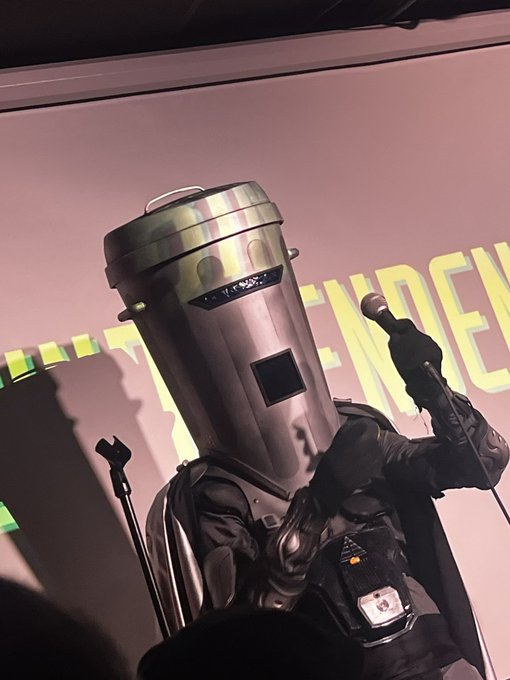
Count Binface, courtesy of Wikimedia Commons
So here we are, with a politician giving up his seat in parliament so he can run for the seat he just gave up. On any normal day, a by-election involving a key figure in the nation’s politics would set the main parties scrambling to run candidates, but they’ve done something as unpredictable as Farage has: announced that the by-election’s a farce and they won’t participate.
The parties sitting out the dance are Labour, the Conservatives, the Greens, the Liberal Democrats, and a further-right populist party that broke away from Reform, Re-something Britain. I never do remember its name. Restore? Restock? Rebuke? Reassert? Remote? Resume? Reassemble? Not Rejoice. Definitely not Rejoice. They lean heavily toward anger.
Never mind. They’re not running a candidate either.
Who does that leave? Count Binface, and this is why I love British politics. Even when I despair of where we’re headed, up steps a Count Binface, and I won’t claim that solves everything but it does give me the strength to face the morning newspaper.
A few minor candidates are running, but they’re also-rans. The contest is Binface v Farage. Or, I suppose, Farage v Binface.
Who is Count Binface?
He describes himself as an “intergalactic space warrior, . . . leader of the Recyclons from planet Sigma IX,” and he appears in full superhero costume with a bin–or if you’re American, a garbage can–on his head. And thanks to election laws that don’t require candidates to live in the district where they’re running, he’s run against anybody who’s anybody: Andy Burnham, Boris Johnson, Theresa May.
In one campaign, he said, “The presence of novelty candidates in general elections is as you know a fine British tradition, and as such I applaud Boris Johnson’s decision to stand.”
In British elections, when the votes have been counted and the winner is announced, the candidates line up on stage to hear the totals read out, which can leave a prime minister standing next to a man with a garbage can on his head, or someone dressed as a fox or a rabbit. And they’re all on equal footing and they have to shake hands and pretend this is normal.
You really want to check out the photos.
Full disclosure here: Binface ran against Theresa May as Lord Buckethead but ran into trouble over who had rights to the name, something he describes as “an unfortunate battle on the planet Copyright”. He’s been running as Count Binface ever since.
“In 2021, I received 92,896 votes (including 24,775 first choice votes) from the humans of London,” he writes, “who made me their 9th choice to be Mayor of the Earth capital, out of 20 candidates. This is a new record for an alien standing for public office on planet Earth.”
His manifesto? When I checked, except for recycling Farage he didn’t have a manifesto specifically for Clacton yet, so we’ll settle for the one he used in Makerfield, where he ran against Andy Burnham, who (having won a seat in parliament) looks set to be our next prime minister. It’s longish and full of in-jokes, so we’ll abbreviate: “I will cut your taxes and raise everybody else’s. . . . I stand by my past manifestoes: croissants [he’ll cap the price at £1], Brexit, Trident, building at least one affordable house. I’ve got it all covered.”
He also promises to nationalize the singer Adele.
The press and the internet love him, and according to a poll that I put no faith in whatsoever, he’s favored 5/1 to win against Farage. That may or may not be the right link for the poll and it’s more likely to be betting odds than a poll, but honestly, does it matter?
A Labour donor, Dale Vince, a green energy industrialist, offered to contribute up to £180,050 to Binface’s campaign.
It’s true that assorted other candidates are standing, including one from the Monster Raving Loony Party and a reality TV star who appeared on Dancing Naked. I’m going to assume–no, I’m going to hope; it’s summer here and light-skinned Brits don’t understand sun and are liable to burn–that he’ll be campaigning clothed, but if I’m wrong, the vote count photos will be memorable.
But even with that prospect, no one cares. It’s Farage v Binface. Place your bets, folks.
Hang on. Is this Binface business legal?
Yup. I took a quick and irresponsible look through the election rules and couldn’t find anything to keep a person from running under a pseudonym. According to the electoral commission, “Where a candidate commonly uses a different name from their actual name, or commonly uses their names in a different way to those stated on the nomination paper, they can ask for this to be used instead of their actual name.”
They give an example along the lines of an Andrew running as Andy, but Binface has road-tested his approach enough times to know it works. And candidates have done it before him, including Screaming Lord Sutch and Howling Laud Hope back in the 20th century.
Remember the 20th century? We thought we had problems then, didn’t we?
Why does stuff like this happen in Britain?
The political system isn’t just a gift to satirists and professional comics, it positively breeds them. Absurdity begins to look like self-defense, or a debt they owe the universe.
For example, MPs can’t resign. They were elected to serve the full term, which runs for up to 5 years, and they can just sit there and behave themselves until it’s over. They don’t actually have to show up at debates and their food and alcohol are subsidized, so what do they have to complain about?
The rule dates back to the 14th century, which is when MPs were first elected to the House of Commons and discovered that serving in parliament could be a financial or practical burden. You know how things were back then. The trains weren’t reliable, internet connections were worse, the postal service hadn’t even been invented. Some MPs got lonely. What could a government do but trap them in their jobs?
Then the 1701 Act of Settlement Act and 1707 Act of Union gave them an accidental escape route. MPs would be disqualified if they were appointed to “an Office or Place of Profit” to the crown. The goal was to limit royal influence in Parliament but it didn’t take long for unhappy MPs to find offices or places of profit to the crown that had fallen out of use, paid either nothing or next to it, and weren’t attached to any responsibilities. They asked to be appointed to one and hey presto, they were disqualified from sitting in the Commons and free to go home.
Those offices quickly narrowed down to two: the Chiltern Hundreds and the Manor of Northstead.
From the 1770s on, the chancellor has had to grant the offices to anyone who asks for them, which automatically boots out the previous office holder. In a single day in 1985, 15 office holders barged through that revolving door.
There’ve been–imagine!–complaints that the system’s antiquated and irrational and that it opens the door to corruption (an MP could step down, say, to hand a seat to a family member or to someone who’s paid for the privilege). There’s been a worry or two that the government might refuse to grant the office to someone, trapping an MP in the Commons till their term was up.
They’re not bad arguments–especially that one about antiquated and irrational–but changing a parliamentary tradition just because it’s pointless and absurd? This isn’t the right audience for that argument. I mean, parliament does a yearly check to make sure a nonexistent basement doesn’t hold any explosives because back when there was a basement some were hidden there. Don’t talk to them about absurdity.
The last serious effort to reform the way MPs resign was in 1901. It failed.
What happens next?
We sit back and enjoy the show until sometime in August, when the election will be held. If Farage wins, he will have heroically defended a seat he didn’t have to give up against someone with a trash can on his head and the investigation into his and everyone else’s finances will start up again.
And if Binface wins? That should be interesting. The House of Commons’ dress code says, “Members should dress in business-like attire; this need not include a tie. A Member has been allowed to continue speaking on condition that clothing with inappropriate visual content [they mean slogans] is covered. Members are not permitted to wear decorations in the House. The wearing of military insignia or uniform inside the Chamber is not in accordance with the long-established custom of the House.”
So if Binface insists on being sworn in in character? I’m no lawyer, but I’m happy to impersonate one, and if I was putting the count’s argument together it would center on the definition of businesslike:
Mr. Speaker, this is what the honorable gentleman wears for business.
They really do talk that way, although I have no idea who’d hear the argument and whether Mr. Speaker would be involved.
Then I’d argue that traditions change. I’d make a quick reference to Oliver Cromwell, who broke tradition by wearing a “plain cloth” suit made of linen by “an ill country tailor” and a hat without a hat band.
I’m not sure who I’m quoting there but I’ve seen it quoted in a few places, which lends it the illusion of authenticity, so it’ll do. And if you move through an argument fast enough, most people won’t notice any logical gap.
The counter-argument will surely be that armor hasn’t been allowed in the Parliament since October 30, 1313, but it doesn’t matter. A trash can isn’t armor.
And on it will go. Parliament holds its traditions dear. Swords, for example, aren’t allowed in the chamber but even now, when very few people wear them to work, MPs are supplied with a lovely purple ribbon in the cloakrooms so they can hang theirs up.
The Serjeant at Arms does carry a sword, but someone has to.
Count Binface does not carry a sword and will, I’m sure, be happy to leave that honor to the Serjeant at Arms. Mister Speaker, can we not allow the honorable gentleman to take his seat in the attire appropriate to his business?
At which point the poor guy–and there is a real person in there, named Jonathan David Harvey–will be stuck sitting on an uncomfortable bench in what must be an uncomfortable getup, especially if the weather stays hot.
I mentioned the person inside the suit. Hoping (no doubt) to shock voters away from supporting Binface, Farage supporters have outed Binface as an “establishment comic.” But most people have already guessed that there’s a human inside the suit. I can’t wait to hear their next line of attack.
As for Binface’s, an interviewer asked him, “Why should anybody vote for you?”
“I’m not Farage,” he said.
A final word
The Guardian ran an admirable article about Binface, including a few quotes from fellow candidates in other elections and some great photos. One shows our presumptive prime minister-in-waiting standing between Binface and someone in a fox costume. Another shows Boris Johnson standing between Lord Buckethead and (I think) a Teletubby.
By way of (alleged) insight into Count Binface’s real character, a Monster Raving Loony Party candidate, Nick the Flying Brick, who’s run against Binface in (I think) two elections, said Binface “goes a bit funny if you use his real name.” After he gave up his Buckethead identity and ran against Boris Johnson as Count Binface, someone else stood against Boris Johnson as Lord Buckethead. Binface “drowned out Buckethead’s interviews by singing ‘The Star-Spangled Banner,’ and Buckethead flipped the finger at Binface as the results were announced.”
What’s the point of it all, though? As Nick the Flying Brick explained, “There is that endless joke: there is one absurd, parody, completely inappropriate candidate [in the Clacton by-election]–and he is standing against Count Binface.”


