British fashion, high heels, and dyslexia

Diane Clement asked, “Do British women feel the need to teeter around on high heels in their professional lives?? I always feel a bit sad when I see a woman with future foot problems carefully mincing around in them.”

Since I’m as dyslexic about fashion as I am about math, I hadn’t noticed.

How can anyone not notice if another human being is teetering around on something that makes her three inches taller than her normal height and seven times more prone to foot and back problems but that she thinks (and many people agree) make her look fantastic? Trust me, I can. I’m already shorter than 97.3% of the adults around me, so if they all grew by half a foot, what difference would that make to me? I’m already looking up.

Two interruptions here:

  1. 73.9% of all statistics are made up, including this one, so you should go back and reread the paragraph just above with that in mind.
  2. Endemic mathematical incompetence is called dyspraxia, not mathematical dyslexia, but it sounds like a disease and I’d much rather think of myself as dyslexic about numbers. I mean, my old friend T. used to claim she became dyslexic anytime she drove in St. Paul, and if she can have geographical dyslexia I don’t see why I shouldn’t have the mathematical form. However, I hate to offend anyone unnecessarily, so in case misusing of the word bothers anyone let’s put it this way: There is nothing involving numbers that I can’t fuck up.

There, that’s less offensive, isn’t it?

Irrelevant photo: bluebells in flower at Lanhydrock.

Irrelevant photo: bluebells in flower at Lanhydrock.

But back to high heels, which is our alleged subject. I asked M., who knows all, although I admit that as I phrased the question I didn’t work the teetering or the mincing or the foot problems. Researchers shouldn’t let their biases or anyone else’s get in the way, and I do take this blog seriously.

The short answer is yes—women in Britain tend to wear high heels in their professional lives. Although, M. said, styles do change, and sometimes flat shoes are in fashion, or low heels.

This next bit isn’t entirely relevant, but why should that stop me? The last time—and it was roughly a hundred years ago—that I wore heels of any sort I slipped down half a flight of stairs. The nice thing about my fashion dyslexia is that I now wear running shoes regardless of what’s in style. My feet are happy, and if people think I look funny I’m oblivious, so the rest of me is happy as well. My wardrobe and I are now entirely post-fashion.

Have I mentioned that this isn’t a fashion blog? That won’t stop me from answering fashion questions, but it may stop me from answering them competently.

How British beer is brewed: an expert speaks

HalfPint is a trainee beer brewer, and she wrote a comment in response to my post on British and American beers. So let’s hear from someone who actually knows what she’s talking about:

“I work at a brewery and here’s what we do.

“Beer in a fermenting vessel is kept at 22 degrees – which is at a temperature the yeast works best at. After so long it is cooled to 13 degrees and then a few days later to 5 degrees for a couple of days. Yeast for beer ferments at the top – hence the slow temperature drop to help the yeast settle at the bottom of the vat. This is so when we draw it off there hopefully is little yeast in the casks. In the casks a product is added to make sure in 2 days time the remaining yeast has settled to the bottom and you don’t get cloudy beer or floating yeast (which can be bitter to taste). Some bottled beers have this in, to keep the beer alive and maybe taste fresher. These are called Bottle Conditioned. Never pour a full bottle of these out into the glass.

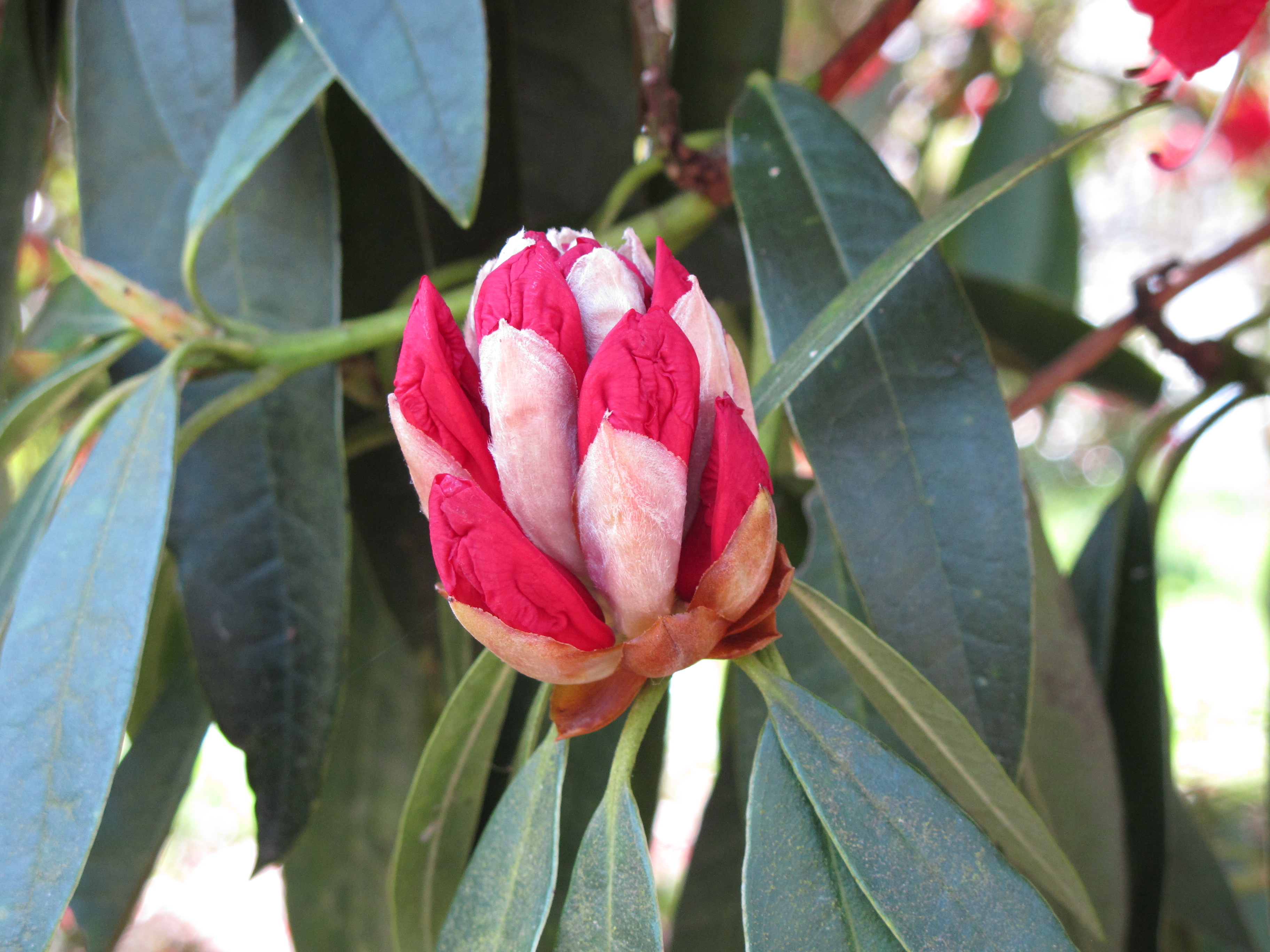
Irrelevant photo: Rhododendron getting ready to bloom.

Irrelevant photo: Rhododendron getting ready to bloom.

“Lager is cool fermented and requires a different yeast that is active at lower temperatures.

“Now serving temperatures, there could be an argument here. We live in the 21st century and therefore we have central heating and insulation so our homes are much warmer. Back in the day a home was a lot cooler. Pub landlords, when keeping casks, have to have good cellar conditions in order to be able to serve a perfect pint. Our brewery suggests with all our beers to pop it in the fridge. However we know some beer lovers prefer ‘room temperature’ so we suggest 1 bottle in the fridge the other not, so they can decide for themselves. Try it next time you have a bottle of your favourite (even if its a Porter or Stout) don’t drink it too quick let it gradually warm up and you will start to taste different things. From this you will roughly know how you like your beer.

“As for percentage – ours range from 3.8% to 9.1%. I’ve had some British beers that are over 12%. In fact quite a few forward thinking micro breweries usually have a range like ours or above. British beers are on the up.

“Now Hops: Flower hops are the natural state, which is what we use in all our brews. Every hop is different in smell and taste. The hops are put in when the mash (malt/barley/oats juice – whatever you’ve used) in the kettle is boiling. If you put it in at the start of the brew, it gives it is flavour and bitterness. The later you put it in through that boiling hour the more aroma and less bitterness it gives off. Each beer is different for us in the quantity and timing. The other type is pellets. We use these in two brews and only put these in when the beer is a few days away from being put in casks, gives it a nicer whiff and a little extra taste.

“Wow you didn’t want a sermon or lecture did you lol. Everyday is a learning day lol.”

Fantastic! Thanks, Halfpint.

How British and American beers compare

Belladonna Took wrote to say, “I would like to know about beer. Is it indeed served at room temperature in Britain? And is it real beer with hops and lifeforms in it, and not the chemically scrubbed cat piss that passes for beer over here [in the U.S.]? (I’m not referring to the good stuff one can get from a microbrewery, of course, but the stuff sold in supermarkets.) What about alcohol content? I’m pretty sure it’s lower here.”

Gee, Belladonna, I wish you’d tell how you really feel. Don’t be hold back.

I had to ask around, because it’s been so many years since I ingested alcohol that I don’t remember if it comes in a solid or a gaseous form.

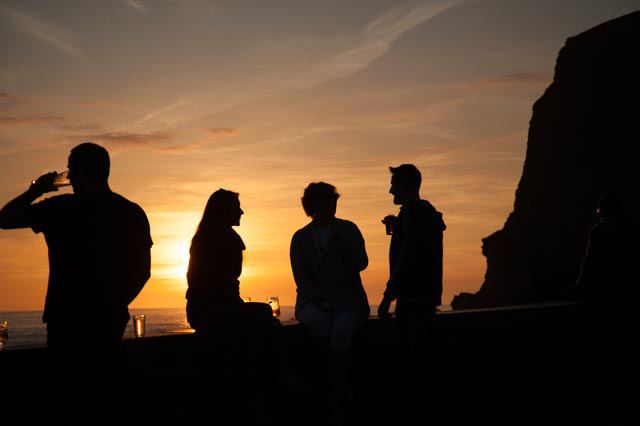
Beer at sundown. Photo by Ida Swearingen

Beer at sundown. Photo by Ida Swearingen

First I asked Google about alcohol content and read that British beer is weaker than American—below 5%, although that will vary from brand to brand and from time to time. I also learned that British brewers, or at least some of them, began making their beer weaker in 2012 because it’s cheaper that way. For them, of course, not for the customer. They probably figured nobody would notice, and since nobody’s burned down the breweries they were probably right. Then I read a list of the alcohol content of American beers and it ranged all place, but some of it was below 5%. So the definitive answer is that it’s complicated and you should never trust me with numbers. But the British stuff is probably weaker.

Sorry, Belladonna. Don’t shoot the messenger.

Next, I asked M., who’s tasted both American and British beer. She said that beer is definitely served at room temperature in the U.K., as is ale, and that they have a richer taste than American beer, so I’m guessing that takes them out of the cat piss category.

A brief interruption here: I have an elderly cat who’s asked me to put it on the record that her piss is nothing at all like American beer and is altogether lovely. She was offended, but if you’d offer a bit of fish by way of apology, Belladonna, I’m sure the incident would be forgotten.

M. also said that lager is more like American beer and is served cold.

And hops? I didn’t ask anyone about this, but yes, hops are involved in both countries. You can’t summon beer out of thin air, even when the beer in question tastes like you did..

Finally, since I was at singers’ night at the pub anyway, I raised the subject there and learned why beer’s served at room temperature and lager’s served cold: Beer’s brewed at room temperature, so its taste develops and is at its best at that temperature. Lager’s brewed in cool cellars and its taste etc. So—unlike so much in life—there’s actually a reason for this and it all makes sense.

Who’d’ve thunk?

And finally a note: This is a bonus post. I usually post twice a week, but I’m working my way through the questions people asked and, I dunno, it seemed like a good idea. Since I’m having a good time with this, I’m still accepting questions about either the U.S. or the U.K.

English place names: where did the missing syllables go?

barbtaub asked why some English place names have “whole syllables missing? How could Worcester only have two syllables? Where do the L and the W go when you say Alnwick out loud?

Well, I’m here to enlighten. The L and W go out for a pint, and after that, y’know, you just can’t count on them so it’s better to pronounce the word as if they’d never been there at all.

Now the R, C, and E—that’s a whole ‘nother story. They’re tea drinkers, and they’d come back if they were invited, but no one thought to so there they sit, with their cooling cups of tea, waiting for someone to remember them. It’s all very sad.

Why tea instead of beer? If they’d dropped out of Cornwall, I’d guess they were Methodists—Cornwall is historically Methodist country and the Methodists are serious teetotalers—but since we’re dealing with Worcester I won’t risk a guess. It just is that way. Some people want a pint, others want a cuppa.

Camel Estuary. Padstow. North Cornwall.

Irrelevant photo: the Camel Estuary.

What I can tell you is that the letters in English place names are unreliable. I expect that’s a cultural inheritance from French. You know, 1066, the Norman invasion, all that French influence pouring into what was until then a Germanic language. Whether you could count on the spelling of Old English to be even vaguely sensible I don’t know, but I do know that French is wasteful with its letters, not just in place names but in everything. It tosses in handfuls it has no intention of pronouncing as if to say, “See how rich we are? We have so many of these we can afford to throw them away.”

When you treat letters like that, why should they stick around? They’re not needed, so of course they seek solace in the pub or the café. Who wouldn’t?

Now that Britain’s in an age of artificially induced austerity, you’d think the government would want to claw some of those wasted letters back. I mean, at one point, the government considered selling off nationally owned woodlands, which were being used and weren’t in the pub, and it only backed off because the proposal caused an uproar. I’ve read speculation that they’ll sell off property owned by the National Health Service soon. You know—balance the books in the short term, even if it impoverishes the nation in the long term. What the hell: by the time the problems show up, some other government will be in power, so who cares? It’ll all be their problem to solve.

What I’m thinking is that they could easily sell off those vowels and consonants that no one’s using. A prime example lies up the coast from us: Woolfardisworthy is pronounced Woolsery, and the spelling’s so out of whack with the pronunciation that the road sign (in a rare moment of linguistic sanity) gives both spellings. So we could not only save on letters, we could have a smaller road sign.

Not all place names present as clear a case. The town of Launceston has three pronunciations: LANson (that’s the Cornish version), LAWNston (I’m not sure who pronounces it that way), and LAWNson (I think of this as the compromise version and it’s the one I use; with my accent, LANson sounds too strange). The only pronunciation that’s wrong is lawnCESSton—the one that uses all the letters. With three pronunciations, it’s not clear what letters we should sell off, but that doesn’t have to stop the program. Sacrifices must be made.

For what it’s worth, I’ve read that over centuries the sandpaper of time tend to wear away at difficult pronunciations. I’m still waiting for it to smooth out the pronunciation of sixth. Try saying that quickly three times. Still, the theory would explain the bizarre spellings of place names. English spelling was codified when the pronunciation was still changing rapidly, and it reflects (or so they say) pronunciations we no longer use. So place names were frozen even as the residents went about the natural business of simplifying the pronunciation, leaving us to wonder, What were they thinking?

Aren’t you glad you asked, barbtaub?

Traditional British celebrations: May Day in Padstow

The Padstow May Day celebration is so old that no one knows when it began. The only things that are certain are that (a) it’s genuinely ancient and (b)it’s still going on.

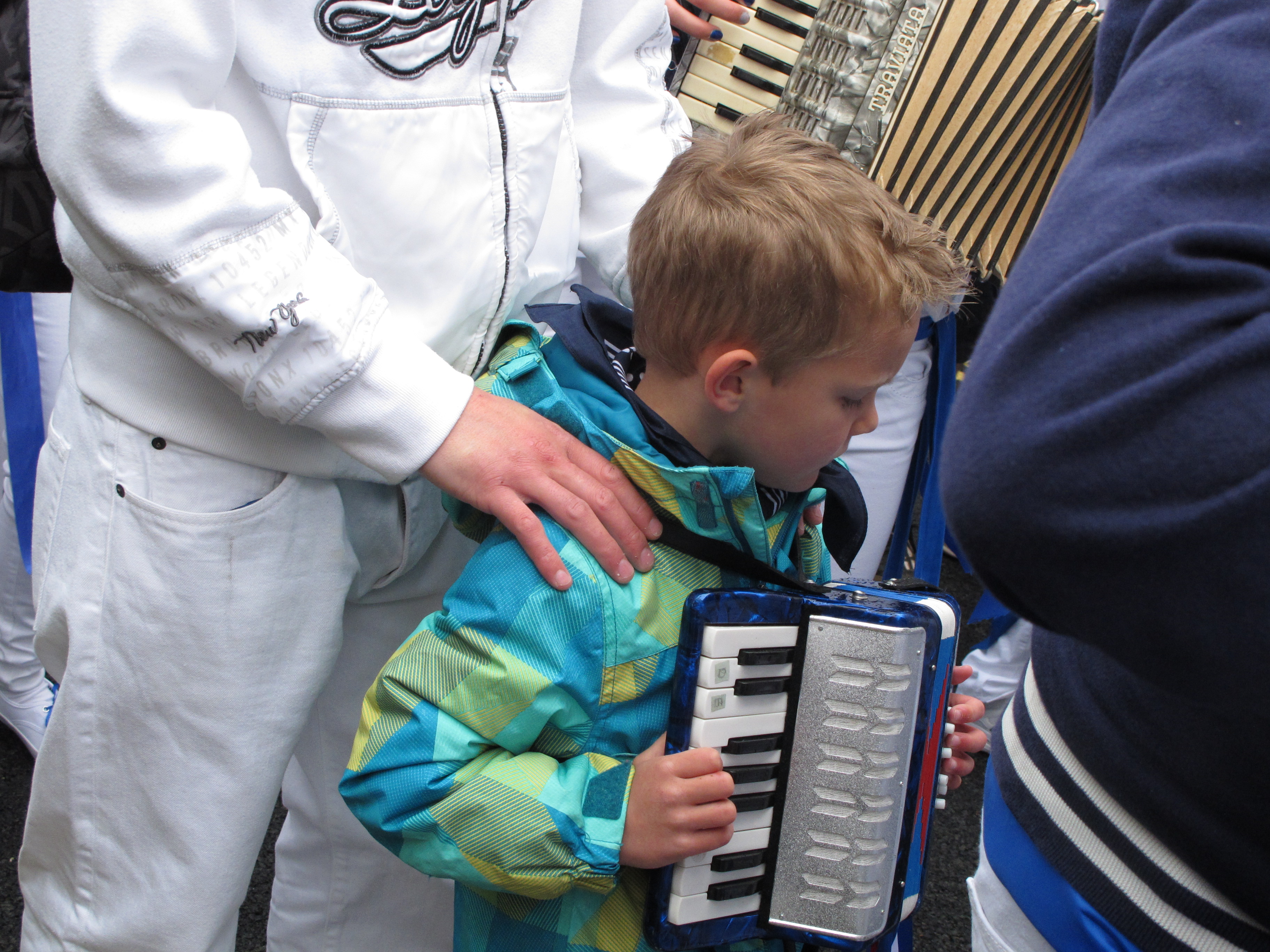
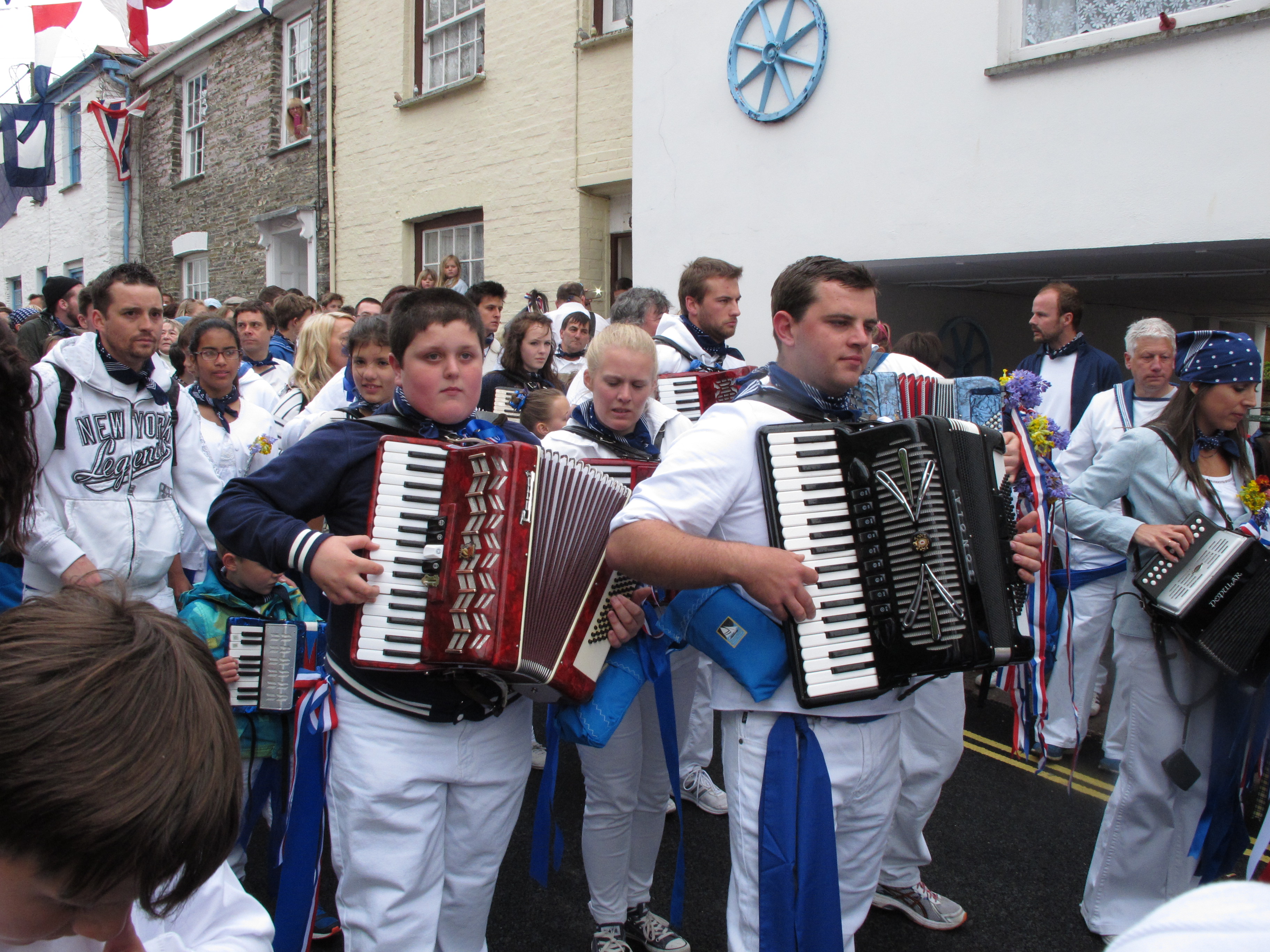
In addition to the inevitable alcohol, the celebration involves songs, dance, drums, accordions, and two ‘Obby ‘Osses, one red and one blue. Actually, both are mostly black (with a head that looks nothing like a horse’s), but their followers (dressed mostly in white) wear either blue or red sashes and whatevers. The tradition’s so deeply rooted that during World War II soldiers from Padstow cobbled together a celebration as best they could, making an ‘Oss out of blankets.

We heard that from a woman whose father had done it.

Padstow, Cornwall, May Day, 'Obby 'Oss

The ‘Obby ‘Oss. It’s good luck for the kids to touch it. These shots are from the children’s parade, which is in the morning.

Padstow’s Tourist Information Centre web site talks about “many conflicting theories about the origins of the Obby Oss. [Some spellings leave out the apostrophe, and since I’ve been a copy editor, I can’t help noting that sort of nonsense. I’m sure every last snoozing one of you cares just as passionately.] Some say its roots are in pagan times, others that it’s a rain maker, a fertility symbol, a deterrent to a possible landing by the French some centuries ago or even a welcome to summer.”

My best guess is that a lot of those things were layered over each other during the course of centuries. My next best guess is that Cornwall doesn’t need rain often enough for a rain-making ritual to get ancient, so that’s the only theory I’d rule out.

I checked several sources for the morning song’s words (there’s also an evening song), and they vary, but basically it has lots of verses and you can find one to justify almost every theory. Except rain. So layers, right? I found references to the French, one verse mentions the Spanish, and several mention the white rose and the red. Since the War of the Roses wasn’t fought on Cornish soil, I’m guessing they’re about purity and passion, but I may be importing that from some English lit class I took—the one called Stinkingly Obvious Symbolism and its Heavy-Handed Interpretation.

The song’s worth a listen.

Even if you discount the roses, it’s hard not to find fertility references. The verses are full of beds and bodies. And then there’s the belief that a woman caught under the ‘Oss’s skirts will be pregnant within the year. Can’t get much more stinkingly obvious than that.

The ‘Oss flashed his skirts over Wild Thing the first time we went. That was several years ago and she’s still not pregnant. Now it’s true, she’s past the age and in a same-sex relationship, as well as lacking a uterus for the past few decades, but even so, if you’re looking to get pregnant I recommend trying the more conventional method in addition to getting under that ‘Oss’s skirts.

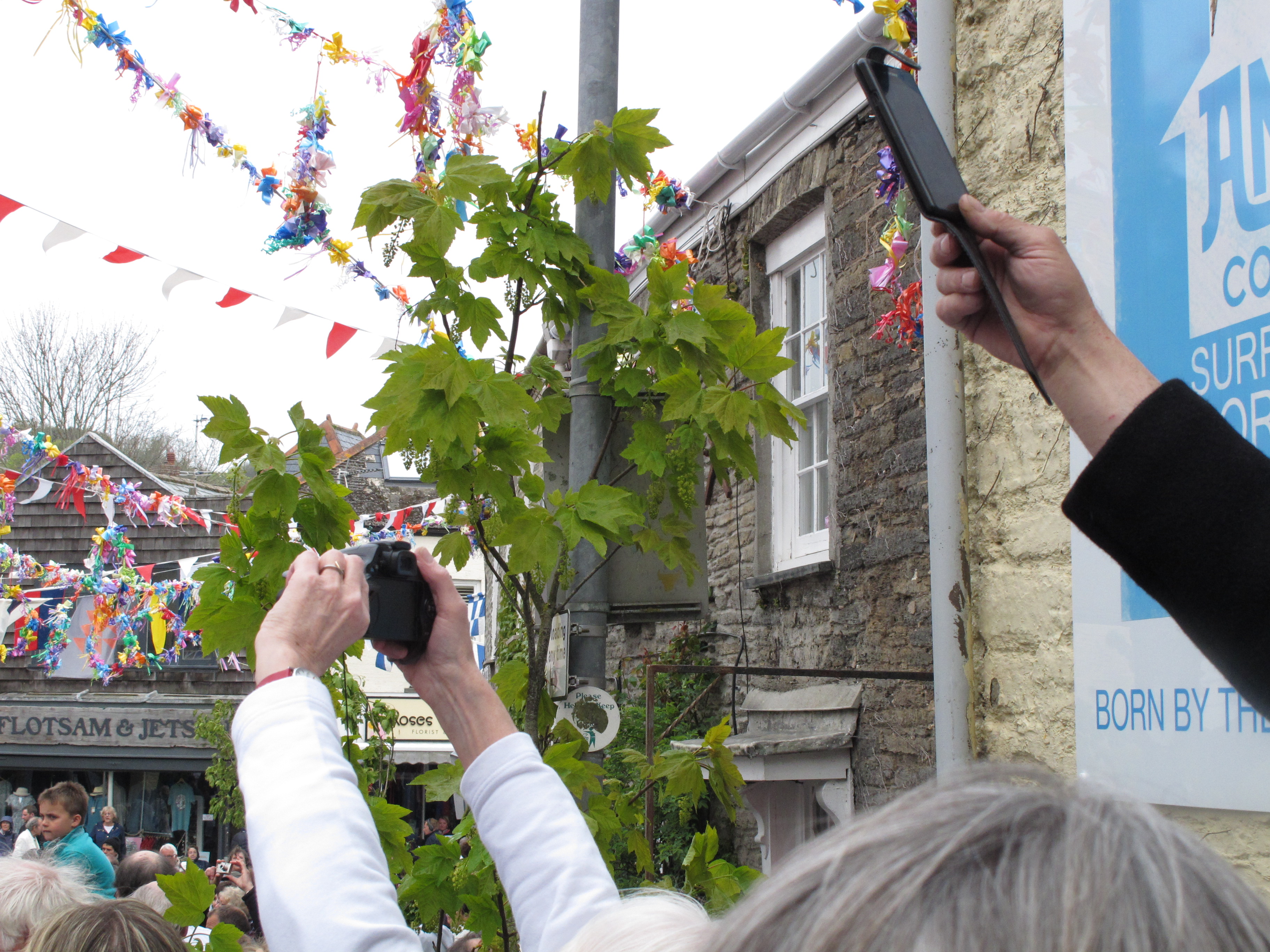
Here’s a handful of photos. They are—in a break from tradition—relevant to the post.

Padstow May Day children's parade

From the children’s parade.


The best way to see the 'Oss.

The best way to see the ‘Oss.


The second best way to see the 'Oss. It does get crowded.

The second best way to see the ‘Oss. It does get crowded.


If there's any rivalry between the followers of the Red 'Oss and the Blue 'Oss, it doesn't seem to turn into hostility.

If there’s any rivalry between the followers of the Red ‘Oss and the Blue ‘Oss, it doesn’t seem to turn into hostility.


Following the blue 'Oss.

Following the blue ‘Oss.

What are neighbors like in Britain?

On Not Another Tall Blog, Angie K. wrote recently about English people’s reputation for being cold. No, she wasn’t not talking about the weather, she was talking about whether there’s a downside to all that stiff-upper-lip-ness and explored the question of whether the British are good neighbors. Then she asked if I’d tackle the same question.

I sat at the computer and was pontificating away about how to define good neighbors and the differences between neighbors in New York, Minnesota, and Cornwall. Franklin Delano Roosevelt’s Good Neighbor Policy echoed around inside my mostly empty head. It wasn’t relevant and I knew that, but it came to mind anyway. I was failing to be either funny or interesting about any of it when the doorbell rang and who should be there but our actual neighbors—or two of them anyway, along with their baby. You can’t plan this stuff. You could make it up, but as it happens I don’t have to. I shut the computer down, made a pot of tea, and grabbed some brownies out of the freezer (they’re good frozen—I don’t even apologize anymore), and we sat around and talked and admired how well the little guy’s walking.

He’s a gorgeous fellow, just a year old.

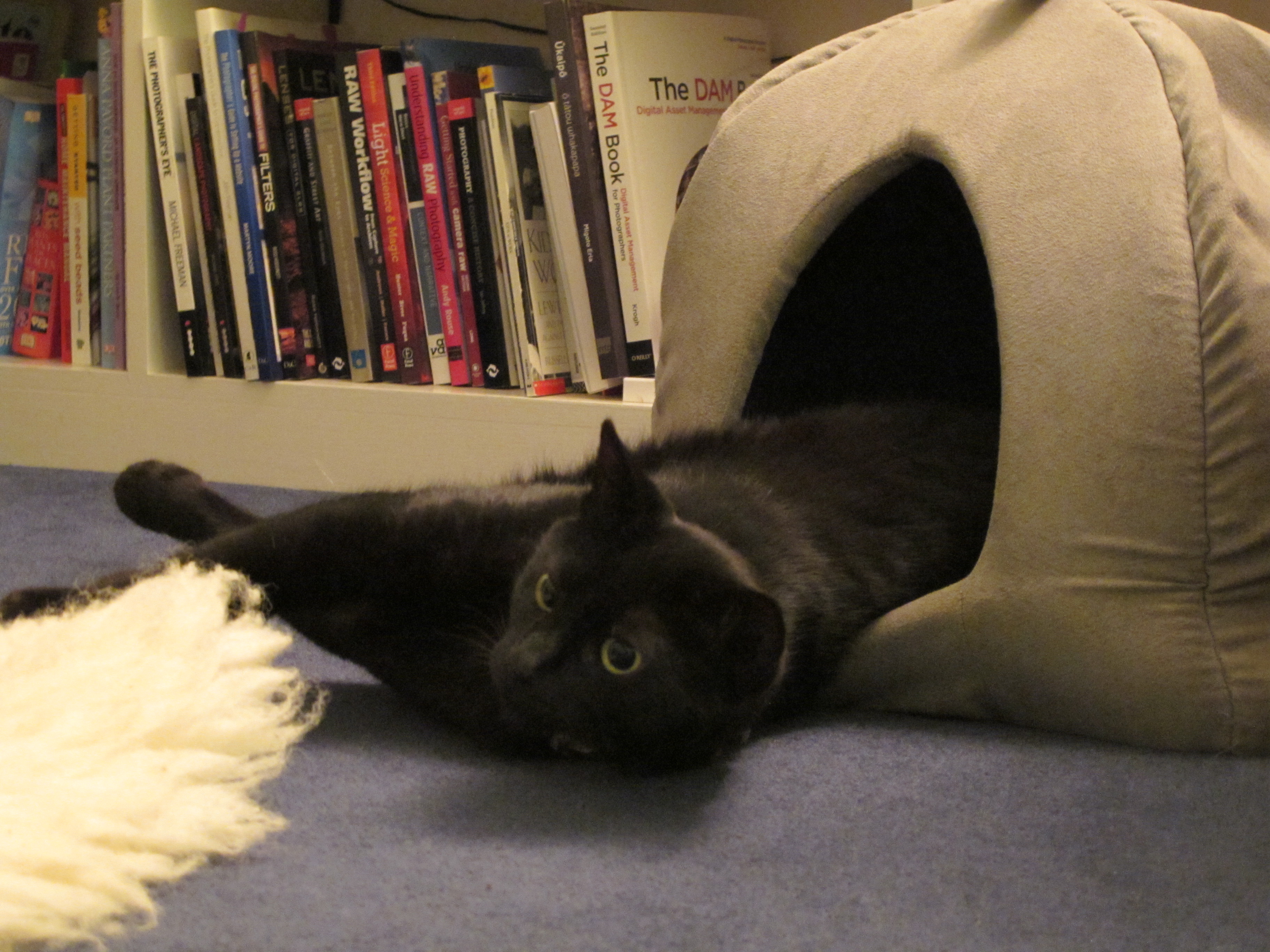
Smudge

Smudge

So yes, we’re of good terms with our neighbors. We’re closer to some than others, but where isn’t that true? Some of them seem standoffish, but ditto. Others are warm and delightful. We have small, human interactions with people we don’t know well, and it reinforces the shared idea that we live near each other and can get along. We ask after health, partners, gardens, kids, pets, and anything else we know about. We talk about the weather. Y’know that stereotype about the British and the weather? It’s true. People have a lot to say about it. I mean, we’ve got a lot of weather. And it’s free. Why let it go to waste?

On the other hand, if you take a survey of the village you’ll find we also argue about fences and boundaries and who said what to who and whose fault it was, or whose kid’s fault it was, or what exactly the it was that started the whole disaster anyway. We take each other to court. We pass along stories that are sometimes true and sometimes maybe not so true and sometimes, true or not, should’ve been kept to ourselves. We join clubs and committees and organizations, where we either get along so well we all want to get married and move in together or we have a bitter, six-year battle over whether to start the meeting at 7:01 or 7:03 and whether we need to open a checking account for the £4.39 in our treasury. We think about assassination and wonder why it’s illegal. Memories last a long, long time, and relations can get as toxic here as they do anywhere.

But just over a week ago when our younger cat, Smudge, was killed by a car (yes, today’s photo is actually relevant), the neighbor whose house he was nearest to activated the network—human and virtual—to find out whose cat he was. No more than an hour had gone by before Wild Thing saw the notice on the village Facebook page, and only a few more minutes had passed before someone knocked on the door to ask if he was ours, just in case we hadn’t heard. (Wild Thing had already gone to check, and she brought him home.) If they’d all shrugged their shoulders and told themselves it wasn’t their problem. we’d have spent days looking for him and worrying that he was trapped or hurt somewhere and then finally, endlessly, wondering what had happened to him. I’m grateful to them for letting us know, and grateful for the sympathy they expressed, because we miss him and somehow it helps to hear a few words of comfort.

So neighbors? I’m not trying to draw any large conclusions here, but ours are wonderful.

What Brits really think of American tourists

Gunta asked, “I often wonder what Brits or folks from other cultures think of us Americans at the tourist spots. It can’t be good.”

So I asked around. Most of the answers come from a village Facebook page. Yes, that’s an ancient custom in Cornish villages, having a Facebook page. We do things quaint around here. (If I were Cornish, I believe I’d say, “We do things proper.” But I’m not, so I won’t risk it. When you’re not 600% sure of what you’d be saying, implying, not saying, and vaguely hinting at, I’d advise playing it safe and sounding like yourself. In my case, that’s risk enough.)

Roman wall. Exeter, Devon, U.K.

Nearly relevant photo: Part of the Roman wall in Exeter. Hey, what tourist wouldn’t want to see that? This bit is right beside a parking ramp–or car park, which sounds like a place cars go to play in their time off. The bit of modern fencing looks kind of puny beside it.

A lot of the comments were positive, although I as I’m writing this I seem to notice a tinge of not-so-positive underlying them. I’m not sure if people were being polite (ah, yes, people around here are polite; except when they’re not, of course, but that happens waaay less often than in the U.S., and it has a lot more impact because it’s so unexpected) or if I’m just a sour old bat who’s importing her own view of the world into places it doesn’t belong. Take it all with the usual half cup of salt.

Several people mentioned Americans’ enthusiasm for how old Britain is. V. wrote that anything over 250 years old excites them. Which reminds me to mention that 250 years isn’t all that old around here. I mean, if we’re talking about stone circles, we’ll have to count in thousands of years, not hundreds. So 250 years? Nyeh.

S. wrote that she enjoys Americans’ love of castles, even when they don’t understand what they’re looking at.

What don’t they understand? Well, when N. “worked in Windsor years ago, I heard two American tourists looking up at the castle while a jet flew over out of nearby Heathrow. One said, ‘Gee, you’d think they’d have built it further from the airport.’ ”

If you can top that, you have to leave a comment.

M. wrote that “my dear sister-in-law is American, and when she was dating my brother she was still a tourist (she’s a hard-nut Londoner now, innit?) and we had some fun with her, like the time we (almost) convinced her that Stonehenge is moved around each solstice so it’s never in the same place twice.”

So, enthusiastic, appreciative, and, um, not necessarily well informed—either by their own (lack of) research or by their loving hosts.

And then there are the ones who are well informed but—well, H. wrote about a couple she met when she ran a B & B: “His knowledge of British history was incredible but he did admit it was easy to be an expert when surrounded by idiots. He requested clotted cream with his porridge!! She had a BRAG book containing photos of her grandchildren and proudly bored us for rather a long time.”

I should add that H. liked them. In fact, she called them fabulous.

What else?

Tourists bring their preconceptions with them, and look for ways to reinforce them. A. told a story about running past a group of American tourists (she was late, and stressed, and I’m guessing not in the best of moods) and hearing one call out, “I told you there would be rosy cheeks.” At the time she was annoyed. In retrospect, she thinks it was sweet.

She has a more tolerant nature than I do.

I hadn’t thought of rosy cheeks as something Americans expect of the British, but they do figure in a lot of English novels. So yes, I guess as least some people will come looking for them.

Another distinctive factor is that American tourists tip. And the British, in most situations, don’t. Still talking about her sister-in-law, M. wrote, “One thing I remember about going out with her in London as a tourist is that she never had an umbrella (she certainly does now), and that bar staff loved her, as she had no idea that you’re not supposed to tip them.

“Well, you aren’t, are you?”

Americans, you are not to take that as an instruction not to tip, because A.2 wrote, “And that’s why Americans will always get served before a tight, non-tipping Englishman!!”

Besides, it’s the right thing to do and you know it.

The most negative comments weren’t about Americans as Americans but about the sheer tourist-ness of tourists. T. wrote, “I think it’s just tourists not American tourists. There are a lot of people who simply forget they are travelling to someone’s home / work / life and have a responsibility to allow that to continue. Perhaps it’s just that in recent years there have been more of them and they are often …. easy to spot.”

Like all the other ellipses here, that “…” is his, not mine, so try to hear a pause there while he searches for a polite phrase.

Picking up on his comment, V. wrote, “Much like surfers, small groups of tourists always better.”

As if to prove that it’s tourists, not necessarily American tourists, G. wrote that “most English folk can’t differentiate between an American accent and a Canadian accent.”

I can testify to that. Periodically, I get asked if I’m Canadian. Since Canadian tourists are scarcer than the American variety, I’ve assumed they thought a Canadian would be offended at being taken for an American but that the reverse wouldn’t be true. And, in fact, I’ve never been offended by it. Baffled at first, but not offended. I admit, I’ve never checked my assumption about their assumption against anything as deflating as reality, so don’t take it too seriously. Especially since S. wrote to say that she gets asked the same thing “and I’m German!”

I can’t find any way to account for that.

J.’s American and does know her U.S. accent from her Canadian. She wrote, “I tend to hear [American tourists] before seeing them.” Ah, yes, the national volume control knob. Wild Thing—whose personal volume control knob is set pretty close to High—said simply that American tourists are loud. And our English friends D. and D., who visited us once in Minnesota, told us they’d always thought Wild Thing was loud until they changed planes in Chicago. So I think we’ve got a small consensus here.

Then there’s the question of looks: M.2 said American tourists “do often hit the stereotype, with the cameras, the bum bags, and the baseball caps, but I think that’s quite sweet.”

M.3 thinks they look “jolly, with their shorts and trainers [those are running shoes if you’re American] and baggy T-shirts, whether they’re male or female. They look really happy to be in England. They can’t wait to find out about it all.”

No discussion of Americans would be complete without World War II coming into it, and J. wrote that the “young Americans were very welcome in 1944, and Britain could have not have managed without the Marshall Plan in 1945.” To which V. answered, “Whilst their help in ’44 was invaluable, I didn’t think the UK got that much comparatively from the Marshall Plan … and what we did get took until this millennium to pay back … no economic miracle here (unlike Germany).”

Americans, is that a bit of history you ever heard about?

Finally, to put all this in perspective, V. told a story about her mother, who “stood at the top of the Empire State Building, looked down at the road system and said, ‘I think they could have done that a bit better.’ My sister’s response was to apologise to nearest American, saying, ’I’m so sorry, she still thinks we have an empire …’ “

I’d encourage you all to chip in with a comment, but I figure you know that already. Let’s hear what you can add.

The Palace Guard, the hat, the bears

Cat9984 asked, “Any chance you learned whether they have to kill a fresh bear when someone joins the Palace Guards?”

Great question, and it led me to an exhaustive ten-minute search. Or maybe that was half an hour.

I’ll start my answer with a Mirror Online article about the Ministry of Defense searching for a fake fur replacement for the hats. The article looked like it had been published just that day, but when I checked it again the next day it looked like it had just been published again. In other words, I haven’t a clue how old it is. It’s either breaking news or old—oh, hell, I can’t help myself—hat.

Irrelevant photo: wallflowers, which aren't people who don't get asked to dance, but real spring flowers. That grow happily in field walls--and in my garden.

Irrelevant photo: wallflowers, which aren’t people who don’t get asked to dance, but real spring flowers. That grow happily in field walls.

But forget the timing; let’s talk about the substance. Apparently animal rights activists have made an impact, even on the bastion of tradition that is the Ministry of Defense. I think it was Margaret Sanger who said something along the lines of “Never think that a small, determined band of people cannot change the world. Indeed, throughout history it is the only thing that ever has.” Or something like that. I’m working from (a screamingly imperfect) memory, so that may turn out to be a quote from Groucho Marx, and the quote may have been something along the lines of “Outside of a dog, a book is man’s best friend. Inside of a dog, it’s too dark to read.” What I can say for certain is that there’s a quote out there somewhere. From someone. And it’s great. It might even be relevant, depending on whether it’s the one about changing the world or the one about the dog.

But I’ve wandered, haven’t I?

The bearskin hats were adopted by the grenadiers in the 18th century, because the brimmed hats they’d been wearing blocked their view when they hurled grenades. (We’re in the land of Wikipedia now, having left the Mirror for the moment. I’m providing a link, although by now the article may have been changed so much that it claims the hats were designed by aliens who misunderstood the shape of the human head.)

The bearskin replacements are 18 inches tall. You might think a hat that tall would draw unwelcome attention on the battlefield, but 18th-century British troops weren’t known for their guerrilla tactics, and maybe once you convince yourself that a bright red jacket is a good idea, a foot-and-a-half-high hat doesn’t strike you as a problem.

The hats, according to the Mirror article, are made from the skins of Canadian black bears, and 100 new hats are needed each year.  Why 100? It doesn’t say. Do they have 100 new recruits each year? Do they only have 3, but 97 of the existing soldiers leave their hats in pubs when they stop off after work and never find them again? Do the moths eat holes in them? I just don’t know.

What I can tell you is that each hat requires the skin of an entire bear. Now I lived in Minnesota long enough to know that bears are bigger than hats. Much bigger than hats. Even foot-and-a-half high hats. Even the relatively small black bear.

Ah, but are the hats really are made from the skins of black bears? The Royal Hats website (yes, my friends, there is either a website or a blog out there about everything; every single thing) claims they’re made from the skins of brown bears, which have thicker pelts than black bears.  Then they’re dyed. Who’s right? I don’t know. I haven’t found an official government website that covers the topic, important though it is. Good thing it wasn’t a question in the Life in the U.K. Test or I’d have been kicked out of the country.

Where does the rest of the bear go? Dunno again. I do know that each hat ends up weighing 1.5 pounds.

The army argues that the bears—whether black or brown—are culled anyway to keep the populations in check, so no bears are killed specifically to make the hats and therefore it’s okay. They add that the hats are a symbol of Britain recognized around the world. If they have anything to say about whether the world, having recognized the hats, takes them seriously, I failed to find it.

The Independent  does date its articles, and in 2008 wrote that the hats were “likely” to be replaced, and that Stella McCartney or Vivienne Westwood might be designing the replacements. No, it’s not dated on April Fool’s day; it was posted in August. Apparently, the Ministry of Defense would be meeting with “leading designers” on the question. Now that’s a meeting I’d love to have reported on. Forget the hats—I’ll never be a fashion blogger—what I’d have been listening for was how the two groups communicated. If at all.

Since the only thing I know about Westwood is how to spell her name, I punched her into Google. She offers a nice little swimsuit with a strategically printed fig leaf for £220 pounds. The male equivalent is a steal at £125. The models, I have to say, do not look happy in them, and I don’t blame them. The suits are—as folks in Minnesota say when they disapprove of something—interesting.

And Stella McCartney? She’s offering a fizzy little black dress for £1,795. Sorry: No male equivalent seems to be available.

Neither the swimsuit or the dress strikes me as an obvious choice for the Place Guard, but the times they are a-changin’ and who am I to close off possibilities?

It must’ve been an interesting meeting, but I can’t find any reports on it and they seem not to have agreed on a replacement hat, because the bearskins are still in use.

And what, you might want to know, goes on underneath the hat? Well, one guy got really and truly bored under his and started cutting up in front of Buckingham Palace. My only question is why don’t they all? The Ministry of Defense assured the press that he wasn’t likely to be jailed for it.

Jailed? I know there are things about tradition that I don’t understand, but aren’t they over-reacting a bit by even considering it?

In the meantime, anti-fur activists continue to put pressure on the Ministry of Defense, and I’m going to take advantage of that and set up a meeting to discuss replacing the bearskin with a tasteful little flowered sunhat. The Palace Guard doesn’t throw grenades anymore, so the brims shouldn’t be a problem.

I’m sure they’ll be interested.

 The Cornish Saints

Cornwall was Christianized by a raft (and I’m using that word metaphorically, but you’ll see why it comes to mind) of saints that most people outside of Cornwall never heard of. I’m guessing the best known is St. Piran—Cornwall’s patron saint and a favorite saint of Cornish tin miners. He sailed over from Ireland on a millstone. (“As you do,” as people here say in just that kind of situation.) He’s said to have liked his drink, and to have died of it. Memory insists that he got drunk and fell down a well, but memory—or the version of it that lives in my head—isn’t reliable and may be making that up. So don’t trust me on that. None of the web sites I’ve checked mention it, although they do mention a lot of drinking on St. Piran’s Day.

Whether or not he was a heavy drinker, the saints in those days weren’t prissy. St. Brychan came from Wales with three wives, twelve sons, and twelve daughters, many of whom became saints themselves. I’ve never heard how they got here—probably a VW beetle—but transportation seems to have been a big thing among them: St. Ia floated over on a leaf and St. Budoc floated over in a barrel.

later may 2015 001

The British legal profession and its wigs

Retirementally Challenged wants to know why British lawyers wear wigs in court. Her exact question involved the words “stupid white-haired wigs.”

Since I am (a) not a lawyer, (b) not, at least at the moment, a defendant, and (c) a galvanized rather than born-and-raised Brit, I’m the obvious person to answer this question.

In case you’ve never been in a British court and haven’t watched the right mix of TV shows, I should stop to tell you that in at least some courts British lawyers and judges both wear the most bizarre white wigs you’re likely to find outside (or inside, now that I stop to think about it) of a costume shop. They stand up in court looking as if some evil-haired little white critter had curled up on their heads and died there, and not one of them gets the giggles. You’d think one look at each other and they’d go to pieces.

North Cornwall.

Vaguely related photo: A neighbor’s holly makes a break for freedom.

My first-hand experience with the wigs is limited. When Wild Thing and I had to were told to leave Britain and had to appeal, the hearing was what our barrister called informal, which meant wigless. Informal or not, it was still pretty intimidating.

The only other brush I had with wigs was when we were buying our house. Our solicitor (that’s the wigless half of the legal profession, which comes in two flavors in the U.K.) was tolerant enough to keep working with us even though Wild Thing regularly announced that as long as we were doing legal business she wanted to see the wig. (When he told us about stamp tax on the house, she reminded him that we’d fought a revolution over that. We still had to pay, but I was tempted to throw a teabag in the Bude harbor as a sort of memorial protest.

According to the humorless government web site on the subject of legal wigs (yes, folks, someone felt it necessary to create one), what a High Court judge wears was established by the time of Edward III (1327-1377). King Eddie gave the judges the material for their robes, and the style was based on what was worn in the king’s (as opposed to the judges’) court at the time.

In 1635, what judges wore wasn’t changed but it was codified, because—be serious, can’t you?—it was painfully important to get it all right. After that, the standard uniform changed in various and boring ways at various and unimportant times.

How interesting, you say, suppressing a yawn, but what about the wigs?

They were introduced during the reign of Charles II (1660-1685), who wasn’t called Charles the Vain but could have been. The judges took some convincing before they all agreed to wear them, but eventually they caved. I mean challenging the king of a topic of that much importance? That’s risky.

By the reign of George III (1760-1820), wigs were going out of style but still had to be worn by bishops, coachmen, and the legal profession. Now that, friends, is a bizarre combination of professions, and I can’t tell you who enforced the rule, but I do wonder.

Bishops eventually got permission (from who? I dunno) to stop wearing them. Then coaches met the internal combustion engine, and if coachmen hadn’t already gotten permission to burn their wigs it all became irrelevant because the profession disappeared. I’ve been a cab driver, which is close enough to a coachman, and you can trust me on this: You won’t find many cab drivers wearing white wigs.

And those short, curled wiglets that judges and barristers wear today—the ones that don’t cover all their hair? (A barrister, by the way, is the other half of the legal profession—the half that appears in court.) They were adopted around the 1780s “for civil trials” and probably felt like a liberation from the full-scale wigs that came before them. Today, the full wig is only used on ceremonial occasions, of which—this being Britain—there are probably many.

Barrister Harry Mount reports that the wigs are “Itchy, ludicrously expensive and dirty—barristers hold on to the same one for their whole career—they’re also extremely hot.”

But eliminating them entirely? Not going to happen. Civilization in the questionable form in which we know it would come to a crashing end.

So there you have it: the history of the legal wig. What else would you like to know, either about Britain or the U.S.? I’ll answer any question that tickles my fancy, regardless of how unqualified I am.