The fun hasn’t gone out of British politics yet

Once Britain’s Conservative government was booted out, it looked like the grownups, in the form of a shiny new Labour government, were in charge at last. In other words, it looked like the fun had gone out of politics, but have hope: humanity’s most absurd qualities haven’t been banished. 

This is admittedly gossip and rumor, but it’s credible enough for a responsible paper, the Guardian, to have trusted it: low-level guerilla warfare is going on inside 10 Downing Street between Sue Gray, the prime minister’s chief of staff, and Morgan McSweeney, who was his election strategy wizard and is now his head of political strategy. 

The plan was for McSweeney’s desk to sit outside the prime minister’s office, since he would be in and out of there more than Gray, but apparently Gray has moved McSweeney’s desk away from the prime minister’s door. Twice. Which implies that he’s moved it back at least once. She’s also (allegedly) tried to block his access to a secure computer system that would let him get security briefings.

There’s hope for humanity yet.

A nearly relevant photo, but you’ll have to read to the end to find out why. This isn’t the cat in the news but our own Fast Eddie in the foliage.


Exit Liz Truss, pursued by a head of lettuce 

Admittedly, though, the Conservatives were more fun. Watching them run the country was kind of like watching a classroom full of six-year-olds try to make a pie from scratch after the adult’s been called away: a lot to laugh at, but now that their parents have taken them home and, we hope, washed their clothes, there’s a real mess to clean up.

I’m not on the clean-up crew, so allow me to call your attention to Liz Truss, who was prime minister for 49 days. During the final stretch, disaster was so clearly headed her way that a newspaper put a livecam and a blond wig on a head of lettuce and asked if it would last longer than Truss.

Or maybe she was in office for 45 days. Or 50. For reasons that I won’t try to understand, different sources are coming up with different numbers. Whichever one we pick, she still holds the record for the country’s shortest-serving prime minister and the lettuce outlasted her, but that hasn’t stopped her from publishing a book, Ten Years to Save the West–an ambitious goal for a politician who couldn’t save her own premiership. And more than a quarter of that first year is gone already. 

Modesty prevents me from making fun of anything more than the title since I haven’t read it. 

The reason she’s back in the headlines is that she walked out of her own book event in August, which must also set some kind of a record. A crowd-funded group called Led by Donkeys had installed a hidden banner above the stage. When they lowered it by remote control, it read, “I crashed the economy.” Inevitably, it included a picture of a head of lettuce. 

Truss said, “That’s not funny,” and walked off stage. End of event. She has since accused Led by Donkeys of stifling free speech, although nothing they did kept her from speaking and a banner can also be considered speech. In fact, interrupting someone can be considered free speech. 

Led by Donkeys calls itself an accountability project and says the new government will inevitably “disappoint us in some, if not more, respects . . . so it’s inconceivable that we won’t turn our attention in a really direct way to what the government is doing.”

I can hardly wait.


What’s it worth to be booted out of office?

In the year after she stepped down as prime minister, Liz Truss made £250,000 in speaking fees. In one speech, she took in more than most of her fellow citizens earn in a year.

Suella Braverman made £60,000 as a speaker, although I’m not sure about the time period on that. She also made £14,000 for newspaper articles in the Telegraph and accepted an all-expenses paid trip to Israel worth £27,800. A mere nothing, but then she wasn’t prime minister. She never got past home secretary.

The top earner is Boris Johnson, who made £4.8 million in the six months after he stepped down, £2.5 million of which is an advance on some unspecified number of speeches. I haven’t seen a breakdown of the rest of his income, but I’d think twice before paying him an advance on so much as a piece of toast, even if I was looking at both bread and toaster. He got an £88,000 advance (or “a rumoured” £500,000–go figure) in 2015 for a book on Shakespeare.  

What does he actually know about Shakespeare? Indications are, not much. In 2021, a leading Shakespeare scholar was approached to help him with his homework by answering questions for Johnson. “The originality and brilliance, his agent assured me, would lie in Mr Johnson’s choice of questions to ask and in the inimitable way in which he would write up the expert answers he received,” the scholar said when he went public about it.

The book has yet to appear–or from what I’ve read, make its way to the publisher, but that hasn’t stopped him signing a £510,000 deal to write his political memoirs–for a different publisher. 

And I still don’t have my toast.

*

To prove there’s no justice in this world, the lettuce–which, you’ll remember, outlasted Truss–ended up on the compost heap. 


Meanwhile, in Cananda . . .

 . . . a totally separate Conservative Party aired a feel-good election ad, full of patriotic hoorah about how much they love Canada. You know the kind of thing: a Canadian father drives through the suburbs, only it turns out that was shot in North Dakota. The kids in school? That was from Serbia. The university student? Ukraine. The kid in the park with her grandparents? London. The two jets on a training mission, “getting ready to defend our home and native land”? Russia.  

And the sunset with the words “we’re home”? Venezuela. 

The ad has been pulled.


And in nonpolitical news . . .

. . . Larry Richardson is the author of a dozen academic papers on mathematics that have been cited 132 times. Larry Richardson is also a cat and, disappointingly, his papers are gibberish. 

Larry was boosted into academic stardom by his person’s grandson, a grad student in metascience and computational biology, who had run into the academic trick of getting your papers cited by either writing the papers citing you or paying someone else to do that for you. This matters, because the more a scientific paper is cited, the more important its author becomes. It influences hiring and tenure decisions. If you’re a cat, it gets you headlines.

Not that you care about headlines if you’re a cat. 

The papers that cite you can be gibberish as long as they have a plausible title. In fact, a program, MathGen, can produce them for you if you can’t be bothered writing your own nonsense. And  they can be written by long-dead scientists and mathematicians. 

Ever wanted to have your paper cited by Galileo? It can be arranged. 

The papers can also be written by your grandmother’s cat. You upload them to ResearchGate, let GoogleScholar do its work, then delete them. Or leave them. What the hell, it’s your call. 

GoogleScholar doesn’t sound overly cautious about what it accepts as a scholarly paper. Someone got it to accept a cafeteria menu. The authors are C.S. Salad, P. Pack, B. Noodles, C. Fajitas, and R. Beans. If the hyperventilating comments on Twitter are to be believed, the paper’s been cited multiple times.

R.  Richardson’s goal was to make L. Richardson the world’s most-cited cat. It took two weeks but only one hour of that was actual work.

The cat whose record L. Richardson broke was E.D.C. Willard, whose human was theoretical physicist Jack Hetherington. Hetherington added E.D.C. to a single-author paper because he didn’t want to go back and change all the we’s to I’s. E.D.C.–also known as Felis Domesticus Chester Willard, or Chester to his friends–racked up a mere 107 citations. He went on to drop his coauthor and write a paper and a book chapter under his own name.

R.  Richardson assures the world that L. Richardson–who goes by Larry–has been compensated in some unspecified way for the use of his name. R. Richardson did not comment, but you can find his profile here

No, Britain hasn’t had a civil war lately

As you may have read when the UK experienced a series of racist and anti-immigrant riots earlier this month, Elon Musk predicted that civil war was inevitable in Britain.  

Relax, kids. Bad stuff did happen, but a civil war it ain’t, and whatever else Musk is, he’s not a political sage.


What did happen? 

Bad stuff, genuinely. It all started when with a knife attack on a dance class in which three young kids were killed and eight people were injured. The attacker was arrested, and a social media campaign claimed he was a Muslim immigrant. He was neither. He was the Welsh-born son of Somali Christian immigrants. 

If anyone knows what his motivation was, they haven’t gone public with it. The best guess going is that he’s crazy, and craziness is an equal opportunity employer, but good luck convincing someone of that if they’ve put their bet on immigrants being the cause of all the country’s problems. Social media blamed an immigrant with a vaguely Muslim sounding (and incorrect) name, so folks got fired up. It was all the fault of immigrants and of Islam. The government was withholding the truth. Somebody had to do something!

The first something they did was riot in the town where the stabbings had taken place, attacking a completely unrelated mosque, burning a police van, and fighting the police–and they had so much fun there that they, or versions of them in other towns, went on to riot in other cities, attempting to burn down buildings housing refugees while people were inside. They also attacked mosques, minority-owned businesses, cars, Muslim gravestones, police, libraries, reporters, photographers, camera crews, individuals who weren’t white, and whatever else was available, including trash cans. 

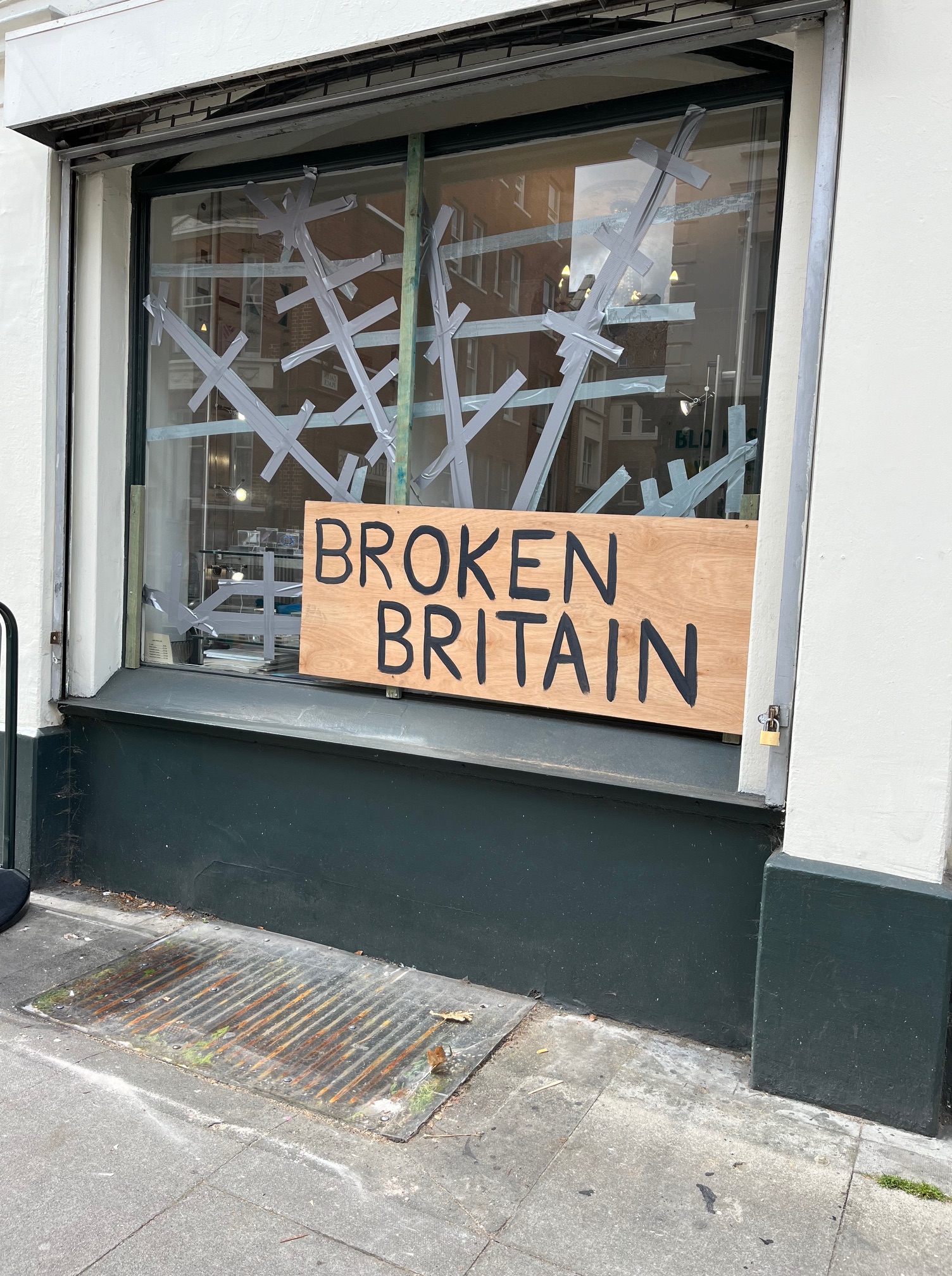
I saw this broken window and sign in London shortly after the riots ended. I tried to go in and ask what they meant (with my still-American accent, no one’s surprised if I seem clueless), but they were closed. The slogan appeared when David Cameron, the first in a string of Conservative Prime ministers, claimed he was going to fix Broken Britain. We could argue about whether it was, in fact, broken, but he and the Conservative prime ministers who followed him have beyond doubt left it shattered. So I’m genuinely not sure what the thinking is behind this particular sign.

In places, the rioters came with helmets and metal bars, wearing balaclavas, and generally ready for to wreak havoc. An article in Foreign Policy reports rioters yelling, “Go home,” at anyone with brown skin, or more generally, “We want our country back.”

The riots have gotten most of the publicity, but they’ve gone along with a fivefold increase of threats to Muslims–death threats; rape threats; generalized hate messages–and a threefold increase in outright hate crimes against Muslims. (I’m focusing on those because statistics are available, not because threats and attacks are only against Muslims.) Predictably, many Muslims and people of color report not feeling safe in public–which was, of course, the point. An anti-racism activist, Nazir Afzal, said, “This feels targeted against people who are black and brown. I can’t have a conversation with any person of color at the moment without finishing with: ‘Keep safe.’ ”  


What’s the background?

The riots make no sense until you look at the background: we have entire dump trucks filled with politicians happy to fuel anti-immigrant sentiment. In fact, they’ve built their careers on it. They’re from both the Conservative Party and, to its right, the new Reform UK. I’ll give you just a few of examples or I’ll get too depressed to go on tapping the keyboard:

  • Robert Jenrick, who’s in the running to lead the Conservative Party, called for the immediate arrest of anyone who shouts “Alluhu Akbar” at a protest. Betting sites give him the best chance to win.  So does the Telegraph.
  • The former home secretary Priti Patel got a lot of press for accusing “lefty lawyers” of keeping the government from cracking down on immigration. More recently, she’s accused the Labour government of “two-tier policing,” in which police are harder of whites than Blacks. 

Yeah, I know, but if you lot at the back of the room can stop laughing, please, we’ll go on.

Et cetera. They’ve shifted the conversation around immigration so far to the right that the Labour Party is afraid to say, Hey, this country needs immigrants. They contribute to its economy and culture, even though it’s true and would resonate with a substantial number of voters.


Who took part in the riots? 

Some participants were–as the papers put it cautiously–linked to the now-defunct English Defense League, which held that Muslims couldn’t be truly English. Some were Nazis, complete with swastika tattoos and straight-arm salutes. Others may have been football hooligans–a category of troublemaker I’d never heard of before I moved to the UK. They’re basically guys who like football and like a fight, so wouldn’t it be efficient to combine the two? I’ve been told–and it does seem to be true–that the British will organize a club for just about anything, and this is an example: they organize themselves to go out and get in a fight with people who support an opposing team. 

So here was the prospect of a fight. Whee. Let’s go join in. 

Are football hooligans inherently racist? A government site says no, they reflect the communities they come from, so some are and some aren’t.

Not all the rioters were there because they’re racists or hate immigrants, though, and I find that oddly reassuring. They wandered by, saw a riot, and were angry enough that rioting seemed like a great idea, so they joined in. Or saw looting going on and wanted some stuff. As one participant put it, “People just like rioting.”

Listen, fourteen years of Conservative governments have shattered not just the country but a lot of people’s lives. Let’s not be surprised if they’re angry. That wasn’t the cause of the riots, but it does seem to have been part of the picture.

Social media is another part of the picture, and was used in two ways: first to stir people up in general and second to let people know about specific riots. So although the articles I’ve read talk about the British far right as fragmented and can’t pinpoint any organizations responsible for the riots, it does sound like some non-organizations were effective in calling their non-members together. 

According to a former head of MI6’s Russia desk, Russia was involved in instigating the riots. How accurate that is I don’t know. He’s a former-head, not a current one. Tuck the thought in your pocket as a possibility, not a fact.


Counter-demonstrations

The day after the first riot, in Southport, neighbors from multiple backgrounds came out to clean up, to rebuild and raise money to rebuild the mosque that had been attacked, and to show solidarity. Any number of them were quoted as saying that the rioters weren’t from around there. 

There’s your first shred of hope for the day.

In Liverpool, an imam prepared for an expected riot by stocking up on burgers, chips (that’s British for french fries; you’re welcome), and cold drinks. About thirty people showed up ready to riot and were met by a couple of hundred who were there to protect the mosque–again, from many backgrounds. The imam crossed over to the thirty, handing out food, drinks, and when possible, hugs. Some people refused to talk with him, but with some he managed a dialogue.

There’s your second shred of hope for the day. 

The rioting lasted about a week and seems to have been stopped by a combination of arrests, with threats of heavy sentences, and large anti-racist counter-actions. There’s your third shred of hope. 

The anti-racist demonstrations really took off after it became known that a list of organizations supporting refugees had been circulated. The organizations on list either were or were believed to be targets for the next set of riots. Many of them were lawyers, and given Suella Braverman’s campaign against “lefty lawyers,” it wasn’t not irrational to think they’d be a target. 

Thousands of people showed up in multiple cities to protect them. 

Your fourth shred of hope is this: On Twitter, someone called RS Archer (@archer_rs) wrote, “I’m a lurking member of some far right discussion forums and they are VERY unhappy. They lament the lack of public support and recognise the fear generated by the high number of arrests and swift convictions. Also a lot of anger toward Farage [the most visible politician in Reform UK] who is seen as abandoning them.”

Who is Archer? No idea. Does he know what he’s talking about? I can’t say. It’s a shred. I won’t tell you it’s more than that, but I’m not above being glad of what it might tell us.

But with or without that fourth shred, sorry, Elon, we don’t have a civil war today and my reading is that we’re not on the edge of one either. We do have some ugly stuff happening, and we do have a problem, but I think we need to discuss the definition of civil war. Once we work that out, we can talk about what it takes to start one. 

Or not. I don’t believe we have the ingredients in stock, but even so I don’t want to hand you a blueprint. 

The early days of Britain’s National Health Service

The National Health Service–known to friends and wolves-in-friends’-clothing alike as the NHS–began in 1948, when World War II was over but food was still both scarce and rationed, the economy was just staggering out of a severe recession (no, I hadn’t heard of it either), and the empire was in the process of collapse. 

Introduce anything so ambitious these days and every sober advisor in (and out of) sight would tell you, Get serious. Maybe you could just replace the program with a nice slogan. So how did the prime minister, Clement Atlee, and his minister of health, Aneurin Bevan, manage this little trick?

For starters, the system they introduced didn’t drop from the sky. It had been taking shape since at least 1909


Irrelevant photo: A camellia–although if you read to the end it becomes semi-relevant since you could argue that it’s deepest pink. Or at least tinged with red.


Background

Here at Notes, we–by which, of course, I mean I–can never tell a story without going backward first, so let’s go backward. What happened in 1909 was the publication of the Minority Report of the Royal Commission on the Poor Law, under the leadership of Beatrice Webb. The commission was looking for something that would replace the Poor Law and the punitive Victorian workhouses. The minority report argued for “a national minimum of civilised life . . . open to all alike, of both sexes and all classes, by which we meant sufficient nourishment and training when young, a living wage when able-bodied, treatment when sick, and modest but secure livelihood when disabled or aged.”

Its focus was on preventing poverty rather than providing relief once it was entrenched. But this was a minority report. The majority report argued for individual responsibility and charity. 

What happened? The party in power, the Liberals, tossed both reports into the revolving file, also known as the trash, but Webb and her fellow Fabian socialists printed copies of the minority report and sold 25,000 of them. I’d be happy to see one of my books sell half as well. 

The minority report had far more impact than the majority’s and became  central to the thinking that eventually formed Britain’s welfare state. In some estimates, it led to the Beveridge Report, which leads us to our next subhead.


The Beveridge Report 

Despite its name, this was not a misspelled report on what people drank. It was a 1942 report that created the blueprint for a cradle-to-grave social services system. Most importantly for our purposes, it included the idea of a free health service, funded by the state and spreading the cost of healthcare out over the country’s population instead of having it fall on the individual or family unlucky enough to get sick. 

Some 250,000 copies of the full report were sold, along with 370,000 of an abridged version and 40,000 of an American edition. In twelve months. 

Britain’s 2,700 hospitals, at this point, were run by a mix of charities and local governments. National insurance existed, but it only covered people who were working. The number of wounded coming back from the war pushed the system toward bankruptcy, adding to the pressure for a unified, state-run health service.


Churchill, Atlee, the war, and the welfare state 

During the war–that’s World War II in case you got lost somewhere along the way–the Conservative and Labour parties governed in coalition. Churchill–a Conservative–was the prime minister, and Labour, the junior partner. pushed for the Beveridge report to be put into practice. Churchill was reluctant to commit the country to hefty new expenses until the postwar economic picture was clear, but he also advocated a “national compulsory insurance for all classes for all purposes from the cradle to the grave.” He didn’t oppose the Beveridge Report but wouldn’t commit himself to implementing it, and privately called Beveridge “a windbag and a dreamer.” 

That left Labour in a position to campaign as the party that would put the report–”the full Beveridge”–into practice, and in the first election after the war Labour won a big honkin’ majority: 393 seats to the Conservatives 197. Labour was a socialist party at this point (it no longer is) and on the first day the new parliament met, its MPs sang (or in some tellings, bellowed) the socialist anthem, “The Red Flag.” 

The link will take you to the song if you can’t go on without hearing it. This version is sung, not bellowed, which is a bit more important than being shaken not stirred.

Once he was prime minister, Atlee threw his weight behind the creation of a welfare state–a huge undertaking, including not just medical care but housing, education, and financial assistance to the unemployed, retired, and disabled.

“We had not been elected to try to patch up an old system but to make something new,” he said. “I therefore determined that we would go ahead as fast as possible with our programme.”

The program also included the construction of housing and the nationalization of key industries. Railroads and coal mines were “so run down,” as the Britannica puts it, “that any government would have had to bring them under state control. In addition, road transport, docks and harbours, and the production of electrical power were nationalized. There was little debate. The Conservatives could hardly argue that any of these industries, barring electric power, was flourishing or that they could have done much differently.”

I should probably stop here and say what will be obvious to some people and not at all to others: there’s no single definition of socialism that all socialists agree on. I think a fair summary of this version is that key industries were nationalized and the state was responsible for supporting people’s overall welfare. It was a form of socialism that coexisted with capitalism.

But let’s go back to the end of the war. The country was well past its eyeballs in debt and Keynes had warned earlier that the country faced a “financial Dunkirk.” It had borrowed massively to fund its role in the war (a lot of it from the US), and wartime industries like aviation were bigger than it now needed while basic industries like coal and railroads needed serious repair–which is to say, investment. As the Britannica (again) puts it, “With nothing to export, Britain had no way to pay for imports or even for food.”

Loans from the US and Canada helped the country get through a short stretch. The Marshall Plan got them through another stretch of time. But food continued to be rationed, and the fifties were a pretty gray time for the country.

In that situation, how were they going to pay for this massive investment in a welfare state? At least part of the answer was the National Insurance Bill–an extension of a system put in place before World War I–which had working-age people paying in every week specifically to support the benefits everyone in the country could draw on. (Married women who worked didn’t pay in, but don’t worry, they suffered enough inequalities to more than make up for it.)  


The NHS

In 1948, the National Health Service was launched, under the leadership of Aneurin–called Nye–Bevan, the minister of health. 

Bevan had started work as a miner at 13 and chaired his miners’ lodge at 19. He also chaired the local Medical Aid Society, a system that had members paying in and getting healthcare in return. Initially, this didn’t include miners’ families. During his tenure, membership expanded to include non-miners,until 95% of the town was eligible. This became his blueprint. 

“All I am doing is extending to the entire population of Britain the benefits we had in Tredegar for a generation or more,” he said. “We are going to ‘Tredegarise’ you.” 

The NHS was set up to help everyone, and care would be free and based on need, not ability to pay. “A free health service is pure socialism,” he said, “and as such is opposed to the hedonism of capitalist society.” 

Opposition came from the Conservative Party, the British Medical Association, and the right-wing newspapers.

Okay, historians argue about whether the Conservatives belong on the list. Their 1945 manifesto backed health services available to all citizens but didn’t commit to it being free. At any rate, they voted against Bevan’s version of the NHS and compared it to Nazism. That probably makes it fair to say they opposed it.

No one argues over whether doctors opposed the plan, at least as a group. Bevan claimed he won them around by “stuffing their mouths with gold”– allowing consultants to treat paying patients privately and still work inside the NHS. He later claimed he’d been “blessed by the stupidity of my enemies.”


And now?

I’d hoped to take you through a bit of more recent NHS history, but I dipped a toe into that water and just about drowned. Now that I’m back on the couch, safe and dry, I’ll risk nothing more than the most superficial of summaries. The NHS is immensely popular–basically, it’s the national religion–and most people find the idea of medicine for profit both shocking and counter-intuitive. But profit has crept into the system, and for the moment at least, socialism has been pushed to the political fringes. 

I’ve lived in Britain for 18 years and seen the NHS reorganized in assorted ways, all of them disastrous. Huge chunks have been privatized so one corporation or another could make a profit by running it as cheaply as possible, all in the name of efficiency, but somehow, magically, it all gets less and less efficient. At the moment, the NHS is suffering from years of underfunding. Waiting lists are long, jobs can’t be filled, and nurses and doctors are leaving the system to work somewhere–anywhere–else. 

With the next election predicted to return a huge Labour majority, I’d like to think the problems will be fixed–or at least addressed in some way that serves the public interest–but I’m doubtful. The current party leadership has been telling us we can’t expect much from them and I’m inclined to think they’re telling the truth. 

Still, for all its problems–and they’re many–the NHS is a magnificent thing: a system that makes healthcare free at the point of delivery, as the saying here goes. I’m originally from the US, so I’ve seen what the alternative looks like. A for-profit system is primarily interested in, um, making money, so what matters is whether a person can pay. US healthcare can and does bankrupt even the comfortable and well insured. It neglects the poor and milks the rich and–oh, hell, I could go on but you get the point. Both systems have their problems, but I much prefer the problems of a socialized system.

*

Now that Labour’s taken distance from any suggestion of socialism, I wondered if it had also taken distance from its old song, “The Red Flag.” Apparently not. Its 2022 party conference made headlines when the delegates sang it. The song opens with the words, “The people’s [or “workers’,” depending on the version you choose–and probably your politics] flag is deepest red / It’s shrouded oft our martyred dead.” A parody runs, “The people’s flag is deepest pink / It’s not as red as you might think.”

And with that I’ll leave you for the week. Stay well out there, people. It’s not safe to get sick.

The House of Lords: how it formed and what it does

Britain’s House of Lords traces its history back to the 11th century, which means it predates the country itself, because although Britain did eventually show up at the party, it was unforgivably late.

The part of the 11th century that we happen to be talking about is the Anglo-Saxon part of the century, before the Norman invasion, when the king had a witan–a group of advisors to consult if and when he wanted to. It would’ve been made up of the king’s ministers plus the most powerful of the lords and religious leaders–you know, the country’s big bruisers–and a wise king sometimes made sure they’d support whatever he had in mind before going too far out on a limb.

Although having said that, there’s some debate about who got invitations to the witan and who got to stay home and sulk. A lot of Anglo-Saxon history is subject to debate, but we’re going to rampage through this quickly because we were looking for Britain, remember? And Britain isn’t here yet.

Irrelevant photo: morning glories, a.k.a. bindweed

Before we leave, though–have a drink while I’m messing around, why don’t you?–I should mention that whatever the Witan did (and that sounds a little hazy too), it did get to select the king. The Anglo-Saxons didn’t automatically go with the oldest son. 


Then the Normans invaded and everything changed…

…except for what didn’t. Kings still summoned the country’s big bruisers once or twice a year. Because in theory the kings might’ve been all-powerful, but they couldn’t govern without the backing from their lords–at least not well and not for long. It’s not hard to find examples of English kings offending the nobility more than they were willing to be offended and ending up in history’s large and unsentimental trash can. 

After one of those not-quite-all-powerful kings was forced into signing Magna Carta (1215, and yes I did have to look it up), he and all the kings who came after him were committed to asking the barons’ consent before they imposed taxes. This gave his proto-parliament–that yearly or twice-yearly gathering of lords–a well-defined power. 

As the thirteenth century wore on, locally elected representatives of counties, cities, and boroughs also began to be summoned when taxes needed to be approved. Among other things, this made the taxes easier to collect. 

Representatives of the towns and cities were called burgesses and tended to be rich lawyers and merchants. Representatives of the counties were called knights of the shire and were mostly from the landed gentry. I haven’t a clue what representatives of the boroughs were called. They may also have been called burgesses, since the root word looks the same and a borough was nothing but a town with a fancy hat. 

The burgesses outnumbered the knights and were paid two shillings a day when parliament met, but the knights (probably) dominated the proceedings because they were better connected and, as everyone at the time would’ve agreed, more important and better looking, and in recognition of all that were paid four shillings a day. 

After 1325, no parliament met without the commoners.

Now let’s get to the small print: When I said these assemblies could approve taxes, that doesn’t mean it was easy for them not to approve them. They had to go pretty far out on a limb to say no. In 1376, when they did refuse one, they had to claim that funds had been misappropriated by some of the king’s courtiers. 

Short of saying no, though, they could negotiate. They could drag their feet and sulk. They could, in general, be a pain in the neck. 

Never underestimate the power of being a pain in the neck.

Much to the monarch-of-the-moment’s annoyance, he (or the occasional she) needed Parliament. The monarchy’s income from its own lands had decreased over the years–hey, it’s tough up there at the top of the heap. And they kept taking the country to war, which is an expensive little habit. So however annoying parliament became, the monarch was constantly driven to call it back and ask for some new tax. 

Parliament was also the place where communities and individuals, high and low, could go to petition the king, and it was petitions involving the affairs of the country gradually drew parliament into a law-making role. At first, it was the king’s prerogative to initiate a law, but in the 14th century parliament began petitioning the king about this or that and making gradual moves into what the king’s territory.


The houses separate

But we’ve spent entirely too much time brushing our refined elbows against the commoners elbows. We should be talking about lords.

If we can duck back for a minute to the 13th century, we’ll see a forerunner of the House of Lords in a small group of councilors clustered around the king. And by councilors, of course, I mean important people, and by important people I mean nobles. By the 14th century, they’d become a larger group that began meeting separately. These were dukes, earls, barons, marquesses, viscounts, and the top layer of the clergy. They were called, collectively, the peerage. 

And I’m sure the peers were much happier meeting that way. The commoners had been getting too big for their little bootsies. An anonymous publication from the 1320s argued that parliament’s barons could only speak for themselves, unlike (as the BBC puts it) “the knights, citizens and burgesses who represented ‘the whole community of England’ . . . who alone should grant taxation on behalf of the people.”

Yeah. A pesky lot, those commoners. 

As the two groups separated, the king’s key officers–the chancellor of the exchequer, the treasurer, the senior royal judges and key members of the royal household–met with the lords, not the commoners, and the real business was done there, at the top. As someone put it in 1399, the commons were merely “petitioners and suitors,” and all judgments of parliament “belong solely to the king and lords.”


The mysterious shrinking peerage

This isn’t strictly relevant, but it’s interesting: during the Tudor period (start counting in 1485 and stop when Elizabeth I dies), the number of peers shrank. Part of that was the War of the Roses–the count dropped from 64 to 38–but nobles had always died in wars; under normal circumstances dead ones would’ve been replaced with live ones who were either their heirs or, if no heir was to be had, someone the king owed a favor to. Or liked or wanted to placate or hoped to control. Or whatever motivated that particular king at that particular moment. 

Henry VII, though–the first of the Tudors–didn’t replenish the stock, probably because he didn’t want a group of powerful nobles who might challenge him, starting another war. He’d seen enough of that, and the country was out of roses anyway. 

So start there, then run through the rest of the Tudor kings and queens and count the number of nobles executed for treason whose titles were taken from them, which meant their heirs didn’t inherit them. I doubt being a Tudor-era peasant was a barrel of laughs, but belonging to the nobility had its own dangers. Romanticize it all you want, the Tudor era was a dangerous time to be part of the nobility.

For the last 30 years of the Tudordrama, the country had zero dukes, in spite of the after-VII Tudors (not to be confused with After Eight Mints) having created some new peers as they went along, and most of the 16th-century nobility were of recent coinage. 

With the dissolution of the monasteries under Henry VIII, the number of abbots in the House of Lords (no surprise here) shrank, and by the end of Elizabeth’s reign there wasn’t an abbot to be found in the Lords, and only 26 bishops. For the first time, the secular lords formed a majority. Semi-relevantly, the secular lords were and still are called the Lords Temporal, because everything needs a fancy name.

We now return you to our regularly scheduled drama.


From the Civil War to the 19th century

From the Tudor period, it’s a short march to the Civil War, when Parliament seized power. In 1642, it excluded bishops from the House of Lords. Then in 1649, it abolished both the monarchy and the House of Lords. I’m sure that made the bishops feel better about having been tossed out. Guys, the party ended just a few years after you left, so don’t feel bad.

When the monarchy was restored, everybody pushed the Reset button and Parliament was reconstituted in its old form–Commons, Lords, Church worthies–and when (you thought we’d never get there, didn’t you?) Scotland and then Ireland were folded into the batter that became first Great Britain and then the United Kingdom, the Scottish and Irish peers elected representatives to the Lords. 

Now we do a couple of fancy steps until we get to the 19th century, when the number of bishops in the House or Lords was limited to 26 and the monarch got to create life peers. That’s as opposed to hereditary peers. Once they’re appointed, they can put down roots and make themselves at home, but they can’t shoehorn their kids in after them.


20th century

In the 20th century, the story gets interesting enough that I’ll slow it down again. By the beginning of the century, it was standard for the prime minister to govern from the House of Commons, so basically the power had shifted. The last PM to govern from the Lords was the Marquess of Salisbury in 1902.

Then we get to 1906, when the Liberals won a big honkin’ majority in the Commons–132 seats–and figured they’d use it to introduce radical things like sick pay and old age pensions.

Horrors, the Lords said in one aristocratic voice. And double horrors because the programs would be paid for by a tax on the rich–especially on the landed rich: in other words, on the people sitting in the House of Lords.

You might have already figured out that the House of Lords had a built-in Conservative–and lower-case conservative–bias. So predictably enough, the Lords refused to pass the budget. After a bit of back and forth, including a general election, the Lords did pass the budget, though, along with the Parliament Act of 1911, which limited  the Lords’ power. 

Why’d they do that? Because the government threatened to flood the house with 400 new Lords, all of them Liberals. 

The bill left the Lords with the power to, at best, delay money bills by a month, and it completely lost the ability to veto bills. It could delay non-budget bills for two years, but that was the limit.

The two years have since been reduced to one.

That takes us to 1958 and the Life Peerages Act, which poured in a group of life peers, including experts in various fields and for the first time–gasp; horrors–women. It was a gesture in the direction of counteracting the house’s built-in rightward tilt. 

Then we skip forward again. Tony Blair had a three-stage plan that would fold the House of Lords into a paper airplane, sail it out to sea, and replace it with a fully elected house. 

How did that fare? Well, the House of Lords started 1999 with 758 hereditary lords and ended the year with 92, but then it all bogged down. The plan’s probably still stashed on some governmental shelf, gathering dust, and we still have 92 hereditary peers. They’re chosen by all the country’s hereditary peers, making the aristocrats, in a nice little piece of irony, the only elected members of the Lords.

People who think seriously about these things, along with people who don’t but who shoot their mouths off anyway, have suggested all sorts of ways to reform what’s clearly an antiquated system, including setting a limit on the number of lords, but tradition allows outgoing prime ministers to shovel in new members, and we’ve been through a lot of prime ministers lately. Each one got a shovel of their very own. A committee’s supposed to weed out anyone who’s inappropriate, but the committee doesn’t get the final say. 

At the moment, 779 people sit in the House of Lords. Or don’t sit there. Nothing says they have to show up. 

British politics: how all-party parliamentary groups work

I’ll never completely understand British politics, but that’s okay because no one else does either. If you doubt that, just look at Britain’s politicians these days. They haven’t a clue. So I’m going to section off a small corner of British politics and explain it to you–and to myself as I work my way through it: Welcome, my friends, to the corner labeled all-party parliamentary groups, known to admirers and detractors alike as APPGs, which makes them sound vaguely like something motorized and hazardous.

They’re neither, but if you feel safer wearing a crash helmet, no one here will make fun of you for it. At least not while you’re listening. 

Irrelevant photo: A neighbor’s tulips.

How do APPGs work?

The positive side of APPGs is that they give Members of Parliament and of the House of Lords who share an interest in–oh, let’s say crash helmets a chance to get together and discuss the topic informally. Because they cross party lines, they have at least the potential to calm political rivalries, allowing some actual thought to go on. Members–at least in theory–can listen to evidence and consider the shape of a problem and maybe even find a solution or two. They can bring in experts, campaigners, interested parties, lobbyists, and anyone else who seems relevant. 

As Parliament’s website explains, APPGs have “no official status within Parliament. They are run by and for Members of the Commons and Lords, though many choose to involve individuals and organisations from outside Parliament in their administration and activities.”  

Pay attention to the phrase about involving individuals and organizations from outside Parliament. We’ll come back to it in a minute. In the meantime, let’s look at the APPG for London as an example of how they work. Its goal is to “strengthen the capital’s voice in Parliament.” And, as it happens, “London Councils [‘the collective of local government in London‘] provide the secretariat to the group.” If I understand that correctly, it means London Councils do the work that keeps the hands of the APPG clock circling the dial. All the MPs and Lords have to do is–well, as much or as little as they want. Show up. Talk. Drink tea. I’m not sure and I’m starting to make things up so let’s cut away before I visibly make a fool of myself.

Members of the APPG could, of course, dig deeply into the numbers, read conflicting interpretations of them, meet ordinary people who live in London, become experts on the subject, and generally impress the hell out of us. But it’s not required. They could also sit back and let the secretariat discreetly set the group’s agenda and direction.


The line between registered and unregistered groups

There are also unregistered groups that don’t meet the qualifications for an APPG. They don’t get to use Parliament’s nifty little logo on their publications and letters and they can’t use the words all-party or parliamentary in their names. They also can’t use the words and, but, it, or the in their correspondence. They have a lower priority when booking rooms.

Groups that do make the cut have to register themselves, meet, and follow the rules. They make boring reading but, sadly, they do matter.   


Why would anyone object to APPGs?

We-e-ell, because of that business of an outside group providing the clockwork that makes the hands move.

Sorry, did that metaphor get too weird? Because APPGs are an entry point for lobbyists, official and unofficial. Let’s say you’re the Crash Helmet Manufacturers’ Association. Or the Crash Helmets Are Dangerous and Anti-Democratic Advocacy Group. You’ll want to provide all the help you can to the APPG that’s talking about crash helmets. You can offer to supply secretarial services or researchers. You can give the group money or buy tangible stuff or services on its behalf. For all I know, you can bring it ice cream. You can find–and pay–experts who will supply the committee with your position, all neatly wrapped up with an impressive bow, and they can hand the members–who for the most part aren’t experts, remember–with arguments, sound bites, justifications, and all the facts that fit your position.

When Parliament’s website explains what services you as an outside group can provide, it doesn’t mention ice cream but does list office cleaning, publishing reports, and web support. If there are limits to how involved an outsider group can get, I haven’t found them. 

Outsider groups can also pay for “overseas visits, hospitality, event or travel tickets, receptions or other events, clothing, jewellery or discount cards, loans or discounts.”

I don’t know about you, but I can see where clothing, jewelry, and loans are essential when you’re learning about crash helmets. And as long as it’s all declared, it’s kosher.

If an individual volunteers their services? That doesn’t have to be declared. 

MPs and Lords also have to register the individual gifts–trips, accommodation, jewelery, whatever–that they received because they’re group members. Again, once that’s done, it’s kosher.

Any organization acting as an APPG’s secretariat will have to do some disclosing of its own, including its clients and major donors. That koshers everything. But whether a group runs an APPG or plays a smaller role, it still gets access to MPs and Lords, and it gets the prestige that being associated with Parliament lends it. 


Let’s run through a few examples

The cryptocurrency company Phoenix Community Capital sponsored one APPG and its co-founder spoke at an event put together by another one. The company’s online promotion pumped up its links to Parliament and to the APPGs.

Then in September 2022, it seemed to disappear. Its website went offline and investors couldn’t get at their money, no matter how much they pounded on their computers and yelled. In February, according to an article, Some of the firm’s assets and its name appear to have been sold to a new company run by an individual called ‘Dan’, who has told investors it has no obligation towards them, but that it would still try to make them some returns. . . .

“Phoenix Community Capital . . . gave £5,000 last year to the APPG on blockchain – the technology behind cryptocurrencies but which also has other uses.

“The company appeared on the APPG’s website as one of its corporate ‘partners.’ The group is co-chaired by Martin Docherty-Hughes, a Scottish National party MP who said he had no contact with, or knowledge of, Phoenix.”

Between 2019 and 2021, an APPG promoting medical interventions into obesity got from £178,500 to £183,000 from three private healthcare companies that make their money from surgery and other treatments for obesity. The APPG used the money to pay for a lobbyist to run the APPG’s secretariat. The lobbyist wrote on the APPG website that the group promoted “a shift away from the ‘move more, eat less’ mentality prevalent in obesity thinking and better utilisation of treatment for obesity and access to services.” 

If you’re tempted to shrug that off as nothing more than noise, it also says the APPG “had direct input into the government’s obesity strategy published in July 2020 through meeting with No 10 officials and the development of a top 10 policy wishlist.”

That kind of implies that its involvement matters.

The secretariat of the APPG on sustainable aviation is run by an alliance of airlines and airports. And the net zero APPG? From the goodness of their hearts, energy companies donated tens of thousands of pounds in the past year for the consultancy running it. 

Since 2018, the private sector spent more than £12 million on APPGs. (There are 755 of them–or were in February, anyway. They seem to be breeding like stray socks in a drawer. In other words, the number’s grown substantially in recent years.) Charities (if you’re from the US, that means nonprofits) and unions also coughed up money to support them. 

The chair of the Commons standards committee sees APPGs as enough of a problem that he made a public call for parliamentary authorities to be given the power to shut down the groups when there’s a  clear conflict of interest.

“When lobbying firms are effectively driving an APPG in the interests of their clients,” he wrote, “we should not only know who those clients are, but we should be able to close the group down where there is a clear conflict of interest. . . . It feels as if every MP wants their own APPG, and every lobbying company sees an APPG as an ideal way of making a quick buck out of a trade or industry body.”

Britain’s great salad crisis, and other news from Britain

As I write this, the UK’s in the midst of a salad shortage. The critics are talking mostly about the tomatoes, but if you listen carefully (keep the noise down out there, will you?), you can hear the lettuces and all their salady friends singing backup.

What’s happening is that tomatoes are scarce, and if you find any on the store shelves they’re expensive. They’re also, as Hawley’s Small and Unscientific Survey informs us, sorry looking specifmens. 

How short are the shortages? Not long ago, I was in my local supermarket looking for what I call an eggplant and the British call an aubergine. When I couldn’t find it, I asked a guy stocking sliced meats nearby if I could ask him a fruit-and-veg question.

“We haven’t got any,” he said wearily.

Since the fruit and veg section wasn’t completely empty, I told him what I was looking for anyway and he pointed them out. He seemed to be relieved to get rid of me without hearing any more moaning about tomatoes.

Irrelevant photo: Lesser celandine–one of the first wildflowers of the season, currently appearing at the base of a hedgerow near you. Or if not near you, at least near me.

So where’d the tomatoes go? As usual, the answer depends on who you ask. Everyone agrees that cold weather in Spain and Morocco are part of the problem. Most will add that growers in Britain didn’t plant much–or anything–this season because at this time of year they have to grow the tender little beasts in heated greenhouses and high energy prices have made that somewhere in between not economically viable and too depressing to even hallucinate about. 

You could add, if you like, that climate change will be doing this sort of thing regularly and we might want to, ahem, think about that. Or you could skip that and ask the weary guy in the supermarket what’s happened to the tomatoes, hoping to get an answer you like better. 

UK growers will add that they’re being put off not only by high fuel prices but by the low prices that supermarkets are willing to pay them. Consumers will choke on their turnips and ask what low prices the growers have in mind, exactly, because prices have gone up to maybe-I’ll-make-you-a-salad-for-your-birthday levels.

Why am I talking about turnips? We’ll get to that.

Some people will add that Brexit has a lot to do with the shortages. It’s made the UK more difficult and more expensive to export to, so sellers move it to the back of the line (or queue if you’re British), and when a product is scarce guess who drops off. Reports from France say they have no shortages of salad veg, although the prices have gone up. 

But as any British news addict can tell you, Brexit was supposed to let the country negotiate more favorable trade deals than it had in the EU. What happened? My impression is that it hasn’t been a screaming success. The new deal with Morocco has apparently made us harder to trade with, not easier, again moving us to the back of the line. 

Sorry, I don’t know the details of the deal and don’t have the oomph it would take to chase them down, that’s why I dropped in a well-worn apparently. I trust they’re suitably absurd.

Since we’ve been having shortages of fairly random products for some time now (I work at our village shop and it makes me aware of how random they are, and how frequent), we could expand the question and add that the just-in-time business model means any hiccup in the supply chain (Covid, anyone?) will lead to shortages of all sorts of products.

It wouldn’t be hard to find people who’ll add that it’s not a viable long-term strategy to depend as heavily as the UK does on India, China, and other countries that produce goods cheaply and ship them long distances. 

But back to our salad crisis: The environment minister, Therese Coffey, is trying to guide us through it by encouraging us to eat less imported food and cherish our turnips, which grow locally in whatever ridiculous weather we throw at them. 

Are we cherishihng them? Well, the head of an organic vegetable box delivery company is all for eating locally but said, “Winter turnips are an abomination. . . . We don’t grow them. Wouldn’t want to inflict them on our customers.”

Coffey’s intervention hasn’t quieted the tomatoratti, but that’s okay, she didn’t expect to. The government strategy is to keep us making jokes about turnips until warmer weather comes, when the government will claim credit for the victorious return of salad. Any day now, they’ll point that the shortage started under Tony Blair and was Labour’s fault. 

*

To ease us through these trying times, the Guardian devoted a two-page spread to recipes that substitute everything short of socket wrenches for tomatoes. You can, it turns out, make a red pasta sauce out of carrots, celery, butternut squash, and beets–or as the British call them, beetroot. Add vinegar, olive oil, honey, onion, and garlic. Cook everything, blitz it, add fine herbs, and then, whatever you do, don’t serve it to me. I’d get as much joy out of cooking my spaghetti with red food coloring.

You could also forgo the redness and make a sauce involving butternut squash, egg yolks, and yogurt. Or one that uses onion, carrots, ground beef, toasted oats, and black pudding.

I know, I shouldn’t dismiss this stuff without trying it, but I’ve been cooking long enough and I’ve lived in Britain long enough to have learned–or to think I’ve learned–when to look a recipe in the eye and say, “Sorry, but the kitchen is closed for repairs.”

Is it a cheap shot to make fun of British cooks and their recipes? Probably, but they do seem to get carried away with themselves. I mean, surely there are a hundred non-tomato ways to serve noodles without resorting to beets or black pudding. And I don’t say that to diminish Britain as a nation. It’s a wonderful country and I hope it survives the current government, but that doesn’t mean I have to retire my taste buds.

I’d love to give you a link to the article but I couldn’t find it online. Do you suppose someone thought better of it?


And since we’re talking about British politics…

I haven’t written about the Monster Raving Loony Party since early in my blogging non-career, when I had only three followers. Now that I’m up to four, one of which is a lawnmower company that subscribed but never hits Like, so I have to assume they don’t read the posts–

Where were we? Surely it’s time to detour back to that most British of political parties.

The Monster Raving Loonies were formed 40 years ago, in, um, whatever year that was (it’s 2023 now, in case that helps), when David Sutch ran in a Bermondsey by-election under the name Screaming Lord Sutch. 

He’d been running since the 1960s, primarily as a way to publicize his music, although you could probably say that his political non-career eclipsed his musical one. 

Or skip the “probably. Of course you could say it. The question is, would you be right? I haven’t a clue. The point is that this time it was different: He wasn’t running as one lone loony, he was at the forefront of an entire party of loonies.

In its 40 years, the party’s run candidates in 76 by-elections (they’re the off-schedule ones that happen when an incumbent dies or is convicted of larceny and needs to be replaced) and in every general election. Its candidates have included R. U. Seerius, the Flying Brick, Bananaman Owen, Mad Cow-Girl, Sir Oink A-Lot and Lady Lily The Pink. Not one of them has won and the party’s current leader, Howling Laud Hope, says that any candidate getting too many votes will be kicked out.

Embarrassingly, some of its policies have become law, including pet passports (adopted in 2000), a change to pub opening hours (adopted in 2005), and giving the vote to 16-year-olds (okay, only in some elections and only in Scotland and Wales, but still). The last change must’ve been too much for the party, because it’s now calling for 5-year-olds to be given the vote. 

The country’s current political state doesn’t make a good argument for adult competence, so I could be won over on this one. 

Howling Laud Hope now describes his party as the official think tank of Parliament.

It’s proposing a high-speed rail line to the Falkland Islands and “a year off from listening to our politicians.”

In 1985, the Conservative government tried to shoo the Loonies off the national stage by making candidates put up a deposit that they’d only get back if they won 5% of the vote. The Monster Raving Loonies coughed up the cash. 

How seriously should we take the party? In 2019, one perennial candidate announced that he wouldn’t be running this time because December was “a bloody stupid time for a general election.” On the other hand, John Major described Screaming Lord Sutch as by far his most intelligent opponent.

What’s the party’s future looks like? Screaming Lord Sutch died in 199 and the current chair is in his 80s (which I have to say looks younger all the time), so it might be time to talk about a replacement.

“We might just elect someone’s parrot,” Howling Laud Hope said.

Drugs, denials, and British politics

It’s always fun when you can wring a denial out of a politician, and the denials are rolling in: Unspecified people who do equally unspecified work at Chevening–an estate used by Britain’s secretary of state–reported finding “suspected class A drugs” after parties thrown by Liz Truss, the lettuce who became prime minister but was then secretary of state.

Lettuce? Well, yes. Her tenure as prime minister was so short that a lettuce publicly outlasted her. She’ll never live it down. 

What kind of class A drugs? Something that registered as cocaine when it was tested with a swab that changes color when it gets high. Or, more accurately, when it comes into contact with cocaine.

Irrelevant photo: This is from our recent cold snap.

Is cocaine legal in Britain? Nope. Possession carries a sentence of up to seven years or an unlimited fine or both, and in July the government launched (or anyway, announced; I can’t swear that they did any more than that) a crackdown on casual users. 

Casual users? Yes. Those are the kind of users who have passports, because it was going to confiscate them. That’s a more fitting punishment for a high-end user than jail time, which is a better fit for the low-end, no-passport, no-invite-to-Chevening kind of drug user.

An unspecified insider says cocaine’s used widely in Whitehall (“Whitehall” being shorthand for British government offices) and around Parliament. And you know how it is: These are important people. You can’t just toss them in jail when they do something illegal.

During the ten minutes when Truss was prime minister, one of her spokes-salads said cracking down on illegal drugs was a priority. 

Cleaners report finding white powder at no less a residence than 10 Downing Street after two of the parties that were held during lockdown back when Boris Johnson was prime minister. Johnson outlasted many lettuces as well as a head of broccoli, and although several barbers are rumored to have attempted damage control on his hair he outran them all. 

No one’s saying either Truss or Johnson put the powder up their own personal noses. In fact, Johnson’s said not to have been at either of the No. 10 parties that left powder behind. But it does raise questions about the culture around them and what’s tolerated at high levels and not at lower ones. 

So what about those denials? 

When the Guardian, which broke the story, asked for a comment, Truss’s spokes-salad said, “If there were evidence that this alleged activity had occurred during her use of Chevening, Ms Truss would have expected to have been informed and for the relevant authorities to have properly investigated the matter. As it is, the Guardian has produced no evidence to support these spurious claims.”

A spokescomb for Boris Johnson said, “Boris Johnson is surprised by these allegations since he has not previously been made aware of any suggestions of drug use in 10 Downing Street and as far as he is aware no such claims were made to Sue Gray or to any other investigators.

“It was a feature of Mr Johnson’s premiership that he strongly campaigned against drug use, especially middle-class drug use. His government made huge investments in tougher policing to help roll up county lines drugs gangs, which cause so much misery. He repeatedly called for harsher punishments for the use and distribution of class A drugs.”

A spokesdriver for No 10’s current U-turn expert said, “The Guardian has provided no evidence to support these claims. If there were substantive claims, we would expect these to be reported to the police.”

So there you go. Move along, folks. Nothing to see here.

Larry the Cat refused to comment but is alleged to have a serious catnip habit. As for me, I don’t usually post in the middle of the week, but this was too much fun to ignore.

“A very British way” of saying no: It’s the news from Britain

“A very British way” of saying no: It’s the news from Britain

Our most recent ex-prime minister, Liz Truss, may not have outlasted that famous lettuce, but she hasn’t dropped out of the news. 

In spite of being prime minister for only 44 days, she and the loyalists who stayed in place around her insisted she had the right to draw up a resignation honors list–a list outgoing prime ministers create to nominate supporters, donors, and hangers-on for knighthoods or seats in the House of Lords.  

I’m not sure if a knighthood’s worth much, financially speaking, but a member of the Lords can collect £323 for any day they bother to show up, which a lot of them don’t. And they get bragging rights and can get people to call Lord or Baroness Whatsit and wear a very nice ermine robe on dress-up days. 

At least it’s very nice if you go for that sort of thing, although it’s a lot like a bridesmaid’s dress: Where can you wear it once the wedding’s over? 

That may be why they’re lent to the Lords, not given. 

Sorry, did I go off topic there? 

Irrelevant photo: a neighbor’s dahlia

Other than the money, the robe, and the bragging rights, I’m not sure what a person gets out of being in the House of Lords, but who’s there matters to the rest of us because they have a political impact. The more of its loyalists a party packs in there, the better. For it, if not for the country.

There’s a certain irony in a party–the Conservatives–adding to the House of Lords after it argued for slimming down the Commons needed because it was too expensive, but that was a while ago and it’s okay because we’ve all forgotten about it.

But we were talking about our most recent ex-prime minister, Liz of the Lettuce. There was a lot of push and pull over whether she should get to submit an honor list–or for that matter whether Boris Johnson, who lasted longer but left office in disgrace and is surely still hoping to bumble back in, should. Rumor has it that the word honor filed a lawsuit at being associated with either of them, but I haven’t been able to confirm that in the responsible press.

Now Buckingham Palace has stepped in to handle the situation in what an anonymous source (this is from the responsible press) described as “a very British way,” telling Truss that she can’t submit a long list. That apparently means she can submit a short one, but at least someone’s setting limits.

How will they do that?

“It will be a case of . . . you don’t want to embarrass the king, do you?” No formal rules govern the system of resignation honors (that may in itself be very British: This is a country with an unwritten constitution, after all) but tradition dictates that the new prime minister doesn’t object to the former prime minister’s nominees. So “don’t embarrass the king”? Tradition allows for that. 

As an ex-PM, Truss is also eligible for the £115,000 per year that former prime ministers are allowed to collect in order to fund a private office to handle the public role that’s at least theoretically involved in being a former prime minister, and there was, briefly, a flap about whether 45 days in office justified the money. No one seems to be arguing that she should get the money, but we’ve all gone on to new outrages since then. 

We have the attention span of a lettuce lately.

There were (and still are) assorted rumors that the money was a pension. It isn’t. 

*

When Boris Johnson dropped out of the latest contest for prime minister, leaving the way open for Rishi Sunak to waltz in without Conservative Party members voting on their–and our–new leader, speculation was that he did it because he didn’t have enough support. 

Not so. It turns out he did have enough support, and he also had some advice (or so people in the know believe) that if he lost to Sunak it would cut into his potential earnings on the international speaking circuit. So to hell with leading the country. Let’s make cash.

Johnson still hasn’t submitted his list of resignation honors. We may have some outrage left when that happens or we may be tapped out by then. 

*

Now that Truss is safely out of office, a former aide’s come forward to say that when she was justice secretary she avoided appearing on BBC’s Question Time by claiming family members had died–ones the aides described as “minor people like aunts and cousins and things.”  

Forgive me for getting personal about this, but I’m an aunt. Also a cousin. And a thing. So if you happen to be one of my relatives, please understand that I do not appreciate being killed off, even fictionally, no matter how minor I am in your life or how badly you want to avoid some commitment you made. I’m surprisingly central to my own life, thanks.

Eventually she either ran out of relatives or it all got too obvious and she had to appear on the show.

*

In his first day or so as prime minister, a photo of Rishi Sunak appeared, looking crisp and tailored and being stalked by someone with a lettuce (complete with googly eyes) on his head. The humor there strikes me as particularly British, although I’m damned if I can explain why. If anyone else can, I’d love to hear it. Sadly, I’ve lost the link. It was on Twitter, I think, which is another way of saying I’ll never find it, and googling Sunak, lettuce, and googly eyes got me nowhere. 

And here I thought I had such a good relationship with Lord Google.


Speaking of very British ways…

The 1960s Profumo scandal involved British cabinet ministers, a Russian spy, and a young woman who was involved with all of the above. Newly released files note that MI5 pegged the Russian as a spy when he arrived at the London embassy as an assistant naval attache because he didn’t know much about ships and because he carried an umbrella. 

“Russians who frequently carry umbrellas are more likely to have an intelligence function,” someone noted.

Keep that in mind. You never know when it’ll prove useful.


In other political news

A while ago, Jeremy Hunt, currently the chancellor of the exchequer–a.k.a. the guy who’s in charge of the government’s money and on a good day is expected to make taxing, spending, and borrowing match, or at least not set each other on fire–set up a charity (if you’re American, that’s a nonprofit) called Patient Safety Watch to research preventable harm in healthcare. In the year that ended in January 2022, it spent two-thirds of its income–that’s something more than £110,000–paying its only employee, who’s it’s chief executive and who just happens to be Hunt’s former advisor, Adam Smith. 

Smith lost his job as Hunt’s advisor in a 2012 lobbying scandal but is now Hunt’s parliamentary aide because we have the attention span of a lettuce.

Hunt set up the charity in 2019 and part-funds it himself. So far, it’s produced zero papers. 

Sorry–”appears to have produced” zero papers.

And in the nonpolitical news

Since this is a roundup of the British news, let’s go to some art news from Germany, which for the sake of clarity I should remind you is not in Britain, it’s in, um, Germany. 

A painting by Piet Mondrian that’s been hanging in a museum in Dusseldorf since 1980 turns out to be upside down

Why couldn’t anybody tell? Mondrian was an abstract artist–so abstract that he painted nothing but grids–and he never got around to signing this one, so they didn’t have much to go on, but a photograph of his studio shows it hanging the other way around, so presumably that’s what Mondrian had in mind. 

But you know what? In a new show of his work, they’re going to hang it the way it’s been anyway.    

*

A study reports that unborn babies grimace when their mothers swallow capsules packed with powdered kale 20 minutes before an ultrasound. They don’t  grimace when the mothers swallow capsules filled with powdered carrots. 

Use that information in whatever way suits you. 

*

A study estimates that 20 quadrillion ants live on earth. 

How many ants in a single quadrillion? Lots. Enough that there are 2.5 million ants to every human now living. 

Use that in whatever way suits you as well.

Who hasn’t resigned yet? It’s politics in Britain

British politics have been so much fun this week that people were rushing home to watch the news because they need a good laugh. Our newly minted prime minister, Liz Truss, is now our ex-prime minister, although she’ll stay in office until her party finds some unfortunate soul to replace her. She should set a record for the shortest-serving prime minister in the country’s history.

She came into office not much more than a month ago. Then the queen died and for ten days history was canceled, so Truss didn’t have much chance to screw up, or not publicly anyway. What she did behind closed doors was between her and Larry the Cat, chief mouser to multiple prime ministers. So she’s done a lot of damage–not all of it to herself, unfortunately–in a remarkably short time. 

Largely irrelevant photo: This isn’t Larry the Cat, just some cat I saw sitting in a window, looking like it would prefer to be someplace else.

So much for the intro. What’s happening?

We’ll start at something vaguely like the beginning. When she became prime minister, Truss appointed Kwasi Kwarteng chancellor and the two of them put together a mini-budget that in hindsight looks like a suicide pact, although I’m sure they saw themselves as bold, courageous, and several other synonyms. 

The mini-budget involved multiple tax cuts that were heavily weighted toward the people with the most money because, you know, they have so much money. And they dress well and they donate so much to political parties. Who can resist them? Besides, they’d invest that money and the economy would grow and all the cash would trickle down to people with less money, who’d be ever so grateful, and the pie would grow.

Yes, Truss did say the pie would grow. Cartoonists had a glorious few days with that before life got so crazy that growing pies started to look sensible.

In addition to the problems inherent in the trickle-down theory–primarily that it doesn’t seem to work–a more immediate problem was that they hadn’t bothered to say where the money was going to come from to fund the tax cuts, and you have to at least pretend you’ve got that piece before you show the world your completed jigsaw puzzle. 

The pound promptly tanked, which raised the cost of government borrowing, and there’d clearly be a lot since they hadn’t figured out how they were going to cover those cuts. It also raised mortgage rates, because some 20% of mortgages in the country are trackers, which go up when the interest rates rise, and interest rates were imitating that imaginary pie.

Truss’s party began to turn on her publicly–first one Member of Parliament, then several, then a few more. It was an iceberg situation. You judge the size of the hidden opposition by the part that’s visible.

So what does a courageous etc. prime minister do when her party doesn’t like her bold etc. plan? She fires her chancellor, that’s what she does, and exempts herself from the suicide pact, and appoints a new chancellor–in this case Jeremy Hunt, leaving Kwarteng holding the record for the chancellor who spent the second shortest length of time in office. But since the absolutely shortest-serving chancellor left his position by dying, that still gives Kwarteng a sort of first place.


Confession

I’m condensing the events here. And I’m not necessarily sticking to the sequence. It was all happening too fast to untangle, so in deference to the speed of events we’ll shift to the present tense, even thought it’s all in the past now. 

Don’t think about that too much. No matter which way you turn it, it won’t make much sense. Don’t give me any grief about it. I’ve rewritten this damned thing too many times already.


The press conference

If you want to look prime ministerial, you have to hold a press conference, so that’s what Truss does. Surely that’ll calm the markets, the politicians, and that segment of the populace that’s still searching the fields where pies grow. She’s smart enough to know she’s not popular, so she picks through the assembled journalists like someone who’ll only eat the blue M&Ms. Blue is her party’s color, after all, and she needs Tory-friendly questions. She’s surrounded by enemies. The woods are dark and dangerous. It’s hard to tell Grandma from the wolf.

None of the journalists, it turns out, are her grandmother. One asks, “Can you explain . . . why you should remain as prime minister, given that you’ve dumped a key tax cut that led you to be elected and got rid of your chancellor?”

Another asks how come, given that she and the chancellor designed the budget together, “you get to stay?”

A third asks what credibility she has.

A fourth asks why not even Grandma hasn’t seen fit to show her support.

To each question, she blithers something about being determined to “see through what I’ve promised.” 

After eight painful minutes, she ends the press conference and staggers out of the room.


Larry the Cat

Larry the Cat is reported to have chased a fox away from 10 Downing Street, although I have it on good authority that Larry was only asking if it would like to be the next prime minister, at which point it fled. 


Facing the Commons

Since nothing gladdens the heart of a British politician more than making another politician (preferably one from another party) suffer in public, the Labour Party puts forward a question that, under normal circumstances, would bring a prime minister toddling into the House of Commons to answer it personally. 

These aren’t normal times, though, and Truss doesn’t appear, so Penny Mordaunt–a fellow Conservative and at one point a rival for Truss’s current, unenviable position–steps in to answer for her, explaining that the prime minister is not hiding under her desk. 

A new rumor circulates: Liz Truss is hiding under her desk.

Jeremy Hunt–new chancellor, remember–announces that he’s reversing almost all Truss’s tax measures. The pound inches upward. The markets nod dozily.

He reassures us that Truss is still in charge. 

A new rumor circulates. Yes, you guessed it.


Facing the king

Truss is announced to the king for her weekly audience and he says, “Back again?” and then, “Dear, oh dear.”


Facing her own party

In the week before Truss resigned, all you had to do was ask Lord Google, “How long will Li . . .” and he’d finish the sentence with “. . . z Truss be prime minister?” Although, in fairness, he might have suggested something different to you. He knows what you’ve been thinking. He knows when you’re awake. He knew when Truss is in trouble, and so does everyone else.

Okay, that was past tense. Truss resigned twenty minutes ago and I’m rewriting this. Again.  

There were several ways Truss could be dumped, but they boil down to these: 1, Her own party could force her out, or 2, the House of Commons could force her out, triggering a general election.

Or, of course, she could resign and claim it was her own idea.

Her own party was and is somewhere between reluctant and shit-scared to trigger an election right now. Polls suggest that they’re slightly less popular than Covid. One shows ten ministers losing their hind ends, along with the parliamentary seats they sit them on, if an election were to be held now. They include Jacob Rees-Mogg, Jeremy Hunt, and Therese Coffey, the health minister who recently told the world she’d given leftover antibiotics to a friend, enraging the medical establishment, which reminded us all that it’s not only illegal but dangerous. And unbecoming a health secretary, who might ought to maybe at least pretend she knows something about medicine, or at least knows enough to consult people who do.

To make up for it, she ups the ante and suggests that maybe pharmacists should start prescribing antibiotics, because who needs a diagnosis anyway? You just take some little pills and you get better.

But we were talking about polls. Sorry. It’s just so nice to hear that Coffey has an opinion on something other than the series comma. 

That same poll also projects that Boris Johnson would lose his seat and ass and the Conservatives would face a wipeout.

So no, the Conservatives aren’t in the mood for an election right now, and they still have a huge majority, so they’re in a position to block any move in the Commons. This means the first possibility was the one to pay attention to: Her own party forces her out. To do that, they have follow rules the party itself sets, which say the prime minister’s position can’t be challenged until she’s been in office for a year. Unless, of course, the party decides to change its rules, which it can do as soon as enough of the right people are in the mood. 

The last two prime ministers were forced out that way, remember. All it took was a threat to change the rules, although in Boris Johnson’s case most of his cabinet had to resign before he noticed. The point is, though, that they’re getting good at forcing prime ministers out, if not at governing. But rumor has it that they can’t coalesce around an alternative. Or any half dozen likely sounding alternatives. They seem to have poured all the fizz off the top of their beer and now they’re left with–

That metaphor’s not going to work, is it? Never mind They don’t seem to have convinced themselves that any living Conservative politician has what it takes. It’s one of the places where I find common ground with them. The other? That the law of gravity should remain in force.

Some are even talking about bringing Boris Johnson back. 

Nevertheless, speculation about how long Truss will last was so widespread that one paper had a live-streaming lettuce-cam, asking which will last longer, the prime minister or a head of lettuce?

The lettuce had a ten-day shelf life. It won.

Jack Peat, who writes at the London Economic, raised a possibility I hadn’t thought of: A new election doesn’t have to depend on a majority of parliament voting for it. A general strike could force one. We’re already in the midst of multiple strikes, and more are likely, regardless of who follows Truss.

“As we have seen this summer, workers are more organised than they have been in many years, and the worst is still to come as the cost of living crisis really shows its teeth. Such a large movement could force Truss’s hand, and in doing so, trigger the inevitable capitulation of the Tory Party. “

Truss’s resignation (now forty minutes old) makes that unnecessary but who knows what comes next? The strategy might still be useful.


Meanwhile, addressing the nation from under her desk . . . 

. . . Truss announced that she would lead her party into the next election. Several people near where I live said, “Whatever she’s on, I’d like some.”

Larry the Cat reopened negotiations with the fox, whose name has still not yet been made public.


Also meanwhile, at a committee of the House of Lords

Ai-Da, an ultra-realistic robot who paints, testified about I have no idea what. Someone asked how she produces art and she said, “I produce my paintings by cameras in my eyes, my AI algorithms and the AI robotic arm to paint on canvas, which result in visually appealing images from my poetry using neutral networks.”

Neutral is not my typo. The questions were submitted in advance and Ai-Da was giving a prefabricated answer. So someone of the human persuasion thought that particular set of words answered the question. 

And maybe it does. I’ve seen equally enlightening statements written by flesh-and-blood artists, and understood them just as well. 

In response to the next question, Ai-Da shut down and had to be rebooted, giving Truss a workable strategy for her next press conference–which didn’t happen.


. . . while in what passes for the real world

. . . the new chancellor made noises about a return to austerity. You know what that’s like: They start talking about efficiency and trimming fat, but mysteriously leave fat on the programs they like and take the bones and the meat from ones they don’t, leaving them not only less efficient but in pieces. 

Looking around the country, you might not be able to tell that we left austerity behind, but never mind. If we did, apparently we’re going back. Last I heard, the government needs to come up with £70 billion, and reversing the Truss/Kwarteng tax cuts will only cover half of that. 

Inflation was last clocked breaking the 10% speed limit, but necessities are up more than that. Electricity’s gone up 52%, gas 102.2%, cheese, 23.1%, prefab meals, 19%; milk (that’s low fat), 42%, and so on. People are looking for ways to use less and less fuel when they cook–it’s taking that much of a bite out of the budget.


It couldn’t get any worse, right?

Of course it could. Truss’s acting director of communications and key advisor was suspended for saying–or more likely, for being quoted as having said–that Conservative MP Sajid Javid was “shit”–or as one reporter put it, “excremental.” 

Folks, this is why governments need directors of communications. They know what to say in every situation.

The home secretary launched an attack on the Guardian-reading, tofu-eating wokerati. Tofu immediately started trending on Twitter.

Then she resigned, having held the position for 43 days and setting another record. Why? Well, she sent a secret document from her personal email account (apparently to someone who wasn’t authorized to see it anyway) and since she was on her way out she used her resignation letter to savage the government for not taking responsibility for its mistakes. 

But wait. She hadn’t quit, she was fired. Or she wasn’t fired. Or else she was and she and Truss had a 90-minute shouting match. At this point, no one much cares about the details, or at least the tofu-eating wokerati and I don’t and let’s face it, who else matters? She’s gone. Her replacement praised the new chancellor but managed not to mention the prime minister. 

Journalists began asking who was in charge. From under her desk, Truss sent a note saying, “I am.”

A vote in the House of Commons degenerated into chaos, with accusations of screaming, shouting, bullying, and more to the point pushing and shoving so Conservative MPs would vote the way their party wanted them to. This was possible because MPs vote by walking into one room or another–or in this case, by getting pushed into one of them. Apparently if your body goes through the door, it doesn’t matter how it got there, you voted.

The chief whip resigned–and apparently her deputy did as well. 

What’s a chief whip? The person who keeps MPs in line, threatening them with mayhem if they look like they might vote the wrong way. 

What does it mean when a chief whip resigns? It’s the political equivalent of your underwear spontaneously falling off as you stand at the bus stop on your way to work. Only your underwear’s unlikely to yell, as the deputy is supposed to have at the point where he and his underwear left the voting lobby, “I am fucking furious and I don’t give a fuck anymore.” Except the the site where I found that quotes him as saying “f***ing,” which is hard to pronounce, never mind yell.

Then they both unresigned. Or else one of them did. Or neither. Or possibly they never resigned in the first place.

We’re all a bit dizzy and need to sit quietly for a while.

A veteran TV journalist called the Northern Ireland minister–off camera–a cunt and apologized to the world at large, saying it was below the standard he sets for himself. I’m disappointed only that he apologized. Not that I know enough about the Northern Ireland minister, just that–oh, hell, I like a bit of swearing now and then.


Who’s next?

A friend suggested yesterday that we’ve had so many prime ministers lately that we need a collective noun for them. A disappointment of prime ministers? A desperation of prime ministers? Please, help me out here. It’s important and we need the world’s best brains working on it.

I’m writing this on Thursday, October 20. It’s now an hour since Truss resigned. She’ll stay under her desk, pretending to govern, until her party picks a replacement, which is expected to take a week–much less time than it took to choose Truss, but after the MPs narrow down the candidates the final two will be voted on by Conservative Party members, those wise and sober citizens who thought Truss was a good idea. The rest of us will sit on the sidelines.  

[Yet another update: Conservative MPs will narrow the field of candidates down and if two are left standing and unmaimed the choice will go to the members. If only one is still functional, that’s it, the decision will have been made and the members won’t have to bother their little heads.]

As for me, I’ve worn out several of the English language’s verb tenses and refuse to do any more rewriting. I’m posting it early–Thursday evening instead of Friday morning–before anything else changes. For whatever happens next, allow me to refer you to a real newspaper. Even if you’re not a fan, they’ve been a lot of fun lately.

A final word, though: Larry the Cat’s negotiations with the fox are ongoing. The snag, apparently, is that the fox won’t accept the position without a mandate from the voters and the Conservatives are understandably not interested in bringing the voters into the picture right now.


How to enjoy British politics: Imaginary menu items, hard hats, and triple negatives

As Britain staggers unenthusiastically in the direction of its new prime minister, whoever that turns out to be, the two contenders are telling us how gloriously they’ll govern the country (if give the chance) while ignoring small things like the inflation crisis, the sewage crisis, the housing crisis, the drought crisis, the energy crisis, the environmental crisis, and the crisis crisis.

But one of them, Rishi Sunak, works harder at it. Because he’s ridiculously rich and people know it, he has to prove he could not only govern but is in touch with the real world. 

In pursuit of that image, he recently told the media that he likes McDonald’s breakfast wraps. Isn’t that the kind of thing the common people eat, after all? He and his daughter eat them regularly, he told the media.

Not anymore. Someone did some digging and found that McDonald’s hasn’t sold them for two years

His campaign team leapt to his defense by saying that, um, yeah, well, he ate them when they were on the menu but “he’s barely seen his kids in the last two and a half years.”

Thanks, folks. That really humanized your guy.

He’s also been spotted struggling to figure out how contactless card payments happen (he held the card in front of a barcode scanner) and filling up a car that turned out to be borrowed. His advisors must’ve told him common people do stuff like that. I don’t think he’s been spotted pretending to wash his clothes at a laundromat (called a launderette in Britain) or playing at being a food bank client, but there’s still time.

Irrelevant photo: a neighbor’s dahlia

*

The strain between Sunak and his former boss, the multi-vacationing prime minister Boris Johnson, brought us a headline I can’t help but admire, since it manages a triple negative: “PM Refuses to Deny He Is Not Taking Sunak’s Calls.”

In the interests of complete transparency, that’s from the print edition. Once it went online, the PM failed to deny, but it’s still a triple negative.

*

But let’s talk about hard hats, because politicians just love to put them on their heads and pose for the press. It makes them look like they’re doing something real. Or at least like they might at any moment.

Knowing that, I asked Lord Google about hard hats and politicians and he led me to a Buzzfeed article that’s well worth a visit: “21 Photos of Politicians in Hard Hats Pointing at Things.”

Call me naive, but I hadn’t noticed what they did after putting on the hats, but I will from now on. So go ahead, follow the link. You know you want to.

I’d tell you what Sunak and Truss are doing and proposing about real-world issues, but it’s all too depressing. And in case it sounds like I think Truss would be less evil or even less absurd, I don’t. I’m damned if I know which will be worse. Both. Either. Sunak just happens to have been funnier lately. I struggle to find a laugh in the Truss stories.


The politics of blood

Scotland’s the first country on the planet to provide free universal access to period products, which is a great thing to do, and in that spirit the Tay region appointed someone to promote the dignity of menstruation. 

Who’d they choose

A man. 

Why? 

Because of his long experience of monthly bleeding, of course. And his background in tobacco sales and as a personal trainer. 

The man in question defended his appointment by saying, “I think being a man will help me to break down barriers, reduce stigma, and encourage more open discussions.”

I have little doubt that it also helped him rise up the list of nominees. It happens so quietly and so often, and we’re so used to it, that we barely notice. Until suddenly something like this comes along and we wonder how that happened.


The politics of swans

Rumor has it that all swans in Britain belong to the queen, but as so often happens rumor has it wrong. Or partially wrong. She owns the swans that aren’t marked as belonging to someone else, and that gives her the title seigneur of the swans. 

Is seigneur a masculine noun? I’m reasonably sure it is. My French was never impressive, but maybe we’d want to make her the seigneuse of the swans. Or maybe, being a queen and all, she’s above gender. 

That’ll upset the anti-woke warriors. Don’t tell Liz Truss. 

The queen’s staff includes a swan warden.

The tradition of marking–or for that matter, owning–swans goes back to the middle ages, when they were a status symbol and aristocrats wanted to have a pair or three paddling on their rivers and on grand occasions carried onto their dinner tables (to be clear: that’s as food, not as guests), but the right to own them could only be granted by the king and only went to the most important landowners, who marked their ownership by nicking the birds’ beaks in distinctive patterns, which wouldn’t have been a lot of fun for the birds. Or the people doing the nicking.

Owning swans is so deeply embedded in the monarchy that it observes a yearly swan upping. Or maybe it does a swan upping. Or, well, I’m not sure, since I’ve never upped a swan. It sounds like some disreputable thing you’d do in a back alley, not on a river. But I do know that the staff does/observes/whatevers it, not the queen herself. And it does happen on a stretch of the water, since that’s where the birds are.

If you want to learn about swan upping you’ll find an article about it in the Smithsonian magazine. 


The politics of money

Britain’s fastening its frayed seat belt and bracing itself for inflation to hit 18% or so, and people who aren’t in Rishi Sunak’s tax bracket are feeling the pinch already, since prices are up 10% from a year ago.  

An assortment of pointing fingers blame the war in Ukraine, Brexit, Covid, the energy crisis, and workers demanding pay increases. If you read enough explanations, you’d be forgiven for thinking that they’re blaming our current inflation on inflation. What’s the cause of inflation? Higher prices on goods from abroad, they answer. Increased cost of supplies. A shortage of workers willing to take low-paid jobs, etc. 

In other words, inflation.

The government–such as it is until we have a new prime minister or the outgoing one comes back from vacation and is jolted awake by his wallpaper, causing him to remember that he’s still the prime minister and is expected to pretend he cares–

Where were we? The government and the contestants in the pre-prime ministerial boxing ring are making a show of pretending they can stop the inflationary cycle by blocking the pay increases unions are demanding, in response to which the unions that aren’t already on strike are making noises that hint they could be soon.  

Which is why a headline saying the average pay of chief executives for Britain’s 100 biggest companies drew my eye went up by 39% last year. That gives them, on average, a take home pay of £3.4 million. Per year. Which is 109 times what the average British worker makes. 

In 2020 it was a modest 79 times the average. 

I don’t believe that includes bonuses. Or perks. And we won’t get into what shareholders make.

But it’s okay, because that doesn’t contribute to the inflationary spiral. 

*

How does executive pay get set? Well, children, I’m glad you asked, because at least some of the time, and quite possibly all of it, the pay of one chief exec gets set by chief execs from other companies, who act as non-executive directors on the boards of companies where they’re not CEOs. And of course they get paid for that. 

This comes to light–bear with me while I take a step sideways–because Britain’s privatized water companies are in the news lately. We’re in a serious drought, drawing attention to the 3.2 billion liters of water that leak from the water companies’ pipes every day. That would fill 1,237 Olympic-sized swimming pools but first you’d have to convince the water to jump into them instead of running pointlessly down the nearest gutter.

The water companies have also been dumping raw sewage into the sea, winning the hearts of surfers and swimmers throughout this beshittened isle. Beaches do not have an exemption. So when, say, United Utilities, which is in charge of leaking northwest England’s water and sewage into places it’s not supposed to go, pays its CEO £3.2 million a year, that has a way of making headlines, and even more so when he also gets paid to sit on the remuneration committee at BAE systems. 

Other water company execs sit on other boards, and on the committees that set pay. One is paid £115,000 for sitting on the  International Airlines Group board and another a measly £93,000 for sitting on the Centrica board. 

Please be sympathetic. It’s not easy to live on just one CEO salary. A person needs those little extras.


What’s happening in the rest of the world?

The Japanese government wants people to drink more booze

That goes against the tide–most governments are discouraging drinking–but alcohol sales are linked to taxes, and taxes are linked to, um, you know, money. In 1980, alcohol accounted for 5% of tax income. In 2011, that was 3%, and in 2020, 1.7%.

Get out there and drink, people. It may not be good for you, but it’s patriotic.

*

In New Zealand, a seal used the cat flap to break into a marine biologist’s house, traumatizing the cat but otherwise doing no damage. The marine biologist wasn’t home, though, leaving his cat, his wife, and his kids to deal with the seal.

This is really the only family emergency where it would be useful to have a marine biologist in the house,” he said. 

The seal was returned to the sea. The cat is receiving therapy and multiple cat treats and is lobbying for one of those high-tech cat flaps that keeps out unchipped intruders.

*

Since we’re talking about water, let’s talk about the news that sponges sneeze.

No, not those plasticky things sold as sponges but the real ones that grow on the seabed. They clear their filtration systems of assorted gunk (sorry for the scientific terminology, but you’re tough; you can handle it), shooting it out through small pores called ostia. It takes anywhere between 20 and 50 minutes for a single sneeze, but what else has a sponge got to do with its time? It doesn’t have to punch a clock or catch a train, so why not luxuriate in a long, slow, cleansing sneeze.

The sponges coat the gunk in mucus before they expel it, which temps nearby fish to eat it, proving, in case you were even in doubt, that nature is disgusting.


Your heart-warming stories for the week

One: During the pandemic, a ransomware group called Maze promised not to attack health organizations. Sweet, right?

But between last April and the end of June, though, attacks on healthcare organizations rose by 90% compared to the same months the year before. Or I assume it’s the year before. A typo has that reading “compared to the same period in 2022.”

Somebody tell me this is still 2022, please. I’m starting to feel a little dizzy.

Anyway, that’s what you get for telling ransomware companies (and the rest of the population) that the pandemic’s over. They were playing nice for a while there. Really they were.

*

That didn’t quite warm your heart? Okay.

Two: The Patmos library in Jamestown, Michigan, was the focus of a year-long campaign by the Jamestown Conservative group, which wanted LGBTQ books taken off its shelves. The books made up, after all, a whopping .015% of the collection. As measured in number of titles, I assume, not weight or word count or font size.

As the Jamestown group explained its objection, “They are trying to groom our children to believe that it’s OK to have these sinful desires. . . . . It’s not a political issue, it’s a Biblical issue.”

The library refused to get rid of the books and in a recent election lost its funding.

Someone or other asked the board president if it was a wake-up call.

“A wake-up call to what? To take LGBTQ books off the shelf and then they will give us money? What do you call that? Ransom? We stand behind the fact that our community is made up of a very diverse group of individuals, and we as a library cater to the diversity of our community.”

Two Jamestown residents responded by starting GoFundMe pages, which in four days raised $59,000 and $2,900, making a total of, um, something larger than either number alone. 

Last I looked, the larger campaign had raised just short of $156,000 and the smaller one had raised over $6,000. 

The tax money the library lost came to $245,000, but the money that’s been raised should keep it open until it can work out a plan, which will probably involve getting tax support on the ballot in a second election. 

BookRiot–a large online site dedicated to books–is calling on readers and writers to support the campaigns and “send a strong message that these tactics don’t work — that they can backfire and provide the library with more support and more funding. And hopefully, next time a book banning group considers defunding the library, they’ll remember Patmos Library.”


And from the Department of Gastronomical Karma…

…comes the news that the US pizza chain Domino’s thought it could challenge Italian pizza makers on their home turf. The theory was that people will eat anything–even American pizza–if it’s delivered to their door. This turned out not to be true. All its Italian branches have now closed and the company that held the franchise is filing for bankruptcy.