British traditions: tea, tomatoes, and the House of Commons

Is tradition any more important in Britain than it is in other countries? Probably. This is a country that, in advance of the monarch’s address to Parliament, searches nonexistent cellars for gunpowder because in 1605 some was hidden there. (The building had cellars then.) The people who do that searching wear uniforms that are traditional enough to have gone eye-catchingly out of sync with what your average human actually wears these days.
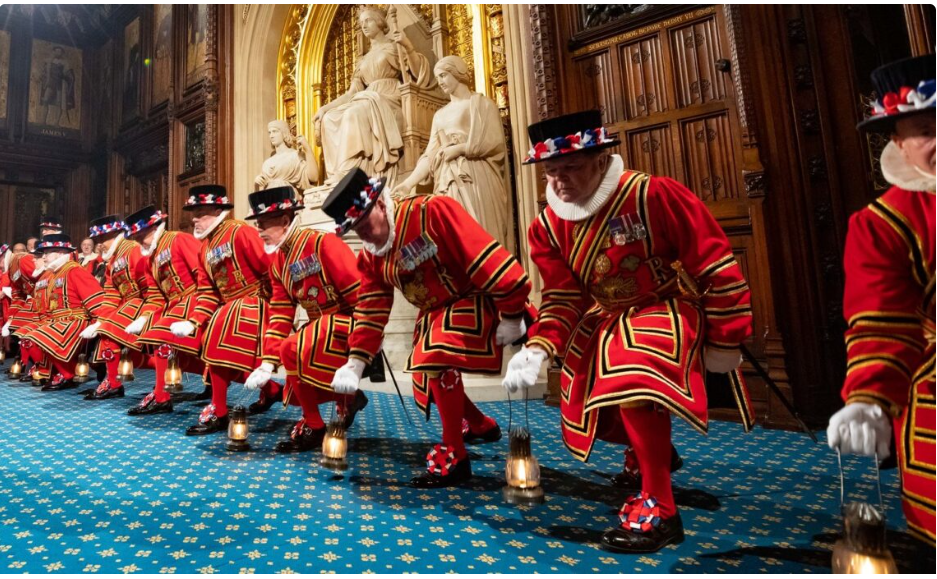
A relevant photo, which is a rare item around here. These are Yeomen of the Guard, in uniform, searching the nonexistent cellars, using lanterns and looking entirely serious about the whole thing.

During the address, a Member of the Commons (yes, they capitalize that) is ceremonially held hostage in Buckingham Palace until the monarch is safely returned from the hostile territory that is the Commons. That dates back to 1649 and Charles I, who was eventually beheaded and did, arguably, have a good reason to think the neighborhood was dangerous.   

So yes, tradition’s a powerful force. We’ll get to its role in politics in a minute. First let’s look at the breakfast table. 


Tea

If I’ve learned anything from living in Britain, it’s this: Don’t mess with the tea. It sits at the heart of British culture and outsiders shouldn’t meddle. I’m not sure about insiders, but they’d probably be wise not to mess around either.

Did it take me 17 years (and counting) to learn that? No, but however long it took I’ll pass it on to you for free so you’ll be spared the fate of American chemistry professor Michelle Francl, whose book Steep: The Chemistry of Tea has been greeted with caffeinated giggles on this side of the Atlantic.

What did she do? She told us to add a pinch of salt to our tea. If you’re American and don’t understand how that went over, imagine a British writer telling you to add–oh, I don’t know, let’s say ketchup to your coffee. If you’re not British and not American, I don’t want to go too far out on a limb but you could, just maybe, imagine me recommending that you take your national beverage and filter it through a pair of old socks.

What’s Francl’s salt supposed to do? Take the bitterness out of the tea. 

Am I brave enough to try it? Hell no. I did think about it and lost my nerve. So far I’ve only found one food writer who tried, and she admits that it “brings out savoury notes” in the tea, which she’s “not averse to,” although that’s not what you’d call an enthusiastic endorsement.

The others? They’re all either too outraged or laughing too hard to experiment.

Francl also recommends heating the milk before you add it on the grounds that it reduces the risk of it curdling.

Has cold milk ever curdled when I’ve added it to my tea? Only when it was older than me, in which case it was kindly warning me to pour out the tea and start over. 

To be fair, Francl also recommends some sensible things, like boiling the water, a trick your average American has trouble with. I don’t know what it is about Americans, but (generalization alert here) we’re convinced that if you allow lukewarm water in the same room as a stove, it’s hot enough to make brew tea. 

It’s not. You could get as much good out of your teabag by taking it into the bathtub with you.

So boiling the water is good advice, but it’s not enough to redeem her. Tea is British culture. It’s tradition. It’s what you turn to in a crisis. It’s what you offer someone who crosses your threshold (assuming you want them there). It’s–you know, it’s Britain. So that thing with the salt? It’ll see Francl banned from Britain forever.


Breakfast

Asking what’s for breakfast just became unexpectedly controversial. The English breakfast is under threat from no less traditional an organization than the English Breakfast Society.

Is there such a group? Yes indeedy deed, kids, it’s real. I’d have made it up if I could, but I don’t need to and it would never have crossed my mind anyway.

The society hit the headlines with an announcement that people should get rid of the mushrooms or tomatoes that are a longstanding part of the English breakfast (along with a fried egg, baked beans, bacon, sausage, toast, and of course unsalted tea) and add a slice of pineapple instead. 

The society’s founder and chair–

Hang on. Founder and chair? What is it, a closed shop? I’ll admit to wondering if the society has any actual members, but its website lists 31 fellows, so apparently it does. It also assures me that it’s a “learned society.” I feel smarter already.

Anyway, its founder and chair, Guise Bule de Missenden, said nobody ever liked the tomatoes anyway, “So why shouldn’t we swap them?” 

And he knows this how? Because he taps into the psyche of the entire nation when it sleeps, that’s how. He knows what people eat  not because they like it but because they feel they have to. He knows what they shove to the side of their plates. He’s the founder and chair of et cetera, after all.

And this being Britain, he bases his suggestion on history and tradition. Pineapples were a luxury item in the late 16th and early 17th centuries, he tells us (as if we didn’t all know that already). The elite ate them at breakfast, he says, and he doesn’t say but I’ve learned elsewhere that they served them at their fancy dinners. Then pineapples came down in price and, come on, what was the point of eating them if they didn’t demonstrate how rich and important you are? I mean, even if they do taste good. So they fell out of favor. 

Why add them to the English breakfast now? Because they’re traditional, at least if you bend your history around corners at just the right times. And maybe the society felt it was in need of a headline. Or got a kickback from the Pineapple Promotion Society. 

I don’t predict a long life for this new tradition, but then if you’d asked me whether baked beans would catch on as part of a traditional English breakfast I’d have laughed myself into insensibility. So don’t bet heavily against this based on my say-so.


How do we decide what becomes a tradition?

Good question, even if I did ask it myself. The tomatoes became part of an English breakfast sometime around World War I, so they’re not in the same category as thatched roofs or monarchy. Mushrooms and hash browns came along even later, but the English breakfast itself only dates back to the Victorian era, when it was the breakfast of the wealthy. Still, it’s been adopted enthusiastically, and maybe that’s the dividing line between tradition and non-tradition: enthusiasm trumps longevity.

Or maybe not. Let’s slide carefully onto thicker ice. A YouGov poll (you see how important this is) asked people what the essential ingredients of the English breakfast were. For more than half the people polled, they were bacon (89%), sausage (82%), toast (73%), beans (71%), fried egg (65%), hash browns (60%), mushrooms (48%), and black pudding (a lonely 35%). A whopping 83% said they liked a full English breakfast and 15% said they didn’t; 2% said, “Don’t bother me, I’m eating.”


Political traditions

Tradition, of course, isn’t only about food, it’s also about politics. As far as I can figure out from reading the papers in recent years, it’s perfectly acceptable to destroy the country’s infrastructure, safety net, and human rights record as long as you color within the lines that tradition dictates.

To wit: having very nearly drained his party’s talent puddle, Prime Minister Rishi Sunak was driven to resurrect former Prime Minister David Cameron and give him the office of foreign minister, and that’s brought us all nose to nose with an obscure political tradition, and a slightly less obscure problem, which is that recent convention says ministers should be either MPs–Members of Parliament–or members of the House of Lords, and Cameron was neither.

Why is that a convention instead of a tradition? Beats me.You need a law degree and a dowsing rod to find the line between the two. What matters is that Sunak solved the problem by be-lording Cameron: making him a lifetime peer, entitled to sit in the House of Lords, wear a fancy robe on dress-up days, and collect £332 on any day he shows up for work and/or passes Go. Plus expenses and subsidized food and drink.

I can tell you–reliably, since I have a link right her on my computer screen, and now on yours –that this isn’t the first time a minister has been chosen from outside Parliament, so we’re still inside those all-important lines. Be-lording them is a recent way of handling the awkwardness, but it turns out not to solve all the problems, because if you’re not an MP, you can’t just walk into the House of Commons and address the country’s highest legislative body and its only elected one.

Why not? 

Because it’s not done.

Wait, though. MPs are expected to scrutinize what the foreign secretary’s up to. How are they supposed to do that if he’s not allowed in? 

Before we get to that question, let’s ask what  they mean scrutinize. 

Well, kiddies, it’s political-speak for giving him grief (if you’re in the opposition party) or support (if you’re in his own). The Commons is a raucous place that traditionally (see how I snuck that word in again?) rewards braying and hear-hear-ing and verbal bullying as long as the MPs say the people they’re berating are honorable, as in, “The honorable member has surely mistaken a Dr. Who episode for a budget.”

Hear-hear? That’s what a minister’s supporters bray when they’re trying to drown out the opposition’s heckling. Yes, this is politics in the hands of adults.

Now tuck all that in your back pocket and let’s review the pieces of the puzzle: We need the minister in the room so MPs can bray and heckle and hear-hear and occasionally ask useful questions, but only MPs are allowed into the House of Commons. Because it’s a tradition. 

You may be wondering why only MPs are allowed in. Think of it this way: let’s say the room where the MPs meet is a chicken coop and let’s say the Lords are geese. You can see where this isn’t going to work. Different feet. Different ways of sleeping. Different requirements of all sorts. Even the subsidized champagne they drink is different.

Sorry, I slipped right out of my metaphor there.

A further convention (or possibly tradition) holds that ministers stand at the dispatch box to speak to the Commons and be scrutinized and generally made miserable. But allowing the newly be-lorded Cameron (or any other Lord) to walk that far into the Commons would “risk blurring the boundaries between the two houses,” according to a cross-party procedure committee.  

Disaster looms. What are they to do? 

The committee proposed having him stand behind an actual, as opposed to metaphorical, white line on the Commons floor. It’s called the bar and visitors aren’t allowed to cross it when Commons is sitting. Because that would violate the Natural Order of Things. So he can address the Commons from there.

Last I heard, the government hadn’t responded to the committee’s recommendation. They might be happier if the foreign secretary wasn’t available to answer questions just now.

Strange English Customs: The Ashbourne Royal Shrovetide Football Game

Something in England’s soil nurtures bizarre traditions, from the soberly political (think Black Rod) to the brutally folkloric. The Ashbourne Royal Shrovetide football game belongs to the second category, and it puts the emphasis on brutal

What could possibly be more fun?

Basically, we’re talking about a mass football game that runs for two days. That’s eight hours each day. One article claims it has only two rules, you can’t move the ball in a motorized vehicle and you can’t murder anyone, but don’t take that too seriously. It has other rules, but not murdering anyone is important. It’s that kind of game. Although I’m not sure that’s a rule. One of the assorted articles I read says “unnecessary violence” is frowned on but it’s not banned. It doesn’t mention murder.

Irrelevant photo: a romantic-looking shed door.


Sounds like fun. How do I play?

It helps if you’re from Ashebourne, because the town divides into teams according to which side of the river you’re born on. Outsiders can throw themselves in on whichever side they want, but they’d be wise to be (a) large and (b) young enough to heal well. And probably male. I haven’t seen any women in the photos, and wild-eyed feminist that I am, I’m not about to campaign my way into this. Look at it this way: If a group of men decide to do something insanely stupid, being a feminist doesn’t mean I’ll join them in the name of equality. If someone else wants to, I’ll cheer her on, but I’ll do it from the sidelines. 

Here’s how the game works: Someone lets a ball loose in the middle of town and everyone tries to get hold of it, so it immediately turns into a shoving match involving hundreds of people. Odds are that for at least part of the time most of the players won’t have a clue where the ball is, so they’ll shove whoever’s closest and trust it contributes to the greater good. Or that it doesn’t, but at a certain point instinct takes over and who cares? Players get lifted off their feet. They get squeezed until they see stars–which actually does happen when your body doesn’t get enough oxygen. They get broken ribs, broken other things, bruises, black eyes, and injuries to any part of the human body that’s injurable.

The object is to get the ball to the opposite team’s goal–it’s a millstone–and the goals are three miles apart, so the rule about not using motorized transportation begins to make sense. Once you get it there, you hit the ball three times against the stone to score a point. 

It sounds like you need to jump in the river to do that. (See? There are rules.)

Then your teammates carry you back to the town center on their shoulders and if you made your goal before 6 pm, the whole thing starts over with a new ball and the game runs until 10. If it’s after 6, then play’s over for the day and everyone heads for the pub, where people buy you drinks. 

People will be buying you drinks for weeks to come, and you get to keep the ball, which is handmade and hand painted.

On the second day, everyone who isn’t too hung over does it all again.


And if I don’t want to play?

You’d be wise to stay well out of the way, because onlookers can get swept into the mayhem, as one reporter was, losing his notebook but gaining some experience in the process. At some point, someone grabbed him by the hood and yanked him out. 

The mob is called the hug and it isn’t entirely in anyone’s control, but it’s powerful. When I read about it knocking over walls, I thought I was reading a bit of poetic exaggeration. Then I saw a photo of a brick wall that had been pushed over. The reporter who lost his notebook wrote about the hug barreling through a barbed wire fence. Shops (wisely) board up their windows. 

And pubs? They sell a lot of beer. 


The history

No one knows how the tradition started, but that doesn’t stop people from making it up. According to one theory, it started with an execution. The severed head was thrown into the crowd (of course) and the fun began. You can choose to believe that if you like. No one can prove you wrong.

Or right, but that doesn’t bother people as much as it used to.

The game can be documented as far back as the seventeenth century but probably started long before. A fire wiped out the town records, so that’s as far back as we go. The medieval period’s not an irrational guess. 

A couple of other English towns have similar games at Shrovetide, but most places settle for running around flipping pancakes and seeing who crosses the finish line first.


What’s Shrovetide?

The days before Lent. And Lent is the days before Easter, the soberest holiday in the Christian calendar. You needed a Jewish atheist to explain that to you, right? As far as I can figure it out, the medieval approach to Lent was for people to give up everything they enjoyed–meat, dairy products, eggs. Sex. They’d eat one meal a day. 

People were supposed to go to confession at Shrovetide and do all that sober stuff in preparation for Lent. But flipping pancakes and shoving your neighbors through a barbed wire fence and into the river? That also makes sense as a preparation for a somber season. 


Mayhem and community spirit

Local people will swear that the point of the game is community spirit. “It’s the lifeblood of the town,” an Ashebournian told the reporter who lost his notebook to the hug. “The media focuses on the fighting, but that’s all forgotten the moment the game ends. The real legacy is how it brings people together.”

Backing that up, a different reporter got a quote from a local businesswoman: “It looks like Armageddon. It’s knee-deep in litter, there’s stuff everywhere piled up in the doorways, in the road.” But after the second day, “all the players will be out mending fences, they’ll help you take your boards down, they’ll be picking up litter, because they want it to continue the next year.” 

Strange British Festivals: The World Custard Pie Championship

To prove that the pandemic is nothing to mess around with, the 2020 World Custard Pie Championship–like so many other non-essential events–was canceled.

But was the contest truly non-essential or was that just the decision of some self-serving, soulless sort with a scrub brush for a brain? Did they consider its obvious cultural, political, and academic importance? 

Ah, well, let’s not be too hard on self-serving, soulless scrub brushes. It’s been a rough year for everyone.

And it doesn’t matter anymore, because barring a major step backward in the U.K.–that’s pandemically speaking, of course–the competition will take place in 2021, so let’s learn what we can about the details, quick before it’s too late to enter. 

Irrelevant photo: A camellia, I think. In fact, I’m reasonably sure. Of course it’s a camellia. What else would it be? A snowmobile?

The World Custard Pie Championships fits nicely into the category of strange traditional festivals that England (or maybe that’s Britain) is so good at, even though this particular tradition is no older than fifty or so years. That makes it modern, at least by British history standards, but it’s a good enough imitation to fool my filing system. 

And if someone would help me sort out whether these festivals are a particularly British thing or a particularly English one, I’d be grateful. I’m sure it would help me understand the country better. Are people this strange in Scotland, Wales, and Northern Ireland?


Origins, rules, & important stuff

The origins of most truly traditional traditions have been lost by now, but since this one’s a newcomer–a nontraditional tradition–we can document it: Coxheath, Kent, needed to raise money for a village hall and came up with the idea of inventing a tradition. Or at least that’s my interpretation. I’m reasonably sure no one put it that way when they were sitting around the pub figuring out what to do.

The pub’s also my interpretation. I’m convinced that these traditions all started in the pub. Even before pubs were invented.

How does the championship raise money? It costs £60 for a team to compete and £40 to set up a stall. Unless you’re selling food and drink, in which case that’ll be £80, thanks. If a town can keep its festival going for a few years and get itself some publicity, it’ll raise enough to buy a bucket of paint or three. 

By now the custard festival’s had enough publicity for teams to fly in from around the world. Or so the website says. They manage not to say how many teams have flown in. Two’s enough to justify a plural.

The rules are simple. Each team’s made up of four people and they line up and throw pies at someone–I assume it’s another team. Using their left hands. I’ll go out on a twig and guess that if you’re left handed you throw with your right. If you’re ambidextrous, you’re disqualified. If you’re amphibious, you can throw from under water, but it won’t be an advantage–at least not in terms of scoring. You’ll be a hit with the crowd, though.

Scoring? Your points depend on where your pie hits your opponent–six points for a pie in the face, three if it hits from the shoulder up, and one for any other body part. 

If you miss three times, you lose a point. 

The judges’ decisions are final. 

Throwing pies at the judges when you don’t like their decision is frowned upon, but they don’t say that for fear of putting the idea in some suggestible person’s empty little head. And yes, having to throw with your nondominant arm is a perfect excuse for not being good at it.

Unlike dwile flonking, you don’t have to be drunk to do this, but this being England (or should I say, “This being Britain”?), you’re more than welcome to show up dressed in something silly. Or as they put it in British, in fancy dress. Don’t wear anything you’re attached to, though, because by the end of the day everyone’s wearing custard.

And now the bad news: They don’t use real custard–it’s not the right consistency–and the formula for whatever they do use is a closely guarded secret. Presumably, neighboring towns are just dying to poach the festival and that’s all that stops them. The only ingredients they’ll admit to are flour and water. The Calendar Customs website recommends not eating whatever it is.

The contest’s usually held in May or June, but this year, with the number of vaccinated people going up and the number of Covid cases (“so far,” she said nervously) staying low, it’s been rescheduled for September 21. 

They’re expecting 2,000 pies to be thrown. The day begins around noon with a wet sponge competition for kids, who as any fool knows can’t be trusted with pies.

*

Some time ago Autolycus suggested that I might want to write about another great British tradition, rhubarb thrashing, and I did try, but I couldn’t find enough information to go on. Besides, it’s a perfectly sensible game where two people stand inside trash cans and whack at each other with rhubarb  sticks, and where’s the laugh in that?

Why more isn’t written about it remains a mystery. It’s one of those rare subjects where Lord Google offered me no more than a single page of links, most of which were to a kids’ program, the BBC’s mysteriously named Blue Peter, which decided many and many a year ago that this was what the kiddies needed to know.

Those kiddies have now grown into adults. If you want to know what’s wrong with the world, look no further.

I am, as always, grateful for people’s topic suggestions, even when I don’t end up writing about them. Some–like rhubarb thrashing–just don’t lead anywhere, but you never know. Some are glorious.

Dwile flonking: another strange English tradition

If you ask the BBC about dwile flonking (and who doesn’t at some point?), you’ll find them asking a question of their own: 

Does dwile flonking really date back to the Suffolk harvests of 400 years ago or is it just a good excuse for getting drunk and celebrating Christmas in August?

They don’t answer the question and neither can I, but in my relentlessly shallow exploration of the topic I did find some faint linguistic evidence either that the game has a long history or that whoever invented it did their homework. Dwile comes from the Dutch word dweil, meaning floor cloth. Or it seems to, anyway. The word was probably introduced to England by Flemish weavers during the Middle Ages. Or, as Wikiwhatsia says (at the moment–it could change at any time), dwile is Dutch for a mop and the word worked its way into the Norfolk dialect. 

Irrelevant photo: The fields after a frost.

I try to avoid using Wikiwhatsia as a reference, but for dwile flonking? Why not? It’s right in the spirit of the game. It also says that flonk is “probably a corruption of flong, an old past tense of fling.”

Who knows. It might even be true. And when no one’s looking, sheep could just possibly type. If they had typewriters. 

The BBC agrees that flonk could be an archaic past tense of fling. If you squint hard. Meanwhile, Etymology Online gives us as a Middle English past tense flang with the past participle flungen. Which is no help at all but likely to be more reliable than anything else in the past few paragraphs. 

What is reliable is that Flonk is also a brand of ale, but that’s got to be recent than the rest of that mess. 

If you feel the need to watch dwiles being flonked (and if the pandemic ever ends), period costume is encouraged. I expect that’s in the spirit of imitation authenticity, although I’m not sure there’s any agreement on what period we’re talking about, so either pull one out of a hat (then wear the hat) or check out one of the videos on YouTube and do whatever you think best. After a few beers, no one will care and neither will you. 

Preliminaries

To play (did I say that dwile flonking’s a  sport?), you need two teams. Then you toss a sugar beet (which the BBC misspelled, she said without in the least betraying how smug she felt about catching that) to decide which team flonks first.

Then you choose a dull-witted person to serve as referee. That’s the jobanowl. He or she starts the game by shouting, “Here y’go t’gither!”

But wait. Before the match can start (and quite possibly before the jobanowl calls out his or her line), the teams have to sing “Here we ‘em be together.” It was written by Amos Thirkle, who was adopted as the patron saint of dwile flonking.

And why shouldn’t he be? Without even progressing past the letter A, I found patron saints of abdominal pains (Erasmus), for protection against mice (three, in fact: Gertrude, Servatus, and Ulric, and they were listed as “Against mice, protection against,” which is a double negative, but saints may be above grammatical quibbling) and of pain in the arms (Amalburga). 

You can make me the patron saint of pain in the ass if you like. Informally. Thirkle isn’t listed with the Church-approved saints either. 

I also found Amand, the patron said of bartenders, bar keepers, and bar staff in general. He’ll be busy during the match, and after. 

Rules

Here’s where it gets complicated and where I damn near decided to write about toadstools, or anything else that might turn out be less peculiar. But you can’t grasp the basic insanity of the game without slogging through the rules, so let us slog:

The team that isn’t flonking holds hands and dances in a circle (that’s called girting) while one person from the other team (that’s the flonker) stands in the middle with a driveller–a 2- to 3-foot pole made of hazel or yew. On the end of the driveller is the beer-soaked dwile. 

Remember the dwile? The floor rag/mop?

The flonker turns in the opposite direction from the girders and flonks the dwile at the opposing team, trying to hit someone. If the dwile hits a girter’s head, that’s three points. If it hits the body, it’s two points. A leg shot’s worth one.

If it misses, it’s called a swadger and the flonker takes a pot of ale and  has to drink it all while the girters form a line and pass the dwile from hand to hand, chanting, “pot, pot, pot.”

The pot? It’s what’s known as a gazunder–a chamber pot, called that because it goes under (goezunder–blame English spelling if you can’t make sense of the joke there) the bed. 

Well, what do you drink your ale out of?

When everyone’s had a chance to flonk, the game’s over and the points get counted up.

Teams lose a point for every person who’s sober at the end of the game. 

Dwile flonking is not recommended for people who go to AA meetings.

Want photos? Of course you do. These are from Beccles

And from Coventry, where the opposing team didn’t show up,

And more generally, from the BBC Suffolk, which describes the game as an adult version of All Fall Down.

And of course, you’ll want a video. YouTube is happy to oblige.

So now that you have this information, what do you do with it?

Well, once we get past the pandemic (nothing to it) you could always organize a dwile flonking competition where you live. Failing that, you could go down to the bar or pub and throw a beer-soaked rag at someone, then tell them they just participated in the ancient ritual of dwile flonking. 

One of two things will happen:

  1. They’ll stop in their tracks, wondering why they seem to have a beer-soaked rag on their heads when just a moment before they didn’t have a beer-soaked rag on their heads. (You’re not dancing around, so let’s assume you get a three-point hit. And you’ll have thrown the rag in the normal way, which will improve your aim. No magic two- to three-foot magic dwile flonking wands in the bar. ) If you’re in England when you do this, the other person will think, Dwile flonking. Of course. Because even if they’ve never heard of it–which is likely–England understands mysterious celebrations. Cheese rolling. Flaming tar barrels. Why not dwile flonking? Or,
  2. They’ll hit you so hard you’ll fall off your bar stool. 

Life’s a gamble. 

*

Endless thanks to Autolycus for suggesting that I write about this. I do worry about him. He also mentioned something about rhubarb thrashing. I’m saving that. It’s good to have something–however bizarre–to look forward to in these dark times.

Strange British Customs: The Whittlesea Straw Bear Festival

Can any country without a straw bear festival claim to have a culture? 

Well, possibly. I hesitate to throw whole cultures into history’s extensive trash can. Especially since, no matter how much I try, they never do stay thrown. 

But either way, let’s talk about the Whittlesea Straw Bear Festival. Because it exists. Because it takes place (when the country isn’t in lockdown) in January and this is June, and that makes it an obvious topic right now. And because I thought a quick break from the serious stuff might do us all good.

The festival started before Whittlesea’s collective memory kicked in, so no one knows how far back it goes. Britain’s full of events like that. This one involves what an 1882 newspaper called the confraternity of the plough. That sounds like an organized group but the writer was probably just trying for a cute and condescending way of talking about farm workers.

Irrelevant photo: No flower this time, just sunlight and leaves.

What does seem to be known–and remember to take everything with a teaspoon or two of salt because of that problem with collective memory–is that each year they’d pick a man or boy to be the bear. Then on Plough Monday (British spelling because what the hell it’s their holiday) they’d drag a plow (American spelling because I can only be well behaved for just so long) through town and lead the bear around, with lots of singing and dancing. 

And drinking.

We’ll get around to the Plough Monday part later. 

The newspaper article describes the straw bear dancing in front of  “the good folk who had on the previous day subscribed to the rustics, a spread of beer, tobacco and beef.” So basically, the well-to-do got entertainment and the badly-off got roaring drunk and went away with their bellies (and lungs) filled, and a good time was had by most.

Until the next morning. But there’s me spoiling the fun again.

As a counterbalance to that above-it-all description, let’s quote a book by Sybil Marshall about life in the fens in the 1890s. This isn’t specifically about the straw bear, but it’s close enough to be useful.

“Living where we did and how we did, we used to make the most of anything a bit out o’ the ordinary, and we looked for’ard from one special day to the next. Looking back on it now, I’m surprised to see how many high days and holidays there were during the year that we kept, and we certainly made the most of any that children could take part in at all. . . . The Molly Dancers ‘ould come round the fen from Ramsey and Walton all dressed up. One would have a fiddle and another a dulcimer or perhaps a concertina and play while the rest danced. This were really special for Christmas Eve, but o’ course the dancers cou’n’t be everywhere at once on one day, so they used to go about on any other special day to make up for it. They’d go from pub to pub, and when they’d finished there, they’d go to any houses or cottages where they stood a chance o’ getting anything. If we ha’n’t got any money to give ’em, at least they never went away without getting a hot drink.”

Whittlesea’s straw bear tradition lapsed in the early twentieth century, when a police inspector (speaking of spoiling the fun) decided the whole festival was a form of begging. Then it was revived in 1980, by (I’m taking a wild guess at this) either a group of guys who’d had too many beers or a group of promoters who decided it would bring the tourists in. 

Or a group of promoters who’d had too many beers. Why have two groups when one will do?

These days the festival involves a procession with the bear and a team pulling a plow (or a plough, which with all those extra vowels has got to be heavier) through the streets, and of course music, dancing, and (I’m guessing, since I haven’t been to the festival) a lot of drinking. The festival website’s FAQs includes the question, “Can I drink on the streets?” 

Answer: No. The cops are watching. Drink in the pub. Drink outside the pub but use a plastic glass. Play more or less nice.

The bear’s led around the town to dance in front of pubs, which is no mean trick because the costume weighs 5 stone.

A stone? It’s one of those insane, traditional British measures and it equals 14 pounds. Because who doesn’t like to multiply by 14? So 5 stone is–

Will you give me a minute here? I’m working on it.

It’s 70 pounds. Or 31.7515 kilos, give or take a gram. In other words, heavy enough that we should all be impressed by someone wearing it for long, never mind dancing in it. 

At the end of the festival, the bear costume is burned.

And of course, the festival includes morris dancers. Love ‘em or hate ‘me, you can’t hold a traditional festival in England without morris dancers. 

It also involves molly dancers, and I thought we’d get to take a break from anything serious, but I never do know where a topic will lead me, so buckle up, kids, ‘cause it’s about to get serious.

According to the Morris Ring website, molly dancing traditionally involved white men blacking their faces and dressing in women’s clothes. The blackface may have been to disguise themselves or it may be good old-fashioned racism. It could easily have been one twisted around the other. At this point, I doubt anyone can unpick the threads. 

The winds are blowing hard against blackface these days, and some molly dancing groups have dropped it. Others defend it on the grounds–and this is an argument I’ve never heard outside of Britain–that it isn’t (or wasn’t) meant to be racist, and so it isn’t racist. I’ve argued that through with more than one person and have yet to change a single mind.

The website of a molly dancing group called Pig Dyke explains its decision to drop blackface: They don’t want to be linked to the minstrel show tradition, where whites blacked their faces and played out a grotesque image of black people. It says, “Molly dancers in the past blacked their faces for disguise, weirdness, and loss of personal identity: we achieve that” without blackface. 

I looked through the Whittlesea website photos hoping to find that all the groups had dropped blackface. They hadn’t. If I was around to ask the dancers why they still do it, I’m sure they’d tell me it’s not racist because it was never meant to be racist. And because they’re not racists. And I’d try to convince them that their intent (or the originators’ intent–take your pick) isn’t the center around which the universe pivots–that our intent doesn’t control our impact. 

I’d leave wondering why I bothered. 

I won’t take a guess at what they’d be thinking. I don’t expect it’d be flattering. So let’s leave them to be unflattering and talk about the dressing in women’s clothes part. 

Pig Dyke connects the word molly to London’s molly houses, which were eighteenth-century gay and transvestite brothels. Whether they’re right to make that connection is anyone’s guess. There’s a strong British tradition of straight, non-transvestite men cross-dressing, and it’s widespread enough to make me think it was independent of the molly houses, although they may share a common root. But that’s guesswork. Let’s just chalk it up to another one of those collective memory blank spots.

I promised we’d get back to Plough Monday. The Molly Dancing website says it fell on ”the first Monday after Epiphany (or twelfth night) and was the first day after Christmas that farm-workers were meant to return to work, so they didn’t! Instead they decorated a plough and pushed it round the village, calling at the houses of the well-off villagers to beg for money. If the householders weren’t forthcoming with donations then they threatened to plough up the garden, or if there wasn’t a garden, the doorstep.”

That accounts for why the Morris Ring website says molly dancers ”could be destructive, drunk and disreputable.” 

These days, no one plows up gardens or doorsteps, drinking on the streets is only allowed outside the pubs, and storytelling groups gather the kids around so that they can take home something wholesome–something full of mental fiber and emotional green vegetables.

English Traditions: May Day

Any May Day celebrations that were planned this year have been canceled, so what better time could we find to look into the tradition itself, and to the festivals we can’t go to?

May Day starts, depending on who you want to believe, with either 1) the Romans celebrating Flora, the god of flowers and spring (or goddess, if you like male and female endings for your gods), or 2) the Celts, celebrating Beltane, a fire festival of–

Let’s start a new paragraph here, because this is too complicated to dangle off the end of an already convoluted sentence. In fact, it’s going to take more than one paragraph, so let’s start an extra new one. What the hell, they’re free and I don’t have to go out of the house to get them. 

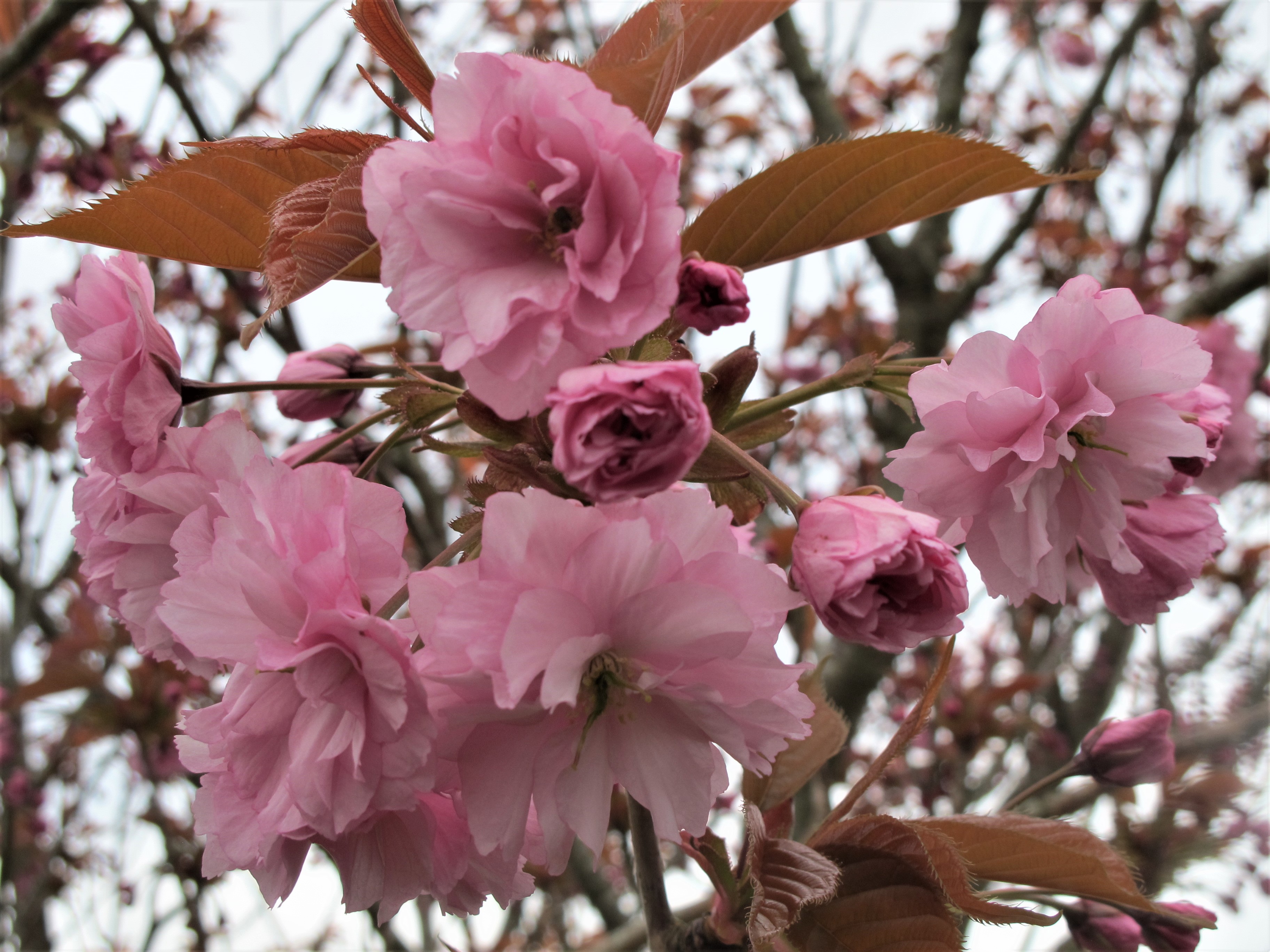
Relevant photo: Any flower can pass as relevant to a post about May Day. These are, I’m reasonably sure, an ornamental cherry.

The Celts had a god named Belenus. That ending sounds suspiciously Latin, so what we know was probably filtered through the Romans, who had a habit that the Celts didn’t at that point: They wrote things down, and so we turn to them for information on people they understood at best imperfectly. The people who really knew about Belenus? They didn’t leave us a record.

Belenus, if you believe a random sampling of enthusiastic but non-authoritative online sources, was a sun god. If you believe the Brittanica, he wasn’t. He was “widely associated with pastoralism” and Beltane was celebrated on May 1 with fires where cattle were purified before being put out in the pastures for the summer. 

The holiday was also associated with fertility, as anything in the spring would be. If stuff doesn’t start growing right about now, you’re not going to make it through the winter.

I’m going to put my money on the Brittanica, which goes on to say that there’s no evidence the Celts worshiped the sun, although they used sun images a lot. Images aren’t proof of worship. Give me a piece of paper and a good chunk of boredom and I draw images of snails. I don’t worship them. The damn things eat my lettuce. They’re just something I’m able to draw.

So, we’ve got two origins, and it’s entirely probable that the two met sometime after the Romans invaded Celtic Britain and that they got along fairly well. The Romans had no objection to new gods as long as the locals agreed to nod politely to the Roman ones when they passed on the street. 

When the Anglo-Saxons came, they introduced the maypole to whatever celebrations the Celts and the Romans had negotiated.

Then, bit by bit, what’s now England was converted to Christianity, which did not nod politely to other gods when they passed on the street. It’s an exclusive religion. It allows for one god and considers all others either devils or superstitions. But when you’re trying to make converts, sometimes practicality wins out over theory, and it quietly absorbed a lot of the old ways. By way of an example, churches were often built on the sites of holy wells, keeping the sense that the spot was holy but changing the form and the content. And many of the old religious festivals continued, shedding bits of their history, power, and context as time went on, until outsiders could look at them and see them as nothing more than the superstitions of the ignorant. 

So after enough time passed, no one remembered how some of the festivals started or what they used to mean. They became just something we do on a particular date because we always have, and anyway, they’re fun. You know: quaint folk traditions. Does anyone know when and why they started chasing wheels of cheese down a heart-stoppingly steep hill in Gloucester? I doubt it was ever religious, but who’s to say? 

So May Day continued, but without the religious elements. 

By the time we get to Henry VIII (or possibly earlier, in the full-on medieval period), we’re talking not just about May Day but about May games, which spilled over into the rest of the month and somehow or other picked up a link to Robin Hood. And to morris dancing. 

You can’t do anything for long in England without morris dancing coming into it. It’s one of those mysteries that no one understands except morris dancers, and they keep trying to explain it, but the rest of us never do understand.

Then the Puritans came to power under Oliver Cromwell, and they were always ready to spoil the fun. Any fun. They shut May Day down and banned maypoles, since they were “a heathenish vanity generally abused to superstition and wickedness.” 

Don’t try to make too much sense of that “abused to superstition” thing. They talked like that then. Or at least they wrote as if they did. It may have been a plot to keep people so busy trying to make sense of the words that they didn’t have time for fun.

Then the monarchy was re-established and Charles II had a giant May pole set up in London. Let’s assume he wanted to prove that his was bigger than Cromwell’s. It stayed in place for 50 years.

Do I really want to make jokes about that? I still haven’t decided.

May Day made a big comeback in the Victorian era, but the Victorians didn’t want to hear about that fertility stuff, so they put kids on the end of ribbons and taught them to dance around the Maypole and look innocent. 

The Victorians reinvented a lot of traditions, with questionable accuracy. The early Maypoles may have involved flowers or kerchiefs and banners, but they also involved  drinking, less aggressively innocent dancing, and general carrying on. 

In recent decades, assorted groups of people have gone back to the early religious practices and reinvented them. If we’re desperate for something to squabble over, we can argue over how accurate they are and what it all means. The comment box is always open.

We can’t leave without acknowledging the political May Day, an entirely different holiday that falls on the same day and just to confuse things has the same name. It began in 1890, during the fight to limit the working day to eight hours, when marches and demonstrations often turned out tens–and sometimes hundreds–of thousands of people. After the Russian Revolution, it became heavily associated with the Soviet Union, although periodically it gets reclaimed by other left-wing groups. 

That’s it for the history. What events aren’t happening in Britain this year? 

Obby Oss Day in Padstow, Cornwall. This involves music, dancing, crowds, flowers, ritualized battle between the red Oss and the blue Oss, and if you know where to look (and sometimes even if you don’t) a stunning amount of alcohol. 

Sometimes that’s spelled ‘Obby ‘Oss. Your choice. There’s not a maypole in sight.

Beltane in Edinburgh.  I’m cheating on this one since it happens on the evening of April 30 and it’s in Scotland, which would be happy to remind me that it’s not England. It involves fire, drumming, and body paint. It is, I think, one of those modern recreations.  

The Jack-in-the-Green festival in Hastings. This involves costumes, a procession, poetry, music, the release of the Jack and then the slaying of the Jack to release the spirit of summer. 

And morris dancing.

The Rochester Sweeps festival in Kent. It runs for three days and doubles as a folklore festival. It involves a Jack in the Green, music, dancing, and morris dancing, which gets its own mention (that wasn’t my decision, she said defensively), separate from dancing-dancing.

The Jack in the Green part of it dates back to the sixteenth or seventeenth century, according to a local website.

Originally it was a May Day celebration where people would make garlands with flowers and greenery. The garlands became increasingly elaborate as work’s guilds would compete against each other, eventually so extravagantly that they covered the body entirely. The garlands were originally carried by milkmaids during May Day Parades – They became larger and more intricate to the point where they would balance them on their heads whilst the rest of their bodies would be adorned with silver houseware.

“The Chimney Sweep’s guild, not to be outdone by this and also to earn more coins from the watching crowds, upped their game to the point of covering their whole bodies in a framework covered in foliage and flowers. This became known as The Jack in the Green, a familiar participant in May Day Parades. The garlands are made out of a framework usually conical or pyramid in shape, covered in different types of fauna and flora.

“May Day was traditionally a holiday for the Chimney Sweeps and became known as ‘Chimney Sweeper’s day.’ . . . Jack in the Green became known as a practical joker associated with licentious and bawdy behaviour which soon became disapproved of in Victorian England.”

I can’t vouch for the accuracy of that history anymore than I can vouch for the skill of the person who edited it, but with a lot of folk traditions all you have to go on is the stories that get passed down from one generation to the next. I can confirm that the internet’s awash in connections between chimney sweeps and May Day.

That’s a sampling. Calendar Customs lists more.

Strange British Traditions: The Tichborne Dole

March 25 is Tichborne Dole day, although if you get too far from the village of Tichborne not many people will have heard of it.

The tradition started in the thirteenth century with what we can pretty safely assume was a miserable marriage between the unfortunate Mabella and the insufferable Roger Tichborne. 

Am I biased? Of course not. I’m just telling you how it was. But we should probably call the unhappy couple Lady Mabella and Sir Roger at least once, because that’s what other people would’ve called them. 

Good. Now that we’ve done that, we’ll go back to plain ol’ Mabella and Roger. But as long as we’re correcting my carelessness, let’s add that the tale may start in the twelfth century, not the thirteenth. From this distance, it doesn’t much matter, but it should remind us to take the story with something between a grain of salt and a cup of it. Good storytellers are seldom to be trusted with the truth, and this story was good enough that it stuck around. Let’s tell it as if we trusted every last detail:

Irrelevant photo stolen from an old post: California poppies. Californians or not, they grow well in Cornwall and once you get a few going they’ll self-seed. Generally in places where you didn’t want them but they don’t object to being moved.

Mabella was dying of a wasting disease, and she worried what would happen to the poor of Tichborne village without her charity, so she asked her husband to give them food every year. He pulled a piece of wood out of the fire and said he’d hand out the grain from as much land as she could crawl around before the chunk of wood stopped burning.

Why did she have to crawl? The disease had left her crippled. Although in another version of the tale, she walked. Like I said, storytellers.

Either way, she made the circuit of a twenty-three acre field, now known as the Crawls. But she knew her husband, so she laid on a curse on top of the request. If the dole was ever stopped–even after his death–first the family would have seven sons, then in the next generation it would have seven daughters and the Tichbourn name would die out. Plus the house would fall into ruins.

Take that, Roger. 

It’s worth noting that rogering is British slang for having penetratiive sex. No one claims this story as the origin of the word–it probably comes from the name’s link to spears and lances–but all the same we could say that Roger got rogered.

Anyway, Sir R. was intimidated into keeping his end of the bargain. He had bread handed out every Lady Day–March 25. And that went on until 1796, when local magistrates decided that vagabonds and vagrants were taking advantage of the situation. How? By not being local. This was a time when the deeply settled in place distrusted vagrants–people desperate enough to take to the road. Think of vagrants as the era’s equivalent of refugees: the folks no country wants to take in. No one knew them, no one trusted them, and if they’d had any decency they’d have stayed where they were born, even if it meant dying there.

So rather than waste good bread on them, the dole was ended. Because you know what its like when you give good food to the desperate: They’ll only go and eat it. And desperation’s such a disturbing sight.

Or that–without my editorial comments, of course–is the Historic UK version. The link’s above. In the Alresford Memories’ telling of the tale (that link’s also above), the dole had become rowdy, attracting the dissolute, the dishonest, the (horrors!) Gypsies.

How much distance lies between those two versions? It’s hard to say. A third version  involves vagabonds and paupers from neighboring villages instead of Tichborne. What stays the same in all versions is the distinction between the local poor who the great and good knew and felt (once every a year) good about feeding and the undeserving poor who they didn’t know and don’t like and were afraid they’d be overwhelmed by.

In fairness, the number of poor really could be overwhelming. From 1791 house accounts, it looks like 1,700 loaves of bread were handed out, and the tradition was that if it ran out people got two pence instead. One year, that came to £8–equal to £1,214 in 2020 by one estimate. By another, it was the price of one cow (probably with some left over), or 53 days’ wages for a skilled tradesman. Not, you’d think, an overwhelming amount for an aristocratic family, but the dole’s end followed two bad harvests. The family may have been–or felt, which isn’t necessarily the same thing–hard up. Travelers did record that the house looked like it wasn’t being kept up, and in 1803 part of it collapsed. 

It was rebuilt on a smaller scale. The definition of hard up is relative.

The bad harvests also meant more people and needing bread, so that just when the need was greatest, help stopped being available.

As usual, you can chase up alternative explanations of why the dole ended. It wasn’t that the family was hard it, it was because magistrates demanded that it end. (There’s no record of it, however.) It was because local landowners demanded etc. (There’s no record of that either, but there’s no reason why there would be.)  

Whatever the reason, the dole stopped and a generation of seven sons was followed by a generation of seven daughters, which is convenient enough to make this old cynic wonder if the story wasn’t edited after the fact. 

In the absence of a son (don’t be silly: of course a daughter couldn’t take on such a heavy responsibility), the estate went to a nephew, but he was from a branch of the family that had changed its last name to Doughty. They re-started dole in 1835, but it was restricted to residents of three parishes–Tichborne, Cheriton, and Lane End.

At some point they started handing out flour (a gallon to each person, and recipients had to bring something to carry it in) instead of bread. 

The house is now owned by a family name Loudon–yes, they’re related; the aristocracy keeps its possessions close–and they’re continuing the tradition, but since it is now, they say “a fairly affluent part of the country, we would do something more in keeping with the nature of Lady Mabella’s cause. We decided to ask for a voluntary donation from the villagers for charity, usually collecting about £100.”

I can’t find a date for that quote, but it’s from a 2016 post, so I’m guessing it’s recent. And Lord Google flags Tichborne’s county, Hampshire, as above average in education and income. That’s as close as I could come to data on Tichborne itself, but even so I doubt raising £100 is enough to keep Lady Mabella happy. Especially since the family buys the flour in bulk and says it’s not that expensive, and since the event now involves tourists, who could be persuaded out of a coin or three by a determined fundraiser.

The minute I figure out how, I’m letting Mabella know. 

British traditions: Lammas, sheep racing, and nightgown parades

Lammas is a quiet British church festival that was traditionally celebrated on the first of August, although these days it suffers from moments of inattention and wanders off to whatever Sunday’s closest to the original date. We’re too late for either the right date or the closest Sunday, but we’re not fussy here at Notes and we’re not celebrating anyway, just marveling at the intricacies (that’s a nice word for oddities) of British tradition.

Those of us who aren’t British, if we’ve heard of Lammas at all, never bothered to learn what it is. We saw it mentioned in some novel or other and our eyes hopped over the word, sending our brains a signal that we don’t need to know about this.

Our mine did anyway. I don’t really know about you lot. I only pretend to when I’m writing. For what it’s worth, though, Word Press’s spell check thinks I made the word up. Or that I’m spelling it lamas wrong. 

No one has mentioned Lammas to me in the thirteen years that  I’ve lived in Britain. That’s how quiet a festival it is.

Irrelevant photo: Poppies. They used to grow wild in fields of grain. Here they’ve had considerable encouragement.

But however quiet it may be, it happens in August and this is August. so let’s find out about Lammas. Because that’s what we do here at notes: learn about things we never thought we wanted to know. 

Lammas is an inheritance from the Anglo-Saxons. The word comes from the Early English (or Anglo-Saxon, if you like; same thing, different name) for loaf mass–a church celebration of the first grain that’s been harvested. Or as the British insist on calling the stuff, corn. What I and my fellow Amurricans call corn, they call maize. I’m still need a crib sheet to keep it all straight.

But what Lammas isn’t is at least as important as what it is: It’s a harvest festival, but it’s not the harvest festival: That comes at the end of September. It’s also not a lamb mass, although it sounds enough like one that in the nineteenth century some churches misunderstood their own traditions and, in an effort to go back to their roots, introduced one. In York, farmers who rented their land from the cathedral had to bring a lamb in to be blessed. 

That’s how it was back then. If the landlord said you had to haul a sweet little lamby, all baa-ing and terrified, out of its fields, away from its mama and its flock, and into the cathedral, you brought the poor beast. Your tenancy depended on it.

Yeah, those were the good old days. If the landlord had told you to dress it in a pink tutu, you’d have stayed up all night, trying to get a signal on your phone so you could find a tutu pattern that just might remotely fit a lamb. 

Whoever cleaned the floors after the blessing would have done some blessing of their own–a literal shitload of it. You can be sure that the idea for a lamb mass didn’t come from them.

Then in 1945, a minister started a campaign to revive the loaf mass, along with several other Anglo-Saxon festivals that had dropped out of use. He became the patron saint of all church cleaners.

But Lammas wasn’t just a religious date. British religious and secular life twined around each other for such long time that it’s sometimes hard to separate them. So Lammas was also a day for doing all sorts of secular stuff: paying rent, settling debts, changing jobs and houses. The rents make an intuitive kind of sense: If you harvest your grain and owe part of it to the landlord, everybody involved will want to set a date that falls after the harvest. And if you owe the landlord money, you’re most likely to have some after you’ve sold your grain. Everything else that fell on Lammas, I expect, trotted meekly behind that. 

What do people do on Lammas if they don’t have debts to settle and don’t have to bring a little lamby into the cathedral? Observation says most of them don’t do anything they wouldn’t do on some other day. The tradition’s obscure enough that the link I gave you back at the start of the post is to a newspaper article explaining it to the clueless people whose ancestors (genetic or cultural) once took the date seriously. When a tradition’s in working order, news outlets don’t feel the need to do that.

What people used to do was take a loaf of bread into church to be blessed. It’s nowhere near as messy–or as complicated–as taking a lamb in.

In some parts of the country, people then broke the loaf into four pieces and left one piece in each corner of the barn to protect the harvest. 

From here on, we may be slithering from traditional traditions to modern (or, if you like, made up) traditions: If you feel the need to mark the occasion next year, you can make a bundle of twigs (what could be more fun?) called a besom, or make a doll out of, um, something grainish. If you were in the Americas, you’d use corn husks, but for this you’ll want to use what the British call corn, which has narrower leaves and strikes me as harder to work with, so I can’t give you any guidance. 

You can also bake bread dough into a kind of plaque that that looks like a bundle of grain, an owl, or the–hang on a minute: the corn god? When did Christianity acquire a corn god?

I don’t make this stuff up. The article I linked to mentions one, and if the corn god’s wandered in, it means one of two things: 1, Lammas derives from a much older, pre-Christian celebration, or 2, the modern-day pagans have been busy reclaiming a heritage that, since it was pretty thoroughly erased, they make up as they go along, connecting Lammas with Lugh, a Celtic god whose festival was celebrated around the same time of year. 

Or possibly both 1 and 2. I can’t tell. They may be onto some real connection and they may be mixing up a loaf-mass and a lamb-mass.

The article has a couple of photos of gorgeous bread, along with a couple of recipes in case you have a gift for fancy baking.

Eastborne, Sussex, has a Lammas festival, and you didn’t miss it because it took a break this year. It’ll be back in 2020, with music, drumming, morris dancers (everything comes back to morris dancing sooner or later), and booths selling stuff. Selling stuff is as an essential part of any festival as morris dancing. 

What other traditions does Britain have in August? 

Why the Staithes Nightgown Parade. This year, it’s on August 16, which means you missed it, but  it’s been going on for as long as anyone in the village can remember so you should be able to catch it next year. 

In spite of the name, participants can also wear pajamas, and even bathrobes, but the men will probably be wearing nightgowns. It’s a British thing, straight non-(otherwise)transvestite men wearing what they think are women’s clothes, although I’m prepared to testify that I’m a woman and wouldn’t be caught dead in any of the things they wear. Never mind. They’re happy thinking that they’re dressed like us and none of them have been tempted to raid my closet, so I’m happy too. 

If anyone can explain the whole British cross-dressing thing to me, please do. A reader here once linked it to the time when women weren’t allowed on stage and young men and boys played the women’s roles. It’s a good start at an explanation, but it doesn’t stretch as far as telling us why the tradition escaped the stage, went free range, and is still wandering loose in someone else’s nightgown.

Staithes is a fishing village and the event raises money for the lifeboats, and no one can object to raising money for the lifeboats.

The Moffat Sheep Races were canceled in 2017 after 80,000 people signed a petition saying it was cruel to the animals. 

Where were all those people when those lambs were being hauled into church? They hadn’t been born yet, that’s where they were, so they get a pass on this one.

The sheep raced with knitted jockeys fastened on their backs, and in the video I watched they were being chased by a boy with a checked shirt on his. I can’t be sure, but the boy seemed to be having more fun than the sheep.

More Strange British Traditions: The Honiton Hot Pennies

Unlike Whoopity Scoorie, whose origin is so uncertain that it might date back to the beginning of time but also might date back to the nineteenth century, whichever came first, the Honiton Hot Pennies celebration has a clear beginning: It started in the thirteenth century, when Honiton was given a royal charter.

What’s a royal charter? It’s the oldest form of incorporation in the U.K., according to the Chartered Insurance Institute, which is an institute with a charter, not an institute that deals with chartered insurance. Having a charter of its own, it’s in a position to explain what that means. And also to explain why you should be impressed with them.

Irrelevant photo: Watching the sea in mid-February.

Charters are given by the monarch on the advice of the privy council.

The privy council? That’s–actually it looks boring. Let’s say it’s a topic for another time, when I’ll see if I can’t find a bit of spice for it.

The point of a charter is to “create and define the privileges and purpose of a public or private corporation such as a town or city. Although still occasionally granted to cities, today new Charters are usually conferred on bodies such as professional institutions and charities that work in the public interest and which are able to demonstrate financial stability and permanence and pre-eminence in their field.

So there.

You’ll notice (or you will now that I’m making a fuss of it) that the Chartered Insurance Institute capitalizes the word charter. It’s a British thing. You capitalize words you think are important. Especially Nouns. Charters are important. Because the institute has one. And because it’s explaining them.

That non-system of capitalization drives me Nuts.

The earliest royal charter in Britain dates back to 1066, which makes it sound like charters came over with the Norman hordes, but they didn’t. The first chartered town was in Scotland, which was cheerily Normanless in 1066 and remained so for some time to come.

The Normans? They invaded Anglo-Saxon England and became its rulers.

England?

Oh, stop it. If you can’t find England on a map, go offer your soul to Lord Google and he’ll explain it.

The earliest charter in England was given to Cambridge University in the thirteenth century.

But I believe we were talking about hot pennies, which are not pennies that have been stolen but pennies that have been heated.

Why were they heated? Because it amused the hell out of the gentry to throw pennies to the peasants and watch them burn their hands trying to pick up as many as they could before someone else got them.

Desperation and poverty are so amusing.

By that way, that interpretation of the gentry’s motivation isn’t the product of my leftish mind twisting the available facts. It’s what the Honiton Town Council’s website says, although I’m responsible for “amused the hell out of.” The website says they “took great delight in seeing the peasants burn their fingers whilst collecting them.”

Whilst? It’s a British thing and completely apolitical. You’re not likely to find me using it.

These days, when we’ve all lost our sense of humor and become so fearful of being criticized, the pennies are warmed but not heated enough to burn anyone’s fingers.

Sad, isn’t it? That’s what political correctness brings us to.

The celebration is held on the first Tuesday after the 19th of July. Which is as convoluted a date as the one when the U.S. votes–the first Tuesday after the first Monday in November.

The Hot Pennies celebration also involves a glove being hoisted on a garlanded pole. The town cryer announces, ““No man may be arrested so long as this glove is up.” The idea was to make sure no one would stay away for fear of being arrested for their (or as stated, his) debts.

*

My thanks to Bear Humphreys for sending me a couple of links about the celebration, which I wouldn’t have known about otherwise. 

Strange British traditions: Whuppity Scoorie

March 1 is Whuppity Scoorie in Lanark.

That sentence was entirely in English. Let’s take it apart.

Is is a verb. March 1 is a date. In is a preposition. A preposition is anything you can do in relation to a cloud: You can be in it, on it, under it, near it. Lanark is a town in Scotland–a royal burgh, to use its formal description. You can be in it or near it. It’s awkward to be on it or under it, but it’s not impossible. It has a population of 8,253 (or did at last count) and is 29 1/2 miles from Edinburgh and 325 miles from London.

In between all those words is a festival, Whuppity Scoorie, and if you hurry you still have time to go, which is why I’ve added an extra post this week. Welcome to another oddity of British culture.

A royal burgh? That’s a Scottish burgh with a royal charter under a law abolished in 1975. Which is sort of like giving directions by telling you to turn left where the cafe used to be, but history’s a powerful beast and the phrase lingers even if the law and the cafe are gone

A burgh? That’s an incorporated town. In Scotland.

Scotland? It’s that stretch of land covering the north of Britain.  

We could keep this up all day but let’s move on. What’s Whuppity Scoorie?

To help explain that, a 2011 article in the Scotsman quotes the chair of the community council, who describes it as an “ancient ritual . . . despite the fact that nobody really knows when it started or what it means. But hey, it’s fun and it’s aye been.”

It’s aye been? That’s one of those things the Scots say to mess with the English. I’m American and easy to mess with, linguistically speaking, especially since Google translate won’t divulge the secret of what that means. But I dug deeper, with Lord Google’s permission, and found that it means it always has been.

And if it doesn’t, I’m sure someone will correct me.

Okay, you’ve stuck around long enough to prove that you’re serious, so let’s find out what happens at Whuppity Scoorie: The town’s kids run around the kirk (that’s the church) three times, going anti-clockwise and swinging paper balls around their heads on strings. At the end, the kids scramble for small coins scattered on the ground. Since it’s evening, the coins are hard to spot.

A man scattering scattering coins told the Scotsman, “I just keep walking. If you stop, you’re surrounded. Nothing against the kids, but I’ve seen vultures no as bad as this.”

What do people think it means? One local woman thought the ritual was pre-Christian and was meant to chase evil spirits to the neighboring village.

Good neighbors, those Lanarkians.

Did either town exist in pre-Christian times? Possibly. I can’t find a date for either place. The evil spirits have been chased onto the internet and they’ve taken the dates down.

Other people believe the ritual welcomes spring and still others that it mimics the seventeenth-century “practice of taking prisoners from the nearby Tolbooth and whipping them round the kirk before scouring them of their sins in the River Clyde.”

Another belief dates it to the nineteenth century, when Lanark kids would march over to New Lanark to throw stones at the kids there.

Like I said, good neighbors.

Lanark has two other yearly festivals. Het Pint started in 1662. It takes place on New Year’s Day and involves pensioners getting a free glass of mulled wine at the Tolbooth. Lanimer Day sounds like a carnival but it lasts five days.  

It’s a very strange place, Britain. That’s not a complaint, just an observation.