Shipwrecks and wreckers: a bit of English history

Any coastal community sees storms deliver shipwrecks to its shores, and if times are hard no community lets those deliveries go to waste. 

Okay, even when times aren’t hard. As far as I can figure out, humans are wired to accept a free lunch. Or a free shipping container of slightly salted whatever. 

Before we go on, though, I need to build a wall between two words: Wreckers are people who scavenge what they can from wrecked ships or from the cargo that floats ashore. Wrecking is an activity that probably never happened. The Cornish are said (although not by the Cornish themselves, in my experience) to have used lights to lure ships ashore where they’d wreck. There’s not only no evidence that anyone actually did that, it’s questionable that it would even work. But it still means I can’t use the word wrecking here, since I’m talking about what did actually happen.

With that out of the way, let’s talk about the right to wreck–wreck here meaning to scavenge a wrecked ship. And lets watch me jump through linguistic hoops to avoid the word wrecking.
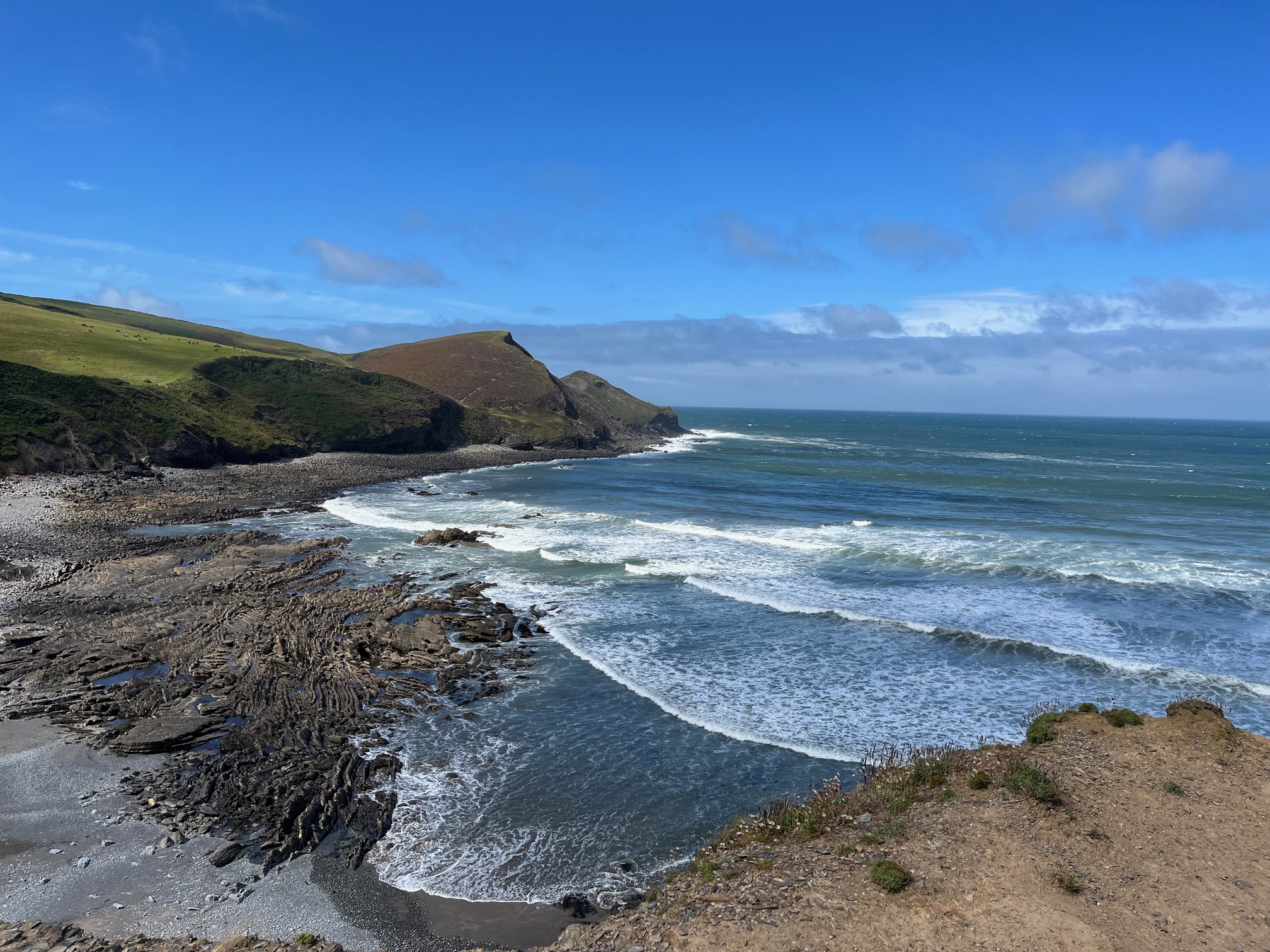
 

The rocks where the L’Adaldise wrecked. (See below. It’ll all make sense.)

The right of wreck

If Wikipedia’s right on this (it has a good overall record even if it’s subject to the occasional fit of madness), the right of wreck, or jus naufragii if we’re going to pretend we know Latin, is a medieval European custom rather than an actual law. 

It was based on the idea that if a ship wrecked it was because god got mad at the crew for–well, something, clearly, so he drove their ship ashore. That made the ship, its contents, and in the early days its crew the property of the finders. Because god had set it all up that way.

Gradually that business about enslaving the crew dropped away, but claiming whatever was left of the ship and its contents? That continued powerfully enough for the Church to condemn it from the 12th century into the 16th.

If you want to know what’s actually happening in a time and place, look at what gets condemned or outlawed multiple times. It’s not foolproof–centuries of hysteria over witchcraft really doesn’t prove the existence of witches–but it’s still a good place to start.

Starting in Norman times, the English crown owned the land–the whole damn land–and that’s relevant because ships tend to wreck where the sea meets the land. The king could and did hand chunks of land to his followers, but it was still his and if one of them pissed him off too badly he could take it back. We could find a parallel there to god getting mad and wrecking a ship because, never mind human ownership, it’s his to wreck, but it won’t stand up to rough handling so let’s not push it too far.

So the king owned the country, even the parts other people owned. Try not to think about it too hard. Just nod your head and agree that of course he got to eat his cake and discover that it was still there, on the plate. He was the king, after all.

What matters for us is that he also owned whatever washed ashore, and he could and did assign it to others, just like he owned land and assigned it to others. 


The right to complicate the situation

Edward I (1239 –1307; you’re welcome) introduced a law stating thatwhere a man, a dog, or a cat escape quick [in other words, alive] out the ship,” the ship wouldn’t be considered a wreck, and neither would its contents. Its owners had a year to claim their property–minus fees, rewards, and droits.

What’s a droit? It seems to involve money, law, and ownership. Beyond that, it’s a rabbit hole. 

The new law kicked off all sorts of arguments and lawsuits about what actually happened in this, that, or the other shipwreck. Did everybody die? Was the cat alive and curled up at someone’s fireside? Was this black cat at fireside the black cat who used to be the ship’s black cat? In other words, was the ship a “true wreck” or was it not?

The abstract of an academic paper that I can’t get full access to (sorry) says, “Different views coexisted about the legality and propriety of shoreline activities, whether salvagers worked with or against established authority, whether wrecking constituted a service, a custom, or a crime, and whether common lawyers or the civil lawyers of the Admiralty had jurisdiction.”

In other words, the law complicated things. And you might want to notice that the paper’s using the word wrecking there in exactly the way I’m not, but I’m pretty sure they lost points for it and I haven’t. 


But let’s stop following the story chronologically . . .

. . . because I’m having trouble unscrambling this egg. The point I want to get to is that somewhere along the line the crown gave seaside landowners the right to salvage whatever god (in his fury) had smashed onto their bit of the king’s shoreline, and this turned out not to be simple either, because the king (in his wisdom) had given the right to the owners of both manors and of hundreds.

Hundreds? The hundred was a political unit smaller than a county, and a manor was a large estate of no specified size but smaller than a hundred (at least usually; I can’t guarantee that it always was) and larger than the egg I can’t unscramble. So a hundred could contain multiple estates. 

In other words, the king just granted the same right to overlapping landowners. This is not a recipe for harmonious living. Cue an assortment of lawsuits, and if you’re interested in them follow the link just above, because we’re headed off in another direction:

If a tenant found a wreck, they were expected to let the lord know, in return for which they’d get half the goods and the lord would get the other half. That amount would’ve ranged from the piddling to the spectacular, but ordinary people lived close to the edge and no find was too piddling to pass up.

What happened if the tenant didn’t notify the lord? In a case in Cornwall, two tenants carried off 54 gallons of wine, were caught, and were fined, although the source I’m relying on doesn’t say how much. More than the wine was worth, I’m sure. 

What we can’t know is how often tenants weren’t caught, because not getting caught leaves no record.


Then the laws got tougher

In 1714, anyone who boarded a wreck without permission or got in the way of the crew salvaging their cargo faced fines and imprisonment. After 1753, they faced the death penalty.

If you want to blame someone for that, I’m told you can blame the philosopher John Locke, who argued for the sacredness of property. The idea caught on among (no surprise here) people who had property, and suddenly it seemed perfectly sensible to say that the purpose of government was to protect and preserve property. Punishments for crimes against property became harsher, usually following some local event that the great and the good could whip themselves into a state of outrage over. Soon a person could face the death penalty for anything from picking pockets to poaching to stealing livestock. 

And here’s a spot where I have to stand on my head to avoid using the word wrecking: scavenging from a wreck went on the list. 

If you’re not in a mood to blame John Locke for that, you can blame the East India Company, which had plenty of property to consider sacred and had lost some expensive cargoes off Cornwall and the Scilly Isles. Along with a few other companies who had a lot to gain, it lobbied to change what was still essentially a medieval law on wrecks. 


The aftermath of one wreck

In 1767 a French ship, L’Adaldise, wrecked off Cornwall, not far from where I live. To be clear, I wasn’t there. I’m not that damn old. I not only hadn’t been born yet, neither had my grandparents. I only come into the story because I know the area. 

A hundred people rushed to the shore, according to the account. At the time, the nearest village would’ve been very small indeed and (if AI can be believed, and it sometimes can) the whole parish (4,000 acres) had a population of 700. I’m guessing it would’ve taken a while to collect 100 people. But Cornwall was a poor county, and a wreck washing ashore could well have meant the difference between eating and not eating.

However many gathered, a lot of people rushed to the shore. Some were salvaging for the lord of the manor and some for themselves, or so the article I’m relying on says. Some had axes and chopped into the hold to get at the cargo, but they also carried off masts, anchors, cables, ropes, and anything else that could be put to use. 

Then everyone went home, including an elderly farmer, William Pearse, who for reasons that aren’t clear to me was the only person arrested (at home) and charged with wrecking. Under the new law, he faced the death penalty. He was held in Launceston jail, which the British in their inexplicable wisdom spell gaol. Eight years later, a reformer described the jail this way:

“The Prison is a room or passage twenty three feet and a half by seven and a half, with only one window two feet by one and a half;—and three Dungeons or Cages on the side opposite the window; these are about six and half feet deep…They are all very offensive. No chimney: no drains: no water: damp earth floors: no Infirmary . . . The yard is not secure; and Prisoners seldom permitted to go out to it. Indeed the whole prison is out of repair. . . . I once found the Prisoners chained two or three together. Their provision is put down to them through a hole in the floor of the room above. . . . And those who serve them there, often catch the fatal fever . . . a few years before, many Prisoners had died from it.”

Pearse was tried in Bodmin, and if he had any witnesses to defend him they would’ve had to make a rough trip across the moor, but no records of the trial exist so we can’t know. I can’t help wondering, though, how anyone could’ve appeared as a witness in his defense without having to admit that they’d been a participant. 

What we do know is that Pearse was convicted and sentenced to death, and so were six others that week, all for theft of one sort or another–except, possibly, for the one person convicted of house-breaking. 


Appeal

Death sentences were often handed out and then commuted them to transportation by the judge. (At the time, transportation was to the American colonies.) Four death sentences from that week were commuted, but not Pearse’s, and the elite of Launceston rallied behind him, campaigning for a royal pardon. 

Why did the local gentry rally behind a poor man? Possibly because they had a lot to gain from wreckers and a lot to lose if the crackdown held. Pearse was being used as a test case.

Campaigning for a pardon involved lawyers, and lawyers involved money, something Pearse didn’t have. It’s not clear who footed the bill, but the local gentry sound like a fair guess. 

Whoever was paying, Pearse now had a high-powered legal team, and local politicians were appealing for a pardon, arguing variously that he hadn’t taken much (“an inconsiderable quantity of rope” and a bag of cotton), that he wasn’t guilty, that the witnesses against him had lied, and that local people were deeply concerned about the case. Pearse’s age could also have been expected to argue for a pardon, and in any case the statute called for the death penalty only if violence was involved

Meanwhile, Pearse sat in that small, foul jail in Launceston.

Following standard procedure, the matter was referred back to the judge who’d condemned him (the logic was that he knew the case best), and the judge wrote, “‘As there were many common people in Court, I took the opportunity of inveighing very warmly against so savage a Crime, and of declaring publickly that no Importunities whatsoever should induce me to reprieve the Criminal.”

Pearse did not get his pardon.

It’s not irrelevant that the judge was also a legal representative for the East India Company. Remember them? The good folks who lobbied for the harsher law?

Pearse was the first person hanged as a wrecker under the new statute.


Current law

That doesn’t really take us to the present day, but let’s hit fast forward. Under the Merchant Shipping Act of 1995, you have to report a wreck or any materials from a wreck to none other than the Receiver of Wreck. That could get you a salvage award, which will vary depending on the value of the wreck and what you had to do to rescue it. What you can’t do anymore is call in the entire village and cart everything away like ants carrying an entire picnic home to the nest.

Spring flowers in January

Having lived in Minnesota, a state that’s in the middle of the US and hangs from the Canadian border by clinging to an icicle, I suspect that what my neighbors in Cornwall call winter is really spring. Here are a few flowers that bloomed not in January (the headline’s a lie) but in December.

Primroses on a neighbor’s lawn

Camellia, ourside a differnt neighbor’s house

Periwinkle–ours. It’s a good thing it’s pretty, because it’s trying to take over the yard.

Wishing you good weather, wherever you are. Apologies for the not-quite-convincing post. I need a bit of down time.

Cornwall’s Prayerbook Rebellion

It’s 1549, we’re in Cornwall, and (I’m taking a gamble here) none of us speak the language, because it isn’t English, it’s Cornish. Enough people speak English that we can probably buy a loaf of bread and a pint of beer (we’ll want to stay away from the water), but it’s embarrassing to depend on other people being better at languages than we are.


The inevitable background

What else do we need to know? Edward the Kid is on the English throne. That makes him sound more like a wild west gunslinger than a monarch, though, so let’s be conventional enough to call him Edward VI. He won’t last long–he becomes king at 9 and dies of TB at 15–but right now he’s sitting in the fancy chair, and he’s seriously, Protestantly Protestant, and more to the point, so are the people around him who, since he really is a kid, are powerful forces. 

This is when (and why) crucifixes and saints’ images are stripped out of the churches. Stained glass is destroyed. Masses for the dead are banned, and so are rosaries and church processions. The clergy’s gotten permission to marry.

But in Cornwall it’s gone further than that. Churches can’t ring bells for the dead. Church ales–fundraising banquets that are one of the important ways local churches raise money–have been banned. Priests’ vestments have to meet strict guidelines, and parishioners have to pay for that. 

Irrelevant photo: A magnolia blossom. For some reasons, it decided to bloom a second time this summer

These West Country rules come from William Body, who (I’m quoting David Horspool’s The English Rebel here) “got his hands on the archdeaconry of Cornwall against local opposition,” and then managed to line his pockets once he did.

In Penryn two years ago (that was 1547), there was a demonstration against him and the changes he’d introduced. It came off peacefully, and so did the government’s response. 

But the next year, the foundations that sang masses for the dead were suppressed, and in Helston Body was attacked and murdered by a mob led by a priest. 

Do I need to point out that this wasn’t peaceful? The priest and eleven other people were executed. This wasn’t a peaceful response.

Aren’t you glad I’m here to tell you these things?

Still, Edward, his advisors, or a combination thereof, didn’t think the opposition meant much. It happened in Cornwall, for fuck’s sake–the outer edges of beyond. They were convinced that people were thirsty for their reforms, but even if they’d believed the opposite, they might have acted the same way. Because they were right. It said so in their holy book, or it did once someone put the correct interpretation on it. So they moved ahead and introduced a major change in church services: they’d now be in English instead of Latin, and they’d follow the Book of Common Prayer

The Latin mass was now an endangered species, and if you insisted on saying it you’d be endangered yourself.

And since we’ve caught up with our timeline, we’ll shift back to the present tense. It almost makes sense if you don’t think about it too hard.

Conducting church services in a language people understand is a very Protestant move, and the English church has been edging in this direction for a while, first including snippets of English, then tolerating–maybe even encouraging–English-only masses in a few churches. Now, though, every last church has to use the Book of Common Prayer, and nope, they’re not negotiating this.

This sets off a massive flap. Catholics cling to Latin, and they’re horrified. But people who are further along the Protestant spectrum are equally offended because the Book of Common Prayer doesn’t break as sharply as they’d like with Catholicism. 

And–we’re finally getting to the point here–it offends the Cornish, because say what you like about how a service in the language people actually speak brings religion closer to the people, English isn’t their damn language and their priests can’t say services in Cornish because that’s not how it’s being done this week.

I’m not sure anyone wanted to say the service in Cornish, mind you. I’m just pointing out that the compromise wasn’t on the table. The Act of Uniformity bans every language except English from church services.


Cue the rebellion, please 

We’ll start in Bodmin, which is more or less the geographical center of Cornwall. It’s the first day the new services are scheduled to be heard. So people gather. People protest. They convince a local member of the gentry, Humphrey Arundell, to lead them.

Yes, I do notice the strangeness of people having to convince someone to lead them. It speaks, I think, to how deeply ingrained the hierarchy is. Without a gentleman to lead them, how could they possibly know what to do, even if they had to set him up there and tell him to do it?

Instead of going home at the end of the event, the protesters set up camp.

On the same day and for the same reasons, a protest breaks out in Sampford Courtenay, in Devon, the next county up from Cornwall, and nine days later the two groups set up camp a few miles outside Exeter and prepare to lay siege to the city. Figure there are some 2,000 rebels out there. Or some 4,000. Let’s not bog down over the details. A lot of people. More than you’d want at your birthday party.

The rebels put together several versions of their demands, and most of what they want is about religion. The center of religious reformation is in London. In the West Country, they hold to the beliefs and traditions that have been part of daily life for centuries. Still, they don’t call for a full return to the Catholic Church but to a return to the way things were under Henry VIII. And like so many rebels in monarchical countries, they don’t see themselves as challenging the king but the bad counselors around him. 

Yes, everybody’s drunk the monarchical KoolAid. It won’t be until the Civil War that they turn to other drinks.

The siege of Exeter lasts five or six weeks, and Exeter is left to defend itself until John Russell, who just happens to be the Lord Privy Seal (and people take these titles entirely seriously, remember) arrives with soldiers and defeats the rebels.

Estimates of the number of rebel dead are roughly the same as the estimates of the rebels themselves: 3,000 to 4,000. 

Again, don’t try too hard to make the numbers work. The leaders are hauled to London to be ritually hanged, drawn, and quartered. 


The aftermath

As a BBC historical article puts it, “The insurrection was eventually crushed with hideous slaughter – some three to four thousand West Country men were killed – and in its wake the ruling classes may well have come to associate the Cornish tongue with rebellion and sedition, as well as with poverty and ‘backwardness’. This in turn may help to explain why the Book of Common Prayer was never translated into Cornish, as it was later to be translated into Welsh. What is certain is that the failure to provide a liturgy in the Cornish tongue did much to hasten the subsequent decline of the language.”

The decline is more or less geographical, with English leaking across the Devon border and pouring south and west. By 1640, Cornish has retreated into the toe of Cornwall’s sock, and as the language dies out, the process of assimilation into England gathers force. By 1700, only 5,000 people speak Cornish.

The last native speaker of Cornish is Dolly Pentreath, who’s born in 1685 and dies in 1777

But. The sense of separation stays strong and plays a role in Cornwall taking the royalist side in the Civil Wars–partly (or so the BBC article speculates) because they saw Charles as  British and the Parliamentarians as English. With his defeat, the Cornish identity took another hit.

The An Gof Rebellion, with an extra bit of Cornish history thrown in

Welcome to Cornwall, 1497. Henry VII is on the English throne and Cornwall is part of England but also not part of England. The way that works is that the Cornish are a separate nation, which is about culture, but not a separate country, which is about law, power, and who’s in charge. So, like the Welsh, they’re a nation inside the country of England.


The culture

Most people’s mother tongue is Cornish, a Celtic language closely related to Welsh. And to a few other languages, but never mind that. I know a rabbit hole when I see one. The Cornish language is strongest in the west of the county and among ordinary people. Go east (which is actually northeast, but that’s a whole ‘nother rabbit hole) or spend time with the gentry and you’ll find English taking a stronger hold–probably alongside Cornish but in spite of what I said in the first paragraph we’re not actually there so we can’t walk down to the market and find out.


Irrelevant photo: what could be more Cornish than a Japanese anemone?

English is spoken among the gentry because not long after the Normans conquered England (and with it, Cornwall), the English king started handing Cornish lands to English (or Norman, or–rabbit hole, damn it) lords. That’s given English some upper-class cachet. Either for that reason or of necessity, a fair number of people speak it as a second language. 

But there’s another reason English is gaining a foothold. Cornwall’s surrounded by water, which means ships dock at its ports, bringing people in from other parts of the world, including from that closest of nations, England. People who live in ports tend to pick up at least bits of other languages.

Still, Cornish is the primary language, and the Cornish also have their own way of dressing, their own folklore, their own customs and games and ways of farming. The place is called–at least by the Cornish–Kernow, not Cornwall.


What outsiders say about the place

In 1538, the French ambassador to London, Gaspard de Coligny Chatillon, writes that the kingdom of England “contains Wales and Cornwall, natural enemies of the rest of England, and speaking a [different] language.” 

How much should we trust that business about “natural enemies”? Hard to say. An equally authoritative Italian diplomat reports, “The Welshman is sturdy, poor, adapted to war and sociable,” while “the Cornishman is poor, rough and boorish; and the Englishman mercantile, rich, affable and generous.” So yes, a grain or six of salt might not be a bad idea here. These guys aren’t just outsiders, they make themselves into authorities no matter how little they know. 

Still, that idea of enmity might (emphasis on might) be useful background to the rebellion that I still haven’t told you about.


But before that, let’s talk about tin mining

Cornwall doesn’t have great agricultural land unless you have your heart set on farming slate, but it does have tin, and it’s been trading it with the world for centuries. Tin’s useful stuff. Mix it with lead and you get pewter. Mix it with copper and you get bronze. Mix it with trade and you get money.  

In 1201, Cornish tinners got their own legal framework, which exempted them from normal laws and taxes but replaced them with a whole different set. This framework divided the county into stannaries, complete with stannary courts. (Stannary? It comes from the word for tin.) The framework changed over the centuries, and starting in the fourteenth century, Cornwall was governed by a combination of the Duchy of Cornwall and a stannary parliament.

But Henry VII is still the king, remember, and his son, Arthur–the one who died and left the next Henry in charge–is the Duke of Cornwall. When he tries to make some changes in the stannary arrangements, the tinners don’t accept them. So what does Daddy do? He suspends the Stannary Parliament and the privileges that go with it. Talk about helicopter parenting.

Henry’s big on centralizing the government anyway, so this works for him.

You can–and at least one writer does–cast this as a conflict between self-rule and centralization, but how relevant the stannary parliament is to the average person I don’t know. It would’ve been run by a thin top layer of Cornish society. Did your average miner or peasant have more in common with them than with an English lord? Possibly, but not necessarily.

One writer also–sorry, by now I’ve lost track of whether it’s the same one or six other people–lists suppression of the Cornish language as a reason for the revolt that–I know, I know–we still haven’t gotten to. No one else mentions that, and he gives no specifics, so I’m inclined to put the language issue on the shelf for a later revolt, which I’ll write about soon.

Really, I will. 

What does matter to everyone is the new tax that goes along with this change in Cornish government. It’s to fund Henry’s war with Scotland. Without question, that affects everyone’s lives. Most people are somewhere between poor and very poor. They don’t have a lot of slack in their budgets.


Why a war with Scotland? 

We have to back up another step, avoiding another conveniently placed rabbit hole. It all has to do with Perkin Warbeck, who’s running around up north, claiming to be one of those famous princes in the tower: the ones who are lost to history and presumed to have been killed by Richard the Evil Uncle but miraculously making himself known just now to the world at large. 

But if Warbeck is one of the princes, that means he should be the king, not Henry. Which is awkward for both of them.

The Scots figure Warbeck’s a nice piece of sand to throw into the English governmental machinery and they back his claim. The Cornish, on the other hand, say, “What’s all that to us?” and (as one source puts it) refuse to pay the tax.

All of them say that? Probably not, but enough that a rebellion breaks out, led by the blacksmith Michael Joseph (he’s known as An Gof, which is Cornish for the blacksmith) from St Keverne, and the lawyer Thomas Flamank, from Bodmin, who’s the son of an estate owner. In several places, An Gof is described as powerful and a natural leader. Flamank is described as a plausible lawyer, which doesn’t quite sound like a compliment. 

If you’re not from Cornwall, the place names won’t mean much to you, but so little seems to be known about them that I’m tossing in the few scraps of information I do have. 


And at long last, the rebellion

The rebellion starts in the west, in an area called the Lizard (nope, you won’t find more lizards there than anywhere else in Cornwall) and the rebels head up through Bodmin and on toward London. When they leave Cornwall, they’re a force of 3,000 men. (I’m assuming they were all men, but I don’t really know that.) By the time they reach London they’re a guesstimated total of 15,000. 

Those numbers speak to the Cornish rebellion striking a chord among the English, and the Cornish historian Brian Webb says it spoke to both yeomen and peasants. A river of grievance is flowing through the country. So even though I just spent a lot of time talking about Cornwall as a nation, nationalism can’t be the only force driving this. There’s an interesting essay to be written about the ways class and nationalism intertwine and then conflict with each other, but preferably by someone who isn’t me.

At Flamank’s urging, the march is peaceful. The rebels are armed (according to some sources) with bows and arrows and agricultural tools, which have doubled as weapons in many a war, but from what I’ve read they attack no one on the way to London.

What do they plan to do once they get there? I wish I knew. I’m reasonably sure it isn’t get rid of the king. If monarchy strikes you as a natural arrangement, the accepted way to get rid of one king is to pull an alternate out of the oven, then get rid of the one someone else baked. And it helps if yours has a marginally believable hereditary claim. 

These rebels weren’t in the business of baking or un-baking kings. So maybe we should think of the rebellion as a sort of armed demonstration. Cardboard and felt-tip pens haven’t been invented, so you’d pick up a weapon. It said, “Look how serious we are,” not to mention, “We’re not taking any shit, by the way.” But I’m speculating. Let’s not take me too seriously. What I’m reasonably sure of is that the decision to march on London speaks to how much they considered Cornwall a part of England. Contrast that with centuries of Irish rebels, who fight in Ireland to get the English out, and to hell with London.

So the An Gof rebels march to London, and they’re enough of a threat that Henry forgets the Scots and marches an army south to join the forces he’s already assembled, so that 25,000 men meet the rebels outside London, at Blackheath.


The defeat

The rebel army is defeated at the battle of (take your pick) Deptford Bridge or Blackheath–same place, two names. In some tellings, in addition to being lightly armed, the rebels aren’t well trained. In another, their weakness is simply that they don’t have horses or artillery, although their archers are good.

Either way, somewhere between 1,000 and 2,000 rebels die before the group surrenders, and another 1,500 are taken prisoner. An Gof and Flamank are tried and–yeah, they’re going to do that horrible thing to them–they’re sentenced to be hanged, drawn, and quartered. An Gof declares that they’ll have “a name perpetual and fame permanent and immortal.” 

In a moment of mercy (Henry’s apparently worried about getting the Cornish any more cranked up than they already are) they’re left to die by hanging before the rest of the theatrical stuff is carried out. A baron who joined them when they marched through Somerset is simply beheaded, because he’s an aristocrat, after all. 

All three heads are displayed on London Bridge. Forgive me, but the Tudors have some really unpleasant habits.

Nobody says what happens to the rank and file rebels who were captured. Nothing good, I’m sure. I also haven’t found anything about the rebels who weren’t captured. I imagine them filtering back home with tales to tell, some true and some good enough for neighbors to buy them a pint or three. And some, inevitably, unwilling to talk about what happened at all.


However

In 1508 Henry reinstateds and strengthens the stannary system in return for Cornwall’s payment of a £1,000 fine. The Stannary Parliament now has the power to ignore Westminster’s laws.

That £1,000 would be the equivalent of £666,000 in 2023, but a more useful comparison is to say it’s equal to 709 contemporary horses. Horses, remember, are a luxury, which is why the rebels didn’t have them. In other words, this is a hefty chunk of cash, and I have no idea how it’s raised. Probably from those least able to pay.

According to Historic UK Henry “never imposed such high taxes on the Cornish again.” 


Back to 2023

The Stannary Parliament last met in 1753 and the Stannary Court heard its last case in 1896, but the charter that created them has never been revoked, so the Duke of Cornwall still appoints a Lord Warden of the Stannaries. Who, I have to assume, does nothing more than show up here and there in a fancy costume, or at least with a huge metal necklace to show how important he or she is. 

It’s a British thing. If you live here long enough, it almost begins to make sense. 

Who was Trelawny?

Wander through any Cornish town–or village, for that matter–and you’ll find a house called Trelawny. Or Trelawney. We’re reaching far enough back in history that spelling was still a liquid.

Who was Trelawny? The bishop of Bristol when James II was king, that’s who. It doesn’t sound like he has an obvious connection to Cornwall, but stay with me: it’s a powerful one.

Before we get to that, though, yes, houses here have names. It’s romantic as hell and equally inconvenient. I don’t know how many times my partner and I have been walking the dogs and been stopped by a delivery driver asking where some named house is. We seldom remember, but that’s okay because with our accents (both, after 17 years here, still strongly American) no one believes us anyway. 

Cities and new housing developments have abandoned the for the easier-to-manage system of named streets and house numbers, but nobody’s been brave or crazy enough to reorganize the countryside.

Are we done with that? Good. Onward.

Irrelevant photo: a begonia flower


King James and Bishop Trelawny

Jonathan Trelawny was born in Cornwall–in 1650, which I mention so we’ll have some clue as to what century we’re wandering through. He was the younger son of an old Cornish family, although when you think about it, what family isn’t old? We all have ancestors stretching back to the beginning of time, otherwise we wouldn’t be here, but old old families are the ones who are impressed with themselves and expect the rest of us to be as well. Ideally, they have substantial amounts of money as well as portraits of their ancestors hanging disapprovingly on the walls.

In this particular old family, Papa Trelawny was a baronet–a commoner, but one with the right to be called “sir.”

Not by me, however. 

A baronet is below a baron but above a knight. Except knights of the Garter and–

Oh, come on, this is just too silly to go into. It’s a title. If they impress you, be impressed, please.

Jonathan became a minister in the Church of England, which is the kind of thing a good younger son would’ve done back then. I haven’t been able to find out what his role was in putting down Monmouth’s Rebellion, but he had one, and in gratitude for it King James (that’s James II, in case you’re counting) made him the bishop of Bristol. 

By this time, Trelawny’s older brother had died and the Trelawny we’re following inherited the title of baronet, and if anyone saw a conflict between being a baronet and a bishop, I haven’t found evidence of it.

We’ll stop here long enough to note that he and his family were royalists, having backed the king not only against Monmouth but (earlier king here but still a king) in the Civil Wars. 


And then it all went wrong

A royalist Trelawny may have been, but when, after Monmouth’s Rebellion, James misread the political tea leaves and thought they said “Hey, guess what, the country’s ready for political tolerance,” Trelawney parted ways with him. More specifically, the break came over the Declaration of Indulgence. To modern calorie counters that sounds like an announcement that not only was he going to eat a full English breakfast but that he’d have a slice of triple-layer chocolate cake for afternoon tea. 

Sorry, no such thing. Baking soda–or if you’re in Britain, bicarbonate of soda–and baking powder weren’t invented until the nineteenth century, and chocolate (I think–I haven’t double checked this) was still something to drink. You can, apparently, get a cake to rise using cream of tartar, but that only dates back to the eighteenth century. So no cakes for King Jimmy, and we’re not going to even discuss tea. 

What the Declaration of Indulgence did was suspend laws against religious nonconformists–a category that included those scary Catholics.  

Why were Catholics scary? Because England had spent a good bit of time seesawing back and forth between Protestantism and Catholicism, and every shift in the seesaw involved the two sides performing unspeakable acts on each other. Whichever side you were on, you had good reason to be afraid of the other one. So James granting a measure of religious freedom to Catholics? Especially when he’d appointed some to high offices and sent his Parliament home so they couldn’t stand in his way? If you were living back then, you might at this point let out a heartfelt, Protestant eeek

And if you’re living now–as I have to assume you are–you could argue either way about whether James was tippy-toeing (or stumbling) toward a Catholic takeover or toward a more tolerant country. He wasn’t around long enough for anyone to be certain.

But that’s getting ahead of the story. First, James demanded that the Declaration of Indulgence be read out in the churches, and seven bishops, including Trelawney, refused. They were arrested, tried for seditious libel, and (to popular acclaim) acquitted. According to the Cornwall Heritage Trust, the episode didn’t make much of an impact on Cornwall, although the Cornwall SEO Co. site says the acquittal sparked celebrations from Cornwall to London. Take your pick. My money’s on the Heritage Trust, but that’s strictly a hunch. 


And then?

And then James was overthrown by the Glorious Revolution, which brought in a pair of Protestants as joint monarchs, which is why we don’t get to know which way James was trying to nudge the country. Trelawny became the bishop of Exeter, which brought him closer to Cornwall but he was still on the wrong side of the Tamar River, and later of Winchester, moving him further away. He died in 1721.

Why, then, is his name on so many houses in Cornwall? As far as I can tell, it’s because in the nineteenth century Reverend Robert Steven Hawker wrote a song about him, “The Song of the Western Men,” better known as “Trelawny.”


Rev. Hawker, the mermaid, and the elusive truth

Hawker was nothing if not an eccentric. He built himself a hut on the cliffs, where he smoked opium and wrote poetry. He publicly excommunicated one of his cats (he had ten) for killing a mouse on a Sunday. You can pretty well count on the cat not being impressed.

He also put seaweed on his head, sat on a rock, and impersonated a mermaid. The shorter version runs like this:

“For several moonlit nights, he sat at the end of the long Bude breakwater draped in seaweed, combing his locks and singing mournful dirges, to the consternation of the local inhabitants. Finally a farmer loudly announced his intention of peppering the apparition with buckshot, whereupon it dived into the ocean and was never seen again.”

If you want the longer version, you’ll find it here.

Hawker’s song tells the story of 20,000 Cornishmen marching to London to demand Trelawny’s release. The problem is that they didn’t. One estimate puts the Cornish population in 1760 at around 124,000. Let’s say half of those were women, although I seem to remember that, left to herself, nature produces a slim majority of girl babies. I found some slim and pointless comfort in that back in the Dark Ages, when everything in (and out of) sight was engineered to promote more males than females. Never mind. We’re down to 62,000 people. Let’s say randomly that a third of those were either too young or too old to fight. After rounding out the numbers to make my life easier (have you ever wondered why I’m not a statistician?), we’re in the neighborhood of 40,000 men of fighting age. So that would be half the men of fighting age downing tools and taking off for London to wave their weapons and issue threats. 

No, I don’t think so either. And if you’re inclined to argue with my figures, you’ve got more than enough grounds. Even the original population number is an estimate. Britain’s first census (unless you count the Domesday Book) wasn’t taken until 1801 and it’s not considered a professional-quality census anyway.

But to return to our alleged point: there was no Cornish army marching on London. Cornwall Heritage speculates that Hawker mixed in an earlier rebellion, the An Gof rebellion of 1497. Call it poetic license if you like, or blame the opium. Or the seaweed.

In spite of that minor historical problem, Hawker’s song is still sung and it has great power. It taps into the well of anger you’re likely to find in any formerly independent nation that’s lost its language and been overwhelmed by incomers. A fair number of people count “Trelawny” as the Cornish national anthem. You’d be wise–and so (as an incomer) would I–not to run around debunking the man or the song. 


So how does the song go?

With a good sword and a trusty shield
A faithful heart and true
King James’s men shall understand
What Cornish men can do
And have they fixed the where and when?
And shall Trelawny die?
Here’s twenty thousand Cornish men
Will know the reason why.

Chorus
And shall Trelawny live?
Or shall Trelawny die?
Here’s twenty thousand Cornish men
Will know the reason why.

Out spake the captain brave and bold
A merry wight was he
Though London Tower were Michael’s hold
We’ll set Trelawny free
We’ll cross the Tamar, land to land
The Severn is no stay
Then one and all and hand in hand
And who shall bid us nay.

And when we came to London wall
A pleasant sight to view
Come forth, come forth, ye cowards all
Here are better men than you
Trelawny, he’s in keep in hold
Trelawny he may die
But twenty thousand Cornish men
Will know the reason why.


Want to hear it instead of reading it? Catch the Fisherman’s Friends–a Cornish group if there ever was one–singing it. 

I was going to tuck the An Gof rebellion in at the end of this but I’ve got on long enough. Next week if all goes well. Stick around. In the meantime, I’ll leave you with a question for people whose British geography is better than mine: what route would take you from Cornwall to London that crosses the Severn?

Covid, Cornwall, and the G7 meeting


Cornwall’s had a low Covid rate throughout most of the pandemic, but it now has the fourth highest Covid growth rate in England. That’s not the highest number of overall cases–that’s still relatively low. It’s the rate of growth, which went from 12.2 cases per 100,000 people to 99.5 per 100,000. 

Did that happen because the G7 met here? Or is it because the county’s a tourist center and we’re visitors have flooded in–more than usual, since going abroad’s a gamble just now? County councilors (which I initially misspelled as counselors, as noted in a comment; councilors is British for politicians, not for mental health professionals) are arguing both sides, but heavy Covid concentrations have shown up in Falmouth, St. Ives, and Newquay, where assorted people associated with the summit stayed, and in Carbis Bay, where the meetings were held 

Most other parts of the county haven’t seen spikes. That argues for the G7 as a superspreader event. 

Irrelevant photo: honeysuckle

On the other hand, the spikes started three weeks after what we’ve learned to call hospitality venues–those place we might once have called cafes and pubs and things like that–opened back up. Staffed heavily by young (by which you can understand largely unvaccinated) people, and customered at least in part by people visiting from parts of the country with higher Covid rates, many of them accompanied by children (by which you can understand smallish unvaccinated people). 

Also on that second hand, some spikes point toward a local university campus at Penryn.

Those points argue for reopening hospitality venues as a superspreader idea.

The national government’s announced that the spikes have nothing to do with the G7. It’s also announced that it’s not about to publish its summit risk assessment and anyone getting themselves into a state about reading it should go have an ice cream cone and settle down.  

Someone may manage to untangle the threads in the next week or three, but until then you can take your pick of the causes.

My small patch of the county is still fairly Covid free, but we’re full of visitors and the cafes, pubs, and restaurants are open. We’ll see what happens next. 


Covid transmissibility

A study of two Covid variants–the one first found in South Africa and the one first found in Britain–looked at why they’re more transmissible and found that the people they infect don’t have increased viral loads, which a person might logically think would be linked to high transmissibility. But nope, that doesn’t seem to be it.

People with the variants are less likely to have asymptomatic cases, though. And although they’re not more likely to die of Covid, they are more likely to be hospitalized. 

I can’t draw any conclusions from that. All I can do is toss it on your doorstep and hope you find something useful to do with it. 


Covid test effectiveness

Not long ago, the US FDA–that’s the Food and Drug Administration–urged the public to stop using the quick Covid tests that Britain relies on to test asymptomatic people. To which Britain said, “What do you know anyway?” and extended its emergency use approval. 

One of the problems with the tests is that when the number of Covid cases drops below a certain point, they produce more false positives than genuine positives, turning them from a not terribly accurate but possibly useful tool to an outright pain in the neck. Other tests are available and better supported by test data. But we like our lateral flow tests and we’re not about to abandon them. I have no idea why. 


Stay safe: avoid birthdays

A study in the US found a link between the spread of Covid and–guess what–birthdays. Yes indeed, gathering data from 45 weeks in 2020, a study found that in areas where Covid was circulating heavily, a birthday was 30% more likely to be followed by a Covid diagnosis in the household than a non-birthday. If it was a kid’s birthday, the rate was higher. 

The study was designed to look at the impact of small gatherings in spreading the disease. It didn’t specifically look at whether the household had a party–it drew its information from insurance records–but it is suggestive.

But don’t worry. If you don’t have a birthday in any given year, you should be safe enough.

Cornish history: the Prayerbook Rebellion

The Prayerbook Rebellion started when Henry decided to divorce Katherine.

Yeah, that Henry. Isn’t it odd how we’re on first-name terms with people who wouldn’t have known us from the dirt under their feet?

By way of full disclosure, I set the start date a little early, just for context, so nothing happened for the first few years. Then in 1534 Henry founded the Church of England, with himself as its head. And–no one could’ve been more surprised than him–it decided to grant him his divorce, which the Catholic Church was being very crabby about.

Irrelevant photo: Camellia blossoms. 


Henry the Much-Married starts the ball rolling downhill

The reconfiguration of the church took on a logic of its own, and starting in 1536 Henry closed religious centers–monasteries, hospitals, nunneries, abbeys. Some of them served a purpose in their communities–as schools and hospitals. The confiscated land and the buildings went to the crown and a lot of it was sold off to the wealthy. Who else had that kind of money? 

We’ll get to Cornwall any minute here. I promise.

In 1537, Henry banned the feasts on saints’ days. That included St. Piran’s Day, which is where I finally get Cornwall into the picture. St. Piran is Cornwall’s patron saint, and at this point we have a reaction on record: A fisherman from St. Keverne planned a protest and was arrested and probably executed. In Truro–Cornwall’s capital–a customs officer tried to stop a ship carrying people to Brittany to celebrate some unspecified saint’s day. He was pushed into the sea. The story seems to drop out of history there but let’s assume the ship got away and the people came back later and lived happily ever after.

The next year, pilgrimages were banned. 

You get a sense of how life was changing, right? Anne Bolyn, who Henry divorced Katherine for, had been dead by Henry’s executioner’s hand for two years by now. I mention that as a reminder of how far all this had wandered from where it started.

Along with the ban on pilgrimages came a directive that churches had to use an English-language translation of the bible. When I first heard about that–this was, oh, maybe a hundred years ago–I thought it meant people could understand the book they considered holy. The problem was, English wasn’t Cornwall’s language. Cornish was. 

It didn’t go down well. So let’s talk about the ways Cornwall was both a part of England and not English.


Cornwall as a country and a county

Cornwall was governed by England at this point, and it had been for a long time. Technically speaking, it was just another English county.  But it also had a distinctive culture: Not just its own language, but its own style of dress, folklore, naming customs, agricultural practices, and games and pastimes.”

High on the list of games and pastimes was pushing customs officers into the sea.

Cornwall also had two distinctive administrative institutions, the Stannary organisation, which oversaw tin mining, and  the Duchy of Cornwall. We won’t stop to make sense of those; we’ll just take it on faith they underlined its sense of separation.

Writers of the time–and well into the next century–wrote about the Cornish as a separate people, as distinct and recognizable as the Welsh, and about Cornwall as almost a separate country.

So that’s what we get to plunk onto the separate-country side of the scales. On the English-county side was an English gentry, which England had long since imposed on Cornwall, and the gradual inward seep of the English language. 

It might not have looked that way at the time, but from our point of view we can see the Cornish language in a slow retreat from the Devon border down toward the tip of Cornwall’s foot. 

Why’d that happen? The English gentry spoke English, although they may (or may not–I don’t know) have spoken Cornish as well. That made it useful to know enough English to do business with them, to work for them, to mix with them in whatever other ways the non-gentry mixed with the gentry. To people who cared about refinement, the fact that the gentry spoke English would’ve made English seem like the language of refinement. 

Cornwall’s ports would also have been full of the English language and the people who spoke it. This was a time when it was easier to get from, say, London by sea than by road.


All hell breaks (slowly) loose

In 1547, colleges, hospitals, chapels, and guilds were closed, and no provision was made for anyone else to fill the roles they’d played in caring for the sick and educating–well, some small number of kids, but still it mattered to the ones who might’ve been able to take advantage of it, leaving a very practical gap. The next year, an English official was stabbed when he tried to take down an image in a parish church. 

That makes it sound like a sudden thing. It wasn’t. The conflict had rocked back and forth for months, but we don’t do detail here at Notes. Twenty-eight Cornishmen were arrested and ten were executed for it. 

Then in 1549, Edward VI–or at least his government, since he’d have been somewhere in the neighborhood of eleven–introduced the Book of Common Prayer. Which was in English. And it insisted that church services follow it. That demand’s called the Act of Uniformity, in case that rings any bells from your long-buried memory of history classes.

Straw.

Camel.

Back.

For all that Cornish was in retreat, it was still Cornwall’s language, and for many people it was their only language. This wasn’t bringing the church’s language closer to them, it was moving it further away. 

Nationalism, meet outraged religious beliefs. You’ll find you have a lot to talk about.

Three thousand men gathered outside Bodmin–the geographical center of Cornwall, in case that’s of any relevance, which I suspect it isn’t–and drew up a set of complaints. They chose a leader, Humphrey Arundell, who was one of the richest and most powerful men in Cornwall and from an aristocratic English Catholic family. 

Was he Cornish or English? These days, the only way to figure out who’s Cornish and who isn’t is by how many generations of ancestors a person has buried in Cornish soil. I’ve been told four. I’ve also been told two. Either way, I’m too late. Whether either of those was the standard then, when Cornish identity was more sharply defined, I don’t know. I know Arundell was born in Cornwall and that he had family in England. He could as easily have been moved by religious belief as by nationalism. 

Either this set of complaints of a later one (sorry–the quotes have all gone adrift) said, “We will not receive the newe service because it is but lyke a Christmas game, and so we the Cornyshe men (wherof certen of us understande no Englysh) utterly refuse thys newe Englysh.” 

Half the church’s confiscated land was to be returned.

The complaints were sent to the government, which shrugged its shoulders and ignored them, convinced everyone would settle down as soon as it was time for Coronation Street to come on.

Then, in the random way that these things tend to happen, a rebellion broke out in Devon, the neighboring county: A congregation forced its priest to conduct the service in Latin, and in case that wasn’t enough, a supporter of the book of Common Prayer was killed. Somehow or other things escalated and the next thing anyone knew (okay: the next thing I knew) an army was marching on Exeter, Devon’s capital. 

You know how things can get out of hand, right? One day you’re killing someone over a prayer book and before you know you’ve got a whole damn army and you’re marching on the capital, thinking, How’d I get here? Do I really want to do this? Did someone think to bring sandwiches?

Arundell hadn’t wanted a fight, but the snowball was rolling downhill too fast. His army started off toward London. His plan was to talk to the government, with a few thousand soldiers at his back to serve as a megaphone, but on the way it took Trematon Castle, where some members of the gentry had holed up, and Plymouth. It also took St Michael’s Mount, which is in the wrong direction. This tells us that sat-navs (what Americans would soon learn to call GPSs) were no different then than they are now.  

Plymouth, by the way, isn’t in Cornwall, it’s in Devon, a change that’s marked by the River Tamar, which is wide enough at that point that you’d be hard put not to notice it. It’s also very wet, both there and along its entire length. But like I said, snowball; downhill; and melting gently in the Tamar’s waters. Who’s going to argue about county borders when all that’s going on?


Across the Tamar

At roughly this point, the Cornish and Devon armies joined together and laid siege to Exeter for five weeks, and they would have blown up the city walls but their gunpowder was too wet. That’s the English weather for you. 

The Cornish weather’s no better.

In London, the news that a Cornish army was marching on London caused a panic. Bridges were pulled down. Plays were banned–they might turn people against the government. France rubbed its hands and declared war.

The government sent soldiers to defend Exeter.

The leaders of the Cornish on Devonian armies wrote the government again, saying essentially the same thing: “We will have our old service of matins, mass, evensong and procession in Latin as it was before.”

This time the government wrote back. Three times, in fact, all of them saying no. In a long-winded, oddly spelled sort of way.

Several battles were fought, and I won’t drag you through them. The English army was bigger and the Cornish and Devonians lost. In one battle so many were captured that the English were afraid they’d lose control of them and slaughtered them instead. 

In the final battle, 1,400 were killed and the survivors fled. Arundell went into hiding and was captured (his servant turned out to have been working for the English). He was taken to London and with other leaders of the rebellion was hanged, drawn, and quartered.

Which kind of makes getting slaughtered en masse by the people who captured you look almost good. 

His lands were also confiscated and given to the leader of the English army that had defeated him. He was past doing anything with them by then, but it meant his family lost out. 

All told, some three thousand to four thousand Westcountry men were killed, including some priests and mayors hanged after the rebellion was over. According to one source, hundreds may have been killed for taking part–including many who may not have had anything to do with the uprising. 


The aftermath

The Cornish language went into a sharper decline after this, and although the Book of Common Prayer was translated into Welsh, it was never translated into Cornish.

Mind you, I’m not sure how welcome the translation was in Wales.

Stained glass windows were broken out of Cornish churches and images with any scent of Catholicism were destroyed, as they were elsewhere in England. 

Maps stopped showing Cornwall as a separate nation, and by 1700 you don’t find anyone writing about it as almost a separate country.

Ironically, the defeat of the rebellion, which was against the king’s new religion, set Cornwall up to support the king during the Civil War. The king was seen as British and the Parliamentary Army was seen as English. I suspect you had to be there at the time for that to make sense. The Parliamentary Army was also far more Protestantly Protestant than the king’s. I don’t know how heavily that weighed on the scales, but I assume it mattered.

When the king was defeated, it was another whack on the head for Cornwall’s status as an almost-country of its own.

The Cornish diaspora

Cornwall–that nobbly foot sticking its toes into the waters of southwestern Britain–lost about a third of its population in the nineteenth century. 


The background stuff

To come up with that number, we have to use a flexible definition of the nineteenth century, then we have to admit that no one actually counted heads. Yes, you can document the number of people who left Britain, which ports they left from, and where their ships were bound, but no one asked where they were from. Or if they did, they didn’t write it down. 

You can guess more or less reasonably that most people leaving from Cornish ports were Cornish, since Cornwall (being foot-shaped and sticking into the ocean) isn’t on the way from anywhere except Cornwall, but not everyone would’ve left Cornwall from Cornish ports. Plymouth, which is in Devon, is temptingly close. 

Never mind. A third is close enough, so let’s call that calculated.

Irrelevant photo: A wild primrose. Although it’s in Cornwall, so let’s call it semi-relevant.

Are we ready to start yet?

Nope. To understand the story, you need to know although England swallowed Cornwall centuries ago, it never managed to digest it completely. 

Cornwall was once its own country, with its own language, and even today it holds onto its identity. The last native speaker of the Cornish language, Dolly Portreath, died in 1777, not all that long before the period we’re talking about, and I’m reasonably sure that “native speaker” here means that Cornish was her only language, not that she was the last person who spoke it fluently, because the language survived in isolated communities into the nineteenth century.

If we’ve got the pieces in place now, we’ll go on.


Early emigration

In 1815, the Napoleonic Wars ended, and instead of joy and relief, peace brought a depression. For farm workers, that meant low wages and unemployment. For farmers, it meant being squeezed between high rents and high taxes. 

In Britain, remember farmers were likely to rent their land, not own it. 

For Cornwall, it meant the start of wholesale emigration, with families headed to the U.S. and Canada. 

The West Briton (that’s a newspaper) wrote in 1843, “The spirit of emigration continues active in the neighbourhood of Stratton. High rents, heavy rates, and obnoxious and impoverishing taxes are driving some of the best of our agriculturalists to climes where these demons of robbery and ruin are unknown.”

Agriculturalists? That translates to farmers. And Stratton’s in North Cornwall, not all that far from where I live.

But if poverty and depression were the primary forces driving people out, they weren’t the only ones. Cornwall was a stronghold of Methodism, and even though they no longer belonged to the Church of England, they still owed it a tithe, which was basically a tax the church levied. You could quit the church if you liked, but your money couldn’t. If you left England, though, you could shuck off that history and those obligations and be free in your religion. 

Still, if leaving England gave people a whiff of freedom and the promise of a decent living, or at least a full meal, it also meant leaving their families, their homes, and their culture. It’s the story of immigrants everywhere, and as always, hope mingled with grief.

Between 1815 and 1830, Latin American countries were winning their independence, and some of them drew Cornish emigrants. Copper, gold, and silver were being mined in Brazil, Chile, Mexico, Colombia, and Peru, and Cornwall was hard-rock mining country, from prehistory onwards. Cornish miners had the experience mine owners were looking for. The saying is that you can go anywhere in the world and if you look into a hole in the ground you’ll find a Cornishman at the bottom, digging. 

In the 1840s, the same potato blight that devastated Ireland hit Cornwall. Potatoes had become a staple in the Cornish diet as well as a cash crop and pig food. With the blight, people faced starvation in Cornwall, although not in the same devastating numbers as in Ireland. But if you’re starving, you don’t stop to argue if somewhere else more people are even closer to the edge than you are. There were food riots.

At about the same time, the Australian government offered free passage to anyone who met their standards. They wanted people who were “healthy, sober, industrious and in the habit of working for wages.” To prove that they qualified, applicants needed two signatures from “respectable householders,” one from a physician or surgeon, and one from a clergyman. Presumably the clergyman was supposed to attest to the sober and industrious part.

Don’t get me started.

They wouldn’t have needed to say this, but they also wanted people who were white. 


And the later waves

In 1859, Australian mines started producing copper–lots of copper–and the price dropped worldwide. Cornish mines closed. Then in the 1870s, the price of tin collapsed. More jobs lost. More emigration. 

Reverend Hawker, from a North Cornwall parish, wrote in 1862,

“They come to me for advice. If they have a few pounds out of the wreck my advice always is ‘Emigrate!’ And accordingly nearly a hundred in the current year go across the seas. Our population in 1851 was 1,074 in 1861 it was 868.”

Toward the end of the nineteenth century, the Cornish began emigrating to South Africa to mine diamonds and gold. By then, steamships had made the trip faster, and miners were more likely to go abroad and return home rather than sink permanent roots in new countries. 

Wherever they went, though, and for however long, many emigrants sent money home. At the end of the nineteenth century, 7,000 miners in South Africa  sent £1 million a year to Cornwall. In 1898, the West Briton reported a rush to the banks after mail came from South Africa. 

By the time World War I ended, emigration had slowed down, but the population of Cornwall kept on shrinking until the late 1960s. By one estimate, between 1815 and 1920, 250,000 people left Cornwall for other countries and almost the same number left to find work–mostly in mining–in other parts of Britain and in Ireland. 

A different source estimates that between 1861 and 1900 44.8% of the Cornish male population who were between fifteen and twenty-four left to work overseas. So did 26.2% of the female population in the same age group. Another 30% of men and 35.5% of women left for other parts of Britain. 

By the time you add all that up, you have something like half a dozen people left at home to keep the fire going.


Cousin Jack

Outside of Cornwall, the non-Cornish considered the Cornish to be clannish. Somehow immigrants are always accused of being clannish. They cluster together to share their customs, their food, their memories, their language, their joys, and their grief. They lean into each other for familiarity and for help–material and emotional–in negotiating the transition. And they’re resented for it. It’s an old story, and it seems to play on a loop throughout–well, I can’t speak for all of human history but the parts of it that I know about.

This led to the belief that Cousin Jack, the common name for a Cornishman, especially a miner, came from Cornish miners always lobbying for some other Cornishman to be hired–his cousin Jack. 

The parallel name for a Cornishwoman is Cousin Jenny.

The story’s vivid enough to be convincing, although that doesn’t make it true. Especially since different sources trace the origin of the phrase to Australia, to the California gold fields, and to Devon, Cornwall’s neighboring county. 

The historian and archeologist Caitlin Green traces it to either Cornwall itself or to Devon and wonders if it didn’t start out as a name to mock Cornishmen, which was then stolen and repurposed by the community it was meant to mock. 

Cousin, she reminds us, didn’t just mean a family member at the time. It was a friendly way to address someone who was close but not family.

I’ll leave you with a link to a beautiful and heartbreaking song about Cornwall, mining, and emigration, “Cousin Jack.” It’s by the Fisherman’s Friends, a group of Cornish singers who are the subject of a movie made a few years ago. It’s got a joke embedded in it about Cornish and English nationalism, although maybe you have to have spent time in Cornwall to get it.

*

My thanks to Pete Cooper for sending me a link about the origin of the phrase Cousin Jack, which got me going on this.

Surfers, Black Lives Matter, and the Star Count: It’s the news roundup from Britain

Let’s start with the star count: Back in the winter sometime, I posted information about an effort to study light pollution by asking people to count the stars they could see inside the constellation Orion. If you’d like to see the map that compiled from that study, here’s the link.

*

I know I said the news was from Britain, but what the hell, I’m sitting in Britain and I’m typing this, so this comes from Britain, even if the news is from the U.S. It’s too good to miss: Someone from Nebraska is suing every gay person on the planet. In federal court.

She’s not claiming gay people have broken any laws. In fact, her hand-written, seven-page statement doesn’t talk about law. She quotes the Bible and she quotes a dictionary.

Now, I’ll admit to having misspelled a word or two in my time–possibly more than two. And ignorance of the law is no defense, so I might be worth suing, although first we should establish that a lawsuit is the appropriate remedy.

But the Bible–. Folks, it’s time we all sat down and had a serious discussion about whether people have to follow the rules of religions they don’t belong to. And if the answer turns out to be yes, we need to talk about which religion’s rules to follow. Because the world’s full of religions, and they have different rules. We’ll find a few areas of overlap, but that’s not going to be enough.

I predict a messy, uncomfortable discussion.

It probably won’t surprise you to learn that the woman bringing the lawsuit is representing herself in court.

*

Relevant photo (it happens sometimes): A Black Lives Matter demonstration in Camelford, Cornwall.

Enough of that. Let’s go back to Britain:

After a slave trader’s statue was toppled into the Bristol harbor, British conversations about black lives matter have focused heavily on the symbolic. In other words, on statues. So a group of white, far-right activists felt called upon to gather in London so they could protect its historic statues.

To avoid violence, Black Lives Matter called off the protest it had scheduled for that day, although other groups didn’t.

The far-right activists drank; threw bottles, smoke grenades, and flares at the cops,; gave the Nazi salute: took off their shirts; and pissed on statues, possibly on the theory that they need liquid to grow.

To be fair, not all of them did all those things. That’s a collective portrait.

A hundred people were arrested.

They made a point of claiming Winston Churchill as one of their own, possibly because someone had painted, “Was a racist” below his statue. I’ll let a tweet from @dannywallace sum the situation up:

“-  Police are protecting a statue from people who want to protect it from people who don’t seem to be there.

“- Meanwhile the man who stopped us all from having to salute like a Nazi is celebrated by men doing Nazi salutes.”

A group called the Football Lads Alliance took part. It’s a British thing, going to a football game in order to get in a fight. Not everyone who likes the game does that, but for some people it’s the whole point. And it does seem to be linked to racism.

I’m not even going to try to explain it. I don’t think it’s anything an outsider is likely to understand..

*

At a point where a group of far right demonstrators (let’s call them FRs) clashed with a group of Black Lives Matter demonstrators (let’s call them BLMs), one FR was left by his friends and was curled on the ground, surrounded by the group of BLMs they’d been fighting with. Patrick Hutchinson, a personal trainer who’d come with some friends in order to de-escalate clashes, waded in, heaved the FR over his shoulder, and with his friends in formation around him, carried him out.

The photo–a black guy carrying a white FR demonstrator to safety–went viral.

“If the other three police officers who were standing around when George Floyd was murdered had thought about intervening like what we did, George Floyd would be alive today,” he said.

*

Near where I live, in mostly white, very rural Cornwall, thirty people held a one-hour Black Lives Matter demonstration in the small market town of Camelford. We were masked and distanced and it took some of us most of the hour to work out that we already knew half of the people we were standing with.

I’d posted the event on our village Facebook page (having a village Facebook page is a tradition that dates back to the middle ages), and the response was a long argument about statues and whether responding to black lives matter by saying “all lives matter” is like saying responding to someone saying, “Save the Amazon,” by saying “all trees matter.”

The argument went on for over 200 comments.

*

Further down west (as people say around here), in Porthleven, surfers paddled into the harbor in support of black lives matter.

*

On a totally different note, in Italy, a group of drug dealers knew they were being watched by the police and wanted someplace safe to stash their stash until the cops got bored, so they did what any sensible, adult drug dealer would do: They hid $22,000 worth of cocaine in the forest. Where a pack of wild boars found it, tore open the packaging, and spread it all over the forest floor.

It’s not at all clear whether the boars inhaled.

The article I got this from called the boars a horde, which made me realize that I don’t know what you call a group of wild boars. I’ve (arbitrarily–it’s the privilege of the chair to be arbitrary) called them a pack, ruling horde out of order, along with mob, herd, and flock. I haven’t ruled out committee.

A committee of cocaine-fueled wild boars . . .

If you’re a fan of short story prompts, you’re welcome to use that as an opening line. In the story I won’t bother to write, they end up running the country.

It may or may not be fiction.

How English is England? a quick lesson in geology

England’s creation story as we once knew it went like this: In the beginning, whatever god(s) you like to give credit to, along with all the ones you don’t, separated England from France because they thought it would be better that way, and all the humans with an interest in either country agreed that, yea, this was wise.

It wasn’t easy for the humans to do this, because humans only joined the planet some 2.8 million years ago and the separation of England and France took place 400 million years ago. But the tension between the English and the French is pronounced enough that it could have easily predated the human race by some 397 million years, give or take a few months.  

Gods, as it turns out, can be vain–it’s an occupational hazard–and they were so pleased with all that human praise that many million years later they poured the English Channel into the space between the two countries to mark their accomplishment. And lo, the humans lavished them with more praise.

Endangered species: This is a relevant photo–see below for a comment about
stone monuments, although in keeping with tradition this isn’t quite the kind of monument I was talking about.

To be marginally more scientific about this, until very recently the belief was that Britain–that’s England, Scotland, and Wales–was formed when two ancient landmasses, Laurentia and Avalonia, met and married. France had nothing to do with it–it was on a landmass called Armorica–and a marriage can only take place between two landmasses. The third could have been, at most, a witness.

It’s true that this was before marriage had been invented, and possibly even before sex had been invented, but for richer and for poorer, for better and for worser, the two landmasses became one and everyone was happy with the arrangement, especially the English, because there’s something about being English that compels even the most broad-minded people to get sniffy about the French.

We’re going to assume that the French were just as happy, because (at least in my limited experience) they can be sniffy about the English as well. I’m basing that on the number of people my partner and I met in France who asked, “Are you English?” and when we said we were American said (more or less, and in French), “Oh, wonderful. We like Americans.”

That was back when it was easy to tell people what nationality we were. These days it’s complicated. Are we American? Yes. Are we British? Yes. So are we British-Americans? Americo-Britoids? Passport-hopping cosmopolitan nuisances?

Never mind. Let’s go back to our origin story. Here was an arrangement that suited both parties. The English were from Laurentia-Avalonia and the French were from Armorica and never the twain would meet. They didn’t have to trace their geological histories back to a common point.  

It turns out, however, that it didn’t happen that way. Some wiseacres from the University of Plymouth have spoiled it all by taking rock samples from southwestern Britain and Brittany (in western France), playing geologist games with them, and announcing that the deposits left from volcanic explosions in part of Cornwall and Devon match those in France.

This explains why the mineral deposits in the southwest (primarily tin, but also copper, antimony, arsenic, a bit of silver, plus in case you’re still interested, tungsten, uranium, zinc, and occasional supermarkets cart–called a trolleys–that show up when they drain canals) match what’s found in Brittany (with the possible exception of the supermarket cart) but not what’s found in the rest of Britain (again with the exception of the supermarket cart).

So geologically speaking, a fair chunk of southwest England is French, including most of Cornwall, which culturally and historically may not be part of England at all, but let’s not argue about that, I only brought it up to complicate things. And because people I know bring it up regularly, so I feel a kind of duty to toss it into my posts.

What can we learn from this discovery? That marriage is more complicated than anyone imagined and can indeed involve three landmasses. That everyone should settle down and stop being sniffy about whole swathes of people because if we go back far enough we’re all related, as is the land we live on. That we should all save our spikiness for deserving individuals. And for the people we’re closely closely related to and have to play nice with on holidays.

We can also learn that it’s good to have our brain molecules rearranged periodically. That’s the lovely thing about the sciences. They start with a theory, they test it, and when they find information that contradicts it they either update it or throw it out altogether.  

*

But the French-Southwest England connection is more than just geological. The cultural links go back to the Neolithic age–that’s the late stone age–when the people of southwest Britain traded with the people of what’s now France. It couldn’t have been easy sailing stone boats back and forth across the channel, never mind hollowing them out, so they must’ve wanted to see each other really badly.

If anyone decides to link to this, please, please note: that’s a joke about stone boats. I had another joke go wrong again recently and I’m feeling just the slightest bit sheepish. If sheep can giggle (sorry, I can’t help myself), which I’ve never seen them do but can’t rule out.

The two groups would’ve shared shared overlapping cultures, because both spent their free time setting huge stones in place to mark we’ll never really know what. Their presence, maybe. It’s too weird an activity not to mark an overlap.

English Heritage (the name doesn’t play universally well in Cornwall) says that “by the later Iron Age, southern England’s principal trading partners were northern Gaul (France) and Armorica (Brittany).” 

If we slip forward to the years after the Romans left Britain, we’ll  find Celtic refugees fleeing the invading Angles, Saxons, and Jutes–or so it’s said. Archeologists are challenging that belief, but we’ll get to that some other time. If the Celts did indeed flee, they left with their language folded neatly into their suitcases. And where did they land? Armorica, which they renamed Brittany.

Then in the eleventh century, the Norman French invaded England, changing the language to French and completing the circle on influence, connection, resentment, and bizarre spelling. They didn’t care about landmasses, they just wanted the land. And its people.

We, of course, live in an enlightened age and do care about landmasses. Please take a few minutes to feel smug.