Heavy Traffic in a Cornish Village

Wild Thing and I were walking the dog the other day and we’d just turned off the main road when a car made the same turn. We moved to the side of the road, stood in the weeds, and corralled the dog so that she did the same. She’s convinced that if her nose is out of the way, that takes care of the problem.

The car passed. The driver waved. We waved and moved back onto the road.

Then another car came past. That’s roughly two cars more than we usually see on this stretch of road.

“So much traffic!” Wild Thing said.
mulfra 043

Irrelevant Photo: Fall Berries of Some Sort of Other

You need a little background here.

First, what I just called the main road? It has two lanes, goes from no place in particular to no place else in particular (I’m going to catch hell for saying that), and no one’s even bothered to give it a name or a number. That’s why I call it the main road. What else am I going to call it? Marlena? Suzette? It’s as main a road as the village has. Everything else is even smaller.

Second, Wild Thing and I are both New Yorkers. I was born and raised there and she lived there for ten years. So it’s not that we’ve never lived with traffic. But human beings are adaptable. When I lived in Minnesota, I noticed that 40 degrees F. was cold in the fall and the most blissful warmth in the spring. So we’ve adapted. Two cars in a single day on the road past the ford? In the off season, when the emmits have gone home? Outrageous!

And we’re not the only ones who resent seeing two cars in a row. Someone who shall not be named, nay, not even by initial (okay, I’ve forgotten who it was), set out a Road Closed sign on one of the back roads. For years. Long after whatever was once wrong (if anything ever was) had been fixed. He didn’t like the traffic.

The locals all knew to drive past it, and when I became a local I taught myself to do the same, although the first time expected to find that the ford (this is a different ford) had risen out of control; that a downed tree had left the power lines sprawled across the road; that a herd of wild elephants had set up camp by the ford and were scavenging downed limbs for firewood. Even though I knew better.

In one version of the story—and no story in the village has only one version—he got tired of people with long vehicles taking the road and getting stuck at the ninety-degree bend where the road narrows down. In another version, a delivery truck got stuck and its cargo had to be off-loaded onto a smaller truck. In a third version, the company kept sending big trucks and they all got stuck—one, two, three pretty trucks, all with the same logo and all stuck where the road bends. It’s a wonderful image. Sadly, it’s the least likely of the versions. A single truck could get stuck there if it was long enough, but by getting stuck it would sacrifice itself for its fellow trucks, who’d have to back up a long way and then cross the ford backward before backing up some more, but they wouldn’t be stuck. That’s village gossip for you. Whatever story you hear, you have to figure it’s related to something real, but you can’t necessarily tell what the relationship is.

Anyway, it’s the off season here in the village, and the traffic’s horrendous. If you were thinking of visiting, wait till it calms down a bit.
Gardening in Cornwall: What We Do When Autumn Comes

J. is a serious gardener, and she grows the best tomatoes I’ve eaten since I moved to the U.K. I don’t know how she kills slugs and snails on her patch in the spring, but I know she does, because if you’re going to grow anything around here, you have to. Otherwise they mow down every plant you stick in the earth. They move through like a scene from Slug Apocalypse, leaving nothing behind.

Irrelevant Photo: The North Cornwall Coast

Irrelevant Photo: The North Cornwall Coast

A couple of us were at J.’s house and we went outside to admire the garden. It was that beautiful time of the evening when the sky’s a tissue-paper blue and you can almost convince yourself that the world is at peace, even though, yeah, of course you know better. Even though it was late in the year, she still had some flowers in bloom.

On the edge of a flower bed was a slug. The big, creepy kind, easily the length of my ring finger.

J. flicked it away—and I’d have to say she did it gently—with the toe of her shoe.

“That’s why I don’t come out at this time of day,” she said.

So it’s not just me. Everyone who gardens knows they’re out there. And at least for part of the year, we don’t look. If we did, as surely as if we’d sworn an oath, we’d have to kill them. And really, you can’t dedicate your life to eliminating an entire species, even if it’s only from a small patch of ground you call your own.

Gardening and Snail-i-cide in Cornwall

One of my first posts was about slugs. I wrote it early in the growing season, when none of the new plants stand a chance unless I carry out mass slug-i-cide. And snail-i-cide. It’s disgusting, it’s disturbing, and it works, up to a point.

But the plants that don’t get eaten get bigger, and sooner or later I convince myself that I can skip an evening’s slaughter. Maybe because it’s raining. Maybe because it isn’t. There’s always a reason, and it doesn’t have to be a sensible one. Then, before I notice what’s happening, several days have rolled past, and then the weeks do the same thing, and eventually I decide that I don’t have to kill them anymore. The plants are established.

Irrelevant Photo: Late Summer Wildflowers

Irrelevant Photo: Wildflowers

Oh, happy summer. I declare a truce with the slugs and snails. This isn’t negotiated, it’s a one-sided thing. They still eat everything in sight, but now I look the other way when I see them.

Then summer passes, and right now it’s fall. Or autumn, if you’re of the British persuasion. A few days ago, I lifted the lid on the kitchen garbage can and found a snail glued to the underside. How did it get there? I suspect I found it when I was washing a batch of spinach I’d cut and I tossed it in as a sort of compromise: I won’t carry it sweetly back out to the garden to munch its way through more spinach, but I’m not killing it, am I?

The reason I say “I suspect” is that I’ve rearranged my memory so that I’m no longer absolutely the kind of person who’d do that. I probably am, but I have a small escape hatch. The snail might have moved in on its own: come in the back door, crossed the living room rug, crawled up the side of the garbage can, lifted the lid, crawled in. You know; it could happen if, I don’t know, the laws of physics changed or something. I’m just not sure.

I plucked it off the top and put it inside the bin again. Why? No idea. I don’t understand the workings of my mind any better than you, dear reader, are likely to. The next time I looked, it had climbed to the top of the liner and I left it there. Because by now it had become individualized. It wasn’t just some snail, it was almost a pet. And I’d tossed the poor thing in a near-empty, and dry, garbage can, with nothing edible and nothing moist.

Stop that, I told myself.

I didn’t listen. Instead I asked myself whether it was crueler to carry it to the pavement and crush it or to leave it where it was. This was, in spite of its absurdity, a serious ethical question, and a complicated one, which (like so many serious and complicated ethical questions) I haven’t answered to my own satisfaction. That’s another way of saying that I left it where it was but became conscious of every bit of edible junk I tossed in, and every smidgen of moisture. I made a batch of oatmeal chocolate chip cookies, which involved a lot of oatmeal landing on the floor. My recipes are like that: Take one handful of rolled oats and toss over your left shoulder. So I swept the oatmeal up and threw it in with the snail. Ditto the bits of dog treats I cut in half because the dog is small and the treats are big and she’d be chewing for half an hour if I didn’t cut them up.

Mmm. Snail food.

So here I am, the bane of slugs and snails, feeding a pet snail.

Eventually the garbage can will fill up and I’ll take the bag out, slug and all, and toss it in the trash. I know this. But like a mother who can’t bear to tell her daughter the goldfish died, I’ll tell myself it’ll be fine. It’s just going on a trip, darling, to a new home.

Planning Thanksgiving in Cornwall

We’ve started planning our Thanksgiving party. The guest list is limited by the size of our house, which is a shame because we’d love to add more people. And since there’s no competition—no one says, sorry, but I have to go to my brother’s this year—almost everyone we invite is available. And it’s an American holiday, which gives it an element of cool here.

Our tradition, both here and back in Minnesota, is that we cook the turkey, cranberries, sweet potatoes, and pumpkin pie (usually; back in Minnesota, as D. got older he became a very good cook and he brought the pies), and we ask everyone to bring something. Which is where it gets interesting.

Pumpkin pie--with a neater crust than I make. Photo by the Culinary Geek from Chicago, courtesy of WikiMedia

Pumpkin pie–with a neater crust than I make. Photo by the Culinary Geek from Chicago, courtesy of WikiMedia

The first time we invited we invited M. and J. to our Thanksgiving in Minnesota, was the first time I understood how rigid the traditions are. J. isn’t from the U.S. but she was the cook in the family, and as they told the tale later, M. said “No, you can’t bring that” to everything J. suggested. Macaroni and cheese? No, you can’t bring that. Chocolate cake? No, etc.

So this year, a different J.—an American—told me she’d have to explain to P. that just because root beer floats are American doesn’t mean you can have them at Thanksgiving. I looked at the list of what people were bringing: leek gratin, cauliflower cheese, quiche. Don’t bother, I said. We’ve given up the battle.

The only traditional elements of the meal are the ones we make—turkey, cranberries, sweet potatoes, and pumpkin pie. And baking powder biscuits, which weren’t traditional in my family, but Wild Thing’s from Texas and will never say no to biscuits. The rest is all stuff that would get us all deported if we tried it in the U.S.

So we’ve evolved our own traditions, one of which is the meal isn’t traditional. A second involves me, the vegetarian, cooking a dead bird. Which hardly even strikes me as strange anymore. A third—one we’re trying to break—is that I make cranberry sauce and forget to set it out. A fourth is that we have to have at least one dessert that isn’t pumpkin pie, because although pumpkins grow here they’re considered a squash and people are, um, let’s say hesitant about eating it as a sweet. But we do have to have it. That’s tradition for you. Besides, a few of us like it.

Further Adventures in British English: The Letter U

The British love the letter U. They use it at every possible opportunity (neighbour, colour, flavour, savoury), and it drives some of my friends insane that Americans don’t. It’s one of those things: If you let it get to you, it will. Gleefully. If I have to write something in British, I assign myself a handful of U’s and I don’t stop writing until I’ve used them all. When I write in American, I now see tiny gaps in neighbor and color where the U isn’t: colo’r; neighbo’r.

He's been here before, but I can now offer some advice: Make your your spell check is set to the right language.

He’s been here before, but I can now offer some advice: Make your your spellcheck is set to the right language.

And no matter which country I’m writing for, my spell check is set to the other. To my embarrassment, it snuck a U into neighbor a while back, and I posted it on the blog, which T. (copy editor that she is, down to the bone) pointed out diplomatically. I felt like the carrier of an, admittedly mild, disease—U-itis. I don’t have the bug myself, but I did spread it.

Trying to Count the Cornish Wildflowers

Wild Thing and I hadn’t really seen the Cornish countryside until we discovered the footpaths, and the wildflowers bowled me over. I was living in Minnesota then, and when it isn’t frozen solid and buried under snow Minnesota is green and beautiful and all that, but you wouldn’t be tempted to call it lush. It’s too cold for too much of the year. What wildflowers grow there always struck me as self-effacing, somehow, as if they didn’t want call attention to themselves.

A lot the people are like that too.

T. and S., whose roots are in western Minnesota, swear there were more wildflowers when the farmers didn’t use pesticides as enthusiastically as they do these days, and I’m sure that’s true, but still, Minnesota’s a bit like the Puritans were: It’s never going to encourage a wild profusion of stuff it doesn’t absolutely need.

Montbretia, pronounced mombresia. Or something like that. Considered not just a weed but a thug. Isn't it gorgeous?

Montbretia, pronounced mombresia. Or something like that. Considered not just a weed but a thug. Isn’t it gorgeous?

So, while I was on parole from Minnesota, I’d walk along the footpaths in Cornwall and try to count how many kinds of wildflowers were in bloom. To understand what a misguided undertaking this was, you have to know that numbers and I are not on good terms. Ask me to remember the number 3 for more than a minute and I’ll need to check my notes. Ask me to solve a word problem (Train A left station B at 3:44….) and I’ll weep. Or at least I’ll want to. So voluntarily counting anything indicates an extreme state of mind. In this case, it was extreme happiness. So much color. So much life pushing up out of the ground. I’m tempted to say so much unnecessary beauty, but yeah, the ecosystem, the necessity of so many things we humans don’t think are necessary because we can’t make any immediate use of them. All of that. Still, you can see what I’m getting at.

The problem with counting wildflowers was that first, if I’m distracted at all, I can’t reliably count from 1 to 70 without losing my way. Did I say 70? Make that 10. But second, and more to the point, I couldn’t keep track of which flowers I’d already counted. If you don’t have names for things, it turns out, it’s hard to remember them. Little yellow flower, bigger yellow flower, little yellow flower that isn’t like the first yellow flower because it has four petals, although maybe the first one did too because I wasn’t noticing petals, only color and size at that point. Little yellow flower that also has four petals but they’re pointy. Little yellow flower that I might have counted already but I don’t think so.

I often wonder how animals remember in the absence of words. Of course, as far as I know they’re not counting, but they do other complex things, like remembering smells and places and long routes. It’s not all looking at a plant and thinking either yumm or bleah, that tastes foul.

Anyway, I bought the first of my wildflower books and began attaching names to what I was seeing. And the odd thing is that this allowed me to see them better—to notice and then remember petal shapes, leaf shapes, the ways leaves grew on the stem, and from there stem shapes and whether the leaf or stem was hairy or smooth. I’m still useless with some of it. Talk of sepals sends me into a panic. Heights given in centimeters might as well be written in an alphabet whose origins aren’t on this planet for all the good they do me.

That first book led to the next book, which was organized differently and promised more, better, deeper. And another book after that. One that had photographs. Another that had drawings. Each one had advantages and drawbacks. Then one organized by color, which I’d always thought would be simpler but still leaves me flipping through page after page, looking for a match for something new that I’ve brought home. Or something that isn’t new—I know I’ve seen it before—but I’ve forgotten its name since last year at this time.

I’m still a barbarian about it all. One of my books (and I pulled it out of the shelf at random) lists 15 kinds of violet, including common dog, early dog, pale dog, heath dog, hairy, sweet, and dame’s. And speedwell? Alpine, blue ivy-leaved, fingered, germander, marsh, spiked, thyme-leaved, wall, water, wood, and on until you reach 25 of them. I’ve tried to see the differences, really I have, but I’ve decided to be happy to look at the damn plant and say, “Violet; speedwell; close enough.”

Although I do love being able to identify the ivy-leaved toadflax.

No matter how many I learn, though (and I haven’t learned that many), there are always more.

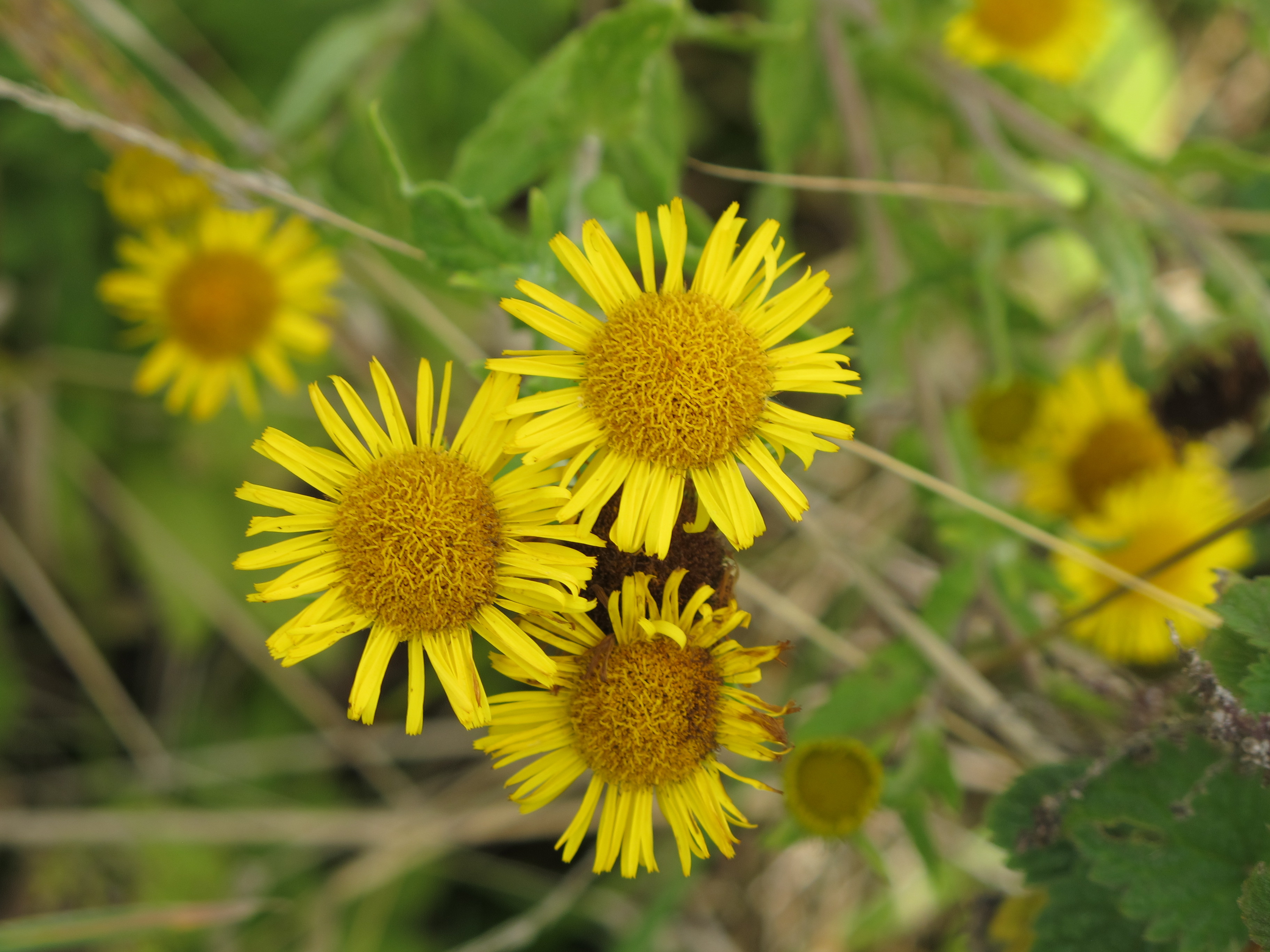
If this sounds geeky, that’s because it is geeky, but it’s not about checking off how many flowers I’ve seen or how many names I can recite. By learning the flowers, I’ve learned a new way to watch the seasons roll past. The first wild primroses come into bloom when it’s still winter, and they tell me spring’s coming. Then the celandine comes out. It’s a low-growing yellow flower. Spring progresses with each new flower, and I think of it as a yellow season.

Damn, it’s beautiful here.

Spider Season in Cornwall

Spiders have moved into M.’s house, something he’s mentioned because he’s phobic about spiders and even with what he calls the arachnavac he still feels at a disadvantage. Even though he’s in the neighbourhood of six feet tall and none of them even come close. But being in possession of a phobia or two myself, I won’t try to make too much sense out of his. These fears don’t follow the rules of logic, they simply are.

But back to spiders: They’re moving into our house as well as his.

A Spider–Not One of Ours. Photo by Stefan-Xp

On an expat forum, I read a comment by an American asking, more or less, “What is it with all these spiders in the shower?” He was in some other part of the U.K., so based on that small and unscientific sample, I’m going to be reckless and say this is a nationwide issue.

A few years ago, I read that if you put a horse chestnut in every corner of a room, they’ll keep spiders out. This struck me a vaguely reasonable, since I happen to know that chestnut wood was used in the beams of at least one French chateau because it was thought to deter spiders from building webs.

Notice the weasel-word “thought” in that sentence. I didn’t notice it myself when I heard about the beams. I also didn’t—and still don’t—know how closely related the chestnut is to the horse chestnut. Still, when a catalogue slid through my door offering a horse-chestnut scented, spider-deterring spray, I bought a can. And sprayed around the windows most of that summer—or for as long as I remembered and could be bothered, whichever came first, and you can pretty well guess which that was.

I spent the rest of the summer sweeping cobwebs off the windows, just as I have every summer since I moved here. But I hadn’t been meticulous about using the spray, so I couldn’t have sworn the it didn’t work.

The next fall, Wild Thing and I were in Derbyshire (which in case you’re not British you’ll never guess is pronounced Darbysheer, but that belongs in another post), and horse chestnuts lay around for the taking. And take I did—enough for our house and a different M.’s as well, since she also has a thing about spiders. I didn’t know about the other M.’s spider phobia at the time or I’d have brought home all the horse chestnuts in Derbyshire.

Back in Cornwall, I set horse chestnuts in every corner of damn near every room, and M. did the same. It was late fall by then, and the spiders had already moved in, so it was hard to tell if the horse chestnuts worked. Winter came. A mouse came. The mouse found a horse chestnut and thought it had moved into the promised land.

The mouse got tossed back outside, without its prize horse chestnut.

The horse chestnuts waited for spring, and then for summer, and then for fall, when the spiders get serious about moving in.

I wish to report that horse chestnuts do not keep spiders away, and since they make mice very happy I’ve thrown ours out.

Every few days, I run around with a long-handled duster and dislodge as many spiders as I can from the ceiling and walls and, when I can, I carry them outside. Where for all I know they die of cold, but I’m not in charge of nature’s plan. At a certain point in this world of ours, you just have to turn off the empathy spigot. The trick is not to turn it off too soon and not to send yourself into meltdown by keeping it funning at full force every moment of every day. Sometimes I’m reduced to smashing the little bastards with my hand, which for all I know is kinder than letting them die of cold. Or quite possibly not. A certain number of them, though, hunker down in corners where I can’t get them out with a duster, and where the arachnavac won’t even get them loose. (Yes, I have arachnavacced. It strikes me as a miserable way for a creature to die, but I’ve done it.)

One particularly big spider lives down a duct that covers a heating pipe, and last winter I got serious about trying to get rid of it and thought I had, but I saw it again last week. Unless it’s another one. If I were arachnophobic, I’d be pretty well phobed out by it.

When I lived in the U.S., we never had spider season, and I don’t know if that’s because I always lived in cities (I’m way out in the country these days) or because the parts of the country I lived in didn’t have as many spiders or if the U.K. is some sort of spider capital to the world. If you’re in the mood to comment, I’d love to hear about what it’s like where you are. Do you have spiders moving in with you in the fall? Does it happen in cities or only in the countryside? Have you found a way to keep them out?

Driving in Cornwall: When Good Technology Turns Bad

My spies tell me that sat navs are called GPSes in the States, but in spite of my last post about keeping my American vocabulary pure I’m going to write about them as sat navs, because I’m writing about the way they work here. And also because the idea of purity in language is complete and total bullshit and I don’t want to take myself too seriously on this subject.

I needed a spy network to pin down the word GPS because I never needed one when I lived in the U.S. Or, well, yes, I could have used one during the five years that I drove cab, but they didn’t exist yet, so the thought I need that couldn’t exist either.

Not that I’d have spent the money on one.

I’m a technophobe. I’m a techno-I-don’t-need-it, but even I have conceded that in Cornwall I need a sat nav. Or, to be entirely accurate, I don’t need one myself but will steal Wild Thing’s now and then. She’s a major prophet of the Church of We Need All the Techno We Can Get, so this seems (to me) like a reasonable arrangement.

Irrelevant Photo: Boscastle, Evening.

Irrelevant Photo: Boscastle, Evening.

Now in Cornwall, and probably in the rest of Britain, before the invention of sat navs, people would leave home with a set of directions to a place they’d never been before and 70% of them were never seen again. On a dark night, you can see the faint gleam of their headlights passing like ghosts, still looking for a house called Craggy Bottom, which was supposed to be on an unmarked road somewhere off the A39.

The incident that made me a sat nav user was looking up directions to a meeting on MapQuest or Google Maps or something like that and reading, “Turn right on unmarked road.” Which unmarked road? They couldn’t tell me. Because that’s the thing about unmarked roads: They’re unmarked. It’s one thing if a friend says, “Turn after you pass the bungalow with the brown egg box out front,” but internet directions won’t give you that level of detail.

But sat navs have their own problems. First, you become dependent on them. They tell you to cross the roundabout, third exit, and you cross the roundabout, third exit. The next time you come the same way, do you remember that? Hell no. You need the sat nav again.

But the second problem’s more serious. In parts of Cornwall, they don’t work. Some years ago, Wild Thing and I were walking the dog past a ford and waved down a guy in a delivery van as he was about to leave a paved (and unmarked) road and go up an unpaved, washed out axle-breaker of a vague memory of a former road.

“You can’t get up that,” we told him.

“The sat nav says.”

I don’t think he quite finished the sentence. He had that blank, terrified look of someone who wasn’t taking in anything we said. Part of it would have been our accents—we couldn’t seem any less local if we carried signs saying “We’re not from around here”—and part of it would have been sat nav dependence. The rest, though? When a man doesn’t take in what a woman’s saying, it’s hard not to go back to the words man and woman and think, hmmm.

But never mind. We told him only a four-by-four could handle the hill he was about to go up. We told him he’d wreck the van. He told us the sat nav said.

We shrugged and watched him cross the ford and start up the hill. If a van can look fatalistic, I tell you, his did.

He was lucky. It was a rainy year and the mud was slick, so he didn’t get far enough up the hill to wreck an axle. He slid back, still looking blank and terrified, and he drove back the way he’d come. On foggy nights, I’ve seen his headlights pass me like ghosts, still following directions from his sat nav.

This kind of thing happens all over the country. Sat navs send massive damn trucks down streets that are so narrow they get stuck.  Really they do. They send cars down stairs. Some of the problems you couldn’t predict, but some of them—well, the truly crazy thing is that people do what they’re told. And yeah, I know I shouldn’t laugh but when I see some of the pictures I laugh anyway. It’s the oldest joke humanity knows: Somebody falls down. Follow the link and see if you don’t do the same.

We’re not, all told, a very nice species.

And maybe our sat navs know that, because with the detached serenity of gurus, they’ll spend hours talking us through the mazes we’ve laid down on the surface of the earth and call roads, and then, with no warning, they turn on us. Wild Thing’s first one did it in the middle of the Tamar Bridge—a long, high bridge connecting Devon and Cornwall.

“Turn left,” it commanded.

We came out of our sat nav trance and decided maybe that wouldn’t be a good idea, so she escalated.

“Turn left immediately.”

There really is a lot of water under the Tamar Bridge. And I’m not much good with either heights or water. We turned the sat nav off. It already had a history of going wild when we crossed the moors. If you’ve read the Brontes, you probably know about the moors as a metaphor for something wild and free and frightening, and our sat nav was in tune with all that. It would tell us, “In 18 yards [and it was always 18 yards], turn right.” Or left. In 18 yards, though, there was no road, only hedge. It had an image of us, I guess, breaking loose and driving wild and free across the fields.

Wild Thing retired it and bought a new one whose quirks are more predictable. But even so, near Scorrier both our new sat nav and everybody else’s try to kill people so consistently that the county’s put up a sign, in a panicky set of colors that they use for nothing else, saying, “Turn off sat nav.” The highway entrances were rerouted at some point and sat navs seize the opportunity to send cars the wrong way down exit ramps onto the wrong side of the highway.

So yeah, you need one around here. And you never turn your back on it.

A Clash of Words: Keeping My Vocabulary Pure

What does it take to keep my American vocabulary pristine here in the U.K.? Well, let me tell you a tale.

I was working on a post about those thingies people keep in their cars to tell them how to get where they want to go.

You’ll notice that I’m using technical language here: thingies. They’re called sat-navs here, and since I’m hell bent to maintain the purity of my American vocabulary, I wanted to know what they’re called in the U.S. so I could slip the word casually into my post.

Now, I admit that in the Wasting Your Time Sweepstakes, keeping a language or culture pure runs neck and neck with keeping white jeans clean. And for the record, I also admit that the belief that you can keep dirt off white jeans has done a lot less damage in the world than the notion of cultural purity. But I’m not claiming that any one set of words is better than any other, it’s just that I’m a writer and I need a matching set of words.

Irrelevant Photo: Stannon Stone Circle, by Ida Swearingen

Irrelevant Photo: Stannon Stone Circle, by Ida Swearingen

But we were talking about directional thingies. I seemed to remember that they’re called GPSes in the States, but I didn’t own one when I lived there, so I never called them anything. Who needed to? When you don’t talk about something, you don’t need a word for it.

But as I’m sure I need to remind you, we live in the age of the Internet, so I googled a bunch of terms that seemed vaguely relevant, and Google, in its wisdom, sent me to U.K. sites, even when I added U.S. to my search terms.

It’s great to have a browser that knows what I want better than I do. I remember reading an essay arguing that this is one reason the U.S. is so politically and culturally polarized: You can go online and never encounter a single opinion that you don’t already hold, because search engines only show you what they think you want to know. I won’t go as far as calling that a cause, but I doubt it’s helping much.

After getting diverted one too many times, I gave up and emailed T.—a virtual colleague from my days as a freelance copy editor—because only a fellow copy editor would understand why I cared.

She wrote back, “I usually refer to it as a GPS unit–but I’m low-tech when it comes to finding addresses and will often use a paper map in the car as our portable GPS is usually collecting dust in my husband’s office.”

I sympathized.

She also went online and checked the Best Buy website, which, just to be helpful used both names, but what I really trust is what she instinctively calls it: a GPS unit.

And with that, I can pretend my vocabulary hasn’t budged one inch in the eight plus years that I’ve lived here, when in fact it’s floating in the New York harbor and drifting west.

Measuring Butter in a Cornish Kitchen

I made a pound cake a few years ago and a friend asked for the recipe. I copied it for her, and a day or two later, she called up.

“What’s a stick of butter?” she asked.

I was afraid she understood it as a verb: Stick that butter where? The thought threw me enough that it took a bit of back and forth in my head before I got stick of butter translated.

“A quarter of a pound? Four ounces? Eight tablespoons?”

Irrelevant Photo: Cows.

Irrelevant Photo: Cows. They never heard of a stick of butter.

Butter here isn’t sold by the pound, and no one over a certain age thinks in ounces. But when the U.S.—or what later became the U.S.—was young and impressionable, Britain convinced its population to use a completely batty system of measurements: 8 ounces to a cup, 2 cups to a pint, 2 pints to a quart, 4 quarts to a gallon, but look out because ounces are both a measure of weight and a measure of volume but they’re not interchangeable, you just sort of have to know which one the recipe means. Sixteen ounces in a pound. We’re not going to get into bushels and hogsheads and their even more obscure friends and relatives, and I have no idea how many feet to the mile but, for no apparent reason, there are three to the yard. Then the British gave the system up and adopted the completely logical metric system. (Mostly. Car-related distances and speeds are still measured in miles. Go figure.) There was a predictable backlash from people convinced civilization was coming to an end, but by that’s faded away now, leaving us with no quarter pound and no ounces, although they do still use teaspoons and tablespoons sometimes. (Three teaspoons to a tablespoon, in case anyone asks.)

Even I’ve adapted. I stopped asking for a pound of lunchmeat at the deli counter, because even though they’re theoretically bilingual they always thought I was talking about currency—a pound’s worth. Which these days isn’t much. And since no one says half a kilo, I ask for 500 grams.

And I’m a vegetarian.

What does this have to do with butter? When you buy butter here, it doesn’t come marked into tablespoons because you subdivide it by the gram, which unlike the ounce is a measure of weight and only of weight. The packages are close enough to half a pound that I still think of them that way, but they’re not cut into sticks, the way god also intended, they’re sort of flattish and clunky. Hence my friend’s confusion. No one talks about a stick of butter here because there are no sticks of butter.

Sad, isn’t it?

If you plan to bake over here, you need kitchen scales—not just for butter, but for most ingredients, because they’re measured by weight. Of course, a few gifted cooks just know how much of an ingredient they need without having to measure. I knew a woman like that back in Minnesota. I asked her for her pancake recipe once.

“You start with enough milk for pancakes,” she said.

“Edith,” I said. “Never mind.”