Walking the Footpaths in a Cornish Village

On Sunday, I joined the Parish Plod, an event whose aim was to make sure every footpath in the parish was walked in a single day. It’s not a traditional event, but I’m guessing it could turn into one.

We broke into five groups, followed our assigned footpaths, reported back on work they needed, and drank caffeine at one of the beach cafes (and one lucky group stopped at Wooda Farm, a midway point on their route, for homemade cake).
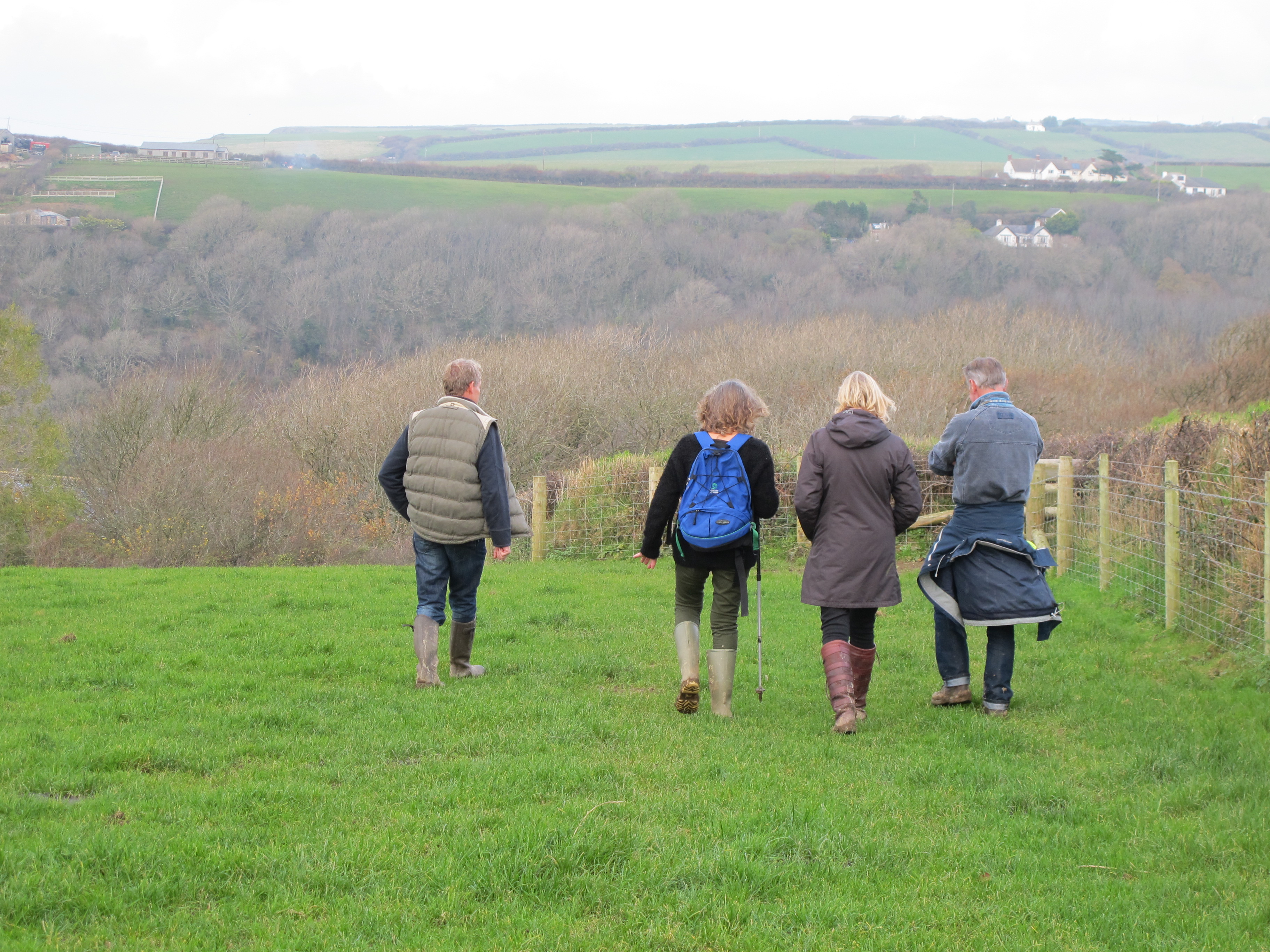
The Parish Plod

The Parish Plod

Eventually, as so many things do, it ended at the pub, at least for some of the walkers.

A word about footpaths in the U.K.: Forget your castles, your cathedrals, your stone circles—the footpaths make me feel I can almost touch history here. I’ve followed paths that have been walked not just for centuries but for thousands of years, and they’re still in use. People walked them before running shoes were invented. Before maps. Before metal. Before pubs, even. The people who built the stone circles walked them, and they saw at least some of the same wildflowers. (Land use patterns and imports would have eliminated some and added others, but some would have been the same.)

These footpaths are protected public rights of way, giving walkers the right to cross private land. They take you across fields, through herds of cattle and sheep, through mud that comes up to your ankles and fights for your boots, along the cliffs by the coast, and sometimes through a farmyard or past someone’s front windows. Some landowners hate them, but if you buy a house with a footpath, then you own a house with a footpath. It’s like owning a house next to a road: You don’t get to move the road just because you’re not crazy about the traffic. In 2004, Madonna butted heads with the laws governing footpaths after she bought a modest little mansion whose land included a footpath, and she came away with a bruised forehead when she tried to close it.  She did win the right to limit people’s access to parts of her land, but ramblers (as dedicated hikers are called) kept the right to cross it.

parish plod 004

Cattle making sure we left their field as we found it.

Many of the old footpaths have been lost, so the ones left in our parish don’t entirely link up, but the ones that are left are a real asset, loved by both tourists and local residents.

The group I went with got back to the café first (we had the shortest route), declared ourselves the winners, and waited for everyone else to straggle in. I brought the dog down to the stream and washed the mud off her, then we came back equally wet and cold, so at least I hadn’t done anything to her that I hadn’t done to myself.

I’ll be surprised if we don’t do it again next year.

Trying to Count the Cornish Wildflowers

Wild Thing and I hadn’t really seen the Cornish countryside until we discovered the footpaths, and the wildflowers bowled me over. I was living in Minnesota then, and when it isn’t frozen solid and buried under snow Minnesota is green and beautiful and all that, but you wouldn’t be tempted to call it lush. It’s too cold for too much of the year. What wildflowers grow there always struck me as self-effacing, somehow, as if they didn’t want call attention to themselves.

A lot the people are like that too.

T. and S., whose roots are in western Minnesota, swear there were more wildflowers when the farmers didn’t use pesticides as enthusiastically as they do these days, and I’m sure that’s true, but still, Minnesota’s a bit like the Puritans were: It’s never going to encourage a wild profusion of stuff it doesn’t absolutely need.

Montbretia, pronounced mombresia. Or something like that. Considered not just a weed but a thug. Isn't it gorgeous?

Montbretia, pronounced mombresia. Or something like that. Considered not just a weed but a thug. Isn’t it gorgeous?

So, while I was on parole from Minnesota, I’d walk along the footpaths in Cornwall and try to count how many kinds of wildflowers were in bloom. To understand what a misguided undertaking this was, you have to know that numbers and I are not on good terms. Ask me to remember the number 3 for more than a minute and I’ll need to check my notes. Ask me to solve a word problem (Train A left station B at 3:44….) and I’ll weep. Or at least I’ll want to. So voluntarily counting anything indicates an extreme state of mind. In this case, it was extreme happiness. So much color. So much life pushing up out of the ground. I’m tempted to say so much unnecessary beauty, but yeah, the ecosystem, the necessity of so many things we humans don’t think are necessary because we can’t make any immediate use of them. All of that. Still, you can see what I’m getting at.

The problem with counting wildflowers was that first, if I’m distracted at all, I can’t reliably count from 1 to 70 without losing my way. Did I say 70? Make that 10. But second, and more to the point, I couldn’t keep track of which flowers I’d already counted. If you don’t have names for things, it turns out, it’s hard to remember them. Little yellow flower, bigger yellow flower, little yellow flower that isn’t like the first yellow flower because it has four petals, although maybe the first one did too because I wasn’t noticing petals, only color and size at that point. Little yellow flower that also has four petals but they’re pointy. Little yellow flower that I might have counted already but I don’t think so.

I often wonder how animals remember in the absence of words. Of course, as far as I know they’re not counting, but they do other complex things, like remembering smells and places and long routes. It’s not all looking at a plant and thinking either yumm or bleah, that tastes foul.

Anyway, I bought the first of my wildflower books and began attaching names to what I was seeing. And the odd thing is that this allowed me to see them better—to notice and then remember petal shapes, leaf shapes, the ways leaves grew on the stem, and from there stem shapes and whether the leaf or stem was hairy or smooth. I’m still useless with some of it. Talk of sepals sends me into a panic. Heights given in centimeters might as well be written in an alphabet whose origins aren’t on this planet for all the good they do me.

That first book led to the next book, which was organized differently and promised more, better, deeper. And another book after that. One that had photographs. Another that had drawings. Each one had advantages and drawbacks. Then one organized by color, which I’d always thought would be simpler but still leaves me flipping through page after page, looking for a match for something new that I’ve brought home. Or something that isn’t new—I know I’ve seen it before—but I’ve forgotten its name since last year at this time.

I’m still a barbarian about it all. One of my books (and I pulled it out of the shelf at random) lists 15 kinds of violet, including common dog, early dog, pale dog, heath dog, hairy, sweet, and dame’s. And speedwell? Alpine, blue ivy-leaved, fingered, germander, marsh, spiked, thyme-leaved, wall, water, wood, and on until you reach 25 of them. I’ve tried to see the differences, really I have, but I’ve decided to be happy to look at the damn plant and say, “Violet; speedwell; close enough.”

Although I do love being able to identify the ivy-leaved toadflax.

No matter how many I learn, though (and I haven’t learned that many), there are always more.

If this sounds geeky, that’s because it is geeky, but it’s not about checking off how many flowers I’ve seen or how many names I can recite. By learning the flowers, I’ve learned a new way to watch the seasons roll past. The first wild primroses come into bloom when it’s still winter, and they tell me spring’s coming. Then the celandine comes out. It’s a low-growing yellow flower. Spring progresses with each new flower, and I think of it as a yellow season.

Damn, it’s beautiful here.