
In 1666, Samuel Pepys’ maid woke him up, telling him about a fire. To which he said something along the lines of Ho hum and went back to sleep. London was a flammable town, full of wooden houses. Fire was nothing new. This one was far enough away that he wasn’t about to let it wreck a good night’s sleep. We know this because he wrote it–and endless other details of his life–down and his diaries survived him. I’ll be quoting from them extensively here. They’re online, and although each day’s entry has its own URL, I’ve only given a link to the first day. Start there. You’ll be fine.
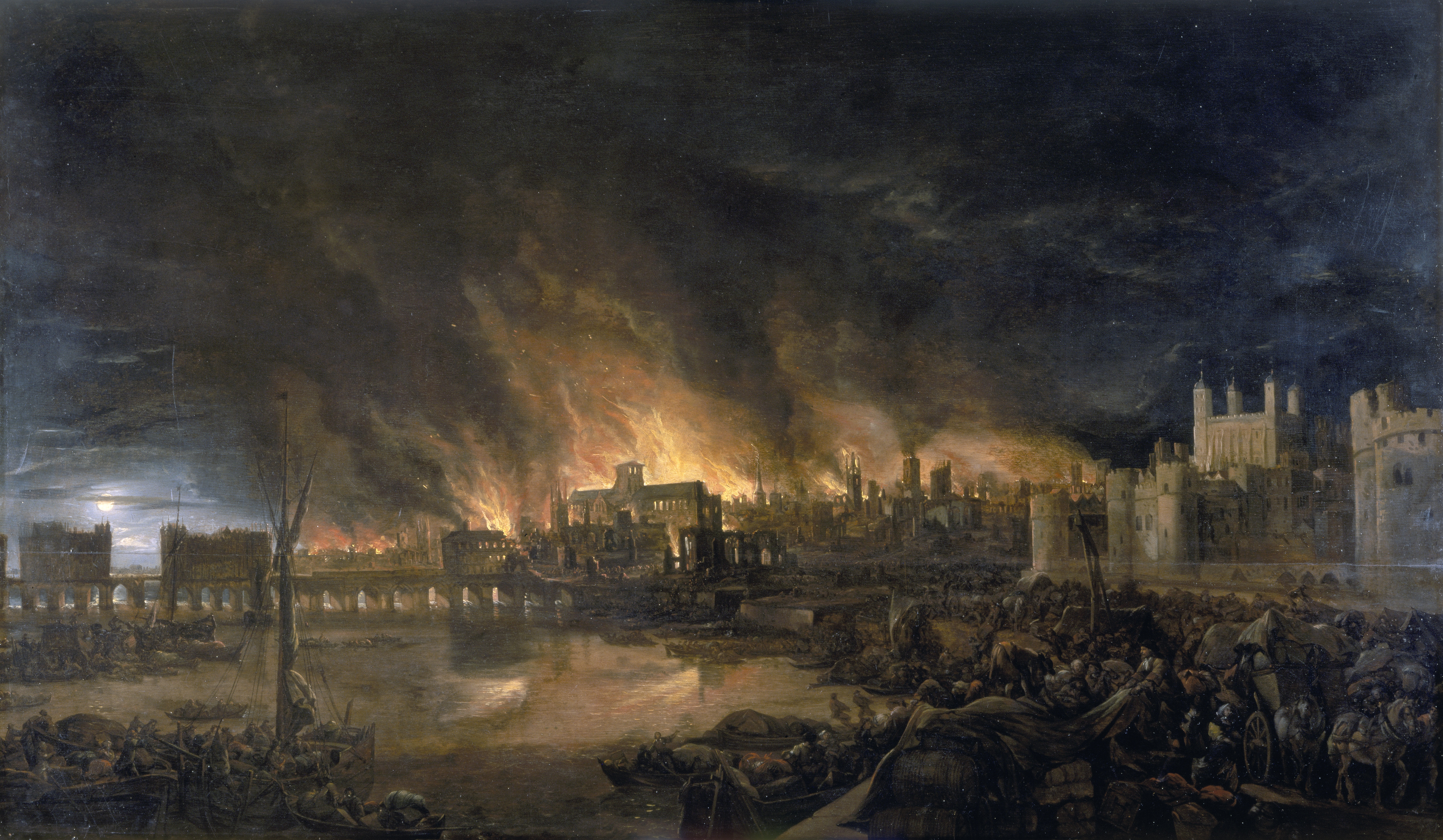
The fire. With thanks to Wikimedia Commons
The next day
The next morning, September 2, the fire still didn’t look like anything to worry about, but “by and by Jane comes and tells me that she hears that above 300 houses have been burned down to-night by the fire we saw, and that it is now burning down all Fish-street, by London Bridge.”
Okay, he starts to take this seriously and walks to the Tower of London “and there got up upon one of the high places, . . . and there I did see the houses at that end of the bridge all on fire, and an infinite great fire on this and the other side the end of the bridge.”
In other words, he thought the era-appropriate equivalent of Holy shit, this is serious and walked to the Thames, where he got a sense of just how serious.
What he saw was “everybody endeavouring to remove their goods, and flinging into the river or bringing them into lighters [they were flat-bottomed barges] that layoff; poor people staying in their houses as long as till the very fire touched them, and then running into boats, or clambering from one pair of stairs by the water-side to another. . . .
“Nobody, to my sight, [was] endeavouring to quench it, but to remove their goods, and leave all to the fire . . . and every thing, after so long a drought, proving combustible, even the very stones of churches.”
The king and the firebreak
Pepys was a member of parliament, worked for the Navy Board, and was the kind of guy who could talk his way in to see the king and the Duke of York, which he did, telling them “that unless his Majesty did command houses to be pulled down nothing could stop the fire.”
Pulling down houses was pretty much the only way to stop a spreading fire. London had no professional firefighters and even if they had I doubt the technology of the day would have let them shoot any serious amount of water at a burning house. The way to keep a fire from spreading was to destroy buildings that weren’t on fire, creating a firebreak, and the king ordered the lord mayor to do that, with the D of Y offering to send soldiers if they were needed.
Off Pepys trotted to find the mayor and in the midst of this madness, with luxury goods being hauled away in carts and on people’s backs and sick people being carried in beds, he actually found him, and the mayor, basically, said, Nobody listens to me anyway, I’ve been pulling down houses all night, I don’t need any soldiers, and I’m going to bed.
He might’ve been pulling down houses all night–I don’t know–but when the fire was first starting to spread and he was asked to do exactly that, he refused. If he gave the order, the city would have to pay for the houses it had destroyed. If he waited for the king to give it, guess who had to pay then?
Anyway, king’s order or no king’s order, he toddled off to bed.
At this point you’d expect Pepys to rush back to the king and the D of Y so they could do what the mayor wouldn’t, right?
Nah, it was noon and he went home, where he had guests. They were all worried about the fire, “However, we had an extraordinary good dinner, and as merry, as at this time we could be.”
Then he went out and found the king and the D of Y, who were on the river, and they gave the order to pull houses down. “But little was or could be done, the fire coming upon them so fast . . . [and] the wind carries it into the City.”
Translation: this, I think, is where the wind changed direction.
By that night, Pepys was packing up his own house and worrying about where to put his gold.
“I did remove my money and iron chests into my cellar, as thinking that the safest place. And got my bags of gold into my office, ready to carry away, and my chief papers of accounts also there. . . .
“About four o’clock in the morning, my Lady Batten sent me a cart to carry away all my money, and plate, and best things, to Sir W. Rider’s at Bednall-greene. Which I did riding myself in my night-gowne in the cart; and, Lord! to see how the streets and the highways are crowded with people running and riding, and getting of carts at any rate to fetch away things. I find Sir W. Rider tired with being called up all night, and receiving things from several friends. . . . I am eased at my heart to have my treasure so well secured.”
At last we get to the cheese
“Sir W. Batten not knowing how to remove his wine [it would’ve been in barrels–in other words, large and heavy], did dig a pit in the garden, and laid it in there; and I took the opportunity of laying all the papers of my office that I could not otherwise dispose of. And in the evening Sir W. Pen and I did dig another, and put our wine in it; and I my Parmazan cheese, as well as my wine and some other things.”
Why would he bury a parmesan cheese? Because it was a luxury item. Even now, when you can find the stuff in any supermarket, a 36 kilo wheel of good parmesan can cost $1,450. Back then? Sorry, can’t quote you a price, but a lot. It was rare, it was valuable, and his would’ve weighed 80 to 90 kilos.
What’s that in pounds and ounces? Make yourself a cup of coffee and multiply by 2.2.
You’re welcome. You really don’t want me doing the math.
Are you getting the sense that this is one whale of a big hole they’ve dug? Would you like to bet that when he says they dug the pit, that means they had their servants do it for them?
But back to Pepys himself.
“This afternoon, sitting melancholy with Sir W. Pen in our garden, and thinking of the certain burning of this office, without extraordinary means, I did propose for the sending up of all our workmen from Woolwich and Deptford yards (none whereof yet appeared), and to write to Sir W. Coventry to have the Duke of Yorke’s permission to pull down houses, rather than lose this office, which would, much hinder, the King’s business. So Sir W. Pen he went down this night, in order to the sending them up to-morrow morning; and I wrote to Sir W. Coventry about the business, but received no answer.
“Now begins the practice of blowing up of houses in Tower-streete, those next the Tower, which at first did frighten people more than anything, but it stopped the fire where it was done, it bringing down the houses to the ground in the same places they stood, and then it was easy to quench what little fire was in it, though it kindled nothing almost.”
Aftermath
“Could not . . . find any place to buy a shirt or pair of gloves, Westminster Hall being full of people’s goods, those in Westminster having removed all their goods, and the Exchequer money put into vessels to carry to Nonsuch. . . . A sad sight to see how the River looks: no houses nor church near it, to the Temple, where it stopped. At home, did go with Sir W. Batten, and our neighbour, Knightly (who, with one more, was the only man of any fashion left in all the neighbourhood thereabouts, they all removing their goods and leaving their houses to the mercy of the fire), to Sir R. Ford’s, and there dined in an earthen platter — a fried breast of mutton; a great many of us, but very merry, and indeed as good a meal, though as ugly a one, as ever I had in my life. . . . Thence down to Deptford, and there with great satisfaction landed all my goods at Sir G. Carteret’s safe, and nothing missed I could see, or hurt.”
The next day he was able to borrow a shirt and wash.
The fire burned four-fifths of the city: more than 13,200 houses, 87 parish churches, 52 livery company halls, the Guildhall, the Royal Exchange, and St Paul’s Cathedral. Pepys’ house did not burn and in a later entry he writes about unearthing his wine but doesn’t mention the cheese. Since he didn’t complain about losing it, we can probably assume the fire didn’t turn it into a giant grilled cheese sandwich, minus the bread.
*
For an exploration of how differently the rich and the poor experienced the fire and its aftermath, watch Ruth Goodman and Rob Rinder’s 90-minute documentary The Great Fire of London.

 Notes from the U.K.