Lewis Carroll and the British Parliament

That great institution the House of Commons meets in a room that doesn’t have enough seats for all its members (called MPs–Members of Parliament).

A good part of the time, this is fine, because most debates take place before an almost empty chamber. That probably says something depressing about how much the debates matter, but let’s move on, because it’s not the point right now. The point is that sometimes everybody does want to be present, and the only way to reserve a seat is to show up before 8 a.m. and put a prayer card on the seat you want.

Yes, a prayer card. It indicates that you’ll attend the prayer that opens each day’s session. And when you do, you and all the other MPs will stand facing the walls behind you.

North Cornwall. Newly mown fields

Irrelevant photo: fields

Yes, the walls behind you. No one knows why, but a fact sheet published by Parliament itself says it’s attributed to “the difficulty Members would once have faced of kneeling to pray whilst wearing a sword.” Never mind the awkwardness of that sentence, or the use of whilst, pay attention instead to the explanation it offers: It would have been difficult to kneel, so they all stand backward? Couldn’t they stand facing forward? Or kneel backward? And would kneeling backward really make a sword fit any better? I’d experiment, but I don’t have the right benches on hand. Or a sword. I come from the wrong class. And country. As far as I know, none of my ancestors ran around wearing swords, never mind praying with them.

But never mind all that. We haven’t dropped into a world that puts a high priority on linear logic. Since I began researching this post, I’ve come to appreciate Lewis Carroll’s Alice in Wonderland and Alice through the Looking Glass in a whole new way.

But we were talking about seats: Having reserved one, an MP actually has to show up for the prayer, regardless of what his or her religion, or lack thereof, may be. Such are the joys and absurdities of established religion.

According to another tradition—one that makes instinctive sense to me, but probably only because I’m used to it– the MPs seat themselves according to party, with the governing party on one side and the opposition on the other. That was simple enough when two main parties controlled the Commons, with a third much smaller party in the background and behaving itself nicely, but the Scottish National Party (SNP) has become a major player very quickly, and it’s feeling its power and not inclined to play nice, so all hell’s breaking loose.

It turns out that on the first day of Parliament, the prayer card rule doesn’t apply. Well, of course it doesn’t; it also doesn’t apply when a litter of all-black kittens is born precisely at noon on a Wednesday in 10 Downing Street. (Yes, I made that up about the kittens, but it makes as much sense as anything else.) So the first day of this new Parliament was a scramble. Having taken a political seat from Labour in the election, an SNP member parked himself in the physical seat that has belonged, unchallenged, to a Labour Party MP, Dennis Skinner, since forever. He and Skinner managed not to wrestle over it, but Skinner was upset enough that he wedged himself into a crack between the seat he considered his by right and the one next to it.

After that, the SNP took a row of seats behind Labour’s traditional front bench. Apparently this defies another longstanding tradition, but I have no idea what that is. As far as I know, Labour MPs didn’t pile in and sit on their laps, but I don’t know why not.

And there you have it. The mother of Parliaments, in all its sober glory.

Bizarre British festivals: Gloucester cheese rolling

What I won’t do in the interests of researching British culture.

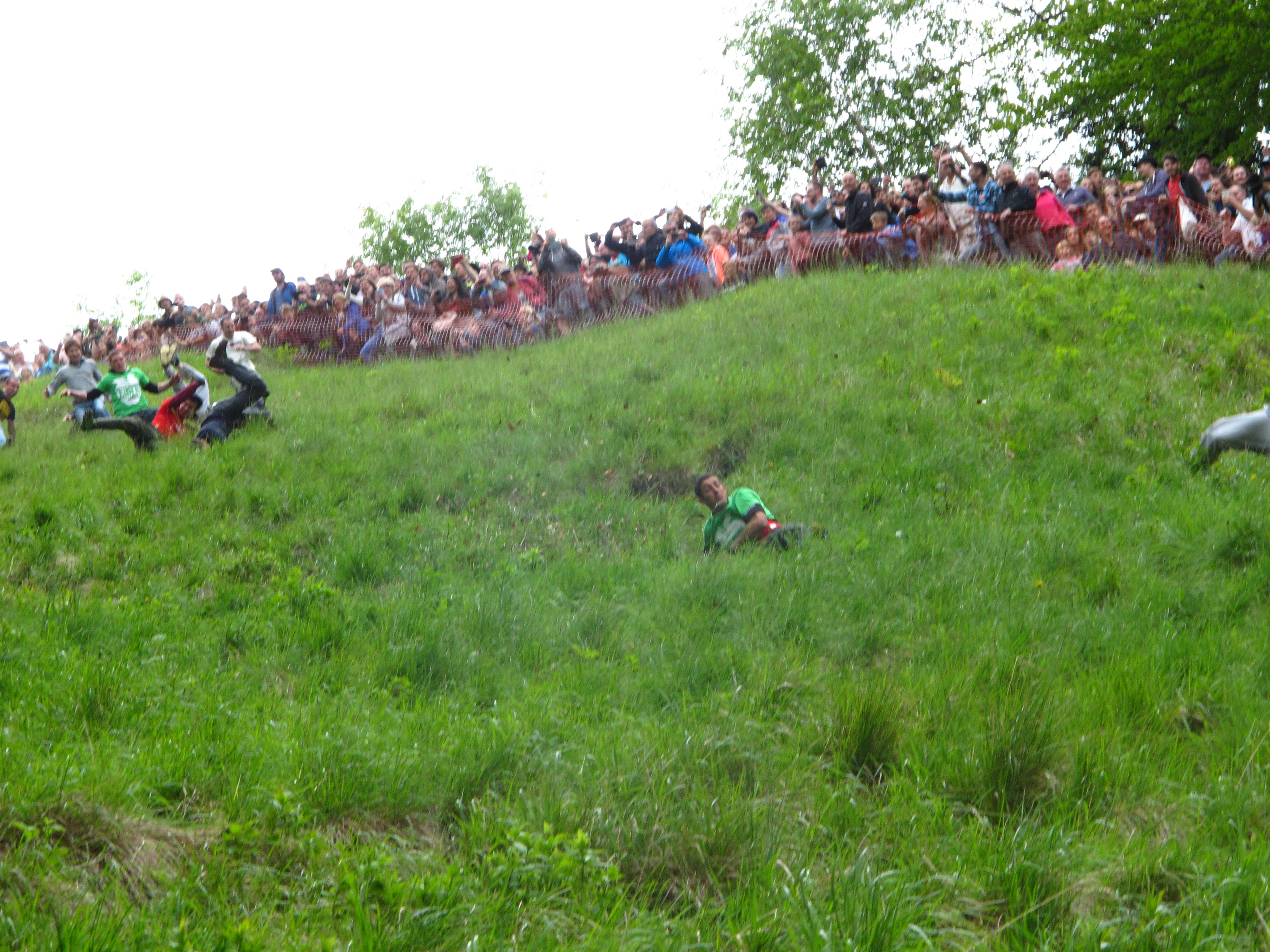
Wild Thing and I just got back from the Gloucester Cheese Rolling and I hardly know what to say, except that humans are a very strange species. The Cheese Rolling works like this: The contestants line up at the top of an insanely steep hill. Someone starts a wheel of Gloucester cheese rolling down the hill. Then the contestants run after it. The first one to the finish line wins the cheese.

Runners sliding down the hill. The camera’s at an angle and doesn’t do justice to how steep the hill is, but keep scrolling down.

Sounds simple. Did I mention that the hill is steep? Steep enough that before the race started I told Wild Thing I was going to see what was happening at the top. I got maybe ten yards uphill and thought, No I’m not. I was tipped forward, almost on all fours, and my feet were sliding backward. It would have been easier if I’d had a walking stick or two. Or possibly three. Cleats would have helped. So would a tow rope. But with anything short of a tank, it would’ve been a helll of a climb. And then I was going to have to turn around and come down, which is harder. So forget curiosity. Forget pride. I gave up and wedged myself back in where I started out.

Wedged because unless you find a bit of bumpy ground to keep you in place or dig your heels in and put those thigh muscles to work, you slide downhill onto the people below you. You’re not sitting so much as clinging. That’s the hill they’re running down.

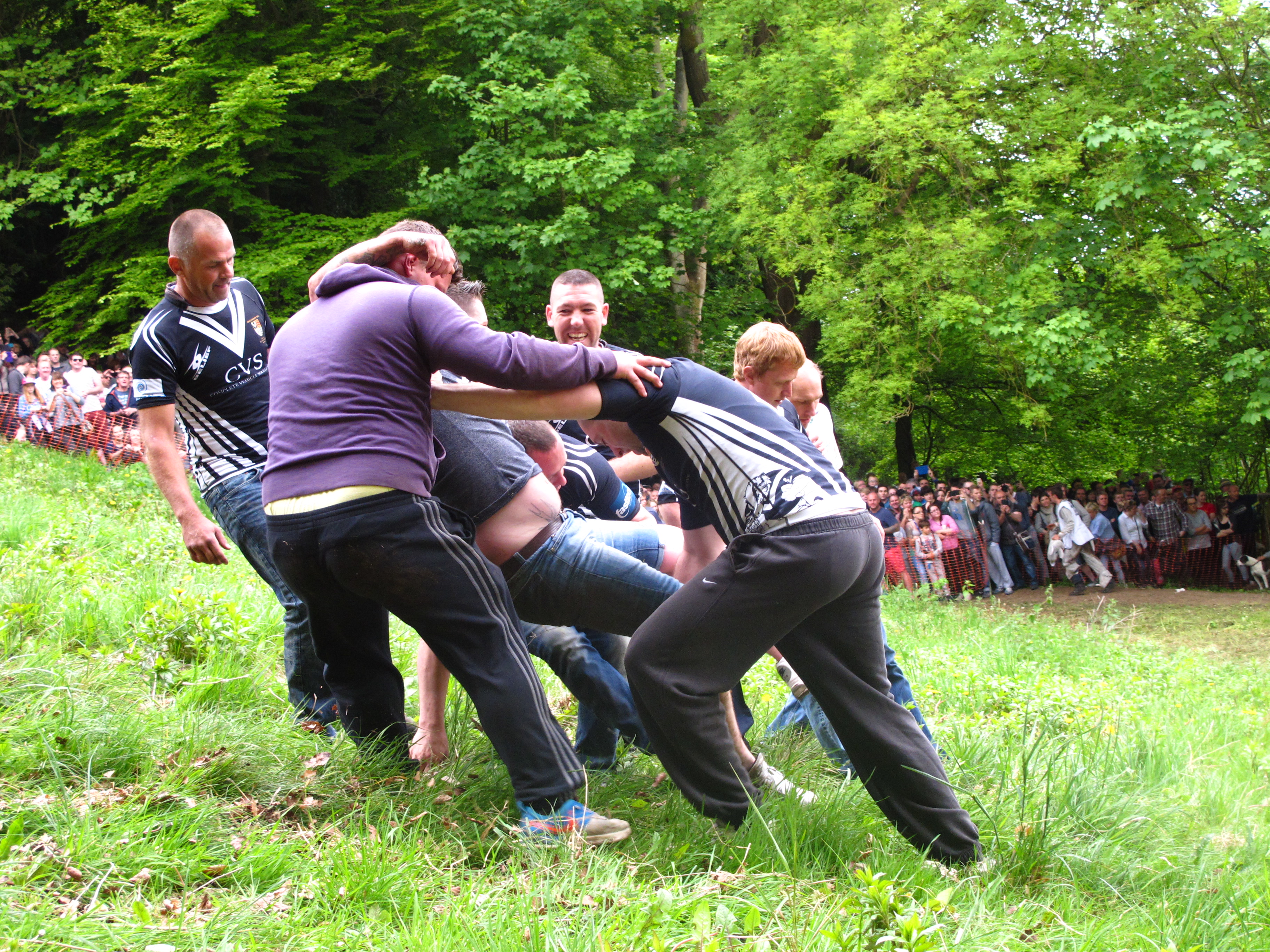
Not many of the runners stay upright. They skid, they cartwheel, and they get hurt—or some of them do. At the bottom, the local rugby team lines up to catch them, otherwise they’d keep going until they reached the Severn, or possibly the Atlantic. If that happens to be the direction they’re running in, which I couldn’t swear to but I think it was and it does sound romantic that way. What I can swear to is that they build up some serious speed. As does the cheese, which someone near us claimed hits 70 mph by the time it gets to the bottom, which happens well before the runners get there.

Helping an injured runner off the hill. Notice how the helpers are struggling to stay upright.

Helping an injured runner off the hill. Notice how the helpers are struggling to stay upright.

I didn’t see the rugby team stop all the runners. I was focused on the people who were struggling downhill, but I did see a few tackled to the ground. Others were blocked, or caught and hugged. Maybe it depended on their size and how fast they were going, or maybe a full-on tackle was a favor saved for friends. A few runners dodged off to the side, and given the heft of those guys I might’ve done the same.

Not that you’ll find me chasing a cheese down a hill. I say, if your cheese goes free-range, let it go.

A runner looks a hesitant about getting caught by the rugby team.

A runner looks a hesitant about getting caught by the rugby team.

One of the strange things about the cheese roll is that as a nation Britain takes health and safety seriously. I was once told in a second-hand store where the clerk said she couldn’t sell me a crochet hook because of health and safety. But before you start muttering about government regulation and the nanny state, consider the cheese roll. It goes on. Because it always has. Because no one’s thought to pass a law banning people from chasing cheese down a hill.

The crochet hook business had nothing to do with government regulation, by the way; it was just someone being a pill.

A few years ago, the group that organized the cheese roll couldn’t get insurance coverage. Tell me you’re surprised. This is where the real health and safety problem comes in. A tradition was about to die, but the community refused to let it and the races were held anyway, with no official organization (at least as far as I understand) and no insurance. If you get hurt, you’re on you’re own, because there’s no one to sue.

The local police hate the cheese roll. Maybe because of the crowds and the traffic and the injuries, or maybe because it’s basically insane, but they haven’t been able to stop it. They close off the nearest highway and people park outside the exclusion zone and walk past them to get there. It must drive them nuts.

We hiked in and ended up sitting next to the partner and son of a local legend who had won, if I remember right, six times in the past. He went home this year with two cheeses. What did they do with all the cheese? I asked her. The first year, he gave a lot to family and friends. After that—and here there was a pause.

“I have a lot in my refrigerator,” she said.

There are several races every year, she said. How many depends on how many cheeses they have.

Well, of course.

Sometimes they don’t have enough cheeses to satisfy the runners, so an extra race pours downhill anyway.

A first-time runner was standing near us, and after his race I asked how it had been.

“Fast,” he said, “and exhilarating. And terrifying.”

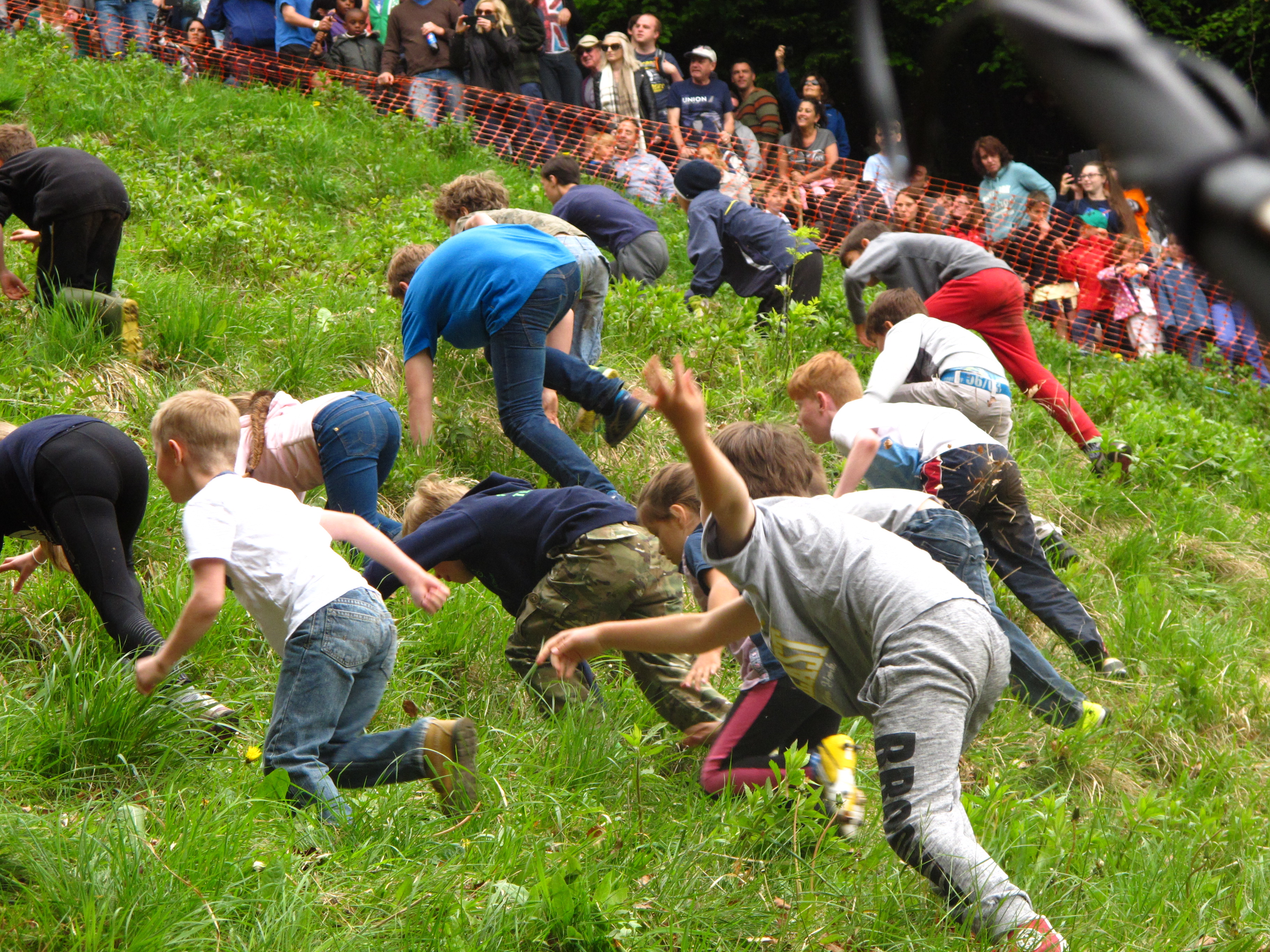
One of the races is for kids, but they go uphill, shepherded by the rugby team catchers and a few adult runners. It’s safer going up. Of course, then they have to come back down to rejoin their families, and inevitably some of them run. And some of them scoot down on their butts. And some of them are terrified. The adult shepherds were very sweet about coming down with them. A rugby player scooted on his butt alongside one kid. Another led one by the hand. The last kid off the hill got a round of applause.

The kids' race.

The kids’ race.

This being England, a few adult runners showed up in costumes—what’s called fancy dress here. One guy came to a halt near us, stopped to make sure someone who’d fallen was okay, then pulled on a mouse’s head and finished the race in it. Another was dressed as a banana in a top hat. Well of course he was. Other costumes I saw were a kilt, a cape, and a tutu combined with a Canadian flag tee shirt.

According to an awkwardly worded Wikipedia entry, “Two possible origins have been proposed for the ceremony. The first is said that it evolved from a requirement for maintaining grazing rights on the common.

“The second proposal is pagan origins for the custom of rolling objects down the hill. It is thought that bundles of burning brushwood were rolled down the hill to represent the birth of the New Year after winter. Connected with this belief is the traditional scattering of buns, biscuits and sweets at the top of the hill by the Master of Ceremonies. This is said to be a fertility rite to encourage the fruits of harvest.

“Since the fifteenth century, the cheese has been rolled down the hill, and people have competed to catch it.”

As is usual with these things, no one knows for certain. One woman from the area thought the race’s history was measured in decades, not hundreds of years. All I know for a fact is that the country’s full of traditional festivals, and some of them are stranger than this one. I hope to get to one of them later in the year.

If you want to know more about the cheese race, here’s a link to an article from a local paper, one to the official site, and one to cheese race pictures.


Strange stuff non-Brits want to know about Britain

Two stray questions about Britain that people have asked me to address, which I’ll group together because they’re 600% unrelated: kinky sex and the letter U.


Are the English particularly kinky?

Katie Powell wrote, “I want to know why English folks are so kinky.” I asked her to be more specific and she answered, “The Brits exude this very staid exterior, but then there is the underbelly of kinky sex — maybe the kinkiest in the world? Not violent or dangerous, just kinky . . . .”

Sadly, I’m not willing to do any original research on the topic. Nope, not even for my blog. A few other things I won’t do, in case you need to know about them: I will not eat haggis in order to tell you what it tastes like. Not particularly because it’s haggis but because it involves meat. You can get vegetarian haggis, but that’s like vegetarian bacon—it is vegetarian but it’s not bacon, so it’s not much use if you’re trying to report on bacon. I also won’t get stinking drunk so I can find out if the tendency of drunks in this country to sing is cultural or due to some mysterious influence of the geography. So, sex in the British Isles? It does go on. I’m sure of that. But Wild Thing and I have been together for—wait, let me wrestle with a few numbers—38 years now. That’s long enough, really, for a person to make a commitment to a relationship. To get comfortable in it, and not want to wreck it. And then there are my own tastes to consider (which, forget it, you don’t need to know about, and very probably don’t want to).

cut kitten picture

Screamingly irrelevant photo: Fast Eddie and the laundry

I can report that back in the Stone Ages, when phone booths were the kind of thing you found on any city street, lots of London phone booths were plastered with stickers advertising sexual services designed for specific tastes–mostly S&M, at least as I remember it. I’d never seen the sex trade advertised that way. Does that mean the tastes of actual people here are kinkier than they are anywhere else? I haven’t a clue. Maybe they’re just out in the open more—although I’ve known some Americans whose interests were far from white bread and who had a lot more to say about them than I, for one, wanted to hear. They didn’t plaster them on phone booths, but then they weren’t in business, so they had no reason to.

So this separates into two question: Is there a difference in kink level? Do different cultures channel their kinks in different directions? It’s also possible that the definition of kinky is worth some thought. It assumes there’s a standard practice out there, and I wonder how standard anyone really is. I haven’t a clue, but I’ll leave you with that thought and move on to a question where I can be more useful.


History of the letter U in British and American English

Once upon a time I knew who asked me about this, but I didn’t paste either the name or the link into my notes, and although I swam back through the comments trying to find where it came from it, it was too far and I sank. That’s me you’ll notice on the bottom of all your insightful, hysterical, wonderful comment threads, blowing the last electronic bubbles out of my lungs.

Bad blogger.

So I’m going to be rude and not acknowledge the source of the question.

However. Someone asked me to write about the history of the letter U in British and American usage, and if you’ll let me know who you are I’ll provide a link to your blog. In the meantime, the tale takes us back to two of the most influential compilers of early dictionaries.

When the British first settled in North America, English spelling was still fluid. You went to school, you were issued a toolkit with 26 letters, and as long as another person in possession of that same basic toolkit could figure out what you meant, you were free to spell a word any old which way you wanted. I may exaggerate a bit, but not much.

It was Samuel Johnson, in the eighteenth century, who’s usually credited with (or blamed for) standardizing English spelling, although—as is usual with this kind of thing—there was a general movement in that direction and rather than creating the momentum himself he rode in on its tide. But still, if you don’t like the U in British spellings of words like favour and honour, Old Sam Johnson’s your bad guy. Up until then, English had used  -our interchangeably with -or.  According to an article in Bartleby Johnson “established the position of the u in the –our words. . . . Other lexicographers before him were divided and uncertain; Johnson declared for the u, and though his reasons were very shaky and he often neglected his own precept, his authority was sufficient to set up a usage which still defies attack in England.”

He was so knocked out by the U (which I’m capitalizing and the Bartleby entry doesn’t) that he tried to introduce translatour, emperour, oratour and horrour. Oddly enough, although he kept exterior U-less, its opposite was interiour.

Johnson’s reasoning was that the -our form acknowledged modern English’s French roots. If you know any French, you’ll have noticed that the argument’s shaky. French uses -eur, not -our: honeur; faveur. But never mind, an argument doesn’t have to make sense to be effective. British English is firmly committed to sticking a U into any word it possibly can. And, hell, they’re free, so why not?

If Johnson’s usually credited with standardizing English spelling, Noah Webster’s usually credited with divorcing American spelling from its British ex, although here too other people were already agitating for that and he too rode a tide he didn’t create. The United States was a new nation. It wanted a new culture. You know what it’s like: You have a revolution, you rename the streets, tear down the political statues, replace the schoolbooks.

Webster came down heavily on the side of simplified spellings, and his early books deleted a lot of the language’s silent letters: the B in thumb, the O in leopard, the A in thread. You could cut a 300-page book down to 150 pages if you kept that up. Also the K that was then in frolick, the spare L in traveller and jeweller. He transposed the -RE in words like centre.

“Those people spell best who do not know how to spell,” he said. Or quite possibly wrote. But let’s not split hairs. The point is that they were spelling phonetically and logically, and he set out to follow their lead with spellings like wimmin, tung, porpess, and fantom.

They didn’t all catch on, and as a result generations of schoolchildren toddle home with spelling lists to memorize for no better reason than that they’ll look ignorant if they don’t spell the words in the approved way. Think what they might have time to learn instead if our language made sense.

George Bernard Shaw, in demonstrating the need for rationalized English spelling, is said to have argued that, given the rules of the English language, you should be able to spell fish ghoti: GH as in tough, O as in women, TI and in nation.

Don’t use that on your standardized exams, kids. The people who mark them won’t be impressed.

Miss Marple and World War II evacuees

I’m sure Miss Marple would agree: There are no secrets in the village. But there’s a lot of misinformation, and if you want to unravel a story, that’s where you start.

Wild Thing and I worked on the village newsletter for a while. Then we stopped and the newsletter continued on. Long story there and not one I’m going to tell (sorry), but I mention it because we got a letter last week addressed not to either of us but to the newsletter’s secretary—no name, just the title—with no street address and a post code that would land you somewhere in the village but not at our house, or even close to it.

And it reached us. Because we used to get mail for the newsletter, and because the letter carrier remembered that.

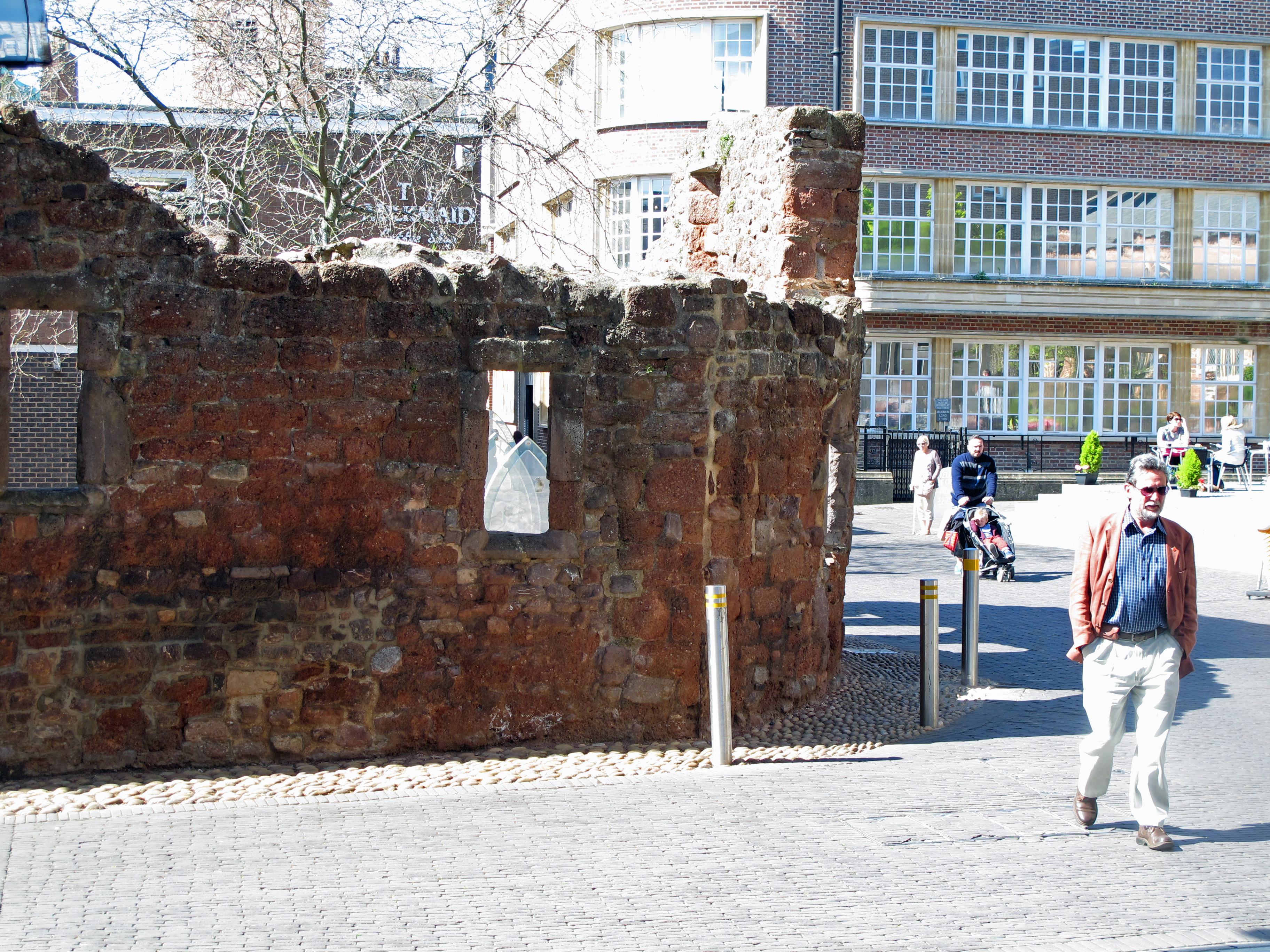
Remains of a church, destroyed in the bombing of Exeter city center, now preserved as a monument.

Remains of a church, destroyed in the bombing of Exeter city center, now preserved as a monument.

I took the letter to M. She’s not the newsletter’s secretary, but then neither is anyone else. It works just fine without one. She does work on the newsletter and part of her job, at least when I was still involved, was to type up announcements that come in on handwritten scraps of paper, so it more or less made sense to choose her. Here was a handwritten bit of paper. Not a minute’s walk from our house was M. So I rang her bell and handed her the envelope.

“You didn’t open it,” she said.

I hadn’t. Not because I’m virtuous (although, oh, I am; painfully so; if I didn’t swear so much, I’d float a good six inches off the ground) but because I hadn’t been curious about it. Mostly—let’s be honest here—the newsletter’s pretty dull. Suddenly, though, I did care. We were holding a secret and we were inside the village. We were two bad kids, about to be find out something that was none of our business. Except that it was, but let’s not argue, the feeling was delicious.

She tore open the envelope.

The letter turned out to be from a woman who’d been evacuated to the village during World War II, asking for information about someone she’d known. M., who’s much better than I am about knowing who’s related to who(m, if you insist), immediately started talking about who would know. And there I left it. She’ll make a few calls. People will ask around. The network will be activated. If nothing else works, the newsletter will run the letter. Maybe it’ll run it anyway, because other people will want to know about it, and it may trigger reminiscences of those times, and all of that is the job of a village newsletter.

*

If you don’t know the history of the World War II evacuations, or if you’re interested in how it affected the Southwest: Many British cities were heavily bombed and children were evacuated to safer areas. It was a measure of the desperation families felt that they’d send their children off into the unknown, to live with strangers. Most of the evacuees returned home at the end of the war, but a few settled locally, and more than once we’ve met people who, when we asked if they’d always lived in the area, said, “I was evacuated here as a child.”

Of the nearby big cities, Plymouth was heavily bombed, and Exeter was bombed but not as heavily. Unlike Plymouth, it wasn’t targeted for its industrial or military importance, but for its cultural and historical interest, which no one had expected, and although children were evacuated from Plymouth (a predictable target), they’d been evacuated to Exeter, which must have seemed safe. The BBC has compiled a list of bombings in Cornwall and some memories of evacuees and others who lived in Cornwall during the war (and elsewhere in the country, but the link will take you to the Cornwall pages). The memories especially are worth a look.

British school uniforms: a follow-up post

D. tells me that the dowdy little dresses I said the youngest British schoolgirls are stuffed into are voluntary. They’re for summer, she says. They’re cooler. Some girls (or their parents, which is not at all the same thing) prefer them. Furthermore, at least in some schools the boys don’t have the option of wearing shorts in hot weather, which some boys consider discrimination. In 2011, a twelve-year-old boy wore a uniform skirt to school as a protest. A loophole in the rules meant that he was still wearing an acceptable uniform, the clever little devil.

You may be interested to note that if you follow the link to that article, the end disappears quickly and you can’t read it unless you take a phony survey designed to prove that some brand of shampoo is better than chocolate and a sunny day all rolled into one. It will also make you so sexy you’ll give up chocolate voluntarily. Which does seem contradictory, but what do I know about marketing? I’m just the sort of contrarian who wouldn’t take their alleged survey and as a result I don’t know what the rest of the article says, so I can only hope it doesn’t say April Fool. Probably not. The date is May.

Wildflowers, celandine

Irrelevant photo: celandine, a wildflower–one of spring’s early ones, but still in bloom.

British educational terminology: the cheater’s guide

APROMPTreply asked what A-Levels and Sixth Form are, and Diane Clement wanted me to “explain all the education jargon in the U.K., especially this new stuff that sounds like American charter schools.”

Let’s start with Sixth Form, because it’s damn near manageable. The phrase is left over from an earlier way of organizing education—or at least of talking about how it’s organized. What I (being American) call grades and are called years here but were once called forms. The First Form was the first year of secondary school.

Lanhydrock House, Cornwall, rhododendron, azaleas

Irrelevant photo: rhododendrons and azaleas in bloom at Lanhydrock House

Students who stayed in school to study for A-Levels (those are tests, and if I live through this part of the explanation I’ll get to them) went into the Sixth Form, which took two years and was divided into the Upper and Lower Sixths, because it would all be too simple otherwise. To ward off the danger of simplicity even further, some schools called the Upper Sixth the Middle Sixth because students who were trying to get into Oxford or Cambridge would do a third year of Sixth Form and that was the Upper Sixth. But some schools called that the Seventh Form or the Third-Year Sixth.

And you thought English spelling was complicated. The urge to complexify runs deep in the culture.

But move along, folks, nothing to see here, as they say on British cop shows when there’s been an accident and parts of the language lie strewn and bleeding all over the road.

Now that you’ve memorized all that, you should know that it was swept away in 1990—except in public schools, by which, of course, I mean private schools. Do keep up (as they say here). Being private, public schools get to do whatever they want and—well, let’s put it this way: Have you looked at the uniforms those kids wear at the fanciest public schools? I know not many people feel sorry for the rich and ridiculous, but good lord. Somebody should intervene on their behalf. Anyway, the uniforms don’t lead me to think these schools set a tradition aside just because it no longer makes sense.

Or because it never did.

But back to state schools. They now count from Year 1 up to Year 13, which is simple enough, but lots of people still call the last two years the Sixth Form because they used to and who’s to stop them? And in case it all sounds worryingly simple, you should know that Year 1 starts after Reception, so Reception is really the first year except that it isn’t. As an American, I’m used to the idea that first grade comes after kindergarten, therefore this almost makes sense to me, except for that business about calling it Reception, which sounds like a desk near the entrance of a building.

Typically, Sixth Form students don’t have to wear uniforms, which is a big deal, since the poor creatures  have been stuffed into one uniform or another since they first entered the school door. But at least most state schools (emphasis on most) choose something that borders on sensible—sweat shirts, polo shirts, trousers that I’d call pants except that means underwear here so let’s call them trousers. I so want to believe the kids can choose their own underwear.

The littlest girls get stuck wearing dowdy little checkered dresses in some schools. On their behalf, I wish to register an objection–to the dowdiness (I know I said I was post fashion, but there is a limit) but far more so to making them wear dresses. I mean, what year is this, anyway? Are they supposed to sit at their desks and do samplers while the boys go out and play?

Some Sixth Form students go to Sixth Form colleges, which may offer a wider range of courses than schools that combine Sixth Form with the rest of secondary school. In rural Cornwall, this may mean either traveling long distances or rooming near the school during the week, which not everyone can manage, so access is divided by a combination of money and geography..

And in Scotland and Northern Ireland? Every bit of this is called something different. What I wrote applies only to England and Wales.

Isn’t this fun?

And now, undaunted, we stagger on to A-Levels, which are the high-stakes tests at the end of Sixth Form. AS-Levels are the first half of A-Levels. Admit it: You don’t really want details here. O-Levels were replaced by GCSEs, but both are high-stakes tests that come before Sixth Form. All of them can be spelled without the hyphen, although you might lose points for it on the exam.

I’ve been following the education system here long enough to offer the following authoritative report on all these tests: If the average scores go down one year, the press and politicians fret and agitate about why the younger generation is failing to learn and society is failing to stress the importance of education and the schools are failing to teach, and in general there’s hell to pay. If the average scores go up, the press (and some politicians, depending on whether their party’s in power or out) fret and agitate about the tests having been dumbed down. And there’s hell to pay.

How many ways to win can you spot here? I can’t find a single one.

One problem—here and elsewhere—with high-stakes testing is that schools are judged by their students’ test scores (and students’ futures, ever so incidentally, are determined by them) and so they teach frantically to the tests. The tendency, then, is for broad and imaginative teaching to go out the window. For flexibility to go out the window, along with the cultivation of creativity and independent thinking. Because tests can test only those things that can be standardized and measured and marked. They push the schools to become factories. I’d weep, but it’s not likely to make any of us laugh, so I’ll move along, leaving a trail of damp tissues for you to follow.

And it is in this unhygienic way that we come to the educational jargon Diane asked about, and for the most part I haven’t managed to be funny about this, so you’ve been warned. It’s also complicated enough to make Sixth Form look simple, so I’ll narrow it down as tightly as if we were clutching it to our chests and squeezing with it through the eye of an A-Level.

State schools have historically been the responsibility of local councils—or to translate that, of local governments. There’s always a but, though, isn’t there? The money comes from the national government, so you can guess where the power lies, and the last government became obsessed with a Swedish experiment with free schools—schools that weren’t under local government control and that, in theory, would be free to innovate. Parents would be free to choose their children’s school, schools would offer a range of educational approaches and compete for students, and that would force them to improve, and everything would get better and better in this best of all possible worlds.

A recent report from the Organization for Economic Cooperation and Development recommended that Sweden abandon its experiment because it’s led to a steep decline in educational standards, but never mind. What do they know?

So a good chunk of money has been pumped into free schools and academies. I’m not going to get into the difference between academies and free schools because, hey, I’m simplifying here, and it won’t be on the test anyway. Besides, I don’t understand it and, as folks say here, I can’t be arsed to look it up.

Academies and free schools have been started, variously, by concerned parents who have the free time (which usually also means the money) and expertise to do that, by teachers, by for-profit chains, by nonprofits, by religious groups, and inevitably by the occasional scamster. A few state schools have been forced, over parent and staff objections, to become academies on the theory that this will improve them. Under the new government, we can expect more schools to go down that road. The new government just loves free schools and academies.

Unlike state schools, free schools and academies don’t have to worry about responding to a region’s needs. They can and often do open where there are already enough places, meaning government money goes to set up schools where they’re not needed. Also unlike state schools, they don’t have to hire qualified teachers. They don’t have to pay teachers the going rate, because they’re starting from scratch and their teachers have no union. They are, in theory, free of political interference, but they seem to be directly, and heavily, beholden to the central government rather than to the local one, so all this diversification may (emphasis on may; I’ve read about this but didn’t save the articles and I’m not a good researcher, so I can’t find any sources on it right now, which means I’m working from memory and impressions) be centralizing the control of education rather than loosening it.

One argument for these schools is that they’ll provide an alternative to failing schools. I read that so often that a person could begin to think all state schools are failing. They’re not; some have serious problems and others are doing well. From what I’ve read, the academic record of the new schools is mixed. Some do better than the comparable state schools and some do worse. Some aren’t well planned and close without warning, leaving the parents scrambling to find their children other ways to finish out the academic year. Some are in areas where they’re not needed. Opponents argue that they take up a disproportionate amount of the education budget, starving the state schools of funds. Proponents argue that they encourage diversification, excellence, and choice. Do I sound biased? I am, especially about the way the deck’s been stacked against the state schools.

So, to return to Diane’s question, they’re somewhat like the charter school movement in the U.S., but with the added, and I think toxic, element that state schools can, in some situations, be forced to become academies even if they and the parents involved don’t want to.

British fashion, high heels, and dyslexia

Diane Clement asked, “Do British women feel the need to teeter around on high heels in their professional lives?? I always feel a bit sad when I see a woman with future foot problems carefully mincing around in them.”

Since I’m as dyslexic about fashion as I am about math, I hadn’t noticed.

How can anyone not notice if another human being is teetering around on something that makes her three inches taller than her normal height and seven times more prone to foot and back problems but that she thinks (and many people agree) make her look fantastic? Trust me, I can. I’m already shorter than 97.3% of the adults around me, so if they all grew by half a foot, what difference would that make to me? I’m already looking up.

Two interruptions here:

  1. 73.9% of all statistics are made up, including this one, so you should go back and reread the paragraph just above with that in mind.
  2. Endemic mathematical incompetence is called dyspraxia, not mathematical dyslexia, but it sounds like a disease and I’d much rather think of myself as dyslexic about numbers. I mean, my old friend T. used to claim she became dyslexic anytime she drove in St. Paul, and if she can have geographical dyslexia I don’t see why I shouldn’t have the mathematical form. However, I hate to offend anyone unnecessarily, so in case misusing of the word bothers anyone let’s put it this way: There is nothing involving numbers that I can’t fuck up.

There, that’s less offensive, isn’t it?

Irrelevant photo: bluebells in flower at Lanhydrock.

Irrelevant photo: bluebells in flower at Lanhydrock.

But back to high heels, which is our alleged subject. I asked M., who knows all, although I admit that as I phrased the question I didn’t work the teetering or the mincing or the foot problems. Researchers shouldn’t let their biases or anyone else’s get in the way, and I do take this blog seriously.

The short answer is yes—women in Britain tend to wear high heels in their professional lives. Although, M. said, styles do change, and sometimes flat shoes are in fashion, or low heels.

This next bit isn’t entirely relevant, but why should that stop me? The last time—and it was roughly a hundred years ago—that I wore heels of any sort I slipped down half a flight of stairs. The nice thing about my fashion dyslexia is that I now wear running shoes regardless of what’s in style. My feet are happy, and if people think I look funny I’m oblivious, so the rest of me is happy as well. My wardrobe and I are now entirely post-fashion.

Have I mentioned that this isn’t a fashion blog? That won’t stop me from answering fashion questions, but it may stop me from answering them competently.

How British and American beers compare

Belladonna Took wrote to say, “I would like to know about beer. Is it indeed served at room temperature in Britain? And is it real beer with hops and lifeforms in it, and not the chemically scrubbed cat piss that passes for beer over here [in the U.S.]? (I’m not referring to the good stuff one can get from a microbrewery, of course, but the stuff sold in supermarkets.) What about alcohol content? I’m pretty sure it’s lower here.”

Gee, Belladonna, I wish you’d tell how you really feel. Don’t be hold back.

I had to ask around, because it’s been so many years since I ingested alcohol that I don’t remember if it comes in a solid or a gaseous form.

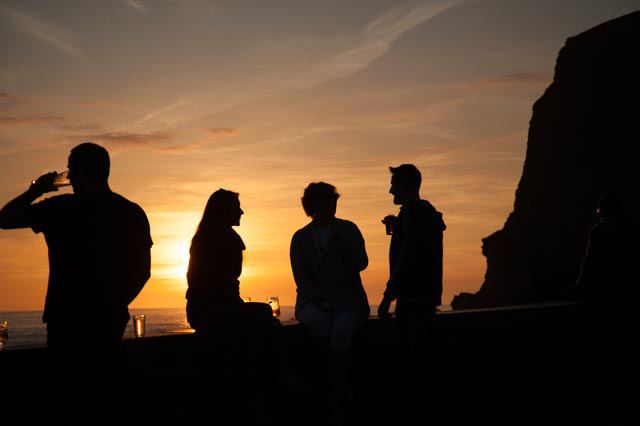
Beer at sundown. Photo by Ida Swearingen

Beer at sundown. Photo by Ida Swearingen

First I asked Google about alcohol content and read that British beer is weaker than American—below 5%, although that will vary from brand to brand and from time to time. I also learned that British brewers, or at least some of them, began making their beer weaker in 2012 because it’s cheaper that way. For them, of course, not for the customer. They probably figured nobody would notice, and since nobody’s burned down the breweries they were probably right. Then I read a list of the alcohol content of American beers and it ranged all place, but some of it was below 5%. So the definitive answer is that it’s complicated and you should never trust me with numbers. But the British stuff is probably weaker.

Sorry, Belladonna. Don’t shoot the messenger.

Next, I asked M., who’s tasted both American and British beer. She said that beer is definitely served at room temperature in the U.K., as is ale, and that they have a richer taste than American beer, so I’m guessing that takes them out of the cat piss category.

A brief interruption here: I have an elderly cat who’s asked me to put it on the record that her piss is nothing at all like American beer and is altogether lovely. She was offended, but if you’d offer a bit of fish by way of apology, Belladonna, I’m sure the incident would be forgotten.

M. also said that lager is more like American beer and is served cold.

And hops? I didn’t ask anyone about this, but yes, hops are involved in both countries. You can’t summon beer out of thin air, even when the beer in question tastes like you did..

Finally, since I was at singers’ night at the pub anyway, I raised the subject there and learned why beer’s served at room temperature and lager’s served cold: Beer’s brewed at room temperature, so its taste develops and is at its best at that temperature. Lager’s brewed in cool cellars and its taste etc. So—unlike so much in life—there’s actually a reason for this and it all makes sense.

Who’d’ve thunk?

And finally a note: This is a bonus post. I usually post twice a week, but I’m working my way through the questions people asked and, I dunno, it seemed like a good idea. Since I’m having a good time with this, I’m still accepting questions about either the U.S. or the U.K.

English place names: where did the missing syllables go?

barbtaub asked why some English place names have “whole syllables missing? How could Worcester only have two syllables? Where do the L and the W go when you say Alnwick out loud?

Well, I’m here to enlighten. The L and W go out for a pint, and after that, y’know, you just can’t count on them so it’s better to pronounce the word as if they’d never been there at all.

Now the R, C, and E—that’s a whole ‘nother story. They’re tea drinkers, and they’d come back if they were invited, but no one thought to so there they sit, with their cooling cups of tea, waiting for someone to remember them. It’s all very sad.

Why tea instead of beer? If they’d dropped out of Cornwall, I’d guess they were Methodists—Cornwall is historically Methodist country and the Methodists are serious teetotalers—but since we’re dealing with Worcester I won’t risk a guess. It just is that way. Some people want a pint, others want a cuppa.

Camel Estuary. Padstow. North Cornwall.

Irrelevant photo: the Camel Estuary.

What I can tell you is that the letters in English place names are unreliable. I expect that’s a cultural inheritance from French. You know, 1066, the Norman invasion, all that French influence pouring into what was until then a Germanic language. Whether you could count on the spelling of Old English to be even vaguely sensible I don’t know, but I do know that French is wasteful with its letters, not just in place names but in everything. It tosses in handfuls it has no intention of pronouncing as if to say, “See how rich we are? We have so many of these we can afford to throw them away.”

When you treat letters like that, why should they stick around? They’re not needed, so of course they seek solace in the pub or the café. Who wouldn’t?

Now that Britain’s in an age of artificially induced austerity, you’d think the government would want to claw some of those wasted letters back. I mean, at one point, the government considered selling off nationally owned woodlands, which were being used and weren’t in the pub, and it only backed off because the proposal caused an uproar. I’ve read speculation that they’ll sell off property owned by the National Health Service soon. You know—balance the books in the short term, even if it impoverishes the nation in the long term. What the hell: by the time the problems show up, some other government will be in power, so who cares? It’ll all be their problem to solve.

What I’m thinking is that they could easily sell off those vowels and consonants that no one’s using. A prime example lies up the coast from us: Woolfardisworthy is pronounced Woolsery, and the spelling’s so out of whack with the pronunciation that the road sign (in a rare moment of linguistic sanity) gives both spellings. So we could not only save on letters, we could have a smaller road sign.

Not all place names present as clear a case. The town of Launceston has three pronunciations: LANson (that’s the Cornish version), LAWNston (I’m not sure who pronounces it that way), and LAWNson (I think of this as the compromise version and it’s the one I use; with my accent, LANson sounds too strange). The only pronunciation that’s wrong is lawnCESSton—the one that uses all the letters. With three pronunciations, it’s not clear what letters we should sell off, but that doesn’t have to stop the program. Sacrifices must be made.

For what it’s worth, I’ve read that over centuries the sandpaper of time tend to wear away at difficult pronunciations. I’m still waiting for it to smooth out the pronunciation of sixth. Try saying that quickly three times. Still, the theory would explain the bizarre spellings of place names. English spelling was codified when the pronunciation was still changing rapidly, and it reflects (or so they say) pronunciations we no longer use. So place names were frozen even as the residents went about the natural business of simplifying the pronunciation, leaving us to wonder, What were they thinking?

Aren’t you glad you asked, barbtaub?

Traditional British celebrations: May Day in Padstow

The Padstow May Day celebration is so old that no one knows when it began. The only things that are certain are that (a) it’s genuinely ancient and (b)it’s still going on.

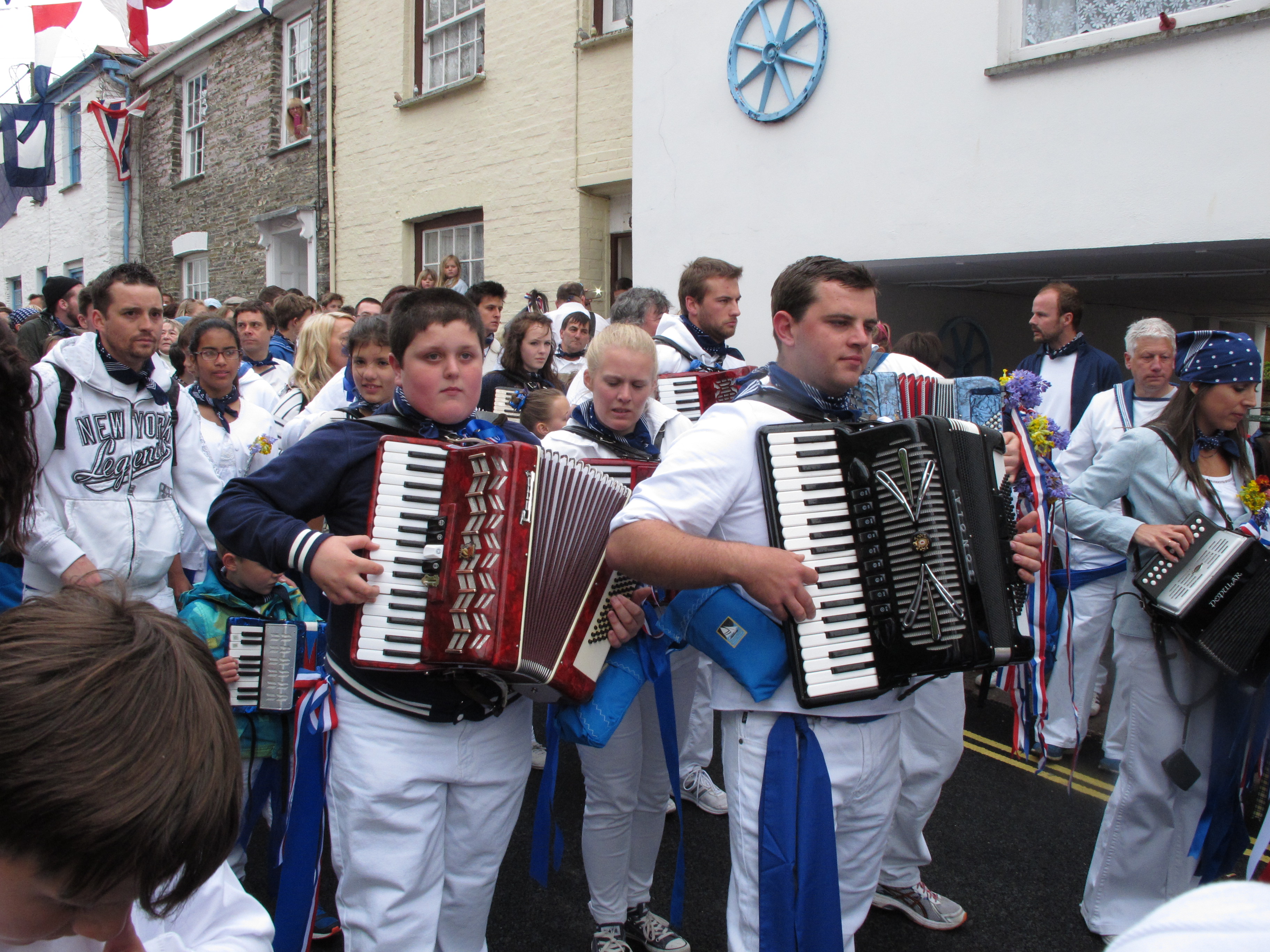
In addition to the inevitable alcohol, the celebration involves songs, dance, drums, accordions, and two ‘Obby ‘Osses, one red and one blue. Actually, both are mostly black (with a head that looks nothing like a horse’s), but their followers (dressed mostly in white) wear either blue or red sashes and whatevers. The tradition’s so deeply rooted that during World War II soldiers from Padstow cobbled together a celebration as best they could, making an ‘Oss out of blankets.

We heard that from a woman whose father had done it.

Padstow, Cornwall, May Day, 'Obby 'Oss

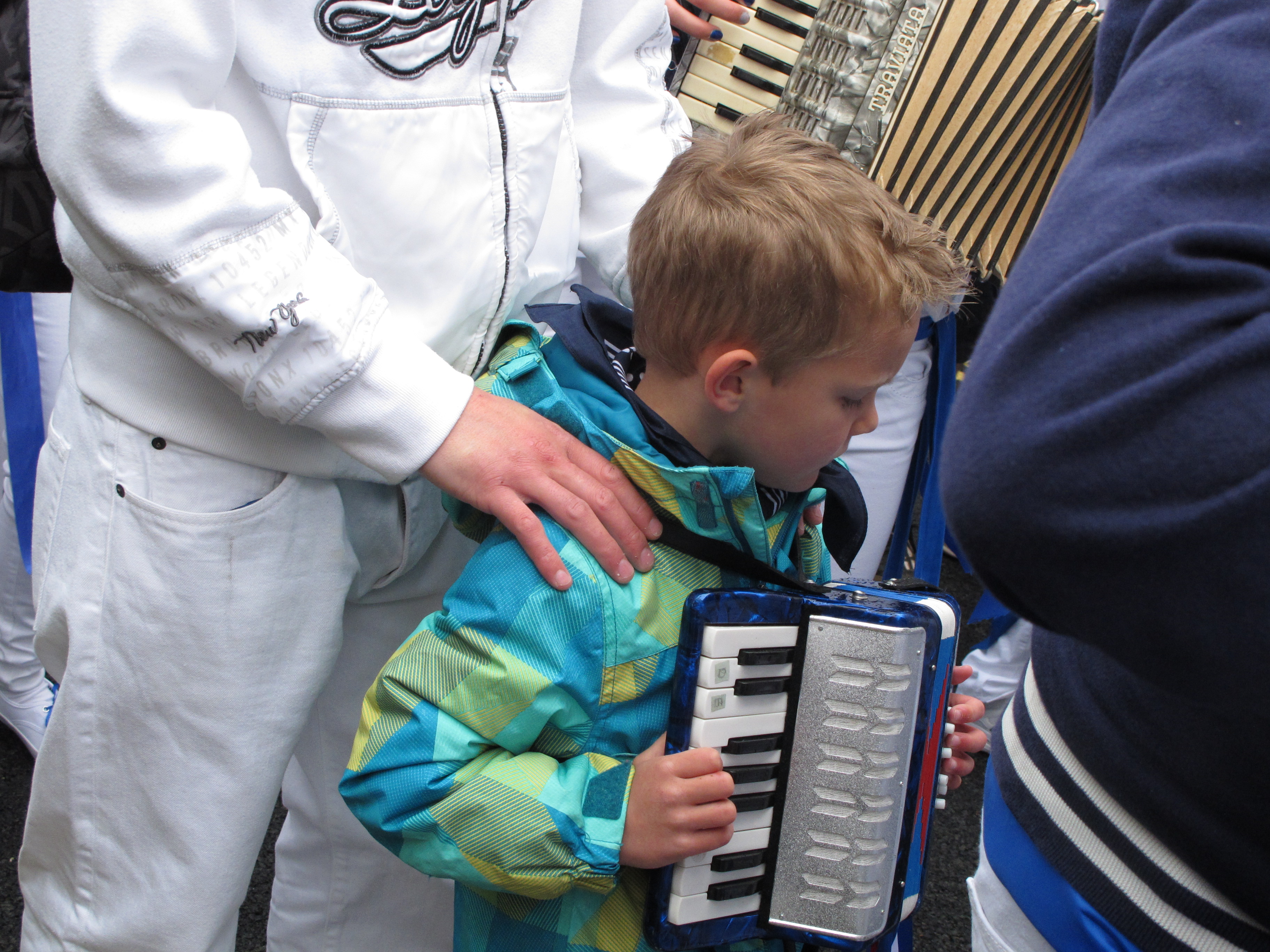
The ‘Obby ‘Oss. It’s good luck for the kids to touch it. These shots are from the children’s parade, which is in the morning.

Padstow’s Tourist Information Centre web site talks about “many conflicting theories about the origins of the Obby Oss. [Some spellings leave out the apostrophe, and since I’ve been a copy editor, I can’t help noting that sort of nonsense. I’m sure every last snoozing one of you cares just as passionately.] Some say its roots are in pagan times, others that it’s a rain maker, a fertility symbol, a deterrent to a possible landing by the French some centuries ago or even a welcome to summer.”

My best guess is that a lot of those things were layered over each other during the course of centuries. My next best guess is that Cornwall doesn’t need rain often enough for a rain-making ritual to get ancient, so that’s the only theory I’d rule out.

I checked several sources for the morning song’s words (there’s also an evening song), and they vary, but basically it has lots of verses and you can find one to justify almost every theory. Except rain. So layers, right? I found references to the French, one verse mentions the Spanish, and several mention the white rose and the red. Since the War of the Roses wasn’t fought on Cornish soil, I’m guessing they’re about purity and passion, but I may be importing that from some English lit class I took—the one called Stinkingly Obvious Symbolism and its Heavy-Handed Interpretation.

The song’s worth a listen.

Even if you discount the roses, it’s hard not to find fertility references. The verses are full of beds and bodies. And then there’s the belief that a woman caught under the ‘Oss’s skirts will be pregnant within the year. Can’t get much more stinkingly obvious than that.

The ‘Oss flashed his skirts over Wild Thing the first time we went. That was several years ago and she’s still not pregnant. Now it’s true, she’s past the age and in a same-sex relationship, as well as lacking a uterus for the past few decades, but even so, if you’re looking to get pregnant I recommend trying the more conventional method in addition to getting under that ‘Oss’s skirts.

Here’s a handful of photos. They are—in a break from tradition—relevant to the post.

Padstow May Day children's parade

From the children’s parade.


The best way to see the 'Oss.

The best way to see the ‘Oss.


The second best way to see the 'Oss. It does get crowded.

The second best way to see the ‘Oss. It does get crowded.


If there's any rivalry between the followers of the Red 'Oss and the Blue 'Oss, it doesn't seem to turn into hostility.

If there’s any rivalry between the followers of the Red ‘Oss and the Blue ‘Oss, it doesn’t seem to turn into hostility.


Following the blue 'Oss.

Following the blue ‘Oss.