Archeology in Britain: a roundup

Sink a shovel into the soil anywhere in Britain and–

No, I’m about to exaggerate. You won’t necessarily find an ancient artifact, you’ll probably find good old fashioned dirt, but if you scan the papers for archeological news it’s easy to believe you’ll find treasure. Let’s review a few finds:


The Galloway Hoard

This was found by a metal detectorist in 2014, in a plowed field in Scotland. It’s one of the richest collections of Viking-age treasure found in Britain so far. The finder was paid something in the neighborhood of £2 million, which ain’t bad for a day’s work. Even if you count all those other days, when he found nothing except the tabs from soda cans, it still ain’t bad.  

The reason finds like this are known instead of being quietly sold to rich collectors is that British laws require detectorists to report their finds to a government body, which works out the cash value and the museum that should receive it if they can raise the money. So the finder benefits. Under English law, the landowner also benefits. Scottish law leaves the landowner out. I’m not sure about Northern Ireland. Either way, though, blank spots in the nation’s history get filled in.
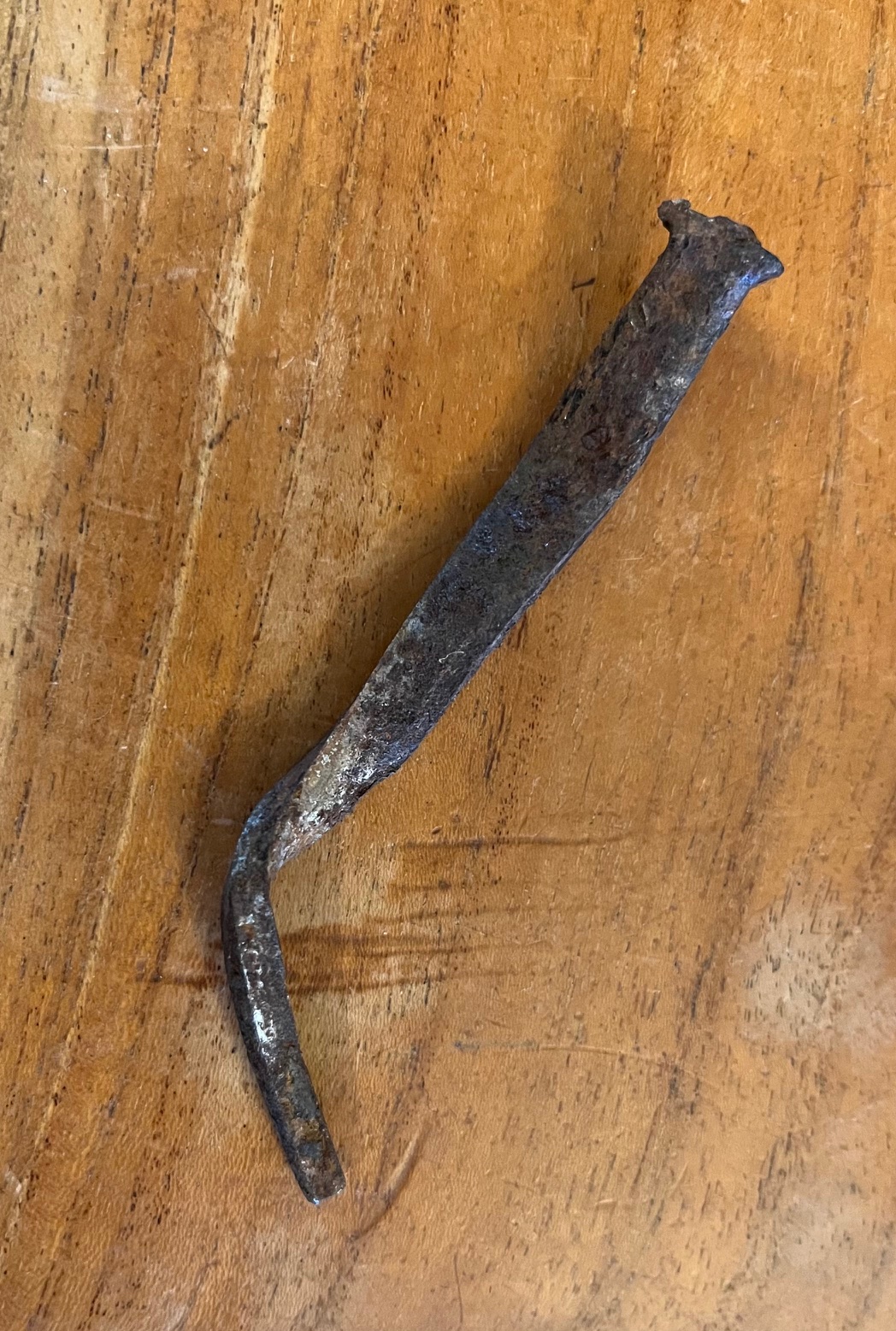
A hand-crafted nail. No idea how old it is, but I didn’t have to stick a shovel in the ground to find it. There’s been quite a bit of construction in the neighborhood and I’d guess someone else dug it up. All I did was walk past and kick it. It has an odd bend (I’ve bent a lot of nails in my time but never that way), and one person who looked at it figured it had been in a fire. All theories–even knowledgeable ones–will be gratefully entertained.

Experts have been working their way through the Galloway Hoard since it was found and in 2024 reported that the metal from a silver cup–okay, a silver vessel–was mined in what’s now Iran and that the vessel itself was probably made for royalty of the Sasanian empire–the last Persian empire before the Muslim conquest. They were Zoroastrian. So it traveled halfway around the known world to get buried in a Scottish field in 900 CE.

Follow the link for damn some good photos of the hoard.

Why did anyone bury it, though, and who did it belong to? An answer to the second question comes from an inscription on a decorated arm ring. (Follow this link as well for photos.)

But before I get to the inscription, let me tell you a few other things: The stash included four arm rings with runic writing. Three had what are described as elements of Old English names, presumably the original owners of the rings. But the experts all stubbed their toes on the fourth arm ring. It didn’t match any known language from early medieval Britain or Ireland. 

Then someone had an inspiration and I’d explain it to you in detail but halfway through the explanation I sank, and I’m here to protect you from that fate, so let’s just say that they made an educated mental leap and realized they might be looking at a shortened or phonetic spelling. That led them to a translation: “This is the community’s wealth,” using a word that specifically meant a religious community.

Which takes us back to the other question: Why did a religious community bury all this wealth? Possibly to keep it safe from Viking raids. Christian monastic communities were full of expensive bling and the Vikings were wise to them. They were an easy target and a rewarding one.

Why didn’t the community dig it up? That’s the problem with history. It’s so full of things we’ll never know. 


The Chew Valley Hoard

In 2019, seven detectorists in Somerset set out to mess around with someone’s new metal detector. They’d do a little detecting, get rained on, give the dog some exercise, have a few beers– You know. 

They ended up unearthing 2,584 silver pennies that date back to the time of the Norman Conquest. (1066; you’re welcome.) The best guess is that they were buried for safekeeping during an early rebellion against Norman rule. 

According to Lisa Grace, one of the finders and an expert in cataloguing antiquities, “The hoard may have been the result of looting or maybe the result of somebody hiding their money away because of the revolt.”

The coins have been valued at £4.3 million. Half goes to the landowner and the group will split the rest. I don’t know what the dog gets. 


Stone circles

The southwest is full of ancient monuments, and most of them are just sitting out in fields, where you can walk in, lean against them, and feel blown away by their age and mystery, all without paying a fee or worrying about opening and closing hours. You do sometimes have to share them with sheep, cattle, and the occasional wild pony (as well as their droppings), but if you don’t mind, they don’t either. 

A couple of Neolithic stone circles have recently been found on Dartmoor, and at least one of them adds weight to the finder’s theory that there was a circle of stone circles on the moor, which he calls a sacred arc. So far, he’s locate about half of the presumed circle.

One of the newly found circles had a ditch around it, as Stonehenge does, and they were built in roughly the same period.

If the theory’s correct, the other half of the arc is still out there, waiting to be found.


Dead bodies

Sorry to get gruesome on you, but when you’ve been dead long enough you stop being the much-missed Aunt Sadie or Uncle Marv and turn into archeology. In other words, your body isn’t gruesome anymore, it’s a clue to history.

People who try to piece together the details of what used to be called the dark ages and is now more respectably called the early medieval period lean heavily on clues from archeology because written records are sparse. Some were destroyed and others–um, yeah, they were never written, which makes them hard to read. 

What’s more, where written records do exist it makes sense to ask how reliable they are. Historians of the time didn’t play by the rules of our era.

With that tucked under our belts, let’s go to Norway, which I admit isn’t in Britain but does have an interesting story to tell: an Icelandic saga from 1197 tells of the siege of Sverresborg Castle. The besiegers broke into the castle and “burned every single house that was there. . . . They took a dead man, and cast him headfirst into the well. Then they piled stones into it until it was full.”

Fast forward a few centuries until 1938, when archeologists found a skeleton in a well, buried by a layer of stones. Aha! Significant! But World War II intervened, the Nazis occupied the area, and suddenly everyone had other things on their minds. The body stayed where it was. It wasn’t until 2014 that anyone got it out and identified it as belonging to a man who was somewhere between 30 and 40 years old. He’d been hit over the head before he died and was injured in assorted other ways as well. Radiocarbon dating put his death in roughly the right period for the siege, and a DNA comparison to modern Norwegians hints that he might have come from southern Norway–the home of the besiegers, not the defenders. Which says they may have thrown their own guy in the well. 


So much for history. Do we know anything about the recent past?

Here we’re going to abandon archeology. We can learn about our culture from the papers: in 1977, garden gnomes began disappearing from a town in England. 

You know garden gnomes: those painted plaster statues so beloved of British homeowners that even the people who hate them love to hate them. In place of the missing gnomes, the bereft homeowners found ransom notes. By way of example, one read, “Listen, your gnome has seven hours to live unless you wrap 25 pence and leave it at the car park at Safeways near the bowling green. This is no hoax.”

Time passed. No dead gnomes were spotted, and a few days later, 8 gnomes appeared, as alive as they’d ever been, at a roundabout, draining all the tension out of the story.

A roundabout? That’s an ingenious way of handling traffic without using traffic lights. It either works like a charm or backs traffic up for months, depending on time, place, and circumstance. And luck.

The 8 gnomes were accompanied by three frogs, two squirrels, two toadstools, one peacock, one rabbit, and a Snow White. The statues’ owners reclaimed them, made them a nice cup of tea, and set them back in their gardens without checking them for PTSD because the diagnosis wasn’t widely known yet. 

The perpetrator became known as the Phantom Gnome Snatcher of Formby.

And now, damn near 50 years later, the Phantom has identified himself. Sort of. His name’s Arthur, he’s 62, and he was 15 when he gnome-snatched, with the help of his 5-year-old brother. The two of them scoped out the neighborhood gnomes one night and went back the next night to collect them and leave ransom notes. They did check the locations they’d given in the notes–a phone box; a park bench–and found nothing. 

Yeah, Formby was filled with hard-hearted cheapskates who were willing to let their gnomes die terrible deaths.

“So three nights later we put them all back and thought absolutely nothing of it,” Arthur said.

Arthur was outed–sort of–by a cousin, who didn’t give his name but said on radio, “I know the culprit. . . . He tells that story most Boxing Days and each time he gets a little bit wearier, you can see the weight of his conscience on his shoulders.” 

That led Arthur to call Radio 2 and out himself–minus his last name. 

“It’s been on my conscience that I did this terrible thing,” he said. “I would like to beg forgiveness from all the families that I have caused grief to.”

If that was the worst thing any of us had done–


And that brings us to the present day 

Lupa Pizza in Norwich has bowed to pressure and is offering a pizza with a pineapple topping, but there’s a snag: It’ll cost you £100. (If you work in US dollars, that’s $123, give or take a bit, but you’ll have to get there, which ain’t cheap.) 

I know that says something deep and meaningful about the culture, which means it connects perfectly to the archeology theme we’re following here, but I’ll leave it up to you to figure out what the connection is.


A few Irrelevancies

On a totally irrelevant (to this post, but not to the real world) topic, 200,000 Danes have signed a petition to buy California from the US. It reads, in part:

“Have you ever looked at a map and thought, ‘You know what Denmark needs? More sunshine, palm trees, and roller skates.’ Well, we have a once-in-a-lifetime opportunity to make that dream a reality. . . . We’ll bring hygge to Hollywood, bike lanes to Beverly Hills and organic smørrebrød to every street corner. Rule of law, universal healthcare and fact-based politics might apply.”

The petition’s website includes a call to “Måke Califørnia Great Ægain.”

*

Okay, this has nothing to do with archeology either. A breeding program trying to keep the northern spotted owl from going extinct had a pre-Valentine’s Day offer: for 5 Canadian dollars, you could name a dead rat after an ex–any ex–and get a photo of the rat. And the owl. The deal ended on February 13, but I’m sure they’re still accepting donations. And you could probably talk them into extending the offer just for you. And your ex. 

*

In my last post, I wrote about the problem of telling native from non-native plants. 

“Actually,” I said, to quote my own silly self, “what does native mean? How far back do you want to go? Think about it long enough and your mind will melt.”

To keep my mind from melting, my friend Helen sent me a link to a Botanical Society of Britain and Ireland website, which explains how far back to go.  

Basically, if something was introduced by humans, either deliberately or by accident, and became naturalized between the beginning of the Neolithic period and 1500 CE, then it’s an archeophyte–a fancy way of saying an old plant.

Most of them arrived in the late Bronze Age, the Iron Age, and the Roman and Medieval periods. Some were hitchhikers that snuck in with crops, others started out in gardens, where they were grown for food or medicine but liked the conditions and jumped the garden to go wild. 

You can break the category down into denizens, colonists, and cultivated crops if you like, but let’s leave that to the experts. Amateurs get hurt messing around with these things. 

After 1500, when Europe and the Americas were in contact–eagerly on one side, reluctantly on the other–all sorts of new plants were introduced: for food, for medicine, for forestry, or because they were pretty. Farming, demographics, trade, and industry changed. All that makes 1500 a handy place to draw a line: Anything introduced after that date is a modern introduction: a neophyte. 

A native plant is one that showed up without human assistance after the last ice age ended or got here before it and somehow survived. It sounds as if the date doesn’t matter, only whether it got here on its own. 

Britain’s Amateur Archeologists

Let’s take a moment to appreciate Britain’s amateur archeologists–the people who do grunt work for real archeologists, who wave metal detectors over unpromising ground to see what turns up, who follow local legends and either find something ancient or go to the pub and decide when to try again. 

Okay, I can’t tell how fully appreciative you just were, so I’ll take us through a few things amateurs have done lately and see if we can’t push the appreci-ometer upwards a bit.

Irrelevant photo: St. John’s wort, a.k.a. rose of sharon

The Palace of Collyweston

Collyweston was home to Margaret Beaufort, Henry VII’s mother, but by the modern era the palace had disappeared so thoroughly that efforts to find it in the 1980s and 1990s came up with nothing. 

Enter the Collyweston Historical and Preservation Society. It had three things going for it when it decided to look: a group of amateurs, ranging in age from their teens to their 80s; local legend; and ground-penetrating radar. 

Yeah, that last thing was important. Equally important, I suspect, was a fourth thing: local people, some of whom had grown up hearing about the palace. It was out there and they damn well wanted to find it.

“We had no money, no expertise, no plans, no artist impressions to go off,”  the society’s chair said, “and nothing remaining of the palace. It’s naivety and just hard work that has led us to it.”

They used “local folktales and hearsay” to narrow down their search, then they brought in the radar and got permission to dig in people’s gardens, where they found stone mouldings–the remains of the castle. Historians from the University of York will verify their findings, plan the next moves, and preserve what’s been found. 

It’s got to be exciting, seeing a castle emerge from your compost heap, your veg bed, or your kids’ sandbox. 


A Bronze-Age Hoard in Dorset

A retired pensions consultant paid £20 to join a group of metal detectorists working on private farmland in Dorset, but he managed to get himself lost and ended up with what he called the find of a lifetime. About 8 inches below ground, he found a sword from the middle Bronze Age, a bronze ax head, and what the paper’s calling “a decorative arm bangle.” Before I moved to Britain, I read about bangles and wondered what they were. Allow me to translate in case you’re as clueless as I was: a bangle is a “stiff usually ornamental bracelet or anklet slipped or clasped on.” So, basically a bracelet. Unless of course it’s on an ankle, but let’s not complicate things. 

You feel much wiser now, right? 

The director of collections at the Dorset Museum said, “This hoard is incredibly special. The rapier sword is unusual because of the cast bronze handle. The bracelet decoration was quite unusual as well. . . . Finds like this tell us about how people were traveling, meeting, and exchanging ideas with others on the continent in the centuries before the Roman invasion. 

“There was a farming community here and people generated enough wealth to be able to barter for or exchange objects others had made.”

And since nothing matters in our culture unless it can be measured in money, let’s give it a price: the museum raised £17,000 to buy the finds. That was divided between the finder and the landowner.


Deep Time

This is a project that had some thousand people looking through high-resolution satellite images and I have no idea what else to find hints of archeological sites. They covered some 200 square miles of ground in Derbyshire, Yorkshire, Northumberland, and Dorset, finding Bronze Age burial mounds, Roman roads, abandoned medieval villages, and some 13,000 other old places. 

Okay, potentially old places. The next step is to go out in the field and decide which sites to excavate. 


And in General . . .

. . . amateur archeologists are having a moment. A long moment. 

Back before the pandemic (remember a time when you didn’t know the word pandemic?), my partner and I joined some other volunteers at Tintagel Castle, in Cornwall. The glamorous work involves uncovering stuff, in this case the foundations of several early medieval buildings on a headland surrounded by the Atlantic on three sides. 

We joined the crew that came along to rebury what the first crew had uncovered. The idea is uncover, document, and then rebury in order to preserve. It’s less glamorous than finding, but it left us with a strong sense of connection to the site. And working in dust and a wet, salty wind, left us dirtier than I’d thought it was possible to be. Salt, it turns out, binds dirt to the human skin in ways that no one has yet explained to me.

More recently, schoolkids have unearthed what’s being called a 1,400-year-old possible temple near Sutton Hoo. (Sutton Hoo itself is an over-the-top medieval burial involving an entire ship and a shipload of treasure.)

More schoolkids helped unearth a Bronze Age hillfort in Wales. Injured ex-servicemen helped with excavations in the Salisbury Plains, and in Greenwich Park (that’s Greenwich as in Greenwich Mean Time) volunteers have uncovered Charles II’s steps, a swallow brooch, clay pipes, coins, the lens of a sextant, and a Sony mobile phone “that was buried pretty deep.” 

Earlier community excavations in Greenwich found a World War II air-raid shelter and a Saxon burial mound. 

A TV show, The Great British Dig: History in Your Back Garden has encouraged people to find out what they’re living on top of. Its presenter–an archeologist–talks about Britain as having been densely populated, which increases the odds of an amateur finding something. Put a shovel in the earth and who knows what will come up. In our very own back yard, I found a small plastic toy spawned, no doubt, by a TV show I’m not familiar with. I reburied it–uncover, document, rebury in order to preserve. It will be a golden find for some future archeologist. 

Lord Google, who’s always anxious to help, thought I’d want to know about ways a person can volunteer on a dig and led me to the Council for British Archaeology. (Please note the stray A wandering around the word archeology. It’s presence is what tells you the organization is genuinely British, not some American knock-off.) 

Yes, you can volunteer on a dig. You can be a Casework Input volunteer and help plow through applications involving historic buildings in England and Wales. You can join a local group. You can “inspire young people.”

Sorry, at that point they got too upbeat for an old cynic like me and I closed the tab. But never mind. You can sign up to help on a dig, although some digs will cost you, because volunteering ain’t necessarily free.

The End of Roman Britain: Instability and the Hoxne Hoard

Whatever shortages Britain’s facing due to Brexit and Covid, it hasn’t run short of archeology. The country entered this strange time of ours rich in buried history and since the stuff in question hasn’t gotten up and walked out of the ground, it’s still rich.

The tale I’m about to tell you comes from before Brexit, though, and before Covid. Never mind the logic of that. I needed an opening paragraph. 


The tale

Let’s begin in 1992 with a tenant farmer, Peter Whatling, losing his hammer. And since–well, you know how attached you can get to a hammer, he got hold of a friend, Eric Lawes, who’d taken up metal detecting when he retired, and out they went to the field where Whatling had been when his hammer wandered off.

Before either of them had time to get cold and go home for a nice cup of tea, Lawes picked up a strong signal and started to dig, but instead of the hammer he brought up shovelfuls of silver and gold coins. Lawes was an experienced enough detectorist by then to knew when stop digging. He contacted the police and the local archeological society. 

The next day, archeologists came and dug out the treasure with the earth still around it so they could move it, intact, to a lab and work out both its age and how it had been stored before it was buried. What Lawes had turned up was 60 pounds of silver and gold in the form of 15,234 (or 14,780; take your pick) Roman coins and what’s technically known as a shitload of fancy thingies of one sort and another.

Lawes got £1.75 million for the find, which he split with Whatling, although legally speaking he didn’t have to. 

Whatling also got his hammer back, and it’s now on display along with the older and more expensive stuff, which is called the Hoxne Hoard, after the village where it was found. And because the English language is insane, that’s pronounced Hoxon. 

Try not to think about it. It won’t help.

The hoard is particularly valuable not just for what it contains but because it was excavated whole instead of being scattered by a plow or an over-eager detectorist. 

Irrelevant photo: Once again, I’m not sure what these are. Let’s just call them some of the many red berries that cheer us through the fall and winter.


Why people bury treasure

Every time someone digs up a pile of treasure, someone else asks what it was doing in the ground to start with, and it’s a good question. Who buries these things, and when and why? 

In the case of the Hoxne Hoard, the who is easy to answer (sort of), because some spoons included in that shitload of fancy thingies had a name engraved on them: Aurelius Ursincinus. That can give us the illusion that we’ve answered one of the questions, although we haven’t, really. We know he was male and that he had a Latin name. After that, the record’s blank. We don’t even know for sure that he was alive when the hoard was buried.

As for when, the coins give us something more solid to work with: The newest ones were minted between 407 and 408 C.E. So logically speaking, they’d have been buried sometime after that. 

Why someone buried them, though, draws us into the land of speculation, which is a nice place to visit but it’s always foggy, so it’s hard to be sure of what we’re seeing. What we do know is that some clever devil thought to make a graph of all the dates of the treasure hoards in British Isles and found spikes in three time periods: when the Roman legions left Britain, when the Normans invaded, and when England divided up into two teams and fought a civil war. 

In other words, people bury treasure in troubled times, hoping they’ll be around to dig it back up when the danger’s passed. The ones we know about? Those people didn’t come back. The ones we don’t find and that no one will? Someone came back for those.


Roman Britain

I’ve read about the Roman legions leaving Britain and always kind of assumed they got a telegram from Rome: “Troops withdrawn Stop. Expect you home soonest Stop.”

Well of course they used telegrams. They didn’t have email yet. The problem is that you paid for telegrams by the word. Or maybe it was by the letter. Either way, no legionnaire would expect an explanation–it would’ve been too expensive. So off the legions toddled, leaving Britain to fend for itself.

Which goes to show what I know. It turns out that they didn’t all pack up and leave at once. But as we usually do around here, let’s take a step back before we go forward: 

In the mid-fourth century Britain was being raided by an assortment of barbarians–a word I use under protest and only because I don’t have a better one. We attach all sorts of judgments to it, thinking it describes people who are hairy and unwashed and brutal. Also uncivilized, as if civilization was a guarantee of good behavior. But all it means here is that they weren’t Roman. 

Mind you, they might also have been unwashed and hairy and brutal, but except for the unwashed part, so were a lot of Romans. And I’m not convinced that modern well-washed brutality is an improvement, but that’s a whole different issue. 

Let’s go back to late Roman Britain: In the barbarian corner and raiding Britain, we’ve got Picts and Scots (with the Scots coming from Ireland, just to mess with our heads) and Attacots, who I’ve never heard of either. It doesn’t look like anyone knows who they were. Also the Saxons, who we recognize from other storybooks. 

Since the small print of Britain’s contract with Rome specified that Britons couldn’t be armed, the country relied on Roman power to protect it. Or at least the part of Britain that Rome had conquered did.They never did hold the whole thing.

In the midst of this, the more central parts of the Roman Empire had troubles of their own by then. Barbarian invasions. Uprisings. Emperors. The deaths of emperors. Battles over who was going to be emperor. 

In 383, in response to an uproar in the empire that we won’t go into, the Roman army in Britain revolted and named its leader, Magnus Maximus, emperor. He could only be the emperor of the west by then, since the east now had its own emperor, but hey, an emperor’s still an emperor, and the title was worth fighting for. So he–and presumably some sizable chunk of his army–invaded Gaul and killed enough people for him to actually be the emperor. Until he was killed, that is, which disqualified him forever after.

What happened to the soldiers who left Britain with him we don’t know. It seems to be a fair assumption that they didn’t go back, so color the Roman army in Britain depleted.


Emperors and clipped coins

After 402, the bulk importation of Roman coins into Britain ended, and from that point on the British started clipping coins–shearing bits off of them and using at least some of the metal to make new coins, which were local imitations of the imperial ones. Since the metal itself was what made coins valuable, this meant the coins were worth less and less.

A good 98% of the Hoxne coins had been clipped, with some of them having lost a third of their weight. If you’re trying to get back into your pre-Christmas wardrobe, you should know that this strategy doesn’t work for humans.

In the midst of all this, we can pretty safely assume that the army wasn’t happy, because soldiers don’t like it  when they’re paid in coins that aren’t worth what they used to be. Or when they’re not paid at all. In 406, a rebellion of Roman soldiers in Britain declared someone named Marcus as their emperor. Then he was deposed by someone named Gratian, who was replaced by someone named Constantine, at which point he and his followers toddled off to Gaul–that was in Europe and a far more central piece of the Roman Empire’s jigsaw puzzle–to see if they couldn’t really make him emperor. 

He was beheaded and once again there’s no record of what happened to his followers, but it couldn’t have been nice.

And that telegram still hadn’t arrived. That was the problem with telegrams back then. They had to be carried by guys in sandals. On foot. If you paid extra, they’d jump on a horse or they’d set sail, but it was still slow. And precarious.


Not-so-Roman Britain

Soon after Constantine and Co. left, in 408 or thereabouts, Saxons invaded, and sometime after that what was left of Britain’s Roman government faced a rebellion. The Britons armed themselves, ran off the barbarians, and then, for good measure, ran off the Roman magistrates and set up their own government. Or so said the historian Zosimus.

It sounds good, but according to the far more contemporary historian Marc Norris, it was a disaster. Britain’s links with the empire were cut and the archeological record shows a country rapidly moving backward. The economy and social structure collapsed, along with trade and distribution networks. Cities, towns, and villas were abandoned. Norris assumes widespread looting, along with a couple of synonyms–pillaging, robbing, that kind of thing. 

Archeologists can’t find much stuff left in the ground from this period. Good-quality pottery disappears, along with things like iron nails. Entire industries, they conclude, failed.

In the absence of a working government and army, the rich would have privatized security for as long as they could–and buried their wealth, because they couldn’t know when their privatized security squad will notice that it doesn’t actually need them, all it needed was their hoard of coins and expensive goodies. The person who hired them didn’t actually contribute anything.

Norris assumes that barbarian raids increased, although as he points out raiders don’t leave much in the way of hard archeological evidence, so we can’t know for certain. 

According to Bede, writing much later, the Britons of this period were “ignorant of the practice of warfare” after so long under Roman rule. Which is why, fatefully, their leaders seem to have made a deal with the Saxons to defend them from the Picts. Emphasis on seem to. History goes a little hazy during this stretch of time. But the going theory is that they swallowed the spider to catch the fly, and that’s how Anglo-Saxon England came to be: The spider did indeed eat the fly by inviting the Anglo-Saxons in, and that left Romano-Celtic Britain with a Saxon spider that wriggled and jiggled and jiggled insider ‘er.

*

In addition to the two links I’ve tucked in above, I’ve relied heavily on Marc Norris’s The Anglo-Saxons: A History of the Beginnings of England. It’s a highly readable and very useful book. I’ve lost track by now of who recommended Norris to me. Sorry, I have a note somewhere but I put it someplace safe and I’ll never see it again. So I apologize for not thanking you by name. But I really do appreciate the recommendation. Let me know who you are and I’ll include a link in my next post.

Archeological finds and treasure from a country knee deep in history

The last few years have been good ones for British detectorists.

For British whats?

Detectorists. Those people who wander around with glazed eyes, waving metal detectors above the ground and listening to them beep. They’re looking for buried treasure. Or the tops that people break off aluminum cans. The metal detectors, as opposed to the detectorists who wave them, aren’t discriminating. They’re like gun dogs that point not just at game birds but also at feathered hats, feather dusters, and feathers tattooed on people’s arms. Metal is metal. Let the humans sort it out.

Irrelevant photo: camellia buds.

More people have turned to metal detecting in recent years and they’re uncovering some serious archeological finds, which are making their way into museums. The increasing interest is due in part to–of course–a sitcom. Reality limps along behind the representation of reality. And that, my friends, is what passes for real life. 

In 2018, 96% of the treasure dug out of the British earth was found by people with glazed eyes and metal detectors.

Okay, they don’t necessarily have glazed eyes. It just sounds better that way. And treasure has a narrow official definition–coins; precious metals; that sort of stuff–so archeologists have found plenty of other stuff, but it appears in a different column on the sreadsheet.

A 1996 law that required finders to report treasure also allowed them to split any profits with the landowner, and that’s meant that they’re likely to actually report their finds instead of squirreling them away somewhere or selling them through shady antiquities dealers in back alleys.

Sorry. I don’t know any antiquities dealers, shady or otherwise, so I’m falling back on cheesy stereotypes there.

So when we count up the reasons new people are being drawn to metal detecting, the sitcom isn’t the only one. We can add potential profit. 

A very small and random selection of what’s been found lately: 

  • More than a thousand silver coins in a field behind a pub in Suffolk. The best guess is that they were buried there during the Civil War. 
  • And 69,347 Iron Age coins in a field in Jersey. They date back to 50 B.C., give or take a few months. 

But enough about treasure. It’s the smaller part of the historical riches waiting to be discovered. Let’s talk about archeology.


The neolithic era

In Yorkshire, archeologists have uncovered a saltern–an industrial-scale salt-making site–that dates back 6,000 years. Or to put that another way, it predates Stonehenge. It’s the earliest one that’s been found in Britain.

The pottery that’s been found there shows traces of milk, indicating that the people who built it were settled, growing crops and raising animals. And the scale of the saltern says that they were selling salt, not just making it for themselves. 

“It changes how these people are seen,” said Steve Sherlock, the archeologist who led the dig. They were “people who are undertaking a level of industrial processing and distributing.” 

Because of salt’s use in preserving food, the people who produced and distributed it would have been among the wealthier groups of their time. 

Neolithic salterns have been found in Europe–especially Poland and the Balkans–but this is the first found neolithic one found in Britain, possibly because rising sea levels and coastal erosion have swallowed the others. They have a habit of being coastal, since seawater has a habit of being salty.

The pottery found at the site matches a type introduced by people who migrated from what’s now northern France at around 4000 BC. The saltern technology may well have come with them.


The bronze age

With the old stuff out of the way, let’s move south to Stonehenge

A major road, the A303, runs alongside Stonehenge, and for years there’s been a fight over whether to dig a two-mile tunnel and run the road through it. Opponents argue that it will do lasting damage to a world heritage site and that millions of artifacts will be lost. On the other hand, once the tunnel’s built, you’ll be able to take a selfie at Stonehenge without a big red bread truck showing up in the background. Which makes it all worthwhile.

After an assortment of court challenges and the use of a lot of newsprint, the opponents lost and the work’s been started. The current stage involves 1,800 test pits, 400 trial trenches, 150 archeologists, 18 months, and some uncounted amount of mud. Construction on the tunnel itself won’t start until 2023. 

Is the tunnel a good idea? Probably not, but what do I know? As long as they’re digging, though, they’re finding some interesting stuff. Let’s not ignore it just because we’re sulking. They’ve found graves, pottery, burnt flint that suggests metal or leather working. (No, I don’t know what the connection is either.) It’s probably too early to know what this tells them about the site or the people. 


The iron age and the Roman era

In Oxfordshire, the excavation of a hillfort turned up an iron age settlement that dates from 400 to 100 BCE, not to mention a Roman villa built at the end of the third century CE or the beginning of the fourth. They were found when the Earth Trust, which cares for the hillfort, decided to redevelop its visitor center.

Because no place that welcomes visitors is complete without a visitor center. Where else will people spend their money?

The site was occupied from the bronze age through the Roman era, so the trust hadn’t just planned to just plow through with heavy equipment–they figured they’d find something interesting–but they also hadn’t expected anything quite so rich. What they found included well-preserved iron age pots, Roman bone combs, surgical instruments, and lots of pottery shards. It seems like pottery shards are always in there somewhere.

Chris Casswell, the dig’s head, said, “It’s a substantial iron age settlement. It’s probably no surprise because we’re right at the foot of Wittenham Clumps, an enormous hillfort. The settlement probably continues well into the landscape beyond where we’ve looked.

“Normally we go out and do geophysics, which gives an image of what might be under the ground. But on this site, it didn’t show up any of this. . . . So it’s completely unexpected.”

The Roman villa is still partially buried, and there are at least two Roman cemeteries and stone-built ovens for drying grain.

And in case you’re wondering, the bronze age came before the iron age because copper and tin, which make bronze, melt at lower temperatures than iron. It took humans a while to pull together the technology to melt iron. I had to look it up too.


The medieval period

King’s College in Cambridge tore down some 1930s-era student housing and found an early medieval graveyard

According to Bede’s Ecclessiastical History, which was written in the eighth century, Cambridge was abandoned in the fifth century, when the Romans left. A lot of Roman towns were. But take that with a grain of salt. Dr. Caroline Goodson, a professor of medieval history, said, “We already know that Cambridge wasn’t fully abandoned. But what we’re seeing now is a greater and clearer picture of life in the post-Roman settlements.” 

They’re finding lots of goodies in the graves: bead necklaces, swords, pottery, glass, bronze brooches, short blades, mostly from the early Anglo-Saxon period–say 400 to 650 C.E. And because the soil’s alkaline, the bodies are well preserved, so they may be able to extract information about people’s diets and DNA, which should give them information on migration patterns. 

Goodson’s best guess at the moment is that the people were the descendants of Roman Britons along with more recent migrants from Europe. 

“They are no longer living as the Romans did,” she said. “They’re eating differently, dressing differently, and finding different ways of exploiting the land.”