
Every last one of us was born too late to visit neolithic Britain. Sorry. Most of us wouldn’t handle it well anyway. But we can get a surprising glimpse of late stone age life from the island of Orkney, off the northeast coast of Scotland.
These days, Orkney’s located almost exactly in the middle of nowhere, at least if by nowhere you mean a lot of water, but back then it seems to have been the center of a civilization, if for no other reason than that it was a midway point between northern Europe and Britain. For that, being in the middle of a lot of water is useful.
Not much is known about stone-age boats, but we can pretty well guess that traveling in one made a stop on a long voyage welcome. The break would’ve let people indulge in a neolithic cultural exchange, which I’m going to guess involved food, fresh water, alcohol, gossip, songs, gifts, and possibly an era-appropriate ritual or three.
I tossed in the rituals because Orkney’s rich in sites that hint at them, and every one of them involved an immense amount of labor. You don’t do all that if they don’t matter to you and if you don’t have time and energy to spare.
Irrelevant photo: hemp agrimony
Skara Brae
Around 5,000 years ago, a group of people built a village on Orkney that’s now called Skara Brae. What they called it is anyone’s guess. A lot can get lost in 5,000 years, including a name. The people who lived there farmed, hunted, and fished.
The village is older than Stonehenge, older than the pyramids, and older than me. It was inhabited for something along the lines of 650 years and abandoned for reasons we can only guess at, but for us what’s significant about it is that at some point it was covered over by sand, which preserved it until a storm swept the sand off in 1850, uncovering an archaeologist’s dream.
The village is a circle of stone-built, single-room houses linked by roofed passages, with one larger building that according to one article might’ve been a workshop, although I can’t help wondering if it wouldn’t have been a place for everyone to gather. The walls were made of two layers of stone with insulation in between and the roofs were slate. Each house had a hearth, two beds outlined by stone slabs, which would have kept the bedding in place, and what are called dressers because–well, they have to be called something. To me, they look more like stone bookshelves, although this was a bookless, writingless world, so let’s stick with dressers. It’s chilly up there. People would’ve worn clothes, although that might not have been what they stored on them. They could’ve stored useful stuff, beautiful stuff, things they didn’t want to step on in the dark–say the neolilthic equivalent of Lego pieces.
For some fabulous photos, follow the link.
The houses also had tanks set into the floor. One house had an indoor toilet, although since plumbing was still a long way in the future that might not have been a great idea. I wasn’t there, so I can’t know.
Around the settlement, archaeologists have found dice, jewelry, tools, carved stone objects (objects here meaning things that are mysterious to us), and pottery in a style that spread to mainland Britain, supporting the argument that Orkney was an important site in the culture–a place that led the way. What hasn’t been found is weaponry, and the village wasn’t in an easily defended spot, arguing that this was a time and place of peace.
Not far from Skara Brae are two stone circles, The Ring of Brodgar and the Stones of Stenness; a chambered tomb, Maes Howe; and an assortment of unexcavated sites that hint at being ceremonial, burial, and settlement sites. The places that have been excavated show evidence of feasting–lots of feasting.
I won’t try to take you through the details of the excavations. I wouldn’t trust myself to get it right anyway. Follow the links if you want to know more. You’ll find lots of measurements and layouts. Or else settle for knowing that a lot went on in this seemingly isolated spot.
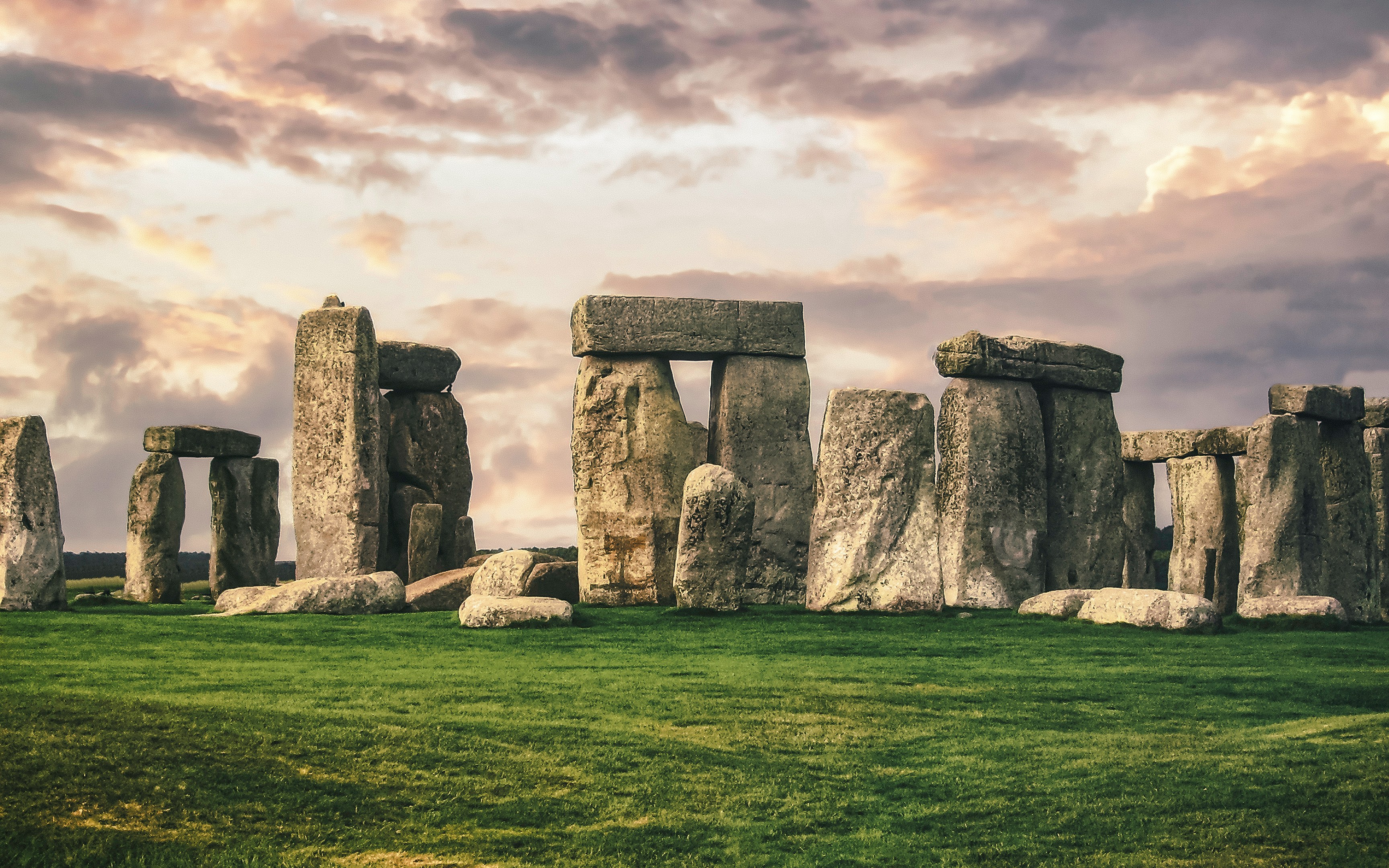
So, did this important cultural center contribute the Stonehenge altar stone that’s recently been spotted as having come from somewhere in northeast Scotland or the Orkneys? It would make sense. They built similar monuments, but no. Orkney’s been ruled out and the search for the source of the altar stone goes on.
 Notes from the U.K.