Black British history: the parts that get left out

Black people have been part of British society at least since the Tudor era. I could as easily say, “since the Roman era,” but we’re trying to keep this short so let’s skip over that. 

Who’s the we in that last paragraph? That’d be me. I’m trying to make you feel included. Don’t you just love how subtle I am?


The Tudor era

The work of writing Black people back into English (or British–take your pick) history is relatively new and seems to be at the stage where historians are still popping up saying, “Found one!” and “Found another!” Information is scattered and finding it depends on digging through archives full of information that’s no help at all. Starting in the time of Henry VIII, the Church of England kept records of baptisms, marriages, and deaths, so that’s one place to look, but sometimes they record people’s ethnicity and sometimes they don’t. Nothing was standardized. Even so, they’re a rich source of information.

At this point, we have enough information to know that Black people were present as musicians, as sailors, as ambassadors, as weavers, as servants, as seamstresses, as traders. A few were the sons of African kings. One was described as an independent single woman. She lived in a village in Gloucestershire and owned a cow–a valuable possession. Just enough is known about her to be thoroughly frustrating. What is known is that all of them were free.
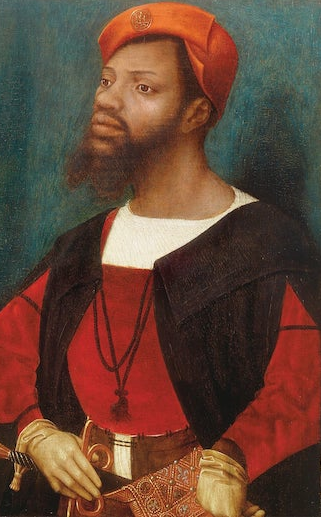
Black people were present at the Tudor courts and could be found on all levels of Tudor society. According to one source, skin colour was less important than religion, class or talent.” Some married into the overwhelmingly white population and within a few generations their descendants’ connection to Africa was likely to have been lost.

How many of us can trace our family history any further back than our grandparents or great-grandparents?

I’m going to go ahead an repeat that Black residents in Tudor England were free, and the reason I’m honking on about it because when we think of Black people living outside of Africa at this stage of history, we tend to assume they were slaves–and you see how neatly I’ve convinced you that your mind works the same way mine does. So let’s repeat that once more, in four-part harmony: They were free.

Thank you. That was gorgeous.

England wasn’t heavily involved in the slave trade yet and although English law didn’t forbid slavery it also didn’t allow for it.  


Slavery puts down roots

Once England did get involved in the transatlantic slave trade, it made, to use academic terminology, a shitload of money–not just from the slave trade itself but from slavery in its Caribbean colonies. (Let’s keep life simple by ignoring its colonies in North America.) But even then,, England itself muddled on in that strange in-between state where slavery wasn’t banned within its borders but also had no legal foundation. At some point, though–and I haven’t found a source that says when–enslaved people were brought to England, stayed, and continued to be slaves. 

For the most part, they were the servants of returning planters, ships’ captains, government officials, and army and navy officers. This wasn’t a flood of people, but it was a significant trickle, and English society shaped itself to this change. Having a black servant became quite the fashion among the aristocracy and the well-to-do. 

Most of the newly arrived slaves continued to work as servants. In other words, slavery didn’t become central to the economy, but they were still treated as commodities. Some were sold; some were given as gifts. And some said the era-appropriate equivalent of “screw this” and took off, which was a lot easier to do in England than in, say, Jamaica.

This part of the story is relatively easy to document: newspapers ran notices calling for the return of runaway slaves.

June 1743: a woman called Sabinah was “deluded away [from a ship bound for Jamaica] by some other Black about Whitechapel.”

February 1748: “RUN away last Thursday Morning from Mr. Gifford’s, in Brunswick-Row, Queen-Square, Great Ormond-Street, an indentur’d Negro Woman Servant, of a yellowish Cast, nam’d Christmas Bennett; she had on a dark-grey Poplin, lin’d with a grey water’d Silk … and suppos’d to be conceal’d somewhere about Whitechapel.

“Whoever harbours her after this Publication shall be severely prosecuted; and a Reward of a Guinea will be given to any Person who will give Information of her, so that she may be had again.”

Why does it say indentured? Slavery and indentured servitude weren’t identical they did overlap. Much later, it was later used as a way to abolish slavery in the colonies without abolishing slavery in the colonies. You can find that in an older post.  

A University of Glasgow project has catalogued 800 runaway slave notices.  Slavery had become an accepted part of British life. Anti-slavery activists chipped away at it through the courts and through Parliament, until even before slavery was abolished it became illegal to take a slave out of Britain without his or her agreement. That didn’t make it illegal to hold someone in slavery within the country, mind you, but it was a milestone.


Free Black people

Having said all that, let’s not lose sight of the free Black community, because it was still out there and it’s important to any discussion of Black British history, and of the abolition slavery in the country. 

Most Black people–free or enslaved–worked in domestic service, but I’m not sure if that’s a comment on the work available to Black people. A lot of white people worked in domestic service. I tried to find out what proportion of the population worked as domestic servants and the best I could come up with was “considerable.” So let’s say a considerable proportion of the population worked as servants and some proportion of them were Black, then we’ll duck out the door before anyone notices that those aren’t numbers. (I got the “considerable” estimate from a reputable source in case that helps.)  

What other jobs did Black people do? There’s no centralized set of records to consult, so we’re back to the historians saying, “I found one!” Some were agricultural workers, craftsmen, laborers, seamen. Single mentions include a fencing master, an actor, a fire-eater, a minister, a hairdresser, and a contortionist. The range of jobs open to women, Black or white, was narrower than the range open to men, and Black women enter the record as laundry maids, seamstresses, children’s nurses, prostitutes, and one actress with a particularly fine singing voice.

In 1731, London barred Black people from becoming apprentices. Since apprenticeship was the only way to learn and then practice a trade, this kept them out of skilled work, at least within London. 

Did you just hear a bell ring? That was the Racism Alert Bell, marking a change in the culture. Black people could no longer integrate into the larger population as easily as they used to, and skin color was no longer less important than skill or religion or money.

If you were a legally free Black person and work was hard to find, it was that much harder if you were an escaped slave. Any time you spent in public put you at risk of being recaptured. So we shouldn’t be surprised that the historical record starts to mention Black beggars. 

As a side note, my point of reference is the United States, since that’s where I spent most of my life. Compared to American racism, the British brew was mild. I don’t want to get into a my-racism-can-beat-your-racism argument, but to give a single example, Black-white marriage was unremarkable in Britain at a time when it would’ve been damn near suicidal in the US. That doesn’t let anybody off the hook. It’s just a reminder that no good comes of uprooting assumptions grown in one country and importing them into another. 


Community

By the end of the 18th century, some 15,000 Black people were living in England, most of them in port cities–London, Bristol, Liverpool–but also in towns and villages around the country. 

Or possibly it was more than that. Or less. It’s all guesswork–educated guesswork but still guesswork. So forget the numbers. We won’t get them right anyway. What matters is that a Black community was forming. Assorted white writers left us a record of Black people gathering for serious discussions as well as to drink and dance and to celebrate weddings and baptisms. It’s shallow evidence but it does tell us that people were coming together and a community was defining itself. 

Listen, you take your historical records where you can find them. Black sources exist but they’re scarce. 

The Black community played a crucial part in the movement to abolish slavery. When I asked Lord Google for the names of British abolitionists, he gave me twelve; nine of them were white. But a host of people whose names we don’t know were busy helping slaves to freedom, and somewhere between many and most of them were Black. As Peter Fryer put it somewhere in Staying Power (I’m damned if I’ll reread the whole book to find you the exact quote),  for the most part the slaves within Britain freed themselves. 

London’s East End–an integrated, working class neighborhood and a center of Black community–had safe havens, including the White Raven pub, where “Black patrons formed a frontline against bounty hunters, and the church of St. George-in-the-East, which in the mid-18th century committed itself to baptising escaped slaves.” 

Why did baptism matter? An early legal ruling opened the possibility that holding a “heathen” as a slave was okay, but not a Christian. That escape route was closed off relatively early, but the belief lingered that becoming a Christian would free a person.

In 1773, two Black men were jailed for begging and they were “visited by upwards of 300 of their countrymen” and the community “contributed largely towards their support during their confinement.”

Sir John Fielding–brother of the novelist Henry Fielding–wrote scathingly that Black people entered “into Societies and make it their Business to corrupt and dissatisfy the Mind of every fresh black Servant that comes to England.” And if that wasn’t bad enough, they made it hazardous to recapture a runaway, because they got “the Mob on their side.” Blacks brought to England grew “restless” and conceived and executed “the blackest Conspiracies against Governors and Masters.”

And don’t we just want details of that? Sorry, we’ll have to settle for a detail or two about that mob. A few years earlier, Fielding listed among its members “an infinite number of Chairmen [those weren’t people who chaired meetings, they carried people in sedan chairs], Porters, Labourers, and drunken Mechanics.”

Drawing on the participants in the Gordon riots, Fryer (remember him? Staying Power?) lists more occupations: coal heavers, shopkeepers, sailors, apprentices, journeymen, weavers–the list goes on for another line or so but let’s stop there. What’s interesting is that he’s not talking only about Black workers. They were both white and Black and saw slavery as part of a system that degraded everyone: free and enslaved, Black and white. 

This was the community into which runaway slaves disappeared. If you know the history of the Underground Railroad in the United States,  you can think of the East End as an English version: a network of places and people who would take in fugitives. Predictably, that also made the East End a magnet for the people who hunted escaped slaves. 


The Communities of Liberation Project

We’re coming to the end of the post and it brings us to the news item that got me started on the topic: a new project is researching the Black presence in London’s East End in roughly the period I’ve covered, and it’s inviting non-historians to get involved. They’re looking for people who live in or have a strong connection to the Tower Hamlets neighborhood–or borough if we’re being all British about this–and who have an African or African-Caribbean background. They particularly welcome “people with no specific qualifications or experience,” which wins my heart. They’ll train them in archival research.

(This is as good a place as any to answer a question that’s been annoying me for a while: why’s the place called Tower Hamlets? Because it’s near the Tower of London. And because it used to be a bunch of hamlets. But that was a long time ago. It’s now part of London’s East End.) 

The project’s hoping to “identify the places, spaces and networks in which African people lived, worked or socialised during the period of the operation of the Transatlantic Slave Trade” by unearthing the”names, stories and experiences of everyday life of working Londoners” as well as “the buildings or spaces, the taverns and churches, where ‘working class’ African Londoners would gather, meet and coalesce as a community.”


Rewriting history

If you keep your ear to the ground, you’ll have noticed two things recently: one, you have dirt in your ear, and two, a lot of self-appointed defenders of the culture are complaining about wild-eyed lefties rewriting history. What particularly sets them off is people writing about aspects of history that go beyond what they learned from their grade-school textbooks.

As your official Wild-eyed Lefty Representative (see my photo at the top of the page; look at those eyes; they’d worry anyone), I’d like to remind you that every generation rewrites history. It’s commonly known as reinterpreting it, or correcting the biases of earlier generations, or incorporating new material. Otherwise we’d still be working with 1913 textbooks, when no Black history was taught because, basically, who cared? It wasn’t important.

So am I helping to rewrite history here? You bet your ass I am. That doesn’t mean I’m inventing it. It means I look for sources who’ve done the hard work of filling in the blanks. Long may they dig through the archives.


A few notes

  • If you want to fill in a few blanks I’ve left, I have two earlier posts about the history of British slavery. One focuses on the legal aspects of abolition but also works as a rough outline of British slavery and slave trading. Another focuses on abolition and the substitution of indentured servitude for slavery. (Isn’t progress wonderful?)  After you chase those down, I expect you’ll be sick of me and we can all ignore each other for another week.
  • I don’t have a topic up my sleeve to write about next. England has plenty of history left but I feel like I’m running out of ideas. If you have any suggestions, questions, or areas you’re particularly interested in I’d love to hear about them. I can’t promise to write about them all, but if something grabs my imagination and if I can find enough material to work with (neither of those is guaranteed), I’ll do it. 
  • In the meantime, thanks for reading. And if you leave comments, thanks for that. If they make me laugh or think or do both, even more thanks. 

The Battle of Cable Street 

Now that Britain’s racist riots are–I hope–behind us, this might be a good time to look back at what happened on London’s Cable Street in 1936.

The background? (If you stay here long, sooner or later you’ll end up slogging through a bit of background.) Hitler held power in Germany and Musolini ditto in Italy. The British Union of Fascists, led by Oswald Mosley, claimed to have 50,000 members, and I’m not saying it didn’t, only that we’re taking their word for it and–oh, hell, it was a long time ago and for our purposes doesn’t really matter. It was big and it was most definitely fascist, complete with the antisemitism, the black shirts, the salute, and the violence. It had a gang of toughs known as the Biff Boys. 


Screamingly irrelevant photo: everlasting pea

The roots of antisemitism

Antisemitism was the Islamophobia of the era (in case you’re tempted to tell me that’s antisemitic, keep in mind that I’m Jewish), and it has deep roots in Britain. We could go back to 1290, when Edward I expelled the Jews from England, but let’s start instead at the turn of the twentieth century, when some of the people who opposed the Boer War (1899 to 1902; I had to look it up) blamed it on the Jews–they were imperialists, financiers, bankers, and capitalists. Not long after that, they were blamed for World War I (because they were financiers etc.) and the Russian Revolution (because they were communists). 

One of the oddities of antisemitism is that the Jews appear as both capitalist bloodsuckers who control the world and communist revolutionaries who want to overthrow the capitalist bloodsuckers who control the world. Basically, it works like this: if you see a problem, the Jews caused it. 

But antisemitism wasn’t all name calling and finger pointing. It was respectable. At University College London, in the name of improving the country’s genetic stock, Karl Pearson opposed Jewish immigration and argued that attempts to improve “inferior races” were a waste. Among other things, his work provided an intellectual grounding for the Nazis’ race theories.  

I focus on Jews here because we’re talking about antisemitism, but to be fair he was generous about handing out inferior race labels. 

Clubs and institutions–think golf clubs and things of that sort–had quotas to limit the number of Jewish members they’d accept. That continued into the 1960s. 

In the early 1930s, fascism was also respectable, not only for its antisemitism but because it offered a bulwark against communism, which in the midst of the Great Depression was a powerful force. Fascism appealed to industrialists who were desperate to keep their workers in line and to aristocrats, who’d lost considerable power–and along with it, money–to the industrialists. Again, to be fair, it didn’t appeal to all of them, but some went for it.

Take, for example, a 1934 headline in the Daily Mail, reflecting the opinions of its aristocratic owner, Harold Sidney Harmsworth, 1st (ahem) Viscount Rothermere: “Hurrah for the Blackshirts!” Harmsworth saw fascism as the wave of the future, was enthusiastic about Hitler and Mussolini, and opposed votes for women and wrote, “The fact is that quite a large number of people now possess the vote who ought never to have been given it.” 

Archibald Ramsay, son of the Earl of Dalhousie, founded the Right Club,  whose logo was an eagle killing a snake with the initials P.J., standing for “Perish Judah.” 

As an article by Adam J. Sacks points out, any hereditary aristocracy has a built-in affinity with theories about pure blood. “Even today,” he writes, “adoptees into aristocratic families in the UK are ineligible to inherit titles or properties.”

Oswald Mosley himself was a baronet. As titles go, it’s minor-league, but hey, it’s one more title than I have.

Or want.

But why should we spend our time with baronets, viscounts, and other riffraff when we can talk about the king? Edward VIII was openly pro-fascist. After he gave up the throne, he told Hitler, “We are derived from the same race with the blood of the huns flowing in our veins.” He’s on record as having told the Nazi high command “that continued heavy bombing will make England ready for peace.” 

Sacks sums it up by saying, “There is hardly a major British institution that was left untouched by fascism, from the Bank of England to the Daily Mail to the House of Commons. . . . If there is a story to be told about Britain and fascism, let it be this: while the people of Britain stood up to the Nazis, the British ruling class were in many cases enthusiastic collaborators–and found justification for being so in their own aristocratic roots and worldviews.”


The British Union of Fascists

Mosley overdid the violence at a couple of BUF rallies, where his Biff Boys beat up hecklers badly and more to the point, visibly, and he lost some of his support. That led him to refocus, organizing in a handful of working class neighborhoods. In 1935, the BUF newspaper said, “We are now the patriotic party of the working class.”

Led by a baronet.

One of the things they did was hold threatening open-air meetings on the fringes of the East End, which in the 1930s was a mainly Jewish neighborhood, and forget that noise about Jewish bankers and financiers, the people here were poor. Soup kitchens had lines outside every night.. And to double down on the parallel between antisemitism and Islamophobia, many of the Jews were immigrants. 

Individual Jews were attacked on the street, shopkeepers were threatened, antisemitic slogans were painted on walls. One or two of the articles talk about the residents feeling like they were living under siege.


Enough with the background. What happened?

Mosley announced that the British Union of Fascists would march through the East End, in uniform. 

The Jewish People’s Council against Fascism and Anti-Semitism–the JPC–circulated a petition asking for the march to be stopped. Within two days they’d gathered 100,0000 signatures and the petition was presented to the Home Secretary, who said goodness, no, he couldn’t interfere with freedom of speech or movement. Instead, he sent a police escort (6,000 in one telling, 10,000 in another) to keep protesters from interfering with the march.

The JPC started organizing to do exactly that–interfere. Various sources credit slightly different combinations of groups for this, but let’s go with the counter-demonstrators being from the Jewish and Irish communities, from trade unions, and from the Independent Labour and Communist parties. More respectable Jewish organizations were urging the Jewish community to stay indoors and avoid confrontation. This was very much an action of the left, and the crowd that turned out on the day was big enough to block Gardiners Corner at Aldgate. The estimates I’ve seen range from 100,000 to 300,000. 

The march was made up of 3,000 Blackshirts, and they waited near the Tower of London for the police to clear them a path, which they tried to do by charging the crowd on horseback and wading in with batons. They’d beat the crowd onto the pavement and more people would stream onto the street. Four tram drivers abandoned their trams where they blocked the road.

Meanwhile around the Tower of London, fights broke out between Blackshirts and antifascists. 

Eventually, the police gave up on clearing a path and redirected the march to Cable Street, a narrow street leading to the docks. (In one telling, this was Mosley’s decision.) A combination of Jews and Irish dockers barricaded the street. (The final third of Cable Street was predominantly Irish.)

When the police broke through the barricade, they were faced with a second barricade and while that slowed them down women threw things at them from upstairs windows. 

Eventually the police retreated and told Mosley to head his march in the opposite direction and disperse. 

A member of the Jewish community later said, “I was moved to tears to see bearded Jews and Irish Catholic dockers standing up to stop Mosley. I shall never forget that as long as I live, how working-class people could get together to oppose the evil of fascism.” 

Another said, “it was amazing because we saw Jews, Orthodox Jews with long silk coats and soft felt hats and the sidepieces standing shoulder to shoulder with Irish Catholics, dockers and Somali seamen. . . . They all felt there was a need to be out there to stand on that particular day.” 

A third said, “In Stepney nothing had changed physically. The poor houses, the mean streets, the ill-conditioned workshops were the same, but the people were changed. Their heads seemed to be held higher, and their shoulders were squarer–and the stories they told! Each one was a ‘hero’–many of them were. . . . The ‘terror’ had lost its meaning. The people knew that fascism could be defeated if they organised themselves to do so.”

The acclaim wasn’t universal. Time magazine described it as an “anti-Fascist rampage . . . which turned out to be London’s biggest riot in years.”  

By the end of the day, 85 people had been arrested, 79 antifascists and 6 fascists. Many of the antifascists were beaten by the police and some were sentenced to hard labor. What happened to the fascists who were arrested I don’t know.

Cable Street marked a turning point for the British Union of Fascists. The leaders turned on each other. Some resigned. The organization didn’t collapse but it did lose momentum. It also lost Mussolini’s financial support, which had been substantial. In 1940, not long after the start of World War II, Mosley and other leaders were in prison.

Why British history isn’t the story of a white country

A new BBC adaptation of Charles Dickens’ Great Expectations has set off (heavy sigh) yet another conversation about whether British history is the story of a white country. 

Why? Because either the show’s casting was color blind, where actors are chosen without regard to their skin color, or because (and my bet’s on this) the directors deliberately placed Black actors in major roles. 

Cue the predictable emails/phone calls/howls of outrage. Cue mentions of wokeness and political correctness. Sadly, I doubt we can cue any repetitions of that glorious confection of manufactured outrage, “Guardian-reading, tofu-eating wokerati.” The workerati had too much fun with it and the sleeperati had to retire it. But if you want to do your bit to keep the phrase alive, for £12.99 plus shipping and handling, you can buy a tee shirt announcing your reading and eating preferences.

It comes in a variety of designs, which says (a) it’s popular, (b) someone had too much fun to stop at one, or (c) it wasn’t all that popular and they’ve still got stock left. 

But forget the shirts. The assumption behind the complaints is that having a Black lawyer in a Dickens story is historically inaccurate and can only be explained by someone’s desire to rewrite history into something tofu flavored. 


Brief interruption for the sake of complete accuracy

I don’t like tofu. I can eat it–it’s not liver, after all–but I haven’t found a way to enjoy it and I’ve stopped searching for one. I do like the shirts, although I won’t be eating any. I probably won’t be wearing one either. I’ve stopped thinking people want to hear from my clothing.

Irrelevant photo: Cuckoo flowers–also called lady’s smocks, milkmaids, and mayflower. It’s a member of the Brassicaceae family, and yes, it will be on the test.


Meanwhile, back at the Complaints Department…

…the question we’re considering is, How likely would it have been in the Victorian (and slightly pre-Victorian) era, which is when Great Expectations takes place, to find a Black lawyer and an Indian law clerk? And would Miss Havisham’s adopted daughter, Estella, be–um, it’s not immediately apparent from watching the series what her ethnicity is. I was going for someplace in Asia (it’s a big continent; surely it has a likely spot somewhere), but it turns out the actor playing her is of Mauritian and Thai heritage. She’s also described as an English-born Australian actor. That last bit isn’t relevant to the flap at hand but does remind us how complicated a person’s background can be. She has brown skin, though, and I’m assuming that does its bit to stir up the complainers.

To answer the question I’ve wandered away from, though: It’s quite accurate. English history is not all white, even if it’s often presented as if it were.


Georgian Britain

Let’s start with Georgian Britain, since that’s when Great Expectations begins (it then crosses into the Victorian era without needing to present a passport). The Georgian era ran from 1714 to 1830. Yes, I had to look it up, and I learned that it took four back-to-back Georges to cover that many years. 

At least 5,000 Black people lived in Georgian London, although that’s a minimum estimate, not a complete count. Data is (sorry: are) sparse–not just about Black people in London but about lots of people and things of the era. We have to work with what we’ve got. Many of them arrived as slaves and lived on in Britain as enslaved servants–it was quite the fashion among the upper class to have a Black servant in the household. Many of them escaped, though, disappearing into the general population. We know about them from newspaper ads calling for their capture and return. They’re often identified by the metal collars fastened onto their necks and by their scars.

Slavery within Britain itself was abolished in 1807, although the country continued to accumulate wealth from slavery in its colonies and trading relationships. Anyone who presents history as a simple picture is lying to you or themselves or both. So however ironically, British soil itself was free, and so were the people who stood on it.

Who, then, were these Black Britons? Most were poor and not lawyers in Dickens novels, but then so were most white Britons and you won’t find anyone offering that as an argument against casting a white actor as the lawyer. 

A few did become part of the middle and upper classes. 

How upper is upper?As far as I know, none of them inherited titles, but Queen Victoria  (you don’t get much higher in the class structure than that) had a ward and goddaughter, Sara Forbes Bonetta, who was Yoruba. 

So a Black lawyer? Entirely possible. 

As for the Indian law clerk and Miss Havisham’s adopted daughter, when a country conquers an empire,it will be changed by the countries it conquers. The British Empire didn’t  just bring back money, textiles, tea, spices, opium, and new recipes to break up the same-old same-old of British cooking. People came as well, some by choice and some not. They came to work, to study, to live, to do all the assorted things humans do. Some stayed a while and went home. Others put down roots and became British. Communities formed.

That’s not to say there was no racism. 


Racism

British racism was (and, I think, still is) different from the American brand. For one thing, intermarriage wasn’t uncommon in Britain, whereas during large parts of US history it wasn’t just uncommon, it was illegal in many states. I mention that in part because a lot of readers here at Notes are American and also because culturally speaking I’m more American than British. I do know the US isn’t the world’s focal point, but I can’t help using it as mine a lot of the time. 

In the Victorian era, science was dragged in, kicking and screaming, to explain why racism and empire were natural and whites–and especially whites of the British persuasion–were superior to whoever else you had in mind. They measured heads and found that–surprise, surprise–the heads that happened to be shaped like their own had more brain power than anyone else’s, proving that their little twig of the human tree was by far superior to the other little twigs. They catalogued humanity into races, and no matter how many times later scientists have demonstrated that science provides no basis for the divisions, we’re still fighting our way out of that paper bag.

So again, we’re looking at a complicated picture. Racism, yes, but also Black people distributed–however unequally–throughout society.

And for the benefit of American readers, who see the word Black and understand it to mean someone of African heritage, in Britain it often includes Asians, although I think that’s shifting.

The Victorians didn’t invent racism, though. As soon as the country dove into slave-holding and the slave trade, it began to tell itself that the people it was enslaving were a lower grade of human. All the Victorians did was sprinkle a bit of pseudo-scientific glitter over it.


Moving backwards

Historians have relatively recently begun tracing Black British history in the Tudor era, picking individuals out of the sparse records that are available, and again the picture isn’t simple. Miranda Kaufman writes about a weaver, a sailor, a porter, travelers, a salvage diver, and an assortment of others. Onyeka Nubia combed through marriage and baptism records and found Black people who often married whites and over several generations disappeared into the gene pool. As he put it when I heard him speak to an almost all-white crowd, “This is not my history [he’s of African extraction]. This is  your history.”

Peter Fryer covers some of the same territory, but he starts with Roman legionnaires. 

Most of the stories they give us are, of necessity, limited. The written records mark  brief moments in people’s lives, then they disappear. But they were here. They lived, they worked, they died. They’ve been written out of British history. If someone writes them back in, it’s an act of restitution, not tofu addiction.

Does racism go back as far as the Tudor era? I’m not sure, but if it does it was probably different from the racism we know today. 

As early as the Elizabethan era (1558-1603, and yes, I had to look it up) we can find Liz issuing two separate orders to expell Black people from Britain because they were eating food that should have gone to her people, and besides, most of them were heathens. Or some of them were heathens. Or, well, never mind, they ate, and getting rid of them was easier than wrestling with inequality and famine.

Except that she didn’t get rid of them. She issued a couple of proclamations and there (give or take a bit of historical running back and forth, which we’ll skip) it ended. You can find the full tale here. 

Does it matter whether Black people were targets because they were Black, because some of them weren’t Christian, or because they were an immigrant community (with some  descendants of immigrants added in)? I’m not sure. None of those positions are comfortable. 

Onyeka Nubia argues that the Tudor era was more open and it wasn’t until later that the contributions of Black Britons were written out of the official history. I’d give you details but I haven’t gotten my hands on his books yet. Expect me to come back to the subject.

All the news you don’t need to know

Patriotism has run away with us in ever-so-great Britain: Paul Scully, a minister at the Department for Business, Energy and Industrial Strategy, went on TV to promote offshore windfarms and bragged that a government program would create British jobs, using British manufacturing “and of course British wind.”

The plan at the moment is to surround windfarms with barbed wire and make sure foreign winds are kept out, but the plans could change if the political winds shift. The possibility of putting electric fans on the leeward side hasn’t been ruled out. 

Irrelevant photo: A Cornish stone wall. The plant is wall pennywort.


More political stuff

After Meghan Markle and Harry Whatsisname accused Britain’s tabloid press of being racist, Ian Murray, the executive director of Britain’s Society of Editors, responded by asking himself, “Are you a racist?” answering, “Don’t be silly,” and then issuing a statement saying that racism was never a factor in how the press treated Markle. M & H’s “attack,” he said, was “not acceptable.”

All hell broke loose, a great deal of huffing a puffing followed, and Murray has now resigned.

A particularly British way of thinking about racism is for a person (the person in question, in my experience, being white) to consult their intent and declare themselves free of it. Their impact on other people or the world in general doesn’t come into it and neither does anything that other people might contribute to the discussion. If they declare their intent to be pure, they are pure. 


The sciencey stuff they don’t want us to know

And now we come to the shocking revelation that on the equinox, which most of us were trusting enough to think is the moment when day and night are equal in length, day and not are not equal in length.

Yes, folks, deep forces are at work here and they do not have our best interests at heart. 

I’ll quote an explanation of what the equinox really is: “On a winter day, the Sun is low in the sky, whereas on a summer’s day the Sun lies considerably higher. But on a specific day in the spring or autumn, the Sun will be visible directly above the equator, somewhere in the middle of the two arcs traced by the Sun in the summer and winter.”

You mean all those people on the equator only get to see the sun twice a year? 

Um, probably not. It means–

Well, it means something else, okay? 

The unevenness of day and night has to do in part with sunrise being measured from the moment when the rim of the sun appears on the horizon and sundown being measured from the time that same rim disappears. That leaves a bit of time sloshing around when the rest of the sun is following the rim.

Did you follow that? Maybe it would be better if we skip over the sciencey stuff. All we need to know is that deep forces are at work and that we’ve been lied to. Don’t trust the forces of nature. Stay alert. Keep a clock by you at all times. Trust no one. And if you want an actual explanation, follow the link


The animal stuff

This is the year of cats and lawyers. 

Barrister Naz Hussain’s cat Colombo broke into a Zoom hearing in January. He had his eye on the headphone cable but then strolled across the keyboard until he was in range of the camera.

“The judge jokingly asked if he was my instructing solicitor,” Hussein said, “to which I said: ‘No, it’s my replacement junior.’ “

That is British legalspeak. Don’t worry about what it means. Just bask in how arcane and British it sounds and pretend you’re watching one of those law shows where half the actors have lambs curled up on their heads.

“Everyone laughed,” Hussain said, “and, sensing stardom, Columbo just kept coming back.”

I don’t know if the defendant was included in everyone, but he may have been because he was found innocent.  

Colombo now has his own Twitter account. And Hussain–having been repeatedly mistaken for a defendant and asked by other lawyers if he’s really a QC–has taken advantage of the moment when people are listening to him to say some serious things about diversity in the legal profession.

A QC? That’s a particularly high-powered breed of lawyer. They’re so important they’d wear two lambs on their heads if there was room.

*

Somewhat less impressively, a sheriff’s deputy in Georgia got out of her patrol car to serve papers on someone, leaving the door open, and a goat jumped in. She–that’s the deputy, not the goat–recorded the whole thing on her head cam, which also recorded her saying, as she knocked on the door, “I hope that goat don’t get in my car.”

Be careful what you say around a goat. They’re very bright and highly suggestible. 

Leaving the car door open is standard practice, at least for her. If she has to get away from a bad-tempered dog, she wants the escape to be seamless. 

While it was in the car, the goat munched on her papers and spilled her drink. And when the deputy got to be enough of an annoyance, it head-butted her to the ground. 

She’ll never hear the end of it.

To the best of my knowledge, the goat hasn’t set up a Twitter account.

Yet.


The high-tech stuff

Gucci’s selling sneakers for $17.99, but since the brand’s shoes can sell for as much as $500, there’s a catch: They’re virtual sneakers. You can buy them for your imaginary self to wear in online games, which if I was even remotely with it I’d call virtual reality but I can’t be bothered to pretend. You can’t put them on real feet because they don’t actually exist. So if you buy a pair you just spent $17.99 on something imaginary.

The Guardian describes one of them as “a chunky slime green, bubble-gum pink and sky blue shoe that wouldn’t look out of place in a robot’s orthotics clinic.” I’m going to assume that the other one matches.  

Who could resist?

The Bristol bus boycott

Back in the bad old days, when the U.S. was unashamedly racist (gee, just think of the changes time has wrought), when the southern states weren’t just segregated but vibrating with the possibility of lynching, Britain had a reputation for being free of the color bar. 

I don’t think it was just me who believed that. I’m pretty sure I had both company and a push or two in that direction, and I’m going to go out on a limb and say that the belief came at least in part out of the experience of black American soldiers during World War II, when the U.S. Army was still segregated and Britain felt like a place you could take a deep breath.

That should teach me not to judge a country on the basis of one or two stories, although it probably won’t. In postwar Britain, it wasn’t unusual to see signs saying, “No blacks, no Irish, no dogs,” when a place was for rent. 

In the interest of getting to the point, we’ll let that example stand in for a range of racist practices and talk about the bus boycott. 

Irrelevant photo: I wouldn’t swear to it, but I think this is a viola. At any rate, it’s a volunteer.

But before we do that, I need to stop and warn you that I haven’t managed to be funny about any of this. Sorry. It happens. Ask me to write about the black death and yes, I could probably be funny. The Bristol bus boycott, though? I haven’t managed it, but it’s an interesting piece of history. For whatever good my opinion does, I think it’s worth your time. 

The story starts in 1963. In the U.S., the Civil Rights Movement was still fighting to integrate the most basic elements of public life, in South Africa the anti-apartheid movement was becoming more and more visible, and in Bristol the bus company had a whites-only policy for its higher paying jobs. That was as legal in Britain as it was in the US or South Africa. The difference was that in Britain no law enforced segregation, it just didn’t ban it.

The union local at the bus company and the management were in agreement on keeping blacks out of the better jobs. For the union, it was about the garden-variety racism of some members, but it was also protecting overtime. Before the war, basic wages had matched what skilled workers at the city’s aerospace plant earned, but since then they’d fallen behind. That left drivers and conductors dependent on overtime to make up the difference. 

But overtime depended on the company being short of workers, so tapping into a new source of drivers and conductors was the last thing the union wanted, and back in the fifties the local had passed a resolution against hiring anyone black as a driver or conductor. 

What management got out of the whites-only policy is anyone’s guess. Maybe just a chance to sit comfortably in their existing prejudices. It’s a surprisingly powerful motivator. You can judge their thinking by a quote from a manager:

“The advent of coloured crews would mean a gradual falling off of white staff. It is true that London Transport employ a large coloured staff. They even have recruiting offices in Jamaica and they subsidise the fares to Britain of their new coloured employees. As a result of this, the amount of white labour dwindles steadily on the London Underground. You won’t get a white man in London to admit it, but which of them will join a service where they may find themselves working under a coloured foreman? . . . I understand that in London, coloured men have become arrogant and rude, after they have been employed for some months.” 

A group of four men formed the West Indian Development Council (West Indians made up the majority of the black community) and set out to demonstrate that the bus company really was refusing to hire black drivers and conductors. An eighteen-year-old, Guy Bailey, applied for a job and showed up at the receptionist’s desk, explaining that he had an interview. 

You have to give a kind of back-handed credit to the bus company, because if they’d wanted to prove the association’s point they couldn’t have been more helpful. 

“I don’t think so,” the receptionist said.

He gave her his name. Yup, he had an appointment. 

She went to the manager’s office door and called,  “Your two o’clock appointment is here, and he’s black.”

The manager called back, “Tell him the vacancies are full.”

The company had been advertising for applicants, and an hour before someone from the association had called to ask about a job and been told they were hiring. He had an Essex accent, so they’d assumed he was white.

“There’s no point having an interview,” the manager said, still calling from his office. “We don’t employ black people.”

The next day, the association called a boycott of Bristol’s buses. 

At this point, I’d expected to read about the boycott itself, but the boycott isn’t the focus of anybody’s article about, um, the boycott. Bristol’s black community wasn’t large, so it didn’t have the economic impact of the Montgomery, Alabama, bus boycott. Instead, the West Indian Development Council picketed bus depots, organized blockades and sit-ins, and generally brought the issue in front of  the public. Britain was the scene of an active movement against apartheid in South Africa, and the two causes became linked. 

Support came from the local Labour MP, Tony Benn, and the Trinidadian cricket player and high commissioner for Trinidad and Tobago Learie Constantine became a central figure. Student groups and antiracist organized demonstrations handed out leaflets. Bristol’s local press was inundated with letters, pro and con. The national press began to pay attention. 

The strategy had an impact. The local became isolated within the union movement and was accused of bringing shame on it. And the drivers began getting grief from passengers. 

Bristol’s Council of Churches decided to help out by issuing one of history’s more useless public statements: “We seriously regret that what may prove an extended racial conflict arising from this issue has apparently been deliberately created by a small group of West Indians professing to be representative. We also deplore the apparent fact that social and economic fears on the part of some white people should have placed the Bristol Bus Company in a position where it is most difficult to fulfil the Christian ideal of race relations.”

If you figure out what they’re calling for there, do let me know. Possibly a return to the time when they could snoozily ignore the problem.

Negotiations went on for months with the bus company, the union, the Bishop of Bristol, and the city government doing their best to sideline the West Indian Development Council, but Learie Constantine–remember him? the cricket player?–met with everyone he could and convinced the Transport Holding Company , the parent company of the Bristol Omnibus Company, to talk with the union, which they did for several months before the union voted, at a meeting of 500 members, to end the color bar. 

The first non-white conductor wasn’t Guy Bailey but a Sikh, Raghbir Singh. Bailey–remember, he was only eighteen–had found it hard being at the center of the storm and decided he didn’t want to work on the buses. 

“I felt unwanted, I felt helpless, I felt the whole world had caved in around me. I didn’t think I would live through it,” he said. “But it was worth it.”

A few days after that first hire, four other non-whites joined him. 

In 1965 and 1968, Britain passed two Race Relations acts banning discrimination in housing, employment, and public places. Harold Wilson’s government had decided it had to keep a situation like Bristol’s from happening again.

Three of the central people, Bailey, Roy Hackett, and Paul Stephenson, were awarded OBEs for the roles they played. 

An OBE? Well, irony’s alive and well, thanks. That stands for Order of the British Empire, which (you may remember) wasn’t what you’d call free of racism. Still, recognition is recognition, however deeply tinged with irony.