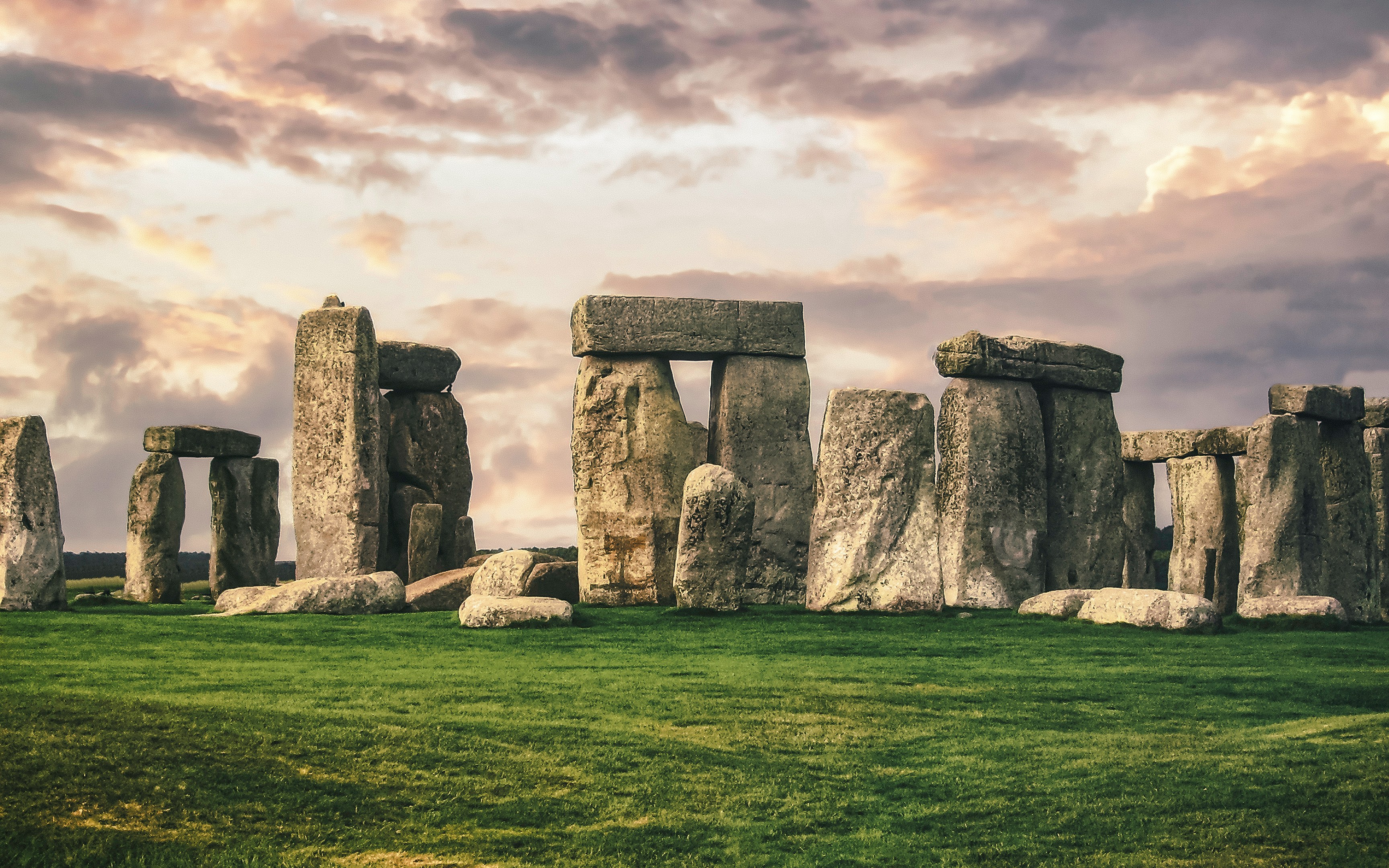
Stonehenge, cows, and technology: a roundup of British archeology

A century ago, someone found a cow’s jawbone buried beside the entrance to Stonehenge. The placement looked deliberate, and historians have been speculating about it ever since. Now, the high-tech toys available to scientists have delivered new information, answering some old questions and leaving us with new ones: the cow came from an area with Paleozoic rocks–in other words, rocks that are more than 400 million years old. The closest place that fits that description is Wales, where Stonehenge’s bluestones were quarried. 

Does that mean Stonehenge was built by Welsh cows? 

When they sober up, archeologists aren’t convinced of that, but there is speculation–sober speculation–that cows or oxen were used to drag the stones overland. It’s only recently that archeologists have found evidence that cattle were used to pull heavy loads in the Neolithic era, when Stonehenge was built, but they’re now pretty sure they were, and that fits nicely into the jawbone puzzle.

If you forgot to set your watch, the Neolithic era took place somewhere around 2990 BCE. 
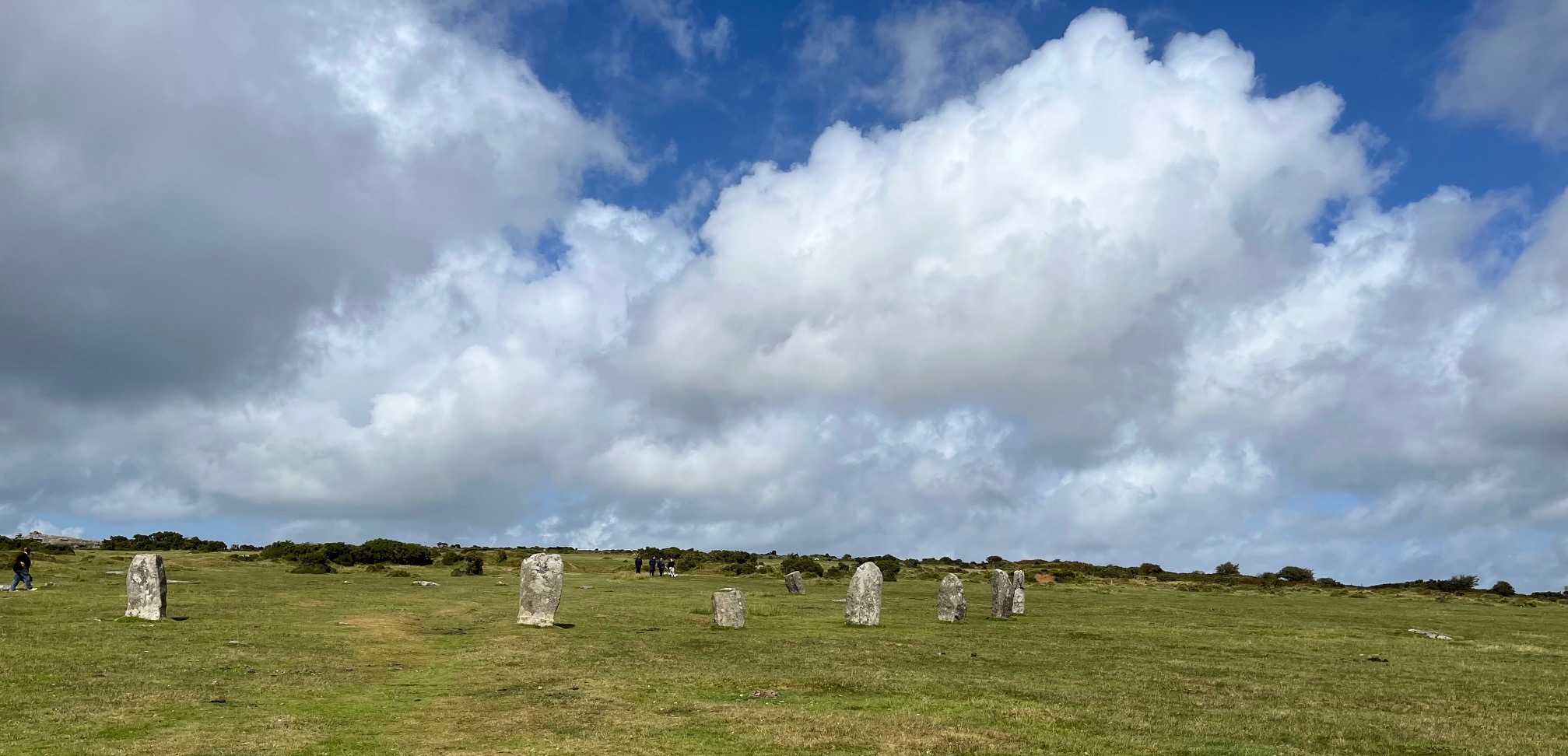
Marginally relevant photo: Stonehenge it’s not, but it is a stone circle. This one’s from Minions, in Cornwall.

But cows and oxen pulling the bluestones sits squarely in the land of speculation, so let’s not commit too heavily to it. We can’t prove that the cows in general or this cow in particular helped pull the stones. We don’t even know for sure that the cow in question was brought to Stonehenge alive, although if you’re going from Wales to Stonehenge, you’ll find it’s a long way to carry a cow. Or even a cow’s head, especially in the era before refrigeration. Humans are indeed strange, but not, I like to think, quite that strange. 

What’s known for certain is that the cow was indeed a cow, not an ox or a bull. And that someone left her jawbone in a significant spot, like a note saying, “This means something,” and don’t we wish they’d told us what.


Cows, sheep, and pigs

Animal bones also figure in a recent article about bronze age gatherings in what’s now Britain. People traveled long distances to get together and eat. And, presumably, solidify the relationships between tribes or–well, whatever groupings we’re talking about. They would’ve known. The same techniques that inform us about Stonehenge’s Welsh cow also tell us where their animals came from before they became the feats. 

Whatever it means, at one site they mostly ate beef; at another, mutton; and at a third, pork. 


A Danish woodhenge

A circle of 45 wooden posts has been discovered in Denmark. It’s believed to have been built between 2600 and 1600 BCE–the late stone age and early bronze age–and it’s the second woodhenge that’s been found in the area. What experts take from this–or one of the things they take from it–is that Denmark, Britain, Ireland, and parts of northern Europe, which all have similar henges, were strongly connected. 

The axis of the newly discovered henge matches that at Stonehenge, underlining the assumption that the builders had shared beliefs and technologies.


The Melsonby Hoard

Someone with a metal detector found what’s described as one of the biggest and most important hoards of iron-age glitz in Britain: a collection of more than 800 objects. It was found in a field in the north of England and includes wagon and chariot parts, bridle bits, ceremonial spears, and two ornate cauldrons, all of which shows evidence of burning, possibly as part of a funeral. 

The expert who was called in after the detectorist reported his find said, “Finding a hoard of ten objects is unusual, it’s exciting, but finding something of this scale is just unprecedented. . . .

“Some people have regarded the north as being impoverished compared with the iron age of the south of Britain. This shows that individuals there had the same quality of materials and wealth and status and networks as people in the south. . . . The north is definitely not a backwater in the iron age. It is just as interconnected, powerful, and wealthy as iron age communities in the south.” 

The find also provides the first evidence of four-wheeled vehicles in use among the tribes. 


The Romans and the Welsh

A huge Roman fort that was in use from the first through third centuries has been found in Pembrokeshire, Wales, in an overgrown farm field. It may rewrite the history of relations between the Romans and the Demetae–the tribe that lived there. The belief had been that they were on peaceful terms, but the presence of a fort this size throws that into doubt, indicating a strong military presence.

The fort explains why the field was never worth cultivating: the farmer, and probably many before him, kept hitting stone. It was found by an archeologist from Pembrokeshire, who had often wondered whether an unusually straight road might not be Roman. (You may have to live in Britain to understand why a straight road would cause a person to wonder.) Then  he looked at a satellite image and spotted the field, which is the size and shape of a Roman fort.

He drove out to see it and as he described the moment, “Sticking out of the ground was a triangular piece that looked like a Roman roofing slate. I thought: ‘Surely not?’ I pulled it up and lo and behold, it’s an archetypal Roman roofing slate, an absolute peach. Flip it upside down and you can see underneath a diagonal line where it was grooved to fit into the one that was underneath it. It’s a real beauty. . . .

“That was the diagnostic evidence I was looking for, which is a miracle, because it’s a huge site.”

The current best guess is that the fort held some 500 soldiers.


England and West Africa

We’ve moved to the 7th century CE, so reset your watches if you would, and we’re poking around disrespectfully in a couple of graveyards, one in Kent, on England’s southeast coast, and one in Dorset, a long walk to the west, even if you’re being dragged by a cow. 

Sorry, no. Wrong era. Forget the cow. But in the same way that the Stonehenge story follows one cow to make sense of the Stonehenge story, this one follows two unrelated humans to get a glimpse of life in early medieval England. These burials hint at people traveling much greater distances in the early medieval period than we would’ve expected: both had a paternal grandparent from West Africa. Their grave goods show they were both buried as typical and well-thought-of members of their communities, and the ancestors of the people buried nearby were either northern Europe or western British/Irish.

That western British/Irish business is, I think, a way of saying Celtic now that it’s looking questionable that a group of people called Celts ever existed. 

The Kent and Dorset communities had very different cultures, the eastern one Anglo-Saxon and in frequent touch with Europe, the western one on the fringes of European influence and primarily–um, whatever we say if the word Celtic’s gone up in smoke. Both, though, had contact with far-away West Africa.


And finally, a mere 800 years ago

In Leicester–pronounced, through some miracle of English spelling, Lester–in the twelfth century, 123 women, men, and children were buried, in a short space of time, in a narrow shaft near the cathedral. That would’ve been something like 5% of the town’s population and it’s one of the largest pit burials found in Britain. 

“Their bones show no signs of violence – which leaves us with two alternative reasons for these deaths: starvation or pestilence,” said Mathew Morris, project officer at Leicester University’s archaeological services. “At the moment, the latter is our main working hypothesis.”

Initially, the archeologists assumed the deaths were from the bubonic plague, but when the bones were radiocarbon dated the centuries were wrong. But the Anglo-Saxon Chronicles do mention pestilences and fevers, severe mortality, and miserable deaths from hunger and famine in England from the mid-tenth century through to the mid-twelfth century. The pit burials seem to back that up.

“It is also important to note there was still some form of civic control going on,” Morris said. “There was still someone going around in a cart collecting bodies. What we see from studying the bodies in the pit does not indicate it was created in a panic. . . . There was also no evidence of clothing on any of the bodies – no buckles, brooches, nothing to suggest these were people who were dropping dead in the street before being collected and dumped.

“In fact, there are signs that their limbs were still together, which suggests they were wrapped in shrouds. So their families were able to prepare these bodies for burial before someone from a central authority collected them to take to the pit burial.”

In a roundabout way, the find is the result of Richard III’s body being discovered, minus the feet, in a nearby parking lot. His body was reburied in the cathedral and since then visitor numbers have gone wild, so the cathedral decided to build a heritage learning center in the cathedral garden, which had once been a graveyard. 

In Britain, construction like that means an archeological survey, and tha turned up what was left of 1,237 people buried between the eleventh and nineteenth centuries. Below them was evidence of Anglo-Saxon dwellings below that, a Roman shrine. 

“It’s a continuous sequence of 850 years of burials from a single population from a single place, and you don’t get that very often,” Morris said. “It has generated an enormous amount of archaeology.”

***

Totally unrelated to any of that, I wonder if a reader or readers can enlighten me on something that’s happened here lately. Notes used to get 2,000 to 3,000 hits per week, but about a month ago it started getting between 10,000 and 20,000, with as far as I can tell all the growth coming from China. That’s lovely–whoever you are, welcome–but it’s also strange. For one thing, it wasn’t slow growth; all those new hits appeared between one week and the next. For another, the list of posts that get the most hits hasn’t changed: Britain’s gun laws, Britain’s native foods, the shift to metric measurements, the scone. (I know: it’s an odd list.) I’d have expected a shift in readership to bring a change in interests, but it hasn’t. So is this a bot, clicking away mindlessly and reading nothing? Or is this something real?

If you’re a new reader from China, or if you’re not but know something that might explain what’s happening, or if you just want to tell me how strange this is, leave me a comment, will you?

Thanks.
A new theory about Stonehenge

The recent discovery that one lone piece of Stonehenge was brought some 700 kilometers, either overland or by sea, from northern Scotland has led to a new theory about the monument’s purpose: that it might’ve been built to unite the island’s early farming communities at a time of cultural stress. 

The monument’s stones come from Wiltshire, Wales, and Scotland. And they were set in place some 5,000 years ago, when (I remind you) the art of trucking hadn’t yet been perfected. Or invented. 

Even the most conveniently located stones had to be hauled more than 20 kilometers, so this was already a major commitment. I’d hesitate to move those beasts from my neighbor’s front yard to mine, and we’re within spitting distance of each other. So 20 kilometers? I’ll pass, thanks.

What I’m saying here is that a society committing to haul huge stones over long distances screams for an explanation. I mean, it’s not like the local shops had run out of stone.

Semi-relevant photo: I doubt much in this photo has changed since Stonehenge was built. Except that cameras were invented.


Cultural stress

The theory we’re playing with here belongs to archeologist Mike Parker Pearson, and the cultural stress he’s talking about is the arrival of a group of people who were new to Britain and are believed to have introduced metalworking to the island.. They’re known to us as the beaker people, after–um, sorry, we’re sort of going in circles here–the distinctive decorated beakers they made. 

What’s a beaker? In this case, a piece of pottery. The beakers were important enough that they buried them with their dead.

What do we call the earlier inhabitants? Good question and not one I can answer. All I’ve seen them called is Neolithic farmers, which is kind of generic but, sorry, I don’t make the rules, I only make fun of them.

The beaker people migrated into Britain from Europe, and the two cultures would have met, rubbed elbows, and–

Well, we have no idea what they did. Got roaring drunk, told each other lies, and traded songs? Fought? Circled each other warily? Could’ve been any of that, or all of it at different times. They don’t seem to have slaughtered each other, though. Not only have fewer markers of violence been found on skeletons from this period than on skeletons from the Neolithic, there’s also not much evidence of the extensive burning or destruction that would go along with warfare.

This is roughly the time when Stonehenge was built. Or, to be more accurate about it, rebuilt. If you’d lived near Stonehenge for a few thousand years, it would’ve been like having a family member who couldn’t leave the living room furniture in one place and also had to repaint, redecorate, and reconfigure regularly. And convinced everyone to pitch in. In other words, the place was changed significantly over time. What we’re talking about is the version of Stonehenge that we know. Let’s call it Stonehenge 2.0.

Parker Pearson’s theory is that it was built to bring people together–or “assert unity.”

If you want backing for that theory, consider the stone from Scotland. Unlike its more photogenic friends, it lies flat, not because it fell and hasn’t been set upright but because it was meant to be that way. And northeastern Scotland has a number of stone circles where the stones that were set in place that way. So the builders seem to have brought down not just a huge, heavy stone but a tradition.


What happened next

As usual when we’re talking about archeology, we don’t know the whole story, but in this case we get a particularly confused picture. The Neolithic farmers tended to cremate their dead, keeping them safe from the nosy archeologists who they knew would eventually come snooping around. That means we don’t know who lived where or when. 

What we do know is that the beaker people ended up largely (and slowly) replacing the original inhabitants, creating a 90% shift in Britain’s collective DNA. 

It’s easy to think that had to do with conquest and slaughter, but (see above) we have no evidence of that. It could’ve had to do with climate change, disease, ecological disaster, or any combination of those. It could also–convincingly, to my mind–be the result of a much smaller population getting absorbed into a larger one.

What can be documented is that for some 500 years the two cultures lived parallel lives while carrying out an extensive cultural exchange. Then, after some 300 to 500 years, they started having significant numbers of children together. 

No, I can’t explain that either. Maybe we’re talking about two unbelievably shy cultures.

“Just before the point where we can infer interbreeding,” according to Dr Selina Brace, “there was a hybrid culture between what came before and what came after. It is almost like it takes them a few hundred years to iron it out, but then they find an accord and develop this set of ideas that incorporates both cultures into something that they can all subscribe to.”


What that meant for Stonehenge

The beaker people found a new use for Stonehenge. Or at least, they found one that archeologists can track: it became a place to bury the prestigious dead. Interestingly enough, DNA indicates that the burials were all from the beaker people, not from the culture that build Stonehenge and not from the mixed descendants of both groups. 

How that went down with the builders we’ll never know.

*

I normally post on Fridays and this was supposed to post on December 27. It didn’t. Because I screwed up. What the hell, no one’s paying attention, are they?

Stonehenge: the story keeps changing

Want to change history? You have two choices: do something that changes the future or change the way we see the past. Neither one is easy, but a group of scientists studying the Stonehenge rocks have managed to change the way historians understand late stone age Britain

If you read much about Stonehenge, you’ll probably read about sarsen stones first–the uprights and the massive crosspieces that sit on top of them, forming the outer circle. They were hauled a mere 16 miles. On the other hand, they weigh an average of 25 tons, so however hard you worked last week I’m pretty sure you didn’t do that.   

Once you’re done being impressed, you’ll read about the bluestones–the stones that form the inner circle–which came from 140 miles away, in Wales. Before the invention of smartphones, which would at least have let the people who dragged them document the challenge.

Think about doing that without a single online follower leaving a Like. Where’s your incentive?

The bluestones weigh between 1 and 3 tons. 

A rare relevant photo, with thanks to K. Mitch Hodge, who made it available online at Unsplash.

What most of us wouldn’t have read about is the altar stone, but it’s the one that’s making headlines and retroactively changing history. 

In spite of its name, there’s no reason to believe it was ever used as an altar. It’s lying flat and it must’ve reminded someone of an altar. The name stuck, but don’t get carried away with the idea. 

The new information is that the stone traveled something like 500 (or 350, or 800) miles to play its part in Stonehenge–that’s pretending it went in a straight line–from what’s now Scotland, somewhere around the neighborhood of Inverness, John O’Groats, and Orkney. It’s a big neighborhood, but someone will be out there even now working to narrow it down. 

Why does that matter? Because it tells us that late stone age Britain (known to its friends as neolithic Britain) was a lot more connected than anyone knew. And it tells us that whatever function Stonehenge had, it had it for a whole lot more people than any recent residents suspected. 


Moving the stones

How did they get the stone from Scotland to the Salisbury Plain? It’s tempting to think, No problem. Just plop that beast on a boat, but we’re talking about a 6-ton stone. In a boat built in the late stone age. That might not comply with health and safety guidelines. Personally, I’d think two or three times before I jumped in and started to paddle.

Information about ocean-going boats in this period seems to be pretty limited, but they’d have been small and a little sticker on the side would’ve said, “Not recommended for the transport of any stone above 1 ton in weight.” 

Evidence of cross-Channel trade between Britain and Europe has been found, and that meant boats–it’s wet out there, people–but the evidence consists of lighter things like pottery, axes, and cattle. 

Okay, I admit, cattle aren’t light. But compared to the stones we’re talking about? You could lift two of them before breakfast.

The experts are still arguing about how the stones were transported. One experiment tried to move the equivalent of the bluestones across the Severn on rafts. They sank. 

The Severn? Most likely body of water on the way from Wales to Wiltshire, currently playing host to some large stones that future archeologists will try to explain in some marginally rational way.

That doesn’t prove it can’t be done, only that it couldn’t be done the way they tried to do it. Neolithic people would’ve had a lot more experience with neolithic boats than even the best modern-day experimental archaeologist. With so little known about late stone-age boats, it’s all guesswork. So we can’t rule out boats.

But there’s another compelling reason to take the stone overland. An archaeologist who wasn’t involved in the study explained it this way: “If you put a stone on a boat out to sea, not only do you risk losing the stone–but also nobody can see it.” 

But if we spend a few years dragging it the length of Britain, people along the route will get involved. Maybe they’ll help drag it a few miles. Maybe they’ll make us a nice cup of–

No, sorry, we’re centuries too early to get a nice cup of tea. Or even instant coffee, and forget about that frothy, expensive stuff folks have fallen for. We might be offered some nettle tea, though. It’s supposed to be good for sore muscles and arthritis. The island’s rich in nettles, and after hauling that stone we’re rich in sore muscles. We’re also building up the prerequisites of future arthritic problems. So whatever it tastes like, drink that tea and look happy. These people are being hospitable.

Most settlements will lay on a feast, or share what they can if it’s been a bad year. They’ll make us feel welcome and speed us on the next leg of our journey. And with each stop, more people will feel involved with the project. They helped pull that stone. They welcomed the people who delivered it. For generations, people will talk about it. 

The stone, the expert said, will become “increasingly precious . . . as it travels south.”

If dragging a 6-ton stone the length of Britain sounds impossible, I refer you to a BBC documentary–sorry, the name sank into the sludge that passes for my memory–about the bluestones. The presenters somehow got an entire class of primary school kids to pull a stone very much like the bluestones using nothing more than ropes and (if my memory isn’t playing tricks on me) a wooden sledge and logs for it to roll across. Maybe thirty ordinary kids, none of them even close to full grown. And the stone slid across the ground as if that’s what it had in mind all along. 

Admittedly, the ground was flat and it wasn’t full of boulders or forests, but it does show what plain old muscle power can do. 

One objection to the land route theory is that it’s hard to coordinate that many people, but teamwork would’ve been an integral part of any late stone-age community. And they wouldn’t necessarily have seen the length of time involved as a problem. They might’ve seen it as something like a pilgrimage. 

Getting places in a hurry is a relatively modern obsession.

The terrain wouldn’t have been easy, but the idea that Britain was wall-to-wall forest is, apparently, a myth. 

One theory holds that the stones could’ve been moved to Wiltshire by the glaciers, but finding a stone from Scotland wrecks this. 

“From Orkney, I can’t see a way that the stone hikes a ride on half a dozen glaciers in the right order to end up on Salisbury Plain,” a geologist said.

But forget about moving the stones. How did they set them upright?

An archeologist who’s raised the 12-ton cap stone on neolithic tomb using wooden levers said it’s easy, 

So if you buy a Stonehenge from Ikea, those are your assembly instructions.

*

If all that doesn’t sound like enough work, Stonehenge was built in several stages, each one involving a different configuration. I won’t take you through all them but it must’ve been like living with someone who insists on moving the furniture every few thousand years, only the furniture is multiple tons of rock and soil. 

We’ll probably never know what went on there or why, but we’re pretty safe saying that whatever it was, it was important. To a lot of people.

Celebrating the queen’s WTF jubilee

Let’s start with basics: The queen in question is Elizabeth, and she’s been on the throne since 1066 or thereabouts. Surely that calls for a party, so here in Britain we’ve been handed a spare holiday, a dessert recipe so simple that can be prepared in two days by half a dozen trained snipers, and lots of encouragement to hold our own street parties, band concerts, and whatever else sets our suggestible little hearts a-racing. 

It’s not easy, if you live in Britain right now, to ignore all that, but I had planned to until I realized how gloriously parts of it could go wrong. 

Let’s start with Wincanton, in Somerset, which is holding the Wincanton Town Festival. That comes with a logo showing a be-jeweled crown on a purple background with, as Dorset Live puts it, “a diamond-encrusted WTF welded to the top.”

You know the acronym WTF: Wincanton Town Festival. 

If you want to attend a WTF Jubilee (even I will give that a capital letter) garden party, it’s on June 3 so you’ll have to either hurry or time travel, but I’m sure you’ll be welcome.

Nothing could be more British. Just try to keep a straight face.

*

English Heritage, which manages the Stonehenge site, is celebrating by projecting color images of the queen onto the stones. The effect is–

The word bizarre doesn’t begin to capture it. There stand these rough, prehistoric stones, in all their timeless majesty, and they’re being used as a screen to show photos of an old woman dressed in the colors of toy Easter chicks.

I’m not disparaging her for being an old woman, mind you. I’m not what you’d call young myself. But you won’t find me on an ancient monument dressed like an Easter chick.

But English Heritage is proud of their decision, and since nothing that happens really happens unless it’s on social media, they tweeted a photo, with the predictable results. And just to prove I don’t make this stuff up (who could?), here’s the tweet.

A few of my favorite comments are:

“Pointless, outdated, ancient monument to a bygone era. Projected onto Stonehenge.”

“Things Stonehenge and the Monarchy have in common? How the fuck did this get here?”

“Something ancient and now pointless that we keep under the guise of tourism, projected onto stone henge”

*

But we’re not done yet. Boris Johnson–he’s our prime minister when he finds time between parties–wants to celebrate by bringing back imperial measures. Or at least letting shops use them if they’re in the mood.

Oh, c’mon, you know what imperial measures are. Generations of schoolkids sacrificed (cumulatively speaking) months of their lives memorizing that a foot is 12 inches long, a yard is 3 feet, and a mile is 1760 yards. Also that a cup holds 10 ounces if you’re in Britain but 8 if you’re in the US, and that a quart holds 4 cups while a gallon hold 4 quarts. In either country, although the cups won’t be the same size, so why should anything that follows from them?

Mind you, those ounces that make up the cup aren’t the same ounces that go into a pound. They’re liquid ounces and a pound is a measure of weight, so it uses different ounces. Unless that pound is measuring money, which it does as a second job. It doesn’t use ounces for that at all–it drops them off at home when it stops in for a quick bite to eat.

In case all that business with 4 cups and 4 quarts made you think the number 4 is magical when you work with liquid measures, a pint holds two cups. You can’t rely on anything.

We won’t get into hogsheads and firkins and bushels and furlongs, but oh, we could, my friends, and we’d have such fun. Still, it would be irresponsible to move on without telling you that a hundredweight is made up of 112 pounds and a pennyweight is 12 grains.

So you can see why imperial measures are simpler, more logical, easier to understand, and all-around better than the metric system: They keep out the riff-raff and the numerically challenged.

But silly as it may seem, Johnson’s proposal’s done wonders for my stats. An old post on Britain’s halfhearted adoption of the metric system and on the old system(s) of measuring has attracted some ridiculous number of hits lately.

That’s ridiculous given the scale I work on. We’re talking about hundreds, not thousands. If you want to read about rods and furlongs and apple gallons and Cornish miles, it’s all there. And if you think the past was a simpler place, I recommend it.

*

What else happens dring the jubilee? Why, the queen’s jubilee-themed tree-planting program. This encourages people to plant a tree for the jubilee, which not only rhymes (if it hadn’t, what would they have come up with?) but is promoted as a way to reforest the country.

It’s been busted for having sponsors with links to deforestation. But in other countries. Ones with more forest. And less power. So that’s okay. 

According to a campaign group, the program’s platinum sponsors include McDonald’s, with beef linked to the deforestation of the Amazon, and the bank NatWest, with links to deforestation in Uruguay. And so forth.

Everyone involved says they have no links to deforestation or are committed to doing better or have planted a tree at midnight in a neighbor’s yard and we should all go mind our own business, thank you very much, so we’ll move on.

*

Because that’s not all the queen’s doing. She’s giving Britain eight new cities

No, not like that. She doesn’t build them herself. What she does is wave her magic feather over someplace that already exists and declare that what used to be a town is now a city. This doesn’t make it any larger, although some research suggests that it may make it richer, since (and I’m quoting the BBC here, which doesn’t explain the mix of singular and plural but does give me someone to blame it on) “it put them on the international map as a place to do business.” Presumably, businesses ask Lord Google about a place, find out it’s a city, and get so excited they’d push little old ladies out of the way in their rush to do business there. Even little old ladies dressed like Easter chicks.

Listen, don’t ask me. I’m not the one making the argument. The survey seems to be based on a sample of one, the former town/now a city of Perth (it’s in Scotland), which for all we know grew richer for other reasons. But never mind, we can’t rule out the queen’s magic feather.

I should mention, in case you don’t already know this, that in Britain a town doesn’t become a city by democratic consensus–you know, by people noticing how big it is and calling it a city. It happens by decree and has precious little to do with size. The smallest British city has 1,600 residents. For all I know, the queen could make herself a city. Or make you one. You wouldn’t be any larger, and neither would she.


But speaking of democracy…

…jackdaws decide when to leave the roost in the most democratic possible way. Each bird literally has a voice. 

In the winter, jackdaws roost together overnight, and in the morning they take to the air in a mass. When a bird thinks it’s time to leave, it calls out, and each call is a vote. The noise level and the speed at which it increases both influence the flock’s decision to take off. 

As many as 40,000 of them can roost–and lift off–together. They don’t care if you call it a city or not.


Will everyone who isn’t Banksy please stand up?

We’re still talking politics here. William Gannon, a town councillor in Pembroke Dock, Wales, resigned in an attempt to squish a rumor that he’s the anonymous street artist Banksy. The rumor, he believes, was started by someone who wants his seat on the town council and, he said, it was “undermining my ability to do the work. . . . [People were] asking me to prove who I am not and that’s almost impossible to do.”

Gannon is an artist and does make street art, which his website describes as “Banksy-esque, not intentionally,” but that’s not the same thing as him being Banksy, and to prove that he’s handing out buttons saying “I am NOT Banksy.” He wears one himself, but then, as many people have pointed out, that’s exactly the sort of thing Banksy would do.

You can’t win this game.


And in unrelated clashes with the law…

…a pair of herring gulls have nested on a police car in Dorset and can’t be moved off because they’re members of a protected species. The car’s out of use until the chicks fledge. In the meantime, the adult birds are helping the police with their inquiries.


This one stayed out of court, but…

…the Star Inn at Vogue, which is in Vogue, Cornwall and known locally as the Vogue, was threatened with a lawsuit by the owners of Vogue magazine for using its name. The pub owners found that hilarious and wrote back to say the pub had been in place, under that name, for hundreds of years.

“I presume,” Mark Graham wrote, “that at the time when you chose the name Vogue in the capitalised version you didn’t seek permission from the villagers of the real Vogue. I also presume that Madonna did not seek your permission to use the word Vogue (again the capitalised version) for her 1990s song of the same name.”

The magazine wrote back with an apology, which is now framed and on display.


And finally, leaving the UK behind

A year ago, a two-day promotion by a restaurant chain in Taiwan offered free sushi–on an all-you-can-eat basis–to anyone with the Chinese characters for salmon in their name, and also to the people they brought with them. That led 331 people to change their names. It doesn’t cost much, at least when compared to the price of a tableful of sushi. So the country suddenly acquired a bunch of people named things like Salmon Dream and Dancing Salmon. Some of them built a social media following on that basis. (There’s no explaining social media.) Others started small (and short-lived) businesses, charging people to go out for sushi with them. 

It was called Salmon chaos, and the government was not amused by the administrative cost of it all. 

Most people changed their names back as soon as the promotion ended, but a few got trapped, because the government only allows a person to change their name three times. Last I heard, the government was debating a change in the law, but in the meantime a few salmon were still trapped as salmon. 

A Minnesotan admits, belatedly, that it does actually snow in Britain

Having survived 40 Minnesota winters, I can get snobbish about the British weather, but recently 61 people got trapped in at a pub by a 9-foot-high snow drift and downed power lines, so I’m now prepared to admit that British weather can, very occasionally, be extreme. That happened during Storm Arwen (Britain names its storms these days). Even in Minnesota, we would have classed it as more than a nuisance snow. Most of the people were stuck there for three nights and they spent the time playing board games, singing karaoke, and doing pub quizzes. Two stayed an extra night, working up the courage to leave.  Pub quizzes? They’re a big thing in British pubs and people love them. Don’t ask me to explain that. I’m a foreigner. I was glad to be done with quizzes when I left school. A single day of quizzes, board games, and karaoke would’ve sent me out into the snow drift. If I could’ve gotten the door open.   The pub fed everyone for free but–wisely–charged for booze.

Irrelevant photo: Li’l Red cat in a basket.

Elsewhere, Storm Arwen was less fun. Thousands of people lost power, and with it heat, for, as I write this, more than a week. Why it’s taking the power companies so long to patch the network back together is anyone’s guess. There’ll be an investigation eventually, but in the meantime we’ve got some people who are too damn cold to think that far ahead. The army and navy were finally called out to help. That would’ve happened sooner, but it took a while for anyone to remind the government that people up north do actually vote.  Storm Arwen was followed closely by Storm Barra, and Storm Barra was preceded by wind and snow  warnings. Since storm news uses a traffic light system and warnings are yellow, we’ve been treated to yellow snow warnings. Maybe you have to have lived in the US to find that funny–or disgusting–but Minnesotans consider it the height of humor to advise each other not to eat yellow snow, and here we are with warnings about the stuff falling out the sky. How the dogs managed to get near it before it hit the ground is anyone’s guess. You have no idea how many things will change when you drop yourself in a new country.   Reviving a cat story This happened it 2015, but it resurfaced recently and since I missed it last time around, I’m willing to bet someone else out there did too: A man in Yorkshire called 999–Britain’s police, fire, and ambulance  emergency number–because his girlfriend let the cat eat his bacon Yes, and what, the operator asked, did he want done about it? Well, he wanted to press charges, of course. Against the girlfriend or the cat? Against both of them. “Right, sir,” the operator said. “it’s not a criminal offense to let a cat eat your bacon. And we don’t arrest cats. I’m very sorry.” No word on what happened to the relationship, but I wouldn’t bet on him living happily ever after. With either the girlfriend or the cat. My gratitude to CatLadyMac for pushing me in the direction of this story.   Neolithic mince pies Archeologists at Stonehenge have been derailed by enough Christmas cheer that they’re claiming the monument’s builders invented the mince pie. Or at least that they ate something very much like mince pies, involving meat fat, nuts, and fruit. And possibly grain for a crust. Or possibly not. They’re making a huge leap from what was available to what they might’ve done with it., and I’ve made enough questionable pies to tell you that you can’t draw a straight line from having the right ingredients to turning out a pie. Especially if you’ve never seen a pie before.  In the interest of accuracy, let’s say that it’s probably not the archeologists making that leap from they had the ingredients to they made mince pies. That comes from English Heritage, which funnels visitors through Stonehenge, and sells them stuff–including, at this time of year no doubt, mince pies, since they’re a hazard of every British Christmas. English Heritage has made a “neolithic mince pie recipe” available.  Those people you see standing on the sidelines rolling their eyes and silently mouthing, “Don’t blame me”? Those are the archeologists.   Covid news In Italy, a man tried to get his vaccination certificate while still avoiding vaccination by presenting a fake arm. Because who’d notice, right?  Colorwise, the arm was a pretty good match for the rest of him, but it was made of silicon and the rest of him was made of muscle, bone, and all those other things that are found in animate creatures. So yes, someone noticed, probably well before jabbing a needle into the arm. I can’t help wondering whether he just handed the arm over or attached it in more or less the area where a real arm would normally grow. Either way, he didn’t get his proof of vaccination and he did get some attention from the local police. And the press.

*

From the start of the Covid pandemic, a substantial number of people have told us that viruses inevitably get milder as time goes on. Didn’t that happen with the 1917 flu epidemic? Didn’t the Black Death eventually disappear? The conversation around that has gained in intensity with the arrival of the Omicron variant, which on early and incomplete reports appears to be more transmissible and maybe, possibly, hopefully milder.  With the emphasis on maybe. The experts, though–spoilsports that they are–are holding out for actual evidence before they commit themselves. But do viruses inevitably become milder? Not according to Alan McNally, the director of the Institute of Microbiology and Infection at the University of Birmingham.  I know. Another spoilsport. The world’s full of them. He calls it “one of the most baffling misinformation myths peddled during the pandemic.”  He’s joined by spoilsport Brian Ferguson, an immunologist at the University of Cambridge. “It’s really unpredictable what will happen to the evolution of the host or the virus. You can pick out examples of things going one way or the other depending on what point you want to make.” One argument trotted out to defend the belief that viruses evolve toward being kinder is that indisputable fact that dead people don’t walk around much. This, the argument goes, limits their ability to spread any disease that may have killed them.  I’ll confess to having trotted out that argument myself. Oops. I did mention that I’m not an expert, right? The problems with it include Covid’s ability to spread before people know they have it, including people who never become sick and never know they were carrying the disease to spread it anyway. And if that isn’t enough, a disease can be serious, both to individuals and to the society they live in, even if the people who get it don’t die.  We have no way of predicting what direction this mess will go in. 

*

How’s the vaccination campaign going? Well, the Sicilian village of Monte delle Rosse (population 2,100) has a vaccination rate of 104%. And they accomplished that without vaccinating either the dead or any silicon arms. Here’s how it happened: Italy calculates the vaccination rate by comparing the number of residents and the number of people vaccinated. So when people came in from the surrounding villages for their vaccines, they put little Monte delle Rosse on the map.  The take-up there was particularly good because before the vaccines were available, the area had a bad Covid outbreak, started by a nun and a priest who came to town not knowing they were Covid positive.  That sounds like the start of a bad joke, doesn’t it? Although they usually walk into a bar, not a Sicillian town. Sorry I can’t supply a punchline, but-you’re welcome to leave one in the Comments section. In the meantime, the outbreak really did start that way, and when a vaccination team arrived, word of mouth brought people flooding in. The village mayor said, “There was almost an air of celebration at the vaccination hubs. It was like being at a popular town festival. People understood that, with vaccines, they were creating a shield that would protect their community, safeguarding the very survival of the village.” It also helped that someone set up a What’s App group that responded “to fake news and reassured people about vaccine safety. I am convinced that, if we had spread the wrong information about the dangers of jabs, today we would be here to tell you another story–that of dozens of deaths from Covid that would have risked halving the inhabitants of this village.”   A follow-up on what makes a British city a city In November, I wrote about how a British town becomes a city. It’s time for a follow-up, because the Cornish town of Marazion, with a population of 1,440, is making a bid to become a city. How do they justify that? The boosters cite things like its wonderful people, its community spirit,  its history, and its beauty. Not to mention its clock tower and the possibility that it’s the oldest chartered town in Britain. Or that, if it isn’t, it’s among the oldest. “Size is not important,” said a town councillor, who may or may not have understood what he was saying. I’m working on a proposal to make my living room a city. It has a human population of two and a remarkable number of resident animals, along with stunning drifts of dog and cat fur. .  

Stonehenge, nuclear fusion, and pepperoni: It’s the news from Britain

In late July, researchers announced that they knew where fifty of Stonehenge’s fifty-two sarsen stones came from: a spot fifteen miles away. 

Probably. It’s a good match, but they still need to eliminate some more places.

Sarsen? It’s a kind of sandstone. According to one dictionary, the word might be a variant on the phrase Saracen stone, which comes from the (local) Wiltshire dialect.  No, I have no idea either. I think we’d have had to be there at the time for it to make any kind of sense. Besides, the origin’s not definite anyway.

According to another dictionary, the stuff is also called Druid stone. None of which should matter to us but hey, it’s your own fault for letting me lead the way. 

What you probably wanted to know is that we’re talking about Stonehenge’s uprights, which weigh something in the neighborhood of twenty tons, and that’s before breakfast. After a full English (that’s a serious breakfast, since we’re defining things), you can add an easy 10% to that.. 

We’re also talking about the lintels and a few of the other stones. Basically, everything except the bluestones, which came from Wales, parcel post and cash on delivery. Boy, was that expensive.

Why have the experts figured out the location now? Back in 1958, while a crew was setting up three stones that had fallen over a century or so before, they discovered that one of the stones was cracked, so they drilled out a core and pinned the stone back together with a bolt. Sort of like gluing the handle back on that mug you really like, but on a larger scale.

That left them with a neatly drilled core, and a guy named Robert Phillips, um, kind of took it home, because why not? If he hadn’t, odds are someone would’ve thrown it away. He kept it as a souvenir, and sixty-odd years later he decided to send it back where it belonged. But what’s sixty-odd years when you’re talking about something 2,500 years old?

These days, no one’s allowed to mess with the stones, even if they mean well and are trying to figure out something important, so the core–now called the Phillips core–came as a real gift. It has been x-rayed, analyzed, and diagnosed with PTSD, and all the resulting information has been compared with local stone, and that’s how they found a geochemical match. 

Two of the stones don’t match. The theory is that they may have been the work of other builders. 

How do they know that when they can’t take chips from any of them? I have no idea.

*

Ten 15,000-year-old stone fragments have been found in Jersey and may be the earliest evidence of art in the British Isles. They were found near flint tools, hearthstones, and granite slabs. 

I have no idea what the granite slabs have to do with anything. I don’t keep any in my house, and I am of course typical of everybody in all ways, but life was different back then. Everyone kept granite slabs in their houses.

Dr. Silvia Bello of the Natural History Museum in London said it’s possible that the people who made the plaques weren’t particularly interested in the final product. 

“For us, art is something that we put on the wall, something that we can admire. For them it is more likely that the act of producing the engraving was the meaningful thing.”

That’s a way of saying that the art isn’t particularly pretty. To our eyes, anyway.

*

So much for the past. We’ll skip over the present. It hasn’t been a great year, so let’s peer into the future and pretend it’s going to be wondrous.

It will. Really it will.

New technology makes it possible to turn the ordinary brick into a battery that stores enough energy to power a small LED light. 

Okay, the brick doesn’t actually become a battery, it becomes a supercapacitor. The trick is to fill the brick’s cavities with conductive plastic nanofibers.

No, I didn’t understand a word of that either. Except for brick. I understand bricks. But forget the quibbly stuff. If this works, you could have solar panels or a wind turbine and store the power in your wall. 

The bricks don’t have the same power density as a lithium-ion battery, but the researchers are hoping they can increase it. If they can, it will be cheaper than batteries. And, as far as I can tell, less destructive.

*

A collaboration involving the European Union, the UK, China, India, Japan, Korea, Russia, and the US is building a nuclear fusion reactor in France. It’s not a commercial project. The idea is to demonstrate that it’s possible to contain temperatures of, oh, say 150 degrees Centigrade, with magnets. One of the magnets would be strong enough to lift an aircraft carrier. 

Look out for your belt buckle.

Okay, I left some countries off the list. Thirty-five are involved. 

If the process works, it could produce carbon-free energy from small amounts of seawater, with no possibility of meltdown and far less nuclear waste than fission reactors.

*

Okay, two news items from the present, because you can’t count on me to play fair. One isn’t even from Britain. 

First, a cycle cafe in Wales was refused planning permission.

Why is this news? Because the refusal was based on it not having enough parking spaces. For cars. On top of which, it’s not on a cycle route, and what’s a bike doing out in the real world anyway?

The owner says she’ll appeal.

Second, the U.S. is facing a pepperoni shortage

And you thought life could go on as usual, didn’t you?

The news from Britain, with neolithic sites and new coronavirus tests

News about the government’s failed Coronavirus tracing app keeps trickling out. This weekend, we learned that several groups responded when the prime minister called for a national effort to create a smartphone app. Dunkirk spirit! Save the nation! 

What happened next? NHSX, the outfit that made the failed app the government committed to, treated them as rivals. 

NHSX, ever so incidentally, was set up by the health secretary before he became the health secretary, so he was able to be totally neutral about it.

Don't worry about it. The photo's just to break up the text. It's completely irrelevant.

Irrelevant photo: pansies

“We naively thought they would incorporate them into one,” Tim Spector, one of the rival developers said. “The whole point was to help the NHS, to find the hotspots so they could get the resources to the right hospitals.”

Silly him. NHSX, he said, treated his team like the enemy and people within the NHS were told not to work with them. 

“They were very worried about our app taking attention away from theirs and confusing the public,” he said, but if the NHSX app had worked they’d have happily handed over what they’d done. 

Of the rival apps, Covid Symptom Study has 3.5 million users and helped spot symptoms like loss of taste and smell, and Evergreen Life has 800,000 and spotted a local outbreak around Manchester before testing was available. 

The Covid Symptom Study reports that although the number of people reporting symptoms are decreasing around the country, they’re staying steady in London. As far as I can tell, it’s getting zilch in terms of backing from the government, which is now betting its chips on an adaptation of the Apple-Google app, which won’t be ready till fall. 

The delay is because the government says the distance calculator on the app isn’t accurate enough. That means it’ll send people who haven’t been exposed notices that they have been, and they’ll have to self-isolate when they shouldn’t have to. Matt Hancock, the health secretary, said the government’s working closely with  Apple-Google and will come up with a hybrid version. Which will be better, bigger, more accurate, and have polkadots.

“Oh yeah?” said  Apple-Google. “We never heard of you and where exactly is Britain anyway?”

Okay, what they–the they in question here being Apple–actually said was, “It is difficult to understand what these claims are as they haven’t spoken to us.”

They said they’re not aware of a distance problem and have no idea what the hybrid model’s about.

The NHS, however, said, “NHSX has been working with Google and Apple extensively since their API [application programming interface ] was made available.”

Google said, diplomatically, that it welcomed the government’s announcement.

Yeah, we’re doing fine over here, and thanks for asking. Hope you are as well.

*

While we’re doing tech news: K-pop fans have co-opted the #BlueLivesMatter hashtag by tweeting images of Smurfs and other blue characters. They also flooded #WhiteLivesMatter with K-pop videos to the point where it became known as a K-pop hashtag.

*

Let’s check in on what’s happened with all those possible tests that we heard about and that were going to save our viralized asses from an enemy that’s not only too small to see but too small for most of us to imagine. 

A four-week trial of a saliva test is about the start. All people have to do is spit in a plastic jar instead of letting someone stick a swab down their throats and up the  noses (or worse yet, having to do it themselves, which involves finding either your tonsils or the address where they once lived).

People can do the test at home. They can even do it out in public if they don’t mind being disgusting. Cross your fingers. 

The current test has multiple problems. In addition to having to figure out where your tonsils used to live, it gives a lot of false negatives–20%. It also makes people cough and sputter, putting people administering the test at risk. And the virus doesn’t last long on the swabs, so too much delay and the test’s invalidated. 

Another new test gives results in 50 minutes and should be tested on NHS staff starting this week. Unlike the saliva test, which reports back in 48 hours, though, it relies on a throat swab. 

*

When the government instituted a program to deliver food parcels to people who are in deep hiding from the virus because they or a family member are particularly vulnerable, I had a moment of thinking the government might get its act together and I before long I wouldn’t have anything to make fun of. 

That’ll show me what I know.

Where the program works, it’s great. But. It’s delivering pork products to Muslim families. It’s delivering free food to families whose pride is hurt by the assumption that they need help and who would happily take themselves off the list if someone had asked.

I’d be willing to bet they’re sending beef to HIndus, but I haven’t seen that reported. 

The program’s being run by a private firm and the government says anyone with special dietary needs should contact their local government and leave the national government the hell alone. Want to place any bets on how long it takes to get through three levels of local government to the company that’s actually running things?

*

In the department of slight over-reactions, North Korea lost its temper over a defector’s plan to send propaganda across the border from South Korea and blew up an office that was set up to improve north-south communications. 

Am I making assumptions when I say they lost their temper? Probably not. The official news agency said the move reflected “the mindset of the enraged people to surely force human scum and those, who have sheltered the scum, to pay dearly for their crimes.”

So yeah. Lost temper. Plus a few commas gone a-wandering.

*

Near Stonehenge, archeologists have found a 4,500-year-old circle of shafts that’s 1.25 miles across. Or 2 kilometers, if you take your distances metric. That may be a rough approximation. I’d be surprised if they match that neatly but I’m too lazy to check. Whatever it translates to, it’s the biggest prehistoric structure found to date in Europe. A paper on it has been published in Internet Archaeology and is available to any idiot–and I offer myself as an example of the species–who clicks on it.