Manners, American and British

The British have manners. They have such good manners that from time to time they’ll throw them out the window to scold strangers for their lack of them.

Wild Thing and I were in the outdoor section of a café once—a cramped, eat-your-lunch-and-get-out kind of place—and as a couple who’d been sitting nearby wove past our table to leave, one of them said, “In this country, we say please and thank you.”

Sadly, by the time we’d processed the words, they were too far away for a snappy comeback, but “In our country, we’re polite to strangers,” did come to mind. It may not be true, but I still wish I’d been quick enough to say it.

mulfra 030

Irrelevant Photo: Fountains Abbey, in Yorkshire

I have no idea what we’d done, or more likely not done, to piss them off. I’ve been a waitress. Wild Thing and I have both been cab drivers. We’re not the kind of people who think that if they have the money for a meal, or a cab ride, or a tube of toothpaste, it gives them the right to be obnoxious. But we are, I admit, incapable of saying thank you as often as the British do. Buy something at a small store and when you hand in your item to be rung up, the clerk will thank you. When you hand over your money, you’ll get thanked again. (A variation: The clerk may look at the twenty you handed over for something costing less than a pound and say, “Lovely,” or “Brilliant,” as if you’d handed them a slice of chocolate cake, or exact change just when they were about to run out and the banks had all closed and the vandal hordes were all lining up to do their shopping and none of them had brought the exact change.) Then when you go to leave, unless some other customer’s diverted the clerk’s attention, you get thanked a third time, often with the phrase, “Thank you very much, thank you.” Or, “Thank you. Thank you very much, thank you.”

At least it’s like that way out in the country, where we live.

I can’t do that. Can not. Am constitutionally incapable of. I also can’t manage to say you’re welcome three times for a single transaction, especially when I haven’t done anything. I mean, you’re welcome? For what? I bought something. I wanted it enough to hand over money. That’s not a gracious act that I should say “you’re welcome” for. Sometimes I find myself saying “thanks” instead, which is also absurd but doesn’t feel quite as bizarre as “you’re welcome.”

I asked S. once how often she said you’re welcome in response to the multiple thank-yous. She looked startled and said she didn’t think it was “called for” unless you’d done something particularly—well, kind may not have been the word she used but it was the impression she left me with. Unless you’d gone out of your way, somehow. But I doubt she’d never noticed how many times she got thanked per transaction. It’s that old thing about the fish and the water. She swims through an ocean of thank-yous and wouldn’t notice them unless they stopped.

Or that’s what I thought, anyway, until A. and H. told me that you’re welcome is an Americanism, although H. added that there’s an equivalent phrase in Welsh. R. swore that it’s a class thing: If you’re working class, you learn to say “you’re welcome.”

At this point, I understood two things: 1, It’s complicated, and 2, I’ll never completely get it.

“What do you say?” I asked.

“That’s okay” would do, apparently. So would “cheers.” But “cheers” can also be used to mean goodbye, or as a kind of toast—when you lift your glass to someone. According to my British English A to Zed, it also means here’s how! What does here’s how! mean? I looked it up and it’s either too obvious or too unused to include, so I don’t know.

I asked M. and Wild thing what here’s how! meant and they were as blank as I was.

So in this country we say “please” and “thank you,” but we don’t say “you’re welcome.”

If I didn’t know better, I’d think that was rude.
The Writing on the Sidewalk of a Cornish Village

Either I’m engaging in antisocial behavior or I’m the last defender of decency in Cornwall. Some days it’s hard to tell.

Wild Thing and I live on what’s called the estate. If you’re American, that sounds all grand and Downton Abbey, but what it really means is “the subdivision.” We live in a tiny fragment of suburb, even though we don’t have a city to be suburban to. Our village is spread out—a village without any center—so this is the most densely populated bit. By dogs as well as humans.

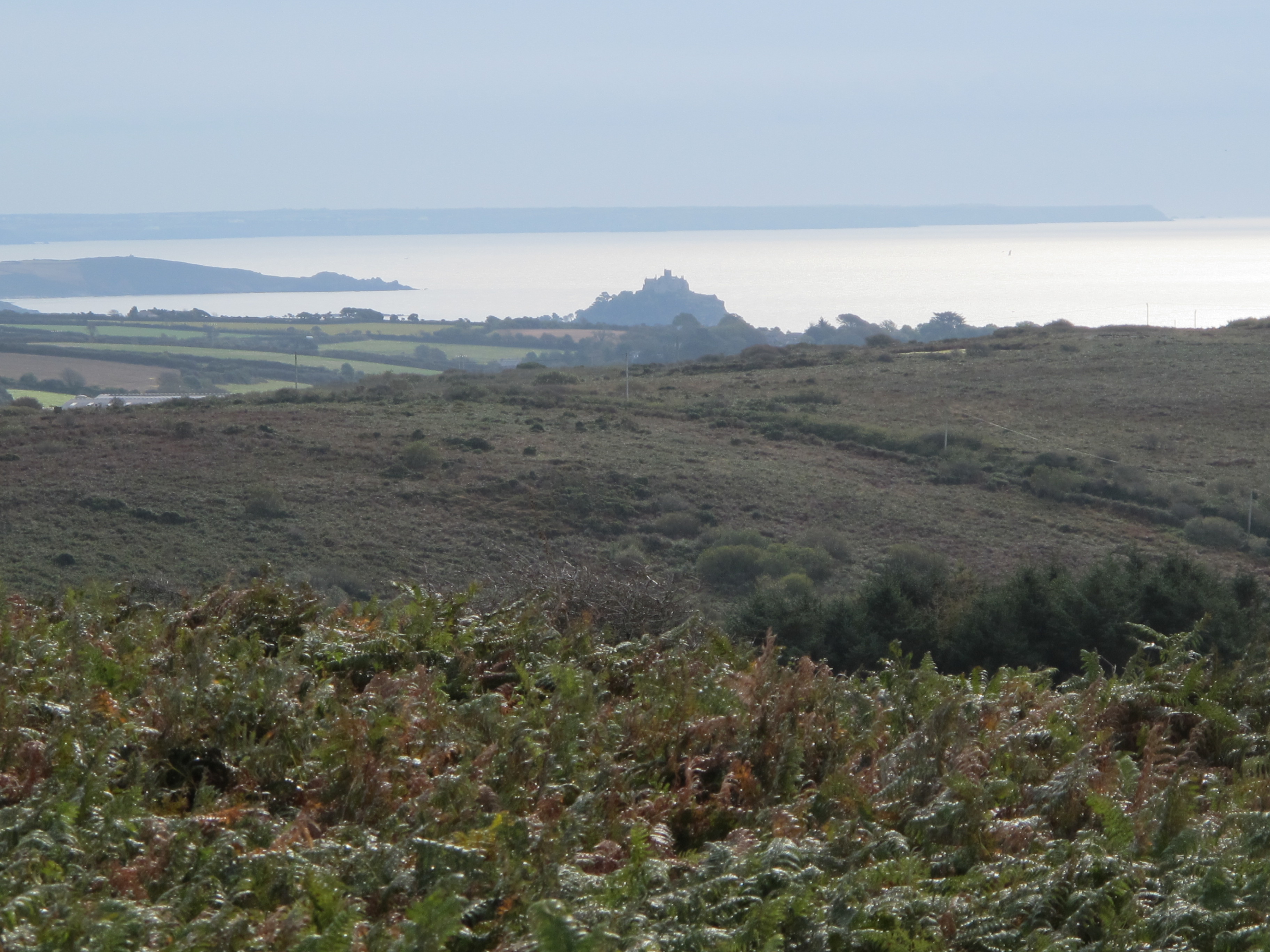
Irrelevant Photo: A view of the south coast and St. Michael's Mount

Irrelevant Photo: A view of the south coast and St. Michael’s Mount

Yes, dear ones, I’m writing about dog shit, and I’m not going to call it poo because I just can’t. When I first moved to Minnesota, I heard a wonderful phrase: “She wouldn’t say shit if she had a mouthful.”

Well, I don’t have a mouthful, but I did skid through the stuff and come away with a shoeful, and I can’t see why I should call it anything else. It’s not a beautiful word, but then the shoe wasn’t looking so good either.

Shit was the mildest word I yelled. I’m sure someone was behind a window saying, “Oh, that’s one of the Americans.”

Never mind the language, though. The important point is that somebody hasn’t been cleaning up after their dog.

I know two things about this dog: It’s large and it likes to spread its bounty as far as it’s physically able. I walk with my eyes on the sidewalk these days, the way I did as a kid in New York, before dog owners were expected to clean up after their dogs. My family had a dog. We thought we were being good citizens because we got him to shit between the parked cars. In fact, back then the city put up signs saying “Curb your dog.”

After the shoe incident, I bought myself a box of chalk. Then I waited.

Several days later, I found another deposit. Right by the red metal box that everyone (even me) calls the dog poo bin. I knelt on the sidewalk and chalked, “Clean up after your dog, please.”

I stepped back to admire my work. I’d forgotten the your, so it actually read, “Clean up after dog, please,” as if a computer translation program had written it. I used to work as an editor, so that missing word bothers me, but it did get the point across. And at least I hadn’t forgotten the please.

Good manners are more important here than good grammar. No matter how ungrammatical—or, for that matter, rude—a note you tack up somewhere, you can make it okay if you write “Polite Notice” at the top. I can’t tell you how many signs I’ve seen that declare themselves Polite Notices. Even if you were to say, “Pick up after your dog, you miserable, lazy, unclean excuse for a human being,” if you also said it was a polite notice, it would be okay.

And even if the rest of your wording is polite, you still have to open with “Polite Notice.” Actual politeness isn’t what matters. You have to remind everyone that you’re being polite.

I didn’t open with “Polite Notice.” I didn’t figure a chalked notice on the sidewalk had to, but then (as I’m often reminded) I’m not British. Wild Thing’s sure that what people mean when they say that is that we just don’t get certain things, and that the speaker feels sorry for us. I’m not sure she’s right. I tend to hear it as a statement of fact: We really aren’t British. Or we are—we’re citizens—but on some deeper level we never can be.

I don’t necessarily want to know how the speaker feels about this.

So it’s hard for me to be sure how significant that missing “Polite Notice” is. I may have offended someone other than the dog walker, but I can’t tell. I’m not British.

Rumors

Walking the dog to the store for the paper this morning, I saw I. and R. standing in the shade of a hedge, catching each other up on who knows what—I was too far away to hear. They talked for a while and parted ways, I. heading down a side road to her house and R walking in my direction.

When we passed, he said, “No papers today.”

I asked if they’d be getting them in later, but he didn’t know. He’d heard it from I. and turned back.  We complained for a while about the distributor the store uses, because this happens a lot, and often, he said, the stores in the next village gets its deliveries.

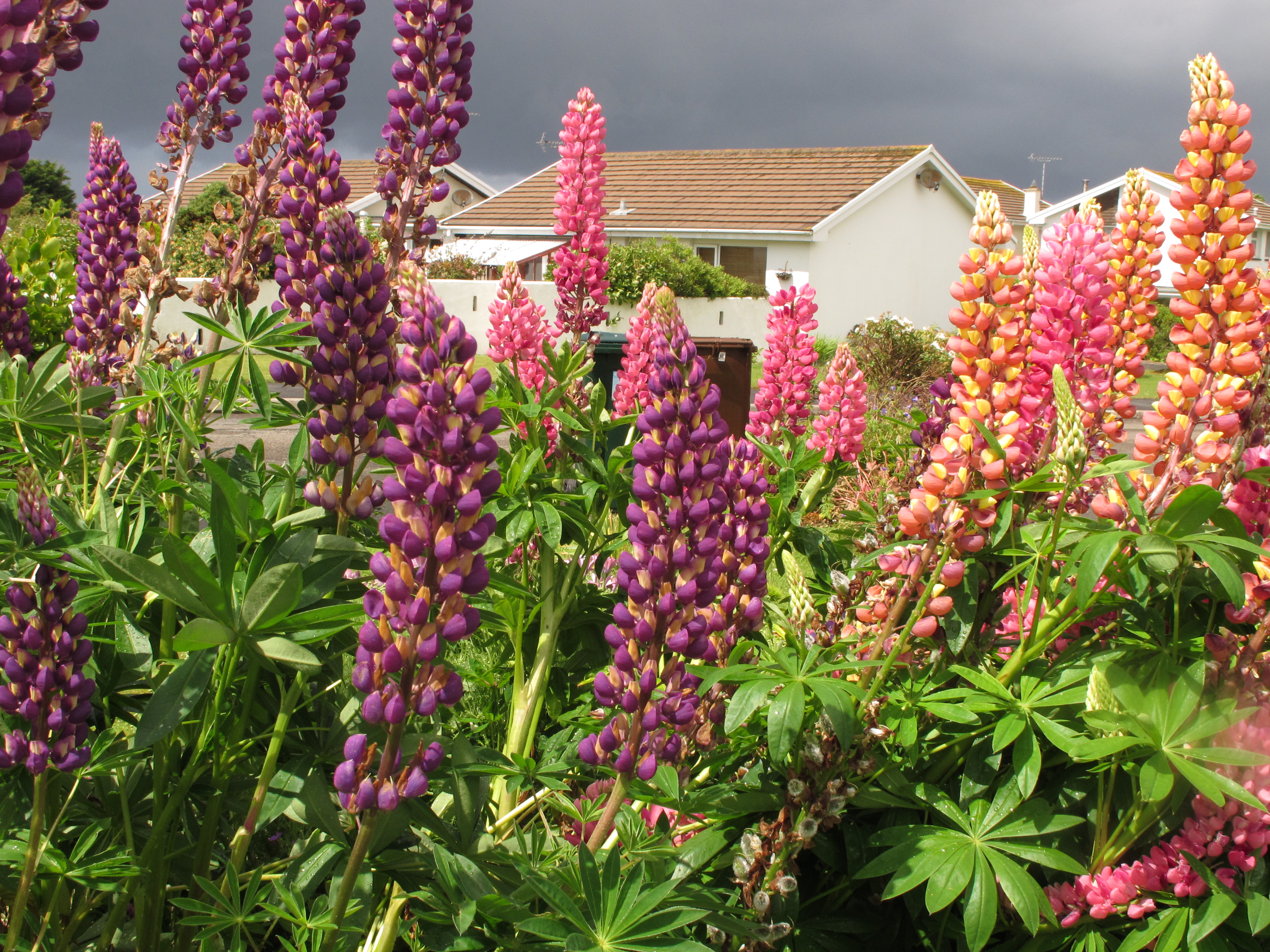
Lupines--in bloom right now.

Lupines–in bloom right now.

Okay, we weren’t complaining about the distributor. We were complaining about the store, for using them.

I had a magazine to drop in someone’s mailbox, so I didn’t turn back, and on the way decided to go to the store anyway, to ask when they expected the delivery. I debated whether to ask for today’s coupon and drive to the next village and buy the paper there. (Newspaper subscriptions, at least out here in the country, involve coupons, which you can either present day by day, anywhere you like, and which give you a discount but no guarantee that the store won’t have run out, or leave with the store, which will then set your paper aside.)

I still hadn’t decided when I got to the store and asked when the papers were expected.   They looked at me blankly.

“We have yours,” they said, and asked who told me they didn’t.

I reconstructed the whisper chain.

“It’s only the Express. R. gets the Mail. We have that.”

And that’s the way word gets around the village. We have no secrets, but have a whole lot of misinformation.