The Strange World of the Book Giveaway

Friends, I’m entering the weird world of the Book Giveaway, which is a small and theoretically habitable planet in the Book Promotion system. Here’s how I got there:

I have a novel, The Divorce Diet, coming out on December 30, and the publisher just sent me a box of advance reader copies, also called uncorrected proofs. I know they’re uncorrected because the bio shaves twenty years off the time I lived in Minnesota.

the divorce dietHaving gloated over them for as long as I decently can, I’m ready to offer one to half a dozen people who promise to post a review online somewhere—preferably on a site people actually read. Goodreads or BookLikes accept early reviews (or so I’m told); Amazon and Barnes & Noble (again, I’m told) don’t accept reviews until a book’s been published, but if you’re more organized than I am you can wait and post it on New Year’s Eve. Early on New Year’s Eve, before you get too happy. Hey, do I know how to celebrate or what? If you have a blog yourself and want to review it there, that would also be great. It doesn’t even have to be a good review, just an honest one. Of course I want everyone everywhere to fall in love with the book, but that’s one of the many things I can’t control. I’ll be grateful for any visibility you can give it.

So here’s what you do if you want one: Before October 5, send me your email address as a comment. I won’t publish it, just set it aside, so that if you win I can contact you to ask for your mailing address. If more than half a dozen people want one, I’ll use the high-tech approach and toss the names into a hat.

The publisher also sent me a stack of covers and I have no idea what to do with them. Anyone want to dozen or more? They’d make the perfect placemats for, I don’t know, a divorce party or something.

Driving in Cornwall: When Good Technology Turns Bad

My spies tell me that sat navs are called GPSes in the States, but in spite of my last post about keeping my American vocabulary pure I’m going to write about them as sat navs, because I’m writing about the way they work here. And also because the idea of purity in language is complete and total bullshit and I don’t want to take myself too seriously on this subject.

I needed a spy network to pin down the word GPS because I never needed one when I lived in the U.S. Or, well, yes, I could have used one during the five years that I drove cab, but they didn’t exist yet, so the thought I need that couldn’t exist either.

Not that I’d have spent the money on one.

I’m a technophobe. I’m a techno-I-don’t-need-it, but even I have conceded that in Cornwall I need a sat nav. Or, to be entirely accurate, I don’t need one myself but will steal Wild Thing’s now and then. She’s a major prophet of the Church of We Need All the Techno We Can Get, so this seems (to me) like a reasonable arrangement.

Irrelevant Photo: Boscastle, Evening.

Irrelevant Photo: Boscastle, Evening.

Now in Cornwall, and probably in the rest of Britain, before the invention of sat navs, people would leave home with a set of directions to a place they’d never been before and 70% of them were never seen again. On a dark night, you can see the faint gleam of their headlights passing like ghosts, still looking for a house called Craggy Bottom, which was supposed to be on an unmarked road somewhere off the A39.

The incident that made me a sat nav user was looking up directions to a meeting on MapQuest or Google Maps or something like that and reading, “Turn right on unmarked road.” Which unmarked road? They couldn’t tell me. Because that’s the thing about unmarked roads: They’re unmarked. It’s one thing if a friend says, “Turn after you pass the bungalow with the brown egg box out front,” but internet directions won’t give you that level of detail.

But sat navs have their own problems. First, you become dependent on them. They tell you to cross the roundabout, third exit, and you cross the roundabout, third exit. The next time you come the same way, do you remember that? Hell no. You need the sat nav again.

But the second problem’s more serious. In parts of Cornwall, they don’t work. Some years ago, Wild Thing and I were walking the dog past a ford and waved down a guy in a delivery van as he was about to leave a paved (and unmarked) road and go up an unpaved, washed out axle-breaker of a vague memory of a former road.

“You can’t get up that,” we told him.

“The sat nav says.”

I don’t think he quite finished the sentence. He had that blank, terrified look of someone who wasn’t taking in anything we said. Part of it would have been our accents—we couldn’t seem any less local if we carried signs saying “We’re not from around here”—and part of it would have been sat nav dependence. The rest, though? When a man doesn’t take in what a woman’s saying, it’s hard not to go back to the words man and woman and think, hmmm.

But never mind. We told him only a four-by-four could handle the hill he was about to go up. We told him he’d wreck the van. He told us the sat nav said.

We shrugged and watched him cross the ford and start up the hill. If a van can look fatalistic, I tell you, his did.

He was lucky. It was a rainy year and the mud was slick, so he didn’t get far enough up the hill to wreck an axle. He slid back, still looking blank and terrified, and he drove back the way he’d come. On foggy nights, I’ve seen his headlights pass me like ghosts, still following directions from his sat nav.

This kind of thing happens all over the country. Sat navs send massive damn trucks down streets that are so narrow they get stuck.  Really they do. They send cars down stairs. Some of the problems you couldn’t predict, but some of them—well, the truly crazy thing is that people do what they’re told. And yeah, I know I shouldn’t laugh but when I see some of the pictures I laugh anyway. It’s the oldest joke humanity knows: Somebody falls down. Follow the link and see if you don’t do the same.

We’re not, all told, a very nice species.

And maybe our sat navs know that, because with the detached serenity of gurus, they’ll spend hours talking us through the mazes we’ve laid down on the surface of the earth and call roads, and then, with no warning, they turn on us. Wild Thing’s first one did it in the middle of the Tamar Bridge—a long, high bridge connecting Devon and Cornwall.

“Turn left,” it commanded.

We came out of our sat nav trance and decided maybe that wouldn’t be a good idea, so she escalated.

“Turn left immediately.”

There really is a lot of water under the Tamar Bridge. And I’m not much good with either heights or water. We turned the sat nav off. It already had a history of going wild when we crossed the moors. If you’ve read the Brontes, you probably know about the moors as a metaphor for something wild and free and frightening, and our sat nav was in tune with all that. It would tell us, “In 18 yards [and it was always 18 yards], turn right.” Or left. In 18 yards, though, there was no road, only hedge. It had an image of us, I guess, breaking loose and driving wild and free across the fields.

Wild Thing retired it and bought a new one whose quirks are more predictable. But even so, near Scorrier both our new sat nav and everybody else’s try to kill people so consistently that the county’s put up a sign, in a panicky set of colors that they use for nothing else, saying, “Turn off sat nav.” The highway entrances were rerouted at some point and sat navs seize the opportunity to send cars the wrong way down exit ramps onto the wrong side of the highway.

So yeah, you need one around here. And you never turn your back on it.

A Clash of Words: Keeping My Vocabulary Pure

What does it take to keep my American vocabulary pristine here in the U.K.? Well, let me tell you a tale.

I was working on a post about those thingies people keep in their cars to tell them how to get where they want to go.

You’ll notice that I’m using technical language here: thingies. They’re called sat-navs here, and since I’m hell bent to maintain the purity of my American vocabulary, I wanted to know what they’re called in the U.S. so I could slip the word casually into my post.

Now, I admit that in the Wasting Your Time Sweepstakes, keeping a language or culture pure runs neck and neck with keeping white jeans clean. And for the record, I also admit that the belief that you can keep dirt off white jeans has done a lot less damage in the world than the notion of cultural purity. But I’m not claiming that any one set of words is better than any other, it’s just that I’m a writer and I need a matching set of words.

Irrelevant Photo: Stannon Stone Circle, by Ida Swearingen

Irrelevant Photo: Stannon Stone Circle, by Ida Swearingen

But we were talking about directional thingies. I seemed to remember that they’re called GPSes in the States, but I didn’t own one when I lived there, so I never called them anything. Who needed to? When you don’t talk about something, you don’t need a word for it.

But as I’m sure I need to remind you, we live in the age of the Internet, so I googled a bunch of terms that seemed vaguely relevant, and Google, in its wisdom, sent me to U.K. sites, even when I added U.S. to my search terms.

It’s great to have a browser that knows what I want better than I do. I remember reading an essay arguing that this is one reason the U.S. is so politically and culturally polarized: You can go online and never encounter a single opinion that you don’t already hold, because search engines only show you what they think you want to know. I won’t go as far as calling that a cause, but I doubt it’s helping much.

After getting diverted one too many times, I gave up and emailed T.—a virtual colleague from my days as a freelance copy editor—because only a fellow copy editor would understand why I cared.

She wrote back, “I usually refer to it as a GPS unit–but I’m low-tech when it comes to finding addresses and will often use a paper map in the car as our portable GPS is usually collecting dust in my husband’s office.”

I sympathized.

She also went online and checked the Best Buy website, which, just to be helpful used both names, but what I really trust is what she instinctively calls it: a GPS unit.

And with that, I can pretend my vocabulary hasn’t budged one inch in the eight plus years that I’ve lived here, when in fact it’s floating in the New York harbor and drifting west.

Measuring Butter in a Cornish Kitchen

I made a pound cake a few years ago and a friend asked for the recipe. I copied it for her, and a day or two later, she called up.

“What’s a stick of butter?” she asked.

I was afraid she understood it as a verb: Stick that butter where? The thought threw me enough that it took a bit of back and forth in my head before I got stick of butter translated.

“A quarter of a pound? Four ounces? Eight tablespoons?”

Irrelevant Photo: Cows.

Irrelevant Photo: Cows. They never heard of a stick of butter.

Butter here isn’t sold by the pound, and no one over a certain age thinks in ounces. But when the U.S.—or what later became the U.S.—was young and impressionable, Britain convinced its population to use a completely batty system of measurements: 8 ounces to a cup, 2 cups to a pint, 2 pints to a quart, 4 quarts to a gallon, but look out because ounces are both a measure of weight and a measure of volume but they’re not interchangeable, you just sort of have to know which one the recipe means. Sixteen ounces in a pound. We’re not going to get into bushels and hogsheads and their even more obscure friends and relatives, and I have no idea how many feet to the mile but, for no apparent reason, there are three to the yard. Then the British gave the system up and adopted the completely logical metric system. (Mostly. Car-related distances and speeds are still measured in miles. Go figure.) There was a predictable backlash from people convinced civilization was coming to an end, but by that’s faded away now, leaving us with no quarter pound and no ounces, although they do still use teaspoons and tablespoons sometimes. (Three teaspoons to a tablespoon, in case anyone asks.)

Even I’ve adapted. I stopped asking for a pound of lunchmeat at the deli counter, because even though they’re theoretically bilingual they always thought I was talking about currency—a pound’s worth. Which these days isn’t much. And since no one says half a kilo, I ask for 500 grams.

And I’m a vegetarian.

What does this have to do with butter? When you buy butter here, it doesn’t come marked into tablespoons because you subdivide it by the gram, which unlike the ounce is a measure of weight and only of weight. The packages are close enough to half a pound that I still think of them that way, but they’re not cut into sticks, the way god also intended, they’re sort of flattish and clunky. Hence my friend’s confusion. No one talks about a stick of butter here because there are no sticks of butter.

Sad, isn’t it?

If you plan to bake over here, you need kitchen scales—not just for butter, but for most ingredients, because they’re measured by weight. Of course, a few gifted cooks just know how much of an ingredient they need without having to measure. I knew a woman like that back in Minnesota. I asked her for her pancake recipe once.

“You start with enough milk for pancakes,” she said.

“Edith,” I said. “Never mind.”

Raising Money in Cornwall

In our village, no event ends before we hold a raffle. I dread the day we run out of raffle books, because we’ll be trapped together at the end of some play or tabletop sale, waiting not for Godot but for more raffle tickets.

The tickets cost a pound for a strip of five. It’s as predictable as if it were governed by law, which it may well be. It’s one way to raise money, and it works if all you need to do is cover the cost of renting the hall or raise a bit of money for the local hospice or the Air Ambulance, because a thousand other villages are also raising money for them and it all adds up.

But this post is about a local fundraising effort that’s going to take more than a raffle, and if you’ll forgive me I’m going to abandon my usual wise-ass tone.


Emily Skerrett is a local disabled paradressage rider who has a good chance of making it onto the British Paralympic team. I didn’t know what paradressage was until I started working on with this, so I’ll explain: Dressage is a kind of horseback riding that doesn’t involve flying over hedges or doing anything insane like that, so it’s kind to a disabled rider, which explains the para part.

Now set aside your assumptions about the piles money people who are drawn to horsey sports must have, because she’s not a rich woman, and so a group of us from the village have come together to form Team Emily and raise enough money to keep her going until she reaches national level, at which point funding will become available.

The village is like that. Not always, but sometimes. And sometimes, in this battered old world of ours, isn’t a bad track record. It’s enough to give me a spark of hope for this human race we all belong to.

Emily Skerrett and Woody

Emily Skerrett and Woody

A bit of background: Emily has Ehlers-Danlos Syndrome, which used to be called hypermobility syndrome. It means her joints are so loosely held together that she can dislocate a shoulder just by rolling over in bed. She lives with a level of pain that would drive me to despair, and to cover any distance she uses either crutches or a wheelchair. She has two young sons and she loves them but can’t carry them any distance. Oddly enough, on the days she rides she can lower her usual dose of painkillers. Riding is, both physically and emotionally, good for her. And she’s good at it. Clive Milkins, who’s a Fellow of Riding for the Disabled and a world-class trainer with multiple gold medals at European and World levels, said, “Emily and her horse have . . . the ability, the potential and the determination to reach the very top.”

In part, of course, she’s wants to make the team because she loves the sport and because it would be good for her as an individual, but in part she’s doing it to demonstrate that being disabled doesn’t mean being unable, and to show her sons that, although their mother can’t do many of the things other mothers can, there are things she can do.

Team Emily is trying to raise £10,000 through crowdfunding. We need small donations. We need large donations. We need help from people who can’t make any donation at all. We need people like you to paste a link to her crowdfunding site (or to this post) on Facebook, or to tweet the link, or to email it to friends, or to pass it on in any other way you can think of. This is one small human being fighting the limitations that illness has imposed on her life, and it’s inspiring. If you can help in any way, you have our thanks.

And let’s be honest: It’s the closest most of us will ever come to the Olympics, para- or otherwise.

And now I’m going to be obnoxious and put the links in one more time.

Crowdfunding: to donate, watch a video of Emily riding, or get the address so you can let people know about it 

Facebook: to follow Emily

Blog Hop

I should start by telling you what a blog hop is, because I didn’t have a clue when I said I’d be part of this one. It’s a series of bloggers linking to each other and, in this particular one, answering a series of questions about their current or forthcoming novels. The common thread here is that we’re all published by Kensington. Not that I’m, ahem, trying to promote my novel or anything, although it will, she said with great subtlety, be out in January.

sabine priestley

Sabine Priestley

Last week, in her blog, Sabine Priestley wrote about her book, Alien Attachments. Sabine grew up in Phoenix, but has lived in Arizona, California, Colorado, Utah, Idaho, Texas, Massachusetts, and Florida. She has a B.S. in electrical engineering technologies and did everything but her thesis for a masters degree in cultural anthropology, looking at the nexus of culture and technology. She was a project manager, flying back and forth between Tucson and Boston when she met her very own alien. She spent a year running the Q.A. department for a seriously cool and underappreciated computer telephony system, then moved to California, where she ran a small tech support group for a company making DSL routers before anyone knew what DSL was. She is a lifelong fan of science fiction and romance novels, so Alien Attachments naturally gelled in her imagination. Sabine lives in Florida with her husband, kids, cats, and whole mess of characters in her head. 


And that brings us to my part of the blog hop.

What is the name of your character?

Abigail.

Is she fictional or a historic person?

Definitely fictional, but everything that’s best about her was inspired by my friend Janneen Love, who got through a difficult breakup with grace, helped along by her love of cooking, her love for her daughter, and a whole lot of tea.

When and where is the story set?

In the United States, at this very moment.

What should we know about her?

Abigail’s an involuntarily single mother, advised by an invisible weight-loss guru. Yes, I know, but in the context, it makes perfect sense. In an out-there sort of way. She’s struggling to support her daughter and make enough money to move out of her parents’ house.

What is the main conflict?

Abigail’s most immediate conflicts are with her soon to be ex-husband and with her the divorce dietparents, who she loves and respects but who have a gift for turning her back into a teenager. But—never one to shy away from the impossible—her underlying conflict is with the way the world is organized: Her husband has kept their house, since she couldn’t afford to, while she and their baby are living in her childhood bedroom. He has a new girlfriend while she can’t call up the thinnest wisp of a thought about sex. He’s still going to work in a clean white shirt while she’s waiting tables, because even though she’s a gifted cook he wasn’t enthusiastic about her getting any formal training and she thought, Well, a woman has to sacrifice something if she wants a marriage to work. On top of which, if she’s very careful and saves every penny of her tips, she’ll be able to afford her own place in forty years. Maybe. She’d work up a theory about all that, but she’s too busy and she couldn’t afford the upkeep on it anyway.

What is the character’s personal goal?

To raise her child and make a living doing what she loves, cooking.

Is there a working title for this novel and can we read more about it?

It’s called The Divorce Diet, and it goes on sale in January 2015. Actually, December 30, 2014. I’m sure there’s a reason for that but I’m damned if I know what it is. I’ll have a link on the blog as soon as it’s available. Or you can watch the Kensington website and do your very own countdown.


Kristi Rose

Kristi Rose

Next stop on the blog hop: On Monday, September 22, head over to Kristi Rose’s blog to see what she’s working on.

British English and American English

If you browse the expat blogs, you’ll find gleeful posts tracking the dividing line between British and American English. And a wandering line it is. Are pants those things you wear under your jeans or are jeans one kind of pants? Is the fanny pack a bizarre medical procedure or a practical but geeky accessory? When you live your life in a semi-foreign language, all that stuff becomes important.

It also cues the kind of giggles you get when an eight-year-old has a chance to say “fart.”

Irrelevant Photo: Rocks near Minions, eroded by the wind. By Ida Swearingen

Irrelevant Photo: Rocks near Minions, eroded by the wind. By Ida Swearingen

But pants and fanny aren’t even on the real dividing line. Only I know what really divides the Englishes: It’s the use of that and which.

I know: Speaking of geeky. Only someone who’s worked as a copy editor even notices, never mind cares.

I have worked as a copy editor, though, and I do. American publishing follows Strunk and White’s Elements of Style, and British publishing doesn’t. The distinction has to do with lawnmowers. You never thought of lawnmowers as a grammatical concept? See what you missed out on? Example A: The lawnmower, which is in the garage, is broken. This means we have one lawnmower. Example B: The lawnmower that is in the garage is broken. This means we have more than one, so use the other. I left it on the dining room table.

British publishing doesn’t care about lawnmowers. This—to a recovering American copy editor—is as shocking as wearing your pants inside your trousers.

It all has to do with restrictive and non-restrictive clauses and is too obscure to bother explaining. Which is lucky, since I don’t trust myself to get it right. And (she said defensively) you can be a perfectly competent copy editor and not be able to explain any of it. All you have to be able to do is apply it. It’s like not being able to explain electricity but knowing how to charge your phone.

Legend has it that Strunk and White introduced the that/which division because they thought it would be useful, if only it could be pounded into millions of recalcitrant little heads. In other words, they weren’t telling us about something that already existed, and so the aforesaid heads resisted the distinction because it wasn’t native to the language. But the owners of those heads still manage to mow their lawns and figure out, when and if it matters, how many lawnmowers they have.

So the that/which distinction is arbitrary and unnecessary, and in the long run the spoken language will always win out against the silly twits who tell us what’s wrong with the way we speak. But having made a career—such as it was—out of knowing this sort of stuff, it’s painful to watch as entire country consign it to the dustbin of irrelevant grammar. Even if it belongs there.

On an emotional and philosophical level, I’m on the side of spoken English, in all its barbaric glory. I’m not impressed with formal writing, for the most part. I believe that the language gains its power from use and that the hair-splitters are fighting a rear-guard action. If you break the rules of grammar idiomatically and well, the force is with you. And, in case you care, so am I.

On the other hand, I’ve read enough tin-eared writing to value the rules of grammar. Not because they keep us from barbarism and illiteracy, but because they keep us from incoherence. So I’m passionately on both sides of this battle, and if it ever turns violent both sides will call on me to shoot myself as a traitor.

True Confessions: I Misread My Tax Disc

The is a P.S. to my last post, which was on bureaucracy and trying to pay the tax on my car. Just after I posted it, I gathered up every vaguely relevant piece of paper I could get my paws on and presented myself at the post office, hoping to convince an actual human being that my car was real.

For anyone who doesn’t live in the U.K., I should explain: The post office isn’t just a post office. And it’s capitalized—the Post Office. Sorry. I’m just a lower-case sort of person. The Post Office is also a bank and a place to pay some of your bills and some of your taxes. In a village, it’s not a bad place to get gossip, two onions, and a container of milk, because it’s also a small store. So going to the Post Office wasn’t a measure of how far around the bend I’d gone but (at least in my mind) a clever attempt to outwit computerized insanity.

But I had to go to a larger, non-onion, non-gossip Post Office, because our local sub-Post Office can’t handle car taxes anymore. I’m sure that makes sense to someone and I doubt it would to me if they explained it.

Irrelevant Photo: The Cornish Coast

Irrelevant Photo: The Cornish Coast

I talked with a very nice woman, who scanned my eleven-digit number, told me—with just the slightest air of panic, as if I might get dangerous any moment—that she didn’t need the rest of the papers I was toting, and began the process of registering my car.

I’d promised myself that I wouldn’t tell her the tale about how the computer wouldn’t recognize my car, but it took less than a minute before the words were out of my mouth. You know how that works. I know you do. She didn’t refuse to go any further, though. She laughed. Maybe that was the point where she decided I was safe to have around.

Or at least entertaining. There was no one on line behind me.

She called someone else over, and they looked at the screen together.

“When does your tax run out?” she asked.

“On the twelfth.”

I’ll summarize, because the conversation was long and I don’t remember most of it anyway: Car taxes can’t run out on the twelfth. They run out at the end of the month. Any month. Whatever month. If I saw a twelve on the disc, it must run out in December.

I was fairly sure it didn’t, but—in that strange way that you can believe two opposing things at once—I also believed it must. Otherwise how did twelve come into the conversation?

Have I mentioned that there’s nothing involving numbers that I can’t screw up?

I could, she told me, go ahead and pay the tax, but if there was an overlap I’d be paying double for those months. For a fleeting moment, the idea appealed to me. It would be done. Even if I paid double for eleven months, I wouldn’t have to think about it again until—well, whatever September plus eleven comes to.

Or twelve. Wouldn’t that be twelve?

I asked her something—I can’t remember what—that she could only answer if the second person came back from doing whatever he was doing, which involved another window, Canadian dollars, U.S. dollars, and time.

We waited. She looked at her screen. A line was building up behind me.

“It’s not showing up as expired,” she said.

I think she told me that in a couple of different ways before I understood: At the very least, the car’s okay until the end of this month. It hasn’t expired. It can’t expire on the twelfth.

“They’ll send you a letter,” she said.

“They still do that?”

She said they do. I’m not sure I believe her, but it would be very sensible if she turned out to be right.

“Why don’t I wait, then?” I said.

She handed me back the one bit of paper she’d actually needed and I moved aside to fit it back into my folder, thanking her as I went. Recalcitrant bits of paper were trying to escape and make their way back to her window, but I wrestled them down, then turned to everyone still in line and apologized for holding them up. It was—for reasons I can’t define—a very un-British moment and I had an odd glimpse of myself as a street entertainer. I had to stop myself from taking a bow.

No one had yet moved up to the window I’d vacated. They were waiting.

“Can I help who’s next?” she said.

I finally got to my car and looked at my tax disc. They’d shown me how to read it, so it almost made sense this time. It expires at the end of September. There isn’t a twelve to be seen.

Bureaucracy, U.K. Style vs. U.S. Style

I do love bureaucracy. Wild Thing swears that customer service in general and web sites in particular are worse in the U.K. than in the U.S., but I’m not sure she’s right. If anyone wants to weigh in with an opinion, I’d love to hear it.

My senior rail card runs out in not so many days, and I’ve been trying to renew it. Online. On the phone. By intense psychic messages. Quick, because if I can’t get this done before it expires I have to drive 40 minutes to renew it in person by presenting proof of my existence, my age, and my warm feelings toward Network Rail.

I begin online. I still believe this will be easy, and I answer their questions.

Password? I get that on the second try.

Renew? Yes.

One year? Three years? A thousand years? Oh, a thousand. Think of the discount.

 

Irrelevant Photo: Boat. Photo by Ida Swearingen

Irrelevant Photo: Boat. By Ida Swearingen

“We save your details at every step,” the second or third page chirps at me. “Just log back in to pick up where you left off.”

It doesn’t tell me this, but I’ll damn well need to pick up where I left off because I won’t be able to finish on this visit. I’ll be coming back and picking up where I left off until I’m so old I qualify for a SuperSenior Rail Card. Which doesn’t exist yet. They’ll introduce it just for me.

But I don’t know that yet. In all innocence, I move to the next page, fill in my credit card details, and hit the Irretrievable Commitment button. The internet takes a few moments to contemplate the obesity of the universe and comes back with a message saying my card’s been rejected.

Well, that card’s difficult. Sometimes I want to buy things that the issuing bank doesn’t think I need. It’s the strict parent. But I have another card—the indulgent parent—and I enter that one.

It won’t take that either.

I call and we go through all the same details. When we run out of details, the guy I’m talking to says their payment system’s down. But he can give me a number so we can pick up right where we left off.

He couldn’t tell me this at the beginning of the call?

I write the number down on a shred of paper in the morass I call a desk. I keep a pad on the desk—for all I know, I keep several—but it sank to the bottom months ago, so a shred will have to do. He tells me to call back in an hour.

But I’m no longer the sugar-fed fooI I was at the beginning of the process. I wait a full day, then go back to the web site. Most of my information really is still there. I fill in what’s missing and hit Buy Rail Card.

I get a message saying I already have one. I don’t, but there’s no one to argue with and I’m locked out of the payment page.

I call and, in a rare moment of good organization, find my transaction number and read it out. Just to confirm that I am who I say I am, the man I’m talking asks for my name, my address, my date of birth, and everything the first guy asked. But it’s okay because we’re saving time here and it’s much more convenient.

Then he tells me the payment system’s down—either again or still, I don’t have the heart to ask which. I can call back in 45 minutes.

I wait another day and try the computer. When I get to the message saying I already have a Senior Rail Card, it suddenly hits me that maybe I really do. Maybe my transaction of two days ago went through. Maybe my transaction from two days ago went through twice, once on each card. I may now have two rail cards. I may have to prove I’m over 120. This worries me, as does the possibility of being charged twice for my, ahem, discount card.

I don’t call. I’ve lost the magic number that saved me eons of time, besides which I lack the moral fortitude. Besides, I may really have a rail card so I should wait to see if it comes in the mail.

The next morning, for a change of pace, I go online to renew the tax disc on my car. In the past, we’ve been able to do this at the post office, but come October this has to be done online and we won’t get an actual physical disc to put in the car windshield, it’ll all be tracked by computer, because computes are infallible. If we fail to register our cars, we’ll be fined £1,000 pounds and hung by the neck until very, very sorry.

It’s not October yet, so I could still go to the post office, but as far as I understand it—which is not very far—I’ll have to register online by October anyway, so why not get it all done at once?

Under the old system, every car owner has gotten a reminder letter, but to save money in this age of budget cuts these are being stopped, and the only warning has been a bare few back-page newspaper articles and whatever gossip we’re lucky enough to pick up. And the newspaper articles weren’t all that helpful. Exactly what were we supposed to do and how? They didn’t say. They probably don’t understand it either. But we are all going to be in a lot of trouble if we don’t do it. In other words, the new system is being introduced with all the competence I’ve come to expect of the current government.

Just the day before, I asked at our repair shop, figuring, you know, cars, registration, they’d know this stuff. They hadn’t a clue and of the two women at the counter, one’s registration was about to run out and she was catching that first panicky whiff of trouble herself. It smelled like the burning-rubber-on-the-highway scent that tells you your car’s about to do something unfriendly, like catch fire maybe.

So they couldn’t help me. I can count only on myself this sunny morning. After googling several wrong terms, I find the right section of the right department of the right government website and I enter the eleven digit number from my log book.

The web site would have also accepted a different number, I think it was thirteen digits, from the letter they didn’t send me, but since they didn’t send it this year—well, just because they didn’t send it doesn’t mean they have to stop asking, does it?

I entered my information. The website reported that my car doesn’t exist. But it’s okay, because they have a phone number.

I dial. The system is automated and I punch in my eleven-digit number. I’m told that my car doesn’t exist but that I may have punched the numbers in wrong. I didn’t, but there’s nothing involving numbers that I can’t screw up, so I try again, checking each digit as I add it. Nope. I try a third time. At the end, surely  they’ll have pity and let me talk to a human being. But in these days of budget cuts, human beings are like my car: They don’t exist. I’m no longer the system’s problem. Goodbye. I have a non-existent car. I have a tax disc that’s about to go out of date. I have a phone and a computer and neither of them will do me any good.

The Department of Non-Existent Car Registration is going to hang me by the neck until very, very sorry.

Your honor, I’m already sorry. Very extremely sorry. And I have a magic number, somewhere, from Network Rail. Couldn’t I read that out and save us all some time and trouble?

I need a break, and since the letter carrier’s come and gone without bringing my imaginary rail card, I dial the rail card line. I wait for it to ring and go blank about what I’m trying to renew. I gaze at the shreds of paper on my desk. Call Simon, one says. Write Emily piece, another advises.

I understand these, but I still can’t remember who I’m calling.

An automated voice says something about rail cards. Yes! Rail cards! I need a rail card! I punch 5 without waiting to hear my choices. That’s how well I know rail cards. A man answers and I ask if the payment system’s working.

“As far as I know,” he says.

I’d kind of hoped for a yes, but I read out my magic number, which has resurfaced, and he asks for my name, my address, my date of birth. We save more and more time. I give him my credit card number. He tells me my card will arrive in three to five days. By which time I may have found a way to convince someone that my car’s real. Or that I don’t have a neck and am therefore exempt from punishment.

Tomorrow I have to do something about my U.S. voter registration. I sent the form in, but I just checked online and I’m not listed.

A Report from the Edinburgh Fringe Festival

The Edinburgh Fringe Festival runs for most of August, and a wondrous mess it is. You want good theater, street theater, cutting-edge theater, dive-under-your-chair bad theater, awkward student theater? It’s all there, along with pretty much anything else you can put on a stage or a sidewalk. Swarms of actors, comics, singers, wish-they-were-singers and –Britishism warning –punters* condense on the city the way starlings condense on a power line, the entire flock tightening its formation until the cable feathers out along its length and the sky’s clear of birds.

Which, minus the wish-it-was-poetry, is a way of saying that during the festival Edinburgh’s sidewalks are jammed beyond capacity and the traffic’s hopelessly snarled. As far as I can figure out, Edinburgh’s residents either find a way to make money out of the mess or hide under their kitchen tables the way we were taught to do when I was a kid, in case of nuclear attack.

They come out as soon as we go home. They probably hold a celebration. In secret, so we won’t come back and crash the party.

Wild Thing and I joined the mobs for the better part of a week, but I’m not going to review anything we saw. The role I assigned myself when I started blogging was to explore the spidery corners of the culture, and the Fringe has so many reviewers that no spider would dare spin its web. So many, in fact, that I believe every show got a five-star review from someone. One had six stars. For all I know, they stitched those together from three two-star reviews. Or maybe it was six stars out of twenty. It’s hard to know what any of it means. I didn’t go.

If there isn’t already a publication charging for good reviews, someone could make a buck or three (sorry: 60 p. or 1.8 quid) by starting one. You wouldn’t even have to write words, just award stars—lots of stars.

Edinburgh Rooftops

Edinburgh Rooftops

For all that I go to the Fringe for the theater, and I’ve seen some great shows, the Fringe, for me, is also about coffee shops. Damn, I miss writing in coffee shops. Our village has a couple of cafes, and in the off season I wouldn’t get thrown out if I rooted myself in a corner and wrote in one of them, but I know too many people there, and that destroys the illusion of invisibility which I need to write in public places.

My favorite Edinburgh coffee shop this year was crowded enough that people shared tables, and on my first morning, I sat with an American who lives in Edinburgh. He worked on his computer; I wrote longhand, and we pretty much ignored each other. Then an English woman joined us. She’d come up for the Fringe, and we talked until my extremely large teacup jumped out of my hand, hurling tea on her and me and my notebook and, by sheer dumb luck, not the other American’s computer. As spills go, I’d award it four stars out of five, and since I was traveling light I wore that bit of history on my jeans for the rest of my stay, and I did look gloriously casual in them, if not outright messy. We mopped up what we could, a man appeared from behind the counter with a massive wad of blue paper towels—enough to dry up some municipal fountain somewhere—and the American packed his computer and left. In the friendliest possible way.

Street Performers

Street Performers

What little tea I had left in my cup—and it was only enough to keep the spill from earning that fifth star—had turned cold by now and I sipped it slowly, for its caffeine content alone.

A second American sat down and the three of us talked. He turned out to be the producer of a Fringe show. The English woman and I duly swore we’d go see it. I, it turned out, was lying, but I didn’t know that at the time. I did mean to. Then I did some obnoxious self-promotion and handed out the address of my blog, which they duly swore to look at. In case either of them actually does, I’d like to say that they were personable and interesting and I enjoyed sharing a table with them. And I really am sorry about the tea—and about not getting to that show.

In the middle of all this, I got a surprising amount of writing done and I managed to keep believing I was invisible. Even when I knocked over the sugar on my way out.

The human brain is a strange and fascinating thing, with a great gift for self-delusion.

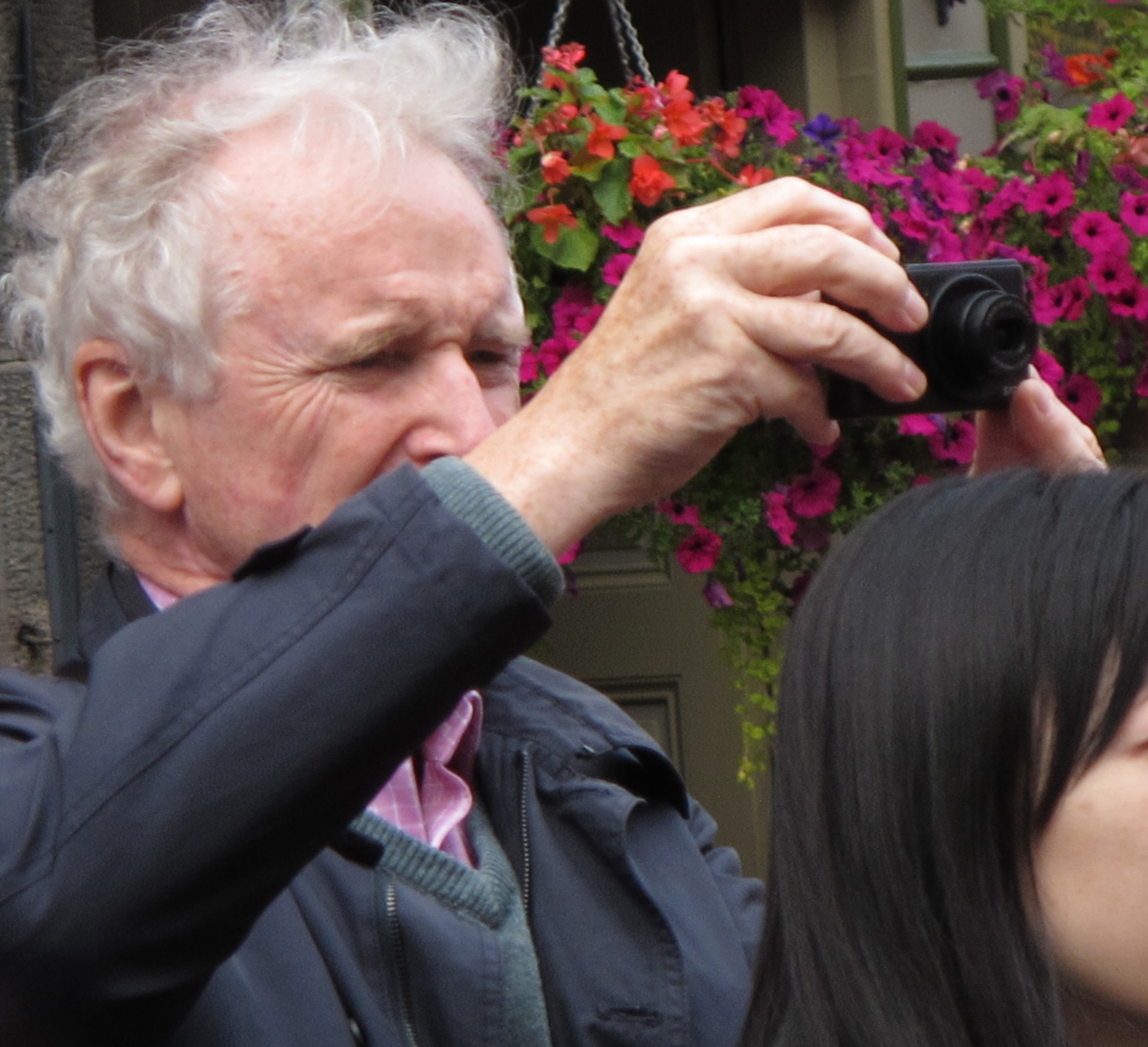
Guy with Camera, Watching a Street Performer

Guy with Camera, Watching a Street Performer

The Fringe is also a fine place to overhear conversations, and Wild Thing gives out an award, which the people who win it never know about, for the best overheard conversation. No one won this year, but last year’s winning conversation went like this:

“You know what your problem is?” Person A said. “You don’t take yourself seriously.”

“I do,” Person B said from inside his chicken suit. “I do take myself seriously.”

I don’t get a vote on the award, but if I could I’d give this year’s to a guy who was hawking the Scotsman, which pays people to call out to the crowds, “Buy the Scotsman and get a free Fringe gift pack.” The gift pack is, I think, a canvas bag, a bottle of water, and a Fringe catalog. Only this guy’d gone off script and was calling, “Four more days. Only four more days. Fly away home. Everyone go home.”

It took me a minute: The Fringe was ending in four days. Unemployment was beckoning, and he’d reached the point where it looked good.

Second Guy with a Camera

Second Guy with a Camera

The Fringe is also a great place to people watch. The street-theater areas are populated by folks watching the world through their cameras. Expensive cameras with lenses as big as I am. Palm-size pink cameras full of sparkly stuff. Phone cameras. iPad cameras. They watch a street performer only long enough to take a picture, then they move on, 80% of the time without leaving money in the hat. The picture matters. The performer doesn’t. We’re all our own performers these days, gathering up the scraps of our experience, arranging them, imagining the audience they’ll find, barely letting the other performers take root in our consciousness.

*

And having said I don’t do reviews—yeah, I lied about that too, but I’ll be brief. If you live in the U.K. and get a chance to see anything by Theatre Ad Infinitum, go. They’re amazing, and they’ll be touring. Out of five stars, I’d give them six.

 __________

*Punter: A customer, client, or audience member. Also someone who places bets or a prostitute’s client. Aren’t you glad to know that?