
According to documentary evidence, the rabbit’s history in Britain goes back no further than the Norman conquest. That makes them not native, although if you look in the right places you can find humans in Britain whose family histories don’t go back any further but still claim to be 600% British.
Why should they be native when the rabbit’s considered an import? That’s too deep for a mere blogger to unravel, so let’s skip it. Instead, I’ll tell you what I do know about rabbits in Britain.
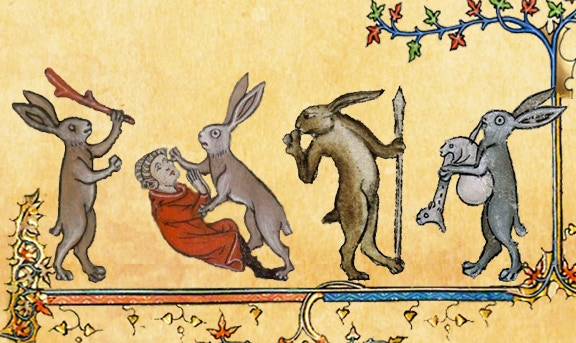
Medieval illustration: the rabbits take their revenge
The evidence
I mentioned documentary evidence, but what about the non-documentary kind? Isn’t it possible that the lack of documentary evidence is a result of rabbits’ low literacy rate?
Of course it is. One of history’s rules is that if you don’t write or get someone to do the writing for you, you don’t leave much in the way of documentary evidence.
However, a bit of non-documentary evidence is available. Archeologists (who do write) have found evidence of British rabbits from way back in Roman times. It takes the form of a single bone.
Given rabbits’ gift for multiplication, how is it that if they were here that early they didn’t populate the land and leave many bones behind? Because what’s been found is one bone, from one rabbit, and even a rabbit needs help from another rabbit. Of the appropriate sex. So this rabbit didn’t have the opportunity and might’ve been somebody’s pet. The clue to that is in the bone itself: rabbits in hutches will eat their own feces. (If you’re visiting from a language other than English, that’s a polite way to say shit. Which you may already know, in which case I apologize.) Wild rabbits will do that but not as often. Either diet will show up in the bone structure.
Isn’t it wonderful how many things you learn here, and how little use you have for them?
Back to documentary evidence, then
One of the earliest mentions of rabbits in Britain comes from 1176, when a landowner on the Isles of Scilly didn’t pay the church its tithe–think of the tithe as a kind of divine tax–on his rabbits because he thought “tithes were not payable on things of this kind,” suggesting that rabbits were still rare enough that the landowner thought somebody would fall for that reasoning.
Fast forward a bit and in 1235 Henry III gave Geoffrey Despenser ten live rabbits from his park at Guildford. A few years later, he sent men to collect 30 or 40 rabbits from Guildford, but only if it wouldn’t deplete the warren. So these are still critters to be careful with.
It wasn’t until 1240 that rabbits appeared on the menu as part of Henry’s Christmas feast. They were very much a luxury, costing four or five times more than chickens. Rabbit warrens were guarded against poachers, foxes, and anything else that would be happy to eat a rabbit without paying.
The Black Death
And there we stay, with rabbits the preserve of the wealthy, the titled, and the entitled, until the Black Death docked in Britain and multiplied more efficiently than rabbits. (The dates on that are 1346 to 1353; you’re welcome.) Somewhere between a third and two-thirds of the population died. With the cold-blooded irony that history specializes in, this improved life for the survivors. Land was going begging, improving the lives of the peasantry. And laborers could say, “Sorry, your lordship, but the iron law of supply and demand dictates that I have to charge more than I did last year, and that you have to pay.”
Let’s not get into the efforts to keep wages down–that’s another story and you can find it here, in another of my posts. (Sorry. If I don’t promote this stuff, who will?) We’re following the rabbits instead, so let’s note that in the 14th and 15th centuries they were showing up on the tables and in the bellies of wealthier peasants and that aspiring craftsmen were wearing grey rabbit fur.
And that leads us to mention sumptuary laws, medieval efforts to keep everyone in their place and dressing the part. The intent of the 1363 law was to control “the excess of dress of people beyond their estate, to the very great destruction and impoverishment of the land.”
Still, that gray rabbit fur that aspiring craftsmen wore wasn’t the truly fancy stuff. Henry VII tucked his royal self into bed wearing something involving black rabbit fur, and specialty warrens raised only silver-gray or black rabbits.
Hunting and poaching
By this time, rabbits were at long last doing what rabbits do best, which is to breed and to eat, and manorial accounts start to mention complaints about the lord’s rabbits damaging crops and land.
Did that mean the riff-raff could hunt them to control the numbers? The hell it did. In 1390, a law banned poaching and hunting by laborers and artisans. This was after the 1381 Peasants Revolt, and the fear–or the excuse; take your pick– behind the law was that while pretending to hunt they’d “make plots and conspiracies of rebellion” against the king.
The ban was extended to the use of “hounds and ferrets, hays, nets, hair-pipes, cords and all other devices to take or destroy beasts of the forest, hares or rabbits, or other sport of gentlefolk.”
So everybody stayed in their place, garbed in clothing appropriate to their station. The gentlefolk enjoyed their protected sport, destroying the beasts of the forest, without competition from hungry lowlifes. And the rabbits bred like mad, to the point where government guidelines now list them as a pest. They cause some £100 million of damage in a year and most of the country is a rabbit-clearance area, meaning people are obliged–theoretically–to kill wild rabbits on their land.


Faeces Ellen. You’re in the UK now LOL. Joking aside, a good piece. I enjoyed reading it.
LikeLiked by 1 person
I am. My spelling and I are holding onto the old ways, however. And so is my accent.
LikeLike
It isn’t often that I venture onto the vulgar fringes of the internet, but your scandalous trivialisation of Anglo-Norman warrenage demands an immediate corrective. To refer to yourself flippantly as a ‘mere blogger’ doesn’t excuse such disregard for medieval statecraft. You seem to imagine that our Plantagenet monarchs distributed fauna on a whim, rather than through calculated instruments of regal patronage.
Dwelling so crudely upon intestinal matters regarding that solitary Roman specimen is utterly repulsive. One shouldn’t descend into tavern-yard vocabulary when discussing archaeological evidence, especially when a proper examination of bone ossification would suffice. Furthermore, your sneering dismissiveness towards the Norman conquest reveals an alarming ignorance of administrative purity. The Scilly landowner in 1176 didn’t evade his tithes because rabbits were trivial; he was mounting a jurisdictional defence of lordly rights against ecclesiastical greed.
When King Henry III granted ten live rabbits from Guildford to Geoffrey Despenser in 1235, or ordered thirty beasts for his royal table, he wasn’t indulging in culinary frivolity. Rabbits at his 1240 Christmas banquet cost four times the price of ordinary poultry because they represented sovereign majesty. Yet you treat the catastrophe of 1346 to 1353 as a stroke of peasant good fortune! To suggest that the Black Death ‘improved life’ simply because surviving ploughmen extorted inflated wages from beleaguered landlords is deeply offensive to the social order.
Naturally, the Crown intervened with the necessary Sumptuary Act of 1363. If aspiring craftsmen had been permitted to drape themselves in grey fur without regulation, society would’ve collapsed into chaotic uniformity. Black fur was rightly reserved for the bedchambers of monarchs like Henry VII. Your disdain for the Hunting Act of 1390 is equally misguided. Why shouldn’t the Crown forbid labourers from brandishing illicit ferrets and nets? Following the treasonous unrest of 1381, allowing rustic rabble to gather under the excuse of hunting invited sedition.
Today, this magnificent creature has been degraded into an agricultural nuisance costing £100 million annually precisely because manorial discipline was abandoned. If commoners are permitted to roam unchecked, disorder will flourish. I suggest that you leave the interpretation of the Rolls of Parliament to trained scholars who don’t treat our national heritage as an excuse for cheap humour.
Dr Alistair Sterling-Fox, FSA
Senior Keeper of Manorial Rolls and Feudal Warrens, The Society of Antiquaries of London
LikeLiked by 1 person
Tavern-yard language? Dear me, no. I learned my, ahem, language on Manhattan’s streets and refined it in the cab lines of Minneapolis, with nary a tavern or its yard involved.
LikeLiked by 2 people
I love rabbits, and there’s no way I’ll be killing the ones who live in my garden. I can’t vouch for my whippet, however.
LikeLiked by 1 person
Yeah, I’m sorry to say I don’t have much control over what my cats do out in the wide world. I’ve talked with them about it, but I just don’t seem to have much influence.
LikeLike
I know what you mean. How those rabbits have survived this long is beyond me.
LikeLiked by 1 person
Rabbits insist on multiplying in spite of some pretty nasty human efforts to control them. The history of biological warfare against them makes, umm… interesting reading. It seems to be successful for a human generation or so, but then Rabbit Resistance comes into its own, and the population is more or less back where it started, devouring crops etc.
https://csiropedia.csiro.au/myxomatosis-to-control-rabbits/
LikeLiked by 1 person
And the history of importing them to new territories doesn’t make for good bedtime reading either. See: Australia.
LikeLike
Exactly. And if rabbits were brought to Britain by the Normans following the Conquest, there’s a parallel with what happened in Australia, where they were introduced by wealthy landowners who thought they’d be fun to hunt. With no natural predators, Bunny Apocalypse ensued. At least in Britain there are foxes and whatnot who find them tasty.
LikeLiked by 1 person
It’s interesting that it seems to have taken a long time for them to over-populate in Britain.
LikeLike
Yep. It could well have been the (non-human) predators in the mix. Given that predator populations fluctuate with their prey, it’s tempting to speculate that the reason the descendants of the Normans eventually made such a fetish of fox-hunting was to control a rabbit-assisted population explosion…
I might need to look into that when it’s not the middle of the night.
LikeLiked by 1 person
The excuse I’ve generally heard for fox hunting is that they attack newborn lambs. I suspect “the gentry must not be robbed of their sport” is closer to the truth.
LikeLiked by 1 person
The rabbit problem manifests in unexpected ways. Sometime in the 1990s, L. and I flew to Europe on Sabena. When we landed at Brussels Airport, I was a bit stunned to find the grassy spaces between the runways overrun with rabbits. There were dozens of them, and those were just the ones I could see. The authorities worry about them because they attract raptors, which can FOD aircraft engines, and because their burrows can undermine the runways. So… chemical warfare, as well as biological:
https://eur-lex.europa.eu/legal-content/EN/TXT/PDF/?uri=CELEX:32019D0623
LikeLiked by 1 person
Now that I would never have expected.
LikeLiked by 1 person
If there had been airports in the Middle Ages, those scribes would have drawn their marginal rabbits flying fighter planes…
LikeLiked by 1 person
I’m sure they would’ve, but it does kind of fall into the category of if my grandmother had wheels she’d be a trollycar.
LikeLiked by 1 person
I love pretending to hunt and getting a good conspiracy going myself
LikeLiked by 1 person
I could get behind pretending to hunt. It would add the illusion of purpose to a walk. Thanks.
LikeLiked by 1 person
Is there a certain sense of nature adding to the mix? The landowners who were so hard on rabbit poachers in the past might well be grateful to anyone who reduced the population had they foreseen the future damage done by the furry beasties. Or would it be the usual response of the entitled (in both senses of the word), of ‘I don’t share what’s mine, even if it’s to my advantage’?
Jeannie
LikeLiked by 1 person
There’s a nice little irony either way, and I’d missed them both. Thanks. I hate to miss out on a bit of irony.
LikeLike
Apparently the Normans also introduced rabbit to Ireland in the C12th but I only ever saw hares when I lived there. I love the Medieval depictions of rabbits/hares/cats.
LikeLiked by 1 person
The main article I worked from had a paragraph or two at the end about why the monks drew all those strange, intriguing pictures of rabbits. I won’t do it justice if I try to summarize it, but if you’re interested it’s the link to the article in The Conversation.
LikeLiked by 1 person
OK. I’ll look that up.
LikeLiked by 1 person
Can’t say much about rabbits. One needs to shoot them with a small calibre, and some of them for a good stew.
LikeLiked by 1 person
If, in fact, one needs to shoot them at all. I know, I know. They multiply like mad. They’re a problem for–heh heh–us, the species who brought them here to be a problem. But certified vegetarian that I am, I couldn’t bring myself to solve the problem that way. Or at all, frankly. Lots of problems I don’t seem to be able to solve. I think I’ll dedicate myself to a different one.
LikeLike
I think it was POPPER who once remarked that life is basically problem solving. One does not escape the task.
My grandfather taught me how to skin a rabbit, cut it, take care of the fleece. I still remember the smell. My uncle was hunting, so now and then a few rabbits (“Hasen”, not “Kaninchen”) made it on the menue. They were/are always here in Franconia, I doubt they are imported.
Sadly there is an epidemic in Hasenland, it is called Hasenpest (Tularämie), can infect humans too, you do not want to have it. Hunting is necessary around here, wild boar and Rehe (I think it is generally called “deer” in English, but there are some different sorts) do a lot of damage – you either want reafforestation or boar paradise. Forests are very important (soil, water), so it is Wildschweinbraten (in red wine sauce) & Hirschgulasch (in Sahnesauce). And do not start me on the wine yards – Sylvaner is holy – Period !
Nobody wants to stamp big holes in fluffy Hasis just for fun – just do not use the elephant gun, the recoil is shoulder braking, and the Hasi in question is just a pulp (sorry) – one hunts, and eats the prey. It is not murderous killing for “fun”, that’s sick.
(I remember a scene from a Sixties fillum, when a crazed guy throws white rabbits out of the trunk of his car and starts shooting like mad on the ground (no bloody Hasis shown, no animals killed, rest assured), the protagonists bonk him over the head and throw him into the trunk – I always wanted to find this on the “you tube”, but to my best knowledge, I can not name a title, or actors, or bloody something, i was very stoned then when I watched it.)
Goodness, you have a way in stirring up things.
LikeLiked by 1 person
I never saw the film (just as well, I think) and haven’t been stoned in many a year, but I do remember the impression movies can make when you’re in an altered state. I wonder if you have to be within a certain age range for it to have that effect.
Sigh. I won’t be doing that particular bit of research, although it would be interesting. But that has nothing to do with hunting, does it? If people hunt for meat–well, that makes a lot more sense than hunting for sport. I do still wince but I won’t hurl myself between gun and target. Promise.
LikeLike
I am, very glad to learn that you will not throw yerself in harm’s way to protect some Hasi.
If I ever get my hands on a piece again (Schwarzer Afghane), I’ll spare a part for you – promised.
LikeLiked by 1 person
Sorry, I can’t figure out what the last sentence means, but that may be just as well. Let’s leave it there.
LikeLike