
In early modern England, it was pretty nearly unthinkable for a respectable man to go out bareheaded. A gentleman or a well-off artisan wore a hat (or as we stumble into the later part of the era, a wig). Further down the social order, a man wore a flat cap. Only if he was destitute (as a sign of poverty, going bare-headed was right up there with going barefoot) or out of his bare-headed mind would he stick his head out the door without some sort of covering.
What was that about?
Health, for one thing. Any doctor would’ve told you it was unhealthy to leave your headownloads bare. Even in bed, you’d want a nightcap. But there was also convention to consider. You wore one because you wore one because everyone wore one, and since everyone wore one you couldn’t imagine doing otherwise.
It was also a marker of your class–and of course your sex. It let everyone know how to treat you and what to expect from you.
Laugh at them if you will–I sure as hell do–but we’re not that different.
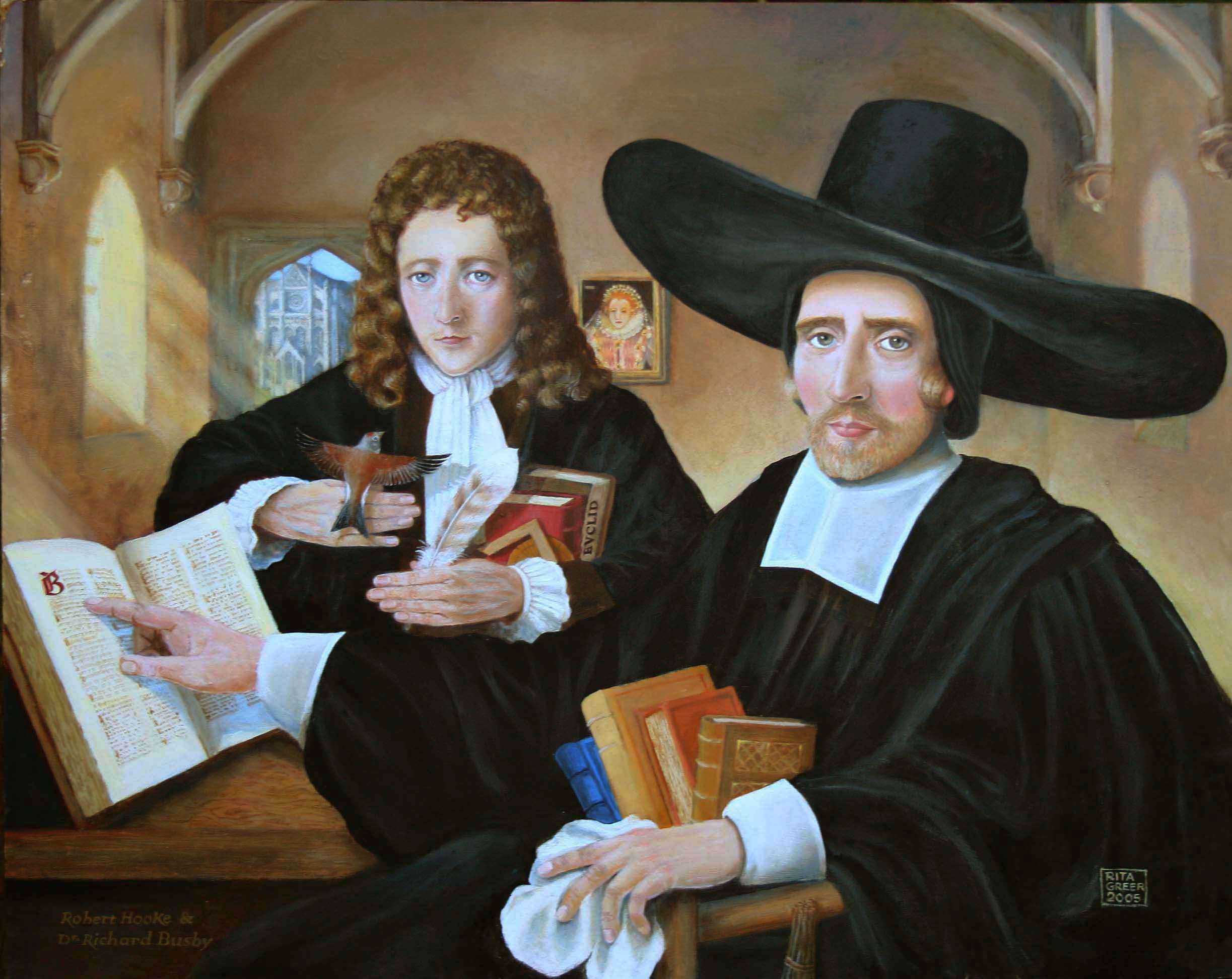
“School,” about 1652, although painted in 2005. Robert Hooke (bareheaded) as a pupil at Westminster School. Dr. Richard Busby (in the hat) was the headmaster. By Rita Greer. Courtesy of Wikimedia Commons.
Manners
Among the hat-wearing classes, more-or-less equals could greet each other by taking their hats off. You can see how gracious that was if you watch what not-equals did: The person lower down the social ladder took off his hat or cap–not just to his landlord or some random gentleman, but to his parent, his boss, a magistrate, whoever. And his superior would leave his hat where it was and feel free to respond in any old way he wanted. A nod would do. No nod wasn’t out of the question. It depended on and reinforced the social distance between them.
All this was called hat-honor, and it wasn’t set out in law but it might as well have been. When the issue came up in court, judges “ruled that custom was sufficient to make it obligatory, while clerics explained that the biblical commandment to honour one’s father and mother applied to every position of authority.”
I’m quoting–no, I didn’t make up his name–from Bernard Capp, who’s made a study of this. He quotes 16th and 17th century tracts that talk about how “doffing the cap” is a “signe of obedience and humility.”
Humility was good, remember–at least if you weren’t among the humbled. It kept the order in social order.
From all this nonsense, we inherited the phrase “going hat in hand” (or “cap in hand”) for humbling yourself and begging a favor.
The flip side of that was that someone could show favor to an inferior by allowing him to keep his hat on. That was a big deal. And we’re not talking only about lords and kings. It went down the social scale at least as far as craftsmen and tradesmen.
The system was pervasive and it grated on–well, not on everyone but on some people. The system was starting to creak at the joints, and people weren’t as willing to put up with what might once have seemed natural. Or if not natural, at least necessary. During the Civil Wars and the years that led up to them, a small sort of revolution went on, with people on one side signaling, You’re not my better and I’m not your inferior, and people on the other side signaling, Oh, yes you are.
Examples?
In Worcestershire in 1608, a parish officer refused to take off his hat to a knight, who had his servants beat the man up. Other incidents ended with someone knocking off the offender’s hat.
Take that, you bad-mannered hat.
The Quakers were known for refusing to take their hats off. George Fox, a founder of the Quakers (I’ll be quoting Capp again), considered his refusal “a gesture against the sins of vanity and pride, but did not hide his contempt for the deferential ‘crouching, scraping, capping’ the elites demanded in the name of ‘that they call their civilitie.’”
In 1646, when John Lilburne, a Leveller, was taken from jail to appear in front of the House of Lords, “he resolved to ‘come in with my hat upon my head.’”
In 1649, when Charles I was on trial, he made the same gesture, refusing to take off his hat, signaling that as king he recognized no superior.
Hats in church
Just to confuse the issue, men were expected to take their hats off in church but women were expected to keep their heads covered. I’m sure there’s a perfectly rational theological explanation for that and I’m sure my brain would fry if I tried to follow it.
In the period before the English Civil Wars, when everyone available was playing tug-of-war over religious issues that seem small and silly a few hundred years later, the hats-in-church issue became important enough that men were officially mandated to take their hats off during services. As Capp puts it, “Conformists railed against ‘Ruffians and rude ones’ who wore their hats while psalms were being read or sung, and defiant puritans ‘putting them off but half way.’”
After the Restoration, nonconformists often attended church to avoid prosecution but registered their dissent by either taking their hats off during the sermon and putting them on during prayers or doing exactly the opposite. Both gestures carried the same meaning. Both groups had theological arguments to support their choice–as did the people who kept them off the whole time. In the interest of protecting my brain, I won’t dig out their rationales.
Fashion
During the medieval era, people wore low hats, caps, or hoods. Each of those announced a person’s place in society–didn’t everything?–but all of them were at least practical. In the early modern period, though, the brims of hats got wider, the crowns got taller, and the odds of them staying on a head got thinner. I’ll go out on a limb and guess that wearing something that impractical showed you didn’t have to do physical work.
In the first half of the 17th century, the hats were “so incommodious for use,” someone or other wrote, “that every puffe of wind deprived us of them.” In fact, the wind took a royalist commander’s hat at the siege of Scarborough (1644; you’re welcome) and he fell off a cliff trying to get it back.
During the Restoration, wigs came into fashion, either with or instead of a hat, and here we add another reason for not being seen bareheaded. Men who wore periwigs shaved their heads, so going wigless would leave their heads cold and endanger their health. And if that wasn’t bad enough, the inmates of Bedlam–that dread mental institution–also had their heads shaved, making an awkward parallel. Capp offers instances of gentleman handing over their money and jewellery to highwaymen but as a point of honor (and to protect their health) balking at handing over their wigs and hats, although they were worth less.
Going hatless was so unthinkable that in 1659, when Thomas Ellwood’s father wanted to keep him from running off to Quaker meetings, he confiscated Thomas’s hats, effectively trapping him in the house for months, “unless I would have run about the country bare-headed, like a mad-man: which I did not see it my place to do.”
The statute cap
Since everyone thought they had to wear a head covering, in 1571 it made sense to pass a law mandating that “Every Person above the Age of seven Years… Except Maids, Ladies, Gentlewomen, Noble Personages [and other aristocratic men and clerics]” had to have a particular kind of woolen cap and wear it on Sundays and holidays. It became known as a statute cap.
Why bother? The short answer is that when Henry VIII dissolved the monasteries, he also (beware of unexpected consequences) ended the only support available to the destitute. Elizabeth I’s government made some gestures in the direction of filling that gap, and one of them was finding work for them, in this case making those woolen caps. It cost the government nothing, since the people who had to wear them also had to fork out the money for them, and it kept the poor busy. Idleness, after all, led to disorder, moral decary, and rebellion. So put the poor to work and guarantee a market for the caps they made.
Just don’t expect gentlemen to wear them.
 Notes from the U.K.