Unknown's avatar

About Ellen Hawley

Fiction writer and blogger, living in Cornwall.

A quick history of Britain’s gun laws 

Britain has some of the world’s toughest gun regulations, and not only do the vast majority of people approve of that, 76% think they should be stricter. That’s from a sober poll taken in 2021, but Hawley’s Small and Unscientific Survey reports pretty much the same thing. 

How did I conduct my survey? Effortlessly. I’m an American transplant, which leads British friends and acquaintances to ask periodically, “What is it with Americans and guns anyway? Are you people crazy?”

I’m paraphrasing heavily. Most people are too polite to ask if we’re crazy, but if you listen you can hear the question pulsing away, just below the surface. Basically, they’re both baffled and horrified by the US approach.

I should probably tell them that a majority of Americans (56%) also want stricter gun laws but haven’t managed to dominate the national conversation yet. That’s probably because they haven’t poured as much tightly focused money into political campaigns as the pro-gun lobby. 

Am I being too cynical? In the age-old tradition of answering a question with a question, Is it possible to be too cynical these days?

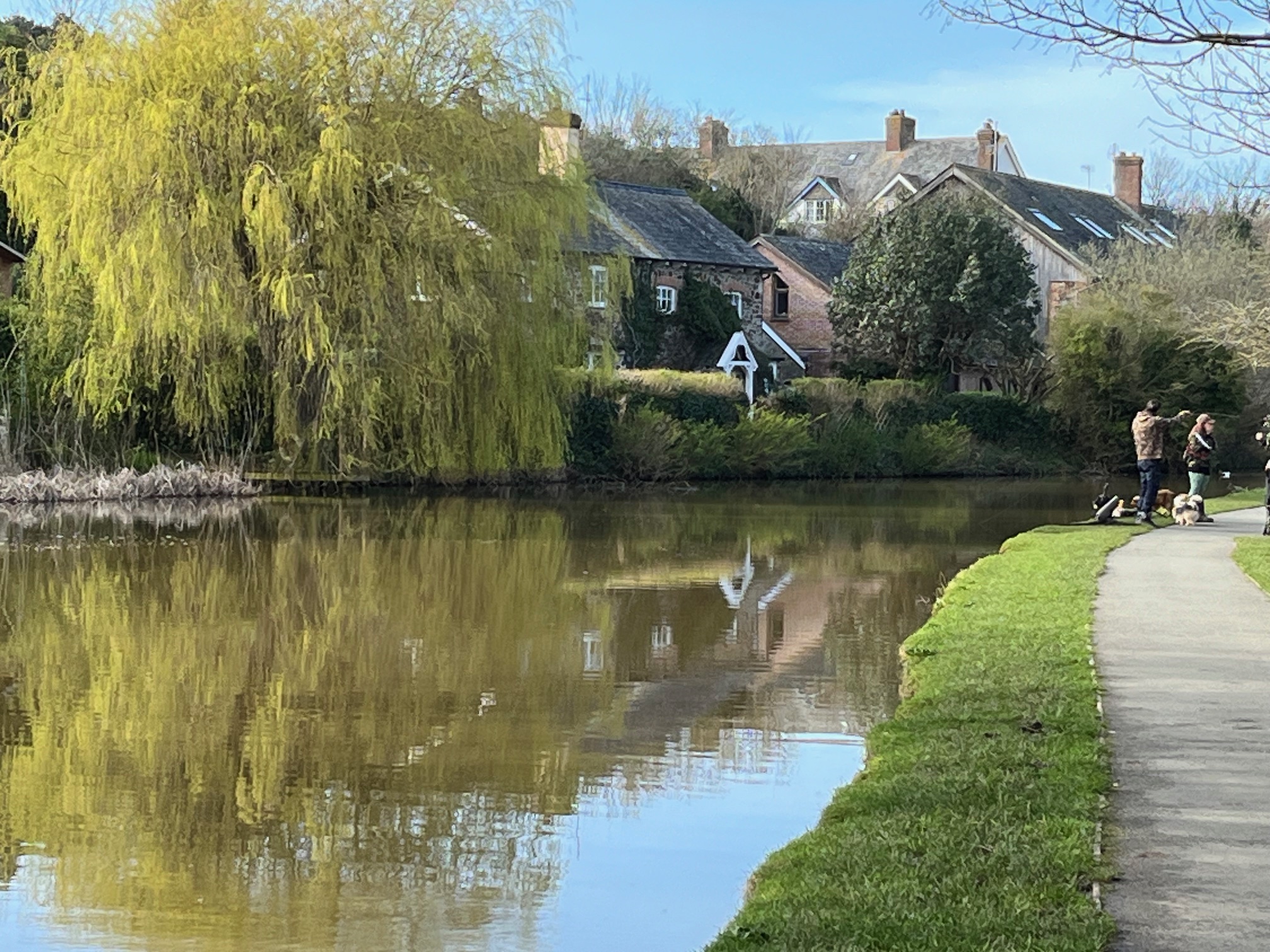
Irrelevant photo: The Bude Canal


What are Britain’s gun laws?

For a long time, they were somewhere between minimal and nonexistent. 

Way back when William and Mary crossed the channel in small boats, the price they paid to become Britain’s joint monarchs was accepting the 1689 Bill of Rights, which acknowledged that Parliament was the source of their power. It also guaranteed the right to bear arms–unless of course you were Catholic, who were the boogeymen of the moment. You were also excluded if you were some other (and barely imaginable) form of non-Protestant.

The relevant section says, “The subjects which are Protestants may have arms for their defence suitable to their conditions, and as allowed by law.” 

That leaves some wiggle room: “suitable to their conditions”; “as allowed by law.” (The US second amendment is ambiguous as well. Maybe it’s something about weaponry.) So when in 1870 a new law required a license to carry a gun outside your home, it wasn’t a violation of W and M’s agreement, because this was a law. As far as I can tell from the wording, if all you wanted to do with your gun was set it on the kitchen table and gloat over it, you could skip the license.

In 1903, a new law required a license for any gun with a barrel shorter than 9 inches and banned ownership by anyone who was “drunken or insane.” 

You could have a lot of fun poking holes in that. Could I get a license if I was sober all week but on the weekend I routinely got so drunk I fell in the horse trough? If I had a title and expensive clothes, would I still be considered a drunk (or a nut)?

Never mind. That was the law they passed. Nobody asks me to consult. It’s a mystery.

But let’s go back a couple of years, to 1901, as Historic UK does in its post on gun laws. Handguns were being widely advertised to cyclists, with no mention of licenses, although the ;need for them may have been so obvious to everyone involved that they didn’t need mentioning. Or enforcement may have been patchy.

Bikes were the hot new thing–the AI of the day–and everyone who had any claim to with-it-ness was rushing around on one. And maybe the cyclists felt vulnerable, out there in the countryside on their own, or maybe gun manufacturers saw an opportunity and manufactured a bit of fear to boost sales. To read the ads, every cyclist needed a handgun. They were advertised, variously, as the cyclist’s friend and the traveler’s friend. One ad said, “Fear no tramp.”

Before World War I (it started in 1914; you’re welcome), Britain had a quarter of a million licensed firearms and no way to count the unlicensed ones. Then the war turned Britain, along with a good part of the rest of the world, on its ear. One of its smaller side effects was that when it ended soldiers came home with pistols. 

How’d they manage that? The army didn’t want them back? I consulted Lord Google on the subject, but I seem to have asked the wrong questions, because he went into a sulk and refused to tell me anything even vaguely relevant. But bring guns home they did, in large enough numbers that the government started losing sleep over it, because this was a turbulent time and  the government had a lot of things to lose sleep over. For one thing, the Russian Revolution not only meant it had to share a planet with a revolutionary socialist government, it also kicked off a wave of revolutions in Europe that must’ve made it look, for a while, as if Britain would end up sharing the planet with multiple socialist governments. 

Life was turbulent on British soil as well. Not all that long before the war, in 1911, a shootout in London involved two Latvian anarchists, a combination of the Metropolitan and City police departments, the Scots Guards, and Winston Churchill. The anarchists might not have been anarchists, though, but expropriators, carrying out robberies to support the Bolshevik movement. Either way, they were well armed and the police were armed only with some antique weapons they pulled together. Until the Scots Guards showed up, they were outgunned. 

In “Forging a Peaceable Kingdom: War, Violence, and Fear of Brutalization in Post–First World War Britain,” Jon Lawrence argues that postwar Britain lived with a fear of violence from returned soldiers, the general public, and/or a government “brutalized” by the war. (The quotation marks are his. I’ll hand them back now that we’re ready to move on.) 

The press was full of violent crime reports. When isn’t it, and when don’t we at least partially believe it’s a balanced picture of the world we live in? Still, the stories are part of the picture: fear was the air people breathed.

The soldiers returning from the war are also part of the picture: they came home to unemployment and its cousin, low pay. A wave of strikes swept the country, including a police strike and in 1919 a strike by soldiers–or if you want to put that another way, a mutiny. Some of that was violent and some wasn’t. All of it kept the government up at night.

In many cases, unemployment led to whites turning their anger on Blacks and immigrants, blaming them for taking their jobs. Familiar story, isn’t it? (Black, in this context, includes people from India. I only mention that to remind us all how fluid the categories that seem so fixed in our minds really are.) 

Longstanding Black British communities were joined by a good number of sailors from both the military and the merchant fleets who were stranded in Britain when they were fired and their jobs filled by white sailors. Their hostels were a particular target for violence. Black and immigrant communities often defended themselves, leading to some full-on battles–and more lost governmental sleep.

For a fuller story on that, go to Staying Power: the History of Black People in Britain, by Peter Fryer. We’ll have to move on, because most of that is, again, a side issue to this topic. The point is that that was a turbulent period with a nervous government. In 1920, a new law allowed the police to deny a firearms permit to anyone “unfitted to be trusted with a firearm”–a loose category if there ever was one. 


And after that?

In 1937–a different era but the midst of the Great Depression, so still a turbulent time–most fully automatic weapons were banned, then in 1967 shotguns had to be licensed. Applicants had to be “of good character, . . . show good reason for possessing a firearm, and the weapons had to be stored securely.” 

In 1987, a man killed 16 people and himself, using two semi-automatic rifles and a handgun, and the government came under pressure to tighten the laws. In response, semi-automatic and pump-action rifles were banned, along with anything that fired explosive ammunition and a few other categories of weapons. Shotguns remained legal but had to be registered and stored securely. 

After a 1996 shooting of 16 schoolkids and their teacher, in which the shooter used four legally owned pistols, a new law banned handguns above .22 caliber, and in 1997 .22s were outlawed.

In 2006, in response to a series of shootings, the  manufacture, import, or sale of realistic imitation guns was banned, although it was still legal to own one. The logic there is that they look realistic enough to commit crimes with, so this isn’t exactly gun control; it’s more like toy control. The maximum sentence for carrying an imitation gun was doubled, and it became a crime to fire an air weapon outside. The minimum age for buying or owning an air weapon went from 17 to 18, and air weapons could now be sold only face to face. 

In 2014, police were required to refuse or revoke a firearms license if the applicant or license holder had a record of domestic violence, drug and alcohol abuse, or mental illness, which implies that they’re expected to actually check.


And the result?

I know a few people in Britain who own rifles and shotguns that they hunt with. When they applied for licenses, they had to show that they had a secure place to store them, that they had a legitimate reason for owning a firearm, and that they were “of sound mind.” They had to pass police checks and inspections of their health, property, and criminal records. If any of them have moaned about it, I haven’t heard it. 

As a way of looking at the impact, I thought I could find a nice, simple set of statistics comparing homicide rates in the US and UK, but nothing’s ever simple. If you use two different sites, one for each country, you end up comparing apples and motor scooters, but I did eventually find one that compares many countries’ murder rate per million people. In 2009 in the UK, it was 11.68; in the US, it was 44.45–four times higher. We’ll skip the intentional homicides, which aren’t  the same as murders, along with the accidental deaths and the suicides. They might all be worth thinking about if we’re talking about the impact of gun ownership on death rates, but they’ll make my life more difficult and I don’t know how you feel about that but it won’t make me happy, so basically, screw it.

Another site I found compares mass shootings between 1998 and 2019. The UK’s had one. Twelve people died in it and one was injured.  The US has had 101, making it the world’s leader in mass shootings. In the deadliest, sixty people died and more than eight hundred were injured. In the second deadliest, forty-nine died and fifty-eight were injured. 

So is the US, with its permissive gun laws, a freer country than the UK? That’ll depend on how you define freedom, and that’s above my pay grade since I do this for free. Some people measure freedom by a country’s voting system, some by people’s sense of security and safety, and some by the right to carry a gun. I have yet to meet anyone in Britain who feels oppressed by the gun laws or measures their freedom by their access to weaponry. I’m sure someone out there does, but they’re a minority, and a small one. 

What about the argument that access to weapons makes the little guy a more powerful political force? My observation is that the little guy struggles to be heard in both countries, but that guns and threats of violence in the US are allowing a minority–a sizable one but still a minority–to increase its power at the expense of their fellow citizens. That’s not a good fit for my definition of freedom.

How many prime ministers does it take to destroy a party?

Is anything more fun than watching a political party you despise come apart in slow motion? This isn’t innocent fun, I admit, because the Conservative Party’s woes risk tearing the country apart as well, but as long as it’s happening I see no reason not to enjoy the spectacle. 

What’s going on? The most recent news is that a section of the Conservative Party seems to be plotting the overthrow of yet another prime minister. That’s a prime minister who belongs to their own party, remember. Who leads their own party and who they put in office to replace a prime minister from their own party who they put in office to replace a prime minister from their own party who–

Et cetera. 

Irrelevant photo: primroses and lesser celandine.

What’s the latest plot?

A group of MPs (Members of Parliament; you’re welcome) met to discuss replacing Rishi Sunak with Penny Mordaunt. The group comes from the right wing of a party that has no left wing and whose anatomically awkward center wing is increasingly hard to spot (at least from the vantage point of my couch). Still, they seem to have located a few moderates to meet with and discuss their plotlet.

When I talk about the party’s right wing, mind you, I’m not talking about some unified group. They split apart as easily as mercury. This particular group could, if they’d wanted to, have backed Mordaunt in the last battle over who would be prime minister (she did run) but they wouldn’t because they didn’t like her views on trans rights. 

What are her views on trans rights? Good question. Two years ago, she either did or didn’t want to make it easier for them to transition. And she either did or didn’t make a U-turn on whatever her earlier position was. Or wasn’t. But since she hasn’t denounced them as a threat to women, weather, and western civilization, the culture warriors consider her woke.

Am I work? I got up at 5:30 this morning, walked the dog, and had two cups of tea. I’m writing this at 7 a.m. and I’m about as woke as it’s possible to be in that situation.

But we weren’t talking about me; we were talking about important people. If the right wing of the party–or this winglet of the right wing of the party–is going to back Mordaunt, the papers say she’d have to agree to farm out culture war issues to them. That way she could protect the purity of whatever she turns out to believe while still letting people who believe the opposite do whatever they think will earn votes from the rabid wing of the country’s electorate. 

Am I biased? I do have a few biases. They’re like accents: everyone has at least one, whether they know it or not. I like to take mine out and waive them around once in a while–it keeps them as fresh as if I’d dried them on the line–but my posts are as accurate as I can make them and I do my best to link to reputable sources. 

Will Mordaunt bite at the bait the plotters are dangling in front of her? She hasn’t said so, at least as I write this, but she also hasn’t said she wouldn’t, although her supporters make it sound unlikely.

This is political maneuvering, though. We can’t expect what people say to always match what they mean. Polls predict Mordaunt will lose her seat at the next election. It’s not out of the question that she’d rather wander out into the allegedly real world as ex-prime minister than as a lowly ex-MP.


Why choose Mordaunt?

The plotters have several reasons to have taken Mordaunt off the hanger when they chose their outfit for the day. One is that, as I’ve said in multiple posts, the Conservatives have an extremely shallow talent puddle and they’ve pretty well splashed all the water out of it. That’s what happens when you give kiddies rubber boots and turn them loose in wet weather. But the most important factor may be that during the king’s coronation she carried an eight-pound sword, upright and well in front of her body, for fifty-one minutes. 

The newspapers all agree that this is no easy trick. Since I’ve never tried it–we don’t have a lot swords at my house–I’ll have to take their word for it. The articles were written by serious journalists who wouldn’t just close their eyes and trust Mordaunt’s publicity machine on something this important. They will have borrowed eight-pound swords and tried it themselves.

If any of you have relevant experience, I’d love to hear about it. A reader who drops in to Notes from time to time is a weightlifter and has pulled a truck in competitions. Is she a good candidate for prime minister? She’s looking better all the time.

Sam, if you’re out there, we need your help here, at least as a sword-carrying consultant and quite possibly as a candidate for prime minister. Our slogan will be, Our candidate can pull a truck. Can yours?


Does the sword really matter?

Maybe not. Some people in the know are speculating that it isn’t Mordaunt the plotters want. They’re using her to hide their real plan, which is to trigger yet another leadership contest in the Conservative Party before the next election. Then they could put her in as prime minister and when she leads them into what pretty much everyone expects to be a disastrous defeat at the next election, they can blame her. That will clear the path for candidates who are further to the right to really, really lead the party, because waiting in the wings and oozing ambition are Kemi Badenoch, Suella Braverman, and Grant Shapps.

Will anything come of this? Anyone who thinks they can predict where we’re headed is delusional. 

As for Rishi Sunak, our prime minister du jour, he says his party’s united and life is fine. I have no information on how long he can hold a sword upright.

When will the next election be? Best guesses at the moment are that the election will happen in November. Or October. Or some other month. The latest possible date is January 25, 2025–five long years from the last one–but prime ministers can set earlier dates if they get lonely. 


What’ll happen at the next election?

Polls suggest a disaster for the Conservatives, although they’re hoping that if they postpone it long enough the economy will improve, all the gods I don’t believe in will descend from Mount Olympus to intervene, and they’ll scrape through. One of many wild cards, though, is that the main challenger, Labour, has divested itself of almost everything it ever stood for. That’s supposed to make them bulletproof. You know: if you don’t hang up a target, it’s hard for anyone to hit a bullseye. 

Whether that will get people to vote Labour is anyone’s guess. It’s hard to work up much passion for a party whose slogan is We’re not the Tories. Vote for us and we’ll all find out what we stand for. If anything.

As for the Liberal Democrats–the other major nationwide party–no one ever did know what they stand for. Or at least no one I know.

In the meantime, multiple MPs–whole flocks of them–are announcing that they won’t run again. Many have taken phone calls from reality and realized they can’t win, but it’s not just Conservatives who are giving up. Across the political spectrum, many are saying, essentially, “I can’t stand this anymore..” 

As Carolyn Lucas, a Green Party MP, put it, “In any other walk of life, if people behaved as they do here, they’d be out on their ear. . . . It is utterly, utterly dysfunctional. I mean, really, it’s loopy.”

Britain’s unexploded bombs

In February, a builder in Plymouth was digging–something builders do a lot of–when his shovel hit a piece of rusty metal. That doesn’t sound like national news, but after a bit of exploration he recognized the size and shape of an unexploded bomb and hit the panic button. As did the experts once they were called in. 

What he’d found turned out to be a 500-kilo bomb left from World War II. (If you want that in pounds, multiply it by 2.2 and eat three squares of dark chocolate, preferably before breakfast.) Some 1,200 people were evacuated from the area and over 100 military personnel were brought in as a kind of unintentional trade. 

Or in a different article, over 10,000 people were evacuated, but let’s not worry about it. I suspect we’re looking at two different categories–the residents who had to move immediately; the ones who had to move later to clear the route the bomb took to its final exploding place; the ones who ran screaming from their houses even though they weren’t anywhere close. Or else we’re looking at a roving zero, which plonked itself down in somebody’s text. I love to see numbers mess with people other than me. I take up enough of their attention, so it’s only fair that I step back sometimes. Anyway, let’s just say a lot of people had to move out of their homes. Roads were closed. Trains and buses were stopped. Reporters and photographers gathered. Ink was spilled.  

Irrelevant and ever so slightly ironic photo: a sunrise, looking as hopeful as any sunrise will

It took days to dig the bomb out, and once that was done (without setting it off, mind you) they still had to move it through the city and out to sea, where they could detonate it safely. Or at least safely if you’re not a marine creature minding your own business in an area humans consider uninhabited. But let’s not think about that. Let’s just call this a happy ending. The alternative–or at least one alternative–was blowing the bomb up where it was, destroying homes for blocks around and threatening water and gas lines.


What’s an unexploded bomb doing in Plymouth?

Plymouth–like London; like a lot of British cities–was bombed heavily during World War II. It had a major naval dockyard and a large military presence, making it an important target. 

Not that a city needed strategic value to be bombed. Leftover bombs were dropped pretty much anywhere at the end of bombing raids so the if the planes carrying them were being chased they could gain height and speed and get the hell out of there. And non-strategic cities were bombed on the theory that destroying historic sites would damage morale, which is why Exeter was bombed. The target was the Cathedral, which they missed, but they wrecked a lot of the city center. When the city rebuilt, it left some of the wreckage in place as  monuments to–well, you can read the monuments any way you like: to those lost in the bombing, to everyone who died in the war, to everything that was lost. Maybe it’s the openness that makes the remains so moving. 

But back to Plymouth, with its value as a strategic target. Want to do numbers? Of course you do. Numbers make us all sound like we know something. 

During the seven worst days of the Blitz, the city was hit with 6,000 general purpose bombs (hands up anyone who knew there was such a thing as a general purpose bomb) and 105,000 incendiary bombs. In four years of bombing, over a thousand civilians died and over three thousand were injured, That’s out of a population a bit north of 200,000. More than four thousand properties were destroyed and eighteen thousand were damaged. The city center was pretty well flattened. It was rebuilt in the late forties and fifties and (unsolicited opinion follows) is pretty grim. 

Never mind. Those weren’t easy times and it’s easy to criticize when you don’t have to wrestle with the problems that must’ve been involved. 

To take in the scale of what Plymouth was  living with during the Blitz, though, you have to think about not just the 59 bombing raids but the 602 alerts, when people would  haul themselves out of bed and hide someplace they hoped was safe but knew to be, at best, only safer than staying put and pulling the covers over their heads.

In the midst of all that bomb-dropping, some 10% of the bombs dropped didn’t explode.


How many unexploded bombs is the UK sitting on?

It’s hard to get an exact count. You can call for them to put their hands up all you want, but they won’t do it. Something like 45,000 have been found, although that’s probably an underestimate. The Ministry of Defense deals with some of them, but others are dealt with by private companies, and there’s no central count for us to tap into.

If we can’t get a count of the bombs that have been found, we’re even further from getting a count of the ones sitting under someone’s garden, minding their own lethal business. The closest I could come to a number is that some 500,000 “items  . .  of unexploded ordnance” are in the waters around Britain, mostly from World Wars I and II, although some are from exercise drills and other fun stuff. 

Are they dangerous? Um, yes, at least potentially. Some are known and marked on maps. Others aren’t. 

Ooooh, don’t go wading. I think I see something just under the sand.

On land, though? The BBC says there are “potentially thousands.” We’ll go with that. It’s vague enough to be unchallengeable. And they’re at least as much of a threat as the ones underwater.

“What makes unexploded bombs dangerous is their unpredictability,” one expert said. Over time, they might have degraded. Or they might’ve become more dangerous. We’d be wise not to gamble that eight or so decades of sitting in the ground, contemplating the horrors of war, has made pacifists of them.


How did Britain deal with them during the war? 

At the beginning, badly. Bomb disposal officers could expect to live two months. They were issued a hammer, a chisel, a ball of string, and if they were lucky, a stethoscope. 

What was the string for? Your guess is as good as mine, but the stethoscope was for the bomb, not to see if their hearts were still beating.

“The running joke was ‘join the Army and see the world, join the bomb disposal squad and see the next world’,” historian Steve Day said.

(You’ll find that in the BBC link that’s just above if you want to make sure I didn’t invent it. I remember just enough about footnotes to get twitchy when I don’t put a link in for quotes.)

With time, they–those who lived and the folks in charge–got better at it. The key was understanding the fuses. One, Type 17, had a clock that could be set to go off anywhere from a minute to a few days after the bomb landed, but it could be gummed up with either a sugar-based fluid or a magnet. When the Luftwaffe upped its game and introduced an anti-tamper fuse, disposal experts learned to drill into the side of the casing, force steam in, and let the liquid TNT drain out. 

These days they use pretty much the same techniques, but robots get to do the most dangerous work.

Love, death, and adverbs: It’s the news from Britain

Residents of a care home in Surrey were sent Valentine’s cards–red heart, pink bow, all the traditional stuff—from that most caring of senders, a local funeral home. A spokesperson for the care home said residents were thrilled to get the cards, and doesn’t the involvement of a local business go to show how deeply embedded the care home is in the community? Read the quotes and you can hear “Look on the Sunny Side” playing between the lines.

Residents’ families, on the other hand–at least those who were quoted–said things like “appalling” and “insensitive.”

The funeral home itself said, “Oops” (that’s a rough summary), followed by some verbiage about “unintended distress,” and it’s that “unintended” that makes this a particularly British story. Because tossing in screamingly unnecessary adverbs is a very British thing. My favorite is when newsreaders tell  us that someone “sadly died.”

As far as I’ve been able to figure out—and I’ve lived here for almost 18 years now—you can’t die in this country without doing it sadly. You can’t die absurdly, or with a sense of relief, or even unnecessarily. Above all, you can’t die unadorned. The word died isn’t allowed out in public until it’s fully dressed and the correct adjective has been buttoned up to the neck.

Irrelevant photo: An azalea blossom. Indoors.


Immigration and the search for an enemy

Ten years ago, when Britain’s anti-immigrant fringe was still searching for a group of people frightening enough to rile up the populace, the Home Office discovered foreign students and offered them up as a target for some of the free-floating hate that drifts across the island with the rains that blow in from the Atlantic.

Why foreign students? The better question might be, Why not foreign students? They needed someone. The Home Office was led at the time by Theresa May, and she was working to establish her right-wing credentials by declaring a hostile environment for illegal immigrants, which ended up creating a hostile environment for legal ones. A hefty number of them were deported, but it’s never enough to satisfy the anti-immigrant lobby, so lucky Terri, Santa Claus brought her the off-season gift of a BBC documentary about cheating on the English-language competency tests that foreign students had to pass before they could renew their visas. The documentary focused on just a few test centers, but Terri turned off the TV and said, “Right. We’ll cancel the visas on 35,000 of them.” Or to put that another way, 97% of the people who took the test.

Is it even vaguely credible that 97% of the people who took the test cheated and, until Terri turned off that fateful TV program, got away with it?

Who cared? It played well with the anti-immigrant lobby, who by then had left the lobby and were occupying seats in the House of Commons.

Cue dawn raids, students held in detention centers for months, lost degrees, lost careers, lost reputations, and deportations before anyone had a chance to appeal or prove that their English was just fine, thanks. What the hell, they were a bunch of foreigners. Of course they cheated. Give them a chance to appeal and they’ll tie this mess up in red tape forever. Give them a chance to demonstrate their competence and they’ll only make us look silly.

Foreigners are sneaky like that.

So here we are, ten years late. Some 3,000 former students have won appeals and a new group is starting what sounds like a mass appeal. And since a TV series dramatizing a post office scandal drove politicians of all parties to make noise about compensating some deeply wronged sub-postmasters, a group of the former students are working on a TV script about what happened to them. To date, noise is all that’s come of the political agreement about the sub-postmasters, but still, if you can’t get justice, the illusion of it is comforting.

*

Lest you should be silly enough to expect consistency from the Home Office, lately it’s been closing its eyes and flinging work visas in what sound like some dodgy directions. Not because it now loves immigrants. It’s at least as anti-immigrant as it was under Theresa May, although it’s found a new boogey man: refugees who cross the Channel in small boats. They make for scarier headlines than foreign students.

The current crop of visas are meant for people to work in the care sector, which is understaffed and underpaid and relies heavily on immigrant workers. But the visas don’t go to individual care workers, they go through care providers, who get licenses to sponsor immigrant workers, and those providers are popping, mushroom-like, out of the soggy ground of our political bog. Or of our overdone metaphor.

One company that was granted 275 visas didn’t exist; 268 companies have never been inspected and some aren’t registered with the watchdog that’s supposed to do the inspecting. Some don’t have addresses, only post office boxes. Some have been formed so recently that they’ve never filed company accounts. One has a website with reviews from clients named John Doe and Jane Smith.

I could go on, but I’ll spare you. And myself.

The assumption is that the companies are selling the visas. I’ve seen reports of immigrant workers in the care sector paying as much as £15,000 for visas and once they get here being “housed in sub-standard accommodation and even forced to share beds.with colleagues.

“Some have been paid for just a fraction of the hours they have worked or [been] subjected to racist remarks, harassment, and intimidation if they complain about the treatment of the people they care for.

“Others have worked for several months without being paid by their employers, who claim this is to recoup fees towards the cost of the migrant workers’ training or accommodation.”

The number of companies with the power to sponsor visas more than doubled between 2022 (41,621) and 2023 (84,730).


How much for that Mao in the window?

A London auction house was selling artifacts–that’s a fancy word meaning stuff–from China’s Cultural Revolution, and a rare early edition of Mao Tes-Tung’s Little Red Book was expected to sell for more than £30,000.

What’s wrong with this picture? So much that I have no idea where to start, so I’ll leave you with the picture and save my adjectives for the time when, sadly, I have to report a death.


Meanwhile, if you’re looking for a free stuffed toy . . .

. . . I can tell you how to get one.

This didn’t happen in Britain, but with a little work it could’ve, since it could happen any place where attractive nuisances entice people to trade coins for a chance to pick up stuffed toys with a mechanical claw and drop them down a chute so their kids can take them home and love them for ten minutes or so. Or not drop them down a chute, because no matter how simple it looks the machine never gives you quite enough time to get the toy where it needs to be.

In Australia, a three-year-old found a better way to get what he wanted. In the half-second when his father got distracted, he climbed up the chute and materialized inside the machine, standing upright among all the stuffed toys any kid could dream of.

Since using the claw to drop him back down the chute didn’t seem like a good idea, the father called the claw machine company, which asked helpful questions like, “How much money did you put in the machine?”

The only thing stuck in the machine was his son, he said, and he’d like to have him back.

The person on the other end of the line wasn’t programed to deal with that and the police ended up smashing the glass and extracting the kid. The media is (sadly) silent on the all-important question of whether the boy got to take a toy home.


From the Department of Historical Preservation

In an effort to polish Britain’s reputation for eccentricity and historical hoo-ha’s, the owner of a pub in Staffordshire, The Crooked House, has been ordered to rebuild it, brick by brick. It was built in 1765 and sank into the ground either because of mining in the area or a nearby water wheel (no, I don’t understand that last one either), until it sat at a 15-degree angle. It had been propped up in various ways over the years and was doing just fine until it was sold and–oops–mysteriously caught fire.

Then, just to make sure of things, the new owner had the shell bulldozed.

Local people got up in arms. Or up in containers, which they used to store 23,000 bricks that they salvaged from the rubble, and the new owner’s been ordered to put them back where they were, and at the pre-fire angle. Unless the owner appeals, they have three years, but they may be too distracted to bother, since the fire’s being treated as arson.

What the British really talk about

If the way to a person’s heart is through their stomach, the way to a culture’s is through its language. Mind you, I invented that theory on the fly, but let’s believe it for long enough to play with a couple of recent studies. 

Two linguists recently analyzed every word in the British National Corpus 2014.

The British National what? British National Corpus 2014 is a hundred million words of contemporary language, which are a sample of all the words that get spewed out in fiction, newspapers, magazines, informal speech (how they catch that I have no idea; my informal speech disappears as soon as I informally speak it), academic writing, and online writing, all of them written or (I guess) spoken between 2010 and 2020. 

Given those dates, I have no idea how 2014 snuck into the discussion. Not my fault, Your Honor. I’m only telling you what I read.

The researchers went through all those words and counted up how many times various topics appeared per million words. By hand, of course.

Irrelevant photo: crocuses

In order of frequency, they are:

Time and punctuality: Year and time were the two most frequently used nouns. Being on time, in time, and punctual are enough of an obsession to rate all three ways of saying roughly the same thing. 

Semi-relevantly, the word morning is used twice as often as evening and three times as often as afternoon. December is the most mentioned month. Summer gets talked about more than winter and Saturday and Sunday more often than whatever those other days are.

Weather and climate: The word sun gets more of a workout than rain, although Hawley’s Small and Unscientific Survey (HS&US) reports that we have a lot more rain than sun in Britain. (Do not trust the HS&US. It takes being unscientific entirely too seriously.) Still, the word weather only appears as often as the words pub and restaurant. Climate change and its related words appear frequently, and considerably more often than in previous years.

Food and drink: Dinner gets mentioned more often than lunch and lunch more often than breakfast. Cake gets mentioned more often than salad. That will surprise no one. Although breakfast doesn’t top the list, eggs do. Go figure. Chocolate ranks pretty high. So do boring things. Look it up yourself if you’re interested. I have a short attention span.

Drinks? Tea, wine, coffee, beer, milk, juice, and champagne all made the list. How much does champagne matter? Tea gets mentioned six times more often. I’m not sure how much more often beer gets mentioned, but in a race between champagne and beer, my money’s on beer. Tea and beer? I’m not sure I want to bet on that one.

Emotions: Finding emotions on the list of top mentions sounds like it breaks the stereotype of the British as a tamped-down culture, but happy is at the top of the sublist, often in phrases like, “I’m quite happy to stay at home.” That’s not what you’d call an emotional outpouring, more like a stoic acceptance of the inevitable. Sorry is right up there too. HS&US reports that the British give sorry one hell of a workout. 

Bodies: Or at least our metaphorical bodies, because whatever we can learn from the calculation here gets thrown off by phrases like “on the other hand.” Researchers from HS&US are going to either eliminate this category or insist that people discuss their livers, earlobes, and unmentionables. 


Is there some other way to measure what people care about?

Why, of course. Let’s throw most of that out the window and talk about alcohol. Or more accurately, let’s talk about how people talk about alcohol. If the number of words a culture has for something carries information about how important it is, the British are a nation of serious drinkers. Or of serious alcoholics. According to a study from Germany, the British have 546 words for getting drunk.

Or for being drunk. After a couple of drinks, the line between the two has a way of blurring.

Need a few examples? Pissed. Sloshed. Stewed. Wrecked. Hammered. Bladdered. Plastered. Mullered. Pickled. Bevvied. Rubbered. Tanked. Cock-eyed. Zombied. Blootered. Trolleyed. Rat-arsed. Wankered. Shit-faced. Arseholed.

Blootered? Yeah, that was new to me too. Blooter is Scots and means to kick something–usually a football–”fiercely and often wildly.” 

What about mullered? A muller is “a stone or piece of wood, metal, or glass used as a pestle for pounding or grinding.”  

The things you learn here. 

Hell, the things I learn here.

You can also get cabbaged, gazeboed, and carparked. Unless– Okay, I got this information second hand, from assorted newspapers, so it’s not impossible that someone’s messing with us there. But basically, you can take just about any noun, add -ed to it, and say you’ve been that way. 

Does it work? I was so earthwormed I couldn’t see straight. Why not? Earringed? It might not be as convincing as cabbaged, but it works. Carburatored? Absolutely. 

Isn’t English a lovely mess of a language? 

Have fun.

The full list is here. Or a gesture in the direction of the full list. I haven’t counted. And a few that may or may not be extra are here

*

Several of the articles I saw mention that the Sami language has 300 words for snow. The Sami are the native people of northern Scandinavia and Russia, so yeah, snow matters to them. The point is supposed to be that we have many words for the things that are important to us, but the comparison to the British and being drunk breaks down when you realize that

the Sami words, at least as I’ve seen them explained, are for different kinds of snow: untouched snow; snow that’s hardened so much that reindeer can’t dig through it; snow your neighbors shoveled off their driveway and dumped on yours because you didn’t buy the cardboardy pizzas their kids were selling to raise money for their school. Or maybe that last kind of snow only falls in the US and the Sami don’t need a name for it.

The difference is that all those words for drunkenness describe a single state of near-oblivion, not variations on it. They have no purpose except to keep people amused, either until they sober up or until they can get drunk again.

Welcome to Britain.

Inventing the post office: A bit of British history

Britain’s post office was established in 1660, under Charles II. Or in 1630, under Charles I. Or in 1711, under Queen Anne. Or in 1516, under Henry VIII.

All those dates have at least a semi-rational claim. One of the things I love about history is how clear-cut everything is. 

Let’s start with Henry. What he set up was a national network that would serve the court, although one website dates it to 1512, not 1516, and Cardinal Woolsey gets the credit instead of Henry, but we’re at least all talking the same language here, so it’s close enough for our purposes. 

The system involved relays of horses and messengers, and this was revolutionary stuff–the internet of its day. Up until then, if you wanted to send a letter, you had to send your own damn courier or find someone going in the right direction who’d carry your letter or package through the airport scanner for you. (“Did you pack your own luggage, sir?” “Of course not. I have minions who do that for me.” “Of course, sir. No problem, but you still can’t take your sword on the plane.”)

Or maybe Henry’s system wasn’t so new. According to WikiWhatsia, the first postal service was in Egypt, in 2400 BCE, and Persia had one in 550 BCE. Ancient Rome, ancient China, the Mongol Empire, and assorted other political entities can also stake early claims. Whether anyone in England knew about them at the time is up for grabs.

For us, it doesn’t matter. The system was new to England and people who were important enough to get close found ways to slip their own letters in with the court documents. 

Irrelevant photo: A camellia escaping a neighbor’s back yard in early February.


The service goes public

In 1630, the ill-fated Charles I (lost his head in the civil war) opened the service to the public. Or someone did it for him. Monarchs always get the credit for other people’s work, possibly because the initiative was theirs but possibly because they didn’t get in the other people’s way.

Never mind. Here’s how it worked: First we shift into the present tense, because it’s so much more exciting and because you want to drop Mom a note saying you’ll be home next Monday and what’s the point of doing that if Monday’s already in the past? You write your letter and take it somewhere–the write-ups aren’t clear on this, but it wasn’t your local post office and it wasn’t a mailbox, since neither exist yet. Probably to the nearest post, which is not a piece of wood driven into the ground but a place that’s part of the (ahem) postal network. The mail goes from one post to another, and the postmaster at each one pulls out the mail–sorry, the post–for his area and sends the rest on. 

We’re probably correct here in saying “his,” not “his or hers,” “theirs,” or some other awkward variation, although I can’t swear to that. Let’s let it stand this time.

England and Scotland have six main post roads, and letters travel along them, so if you and Mom aren’t that far apart but are in different postal areas that aren’t joined by a post road, your letter will first go to a post before it heads more or less backward to reach her. But it’s not all inefficiency, because the service works night and day, literally. 

Once your letter reaches the post in Mom’s area, it’s handed to a postboy, who’ll deliver it, either on horse or on foot, and if Mom wants it she’ll have to hand over some money, otherwise forget it: no letter. Of course, by the time it reaches her you might already be home, so she can save herself the expense.

How much does she save? It depends on weight and distance. When the system started, the charge was 2d for 80 miles for a single sheet of paper. 

A d? For no reason a rational person will ever remember, that stands for a penny, so 2 pence, or a day’s wage for a skilled tradesman. In other words, not cheap.

How fast was the system? (You’ll notice we’re in the past tense again, having forgotten all about you and your mother. Hope you had a nice visits.) A letter sent from Edinburgh to London might get a reply in something like two months. 

The system had competition from private carriers–hundreds of them, although I haven’t found any information on their systems, costs, or speed.


The Civil War and the Restoration

You’d think the English Civil War (it started in In 1642) might’ve distracted people, but staying connected mattered at least as much as it ever did, and the Commonwealth’s postal service covered England, Scotland, and Ireland. In 1657, the General Post-Office was granted a monopoly, getting rid of those pesky competitors, and a fixed rate was established for letters. No one seems to list this as one of the post office’s many founding dates, but it strikes me as having a reasonable claim. 

That carries us to Charles II and another founding date. 

In this telling, Charles–or at least his government–gets credit for not just founding the General Post Office (no hyphen this time–think how much time and ink that saved) but for rolling it out across the country, although it sounds like the Commonwealth had already done that.  

How was this different from the hyphenated post office set up by the Commonwealth? Haven’t a clue. It might’ve been a major improvement and it might just be a case of the Commonwealth’s work not being taken as seriously as the monarchy’s. You’re on your own. 

It was under Charles II that postmarks became standard. They showed the date a letter was mailed, pushing the carriers not to stash a bundle at the pub for a week or two when things got busy.

That brings us to postboys, the final link in the delivery chain and a problematic one, which they’d continue to be until late into the 18th century. They were badly paid and some of them dealt with that creatively, by robbing their post bags. Give them an A for initiative. 

However risky it was, it wasn’t uncommon for people to send cash. How else were you going to get money from Point A to Point B? Cheques weren’t used in England until 1640, the first checkbook wasn’t issued until 1830, and checks didn’t circulate widely until the late 1800s. 

But postboys weren’t the only people who thought of looking inside the post bags: highwaymen regularly attacked carriers and stole the mail.  

Even if no money was stolen and the mail wasn’t stashed at the pub for a week or two, the service was slowed down by roads that could be pot-holed, ankle-deep in mud, and in general a mess. And we’re talking about a 24-hour service, remember. In the dark, it wouldn’t have been easy to tell the road from the countryside around it. 


Following the money

In 1711, under Queen Anne, a bill created a single post office of the United Kingdom and set postage rates and delivery times, which is why some sources give that as the founding date. The Post Office (what the hell, let’s use caps here*) was now a branch of the Treasury and its goal was to raise money for the state.

Where had the money gone before that? During the Restoration, it was used to pay pensions to court favorites. After the Revolution (I think this means the Glorious Revolution, so 1688-1689) it paid pensions to peers and statesmen. By 1699, a third of the Post Office’s income went to pay pensions. Compare that to what the postboys and highwaymen stole and they’ll come across as minor-league players.

The bill took that nice little pot of money and put it in the state’s hands so it could do something useful with it, like fund a war. 

What war? I find two: Queen Anne’s War, where England and France fought for control of North America, and the War of the Spanish Succession, where assorted countries fought over, um, the Spanish succession. (You’d never have guessed that without my help, would you?) If I’ve missed any, feel free to pencil them in yourself. The point is, think what an improvement this was.


I’m bored. Could we have a scandal?

Oh, always. 

From the Restoration on, it was accepted practice for MPs and Lords to send and receive letters for free. That’s called franking, which comes from Latin francus, or free, and I had to look it up too.

By the 18th century, MPs (and I assume Lords) were sending other people’s mail for free under their signed covers–it was a nice little favor they could do for friends and supporters and general hangers-on–and by 1754  that was costing the post office £23,600 in lost revenue, which in 2023 money would be something north of £4,000,000. 

How did the post office deal with that? Why, it set up a system to look for abuse of the system, of course, and that brought in a new way to abuse the system. It could almost make a person cynical, couldn’t it? In 1735, opposition MPs complained that their mail was being opened in the post office on behalf of the ministry. 

What ministry? Damned if I know. Apparently it’s too obvious to need saying, but this was the government snooping on the opposition under cover of being sure they didn’t abuse their franking privileges.

This led to the revelation that the inspector of franks, Edward Cave, had been gathering material for his own publication, The Gentleman’s Magazine, from the newsletters and gazettes that passed through his hands on their way to (or possibly from) MPs. And although I’ve lost the link by now, one source mentioned money being stolen from the mail in the House of Commons post office. By the person in charge of it. In the name of being sure no one was misusing their franking privileges.

To deal with the problem, the Commons decried abuse of the franking system. We can all guess how effective that was. Then in 1764, an act dealing with franking set up “harsh penalties for those trying to defraud the Post Office, including transportation to the colonies.”

I can’t find a record of a single MP or Lord being transported under the act. I’m sure you’re as surprised as I am.


Want a bit of corruption that doesn’t qualify as a scandal?

Throughout the 18th century, the post office had two postmasters at a time. These were patronage positions: lucrative places to drop people you owed a favor to and who you knew had no interest in doing any real work. Most of the postmasters were peers or the sons of aristocrats at the end of their careers. One, Thomas Villiers, Baron Hyde of Hindon (later earl of Clarendon), called it “a very good bed for old courtiers to rest in,” 

Why isn’t that a scandal? It was business as usual. It’s only a scandal if enough people are shocked.


* My capitalization of post office is wildly inconsistent, but you know what? I’ve worked as a copyeditor and I’m  retired now. That means I officially don’t have to give a fuck. Whee.

Now out in paperback

Available from Swift Press or The Bad Guys, who do at least make it internationally accessible. (The link is to Amazon US; if you’re elsewhere, Lord Google will be glad to point you in the right direction.) Also available from your local independent bookstore, which needs your support.

Speaking of which, if you can see your way to leaving a review on either Amazon or Goodreads, I’d really appreciate it. They do make a difference.


“Quietly magical. A book that draws you in and then refuses to let you go.”

Stephen May, author of Sell Us the Rope

Britain’s unwritten constitution and its, ahem, challenges

You’d think Britain was a careful country. It’s concerned enough with health and safety to make a lot of jokes about it. (Or them if that’s a plural. The words have melded together so solidly in the national consciousness that it’s hard to tell.) It’s survived long enough to be obsessed with its own history, which keeps those of us who share that obsession occupied happily. Somehow, though, it got careless with its constitution and never wrote it down. 

Yes, that is embarrassing, but the country makes do with something called an unwritten constitution.

What’s an unwritten constitution? Well, it has words, it’s just that they’re not on paper. Or not any one piece of paper. They’re on lots of pieces, in lots of places, and I’m not convinced any two people agree on which pieces, which places, or which words. What everyone agrees on is that it’s made up of statutes, rulings, precedents, treaties, and a yellow onion aging gently in the back of my refrigerator. And because Britain takes itself and its history seriously (most countries do), people who’ve grown up here consider this normal. It’s only people like me, who having wandered in from other places, say, “An unwritten what?? Is that even possible?” 

It is: what exists must be possible, but its unwritten state puts a lot of pressure on precedent–not to mention on me, as the keeper of that onion. Precedent becomes not just history and habit and revered tradition but (I’m repeating myself but this is central, so bear with me) an element of the constitution itself. And that leaves everyone wondering which precedents go into the constitution (who knows? It’s not written) and which ones get filed under Anomalies.

Irrelevant photo: I have no idea what this shrub is, but it’s growing outside a neighbor’s house and it flowered in late January. I’m impressed.

I’m writing about this now because not because the status of the onion has changed (sleep well tonight: it’s fine) but because a recent political and legal uproar has brought it into focus–again.


The uproar

I’ll tell you the tale in a minute, but before I do I have to ask, Don’t I sound clever when I use words like anomaly? Hell, I even spelled it right without the help of my spellcheck. 

Thanks. Now I owe you the tale. 

In 1999, the Royal Mail introduced a new computer system called Horizon, which was made by Fujitsu and cost a billion pounds to install. I hope that included the purchase price, but you know, a billion pounds doesn’t go as far as it used to, as you’ll have noticed the last time you were in the supermarket. It definitely doesn’t include the legal costs of what turned out to be a royal fuckup. It’s way too early to calculate those.

Horizon was used by sub-post offices, which are post office counters set up in corner shops and village shops–mom-and-pop operations for the most part–and the users soon started reporting glitches. Serious glitches. The kind of glitches that said, “Your calculations are off by a few thousand pounds today.”

Since their contracts with the post office said they had to make up any shortfall, you should picture sub-postpeople tearing their hair out, weeping, shouting, and calling the post office to report a problem.

And to each of them, the post office said, “Geez, no one else is reporting any problems. It must be you.” The post office not only didn’t look for the source of the problem, it demanded its money and it prosecuted people for financial shenanigans.

Businesses were lost. Marriages were lost. People went broke. Disaster entered people’s lives in multiple forms. Some 4,000 sub-postpeople were accused of theft, fraud, and false accounting, 900 ended up in court, and a lucky 236 went to prison. Eventually, sub-postpeople contacted each other and compared notes. They discovered it wasn’t just them and went public with their stories.

Anyone in Britain who stays awake for the 6 o’clock news heard about this years ago, and Parliament started hearings on the issue in 2021. The hearings ground on quietly until–I’m serious here–the BBC aired a TV show dramatizing the sub-postpeople’s fight, at which point, politicians said, with one voice, “You’re right. Somebody ought to do something.”

Then they remembered that they were the somebodies in charge. That’s even more embarrassing than forgetting to write down your constitution.

Shocking revelations from the hearings jumped from obscurity to page one of pretty much any paper you can think of. Except, maybe, the Sun. We all collectively found out that Fujitsu knew about the program’s glitches as early as 1999. We learned that the post office not only knew about the glitches but edited witness statements from Fujitsu so they didn’t acknowledge the program’s bugs. We learned that the post office didn’t disclose relevant information and now claims it’s not realistic for them to work evenings and weekends all these years later to find it. I could go on, but you get a feel for the shape of this mess, right?

With that sort of thing floating into public view, suddenly all the ways of addressing the problem that either weren’t necessary or weren’t possible before became not just possible but politically necessary, and if they weren’t exactly done they were at least promised, which in PoliticalLand is the same thing.

On the symbolic level, the former head of the post office gave back her CBE, an acronym that stands for Commander of the British Empire. 

What would the British Empire have done if she’d issued a command before giving back her award? Nothing. It doesn’t exist anymore. As far as I can figure out, all the CBE gives a person is bragging rights and a medal. If those matter to you, it’s important. If they don’t–well, you can put it on the table next to an egg, a sausage, baked beans, tea, and toast and you’ll have a small-scale version of an English breakfast, although I don’t recommend eating the medal. Or the beans.

On a more practical level, the government jumped in and promised compensation and said it would introduce a bill to overturn all those convictions for fraud etc.

How much compensation are we talking about? One former sub-postmaster says it would cover 15% of his losses. Another called the offer offensive and cruel. A third said it wouldn’t cover the interest on what she was owed. But let’s nod nicely to that little game of three-card monte (you’ll want to keep your hand on your wallet as we get close) and move on. We need to talk about the bill to overturn the convictions, because that’s the one that raises constitutional problems.


Why? What’s wrong with doing justice on the cheap?

At first glance, a bill to overturn unjust convictions looks good. Sweep a forearm across the table and shove all those convictions onto the floor, where they’ll land alongside the egg, baked beans, sausage, tea, CBE medal, and broken crockery. Labour–the opposition party just now–in the person of its leader, Keir Starmer, jumped in and said yes, the bill’s a great idea, and walked out of Parliament with baked beans sticking to his shoes. 

I was tempted to write that everyone strode off into the sunset singing “Rule Britannia,” only–did I mention that the empire’s dead and gone? What’s more, the Commons’ Defense Committee estimates that Britain’s army would run out of puff after only a few months of fighting a more or less equal power. So we’ll find some other song. “Goodnight Irene,” maybe. One verse goes, “Sometimes I live in the country / Sometimes I live in the town. / Sometimes I take a notion / To jump into the river and drown.”

You’re right. I shouldn’t be allowed out in public, but have faith, someone will come up with the right song. I look forward to fielding comments on the subject. Y’all are almost as irresponsible as I am.

In the meantime, the proposal has some built-in problems. If anyone really did steal money from the post office, the bill would overturn their convictions along with those of the innocent. In an effort to iron out that wrinkle, the government proposed that no one could get their compensation without swearing to their innocence. In writing. That way, if they turned out to be guilty, they’d end up back in court, because (ironically, given that the context here is an unwritten constitution) putting a statement on paper and swearing to it can be legally binding. 

That brings us to a new wrinkle: the sub-postpeople are understandably wary of swearing to anything. They don’t trust the courts, the post office, or the goodwill and sanity of bureaucrats or the government. They may be reluctant to open themselves up to another unfair prosecution. 

Larger than that, though, is the constitutional problem: Britain’s courts are independent of Parliament. In other words, politicians can’t overrule them, but here they’d be doing exactly that. This is written down exactly nowhere, but it’s a longstanding precedent and part of our invisible constitution.

What happens, then, when a new precedent comes along and overturns the old precedent? Irresistible force; immovable object. I never did know the answer to the question of what happens when one meets the other. The best I could do is say that either one turns out not to be immovable or the other one turns out not to be irresistible. I also don’t know what happens when a new precedent tries to elbow out an old precedent. Are they equally powerful? What does the constitution have to say?  The answer depends on interpretation, and on who gets to do the interpreting.

Ken MacDonald–sorry, Lord Ken MacDonald, the former Director of Public Prosecutions–explained the issue by saying, “What we have is Parliament seizing from the courts and the judges the right to say who is guilty and who is not guilty. And the problem is that once this dam is burst–we can all see it’s being done for the best of reasons here–who’s to say how such a process might be used in the future?”

It’s not unreasonable for him to worry. The government’s already going nose to nose with the courts over a bill to deport asylum seekers to Rwanda. The Supreme Court ruled it unconstitutional and right away a right-wing edge of an already right-wing Conservative Party called for Parliament to overrule the court and review the courts’ authority over the government. It called for the prime minister to “step up and do whatever it takes.” 

Depending on how recently you’ve had the wax cleared out of your ears, “whatever it takes” can sound either down-to-earth and practical or threatening. To my ever-so-clean ears, it sounds like a call for the courts to be swept aside when they get in the way of a party’s political agenda. 

To date, the prime minister has tried to placate the right without ripping up the invisible document that’s supposed to govern the way he governs. He’s introduced a bill that declares Rwanda to be a safe place to deport people to. The idea is that if Parliament says it’s safe, then it is, so the Supreme Court won’t be able to say it isn’t.

No, I didn’t make that up.  

The bill passed the House of Commons and is, I believe, currently being eviscerated in the House of Lords. If I’m right–and I don’t know how the vote there will go–it couldn’t happen to a nicer bill. The problem is that the Lords can only hold the bill up, not chop it into little pieces and put it on the compost heap. 

If you begin to get a picture of vocal sections of the country calling for the introduction of an authoritarian regime, then you’re standing in the same museum I am, and looking at the same picture. Precedents aren’t hard to find on the international scene, and they’re influential although they don’t get to become part of Britain’s constitution. 

The bill may not be necessary in any case. There’s a way to overturn the post office convictions without chopping holes in the invisible constitution: the Court of Appeals could speed up the appeals process by trundling in retired judges to help and hearing the cases in large batches, a bit like chocolate chip cookies in an industrial oven. But that doesn’t give anyone political credit for getting things done, so where’s the fun in it?  

Meanwhile, back at the post office . . .

. . . they’re still using the Horizon software. In fact, the post office paid £95 million to extend Fujitsu’s contract for two years. Or some amount along those lines. The article I pulled that from is full of numbers, and numbers and I aren’t on good terms. If you want serious numerical reporting, go follow the link and don’t bother me. What I can tell you is that Horizon’s still full of glitches and the post office is trying to replace it but seems to be trapped. It spent £31 million trying to move the work to Amazon–and failed. 

If the post office ever gets out of this mess, is the story over? Hell no. Last Sunday’s paper announced that the software used by Ofsted inspectors periodically wipes out everything they’ve put in, leaving them to recreate days’ worth of work from memory. 

Ofsted inspectors? They’re the folks who go into schools and rule–often on shaky grounds, if the reports I’ve read are correct–on whether a school is failing or fabulous. The school’s future depends on their judgment. Schools aren’t told when the inspectors are working from memory, so if they challenge an inspector’s conclusions, they can’t use that as evidence.  

An Ofsted spokesperson said, “Everything’s fine. Go back to sleep. We’ll wake you if we need you.”

British traditions: tea, tomatoes, and the House of Commons

Is tradition any more important in Britain than it is in other countries? Probably. This is a country that, in advance of the monarch’s address to Parliament, searches nonexistent cellars for gunpowder because in 1605 some was hidden there. (The building had cellars then.) The people who do that searching wear uniforms that are traditional enough to have gone eye-catchingly out of sync with what your average human actually wears these days.

A relevant photo, which is a rare item around here. These are Yeomen of the Guard, in uniform, searching the nonexistent cellars, using lanterns and looking entirely serious about the whole thing.

During the address, a Member of the Commons (yes, they capitalize that) is ceremonially held hostage in Buckingham Palace until the monarch is safely returned from the hostile territory that is the Commons. That dates back to 1649 and Charles I, who was eventually beheaded and did, arguably, have a good reason to think the neighborhood was dangerous.   

So yes, tradition’s a powerful force. We’ll get to its role in politics in a minute. First let’s look at the breakfast table. 


Tea

If I’ve learned anything from living in Britain, it’s this: Don’t mess with the tea. It sits at the heart of British culture and outsiders shouldn’t meddle. I’m not sure about insiders, but they’d probably be wise not to mess around either.

Did it take me 17 years (and counting) to learn that? No, but however long it took I’ll pass it on to you for free so you’ll be spared the fate of American chemistry professor Michelle Francl, whose book Steep: The Chemistry of Tea has been greeted with caffeinated giggles on this side of the Atlantic.

What did she do? She told us to add a pinch of salt to our tea. If you’re American and don’t understand how that went over, imagine a British writer telling you to add–oh, I don’t know, let’s say ketchup to your coffee. If you’re not British and not American, I don’t want to go too far out on a limb but you could, just maybe, imagine me recommending that you take your national beverage and filter it through a pair of old socks.

What’s Francl’s salt supposed to do? Take the bitterness out of the tea. 

Am I brave enough to try it? Hell no. I did think about it and lost my nerve. So far I’ve only found one food writer who tried, and she admits that it “brings out savoury notes” in the tea, which she’s “not averse to,” although that’s not what you’d call an enthusiastic endorsement.

The others? They’re all either too outraged or laughing too hard to experiment.

Francl also recommends heating the milk before you add it on the grounds that it reduces the risk of it curdling.

Has cold milk ever curdled when I’ve added it to my tea? Only when it was older than me, in which case it was kindly warning me to pour out the tea and start over. 

To be fair, Francl also recommends some sensible things, like boiling the water, a trick your average American has trouble with. I don’t know what it is about Americans, but (generalization alert here) we’re convinced that if you allow lukewarm water in the same room as a stove, it’s hot enough to make brew tea. 

It’s not. You could get as much good out of your teabag by taking it into the bathtub with you.

So boiling the water is good advice, but it’s not enough to redeem her. Tea is British culture. It’s tradition. It’s what you turn to in a crisis. It’s what you offer someone who crosses your threshold (assuming you want them there). It’s–you know, it’s Britain. So that thing with the salt? It’ll see Francl banned from Britain forever.


Breakfast

Asking what’s for breakfast just became unexpectedly controversial. The English breakfast is under threat from no less traditional an organization than the English Breakfast Society.

Is there such a group? Yes indeedy deed, kids, it’s real. I’d have made it up if I could, but I don’t need to and it would never have crossed my mind anyway.

The society hit the headlines with an announcement that people should get rid of the mushrooms or tomatoes that are a longstanding part of the English breakfast (along with a fried egg, baked beans, bacon, sausage, toast, and of course unsalted tea) and add a slice of pineapple instead. 

The society’s founder and chair–

Hang on. Founder and chair? What is it, a closed shop? I’ll admit to wondering if the society has any actual members, but its website lists 31 fellows, so apparently it does. It also assures me that it’s a “learned society.” I feel smarter already.

Anyway, its founder and chair, Guise Bule de Missenden, said nobody ever liked the tomatoes anyway, “So why shouldn’t we swap them?” 

And he knows this how? Because he taps into the psyche of the entire nation when it sleeps, that’s how. He knows what people eat  not because they like it but because they feel they have to. He knows what they shove to the side of their plates. He’s the founder and chair of et cetera, after all.

And this being Britain, he bases his suggestion on history and tradition. Pineapples were a luxury item in the late 16th and early 17th centuries, he tells us (as if we didn’t all know that already). The elite ate them at breakfast, he says, and he doesn’t say but I’ve learned elsewhere that they served them at their fancy dinners. Then pineapples came down in price and, come on, what was the point of eating them if they didn’t demonstrate how rich and important you are? I mean, even if they do taste good. So they fell out of favor. 

Why add them to the English breakfast now? Because they’re traditional, at least if you bend your history around corners at just the right times. And maybe the society felt it was in need of a headline. Or got a kickback from the Pineapple Promotion Society. 

I don’t predict a long life for this new tradition, but then if you’d asked me whether baked beans would catch on as part of a traditional English breakfast I’d have laughed myself into insensibility. So don’t bet heavily against this based on my say-so.


How do we decide what becomes a tradition?

Good question, even if I did ask it myself. The tomatoes became part of an English breakfast sometime around World War I, so they’re not in the same category as thatched roofs or monarchy. Mushrooms and hash browns came along even later, but the English breakfast itself only dates back to the Victorian era, when it was the breakfast of the wealthy. Still, it’s been adopted enthusiastically, and maybe that’s the dividing line between tradition and non-tradition: enthusiasm trumps longevity.

Or maybe not. Let’s slide carefully onto thicker ice. A YouGov poll (you see how important this is) asked people what the essential ingredients of the English breakfast were. For more than half the people polled, they were bacon (89%), sausage (82%), toast (73%), beans (71%), fried egg (65%), hash browns (60%), mushrooms (48%), and black pudding (a lonely 35%). A whopping 83% said they liked a full English breakfast and 15% said they didn’t; 2% said, “Don’t bother me, I’m eating.”


Political traditions

Tradition, of course, isn’t only about food, it’s also about politics. As far as I can figure out from reading the papers in recent years, it’s perfectly acceptable to destroy the country’s infrastructure, safety net, and human rights record as long as you color within the lines that tradition dictates.

To wit: having very nearly drained his party’s talent puddle, Prime Minister Rishi Sunak was driven to resurrect former Prime Minister David Cameron and give him the office of foreign minister, and that’s brought us all nose to nose with an obscure political tradition, and a slightly less obscure problem, which is that recent convention says ministers should be either MPs–Members of Parliament–or members of the House of Lords, and Cameron was neither.

Why is that a convention instead of a tradition? Beats me.You need a law degree and a dowsing rod to find the line between the two. What matters is that Sunak solved the problem by be-lording Cameron: making him a lifetime peer, entitled to sit in the House of Lords, wear a fancy robe on dress-up days, and collect £332 on any day he shows up for work and/or passes Go. Plus expenses and subsidized food and drink.

I can tell you–reliably, since I have a link right her on my computer screen, and now on yours –that this isn’t the first time a minister has been chosen from outside Parliament, so we’re still inside those all-important lines. Be-lording them is a recent way of handling the awkwardness, but it turns out not to solve all the problems, because if you’re not an MP, you can’t just walk into the House of Commons and address the country’s highest legislative body and its only elected one.

Why not? 

Because it’s not done.

Wait, though. MPs are expected to scrutinize what the foreign secretary’s up to. How are they supposed to do that if he’s not allowed in? 

Before we get to that question, let’s ask what  they mean scrutinize. 

Well, kiddies, it’s political-speak for giving him grief (if you’re in the opposition party) or support (if you’re in his own). The Commons is a raucous place that traditionally (see how I snuck that word in again?) rewards braying and hear-hear-ing and verbal bullying as long as the MPs say the people they’re berating are honorable, as in, “The honorable member has surely mistaken a Dr. Who episode for a budget.”

Hear-hear? That’s what a minister’s supporters bray when they’re trying to drown out the opposition’s heckling. Yes, this is politics in the hands of adults.

Now tuck all that in your back pocket and let’s review the pieces of the puzzle: We need the minister in the room so MPs can bray and heckle and hear-hear and occasionally ask useful questions, but only MPs are allowed into the House of Commons. Because it’s a tradition. 

You may be wondering why only MPs are allowed in. Think of it this way: let’s say the room where the MPs meet is a chicken coop and let’s say the Lords are geese. You can see where this isn’t going to work. Different feet. Different ways of sleeping. Different requirements of all sorts. Even the subsidized champagne they drink is different.

Sorry, I slipped right out of my metaphor there.

A further convention (or possibly tradition) holds that ministers stand at the dispatch box to speak to the Commons and be scrutinized and generally made miserable. But allowing the newly be-lorded Cameron (or any other Lord) to walk that far into the Commons would “risk blurring the boundaries between the two houses,” according to a cross-party procedure committee.  

Disaster looms. What are they to do? 

The committee proposed having him stand behind an actual, as opposed to metaphorical, white line on the Commons floor. It’s called the bar and visitors aren’t allowed to cross it when Commons is sitting. Because that would violate the Natural Order of Things. So he can address the Commons from there.

Last I heard, the government hadn’t responded to the committee’s recommendation. They might be happier if the foreign secretary wasn’t available to answer questions just now.

Of mice and men and women and Barbie dolls

It’s not easy for me to write about the news these days without wanting to slit either my wrists or someone else’s–I lean toward the second choice, always–but I can offer you a few wristless bits and pieces. Let’s start with a mouse in Wales.

Yes, the world is indeed going to hell when the best news I can offer starts with a mouse. 

A retired postman in Wales, Rodney Holbrook, noticed when he got to the workbench in his shed, small objects–clothespins, corks, nuts, bolts–weren’t where he’d left them: they’d been gathered up into a box. So Holbrook set up a night vision camera and it captured a mouse tidying away the stuff he’d left out. Holbrook thinks it’s using the junk to disguise its stash of nuts, but to date no one’s asked the mouse, so that’s guesswork. 

He’s named it Welsh Tidy Mouse.

To understand the story fully, you have to understand the relationship between British men and their sheds. I don’t come anywhere close to understanding it, unfortunately. All I can tell you is that there’s some sort of magnetic attraction between the two.

Irrelevant photo: Sunrise


I can also tell you that when I say “a shed” I’m not talking about a place outside the house to stuff all your junk but about a workshop. The shed’s roots run so deep in the male side of the culture that when I consulted Lord Google on the subject of men and sheds he led me to the Men’s Sheds Association, which reassured me that I hadn’t made up the connection. The group provides sheds that are “community spaces where men can enjoy practical hobbies. They’re about making friends, learning and sharing skills. Many guys come just for the tea and banter – everyone’s welcome.

They might or might not welcome someone who isn’t of the male persuasion (they did say “everyone”), but my guess is that they’d be less thrown by a tidy mouse joining them. When they say “everyone,” they could easily mean everyone we’re thinking of. 


Speaking of men and women, though

Mattel, the company that makes Barbie dolls and that was thoroughly spoofed in the movie Barbie, is trying to cash in on the film by releasing four new dolls: a studio executive Barbie, a film star Barbie, a director Barbie, and a cinematographer Barbie. In response to which screenwriter Taffy Brodesser-Akner tweeted, “Where is Screenwriter Barbie? Does Mattel not know how to make sweatpants? Does Mattel not know how to get avocado toast on a t-shirt and just kind of leave it there?”

David Simon, who created The Wire went a step further, calling for a grip Barbie, a teamster Barbie, a “key set PA Barbie who has to go into Movie Star Barbie’s trailer and tell the delicate flower to get the fuck down to set because 120 other pissed-off Barbie’s are waiting for her. That film taught Mattel nothing.”


Enough of that. Is it safe to talk about politics?

Yes, but not for long or my (or someone else’s) wrists will be in danger. We’ll stick to the peripheral stuff.

When Boris Johnson was mayor of London, he made regular appearances at LBC Studios, which Lord Google tells me is a talk radio station but which uses a camera. Don’t ask me; when I hosted a radio show, we were invisible and free to wear as much avocado toast as we wanted, although this was so long ago avocado toast hadn’t been invented yet, and neither had avocados. Or toast. There wasn’t a camera to be found.

The reason the camera’s important is that Johnson made such a habit of mumbling and sliding his chair out of camera range in response to tough questions that eventually they bolted the guest’s chair to the floor. They called it the Boris Bolt. It didn’t stop him from mumbling when he didn’t have anything sensible to say, but it did at least keep him on camera when he did it.

*

Okay, just a little more about politics. This is from Ottawa County, Michigan, where a group of commissioners affiliated with Ottawa Impact, a right-wing Christian group, took over the county board in November 2022. One of the things they did was try to get rid of the county’s public health officer, Adeline Hambley. She and her department had supported mask mandates and Covid vaccinations, making her an instrument of government tyranny. They’d also offered sexual health tests at a Pride festival, which the new commissioners saw as “encouraging sexually perverse behavior,” according to a Washington Post article. 

Hambley wasn’t about to go quietly. As she saw it, her job was about health, not about serving the board. “I want to work with the commissioners so we can protect the community,” she said. “But I am not their subordinate.”

After ten months of negotiation (fighting might be a better word), both parties agreed that the county would pay her $4 million in return for her resignation.

Then the commissioners discovered that bad things would fall off the top shelf of the county’s financial closet and smack them on their heads if they went through with the deal, because they hadn’t consulted the most important player in the game, their insurers. 

What sort of bad things am I talking about? They’d lose their insurance, which would lose the county its AAA bond rating, which would drive up the cost of borrowing.

Oops.

At last call, the county was trying to back out of the deal and Hambley and her lawyers were trying to enforce it. 

If they ever do get rid of her, the plan is to replace her with a local HVAC (that’s heating, ventilation, and air conditioning) safety manager who’s never held public office and, I think we can all assume, knows a bit more about public health than the Welsh Tidy Mouse.

Hambley? She’s an environmental health specialist with an MBA in business administration and a minor in government tyranny. 

In the most recent article I found, the mess was still working its way through the courts.