What to wear if you want to annoy Buckingham Palace

I don’t care how silly it is, I have to weigh in on the flap over how the U.S. press corps dresses when Will and Kate (W. and K. from here on, because, hey, I don’t care if they’re royal, why should they get to use their full names here?) meet with President Obama (President O.).

If you haven’t been following the story, then congratulations: That shows good sense, which you can now pitch out the window while I tell you about it. Buckingham Palace issued a dress code for journalists covering the event, and threatened not to let them in if they violated it. It specified:

  • No jeans.
  • No trainers.
  • No casually dressed members of the media or technicians.
Irrelevant Photo: Cornwall's north coast

Irrelevant Photo: Cornwall’s north coast

To which one press corps member responded, “First of all, what are ‘trainers,’ or for that matter, ‘technicians’? And second, why should the United States’ press corps—who barely bother to brush the muffin crumbs off their polo shirts before lobbing questions at the President of the United States—schlep extra pieces of clothing to work just so they can make small talk with a (perfectly nice-seeming) British air ambulance pilot-in-training and a former chain-store accessories buyer?”

Buckingham Palace fired back by asking, “What’s schlep?”

Okay, that part hasn’t been publicized. It’s just one of those things I intuit.

Having established a constructive dialog, Buckingham Palace (B.P., for the sake of even-handedness) then canceled its dress code and left it up to the White House (what the hell: W.H.) to establish one. Or not. The press corps celebrated by tucking the pajamas they’d planned to wear to the press conference back under their pillows and hanging their toothpaste-flecked bathrobes back on the peg behind the bathroom door. Which strikes me as kind of sad, since I’d have loved to see the footage.

But the silliness goes on. When I looked the stories up online so I could provide links, I dipped into the comments (you’ll find some at this link and others at the link above) and found people, in all seriousness and in some cases with considerable heat, debating whether all Americans are slobs; what the W.H. press corps actually does wear; whether or not it was a sad day for the U.S.; whether the country under discussion is the U.S. or America; who won the war (unspecified, but presumably the War of Independence, a.k.a. the Revolution); whether and when K. wears underwear (don’t ask me, folks; I don’t care if she does or not, although I question the motives of people who spend their time writing about it); when (no whether involved here, apparently) Harry (sorry: H.) visibly doesn’t wear underwear and shows the crown jewels to all and sundry; and why the dress code was a violation of the First Amendment.

The First Amendment, in case you’re wondering, covers freedom of speech, assembly, and religion: “Congress shall make no law respecting an establishment of religion, or prohibiting the free exercise thereof; or abridging the freedom of speech, or of the press; or the right of the people peaceably to assemble, and to petition the government for a redress of grievances.” The founders meant to say something about dress codes but they were rushed that day. These things happen. Setting up a new country is a chaotic business. Besides, I’m not sure pajamas had been invented yet. It was still all nightshirts and nightcaps. This is the problem with a strict interpretation of the constitution.

One particularly heated commenter seemed to be confusing the Rupert Murdoch’s News of the World newspaper phone hacking scandals with the British government’s phone hacking scandals. Lots of us suspect Rupert Murdoch runs the country, possibly with a little help from his friends, but honest, he isn’t the government yet.

The comments are even more fun than the original flap. Or sadder. Or possibly both. Anyway, they all provide an insight into the contrasting insanities of the two countries . And let me be clear about this before someone thinks I’m insulting either of them: I’m convinced that every country on this planet has its own set of insanities. The two that have had it in their hearts to issue me passports are not unique in this.

And trainers, for those of you who need a translation, are running shoes. Or athletic shoes. Or whatever. You know—those things that I’m still convinced we should call sneakers.
Delivery Trucks and Village Gossip on the Cornish Roads

On Monday, I drove to a nearby hamlet to pick up a couple of blueberry plants. The hamlet’s locally famous for its road, which is one lane wide, closely hedged on both sides, and shaped more or less like a gigantic Z. Periodically, a delivery truck will get stuck on the one or the other of the Z’s angles. Or maybe that was only one truck, one time, but by the time the story worked its way to our end of the parish it’s happening once a week, and the trucks get stuck so thoroughly that road only stays open because of a Bermuda Triangle effect: No sooner does a new truck got stuck than it’s wafted bodily to wherever it is that trucks go when they’ve been not just good but a tiny bit careless as well.

Irrelevant Photo: Late Afternoon Light

Irrelevant Photo: Late Afternoon Light

So there I was, leaving with my blueberry plants, and what should I end up following but a truck. It was a blocky, one-piece thing—the kind that could deliver a dining room table, say, or a couch—and it was moving creeping along the way driver do around here when they’re looking for an address, which is another way of saying that it was lost. Except for one small patch of the village, addresses out here have nothing to do with street names and house numbers. Most of our roads don’t have names and most of our houses do, although they don’t necessarily display those names where you’d think to look for them. Most drivers find the post code they’re looking for, then wander helplessly, hoping to spot a name plaque.

Abandon logic, all ye who enter here.

I should have turned around and taken long way home, but—I guess it was curiosity that made me follow the truck. Here was parish legend, about to enact itself in front of my eyes. How could I turn away?

The truck reached the bend and stopped.

It sat there.

I sat there.

Beside the bend is a farm gate, and from behind the gate a dog barked.

I walked up to the truck to ask if they were okay. I mean, what with Bermuda Triangle effect and all, I might be the last person to talk to them. Before I could ask, though, the driver jumped down and asked if I knew where Tre-something was.

This being Cornwall, half the houses are called Tre-something. “Tre” is the Cornish word for homestead. Or according to some people, place. Or town. I don’t speak Cornish, so I can only report the muddle that’s passed around in the name of wisdom. Half the villages are also Tre-something, so I expect the rumors are right: It means both.

The villages that aren’t Tre-something are Saint Whosit.

I’m not good at remembering which house is named what, so I didn’t have a clue where Tre-something was. I asked about the post code and the passenger called it out to me from inside the truck.

This might have been helpful, but I didn’t know the hamlet’s post code.

I can’t think what they’d have done if they hadn’t run into me.

At this point in most can-you-tell-me-how-to-find conversations, the driver decides I’m not worth listening to because with my accent I can’t be local, but these guys didn’t do that. They were desperate, on top of which I hadn’t offered any information for them to dismiss, but even so it made me absurdly fond of them.

Finally the dog barked long enough to bring first one person out of the farmhouse and then two more. The driver asked the first one asked about Tre-something and she asked the other two, then one of them asked who lived there and all four of us shook our heads and said we didn’t recognize the name. At intervals, one after another, we repeated “Tre-something” as if that would help, and we shook our heads some more.

The dog kept barking. I began to suspect it knew Tre-something.

I asked about the farm’s post code and we established that it was the same as the one the guys in the truck were looking for.

If we’d gone on any longer, we’d have asked what they were delivering and what color it as and whether it matched the curtains, but instead one of the people from the farm said he was fairly sure Tre-something was on the other side of the ford. I was fairly sure it wasn’t, not because I knew the first thing about it but because I was convinced that post codes change when they cross water. But honestly, I’ve lived in the parish for eight years. The people on the other side of the gate have spent their lives here. I know—on rare occasions—when to shut up, and I did.

“If it’s not there,” the man said, “you can ask at the post office.”

This is the universal answer to can-you-tell-me-how-to-find questions. The driver headed for his truck.

At this point, I noticed that the truck’s front bumper was snuggled sweetly into the farm’s stone wall, which forms the most unforgiving part of the Z bend. The truck wasn’t, strictly speaking, too big to make the turn, but it was big enough not to make it easily.

I backed up to give it space. It backed up, with the help of some gesturing from behind the fence. In addition to an altruistic desire to help, the people behind the gate wanted to protect their wall.

Before the truck had backed far enough to try the bend again, I understood, with all the clarity of revelation, I didn’t want to be behind it if and when they didn’t find Tre-something on the other side of the ford. The road doesn’t make any sharp bends on that side, but it’s still only one lane wide. If they got into another long conversation, it wasn’t going to be as interesting—especially since I’d be out of excuses for jumping out of my car and joining in. So I backed up 100 yards (I’m making up the numbers, as I make up most numbers, but it was a fair distance) before I could turn in someone’s driveway, and I went home the long way, sacrificing my chance to see if the truck made the turn.

By the time I passed the post office, the truck was parked outside.

I never found out what they were delivering, but I bet someone in the post office did.

Walking the Footpaths in a Cornish Village

On Sunday, I joined the Parish Plod, an event whose aim was to make sure every footpath in the parish was walked in a single day. It’s not a traditional event, but I’m guessing it could turn into one.

We broke into five groups, followed our assigned footpaths, reported back on work they needed, and drank caffeine at one of the beach cafes (and one lucky group stopped at Wooda Farm, a midway point on their route, for homemade cake).

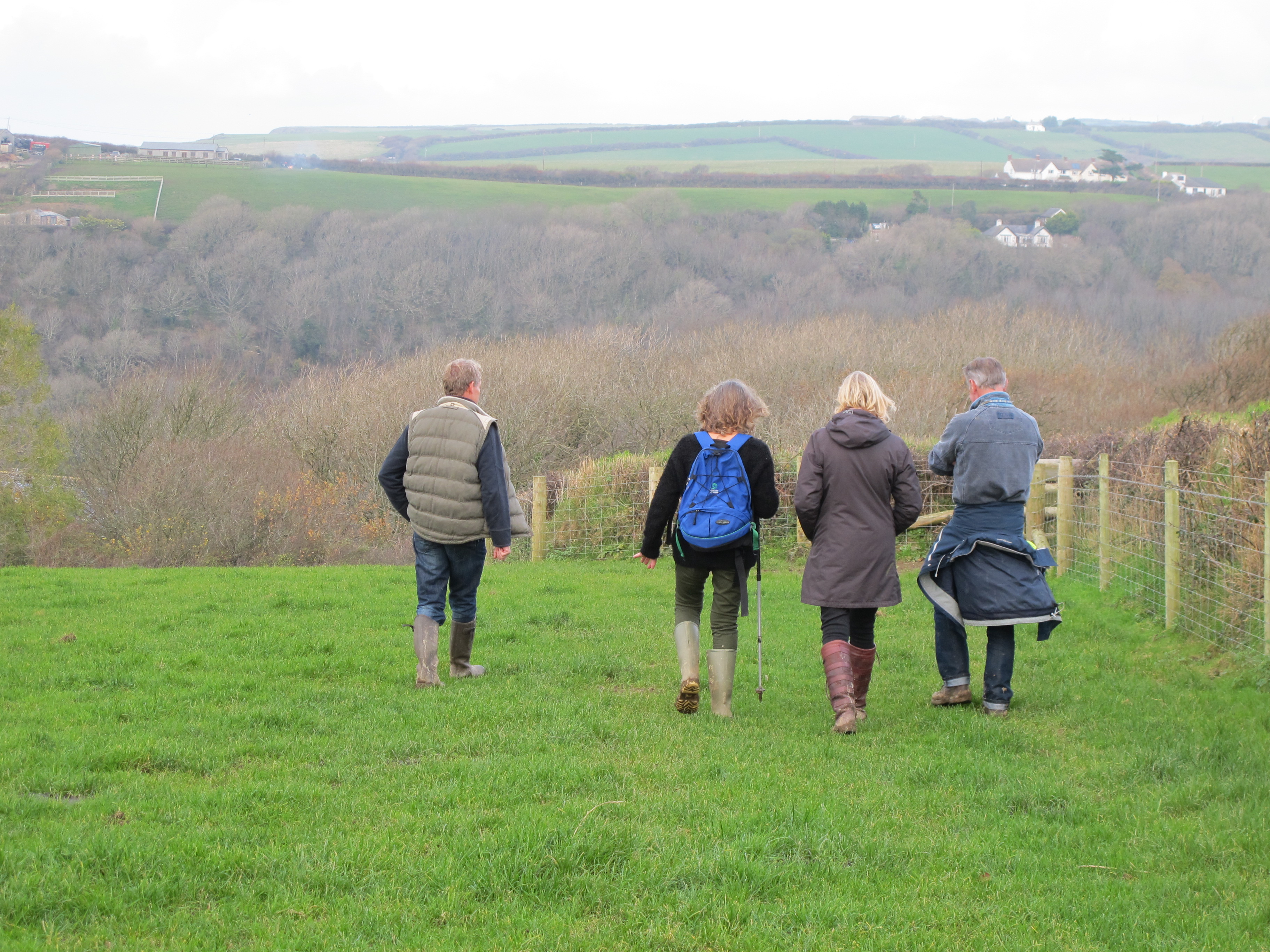
The Parish Plod

The Parish Plod

Eventually, as so many things do, it ended at the pub, at least for some of the walkers.

A word about footpaths in the U.K.: Forget your castles, your cathedrals, your stone circles—the footpaths make me feel I can almost touch history here. I’ve followed paths that have been walked not just for centuries but for thousands of years, and they’re still in use. People walked them before running shoes were invented. Before maps. Before metal. Before pubs, even. The people who built the stone circles walked them, and they saw at least some of the same wildflowers. (Land use patterns and imports would have eliminated some and added others, but some would have been the same.)

These footpaths are protected public rights of way, giving walkers the right to cross private land. They take you across fields, through herds of cattle and sheep, through mud that comes up to your ankles and fights for your boots, along the cliffs by the coast, and sometimes through a farmyard or past someone’s front windows. Some landowners hate them, but if you buy a house with a footpath, then you own a house with a footpath. It’s like owning a house next to a road: You don’t get to move the road just because you’re not crazy about the traffic. In 2004, Madonna butted heads with the laws governing footpaths after she bought a modest little mansion whose land included a footpath, and she came away with a bruised forehead when she tried to close it.  She did win the right to limit people’s access to parts of her land, but ramblers (as dedicated hikers are called) kept the right to cross it.

parish plod 004

Cattle making sure we left their field as we found it.

Many of the old footpaths have been lost, so the ones left in our parish don’t entirely link up, but the ones that are left are a real asset, loved by both tourists and local residents.

The group I went with got back to the café first (we had the shortest route), declared ourselves the winners, and waited for everyone else to straggle in. I brought the dog down to the stream and washed the mud off her, then we came back equally wet and cold, so at least I hadn’t done anything to her that I hadn’t done to myself.

I’ll be surprised if we don’t do it again next year.

Classes, Couches, and Rest Rooms: Word Choice in Britain and the U.S.

N. read last week’s post on toilets and emailed to say that “toilet has a very lower class cachet in current English. Loo or lavatory are the posh versions, just like sofa vs. settee, sitting room vs. lounge, tea vs. dinner, dinner vs. lunch.

I’ve heard some of those pairings before but have trouble keeping track of which word is high on the class scale and which is low—an incompetence that I kind of enjoy. Let’s face it, it’s all arbitrary and snobbish.

mulfra 080

Cornish Engines. The abandoned mine shafts they mark went out under the sea.

The distinctions are equally arbitrary in the U.S., but the silliness we grow up with has a way of looking like perfect sense. When I was a kid, lunch was the down-to-earth meal. Dinner stuck its nose in the air and demanded white tablecloths (not to mention cloth napkins), and it was the evening meal anyway, which we called supper. I not only thought all that made sense, I thought it was fixed for all time and all places and all people. Where Wild Thing grew up, though, dinner was a big midday meal, something you’d have on Sunday, after church, and I’m sure that seemed just as inevitable and fixed.

Then we moved to the U.K., where the things people take for granted are completely different. Settee? To me that sounds fancy, as if I dropped into a Victorian novel. Sofa sounds more ordinary, although I call the thing a couch and it sits in my living room, since I don’t have either a sitting room or a lounge in my vocabulary.

And tea as a meal? When someone talks about eating tea, I get a mental picture of someone struggling with a knife, a fork, and a cup of liquid. I know that’s not what they mean, but no matter how often I hear it, that’s still what I see.

I like it when my vocabulary sets me outside some of the entrenched divisions. True, it sets me deep in the trench of another division, American vs. British, but I’d be there anyway.

I can’t prove this, but I have a hunch that, compared to their U.S. counterparts, the British upper (and, I guess, middle) classes spend an awful lot of time, and find more ways, to establish their separateness (and I’m sure they’d say superiority) through their use of language. It’s an interesting bit of sociology.

Both cultures, though, do their best to avoid saying what they mean when it comes to human waste. Toilet comes from the French word meaning a cover for clothes (toilette). From there, toilet became first the act of dressing, then a dressing room, and eventually that room with plumbing that polite people don’t mention. So basically, it started as a polite word meaning that room where we do those unmentionable things. Eventually, the unmentionable things contaminated the polite word and we had to find an even more polite word so we could back away from our meaning again. I mean rest room? What on earth does that communicate?

For what it’s worth, not every culture does this. The Middle English word for the equivalent of toilet paper was arse-wisp, according to the Online Etymology Dictonary. The Middle English did, apparently, say exactly what they meant, at least about this.

And unless someone brings up a fascinating new aspect of this discussion, I’ll stop writing about toilets for a while. Really. It’s not the thing I most love to think about in the world.

Great British Telemarketing

Recent and highly unscientific research reveals that you have to do more than move across an ocean to get away from telemarketers.

Okay, Wild Thing and I knew that already. Since we moved here, we’ve been called by people telling us our computer has been affected by such a dangerous virus that the only way to fix it is to read a credit card number into the phone and take a sledge hammer to the hard drive. We get calls from a recorded voice with an urgent message. So urgent that it doesn’t merit a live call. And so on.

On Wednesday, Wild Thing fielded a call that—well, we never did find out what he wanted. Wild Thing picked up the phone and the caller said, “Can I talk to the lady of the house?”

Some of these calls set off reactions we could never have predicted.

“Believe me,” Wild Thing said, in a doom-laden voice, “you don’t want to talk to her.”

She has no idea where that came from—or which of us was the lady he so didn’t want to talk to.

People here commonly use the word lady where we’d say woman. I notice it and I kind of roll my eyes , but in a detached, mildly amused way. And, I should add, an invisible one—the mental eye roll; the virtual one. Sometimes think I should object, but it doesn’t set off any deep reaction in me. You want to call me a lady? I’ve been called worse things, although I’m not sure any of them were more unlikely.

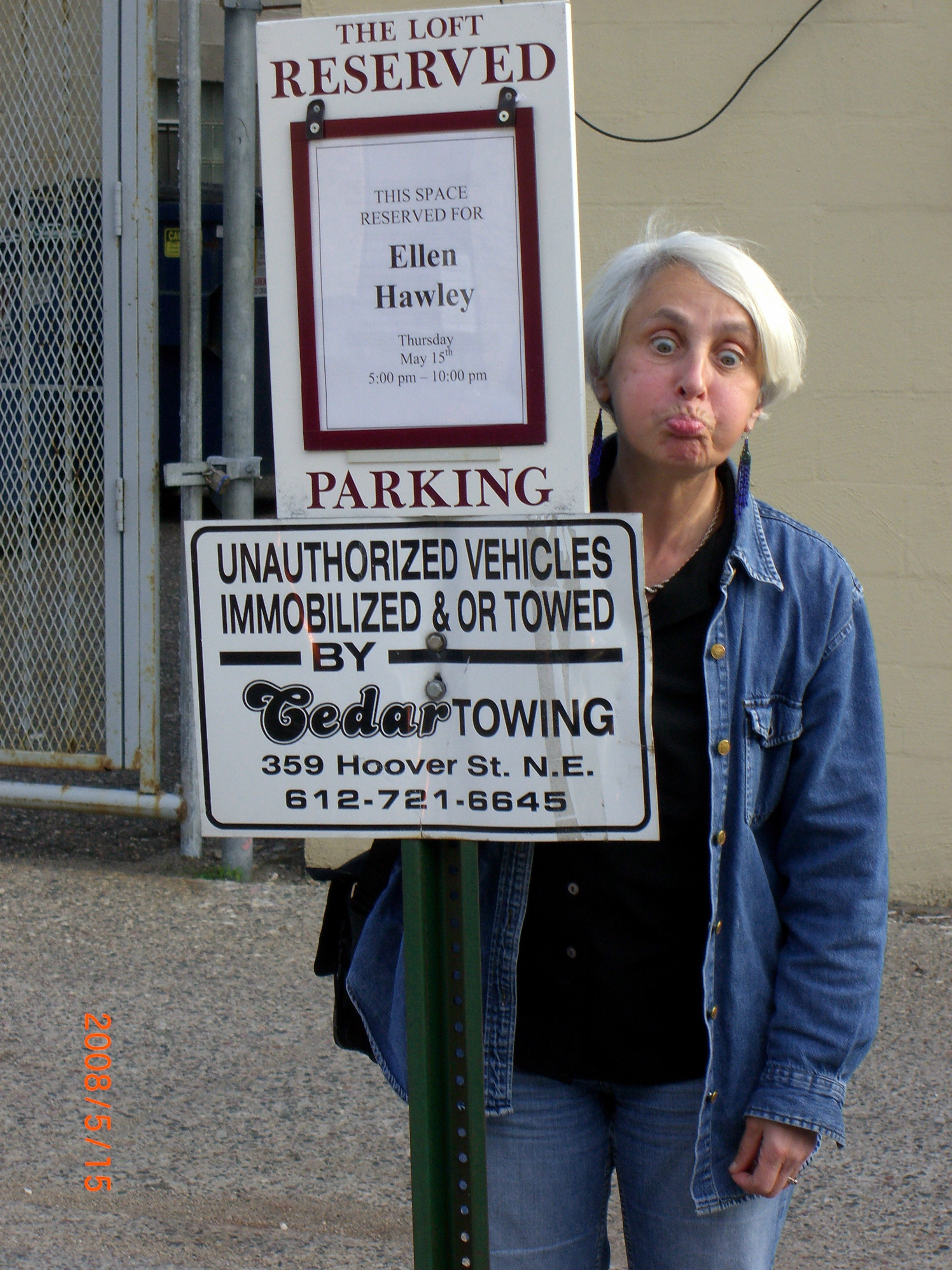
The lady of the house, or one of them, after a reading in Minneapolis, 2008. Photo by Terri Hudoba

The lady of the house, or one of them, after a reading in Minneapolis, 2008. Photo by Terri Hudoba

In the U.S., the telemarketing calls did set me off. The phone was in my name, so I spent a good bit of time fielding calls for Mrs. Hawley, and very few things push my buttons quite like being called Mrs. Hawley. I can’t entirely explain that, but we can begin by saying that I’m not married and I don’t want to be married, but if I did happen to be married I probably wouldn’t be married to myself. Then I can add that I passionately hate the whole business of women being publicly sorted and addressed by marital status. Top it all off with a hefty dose of I-know-my-reaction-isn’t-helping and throw in a telephone, and even though I told myself over and over not to do it, I’d end up saying, “There is no such person. What can I do for you?”

It was unfair, I know. The callers were following a script. Lots of people we know have worked for call centers, and it’s wrong to make a tough, underpaid job any harder than it already is, but there I was being horrible to the people who read the script, not the ones who wrote it. I knew that. I pledged to reform. And then the phone would ring and off I’d go.

Oddly enough, now that I’m living in the U.K., I’m less rabid about being called Mrs., even though it happens more often here. This isn’t my native culture. It can’t touch me as deeply. That makes no sense, but it’s the only explanation I can offer. It still pisses me off, but I’m more distant about it, and less vocal.

Plus the phone isn’t in my name. That helps.

The lady of the house,  though? Sorry, she’s in the back, and the maid’s helping her with her lace gloves. Can you call back when the butler’s available to take a message?

Cutting Waste in Britain and New York

One of the things that impressed me when I first visited Britain was that they had public toilets. Not just along the highways, where I’d learned to expect them, but in towns and villages and cities. I mean, do I resonate with the romance of the place or what? Forget your castles, your prehistoric monuments, your green and pleasant land. Will you look at those toilets? An entire nation had noticed that humans have this recurring, messy, polluting need and had responded logically.

Well—as the kids on my block used to say—holy shit.

I grew up in New York, where if you’re out on the street and need to pee ( or anything else along those lines) you’re—oh, I can’t help myself: shit out of luck, because New York doesn’t do public toilets. You need one? Sorry, that sounds like a personal problem. You can’t expect the city to solve it for you.

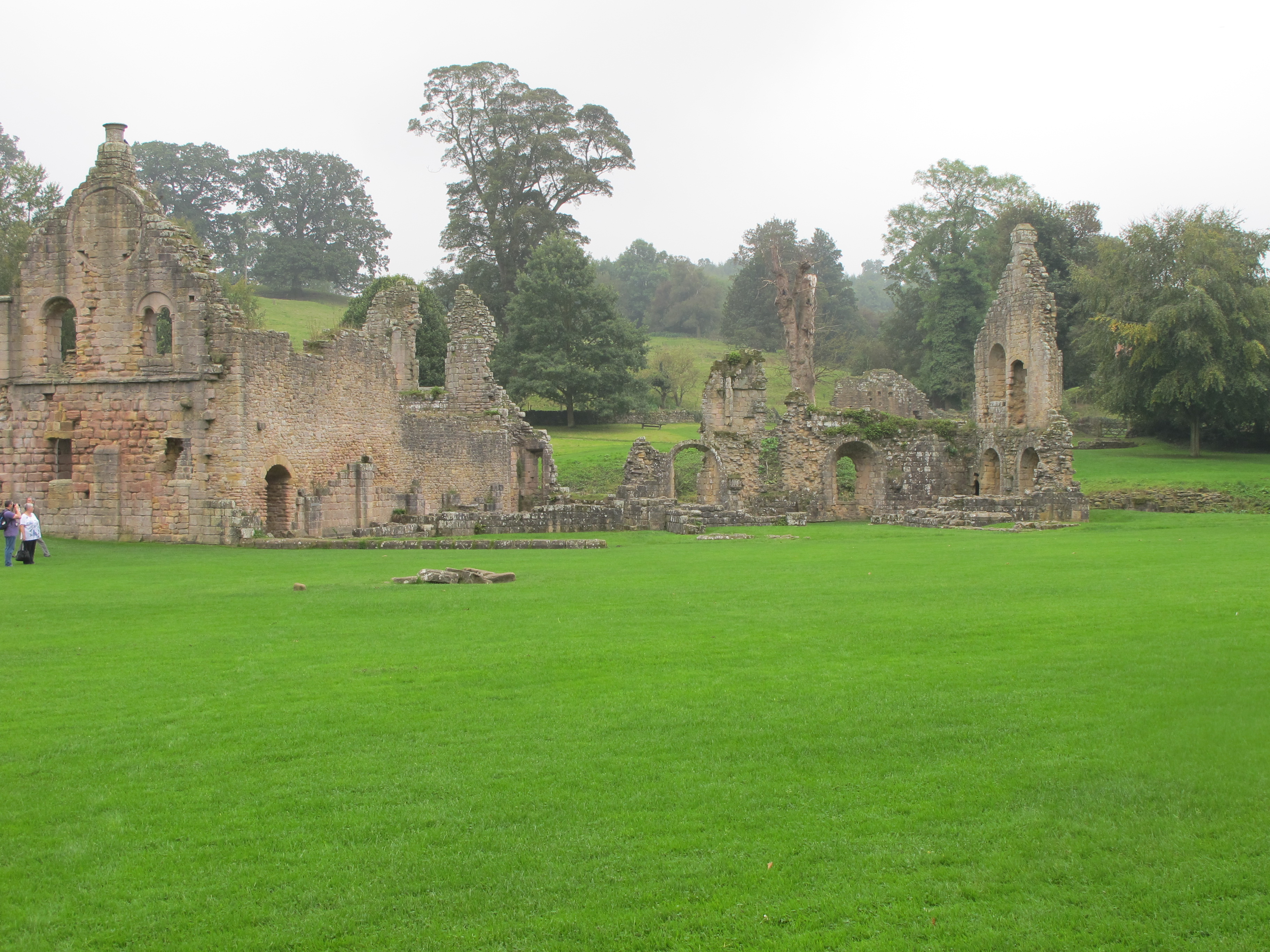
Deeply Irrelevant Photo: Fountains Abbey

Deeply Irrelevant Photo: Fountains Abbey

If you have money, the problem’s manageable. Money has that effect on a lot of problems. You duck into the lobby of a hotel and head for the toilet (which, this being the U.S. and all, is called the bathroom), and if you’re dressed well enough and act like you belong there, you won’t be challenged. Or you stop someplace to buy a cup of coffee and you use the toilet there. That’s a solution that carries its own problem, since you’ll need another cup later on to get rid of the first one, but still, it’s doable.

If you don’t have money—well, that’s one reason so much of the subway smells of urine. I remember seeing a woman at a bus stop simply straddle the curb and let a stream loose from under her skirt. I was torn between shock and very reluctant admiration.

On my first visit to Britain, when I was so impressed with those public toilets, I didn’t find it easy to say “toilet” instead of “bathroom.” I’m American, and was even more so back then. Americans don’t say “toilet” if we can help it. In fact, I was in a café and asked someone who worked there where the bathroom was. She must’ve thought I was going to tear my clothes off and jump in a tub of hot water, because she did a visible double take. I made myself say, “Toilet,” but it didn’t quite repair the damage. She was in no shape to put words together, but she did manage to point.

In Britain, a bathroom has a bathtub. If it has a shower instead, it’s a shower room. If it has neither, it’s a toilet. Even after eight years, though, I feel crass when I say “toilet.” Much more so than when I say “shit.”

The human brain is a wondrous and baffling thing.

These days the U.K. has a government dedicated to cutting the deficit by cutting waste, and—okay, you see the pun coming, don’t you? I can’t help myself. It’s true. The talk’s all about reducing waste, but the reality is about public services crumbling: the health service underfunded, libraries and various kinds of community centers closing, all sorts of infrastructure not being maintained, and yes, toilets closing. Food shelves—which weren’t needed when I first moved here—are springing up and much in demand. A lot of the cuts are being pushed down to the local levels of government, which depend on the central government for a lot of their funding. Since that’s been cut, they have all the fun of deciding what to cut, and they get blamed for cutting it, since they look like the bad guys.

In our village, we initially heard that the county would be closing the toilets by the beach. The parish council entered into endless negotiations over how to keep them open and who’d bear the cost and who’d own them and who’d committed to a long-term cleaning contract that either would or wouldn’t have to be carried over by whoever either did or didn’t own the damned things.

And so on.

It went on for a long time, and in the end the village managed to keep them open. Not only does the cleanliness of the beach depend on them, but so do two local cafes. But not every village or town has managed to find the money, and many toilets have closed.

Maybe it will teach us all to rise above their physical urges.

Let’s hear it for cutting waste, folks.

The Writing on the Sidewalk of a Cornish Village

Either I’m engaging in antisocial behavior or I’m the last defender of decency in Cornwall. Some days it’s hard to tell.

Wild Thing and I live on what’s called the estate. If you’re American, that sounds all grand and Downton Abbey, but what it really means is “the subdivision.” We live in a tiny fragment of suburb, even though we don’t have a city to be suburban to. Our village is spread out—a village without any center—so this is the most densely populated bit. By dogs as well as humans.

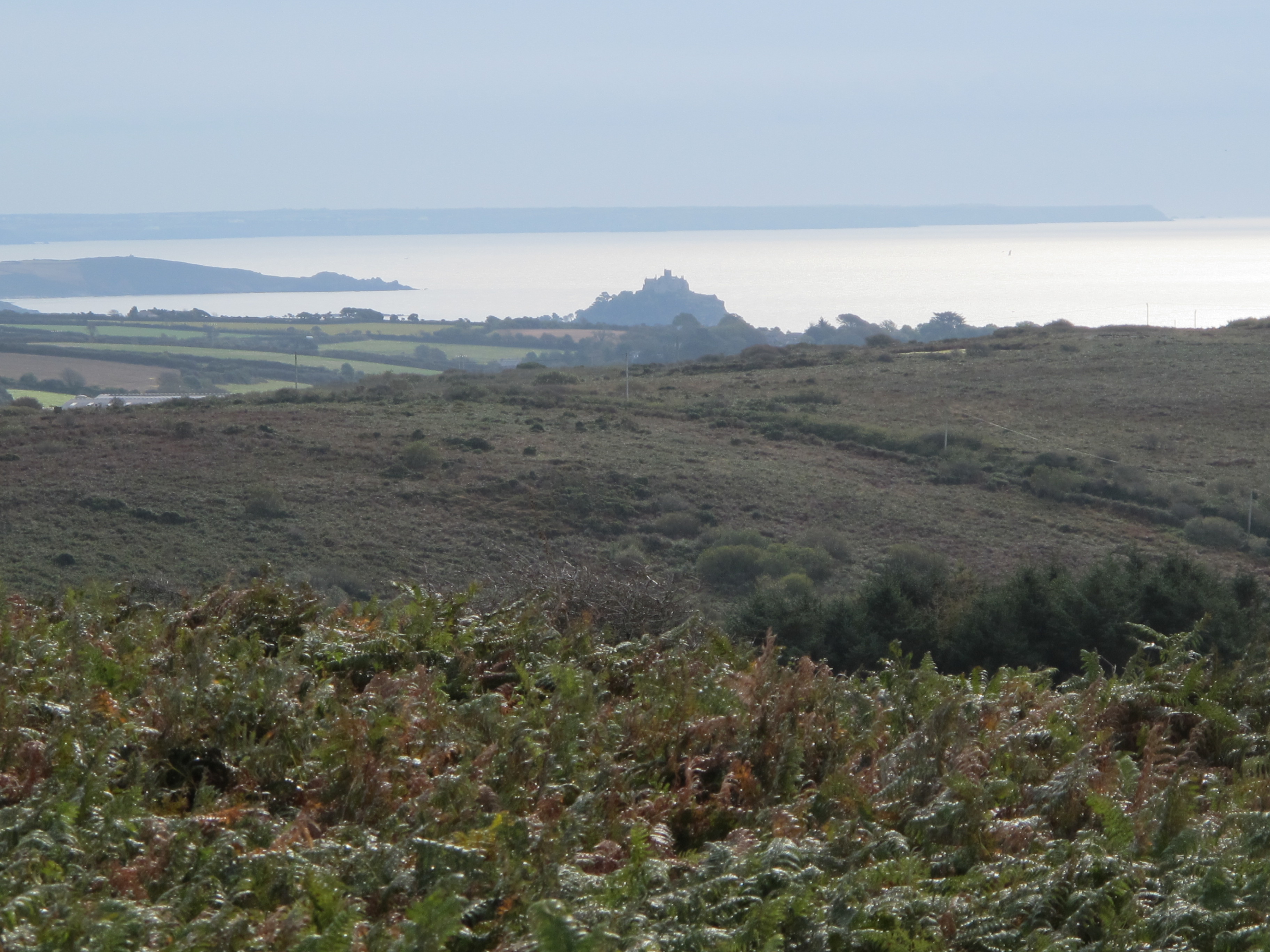
Irrelevant Photo: A view of the south coast and St. Michael's Mount

Irrelevant Photo: A view of the south coast and St. Michael’s Mount

Yes, dear ones, I’m writing about dog shit, and I’m not going to call it poo because I just can’t. When I first moved to Minnesota, I heard a wonderful phrase: “She wouldn’t say shit if she had a mouthful.”

Well, I don’t have a mouthful, but I did skid through the stuff and come away with a shoeful, and I can’t see why I should call it anything else. It’s not a beautiful word, but then the shoe wasn’t looking so good either.

Shit was the mildest word I yelled. I’m sure someone was behind a window saying, “Oh, that’s one of the Americans.”

Never mind the language, though. The important point is that somebody hasn’t been cleaning up after their dog.

I know two things about this dog: It’s large and it likes to spread its bounty as far as it’s physically able. I walk with my eyes on the sidewalk these days, the way I did as a kid in New York, before dog owners were expected to clean up after their dogs. My family had a dog. We thought we were being good citizens because we got him to shit between the parked cars. In fact, back then the city put up signs saying “Curb your dog.”

After the shoe incident, I bought myself a box of chalk. Then I waited.

Several days later, I found another deposit. Right by the red metal box that everyone (even me) calls the dog poo bin. I knelt on the sidewalk and chalked, “Clean up after your dog, please.”

I stepped back to admire my work. I’d forgotten the your, so it actually read, “Clean up after dog, please,” as if a computer translation program had written it. I used to work as an editor, so that missing word bothers me, but it did get the point across. And at least I hadn’t forgotten the please.

Good manners are more important here than good grammar. No matter how ungrammatical—or, for that matter, rude—a note you tack up somewhere, you can make it okay if you write “Polite Notice” at the top. I can’t tell you how many signs I’ve seen that declare themselves Polite Notices. Even if you were to say, “Pick up after your dog, you miserable, lazy, unclean excuse for a human being,” if you also said it was a polite notice, it would be okay.

And even if the rest of your wording is polite, you still have to open with “Polite Notice.” Actual politeness isn’t what matters. You have to remind everyone that you’re being polite.

I didn’t open with “Polite Notice.” I didn’t figure a chalked notice on the sidewalk had to, but then (as I’m often reminded) I’m not British. Wild Thing’s sure that what people mean when they say that is that we just don’t get certain things, and that the speaker feels sorry for us. I’m not sure she’s right. I tend to hear it as a statement of fact: We really aren’t British. Or we are—we’re citizens—but on some deeper level we never can be.

I don’t necessarily want to know how the speaker feels about this.

So it’s hard for me to be sure how significant that missing “Polite Notice” is. I may have offended someone other than the dog walker, but I can’t tell. I’m not British.

Messing with British Baking: Chocolate Chip Cookies

Since moving to Cornwall, I’ve made it my mission in life to mess with the Britishness of British baking. Not because British baking is bad. It isn’t; it’s fantastic. Have you eaten shortbread? Or scones? Or pain au chocolat? Or—wait a minute, that last one’s French, isn’t it? (And in case you’re not familiar with the stuff, it’s not pronounced like the English word pain, it’s closer to pan, and it’s basically a croissant with chocolate inside. Mmmm.)

So okay, we’re not talking about a tradition that goes back, unmixed and unmessed-with, to Alfred the Intolerable. British cooking has done what pretty much every culture does: it’s adapted, stolen, borrowed, and claimed as its own whatever bits happened to work—so much so that now people ask, with an almost straight face, “What’s more English than curry?”

How am I carrying out my mission? I’m baking, and I’m feeding my friends and neighbors. It all sounds so harmless, doesn’t it?

Irrelevant Photo: Fountains Abbey

Irrelevant Photo: Fountains Abbey

So here’s my recipe for chocolate chip cookies, because chocolate chip cookies are even more American than Mom and apple pie. They’re probably more American than the flag. The recipe’s in imperial measures. (Shouldn’t we start calling them American measures, by the way? The empire’s gone and—does any country other than the U.S. still use them these days?  And I’m not sure how many people know what imperial measures means.) But back to my point, I’m not going to try translating it into anything sensible like the metric system because the last time I did lost three weeks of my life and didn’t get it right anyway. So forget it. Besides, what’s more American than an irrational and antiquated system of measuring that we inherited from a country that’s since abandoned it and which we will fight to the death rather than give up?

Am I off the topic yet?

The recipe was adapted from one my friend J. found in the Duluth, Minnesota, News Tribune. The introduction explained that the more sugar a cookie has, the more it spreads out in the oven. The original minimized the sugar, which suited me because my chocolate chip cookies had been turning into chocolate chip wafers and I like a thick cookie. I’ve cut the sugar back even further and substituted oatmeal for some of the flour. If that sounds healthy, don’t kid yourself, they’re lethal, but you can increase the sugar if you like. I’ve left the amount a bit vague (a scant ¼ cup, in one place) for exactly that reason. Not to mention because I’m exactly that sort of cook—a bit vague, probably even a bit scant.

If you want the cookies to turn out well (and why would you make them if you didn’t?), you have to find really good dark chocolate—preferably chocolate chips. In the U.S., that means semi-sweet—none of that milk chocolate mess. In the U.K., I’ve had a battle to find good chocolate chips. For years, all I could find were brown waxy things that tasted like buttons that had popped off an old-fashioned shoe. If that’s all you can find, don’t buy them. Chop up chocolate bars (I’ve used 70% chocolate) with the back of a knife and make chocolate chunk cookies, but chunks of chocolate bars don’t keep their shape the way chips do. They’re good but not the same. For some time now, friends have kept us supplied with American chocolate chips, which is a real luxury, especially when you look at the cost of postage, but recently I’ve discovered that Dr. Oetker’s make decent chocolate chips, even if they come in itty bitty bags and are overpriced. In the U.S., you can buy chocolate chips in industrial-size bags. We’re seriously serious about chocolate chips.

If you’re in other countries, I have no chocolate chip advice to offer, but I do know this: If you open the bag and taste them and they don’t taste like much, they won’t get any better when you stir them into the batter and bake them.

The recipe makes an insane number of cookies. (I did warn you that, as a cook, I’m a bit vague.) I freeze whatever we don’t eat on the first day and take them out when we have company. They’re good frozen. Maybe even better. Honest. I discovered this the time I hid them from myself and—surprise surprise—found them. And ate them on the spot.


Chocolate Chip Cookies                               

1 c. whole wheat flour

2 1/3 c. plain white flour

1 ½ c. rolled oats (any thickness will do)

2 tsp. baking soda (that’s bicarbonate of soda)

2 tsp. salt

12 oz. (that’s 3 sticks if you’re American) butter

Scant 2/3 c. brown sugar

Scant ¼ c. white sugar

4 eggs

2 tsp. vanilla

Lots of dark chocolate chips  (about 2 ½ c.)


Cream the butter and sugars. Beat in the eggs, one at a time, and the vanilla. Mix in the dry ingredients, then the chocolate chips. Drop spoonfuls onto greased cookie sheets, leaving some room for them to spread out.

Bake 9 – 11 minutes at 375 F.,  or 185 c., or 165 c. with a fan oven.

Cool 2 minutes or more on baking sheets before removing.

Consulting the Internet and the Chicken Entrails about Cornish Roads

I went to a meeting the other day, and I consulted the internet about it the night before. That’s the modern version of killing a chicken and consulting the entrails to find out how your trip’s going to go.

The internet entrails told me I’d need one hour and one minute to get there.

I figured I’d allow myself an extra ten minutes and be heroically early.

In the morning, I forgot about the ten minutes, but how many meetings start on time anyway? I punched the post code into the sat nav I stole from Wild Thing because I don’t believe in them unless I need one, in which case see I steal hers. That gives me access to both a sat nav and the moral high ground.

The sat nav spit the post code back out. I punched it in again. The sat nav offered me a list of alternative post codes, some of which were close but close wasn’t what I needed. I could find the town without the damned thing. What I needed was the final details.

mulfra 098We went through this several times until it accepted the post code. I will, of course, swear that I entered it correctly all sixteen times and that the sat nav was both pigheaded and wrong for the first fifteen, but you probably won’t believe me. I’m not sure I believe me either.

I was now going to be late. I was also now ready to accept that you can’t get from my house to Pool, where the meeting was, in one hour and one minute. And I’d kind of known that the night before, but I wasn’t ready to question the wisdom of the chicken entrails then.

I drove, telling myself I’d make up lost time. This was, of course, a crock. (A crock, my writers group tells me, is an Americanism. It may also be as out of date as I am, so if you need guidance, allow to me ask you, ever so delicately, to imagine what I’m implying is inside the crock.) Unless you’re on one of our few four-lane highways (or the occasional, very short, three-lane stretch), you have to be a whole lot crazier than I am if you’re going to make up time around here.

At the Pool turnoff, I realized that the sat nav hadn’t been speaking to me since I left the house. Why hadn’t I noticed? Because I don’t enjoy her conversation, so I hadn’t missed it. Our sat nav, by the way, is a her, and her name’s Dorothy, and she’s been losing her voice a lot lately. The last time it happened, Wild Thing fought with her until she started speaking again but she—Wild Thing, that is—wasn’t sure what she’d done, so I stood no chance of reproducing it. It involved a lot of swearing, which I can reproduce effortlessly, but I’m guessing that wasn’t the effective part. And I didn’t have time to wrestle with the sat nav anyway—I was already heroically late—so I drove into Pool trying to keep one eye on the little brown arrow.

Tell me, I begged the universe, that this isn’t a part of the county where sat navs don’t work.

I didn’t expect the universe to answer and it didn’t. Begging the universe is just one of those things I do to pass the time when I’m coming unglued. I fully expected the little brown arrow to direct me into an abandoned mine shaft or the frozen food aisle of the nearest supermarket. That optimism meant I was ready for it when the little brown arrow told me to turn where there wasn’t a street.

You can’t fool me, I told Dorothy, and I drove on.

The hell she couldn’t. The little brown arrow disappeared.

I turned around and tried again, somehow expecting to get different information this time. The little brown arrow still wanted me to turn onto a non-street, but it was at least paved, so I tried it and ended up in a supermarket parking lot.

I turned around before we got to the frozen food aisle and I drove back to where the arrow had disappeared, pulling into the parking lot of a small business. I walked inside and threw myself on their mercy.

They must’ve been used to this. Not only were they kind, they’d heard of the complex I was looking for and gave me usable directions.

“Sat navs,” I said, trying to look as befuddled as, in fact, I was. I felt—I have no idea why—that I owed them that.

“Sat navs,” they said, nodding and looking wise.

I got to the address, which turned out to be a Free Public Attraction (please note the capital letters, because they’re not mine; I’ve borrowed them from a sign I passed) about Cornish mining. With a not-at-all-free parking lot. I hadn’t counted on that and hadn’t brought much change, but I plugged in what I had, which was enough to carry me to the 11 a.m. break, when I might be able wangle change out of someone somewhere.

Or leave if the meeting turned out to be as pointless as I sort of suspected it would be.

I could probably have used my phone and credit card to pay, but (remember the internet and the chicken entrails?) I was late.

So in a gentle Cornish mizzle, I walked in through what must once have been a working mine complex and now that the mining’s gone is a tourist attraction. I thought melancholy and ironic thoughts about hard, dangerous work and low pay and tourist attractions but didn’t have a lot of time for them because I found the right building and went into a tasteful and (I assumed) expensive modern lobby where there was no sign pointing me to my meeting, only one saying Memory Café.

You know about memory cafes? They’re for people with some degree of dementia, to orient them to I have no idea what. Reality, I suppose, which at the moment didn’t strike me as a particularly wondrous gift.

I found an office and asked a woman about my meeting. She gave me a blank look. I produced my agenda.

“That’s tomorrow,” she said.

I could have gone to the memory café but reality wasn’t looking particularly good so I drove home.

British and American English: The Accent

Two words spoken in an American accent reliably crack up the British: water and butter. It has to do with the difference between English R and the American R, which as far as I can figure out is this: Americans have one and the English have a sort noticeable absence—something you might write as an H, or an apostrophe. WAWtah, as opposed to WAWterrrr.

WAWterrr. Photo by AdriannaNicole

WAWterrr. Photo by AdriannaNicole

I’ve spelled that first syllable the same way but no way does it sound the same. No matter how much I mess around with the spelling, though, I can’t come up with the difference. Put it this way: The English first syllable is well behaved and sits in its chair with a perfectly straight back. The American one slouches and puts its feet on the coffee table.

That may not help. I do understand that.

Okay, I’m writing about English pronunciation as if the English had one single accent. They don’t, but let’s not get into that here. I’m oversimplifying, the same way I’m oversimplifying the American accent, because if I don’t I’ll never write this. I’ll lose myself in complications and sub-points and convolutions so badly that I’ll shut down the computer, go back to bed, and pull the covers over my head. Pretty soon I’ll be joined by two cats and we’ll spend the day there.

They’ll think it’s a day well spent.

Any number of British friends will, in the middle of a conversation involving food or drink, lose all restraint and repeat after us, “BUTTerrrr,” or “WAWterrrr.” They can’t help themselves. It just breaks loose. Even if it was going to fly around the room and break the dishes, they couldn’t keep it in. Sometimes they don’t even wait for us to say it first. I’d love to criticize, but if Wild Thing and I are in the car when the weather comes on and the winds are moderate, we’ll repeat “MAWderit” and laugh as if it was the first time we’d done it. Some jokes just don’t get old.

We’re lucky, though. We have the accent that people think is cool because they’ve grown up watching Hollywood movies. Well, we sort of have it. We have versions of it, with regional flavorings that, from this distance, most people don’t hear. So we don’t get the disapproval that goes with having accents people look down on, or are afraid of. A wave of let’s-all-worry-about-immigrantion is breaking over the country just now, and our accents mark us all. Wild Thing’s and mine get us sorted in the Immigrants We Accept pile. It’s uncomfortable sometimes, but not as uncomfortable as being in the Immigrants We Don’t Accept pile. Still, it’s odd when people react to your accent, even favorably. It’s a bit like having people react to your nose. You’ve been walking around with the thing all your life. You’ve forgotten it’s there and are thinking about something else, but people want to talk to you about it. Over and over.

I’m in the supermarket and the woman at the checkout says, “I love your accent.”

What am I supposed to say? It’s my accent. I’m not responsible for it. When I was a kid, if I’d known I could choose I would have chosen a different variation on the New York accent. Now it’s too late. The glue that holds it in place set long ago.

So I say thanks, just as if she’d said she liked my sweater. Which she’d have called a jumper.