Shedding a bit of light on Dark Age Britain

For a long time, pretty much anyone who paid attention to these things agreed that after the Romans left Britain, Anglo-Saxon invaders flowed in, the economy collapsed, trade withered away, and ignorance twined its thorny tendrils around the land. Roman cities and villas were abandoned and everybody proceeded to live in misery. 

That period was once known as the Dark Ages, although the name’s gone out of fashion, and if I’m reading the tea leaves correctly, that image of collapse is headed toward the same fate. 

Irrelevant photo: field and fog in September


Challenging the orthodoxy

The first challenge I stumbled across was Susan Oosthuizen’s. As she reads the period, the withdrawal of the Romans also meant the end of taxes and goods being siphoned off to Rome. People were able to keep more of what they grew, made, and mined. It’s true that in places land that had grown crops was converted to pasture, and that’s often cited as a sign of collapse, but she sees it as a kind of luxury. People could afford to do that now.

As for the invaders, she looks at the way land was used and finds that people were farming much of the same divisions of land in the same ways. That doesn’t speak to invaders swooping in and changing things to suit their needs. It speaks to immigration and accommodation. 

She paints a picture of immigrants and native people integrating themselves into a shared culture. If you look at their burial grounds, the only way to tell Anglo-Saxons from Celts is to test what’s left of their skeletons, looking for both their DNA and indications of where they grew up–something that’s only been possible recently. They were buried the same way and their grave goods show that their social standing wasn’t defined by which group they came from. 

We might do better to think of we’ve called the Anglo-Saxons as a culture, not an ethnicity or set of tribes.

The tests also show that they weren’t living in isolated communities. They had connections from as far afield as Byzantium and West Africa. That speaks to trade.

Forgive me for referring you to myself as if I was a sober historian–I am sober but a historian, sadly, I’m not. Still, I can’t link to her entire book and I wrote a bit more about some of this here.


So what survived after the Romans left?

Well, take Isurium Brigantum, now called Aldborough, in Yorkshire. The area’s rich in silver, lead, and iron, which set Roman noses a-twitching, and they–that’s the Romans, not the noses–set up a regional capital there. 

To see how much mining went on before and after the Romans picked up their toys and went home, Martin Millet, an archeologist associated with the site, looked at pollutants in the mud beside the river Ure. What he found was that instead of mining either ending or dying back when the Romans left, lead levels–the pollutant mining left behind–rose for the next two centuries. 

For later centuries, the lead levels paint an unsurprising picture of mining rising and falling to match wars, plagues, and kingly politics. The one surprise was the absence of a post-Roman collapse.

Still, some things may have collapsed. Isurium Brigantum was a walled town, and it may or may not have continued to be used, but the Roman villas with their mosaics fell into ruin, and archeologists have found the predictable coins, jewelry, and broken glass and pottery nearby. Websites for the site talk, justifiably, about the sophisticated design and decoration.

You can see collapse in all that if you like, but mining–that measurable activity–continued, but it was integrated now into a different kind of economy, one where for a long time coins were fairly peripheral. 

As for art, the Anglo-Saxon taste in decoration was different, but they weren’t without skill.


Yeah, but those abandoned villas . . .

The abandoned villas get mentioned as a sign that culture took a nosedive and everything was mud and misery. Who, after all, would voluntarily abandon plumbing and under-floor heating to live in a hovel? 

Not the person who posed the question, but back away for a minute and remember that very few people in Roman Britain owned villas or had plumbing and underfloor heating. That was the elite, the some-very-small percent. True, some larger number of people lived in or around villas as servants and slaves, but most or all of them would’ve been servicing the plumbing, not enjoying it. Someone had to keep the fires stoked if those hypocausts were going to work.

So asking who would voluntarily abandon plumbing and underfloor heating is sort of like asking if we, the world’s current population, would voluntarily abandon our luxury superyachts. For 99.someverylargepercent, that wouldn’t be a hardship. We don’t own them and never will. It’s not impossible to imagine a reconfiguration of the world’s resources that would leave the superyachts and all associated possessions abandoned but everyone living better.

If you look at post-Roman society from a distance, you can notice the disappearance of cities and villas and see loss. If you look at it from some peasant’s doorway, though, the change just might look like an improvement.

Stonehenge, cows, and technology: a roundup of British archeology

A century ago, someone found a cow’s jawbone buried beside the entrance to Stonehenge. The placement looked deliberate, and historians have been speculating about it ever since. Now, the high-tech toys available to scientists have delivered new information, answering some old questions and leaving us with new ones: the cow came from an area with Paleozoic rocks–in other words, rocks that are more than 400 million years old. The closest place that fits that description is Wales, where Stonehenge’s bluestones were quarried. 

Does that mean Stonehenge was built by Welsh cows? 

When they sober up, archeologists aren’t convinced of that, but there is speculation–sober speculation–that cows or oxen were used to drag the stones overland. It’s only recently that archeologists have found evidence that cattle were used to pull heavy loads in the Neolithic era, when Stonehenge was built, but they’re now pretty sure they were, and that fits nicely into the jawbone puzzle.

If you forgot to set your watch, the Neolithic era took place somewhere around 2990 BCE. 

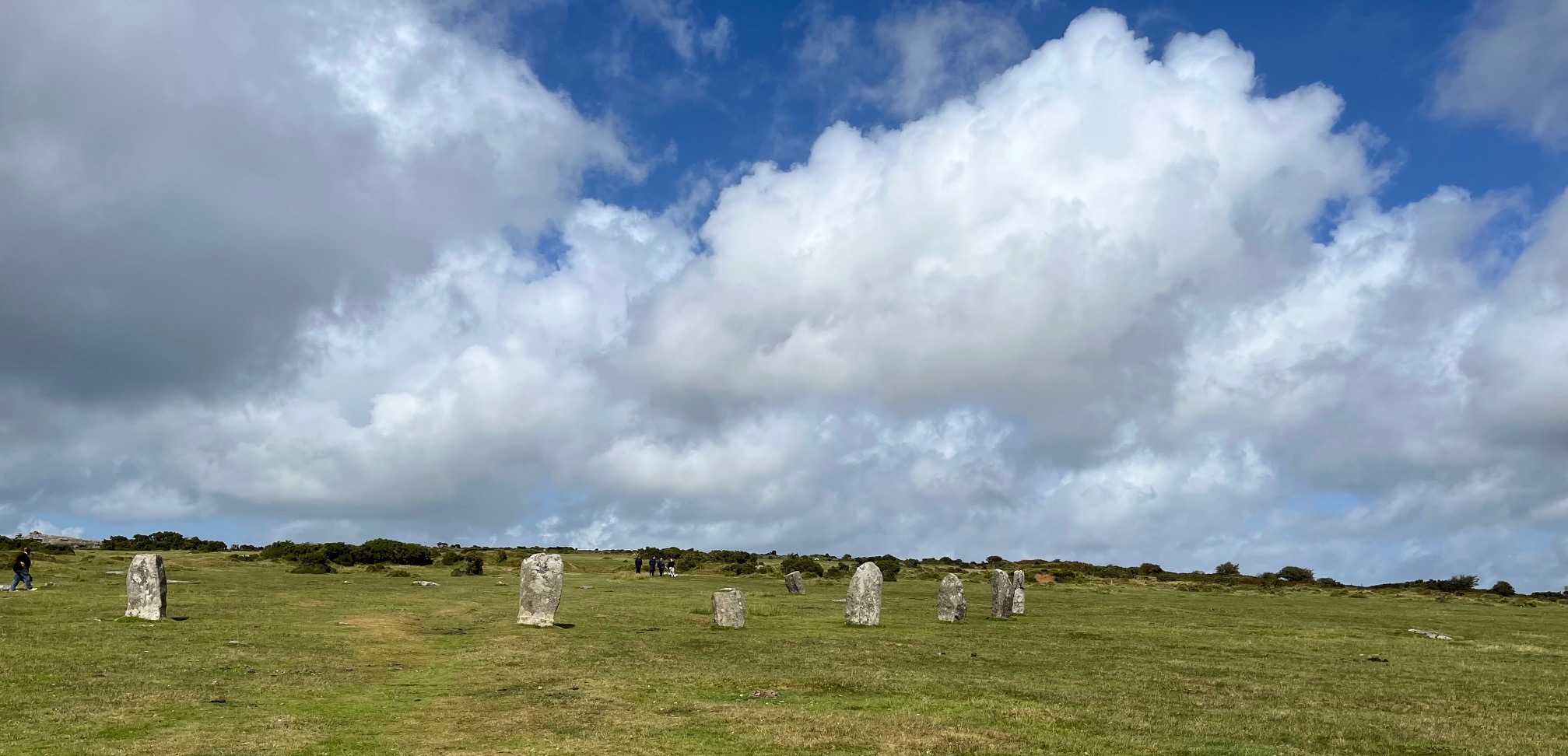
Marginally relevant photo: Stonehenge it’s not, but it is a stone circle. This one’s from Minions, in Cornwall.

But cows and oxen pulling the bluestones sits squarely in the land of speculation, so let’s not commit too heavily to it. We can’t prove that the cows in general or this cow in particular helped pull the stones. We don’t even know for sure that the cow in question was brought to Stonehenge alive, although if you’re going from Wales to Stonehenge, you’ll find it’s a long way to carry a cow. Or even a cow’s head, especially in the era before refrigeration. Humans are indeed strange, but not, I like to think, quite that strange. 

What’s known for certain is that the cow was indeed a cow, not an ox or a bull. And that someone left her jawbone in a significant spot, like a note saying, “This means something,” and don’t we wish they’d told us what.


Cows, sheep, and pigs

Animal bones also figure in a recent article about bronze age gatherings in what’s now Britain. People traveled long distances to get together and eat. And, presumably, solidify the relationships between tribes or–well, whatever groupings we’re talking about. They would’ve known. The same techniques that inform us about Stonehenge’s Welsh cow also tell us where their animals came from before they became the feats. 

Whatever it means, at one site they mostly ate beef; at another, mutton; and at a third, pork. 


A Danish woodhenge

A circle of 45 wooden posts has been discovered in Denmark. It’s believed to have been built between 2600 and 1600 BCE–the late stone age and early bronze age–and it’s the second woodhenge that’s been found in the area. What experts take from this–or one of the things they take from it–is that Denmark, Britain, Ireland, and parts of northern Europe, which all have similar henges, were strongly connected. 

The axis of the newly discovered henge matches that at Stonehenge, underlining the assumption that the builders had shared beliefs and technologies.


The Melsonby Hoard

Someone with a metal detector found what’s described as one of the biggest and most important hoards of iron-age glitz in Britain: a collection of more than 800 objects. It was found in a field in the north of England and includes wagon and chariot parts, bridle bits, ceremonial spears, and two ornate cauldrons, all of which shows evidence of burning, possibly as part of a funeral. 

The expert who was called in after the detectorist reported his find said, “Finding a hoard of ten objects is unusual, it’s exciting, but finding something of this scale is just unprecedented. . . .

“Some people have regarded the north as being impoverished compared with the iron age of the south of Britain. This shows that individuals there had the same quality of materials and wealth and status and networks as people in the south. . . . The north is definitely not a backwater in the iron age. It is just as interconnected, powerful, and wealthy as iron age communities in the south.” 

The find also provides the first evidence of four-wheeled vehicles in use among the tribes. 


The Romans and the Welsh

A huge Roman fort that was in use from the first through third centuries has been found in Pembrokeshire, Wales, in an overgrown farm field. It may rewrite the history of relations between the Romans and the Demetae–the tribe that lived there. The belief had been that they were on peaceful terms, but the presence of a fort this size throws that into doubt, indicating a strong military presence.

The fort explains why the field was never worth cultivating: the farmer, and probably many before him, kept hitting stone. It was found by an archeologist from Pembrokeshire, who had often wondered whether an unusually straight road might not be Roman. (You may have to live in Britain to understand why a straight road would cause a person to wonder.) Then  he looked at a satellite image and spotted the field, which is the size and shape of a Roman fort.

He drove out to see it and as he described the moment, “Sticking out of the ground was a triangular piece that looked like a Roman roofing slate. I thought: ‘Surely not?’ I pulled it up and lo and behold, it’s an archetypal Roman roofing slate, an absolute peach. Flip it upside down and you can see underneath a diagonal line where it was grooved to fit into the one that was underneath it. It’s a real beauty. . . .

“That was the diagnostic evidence I was looking for, which is a miracle, because it’s a huge site.”

The current best guess is that the fort held some 500 soldiers.


England and West Africa

We’ve moved to the 7th century CE, so reset your watches if you would, and we’re poking around disrespectfully in a couple of graveyards, one in Kent, on England’s southeast coast, and one in Dorset, a long walk to the west, even if you’re being dragged by a cow. 

Sorry, no. Wrong era. Forget the cow. But in the same way that the Stonehenge story follows one cow to make sense of the Stonehenge story, this one follows two unrelated humans to get a glimpse of life in early medieval England. These burials hint at people traveling much greater distances in the early medieval period than we would’ve expected: both had a paternal grandparent from West Africa. Their grave goods show they were both buried as typical and well-thought-of members of their communities, and the ancestors of the people buried nearby were either northern Europe or western British/Irish.

That western British/Irish business is, I think, a way of saying Celtic now that it’s looking questionable that a group of people called Celts ever existed. 

The Kent and Dorset communities had very different cultures, the eastern one Anglo-Saxon and in frequent touch with Europe, the western one on the fringes of European influence and primarily–um, whatever we say if the word Celtic’s gone up in smoke. Both, though, had contact with far-away West Africa.


And finally, a mere 800 years ago

In Leicester–pronounced, through some miracle of English spelling, Lester–in the twelfth century, 123 women, men, and children were buried, in a short space of time, in a narrow shaft near the cathedral. That would’ve been something like 5% of the town’s population and it’s one of the largest pit burials found in Britain. 

“Their bones show no signs of violence – which leaves us with two alternative reasons for these deaths: starvation or pestilence,” said Mathew Morris, project officer at Leicester University’s archaeological services. “At the moment, the latter is our main working hypothesis.”

Initially, the archeologists assumed the deaths were from the bubonic plague, but when the bones were radiocarbon dated the centuries were wrong. But the Anglo-Saxon Chronicles do mention pestilences and fevers, severe mortality, and miserable deaths from hunger and famine in England from the mid-tenth century through to the mid-twelfth century. The pit burials seem to back that up.

“It is also important to note there was still some form of civic control going on,” Morris said. “There was still someone going around in a cart collecting bodies. What we see from studying the bodies in the pit does not indicate it was created in a panic. . . . There was also no evidence of clothing on any of the bodies – no buckles, brooches, nothing to suggest these were people who were dropping dead in the street before being collected and dumped.

“In fact, there are signs that their limbs were still together, which suggests they were wrapped in shrouds. So their families were able to prepare these bodies for burial before someone from a central authority collected them to take to the pit burial.”

In a roundabout way, the find is the result of Richard III’s body being discovered, minus the feet, in a nearby parking lot. His body was reburied in the cathedral and since then visitor numbers have gone wild, so the cathedral decided to build a heritage learning center in the cathedral garden, which had once been a graveyard. 

In Britain, construction like that means an archeological survey, and tha turned up what was left of 1,237 people buried between the eleventh and nineteenth centuries. Below them was evidence of Anglo-Saxon dwellings below that, a Roman shrine. 

“It’s a continuous sequence of 850 years of burials from a single population from a single place, and you don’t get that very often,” Morris said. “It has generated an enormous amount of archaeology.”

***

Totally unrelated to any of that, I wonder if a reader or readers can enlighten me on something that’s happened here lately. Notes used to get 2,000 to 3,000 hits per week, but about a month ago it started getting between 10,000 and 20,000, with as far as I can tell all the growth coming from China. That’s lovely–whoever you are, welcome–but it’s also strange. For one thing, it wasn’t slow growth; all those new hits appeared between one week and the next. For another, the list of posts that get the most hits hasn’t changed: Britain’s gun laws, Britain’s native foods, the shift to metric measurements, the scone. (I know: it’s an odd list.) I’d have expected a shift in readership to bring a change in interests, but it hasn’t. So is this a bot, clicking away mindlessly and reading nothing? Or is this something real?

If you’re a new reader from China, or if you’re not but know something that might explain what’s happening, or if you just want to tell me how strange this is, leave me a comment, will you?

Thanks.

Education in Anglo-Saxon England

I’d planned to write about medieval education, starting in the year 1000, since as well all know nothing happened before that, but I made the mistake of taking a quick look at what didn’t happen and all that nothing got interesting, so let’s talk about education in Anglo-Saxon England instead. I’ll get to the stuff that happened later. 

Anglo-Saxon England ended with a crash in 1066, when the Normans invaded and we start talking about it as plain ol’ England. For a starting point we’ll take 597. You could argue reasonably enough that Anglo-Saxon England started in 410, when the Romans packed up their sandals and went home, but during that 410 to 597 stretch the Roman system of schooling seems to have collapsed and no one seems to have organized an alternative. Kids learned what their parents and their whoevers thought they needed to know, but it doesn’t seem to have involved the schoolroom.

I’m hiding behind the word seems a lot there. It’s amazing how much isn’t known about this stretch of time, and I won’t claim to know all of what is known. Let’s just move on.

That changed in 597, when a group of monks arrived from Rome, bringing with them both the Latin language and the Latin alphabet. 


Why Latin gets a mention

I’ll admit to a built-in bias toward the Latin alphabet–it’s the first one I learned and the only one I don’t have to sound out letter by letter–but it’s not like the Anglo-Saxons were illiterate before the monks stepped, seasick and salt-encrusted, onto English soil. They used a runic alphabet. It doesn’t mean much to me, and I doubt it does to you, but an alphabet it was. If you can read it, leave me your email address and I’ll send you a batch of homemade brownies compressed into an attachment. 

A runic alphabet. If I’m lucky, it’s the Anglo-Saxon one, but I can’t swear to that.


The thing about that runic alphabet is that most Anglo-Saxons couldn’t read it any better than you and I can. 

And after the monks brought the Latin alphabet? Same story: not many people could read the new alphabet, and things stayed that way for many a century. Reading was a specialized skill that a limited number of people needed, and the country got by just fine with the very small group who’d learned the trick. 

In spite of that, the Latin language and alphabet did make a difference. Latin was the language of the Catholic Church, and the religion had a baked-in need for people who could read it. In other words, the arrival of Christianity expanded the number of people who needed to know the secret handshake.

I’ll come back to that. Really I will. 

Latin was also Europe’s shared language. It allowed scholars, governments, and business people to understand each other, and that had a certain fairness to it, since nobody spoke it anymore so no one got to complain about favoritism. 

Should we backtrack here? 

Oh, go on, let’s: spoken Latin went out of use gradually, between 200 and 500 CE according to Global Language Services, which also says it became a dead language between 600 and 750 CE. Make of that what you can. My math’s terrible but I do recognize a difference between 500 and 600, and the difference between a dead language and one’s that’s no longer spoken is more than I can explain.

Maybe we should go with the Ancient Language Institute’s estimate, which is that (a) it’s complicated, (b) Latin didn’t so much die as morph into multiple separate languages, and (c) 476 CE is as good a date as any other.

We’ve gone off topic, haven’t we? I just love off-topic. But let’s go back to that handful of seasick monks landing in England. Their assignment was to convert the country–or countries, really, since what we call England was a bunch of kingdomlets–to the Roman brand of Christianity. 

Why did I say Roman? Because Cornwall and Wales had already converted to a Celtic form of Christianity, and we’ll leave that alone for now or we’ll never get to the next paragraph. 

In addition to a language and an alphabet, the monks brought the aforementioned churchly imperatives that demanded a literate clergy. And not just literate: literate in Latin. (See? I told you I’d get back to that.) If the church’s sacraments weren’t in Latin, everyone would be sent back five squares and stay there till they rolled a pair of sixes. On top of which absolutely no one would be allowed into heaven.

So one of the monks’ first tasks was to magic up a group of people native to this new country who could read, write, and mumble in Latin. In other words, they needed not just converts but priests to lead the converts, so they set up schools.

In The World of Anglo-Saxon Learning (it’s online but it’s a download, so no link; sorry), Patrizia Lendinara says in the earliest schools they set up “will have [had] the severely functional [aim] of teaching the future clergy how to read and understand the Bible and how to perform the liturgy. . . . Their principal concern was not with classical literature, nor with educating laymen: their sole work was God’s work, the opus Dei, that is, the performance of the Divine Office at regular intervals during each day; and in order to understand the Office, Latin was essential.” 

As the religion spread, more monasteries were founded; churches and cathedrals were built. And most monasteries and cathedrals ran schools, expanding the pool of literate specialists. 

Until late in the Anglo-Saxon period many monastic communities included both men and women, and some of them were led by women. The focus was still on educating boys–the church needed priests and women couldn’t be priests–but at least some of the schools also educated girls. I’d love to know how the numbers compared but I don’t think we’re going to find that. 

Among aristocratic Anglo-Saxon women, the literacy rate was high. For the era, of course.


What did the schools teach?

The evidence is sketchy. They taught reading and writing–and it wasn’t a given that a person who could read could also write. Writing–quill, remember, on parchment or vellum–was a difficult art, not something you mastered just so you could write yourself a quick note saying, “Pick up half a dozen eggs, you idiot.” Students learned to form perfect, beautiful letters. It was a more specialized skill than reading and nobles had scribes to do their writing for them. 

The schools also taught Latin, because that was the whole point of the exercise, along with heavy doses of religion. Bede–one of the few sources on the period–wrote that the school at Canterbury “gave their hearers instruction not only in the books of holy Scripture but also in the art of metre, astronomy and ecclesiastical computation.” Aldhelm, who’d been a student at Canterbury, adds that they also taught Roman law.

Classes would’ve involved a lot of memorization, and how could they not? No one could consult Lord Google, books were the wildest of luxury items. Public libraries were a thousand or more years in the future. If you hoped to use a piece of information at some point, you needed to store it safely in your head.

Latin was taught, in part, using a book called a colloquy, which gave students scenarios to play out in Latin, pushing them to use the language. Two seem to have survived, one dutifully embracing the monastic lifestyle and one, ahem, somewhat less dutifully showing what History Today calls “aspects of daily life in the classroom . . . monks throwing alcohol-fuelled parties, negotiating kisses from women, riding into town to get more beer and going to the privy with younger pupils, unaccompanied. . . . One colloquy . . . sets out a dialogue between master and pupil in which they exchange a vast array of scatological insults, including the memorable ‘May a beshitting follow you ever.’ . . . In one scene, . . . an older student barters and gains a commission to copy a manuscript for a fee of 12 silver coins.” 


Education in English

In a country that spoke English, even if it wasn’t a version of English we’d understand today, the spread of monastic education created a layer of educated people who read and wrote only Latin, which you may be aware is an entirely different language from English. That matched the situation in Europe, but Alfred the Great (Anglo-Saxon king, 871 to 899, known at the time as plain ol’ King Alfred) saw it as a problem and had a number of books translated into English. He pushed the country in the direction of using the spoken language for government documents, leaving a legacy of administrative documents written not in Latin but in–gasp!–-his country’s own language. 

He also founded a school that taught children to read and write English, and if that wasn’t unusual enough, according to that contradiction in terms History Today it taught all kids.

I’d take that with a grain of salt, though. The Britannica says the school was inclusive in that it taught the sons not only of aristocrats but also of freemen “of adequate means.” That leaves out the sons of slaves and of freemen of inadequate means. It also leaves out girls.  

Yeah, I know. It’s all about the context, though, right? For the times, that was inclusive. 

Whatever the school’s limits, Al the G’s drive to use the spoken language in written documents helped create a body of Anglo-Saxon literature.


But back to Latin . . .

Teaching Latin had a built-in problem, which is that the early Romans–gasp–weren’t Christians, and they wrote in (you got it!) Latin. And once you opened that linguistic door, you couldn’t entirely control what readers would drag through it. They were likely to read stuff the pope didn’t approve of. So Pope Gregory (590 – 604) wrote to a bishop (in Gaul, not England), “The same lips cannot sing the praises of Jove and the praises of Christ. Consider yourself how serious and shocking it is that a bishop should pursue an activity unsuitable even for a pious layman.”

I expect that danger hovered over the teaching of Latin for a long, pious and semi-pious time.

Eventually, English church schools were educating enough people to send missionaries out of the country, primarily to what’s now Germany, and to place scholars in impressive spots in Europe, reflecting impressiveness back on their increasingly impressive schools. Be impressed, please.

By the tenth century, things seem to have taken a nosedive. Viking raids and  settlement and all their associated wars would’ve had a lot to do with that. The century before,  Al the Great himself had written about how few scholars were able to read and write in either Latin or English, and he set out to remedy it. By the tenth-century, though, the criticism was tied up with a monastic reform movement led by the Benedictines that drove secular clergy*, many of them married, out of the monasteries, replacing them with celibate monks. As is wise when reading the commentaries left by any political or religious wrestling match, we might want to be a touch skeptical about the claims of scholarly decline, or at least about its cause. They might be accurate but they might also be overstated. Or just plain false. 

Aren’t we lucky stuff like that doesn’t happen anymore?

Whatever the situation was, the Benedictines are given the credit for a revival of Latin learning in the tenth century.

Since I bad-mouthed the Vikings a couple of paragraphs ago, I should give them their due: by the time we get to King Canute (1016 – 1035; you’re welcome; and yes, he was a Viking–or as I think we’re calling them by this point, a Norse king), we find him paying for the education not only of the sons of freemen “but also of the poor.” And by the 10th and 11th centuries, when churches, staffed by a single priest, were being built in small parishes, the priests at least had the potential to act as teachers.

The potential, you’ll notice. So did they act as teachers or didn’t they? I’m not sure. Let’s say “possibly” and sneak out before anyone notices us. We’re almost at the end of the post anyway.    

In 1066 the Normans invaded, busting up the furniture and recreating the bar fight scene from any western you ever watched on TV, before they settled down to run the place. 

And yes, I’ll admit I’m exaggerating the level of destruction–except for in the north, where I’m understating it–but let it stand. It’s shorthand. I’ll talk about education in Norman England next week.

* And you thought history today was a contradiction in terms.

Telling the girls from the boys in Anglo-Saxon England

We seldom know less than when we’re sure of ourselves, and since we all know that the men in Anglo-Saxon England were warriors and the women were, um, you know, women, a recent article revisiting those assumptions makes for good reading.

What did it mean to be an, um, you know, woman in Anglo-Saxon England? Oh, hell, we all know the answer to that. They pottered around the house, fussing over whether it needed new curtains. In their spare time, they birthed children and kept them from falling into the fire or the lake or the river, and they spun, wove, dyed, sewed, embroidered, cooked, baked, healed, fed, cut hair, made fires, sharpened blades, worked in the fields, churned butter, chopped wood, and basically didn’t matter one little bit to the economy or the culture.

I don’t sound sour, do I? I don’t have any reason to be.

Irrelevant photo: I’m reasonably sure these are  honeysuckle berries. Some species of honeysuckle have edible berries and some don’t, although as someone or other said about mushrooms, “They’re all edible, but some of them only once.” So beautiful as they are, I won’t be making jelly out of them. Especially since I don’t make jelly.

So what’s with this new study?

It re-examines pre-Christian Anglo-Saxon burials, focusing on the ones that were dismissed as outliers because they didn’t fit the expected pattern.

The pre-Christian part of that sentence is important, because people buried stuff with their dead–the things that mattered to them; the things they used in life–so they tell us a good bit about how people lived. Christian cemeteries don’t give us that gift. 

As a general rule, weapons, horse-riding equipment, and tools (as in, not household tools) are associated with men. Jewelry, weights for spinning yarn, sewing equipment, and beads are associated with women. But that’s not an absolute. The exceptions are those outliers, and for years archeologists dismissed them because they messed with their expectations. 

A study by James Davison looks at what’s been swept aside, arguing that the Anglo-Saxon approach to gender may have been more fluid than we’ve assumed. Working with burials that took place between the fifth and eighth centuries in Buckland, Dover, he finds that grave goods don’t always align with the sex of the skeleton, and in an article about his work he talks about two burials in particular, both of people who had high status in the community.

How does he know their status? From how much effort went into digging the graves. Digging graves is hard work. I haven’t dug any myself, but I’ve planted plants and dug a drainage ditch, both of which are easy by comparison, and I can testify that the earth we live on is heavy and full of rocks and roots and clay and other fun stuff. People put more effort into the graves of people they considered important.

And then there are teeth. Cavities indicate that the person had access to sugar, which was a luxury, and an absence of horizontal lines on the teeth (enamel hypoplasia, in case you care) indicates that the person didn’t go short of food. All of that plus rich grave goods will tell a clear story about a person’s standing in the community.

With that bit of background tucked under our gender-appropriate haircuts, let’s consider Grave 30, which holds the skeleton of a person who was somewhere between 35 and 40 years old. The skeleton’s definitely male and the grave was particularly deep for the period–0.61 meters–so figure high status. Other markers of status are the teeth (five cavities, so a taste for sugar, and if we still measured status by cavities, I’d be a fucking queen) and no markers of malnutrition. 

If you’re still not convinced by that, you can run your virtual fingers through the grave goods: a bone comb, a silver-gilt brooch and a silver pin (standard parts of a woman’s clothing, but upscale ones), 84 beads, a silver pendant, a buckle, a knife, and a set of iron keys. High status. 

Keys? They were important markers of women as keepers of the home. Some women were buried with actual keys and some with symbolic ones–presumably because the real ones couldn’t be spared.

Hang on, though: this is a male skeleton. With the kind of things that would typically mark a woman’s burial. And they were held in high esteem by the community.

What can we make of this? It’s hard to know, since the people who could’ve explained it are dead and nobody seems to have thought it was worth documenting. Should we decide the person was a transexual? That strikes me as importing a twenty-first-century interpretation onto a seventh-century life. So should we say this was a man who was accepted as a woman? Or who was accepted as a man but lived the way women typically lived. After all, you don’t have to renounce one sex to live in a way that’s more typical of the other one. 

Basically, we can’t know. What we can know is that the picture of Anglo-Saxon culture that we’ve been given is oversimplified. 


Grave 93

Now let’s wend our morbid way to Grave 93, where we’ll find a skeleton of about the same age that’s written up as possibly female, since it’s not as well preserved as the one in Grave 30. The grave isn’t as deep, but it’s large, so the person was of high status, if not quite as high. The teeth are interesting: they show some evidence of cavities but also of occlusal fissures, which are often caused or exacerbated by feminizing hormones, particularly during pregnancy. 

Hoping to move our skeleton from the Possibly Female category into the Probably Female one, I asked Lord G about hormones and occlusal fissures and ended up trolling through a series of articles about dental sealants. In other words, I learned nothing of any use. So we’ll have to leave our friend in the Possibly Female file. 

Sorry. I liked the story I was building, but we’ll be boring and stick with the few facts we have at hand.

Whatever sex the person was, they were buried with a sword, a spearhead, fragments of a decorated shield, one glass bead (it was probably attached to the sword, and I could spin you a good story around that too, but we’re trying to stay with fact, remember), an iron rod, a bronze band, iron fragments from a buckle, and a bronze ring. Swords were associated with the burials of men, but not just any men. Swords were for (sorry to keep using the phrase) a high-status men. Of the seventeen graves excavated, only this one contained a sword.

If the skeleton was female, what do we make of what was buried with it? Maybe that this person lived and fought as a man and was considered a man. Maybe that women–or at least this woman–fought as a man without having to be considered a one. In other words, women could be accepted as warriors. A person doesn’t have to be transexual to mess with gender roles. It’s also possible that this woman was the last survivor of her family and was buried with the family heirlooms, although if that had been true I’d expect her to have had the traditional woman’s goods as well. 


C’mon, though, give us a conclusion

Sorry, I can’t. Archeologists are amazing in their ability to unearth bits of the past, but they’re frustrating creatures who refuse to give us details they don’t actually know. Or the good ones are, anyway. So hats off to the ones who refuse to oversimplify the picture of how people lived in the past, and a boot up the backside to the ones who left us with the neat and inaccurate images we’ve carried in our heads for so long.

Who lived in early medieval England? 

We’re programmed to imagine early medieval England as a land of straw-haired Anglo-Saxons–so much so that an article debunking that belief is illustrated by (you guessed it) a picture of a straw-haired young woman wearing a leather headband and gazing soulfully up at the clouds. 

But before I go on, let’s define the early medieval period. English Heritage opens the doors at around the year 410 and tossing the drinkers out onto the street in 1066, which means it runs from the end of Roman rule to the Norman invasion. You could call it the Anglo-Saxon period without losing too many points on your essay, even though what you’re about to read messes with the standing assumptions about Anglo-Saxon England. You could also call it the Dark Ages, but you’ll lose points. It’s got more zing but it’s gone out of fashion. 

Irrelevant photo: hellebore


That straw-haired image

The stereotype we bought into–and forgive me if I pretend I can talk for all of us–grows out of having read that the Anglo-Saxons invaded that big central chunk of Britain we call England, pushing its earlier residents, the Celts, to the margins.

The margins? That’d be Scotland, Wales, and Cornwall. 

Since the Anglo-Saxons were Germanic tribes, we can call Central Casting and tell them we need blonds–lots of tall, warrior types and a few wistful maidens.

Why the gender imbalance? Because we were taught the Anglo-Saxons came as warriors–big, blond guys with big, blond swords.

The archeologists who gave us that story did it in good faith. They were working with the tools they had. They’d dig up an early medieval village or graveyard, find Anglo-Saxon artifacts, and not unreasonably deduce that Anglo-Saxons lived there. But turn a few calendar pages and before we know what hit us, science has given them new toys to work with. In other words, the next generation of archeologists could work over the same ground but now sequence DNA and read tooth enamel well enough to identify people’s tribes and know where the tooth enamel- wearer had grown up, and that’s made the picture of early medieval England and the Anglo-Saxons more complicated. 

The article that pushed me down the road toward this blog post opens (once you get past that blond-haired maiden) by questioning the assumption that everyone in early medieval English villages looked alike or talked the same way. It’s based on a DNA study of 460 people from sites across northern Europe, 278 of them from the southern and eastern English coasts. 

The Anglo-Saxons and the Celts

The first change to the traditional story is that the Anglo-Saxons (or the incomers, anyway, whatever we’re going to call them) don’t seem to have driven the Celts out. Instead, the two groups settled down alongside them and played house: Many people in these settlements were of mixed heritage. 

The study did find evidence of mass migration into the British Isles after Roman government ended, but it wasn’t a migration of warriors. These were families.

Now let’s shift to a different article. It’s about the same study but juggles a few different details. It doesn’t talk about Celts and Anglo-Saxons but people of WBI (western British and Irish) and CNE (continental northern European) heritage. If you want the percentages from various communities, that’s where you’ll find it. I hope you know better than to look to me for numbers when they’re avoidable.

But the genetic makeup of the communities wasn’t limited to Celts and northern Europeans. One skeleton–a girl of about eleven, found in Updown (yes, seriously), in Kent–had two-thirds CNE ancestry and one-third West African ancestry. The modern grouping most closely related to her African ancestors would be the Esan and Yoruba peoples in southern Nigeria. 

How’d they show up there? Trade, probably. Early medieval England wasn’t an isolated place, ad traders often exchange more than just the goods they’re selling. They exchange culture, language, DNA.

Updown Girl was buried with her family members and with grave goods similar to theirs, like any other village girl, since that’s what she was, in a manner we still call Anglo-Saxon for lack of a better term. 

Why am I looking for a better term? Because the culture we still think of as Anglo-Saxon and that we used to assume was brought over whole by the Anglo-Saxon tribes seems to have belonged to a hybrid culture–the kind that grows up when cultures meet and mix. We don’t know what that mixing was like; we can only infer it from DNA, tooth enamel, and the goods people were buried with.

Grave goods and social patterns

The second article says, “Grave goods seem to have played only a very limited role in the signalling of different ancestries–assuming that was what was intended–and where it is seen, that signalling was dependent on biological sex.” In other words, you can’t tell from the goods people were buried with who was of primarily CNE (or Anglo-Saxon) ancestry and who was primarily WBI (or Celtic), although men whose ancestry was primarily WBI–what we’d call mostly Celtic–were more likely to have been buried with grave goods primarily WBI than women were.

How come? Dunno. Any answer will be wild speculation. If I was writing historical fiction, I could have fun with that, although someone somewhere would inevitably think it was fact.

The archeologists found that the two groups–the WBI and the CNE–didn’t generally keep themselves separate and people soon had mixed ancestry. The patterns varied from settlement to settlement, but all of them change our assumptions of what Anglo-Saxon means. It’s beginning to look like a culture adopted by a group of genetically mixed people rather than something brought over whole by invading tribesmen.

As the first article–the one with the straw-haired maiden–puts it, “Early Anglo-Saxon culture was a mixing pot of ideas, intermarriage and movement. This genetic coalescing and cultural diversity created something new in the south and east of England after the Roman empire ended.”

For people who believe in racial purity, the science of DNA must be a real pain in the backside.

So the Normans invaded England in 1066. What happened next?

Most people who know any English history know about the Norman invasion, that moment when Anglo-Saxon (and, um,yeah, somewhat Norse) England was taken over by French-speaking colonizers, guaranteeing that Frideswide and Aelfgifu no longer top the English list of popular baby names. But what happened after the conquest to make the country cohere?

More than I have space for, but let’s snatch a few stray bits of paper from history’s gale-force winds and see what we can do with them.

And by we, of course, I mean me, since you’re not actually here as I type this.


Obviously relevant photo: This is Li’l Red Cat, not William the Conqueror, but you can see why a person might get confused.

The replacement of the ruling class

Ten minutes before the Norman invasion, England’s old ruling class was Anglo-Saxon with a bit of Norse embroidery. By the time the conquerors solidified their hold, most of it had been replaced with Normans. William the Conqueror had followers to reward, and the thing about followers is that if you don’t keep them happy, they’ll turn on you. They’re big, they’re armed, and they can get nasty. And there are always more of them than there are of you. So he needed to hand them goodies, and we all know where goodies come from after a war: the people who lost. 

The land belonging to most of the Anglo-Saxon ruling class was confiscated and given to William’s followers. And since land and wealth were pretty much the same thing, we’re not talking about a new, Norman ruling class.

I’ll come back to that in a minute.


The non-replacement of the ruling class

But no story’s ever simple. William made efforts to keep the old ruling class on his side and pretty much limited his confiscations to the nobles who rose against him. So there was an Anglo-Saxon elite that collaborated with the Normans, kept their lands, and adopted the French language and culture. They became Frenchified and separated from the commoners. English was now the language of the peasants and French of the landlords.


Why didn’t England rise against the Normans?

The English outnumbered the Normans a hundred to one. So why didn’t they resist?

People who haven’t a clue what’s involved always seem to ask this about the conquered, and if you listen carefully you’ll hear a hint that it might be the conquered people’s own damn fault. They didn’t fight back, did they? They didn’t have the old warrior spirit. Or their weapons were too primitive. Or–well, you know, something.

The thing is, the Anglo-Saxons did rise against the Normans. Multiple times, and some of the uprisings presented serious threats. The thing is, they lost, and for multiple reasons. 

The leaders of all or most of the rebellions were the old aristocracy. At the time, there was an inevitability about that. The aristocrats weren’t just the governing class, they were also the warrior class. We’re still hundreds of years away from ordinary people leading their own rebellions. This was a hierarchical society. Soldiers fought. Peasants peasanted. Maybe their lords drafted them in to carry agricultural tools onto the battlefield and shout threatening slogans in front of the cameras, but they weren’t trained soldiers. So for the time being, the aristocrats are the people to keep your eye on. 

But after the Battle of Hastings, where the native English government was defeated, a big chunk of the aristocracy died. That was inconvenient, not just for them individually but for the chances of a successful rebellion, because there went its leadership. 

According to one theory, so many of them died because the Anglo-Saxons were behind the times militarily. The Normans swept into the Battle of Hastings using a new European tactic, the heavy cavalry charge, with the lances used for charging, not throwing. 

So although people did rise against the Normans, the rebellions were crushed. The leaders who didn’t die fled the country. 

Which was convenient for William, who handed their lands to Normans.

Another factor weighing against the rebels was that England was a country with a history not just of division but of outright warfare between the Anglo-Saxons and the Norse

Okay, not just warfare. They threw in a fair few massacres just to demonstrate how serious everyone was about this. So they wouldn’t have been an easy bunch to unite. And for many ordinary people, peace under a brutal leader who spoke a language no one understood might have looked better than more warfare.

The church would’ve been another place ordinary people looked for leadership, but it took the Normans’ side. So no help there.

Landscape may or may not have worked against the rebels. In some accounts,they melted into the woods, Robin Hood-like, emerging to fight a guerrilla war. In other accounts, southern England had no natural hiding places where a rebel army could base itself. I’m not sure how to reconcile those two accounts. It’s possible that the land could hide small bands, but not whole armies, but I wouldn’t take my word for that. It’s a reckless guess. I’ll leave it to you to resolve the contradiction.

Or not.


And those defeats led to what?

According to David Horspool, in The English Rebel, the risings against the Normans were persistent and serious, and one outcome was that William the Conqueror abandoned his early efforts to enlist the Anglo-Saxon aristocracy in a Norman government. 

“The top of England’s post-Conquest society, both lay and ecclesiastical, became almost entirely Norman,” he writes.

They also led to a longstanding mythology of English rebellions, which holds that before the Conquest England was a free land. Then the Normans came and all that freedom died. 

That the Normans brought extensive suffering is unquestionable. That Anglo-Saxon England was a land of freedom, though, is at best open to argument. Especially since slavery was deeply woven into the structure.


A note on sources and theories

I’m drawing from two books here: The English Rebel, by David Horspool, and The Shortest History of England, by James Hawes. It may not really be the shortest–I found one with a lighter page count, but it may have more words. I confess that I haven’t counted them. They’re both well worth reading. 

Hawes’ argues that intermarriage meant the English elite was more open to new members than any other elite in Europe. All you had to be was rich, fluent in French, and willing to speak it at all social and political occasions. 

Of course, you also had to start as part of an almost-parallel elite. Entry wasn’t open to a serf. Or even, say, a free glove maker.

In the long run, this relative openness had important ramifications, one of which was that the Anglo-Saxon elite separated itself from the Anglo-Saxon commoners, leaving them leaderless. Another was that culture became synonymous with Norman culture. The Anglo-Saxon culture and language were left to people who–in the eyes of their rulers–had no culture.

Hawes says this it was an unusual pattern in Europe until England grew up and visited it on its neighbors when it became their colonizers.

Hawes is the only historian I’ve found who talks about the Normans having a technological edge in battle. Everyone else talks about Harold–the king who lost at Hastings–having just marched from the  north, where he fought off one invasion, to the south coast to fight with exhausted troops. They talk about his decision not to rest before this second fight. 

I have no idea if Hawes is onto something there. Again, I’ll leave it to you to figure out who’s right.

Bread in medieval England

Bread was medieval England’s most important food. So much so that it gave us our words for lord (from the Anglo-Saxon “loaf-guardian,” or hlafward) and lady (“loaf-maker,” or hlaefdige). 

No, I can’t turn those into anything remotely lady- or lordlike, but they do both have an L and a D. Unless a genuine linguist or someone who learned Anglo-Saxon weighs in (and we do have one or two around here somewhere, so it’s not impossible), that’s as close as we’re likely to get. 

In the meantime, by way of proof I don’t have to mispronounce, records from medieval England, France, and Italy show soldiers, workmen, and hospital patients eating two pounds of bread a day. Or two to three pounds according to another source. That’s the same amount the nobility ate. 

So working people ate as well as the nobility? The hell they did. It’s just that aristocrats had access to meat and fish that the lower ranks could only dream of, while working people supplemented their bread with pottage.

What was pottage? If you think of it as anything that’s available, boiled, you won’t go too far wrong. April Munday did an interesting series of blog posts about making pottage from her garden, depending on what was in season and what would have been available in medieval England. The link above will take you to one of them.  

Irrelevant photo: Another of those tall white flowers I can’t identify. In fact, a whole field of them.

But everyone ate bread. Lots of bread. And the kind you ate was still a reliable marker of your class. The darker and heavier your bread, the lower down you stood in the social rankings.

No bread recipes have come down to us from the medieval period. One historian says this is because most bread was baked professionally. Others say it was so common that no recipes were needed. Which brings us to our next section:


A warning on sources

I’m using a range of sources here, and a lot of them are books. Remember books? They’re lovely things, but it means I’ll be short on links today. When I’m lucky, a range of sources will fill in blanks that others left, but this time they contradict each other in the most authoritative possible ways. 

We’re covering a long period of time here, from the early Anglo-Saxon era to the end of the Middle Ages, and that could account for some contradictions. Regional differences could account for others. After that, all I can offer you is a reminder that we weren’t there and social history’s a fragmentary thing. It examines things that are often considered too unimportant to document or too obvious to notice. So I’ll just throw this whole contradictory mess your way and leave you as confused as I am.

Don’t you just love being here? You read damn near two thousand words and come away knowing less than when you started.


A few kinds of bread

White bread was the good stuff. I’ve seen it called by a range of names, including manchet, wastell, paindemain, even  cake–a word with a Scandinavian origin that meant a small, flat bread roll. 

Paindemain–from the French for “hand bread”–may have been called that to distinguish it from trenchers, which we’ll get to later. 

The best white bread was made with the hardest and best sieved wheat flour, ground on the hardest stones so that it had the least grit in it. (Grit from grinding stones was part of cheaper bread, and some historians say a lifetime of eating it wore people’s teeth down.) It was raised with ale barm–yeast from brewing–which gives the best rise but is also unpredictable and in unskilled hands can go wrong, giving us the word barmy.

Yeast generally came from brewing beer, something that was done at home, or at least in many homes. It wasn’t universally used until the Renaissance, according to one source.

Even the loaf keeper and the loaf maker (that’s the lord and lady, in case you haven’t been taking notes) might not have had white bread every day.

Household bread was for the people a step down in the household. It was made with whole wheat flour, which might have been mixed with rye or barley. It was raised with leaven–a bit of yeasted dough saved from an earlier batch. Some books on bread baking still suggest doing this to improve the bread’s taste, although modern recipes rely on commercial yeast to do the heavy lifting.

Brown bread was made for farm workers and the lowest servants, from a mix of barley, dried peas, malt, and some whole wheat or rye flour. It was what we’d call sourdough: left overnight in a sour trough, where it picked up yeast left from earlier batches of dough. We may worship at the altar of sourdough today, but the taste wasn’t appreciated in the Middle Ages, and according to Pen Vogler in Scoff, the flour was likely to go off and given the bread a rancid taste. (Wheat germ has nutritional value but it goes bad easily. That was another benefit of white bread.)

Horse bread was what it said on the tin, food for horses, but not many people could read and tins hadn’t been invented yet anyway. In the face of famine or less widespread hard times, people ate horse bread, but it was an act of desperation.

According to a paper by Jessica Banks of Penn State University, bread could include not just rye and peas but also chestnuts, acorns, lentils, or rice. 

Rice? Yup. Starting in the eighth century, rice was grown in Spain and then in northern Italy as well. In England, it was an imported luxury and was considered the most nutritious of all grains. This wasn’t something for the poor to add to their bread. It’s not something I’ve added to bread myself and I can’t tell you what effect it has. I’d be surprised if it improves it.

For most of those, though, if you add large amounts to your bread  it won’t rise as well. Barley bread was considered second-best enough that Anglo-Saxon saints could flaunt their humility by eating it. 

According to Robert Lacey and Danny Danziger, in The Year 1000, the bread of the early Middle Ages would have been round, coarse flatbread, and much of it would have been stale enough that you’d dip it in your pottage in self-defense. Outside the towns and cities, they say, there wouldn’t have been any call for specialized bakers baking fresh bread every day.

On the other hand, Sally Crawford, in Daily Life in Anglo-Saxon England, says bread was cooked on a pan over a fire–a quick and logical way to bake flatbreads–or in the ashes of a fire. I’m inclined to go with Crawford on this. I’ve made flatbread. You don’t need an oven. (They weren’t introduced until the sixth century anyway.)

Another source says it was also cooked in the embers of a fire. As long as you turned it often enough, this worked. 


Ovens

The medieval peasant’s home had an open hearth and the fire burned on a flat rock–sometimes for decades, because starting a fire from scratch involved a lot of scratching of flint on iron or wood on wood. 

An oven, though? That would’ve been expensive, and if you could afford one you’d build it outside the house. In a town, you might build it outside the town walls. Fire was a constant threat. The Great Fire of London may have been well after the medieval period, but it started in a bakery all the same.

If you had an oven, though, you’d heat it before the food went in, then rake out the fire and put the food in, leaving the oven to cool slowly. In If Walls Could Talk, Lucy Worsley describes having baked this way. They soaked a wooden door in water to close the oven (that kept it from catching fire) and sealed the gaps with dough. When the seal was cooked, so was the bread inside, and just enough heat was left to bake biscuits–a word that comes from the French for “second cooked.”

Or just possibly for “cooked second.” My French is somewhere between iffy and iffier, but I do know when a phrase sounds better in English.

All of this was a lot of work and not something you’d want to do for a loaf or two. You’d bake either a lot of loaves–a community’s worth of them–or none. On many manors, the lord had a bakehouse and tenants had to pay if they were going to use it. 

Ian Mortimer, in The Time Traveller’s Guide to Medieval England, says that the yeoman’s wife (remember, please, that yeo-people ranged from poor to rich) might have had her own oven but might also have taken her ground grain to the village baker every week or so. That seems to say that she wouldn’t mix or shape her own dough, although other writers have people bringing their loaves to the baker.

In towns and cities, though, people bought their bread ready made, and as guilds formed, bakers organized themselves separately into one guild for the bakers of white bread and another for the bakers of brown bread. It wasn’t until Liz the First came along that–at her insistence–they merged into a single guild.


Why use wheat?

Vogler makes an interesting point about England’s reliance on bread: It’s complicated to make. You have to not just grow and harvest the grain but thresh it (back-breaking work if it’s done by hand), grind it (by hand in the early Anglo-Saxon period; mostly by water mills by the time of the Norman conquest), sieve it, mix it into dough, raise it, and bake it. All of this in a country that’s not ideal for growing wheat, which wants a long, dry growing season. That rules out the north and west of the country, she says, and it doesn’t sound like the rest of the place is ideal either.

Why didn’t people rely more heavily on rye, as large parts of northern Europe did? Or like the Scots and the northern fringe of England, on oats? 

Maybe it was the allure of that light, white bread that the best wheat could produce. Maybe it was just because. Humans are a strange species.


Trenchers

I’ve read several explanations of what trenchers were and how they were used, and everyone at least agrees they were bread used as plates. Some writers say they were a way to use up stale bread. Others say they were thin, unleavened loaves, baked for this purpose. One says they were the blackened bottom of the loaf, because the oven couldn’t ever be cleaned completely. This was cut off and given to lower members of the household, leaving us with the phrase “the upper crust”–the people who got the top half of the loaf. 

Some say the trenchers were fed to pigs after they were used. Some say that if a household was rich enough, they’d give the used trenchers to the poor. Some say they were eaten as part of the meal. I have no evidence for this, but I’d put my money on them usually being eaten, because making bread’s a lot of work and uses a fair bit of fuel. You can feed pigs something a lot less complicated and they’ll still put on weight. Medieval people didn’t waste food.

Giving used trenchers to the poor, though, might have been a way to demonstrate your wealth as well as perform an act of charity.

The most convincing comment on trenchers is from Medieval Cookery, which says about feasts that “the common belief is that after the diners were finished with their food, the used trencher was given to the poor. While there is some documentation supporting this belief, it is somewhat confusing and may be open to question.”

*

This post is in response to an email from the baker at Evandine Sourdough Bakery, asking about medieval bread. It’s not a topic I’d thought about. Thanks for suggesting it, Aleksandra. I hope at least some of this is what you were looking for.

English history: how heavy was the Norman yoke?

In the years before 1066, English history was chugging along very nicely, thanks, with the Anglo-Saxon and Norse royal houses at each other’s throats, as they had been for long enough that everyone thought, Well, families, you know. They’re like that. Because by then they were family, and that was part of the problem. They’d intermarried enough that it wasn’t always clear who was supposed to inherit the chairs, the dishes, the crown. 

It wasn’t what you’d call peace, but at least everyone knew more or less what to expect. 

Then the Normans invaded. In no time at all (as history measures these things) the family broke apart. The Norse became distant relatives who the Anglo-Saxon didn’t see anymore–except, of course, for the ones who’d settled in England. A lot of them had done that in the north, and the Anglo-Saxons saw them all the time but they didn’t seem quite as Norse as they once had, what with the Normans stomping through. By comparison, they seemed positively–English.

Or so I like to think. You won’t find that in any of the history books. 

Just something to break up the text. It has nothing to do with anything.

Irrelevant photo: erigeron

The new outsiders, the Normans, replaced England’s governing class (with themselves, you’ll be surprised to learn), along with its language (sort of; it’s complicated and we’ll leave it alone for now) and its social structure (mostly; everything’s complicated when you give it enough thought). People who’d once been free became serfs–tied to the land and subject to the lord of the manor and his whims. 

See the end of the post for the grain of salt that goes with that last sentence.

Some 600 years later, during England’s Civil War, people who wanted to level out the country’s massive inequalities (called, surprisingly enough, the Levellers) talked nostalgically about the time before the Norman yoke was imposed on free Anglo-Saxon England. That was what they wanted–the freedom the land and its people had once known.

So just how free was Anglo-Saxon society?

Well, it depended on who you were. Free men were free. Free women were freer than they’d be again for many a century, or at least free women upper-class women were. Less is known about free women further down the social ladder. Slaves, though, were anything but free, and although the poorest peasants weren’t slaves, their situation sounds a lot like serfdom, which is somewhere between slavery and freedom.

Let’s work our way through it–or at least as much as I’ve been able to wring out of the internet and the books I have at hand. It won’t be a full picture. So much about Anglo-Saxon England has been lost.

Slavery

In Anglo-Saxon England, people could be born into slavery or they could be enslaved as a penalty for some crime. They could be captured in war, and capturing slaves was as important a reason to go to war as capturing land was. Finally, children could be sold into slavery by their parents and adults could make themselves into slaves. Both of those were probably desperate steps that people took in the face of famine.

There was a well-established slave trade, both within England and to other countries. So slavery’s roots reached deep into the economy. Bristol was a slave port, trading with the Viking merchants based in Ireland.

Slavery wasn’t necessarily a permanent condition, although it could be. Slaves could buy their way out; they could marry out of slavery; or they could be freed by their owners. It wasn’t uncommon for people to free a few slaves in their wills. Sally Crawford, in Daily Life in Anglo-Saxon England, speculates that people freeing slaves in their wills could, at times, have been done it with an eye toward not imposing the liability an older, unproductive slave on their heirs. She doesn’t offer any hard evidence for that, just raises the possibility. Either way, freeing a slave seems to have been considered a pious act. 

Not that Christianity pitted itself against slavery. Toward the end of the Anglo-Saxon period, ecclesiastical landowners had more slaves than lay people did. 

What did slaves do? They were plowmen, stockmen, beekeepers, dairymaids, swineherds, seamstresses, weavers, domestic servants, concubines, cooks, millers, and priests. 

I’m not sure what to make of priests being on that list, but it’s very much a part of the picture.  

Crawford writes about Anglo-Saxon slave owners having reciprocal obligations to their slaves–primarily to keep them fed and clothed, but also, possibly, to train some of them for skilled jobs. They also had the power to beat their slaves–not, she says, because slaves were considered a lower form of human but because Anglo-Saxon law punished transgressions with fines, and they couldn’t fine someone who couldn’t pay, so they fell back on physical punishment. 

Is she right about the reciprocal nature of Anglo-Saxon slavery? I’d have to hear it from the slaves before I’d be convinced, but they left no record. 

HIstory Today paints a less forgiving picture. “As Old English law codes make clear, slaves could be treated like animals: branded or castrated as a matter of routine and punished by mutilation or death; stoned to death by other slaves if they were male, burned to death if they were female.” 

According to Robert Lacey and Danny Danziger in The Year 1000: What Life Was Like at the Turn of the First Millennium, no line clearly divided slaves from the “other members of the labouring classes.” They wouldn’t have lived separately, and “almost everyone was beholden to someone more powerful than themselves.”

As the years ticked away and we come closer to the Norman invasion, Crawford says, slavery became less widespread. Free labor was available to do the same work and slaves had become an economic liability. The Domesday Book, which counted every chicken feather in England so that the new Norman king would know just how many chicken feathers he’d amassed in his conquest, counted slaves as 12% of the population. 

History Today isn’t convinced that slavery was on the wane and estimates that slaves made up 20% to 30% of the population. 

I’m staying out of this. Can we say that slaves made up a significant portion of the population and stop squabbling, please? 

Non-slavery

Just above the slaves on the social ladder were people who owed service to their lords. Most of them were serfs. 

Cottars were one step up from slaves and many of them might have been freed slaves. (You notice how hazy that got? “Many”; “might have been.” We can’t know, so let’s not pretend we do.) They worked on the lords’ estates in exchange for some land they could work for themselves. It was often marginal land. 

Above them came bordars, or geburs, who are in italics because the word’s Old English (it means tenant farmer) and Old English is foreign enough to a modern English speaker’s ear that we treat it like a foreign language and use funny-looking letters. Bordars don’t come in italics because the word crept into Norman usage, although most of us won’t recognize it. 

Look, don’t ask me to explain it. I’m following Crawford’s system of italics and inventing explanations as I go. You shouldn’t trust me too far on this. 

Have we gone off topic? Of course we’ve gone off topic. It’s what we do here.

The  bordars/geburs weren’t as poor as cottars but still owed work to the lord. Some were brewers or bakers. 

Above them came the coerls–small freeholders. They paid taxes, sat on juries, and owed public service, all of which marked them as free, but they also owed service to a lord. They may or may not have been armed and may or may not have fought with their lord when called on. It’s not clear. 

The word coerl comes into modern English as churl–a peasant; someone who’s rude or mean spirited, probably because from the Norman point of view, all Anglo-Saxons working the land looked alike and sounded alike. And were inherently rude and mean spirited, not to mention muddy, and so they could all be treated like dirt.

Coerl didn’t bring any italics with it. I’m only using them here to talk about it as a word, the same way I italicized churl.

And that, my friends, has nothing to do with our topic. Don’t you just love the way I keep us focused?

Under Alfred the Great’s version of Anglo-Saxon law, you couldn’t treat a free person like a slave–couldn’t whip him or her, say, or put him or her in the stocks. If you did, you’d be fined. You also couldn’t cut his hair–and here we’re only talking only about his hair, not hers–“in such a way as to spoil his looks” or to leave him looking like a priest. You also couldn’t cut off his beard, which is one of the things that convinces me that his really does mean his here. 

Anglo-Saxon pronouns were gender neutral. Without the beard, you can’t tell a his from a hers.

The point of the law, apparently, was to keep a lord from forcing a free person into the ranks of slaves, because the hair and beard were marks of a free man. 

Free boys, when they turned twelve, had to swear an oath to the king–at least from the time of Athelstan onward–and the king’s shire reeve visited every community once a year to hear them swear.

What they swore wasn’t just loyalty, but to favor what the lord favored, to discountenance what he discountenanced–and to turn in anyone who didn’t. “No one shall conceal the breach of it on the part of a brother or family relation, any more than a stranger.”

So that’s what freedom looked like.

The Norman conquest

Crawford’s reading of the transition from Anglo-Saxon to Norman society was that the lives of serfs and slaves might not have changed much. Rural life still focused on the manor and the lord, even though the manor would have been owned by a new lord, who’d have spoken Norman French. I can’t help imagining that those new lords, given a huge amount of power and surrounded by a language and a culture that frustrated them and made no sense to them, would have been ruder than the old ones–more churlish, if you like irony. They were conquerors, and conquerors do tend to act that way.

I said earlier that people who’d once been free became serfs after the conquest, and that seems to be the general belief, but I can’t document it. Lots of things from that time can’t be documented. Be cautious about how much belief you pour into that particular juice glass. If I had to guess–and I don’t but I will anyway–I’d guess that it was the coerls who dropped down the scale into serfdom. If that’s true, it would have been a loss of both freedom and status.

As for the Anglo-Saxon elite, they lost their lands and their status, and many fled abroad. Some lost their lives in various rebellions. I haven’t seen anything that says they became either serfs or slaves. Aristocrats recognized other aristocrats, even those who were their enemies.

The lives of both the poor and the rich were massively disrupted–or ended–by the harrying of the north, the Norman response to a rebellion. The Domesday Book lists land in northern village after northern village as waste–valueless and unoccupied. But we’re not talking about whether the transition to Norman rule was brutal–it was–only about whether life, once things settled down, became less free than it had been before they came. 

To weigh against any losses of freedom, it was under the Normans that slavery gradually died out. 

If people ceased to be slaves and became serfs, did their lives improve? Possibly. Probably. But again, they left us no documents. We can’t know.

So although my heart’s with the Levellers, I’d have to say that the picture of Anglo-Saxon freedom and Norman oppression was photo-shopped.

The Anglo-Saxons and the Normans: how hunting turned to poaching

If you read enough English history, you’ll start to wonder how life in England changed once the Normans conquered the place.

Or you will if you’re me, anyway. Which admittedly, you’re probably not.

Be grateful. It’s strange in here.

Let’s look at one change: hunting and access to the woods. I’m working in part from The Year 1000: What Life Was Like at the Turn of the First Millennium, an Englishman’s World, by Robert Lacey and Danny Danziger. It’s a book–one of those odd things involving paper and ink. I just love them, but then I’m several hundred years old. To me, they’re still an exciting new technology.

Irrelevant photo: Camellia blossoms. They weren’t here when the Anglo-Saxons and Normans were running around–they were a much later import.

One important change involved hunting. Before the Normans invaded and seized the place, the Anglo-Saxon aristocracy hunted with expensive dogs and birds and horses but any free-born Anglo-Saxon had the right to hunt.

Notice the restriction there. Anglo-Saxon England  had slavery, and wars were fought in part to capture slaves. What percent of the population was enslaved? Dunno. But however many people were involved, you can take that group of people and set them outside the freedoms the rest of the inhabitants had.

Don’t forget they’re there. It’ll keep you from romanticizing things.

The forest was as important and productive a part of free people’s world as their fields were. They didn’t just use them for hunting, they gathered wood and turned their animals out to forage in them. How did that coexist with private ownership of woodlands? I’m not sure. My best guess–and I haven’t been able to verify this–is that we’re talking about local people’s access to local woodland. In other words, to woods owned by a lord they had some sort of relationship with.

As a whole, the population ate well. Lacey and Danziger argue that the people of that time were as tall as people living today. Where recent generations have grown taller than their ancestors, it’s because during the intervening generations their ancestors were overcrowded and underfed.

The Normans–somewhere between 4,000 and 8,000 of them–barged into this well-fed country, and William made himself the owner of the whole shebang. Under him were 180 chief tenants, who owed him military service. And under them? More tenants, who owed military service through the people above them. The top lords were all or almost all Normans, and they replaced the entire upper crust of Anglo-Saxon society.

And to make sure he’d have a matching set, William did the same with administrators and church officials: He replaced them with Norman versions.

William kept a fair bit of Anglo-Saxon administrative organization–it was efficient and, for its time, centralized–but (among many other things) dramatically changed people’s rights to use the forest. The right to hunt was now reserved for the top one percent of the one percent. Maybe I should add another “of the one percent” there, but forget the numbers: It was reserved for the aristocracy–the landowners, that thin (and Norman) top layer of the population. Anyone else was poaching–stealing the lord’s game.

This was codified into the forest law, which protected the animals so the king could hunt them and also protected everything the animals fed on. Common people not just lost their right to hunt, but to fish, to gather fruit and wood, to dig peat and clay, to pasture their animals. It was a disaster for a people whose living had depended in part on the forest.

What happened if they broke the law? The punishments ranged from fines to death, and in the early years after the conquest the law was enforced with a heavy hand. Hunting had gone from being something any free man might do to something reserved for the aristocracy.

But what was this about pasturing their animals in a forest?

Under Norman law, forest didn’t mean forest as in a place with lots of trees. It could mean woods, but it could also mean pastures and even villages. It meant a place the king might want to hunt and it meant anything that fell within that place he might want to hunt. If he designated it a forest, it was a forest, and you wouldn’t want to stand there arguing about its lack of trees. If you happened to live inside what he said was a forest, you not only couldn’t hunt or cut wood or do any of those other things, you couldn’t use a fence or a hedge to protect your crops because it might get in the way of the hunt.

At the time of the Domesday Book–William’s massive, nitpicking survey of the land he’d conquered–there were 25 royal forests, but forest law applied not just to royal forests but also to forests owned by major lords of various flavors.

Norman forest law led to a lot of confusion over land ownership. Since all land belonged to the king and was granted downward from there–and since it could, if the king got mad at you, be un-granted–ownership had some murky edges. The law was muddled enough that it was possible to own part of a forest but not have the right to hunt in it or cut trees.

All of this is what made the 1217 Charter of the Forest so important: It gave free men certain rights in royal forests–and by then there were 143 royal forests. Commoners could gather wood, honey, and fruit; dig clay; fish; cut peat; and pasture animals. The charter laid the groundwork for rights that held (and were fought over) throughout the medieval period and for the rights of commoners today on some 500 surviving commons.

On the other hand, only about 10 percent of the population was free. Serfs weren’t slaves but they weren’t in any realistic or legal way free. So although the charter was important, both in practical terms and in terms of the precedent it set, but it was also limited.

Alfred the Great: his world and his legend

King Alfred–who you might know as Alfred the Great–could reasonably have expected not to become a king. He was the fourth, or possibly the fifth, son–it’s all a little hazy when you’re looking back that far–of King Aethelwulf of Wessex. But King Alfred he became, although we could also call him Aelfred, or if you want to go completely Dark Ages about it, Aelfraed.

Anglo-Saxon spellings make my teeth ache.

In addition to all those sons, there was a daughter in there somewhere, but she was married off to another Anglo-Saxon king in a political marriage and history doesn’t pay much attention to her. Did you ever wonder why so many women develop a sharp edge? It’s not because of her particularly, but she’s not a bad example of what happens.

Irrelevant photo: A camellia, stolen from something I posted last year. This year’s are out, though.

Back to our point, though: Aelfred was the king of Wessex from 871 to 899 and nobody at the time called him the Great. King was plenty, thanks.

What kind of place did he grow up in and rule? To start with, Anglo-Saxon England was split into an assortment of kingdomlets. Don’t try to count them because the numbers keep changing, especially once the Vikings invaded. They swallowed one, then another. 

Pretty much anything you read about the period talks not just about the Anglo-Saxon kings but also about sub-kings. The sub-kings don’t actually come into our tale, but they’re worth a mention because it’s interesting to know that power was divided up in ways we’re not used to. A king had to move carefully, balancing out the sub-kings’ strength, interests, loyalties, tempers, competence, and possibly incompetence.

Now let’s set them aside and talk about Aelf’s family background, and you should feel free to make fun of the names here because (a) I will and (b) nobody speaks Anglo-Saxon English anymore, so you won’t be stomping on any sensitive toes. 

Aethelwulf (that’s Aelfred’s dad, in case you’ve lost track of him already) fought the Vikings and had a bunch of kids. Then his wife died and he married a twelve-year-old, Judith. Unlike the sub-kings, she’ll come back into the story.

AethelW went on pilgrimage, taking youngest son Aelfred, who’d have been four or five, with him and leaving older son Aethelbald in charge of the kingdom. When he came back a year later, AethelB said, “Sorry, Dad, but I’ve kind of gotten to like being king. Now butt out.”

Instead of starting a civil war, AethelW divided the kingdom with AethelB. Then he died, as people will. Son Aethelberht, not to be confused with Aethelbald–let’s call him AethelB2–took AethelW’s throne. Then AethelB1 married AethelW’s widow, who in our times still wouldn’t have been old enough to buy herself a beer. 

Yes, it was all very weird back then. 

Before anyone had time to say, “It seems perfectly sensible to us,” AethelB1 died and AethelB2 glued the two kingdoms back together. Then he died and brother Aethelred followed him onto the throne. 

This sounds like the fairy tale about the billy goats gruff and the troll under the bridge, doesn’t it? Except instead of the youngest brother coming first, the oldest ones did.

I’m happy to report that neither AethelR or AethelB2 married poor ol’ Judith. She went home and later married someone unrelated to either her first husband or this tale. I hope she was old enough to order a beer by then, but I wouldn’t put any money on it.

And we still haven’t gotten to Aelfred.

You may have noticed that Aelfred is missing a syllable that all his brothers got: He’s plain old Ael-Something while they’re Aethel-Somethings. It’s like that when you’re the youngest kid. By the time you get yourself born, your parents are tired. They don’t have the energy to hand out extra syllables. And in a lot of families, money’s tight. In this one, they didn’t seem to be, but they were running short on thrones. If Aethelred hadn’t died, Aelfred would’ve had to sit on a stool or a bench, just like everyone else.

By the time Aelfred got himself a throne, with a wooden back and arms and everything else that signaled his importance, the Vikings had taken over most of England. The Anglo-Saxons called the Vikings the Great Heathen Army, because (a) they weren’t Christian and (b) it’s a lot scarier to be slaughtered by someone of a different religion than by someone of your own religion.

Aelf’s first task was to fight the Vikings, and we’ll skip the list of battles. We don’t have space for enough detail to make them interesting, and without detail you wouldn’t remember them anyway, would you? 

Okay, maybe you would. I wouldn’t.

What matters is that Aelf lost, and by 878 he’d been pushed back to a corner of the Somerset Levels, where he and a small band of fighters hid in the marshes, working to gather reinforcements. Eventually he had enough warriors to go on the offensive, defeat the Vikings, and as part of the peace settlement demand that Guthrum, the Viking king, become a Christian. Religion doesn’t seem to have been about deeply held beliefs but about–well, it strikes me as being more like joining a football team and agreeing to follow its rules. 

The Vikings eventually all converted to Christianity. Did that bring peace between the Anglo-Saxons and the Vikings? Hell no. It just meant Christians were fighting Christians instead of non-Christians. It meant everyone who died was killed by a co-religionist. You can see how that was a great improvement.

The peace between Aelf (for Wessex) and Guthrum (for the Danelaw, which is what they called Viking England) held for a while, but it wasn’t a stable peace, and Aelf built up his military, fortifying towns, building up a navy to face up to Danish ships, and generally preparing for the time they’d be at war again.

Danish, by the way, was another way to say “Viking.” 

Aelf’s theory was that the Viking invasion of England was a result of Anglo-Saxon England’s moral failings, so he set out to remedy them, in part by focusing heavily on education. One step was to demand that anyone in government had to be literate. Another was to set up a court school for–okay, the article I’m working from here  says “noble-born children.” I haven’t found anything that says the wording only meant boys, but I haven’t found anything that says it didn’t. Women were freer under the Anglo-Saxons than they would be later, under the Normans, but that’s a relative freedom, not an absolute one. 

The school also welcomed “intellectually promising boys of lesser birth.” 

It was under Aelf’s rule that the Anglo-Saxon Chronicle was begun. This was a year-by-year account of events, and it continued to be written for some time after the Norman invasion in 1066. It’s one of our few sources of knowledge about the period and a remarkable piece of work.

Aelf also wrote an ambitious law code, which was a mix of new and pre-existing law, threaded through with bits out of the Bible. In it, he wrote, “Doom [meaning judge; it’s pronounced dome] very evenly! Do not doom one doom to the rich; another to the poor! Nor doom one doom to your friend; another to your foe!”

We can learn from this that he was even-handed and just and placed a high value on exclamation marks. Assuming, of course, that they weren’t added by the translator, because however antiquated that sounds, it’s not Anglo-Saxon English.

Aelf was either wise or canny enough to appoint a biographer, which is one reason he’s come down to us as perfect in all ways. Aelf’s biographer wasn’t independent; he worked for Aelf. That can’t help but color a writer’s work. So Aelf was pious, brave, learned, truthful, a man who ate not five but six helpings of fruits and vegetables every day. Even kale, which wasn’t in the supermarkets yet. Supermarkets weren’t even in the supermarkets yet.

And I say that without diminishing his stature. He seems to have been a far-sighted guy, but let’s not get suckered into the propaganda.

In spite of all his wonderfulness, Aelf was never made a saint, and this meant he disappeared from sight for a while. When the Normans took over England, they played up their connections to the Anglo-Saxon kings, but they leaned toward the ones the Church had made saints of, ignoring the ones who were merely saintly. That meant they ignored Aelf.

Much later, when England broke away from the Catholic Church, finding a saintly-but-unsainted king who just happened to have had a good biographer came as a gift to a country struggling to redefine itself. And there Aelfred was, unsullied by Catholic approval. They dug him out, turned him from Aelf (or Alf, by then) into Alfred the Great, and used his writings and translations to prove that the Anglo-Saxon church had been pure before the Normans came along and made it Roman Catholic. As Barbara Yorke puts it, “With a bit of selective editing, [the Anglo-Saxon church] came to bear an uncanny resemblance to Elizabethan Anglicanism.” 

The Tudors weren’t the only folks to do some selective editing. In later centuries, Aelf was rewritten in an assortment of ways no one would have predicted. The Victorians held him up as an example to kids–the perfect, and probably deadly dull, person they should all model themselves on. (Go hole up in a swamp and eat kale, children, until you’re strong enough to defeat the Vikings.) He was also dragged into racist arguments to demonstrate how great the Anglo-Saxons were and how inferior everyone else was. 

How did Alfred feel about all this? He was past caring–or at least past letting us know his feelings and opinions. I mention it to remind us all that historians aren’t impartial reporters of history. Some start with the story they want to tell then choose their facts to fit it. Others play fair, but even they shape the story. 

And I do the same thing. If you don’t shape the story, you don’t have one, you have a scrambled mess of facts.

Besides, I’m not a historian, I just play one on the internet.

*

My thanks to the Tiny Potager’s oldest kids for suggesting both this topic and next week’s.