A government decides to promote British values

The British government worries that Britain may not be British enough. It worries so much that the Department for Education has instructed schools to promote British values.

Part of this is meant to counter the lure ISIS has on a (let’s be realistic, limited but highly publicized) number of young people, but I seem to remember that they started talking about British values back when Scotland was voting on whether to leave the U.K. So I’m guessing that some more general unease lies behind the decision.

Let me be clear: I take ISIS seriously. Hell, I take Scotland seriously. What I don’t take seriously are people who think “promoting British values” is a response to either of those very distinct entities. Especially since the British values campaign forces everyone to confront the awkward question of what those values are. I mean, they’re not , say, the flag or apple pie. They’re hard to define.
Irrelevant photo: an old shed at Trebarwith Strand.

Irrelevant photo: an old shed at Trebarwith Strand. The pink flowers are red campion. I don’t make this stuff up. Really I don’t.

As prime minister, David Cameron defined them as freedom, tolerance, respect for the rule of law, belief in personal and social responsibility, and respect for British institutions. Nick Clegg, when he was deputy prime minister, added gender equality and equality before the law. Then his party tanked in the elections and no one’s consulted him since. Michael Gove, when he was secretary of education, defined them as democracy, the rule of law, individual liberty and mutual respect and tolerance of those with different faiths and beliefs. Awkwardly enough, in 2007 he said trying to define Britishness was “rather un-British.”

Oops.

Since Ofsted (the Office for Standards in Education, Children’s Services and Skills, which should really be OSECSS) will have the joy of assessing the schools’ efforts, it’s published the official set of British values. They’re democracy, the rule of law, individual liberty and mutual respect, and tolerance of those with different faiths and beliefs.

Can we tolerate people with different, non-British values? Sorry, the question’s too complicated. Ofsted lives in a true/false culture.

Do other countries hold to these same values and if they do are the values still specifically British? Sorry, that’s not on the test and we can’t discuss it now.

Can we tolerate politicians offering three sets of non-identical British values plus one opinion trashing the whole idea of codifying them? Of course we can, because by now everyone’s swung their weight behind the official version and has forgotten that they didn’t always agree. Except possibly Nick Clegg and, see above, no one consults him anymore.

In joyful response to this attempt at unifying the nation’s beliefs, a whole lot of people cut loose on Twitter under the hashtag #BritishValues. According to The Independent, some of the early tweets summarizing the aforesaid values included:

  • Being wary of foreigners while having a Belgian beer with an Indian curry in your Spanish villa wearing Indonesian clothes.
  • Queuing; dressing inappropriately when the sun comes out; warm beer; winning World Wars; immigration & Pot Noodles.
  • Wearing socks with sandals
  • complaining about immigration

The Independent article online was open for comments, and they included a few more suggestions:

  • Seeing a rogue traffic cone and immediately working out the nearest sculpture in need of a hat.
  • Denouncing immigrants, while we have a royal family made up of immigrants.
  • Loving fish and chips even though the potato migrated here from abroad.

The comment thread quickly degenerated into arguments, name calling, and “This comment has been deleted,” so I stopped reading. Instead, I went to Twitter to check out the more recent comments. Not all of them are funny. Some are bitter-edged comments about homelessness and not rescuing migrants in the Mediterranean.  Others are about trash in the hedges and dog-poo bags left by the side of the road. But, hey, we try to keep laughing here, even when the world’s going to hell in a handbasket.  The lighter tweets included:

  • The bloke in front of me just put his entire body weight on my foot & I said sorry.
  • Forming an orderly queue.
  • Pie and chips done properly!
  • Get an exclusive 15% off any order from @TwiningsTea

None of these answers the question (and I do understand that it wasn’t posed as a question) of what British values are, but it does point us in the right direction: Whatever they are, they include an ad for tea and a sense of humor. So brew yourself a nice cup and tell me something silly about British values, would you?

Or American values. Or any other nation’s values. I can’t wait to see where this goes.

Intercultural adventures: Reading road signs in the U.K. and the U.S.

How do the British and U.S. cultures differ? Read the road signs and you can learn a lot.

Ice Badger called my attention to the issue in a comment about calling cats. I admit, the link between the two topics isn’t obvious, but it made sense at the time. So fasten your seatbelt, please, because we’re going to investigate road signs and I hate driving while someone’s bouncing around loose in the back seat.

A few weeks ago, Wild Thing and I drove past a temporary road closure sign on the slip road onto the motorway. I’ll translate that: The sign was about repairs and it was beside the freeway entrance.

Wild Thing was driving, so she asked, “What did it say?”

Damn near relevant photo, from Wikimedia. An American road sign--apparently part of a Highway Department test of dangerous signs. The speed limit isn't really 625 mph, it's 62.5.   Why would anyone bother with .5 mph in a speed limit? Never mind. Someone had fun with it, I hope.) And the edge of the sign went through the windshield in a test crash.

Damn near relevant photo, from Wikimedia. An American road sign–apparently part of a Highway Department test of dangerous signs. The edge of the sign went through the windshield in a test crash. And the speed limit isn’t really 625 mph, it’s 62.5. Why would anyone bother with .5 mph in a speed limit? Don’t ask.

Signs announcing repairs are so wordy here that we’ve stopped trying to read them while we’re driving. They say things like, “We’re terribly sorry to announce that this road will be closed between the hours of 7 a.m. and 4 p.m. on the fifth day of March in the year of our lord 2016 for repairs. We regret the inconvenience but the work is necessary for the smooth functioning of the United Kingdom’s infrastructure.”

I exaggerate only slightly. The repair work is done county by county, so they wouldn’t say “United Kingdom,” they’d name the county. But the fine points don’t matter. If you’re going to write a 500-word essay on a movable sign, you have to use small print, and that in turn means that drivers can’t begin to read it until they’re on top of it. And then they’re past it and they’ve only gotten as far as “terribly.”

When I’m the passenger (which isn’t often; I tend to get carsick and do better when I drive), I try to pick dates or times out of a sea of letters. If I see “p.m.” after the first number, it’s overnight construction and I can toss the road closure into the mental drawer marked “Stuff I don’t need to know” unless we’re planning some late-night driving. If I can’t pick out p.m, I have to shove it into the drawer labeled “Things I don’t know much about but that worry me.” In an odd way that’s good, since it’s overstuffed and this particular worry won’t get much individual attention.

On the other hand, if the road’s going to be closed for days at a stretch, I might actually need to know that and I won’t. So it’s worth a bit of worry. Maybe I’ll lay it neatly on the top layer.

To all of that, the Highway Department (which isn’t called that, I’m sure—I’m importing an American term) says, “Tough.”

Or “We’re terribly sorry, but this is the way we do things here.”

What would an American sign say in a similar situation? “Road Closed, March 5, 7 a.m. – 4 p.m.” Or something along those lines. In large print.

It all goes to reinforce national stereotypes, I’m afraid: Americans are blunt and to the point. Or rude, if you like. Road closed. No apologies and no explanations. The British say about themselves that if someone stands on their foot, they’ll–the person whose foot is being stood on–will apologize, so their signs first apologize and then throw in a bunch of extra words to soften the blow.

Writing British English & Writing American English

Someone asked me a while back if I would ever set a novel in the U.K.

I’ve been tempted. I even have the first few scenes of one on paper. (Yes, paper. You remember paper. It’s that stuff the kitten chases when you crumple it into a ball.) If I’m smart, or at least cautious, a few scenes is as far as that novel will go. Because it doesn’t take long before I/you/whatever writer we’re talking about here comes to one of those spots where British and American English branch off in different directions and chooses the wrong path.

A good copy editor could save our writer, but a good copy editor doesn’t always pop up at those forks in the road, so the writer marches bravely off in the wrong direction and ends up wandering through the wilderness. Days later, she stumbles into town, having missed a few meals and sporting twigs in her hair and mud on her clothes.

Screamingly irrelevant photo: Fast Eddie attacks the laundry basket. I'll impose a short moratorium on cute kitten photos after this.

Screamingly irrelevant photo: Fast Eddie attacks the laundry basket. I’ll impose a short moratorium on cute kitten photos after this.

Where was the copy editor? Semi-comatose at the computer. Or firmly rooted in the wrong version of our shared language. I’ve been a copy editor. We can’t be specialists in everything. We do a bit of fact checking, but nothing guarantees that we’ll check the right facts. And a word we recognize as right? Unless we’re fully bilingual in English, we won’t stop to question it.

When you’re paid by the word, you don’t have time to ponder deeply.

So I don’t assume a copy editor can save me. Whatever version of the language I write in, I’m responsible for getting it right.

I’m not a careless listener. When I started writing fiction, I trained myself to hear not what I thought people said but what they really said. Because speech isn’t even close to the English that we’re taught is correct, and nothing sounds as phony as characters speaking in perfectly formed sentences. I used to listen to snippets of conversation and then write down as much of them as I could remember, paying attention to word choice, to unpredictable phrases, to pauses, to the ways people waited each other out and cut each other off, to run-on sentences and sentence fragments, to the genuine and glorious insanity of the spoken language.

A high point in my eavesdropping career was a conversation between a Minneapolis cop and a man—white and presumably drunk, although I couldn’t swear to that second part—who was lying on my neighbors’ front lawn. The cop was trying to persuade him to move on, and the man, by the time I started listening, was sitting up and holding a hamburger in the air like Exhibit A.

They said a few words back and forth, then the man was on his feet and heading down the street and the cop yelled after him, “I’m gonna come to your house and sit on your lawn and eat hamburgers. See how you like that.”

It was a mix of things that made this memorable. The “and…and…and” rhythm of the cop’s comment. The “see how you like that,” which made him sound like a twelve-year-old. But mostly it was the sheer craziness of a cop, with his gun and his club and the full weight of the law’s machinery on his side, threatening to sit on someone’s lawn and eat hamburgers.

I grabbed a piece of paper and wrote down as much of the exchange as I could, because if I let it wait I wouldn’t believe I was remembering it accurately.

So, there’s my proof—my hamburger; my Exhibit A—that I’m not an untrained listener. Move me from Minnesota to Cornwall, though, and my carefully tuned ear goes off key. I do listen to the Britishness of British speech, and I keep a mental list of phrases I love, because even the clichés sound fresh to me. Someone says, “Oh, she’s away with the fairies,” and I laugh as if she’d invented the phrase. I’ve been hearing it for nine years now, but it still makes me picture fairies.

M. has two stock phrases that sound fresh to me, although I know she didn’t invent them: “He’s all talk and no trousers” and “she’s all frill and no knickers.”

When we bought our house, we asked a different M. to give us some advice about the garden. She showed us a broken pot with blade-like leaves growing out of it, which had been left behind.

“If you have to have these,” she said, “make sure they stay in the pot. Those,” and she pointed to some other plant, although I can’t remember what, “are invasive, but this is a thug.”

I laughed and got one of those blank looks you get when you’ve laughed at the wrong thing. She wasn’t being immensely clever. Thug is a category of plant that any gardener here recognizes—one step worse than invasive.

So yes, I listen and I appreciate and I remember. But I still hesitate to write either Cornish or more standard British dialogue. Sure, I can tuck in a phrase or two, but after that? I’d write something I think is neutral and without knowing it rely on something hopelessly American. Because it’s not the phrases you hear and remember and are delighted with that matter. It’s the ones you don’t hear. It’s the times you don’t stop to question yourself but turn out to be writing your native English instead of that other, related language.

I catch British journalists doing this when they interview Americans: “I just reached into the drinks cabinet,” they’ll have someone say. Into the what??? We don’t have drinks cabinets in the U.S. We have— Wait a minute, what do we have? Liquor cabinets? I never actually had one, so it’s not a phrase that has much life in my mind and I can’t remember what to call the damn things.

Let’s fall back on another example. A while back, I read an interview in which some American actor talked about his mum. His what? Americans have mothers and moms and mamas, but we do not, in any regional or ethnic accent I ever heard of, have mums. But it’s what the writer heard because it’s the word the writer uses. We translate without noticing.

I love running into stuff like that. It makes me feel gloriously smug. Not because I couldn’t do exactly the same thing but because this particular time I didn’t.

For a post about paying the tax on my car, I wrote about being in the post office and trying to conduct a bit of business that we couldn’t finish and couldn’t abandon and if you ever want to bring a small post office to a halt, talk to me because I know how to do now. After what seemed like forever, I was able to step aside and the woman behind the counter called out—

What the hell did she call out? At first I wrote, “Can I help the next person?” I was pretty sure that was wrong, but I left it because it got the job done.

The next day, hesitantly, I changed it to, “Can I help?” and then to “Can I help who’s next?” which is a weird phrase, and grammatically strange enough for me to believe I didn’t invent it, but I checked it with a friend anyway, and she confirmed it: That’s what the woman would have said.

So I got away with it, but I hesitate to write more that a few lines in any of the many versions of British. Because it’s not the stuff you hear that trips you up but the stuff you don’t hear. The stuff you take for granted, that your brain translates automatically. It’s the drinks cabinet. It’s the mum.

Defending the honor of a British politician

A politician made a valiant attempt to defend the honor of a colleague last week and accidentally brought the whole British Parliament into disrepute. Or further disrepute. Or just possibly none of the above. Take your pick once I tell you the tale.

Sir Malcolm Bruce, a former deputy leader of the Liberal Democrats, tried to defend Lib Dem MP Alistair Carmichael by saying that if every MP was kicked out of office for lying “we would clear out the House of Commons very fast.”

(Note: You can follow that link safely. Unlike the one in last Tuesday’s post, you won’t find any mankinis on the other end.)

Did Bruce mean that lying was widespread in public life? a BBC interviewer asked.

“No,” he said. “Well, yes.”

cute kitten photo

Irrelevant photo: Fast Eddie, fast asleep.

Or, just possibly, both of the above. I’m a great fan of all of the above and none of the above, especially when they’re not logical possibilities. They give us an illusion of choice and expansiveness and—well, I don’t think freedom is too high-flown a word for this. Sure, the world may be falling apart and the weather’s getting stranger by the year, but the range of what’s possible just expanded beyond what’s possible and if that ain’t freedom, my friend, what is?

So once again, take your pick. And if you want it to be both all of the above and none of the above at the same time, be my guest: Pick both. There’s no charge.

But back to our story. Carmichael got into trouble by authorizing a leak before the recent election and then denying that he knew anything about it, and it was the denial that caused the problem, not the leak or even that the information he leaked was apparently inaccurate. Or made up, which is a polite way of saying a lie. You can take your choice there too. We’re just rolling in choices today.

For the sake of both British and non-British readers, I won’t go into the details. Brits have already heard about it and for everyone else I’m already teetering on the edge of incomprehensibility with all this talk of Lib Dems and MPs and disrepute. A politician’s in disrepute? American readers are asking themselves. And this makes the news why? (Am I being unfair here? Are readers in other countries asking the same question?) Besides, the content is almost never what matters in these scandals, it’s cover-up that gets politicians in trouble. How come? Because that’s what we, the ordinary newspaper readers and evening news watchers, can wrap our heads around.

Oh, sure, if someone someone slept with someone they weren’t supposed to sleep with, we can follow that without waiting for the cover-up. But the real scandals? The ones involving billions of dollars, or pounds, or whatevers? The ones, say, involving the banks and the Great Recession of 2008? They’re so deeply incomprehensible that our eyes go glazy the minute we hear about them and I’d better end this paragraph fast or you’’ll all click onto something else.

I’m almost inclined to admire ol’ Malcolm. (Sorry, I just can’t call anyone “Sir.” Like ironing, it’s against my religion.) The impulse to defend a colleague, and for all I know a friend, led him to tell the truth as he knows it, which is that in politics almost everyone lies. Or maybe that should be everyone. Yet another chance to take your pick.

I don’t know which you chose just then, and I don’t suppose it changed anything, but didn’t it give you a wonderful feeling, as if your life had just grown larger?

A Cornish beach town bans the mankini

For today’s story, we’re traveling to the Cornish resort of Newquay to find out why the mankini’s been banned, along with other “inappropriate clothing.”

Yes, boys and girls, women and men, dogs and cats and everything in between, in Newquay enough people—and I have to guess they were of the male persuasion—wore mankinis  that they became worth banning.

A Guardian article reports that the ban was part of an attempt to cut down on anti-social behavior. It doesn’t comment on whether the mankini is, in itself, anti-social, but I think a good case could be made.

Semi-relevant photo. Primroses, taken in May (they're past their best now). I thought the primrose path might actually have a connection here.

Semi-relevant photo. Primroses, taken in May (they’re past their best now). I thought the primrose path might actually have a connection. If you want a picture of the mankini, you’ll have to follow the link above, because, no, I just can’t do it. They’re too ugly.

And here I have to interrupt myself: Since English place names need a pronunciation guide if you’re going to have any hope of knowing how to hear them in your head, never mind say them out loud, I’d better tell you that the town’s pronounced NEW-key. I should follow up by saying that once upon a time, in a more innocent (and possibly more boring) past, it was the place Sunday schools went to hold their picnics. They drank lemonade and ate Victoria sponge cake. What else they did I’ll leave to your imagination, because the world of Sunday schools is so deeply foreign to me that I’m not even sure how to poke fun at it.

Inevitably, though, Sunday schools lost their hold on the culture. Time passed. More time passed. At some point Newquay became the place for stag and hen parties to get drunk and throw up in the street. What fun. Isn’t modern life glorious? We’ve done such wonderful things with our liberation. According to mayor Dave Sleeman, in the 2000s “you couldn’t walk the streets on a Saturday without seeing someone wearing a mankini or what have you.”

Eventually the teenagers joined in. Being new to the art of drinking, they got so drunk they fell off the cliffs. Which is not only serious but fatal, and it happened twice and suddenly people started saying out loud what surely some of them were already whispering: “I think we have a problem here.”

Not long after that, residents and business owners marched to “take back their town,” as they put it. Cops started meeting trains in the summer and shaking the kids down, looking for the booze they were still too young to buy so they had to bring it from home. I don’t know if that would have stood up to a legal challenge, but no one seems to have made one.

Then the town banned the mankini, the what have you, as the mayor so cogently put it, and other inappropriate clothing. It’s hard to define inappropriate clothing, and even harder to define what have you, but never mind, because reports of anti-social behavior dropped and crime is down. Mankini sightings are rare or nonexistent. What have yous stay both in the suitcase and behind closed doors, where god intended them to be kept. Or not kept. The bible isn’t specific on the handling of the what have you, so we have to guess.

How well a ban on inappropriate clothing would hold up on appeal I don’t know. It’s a vague term. Your inappropriate may be my fashionable, or my comfortable, or my hysterically funny, or even my perfectly normal, although I have never and will never be seen in a mankini.  That’s a solemn promise, and folks around here will be relieved to hear it.

The definition of appropriate varies wildly with time and place. There was a time when the jeans I’m wearing would have been inappropriate enough to get me in serious trouble. I’m guessing an appeal would stand a fair chance. But launching one depends on someone being sober enough not to throw up in (or wear the mankini to) the lawyer’s office. So I’m not holding my breath.

I’m not going to defend the mankini. I may be dyslexic about fashion, but I do know ugly and ridiculous when I see them. In fact, that may be part of my problem with fashion, but let’s skip over that. I’m also not going to defend throwing up in the street, or the hen and stag party. The hen and stag groups I’ve seen wandering the towns and trains look dismal, and I’m always glad not to get invited to any because after a while I’d run out of contagious diseases that could keep me away at the last minute.

I also sympathize with the residents of Newquay who want something like a normal life. Living in the middle of someone else’s party isn’t a whole lot of fun—especially when it reaches the stage where people fall off cliffs. It’s the approach that makes me hesitate.

But something baffles me about the article. This is coastal Cornwall. People I know sit around saying, “I want to go someplace hot.” You can hear the italics in the way they say it. They want to lie in the sun and sweat. They want to be incapacitated by heat. Because it doesn’t get hot here very often. The summer here may give you a hot day or two, but basically they range from comfortably warmish to comfortably cool. If it gets up to 80, the newscasters talk about heat waves. Mostly we have the kind of weather where sleeves feel good. When I asked an acquaintance if she wasn’t freezing in a spaghetti-strap sumer dress, she said, “We just have to wear them anyway, otherwise we’d never get to.” Go to the beach and you’ll find windbreaks, cover-ups, sweatshirts. I’m writing this on June 1, and I’m wearing three light layers, and they feel good.

How, I ask you, are men running around in mankinis?

Accents: Brits sorting Americans from Australians

A while back, I mentioned that I’m sometimes asked if I’m Canadian. When your accent stands out, people feel free to ask questions. Sometimes I’m fine with it, sometimes I’m tired of it, and sometimes when no one comments I wonder why they haven’t noticed. I mean, here I am talking in this improbable accent that I have and nobody’s saying a word about it. I might as well be giving an impassioned political speech wearing a rabbit costume.

Which I should probably try some day.

Sometimes, though, the comments get strange.

Gloucester

Irrelevant photo: A view of Gloucester, from the path to the Cheese Rolling.

Wild Thing was in a store, winding up whatever business they’d transacted, and as she got ready to leave the kid working there said, “Say it.”

“Say it?”

“Go on, say it.”

He was almost begging.

“Say what?”

“G’day.”

So she said, “G’day?” Complete with the question mark, because how could she leave it out. It stood in for, “You do know that’s Australian, right?” as well as “You do understand that this isn’t an Australian accent, don’t you?”

“Brilliant,” he said. Which the American side of my brain still misunderstands as gee, you’re smart, even though the side that tracks British usage knows it’s just an indication that the speaker’s happy.

He was happy. Ill informed, but happy. Why interfere?

*

And in case you wondered why I posted two pieces at almost the same second on Tuesday, it’s because I screwed up. I’d scheduled one in case I didn’t finish the Cheese Rolling post on time. When I did finish it, I rescheduled my backup post, or I thought I did, but clearly I was wrong. Apologies. I do know most of you have other things to do in the course of a day other than read me. Although I can’t think why.

Lewis Carroll and the British Parliament

That great institution the House of Commons meets in a room that doesn’t have enough seats for all its members (called MPs–Members of Parliament).

A good part of the time, this is fine, because most debates take place before an almost empty chamber. That probably says something depressing about how much the debates matter, but let’s move on, because it’s not the point right now. The point is that sometimes everybody does want to be present, and the only way to reserve a seat is to show up before 8 a.m. and put a prayer card on the seat you want.

Yes, a prayer card. It indicates that you’ll attend the prayer that opens each day’s session. And when you do, you and all the other MPs will stand facing the walls behind you.

North Cornwall. Newly mown fields

Irrelevant photo: fields

Yes, the walls behind you. No one knows why, but a fact sheet published by Parliament itself says it’s attributed to “the difficulty Members would once have faced of kneeling to pray whilst wearing a sword.” Never mind the awkwardness of that sentence, or the use of whilst, pay attention instead to the explanation it offers: It would have been difficult to kneel, so they all stand backward? Couldn’t they stand facing forward? Or kneel backward? And would kneeling backward really make a sword fit any better? I’d experiment, but I don’t have the right benches on hand. Or a sword. I come from the wrong class. And country. As far as I know, none of my ancestors ran around wearing swords, never mind praying with them.

But never mind all that. We haven’t dropped into a world that puts a high priority on linear logic. Since I began researching this post, I’ve come to appreciate Lewis Carroll’s Alice in Wonderland and Alice through the Looking Glass in a whole new way.

But we were talking about seats: Having reserved one, an MP actually has to show up for the prayer, regardless of what his or her religion, or lack thereof, may be. Such are the joys and absurdities of established religion.

According to another tradition—one that makes instinctive sense to me, but probably only because I’m used to it– the MPs seat themselves according to party, with the governing party on one side and the opposition on the other. That was simple enough when two main parties controlled the Commons, with a third much smaller party in the background and behaving itself nicely, but the Scottish National Party (SNP) has become a major player very quickly, and it’s feeling its power and not inclined to play nice, so all hell’s breaking loose.

It turns out that on the first day of Parliament, the prayer card rule doesn’t apply. Well, of course it doesn’t; it also doesn’t apply when a litter of all-black kittens is born precisely at noon on a Wednesday in 10 Downing Street. (Yes, I made that up about the kittens, but it makes as much sense as anything else.) So the first day of this new Parliament was a scramble. Having taken a political seat from Labour in the election, an SNP member parked himself in the physical seat that has belonged, unchallenged, to a Labour Party MP, Dennis Skinner, since forever. He and Skinner managed not to wrestle over it, but Skinner was upset enough that he wedged himself into a crack between the seat he considered his by right and the one next to it.

After that, the SNP took a row of seats behind Labour’s traditional front bench. Apparently this defies another longstanding tradition, but I have no idea what that is. As far as I know, Labour MPs didn’t pile in and sit on their laps, but I don’t know why not.

And there you have it. The mother of Parliaments, in all its sober glory.

Bizarre British festivals: Gloucester cheese rolling

What I won’t do in the interests of researching British culture.

Wild Thing and I just got back from the Gloucester Cheese Rolling and I hardly know what to say, except that humans are a very strange species. The Cheese Rolling works like this: The contestants line up at the top of an insanely steep hill. Someone starts a wheel of Gloucester cheese rolling down the hill. Then the contestants run after it. The first one to the finish line wins the cheese.

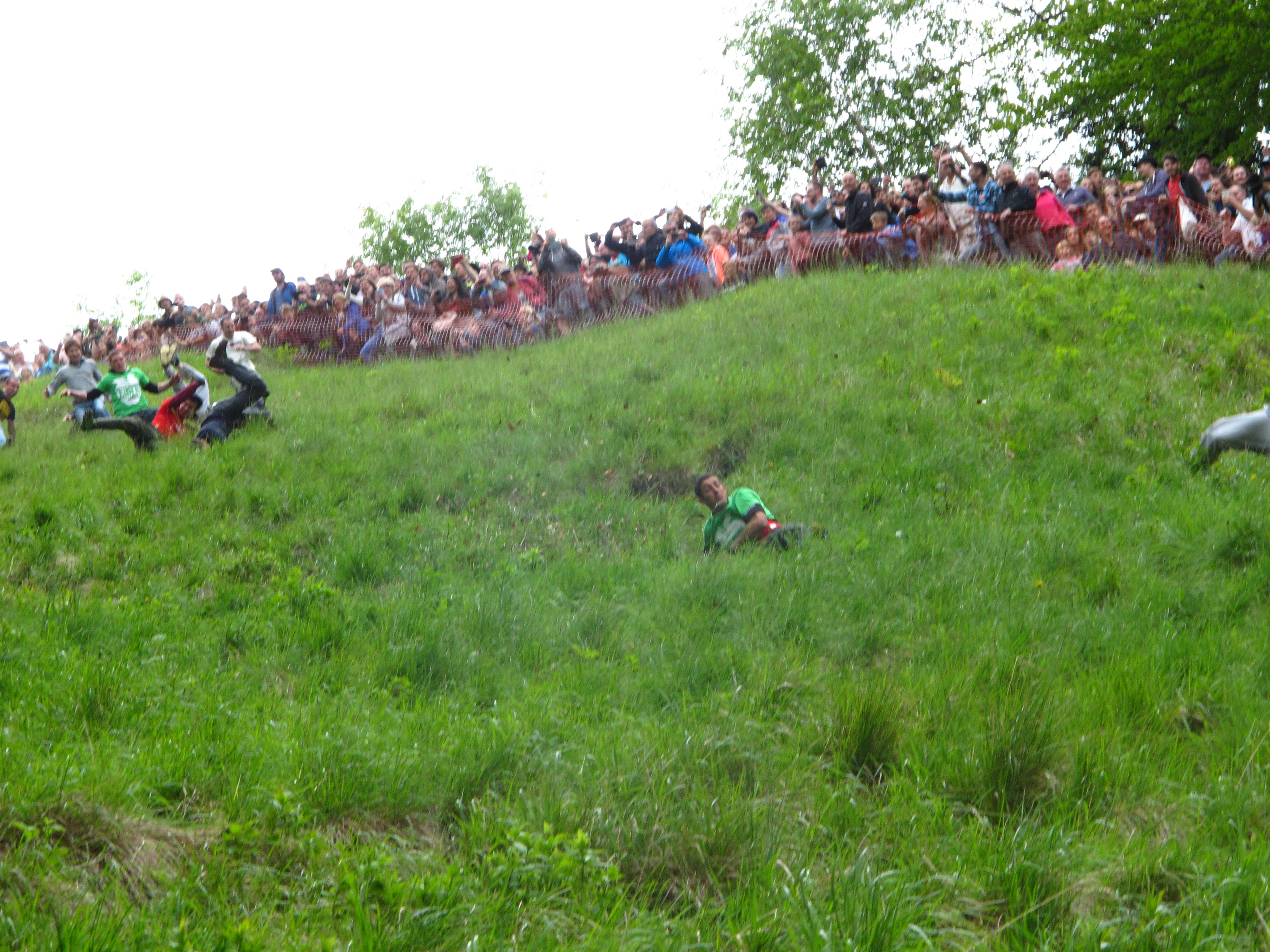
Runners sliding down the hill. The camera’s at an angle and doesn’t do justice to how steep the hill is, but keep scrolling down.

Sounds simple. Did I mention that the hill is steep? Steep enough that before the race started I told Wild Thing I was going to see what was happening at the top. I got maybe ten yards uphill and thought, No I’m not. I was tipped forward, almost on all fours, and my feet were sliding backward. It would have been easier if I’d had a walking stick or two. Or possibly three. Cleats would have helped. So would a tow rope. But with anything short of a tank, it would’ve been a helll of a climb. And then I was going to have to turn around and come down, which is harder. So forget curiosity. Forget pride. I gave up and wedged myself back in where I started out.

Wedged because unless you find a bit of bumpy ground to keep you in place or dig your heels in and put those thigh muscles to work, you slide downhill onto the people below you. You’re not sitting so much as clinging. That’s the hill they’re running down.

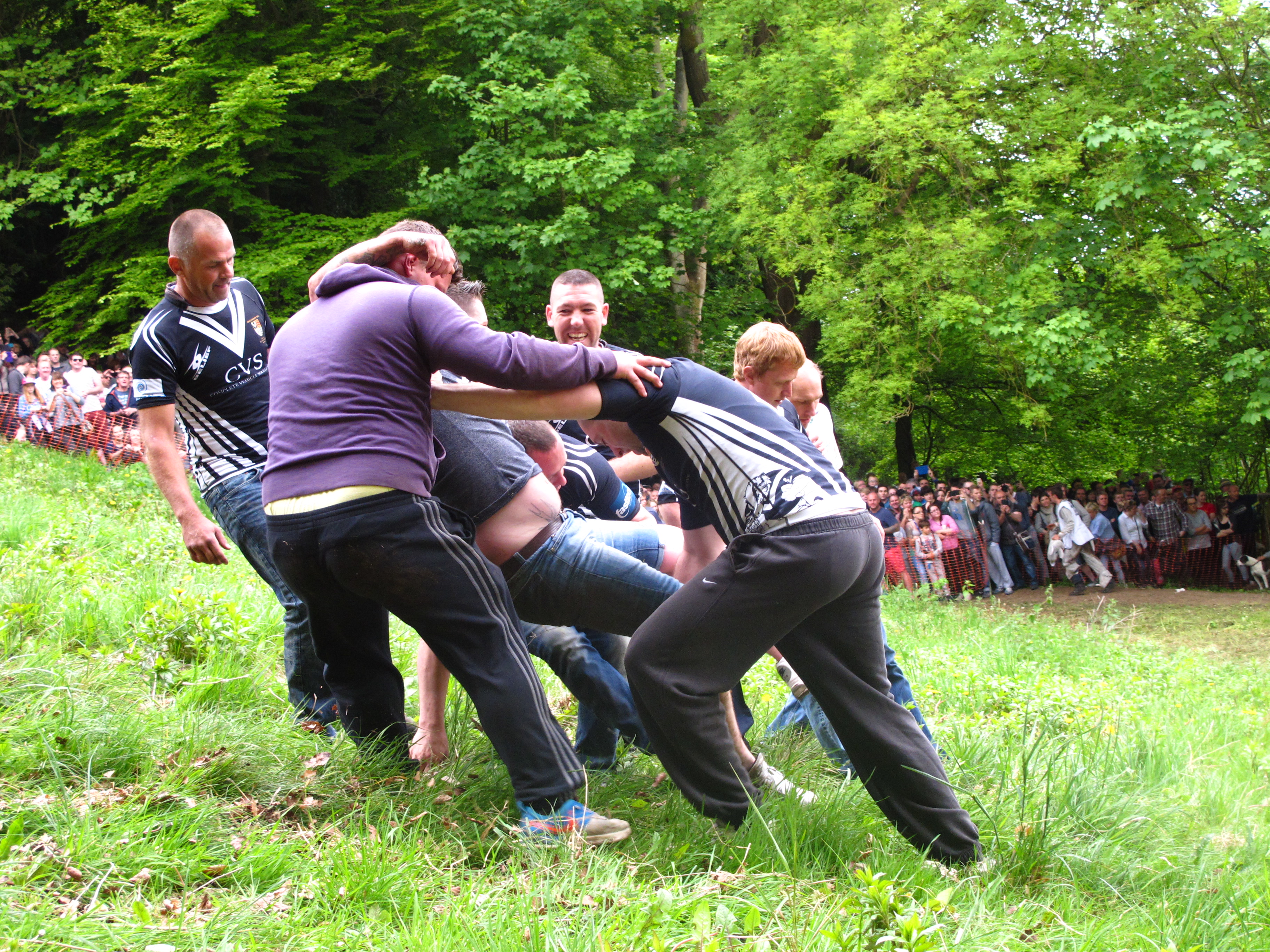
Not many of the runners stay upright. They skid, they cartwheel, and they get hurt—or some of them do. At the bottom, the local rugby team lines up to catch them, otherwise they’d keep going until they reached the Severn, or possibly the Atlantic. If that happens to be the direction they’re running in, which I couldn’t swear to but I think it was and it does sound romantic that way. What I can swear to is that they build up some serious speed. As does the cheese, which someone near us claimed hits 70 mph by the time it gets to the bottom, which happens well before the runners get there.

Helping an injured runner off the hill. Notice how the helpers are struggling to stay upright.

Helping an injured runner off the hill. Notice how the helpers are struggling to stay upright.

I didn’t see the rugby team stop all the runners. I was focused on the people who were struggling downhill, but I did see a few tackled to the ground. Others were blocked, or caught and hugged. Maybe it depended on their size and how fast they were going, or maybe a full-on tackle was a favor saved for friends. A few runners dodged off to the side, and given the heft of those guys I might’ve done the same.

Not that you’ll find me chasing a cheese down a hill. I say, if your cheese goes free-range, let it go.

A runner looks a hesitant about getting caught by the rugby team.

A runner looks a hesitant about getting caught by the rugby team.

One of the strange things about the cheese roll is that as a nation Britain takes health and safety seriously. I was once told in a second-hand store where the clerk said she couldn’t sell me a crochet hook because of health and safety. But before you start muttering about government regulation and the nanny state, consider the cheese roll. It goes on. Because it always has. Because no one’s thought to pass a law banning people from chasing cheese down a hill.

The crochet hook business had nothing to do with government regulation, by the way; it was just someone being a pill.

A few years ago, the group that organized the cheese roll couldn’t get insurance coverage. Tell me you’re surprised. This is where the real health and safety problem comes in. A tradition was about to die, but the community refused to let it and the races were held anyway, with no official organization (at least as far as I understand) and no insurance. If you get hurt, you’re on you’re own, because there’s no one to sue.

The local police hate the cheese roll. Maybe because of the crowds and the traffic and the injuries, or maybe because it’s basically insane, but they haven’t been able to stop it. They close off the nearest highway and people park outside the exclusion zone and walk past them to get there. It must drive them nuts.

We hiked in and ended up sitting next to the partner and son of a local legend who had won, if I remember right, six times in the past. He went home this year with two cheeses. What did they do with all the cheese? I asked her. The first year, he gave a lot to family and friends. After that—and here there was a pause.

“I have a lot in my refrigerator,” she said.

There are several races every year, she said. How many depends on how many cheeses they have.

Well, of course.

Sometimes they don’t have enough cheeses to satisfy the runners, so an extra race pours downhill anyway.

A first-time runner was standing near us, and after his race I asked how it had been.

“Fast,” he said, “and exhilarating. And terrifying.”

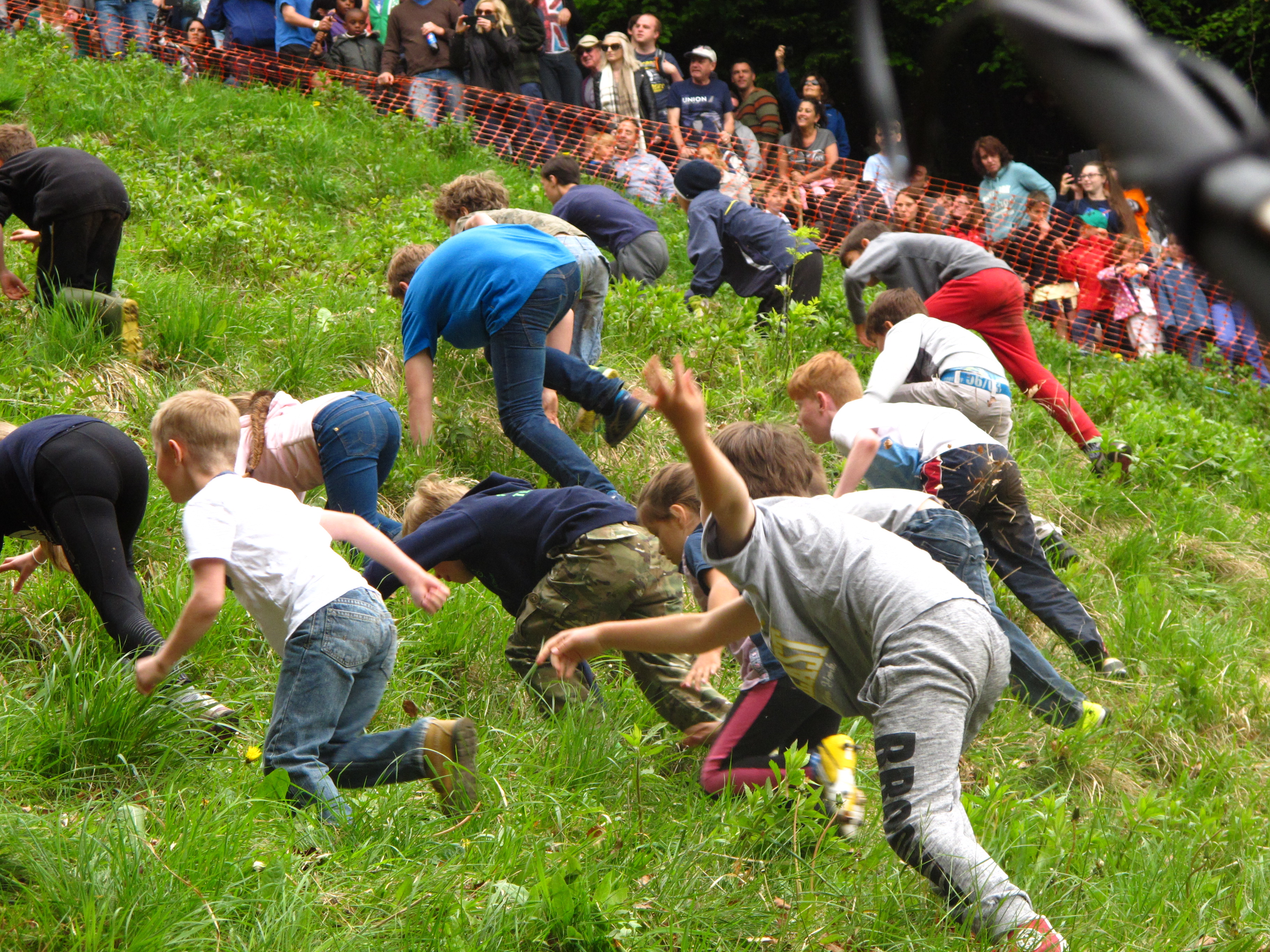
One of the races is for kids, but they go uphill, shepherded by the rugby team catchers and a few adult runners. It’s safer going up. Of course, then they have to come back down to rejoin their families, and inevitably some of them run. And some of them scoot down on their butts. And some of them are terrified. The adult shepherds were very sweet about coming down with them. A rugby player scooted on his butt alongside one kid. Another led one by the hand. The last kid off the hill got a round of applause.

The kids' race.

The kids’ race.

This being England, a few adult runners showed up in costumes—what’s called fancy dress here. One guy came to a halt near us, stopped to make sure someone who’d fallen was okay, then pulled on a mouse’s head and finished the race in it. Another was dressed as a banana in a top hat. Well of course he was. Other costumes I saw were a kilt, a cape, and a tutu combined with a Canadian flag tee shirt.

According to an awkwardly worded Wikipedia entry, “Two possible origins have been proposed for the ceremony. The first is said that it evolved from a requirement for maintaining grazing rights on the common.

“The second proposal is pagan origins for the custom of rolling objects down the hill. It is thought that bundles of burning brushwood were rolled down the hill to represent the birth of the New Year after winter. Connected with this belief is the traditional scattering of buns, biscuits and sweets at the top of the hill by the Master of Ceremonies. This is said to be a fertility rite to encourage the fruits of harvest.

“Since the fifteenth century, the cheese has been rolled down the hill, and people have competed to catch it.”

As is usual with these things, no one knows for certain. One woman from the area thought the race’s history was measured in decades, not hundreds of years. All I know for a fact is that the country’s full of traditional festivals, and some of them are stranger than this one. I hope to get to one of them later in the year.

If you want to know more about the cheese race, here’s a link to an article from a local paper, one to the official site, and one to cheese race pictures.


Miss Marple and World War II evacuees

I’m sure Miss Marple would agree: There are no secrets in the village. But there’s a lot of misinformation, and if you want to unravel a story, that’s where you start.

Wild Thing and I worked on the village newsletter for a while. Then we stopped and the newsletter continued on. Long story there and not one I’m going to tell (sorry), but I mention it because we got a letter last week addressed not to either of us but to the newsletter’s secretary—no name, just the title—with no street address and a post code that would land you somewhere in the village but not at our house, or even close to it.

And it reached us. Because we used to get mail for the newsletter, and because the letter carrier remembered that.

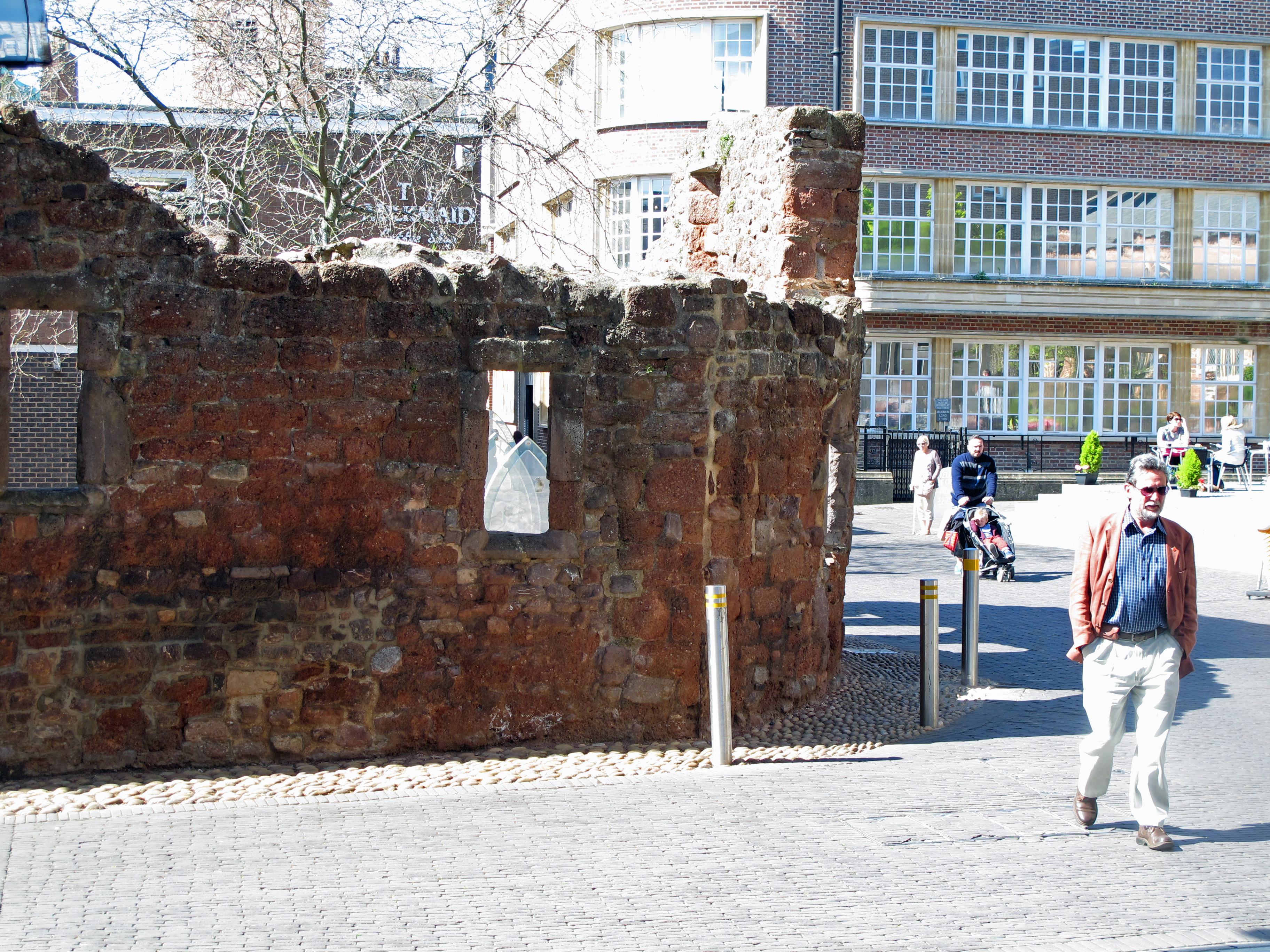
Remains of a church, destroyed in the bombing of Exeter city center, now preserved as a monument.

Remains of a church, destroyed in the bombing of Exeter city center, now preserved as a monument.

I took the letter to M. She’s not the newsletter’s secretary, but then neither is anyone else. It works just fine without one. She does work on the newsletter and part of her job, at least when I was still involved, was to type up announcements that come in on handwritten scraps of paper, so it more or less made sense to choose her. Here was a handwritten bit of paper. Not a minute’s walk from our house was M. So I rang her bell and handed her the envelope.

“You didn’t open it,” she said.

I hadn’t. Not because I’m virtuous (although, oh, I am; painfully so; if I didn’t swear so much, I’d float a good six inches off the ground) but because I hadn’t been curious about it. Mostly—let’s be honest here—the newsletter’s pretty dull. Suddenly, though, I did care. We were holding a secret and we were inside the village. We were two bad kids, about to be find out something that was none of our business. Except that it was, but let’s not argue, the feeling was delicious.

She tore open the envelope.

The letter turned out to be from a woman who’d been evacuated to the village during World War II, asking for information about someone she’d known. M., who’s much better than I am about knowing who’s related to who(m, if you insist), immediately started talking about who would know. And there I left it. She’ll make a few calls. People will ask around. The network will be activated. If nothing else works, the newsletter will run the letter. Maybe it’ll run it anyway, because other people will want to know about it, and it may trigger reminiscences of those times, and all of that is the job of a village newsletter.

*

If you don’t know the history of the World War II evacuations, or if you’re interested in how it affected the Southwest: Many British cities were heavily bombed and children were evacuated to safer areas. It was a measure of the desperation families felt that they’d send their children off into the unknown, to live with strangers. Most of the evacuees returned home at the end of the war, but a few settled locally, and more than once we’ve met people who, when we asked if they’d always lived in the area, said, “I was evacuated here as a child.”

Of the nearby big cities, Plymouth was heavily bombed, and Exeter was bombed but not as heavily. Unlike Plymouth, it wasn’t targeted for its industrial or military importance, but for its cultural and historical interest, which no one had expected, and although children were evacuated from Plymouth (a predictable target), they’d been evacuated to Exeter, which must have seemed safe. The BBC has compiled a list of bombings in Cornwall and some memories of evacuees and others who lived in Cornwall during the war (and elsewhere in the country, but the link will take you to the Cornwall pages). The memories especially are worth a look.