The Writing on the Sidewalk of a Cornish Village

Either I’m engaging in antisocial behavior or I’m the last defender of decency in Cornwall. Some days it’s hard to tell.

Wild Thing and I live on what’s called the estate. If you’re American, that sounds all grand and Downton Abbey, but what it really means is “the subdivision.” We live in a tiny fragment of suburb, even though we don’t have a city to be suburban to. Our village is spread out—a village without any center—so this is the most densely populated bit. By dogs as well as humans.
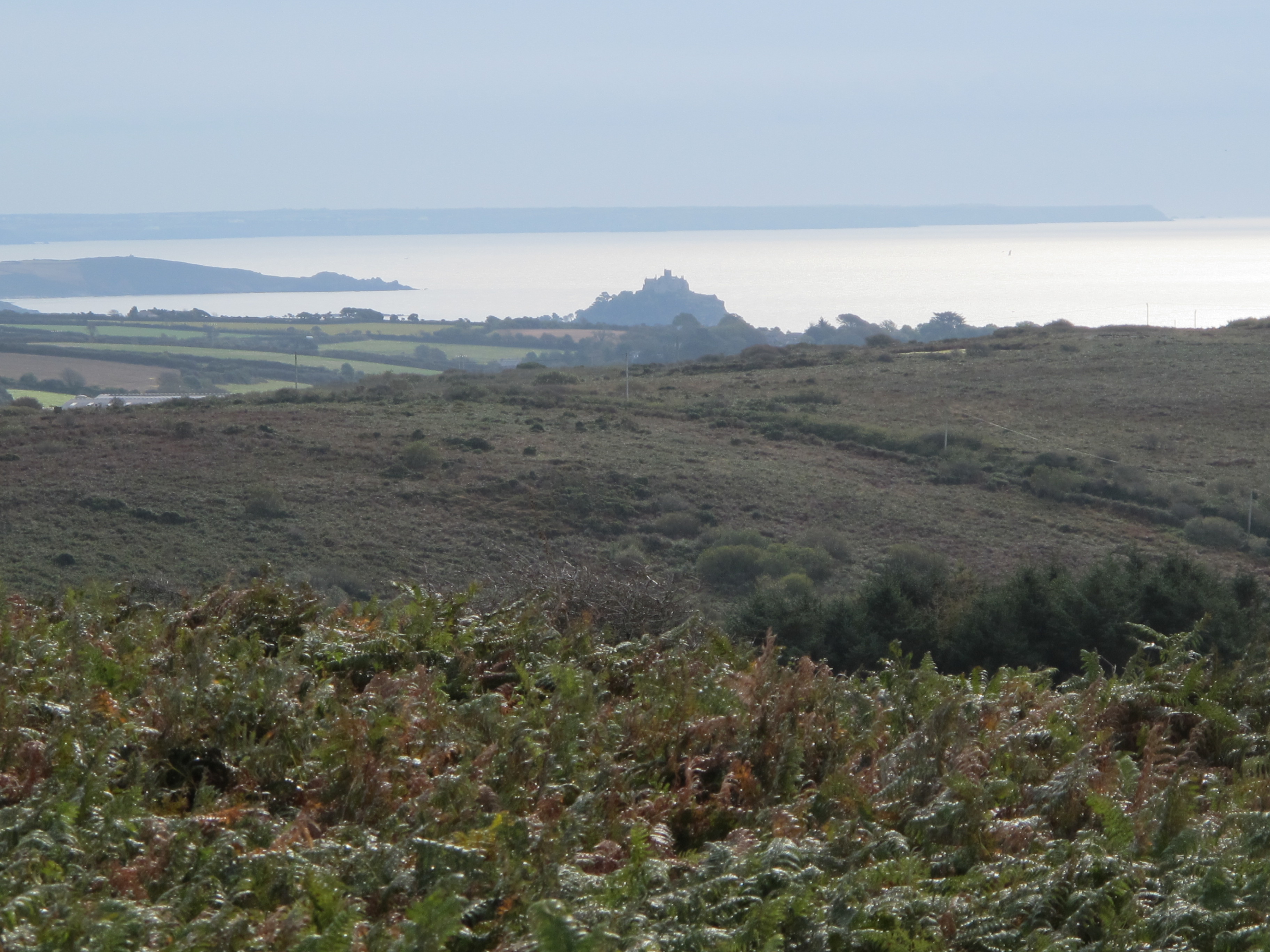
Irrelevant Photo: A view of the south coast and St. Michael's Mount

Irrelevant Photo: A view of the south coast and St. Michael’s Mount

Yes, dear ones, I’m writing about dog shit, and I’m not going to call it poo because I just can’t. When I first moved to Minnesota, I heard a wonderful phrase: “She wouldn’t say shit if she had a mouthful.”

Well, I don’t have a mouthful, but I did skid through the stuff and come away with a shoeful, and I can’t see why I should call it anything else. It’s not a beautiful word, but then the shoe wasn’t looking so good either.

Shit was the mildest word I yelled. I’m sure someone was behind a window saying, “Oh, that’s one of the Americans.”

Never mind the language, though. The important point is that somebody hasn’t been cleaning up after their dog.

I know two things about this dog: It’s large and it likes to spread its bounty as far as it’s physically able. I walk with my eyes on the sidewalk these days, the way I did as a kid in New York, before dog owners were expected to clean up after their dogs. My family had a dog. We thought we were being good citizens because we got him to shit between the parked cars. In fact, back then the city put up signs saying “Curb your dog.”

After the shoe incident, I bought myself a box of chalk. Then I waited.

Several days later, I found another deposit. Right by the red metal box that everyone (even me) calls the dog poo bin. I knelt on the sidewalk and chalked, “Clean up after your dog, please.”

I stepped back to admire my work. I’d forgotten the your, so it actually read, “Clean up after dog, please,” as if a computer translation program had written it. I used to work as an editor, so that missing word bothers me, but it did get the point across. And at least I hadn’t forgotten the please.

Good manners are more important here than good grammar. No matter how ungrammatical—or, for that matter, rude—a note you tack up somewhere, you can make it okay if you write “Polite Notice” at the top. I can’t tell you how many signs I’ve seen that declare themselves Polite Notices. Even if you were to say, “Pick up after your dog, you miserable, lazy, unclean excuse for a human being,” if you also said it was a polite notice, it would be okay.

And even if the rest of your wording is polite, you still have to open with “Polite Notice.” Actual politeness isn’t what matters. You have to remind everyone that you’re being polite.

I didn’t open with “Polite Notice.” I didn’t figure a chalked notice on the sidewalk had to, but then (as I’m often reminded) I’m not British. Wild Thing’s sure that what people mean when they say that is that we just don’t get certain things, and that the speaker feels sorry for us. I’m not sure she’s right. I tend to hear it as a statement of fact: We really aren’t British. Or we are—we’re citizens—but on some deeper level we never can be.

I don’t necessarily want to know how the speaker feels about this.

So it’s hard for me to be sure how significant that missing “Polite Notice” is. I may have offended someone other than the dog walker, but I can’t tell. I’m not British.
Messing with British Baking: Chocolate Chip Cookies

Since moving to Cornwall, I’ve made it my mission in life to mess with the Britishness of British baking. Not because British baking is bad. It isn’t; it’s fantastic. Have you eaten shortbread? Or scones? Or pain au chocolat? Or—wait a minute, that last one’s French, isn’t it? (And in case you’re not familiar with the stuff, it’s not pronounced like the English word pain, it’s closer to pan, and it’s basically a croissant with chocolate inside. Mmmm.)

So okay, we’re not talking about a tradition that goes back, unmixed and unmessed-with, to Alfred the Intolerable. British cooking has done what pretty much every culture does: it’s adapted, stolen, borrowed, and claimed as its own whatever bits happened to work—so much so that now people ask, with an almost straight face, “What’s more English than curry?”

How am I carrying out my mission? I’m baking, and I’m feeding my friends and neighbors. It all sounds so harmless, doesn’t it?

Irrelevant Photo: Fountains Abbey

Irrelevant Photo: Fountains Abbey

So here’s my recipe for chocolate chip cookies, because chocolate chip cookies are even more American than Mom and apple pie. They’re probably more American than the flag. The recipe’s in imperial measures. (Shouldn’t we start calling them American measures, by the way? The empire’s gone and—does any country other than the U.S. still use them these days?  And I’m not sure how many people know what imperial measures means.) But back to my point, I’m not going to try translating it into anything sensible like the metric system because the last time I did lost three weeks of my life and didn’t get it right anyway. So forget it. Besides, what’s more American than an irrational and antiquated system of measuring that we inherited from a country that’s since abandoned it and which we will fight to the death rather than give up?

Am I off the topic yet?

The recipe was adapted from one my friend J. found in the Duluth, Minnesota, News Tribune. The introduction explained that the more sugar a cookie has, the more it spreads out in the oven. The original minimized the sugar, which suited me because my chocolate chip cookies had been turning into chocolate chip wafers and I like a thick cookie. I’ve cut the sugar back even further and substituted oatmeal for some of the flour. If that sounds healthy, don’t kid yourself, they’re lethal, but you can increase the sugar if you like. I’ve left the amount a bit vague (a scant ¼ cup, in one place) for exactly that reason. Not to mention because I’m exactly that sort of cook—a bit vague, probably even a bit scant.

If you want the cookies to turn out well (and why would you make them if you didn’t?), you have to find really good dark chocolate—preferably chocolate chips. In the U.S., that means semi-sweet—none of that milk chocolate mess. In the U.K., I’ve had a battle to find good chocolate chips. For years, all I could find were brown waxy things that tasted like buttons that had popped off an old-fashioned shoe. If that’s all you can find, don’t buy them. Chop up chocolate bars (I’ve used 70% chocolate) with the back of a knife and make chocolate chunk cookies, but chunks of chocolate bars don’t keep their shape the way chips do. They’re good but not the same. For some time now, friends have kept us supplied with American chocolate chips, which is a real luxury, especially when you look at the cost of postage, but recently I’ve discovered that Dr. Oetker’s make decent chocolate chips, even if they come in itty bitty bags and are overpriced. In the U.S., you can buy chocolate chips in industrial-size bags. We’re seriously serious about chocolate chips.

If you’re in other countries, I have no chocolate chip advice to offer, but I do know this: If you open the bag and taste them and they don’t taste like much, they won’t get any better when you stir them into the batter and bake them.

The recipe makes an insane number of cookies. (I did warn you that, as a cook, I’m a bit vague.) I freeze whatever we don’t eat on the first day and take them out when we have company. They’re good frozen. Maybe even better. Honest. I discovered this the time I hid them from myself and—surprise surprise—found them. And ate them on the spot.


Chocolate Chip Cookies                               

1 c. whole wheat flour

2 1/3 c. plain white flour

1 ½ c. rolled oats (any thickness will do)

2 tsp. baking soda (that’s bicarbonate of soda)

2 tsp. salt

12 oz. (that’s 3 sticks if you’re American) butter

Scant 2/3 c. brown sugar

Scant ¼ c. white sugar

4 eggs

2 tsp. vanilla

Lots of dark chocolate chips  (about 2 ½ c.)


Cream the butter and sugars. Beat in the eggs, one at a time, and the vanilla. Mix in the dry ingredients, then the chocolate chips. Drop spoonfuls onto greased cookie sheets, leaving some room for them to spread out.

Bake 9 – 11 minutes at 375 F.,  or 185 c., or 165 c. with a fan oven.

Cool 2 minutes or more on baking sheets before removing.

Consulting the Internet and the Chicken Entrails about Cornish Roads

I went to a meeting the other day, and I consulted the internet about it the night before. That’s the modern version of killing a chicken and consulting the entrails to find out how your trip’s going to go.

The internet entrails told me I’d need one hour and one minute to get there.

I figured I’d allow myself an extra ten minutes and be heroically early.

In the morning, I forgot about the ten minutes, but how many meetings start on time anyway? I punched the post code into the sat nav I stole from Wild Thing because I don’t believe in them unless I need one, in which case see I steal hers. That gives me access to both a sat nav and the moral high ground.

The sat nav spit the post code back out. I punched it in again. The sat nav offered me a list of alternative post codes, some of which were close but close wasn’t what I needed. I could find the town without the damned thing. What I needed was the final details.

mulfra 098We went through this several times until it accepted the post code. I will, of course, swear that I entered it correctly all sixteen times and that the sat nav was both pigheaded and wrong for the first fifteen, but you probably won’t believe me. I’m not sure I believe me either.

I was now going to be late. I was also now ready to accept that you can’t get from my house to Pool, where the meeting was, in one hour and one minute. And I’d kind of known that the night before, but I wasn’t ready to question the wisdom of the chicken entrails then.

I drove, telling myself I’d make up lost time. This was, of course, a crock. (A crock, my writers group tells me, is an Americanism. It may also be as out of date as I am, so if you need guidance, allow to me ask you, ever so delicately, to imagine what I’m implying is inside the crock.) Unless you’re on one of our few four-lane highways (or the occasional, very short, three-lane stretch), you have to be a whole lot crazier than I am if you’re going to make up time around here.

At the Pool turnoff, I realized that the sat nav hadn’t been speaking to me since I left the house. Why hadn’t I noticed? Because I don’t enjoy her conversation, so I hadn’t missed it. Our sat nav, by the way, is a her, and her name’s Dorothy, and she’s been losing her voice a lot lately. The last time it happened, Wild Thing fought with her until she started speaking again but she—Wild Thing, that is—wasn’t sure what she’d done, so I stood no chance of reproducing it. It involved a lot of swearing, which I can reproduce effortlessly, but I’m guessing that wasn’t the effective part. And I didn’t have time to wrestle with the sat nav anyway—I was already heroically late—so I drove into Pool trying to keep one eye on the little brown arrow.

Tell me, I begged the universe, that this isn’t a part of the county where sat navs don’t work.

I didn’t expect the universe to answer and it didn’t. Begging the universe is just one of those things I do to pass the time when I’m coming unglued. I fully expected the little brown arrow to direct me into an abandoned mine shaft or the frozen food aisle of the nearest supermarket. That optimism meant I was ready for it when the little brown arrow told me to turn where there wasn’t a street.

You can’t fool me, I told Dorothy, and I drove on.

The hell she couldn’t. The little brown arrow disappeared.

I turned around and tried again, somehow expecting to get different information this time. The little brown arrow still wanted me to turn onto a non-street, but it was at least paved, so I tried it and ended up in a supermarket parking lot.

I turned around before we got to the frozen food aisle and I drove back to where the arrow had disappeared, pulling into the parking lot of a small business. I walked inside and threw myself on their mercy.

They must’ve been used to this. Not only were they kind, they’d heard of the complex I was looking for and gave me usable directions.

“Sat navs,” I said, trying to look as befuddled as, in fact, I was. I felt—I have no idea why—that I owed them that.

“Sat navs,” they said, nodding and looking wise.

I got to the address, which turned out to be a Free Public Attraction (please note the capital letters, because they’re not mine; I’ve borrowed them from a sign I passed) about Cornish mining. With a not-at-all-free parking lot. I hadn’t counted on that and hadn’t brought much change, but I plugged in what I had, which was enough to carry me to the 11 a.m. break, when I might be able wangle change out of someone somewhere.

Or leave if the meeting turned out to be as pointless as I sort of suspected it would be.

I could probably have used my phone and credit card to pay, but (remember the internet and the chicken entrails?) I was late.

So in a gentle Cornish mizzle, I walked in through what must once have been a working mine complex and now that the mining’s gone is a tourist attraction. I thought melancholy and ironic thoughts about hard, dangerous work and low pay and tourist attractions but didn’t have a lot of time for them because I found the right building and went into a tasteful and (I assumed) expensive modern lobby where there was no sign pointing me to my meeting, only one saying Memory Café.

You know about memory cafes? They’re for people with some degree of dementia, to orient them to I have no idea what. Reality, I suppose, which at the moment didn’t strike me as a particularly wondrous gift.

I found an office and asked a woman about my meeting. She gave me a blank look. I produced my agenda.

“That’s tomorrow,” she said.

I could have gone to the memory café but reality wasn’t looking particularly good so I drove home.

British and American English: The Accent

Two words spoken in an American accent reliably crack up the British: water and butter. It has to do with the difference between English R and the American R, which as far as I can figure out is this: Americans have one and the English have a sort noticeable absence—something you might write as an H, or an apostrophe. WAWtah, as opposed to WAWterrrr.

WAWterrr. Photo by AdriannaNicole

WAWterrr. Photo by AdriannaNicole

I’ve spelled that first syllable the same way but no way does it sound the same. No matter how much I mess around with the spelling, though, I can’t come up with the difference. Put it this way: The English first syllable is well behaved and sits in its chair with a perfectly straight back. The American one slouches and puts its feet on the coffee table.

That may not help. I do understand that.

Okay, I’m writing about English pronunciation as if the English had one single accent. They don’t, but let’s not get into that here. I’m oversimplifying, the same way I’m oversimplifying the American accent, because if I don’t I’ll never write this. I’ll lose myself in complications and sub-points and convolutions so badly that I’ll shut down the computer, go back to bed, and pull the covers over my head. Pretty soon I’ll be joined by two cats and we’ll spend the day there.

They’ll think it’s a day well spent.

Any number of British friends will, in the middle of a conversation involving food or drink, lose all restraint and repeat after us, “BUTTerrrr,” or “WAWterrrr.” They can’t help themselves. It just breaks loose. Even if it was going to fly around the room and break the dishes, they couldn’t keep it in. Sometimes they don’t even wait for us to say it first. I’d love to criticize, but if Wild Thing and I are in the car when the weather comes on and the winds are moderate, we’ll repeat “MAWderit” and laugh as if it was the first time we’d done it. Some jokes just don’t get old.

We’re lucky, though. We have the accent that people think is cool because they’ve grown up watching Hollywood movies. Well, we sort of have it. We have versions of it, with regional flavorings that, from this distance, most people don’t hear. So we don’t get the disapproval that goes with having accents people look down on, or are afraid of. A wave of let’s-all-worry-about-immigrantion is breaking over the country just now, and our accents mark us all. Wild Thing’s and mine get us sorted in the Immigrants We Accept pile. It’s uncomfortable sometimes, but not as uncomfortable as being in the Immigrants We Don’t Accept pile. Still, it’s odd when people react to your accent, even favorably. It’s a bit like having people react to your nose. You’ve been walking around with the thing all your life. You’ve forgotten it’s there and are thinking about something else, but people want to talk to you about it. Over and over.

I’m in the supermarket and the woman at the checkout says, “I love your accent.”

What am I supposed to say? It’s my accent. I’m not responsible for it. When I was a kid, if I’d known I could choose I would have chosen a different variation on the New York accent. Now it’s too late. The glue that holds it in place set long ago.

So I say thanks, just as if she’d said she liked my sweater. Which she’d have called a jumper.

Heavy Traffic in a Cornish Village

Wild Thing and I were walking the dog the other day and we’d just turned off the main road when a car made the same turn. We moved to the side of the road, stood in the weeds, and corralled the dog so that she did the same. She’s convinced that if her nose is out of the way, that takes care of the problem.

The car passed. The driver waved. We waved and moved back onto the road.

Then another car came past. That’s roughly two cars more than we usually see on this stretch of road.

“So much traffic!” Wild Thing said.

mulfra 043

Irrelevant Photo: Fall Berries of Some Sort of Other

You need a little background here.

First, what I just called the main road? It has two lanes, goes from no place in particular to no place else in particular (I’m going to catch hell for saying that), and no one’s even bothered to give it a name or a number. That’s why I call it the main road. What else am I going to call it? Marlena? Suzette? It’s as main a road as the village has. Everything else is even smaller.

Second, Wild Thing and I are both New Yorkers. I was born and raised there and she lived there for ten years. So it’s not that we’ve never lived with traffic. But human beings are adaptable. When I lived in Minnesota, I noticed that 40 degrees F. was cold in the fall and the most blissful warmth in the spring. So we’ve adapted. Two cars in a single day on the road past the ford? In the off season, when the emmits have gone home? Outrageous!

And we’re not the only ones who resent seeing two cars in a row. Someone who shall not be named, nay, not even by initial (okay, I’ve forgotten who it was), set out a Road Closed sign on one of the back roads. For years. Long after whatever was once wrong (if anything ever was) had been fixed. He didn’t like the traffic.

The locals all knew to drive past it, and when I became a local I taught myself to do the same, although the first time expected to find that the ford (this is a different ford) had risen out of control; that a downed tree had left the power lines sprawled across the road; that a herd of wild elephants had set up camp by the ford and were scavenging downed limbs for firewood. Even though I knew better.

In one version of the story—and no story in the village has only one version—he got tired of people with long vehicles taking the road and getting stuck at the ninety-degree bend where the road narrows down. In another version, a delivery truck got stuck and its cargo had to be off-loaded onto a smaller truck. In a third version, the company kept sending big trucks and they all got stuck—one, two, three pretty trucks, all with the same logo and all stuck where the road bends. It’s a wonderful image. Sadly, it’s the least likely of the versions. A single truck could get stuck there if it was long enough, but by getting stuck it would sacrifice itself for its fellow trucks, who’d have to back up a long way and then cross the ford backward before backing up some more, but they wouldn’t be stuck. That’s village gossip for you. Whatever story you hear, you have to figure it’s related to something real, but you can’t necessarily tell what the relationship is.

Anyway, it’s the off season here in the village, and the traffic’s horrendous. If you were thinking of visiting, wait till it calms down a bit.

Gardening in Cornwall: What We Do When Autumn Comes

J. is a serious gardener, and she grows the best tomatoes I’ve eaten since I moved to the U.K. I don’t know how she kills slugs and snails on her patch in the spring, but I know she does, because if you’re going to grow anything around here, you have to. Otherwise they mow down every plant you stick in the earth. They move through like a scene from Slug Apocalypse, leaving nothing behind.

Irrelevant Photo: The North Cornwall Coast

Irrelevant Photo: The North Cornwall Coast

A couple of us were at J.’s house and we went outside to admire the garden. It was that beautiful time of the evening when the sky’s a tissue-paper blue and you can almost convince yourself that the world is at peace, even though, yeah, of course you know better. Even though it was late in the year, she still had some flowers in bloom.

On the edge of a flower bed was a slug. The big, creepy kind, easily the length of my ring finger.

J. flicked it away—and I’d have to say she did it gently—with the toe of her shoe.

“That’s why I don’t come out at this time of day,” she said.

So it’s not just me. Everyone who gardens knows they’re out there. And at least for part of the year, we don’t look. If we did, as surely as if we’d sworn an oath, we’d have to kill them. And really, you can’t dedicate your life to eliminating an entire species, even if it’s only from a small patch of ground you call your own.

Gardening and Snail-i-cide in Cornwall

One of my first posts was about slugs. I wrote it early in the growing season, when none of the new plants stand a chance unless I carry out mass slug-i-cide. And snail-i-cide. It’s disgusting, it’s disturbing, and it works, up to a point.

But the plants that don’t get eaten get bigger, and sooner or later I convince myself that I can skip an evening’s slaughter. Maybe because it’s raining. Maybe because it isn’t. There’s always a reason, and it doesn’t have to be a sensible one. Then, before I notice what’s happening, several days have rolled past, and then the weeks do the same thing, and eventually I decide that I don’t have to kill them anymore. The plants are established.

Irrelevant Photo: Late Summer Wildflowers

Irrelevant Photo: Wildflowers

Oh, happy summer. I declare a truce with the slugs and snails. This isn’t negotiated, it’s a one-sided thing. They still eat everything in sight, but now I look the other way when I see them.

Then summer passes, and right now it’s fall. Or autumn, if you’re of the British persuasion. A few days ago, I lifted the lid on the kitchen garbage can and found a snail glued to the underside. How did it get there? I suspect I found it when I was washing a batch of spinach I’d cut and I tossed it in as a sort of compromise: I won’t carry it sweetly back out to the garden to munch its way through more spinach, but I’m not killing it, am I?

The reason I say “I suspect” is that I’ve rearranged my memory so that I’m no longer absolutely the kind of person who’d do that. I probably am, but I have a small escape hatch. The snail might have moved in on its own: come in the back door, crossed the living room rug, crawled up the side of the garbage can, lifted the lid, crawled in. You know; it could happen if, I don’t know, the laws of physics changed or something. I’m just not sure.

I plucked it off the top and put it inside the bin again. Why? No idea. I don’t understand the workings of my mind any better than you, dear reader, are likely to. The next time I looked, it had climbed to the top of the liner and I left it there. Because by now it had become individualized. It wasn’t just some snail, it was almost a pet. And I’d tossed the poor thing in a near-empty, and dry, garbage can, with nothing edible and nothing moist.

Stop that, I told myself.

I didn’t listen. Instead I asked myself whether it was crueler to carry it to the pavement and crush it or to leave it where it was. This was, in spite of its absurdity, a serious ethical question, and a complicated one, which (like so many serious and complicated ethical questions) I haven’t answered to my own satisfaction. That’s another way of saying that I left it where it was but became conscious of every bit of edible junk I tossed in, and every smidgen of moisture. I made a batch of oatmeal chocolate chip cookies, which involved a lot of oatmeal landing on the floor. My recipes are like that: Take one handful of rolled oats and toss over your left shoulder. So I swept the oatmeal up and threw it in with the snail. Ditto the bits of dog treats I cut in half because the dog is small and the treats are big and she’d be chewing for half an hour if I didn’t cut them up.

Mmm. Snail food.

So here I am, the bane of slugs and snails, feeding a pet snail.

Eventually the garbage can will fill up and I’ll take the bag out, slug and all, and toss it in the trash. I know this. But like a mother who can’t bear to tell her daughter the goldfish died, I’ll tell myself it’ll be fine. It’s just going on a trip, darling, to a new home.

Planning Thanksgiving in Cornwall

We’ve started planning our Thanksgiving party. The guest list is limited by the size of our house, which is a shame because we’d love to add more people. And since there’s no competition—no one says, sorry, but I have to go to my brother’s this year—almost everyone we invite is available. And it’s an American holiday, which gives it an element of cool here.

Our tradition, both here and back in Minnesota, is that we cook the turkey, cranberries, sweet potatoes, and pumpkin pie (usually; back in Minnesota, as D. got older he became a very good cook and he brought the pies), and we ask everyone to bring something. Which is where it gets interesting.

Pumpkin pie--with a neater crust than I make. Photo by the Culinary Geek from Chicago, courtesy of WikiMedia

Pumpkin pie–with a neater crust than I make. Photo by the Culinary Geek from Chicago, courtesy of WikiMedia

The first time we invited we invited M. and J. to our Thanksgiving in Minnesota, was the first time I understood how rigid the traditions are. J. isn’t from the U.S. but she was the cook in the family, and as they told the tale later, M. said “No, you can’t bring that” to everything J. suggested. Macaroni and cheese? No, you can’t bring that. Chocolate cake? No, etc.

So this year, a different J.—an American—told me she’d have to explain to P. that just because root beer floats are American doesn’t mean you can have them at Thanksgiving. I looked at the list of what people were bringing: leek gratin, cauliflower cheese, quiche. Don’t bother, I said. We’ve given up the battle.

The only traditional elements of the meal are the ones we make—turkey, cranberries, sweet potatoes, and pumpkin pie. And baking powder biscuits, which weren’t traditional in my family, but Wild Thing’s from Texas and will never say no to biscuits. The rest is all stuff that would get us all deported if we tried it in the U.S.

So we’ve evolved our own traditions, one of which is the meal isn’t traditional. A second involves me, the vegetarian, cooking a dead bird. Which hardly even strikes me as strange anymore. A third—one we’re trying to break—is that I make cranberry sauce and forget to set it out. A fourth is that we have to have at least one dessert that isn’t pumpkin pie, because although pumpkins grow here they’re considered a squash and people are, um, let’s say hesitant about eating it as a sweet. But we do have to have it. That’s tradition for you. Besides, a few of us like it.

Further Adventures in British English: The Letter U

The British love the letter U. They use it at every possible opportunity (neighbour, colour, flavour, savoury), and it drives some of my friends insane that Americans don’t. It’s one of those things: If you let it get to you, it will. Gleefully. If I have to write something in British, I assign myself a handful of U’s and I don’t stop writing until I’ve used them all. When I write in American, I now see tiny gaps in neighbor and color where the U isn’t: colo’r; neighbo’r.

He's been here before, but I can now offer some advice: Make your your spell check is set to the right language.

He’s been here before, but I can now offer some advice: Make your your spellcheck is set to the right language.

And no matter which country I’m writing for, my spell check is set to the other. To my embarrassment, it snuck a U into neighbor a while back, and I posted it on the blog, which T. (copy editor that she is, down to the bone) pointed out diplomatically. I felt like the carrier of an, admittedly mild, disease—U-itis. I don’t have the bug myself, but I did spread it.

Trying to Count the Cornish Wildflowers

Wild Thing and I hadn’t really seen the Cornish countryside until we discovered the footpaths, and the wildflowers bowled me over. I was living in Minnesota then, and when it isn’t frozen solid and buried under snow Minnesota is green and beautiful and all that, but you wouldn’t be tempted to call it lush. It’s too cold for too much of the year. What wildflowers grow there always struck me as self-effacing, somehow, as if they didn’t want call attention to themselves.

A lot the people are like that too.

T. and S., whose roots are in western Minnesota, swear there were more wildflowers when the farmers didn’t use pesticides as enthusiastically as they do these days, and I’m sure that’s true, but still, Minnesota’s a bit like the Puritans were: It’s never going to encourage a wild profusion of stuff it doesn’t absolutely need.

Montbretia, pronounced mombresia. Or something like that. Considered not just a weed but a thug. Isn't it gorgeous?

Montbretia, pronounced mombresia. Or something like that. Considered not just a weed but a thug. Isn’t it gorgeous?

So, while I was on parole from Minnesota, I’d walk along the footpaths in Cornwall and try to count how many kinds of wildflowers were in bloom. To understand what a misguided undertaking this was, you have to know that numbers and I are not on good terms. Ask me to remember the number 3 for more than a minute and I’ll need to check my notes. Ask me to solve a word problem (Train A left station B at 3:44….) and I’ll weep. Or at least I’ll want to. So voluntarily counting anything indicates an extreme state of mind. In this case, it was extreme happiness. So much color. So much life pushing up out of the ground. I’m tempted to say so much unnecessary beauty, but yeah, the ecosystem, the necessity of so many things we humans don’t think are necessary because we can’t make any immediate use of them. All of that. Still, you can see what I’m getting at.

The problem with counting wildflowers was that first, if I’m distracted at all, I can’t reliably count from 1 to 70 without losing my way. Did I say 70? Make that 10. But second, and more to the point, I couldn’t keep track of which flowers I’d already counted. If you don’t have names for things, it turns out, it’s hard to remember them. Little yellow flower, bigger yellow flower, little yellow flower that isn’t like the first yellow flower because it has four petals, although maybe the first one did too because I wasn’t noticing petals, only color and size at that point. Little yellow flower that also has four petals but they’re pointy. Little yellow flower that I might have counted already but I don’t think so.

I often wonder how animals remember in the absence of words. Of course, as far as I know they’re not counting, but they do other complex things, like remembering smells and places and long routes. It’s not all looking at a plant and thinking either yumm or bleah, that tastes foul.

Anyway, I bought the first of my wildflower books and began attaching names to what I was seeing. And the odd thing is that this allowed me to see them better—to notice and then remember petal shapes, leaf shapes, the ways leaves grew on the stem, and from there stem shapes and whether the leaf or stem was hairy or smooth. I’m still useless with some of it. Talk of sepals sends me into a panic. Heights given in centimeters might as well be written in an alphabet whose origins aren’t on this planet for all the good they do me.

That first book led to the next book, which was organized differently and promised more, better, deeper. And another book after that. One that had photographs. Another that had drawings. Each one had advantages and drawbacks. Then one organized by color, which I’d always thought would be simpler but still leaves me flipping through page after page, looking for a match for something new that I’ve brought home. Or something that isn’t new—I know I’ve seen it before—but I’ve forgotten its name since last year at this time.

I’m still a barbarian about it all. One of my books (and I pulled it out of the shelf at random) lists 15 kinds of violet, including common dog, early dog, pale dog, heath dog, hairy, sweet, and dame’s. And speedwell? Alpine, blue ivy-leaved, fingered, germander, marsh, spiked, thyme-leaved, wall, water, wood, and on until you reach 25 of them. I’ve tried to see the differences, really I have, but I’ve decided to be happy to look at the damn plant and say, “Violet; speedwell; close enough.”

Although I do love being able to identify the ivy-leaved toadflax.

No matter how many I learn, though (and I haven’t learned that many), there are always more.

If this sounds geeky, that’s because it is geeky, but it’s not about checking off how many flowers I’ve seen or how many names I can recite. By learning the flowers, I’ve learned a new way to watch the seasons roll past. The first wild primroses come into bloom when it’s still winter, and they tell me spring’s coming. Then the celandine comes out. It’s a low-growing yellow flower. Spring progresses with each new flower, and I think of it as a yellow season.

Damn, it’s beautiful here.