British traditions: tea, tomatoes, and the House of Commons

Is tradition any more important in Britain than it is in other countries? Probably. This is a country that, in advance of the monarch’s address to Parliament, searches nonexistent cellars for gunpowder because in 1605 some was hidden there. (The building had cellars then.) The people who do that searching wear uniforms that are traditional enough to have gone eye-catchingly out of sync with what your average human actually wears these days.
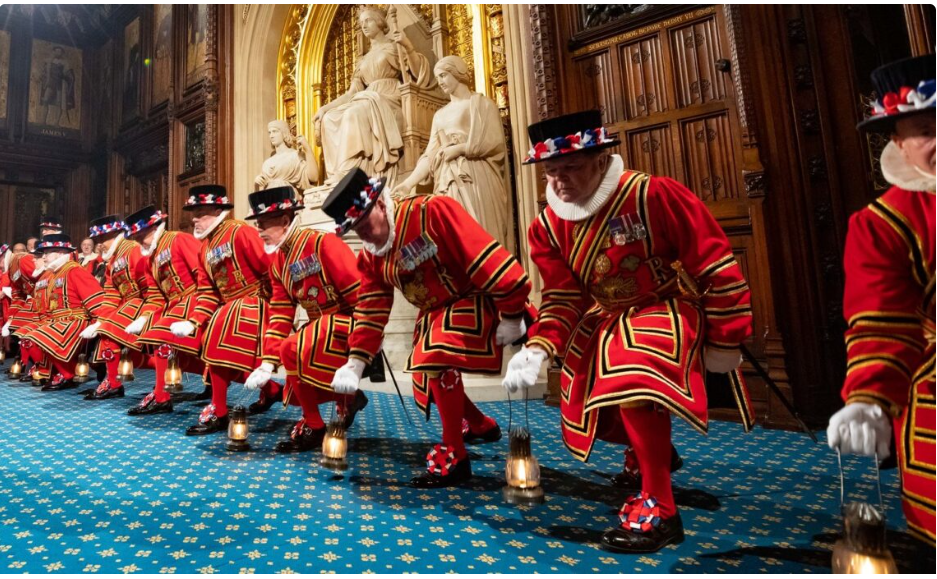
A relevant photo, which is a rare item around here. These are Yeomen of the Guard, in uniform, searching the nonexistent cellars, using lanterns and looking entirely serious about the whole thing.

During the address, a Member of the Commons (yes, they capitalize that) is ceremonially held hostage in Buckingham Palace until the monarch is safely returned from the hostile territory that is the Commons. That dates back to 1649 and Charles I, who was eventually beheaded and did, arguably, have a good reason to think the neighborhood was dangerous.   

So yes, tradition’s a powerful force. We’ll get to its role in politics in a minute. First let’s look at the breakfast table. 


Tea

If I’ve learned anything from living in Britain, it’s this: Don’t mess with the tea. It sits at the heart of British culture and outsiders shouldn’t meddle. I’m not sure about insiders, but they’d probably be wise not to mess around either.

Did it take me 17 years (and counting) to learn that? No, but however long it took I’ll pass it on to you for free so you’ll be spared the fate of American chemistry professor Michelle Francl, whose book Steep: The Chemistry of Tea has been greeted with caffeinated giggles on this side of the Atlantic.

What did she do? She told us to add a pinch of salt to our tea. If you’re American and don’t understand how that went over, imagine a British writer telling you to add–oh, I don’t know, let’s say ketchup to your coffee. If you’re not British and not American, I don’t want to go too far out on a limb but you could, just maybe, imagine me recommending that you take your national beverage and filter it through a pair of old socks.

What’s Francl’s salt supposed to do? Take the bitterness out of the tea. 

Am I brave enough to try it? Hell no. I did think about it and lost my nerve. So far I’ve only found one food writer who tried, and she admits that it “brings out savoury notes” in the tea, which she’s “not averse to,” although that’s not what you’d call an enthusiastic endorsement.

The others? They’re all either too outraged or laughing too hard to experiment.

Francl also recommends heating the milk before you add it on the grounds that it reduces the risk of it curdling.

Has cold milk ever curdled when I’ve added it to my tea? Only when it was older than me, in which case it was kindly warning me to pour out the tea and start over. 

To be fair, Francl also recommends some sensible things, like boiling the water, a trick your average American has trouble with. I don’t know what it is about Americans, but (generalization alert here) we’re convinced that if you allow lukewarm water in the same room as a stove, it’s hot enough to make brew tea. 

It’s not. You could get as much good out of your teabag by taking it into the bathtub with you.

So boiling the water is good advice, but it’s not enough to redeem her. Tea is British culture. It’s tradition. It’s what you turn to in a crisis. It’s what you offer someone who crosses your threshold (assuming you want them there). It’s–you know, it’s Britain. So that thing with the salt? It’ll see Francl banned from Britain forever.


Breakfast

Asking what’s for breakfast just became unexpectedly controversial. The English breakfast is under threat from no less traditional an organization than the English Breakfast Society.

Is there such a group? Yes indeedy deed, kids, it’s real. I’d have made it up if I could, but I don’t need to and it would never have crossed my mind anyway.

The society hit the headlines with an announcement that people should get rid of the mushrooms or tomatoes that are a longstanding part of the English breakfast (along with a fried egg, baked beans, bacon, sausage, toast, and of course unsalted tea) and add a slice of pineapple instead. 

The society’s founder and chair–

Hang on. Founder and chair? What is it, a closed shop? I’ll admit to wondering if the society has any actual members, but its website lists 31 fellows, so apparently it does. It also assures me that it’s a “learned society.” I feel smarter already.

Anyway, its founder and chair, Guise Bule de Missenden, said nobody ever liked the tomatoes anyway, “So why shouldn’t we swap them?” 

And he knows this how? Because he taps into the psyche of the entire nation when it sleeps, that’s how. He knows what people eat  not because they like it but because they feel they have to. He knows what they shove to the side of their plates. He’s the founder and chair of et cetera, after all.

And this being Britain, he bases his suggestion on history and tradition. Pineapples were a luxury item in the late 16th and early 17th centuries, he tells us (as if we didn’t all know that already). The elite ate them at breakfast, he says, and he doesn’t say but I’ve learned elsewhere that they served them at their fancy dinners. Then pineapples came down in price and, come on, what was the point of eating them if they didn’t demonstrate how rich and important you are? I mean, even if they do taste good. So they fell out of favor. 

Why add them to the English breakfast now? Because they’re traditional, at least if you bend your history around corners at just the right times. And maybe the society felt it was in need of a headline. Or got a kickback from the Pineapple Promotion Society. 

I don’t predict a long life for this new tradition, but then if you’d asked me whether baked beans would catch on as part of a traditional English breakfast I’d have laughed myself into insensibility. So don’t bet heavily against this based on my say-so.


How do we decide what becomes a tradition?

Good question, even if I did ask it myself. The tomatoes became part of an English breakfast sometime around World War I, so they’re not in the same category as thatched roofs or monarchy. Mushrooms and hash browns came along even later, but the English breakfast itself only dates back to the Victorian era, when it was the breakfast of the wealthy. Still, it’s been adopted enthusiastically, and maybe that’s the dividing line between tradition and non-tradition: enthusiasm trumps longevity.

Or maybe not. Let’s slide carefully onto thicker ice. A YouGov poll (you see how important this is) asked people what the essential ingredients of the English breakfast were. For more than half the people polled, they were bacon (89%), sausage (82%), toast (73%), beans (71%), fried egg (65%), hash browns (60%), mushrooms (48%), and black pudding (a lonely 35%). A whopping 83% said they liked a full English breakfast and 15% said they didn’t; 2% said, “Don’t bother me, I’m eating.”


Political traditions

Tradition, of course, isn’t only about food, it’s also about politics. As far as I can figure out from reading the papers in recent years, it’s perfectly acceptable to destroy the country’s infrastructure, safety net, and human rights record as long as you color within the lines that tradition dictates.

To wit: having very nearly drained his party’s talent puddle, Prime Minister Rishi Sunak was driven to resurrect former Prime Minister David Cameron and give him the office of foreign minister, and that’s brought us all nose to nose with an obscure political tradition, and a slightly less obscure problem, which is that recent convention says ministers should be either MPs–Members of Parliament–or members of the House of Lords, and Cameron was neither.

Why is that a convention instead of a tradition? Beats me.You need a law degree and a dowsing rod to find the line between the two. What matters is that Sunak solved the problem by be-lording Cameron: making him a lifetime peer, entitled to sit in the House of Lords, wear a fancy robe on dress-up days, and collect £332 on any day he shows up for work and/or passes Go. Plus expenses and subsidized food and drink.

I can tell you–reliably, since I have a link right her on my computer screen, and now on yours –that this isn’t the first time a minister has been chosen from outside Parliament, so we’re still inside those all-important lines. Be-lording them is a recent way of handling the awkwardness, but it turns out not to solve all the problems, because if you’re not an MP, you can’t just walk into the House of Commons and address the country’s highest legislative body and its only elected one.

Why not? 

Because it’s not done.

Wait, though. MPs are expected to scrutinize what the foreign secretary’s up to. How are they supposed to do that if he’s not allowed in? 

Before we get to that question, let’s ask what  they mean scrutinize. 

Well, kiddies, it’s political-speak for giving him grief (if you’re in the opposition party) or support (if you’re in his own). The Commons is a raucous place that traditionally (see how I snuck that word in again?) rewards braying and hear-hear-ing and verbal bullying as long as the MPs say the people they’re berating are honorable, as in, “The honorable member has surely mistaken a Dr. Who episode for a budget.”

Hear-hear? That’s what a minister’s supporters bray when they’re trying to drown out the opposition’s heckling. Yes, this is politics in the hands of adults.

Now tuck all that in your back pocket and let’s review the pieces of the puzzle: We need the minister in the room so MPs can bray and heckle and hear-hear and occasionally ask useful questions, but only MPs are allowed into the House of Commons. Because it’s a tradition. 

You may be wondering why only MPs are allowed in. Think of it this way: let’s say the room where the MPs meet is a chicken coop and let’s say the Lords are geese. You can see where this isn’t going to work. Different feet. Different ways of sleeping. Different requirements of all sorts. Even the subsidized champagne they drink is different.

Sorry, I slipped right out of my metaphor there.

A further convention (or possibly tradition) holds that ministers stand at the dispatch box to speak to the Commons and be scrutinized and generally made miserable. But allowing the newly be-lorded Cameron (or any other Lord) to walk that far into the Commons would “risk blurring the boundaries between the two houses,” according to a cross-party procedure committee.  

Disaster looms. What are they to do? 

The committee proposed having him stand behind an actual, as opposed to metaphorical, white line on the Commons floor. It’s called the bar and visitors aren’t allowed to cross it when Commons is sitting. Because that would violate the Natural Order of Things. So he can address the Commons from there.

Last I heard, the government hadn’t responded to the committee’s recommendation. They might be happier if the foreign secretary wasn’t available to answer questions just now.


The House of Lords: how it formed and what it does

Britain’s House of Lords traces its history back to the 11th century, which means it predates the country itself, because although Britain did eventually show up at the party, it was unforgivably late.

The part of the 11th century that we happen to be talking about is the Anglo-Saxon part of the century, before the Norman invasion, when the king had a witan–a group of advisors to consult if and when he wanted to. It would’ve been made up of the king’s ministers plus the most powerful of the lords and religious leaders–you know, the country’s big bruisers–and a wise king sometimes made sure they’d support whatever he had in mind before going too far out on a limb.

Although having said that, there’s some debate about who got invitations to the witan and who got to stay home and sulk. A lot of Anglo-Saxon history is subject to debate, but we’re going to rampage through this quickly because we were looking for Britain, remember? And Britain isn’t here yet.

Irrelevant photo: morning glories, a.k.a. bindweed

Before we leave, though–have a drink while I’m messing around, why don’t you?–I should mention that whatever the Witan did (and that sounds a little hazy too), it did get to select the king. The Anglo-Saxons didn’t automatically go with the oldest son. 


Then the Normans invaded and everything changed…

…except for what didn’t. Kings still summoned the country’s big bruisers once or twice a year. Because in theory the kings might’ve been all-powerful, but they couldn’t govern without the backing from their lords–at least not well and not for long. It’s not hard to find examples of English kings offending the nobility more than they were willing to be offended and ending up in history’s large and unsentimental trash can. 

After one of those not-quite-all-powerful kings was forced into signing Magna Carta (1215, and yes I did have to look it up), he and all the kings who came after him were committed to asking the barons’ consent before they imposed taxes. This gave his proto-parliament–that yearly or twice-yearly gathering of lords–a well-defined power. 

As the thirteenth century wore on, locally elected representatives of counties, cities, and boroughs also began to be summoned when taxes needed to be approved. Among other things, this made the taxes easier to collect. 

Representatives of the towns and cities were called burgesses and tended to be rich lawyers and merchants. Representatives of the counties were called knights of the shire and were mostly from the landed gentry. I haven’t a clue what representatives of the boroughs were called. They may also have been called burgesses, since the root word looks the same and a borough was nothing but a town with a fancy hat. 

The burgesses outnumbered the knights and were paid two shillings a day when parliament met, but the knights (probably) dominated the proceedings because they were better connected and, as everyone at the time would’ve agreed, more important and better looking, and in recognition of all that were paid four shillings a day. 

After 1325, no parliament met without the commoners.

Now let’s get to the small print: When I said these assemblies could approve taxes, that doesn’t mean it was easy for them not to approve them. They had to go pretty far out on a limb to say no. In 1376, when they did refuse one, they had to claim that funds had been misappropriated by some of the king’s courtiers. 

Short of saying no, though, they could negotiate. They could drag their feet and sulk. They could, in general, be a pain in the neck. 

Never underestimate the power of being a pain in the neck.

Much to the monarch-of-the-moment’s annoyance, he (or the occasional she) needed Parliament. The monarchy’s income from its own lands had decreased over the years–hey, it’s tough up there at the top of the heap. And they kept taking the country to war, which is an expensive little habit. So however annoying parliament became, the monarch was constantly driven to call it back and ask for some new tax. 

Parliament was also the place where communities and individuals, high and low, could go to petition the king, and it was petitions involving the affairs of the country gradually drew parliament into a law-making role. At first, it was the king’s prerogative to initiate a law, but in the 14th century parliament began petitioning the king about this or that and making gradual moves into what the king’s territory.


The houses separate

But we’ve spent entirely too much time brushing our refined elbows against the commoners elbows. We should be talking about lords.

If we can duck back for a minute to the 13th century, we’ll see a forerunner of the House of Lords in a small group of councilors clustered around the king. And by councilors, of course, I mean important people, and by important people I mean nobles. By the 14th century, they’d become a larger group that began meeting separately. These were dukes, earls, barons, marquesses, viscounts, and the top layer of the clergy. They were called, collectively, the peerage. 

And I’m sure the peers were much happier meeting that way. The commoners had been getting too big for their little bootsies. An anonymous publication from the 1320s argued that parliament’s barons could only speak for themselves, unlike (as the BBC puts it) “the knights, citizens and burgesses who represented ‘the whole community of England’ . . . who alone should grant taxation on behalf of the people.”

Yeah. A pesky lot, those commoners. 

As the two groups separated, the king’s key officers–the chancellor of the exchequer, the treasurer, the senior royal judges and key members of the royal household–met with the lords, not the commoners, and the real business was done there, at the top. As someone put it in 1399, the commons were merely “petitioners and suitors,” and all judgments of parliament “belong solely to the king and lords.”


The mysterious shrinking peerage

This isn’t strictly relevant, but it’s interesting: during the Tudor period (start counting in 1485 and stop when Elizabeth I dies), the number of peers shrank. Part of that was the War of the Roses–the count dropped from 64 to 38–but nobles had always died in wars; under normal circumstances dead ones would’ve been replaced with live ones who were either their heirs or, if no heir was to be had, someone the king owed a favor to. Or liked or wanted to placate or hoped to control. Or whatever motivated that particular king at that particular moment. 

Henry VII, though–the first of the Tudors–didn’t replenish the stock, probably because he didn’t want a group of powerful nobles who might challenge him, starting another war. He’d seen enough of that, and the country was out of roses anyway. 

So start there, then run through the rest of the Tudor kings and queens and count the number of nobles executed for treason whose titles were taken from them, which meant their heirs didn’t inherit them. I doubt being a Tudor-era peasant was a barrel of laughs, but belonging to the nobility had its own dangers. Romanticize it all you want, the Tudor era was a dangerous time to be part of the nobility.

For the last 30 years of the Tudordrama, the country had zero dukes, in spite of the after-VII Tudors (not to be confused with After Eight Mints) having created some new peers as they went along, and most of the 16th-century nobility were of recent coinage. 

With the dissolution of the monasteries under Henry VIII, the number of abbots in the House of Lords (no surprise here) shrank, and by the end of Elizabeth’s reign there wasn’t an abbot to be found in the Lords, and only 26 bishops. For the first time, the secular lords formed a majority. Semi-relevantly, the secular lords were and still are called the Lords Temporal, because everything needs a fancy name.

We now return you to our regularly scheduled drama.


From the Civil War to the 19th century

From the Tudor period, it’s a short march to the Civil War, when Parliament seized power. In 1642, it excluded bishops from the House of Lords. Then in 1649, it abolished both the monarchy and the House of Lords. I’m sure that made the bishops feel better about having been tossed out. Guys, the party ended just a few years after you left, so don’t feel bad.

When the monarchy was restored, everybody pushed the Reset button and Parliament was reconstituted in its old form–Commons, Lords, Church worthies–and when (you thought we’d never get there, didn’t you?) Scotland and then Ireland were folded into the batter that became first Great Britain and then the United Kingdom, the Scottish and Irish peers elected representatives to the Lords. 

Now we do a couple of fancy steps until we get to the 19th century, when the number of bishops in the House or Lords was limited to 26 and the monarch got to create life peers. That’s as opposed to hereditary peers. Once they’re appointed, they can put down roots and make themselves at home, but they can’t shoehorn their kids in after them.


20th century

In the 20th century, the story gets interesting enough that I’ll slow it down again. By the beginning of the century, it was standard for the prime minister to govern from the House of Commons, so basically the power had shifted. The last PM to govern from the Lords was the Marquess of Salisbury in 1902.

Then we get to 1906, when the Liberals won a big honkin’ majority in the Commons–132 seats–and figured they’d use it to introduce radical things like sick pay and old age pensions.

Horrors, the Lords said in one aristocratic voice. And double horrors because the programs would be paid for by a tax on the rich–especially on the landed rich: in other words, on the people sitting in the House of Lords.

You might have already figured out that the House of Lords had a built-in Conservative–and lower-case conservative–bias. So predictably enough, the Lords refused to pass the budget. After a bit of back and forth, including a general election, the Lords did pass the budget, though, along with the Parliament Act of 1911, which limited  the Lords’ power. 

Why’d they do that? Because the government threatened to flood the house with 400 new Lords, all of them Liberals. 

The bill left the Lords with the power to, at best, delay money bills by a month, and it completely lost the ability to veto bills. It could delay non-budget bills for two years, but that was the limit.

The two years have since been reduced to one.

That takes us to 1958 and the Life Peerages Act, which poured in a group of life peers, including experts in various fields and for the first time–gasp; horrors–women. It was a gesture in the direction of counteracting the house’s built-in rightward tilt. 

Then we skip forward again. Tony Blair had a three-stage plan that would fold the House of Lords into a paper airplane, sail it out to sea, and replace it with a fully elected house. 

How did that fare? Well, the House of Lords started 1999 with 758 hereditary lords and ended the year with 92, but then it all bogged down. The plan’s probably still stashed on some governmental shelf, gathering dust, and we still have 92 hereditary peers. They’re chosen by all the country’s hereditary peers, making the aristocrats, in a nice little piece of irony, the only elected members of the Lords.

People who think seriously about these things, along with people who don’t but who shoot their mouths off anyway, have suggested all sorts of ways to reform what’s clearly an antiquated system, including setting a limit on the number of lords, but tradition allows outgoing prime ministers to shovel in new members, and we’ve been through a lot of prime ministers lately. Each one got a shovel of their very own. A committee’s supposed to weed out anyone who’s inappropriate, but the committee doesn’t get the final say. 

At the moment, 779 people sit in the House of Lords. Or don’t sit there. Nothing says they have to show up. 

“A very British way” of saying no: It’s the news from Britain

“A very British way” of saying no: It’s the news from Britain

Our most recent ex-prime minister, Liz Truss, may not have outlasted that famous lettuce, but she hasn’t dropped out of the news. 

In spite of being prime minister for only 44 days, she and the loyalists who stayed in place around her insisted she had the right to draw up a resignation honors list–a list outgoing prime ministers create to nominate supporters, donors, and hangers-on for knighthoods or seats in the House of Lords.  

I’m not sure if a knighthood’s worth much, financially speaking, but a member of the Lords can collect £323 for any day they bother to show up, which a lot of them don’t. And they get bragging rights and can get people to call Lord or Baroness Whatsit and wear a very nice ermine robe on dress-up days. 

At least it’s very nice if you go for that sort of thing, although it’s a lot like a bridesmaid’s dress: Where can you wear it once the wedding’s over? 

That may be why they’re lent to the Lords, not given. 

Sorry, did I go off topic there? 

Irrelevant photo: a neighbor’s dahlia

Other than the money, the robe, and the bragging rights, I’m not sure what a person gets out of being in the House of Lords, but who’s there matters to the rest of us because they have a political impact. The more of its loyalists a party packs in there, the better. For it, if not for the country.

There’s a certain irony in a party–the Conservatives–adding to the House of Lords after it argued for slimming down the Commons needed because it was too expensive, but that was a while ago and it’s okay because we’ve all forgotten about it.

But we were talking about our most recent ex-prime minister, Liz of the Lettuce. There was a lot of push and pull over whether she should get to submit an honor list–or for that matter whether Boris Johnson, who lasted longer but left office in disgrace and is surely still hoping to bumble back in, should. Rumor has it that the word honor filed a lawsuit at being associated with either of them, but I haven’t been able to confirm that in the responsible press.

Now Buckingham Palace has stepped in to handle the situation in what an anonymous source (this is from the responsible press) described as “a very British way,” telling Truss that she can’t submit a long list. That apparently means she can submit a short one, but at least someone’s setting limits.

How will they do that?

“It will be a case of . . . you don’t want to embarrass the king, do you?” No formal rules govern the system of resignation honors (that may in itself be very British: This is a country with an unwritten constitution, after all) but tradition dictates that the new prime minister doesn’t object to the former prime minister’s nominees. So “don’t embarrass the king”? Tradition allows for that. 

As an ex-PM, Truss is also eligible for the £115,000 per year that former prime ministers are allowed to collect in order to fund a private office to handle the public role that’s at least theoretically involved in being a former prime minister, and there was, briefly, a flap about whether 45 days in office justified the money. No one seems to be arguing that she should get the money, but we’ve all gone on to new outrages since then. 

We have the attention span of a lettuce lately.

There were (and still are) assorted rumors that the money was a pension. It isn’t. 

*

When Boris Johnson dropped out of the latest contest for prime minister, leaving the way open for Rishi Sunak to waltz in without Conservative Party members voting on their–and our–new leader, speculation was that he did it because he didn’t have enough support. 

Not so. It turns out he did have enough support, and he also had some advice (or so people in the know believe) that if he lost to Sunak it would cut into his potential earnings on the international speaking circuit. So to hell with leading the country. Let’s make cash.

Johnson still hasn’t submitted his list of resignation honors. We may have some outrage left when that happens or we may be tapped out by then. 

*

Now that Truss is safely out of office, a former aide’s come forward to say that when she was justice secretary she avoided appearing on BBC’s Question Time by claiming family members had died–ones the aides described as “minor people like aunts and cousins and things.”  

Forgive me for getting personal about this, but I’m an aunt. Also a cousin. And a thing. So if you happen to be one of my relatives, please understand that I do not appreciate being killed off, even fictionally, no matter how minor I am in your life or how badly you want to avoid some commitment you made. I’m surprisingly central to my own life, thanks.

Eventually she either ran out of relatives or it all got too obvious and she had to appear on the show.

*

In his first day or so as prime minister, a photo of Rishi Sunak appeared, looking crisp and tailored and being stalked by someone with a lettuce (complete with googly eyes) on his head. The humor there strikes me as particularly British, although I’m damned if I can explain why. If anyone else can, I’d love to hear it. Sadly, I’ve lost the link. It was on Twitter, I think, which is another way of saying I’ll never find it, and googling Sunak, lettuce, and googly eyes got me nowhere. 

And here I thought I had such a good relationship with Lord Google.


Speaking of very British ways…

The 1960s Profumo scandal involved British cabinet ministers, a Russian spy, and a young woman who was involved with all of the above. Newly released files note that MI5 pegged the Russian as a spy when he arrived at the London embassy as an assistant naval attache because he didn’t know much about ships and because he carried an umbrella. 

“Russians who frequently carry umbrellas are more likely to have an intelligence function,” someone noted.

Keep that in mind. You never know when it’ll prove useful.


In other political news

A while ago, Jeremy Hunt, currently the chancellor of the exchequer–a.k.a. the guy who’s in charge of the government’s money and on a good day is expected to make taxing, spending, and borrowing match, or at least not set each other on fire–set up a charity (if you’re American, that’s a nonprofit) called Patient Safety Watch to research preventable harm in healthcare. In the year that ended in January 2022, it spent two-thirds of its income–that’s something more than £110,000–paying its only employee, who’s it’s chief executive and who just happens to be Hunt’s former advisor, Adam Smith. 

Smith lost his job as Hunt’s advisor in a 2012 lobbying scandal but is now Hunt’s parliamentary aide because we have the attention span of a lettuce.

Hunt set up the charity in 2019 and part-funds it himself. So far, it’s produced zero papers. 

Sorry–”appears to have produced” zero papers.

And in the nonpolitical news

Since this is a roundup of the British news, let’s go to some art news from Germany, which for the sake of clarity I should remind you is not in Britain, it’s in, um, Germany. 

A painting by Piet Mondrian that’s been hanging in a museum in Dusseldorf since 1980 turns out to be upside down

Why couldn’t anybody tell? Mondrian was an abstract artist–so abstract that he painted nothing but grids–and he never got around to signing this one, so they didn’t have much to go on, but a photograph of his studio shows it hanging the other way around, so presumably that’s what Mondrian had in mind. 

But you know what? In a new show of his work, they’re going to hang it the way it’s been anyway.    

*

A study reports that unborn babies grimace when their mothers swallow capsules packed with powdered kale 20 minutes before an ultrasound. They don’t  grimace when the mothers swallow capsules filled with powdered carrots. 

Use that information in whatever way suits you. 

*

A study estimates that 20 quadrillion ants live on earth. 

How many ants in a single quadrillion? Lots. Enough that there are 2.5 million ants to every human now living. 

Use that in whatever way suits you as well.

The rotten borough and the history of British voting rights

The history of British democracy (or semi-democracy, as you’ll see) is long and convoluted, so let’s hack off a small piece to talk about here: the rotten borough. This was an electoral district that had lost most of its population but still sent an MP–that’s a Member of Parliament–to the House of Commons. Or sometimes more than one MP. 

Just before the picture changed with the Reform Act of 1832, 140 MPs represented (if that’s the right word) rotten boroughs. That’s 140 out of 658 Members of Parliament. Fifty of those boroughs had fewer than fifty voters. 

Meanwhile, major industrial cities like Leeds, Birmingham, and Manchester had no MPs at all.  What was a rotten borough like? Gatton, in Surry, had twenty voters when the monarchy was restored (that was in 1660, and yes, I had to look it up) and a hundred years later it was down to two. Old Sarum had one farm house, some fields, and a lot of sheep. Both sent MPs to parliament. The former port of Dunwich had crumbled into the sea and only 32 people were left above the water line. It didn’t just send one MP to parliament but two.

Irrelevant photo: A murmuration of starlings (along with some sheep) on Bodmin Moor. Photo by Ida Swearingen.

So who got to vote?

You might want to notice that those examples don’t use parallel categories. For Dunwich, we have the number of residents. For Gatton, though, we have the number of voters. For Old Sarum, we have the number of houses and a vague gesture in the direction of the sheep. What’s worse, I haven’t necessarily given you dates. 

But to hell with it, it gives you enough to work with–as much (if your mind’s at all like mine) as you’ll remember anyway.  

The shifting categories point to a central issue, though: Not many people could vote, so residents form a very different category from voters. Women? Don’t be silly. Who’d trust ‘em with anything as serious as the vote. Men? Well, only the ones who mattered, which is another of saying men of property. How much property varied from place to place, but the requirements everywhere involved (a) being male and (b) owning property.

During the Civil War (that’s from 1642 to 1651), when the Levellers, serving as soldiers in the Parliamentary Army, argued for (nearly) universal male suffrage, their officers defended limiting the vote on the grounds that only people who had a stake in society could be trusted to take part in politics. And by having a stake, they meant owning some part of it.

The Levellers were naive enough to think that risking their lives for a new form of government might prove they had a stake in their country’s political future. They were wrong, and it was centuries before their demands were met. The conviction that owning property qualified a man to vote dominated political thought until the next paragraph, where suddenly it’s 1780.


It’s 1780 and we shift to the present tense

Look! It’s 1780. What a surprise. In England and Wales, about 214,000 people have the right to vote. That’s less than 3% of the total population. In Scotland the electorate’s even smaller. 

Now that we’ve pegged those numbers into the ground we can leave 1780 and toss a second element into the discussion of voting: It’s not done by secret ballot. That makes it easy for an ambitious politician–or a would-be politician–to buy votes. Because the electorate’s small, he doesn’t have to buy that many and because voting is public he can see whether the people whose votes he bought are honest enough to stay bought.

In some constituencies, however, this won’t work. Not because the electorate’s above that sort of thing but because whoever holds the power locally controls the process, selecting the MP and tells his people to vote for him. Get his approval and you’re as good as elected. Don’t get it and your chances are thin.

Did you notice how gracefully we slid into the present tense there? It’s going to get in the way eventually, though, so we’ll slip back into the past tense, where we belong. 

I know. When I write anything sane, I comb through and straighten out that sort of thing. Blogs make no commitment to sanity, however, and I enjoy the freedom to screw up so openly.

Buying off the electorate was done as openly as I just shifted tenses. You can even find a few statistics on who spent how much in what year buying which constituency. Approaching a powerful lord if you wanted a seat in parliament was done just as openly. That was democracy in action.


That pesky middle class

Pressure to change the system was growing, though. The middle class was getting larger and richer. 

And here I have to interrupt myself: I just hate it when I have to talk about the middle class. It means I have to define it, and it’s a baggy old piece of clothing. It’s easy enough to say that the middle class was made up of people who weren’t poor but weren’t aristocrats, but that’s a hell of a range and tells you less than it seems to. It includes everyone from the most marginal professional or shopkeeper to the richest industrialist. Not only did their incomes range all over the place, so did their interests.

We could probably pick that definition to pieces but I’m going to move on before we get a chance.

A middle class person who was rich enough could vote, but because of the way constituencies were drawn that didn’t mean they’d be in a position to influence an MP. The richest members of the middle class wanted political power that would match their economic power. 

At this point, a couple of little things happened, like the French and American revolutions, and they spoke to people lower down on the economic food chain. Things that had once looked unchangeable had been shaken to pieces. By the end of the eighteenth century, corresponding societies that pushed for universal manhood suffrage had come into existence.


Reform vs. revolution

In 1819, a public meeting calling for universal manhood suffrage was attacked and eleven people were killed. It’s known as the Peterloo Massacre. I keep promising to write about it and eventually I will. For the moment, take it as a visible sign that the demand for change was flowing outside the established political channels.

People in power gradually began to acknowledge the need for reform, and the rotten boroughs were high on the list of changes that needed to be made. But that was some people in power, not all of them.

By way of an example, take Arthur Wellesley, the Duke of Wellington and in 1830 the Tory prime minister. In an 1831 letter, he defended the rotten borough system, writing, “I confess that I see in thirty members for rotten boroughs, thirty men, I don’t care of what party, who would preserve the state of property as it is; who would maintain by their votes the Church of England, its possessions, its churches and universities. I don’t think that we could spare thirty or forty of these representatives, or with advantage exchange them for thirty or forty members elected for the great towns by any new system.”

That does have the virtue of honesty.

But in 1830 the Tories lost power and a Whig government, headed by Earl Grey, supported reform, which it counted on “to prevent the necessity of revolution.” Toward that end, the House of Commons passed a reform bill in 1831 but it was defeated in Tory-dominated Hour of Lords. 

In response, all hell broke loose, taking the form of riots and “serious disturbances.” You know what serious disturbances are. They’re sub-riots. They’re earnest young riots-in-training. They broke out in London, Birmingham, Derby, Nottingham, Leicester, Bristol, and other places that we’ll skip over. In Bristol, people set fire to public buildings and houses, doing more than £300,000 worth of damage, which was a hell of a lot more money then than it is now. Twelve people died, 102 were arrested, and 31 sentenced to death.

France had just had another revolution–the 1830 one, which tossed out a Charles and installed a Louis-Philippe. It was enough to make a British king nervous, and William IV agreed to pack the House of Lords with some Whigs so that when another Reform Bill passed the Commons, it could go on to pass the Lords, becoming the Reform Act of 1832. 

As far as I understand British politics, packing the House of Commons is a no-no, or at least getting caught at it is. Packing the House of Lords, though? That’s business as usual.


The Reform Act

Fifty-six rotten boroughs disappeared in the Reform Act of 1832 and sixty-seven new constituencies were created, although constituencies still weren’t of remotely even sizes. 

In the countryside the franchise was extended to include small landowners, tenant farmers, and shopkeepers. In towns, men who paid a yearly rent of £10 or more could vote, along with some lodgers, even if they didn’t own the property. If they could afford to rent someplace expensive enough, they could be trusted to vote responsibly.

That left out working class men. In fact, it left out six men out of every seven. 

And for the first time, women were specifically excluded from the franchise. Before that, women’s exclusion was a matter of custom, not law, and in a few rare instances women had voted.

Yeah, progress. It’s a wonderful thing. 

The House of Lords: debate and carpeting

A recent search engine question about the carpet in the House of Lords brought some poor soul to Notes recently, and since it raised an important question that I’d never written –or thought–about, I did some digging.

Yes, my friends, I’m here to research the things you have too much sense to bother with.

And just so you don’t think the question was a one-time thing, a couple of weeks later another one came along: “carpet colours in house of lords and rules on where you can talk.” I’ll do rules and traditions another time. This is long enough already, and surely the carpet’s more important.

Let’s start with what the carpet looks like. I won’t steal a copyrighted photo, so you’ll have to click a link. Is it worth bothering? Probably not. But in case you need help finding the topic of the conversation, it’s the stuff on the floor.

Irrelevant photo: This is not the carpet in the House of Lords, it’s a windflower.

What else is there to know about the carpet? Oh, lots. Let’s look at a couple of freedom of information requests on the subject that Lord Google led me to.

Yes, folks. Someone somewhere thought the carpet mattered enough that they used the Freedom of Information law to pry this sensitive information out of a reluctant government. In response to a 2018 request, here’s what someone or other wrote:

The House of Lords and House of Commons are separate organisations and also separate public authorities for the purposes of the Freedom of Information Act 2000. The carpet in the House of Lords chamber is a Wilton Brussels weave carpet (supplied by Wilton Carpets Manufacturing Ltd). We do not hold information relating to the House of Commons.” 

Well, when someone in politics evades a question that obviously, you have to figure it’s important. So I kept going. A separate (I think) request, also from 2018, unearthed the following:

“Information about the carpet used in the House of Commons Chamber is held, and is as follows: the carpet is in a Wilton weave style and is supplied by Wilton Carpets Manufacturing Ltd. It has two colours of Scott Mottle, green and brown. The pattern has been copied ever since its first installation, in October 1950.”

Oh, they make it sound so innocuous, but let’s turn to a 1966 debate. I was going to cut it back, because they go on and on. Also round and about and in all directions that aren’t necessarily forward. But the puffery and nonsense tells you a lot about the House of Lords, not to mention how important they consider the carpet.

I copied it from Hansards, which records Parliamentary debates on all the important topics of the day. It came with its own links embedded. If you’re relentlessly interested, you’re welcome to follow them. Me? I can’t even be bothered taking them out. 

A bit of background, since this is about two red stripes in the carpet. I did my humble best to find an authoritative source to explain what the hell these are about. The best I can do is tell you that the Commons has two red stripes that are two swords’ widths apart and MPs aren’t allowed to cross them. If someone wanted to spill blood, surely they’d step over them, but they don’t. Because they’re not allowed.

And, of course, they have pink ribbons in the cloakroom to hang their swords on so they don’t bring them into the chamber.

So let’s assume the red stripes in the House of Lords has something to do with all that.

LORD AMULREE My Lords, I beg leave to ask the Question which stands in my name on the Order Paper. [The Question was as follows: To ask Her Majesty’s Government why they have put a red stripe down the carpet on each side of the House.]

LORD SHEPHERD My Lords, I recognise that the noble Lord has raised a matter of great importance to the business of the House. I hope the House will accept the view that a question of this type might perhaps in future be more suitably addressed to the Chairman of Committees, who is Chairman of the Administration Committee which is responsible for the area in which the House of Lords conducts its business.

I understand that there are two very clear precedents for this stripe. If we refer to the portraits which can be found in your Lordships’ House, there is, for instance, in the West Front Corridor a picture by Mr. F. Sargent bearing the date 1880. From that it can be seen that there is a stripe running the full length of your Lordships’ Chamber. Furthermore, I believe that in the Bishops’ Corridor there is a portrait of your Lordships’ House sitting during the Home Rule debate, and although the stripe is not as distinct as the one in the picture hanging in the West Front Corridor, it is quite clearly there.

The noble Lord may remember that before the recent renovations in this House there was sisal matting throughout, which contained strips of carpet with an edging of colour. The view then taken was that this represented the old stripe which was evident in those portraits. It was decided by the Administration Committee on February 8—and the noble Lord himself is a very distinguished member of that Committee—that when the new carpet was laid the stripe should be included. The House may be interested to know that there is no reference in our Standing Orders to this particular stripe. Therefore, the noble Lords who sit on the Cross-Benches will not be inhibited in addresing [nope, the misspelling isn’t mine, it’s theirs] us from their place. If I may give a personal view, I think it is a very considerable improvement.

LORD AMULREE My Lords, I should like to thank the noble Lord for that very long and detailed reply. I will certainly bear in mind what he said about where such questions should in future be addressed. But may I draw his attention to the painting in the Cholmondeley Room, which bears no date but which shows no stripe; and at the same time to the painting in the Bishops’ Corridor which again I think does not show the stripe. Is it not possible that some mistake occurred in the painting in the Ministers’ Corridor? Furthermore, is it not a fact that such a stripe is not needed in this House, where the presence of the Lords Spiritual [those are the bishops who sit in the Lords] is probably enough to curb the exuberance of the Lords Temporal [those are the non-bishops]?

LORD SHEPHERD My Lords, I should not wish to reduce the precedents which I have quoted, but the noble Lord will be aware that there is such a thing as artist’s licence, which may have applied in the recent portrait of your Lordships’ House. In regard to the Bishops, well, we know that our present Bishops are well behaved, but history records that that has not always been the case.

LORD CHORLEY My Lords, is the noble Lord satisfied that the increasing use of green in the carpets and elsewhere in this House does not mark an insidious infiltration from another place? [That’s a reference to the House of Commons, which is color coded green.]

LORD SHEPHERD My Lords, I gather that in the past the carpets were green. I am not sure whether I am colour blind, but I have been informed that this colour is blue. However, I think that the pink breaks up the blueness—there may be no political significance in this—and makes it a little more palatable—shall I say?—to noble Lords on this side of the House.

End of excerpt. We’re talking among our own ignoble selves now.

A 2017 discussion, also in Hansards, was about why the carpet in the Cholmondeley Room had been removed and whether it would be replaced–and when (although no one was so gauche as to use a dash). The answer was about the Cholmondeley Terrace. It said the carpet in the Cholmondeley Room hadn’t been altered.

Sounds like a coverup to me.

So what can we learn from all this? That precedent matters. Why? Because the U.K. has an unwritten constitution. That means no one knows what the hell is in it. It includes the Magna Carta, law, precendent, and the entire library of scripts from The Archers.

The Archers? The world’s longest-running radio soap opera. 

Or maybe it only feels like the longest-running soap opera. *

Where were we? Ah. Precedent. Precedent is part of the unwritten constitution, so if precendent says there’s a red stripe, then that’s part of the constitution. You don’t want to get this wrong. Consult the portrait gallery. Go through the trash. This matters.

And you thought Brexit was difficult.

We can also learn that you could spend a lifetime writing about Parliament and never run out of material. And that the Lords sound every bit as pompous as you’d expect.

And that you couldn’t possibly make it up.


  • The Archers really is the longest running radio soap opera. And it feels like it is.

How Britain’s parliament casts a vote

Let’s talk about how the British Parliament, in all its majesty, passes a bill into law.

We’ll skip all the sensible stuff that comes first–or that should, although you have to wonder sometimes. That’s stuff like researching the need for the law,  the impact it would have (expected and unexpected), and the result of using this set of words as opposed to some other set. That sort of thing.

Or failing all that, how it’ll play on the 6 o’clock news and what it’ll do for your career.

We’ll also skip over the politicking. Let’s get straight to the vote.

Irrelevant photo: A tree. Pointing–as trees around here do–away from the coast and its winds.

When a bill comes to a vote, the first attempt to pass it is a voice vote. That doesn’t mean each person being called on and responding individually. It’s a sort of mass bellow. The Commons (I don’t know about the Lords–they don’t appear as often on the news) bellows like a herd of mistreated cows. A British politician needs a good set of lungs.

In the Commons, they vote either aye or no. Why don’t they use a matching pair of words, either aye and nay or yes and no? Because that’s not how they do it. How things are done is very important around here.

If there’s any question about which side has a majority, the Speaker (if it’s the Commons) says, “Division. Clear the lobbies.”

There’s a history to that clearing. This is Britain. There’s a history to everything.

In 1771, Thomas Hunt, who wasn’t a Member of Parliament, strategically placed himself among the MPs voting no on I have no idea what, and his vote was counted, the clever devil.

What’s more, he turned out to have done this before. Or so says Wikiwhatsia, although I couldn’t confirm it or find the missing pieces of the story. Treat it as urban legend if you like.

So they sweep anyone who doesn’t belong in the lobbies out of the lobbies, no doubt turning up all sorts of riffraff in the process, from mice (the place is infested) to bloggers. Then the MPs file into their separate lobbies: right (from where the speaker sits) for aye and left for no.

Now let’s check in with the House of Lords, where they do things differently because they’re Lords and it’s important to distinguish themselves from the House of Riffraff.

The Lords don’t vote aye and no, they are content and not content–or as Parliament’s website puts it, Content and Not Content, with glorious capital letters. These at least have the virtue of at being a matching set, even if it sounds like their users are making overarching statements about their emotional wellbeing.

If the voice vote isn’t clear, the Lords don’t clear the lobbies, they clear the bar.

What bar? Why, the bar of the House.

Do they serve alcohol right inside the Lords’ chamber?

Not inside, no. It’s a railing.

An important railing.

A railing that visitors aren’t allowed to cross when the Lords are in session.

And to prove that the Lords are classier than the Commons, the bar in the Commons is nothing but a plain old white line.

Don’t you MPs wish you had a railing?

According to Wikiwhatsia, the Lord Speaker announces a division by saying, “The Contents to the right by the Throne, the Not-Contents to the left by the Bar.” At that point the Contents and the Malcontents file into separate lobbies, just like the riffraff in the House of Commons.

Wait a minute, though. What throne?

Why, the throne in the House of Lords, of course. The House of Lords keeps a throne on hand for the queen or king’s yearly visit at the opening of Parliament. The rest of the year, it’s used by the mice.

Okay, I’m guessing about the mice using it, but I do know that in 2017 Parliament spent £130,000 to get rid of mice and moths and assorted other creatures who weren’t (as humans calculate these things) supposed to be there, and I’d be surprised if it got them all. There’d been building work. It had sent the mice scurrying and the number of sightings had gone up from the previous year–411 as opposed to 313.

Yes, someone counts mouse sightings. The unreported ones are counted telpathically.

A few MPs took matters into their own hands and declared an informal Take Your Cat to Work Day (or week, or year), although no one thought to call it that. And they got their hands slapped for it–the ”it” being bringing the cats, not missing the chance for a joke.

As the Serjeant at Arms explained, “This rule is in place because of the duty of care that would arise in relation to animal welfare and the health, safety and wellbeing of members, staff and visitors on the parliamentary estate.”  Translation? Cats are only there because humans bring them, so we’re responsible for any trouble they cause to humans or mice, or that humans or mice cause to them. We can’t be blamed for what the mice do, however, because we’re trying to get rid of them, and we’re doing everything short of bringing in cats.

But we were talking about the throne.

Parliament’s website says, “The Sovereign’s Throne is one of the most important items of furniture in the Palace of Westminster. The elaborately carved woodwork is gilded, inset with rock crystals and upholstered in sumptuous red velvet and intricate embroidery.” And, I’d add, garlanded with sumptuous prose. If you want to see it, follow the link. I’d call it a little over the top, myself, and if someone inflicted it on me I’d hide it in the garage. It’s just not a good match for my living room furniture but you, of course, might feel differently. 

In 1901, “a second throne, known as the consort’s throne, was created. Almost identical to the sovereign’s throne, but an inch shorter, the consort’s throne is brought back to the Palace of Westminster once a year for State Opening of Parliament from its permanent home in Houghton Hall, Norfolk.”

It is not as heavily garlanded in sumptuous prose as the monarch’s throne.

And that inch it’s missing? It’s a highly symbolic one in case the consort’s tempted to forget who’s who.  

Now we need to backtrack a bit, because not everyone who votes on a bill has been sitting in the chamber, listening to the debates. Debates are dull. Some are full of rhetoric. Some are even full of facts, and what’s duller than facts? Many a deadly speech has been delivered to a nearly empty chamber. So has many a rousing one. The folks who don’t need to be there aren’t there, and from the look of the chamber not many people do need to be.

Why debate issues when almost no one’s listening? Because that’s how it’s done. Because it gives everyone the nice warm feeling that they’re doing their job and that the country’s being run well. Or if they’re in the opposition, that it’s not being run well and they’re protesting like hell.    

Also because they get printed in Hansard.

So both the Commons and the Lords ring a bell to summon all the straying politicians from their offices. And those bells ring not only in Westminster but in the surrounding pubs and restaurants where politicians are regulars. That’s a total of 380 bells, one for every day of the week with 15 left over to go play in traffic.

Once the bell has rung, the MPs or Lords have exactly eight minutes to lock their office doors or slam down their drinks and fill their pockets with the mashed potatoes they were saving for last and rush to the right (or left) lobby before the doors are locked. Because they will be locked.

And if they’re late? Tough. No excuses are accepted.

Electronic voting has been proposed at times, but no single proposal’s managed to gather enough support to change the system. I’m taking that from Parliament’s own website, which doesn’t bother to explain why or how more than one way of setting up electronic voting has been proposed at any given time. It does say that “many Members view the procedure of voting in person through the lobbies as an essential opportunity to speak to or lobby senior colleagues.”

In other words, they get to corner all the people who’ve been ducking them in corridors and not returning their emails and phone calls. Such is the life of a politician.

So, like many other arcane traditions, the division of the house continues.

MPs can abstain by staying in their seats during a division, but it’s frowned on. They can, more respectably, pass through both lobbies.

If an MP is too ill to go through either lobby but their party’s desperate for their vote, they can be brought to Westminster–at least once an MP was brought in an ambulance after a heart attack–and be “nodded through” if the tellers agree to it. The only two conditions are that the MP has to be within the precincts of Westminster and alive.

*

My thanks to Bear Humphreys for suggesting this topic. Sort of. His interest was snagged by the bells and the eight-minute dash back from the pub and I got caught up in the preliminaries and the mashed potatoes. Still, I wouldn’t have found them without him.

British traditions: the ceremonial mace

Let’s talk about ceremonial maces. Because, um–.

Never mind the because. Let’s talk about them anyway.

In December 2018, an MP (that’s a member of parliament, and let’s not bother with the capital letters; they bore me) seized the ceremonial mace and started out the door with it.

What ceremonail mace? We’ll get to that, but first let’s talk about why he grabbed it. It was to protest the way the government was handling Brexit. (A quick translation: Brexit is Britain exiting the European Union, and pretty much everybody, from every party and every point of view, was protesting the way it was being handled. Even the people who supported it opposed it, and if that doesn’t make sense to you, it’s a sign that you understand the situation. It’s still a mess, but I write these posts well in advance and by now it’s a slightly different mess.There’s always room at the bottom.)

Irrelevant photo, to cheer us up after a mention of Brexit: This is not a ceremonial mace but an azalea. In a pot whose color doesn’t do much for the flowers. Sorry.

Now let’s go back to where we were before those pesky parentheses and the irrelevant photo got in the way. The MP grabbed the mace and headed for the door, walking as if he was leading some sober ceremony in full silly dress, complete with lace frills and an ermine robe. Not that he was wearing anything silly or that MPs get to wear ermine robes. That’s reserved for members of the House of Lords and only on special occasions. But carrying the thing made him surprisingly stately, either because of the weight of the mace or the weight of tradition. Even when you’re disrespecting it, the mace makes you move respectfully.

Before he got to the door, he let someone take it away from him and she carried it back to its place, equally ceremoniously.

And that was enough to create a huge flap. Because people take this stuff seriously. So seriously that he was probably relieved to let someone take it away before he got out the door and had to decide what to do next. Lean it in a corner in his office? Take it home on the bus and store it in the bathtub? Head for the pawn shop and see what it’s worth?

The MP told reporters, “The symbolic gesture of lifting the mace and removing it is that the will of Parliament to govern is no longer there, has been removed. I felt Parliament had effectively given up its sovereign right to govern properly.

“They stopped me before I got out of the chamber and I wasn’t going to struggle with someone wearing a huge sword on their hip.”

I’ve watched a video of the incident and I couldn’t see who had a sword, huge or otherwise, but given the symbolic silliness that goes on in parliament I’m sure he didn’t make it up. Of course someone would be running around with a sword. I doubt the sword’s sharp enough to cut anything tougher than cheese, but I don’t really know that. Maybe tradition insists that it has to be sharpened daily. I have a nice block of local cheddar in the refrigerator in case anyone wants to experiment.  

Now let’s go back to the question of what the mace is. The Radio Times–which isn’t the place you’d normally go for political reporting–says, “The ceremonial mace is a five-foot-long, silver gilt ornamental staff that represents the royal authority of Parliament. Without the mace, Parliament cannot meet or pass laws.”  

Seriously?

Well, they all think so, so they make sure it’s true.

Oliver Cromwell made an impressive demonstration of its power and at the same time won the prize for most effective mace-grab: In 1653, he got frustrated with the MPs and told the Commons, “I say you are no Parliament. I will put an end to your sitting.” Then he told his soldiers to walk off with that “fool’s bauble,” a.k.a. the mace, which they did and since the swords were on their hips no one stopped them.

After that, he threw the MPs out of the House and locked the door. A month later, he formed another parliament–one he figured he could get along with. 

So there.

Whether he brought back the mace so they could pass laws or they went ahead without it I don’t know. If anyone does, I’d love to hear from you. 

According to WikiWhatsia, maces originated in the ancient Middle East during the late stone age and were symbols of authority. It says, “A ceremonial mace is a highly ornamented staff of metal or wood, carried before a sovereign or other high official in civic ceremonies by a mace-bearer, intended to represent the official’s authority. The mace, as used today, derives from the original mace used as a weapon.” 

The mace that the Commons depends on is a symbol of royal authority. It’s carried in every day by the “Serjeant at Arms. It is placed on the table of the House, except when the House is in committee, when it rests on two brackets underneath the table.”

In contrast, the House of Lords has two maces, probably to prove they’re better than the Commons. One is placed (ceremoniously, I’m sure) on the woolsack before the House meets but isn’t placed there if the monarch comes to the chamber. Presumably because the monarch represents royal authority more impressively than a five-foot silver gilt symbol of monarchy.

I have no idea where the other mace is. Probably gathering dust ceremoniously under the Lord Speaker’s bed.

The woolsack? That’s what the Lord Speaker sits on, of course.

Stop that giggling in the back. We’re trying to learn something here.

The woolsack tradition started when Edward III (1327–1377) ordered his Lord Chancellor to sit on a bale of wool while in council. At the time, the lord chancellor presided in the Lords, so that’s where the woolsack went to live and that’s where it stayed.

This wasn’t just wooly thinking. Wool was central to the economy. The lord chancellor was to remember that. 

You want scandal, though? In 1938, someone discovered that the woolsack was stuffed with horsehair. It was duly taken apart and restuffed with wool. By rights, they should’ve gone back and un-passed every law that had made its way through the Lords while the speaker was sitting on the imposter wool sack, but World War II wasn’t far away and people were distracted.

Sprinkle a little salt on that, would you? On the first part of the sentence, please, not the second.

Anyway, the Lords can’t meet or pass laws without their mace either. And if the woolsack’s stuffed with horsehair, they can’t know about it or they’ll all have to burn their wigs.

Salt, please.

By now the Americans among us (and possibly a few other nationalities; I can’t predict that) are laughing helplessly, not because I’m funny but because of all these sober traditions. I can predict the American reaction because I’m close to that state myself and I’m still mostly American. If anyone wants to discuss what it means to be mostly American, let me know. I’m happy to wander off down that dark alley. But for now, allow me to sober everyone up: The U.S. House of Representatives has its own ceremonial mace, and if it’s not in place, then the House isn’t meeting. That’s not quite the same as saying the House can’t meet without it, but the two symbols are within spitting distance of each other.

Any number of state legislatures have them as well.

If you’re still giggling, think about how many Americans get worked up over someone burning the flag. Not because the thing has any intrinsic value–it’s just a piece of cloth–but because of its symbolism. I’m not sure what the equivalent is in other countries, but  let’s agree that we can all get silly about this stuff and mistake a symbol for a law of physics.

Because the British mace is so freighted with symbolism, periodically some MP or other loses it and grabs the mace. Or doesn’t lose it but makes a calculated decision to grab the mace, because if you want to make a point–not to mention the front pages and the 6 o’clock news–grabbing the mace is a reliable way to do it. It probably won’t be good publicity, but they will at least spell your name right. Or try to.

Making fun of the House of Lords: an appreciation

One of the joys of living in Britain is that you get to make fun of the House of Lords, and I’ve had at least my share of fun with that and probably used up someone else’s portion as well, but a recent (okay, not so recent; it’s taken me a while to get around to this) article in the Guardian’s weekend magazine made me wonder if the chamber may serve some genuine purpose.

But let’s go for the ridiculous first. I learned from the article that the House of Lords has a blue carpet that you can only walk on silently. If you stop and stand on it, you get told off. I’m not sure how you walk on a carpet noisily—maybe you need spurs—but you can’t do that either. The house’s senior official is called Black Rod, but his full title is the Gentleman Usher of the Black Rod. He comes to work in pantaloons and wears a ruffle where a twenty-first century male would wear a tie. Or—well, he probably wears street clothes until he gets to work and then changes. Absurd as the get-up is in the House of Lords, wearing it on the bus would be worse. (I’d love a photo, though. Rush hour. People hanging on the poles. Frilly tie. Pantaloons. I don’t know what kind of shoes you wear with that.)

Irrelevant photo: Minnie the Moocher and Fast Eddie, in a moment of bliss.

Irrelevant photo: Minnie the Moocher and Fast Eddie, in a moment of bliss.

When the lords vote, they line up in corridors, one for Content (adjective, not verb, with the accent on the last syllable) and one for Not Content. Their names are ruled off a list and they’re then counted off by a peer holding a drumstick (“musical, not chicken,” added the lord who described the procedure). When women first joined the Lords, they weren’t allowed to address the doorkeepers.

Why not?

Because.

In case anyone’s interested, I’m capitalizing Lords when it stands in for House of Lords but not when it applies to members of the house, unless the name’s included, in which case it becomes a title and is capped. Is that baroque or what? Normal usage is probably to capitalize it both times but it just seems too damn worshipful and, good (L)lord, I can’t do it. Besides, a lot of Brits capitalize all sorts of words that I’d leave lower case. I suspect they’re overdoing it not just according to American usage but to British as well, but it’s so widely done that it must mean something. Maybe that they’re closer to the German roots of English than Americans are. Or maybe capital letters are on sale and no one’s told me.

I should rush out and Buy and half Dozen.

But back to the Lords: The speaker sits on a woolsack (the current speaker is, apparently, short enough that her feet dangle) and the clerks are equipped with both white wigs and iPads. Is that a great combination or what?

The lords meet in a room built to seat 240 members and there are now 859. Of those, 92 are hereditary. Under Tony Blair, there was a massive cull of hereditary peers; they’re what’s left. Why them instead of some of the others? Haven’t a clue. Other peers are appointed for life and the theory is that they’re experts in one thing or another—science, history, law, medicine, chutney, building blocks—but they also include party hacks and donors, former civil servants, a cheese maker, a children’s TV presenter, a rock star or two (or seven, but who’s counting?), former MPs, 26 bishops (whose bench is the only one that has arms), and the occasional stray novelist.

Peers are nominated by political parties and can be nominated by the public as well. Good luck with that, public. If anyone wants to nominate Wild Thing, go ahead. It’ll be interesting. The governing party gets to make more appointments than the parties that aren’t governing. Are you surprised? Then the appointees have to be approved by an independent commission (exactly how independent it is I’m couldn’t say, although I could take a reckless guess or two), which can make its own nominations, and the list is then approved by the prime minister. I don’t know if he gets to do any final tinkering or not. After all that, the queen waves her magic feather over it. Of 45 appointments in August 2015, 26 belonged to the party currently in office, the Conservatives. One of them is a former MP (that’s Member of Parliament, in case you don’t speak British) who stepped down in 2010 after the public learned that he’d claimed the £2,200 he spent for cleaning his moat on his expenses.

So yes, the system’s working perfectly. They don’t seem to have appointed the guy who got caught claiming the cost of a floating duck island for his country house.

The average age is 69, but the lone Green peer is quoted as saying “You can’t die in parliament. You’re not allowed.” I’d put that down to comic overstatement, but since we’re dealing with the House of Lords it’s probably not.

When the Lords were considering a bill that many people thought would have a disastrous effect on the National Health Service (it passed, and we were right: it has), several friends and I divided up the list of lords who we thought might be swing votes and wrote to all of them. I learned from this that some of them are elderly or ill and don’t show up anymore. They’re not required to, although they’re paid only for days they show up. Last I heard it was £300 a day.

A person could live on that.

I also learned that the peers aren’t provided with a clerical staff. They answer their own mail or they don’t. Mostly they don’t, but one member, Baroness (that’s what the women are called; the men are called Lord) Someone or Other, emailed back. And I emailed her back and she wrote back again and we argued the bill endlessly and purposelessly, since it quickly became clear that neither of us was going to change the other one’s position. It was all I could do to keep from asking, “Why are you writing me? Don’t you have a country to run or something?”

Anyway, she assured me that the bill would work to the benefit of the entire universe and that the sun would shine twenty-five hours a day and Britain would bask in eternal summer. I later saw her name on a list of peers who had investments that should have barred them from voting on the bill (but didn’t), since they were conflicts of interest.

I comfort myself with the thought that when she was writing to me she wasn’t accomplishing anything else.

But. Some of the peers interviewed in the Guardian article made a good case for the Lords having a use.

“A lot of bills are not debated at all in the House of Commons,” one said. “They fall to the House of Lords.”

A lot of the MPs barely even read them.

In the Lords, a certain number of members will actually read the damn things, line by line by dreary line, instead of just voting as their party tells them to. For one thing, they have the commitment and time. For another, since they’re appointed for life they can, if they want to, be independent of their party.

Still, the Lords is an unelected body, and that’s a dangerous way to govern.

The Lords has less power than the Commons (don’t ask; it’s as complicated as the rules governing carpets), but it can in some situations slow legislation down and in others amend or kill it. Since the British system gives a hell of a lot of power to the party that holds a majority in the Commons, the Lords is the only brake the system has. The current gridlock in the U.S. has made me understand what’s wrong with the checks and balances system the U.S. Constitution created. All it takes is one party dedicated to stopping the other for everything to grind to a halt—as long as that party is large enough and ruthless enough. But the British system has made me understand what’s wrong with efficiency. The governing party has a huge amount of power, which can be equally destructive if the governing party’s ruthless enough. The Lords is the one place it may (emphasis on may) not entirely control. Unless it’s in office long enough to stuff it with donors and hacks.

I don’t know what the answer is. But as long as the senior official wears a frilly tie and you can’t stand still on a blue rug, at least we get to laugh about it.