
The area around Stonehenge has a gift for surprising the experts, not to mention the armchair prehistory fans, and it’s delivered a new surprise lately: the remains of a pre-Stonehenge system of tracking the summer and winter solstice. The newly discovered system’s smaller, simpler, and some 500 years older than Stonehenge itself, meaning it was built 5,000 years before noon yesterday. Its use would’ve coincided with the earthworks phase of the Stonehenge site, and it was made of two posts dug into the ground in exactly the positions you’d need to track the solstices. (They move around a bit; even solstices get bored.)
Did the same people build and use both sites? Possibly. The older site was–and still is, amazingly enough–3 miles from Stonehenge. The henge builders could easily have lived or gathered seasonally at the more modest site while working on the pre-Stonehenge earthworks, and trash pits around the smaller site do show that people either lived there or gathered there seasonally. Linking the two crosses the line into speculation, but the senior research manager at Wessex Archaeology considers it “plausible.”
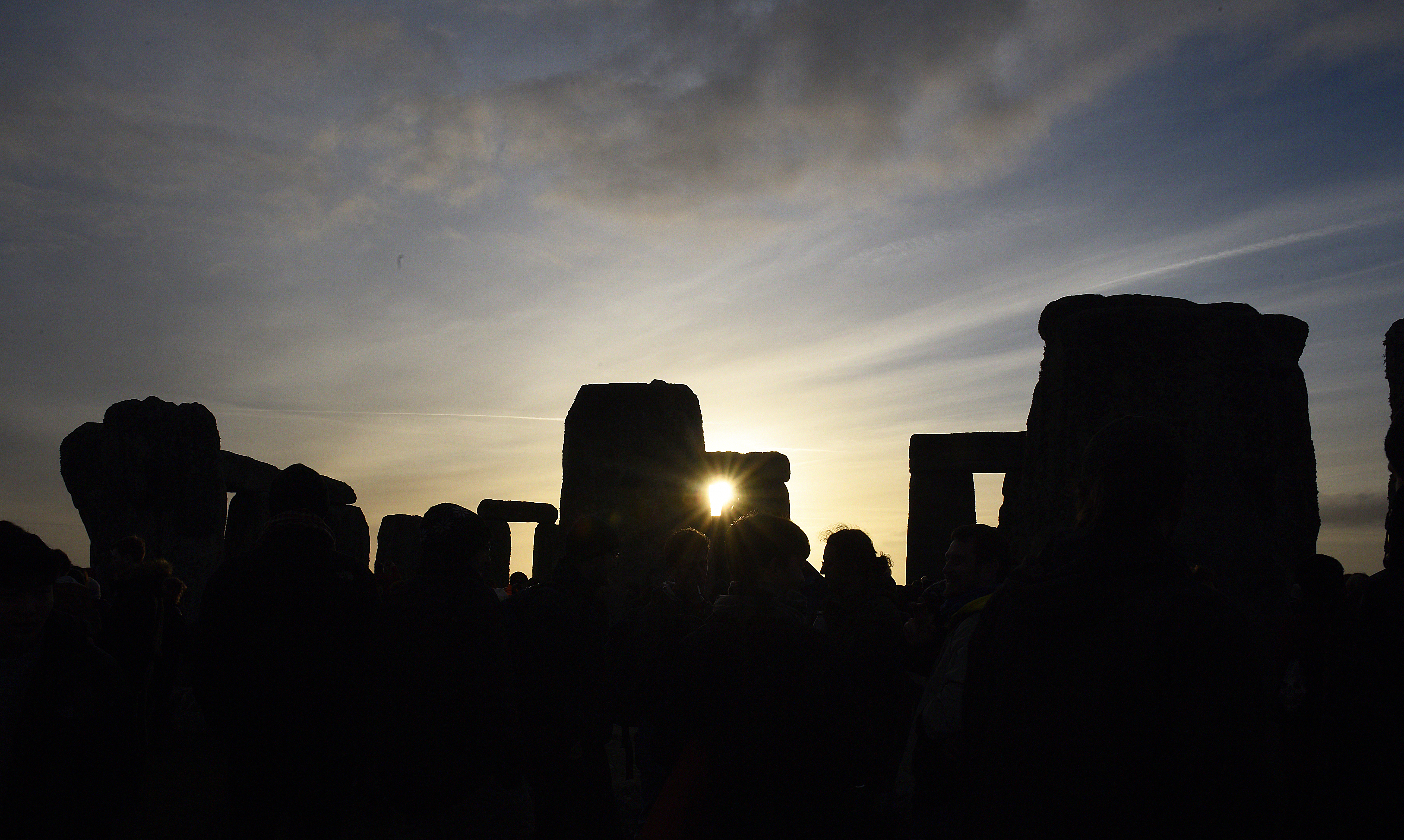
Stonehenge. Photo by Madeline Herzog, couresy of Wikimedia.
“What we’re seeing here,” he said, “is the religion of the stone age made manifest in the ground. Obviously we have no understanding of precisely what any of it meant, but the fact that time and again over thousands of years, people are coming back [here] to build and re-build and mark and re-mark this set of substantial events–it gives us an indication that this is religion. This is how they are understanding their place in the cosmos, what their deities are.”
What earth-shaking news can the rest of the world offer?
Vatican City: You–or at least I–don’t think of popes as having to wrestle with bank accounts and their bureaucracies, but when Leo was be-poped he had to change the address and phone number on his bank account, just the way ordinary mortals do.
No problem. He called the customer service line, got through the security questions, and explained what he wanted.
“Oh, I’m sorry, sir. It says here you have to come in person,” the bank’s representative said–or at least that’s the sparkling bit of dialogue that’s been passed down to us and is now fourteenth hand.
That was a problem, he explained–or so I imagine. The article I’m relying on simply says he begged and pleaded.
Eventually he said, “Would it matter to you if I told you I’m Pope Leo?”
The woman on the other end of the line hung up on him.
I can’t help thinking she turned to the call-center worker next to her and said, “Now I’ve heard it all.”
And they had a short, knowing, and mildly hysterical laugh.
South Africa: In April, South Africa opened a draft AI policy for public discussion, which is admirably democratic. The goal was for South Africa to lead the continent in tackling the ethical, social, and economic issues that artificial intelligence raises.
Then they withdrew it. It turned out, it–or parts of it–had been written by artificial intelligence. Which had tossed in its standard quota of nonexistent sources.
Everywhere: If innocence was ever alive, it’s now dead. You know that game where people search for Pokemon figures out in the real world, then capture them on their phones? I don’t know what good it does them, but I do know people who’ve gotten pretty worked up about it.
Harmless, right? The captures are virtual and the critters aren’t real.
Sorry, nothing’s harmless. A 2021 update (the original game was released in 2016) gave users in-game goodies for scanning their real-world locations. They had to sign in to get the new version, but hey, in-game goodies, you know? Who could turn ‘em down, and how many of us read the fine print anyway when we sign up for something? In the early days of online check-the-box-that-says-you-read-the-terms-and-conditions, someone did an experiment asking people to sign away their first-born child and agree to several other things that are generally frowned upon, and they signed. Of course they signed. For all I know I did too. Life’s too short to read that shit, and trust me, none of it is written in a way that begs to be read.
So what happened to the data of people who wanted Pokemon’s in-game goodies?
Initially, nothing. The company collected it and sat on it. Then the gaming division went into a partnership with Vantor, “a company that specialises in spatial detection software for drones, including those used by some militaries,” according to the article I’m leaning on. There was a sale in there somewhere but it doesn’t seem to matter particularly.
“The partnership addresses a critical vulnerability in modern operations.” according to the company. “GPS unavailability, spoofing, interference, and jamming. When satellite signals are compromised, autonomous systems and field teams lose their ability to orient, coordinate or maintain accurate situational awareness.”
I’ll take a guess at translating that: our drones lose their ability to kill people, but with this new technology they can find their own way. Isn’t progress wonderful?
To be fair, they may do stuff other than kill people, but once I get “kill people” in my head, it’s hard to focus on the smaller stuff.
It all gets more than a little creepy, given that we started out with kids virtually capturing cartoon creatures that were invisible in the real world and we end up with–again, this is my guess–bombs falling on real people.
But it’s okay, because “AR Scans collected through Pokémon Go were submitted voluntarily by players who opted into the feature and were subject to the applicable Terms of Service and Privacy Policy at the time.”
Which makes it okay.

