
If you want to rub elbows with the mystique of British history, you’ll want to explore either a castle or a stately home, also known as a great house. But castles are battered old things these days–they’ve had a rough few centuries–and what’s worse they were never any match for Walt Disney’s imagining of a castle, so for this post let’s stick with stately homes.
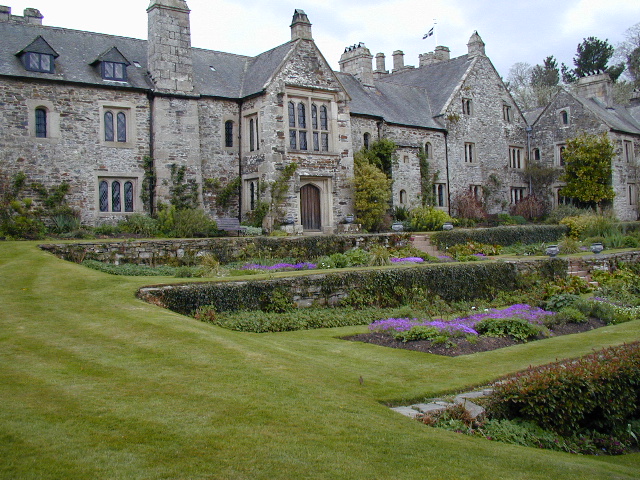
Cotehele House, Cornwall. Compliments of Wikimedia, Attribution-ShareAlike 2.0 license., whatever that means.
The rise
What we’re really talking about when we talk about a great house is an unfortified home fit for a feudal lord. This dates back to the Tudor era, when it became safe for lords to plant themselves and their families in the kind of house where the neighbors could walk up and ring the doorbell. No moats, no battlements. In fact, no doorbells. They hadn’t been invented yet. And I’m not sure about the neighbors, at least not the kind who could knock on the door. That kind of familiarity would’ve been reserved for equals, who wouldn’t have lived next door. Feudal lords had land–estates, thank you very much–surrounding their houses, or formerly their castles. You couldn’t pack them in side by each. The system demanded that they be spread around the country.
Living in an unfortified house was new, even daring, and no doubt more comfortable. But the country looked stable, so out from behind their battlements the lords crept. Which should serve as a reminder that stability is relative and that no one can see what’s coming next.
More great houses were added to England’s collection when Henry VIII confiscated the monasteries. Ever wonder about the word abbey in Jane Austen’s Northanger Abbey? It would’ve once been–yes indeed, folks–an abbey. Ditto Downton Abbey. Fictional ones, admittedly, but still.
By the time we get to Elizabeth I, it was no longer enough just to have a grand unfortified house. If you had the land and the money and a need to play with the big kids, you had to have an architect design you a house so grand it would make both your name and his own (and yes, it would’ve been a his). They were called prodigy homes, and apparently they still are, although I never ran into the phrase until just now.
These were about luxury, style, expense.
Skip to Charles I and we find the high and mighty throwing around words like neo-classical, Palladian, baroque, English baroque. Don’t worry about what they mean. Throw them into a sentence and you’ll sound like you know something.
The ultra-rich aren’t the only people trying to impress.
After Charles I, England stumbled, all unprepared, into the Civil War and discovered that those fortified homes still had a use. Some of them were still occupied, or occupiable, and some of them, even today, have bullet holes in the outer walls to demonstrate the uses they were put to.
The country house
By the late 18th and early 19th centuries, a new class was lusting after stately homes–or country houses if you like. Fortunes were being made in trade, in banking, in industry, in slavery. They needed houses to match their money.
Yes, dears, all those slave-related businesses–tobacco, sugar, cotton, the slave trade itself–were the basis of many a British fortune and of many a mansion that modern visitors pay to admire. (We’ll get to that.) In some of them, the captions telling the house’s history will acknowledge those origins, but boy was there ever shouting and finger-wagging when it was first done.
History was so much nicer when we didn’t talk about that stuff.
At the time, though, slavery and the money it produced were respectable. The monarchy itself invested. You can’t get more respectable than that. The non-respectable ways to make money were in industry and trade. They weren’t quite the equivalent of today’s drug money, but they were a reason for the old money to look down on the new.
So what would you do if you were one of the newly rich? You’d buy land, because land is what old money has. Land is respectable. And you build some huge country house or renovate one, and you try to outdo everybody else who has a country house. The old money will still look down at you but if you’re rich enough and your house is grand enough–and in good enough taste–it won’t turn down your invitations.
Probably.
Before long, it may even marry one or two of its kids to one or two of yours, trading a title for some cash, because new money’s raking in the cash and the aristocracy is struggling. It might even marry off a kid or two to the offspring of some no-name American tycoon.
I’m not sure which was more desperate, marrying an American or marrying the offspring of an industrialist, but it doesn’t matter. They were both signs of the times and ways the economy was shifting.
Ideally, whether you’re old money or new, you’ll have a place in London as well as one in the country. The country one–the great house–will be for hunting, fishing, shooting (which isn’t the same as hunting but something ends up dead all the same); it’ll be for hosting parties and escaping the noise and grit of London. When the family’s in residence, the great and the grand can spend their time visiting each other’s houses and either envying them or thinking how much better theirs is.
The economics of the great house
Ah, but all those grand homes were expensive, not just to design and build and expand and furnish but to run. You needed a staff to go with the house–a big staff: people to cook and clean and garden and serve, to buttle and to maid and to shine the shoes and groom the horses. You needed people to stand around in expensive uniforms looking necessary. And if Historic UK’s to be believed (the link’s above), those big staffs tied a great house into the area’s economy, because when times were hard (and that would’ve been often, or possibly always) great houses provided relatively good jobs–jobs that kept a roof over a servant’s head and food on the table, which was (again, according to Historic UK) the definition of a good job. That tells us a more about how hard times were than about how good the jobs were. English Heritage is less rosy about working in the great houses, and that’s a better match for what I’ve read elsewhere.
Either way, a great house could easily need an indoor staff of 20 and an outdoor staff to match. Those lawns don’t mow themselves, you know.
But a country estate wasn’t just for show. Even as late as the Victorian age (1837-1901; you’re welcome), it could bring its owner a good income, which added considerably to its appeal. It might be mortgaged up to the windowsills to provide dowries, pay off debts, or fund the ludicrous lifestyle that went with it, but if farm prices stayed steady and money kept coming in, the dance could go on.
Until, of course, it didn’t.
From 1815 to 1846 the Corn Laws kept the price of grain high. (Of course you want to know all about the Corn Laws, and for that I refer you to that non-expert, myself. In the meantime, though, let’s settle for a sentence: imported grain would’ve been cheaper than domestic if the Corn Laws hadn’t added a big whackin’ tariff to the imported stuff. That worked well for the people who were selling grain, in this case the owners of those grand estates. But it left the poor hungry–literally–and sometimes starving. Since–you won’t have noticed this, I’m sure–things that benefit the rich are hard to overturn, it took decades of rioting, lobbying, advocating, and assorted other forms of political action to get rid of them.
Prices didn’t do an immediate nosedive after the Corn Laws were repealed, but by the 1870s and ‘80s, with railroads in the Americas carrying wheat to ports, where it could be shipped, they did fall, and between 1870 and 1900, British food prices dropped by half. For the vast majority of people, and especially for anyone overly familiar with hunger, this was great news. For the owners of those vast estates, it was disastrous. Yes, they were rich, but not so rich that they could lose part of their income.
And to make it worse, when the estates’ income went down, so did the value of the land.
If an owner had mortgaged the place, if he was careless about his bookkeeping or his spending, if any one of several other things had happened, he’d find himself selling, say, his art collection to fund his estate. Or his first editions. Or his whole damn property, and someone richer and less indebted would buy it up. Or some public (which, of course means private) school would. Or possibly no one would and the place would end up being torn down, because the land was worth more than the building.
C’mon folks, let’s have a bit of feeling here for the hardships of the formerly immensely rich.
To complete the picture, estate and property taxes started going up in the 1880s.
The twentieth century
Then World War I began and those wonderful jobs in country houses (if indeed they ever were wonderful) were no longer the only jobs on offer. Young young men left for the war, some willingly and some because they were drafted. Women left for factory jobs, which were not only better paid but had predictable hours and allowed for a less restrictive, more independent life.
After the war, not many people came knocking on the (back) door asking if their old jobs were still open. The upper class had to make do with a reduced staff and had to (gasp) offer better pay to those who remained. They talked about “the servant problem.” Even now, “Just can’t get the staff these days” is a standing joke. It gets a sour sort of laugh–or at least that’s how I hear it, foreigner that I am.
In the 1920s and ‘30s, more country houses were sold off or demolished.
During World War II, some were requisitioned to be used as hospitals, military headquarters, supply depots, you name it. At the end of the war, they were handed back, not necessarily in good shape.
In 1945, a Labour government was elected and got to work crafting a welfare state in a country that the war had pretty well bankrupted. Taxes went up on country estates.The coal industry was nationalized, cutting off the income some owners had gotten from coal rents. Even where an estate was still making a profit, its owners didn’t necessarily want to pour money into the house itself–or live there, for that matter.
It’s at this point that the nation began to see the great houses as a bit (a large and expensive bit) of its history, which should be preserved, so heirs who couldn’t pay the inheritance tax could hand over land and houses to the treasury instead, ridding them of an expensive and now useless inheritance. Assorted nonprofit organizations were set up to restore and maintain them and open them to the (paying) public.
Stately homes have turned out to be profitable. Visitors pay to wander through to gawp (I’ve done it myself), to disapprove, or to wish themselves back to that era, forgetting how few of us would be playing billiards instead of shining shoes. Then they (that’s the visitors in case you’ve lost track) move on to buy sandwiches, tea, cakes, maybe scones, sitting at tables in the courtyard and hoping it doesn’t rain. They stop at the gift shop and buy china teacups, nicely packaged candies, walking sticks. It all adds up to a successful enough business model that privately owned houses have followed the pattern.
To round out the picture, some great houses have been turned into hotels, schools, wedding venues, and before this all sounds like too much fun, nursing homes.

