
Let’s start in the Neolithic Period–the New Stone Age, around 4,000 BCE–because that’s when my alarm clock woke me up this morning. By the time I got myself and the cats fed, it was 3,000 BCE and time to feed the dog. More to the point, though, Britons had started building Stonehenge and we’re going to draw heavily on the archeology of the place.
Why Stonehenge? Because at nearby Durrington Walls archeologists have found a settlement from the same period where people gathered and feasted and left all sorts of clues to what they were eating.
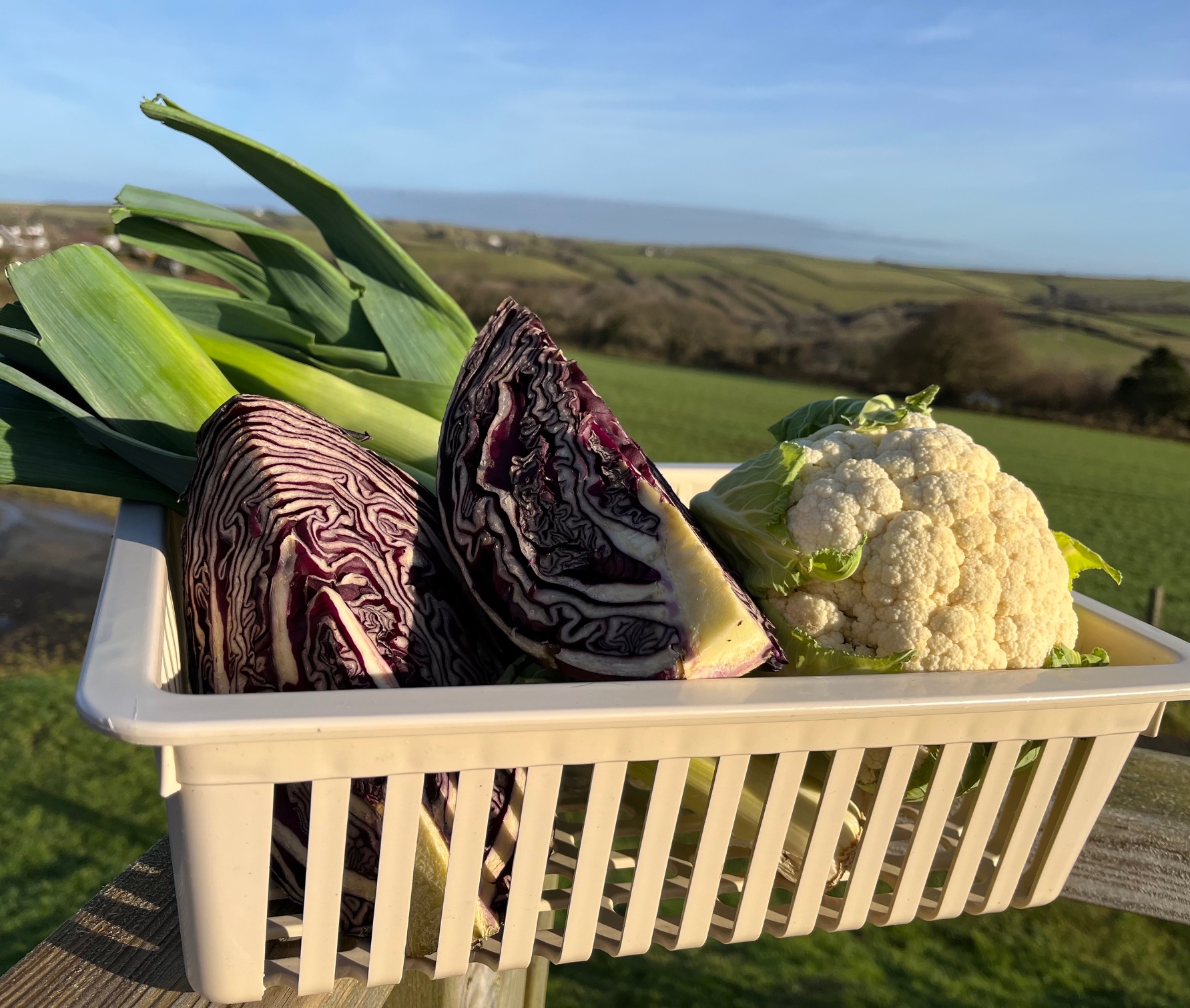
A very rare relevant photo: This, my friends, is food, although not Neolithic. The leeks (at the back) are grown in Cornwall. I can’t vouch for the others but there’s a good chance the cauliflower was as well. The red cabbage? Possibly. The plastic box? Not edible.
The Mesolithic and Neolithic eras
In the Mesolithic Era–the Middle Stone Age–people were hunting and fishing and gathering, as they continued to do in the Neolithic. So they ate meat, fishy-type things, roots, leaves, mushrooms, fruit, and whatever was available and not poisonous.
Even then they knew that poisonous was bad. The probably knew it better than we do.
But once they got to the shiny New Stone Age, not the boring old middle one, people had domestic animals (they were brought to Britain from Europe–or what would later be called Europe). So Britons were raising sheep, cattle, and pigs, and they were growing wheat and barley. They could add all that to whatever they hunted, fished, and foraged.
The official date for the beginning of farming in Britain is 4,000 BCE, and it marks the beginning of the Neolithic, although some enterprising soul found evidence of wheat being in Britain a couple of thousand years earlier. The current best guess is that it was brought by traders and not farmed locally. What’s now the English Channel was still land, so Britain was attached to Europe and people wouldn’t have had to get their feet wet to drop by the neighbors’ place with a sack or two of wheat.
Okay, we don’t know what happened. All we know is that some has been found. Have fun making up your own story. The rest of us can go back–forward, actually–to the Neolithic.
At Durrington Walls, archeologists have found some 38,000 discarded bones, which came from at least 1,000 animals. Some 90% are pig bones, most of the rest are cattle. By analyzing the bones and teeth they’ve put together a picture of what happened there, and they don’t indicated year-round eating. Many of the pigs were slaughtered when they were around 9 months old, and since they would’ve been born in the spring that indicates midwinter eating. This fits with Stonehenge’s alignment with the midwinter (and midsummer) sun. Ditto with the alignment of timber monuments at Durrington Walls itself.
Meat was left on many of the bones, indicating an abundance of food. This was feasting, not everyday eating.
The animals weren’t raised locally. Some came from Wales, some from Scotland, some from northern England. I’m not sure that’s the full list.
What else would they have eaten? These were people who raised grain but not on a large scale. They’d have also gathered wild plants and hunted. Milk products would’ve been part of their diet–about a quarter of the pottery fragments show evidence of dairy products–although they would mostly have been processed ones, not milk itself, since the people were lactose intolerant: they couldn’t digest unprocessed milk. They’d have made the milk into cheese, yogurt, and butter, and there’s some evidence of milk in one of the timber circles, so it may have been an offering to the god of milk digestion, which is why we can now buy lactose-free milk in the supermarkets.
Don’t put too much weight on the last part of that sentence, okay? I made it up and I’ve learned not to take anything for granted.
It’s easier to find evidence of the meat people ate than the fruit and veg, which don’t leave bones behind. That may be why the myth of a meat-heavy paleo diet caught on. It’s also why that part of the discussion is sketchy.
Moving on
By the time we get to the Bronze Age (that’s 2200 to 800 BCE, give or take a few hundred years on either side), people were growing a wider range of crops. We can add peas, beans, and spelt (a form of wheat) to both their fields and their menus. People were crystalizing salt from seawater. And at least those who could afford to would’ve had metal cooking pots.
Once we move into the Iron Age, which runs from the end of the Bronze Age until the Romans invade in 43 CE, we–or, more accurately, those clever archeologists–find the first chicken bones in Britain.
For most people, though, grain–wheat and barley–would probably have made up the bulk of their diet, so figure bread, porridge, beer. Add to that–and this is my addition; I can’t quote a source for it–whatever they could pull out of the water or off the land: fruits, nuts, leaves, flowers, tubers, fish, and game. But don’t forget the beer. This is England we’re talking about. The earliest evidence of beer is from 400 BCE.
The general assumption is that the Roman invasion brought wine and grape vines to Britain, but amphorae–those Roman jars with pointy bases–have been found at some late Iron Age sites, suggesting that wine and olive oil were imported earlier than that. More than one British tribe traded with the Romans.
The Roman invasion
The Romans brought rabbits, pheasants, brown hare, dates, cabbages, leeks, onions, turnips, grapes, walnuts, garlic, pepper,basil, thyme, and other goodies to Britain.
Wait, though. Thyme grows wild here, and if you ask Lord Google if it’s native he’ll say yes. Ask if it was imported by the Romans and he’ll say yes again. Ask if he’s contradicting himself and he’ll stop speaking to you. My best guess is that yes it was imported and then yes, it went wild. That makes it sort of native.
Actually, what does native mean? How far back do you want to go? Think about it long enough and your mind will melt. Leeks are native enough that they’re a national plant of Wales. The story is that King Cadwallader had his soldiers tuck a leek in their helmets so they could identify each other when they fought the Saxons. Since the average modern leek weighs a third of a pound (that’s 150 grams; Lord Google knows stuff like that and if he’s still speaking to you is happy to share), it’s a safe bet that the leeks of the time were smaller, lighter, and less absurd when worn in a helmet.
(In the version I found when tracing leeks via Wales instead of via England, Phoenician traders introduced them. The Romans don’t get a mention. It’s all a little hazy if you go back far enough.)
You won’t get the full list of foods the Romans introduced here–there were more than 50 and I can’t count that high–but others include Alexanders (a forerunner of celery which has also gone wild), figs, apples, pears, cherries, cucumbers, lentils, dill, and fennel. And edible dormice, which they, um, ate. (The hazel dormouse is native to Britain–whatever native means.)
Some of these foods would have made their way to Britain with traders before the invasion, but the pace would have picked up once you had Roman soldiers and administrators on the island, along with whatever other Romans came in their wake and the Britons who adopted Roman ways.
The Middle Ages
The next big bump in food diversity comes in the Middle Ages, when the Crusades brought Europe smashing into the Middle East. The new foods included sugar, dates, raisins, figs, pepper,cinnamon, cloves, nutmeg, ginger, saffron, cardamom, coriander, cumin, garlic, turmeric, mace, anise, caraway, and mustard. Some of those had come over with the Romans and, presumably, dropped out of use when the Romans packed up and left.
Spices and sugar were the wildest of luxuries and not for the likes of us. Most or all the novelties stayed on the tables of the elite. Grain was the mainstay of peasants’ diet. Look around the internet and you’ll get the usual raft of contradictory information, but leeks and cabbage get a mention. Meat was probably rare. Hunting was restricted to the aristocracy, and often fishing as well. They would probably have still been able to forage wild berries and leaves–and possibly nuts. It would’ve all been regulated by local feudal arrangements.
And after that
Domesticated (as opposed to wild) carrots wandered into England in the Tudor era. Wild carrots are edible but woody. The seeds and flower heads are also edible but the plant’s easy to mistake for poisonous things like hemlock, so don’t try this at home, kids.
The Tudor era (1485 – 1603; you’re welcome) also brought turkeys, or at least the first record of them being raised here. It also brought potatoes, cauliflower, tomatoes, and rice. The tomato was treated with suspicion for a couple of hundred years–it was poisonous; it wasn’t poisonous but was best eaten in hot climates; it would kill aristocrats.
That belief about tomatoes killing aristocrats didn’t arise because tomatoes are the stereotype of the wild-eyed anarchist. It came from the action of a tomato on a pewter plate: the acid in the fruit will leach out the lead, giving the eater lead poisoning. When I read that, I was prepared to argue that the aristocracy used silver plates and it was only lower down the scale that you found pewter, but (annoyingly) I seem to have been wrong.
The first description of red cabbage in England dates to 1570. A couple of sites I find credit the Romans for introducing it to Europe in (are you sitting down?) the 14th century. I’ve found white cabbage being credited to both the Romans and the Celts. I’m sure there’s someone out there who credits interplanetary explorers with its spread across the galaxy.
The internet’s a strange old place. Let’s move on.
Pineapples were introduced in 1600 but weren’t cultivated in Britain until 1700. (They’re not a great fit for the climate.) They were very much a prestige item for the upper class. Coffee and tea were introduced in the 1600s, giving insomniacs something to blame in the middle of the night. Instant coffee was invented in Britain, by the way, in 1771. It has been improved and reformulated in multiple countries and decades and still tastes terrible.
Broccoli joined the party in 1700, chocolate bars in 1847, and canned baked beans in 1886. Or 1869. Who cares? They were hyped as a luxury and sold by Fortnum & Mason for £2 a can–the equivalent of £170 in 2019 pounds. If you need that in US dollars, it’s a lot of money. By 1924, the price had settled down to 12 shillings–the equivalent of £25. Yeah, I know. Baked beans. The hype may explain the central place they still hold in British hearts and stomachs.
Something has to.
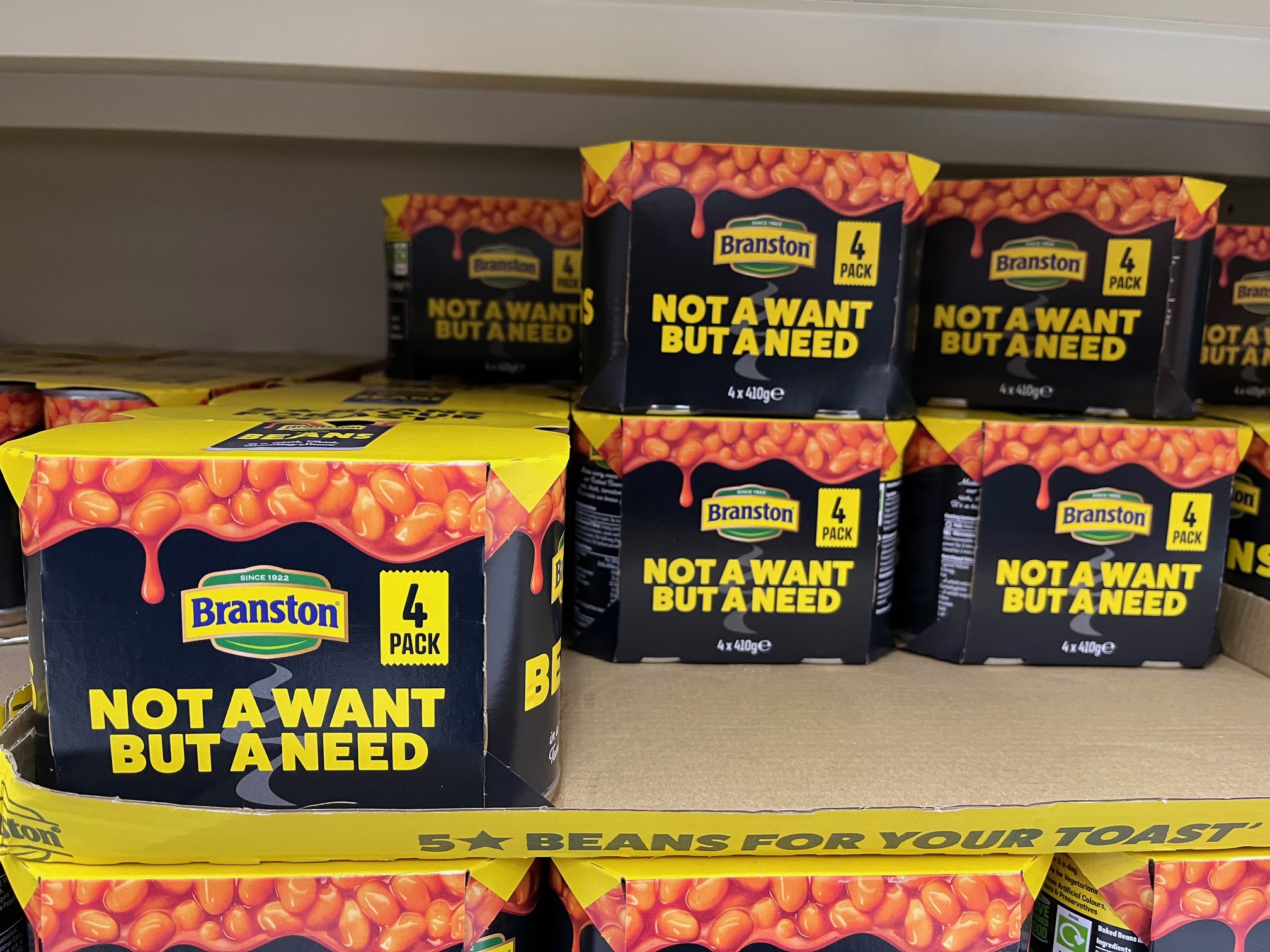
I don’t usually post more than one photo, but I was afraid you wouldn’t believe me about baked beans. Look at that label: “not a want but a need.”
Food was rationed during World War II, and rationing lasted until 1954. That may or may not be where Britain got its reputation for bland, repetitive, snoozeworthy food, but it certainly helped. On the other hand, people’s diets were healthier than they are today, if a lot less fun, and the poor ate better than they had before rationing.
When rationing was lifted, burger bars opened around the country, selling hamburgers and milkshakes. Chinese restaurants opened, followed by Indian ones. (Keep complaining about immigration, people. It’s brought the wonders of the world to your doorstep.)
You’ll notice that we’ve shifted from what’s grown and what’s cooked at home to food cooked outside the home. The 1950s mark the beginning of eating out being fairly common.
Spaghetti landed in Britain in the 19th century and was ignored until the 1960s, when it became the height of sophistication. It was rare enough that the BBC got away with an April Fool’s Day spoof documentary on the spaghetti harvest, showing a family cutting strands of spaghetti from bushes and laying them in the sun to dry. Not a few people got in touch to ask where they could buy spaghetti a bush.
Which seems like a good place to leave you. Be respectful of your spaghetti, please. A lot of work went into picking it.

 Notes from the U.K.