Unknown's avatar

About Ellen Hawley

Fiction writer and blogger, living in Cornwall.

How to eliminate Covid, and other pandemic news


Academics at the University of Otago studied New Zealand’s experience with Covid and say that the virus can be eliminated, not just contained. 

The emergence of an apparently more infectious virus variant is just another reason to eliminate this infection,” they said

Actually only one of them said it, but let’s pretend, for the sake of simplicity, that they spoke in unison. They do stuff like that in New Zealand. 

What you need if you’re going to eliminate the virus, they said, is informed input from scientists, political commitment, sufficient public health infrastructure, public engagement and trust, and a safety net to support vulnerable populations. 

Those will be easier to cobble together in some countries than in others. That’s me speaking in unison and not mentioning any countries by name. To protect the guilty. 

Irrelevant photo: Crocuses. They’ll be coming up soon, and they’re not afraid of the corona virus.

One of the barriers to eliminating the virus is the belief that hard measures will hurt the economy more than half measures, causing greater hardship, which (as advocates of half-measures reminded us at the start of this mess) has its own health impacts.

“Our preliminary analysis suggests that the opposite is true,” the academics said. “Countries following an elimination strategy—notably China, Taiwan, Australia and New Zealand—have suffered less economically than countries with suppression goals.”

The introduction of vaccines should make elimination easier.


Antibody therapy

Scientists are testing an antibody therapy that could prevent someone who’s been exposed to Covid from going on to develop it. It could, at least initially, contain outbreaks–in nursing homes, hospitals, or universities, say–or protect people in households where one person is known to be infected. They’re also investigating the possibility that it could protect people with compromised immune systems. 

If all goes well–please notice the if in that sentence–it could be available in March or April.

The Pfizer and Oxford vaccines don’t confer immunity for about a month after injection. With this, the immunity would be immediate.

It goes by the snappy name of AZD7442. 


Mass testing evaluated

Britain tried a mass testing program in Liverpool, using rapid-result Covid tests, and managed to miss over half the cases. 

So was it worth doing?

A study went through the data and came back with a definitive maybe. In this corner, wearing the electric pink tee shirt that says No, is the danger presented by false negatives. People who test negative but in reality carry the virus may be prone to riskier behavior than people who haven’t been given any reassurance. They think they present no threat, so they may spread the disease more.

And in this other corner, wearing the soothing green tee shirt that says Yes, is the benefit that comes with spotting Covid cases that would have been missed and taking those people out of circulation. Assuming, of course, that they actually do take themselves out of circulation, which most of them will. 

I think.

The Liverpool data hint that the test may spot people with the highest viral load–in other words, people who may be the most infectious–while missing those least likely to be infectious. But you might want to notice how many tentative words wiggled their way into that sentence. It hasn’t been established that a light viral load means you’re less infectious. 

People who are asymptomatic, by the way, can still have a high viral load, and an estimated 40% to 45% of cases are asymptomatic.

So is mass testing with rapid tests worth doing? It’s a matter of weighing the possible gain (spotting cases that would otherwise have been invisible) against the possible harm (giving false reassurance to people who are in fact carriers). And it depends on that unknown: how contagious people with low viral loads turn out to be.

Whatever it is you come here for–and that’s still a mystery to me–it’s not rock-solid certainty, is it?


The compassion report

With a show of compassion worthy of the current American and British governments, Colombia’s president announced that the country will refuse Covid vaccines to hundreds of thousands of Venezuelan refugees. The only refugees who’ll have access to the vaccine are those with dual citizenship or official status. That’s less than half of them, and more are crossing the border daily.

The idea that no one will be safe until we all are is a hard one to get across. As will that business the academics from Otago mentioned–political commitment. 

*

A bookstore in Trieste asked for volunteers to call people trapped at home by the virus and spend twenty minutes at a time reading to them over the phone and just generally chatting. They figured they’d be doing well if they found a few people to help out the three staff members who were already doing making calls during their breaks and on their days off.

They got 150 responses. Some were from Italians living abroad. Some came from a theater company that had itself been trapped by the pandemic–not at home but offstage. Some were I have no idea who–people who don’t fall into such neat categories. The plan was to have the calling run during Christmas, but with the response it’s gotten it now has no end date.

*

An Amsterdam museum that sold a Banksy work for £1.5 million so that it wouldn’t have to lay off staff had a bit of compassion and goodwill returned to it. The anonymous buyer emailed a few months later and offered to lend it to the museum for at least a year.

Starling murmurations

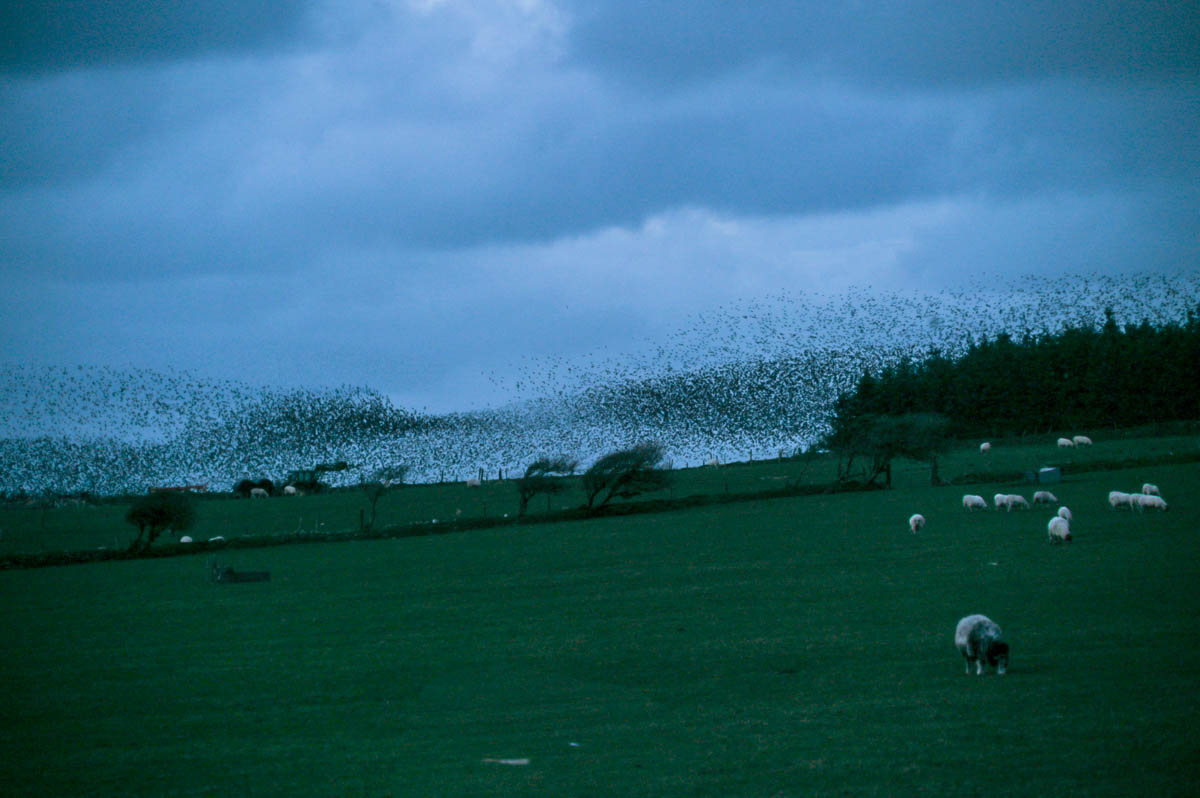
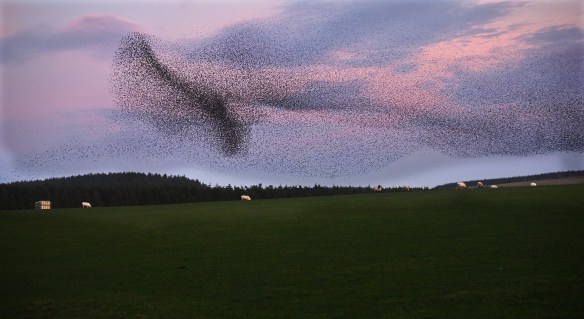
Whatever your holiday, if you have one just now, join me in celebrating the amazing things that starlings do at this time of year.

Photos by Ida Swearingen.

Starlings gather at dusk and if the conditions are right they create amazing airborne patterns before they settle into the trees and roost together. The roosting’s for safety, for warmth, and (the experts swear) to exchange information on where the good food is. The murmurations may be to confuse predators.

Starlings also gather for shorter times during the day, condensing onto power lines, where they pack themselves together wing to feather. So tightly, in fact, that they’ve caused the occasional power outage in the Scottish town of Airth. So many gathered on the lines, and they settled and took off in such a mass, that their weight made the wires bounce, shutting down the power, sometimes for seconds and sometimes longer.

The new Covid variant, plus what Britain does during lockdown

Newscasters and British government briefings are sounding increasingly sure that the new Covid strain is more contagious than earlier versions. And it may turn out to be, but not all scientists are ready to jump on the bandwagon–especially when it’s steered by a government that outsources navigation to companies with expertise in collecting overdue parking fines. 

An article in Science magazine says that getting definitive answers could take months. What we have right now are possibilities and probabilities.


What’s known so far

A couple of things are known at this point. One is that the new variant is out-spreading the old ones. That could be because it spreads more effectively but it could also be because it got lucky: It found a cooperative human host, who introduced it to another cooperative host, who introduced it to a few thousand of his or her closest friends, who and so-forth’d, and before anyone had time to roast the brussels sprouts for Christmas the new strain was all over southeastern England. 

Virology professor Mark Harris, of Leeds University, said. “Unfortunately, the new variant has also become a political football.  It is being blamed by this Government for the rapid spread of the virus in London and the South-East – this is a smokescreen to distract from the failure to put these areas into Tier 3 after the national lockdown. . . .  The potential . . . [for this virus to spread through] communal activities is enormous and the rapid increase in cases of the new variant are a direct consequence.  We need to learn from the lessons of the past year and recognise that by delaying and failing to act decisively our efforts to control the pandemic are less effective, and ultimately lives are at risk.”  

The other thing that’s known is that some of the changes in the new variant are worrying. Like all viruses, Covid evolves, but it’s been known for evolving fairly slowly, making one or two changes a month. Then along comes this new strain carrying seventeen mutations, and at least from where we stand they seem to have popped up all at once.

Irrelevant photo: A camellia. The earliest ones are just now coming out.

Not only do the number of changes worry the scientists, so do their locations. Eight of them are on the spike protein, which is the key the virus uses to break into the human apartment, raid the refrigerator, move the furniture, play loud music, and then raise a family. The changes look like they could make it easier for the virus to break in, but that needs to be confirmed. 

Or to use that famous American (I think) saying, the opera ain’t over till the fat lady sings, and she’s off in the wings, having a good sulk. She hasn’t even bothered to warm up yet.


What’s theorized

There’s speculation that the variant may be able to infect children, but that’s not clear yet. What we have at this point are hints, with no solid evidence. On the other hand, if you want to scare yourself shitless, this is good material. 

A theory on how the variant came to be holds that it could have evolved within a single patient who had a long infection, but at this point it’s just a guess.

As for where it was born, it didn’t necessarily originate in Britain. Britain’s one of a very few countries that sequences a lot of its viral samples. That translates to it being one of the countries most likely to spot a new variant, but it’s been found in other countries. One patient in the Netherlands had it in early December, and it’s been found in Denmark, Australia, and Italy. Belgium recorded four cases early in December. By the time I post this, it will probably have been spotted waiting for the train from Berne to, um, wherever trains from Berne go to. Let’s say Rome. All roads lead to Rome. Surely that includes railroads.

Finding a few (as opposed to many) cases in other countries may (or may not) be evidence that it doesn’t spread as rapidly as advertised. On the other hand, it may simply be evidence of what we (by which, of course, I mean I) already said, that Britain is ahead of most countries on identifying variants. 

Data’s a wonderful thing. Interpreting it is a bitch.

A similar variant seems to have evolved separately in South Africa. That gives some support to the possibility that the mutations give the virus a transmission advantage–or so I’ve read, although unfortunately the article didn’t explain why.


So what does it all mean, bartender?

I am emphatically not arguing that the new variant doesn’t spread more quickly or that any conspiracies are being built to claim that it does. (Was that a simple double negative or an implied triple one?) All I’m saying is that commonly held belief seems to have jumped ahead of the science. We have some numbers on infection rates and we have a spike protein with a fashionable new haircut. They’re worrying, especially in combination. But we don’t have the lab work to confirm the conclusions people are drawing.

I could wish the government and the scientists who appear at its briefings would say this, but I expect they think we need clarity. And since the government, at least, hasn’t been clear on anything else I can see why they might want to sink their teeth into this and shake it until it’s in shreds.

And if apparent certainty moves the government to react more decisively to the virus’s spread, that can only be a good thing. It’s a shock to find myself agreeing with anything this government does–I’ll try not to make a habit of it–but if we’re looking at even the possibility of a more aggressively spreading variant, I don’t want them sitting around saying, “Well, let’s wait and see what happens.” 

Call that one wrong and people die.

People die anyway. But I think we’d all like as few of them as possible, thanks.


What about vaccines?

So far, the virus hasn’t moved itself outside the reach of vaccines, but BioNTech says that if that happens it could tweak its vaccine within six weeks and catch up with a new strain. 


And irrelevantly but importantly . . .

Researchers in Australia have documented Covid immunity eight months after an infection. No one knows yet how long immunity lasts, but the documented time keeps getting longer. 


And even more irrelevantly, do you know what Britons did during the last lockdown?

Given the data we have–

You remember I said (more or less) that it’s all about how you interpret your data? Well, the data we have is about food and drink, and it says we can forget all those pre-pandemic trends toward plant-based eating and healthy whatevering. Britain spent an extra £2.5 billion buying beer, wine, hard liquor (in case you think the other kinds are soft), and meat. And also tobacco–both cigarettes and roll-your-owns. 

At the top of the list was lager, but Corona beer didn’t do badly either, from which we can infer, deduce, or at least allege that the virus hasn’t affected the famously skewed British sense of humor.

Some of the expenditure can be explained by people not being able to buy drinks at the pub or duty-free wine and tobacco on trips abroad, so they may or may not have consumed more of all those things but just bought it in different places. We don’t want to jump to conclusions–at least not when they’re not any fun (she said, reveling in another double negative).

On the other side of the scales, people spent less money on prefab meals. They were suddenly rich in time, so they cooked more. They bought less bottled water and chewing gum. They spent less on cosmetics, hairstyling products, toothbrushes, and deodorants. 

I fed all of that through the invisible data interpreter that I keep on the other end of my couch and it tells me that we’ve become a nation of hard-drinking, bad-smelling cooks.


And finally, things you didn’t know you need to know

A gene that some small number of people inherited from their Neanderthal ancestors may double or even quadruple their risk of serious Covid complications. The genetic risk, though, is much smaller than the risk that comes from social factors like poverty and poor access to health care, to name just two.

On the other hand, another bit of Neanderthal DNA may be protective. It just depends on which particular Neanderthal ancestors you might have had, and what particular bits of genetic material they left you. 

Assuming, of course, that had any Neanderthal ancestors. Most Europeans, Asians, and Native Americans do and walk around sporting some small amount of Neanderthal DNA. Anyone whose ancestors came from other places has none.

Make of that what you will. 

*

And finally, translator Peter Prowse has contributed a video to the worlds’ effort to stamp out the virus. He tells us to stop using those explosive consonants (called plosives–P, T, K, and their troublemaking friends) and replace them with softer ones.

He’s well worth a listen. 

Christmas 2020

The world needs a pandemic carol, and I’m convinced you do as well, and that everyone you know does too. Well, it just so happens that a friend wrote one. With her permission, here it is, direct to you from Duluth, Minnesota.


Christmas 2020
Bring on a brighter year

                        by Jane Whitledge

Hark! The herald angels sing,
We’re tired of social distancing!
What can I say of such a year,
Except “good riddance, disappear!”
Don’t come back with your virus
Now go away,  no more to tire us—
We’re weary of this isolation
Impatient for real celebration!

Each one of us now simply asks,
When will we be done with masks
And gobs of soap and sanitizer?!
Oh, bring good tidings, Moderna, Pfizer!
And though we love you, Dr. Fauci,
We’re really getting kind of grouchy
Standing here six feet apart.
When can the hugs and handshakes start?

Till then we’ll give to the food shelves
And may there be a lot of elves
To aid the little girls and boys                                                                                                  Who fear there won’t be any toys,
And save the fraught small businesses—
May they have future Christmases!
And as we sing bright carol verses
Bless the doctors and the nurses!

And to the scientists—goodwill!
Bless your work, bless your skill!
We’ll string the garland on our tree
With thoughts for others—empathy.
And in this troubled, cold December,
May hardship make us all remember
In pandemic’s darkest weather
That we are in this all together.

And though it be all you can handle,
Go ahead and light a candle.
Stay hopeful, cheerful kind, and clean.
Pretty soon the great vaccine!
So, “Merry Christmas one and all!”
Goodbye to bleach and alcohol
(except for wine, and, yes, champagne,
For when we meet—we will—again!)

May this two-thousand-twenty-one
Put the past year on the run!
And may your heart ring like a bell—
Happy new year! Please stay well!!
May this two-thousand-twenty-one
Put the past year on the run!
And may your heart ring like a bell—
Happy new year! Please stay well!!

© Jane Whitledge, 2020

Whatever you celebrate, I wish you a good one. And may the new year be kinder than this one has.

Santa Shih Tsu wishes you a happy holiday. She also wishes the photographer had moved the trash out of the background before taking her picture. It’s been a bad year when not even Santa gets what she wants.

The new Covid variant and other pandemic news

Remember when Boris Johnson promised Britain a world-beating Covid test system? Or a world-beating something else. It doesn’t matter what it was going to be exactly. What matters is that we were going to beat the world, so take that, world. Well, we seem to have developed a world-beating new strain of Covid. Yay us! It may spread more rapidly than the old ones. Tell me we’re not the envy of the world. Mind you, it also may not transmit more rapidly. That’s still up for grabs. The scientists say they have moderate certainty that it does. But the mutations affect a part of the virus that’s likely to matter. In the lab, it looks like it might set that world-beating speed record.  Notice the multiple wiggle-words there: may, moderate certainty, likely, might. Scientists don’t like to commit themselves in the absence of evidence, bless their white-coated hearts. It’s not time to panic until they finish working on this. What it is is time to be cautious.

Irrelevant photo: heather

What’s known is that the new strain is out-performing other versions of the virus in the southeast of the country. That’s where the world-beating business comes in. Go, Virus! But viruses get lucky sometimes. They’re in the right place at the right time, and it makes them look like champions, but only because they’ve latched onto a set of humans who are particularly helpful. So we don’t know yet if what’s happening is due to the virus or to human behavior.  In the meantime, the sensible thing to do is assume we’ve got a world-beater on our hands and go into deeper lockdown. Which we’re doing, sort of. As of Sunday, the southeast of the country went into lockdown, with socializing limited to Christmas day. I’m simplifying. If you need the details, you either have them already or need to get your news from some sensible source. As I remind myself often when I see some bit of important news that I just can’t wedge in here, I am not a newspaper, I just play one on the internet. So: deeper local lockdown except for Christmas day, and Christmas day, fortunately, is safe: The virus does its celebrating on Christmas eve and it’s too hung over to spread on Christmas day. The lockdown was announced some hours before it took effect, which set off a scramble to get out of London, bequeathing us pictures and videos of socially undistanced trains headed over the river and through the woods to grandmother’s house, bearing tidings of comfort and infection.  I do love a holiday. There’s no evidence that the new strain is more deadly and no indication that the current vaccines won’t work against it, so it’s not time to panic completely. The dangers are that (a) it may spread more rapidly and (b) it may continue to mutate, requiring the vaccines to be tweaked regularly, the way flu vaccines are every year.  But we’re not there yet.  Again, don’t panic. There’s always time to do that later.

*

In the meantime, although it has nothing to do with Covid (except to complicate a bad situation), Santa’s bringing us Brexit, with or without a deal on January 1. The negotiators are still meeting and they’ve got to be sick of hearing each other’s voices by now. A couple of days ago, trucks were backed up for five miles in Kent, trying to reach the Eurotunnel, with similar lines on the other side. And that was not just before Brexit but before France halted freight from Britain in response to the Covid variant.  Covid news snippets  from the rest of the world In a survey, 71% of the US public said they’d either definitely or probably get a Covid vaccine. That’s up from 63% in September. And Covid is now the leading cause of death in the US–equal to fifteen daily plane crashes, with each one carrying 150 people.  Those two statistics might actually be related. But the second one doesn’t include excess deaths–the people who don’t get counted because of reporting delays, miscodings, and non-Covid deaths that are caused by the pandemic’s disruptions. Add those in and the numbers could be as much as 20% higher.

*

Latvia has introduced an automatic Covid testing booth. It eliminates the risk to medical workers who’d otherwise have to test people. A robot arm hands you your vial, you give it your sample, and it gets back to you within 24 hours. I don’t think I ever used the word vial as much as I have this year.

*

A small US study says schools aren’t necessarily a big factor in the spread of Covid, but the small print is says that this depends on everyone wearing masks and keeping six feet apart, and on testing anyone who’s been in contact with anyone who might be infected. That would allow a school to stay open unless there’s an outbreak. So yes, do read the small print.

*

A French study says that socializing, eating out, and going to bars and gyms seem to be more dangerous activities than using public transportation or shopping.  That’s not absolute proof. All they can say is the statistically they’re associated with a greater risk. No one can spot the moment when the virus jumps from one person to the next. Still, it’s worth knowing.

*

A story on Covid and holiday events in Fredericksburg, Texas, included the following quote: “Everyone knows Covid is a risk, but if I want to go lick the handrails at the hospital, that is my God-given right.” If someone could send me the relevant passage from the Bible, I’d be grateful. Not because I run my life by what it says in there, but I really would love to know.

Covid, Christmas, and other pandemic news

After a bit of four-nation arm wrestling, the British government decided to stand by its decision to loosen Covid restrictions for Christmas. Santa Claus, they told us a while back, was bringing everybody the chance to travel around the country and join three households together for up to five days. 

Don’t read the fine print, they said. It’s Christmas. 

Well, Santa hasn’t changed the present he’s bringing but some spoilsport enlarged the small print and now the government’s asking everyone not to actually do what they said we could look forward to doing. That is, we can still do it, they won’t tell us not to, but they’d really appreciate it if we didn’t.

Really, really appreciate it.

The tone of the press conferences has changed from a Santa-ish look-what-I-brought-you to a Pandora-ish don’t-look-inside-the-box.

Government guidance now says, “Think very carefully about the risks of forming a bubble. . . . [A bubble? That’s a  theoretically impermeable group of people that you seal yourself into, sharing love, germs, risk, and a commitment not to so much as turn your thoughts to anyone outside the bubble.] Everybody in a Christmas bubble is responsible for taking clear steps to prevent catching and spreading the virus.” 

If you’ll allow me to translate that for you, it means, If this bubble wheeze doesn’t work, it’s your own silly fault. We thought the British people had better sense than to do what we said would be safe.

Irrelevant photo: A gerbera daisy. Feel uplifted? Good. Now let’s get depressed again.

But we should go back to that four-nation arm wrestling: It’s a particularly British sport involving Wales, Scotland, Northern Ireland, and England. And whatever you’ve heard, four-way arm wrestling is not simple, either physically or politically. See, the British government doesn’t speak for Britain on this issue. It speaks for England, which doesn’t have its own dedicated government, although the other three pieces of the United Kingdom do.

Yeah, I know. It’s complicated, but never mind that for now. 

Wales, speaking for Wales, bailed out of the hoped-for four-nation love fest and issued a narrower set of guidelines. Even so, it expects to need tighter restrictions after the holidays. 

Scotland’s recommending that people stay home, but if they do mix it suggests they mix for only one day, not five. But it’s just a suggestion, not a rule and not a law. 

Northern Ireland’s expecting to tighten the rules after Christmas to make up for whatever Christmas unleashes. 

Assorted experts are holding their aching heads in their hands. For the sake of efficiency, we’ll quote just one, a (very rare) joint BMJ/Health Service Journal editorial, which said, “When the government devised the current plans to allow household mixing over Christmas it had assumed the Covid-19 demand on the NHS would be decreasing. But it is not, it is rising. . . . The government was too slow to introduce restrictions in the spring and again in the autumn. It should now reverse its rash decision to allow household mixing and instead extend the tiers over the five-day Christmas period in order to bring numbers down in the advance of a likely third wave.”

In case anyone wants to know, what I want for Christmas is for the people I love to be alive and well next Christmas. That’s not meant to exclude anyone. If I can be greedy, I’ll expand that to people I like and to people I don’t even know. 

I’d also like to include myself, if that’s okay. 


Vaccinations

In the first week of vaccinations, 137,000 people in Britain got the first shot of the vaccine.

It’s Americans who talk about getting a shot. The British call it a jab. Both of them are unpleasant words. I never heard the underlying aggression until I heard the act of sticking a needle in a person’s arm called by something that surprised me.

Anyway, only 8 million or so people are in line ahead of me–give or take a few hundred thousand.

*

Vaccinating all of Britain will cost something in the neighborhood of £12 billion according to a National Audit Office report, which also says the Public Health England (PHE) complained early on that it, along with its extensive experience in vaccination programs, were being locked out of key decisions. 

It was finally allowed through the door in September. 

Meg Hillier, who chairs the Commons public accounts committee, said (diplomatically) that although the government was right to bet on several different vaccines, the accountability arrangements involved were “highly unusual.” 

*

A study reports that a fifth of the world’s population is unlikely to get a chance at any Covid vaccine until 2022. And even that depends on how many of the vaccines in development turn out to work and on their manufacturers hitting maximum production

Back in November, assorted countries had reserved 7.48 billion vaccine doses from 13 manufacturers. Just over half of those doses will go to the 14% of the world’s population that lives in high income countries.

And the 85% of the population that lives in the rest of the world? 

Um, yeah.

True, those aren’t the only vaccines–48 are in clinical trials–but my best guess is that those are the ones that are furthest along in the process. 

*

An unprecedented attempt at global cooperation in the face of the pandemic saw a number of countries sign up to the COVAX initiative, which involves richer countries buying vaccines through COVAX so that some of the money goes to getting vaccines to poorer countries. By participating, richer countries would both get access to a portfolio of vaccines and also negotiate as a bloc, bringing the price down

Unfortunately, someone (or possibly everyone) seems to have snagged their toenails in the threads, and that could mean billions of people getting no vaccine until (new source, new date; sorry) 2024–or so says a leaked document, although the World Health Organization, one of the COVAX initiative’s backers, is still making optimistic sounds about it.

The problems in the initiative are complicated enough that if I try to explain them we’ll all sink, but they involve some of the cheaper and easier-to-transport vaccines making slower-than-ideal progress, richer countries prioritizing their own needs (which pushes the prices up), and a lack of money for the initiative.

Go back to the yellow flower. It’ll cheer you back up.


Testing

The much-promoted launch of what the British government calls a test and release scheme has been suitably chaotic. 

What’s test and release? 

Well, back when I worked as a copy editor for a hunting and fishing magazine, the phrase catch and release popped up in every third article. It’s the noble act of hauling a fish out of a water by its lip, pulling the hook out of the hole you’ve made, and putting the fish back in the river, all for your own damn amusement, since the fish doesn’t find the process at all amusing. Yes, the fish survives as long as you didn’t hook it too deep and if you didn’t exhaust it and if you remembered to wet your hands before you touched it. But the fish isn’t what you’d call a willing participant.

I agree: Every vegetarian should work for a hunting and fishing magazine for at least five minutes. I lasted until the magazine sank under the weight of its own advertising department, which rumor insisted was run by the owner’s sons.

Anyway, that’s not what test and release is. No hooks, no lines, not even any anglers. I only threw it in because I hear its echoes every time I read about test and release. And, of course, for its sheer irrelevance.

The test and release plan involves travelers arriving in Britain having a Covid test that would shorten their quarantine. 

Hooray. Everyone wins.

Except, it turns out, the people who gambled on it working. A man traveling from the Netherlands to see his mother–who, irrelevantly, has dementia–took the Eurotunnel to London and found himself stuck in a hotel room not for the five days he’d counted on but for what will be either the full quarantine period or damn close to it. 

First he couldn’t find the list of approved test providers. Then he found it but couldn’t book a test with any of them. Not one. The scheme, he said, was “just hot air.”

I know. You’re shocked. So am I. Who’d have expected such a thing from this government?

Eleven providers got government approval. Airports, which already had testing centers up and running, weren’t among them. Instead, you have to get hold of one of the approved providers (assuming that you can, and assuming they have the capacity to deal with you) and ask for a test to be mailed to you. Then you mail it back. (Does that mean breaking your quarantine? Probably. Don’t worry about it. It’s Christmas. It’ll all be fine.)

You’ll get your results within 48 hours–I think of the company receiving it, not of you sending it. That would probably cut your quarantine from ten days to eight, although the program was promoted as cutting it to five. 

An airport source said (with only mild incoherence but impressive accuracy), “The rapid test is not yet approved but would cut self-isolation to five days–that’s what we hoped would be the situation. Unfortunately, the government hasn’t even managed to get a list of who could do it in eight days. Given the small number of passengers traveling now, you’ve got to question the procurement.”

*

The U.S. has approved an over-the-counter Covid test. It costs around $30, uses a swab, and gives a result in twenty minutes. Initially, supplies will be limited. 

It’s most accurate in people who have symptoms but it’ll miss some cases in people who don’t. In other words, if it tells you that you don’t have Covid, you don’t get to run out and hug everyone, because, damn it, you could be either pre-symptomatic or an asymptomatic carrier. 

As I read recently, testing alone does nothing. It’s what you do with the information once you have it. I’m not sure quite what this test will contribute to the fight against Covid.


Triumphantly irrelevant news

In the spirit of irrelevance that animates us here at Notes, I offer you the following news item:

The mayor of Atlantic City, New Jersey, is auctioning off the chance to blow up a former Trump casino. The city hopes to raise upwards of $1 million and will donate it to the Boys & Girls Club of Atlantic City. 

The casino closed in 2014 and is already partially demolished. The auction’s winner will get to press the button that makes whatever’s left go ka-blooey.

The Peterloo Massacre, or how the British got the vote

It’s 1819 and we’re in the north of England. At last count–that was in 1780–only 3% of the population of England and Wales was allowed to vote. But that’s guesswork. A later count, in 1831, will estimate it at 1.35%. Voter registration won’t start until 1832, which may be why the numbers are a little hazy.

Can we say that not many people have the right to vote and leave it at that?

With such a thin slice of the population having any semblance of political power, and with wealth highly concentrated, this is a time when you can talk about a ruling class and not have to explain who you mean or argue about whether you’re seeing the world through Marxist-inflected spectacles. So let’s be bold and say that some elements of the ruling class see the value of expanding the vote in order to release a bit of the political pressure that’s been building in the country. Or to put that another way, they think it might help avoid a revolution. 
Irrelevant photo: I have to toss in a photo of holly sometime before Christmas. It grows here. I can’t quite get over that. Whatever you celebrate at this time of year, have a good one.

But reform itself sometimes leads to revolution, and since we’re in the present tense here we–and more to the point, they–have no way of knowing what will happen next. Will reform avoid a revolution or set one off? 

Tough choice. The French Revolution is still too recent, and it was too bloody and too scary, for the ruling class as a whole to take risks. So reform–at least the kind that came from the top down–gets put on hold, leaving it in the hands of scary, bottom-up radicals. 


So who can’t vote? 

That’s an easier question than who can. The list includes:

  • The working class
  • The poor in general, in case category one left any of them out
  • Women
  • Catholics
  • All or most or–well, at least much of the middle class

I chased Lord Google all over the internet trying to find some solid explanation of who can vote, and the answer was always murky. I finally found a House of Commons Library paper called “The History of Parliamentary Franchise,” which doesn’t answer the question but does at least explain why Lord G. is so evasive. 

Sorry–using the present tense for the nineteenth century gets awkward when I drag the twenty-first century Lord Google into it, but a commitment’s a commitment. We’ll stay with it if for no better reason than that it’ll give you a chance to watch me tie myself in knots. 

First, who can vote depends on whether you’re talking about England, Wales, Ireland, or Scotland, because they all have their own rules. After that, it depends on where in those four nations you live. In England, at least, the boroughs–in other words, the towns–set their own rules. Or at least the ones that have the right to send an MP to Parliament do. They don’t all have that right. In the counties, the rules seem to be consistent, but I wouldn’t want to put money on that.

What’s important is that no matter where you live, the right to vote depends on wealth, property, and influence. And some MPs aren’t even elected, so even if you have the right to vote it doesn’t necessarily get you much. 

According to the House of Commons Library, “Uncontested elections were common and in some seats an election had not taken place for many years. Parliamentary seats were often considered as property and remained in the control of a family from one generation to the next. This persisted until the beginning of the twentieth century.” 

(Votes won’t be cast by secret ballot until 1872. That’s not strictly relevant, but it’s interesting.) 

If you’re getting a picture of an undemocratic country, let me add another detail to the picture: Voting is only for the House of Commons. The upper house, the Lords, is hereditary.


Why does anybody care about the vote?

Nineteenth-century Britain is a country with multiple problems, and the people who suffer most from them don’t have a lot of ways to change their situation. Or if they’re risk-averse, any ways.

Britain’s busy turning itself from a rural country into an industrial one. Huge numbers of people who can’t make a living in the countryside are desperate enough to pour into the cities, hoping to make a living, but the cities aren’t prepared to house them. People are packed in on top of each other and sanitation verges on nonexistent. Wages, hours, and working conditions in the factories (and elsewhere) are terrible, and strikes are illegal: The Combination Acts mean you’re risking three months in prison if you and your co-workers walk off the job in any organized way, or prepare to, although you’re still welcome to quit your job individually and go starve somewhere.

No, I’m not being dramatic. People live close enough to the margin that we’re often talking about eating or not eating. Or ending up in the workhouse, which sets you only a small step above starvation.

The acts won’t be repealed until 1824 and 1825. Union organizing and what the National Archives call labor unrest–a term that takes in everything from riots to organizing a union –won’t break into the open until the 1830s. And here we are, stuck in 1819. 

You notice how subtly I reminded you of the date?

A few years ago, in 1815, the Napoleonic Wars ended. This means a lot of former soldiers are now out of work. 

Thanks, guys, you’ve been positively heroic. Hope you find jobs somewhere.

Wages fell in England’s textile towns, and the taxes that were introduced to support the war didn’t, they walked into the peacetime years like zombies. The country entered a postwar depression. 

And if that isn’t enough trouble, the Corn Laws were passed in 1815. During the Napoleonic Wars, the country couldn’t import wheat from Europe and British farmers grew more of it. Then the wars ended and since landowners dominated Parliament they passed laws to protect their wheat market. The Corn Laws banned imports unless the price of domestic wheat went from high to astronomical.

Then the 1816 harvest was bad, leading to a winter of food shortages and riots. 


Blanketeers

Several strands of discontent wove themselves together: low pay, the Corn Laws, a political political system that shut out the voices of anyone other than landowners. The north–the center of the industrial revolution–became a center of radicalism among working people.

In 1817, a hunger march was organized, to go from Manchester to London. That’s 209 miles if you take the M40, which hadn’t been built yet. Each marcher carried a petition to the Prince Regent and a blanket to sleep in at night (and to mark them all as textile workers). They were called Blanketeers, and 5,000 of them gathered to start the march on St. Peter’s Field, near Manchester, with a larger crowd to see them off. One estimate puts the crowd at 25,000. The gathering was broken up by the King’s Dragoon Guard, which arrested 27 people, including the leaders, and injured several. One–a bystander–was killed. Several hundred people set off anyway, but the group thinned out, with some dropping out and many getting arrested or being turned back under vagrancy laws. 

Legend has one lone marcher reaching London and handing in his petition, but since he’s named both as Abel Couldwell and as Jonathan Cowgill, he may be mythical. Or I may be doing him a disservice.

Also in 1817, two hundred Derbyshire labourers marched to Nottingham in order, their leader said, to take part in a general insurrection. Three of the leaders were executed for treason. This did not calm the nerves of people in power.

The Manchester and Salford Yeomanry was formed. Its purpose was to put down any insurrection that wandered into view.


Are we done with the background yet?

Yup.  Finally. It’s August 16, 1819, and the Manchester Patriotic Union Society has called a massive meeting calling for political reform, once again at St. Peter’s Field.

About 60,000 people turn up. A few years earlier, in 1802, Manchester’s population was 95,000, but people have come from other towns and cities. This is a big deal and a lot of preparation’s gone into it. Their banners call for an end to the Corn Laws, for universal suffrage, and for political reform.

What kind of political reform? 

Several kinds. Not only can’t most of the individuals here vote, the north as a whole is under-represented in the Commons. And in spite of its size, Manchester doesn’t have its own Member of Parliament. So this is about both class and region.

At this point, no one’s calling for women to have the vote. When they say “universal suffrage,” they’re talking about men.

Yeah, I know. History’s a real kick in the head, but we don’t get to rewrite it.

The organization involved is impressive. As Samuel Bamford, a handloom weaver who walks from Middleton, later wrote about the journey, every hundred men have a leader, who wears a sprig of laurel in his hat so you can spot him, and a bugler relays the orders given by the man at the head of the column. Everyone’s warned not to carry sticks or weapons. Only the very old and infirm are allowed walking sticks.

Together with marchers who join them from Rochdale, there are about 6,000 of them.

“At our head were a hundred or two of women, mostly young wives, and mine own was amongst them. A hundred of our handsomest girls, sweethearts to the lads who were with us, danced to the music. Thus accompanied by our friends and our dearest we went slowly towards Manchester.”

And in case you think the emphasis on looks only applies to women, Bamford will also write, “First were selected twelve of the most decent-looking youths, who were placed at the front, each with a branch of laurel held in his hand, as a token of peace; then the colours: a blue one of silk, with inscriptions in golden letters, ‘Unity and Strength’, ‘Liberty and Fraternity’; a green one of silk, with golden letters, ‘Parliaments Annual’, ‘Suffrage Universal.’” 

That “Liberty and Fraternity” is an echo of the French Revolution and may not have helped calm ruling class nerves either, in spite of the emphasis on peaceful, laurel-branched, weaponless demonstrating.

One eyewitness will later describe the gathering at St. Peter’s Field as “large bodies of men and women with bands playing and flags and banners. . . There were crowds of people in all directions, full of humour, laughing and shouting and making fun. It seemed to be a gala day with the country people, who were mostly dressed in their best and brought with them their wives.”

The local magistrates, though, are less poetic than Bamford and less happy with the gathering than the second witness. They’ve pulled together four squadrons of cavalry (that’s 600 men), several hundred infantrymen, the Cheshire Yeomanry Cavalry (another 400), a detachment of the Royal Horse Artillery (no numbers given), two six-pounder guns, all Manchester’s special constables (again, 400), and 120 men from the Manchester and Salford Yeomanry–a kind of amateur cavalry. In other words, a shitload of soldiers and cops and would-be soldiers are on standby.

And their weaponry.

The main speakers arrive and the magistrates decide that Manchester’s “in great danger,” so they order Manchester’s deputy constable to arrest the speakers.

“Can’t do it without the military,” the deputy constable says (although he doesn’t use those words).

“Right,” the magistrates say, “no problem,” although I’m still making up the dialog.

They order in some of the military, and the Manchester and Salford Yeomanry are closest and get the order first. Sixty of them ride into the crowd, which links arms to protect the speaker. Later on, eyewitnesses will claim the yeomen were drunk and the officer in charge will swear they moved erratically because the horses were spooked by the crush of people.

Either way, sabers are drawn. The Yeomanry knock down a woman and kill a two-year-old child. The speaker and a few leaders are arrested, along with some nearby newspaper reporters. 

Always go for the reporters.

Someone in authority decides that the Yeomanry need defending and sends in some of the professional soldiers.

Within minutes, the field is clear and 18 people are dead. Somewhere between 400 and 700 men and women are wounded.

One of the organizers (who’s also a publisher), Richard Carlile, avoids being arrested, is hidden by local radicals, and skedaddles on the first coach back to London, where he gets the story into print as fast as he can. By our standards, that’s none too fast but it’s fast enough to piss off the authorities, who raid his print shop and confiscate every bit of paper they can get their hands on.

The Manchester Observer also reports on what happened and is the first to call it the Peterloo Massacre, echoing the Battle of Waterloo. 

Carlile and the Observer’s editor, James Wroe, are arrested and sent to prison, Carlile for blasphemy and seditious libel and Wroe for producing a seditious publication. 

I have no idea where blasphemy comes into it.


The massacre’s legacy

The Peterloo Massacre is over, and thank all the gods I don’t believe in we can shift to the past tense to talk about its impact.

The government got busy and passed six acts–known, creatively, as the Six Acts–that were designed to keep anything like Peterloo from happening again. Not the massacre part, mind you. The radicalism. The mass meeting. That pesky damn press, or as Lord Castlereagh described it, “The treasonable, blasphemous, and seditious branch of the press.” 

Which branch was that? The branch that sold papers to “the lower orders.” 

It wasn’t just the ruling class you could talk about without argument back then. The class structure was clear, identifiable, and right in your face. To challenge it was to join the ranks of the treasonable and blasphemous et ceteras. 

It was “utterly impossible for the mind of man long to withstand the torrent of criminal and seductive reasoning which was now incessantly poured out to the lower orders.” Castlereagh said. 

Newspapers were already taxed, and that mattered because the higher the price, the less likely working people were to buy them. But the more radical papers had avoided the tax by, at least officially, publishing opinion instead of news. 

A tax was now slapped on them regardless of what they published. Game over.

The penalties for publishing blasphemous and seditious material and generally making the authorities mad went up. They now included transportation, which is another name for exile. 

Four other acts were aimed at suppressing mass meetings and protesters who used weapons. That makes five acts, so we’re missing one. Let’s say it outlawed pineapple on pizza, and like so many laws that overreach, it didn’t work. We’re still plagued by the stuff.

Of the six acts, Parliament’s website considers five to have been mostly ineffective. The one that had an impact was the newspaper tax, which stayed in place until 1836, when it was reduced from 4p to 1p, before being abolished in 1861. 

Even so, for a while there every significant leader in the parliamentary reform period was jailed and reformist meetings were effectively banned, which doesn’t make the acts sound insignificant to me. 

But that doesn’t mean the game went to the anti-reform forces. Either in spite of the repression or because of it (these things are as likely to backfire as the reforms that are meant to avoid revolution), the massacre fueled the anger that led to the Reform Act of 1832, which didn’t address the deeper issues but smoothed out a few of the worst political inequities and expanded the franchise by an inch or two. 

The deeper issues were left to the people who organized the trade unions, the Labour Party, and the movement for universal suffrage. 

Women’s involvement in the Peterloo gathering was significant. They helped organize it, they marched, and they were targeted by the soldiers. Women’s political groups were starting to form. You can legitimately draw a line from Peterloo to the later struggle for women’s rights in the workplace, within marriage, and in the voting booth.


And finally

Percy Bysshe Shelley wrote The Masque of Anarchy about Peterloo. The last stanza is:

   Rise like Lions after slumber

   In unvanquishable number,

   Shake your chains to earth like dew

   Which in sleep had fallen on you–

   Ye are many–they are few.

No publisher was brave enough to touch it and it didn’t come out until a decade after his death.

*

For a glimpse of today’s Tandle Hill, where marchers from Oldham and Saddleworth gathered to walk to St. Peter’s Field, see the Bloggler.

Many thanks to the assortment of people who’ve been pushing me in the direction of writing about this for some time now. The next chapter in the history of British voting rights is the Chartists, and I’ll get to that before too long. Really I will.

If you want to follow the story more or less from beginning to end–and with apologies for referring you to myself (especially when we already know I’m long winded), you can find more posts on the history of voting rights by following the links: The roots of the English parliament, The rotten borough and the history of British voting rights, Suffragists, Sufragettes, and votes for women.

The pandemic update from Britain: money, vaccines, and killing the virus

With Italy’s Covid death toll rising (it just beat Britain to Europe’s top spot), a bar in Rome banned any conversation about Covid, viruses, and lockdown. 

“We’ve been talking about the same thing for months,” manager Cristina Mattioli said. “It’s not at all about denial or not understanding the difficulty of what the world is going through, but just about giving yourself a break.”

They don’t throw people out if they break the rules, but they do show them a poster with a list of alternative topics they might want to consider.

“Customers found it funny,” Mattioli said, “with some saying they could finally have a coffee in peace. They started to have other conversations. What was also lovely is that it gave a cue to customers who don’t know each other to start chatting. Yes, we have to maintain a physical distance, but we can still chat to each other.”

I’m not ready to do that here at Notes, but I do know a reader or three who’s bailed out of the Covid posts. I understand the impulse. If I could bail out on the whole damn virus, I’d be happy to. I’m sure it’s a learning experience and all that, but ignorance wasn’t all that bad, really, was it?

Irrelevant photo: a day lily. Each flower blooms for a single day. We could spin all kinds of metaphors about the transience of all things, including beauty and including the pandemic (I hope), but we’ll skip that. It’s a flower. I needed a photo to fill the space.

*

An Australian vaccine, the University of Queensland/CSL vaccine, has been abandoned because it set off false positives on HIV tests. It didn’t give anyone HIV–that’s the beast that causes AIDS–but somehow it made them look, on tests, as if it had. Which, given that HIV is still out there in the world and people do still get it, and more to the point if you have it you’ll damn well want to do something about it–

Yeah. You’d want a false positive only slightly less than a real one. So we have one less vaccine in the works, but many others still in development.

*

The Peruvian trial of a Chinese vaccine was suspended after a volunteer developed neurological problems–trouble moving his arms (in two articles) and weakness in his legs (in one, which said that was among other symptoms, so these may not contradict each other). That “could correspond to a condition called Guillain-Barre syndrome,” the National Institute of Health said. They’re investigating to see if it’s related to the vaccine or has some other explanation.

The vaccine’s also being tested in Argentina, Russia, and Saudi Arabia–as far as I’ve read without this happening.

Peru has one of the world’s highest per capita Covid death rates.

China has four other vaccines in development, some of which are already being used on an emergency basis.

*

British and Russian scientists will test a combination of the Oxford and Sputnik vaccines to see if that gives better protection than either one singly. The trials will start at the end of the year.

*

Barcelona gave rapid Covid testing a serious challenge by throwing a free five-hour concert but only allowing people in if they tested negative–on the spot. People danced, bumped up against each other, hugged, and generally did things we wouldn’t have found remotely shocking last year at this time. 

They used hand sanitizer and they (mostly) wore masks, except in one area where they could have a single free drink.

A control group with the same number of people didn’t get in. The researchers will keep an eye on both groups to see if one has a higher incidence of the virus than the other. If I see any more news about how this works out, I’ll let you know. 

Why is this worth doing? Because rapid tests miss a fairly high percent of Covid cases. It’s possible that those people aren’t highly infectious. It’s also possible that they are. It all sounds like Russian roulette to me, but then I’m a zillion years old, on the cautious end of the spectrum, and never did take my music loud. 

Besides, I wasn’t invited. I’m sure it was an oversight. 

*

The issue of who’s contagious for how long is a live one. Britain’s cutting the quarantine period for people who’ve tested positive or who’ve been in contact with someone who positive. It’ll go from fourteen days to ten. The theory is that in the last few days only 1% to 2% of infected people can still pass on the virus.

That’s 1% to 2% too many for me, but see above about the cautious end of the spectrum.

People, they say, are most infectious in the day or two before they develop symptoms. 

I suspect cutting the quarantine period is also about hoping more people will respect it if there’s less to respect, although at least part of the problem comes from people not being able to afford time off work. That won’t be fixed by shaving off four days off the recommended time.

There’s talk of eliminating the blanket quarantine altogether for people who’ve been exposed to someone who tests positive, replacing it with daily testing, and only asking people to quarantine only if they test positive themselves. 

*

A system that uses LED lights to emit ultraviolet radiation may be a quick, cheap way to eliminate Covid (and pretty much anything else) from indoor air systems. The snag is that you can’t use it in the presence of actual human beings–or, presumably, non-human beings. I’m not sure what it does to them–or us, more accurately–but probably something not unlike what it does to the virus.

The only way to use it would be in an air conditioning or ventilation system. 

A related use of ultraviolet light involves using conjugated polymers and oligomers (whatever they may be), which when activated by UV light almost completely kill the coronavirus. They can be added to masks, clothes, paint, even sprays. They don’t wash away–at least not with plain water–and don’t leave a toxic residue when they break down. 

They could also be used–and this may be a potential use or an immediate one; I’m not sure which–to combat colds, flu, low grades, and cakes that don’t rise properly.

Yes, we’re playing spot-the-exaggeration today. I got myself into deep water with something I thought was so obviously a joke that no one would believe it. Next thing I knew, someone had referenced my claim that Druids worshiped the Great Brussels Sprout. 

I’m sadder but wiser now. So yes, part of that paragraph is a joke. And yes, it’s very sad when you have to tell people you’re making jokes.

*

Matt Hancock, Britain’s health minister, announced that a new Covid variant may be associated with a faster spread of the disease.

Notice the wiggle words there: may be; associated with. If you dig into the speech he made to a massively bored-looking House of Commons, he even said, “We don’t know . . . ” But he also said the new Covid variant was growing faster than the version that we’ve come to know and love.

He didn’t say that growing faster may not mean that it spreads more easily or that it makes people sicker, but it would’ve been true if he had. Measuring the danger by comparing the spread of the variants would be like kicking over two cans of paint, looking at the pools on the floor, and deducing that blue spreads faster than red. 

Never mind. What he said wasn’t exactly inaccurate but it was misleading enough to sow bits of panic here and there: Covid’s mutating! Help, help, a horrible heffalump. 

The New Scientist reports that researchers are skeptical. Eric Topol of the Scripps Research Institute said, “This is going to require rigorous assessment before it can be confirmed. New variant sure, functionally significant unlikely. Suspect it will be refuted or seriously questioned.”

Missing words in quote to be found under couch. Have gone free range. From whence they send the news that coronaviruses generally need more than one mutation to hide from a well primed immune system. A lot more than one mutation.

*

What else is happening in Britain? Well, the BMJ reports that it hasn’t been able to get information on the financial interests of the doctors, scientists, and academics who give the government pandemic advice. Do they have conflicts of interest? Do they stand to benefit from companies with government contracts?

Dunno. 

At first, the government wouldn’t even release their names. They’ve now done that but refused to let the BMJ see the financial interest forms they’d filled out, although in the interest of complete transparency the government did release a blank copy of the form.

At least someone has a sense of humor. Or else no sense of humor. I can’t tell which.

Patrick Vallance, the government’s chief scientific adviser and head of its Vaccine Taskforce, is reported to have had £600,000 worth of shares in GlaxoSmithKline, which signed a vaccine deal with the government worth we don’t know how much.

Another member of the taskforce, John Bell of Oxford University—who also headed the National COVID Testing Scientific Advisory Panel and chaired the government’s new test approvals group—was reported to have £773,000 worth of shares in Roche, which had sold the government £13.5 million of antibody tests.

The government assures us that neither of them had any involvement in those deals, so it’s okay. 

And I assure you that any resemblance to individual persons, either living or dead, is purely coincidental. 

Bell may or may not also be part of the Department for Business, Energy, and Industrial Strategy. A press release said he was. A spokesperson said he wasn’t.

Brexit, Santa, and bad sex: it’s the news from Britain

As I write, Brexit talks are continuing. Competing headlines say that a deal is possible; that the European Union isn’t optimistic about reaching one; that a no-deal Brexit is likely, is very likely, is more than likely, is likelier than Santa Claus coming down Boris Johnson’s chimney; that even if Britain and the EU reach a deal there may not be time to approve it; and that the Scandinavian gods will descend from Mount Olympus (yes, the Greek gods did use to live there but they found it drafty and moved on. The Scandinavian gods, being from, you know, Scandinavia, think the weather’s great and following the example of the Czars use it as a winter palace.

That didn’t end well for the Czars, but you know what gods are like. They always know best. Won’t listen to anyone–

Where were we? That the Scandinavian gods will descend from Mount Olympus and whack a few heads, dictate a deal, and that’ll settle things. No one will be happy, but that’s the sign of a workable compromise.

Usually.

The Scandinavian gods scenario is generally considered the least likely, but just in case I’m making a list of heads I think would be worth whacking. In case anyone asks.

I don’t want to give you multiple links for all the various scenarios, especially since the last one’s embarrassingly hard to document, so we’ll settle for this one.  

We’ve had days of news stories about what’s going to happen to shipping and production and supply lines and prices. The government’s sunk lots of money into building black holes for trucks to wait in while their paperwork–and everyone else’s paperwork–gets sorted out. And ports are already backed up, for reasons I don’t really understand although as a rule bad political decisions are a fair bet. Empty containers are sitting where they full ones need to be. Ships are landing on the continent because they can’t land in Britain.

And this is all before Brexit hits.

As for us, we’ve stocked up on dog and cat food; on bread flour, sunflower seeds, and tea; on laundry soap; on a few other random items. We have no idea what’s about to happen or what we should have stocked up on instead. And really, we have only the vaguest idea what we need for life to be manageable. If we continue to have electricity and water, and I’m reasonably sure we will, we’ll eat something and we’ll wash. 

No, I’m not really expecting a complete breakdown. It’s just that I feel like minor-league maniac stocking up this way. Making jokes seems to counterbalance that.

Sleep well, Minnie. The dog food stash has been topped up.

If anyone tells you they do know what’s about to happen, they’re (a) kidding you, (b) kidding themselves, (c) pretending to govern the country.

*

Let’s change moods and countries.

A couple of guys moved into an apartment on New York’s 22nd Street and discovered that it came with  a seasonal delivery of letters to Santa Claus. They seemed like an annoyance at first, but after a while one of the men, Jim Glaub, got into the spirit. He picked a letter writer that he could be Santa to and found other people who’d do the same with others. 

The most moving ones were from kids whose parents were broke. One kid wanted a bed so he wouldn’t have to sleep on the couch. Another wanted a blanket “for my mom to sleep warm this winter and gloves for my dad to work.” Also shoes for her brother and some art supplies and glitter for herself.

I hope someone gave her lots of glitter.

At some point, mysteriously, what had been a few dozen letters became hundreds–more than an informal network could handle–and Glaub started a charity, along with a webpage to match kids to people able to give. 

No one’s been able to explain why the letters come to that particular apartment. In the early stages, when they were still an annoyance, the men talked to the post office.

“Can’t help you,” it said. 

Yes, at Christmas inanimate objects can talk. Surprisingly coherently, even if not helpfully.

*

Britain’s National Accounting Office reports that £50 billion pounds in cash is–

Um.

–well, it’s somewhere but they don’t know where. I guess you could say it’s missing, although no one expects to know where the nation’s cash is at any given moment, so missing isn’t quite the right word. Where it’s not, though, is in circulation.

This isn’t money that’s gone missing from the budget or that disappeared due to any sort of creative accounting. People are holding onto cash–a lot of it, as it happens. And this isn’t just happening in Britain. It’s happening in the U.S. and Europe as well. 

What does it all mean? It’s hard to say, but speculation tends to involve criminal activity. The three currencies all have high denomination bills (or notes if you speak British) that make it easy to smuggle–or even just carry–large amounts of untraceable cash. 

In case you need to know that at some point in your life, you heard it here first.

*

In deference to how bad 2020’s been already, the Literary Review canceled the contest it sponsors, the Bad Sex in Fiction awards. The judges felt “the public had been subjected to too many bad things this year to justify exposing it to bad sex as well.” But they warned the writing world not to take that as a “license to write bad sex.”

Not that the writing world needs a license.

I often argue with myself over which paper to link these snippets to. For this, though, the decision was simple: The Guardian’s article comes with a photo of the Reverend Richard Coles, in full reverent suit, reading at last year’s awards ceremony. Someone had fun picking that out of the archives.

How long Covid immunity lasts, and other pandemic news from Britain

Since the start of the pandemic, 63 million of our battered planet’s inhabitants have been infected with Covid. So are they immune and can they run around bareback?

No one knows, although the occasional data-free politician says (loudly and proudly) that they are. Only a couple of reinfections have been documented, and signs of an immune response can be spotted for months after an infection, but that doesn’t exactly answer the question. We still don’t know if they could catch it a second time once their immune responses die back. We don’t know how long the immune response lasts. And we don’t know whether in spite of being able to fight off the virus they could go on to be a-symptomatic carriers, infecting other people.

Covid’s a coronavirus. So’s the common cold, and immunity to a cold doesn’t last long. On the other hand, SARS is also a coronavirus, and seventeen years after a person caught it their immune system will be ready to fight it off all over again. Covid could be in either camp or somewhere in between. Or it may have set up its camp in a whole different country than either of its relatives. No one knows what to expect from this particular coronavirus, and people who’ve had the disease are being advised to get vaccinated.

Irrelevant photo: Hydrangea–our neighbors’. Photo by Ida Swearingen.

And people who get vaccinated are advised to wear a mask and keep their distance, because even with a vaccine-induced immunity, they could be carriers. No one knows yet.

We’re not likely to see what we so quaintly call normal for a while yet.

*

I saw a summary recently of what the Great British Public asked Lord Google during the lockdown. It’s–

Excuse me while I look under the furniture and inside the microwave for a neutral word.

–it’s informative.

People asked how to cut their own hair, how to bake bread, how to make face masks and hand sanitizer, and how to cook Swedish meatballs, katsu curry, KFC-style chicken, and eels. 

Now, I’ll be the first vegetarian to admit that eating eels is no creepier than eating meatballs, but that doesn’t keep it from sounding creepier. People got interested in them, apparently, because I’m a Celebrity contestants were fed eels, presumably to gross out the participants, the viewers, and the crew. That doesn’t explain why it set off a rush on the poor damn creatures, but it seems to have.

People watch too much TV. And take it too seriously.

People also wanted to find someone who’d deliver afternoon tea. Or wine. Or compost. Or possibly all three together. 

They wanted song lyrics. 

Somewhere in all that you’ll find an insight into the soul of lockdown Britain. It was drunk, it had a bad haircut, it was on a do-it-yourself kick, and it watched too much TV, but it didn’t forget the beauty of afternoon tea. If only someone could bring it to the door, because after all that wine the eels got mixed up with the meatballs and the hand sanitizer got into the flour and no, we’re in no shape to make our own. 

And that reminds me of a song. The first word was I. Want to bet Lord Google can find it for us? 

*

From the Joseph Rowntree Foundation comes news that the pandemic’s likely to push two million families into destitution. The foundation defines destitution as not being able to afford two or more of the following over the past month: shelter, food, heat, light, clothing that matches the season, or basic toiletries.

I’d have thought that not having one of those would be plenty, thanks, but I guess they’re making a distinction between garden variety poverty and complete destitution. Either way, we’re looking at a problem. 

This isn’t entirely the pandemic’s doing. It follows years of cuts to government benefits, and I bet we all know the justification for that without googling it: People who rely on government handouts are shiftless and lazy and cheats and worse than that they’re somebody other than us and they should all be out there working. If we just make living on benefits uncomfortable enough, they’ll get off their backsides, put their kids or their dying parents in the deep freeze and their disabilities in their back pockets and accept whatever underpaid job comes along, assuming one is out there to be found–or two or three three of them if need be. Then they can make ends meet as best they can. Or wrestle the ends until they’re as close as possible, anyway. Just like our grandparents so mythically did.

Truth in advertising: On one side of the family, my grandparents did do something along those lines. It’s one of the reasons they were socialists, since you ask. It doesn’t make an argument for someone else having to live that way.

I don’t want to rant about this–or I do, but not here. I also don’t want to ignore it. I’ts part of what’s happening in the country, so let’s acknowledge it. Some of us get to google Swedish meatballs and eels–and neither of them are luxuries–while other people line up at the food bank and if that sort of solves one problem for the moment they still don’t know what they’ll do about the rent and the electricity. 

Meanwhile, some of the people who financed the Brexit campaign are making money because the pound fell in response to the threat of a no-deal Brexit.

*

Depressed? Oh, good. Then this is the time to look at a study from the University of Montreal on how the pandemic’s affected ordinary life. 

Do I know how to throw a party or what?

The study found that if people thought governmental messages about how to respond to the crisis were clear and coherent, then they assumed other people were following them. And the more they assumed other people were following them, the more likely they were to follow them. 

That led the researchers to recommend that government messages be clear and coherent. That may seem obvious, but it’ll surprise the inhabitants of 10 Downing Street and all the people who work there. Except possibly Larry the Cat, who is clear, coherent, and almost universally popular. He also kills mice.

The researchers also recommended that governments target their communications at the majority of people–the ones who follow the recommendations, not at the ones who don’t.

They didn’t say that government ministers and advisors should follow their own recommendations–silly people, they probably take that as a given–but it’s not something you can take for granted, can you, Mr. Cummings?

*

A Geneva study of 700 Covid patients who weren’t hospitalized found that a third of them went on to develop long Covid–which they defined as still having symptoms (fatigue, loss of smell or taste, shortness of breath, coughs . . .) six weeks after they were diagnosed.

The group’s mean age was 43. That’s mean as in one form of an average, not mean as in 43 being inherently any nastier than any other age.

The researchers plan a follow-up at 7 and 12 months to see how the study participants are doing. At this point, no one seems to know how long long Covid is. 

*

A study that followed over 100,000 British people reported that healthcare workers were seven times as likely to get a severe COVID-19 infection as people in other types of work. People working in social care and transportation were twice as likely. 

Black and Asian workers in what are being called non-essential jobs were more than 3 times as likely to develop a severe COVID infection as white non-essential workers, and Black and Asian essential workers were more than eight times as likely.

*

Could we find some good news, please? 

You only had to ask. Researchers from the Open Bioeconomy Lab at the University of Cambridge, the Lab de Tecnología Libre at iBio/PUC Chile, the FreeGenes Project at Stanford University, and the synthetic biology company Ginkgo Bioworks collaborated on a free online toolkit that will let labs in developing countries create their own Covid diagnostic and research tools.

According to John Nkengasong, director of the Africa Centres for Disease Control and Prevention, “The collapse of global cooperation [has] shoved Africa out of the diagnostics market. . . . African countries have funds to pay for reagents but cannot buy them.”

Or, as the article I lifted this information from put it, the supply chain is broken.

The open-source toolkit will allow scientists to develop tests that are fast, cheap, adapted to needs of local health systems, and easy to manufacture.

*

A 91-year-old who got one of the earliest vaccine doses was interviewed by CNN and, inevitably, the reporter asked how he felt about it. 

Reporters always ask members of the public how they feel about something or other. Your entire block was destroyed by flying saucers? Well, how do you feel about that? We the Public are, apparently, no more than ambulatory masses of feelings, so what else can they ask?

May all the gods I don’t believe in help any reporter who asks me that.

“I don’t think I feel much at all,” Martin Kenyon said, “except that I hope that I’m not going to have the bloody bug now.”

It went viral. 

And how does he feel about that?

“Have people not got better things to talk about?” he wants to know.