Evolution of the British diet

Let’s start in the Neolithic Period–the New Stone Age, around 4,000 BCE–because that’s when my alarm clock woke me up this morning. By the time I got myself and the cats fed, it was 3,000 BCE and time to feed the dog. More to the point, though, Britons had started building Stonehenge and we’re going to draw heavily on the archeology of the place. 

Why Stonehenge? Because at nearby Durrington Walls archeologists have found a settlement from the same period where people gathered and feasted and left all sorts of clues to what they were eating. 
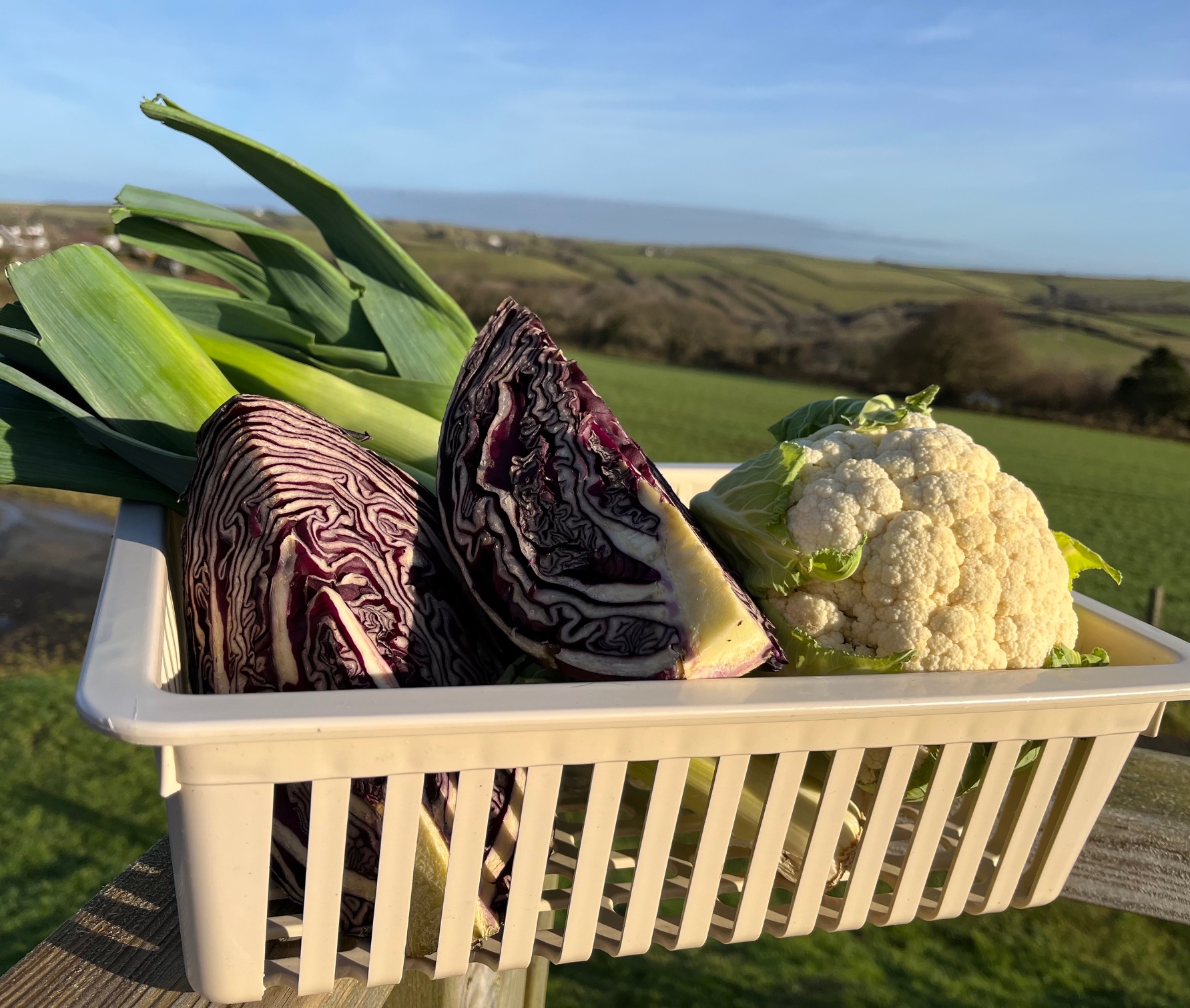
A very rare relevant photo: This, my friends, is food, although not Neolithic. The leeks (at the back) are grown in Cornwall. I can’t vouch for the others but there’s a good chance the cauliflower was as well. The red cabbage? Possibly. The plastic box? Not edible.

The Mesolithic and Neolithic eras

In the Mesolithic Era–the Middle Stone Age–people were hunting and fishing and gathering, as they continued to do in the Neolithic. So they ate meat, fishy-type things, roots, leaves, mushrooms, fruit, and whatever was available and not poisonous. 

Even then they knew that poisonous was bad. The probably knew it better than we do.

But once they got to the shiny New Stone Age, not the boring old middle one, people had domestic animals (they were brought to Britain from Europe–or what would later be called Europe). So Britons were raising sheep, cattle, and pigs, and they were growing wheat and barley. They could add all that to whatever they hunted, fished, and foraged.

The official date for the beginning of farming in Britain is 4,000 BCE, and it marks the beginning of the Neolithic, although some enterprising soul found evidence of wheat being in Britain a couple of thousand years earlier. The current best guess is that it was brought by traders and not farmed locally. What’s now the English Channel was still land, so Britain was attached to Europe and people wouldn’t have had to get their feet wet to drop by the neighbors’ place with a sack or two of wheat.

Okay, we don’t know what happened. All we know is that some has been found. Have fun making up your own story. The rest of us can go back–forward, actually–to the Neolithic. 

At Durrington Walls, archeologists have found some 38,000 discarded bones, which came from at least 1,000 animals. Some 90% are pig bones, most of the rest are cattle. By analyzing the bones and teeth they’ve put together a picture of what happened there, and they don’t indicated year-round eating. Many of the pigs were slaughtered when they were around 9 months old, and since they would’ve been born in the spring that indicates midwinter eating. This fits with Stonehenge’s alignment with the midwinter (and midsummer) sun. Ditto with the alignment of timber monuments at Durrington Walls itself. 

Meat was left on many of the bones, indicating an abundance of food. This was feasting, not everyday eating. 

The animals weren’t raised locally. Some came from Wales, some from Scotland, some from northern England. I’m not sure that’s the full list. 

What else would they have eaten? These were people who raised grain but not on a large scale. They’d have also gathered wild plants and hunted. Milk products would’ve been part of their diet–about a quarter of the pottery fragments show evidence of dairy products–although they would mostly have been processed ones, not milk itself, since the people were lactose intolerant: they couldn’t digest unprocessed milk. They’d have made the milk into cheese, yogurt, and butter, and there’s some evidence of milk in one of the timber circles, so it may have been an offering to the god of milk digestion, which is why we can now buy lactose-free milk in the supermarkets. 

Don’t put too much weight on the last part of that sentence, okay? I made it up and I’ve learned not to take anything for granted.

It’s easier to find evidence of the meat people ate than the fruit and veg, which don’t leave bones behind. That may be why the myth of a meat-heavy paleo diet caught on. It’s also why that part of the discussion is sketchy.

Moving on

By the time we get to the Bronze Age (that’s 2200 to 800 BCE, give or take a few hundred years on either side), people were growing a wider range of crops. We can add peas, beans, and spelt (a form of wheat) to both their fields and their menus. People were crystalizing salt from seawater. And at least those who could afford to would’ve had metal cooking pots. 

Once we move into the Iron Age, which runs from the end of the Bronze Age until the Romans invade in 43 CE, we–or, more accurately, those clever archeologists–find the first chicken bones in Britain. 

For most people, though, grain–wheat and barley–would probably have made up the bulk of their diet, so figure bread, porridge, beer. Add to that–and this is my addition; I can’t quote a source for it–whatever they could pull out of the water or off the land: fruits, nuts, leaves, flowers, tubers, fish, and game. But don’t forget the beer. This is England we’re talking about. The earliest evidence of beer is from 400 BCE. 

The general assumption is that the Roman invasion brought wine and grape vines to Britain, but amphorae–those Roman jars with pointy bases–have been found at some late Iron Age sites, suggesting that wine and olive oil were imported earlier than that. More than one British tribe traded with the Romans.

The Roman invasion

The Romans brought rabbits, pheasants, brown hare, dates, cabbages, leeks, onions, turnips, grapes, walnuts, garlic, pepper,basil, thyme, and other goodies to Britain.

Wait, though. Thyme grows wild here, and if you ask Lord Google if it’s native he’ll say yes. Ask if it was imported by the Romans and he’ll say yes again. Ask if he’s contradicting himself and he’ll stop speaking to you. My best guess is that yes it was imported and then yes, it went wild. That makes it sort of native. 

Actually, what does native mean? How far back do you want to go? Think about it long enough and your mind will melt. Leeks are native enough that they’re a national plant of Wales. The story is that King Cadwallader had his soldiers tuck a leek in their helmets so they could identify each other when they fought the Saxons. Since the average modern leek weighs a third of a pound (that’s 150 grams; Lord Google knows stuff like that and if he’s still speaking to you is happy to share), it’s a safe bet that the leeks of the time were smaller, lighter, and less absurd when worn in a helmet. 

(In the version I found when tracing leeks via Wales instead of via England, Phoenician traders introduced them. The Romans don’t get a mention. It’s all a little hazy if you go back far enough.)

You won’t get the full list of foods the Romans introduced here–there were more than 50 and I can’t count that high–but others include Alexanders (a forerunner of celery which has also gone wild), figs, apples, pears, cherries, cucumbers, lentils, dill, and fennel. And edible dormice, which they, um, ate. (The hazel dormouse is native to Britain–whatever native means.)

Some of these foods would have made their way to Britain with traders before the invasion, but the pace would have picked up once you had Roman soldiers and administrators on the island, along with whatever other Romans came in their wake and the Britons who adopted Roman ways.

The Middle Ages

The next big bump in food diversity comes in the Middle Ages, when the Crusades brought Europe smashing into the Middle East. The new foods included sugar, dates, raisins, figs, pepper,cinnamon, cloves, nutmeg, ginger, saffron, cardamom, coriander, cumin, garlic, turmeric, mace, anise, caraway, and mustard. Some of those had come over with the Romans and, presumably, dropped out of use when the Romans packed up and left. 

Spices and sugar were the wildest of luxuries and not for the likes of us. Most or all the novelties stayed on the tables of the elite. Grain was the mainstay of peasants’ diet. Look around the internet and you’ll get the usual raft of contradictory information, but leeks and cabbage get a mention. Meat was probably rare. Hunting was restricted to the aristocracy, and often fishing as well. They would probably have still been able to forage wild berries and leaves–and possibly nuts. It would’ve all been regulated by local feudal arrangements.

And after that

Domesticated (as opposed to wild) carrots wandered into England in the Tudor era. Wild carrots are edible but woody. The seeds and flower heads are also edible but the plant’s easy to mistake for poisonous things like hemlock, so don’t try this at home, kids.

The Tudor era (1485 – 1603; you’re welcome) also brought turkeys, or at least the first record of them being raised here. It also brought potatoes, cauliflower, tomatoes, and rice. The tomato was treated with suspicion for a couple of hundred years–it was poisonous; it wasn’t poisonous but was best eaten in hot climates; it would kill aristocrats. 

That belief about tomatoes killing aristocrats didn’t arise because tomatoes are the stereotype of the wild-eyed anarchist. It came from the action of a tomato on a pewter plate: the acid in the fruit will leach out the lead, giving the eater lead poisoning. When I read that, I was prepared to argue that the aristocracy used silver plates and it was only lower down the scale that you found pewter, but (annoyingly) I seem to have been wrong.

The first description of red cabbage in England dates to 1570. A couple of sites I find credit the Romans for introducing it to Europe in (are you sitting down?) the 14th century. I’ve found white cabbage being credited to both the Romans and the Celts. I’m sure there’s someone out there who credits interplanetary explorers with its spread across the galaxy.

The internet’s a strange old place. Let’s move on.

Pineapples were introduced in 1600 but weren’t cultivated in Britain until 1700. (They’re not a great fit for the climate.) They were very much a prestige item for the upper class. Coffee and tea were introduced in the 1600s, giving insomniacs something to blame in the middle of the night. Instant coffee was invented in Britain, by the way, in 1771. It has been improved and reformulated in multiple countries and decades and still tastes terrible.

Broccoli joined the party in 1700, chocolate bars in 1847, and canned baked beans in 1886. Or 1869. Who cares? They were hyped as a luxury and sold by Fortnum & Mason for £2 a can–the equivalent of £170 in 2019 pounds. If you need that in US dollars, it’s a lot of money. By 1924, the price had settled down to 12 shillings–the equivalent of £25. Yeah, I know. Baked beans. The hype may explain the central place they still hold in British hearts and stomachs.

Something has to. 
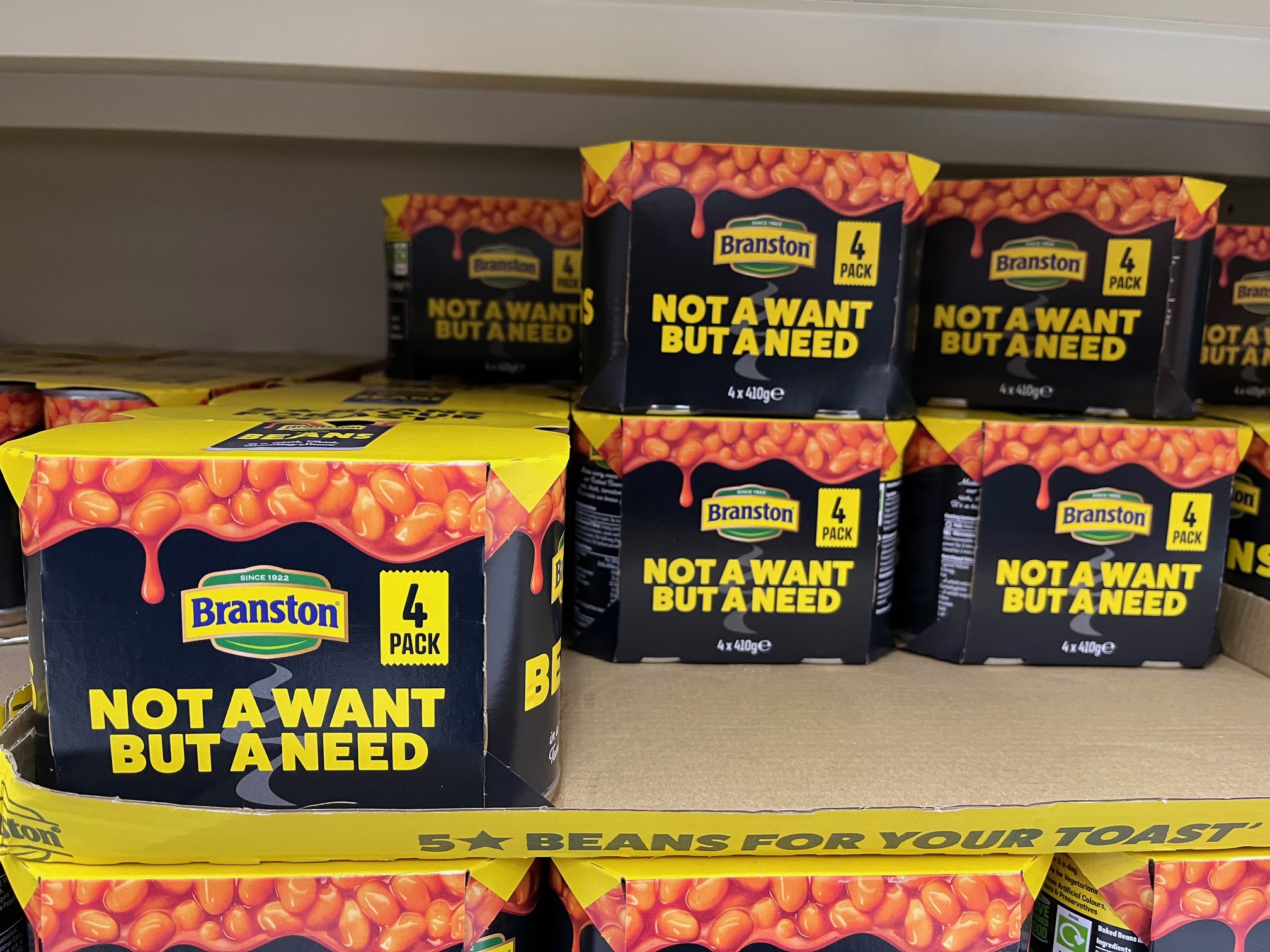
I don’t usually post more than one photo, but I was afraid you wouldn’t believe me about baked beans. Look at that label: “not a want but a need.”

Food was rationed during World War II, and rationing lasted until 1954. That may or may not be where Britain got its reputation for bland, repetitive, snoozeworthy food, but it certainly helped. On the other hand, people’s diets were healthier than they are today, if a lot less fun, and the poor ate better than they had before rationing. 

When rationing was lifted, burger bars opened around the country, selling hamburgers and milkshakes. Chinese restaurants opened, followed by Indian ones. (Keep complaining about immigration, people. It’s brought the wonders of the world to your doorstep.) 

You’ll notice that we’ve shifted from what’s grown and what’s cooked at home to food cooked outside the home. The 1950s mark the beginning of eating out being fairly common.

Spaghetti landed in Britain in the 19th century and was ignored until the 1960s, when it became the height of sophistication. It was rare enough that the BBC got away with an April Fool’s Day spoof documentary on the spaghetti harvest, showing a family cutting strands of spaghetti from bushes and laying them in the sun to dry. Not a few people got in touch to ask where they could buy spaghetti a bush.

Which seems like a good place to leave you. Be respectful of your spaghetti, please. A lot of work went into picking it. 

What tea bag makes the best cup of tea, and other British dilemmas

Every year, Britain’s consumer champion, the oddly named Which?, does a blind test of the nation’s teabags and picks a winner. Because, folks, this is important. You’re a consumer. You need the experts’ opinion on this before you wander cluelessly into a supermarket and buy the tea you, in your ignorance, think you like.

Besides, Which? gets some free publicity out of it. 

This year, in what one headline called a “shock result,” a budget tea, Asda’s Everyday–the cheapest of the contestants–came in first. The high-end Twinings was in joint last place with it doesn’t matter who. What does matter is that Twinings’ tea bags cost four times more than Asda’s. 

My favorite, Yorkshire, wandered in somewhere between the two. 

What qualities do the experts judge tea on? Color. Aroma, Appearance. Taste’s on the list somewhere. Ability to boot you into consciousness first thing in the morning isn’t.

Irrelevant photo: Last week’s post also had an irrelevant picture of Fast Eddie, but surely it’s not possible for a childless cat lady (who’re you calling a lady, asshole?) to post too many cat pictures. So here’s Fast Eddie in slow mode.

The advice column

If you’re in the market for free advice, allow me to offer you this: never try to communicate in an accent or dialect you didn’t come by honestly. I mention this because a local council–in non-British English, that’s a governmental body–tried to use the local dialect for an anti-littering campaign and got it wrong. In very large type.

The North Yorkshire Council put up signs–hundreds of the beasts–urging people to “Gerrit in’t bin’” 

Oops. That should’ve been “Gerrit in t’bin.”

What’s with the “t’”? It’s short for the and it’s a Yorkshire thing. 

Why? 

Why not? There’s no arguing with accents or dialects. They are what they are and they do what they do. 

But let’s not take anything for granted: “gerrit” means get it. “Bin”? It’s what I grew up called the garbage can–that thing you throw trash in. But that’s a Britishism, not Yorkshire’s own invention

To be fair to the council, I don’t know that they’re not from Yorkshire. They may just be people who had some apostrophes to spare and got caught dropping one in the wrong place. As I understand the apostrophe process, we’re born with a certain number and the instructions about how to use them were written by Ikea. So as the years go by, some people get desperate, and they drop theirs in any spot that looks likely. Or if not likely, possible.

It’s not entirely their fault.

A lot of the posters were put up in tourist sites on the theory, no doubt, that visitors would be charmed by a bit of local color, but whether the visitors are looking at the original version or the corrected one, 76.3% are locked in place while they try to unscramble the letters and think, What????


The ghost of prime ministers past

Fifty-six days after he became Britain’s prime minister and moved into his new office, Keir Starmer had a portrait of a former prime minister, Margaret Thatcher, moved out. Apparently short of things to get outraged about, Conservative Party leaders pitched a fit.

But since I’ve been making fun of people’s apostrophe use, I should be careful about this: if multiple people do that thing I just mentioned, do they pitch a single collective fit or multiple individual ones?

Either way, they accused Starmer of being vindictive and petty, of spending his time rearranging the furniture instead of governing, and of appeasing the left wing of his party. 

To which the left wing of his party said, “If only.

That kept the news cycle fed for nearly a day, but when the nation failed to rise up in arms the outrage machine went into sleep mode, during which it appears to be doing nothing but is in fact searching the internet for new and surely more popular sources of potential outrage.


The Ig Nobels

A winner of this year’s Ig Nobel Awards, Saul Justin Newman, from University College Lonon, reports that the claims about extreme aging–living past 110–are, to be scientific about it, mostly bullshit

I’ve tracked down 80% of the people aged over 110 in the world,” he said. “(The other 20% are from countries you can’t meaningfully analyse). Of those, almost none have a birth certificate. In the US there are over 500 of these people; seven have a birth certificate. Even worse, only about 10% have a death certificate.”

To be clear: he only looked for death certificates for the people believed to be dead. The ones who were still alive? It’s pretty much expected that they wouldn’t have one yet.

A lot of the over-110s are concentrated in blue zones, where a startling number people are said to live past 100. “For almost 20 years, they have been marketed to the public. They’re the subject of tons of scientific work, a popular Netflix documentary, tons of cookbooks about things like the Mediterranean diet, and so on.”

But in a 2010 review by the Japanese government, “82% of the people aged over 100 in Japan turned out to be dead. The secret to living to 110 was, don’t register your death.”

Don’t have anyone else register it either.

Okinawa, which was supposed to be a hotspot of extreme aging, turned out to have the worst health in Japan. The best way to find concentrations of super-agers in Okinawa super-agers is to figure out where the halls of records were bombed during World War II. 

“If the person dies [in the bombing], they stay on the books of some other national registry, which hasn’t confirmed their death. Or if they live, they go to an occupying government that doesn’t speak their language, works on a different calendar and screws up their age.”

As for hotspots in Italy and Greece, “By my estimates at least 72% of centenarians were dead, missing or essentially pension-fraud cases. . . . [In Greece], over 9,000 people over the age of 100 are dead and collecting a pension at the same time. In Italy, some 30,000 ‘living’ pension recipients were found to be dead in 1997.”

In England, several low-income areas–”the worst places to be an old person”–have a high number of people over 100 but surprisingly few 90-year-olds. Unfortunately, if you’re going to live to 100, one of the requirements is that you have to live through your 90s first, even if there’s no glory in it.

So will getting an Ig Nobel get people to take his research seriously? 

“I hope so. But even if not, at least the general public will laugh and think about it, even if the scientific community is still a bit prickly and defensive. If they don’t acknowledge their errors in my lifetime, I guess I’ll just get someone to pretend I’m still alive until that changes.”

Britain’s great salad crisis, and other news from Britain

As I write this, the UK’s in the midst of a salad shortage. The critics are talking mostly about the tomatoes, but if you listen carefully (keep the noise down out there, will you?), you can hear the lettuces and all their salady friends singing backup.

What’s happening is that tomatoes are scarce, and if you find any on the store shelves they’re expensive. They’re also, as Hawley’s Small and Unscientific Survey informs us, sorry looking specifmens. 

How short are the shortages? Not long ago, I was in my local supermarket looking for what I call an eggplant and the British call an aubergine. When I couldn’t find it, I asked a guy stocking sliced meats nearby if I could ask him a fruit-and-veg question.

“We haven’t got any,” he said wearily.

Since the fruit and veg section wasn’t completely empty, I told him what I was looking for anyway and he pointed them out. He seemed to be relieved to get rid of me without hearing any more moaning about tomatoes.

Irrelevant photo: Lesser celandine–one of the first wildflowers of the season, currently appearing at the base of a hedgerow near you. Or if not near you, at least near me.

So where’d the tomatoes go? As usual, the answer depends on who you ask. Everyone agrees that cold weather in Spain and Morocco are part of the problem. Most will add that growers in Britain didn’t plant much–or anything–this season because at this time of year they have to grow the tender little beasts in heated greenhouses and high energy prices have made that somewhere in between not economically viable and too depressing to even hallucinate about. 

You could add, if you like, that climate change will be doing this sort of thing regularly and we might want to, ahem, think about that. Or you could skip that and ask the weary guy in the supermarket what’s happened to the tomatoes, hoping to get an answer you like better. 

UK growers will add that they’re being put off not only by high fuel prices but by the low prices that supermarkets are willing to pay them. Consumers will choke on their turnips and ask what low prices the growers have in mind, exactly, because prices have gone up to maybe-I’ll-make-you-a-salad-for-your-birthday levels.

Why am I talking about turnips? We’ll get to that.

Some people will add that Brexit has a lot to do with the shortages. It’s made the UK more difficult and more expensive to export to, so sellers move it to the back of the line (or queue if you’re British), and when a product is scarce guess who drops off. Reports from France say they have no shortages of salad veg, although the prices have gone up. 

But as any British news addict can tell you, Brexit was supposed to let the country negotiate more favorable trade deals than it had in the EU. What happened? My impression is that it hasn’t been a screaming success. The new deal with Morocco has apparently made us harder to trade with, not easier, again moving us to the back of the line. 

Sorry, I don’t know the details of the deal and don’t have the oomph it would take to chase them down, that’s why I dropped in a well-worn apparently. I trust they’re suitably absurd.

Since we’ve been having shortages of fairly random products for some time now (I work at our village shop and it makes me aware of how random they are, and how frequent), we could expand the question and add that the just-in-time business model means any hiccup in the supply chain (Covid, anyone?) will lead to shortages of all sorts of products.

It wouldn’t be hard to find people who’ll add that it’s not a viable long-term strategy to depend as heavily as the UK does on India, China, and other countries that produce goods cheaply and ship them long distances. 

But back to our salad crisis: The environment minister, Therese Coffey, is trying to guide us through it by encouraging us to eat less imported food and cherish our turnips, which grow locally in whatever ridiculous weather we throw at them. 

Are we cherishihng them? Well, the head of an organic vegetable box delivery company is all for eating locally but said, “Winter turnips are an abomination. . . . We don’t grow them. Wouldn’t want to inflict them on our customers.”

Coffey’s intervention hasn’t quieted the tomatoratti, but that’s okay, she didn’t expect to. The government strategy is to keep us making jokes about turnips until warmer weather comes, when the government will claim credit for the victorious return of salad. Any day now, they’ll point that the shortage started under Tony Blair and was Labour’s fault. 

*

To ease us through these trying times, the Guardian devoted a two-page spread to recipes that substitute everything short of socket wrenches for tomatoes. You can, it turns out, make a red pasta sauce out of carrots, celery, butternut squash, and beets–or as the British call them, beetroot. Add vinegar, olive oil, honey, onion, and garlic. Cook everything, blitz it, add fine herbs, and then, whatever you do, don’t serve it to me. I’d get as much joy out of cooking my spaghetti with red food coloring.

You could also forgo the redness and make a sauce involving butternut squash, egg yolks, and yogurt. Or one that uses onion, carrots, ground beef, toasted oats, and black pudding.

I know, I shouldn’t dismiss this stuff without trying it, but I’ve been cooking long enough and I’ve lived in Britain long enough to have learned–or to think I’ve learned–when to look a recipe in the eye and say, “Sorry, but the kitchen is closed for repairs.”

Is it a cheap shot to make fun of British cooks and their recipes? Probably, but they do seem to get carried away with themselves. I mean, surely there are a hundred non-tomato ways to serve noodles without resorting to beets or black pudding. And I don’t say that to diminish Britain as a nation. It’s a wonderful country and I hope it survives the current government, but that doesn’t mean I have to retire my taste buds.

I’d love to give you a link to the article but I couldn’t find it online. Do you suppose someone thought better of it?


And since we’re talking about British politics…

I haven’t written about the Monster Raving Loony Party since early in my blogging non-career, when I had only three followers. Now that I’m up to four, one of which is a lawnmower company that subscribed but never hits Like, so I have to assume they don’t read the posts–

Where were we? Surely it’s time to detour back to that most British of political parties.

The Monster Raving Loonies were formed 40 years ago, in, um, whatever year that was (it’s 2023 now, in case that helps), when David Sutch ran in a Bermondsey by-election under the name Screaming Lord Sutch. 

He’d been running since the 1960s, primarily as a way to publicize his music, although you could probably say that his political non-career eclipsed his musical one. 

Or skip the “probably. Of course you could say it. The question is, would you be right? I haven’t a clue. The point is that this time it was different: He wasn’t running as one lone loony, he was at the forefront of an entire party of loonies.

In its 40 years, the party’s run candidates in 76 by-elections (they’re the off-schedule ones that happen when an incumbent dies or is convicted of larceny and needs to be replaced) and in every general election. Its candidates have included R. U. Seerius, the Flying Brick, Bananaman Owen, Mad Cow-Girl, Sir Oink A-Lot and Lady Lily The Pink. Not one of them has won and the party’s current leader, Howling Laud Hope, says that any candidate getting too many votes will be kicked out.

Embarrassingly, some of its policies have become law, including pet passports (adopted in 2000), a change to pub opening hours (adopted in 2005), and giving the vote to 16-year-olds (okay, only in some elections and only in Scotland and Wales, but still). The last change must’ve been too much for the party, because it’s now calling for 5-year-olds to be given the vote. 

The country’s current political state doesn’t make a good argument for adult competence, so I could be won over on this one. 

Howling Laud Hope now describes his party as the official think tank of Parliament.

It’s proposing a high-speed rail line to the Falkland Islands and “a year off from listening to our politicians.”

In 1985, the Conservative government tried to shoo the Loonies off the national stage by making candidates put up a deposit that they’d only get back if they won 5% of the vote. The Monster Raving Loonies coughed up the cash. 

How seriously should we take the party? In 2019, one perennial candidate announced that he wouldn’t be running this time because December was “a bloody stupid time for a general election.” On the other hand, John Major described Screaming Lord Sutch as by far his most intelligent opponent.

What’s the party’s future looks like? Screaming Lord Sutch died in 199 and the current chair is in his 80s (which I have to say looks younger all the time), so it might be time to talk about a replacement.

“We might just elect someone’s parrot,” Howling Laud Hope said.

A quick history of the Cornish pasty

If Cornwall and Devon go to war–and nothing’s too crazy these days–it will be about either who baked the first pasty or who knows the right way to make a cream tea. You’ll agree, I’m sure, that these are reasonable things for neighboring counties to shed blood over, but they may have to wait until people aren’t quite so distracted by the cost of living crisis that the important things slip past them unnoticed.

In the meantime, allow me, please, to stoke the fires of cultural warfare by exploring, in my usual even-handed way, the history of the Cornish pasty. Or possibly the Devon pasty. 

We’ll skip that business about cream tea for now.

Irrelevant photo: a hellebore

What’s a pasty?

Basically, a semicircular pie made of beef, potatoes, onions, and turnips, only the turnips are called swedes. It might just possibly have other stuff as well, but before we get to that let’s dive down the closest rabbit hole and ask why turnips are called swedes.

According to one gardening catalog’s website, “The swede is thought to have been introduced into Britain around 1800. It is said that King Gustav of Sweden sent the first swede seeds as a gift to Patrick Miller (1731 – 1815) of Dumfries and Galloway, and that this act resulted in the vegetable being called ‘swede.’ ”

The website also says they’re called rutabagas in the US, from a Swedish word meaning thick root. Well, maybe and maybe not. I grew up in New York and remember turnips being called turnips, although I don’t remember that we ate them. Rutabaga, I think, is a regionalism. Or else calling a turnip a turnip is a regionalism. But that’s the wrong rabbit hole, so we’ll back out before we get stuck.

A different gardening catalog site says the swede is “bigger, tougher skinned, yellow fleshed and much hardier than a turnip.“ So basically, by this definition they’re the same thing but different.

You needed to know all of that, right? Now we’ll leave the rabbits and their burrow in peace and get to something vaguely resembling the point. 

Before Britain left the European Union, the Cornish pasty got protected status from the EU, meaning that if a pasty wasn’t made in Cornwall, it couldn’t claim to be a Cornish pasty. Or, since no pasty makes claims on its own behalf, the person selling it couldn’t make that claim.

To translate that into handy bureaucratese, “At least one stage of the production, processing or preparation of the product must currently take place in Cornwall.”

If I’m reading that correctly, you could run the length of Cornwall with a potato and a knife and just as you’re about to cross the Tamar River into Devon cut the potato in two, then use one or both halves to make a pasty in Devon, and still call the result a Cornish pasty, although you’d have gone to a lot of trouble without getting much benefit from it.

Besides, Cornwall left the EU along with the rest of Britain, so the pasty lost its protected status. I admit, that’s well down the list of problems Brexit caused, but the Devon pasty never had protected status to lose, so if we’re keeping score that’s one point for Cornwall. Unless you’re a Brexiteer, in which case you’ll give that point to Devon anyway.


Do pasties always have beef, potatoes, and whatever?

As far as most people are concerned, yes. If someone asks for a pasty, they’re expecting beef, potato, onion, and swede, wrapped in pastry and crimped along the edge. You might slip in a bit of carrot or five army-green peas, but I understand they’re controversial. These days, though, you can also buy cheese and onion pasties, vegan pasties, gluten-free pasties, steak and stilton pasties. In Padstow, I’ve even seen apple pasties and chocolate pasties in displayed shop windows. 

The tourists don’t know any better, but Cornwall’s patron saint, Piran, is in despair and rumor has it he’s taking applications from other counties, hoping they’ll show more respect for their traditional foods.


Was that always what was in a pasty?

Of course not. Where’s the fun in writing about something that has a simple history? If we go back to medieval times, we can find recipes that use venison, beef, lamb, seafood, and eels, flavoring them with gravies and fruits. 

Okay, someone else can find the recipes for us. I’ll surprise no one if I admit to relying on secondary sources. 

Were those the first pasties, then–the pasty pioneers? Once again, of course not. Those are the ones that got written down. Folk pasties, like folk songs, had to make their way in the world without benefit of written records. 

In addition to their having been written down, what tells us that these aren’t folk pasties is that only the rich (along with a lucky poacher or two) ate venison. So if ordinary folk ate pasties–and they probably did–that’s not what they wrapped their pastry around, and if you’ll follow me further into the realm of guesswork, I’m going to assert that they used whatever they had, because most people lived on the edge. Food was scarce. They made what they could out of what they had. And before 1586, that wouldn’t have included potatoes because they hadn’t reached Britain yet. They’re a New World import.

The ordinary Cornish pasty–what we could call the folk pasty, although no one else does–first becomes visible with the rise of the Cornish mining industry in the 1700s. Pasties were filling enough to keep a miner going through a hard day’s work at a time when not even the wildest of wild-eyed radicals were suggesting the 8-hour day or the 5-day week. 

The website of the Cornish Pasty Association (of course there’s Cornish Pasty Association) tells us that “the wives of Cornish tin miners would lovingly prepare these all-in-one meals to provide sustenance for their spouses during their gruelling days down the dark, damp mines.”

I won’t argue with dark or damp, but I will argue with the double L in grueling because I’m American by birth and spelling. I’ll also argue about every last pasty being prepared lovingly. Some wives and husbands were loving. Others were disappointed and bitter. A few were baffled or indifferent or repelled. Either all or almost all were exhausted, which takes a good bit of the love out of cooking, and sometimes out of love itself. Still, make them they did, because carryout (or takeout, or whatever you want to call it) hadn’t been invented, and neither had disposable income.

In everything I’ve read about miners and pasties, no one’s bothered to mention whether the bal maidens–the women who worked above ground at the mines–also ate pasties. It’s always the men eating and the women cooking. Interesting, isn’t it? 

Bal? It’s the Cornish word for mine. 


The shape

The standing belief is that the reason pasties were (and are) shaped like a capital D was to allow miners to hold the crust at one end with a work-grimed hand, then throw that final piece away. Arsenic was a presence in Cornish mines–so much of it that in the nineteenth century mining companies dug it out and sold it as a pesticide, and it was from that humble start that arsenic went on to power many a British mystery. How else was a mere woman to kill her husband?

That business about holding the pasty by the crust isn’t an established fact, though. Some people argue that miners carried their pasties in muslin bags, or in paper ones, and used the bags to hold the pasty while they ate. At least one photograph supports the argument, and it only makes sense considering that they had to not only carry their pasties to the mine but set them down someplace filthy until lunchtime.

According to legend, miners used to leave the final piece of crust for the knockers, who were–well, I can’t find a reliable source for this, so let’s go with WikiWhatsia. Knockers lived underground and were about two feet tall, with big heads, long arms, wrinkly skin, and white whiskers. They dressed like miners and were mostly benevolent. If you listened to their knocking, they could help you find productive seams. They could warn you of an impending collapse. They could also steal your tools or put out your candle. So a bit of crust from your pasty? Sure. You’d want these guys to like you. 

How did these creatures exist if they were all guys and all had whiskers? One strand of belief held that they were the spirits of miners who’d died underground. Another held that they were the ghosts of Jews who worked the mines in the eleventh and twelfth centuries–or possibly earlier.

Yes, kids, we’re getting deep into the land of unsubstantiated legend here. Some tales have Jews coming to Cornwall in ancient times–ancient enough that you can throw a few Phoeniceans into the conversation and not have it get any stranger than it already is. Others have Jews working the mines in the decades leading up to 1290, when Edward I spoiled the fun by expelling all the Jews from England.

Unsubstantiated as they are, you will find the word Jew in a few Cornish place names. Penzance, for example, has a Market Jew Street. Speaking as a marginally Jewish Jew, I’ve never figured out whether I should be offended by that or not. On a balance of probabilities, my guess is that I should, although I’m not exactly, just deeply weirded out.

Academic guesswork holds that these names are the descendants of unrelated Cornish words, which as the Cornish language was lost became corrupted to match local legend. 

The presence of Jews in Cornwall can’t be documented before the eighteenth century.

Didn’t think we’d get here from pasties, did you?


Oggy oggy oggy

While we’re chasing after unsubstantiated beliefs, this would be a good time to chase after the chant “Oggy, oggy, oggy.” 

Authoritative sources are too smart to weigh in on this, but Lord Google led me to sources offering various explanations: An oggy is a pasty–a corruption of a Cornish word for pasty. (At least it didn’t end up as Jew.) Or else the chant came from (gasp) those pesky Devonians, trying once again to claim the pasty as their own. Or it’s what the miners’ wives called down the pit when the pasties they were baking on the surface were ready to eat. (Take that with a cup or three of salt. The shafts were deep and the miners were likely to be working far from the entrance. You could call, “Oggy” all you wanted, they wouldn’t be likely to hear you.) Or it’s what pasty sellers on the streets called to drum up business.

Whatever it meant and wherever it was heard, the correct response if you hear it is, “Oi, oi, oi.”

Somehow or other it ended up as a Welsh rugby chant.

Do you begin to understand why it’s easy to think no Jews were involved in the making of Market Jew Street?


So who gets to claim the pasty, Devon or Cornwall?

An account book in Plymouth (that’s in Devon) mentions pasties in either 1509 or 1510. But a Cornish website cites earlier mentions, one involving Great Yarmouth and another St. Albans Abbey. Neither is in Devon. Neither is in Cornwall either, but they do undermine the value of that Plymouth mention. 

Take that, Devon.

A BBC article notes, with the print equivalent of a straight face, that a Cornish chronicler of the pasty claims that ancient Cornish cave paintings depict the pasty.

Does Cornwall have ancient cave paintings? Well, no, but let’s not let that ruin a good argument.

Okay, go ahead, rule out the cave paintings. That leaves us with some written records–more of them than I mentioned–but no one’s going to prove much about the pasty’s origins by citing written records. And we weren’t doing all that well with the unwritten ones, were we? It’s entirely possible that no one’s going to prove anything at all. Devon’s case isn’t strong. And Cornwall’s isn’t either, but we’ll say that quietly if you don’t mind. I live in Cornwall. I have to be careful.

None of that is likely to stop the rush to war, but I did try.


Yeah, but what about that cream tea?

Oh, that. We’re out of space. I’ll have to refer you to that notorious non-expert, me, for an explanation

Translating from English to English: What does pudding mean in Britain?

Almost anyone who knows and loves the English language will agree that it’s mildly insane. Some of us admit that reluctantly and the rest of us think it’s what gives the language its eccentric charm. I’m in the second category, so I’m taking us all to play in a spot where linguistic oddity meets food. 

How far wrong can we possibly go?

Very, but let’s do it anyway. The question of the week is, What are the British talking about when they talk about pudding?


Irrelevant photo: a begonia flower

Definitions

As far as I’ve been able to tell after sixteen years of haphazard research, pudding means four very different things in Britain.

  1. Something sweet at the end of a meal. 
  2. Something made with a batter.
  3. Something either sweet or savory (savory being the opposite of sweet) that’s been tied into a cloth and steamed or boiled.
  4. A “sausage-like mass of seasoned mince meat, oatmeal, etc., stuffed into a prepared skin or bag and boiled.” (That’s from the Collins Dictionary.) 

If that last category doesn’t send you running to Lord Google for recipes, I sympathize. It doesn’t sound like my idea of what to cook on a slow Sunday afternoon either, although I’m sure someone will tell me that a mass of seasoned minced et cetera can be delicious, and I’m sure they’ll be right, at least if they’re serving it to meat eaters. I, however, live on raw carrots and the stems of organic herbs, so it’s not for me. Even if I ate meat, though, the word mass is what did me in. Any food writers out there? Put mass on your list of unattractive words.

And speaking of unattractive words…


The unfortunate origins of the word pudding

How did two ordinary syllables come to mean so many different things? Etymology Online takes us back to the year 1300, when pudding meant a sausage made of meat, blood, and all sorts of fun things, stuffed into the intestines of a pig, sheep, or other unfortunate, and then boiled. 

That explains meaning number 4, the boiled mass. 

The word may have come from a Germanic word meaning “to swell,” which means it’s related to words for all kinds of unpleasant swellings. But cheer up, it may come have a whole ‘nother source: a vulgar Latin word by way of an Old French word meaning sausage and having to do with animal intestines.

In the sixteenth century, in fact, if you talked about puddings, plural, you were talking about someone’s intestines, so we’ve got a pretty strong set of sausage-y connections here. But in that same century, pudding was slang for vagina. And–not to be outdone–for penis. 

I wouldn’t suggest holding out for any sort of logic there. Slang isn’t answerable to careful reasoning.

And now, let’s drop that thread before we give up on the topic altogether.


Moving right along

How did the word  transition from a sausage to a dessert? Well, in Tudor times it wasn’t unusual to sweeten a sausage, and to add dried fruit, and a sweet sausage-y thing is surely a step in the direction of what we know as a dessert. 

Also in the sixteenth century, a pudding became something involving flour, milk, eggs, and maybe some dried fruit. It could still be either sweet or savory. That points us to meaning number 1–dessert. The connection to those sausage-y things is that you could take those floury, milky, eggy things and boil them in pudding bags, because if you’re not going to stuff them into an intestine, you have to hold them together some other way. So that takes care of meaning 3, something tied in a bag and acquainted with hot water. 


Yeah, but what about meaning 1?

According to GreatBritishMag, calling something sweet at the end of the meal a pudding has to do with the British class system. 

Everything in Britain has to do with the class system. 

Traditionally, it says, puddings were rustic things eaten by the lower classes–things like rice pudding and (fasten your seat belt) spotted dick.

Yes, spotted dick. It’s a dessert–or a pudding, if you like–and no, you won’t get a funny look or a medical referral if you say you have or want some. 

While the rustic lower classes were eating spotted dick and wondering if anyone would get the joke, the upper classes were eating not pudding but dessert–chocolate mousse, sweet souffles, and that sort of fancified stuff. 

(Truth in blogging paragraph: Dick doesn’t seem to have become slang for penis until the late nineteenth century. EtymologyOnline says, “It has long been a synonym for ‘fellow,’ ” and dates that back as far as the sixteenth century.) 

Forget that, though. Somewhere along the line, and I’m not sure when or how, the word pudding not only jumped classes but appropriated the entire category of sweets-after-a-meal, and ended up being one of the few British words that doesn’t mark a person’s class. (Others in the category are and, of, or, but, and a scant few thousand others.)

Or so say one or two sources. Arguing against them, Country Living magazine lists pudding as upper class and dessert, afters, and sweet (as in (I think), “Should we have a sweet?”) as non-upper class, where they join declasse words such as couch and settee (instead of sofa), pjs (instead of pajamas), and movie (instead of film). Oh, the horror. How could one hold one’s head up–?

Who’s right? I haven’t a clue.


So what gets called a pudding?

Just about anything.

Okay, it does have to be edible–no chairs; no bike racks–and (I think) either solid or semi-solid. And it has to have more than one ingredient. I’m sure there are other limits, but hey, I’m a transplant. I’m doing the best I can here, but you wouldn’t want to trust me out of your sight. 

Now that I think about it, you might want to consult somebody sensible about this, and I invite comments on this from both the sensible and the senseless. 

But with that warning out of the way, foods that have pudding in their names include:

Yorkshire pudding. This is a breadlike thing generally served with meat, gravy, and all the sidekick foods. It used to be served before the meal to fill people up so they’d eat less meat. And it’s baked–it used to be cooked under the meat so it soaked up the drippings–not boiled. It lives in the flour-and-other-stuff room of the pudding house.

Christmas pudding. This is a fruitcake, and it’s steamed or boiled. [You’ll find an explanation of why is isn’t a fruitcake in the comments.] It can sleep in the flour-and-stuff room or the cooked-in-a-bag room, depending on the mood it’s in.

Black pudding. This is a blood sausage and it lives in the sausage room.

White pudding. Another sausage, but bloodless. It lives right near the black pudding.

Rice pudding. This has rice, milk, sugar, and whatever bits of flavoring you like to toss in. I learned to make it on the stove (that’s the hob in British), but most recipes I’ve seen in Britain toss it in the oven. Or, okay, slide in in carefully. It lives in the milk-and-bread room, even if it does substitute rice for flour. A starch is a starch.

Toad-in-the-hole. This involves sausages and a milk, egg, and flour batter, so it wanders from room to room at night, dragging its sleeping bag behind it.

Summer pudding. This is made of bread, fruit, sugar, and nothing else. It’s spectacular, but as far as I can tell it doesn’t have a pass to any of the rooms. It sleeps in the hall, mumbling that it was made in a pudding bowl so why’s everyone so mean?

I could go on but we wouldn’t be much wiser. I’ll stop. 

So what do the British call that stuff Americans call pudding?

Nothing. You won’t find it in Britain, so they haven’t given it a name. I’ve seen sites claiming that the British call it custard, but custard’s a whole ‘nother beast.


The Black Pudding Throwing Contest

It wouldn’t be right to leave the topic without mentioning the World Black Pudding Throwing Championships, held in (you can’t make this stuff up) Ramsbottom in September. Legend has it that the contest dates back to the War of the Roses, when the houses of Lancaster and York ran out of ammunition and started throwing food at each other. 

Legend has it that a lot of legends were made up in the pub, but never mind. The tradition was revived–or started–in 1839 and then re-revived in the 1980s.

The idea is to throw black puddings at a stack of Yorkshire puddings and see how many you can knock down. 

My thanks to The Year without Wimbledon for making sure I didn’t miss this. The information’s spent a long time sitting on my list of topics I never get to. I’m happy to see it fight its way out.

Prime ministers and oversize vegetables: It’s the news from Britain

Britain has a new prime minister, but before we get depressed let’s change the subject and talk about the man in Hampshire who grew the world’s longest cucumber–3’ 8”, or 1.12 meters if you prefer. It weighed 17 pounds, or 7.7 kilos. Or quite possibly both.

What’s the point of growing a vegetable that big? Well, you could make 400 cucumber sandwiches out of it, but only if you like cucumber sandwiches made with tasteless cukes and have a few hundred close friends who do. 

How do I know it’s tasteless? I don’t. It could be bitter. It could have the texture of cardboard packing material. What I do know (since the article I stole this from said so) is that it’s destined for the compost heap, not the table.

In the meantime, we still have that new prime minister. The last one’s been dumped on the compost heap, but only because we didn’t have the heart to deposit him where he belongs. The current one, I predict, will be as much use as a three-and-a-half-foot cucumber and do considerably more damage. Already she’s put someone who talks about “climate alarmism” in charge of energy and climate change. But then, to be fair, I don’t know that the job description specifies working against climate change. It may not. 

Okay, these are blackberries, not cucumbers, and they’re normal size, but this is as close as we get to a relevant photo around here.


What goes into a cucumber sandwich? 

Sliced cukes, preferably with the rind cut off. Butter (or cream cheese). Something herby or some black pepper. One recipe (not the one I’m linking to; it had too many popups) suggests a squeeze of lemon, which sounds like it’ll give you soggy bread, but hey, it’s your sandwich so do what you like. 

Put all that on white bread–lots of white bread–preferably with the crusts cut off so you don’t mistake your 400 sandwiches for anything colorful. Then cut them into triangles, giving you, um, 1,600 sandwich pieces, and you make a huge pot of tea.

If you arrange the triangles on tastefully bleak white plates, they will be practically invisible. 


But forget that. Let’s introduce the bike bus

Kids in a Glasgow primary school can ride the bike bus to school on Fridays.

A bike bus is basically a group of kids and parents moving through traffic like a school of fish. It was started by a parent who’d read about something similar in Barcelona. Because impatient drivers were becoming a problem, the lead bike is now rigged with a gizmo that changes the traffic light at a particularly messy intersection for long enough for 50 or so riders to cross. 

Interviews with the kids were predictably informative. One likes ringing his bell. Another likes talking to her friend on the way to school. And a third has a new bike and it’s red and orange. 


What’s happening in the rest of the world?

Well, researchers at the University of Michigan (which is not in Britain) have developed a wind turbine blade that can be recycled into gummy bears.

I’m tempted to stop there, leaving you with an image of gummy bears mysteriously falling from the sky in a disorganized gummy rainbow when the blades reach the end of their first life. But (however briefly) I’m having a responsible moment, so I’ll explain.

The blades are made from a mix of glass fibers, a plant-based polymer, and a synthetic polymer. When the blades are ready to be replaced, instead of joining that great wind turbine in the sky, they break down (with a little help from an alkaline solution) into their component parts, which can be used to make new turbine blades, or tail lights, or gummy bears, or sports drinks. To demonstrate how safe that is, one of the researchers, John Dorgan, publicly ate a gummy bear they’d made.

“A carbon atom derived from a plant, like corn or grass, is no different from a carbon atom that came from a fossil fuel,” he said. “It’s all part of the global carbon cycle, and we’ve shown that we can go from biomass in the field to durable plastic materials and back to foodstuffs.”

Turbine blades can be as much as half the length of a football field, making them an awkward addition to a landfill. 

Is that a US football field or what the rest of the world calls a football field and Americans insist is a soccer field? I’m not sure. I’m not even sure how the sizes of the two fields compare. What I do know is that the new blades can be recycled endlessly. Unless you eat them. 

*

The urine of the Southeast Asian binturong smells like buttered popcorn. Why is that true? Because they both contain 2-acetyl-1-pyrroline, which smells the same whether it’s at the movies or being excreted onto dead leaves. 

Did you need to know that? Probably not, but now that you do you can’t unknow it–at least not unless memory does its loving job of erasing it for you.

You can thank the Encyclopedia Britannica’s “One Good Fact” email newsletter for that gem, and I can’t give you a link because it doesn’t work that way. You’ll just have to trust me on this.


Copyright news

The copyright’s expiring on some of the classic modern novels, and that means you can buy cheap editions online. 

What do you get for your money? Less than you’d expect, according to a recent (if February is recent) article. An edition of The Great Gatsby ends mid-paragraph and three pages before the author, F. Scott Fitzgerald, thought it did.

Another edition is dedicated not to Fitzgerald’s wife, Zelda, as the original was, but to “Logan and Olivia Barbrook / May your lives be filled with wonderful stories, great adventures and happily-ever-afters, Love Mummy.”

Which somehow doesn’t sound like Fitzgerald. 

One edition changes Fitzgeralds line “At any rate, Miss Baker’s lips fluttered” to “Anyway, Miss Baker’s lipped frizzed.”

Then there’s the cover. One edition showed a couple next to something that looks more or less like a 1980s Dodge Charger. That’s prescient for a book first published in 1925. It’s enough to make your lips frizz.


Let’s go back to oversize vegetables

In Nebraska, Duane Hansen paddled 38 miles down the Missouri River in the hollowed-out 846-pound pumpkin that he grew. 

“I probably won’t try this again,” he said, since it was a little cramped in there. However, no politicians were harmed in the setting of what is unquestionably a world record.


In which we see humanity at its best

Somewhere above Europe, two Air France pilots got in a fistfight in the cockpit. The cabin crew heard the noise, went in, and broke up the fight, with one of them staying in the cockpit until the plane landed to keep the pilots in their seats and flying the plane.

The BBC tells us that France’s air investigation body said the airline’s culture “lacked rigor when it came to safety procedures.”

What foods are native to Britain

Every so often, somebody starts a campaign to run some non-native plant out of Britain. With a few, that makes sense–when they got loose in this new climate they turned hazardous, choking out native growth, growing through the foundations of houses, running for parliament so they can run other non-native plants out of the country. But setting those few aside, the rest of it, I suspect, is about returning Britain to some imagined state of purity. 

But what really is native? For the sake of simplicity, let’s stick with food.

This comes with a warning: The further back in time we go, the sketchier the notes people left behind. So I can’t guarantee 600% accuracy. Take it–as is appropriate for food–with a grain of salt.


A rare relevant photo: St. John’s Wort, which isn’t used as a food but is traditionally medicinal. It’s native to Britain but a couple of varieties were introduced in the 17th century. So it’s native but also not. Nothing’s ever simple, is it?

Imports

The first chicken bones show up in the Bronze Age–around 800 B.C.E. That makes them–not to mention their eggs–foreigners.

The Romans (start counting in 43 C.E.) brought rabbits, pheasants, and brown hare (not to be confused with brown hair, which was already present). Also cabbages, leeks, onions, garlic, basil, thyme, turnips, walnuts, and grapes. And alexanders, which went wild. Foragers still eat them and everyone else pretty much ignores them. They’re sometimes called wild celery. 

Incomers, the lot of them.

As an aside, by the time we get to the medieval era, cabbage was peasants’ food and not fit for the upper classes. It was thought to cause melancholy and nightmares but also to cure drunkenness. 

According to one source the Saxon word for February was Sprout Kale–the month when the cabbages sprout. If you’re not a fan of kale, you can blame it on the Saxons. It won’t be fair, but it’ll keep your mind off worse things. (Another source says it was April, but it’s outvoted. Let’s go with February. It’s shorter, and I’m not a big fan of kale.)

You won’t find sugar until 1099–or at least you won’t find it mentioned until then–and for a long time it was the wildest of luxuries. From the 12th century through the 15th, you’ll find monasteries cultivating apples and pears. Or you’d find them if you could get back there. They would’ve been luxuries.

Turkeys and rice showed up in the Tudor period, and potatoes, corn, and tomatoes didn’t arrive until Europeans started bothering the New World. 

Beets–or as the British call them, beetroot–probably came from the Mediterranean. Broccoli showed up around 1700, chocolate bars around 1847, and baked beans in 1886.

Yes, I did switch from raw ingredients to processed food. You’ve got to keep an eye on me every minute. I’ll pull a fast one on you every time.


Native foods

Wild carrots do grow in Britain and as far as I can untangle things they’re native, but a foraging guide describes them as tough and stringy. You’d want to put these in stews, not eat them raw. The plant they come from is also called Queen Anne’s lace and looks a lot like hemlock, which is toxic, so I wouldn’t recommend munching your way through the hedgerows hoping to figure out which is which. 

Cultivated carrots seem to have wandered into England in Elizabethan times, so they’re not exactly native. Emphasis on seems. I got that from a site whose information appears to be solid but whose writing is murky. 

Peas? Probably native, although some people argue that the Romans brought them. 

Of course, someone out there would surely argue that the Romans brought Nintendo. I’d make the argument myself, but I’m trying to keep this brief. 

Cultivated peas are related to vetches, a category of wildflower that does well in Britain without human interference. The early ones would’ve been smaller than the peas we know, and probably bitterer. And if we’re to judge from that last adjective, harder to pronounce. The best thing to do with them would’ve been to put them in pottage–something eaten widely in medieval Britain and varied enough that if you think of it as anything that can be tossed in a pot and cooked with liquid, you won’t go too far wrong. 

It’s not until you get into Tudor times that peas become sweeter and the elite start eating them as a delicacy.

Oats, rye, wheat, and barley are all native. As is brewing alcohol from at least some of them and getting shitfaced. 

Native fruits would’ve been small purple plums, sloes, wild currants, brambles (that means blackberries), raspberries, wood strawberries, cranberries, blackberries, redberries (no idea what this is; they’re probably red), heather berries (Lord Google tells me they’re edible but nasty), elderberries, rowan berries (edible if cooked; toxic when raw), haws, and hips (that’s probably rose hips). To summarize, the native fruits ran the gamut from delicious to nasty.

The wild apple, crabapple, and cherry would might have been rare or absent, although the British apple seems to have predated the Romans. You notice how much of a workout the word probably is getting? Not as much as it should’, I expect. 

We haven’t talked about the nuts and leaves, but let’s skip them, okay? 

Saffron in Britain: a quick history

People in fourteenth-century Europe were desperate to get their hands on saffron, which they used, among other things, as a medicine against the plague. Or they were if they could afford it, which most people couldn’t because it was wildly expensive, so let’s add “rich” before “people” in that sentence. It was expensive enough that pirates often preferred saffron to gold–it was worth more and easier to lift.

C’mon, even pirates can get bad backs.


How saffron got to England

According to legend, saffron got to England as an illegal immigrant, traveling inside a Crusader’s hollow staff. He picked it up, still according to legend, returning from the Middle East by way of Spain, and if you’re a fan of irony, you might enjoy knowing that it was  the Arabs–the people that hollow-staffed Crusader would’ve been fighting–who brought saffron to Spain so he could steal some.

Why did the Crusader (in a sanitized version of the tale,he was a pilgrim) have to smuggle it? Because he’d stolen it. Places that produced saffron wanted to prevent competition, so for example Basel (which admittedly wasn’t in Spain, even during the Crusades) made it illegal to take a corm out of the city and guards protected the plants when they were growing.

A rare relevant photo: The ones in the foreground are crocuses.

Was that true in Spain? Dunno. It’s a legend. Let’s slip that illegal corm into a pocket and move on before anyone notices the geographical switcheroo.

What’s all this corm business, though? 

Well, kiddies, saffron comes from the crocus plant–the Crocus stativus–which grows from a corm. And a corm is what you and I, in our ignorance, would probably call a bulb. The difference is that a corm is–oh, hell, it’s complicated. A corm is rounder than a bulb and it’s solid. That’s enough to let us pretend we know something. 

You can probably smuggle a corm inside a hollow staff if you don’t pound it around too much and if you just happen to have a hollow staff on hand, but whatever happened took place outside the range of the CCTV cameras, so we’ll never know for sure. 

A different version of saffron’s British history has it landing in Cornwall multiple centuries earlier, not necessarily as a corm but in the form of a spice that could be traded again and again for Cornish tin. As far back as three thousand years ago, Cornwall was trading with the Middle East, so it’s entirely possible that tin was traded for saffron, but the ice is getting thin here and we might want to scuttle back to shore before we break through.  

Before I dump a new subread on you, though, I should explain that the word sativus in Crocus sativus doesn’t mean the saffron crocus is related to Cannabis sativa. Sativa or sativus is Latin for cultivated, not for formerly illegal and still mind bending.


How to get from crocus to saffron 

So much for legend. What’s clear is that saffron arrived in England (and by this time Cornwall was part of England), and from the fourteenth century onwards it was an important commodity. It was used in dying, in cooking, and in medicines, and (sorry to repeat myself) it was and is incredibly expensive. These days, it’s the world’s most expensive spice. 

That’s not because it’s rare or hard to grow–make a crocus plant happy and it will spread all on its own–but because you only use a small part of it to make saffron. According to the Britannica“What we use . . . is actually the stigma (plural stigmata)—the pollen-germinating part—at the end of the red pistil, the female sex organ of the plant.” 

Harvesting those tiny little sex organs (try not to think about it; you’ll be happier) involves crawling along the ground and cutting a very low-growing flower, then throwing away most of it. Along the way, you have to separate the stigmata (each plant has three) and their stems (those are the pistils) and dry them. 

Do that with 75,000 plants (or 150,000, depending on your source) and you’ve got yourself a pound of saffron. In 2018, that pound sold for $5,000. 

The next most expensive spice, vanilla, sold for $600.


Could we get back to English history, please?

Fine. If we can agree that the stuff’s expensive, we’re ready to go back and look at it as a luxury item.

Starting in the fourteenth century, England became a major producer of saffron, and the chalky soil of Essex and south Cambridgeshire turned out to be well suited to it. Smallholders–people raising crops on small amounts of land–who’d once been subsistence farmers planted it as a cash crop, probably not replacing all the crops they lived on but as an addition. An acre planted in crocuses could bring in £6–a hefty amount of money at the time. Saffron became so important to the local economy that the town of Chipping (or Chepyng–they couldn’t spell for shit back then, but it  meant market) Walden changed its name to Saffron Walden.

According to the historian Rowland Parker, successful cultivation depended heavily on unpaid labor, which was a major part of the farm economy for a couple of the centuries we’re talking about. Serfs owed labor to their lords. Smallholders had families, preferably large ones. 

I relied on WikiWhatsia for that. I avoid it when I can, but I’m tired this week and can’t be bothered. My apologies to the world at large. In general, it’s as reliable as the grown-up encyclopedias, but when it fucks up it can do it spectacularly. And I did confirm a few bits, so the entry looks reliable, at least at the moment.

The Cambridge colleges used saffron heavily. Smallholders who rented land from them could pay their rent in it, and some of the colleges used it to pay their own bills, making it a kind of currency. 

But currency or not, academics also used it in food and as medicine. And they sprinkled it on floors and tossed it into their fires (talk about burning money) as a disinfectant. That was probably just a few academics–the richest ones, making a point of being the richest ones.


Nothing lasts forever, though, does it?

Change came in response to several things. As the spice trade grew, other offerings became available, and they weren’t only new and exciting, they were cheaper. The elite could spend their money on vanilla, tea, chocolate, and coffee. All of those were outrageous luxuries for a while.

Saffron? That was so last century.

Synthetic dyes also began to replace natural ones. And as the wage economy grew, people left the countryside and that pool of unpaid labor wasn’t around to dip a seasonal bucket into. Growers replaced saffron with the newly introduced crops: potatoes and corn. 

Corn? Sorry. I’m still basically American. The British call it maize, since they call pretty much any old grain corn

If that list of changes doesn’t sound like enough to explain saffron’s decline, consider the Puritans, who wandered in to disapprove of this saffron-burning culture of excess. They wanted their clothing plain, their food plain, and their fires unbothered by show-off gestures. 

Saffron cultivation and usage declined, but in Cornwall, saffron buns and saffron cakes are a long-standing tradition. 

How long-standing? The sources I’ve found hide behind some vague wording about them being traditional, which means they don’t have to commit themselves on how far back the tradition goes.


Saffron Buns

I haven’t posted a recipe in an age, but I do make a mean saffron bun–and if you don’t speak American, mean in this context is a good thing. In spite of my accent, they sell well at bake sales and the local farmer’s market.

Don’t be put off by what I said about the cost of saffron. You won’t be buying it by the pound. All you’ll need is a pinch. 


Ingredients

A large pinch of saffron

300 grams of bread flour (or whatever substitutes for that where you live)

65 grams of butter, softened

25 grams of sugar

1 tsp yeast (use fast acting–it’s easier)

90 grams currants (or raisins if need be)

45 grams of candied peel (I never do get around to adding this)

Milk (the recipe I started with calls for 120 milliliters, but I always need more)


What to do with the ingredients

Crush the saffron and soak it in just enough boiling water to cover it. Cut the butter into the flour. Mix in the sugar, salt, yeast, and fruit. Add the saffron, in its water, and enough milk to form a dough. Don’t let it get too wet, because the buns have to hold their shape. 

Knead it until it’s silky–about 10 minutes by hand, about 5 in a mixer. Cover and let it rise. How long will depend on the temperature of your kitchen, but if you have to punch it down and let it rise again, it’ll be fine. 

Cut into 8 pieces and form into rolls. Bake them on a cookie sheet–called a baking tray in Britain–and use greaseproof paper or baking parchment if you have it. Otherwise, oil the tray. 

Let them rise half an hour or so, until the dough has a little spring in it.

Bake for 20 – 25 minutes at 170 C. (that’s 350 F., give or take a bit). To check if they’re done, turn one over and tap the bottom. It should sound vaguely drumlike.

Cool. Butter. Eat. Toast if that appeals to you.

A quick history of the English breakfast

Every country has its myths, and I suspect one of England’s is, as the English Breakfast Society puts it, that the English breakfast is “a centuries old . . . tradition, one that can trace its roots back to the early 1300’s.” 

Yes, there is an English Breakfast Society. That should tell us something about how central the myth is. Or, if you like, how central the reality is. Or how odd the country is. 

Or possibly how odd any country is.

Never mind. It tells us something or other. Can we move on?

I found the quote on the society’s website, right below the picture of a wealthy couple from the long-dress-and-maid-serving-breakfast era. They’re sitting at a table looking unhappy. The man’s taken refuge behind his paper and all we know about his face is that he has eyebrows–two, I believe–but that’s enough to let us know he has no time for the woman right now because he’s attending to serious business, which by definition excludes women. The woman’s turned away from him, looking bored. Not to mention sulky. She’s not reading a newspaper because, c’mon people, ladies didn’t back then. 

The maid’s leaving the room and if I had to be one of these three people I’d be her because at least she gets to walk out, even if she can’t stay gone for long. 

But never mind the picture. It’s a red herring. I only mention it because it’s such bad publicity for the English breakfast that I couldn’t resist. If you want to promote the beauty of a meal, bury this picture someplace deep.

Irrelevant photo: a slightly battered rose, blooming in February.

Several other websites make more or less the same claim about how far back into history the English breakfast reaches. But let’s stay with the English Breakfast Society. Not only do they say the English breakfast dates back to the 1300s, but in a different paragraph they say it reaches back to the 13th century, which through a quirk of mathematics or accounting or something numbers-related isn’t the same thing at all. And, they say, it was developed by the gentry, “who considered themselves to be the guardians of the traditional English country lifestyle and who saw themselves as the cultural heirs of the Anglo-Saxons.”

I suspect we’re looking at a bit of time slippage there. The Anglo-Saxons hadn’t come into fashion in the 1300s/13th century. If you wanted to get ahead in whichever of those two centuries we’re talking about, you needed to and downplay whatever Anglo-Saxon traditions your family had kept alive and speak Norman French. Chaucer, who first broke the English language into the publishing world, earning rave reviews on Amazon and GoodReads, wasn’t even born until 1340 and didn’t start writing until several years after that. 

So forget the Anglo-Saxons. I’m pretty sure they’re another red herring. Let’s take the rest of the claims apart.


First, who were the gentry?

To belong to the gentry, you had to own enough land to live off it without getting your hands dirty or doing any actual work. It was a loosely defined group, though. The nobles–the people who held titles–were easy to count, and people did count them, totting up fifty in the early 16th century, some 200 in the 18th. Once you had a number, you could be sure you’d gotten them all back on the bus after they’d gotten off to see the attractions or use the restroom.

The gentry, though? Sorry, but if you left a few dozen behind at Tower Bridge, no one would know.  

But let’s not compare the gentry to the nobility. That’s another red herring, and one I dragged in. I got tempted by those numbers. Sorry. Let’s compare the gentry to the peasantry instead. The most striking difference is that where the peasants were hard working and often hungry, the gentry ate well and prided themselves on their hospitality.

Hospitality to people like themselves, that is, or people further up in the hierarchy. It wouldn’t do to get too hospitable to the lower orders. They’d start to think they should eat like that every day.

No, I’m not cynical, just fed up with how little has changed. 

But we were talking about the English breakfast. In this telling, the gentry used breakfast to show off their wealth and hospitality. They made it an important social occasion. 

Take weddings. A wedding mass had to happen before noon (don’t ask me; maybe god had afternoons off), so weddings took place in the morning and then the bride and groom ate a wedding breakfast. With who knows how many well-wishers and hangers-on and family members.

Cue a grand spread for breakfast.

Skip ahead a few centuries and along comes a wealthy middle class. Not all of the middle class was wealthy, mind you, but part of it was, and because it drew its wealth from (gasp, horror) trade instead of land, it couldn’t be part of the gentry. But it could sure as hell eat, and it copied the gentry’s breakfasts, along with many of their other habits.


The tale of the English breakfast, version two

In Scoff: A History of Food and Class in Britain, Pen Vogler tells the tale differently, and I have a hunch more reliably. The earliest courtly records, she says, don’t say anything about breakfast except that people who rose early would have bread and ale. 

Who rose early? Well, it wasn’t the nobles and it probably wasn’t the gentry. Breakfast for them seems to have been a blank. In the medieval monasteries, an early meal was for people who did physical work. Monks and nuns were supposed to have their minds on higher things than stuffing their bellies, at least first thing in the morning.

By Tudor times, though, Katherine Parr’s maids were eating beef for breakfast, and by the 17th century breakfast had become pretty much universal, although the harder you worked (and the poorer you were) the earlier you ate. Samuel Pepys (we’re still in the 17th century) was eating meat left over from last night’s supper, either cold or reheated. (No, the microwave hadn’t been invented and they didn’t have electricity anyway so it wouldn’t have done him any good it if had been. He ate it fried.) For one breakfast, he ate radishes. Make whatever sense of that you can. 

By the time we come to Jane Austen (1775 to 1817), we find her mother writing about visiting cousins and having a breakfast of cakes, rolls, bread, toast, coffee, tea, and hot chocolate, although Austen has one of her characters eating pork and mustard for breakfast and another, boiled eggs.

If I can translate all of this, it means that the English breakfast wasn’t what’s now known as an English breakfast. It was breakfast and it was in England, but that’s where the similarity ended. 

By Victorian times, the owners of a grand country house might show off with French food at dinner, but breakfast would be about showing off what the owner’s land produced, so we find ham, sausages, eggs, and bacon, as well as things I think of as un-breakfasty: beef, meat pies, pheasant, kidneys, smoked fish, and kedgeree, which is an Indian-inflected mix of fish and rice–a sign of that the British were messing around in India and had brought home the idea that if you added a bit of spice to your food your taste buds would wake up and do a little dance. 


The current components of an English breakfast

What’s now known as an English breakfast is heavy enough to stop a train, but a lot of the dishes I mentioned slid off the plate long ago and were replaced with others. It now involves some or all of the following: eggs, sausages, bacon, grilled tomato, mushrooms, baked beans, toast, and fried bread. Plus tea and antacid. 

Did I miss the marmalade and the fried potatoes? I did, along with the assorted regional variations.

So how deep into history do the components go? As far as I can tell, not very. The baked beans that are now an integral part of the English breakfast didn’t land on the plate, or in the country, until 1886, when Fortnum & Mason began selling them as an American luxury.

There’s no accounting for taste. 

As for the eggs, if you leave chickens to their own devices, they stop popping out eggs during the winter. Or so Lord Google tells me. I’ve never raised chickens, so I’ll have to take his word for it. It’s only when you keep the chickiebirds warm and add artificial light to their lives that they get in the mood to produce eggs all winter. So even among the rich, eggs wouldn’t have been available year round.

And even when they were in season, they were a luxury in a working person’s diet.

Eventually  the 20th century came, though, along with artificial lighting and ways to heat a hen house that didn’t risk setting it on fire, and eggs–or maybe that’s chickens–began to be farmed intensively. In the years before World War I a recognizable version of the modern English breakfast started to show up in hotels and in bed and breakfasts. 

Meanwhile, in the country houses of the rich, breakfast changed after World War I. They no longer had the massive number of servants it took to serve grand breakfasts anymore, and they began to simplify.

I know. It’s tough.

Bacon and eggs get a mention here, along with gastronomical boredom.

During World War II, with rationing in force, in many working-class homes the breakfast protein went to the men and boys and the toast went to the women and girls, with some of the trimmings added in on weekends and holidays. That was caused by a collision of sexism and the men and boys doing heavier work, either in reality or in theory. I know the men worked like dogs in many industries, but I’m not sure how heavily to bet on the women and girls carrying a light load.

But back to the components of the English breakfast: The tomatoes and mushrooms weren’t added until the 1960s and 1970s. Sadly, they’re harder to make fun of.

*

If you’re not tired of me by now, I have an article online about the difference between writing for a lesbian audience and writing for a crossover audience. It touches on the gay and lesbian liberation movement in the 1970s. Yes, I really am that old. In fact, I’m older. It has nothing whatsoever to do with the English breakfast.

You can find it at The Bookseller.

Bread in medieval England: an update

A quick update for anyone whose imagination was captured by the post on medieval bread making: Aleksandra from the Evendine Sourdough Bakery sent a photo of a trencher loaf she made (and served with pottage) for a medieval event in Evesham. I can only wish I’d been there.

She was working from a recipe in Food and Drink in Medieval Poland: Rediscovering the Cuisine of the Past, by Maria Dembinska.

Trencher loaf, made by Evendine Bakery.