What happens when you elect a pony as your mayor

Cockington, a village in Devon, has elected a shetland pony as its mayor. 

The pony’s name is Patrick, he’s four years old, he works as a therapy animal in hospitals and schools, and at some point after the pandemic started his person brought him to the local pub to help people who were struggling with–well, whatever the pandemic had them struggling with in the pub. 

As a logical outcome of all that, when the previous mayor–a human–died in 2019, 200 people signed a petition supporting Patrick’s candidacy on the grounds that he was “non judgemental and genuinely caring and supportive to all.”

His person–who doubled as his campaign manager–wrote the petition. 

Irrelevant photo: a sunflower–our neighbor’s.

Disappointingly (especially in view of my  misleading headline), the best the village could do was to make him the unofficial mayor, but he did have a very official-seeming ceremony and his own office. And all was well until someone complained about him being in the pub and the Torbay Council–that’s the local government–stuck its nose in and announced that the pub needed planning permission for Patrick’s pen and for animal grazing. 

That meant money, so the pub dismantled Patrick’s enclosure. (I think that was his office, but I can’t swear to it.)

Why did someone complain? One local suspects jealousy. “It’s someone who also thinks they are mayor of Cockington.”

On the other hand, the council hasn’t banned Patrick from visiting the pub. Which is good because he ‘s developed a taste for Guiness. 


Less upbeat political news

Liz Truss, one of the two remaining candidates for the leadership of the Conservative Party and (ever so incidentally) the country, briefly proposed saving £11 billion by reducing the cost of the civil service. In headline-speak, that was going to be a War on Whitehall Waste, complete with capital letters.

Most of the savings were going to come through cutting civil servants’ pay and vacation time and it would save £8.8 billion.

Why is that £8.8 billion instead of £11 billion? No idea. I’m allergic to numbers. But it doesn’t matter, because according to Alex Thomas, program director for the Institute for Government, the total bill for the civil service comes to around £9 billion. 

What the proposal meant, he explained in a tweet, was not just cutting the pay of civil servants, who politicians love to attack, but also the pay of nurses, doctors, and all the important but less picturesque people who keep the National Health Service running, plus (while we’re at it) teachers.

Truss backed away from the proposal as soon as the bricks started flying, but if the local council orders the pub to tear down her enclosure, I’m not sure how many people will protest.


News from the art world

I don’t know why I think this next story follows from that, but what the hell, it’s about money, so let’s put it here: A New Zealand artist is asking $10,000 NZ for an artwork that (if you have an eye for art) you’ll recognize as the pickle slice from a McDonald’s cheeseburger that’s been thrown onto an art gallery ceiling.

That’s the pickle, not the whole cheeseburger. I do think it’s important to get these details right.

The rest of us, barbarians that we are, will probably think it came from some low-rent, cheeseless quarter-pounder. But no, this pickle slice not only comes from a cheeseburger, it’s classy enough to be a “provocative gesture” designed to question what has value–or so the gallery says. And since art-speak has lots of value, it must be so. At least until the bugs get to it.

The work is called  “Pickle.” If you buy it–and I know  you’d love to–you’ll get instructions on how to recreate it in your own space. But you’ll have to buy your own burger and remove the pickle, so that’ll cost you $4.44 NZ on top of the $10,000.

Or you can just paste a pickle to your ceiling and save yourself $10,000 NZ. If you need a bit of rhetoric to justify saving money on art, I’m happy to work with you on that. For free. Art-speak isn’t my specialty but I’m pretty sure we could, in combination, come up with something and then add art-speak to our CVs.


Can we go back to politics now?

…or at least to the corner where politics and money meet and where so many politicians aspire to live? 

The Summit of the Americas brought together both of the above in the interest of promoting investment and development and profit. Who could possibly object?

Yes, I know you could, but the question was rhetorical so please put your hand down. 

Since the people who attended have no need of free goodies, they were given expensive goodie bags, demonstrating yet again that to those who need not shall free stuff be given. And it was in that spirit that the US Chamber of Commerce (purpose? “We . . . fight for business growth and America’s success”) promoted US business by handing out goodie bags with  sunglasses and insulated drinking bottles stamped with the words “Made in China.” 


From the International Relations Desk

Denmark and Canada have ended the Whiskey War

The what?

A fifty-year squabble over the uninhabited Arctic rock called Hans Island,which is less than a square mile–and for reasons I’ll never wrap my head around that’s not the same as a mile square. You’re welcome to explain that to me as long as you don’t suffer from the illusion that it’ll help. 

The battle began with a boundary dispute over the Nares Channel, which separates Canada and Greenland. That was settled in 1973 but the two countries are close enough to Hans Island that under international law both had a legitimate claim to it. 

And who wouldn’t want to claim a small, uninhabited, and apparently useless rock if international law says you can? 

What does all this have to do with Denmark, you ask? Greenland’s an autonomous territory of Denmark, which means Denmark had a dog in that fight–or as a friend insists on putting it, an animal in that barn.

The two sides eventually came to an agreement about the unimportant stuff but had to postpone the contentious issue of Hans Island. Then in 1984, Canada landed, planted its flag, and buried a bottle of Canadian whiskey. Denmark responded by replacing the maple leaf with its own flag and leaving a bottle of schnapps, along with a note saying, “Welcome to Danish Island.”

And so it went back and forth for 49 years, through multiple flags and lots of booze, until in 2018 the two countries agreed to split the island. 

Why are we only hearing about this now? Is it one of those things the Deep State doesn’t want you to know? 

Well, no. Both countries needed parliamentary approval before they could commit themselves on anything this momentous, so it’s taken time. When the news broke in June, it looked like both sides were ready to declare peace. 

I don’t know who’s been opening all those bottles, but I’m sure they’ll miss the war.


And related to none of that…

The Encyclopedia Britannica’s One Good Fact email informs me that the first ever webcam was set up to monitor a pot of coffee “so scientists wouldn’t have to go check if it was empty.”

It’s variant day at the Covid Cafe

Welcome to the Covid Cafe, my friends. We have two variants on the menu today.


BA.5

Our first variant, BA.5, has gotten better than previous versions at evading both the vaccines and the immunity people acquired from earlier infections. But where previous omicron variants tended to stay in the upper respiratory tract, making it somewhat milder, BA.5 has picked up some mutations from the delta variant–that’s the most damaging variant to date–and it’s very pleased with them, thanks, and with itself for being so clever. 

They may be the reason it’s better at infecting cells than those respiratory-type omicron variants, and why it may be more serious. 

Seeing it circle back in this way doesn’t make me want to go out and celebrate. On the positive side, though, the current vaccines do still protect against its worst effects. But sensible people are recommending masks, ventilation, and distance–all those things governments and a lot of our fellow citizens have gotten bored with. 


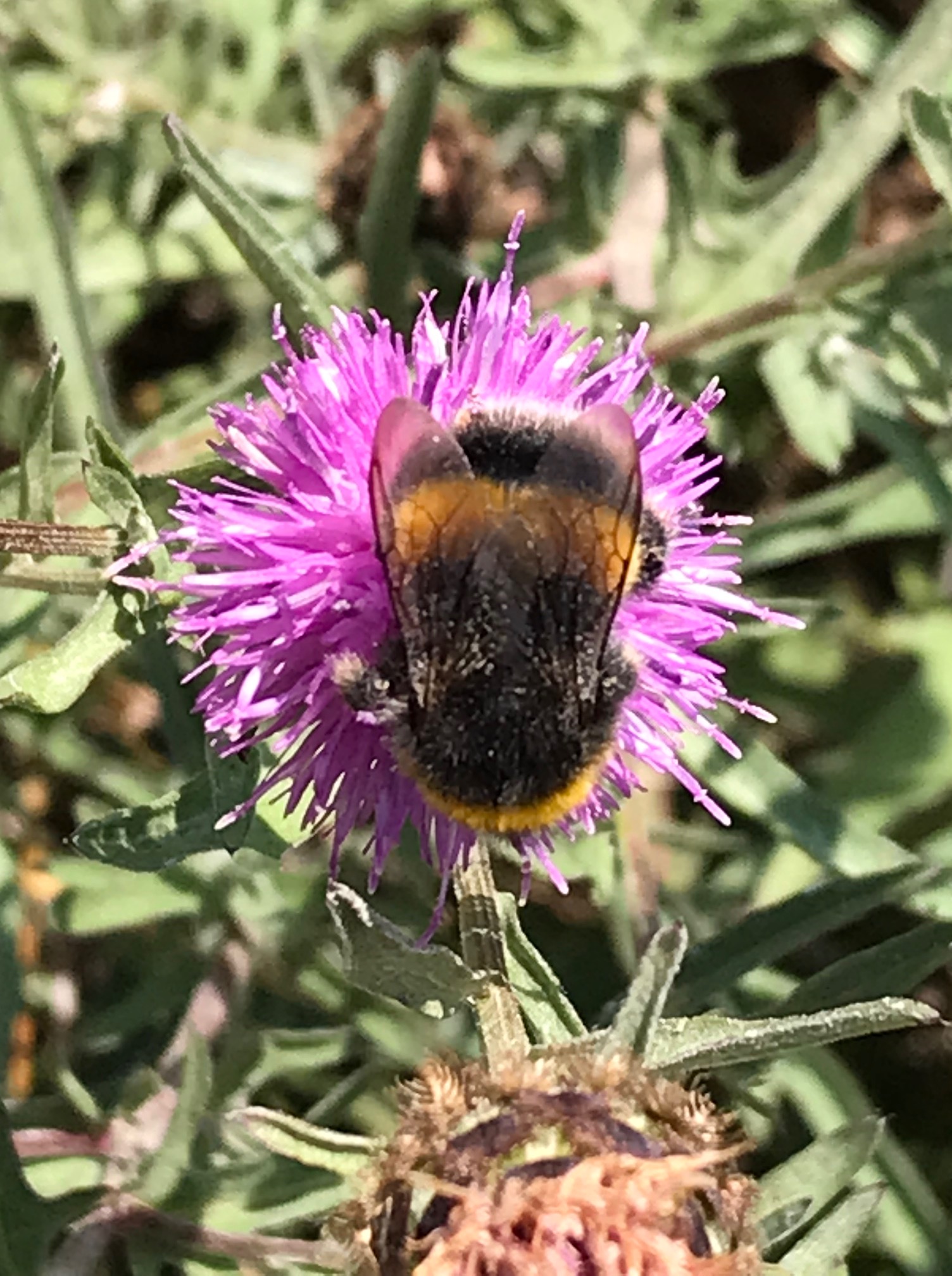
Irrelevant photo: thistle with bee

BA.2.75

Are we having fun yet? 

Our second variant is BA.2.75. It seems to spread quickly and to evade immunity. How hard it hits people is yet to be determined. It’s also called Centaurus. I have no idea why and my brain isn’t willing to expend any bandwidth on it, but since it’s also possible that the thing has peaked, it has a second name: scariant. 

Come fall, updated vaccines are expected to target the omicron mutations. I’m in line already, and rolling my sleeve up.


However

Efforts to create a pan-coronavirus vaccine have slowed down for lack of funding, lack of any sense of pressure, and lack of even marginal good sense. The current vaccines are still keeping death and destruction to a minimum, and hey, that’s good enough. Let’s just stagger on.  I could toss in a quote or two here, but hell, you get the point. Follow the link if you like. It’s find-your-own-quote day here at the cafe.

In addition, testing candidate vaccines won’t be as easy it was at the beginning of the pandemic because Covid isn’t raging through populations the way it was. Pre-existing immunities make their effectiveness harder to measure.


Other mutations

A team that’s been analyzing millions of omicron samples in order to study its mutations reports that omicron alone has 130 sublineages. A member of the team, Kamlendra Singh, thinks vaccines might become less effective over time.  

“The ultimate solution,” he said, “will likely be the development of small molecule, antiviral drugs that target parts of the virus that do not mutate. While there is no vaccine for HIV, there are very effective antiviral drugs that help those infected live a healthy life, so hopefully the same can be true with COVID-19.” 

Singh helped develop CoroQuil-Zn, a supplement that infected people can take to help reduce their viral load. It’s currently being used in India, southeast Asia, and Great Britain and is waiting for FDA approval in the United States.

A virologist writing in the Conversation agrees, at least in part, saying that vaccines targeting recent variants will inevitably fall behind as the virus mutates. “Vaccines that generate antibodies against a broad range of SARS-CoV-2 variants and a cocktail of broad-ranging treatments, including monoclonal antibodies and antiviral drugs, will be critical in the fight against COVID-19.”


Long Covid news

Long Covid’s too stale for the cafe, but it’s not growing mold yet, so let’s have a nibble out here in the alley. 

The BMJ (formerly known as the British Medical Journal) has summarized 15 studies showing that the vaccinated are less likely than the unvaxxed to end up with long Covid. That’s most true of people over 60 and least true of people between 19 and 35. 

Long covid can range from annoying to life changing (in a bad way, in case that’s not already clear; it won’t make you grow wings or develop superpowers). It also ranges from transient to no-end-in-sight. In the UK, 2% of the population has reported having it and in the US, that’s 7.5%. 

Or by another count, 2 million people in the UK have it. That may or may not work out 2%. Don’t worry about it.  

Why is the percentage in the UK so different from the one in the US and why don’t I care if the UK numbers match? Because no one’s tracking long Covid systematically. It can get pretty weird out there.  

With that out of the way, let’s talk about the important stuff: “hy did the British Medical Journal change its name? I don’t know, but since my father did the same thing, I shouldn’t roll my eyes about it.

Which is unlikely to stop me. Especially since my father didn’t change his name to an abbreviation,but to the last name I use although I have no deep-rooted claim to it.

On the positive side, that bit of history means I know for a fact the Josh Hawley isn’t a relative–even a distant one.

*

In the absence of systematic tracking, a UK study compared a big whackin’ number of people’s medical records to see what they could learn about long Covid. 

Among other things, they were able to add 42 symptoms to the existing list. (Yeah, progress comes in some annoying colors.) The new ones include hair loss, reduced sex drive, erectile problems, swelling limbs, and bowel incontinence.

I did tell you it could be serious, didn’t I? You should listen to me. 

They also organized the symptoms into three categories: 80% of the people with long Covid symptoms had a broad spectrum of problems, from fatigue to pain; 15% had mental health and cognitive problems, from depression to brain fog; and 5% had respiratory problems.

*

A small study treated long Covid patients with cognitive symptoms by using hyperbaric oxygen therapy, and the results were enough to give a person hope. The group that got the real treatment had “significant improvement in their global cognitive function and more cognitive improvement related to their specific damaged brain regions responsible for attention and executive function,” along with improvement in their energy, sleep, and psychiatric symptoms.

The patients who got the placebo treatment didn’t, although they did get a simpler sentence with no fancy language or quotation marks.

The treatment, unfortunately, isn’t something you can set up in your garage. It involves five treatments a week for two months in a machine that looks like a mid-size submarine. 


Protective actions you never thought of

Covid is less likely to kill or hospitalize people who fast at least one day a month than it is to do either of those things to those of us who think eating should be a daily practice. This may be because fasting reduces inflammation or it may be attributable to a couple of other reasons that you can look up yourself by following the link.

The bad news? The study involved people who’d been fasting intermittently for decades. It offers no information on people who took it up twenty minutes before becoming infected.


A bit more about vaccines

I’ve found enough shreds of good news that I can spare you one more piece: Vaccination, although it doesn’t prevent Covid, does seem to reduce the odds of infection. Not by as much as we’d all like, but I don’t know about you, I’ll take any percentage I can get.

You want details, though, right? Fine: In the second wave of the pandemic, vaccinated National Health Service employees who worked face to face with patients were 10% less likely to get infected than unvaccinated ones. And I’ll remind the assorted anti-vaxxers who pop up here periodically that the primary value of the vaccines lies in preventing death and serious illness, which (do you really need to be reminded?) is not a bad thing. They haven’t turned out to create sterilizing immunity, and that’s a damn shame but doesn’t mean the people who recommend them should be burned at the stake. 

No one’s offered to do exactly that to me yet, but the conversations do have a way of turning hostile. Or starting out that way. A recent comment opened with, “Stop lying, Ellen.”

And I appreciated the suggestion, since hadn’t thought of that myself. I also appreciated the generous and high-minded approach to discussion. Let it be a model for us all.

*

But forget about me. Ben Neuman, a professor in the Department of Biology and chief virologist at the Texas A&M Global Health Research Complex, has another reason to get vaccinated: “to avoid the brain damage that often comes with COVID. During a natural infection, the immune response around your brain will starve cells of oxygen, and the effect is that you will lose a lot of gray matter—something like a stroke. Unlike a stroke, where usually only one part of the brain is affected, COVID seems to affect the entire brain, so you don’t necessarily lose one thing, like the ability to control nerves on one side of the face, you lose a bit from everywhere. COVID-associated brain damage only happens with infection, not with the vaccine, and having a strong set of white blood cells trained by the vaccine is likely to be helpful in preventing brain damage.” 


Okay, but what about monkeypox?

Let’s forget about whether monkeypox is a pandemic or an epidemic or just a damned nuisance. Those–especially damned nuisance–have technical definitions that, for a bunch of free-range blog readers, aren’t the most useful standards. The more pressing question is, How much of a problem is this likely to be?

After what sounds like a lot of internal argument, the World Health Organization declared it a global health emergency. The disagreement, as far as I understand it, comes from this: Diseases that spread on the air (think Covid or flu) are bigger worries. They’re easy to catch. Monkeypox is spreading through touch. That doesn’t make it fun and I don’t recommend rubbing up against anyone with a rash right now, but it does mean transmission’s slower and more difficult.

It’s also less deadly than Covid. 

If that’s not reassuring enough, existing vaccines can slow the spread–or they can once production catches up with the need.

On the other hand, it’s popping up in a wide range of countries and seems to have surprised the experts.

Monkeypox could (I’ve read) go in two directions: It could establish itself in many countries as a sexually (an also not-sexually) transmitted disease that people will have to deal with or it could be gotten under control. The first prospect isn’t fun, but it’s still not Covid all over again.

Who gets to vote on Britain’s next prime minister?

What’s the news from Britain? Well, the race for leadership of the Conservative Party–and incidentally of the country–is now down to two people, Rishi Sunak and Liz Truss. The winner will be decided by something like 160,000 members of the Conservative Party, 97% of them white, half of them over sixty, and most of them male. While we’re at it, a hefty number are from southern England. 

That’s based on the 2019 count. Statisticians tried to do a complete count but fell asleep before they could complete their work. 

What’s the population of Britain? Something in the neighborhood of 67 million. I’d give you a link to prove it but I fell asleep too. 

So yes, it’s all very democratic and representative and so forth. 

I can hardly wait to see what happens next.

Irrelevant photo: a hydrangea

*

In other uplifting political news, the Nottinghamshire police and crime commissioner won her position (it’s an elected post) by promising to crack down on speeding, then went on to get caught speeding five times in twelve weeks, two of them near a primary school. She’s lost her license for six months and was fined £2,450. 

She asked to keep her license because losing it would cause her exceptional hardship, to which the judge did not say, “Are you kidding me?” 

Sh hasn’t said whether she’ll resign but it won’t surprise you to learn that she’s been asked.

*

In what’s probably an unrelated story, wild European bison are roaming the country for the first time in 6,000 years. Three females were released in Kent this month and a male is set to join them in August, as soon as he gets through the backup at Heathrow’s passport control. 

I’m not sure how the three get to be the first in Britain, since one of them came from a herd in Scotland, but maybe it’s because they’re roaming in the woods as opposed to, um, you know, taking the tram up and down Princes Street in Edinburgh.

Listen, I don’t understand this stuff, I just report it. What does seem comprehensible is that they’re expected to strip the bark off of trees, thinning the forest canopy, creating paths, collecting seeds (bison like seeds), planting wildflowers, and generally rearranging the ecosystem and transforming the woods “into a lush, thriving, biodiverse environment once more.” Which will allow the trust that owns the land “to step back from hands-on management.”

I did say the bison were wild, right? 

I did, but what that means depends on how you define wild. They have tracking collars and are now fenced in a five-hectare area, which will eventually increase to two hundred hectares. But, yeah, within that, they’re wild as hell. 

They’ll soon be joined by ponies from Exmoor and iron-age pigs.

What’s an iron-age pig? For starters, it’s older than anyone you or I know.

*

It turns out that if you switch off a neighborhood’s streetlights between midnight and 5 a.m., it will cut down on the number of things that get stolen from cars. By almost 50%. And crime overall will fall by 25%.

Why’s that? Because it’s hard to see. 

The bad news is that both will increase in nearby neighborhoods. 

*

Have I slagged off the government enough lately? Sorry, I let myself get distracted.

Boris Johnson and Rishi Sunak (who now hate each other but used to work together and played nice in front of the TV cameras) spent £2.9 billion on the Restart program, a mandatory program that was supposed to get the long-term unemployed back to work. A mandatory program, meaning if you were referred to it you had to go. Because, hey, we’re trying to help you here.

How well did it work? Oh, gorgeously. Some 93% of its participants didn’t find work. That gives us with–wait, I need to consult Lord Google to be sure I get this right–a 7% success rate. 

It did, however, transfer a lot of money to the private contractors it was farmed out to. 

By way of accuracy, the program cost £2.9 billion in the headline but more than £2.5 billion in the text. Why the difference? Dunno, but even I will admit that £2.9 billion is more than £2.5 billion.

*

No summary of the news would be complete without this one: A retired Church of England vicar was fined and added to the list of sex offenders after a member of the public (“who was attending a talk about Asperger’s syndrome) found him in church naked except for a pair of stockings and performing a sex act with a vacuum cleaner.

You thought you’d heard it all? Silly you. Human sexuality is infinite. You can never hear it all.

It’s true that this particular vacuum cleaner has a name–not the individual vacuum but the brand. They’re called Henry. All of them. And they have a face painted on the side. So it might be easier to personify them than it is your average back-of-the-mop-cupboard vacuum cleaner. But then, I could be misunderstanding the situation completely.

The newspaper article I stole this from notes that the vicar had, before this, a clean record. As he would, given his inclinations. 


But enough about Britain. What’s happening elsewhere?

Well, around the world, at any given time, one out of six people will have a headache.Maybe it’s why more people aren’t having sex with vacuum cleaners.

*

According to a study in Japan, decisive people are no more likely to make the right choices than people who are full of doubt. 

“What we found is that confidence was the only thing that was different,” said the study’s first author, whose name is the Japanese equivalent of Smith: Zajkowski.

Hesitant people of the world, unite. 

Or not. You might want to think about it before you jump in. 

*

A Belgian virologist and government Covid advisor, Marc Van Ranst, was threatened by an air force officer who got his hands on a submachine gun and four anti-tank missile launchers.

But that’s not our story. The story is that the head of an anti-vax group, who is not so incidentally a dance teacher, publicly said something approving about the death threat.

“When there’s a salsa pandemic,” the virologist tweeted, “I’ll listen to you with great pleasure. But at this moment, I don’t give a flying fuck what you have to say and nobody in the Netherlands should either.”

*

In the US, Republican Senatorial candidate Herschel Walker impressed the hell out of everyone by explaining the climate change problem this way: “Since we don’t control the air, our good air decided to float over to China’s bad air. So when China gets our good air, their bad air got to move. So it moves over to our good air space. Then — now we got we to clean that back up.”

I can’t swear to it, but I think the shift from general incoherence to total incoherence there at the end is the actual quote, not a typo. 

Here’s what he had to say about gun control after the Uvalde shooting:

“Cain killed Abel and that’s a problem that we have. What we need to do is look into how we can stop those things. You know, you talked about doing a disinformation — what about getting a department that can look at young men that’s looking at women that’s looking at their social media. What about doing that? Looking into things like that and we can stop that that way. But yet they want to just continue to talk about taking away your constitutional rights. And I think there’s more things we need to look into. This has been happening for years and the way we stop it is putting money into the mental health field, by putting money into other departments rather than departments that want to take away your rights.”

There you go. A problem understood is a problem halfway solved. 


And a bit of history

Benjamin Franklin deliberately misspelled Pennsylvania when he printed the colony’s currency.And not just one wrong way but three different ones: Pensilvania, Pennsilvania, and Pensylvania. 

The state seems to have survived his efforts.

The plan was to foil counterfeiters, or so it’s generally believed.

What causes long Covid?

A lot of clever people are chasing the cause of long Covid, but so far the virus is outrunning them–and we’re talking about a virus, remember, that doesn’t have a degree in either science or medicine and that’s rumored to be illiterate.

Not that I’m making fun of those clever people. Long covid scares the bejeezus out of me and I’m grateful for the work they’re doing, but I’m also painfully aware that they haven’t even found all the puzzle pieces yet, never mind gotten them in the right place. 

Puzzle pieces? What happened to the chase metaphor? 

I couldn’t keep up with it and had to grab something else off the shelf where I store my cliches.

Irrelevant photos: Morning glories–or as the British call them, bindweed.

But back to our actual subject: The clever folk are at the stage where they have theories, but that’s not all bad. Theories open up possibilities and they’re a good place to start. Let’s check in with a few of them:

Pediatrician Danilo Buonsenso noticed that some of his patients–these are kids, remember, with their habit of showing up at pediatricians’ offices and licking their fingers before touching the toys–

Where were we? Some of his patients who’d had mild Covid cases were left short of breath, exhausted and sporting a variety of other symptoms. That’s not common in post-Covid kids, but what with him being a doctor and all, and one who specializes in infectious diseases (I know, I didn’t get around to mentioning that earlier)–well, the kids he’s most likely to see are the ones who are sick, which skews the sample.

As the article I stole this from explains it, “He now suspects that, in some of them, the cells and tissues that control blood flow are damaged and the blood’s tendency to clot is amplified. Minute blood clots, leftover from the viral assault or fueled by its aftermath, might be gumming up the body’s circulation, to disastrous effect from the brain to joints. ‘In some patients we have specific areas where no blood flow comes in’ or the flow is reduced, Buonsenso says. 

Another theory comes from  microbiologist Amy Proal: that the virus hangs on in the body after the acute stage of the infection is over. Studies show that “the virus is capable of persistence in a wide range of body sites,” she said. 

A third theory comes from Chansavath Phetsouphanh, who’s observed that the immune cells of long Covid patients are still on high alert as much as eight months after they first tested positive. 

A fourth theory comes from Nick Reynolds, who found amyloid clumps in the brains of people with the neurological symptoms of  long Covid. They’re similar to the clumps that cause Alzheimer’s disease and dementia. That doesn’t necessarily mean the patients will have lasting damage or that the drugs used to treat those diseases help in these different circumstances. On the other hand–well, who knows at this stage? It might.

Are any of the theories right? Are all of them showing us a small piece of a large picture? Tune in sometime later–possibly a lot later–for the next exciting episode of What’re We Going to Do to Get Out of This Mess? And keep in mind that once the clever people figure out what’s driving long Covid, they or some colleagues still need to figure out a treatment.

Don’t you just feel better after you hang around here? 

In the meantime, an assortment of studies are following up on the possibilities these theories raise. Wish them well, please. It won’t make any material difference, but it might make you feel like you contributed to the effort.


Numbers

How many people actually have long Covid? Answering that depends on how we define long Covid, but let’s set that aside. We’re not scientists–or most of us aren’t and anyone who is must be slumming. We can get away with being hazy when it suits us. 

In May, the U.S. Centers for Disease Control and Prevention rampaged through the medical records of some 2 million people and reported that at least 1 in 5 people who’d had Covid came away with long Covid symptoms. For some of them, that meant struggling but hanging onto their normal lives. For others, it meant struggling, only with nobut at the end of the sentence.  

In the UK, some 2 million people have long Covid according to the Office for National Statistics, which does have a definition of the thing but never mind what it is. We’re not scientists, remember? Or else we’re slumming and will have to put up with the way other people’s minds work. 

Proal (remember her?) said, “I consider Long Covid to be a massive emergency.”


Who’s most at risk of long Covid?

A small study from Japan found that being over 40 increased the odds. So did being over 60. Since I’m over both (it took a while, but I got there), this is not good news where I live. 

In contrast to other studies, it didn’t find sex to be a big factor, although long Covid seemed to have a harder psychological impact on women than on men. 

In contrast, a UK study found that being female, being in poor pre-pandemic mental and physical health, being obese, and having asthma all increased the odds of long Covid. 

Do the two studies contradict each other? Partially. The data they’re working from is sketchy, but the issue’s important enough to use it anyway. Take them for what they’re worth.

The UK study finds that between 7.8% and 17%of the people who reported having Covid also reported symptoms that lasted longer than longer than 12 weeks, and between 1.2% to 4.8% reported  that the symptoms were debilitating. 

Why the range? I haven’t a clue. I find numbers debilitating.

The numbers were lower when they worked from doctors’ records as opposed to self-reports, but that could be because doctors weren’t reporting long Covid before November 2020.


A shred of good news

The omicron variant may be less likely than delta to cause long Covid–20 to 50% lower. To put that another way, with omicron, 4.4% of cases turned into long Covid. With delta, that was 10.8%. But that’s still a shitload of people.


More numbers: What have vaccinations ever done for us?

Well, in the first year they were available, they prevented an estimated 19.8 million Covid deaths. That’s based on excess deaths in 185 countries and territories. 

Excess deaths? It’s the figure you use when you don’t have any other consistent or reliable way to count the pandemic’s impact. In rough terms, it compares deaths during the pandemic to deaths in some pre-pandemic year. It’s imperfect, but the other systems are even more so. If you don’t use it, you end up counting the number of people who (if they weren’t dead) could brag about having Covid listed on their death certificates. You miss a lot of people that way. You can also count the number who are known to have had Covid and who then went on to die, leaving you counting people who died because a brick fell on their head and missing some who died undiagnosed. Or you can count people who die within 28 days of a diagnosis and miss the ones who took too long to die as well as include a few who had unfortunate encounters with bricks.

The UK switched methods midway through the pandemic, probably because the government wanted it to look like fewer people had died and the new way yielded a lower number. 

Yeah, I have absolute faith in the people leading the country. They’ll do whatever works best for them and to hell with everything and everyone else.

Not only is none of the systems accurate, different countries rely on different definitions of a Covid death, raising hell with international studies. 

But let’s put death on the shelf for a minute and go back to vaccines and lives saved, which is what we’re pretending to talk about. The study estimates that 599,300 more lives would’ve been saved if the world, lower case, had met the World (upper case) Health Organization’s target of getting  two or more vaccine doses to 40% of the population of every country by the end of 2021

By now, 66% of the world’s population has received at least one dose of vaccine.


More numbers

In 2020 and 2021, Covid was the third leading cause of death in the United States, crossing the finish line after cancer and heart disease. So it gets a bronze medal and modest bragging rights, but not as much glory as it was hoping for. 

Celebrating the queen’s WTF jubilee

Let’s start with basics: The queen in question is Elizabeth, and she’s been on the throne since 1066 or thereabouts. Surely that calls for a party, so here in Britain we’ve been handed a spare holiday, a dessert recipe so simple that can be prepared in two days by half a dozen trained snipers, and lots of encouragement to hold our own street parties, band concerts, and whatever else sets our suggestible little hearts a-racing. 

It’s not easy, if you live in Britain right now, to ignore all that, but I had planned to until I realized how gloriously parts of it could go wrong. 

Let’s start with Wincanton, in Somerset, which is holding the Wincanton Town Festival. That comes with a logo showing a be-jeweled crown on a purple background with, as Dorset Live puts it, “a diamond-encrusted WTF welded to the top.”

You know the acronym WTF: Wincanton Town Festival. 

If you want to attend a WTF Jubilee (even I will give that a capital letter) garden party, it’s on June 3 so you’ll have to either hurry or time travel, but I’m sure you’ll be welcome.

Nothing could be more British. Just try to keep a straight face.

*

English Heritage, which manages the Stonehenge site, is celebrating by projecting color images of the queen onto the stones. The effect is–

The word bizarre doesn’t begin to capture it. There stand these rough, prehistoric stones, in all their timeless majesty, and they’re being used as a screen to show photos of an old woman dressed in the colors of toy Easter chicks.

I’m not disparaging her for being an old woman, mind you. I’m not what you’d call young myself. But you won’t find me on an ancient monument dressed like an Easter chick.

But English Heritage is proud of their decision, and since nothing that happens really happens unless it’s on social media, they tweeted a photo, with the predictable results. And just to prove I don’t make this stuff up (who could?), here’s the tweet.

A few of my favorite comments are:

“Pointless, outdated, ancient monument to a bygone era. Projected onto Stonehenge.”

“Things Stonehenge and the Monarchy have in common? How the fuck did this get here?”

“Something ancient and now pointless that we keep under the guise of tourism, projected onto stone henge”

*

But we’re not done yet. Boris Johnson–he’s our prime minister when he finds time between parties–wants to celebrate by bringing back imperial measures. Or at least letting shops use them if they’re in the mood.

Oh, c’mon, you know what imperial measures are. Generations of schoolkids sacrificed (cumulatively speaking) months of their lives memorizing that a foot is 12 inches long, a yard is 3 feet, and a mile is 1760 yards. Also that a cup holds 10 ounces if you’re in Britain but 8 if you’re in the US, and that a quart holds 4 cups while a gallon hold 4 quarts. In either country, although the cups won’t be the same size, so why should anything that follows from them?

Mind you, those ounces that make up the cup aren’t the same ounces that go into a pound. They’re liquid ounces and a pound is a measure of weight, so it uses different ounces. Unless that pound is measuring money, which it does as a second job. It doesn’t use ounces for that at all–it drops them off at home when it stops in for a quick bite to eat.

In case all that business with 4 cups and 4 quarts made you think the number 4 is magical when you work with liquid measures, a pint holds two cups. You can’t rely on anything.

We won’t get into hogsheads and firkins and bushels and furlongs, but oh, we could, my friends, and we’d have such fun. Still, it would be irresponsible to move on without telling you that a hundredweight is made up of 112 pounds and a pennyweight is 12 grains.

So you can see why imperial measures are simpler, more logical, easier to understand, and all-around better than the metric system: They keep out the riff-raff and the numerically challenged.

But silly as it may seem, Johnson’s proposal’s done wonders for my stats. An old post on Britain’s halfhearted adoption of the metric system and on the old system(s) of measuring has attracted some ridiculous number of hits lately.

That’s ridiculous given the scale I work on. We’re talking about hundreds, not thousands. If you want to read about rods and furlongs and apple gallons and Cornish miles, it’s all there. And if you think the past was a simpler place, I recommend it.

*

What else happens dring the jubilee? Why, the queen’s jubilee-themed tree-planting program. This encourages people to plant a tree for the jubilee, which not only rhymes (if it hadn’t, what would they have come up with?) but is promoted as a way to reforest the country.

It’s been busted for having sponsors with links to deforestation. But in other countries. Ones with more forest. And less power. So that’s okay. 

According to a campaign group, the program’s platinum sponsors include McDonald’s, with beef linked to the deforestation of the Amazon, and the bank NatWest, with links to deforestation in Uruguay. And so forth.

Everyone involved says they have no links to deforestation or are committed to doing better or have planted a tree at midnight in a neighbor’s yard and we should all go mind our own business, thank you very much, so we’ll move on.

*

Because that’s not all the queen’s doing. She’s giving Britain eight new cities

No, not like that. She doesn’t build them herself. What she does is wave her magic feather over someplace that already exists and declare that what used to be a town is now a city. This doesn’t make it any larger, although some research suggests that it may make it richer, since (and I’m quoting the BBC here, which doesn’t explain the mix of singular and plural but does give me someone to blame it on) “it put them on the international map as a place to do business.” Presumably, businesses ask Lord Google about a place, find out it’s a city, and get so excited they’d push little old ladies out of the way in their rush to do business there. Even little old ladies dressed like Easter chicks.

Listen, don’t ask me. I’m not the one making the argument. The survey seems to be based on a sample of one, the former town/now a city of Perth (it’s in Scotland), which for all we know grew richer for other reasons. But never mind, we can’t rule out the queen’s magic feather.

I should mention, in case you don’t already know this, that in Britain a town doesn’t become a city by democratic consensus–you know, by people noticing how big it is and calling it a city. It happens by decree and has precious little to do with size. The smallest British city has 1,600 residents. For all I know, the queen could make herself a city. Or make you one. You wouldn’t be any larger, and neither would she.


But speaking of democracy…

…jackdaws decide when to leave the roost in the most democratic possible way. Each bird literally has a voice. 

In the winter, jackdaws roost together overnight, and in the morning they take to the air in a mass. When a bird thinks it’s time to leave, it calls out, and each call is a vote. The noise level and the speed at which it increases both influence the flock’s decision to take off. 

As many as 40,000 of them can roost–and lift off–together. They don’t care if you call it a city or not.


Will everyone who isn’t Banksy please stand up?

We’re still talking politics here. William Gannon, a town councillor in Pembroke Dock, Wales, resigned in an attempt to squish a rumor that he’s the anonymous street artist Banksy. The rumor, he believes, was started by someone who wants his seat on the town council and, he said, it was “undermining my ability to do the work. . . . [People were] asking me to prove who I am not and that’s almost impossible to do.”

Gannon is an artist and does make street art, which his website describes as “Banksy-esque, not intentionally,” but that’s not the same thing as him being Banksy, and to prove that he’s handing out buttons saying “I am NOT Banksy.” He wears one himself, but then, as many people have pointed out, that’s exactly the sort of thing Banksy would do.

You can’t win this game.


And in unrelated clashes with the law…

…a pair of herring gulls have nested on a police car in Dorset and can’t be moved off because they’re members of a protected species. The car’s out of use until the chicks fledge. In the meantime, the adult birds are helping the police with their inquiries.


This one stayed out of court, but…

…the Star Inn at Vogue, which is in Vogue, Cornwall and known locally as the Vogue, was threatened with a lawsuit by the owners of Vogue magazine for using its name. The pub owners found that hilarious and wrote back to say the pub had been in place, under that name, for hundreds of years.

“I presume,” Mark Graham wrote, “that at the time when you chose the name Vogue in the capitalised version you didn’t seek permission from the villagers of the real Vogue. I also presume that Madonna did not seek your permission to use the word Vogue (again the capitalised version) for her 1990s song of the same name.”

The magazine wrote back with an apology, which is now framed and on display.


And finally, leaving the UK behind

A year ago, a two-day promotion by a restaurant chain in Taiwan offered free sushi–on an all-you-can-eat basis–to anyone with the Chinese characters for salmon in their name, and also to the people they brought with them. That led 331 people to change their names. It doesn’t cost much, at least when compared to the price of a tableful of sushi. So the country suddenly acquired a bunch of people named things like Salmon Dream and Dancing Salmon. Some of them built a social media following on that basis. (There’s no explaining social media.) Others started small (and short-lived) businesses, charging people to go out for sushi with them. 

It was called Salmon chaos, and the government was not amused by the administrative cost of it all. 

Most people changed their names back as soon as the promotion ended, but a few got trapped, because the government only allows a person to change their name three times. Last I heard, the government was debating a change in the law, but in the meantime a few salmon were still trapped as salmon. 

Monkeypox and inflation: the news from Britain

The monkeypox puzzle

When I first started writing this, Britain had 20 confirmed cases of monkeypox, and more than 100 had shown up in other non-African countries. Both numbers have grown since then, but let’s stop counting. 

That they’re showing up outside of Africa is significant, because Africa’s the only place the disease is endemic. So let’s ask the question: Is it time to panic?

Well, those aren’t huge numbers, but the last few years have primed us to overreact when diseases we never heard of knock on the door. We hide behind the couch. We yell through the door and throw things. We eat too much of whatever’s on hand. It’s as natural as it is pointless. 

Still, what’s happening is odd. Monkeypox doesn’t spread easily. It’s shown up outside of Africa in the past, but as isolated cases, not as chains of infection, which is what at least some of these are. 

Monkeypox is a milder relative of smallpox and comes in your choice of two designs: the West African and the Congo. The Congo strain is fatal in 1 out of 10 reported cases and the West African in 1 out of 100. In both instances, you should put the emphasis on reported, because a lot of milder cases never do get reported. In other words, the virus is less lethal than the statistics make it sound. 

So far, only the West African strain has been found in Britain. Reports aren’t in from the rest of the world. 

Most people recover from monkeypox in a few weeks and don’t need treatment, although it can cause complications in  pregnancy, including stillbirths, and is generally more severe in children than in adults.

Both an antiviral treatment and a vaccine exist. What’s more, anyone who was vaccinated against smallpox as a baby probably has some protection against monkeypox. But smallpox vaccination wound down in most countries before 1980. 

How does monkeypox spread? Not easily. It likes to travel on large dro

Irrelevant photo: Osterspermum (I think) surrounded by may.

plets–those things we breathe out no matter how delicate we pretend our manners are. But large droplets don’t travel far, so you have to be in relatively close contact to be exposed. The World Health Organization doesn’t talk about it as an airborne virus.

You can also get it from contact with skin lesions (it causes a rash) and from contact with materials. What kind of materials? A New Scientist article talks about the “clothing, towels or bedding used by an infected person.” 

The World Health Organization also doesn’t talk about it as a sexually transmitted disease, but (don’t you love how a but slides in and contradicts everything that comes before it) it can be transmitted by skin-to-skin contact–not to mention by heavy breathing in close proximity. It can also be transmitted by contact with the rash it causes, and if the rash is in a sexually relevant place, contact becomes almost inevitable. So yes, sex with an infected person would be a great way to catch the disease. In Britain, the current crop of cases are clustered in gay and bisexual men, not because they’re any more prone to it but presumably because some of them were prone with an infected person.

The most recent report I’ve seen traces a lot of cases to two raves, one in Spain and one in Belgium.

Charlotte Hammer, an expert on emerging diseases, said, “I am certain we are going to see more cases,” but that doesn’t mean we’re looking at a replay of Covid. The experts will be looking for more cases, and GPs can now be expected to recognize any that show up. So infections that would have gone unnoticed will now be noticed. And since the disease has an incubation period of one to three weeks, it’s about time for people who were exposed early on to come down sick.

Why, thn, do we have such an unusual number and range of cases showing up outside of Africa? Hammer said we’re looking at two possibilities, although it sounds to me like two and a half. We’ll count it out my way, since she’s not watching.

1, The virus is inherently different now,

1a, our susceptibility has changed,

or 2, a perfect storm of conditions has allowed the virus to spread the way it has. 

She thinks number 2 is the most likely. Let’s back that up with a quote from Keith Neal of Nottingham University. “Has the virus changed? Well, it does not actually appear to be any more lethal, though something may have affected transmissibility. And don’t forget, this is a DNA virus and is unlikely to mutate at the rates that RNA viruses do. . . . I am not too worried.”

Researcher Romulus Breban thinks that, given the number of people who have not been vaccinated against smallpox, this was waiting to happen.”

“Our immunity level is almost zero,” he said. “People over 50 are likely to be immune, but the rest of us . . . [are] very, very susceptible.”

In short, this doesn’t sound like the next thing that’s going to kill us all. So settle down, everyone. Just be careful who breathes into your face, whose skin you rub, and whose bedding you handle. Not to mention who you go to bed with. 

That last part is probably good advice anyway.

*

I skimmed through Twitter the other day and spotted an early-stage, monkeypox-related  rabbit hole, which told me that the bad guys are working the good but credulous folks into a state of hysteria over nothing. Again. Not that they need to bother if hysteria’s their goal. The Twitteratti are doing it for them.

Who are the aforesaid bad guys? Depends who you ask. Dr. Fauci, George Soros, the Pfizer corporation, and the government (choose your least favorite or simply the one where you live) all got a mention, and all that was before I’d read for more than a minute. I’m sure the list is longer–and if you believe the theories, they’re all in it together. If I’d dug deeper, I expect I’d have found an international conspiracy of woke neo-Marxist professors of post-structural critical race theory and a cabal of international communist Jewish bankers. 

Has anyone noticed how few bankers turn out to be Communists, and vice versa? How you can find enough to mount a decent conspiracy is beyond me, but never mind. Why ruin a good theory? Whoever they are, they’re out to get us.

I’m not actually sure the denizens of this incipient rabbit hole have to agree on who the they here is. Or are.The whole business puts as much of a strain on grammar as it does on logic. 


The inflation news 

With inflation rising at a level Britain hasn’t seen in 40 years, a handful of Conservative MPs (that’s members of parliament) have demonstrated a breathtaking understanding of what it means to live on a low income. 

Lee Anderson opened the discussion by saying the country doesn’t need all those pesky food banks. The problem is that poor people don’t know how to budget or cook from scratch. If they did, they could make themselves a meal for 30 p. (To translate that to dollars, about 40 cents.)

So Welsh chef Gareth Mason took up the challenge.

 “I’ve come to the conclusion it’s a load of rubbish,” he said. “These meals I’ve done, as soon as you put any protein or dairy into them, it’s not feasible to do it for 30p.

“If you eat beans on toast for every meal, it might work, but even if you did cheese on toast, the cost of cheese would be more than 30p on its own. And you have the cooking cost on top of the cost of the food.”

Yes, money’s tight enough and energy bills are high enough that people are asking themselves whether they can afford to turn on the oven. Or the stove, although they’d call it a cooker.

“Even if this MP is talking about batch cooking army food, even the smallest amount of spaghetti bolognese is going to go above 30p.”

An adult, he said, would struggle to get the recommended number of calories.

I’m grateful to Mason for doing the research, because it gives those of us who already knew it was rubbish someone authoritative to quote.

*

Meanwhile, Rachel Maclean said people struggling with the cost of living should get better jobs. You know, the kind of jobs that pay more. Or they should work more hours. 

See, that’s the trouble with poor people. They don’t think of things like that. 

If poor people became MPs, for example, they could claim–as the average MP does–£203,000 just for expenses, although Maclean claimed £10,000 more than that.  

She, by the way, is the government’s minister for safeguarding, meaning she’s in charge of protecting an assortment of vulnerable people from the kind of stuff they’re vulnerable to. I haven’t noticed any of that going particularly well, but never mind. The pay’s good and–see?–she’s not poor, so maybe the two are connected

*

So how bad is inflation? At the beginning of April, it hit 9%, and the less money you make the higher your personal inflation rate is, because you spend more of your income on food and energy, which have risen more than (and I write this next bit with without checking either my figures or my stereotypes) yachts and champagne, pushing your personal inflation rate in the double digits. Silly you; if you had your priorities straight, you’d forget about food, rent, and heat and spend your money on something with a lower inflation rate.

To put numbers to that, the inflation for the poorest 10% of the  population is 3 percentage points higher than it is for the richest 10%.

The situation is bad enough that Andy Cooke, the chief inspector of constabulary, said police should use their discretion in deciding whether to prosecute people who steal because they need to eat. 

Which led Kit Malthouse, the policing minister, to say the idea that inflation would cause more crime was “old-fashioned.” He’s told officers not to let people off just because they’re desperate and stealing food. 

Okay, he didn’t mention desperation. I’m not sure he understands its connection to money. Or hunger.

What he did say was, “I have to challenge this connection between poverty and crime. What we’ve found in the past, and where there is now growing evidence, is that actually crime is a contributor to poverty. That if you remove the violence and the crime from people’s lives they generally prosper more than they otherwise would.”

So first we take away the violence. As a result, people’s paychecks get larger. Their rent gets lower. Why hasn’t anyone mentioned this before? All we have to do now is figure out how they feed themselves and their kids while they wait for the magic to kick in. 

What do all these people I’m quoting actually do? The chief inspector of constabulary heads the independent body that assesses police forces in England and Wales.  The policing minister is part of the government–in other words, a member of the party in power (the Conservatives, known for their compassion, their competence, and the parties they threw when they’d locked down the rest of the country). He does something or other in that connection, although I have no idea what and I’m not convinced that he does either.

*

We’ll give the final word to the prime minister, who tells us that work is the best way to get out of poverty. This from a man who can’t tell work from a party, which is why he ever so accidentally broke his own lockdown rules. 

*

Nah, let’s not give him the last word, let’s give it to Oxfam, which reports that, worldwide, the pandemic has created a new billionaire every 30 hours–and it expects a million people to be pushed into extreme poverty every 33 hours this year. 

Billionaires’ wealth has risen more in the first 24 months of COVID-19 than in 23 years combined. The total wealth of the world’s billionaires is now equivalent to 13.9 percent of global GDP. This is a three-fold increase (up from 4.4 percent) in 2000. . . .

“The fortunes of food and energy billionaires have risen by $453 billion in the last two years, equivalent to $1 billion every two days. Five of the largest energy companies (BP, Shell, TotalEnergies, Exxon and Chevron) are together making $2,600 profit every second, and there are now 62 new food billionaires. . . .

”The pandemic has created 40 new pharma billionaires. Pharmaceutical corporations like Moderna and Pfizer are making $1,000 profit every second just from their monopoly control of the COVID-19 vaccine, despite its development having been supported by billions of dollars in public investments. They are charging governments up to 24 times more than the potential cost of generic production. 87 percent of people in low-income countries have still not been fully vaccinated.”

Just sayin’, as one of our godkids used to say.

Are the expiration dates on Covid tests for real?

I raise this question because I’m an expiration date-denier, at least in most situations. I’ll bake with flour that’s older than I am. I don’t toss food out until it reeks or evolves new life forms. I don’t take orders from the small print on food packaging. 

To my lasting disappointment, though, test kits do get to boss us around. When they pass their use-by date, they start returning false negatives. And the worst of it is, they expect us to be at least a little sympathetic about it. Wouldn’t we get tired of sitting on a shelf and waiting for someone to decide they might have a use for us? And don’t we also turn a little negative with all that passivity and waiting? 

So apologies, but we really do need to pay attention. 

When do the ones on my shelf expire? Haven’t a clue. I should go look but I think I’ll wait and go into a panic about it when I need one.

Irrelevant photo: a poppy

*

Remember everything hopeful I’ve written about the possibility of universal Covid vaccines? 

Of course you do. You memorize every word I write. Which is good, because I don’t.

I ask because we’ve got some new Omicron subvariants working their way into the pandemic pipeline, and although they don’t seem to be any more vicious than the old versions, they do seem to be better at immunities. 

The one spreading in the US is called BA.2.12.1, which as far as I can tell means it’s a variant on Omicron 2.0. The others were spotted in South Africa and are called BA.4 and BA.5, which are, at least, easier to remember.

Is it time to panic? Nah. There’s always time for that later. 

The new subvariants are able to infect people who had the first version of Omicron–the one that came out before Elon Musk bought the entire genome. They can also infect people who’ve been vaccinated. But the picture isn’t simple. A lot of vaccines are out there and the study couldn’t cover them all. They may provide greater protection. And in case that doesn’t introduce enough unknown quantities, the variants’ ability to slither past people’s immunities could be, in part, because people’s immunity was starting to wane. It could also be because so many people spell Musk’s first name wrong. So don’t jump to conclusions.

What does it all mean for the fight against Covid? A lot of experts are asking that, including the vaccine makers, who could tweak their vaccines to target Omicron and find themselves, yet again, three steps behind a virus that knows the Greek alphabet better than they do. Translation: We don’t know what the next variants will look like (never mind what letter it will be named after), but we do know that a new variant will appear. And experience tells us that Covid’s good at finding ways to dodge our immune systems.

The obvious solution is a vaccine that targets all forms of Covid, and possibly its coronavirus friends and relations as well, and any number of scientists are chasing after that. But they haven’t caught it yet. It’s fast, it’s clever, and it’s small enough to hide in the undergrowth.

Another possibility is to use a mix of monoclonal antibodies that target various strains of Covid. 

A mix of what? A brew made from antibodies created in response to assorted forms of Covid. Pour the mix into an infected person’s system and it can get to work on whatever it finds.

The problem is cost. One dose currently costs $1,000 per patient, so at best it would have to be limited to the most vulnerable people, and only in countries that can afford it. Or if you’re in the US, it would be limited to individuals who can afford it.But if the brew could be gotten down to $50 or $100 per dose, it would be cheaper than constantly updating vaccines.

What does seem to be certain–at least to observers who haven’t drunk the KoolAid labeled “What the Hell, Let’s Say It’s Endemic and Move On”–is that letting the virus spread and mutate while we shrug our shoulders and tell ourselves to live with it is a recipe for trouble.

Sorry–make that more trouble than we already have, since we’re hardly trouble-free just now.


Studies, updates, and patent pools on the spread of Covid

According to one study, you’re a thousand times less likely to catch Covid from touching stuff than you are from breathing in its presence. That’s true not only of you, but also of your friends, your relatives, and your enemies (if you have any, and if you don’t please substitute a few people you never managed to like. And also of me. So if you’re still trying to find that pack of disinfectant wipes you lost at the back of your cupboard (or your neighbors’ cupboard–who knows how these things happen?), relax. You may not need them.

Emphasis, as usual, on may.

Details? Oh, you fussy people. The study was done when lots of antibacterial cleaning was going on and crowds were nonexistent, so let’s not go off the deep end and decide it translates completely to the world we’re living in now. Still, it’s information and it’s worth reading:

The riskiest places, in terms of both air and surface samples, were gyms, with gym drinking fountains rating high on the list of things to avoid. The exercise equipment itself didn’t turn up any positive samples. 

In offices, the study found few positive samples on keyboards, light switches, tables, microwaves, or refrigerator handles. In schools, the same was true of desks.

The survey estimates that the chances of getting Covid after airborne exposure are one in a hundred. From a contaminated surface, it’s one in a hundred thousand–factoring in, of course, that a lot of cleaning was going on at the time, so you might want to move a zero or a decimal point in some random direction to make up for that.

The study didn’t look at the surfaces in people’s homes, dorms, or other places where people live together. I’m not sure how useful any of it is, but I thought I’d mention it.

*

A different study looked at the effect of what it called layered controls–basically, masks, distance, and ventilation–and found that the three used together would reduce Covid transmission by 98% in 95% of the scenarios it studied. The study involved the gloriously named atmospheric scientist Laura Fierce. She gets a mention solely on the basis of her last name. 

Ventilation alone doesn’t do much to reduce transmission, although if you add in a distance of six feet it does, and masks reduce the safe distance from six feet to three. 

This is all wonderfully sensible, but are we going to do it? Hell no. The pandemic’s over, hadn’t you heard? If you get sick, it’s your own silly fault.

It’s infuriating. Allow me to refer you to the scientist mentioned above. We need to clone her. 

*

A research team in Japan is developing a decoy virus receptor that promises to keep the virus so entranced that it never finds the human cells it set out to infect.This is in the early stages yet, so we don’t know if it’ll keep its promises, but if it does it should stand up to Covid’s shape-shifting ways, at least for a decent interval. 

It doesn’t sound like the decoy would completely neutralize the virus. They’re still talking about less severe infection and increased chances of survival. But staying a step ahead of the virus’s evolution would be good.

*

And finally, a bit of good news: The US has put the licenses for eleven Covid-related technologies into a patent pool so that low- and middle-income countries can access them. 

I gather that we don’t have poor countries anymore. We have low-income ones. 

Never mind. The patents include vaccines, drugs, research tools, and diagnostic whatsits. 

The bad news? In some cases, this only gets rid of one roadblock. Countries that want to work with these technologies would still need to negotiate with other patent holders, since nothing about this disease is simple, including who owns what. Nonetheless, it could help pressure companies to do the decent thing, and it could also increase the odds of the World Health Organization making medicines and vaccines available more quickly in the future.

Or so I read. It’s not as if I actually know this stuff.

“It’s a pretty big deal,” according to James Love, director of Knowledge Ecology International, which pushes (reckless radicals that they are) for intellectual property to be shared so it benefits the public. 

Sexism and tractor porn in British politics

You’ve gotta love British politics. Not for what it does or how it works but for its sheer insanity.

At the end of April, Neil Parish, a Conservative MP, was looking at porn sites in the House of Commons–so that’s during working hours and in public–when a couple of his fellow MPs couldn’t help noticing. 

A couple of female fellow MPs, wording that calls attention to the underlying fuckedupedness of the English language, since the word fellow tells us we’re talking about the male of the species, although we’re not. The language doesn’t offer us a parallel word for females or for humans of both or unspecified genders. But never mind that. It’s the language we have, so let’s work with it. We can argue about fixing it when we have the time. In, say, a few hundred years if the species (not to mention the language) is still functioning.

My spellcheck program (since we’ve taken a break to talk about wording) doesn’t stub its toe on fuckedupedness. It just smiles and continues across the kitchen to pick up the mouse parts the cat left in the night. So let’s assume it’s a word English relies on heavily.

At long last, I bring you a relevant photo: This lovely flower is called honesty. What could be more appropriate?

But back to our friend Neil: The aforesaid fellow MPs went public about him watching porn at work and all hell broke loose. And since the incident followed on the heels of another public incident of sexism in the House of Commons, it all turned into a particularly shit-filled shitstorm. (Spell check also accepts shitstorm. Don’t you love the way language evolves?) 

The earlier incident? One of our trashier national newspapers quoted an unnamed MP as saying that Angela Raynor, a leader of the Opposition (that’s the Labour Party), made a point of crossing and uncrossing her legs to distract the prime minister (who’s from the Conservative Party and male) when he was speaking. 

The nerve of her. Any decent woman would have wrapped said legs in burlap. (That’s hessian in British.) Honestly, none of this would be necessary if women would stop showing their ankles in public. How are men supposed to concentrate on running the country with women’s body parts on display everywhere they look?

Where were we before I indulged in that fit of decency? All hell had already broken loose about sexism in Parliament, and in rode Neil Parish and his (I assume) smart phone, although for all I know it could’ve been a laptop, with a bigger screen showing bigger pictures of improbably enlarged body parts.

After a bit of unconvincing waffle (he might have looked at porn, but it might have been by accident), he admitted that he’d watched porn in the Commons twice, but the first time it really did happen by accident. See, he’d been looking for pictures of tractors when up popped (so to speak) this porn site.  

It could happen to anyone. And to be fair, it’s no sillier than the excuse someone offered for one of Boris Johnson’s breaches of his own lockdown rules: He was ambushed by a birthday cake.

Which might or might not have been on a tractor.

*

All of this opened the door to a public discussion of sexism in Parliament, and (refreshingly) it’s not just the opposition parties doing the talking. Women in the Conservative Party–again, that’s the party in power–have waded in, with one suggesting that male MPs should all keep their hands in their pockets, because there isn’t a woman in Parliament who hadn’t been subjected to “wandering hands.” 

What the suggestion lacks in effectiveness it makes up for in evocativeness.

I’ll spare you the specific examples. You’ve heard it all before, and if you’re of the female persuasion you’ve experienced it, but last I heard 56 MPs had been accused of sexual misconduct in one form or another.

To demonstrate how thoroughly the government doesn’t get it, the business minister announced that although there were some bad apples, “that doesn’t mean the entire culture is extremely misogynistic or full of male entitlement.”

If you’re ever following a recipe that calls for a half pound of entitlement and you don’t have one in the refrigerator, you’re welcome to dump that one into the frying pan: The person who doesn’t experience the problem tells the people who do that it’s not as extensive as their silly little minds let them think it is. Because he understands the situation better they possibly could.

*

Not entirely unrelated to this is a 2020 survey reporting that MPs drink more heavily than the general population, with 29% of the ones who answered the survey falling into the risky drinking category. The survey doesn’t seem to have looked at whether they drink at work or after, but the building that houses Parliament is full of bars, and the booze is comparatively cheap. My money’s on a lot of it happening during working hours.

The business secretary (remember him?) said closing the bars would be an “excessively puritanical” response to the problem of sexism in Parliament.

At least he didn’t say “boys will be boys.” At least not in public.


The role of traffic cones in British politics

The combination of Tractorgate, Partygate (that’s Boris Johnson breaking his own lockdown rules), and epidemic government incompetence led me to learn a new political phrase: a cones hotline moment. It came into existence when John Major’s government had lost its way in the dark and decided it could generate light by launching a proposal so spectacularly lightless that it became Westminster shorthand for the moment when (warning: metaphor shift ahead) the rising water reaches the governmental nostrils and the only thing anyone can think to do is spend money on a phone line so people can complain about something they know won’t change. In Major’s case, the subject was roadworks. Which is disappointing. Based on the name, I was hoping it was about rogue traffic cones.

I owe thanks to Gaby Hinsliff, writing in the Guardian, for that information.

Has the Johnson government reached its cones hotline moment? Possibly. As the cost of living soars and increasing numbers of people struggle to pay the rent, stay warm, and feed themselves (choose two, or in some cases one and a half), what does the government offer by way of help? Well, if you own a ride-on mower or a golf cart (called a golf buggy in British), it will save you some £50 a year by scrapping a European Union requirement that you insure it as if it was a car. 

Then it called on us to admire the glories Brexit has brought us.

Embarrassingly, the EU’s already scrapped the requirement. And it did so before Britain got around to it. But if the initiative appeals to you, I have a traffic cone hotline that I’d be happy to sell you. If you hurry, you can get it for 30% off.

*

As people struggle to keep up with inflation and the government reorganizes the traffic cones on the Titanic, another Conservative MP delivered his informed opinion about food banks: The only reason people are using food banks is that they don’t know how to cook cheap, nutritious meals from scratch. And they can’t budget, the silly creatures.

The best answer came from Jack Monroe, a food poverty campaigner and a single mother who actually made a career out of recipes using cheap food:

“You can’t cook meals from scratch with nothing. You can’t buy cheap food with nothing. The issue is not ‘skills,’ it’s 12 years of Conservative cuts to social support. The square root of fuck all is ALWAYS going to be fuck all.”


In the US, Sarah Palin faces off with someone she’d have thought was an ally

From there, it’s only a small step to American politics:

Remember Sarah Palin? John McCain picked her as his running mate in a presidential election and a lot of silly people–I was one of them–thought US politics could sink no lower. 

Yeah, some jokes aren’t funny but I keep trying.

Sarah’s running for the House of Representatives, hoping to complete the term of someone who died in office, possibly of embarrassment. One of the people running against her is Santa Claus. He lives in North Pole, Alaska, possesses a luxuriant white beard, and changed his name from Tom O’Connor in 2005.

Yes, now that you ask, the new name has caused him problems with airport security once or twice. 

He used to work in law enforcement and although he’s politically unaffiliated his politics have more in common with Bernie Sanders’ than with Palin’s.

This is where I should insert something approximating a punchline but I haven’t come up with one. Sorry.

*

In other US news, three former US officials–all unnamed, although presumably they had names soon after birth–told Rolling Stone that Donald Trump asked his aides, repeatedly, if China wasn’t maybe, please, using a “hurricane gun” to create hurricanes and send them to the US. And could the US retaliate militarily.

Maybe, he suggested, they could destroy the storms with nuclear weapons.

One of his press secretaris, Stephanie Grisham, said, “Stuff like that was not unusual for him. He would blurt out crazy things all the time, and tell aides to look into it or do something about it. His staff would say they’d look into, knowing that more often than not, he’d forget about it quickly – much like a toddler.”


Vigilantes face down the vigilantes

Remember Canada’s convoy of honking trucks protesting Covid restrictions? Well, a similar convoy gathered, complete  with bullhorns, outside a California lawmaker’s home to protest her work on a bill that would end coroner investigations of still births and require state businesses to mandate Covid vaccines for their employees.

That’s one bill? Apparently. Or maybe they’re two separate bills these guys objected to. Don’t ask me.

This convoy was run out of town by the legislator’s neighbors, who threw eggs and jumped onto the trucks to go nose to nose with the drivers. 

That’s the annoying thing about threatening, vigilante-type behavior: It’s only fun when you’re winning. 


And from the world of conspiracy theories

Have you heard of the claim that birds aren’t real? It occupies an uncomfortable space between conspiracy theory and satire. It started right after Trump was elected, when a guy named Peter McIndoe was watching the women’s march in Memphis and noticed some counterprotesters, who he described as “older, bigger white men, . . . aggravators .  . . encroaching on something that was not their event.”

He made a placard saying, “Birds aren’t real,” and joined them. The idea was to make an absurdist statement. When people asked what it meant, he ad libbed, saying he was part of a movement that had been around for fifty years and had tried and failed to save American birds, which were destroyed by the deep state and replaced with feathered surveillance drones.

Someone filmed him and put it on Facebook, where it went viral. Then it became a movement. People have chanted it at high school football games and shown up here and there with banners and signs. Admittedly, it didn’t spread all on its own. Once he saw what was happening, he gave it a fair bit of encouragement and some organizational structure. 

So how many people get the joke? 

Some. 

McIndoe gives interviews in character as a conspiracy believer, and some of his interviewers–the shock jocks of the world–treat him not quite as if he’s bringing the truth down from Mount Whatever but not as an obvious nutburger. They don’t say, “You do know that’s bonkers, right?” They’re noncommittal. They say things like, “Huh. That’s bad.”

“Real conspiracy theorists will approach me like I’m their brother,” McIndoe said, “like I’m part of their team. They will start spouting hateful rhetoric and racist ideas, because they feel as if I’m safe.” 

It sounds like that’s evolving, though. Now “they think Birds Aren’t Real is a CIA psy-op. They think that we are the CIA, we’re put out there as a weapon against conspiracy theorists.”

For the people who do get the joke, though, “It is a collective role-playing experiment. There is true community found through this, it breaks down political barriers. We have taken pictures of a car park at a Birds Aren’t Real rally. There are people who will show up with a US flag on their car, Republican, patriotic, and a car right next to them with Bernie Sanders stickers. I was a Bernie guy myself. You see these people marching together, unified.”

I wouldn’t count on it to heal the fractured country, but it might offer us a short vacation from focusing on the conflict.


And unrelated to any of that

I just discovered that Yahoo, in its wisdom, has been dumping several categories of WordPress notifications into my spam folder, which I haven’t checked since our older dog was a kitten. I thought it had gotten quiet out there, but I’ve been stretched thin enough that I didn’t give it much thought. On top of that, WordPress itself has indulged in a badly judged fit of self-improvement and most of its notifications no longer let me drop in on the blogs of the people who send them, which I enjoyed doing before WP tripped over its own feet and made that somewhere between difficult and impossible. So if you’ve noticed my absence (I wouldn’t have, so I’m not expecting you to be moping over it), we have two entities to blame–and neither of them are me.

The British government conquers whatever century this is

To demonstrate that Britain’s a thoroughly modern country, the Treasury has asked the Royal Mint to create a non-fungible token, better known as an NFT or a cryptoasset.

Nothing I’ve read says whether anyone involved understands what an NFT is–I sure as hell don’t, no matter how many times people explain it to me. The closest I can come is that it’s something that doesn’t exist but that people are willing to pay money for. Sometimes large amounts of it.

Fair enough. If you can get people to part with their money for questionable stuff–well, that’s the world we live in these days. Let the buyer beware. And you can see why the government would want to get in on the act. Hell, they sold us Brexit, didn’t they?

The Treasury tweeted that “this decision shows the forward-looking approach we are determined to take towards cryptoassets in the UK.” 

That sounds almost as convincing as me claiming to be on the cutting edge of technology. Or of anything else. People who actually are on the cutting edge don’t bother mentioning it, although they do occasionally bleed a bit. Or at least, that’s my impression from back here in the cheap seats.

Irrelevant photo: A neighbor’s maple doesn’t care if there’s a fence in the way.

What non-fungible token is the government selling? We don’t know yet. Or I don’t, although as you can imagine I’m just panting after one so I can do whatever it is people do with them once they’ve parted with their money. I’ve been looking online for recipes, but whatever it is doesn’t seem to involve cooking.

Stick around. I’ll let you know all about it as soon as I figure it out.

*

Britain’s other Great Leap Forward into the–

Remind me. What century is this?

Twenty-first. Thanks.

–into the twenty-first century involves appointing Michael Grade as the new chair of Ofcom, which regulates the country’s media. Grade doesn’t use Twitter, Instagram, Facebook, or TikTok, all of which he’s now supposed to regulate. That makes him the obvious person for the job. He’s also a Conservative, making him an even more obvious choice. And he has heard rumors about the internet and has kids–three of them–who use all of the above, so he’s more than prepared to deal with online safety and, you know, whatever the other issues are. I’m sure some aide will get him up to speed if his kids don’t.

Or an officeful of lobbyists. They’ll know what’s needed. 

*

Another recent high point in British politics involves the defense secretary getting scammed into a video call with someone he thought was the Ukrainian prime minister, Denys Shmyhal.

No, I never heard of Shmyhal either. I’m guessing the defense secretary was roughly as well informed. 

While we’re at it, do you know who Britain’s defense secretary is? Why, it’s Ben Wallace, of course. 

Sheesh. The ignorance level around here is shocking.

So Ben told the alleged prime minister that Britain was running out of anti-tank missiles to send to Ukraine. Sometime after that he got suspicious, but by then he’d given the hoaxer, who turned out to be a Russian prankster, enough to make an embarrassing clip up on YouTube.

Whether or not he knew what YouTube was before, he does now.


Reports from the world of libraries

Some twenty years ago, two Charles Darwin manuscripts wandered out of the Cambridge University Library, presumably with a bit of human help. They’d been taken out of storage to be photographed and, um, yeah, they somehow disappeared. The assumption was that they’d been misfiled, and I hope you’ll join me in imagining the library’s entire staff tearing the place apart in mounting levels of panic. 

Eventually, the library reported them as stolen, a worldwide appeal went out, and nothing more happened. 

The manuscripts were worth millions of pounds. Or else they’re worth that now. Take your pick. It doesn’t matter since we’re not in the market, but I do have a nice non-fungible token you could buy for considerably less. And a bridge in Brooklyn.

Anyway, twenty years passed, as they will if you give them enough time, and then in early March a pink gift bag showed up outside the head librarian’s door, along with a typed note wishing her a happy Easter. The manuscripts were inside

They’re in good condition and the librarian is in even better condition, and the area outside her door isn’t covered by CCTV. So far, we don’t know whodunnit.

*

On February 6, when New Zealand celebrated Waitangi Day–that’s a national holiday which among other things closes libraries–a programming glitch meant that the doors of the Turanga Library opened up as if it was a working day, and 380 people came in, browsed, read, returned books, and did whatever else people do in a library, including borrowing 147 books using the automatic book-borrowing thingy, which also thought it was a working day. What they don’t seem to have done is steal anything. Or for that matter, damage anything. 

They did leave messages about the lack of staff on social media and somebody sent in a security guard to shoo everyone out and lock up.


Meanwhile, from the car world…

Police in Spain stopped a driver for zigzagging across the road and using his mobile phone–that thing you folks in the US know as a cell phone–while driving. When they asked him for identification, he showed them a card issued by the Errant Republic of Menda Lerenda and said he was a member of its sovereign diplomatic service.

To which they said, “Uh huh. If you’ll just come with us–”

He didn’t invent Menda Lerenda. It exists in the same way that a non-fungible token exists, which is to say only online.

Sorry. This non-fungible thing has turned into a kind of unplanned theme. 

The republic claims a physical existence by defining each person who buys its i.d. as an independent republic whose national territory is the place they occupy at any given moment.

That makes it, it says, a micronation, “an individual and mobile sovereignty recognised by other states capable of acting with complete independence in strict compliance with international law.” 

Uh huh. 

The driver turned out to be higher’n a kite. He was fined for a variety of offenses and ended up with nine naughty points on his driver’s license. 

*

In San Francisco, the police pulled a car over for driving without headlights and found nobody inside. Then the car left, only to pull over on the other side of the intersection.

Welcome to the world of driverless cars. An outfit called Cruise is testing out what the article I read calls technology for ride-hailing purposes. I’m reasonably sure ride-hailing purposes are usually called cabs, but we’ve already established that I’m not at the bleeding edge of new technology. If they need to call a cab a ride-hailing purpose, what can I do but make twentieth-century fun of them for it? 

They’re offering free rides at night. (Here, kid, the first one’s free.) The local cab drivers all hate them. I know that without having to look for a source. I’ve been a cab driver. 

Cruise later took to both Twitter and human communication forms to explain that the thing with the lights was due to human error and that the car left because it didn’t consider the place it had stopped to be safe.

If someone Black had been driving, she or he could’ve been shot for that. 

No, I don’t think that’s funny either, but I did think it might keep things in perspective. 

The car wasn’t ticketed, and neither was the company.

*

Meanwhile, back in Britain, the best brains in government–or at least some that are still relatively unaddled by Covid–are wrestling with the issues that driverless cars present. How will the Highway Code change to accommodate them if, as proposed, they’re allowed to operate at slow speeds on jammed motorways?

Motorways? If you life in the US, you call them highways or interstates.

Well, the non-drivers will (if the proposals go through) be able to watch movies and TV on the cars’ built-in screens but they won’t be able to use their phones. (Sorry. No idea. It made sense to someone.) They’ll have to be ready to take control of the car when it tells them to–for instance, when they’re coming to an exit.

And who gets the blame if something goes wrong? If the car’s in charge, then it’s not the driver, since the driver wasn’t driving. Financially, it would be the insurance company. For dangerous driving, it would be “the company that obtained the authorisation.”

You’re welcome to unravel the bureaucracy implied in that bit of verbiage if you have nothing better to do.  Me, I’d rather vacuum the rug.

Shreds of hope in the pandemic

A Covid vaccine that’s in development could, potentially, create sterilizing immunity.

Sterilizing immunity? That’s the kind that prevents infection, which means a disease not only can’t get you sick, it also can’t use you to pass itself along to anyone else. If we could get enough people vaccinated with a sterilizing vaccine, we could stop this sumbitch in its tracks.

The snag, of course, is hidden in that word potentially. The thing’s still in development. But if all goes well, it could work on both the existing variants and any new ones and could create immunity even in people whose immune systems sleep through the current vaccines, through bouts of Covid itself, and through math class.

How does it work

The SARS-CoV-2 subunit vaccine (PreS-RBD) developed at MedUni Vienna is based on a structurally folded fusion protein consisting of two receptor binding domains (RBD) of the SARS-CoV-2 virus and the PreS antigen from hepatitis B, which serve as immunological carriers for each other, thereby strengthening the immune response.”

Allow me to translate that for you: It’s magic. Don’t worry about it. Although you might want to know that it involves a series of shots to build up to full immunity, and the first trials could start this year. But that depends on funding. 

Irrelevant photo: an ornamental cherry tree. Or I think it’s a cherry.

What doesn’t depend on funding?

Hmm. Dunno. As society’s organized, not much.

Why do I ask so many questions? They’re a cheap and easy way to organize a piece of writing. 

See? Even that depends on funding.

*

A second shred of hope is that researchers have found a monoclonal antibody that could potentially be a treatment for all Covid variants as well as for SARS and MERS (if they reappear), and for some versions of the common cold. But there’s that word potentially again. So far, it’s gone through animal studies. Next they have to capture some humans and test it on them.

It’s being combined with another monoclonal antibody, and the two together are going by the name AR-701 cocktail right now, but before they’re released into the wild someone will have to give them a less pronounceable name to make them sound more scientific. 

The plan is for people to inhale it, and it could–again, that word–potentially last for a year. 

Covid and male fertility

A very (very) small study raises the possibility that catching Covid could have long-term effects on male fertility. 

Long-term effects? When someone says that,they’re never talking about  good long-term effects. In this case, it means that men who had recovered from Covid had lower sperm counts, more misshapen sperm, and sperm with lower motility than the comparison group. 

Again, it was a small study, so don’t go off the deep end with it. But I can’t help thinking that if you want to discombobulate someone who’s pounding the table about vaccines messing with women’s fertility–

Nah. I’m not going to suggest that. I’ll leave it to you to sink that low.  

News about Covid tests

Two rapid, accurate Covid tests are in development. I’ve written that sentence so many times before, changing only the number at the beginning, that I’m not even going to give you the details. But testing’s another area where–out of sight of the general public–work’s going on that could have an impact on the way this mess plays out.


Covid and the sense of smell 

Omicron’s less likely than the Delta variant to mess up the senses of smell and taste, but a failed attempt to lower people’s viral load–that’s how much Covid they carry around–turned out to protect patients’ sense of smell and taste. It also left them less tired than the patients who got a placebo.

They were using a drug called camostat mesylate, and it’s not clear yet whether it would help restore smell and taste to people who’ve lost them. You can live without both of them, but taste and smell are not minor losses.

The drug will need more testing–which in turn means more time, not to mention more money–before it can be used this way. 

An update on Covid in Africa

One of the mysteries of an already pretty weird disease has been its impact on Africa. According to a World Health Organization’s estimate, 65% of people in Africa have been infected by Covid. That’s something like 100 times more cases than have been reported. Covid cases are undercounted everywhere, and more so in Africa, because so many people have no symptoms. 

When they say “estimated,” they’re not talking about an educated hunch. They’re basing it on blood samples from around the continent. It’s not as accurate as counting every head, but it’s not pulling numbers out of thin air either. 

Earlier in the pandemic, the fear was that Covid would devastate Africa, but it’s turned out to be one of the least affected parts of the world. Multiple explanations are on offer. It has a low percentage of people with risk factors like diabetes, high blood pressure, and heart disease. It has a relatively young population. And some studies suggest that having been infected with other diseases, including malaria, may be protective, but that hasn’t been confirmed and rushing out to buy yourself a case of malaria is not recommended.

But being one of the least affected parts of the world doesn’t mean Africa’s unaffected. It’s had 250,000 Covid deaths. Or known Covid deaths–they also tend to be underreported worldwide. Only 15% of Africa’s population has been vaccinated, and that may mean only one vaccination, since the article doesn’t say “fully vaccinated,” which is the phrase that usually pops up.