Spider Season in Cornwall

Spiders have moved into M.’s house, something he’s mentioned because he’s phobic about spiders and even with what he calls the arachnavac he still feels at a disadvantage. Even though he’s in the neighbourhood of six feet tall and none of them even come close. But being in possession of a phobia or two myself, I won’t try to make too much sense out of his. These fears don’t follow the rules of logic, they simply are.

But back to spiders: They’re moving into our house as well as his.

A Spider–Not One of Ours. Photo by Stefan-Xp

On an expat forum, I read a comment by an American asking, more or less, “What is it with all these spiders in the shower?” He was in some other part of the U.K., so based on that small and unscientific sample, I’m going to be reckless and say this is a nationwide issue.

A few years ago, I read that if you put a horse chestnut in every corner of a room, they’ll keep spiders out. This struck me a vaguely reasonable, since I happen to know that chestnut wood was used in the beams of at least one French chateau because it was thought to deter spiders from building webs.

Notice the weasel-word “thought” in that sentence. I didn’t notice it myself when I heard about the beams. I also didn’t—and still don’t—know how closely related the chestnut is to the horse chestnut. Still, when a catalogue slid through my door offering a horse-chestnut scented, spider-deterring spray, I bought a can. And sprayed around the windows most of that summer—or for as long as I remembered and could be bothered, whichever came first, and you can pretty well guess which that was.

I spent the rest of the summer sweeping cobwebs off the windows, just as I have every summer since I moved here. But I hadn’t been meticulous about using the spray, so I couldn’t have sworn the it didn’t work.

The next fall, Wild Thing and I were in Derbyshire (which in case you’re not British you’ll never guess is pronounced Darbysheer, but that belongs in another post), and horse chestnuts lay around for the taking. And take I did—enough for our house and a different M.’s as well, since she also has a thing about spiders. I didn’t know about the other M.’s spider phobia at the time or I’d have brought home all the horse chestnuts in Derbyshire.

Back in Cornwall, I set horse chestnuts in every corner of damn near every room, and M. did the same. It was late fall by then, and the spiders had already moved in, so it was hard to tell if the horse chestnuts worked. Winter came. A mouse came. The mouse found a horse chestnut and thought it had moved into the promised land.

The mouse got tossed back outside, without its prize horse chestnut.

The horse chestnuts waited for spring, and then for summer, and then for fall, when the spiders get serious about moving in.

I wish to report that horse chestnuts do not keep spiders away, and since they make mice very happy I’ve thrown ours out.

Every few days, I run around with a long-handled duster and dislodge as many spiders as I can from the ceiling and walls and, when I can, I carry them outside. Where for all I know they die of cold, but I’m not in charge of nature’s plan. At a certain point in this world of ours, you just have to turn off the empathy spigot. The trick is not to turn it off too soon and not to send yourself into meltdown by keeping it funning at full force every moment of every day. Sometimes I’m reduced to smashing the little bastards with my hand, which for all I know is kinder than letting them die of cold. Or quite possibly not. A certain number of them, though, hunker down in corners where I can’t get them out with a duster, and where the arachnavac won’t even get them loose. (Yes, I have arachnavacced. It strikes me as a miserable way for a creature to die, but I’ve done it.)

One particularly big spider lives down a duct that covers a heating pipe, and last winter I got serious about trying to get rid of it and thought I had, but I saw it again last week. Unless it’s another one. If I were arachnophobic, I’d be pretty well phobed out by it.

When I lived in the U.S., we never had spider season, and I don’t know if that’s because I always lived in cities (I’m way out in the country these days) or because the parts of the country I lived in didn’t have as many spiders or if the U.K. is some sort of spider capital to the world. If you’re in the mood to comment, I’d love to hear about what it’s like where you are. Do you have spiders moving in with you in the fall? Does it happen in cities or only in the countryside? Have you found a way to keep them out?

The Strange World of the Book Giveaway

Friends, I’m entering the weird world of the Book Giveaway, which is a small and theoretically habitable planet in the Book Promotion system. Here’s how I got there:

I have a novel, The Divorce Diet, coming out on December 30, and the publisher just sent me a box of advance reader copies, also called uncorrected proofs. I know they’re uncorrected because the bio shaves twenty years off the time I lived in Minnesota.

the divorce dietHaving gloated over them for as long as I decently can, I’m ready to offer one to half a dozen people who promise to post a review online somewhere—preferably on a site people actually read. Goodreads or BookLikes accept early reviews (or so I’m told); Amazon and Barnes & Noble (again, I’m told) don’t accept reviews until a book’s been published, but if you’re more organized than I am you can wait and post it on New Year’s Eve. Early on New Year’s Eve, before you get too happy. Hey, do I know how to celebrate or what? If you have a blog yourself and want to review it there, that would also be great. It doesn’t even have to be a good review, just an honest one. Of course I want everyone everywhere to fall in love with the book, but that’s one of the many things I can’t control. I’ll be grateful for any visibility you can give it.

So here’s what you do if you want one: Before October 5, send me your email address as a comment. I won’t publish it, just set it aside, so that if you win I can contact you to ask for your mailing address. If more than half a dozen people want one, I’ll use the high-tech approach and toss the names into a hat.

The publisher also sent me a stack of covers and I have no idea what to do with them. Anyone want to dozen or more? They’d make the perfect placemats for, I don’t know, a divorce party or something.

Raising Money in Cornwall

In our village, no event ends before we hold a raffle. I dread the day we run out of raffle books, because we’ll be trapped together at the end of some play or tabletop sale, waiting not for Godot but for more raffle tickets.

The tickets cost a pound for a strip of five. It’s as predictable as if it were governed by law, which it may well be. It’s one way to raise money, and it works if all you need to do is cover the cost of renting the hall or raise a bit of money for the local hospice or the Air Ambulance, because a thousand other villages are also raising money for them and it all adds up.

But this post is about a local fundraising effort that’s going to take more than a raffle, and if you’ll forgive me I’m going to abandon my usual wise-ass tone.


Emily Skerrett is a local disabled paradressage rider who has a good chance of making it onto the British Paralympic team. I didn’t know what paradressage was until I started working on with this, so I’ll explain: Dressage is a kind of horseback riding that doesn’t involve flying over hedges or doing anything insane like that, so it’s kind to a disabled rider, which explains the para part.

Now set aside your assumptions about the piles money people who are drawn to horsey sports must have, because she’s not a rich woman, and so a group of us from the village have come together to form Team Emily and raise enough money to keep her going until she reaches national level, at which point funding will become available.

The village is like that. Not always, but sometimes. And sometimes, in this battered old world of ours, isn’t a bad track record. It’s enough to give me a spark of hope for this human race we all belong to.

Emily Skerrett and Woody

Emily Skerrett and Woody

A bit of background: Emily has Ehlers-Danlos Syndrome, which used to be called hypermobility syndrome. It means her joints are so loosely held together that she can dislocate a shoulder just by rolling over in bed. She lives with a level of pain that would drive me to despair, and to cover any distance she uses either crutches or a wheelchair. She has two young sons and she loves them but can’t carry them any distance. Oddly enough, on the days she rides she can lower her usual dose of painkillers. Riding is, both physically and emotionally, good for her. And she’s good at it. Clive Milkins, who’s a Fellow of Riding for the Disabled and a world-class trainer with multiple gold medals at European and World levels, said, “Emily and her horse have . . . the ability, the potential and the determination to reach the very top.”

In part, of course, she’s wants to make the team because she loves the sport and because it would be good for her as an individual, but in part she’s doing it to demonstrate that being disabled doesn’t mean being unable, and to show her sons that, although their mother can’t do many of the things other mothers can, there are things she can do.

Team Emily is trying to raise £10,000 through crowdfunding. We need small donations. We need large donations. We need help from people who can’t make any donation at all. We need people like you to paste a link to her crowdfunding site (or to this post) on Facebook, or to tweet the link, or to email it to friends, or to pass it on in any other way you can think of. This is one small human being fighting the limitations that illness has imposed on her life, and it’s inspiring. If you can help in any way, you have our thanks.

And let’s be honest: It’s the closest most of us will ever come to the Olympics, para- or otherwise.

And now I’m going to be obnoxious and put the links in one more time.

Crowdfunding: to donate, watch a video of Emily riding, or get the address so you can let people know about it 

Facebook: to follow Emily

Blog Hop

I should start by telling you what a blog hop is, because I didn’t have a clue when I said I’d be part of this one. It’s a series of bloggers linking to each other and, in this particular one, answering a series of questions about their current or forthcoming novels. The common thread here is that we’re all published by Kensington. Not that I’m, ahem, trying to promote my novel or anything, although it will, she said with great subtlety, be out in January.

sabine priestley

Sabine Priestley

Last week, in her blog, Sabine Priestley wrote about her book, Alien Attachments. Sabine grew up in Phoenix, but has lived in Arizona, California, Colorado, Utah, Idaho, Texas, Massachusetts, and Florida. She has a B.S. in electrical engineering technologies and did everything but her thesis for a masters degree in cultural anthropology, looking at the nexus of culture and technology. She was a project manager, flying back and forth between Tucson and Boston when she met her very own alien. She spent a year running the Q.A. department for a seriously cool and underappreciated computer telephony system, then moved to California, where she ran a small tech support group for a company making DSL routers before anyone knew what DSL was. She is a lifelong fan of science fiction and romance novels, so Alien Attachments naturally gelled in her imagination. Sabine lives in Florida with her husband, kids, cats, and whole mess of characters in her head. 


And that brings us to my part of the blog hop.

What is the name of your character?

Abigail.

Is she fictional or a historic person?

Definitely fictional, but everything that’s best about her was inspired by my friend Janneen Love, who got through a difficult breakup with grace, helped along by her love of cooking, her love for her daughter, and a whole lot of tea.

When and where is the story set?

In the United States, at this very moment.

What should we know about her?

Abigail’s an involuntarily single mother, advised by an invisible weight-loss guru. Yes, I know, but in the context, it makes perfect sense. In an out-there sort of way. She’s struggling to support her daughter and make enough money to move out of her parents’ house.

What is the main conflict?

Abigail’s most immediate conflicts are with her soon to be ex-husband and with her the divorce dietparents, who she loves and respects but who have a gift for turning her back into a teenager. But—never one to shy away from the impossible—her underlying conflict is with the way the world is organized: Her husband has kept their house, since she couldn’t afford to, while she and their baby are living in her childhood bedroom. He has a new girlfriend while she can’t call up the thinnest wisp of a thought about sex. He’s still going to work in a clean white shirt while she’s waiting tables, because even though she’s a gifted cook he wasn’t enthusiastic about her getting any formal training and she thought, Well, a woman has to sacrifice something if she wants a marriage to work. On top of which, if she’s very careful and saves every penny of her tips, she’ll be able to afford her own place in forty years. Maybe. She’d work up a theory about all that, but she’s too busy and she couldn’t afford the upkeep on it anyway.

What is the character’s personal goal?

To raise her child and make a living doing what she loves, cooking.

Is there a working title for this novel and can we read more about it?

It’s called The Divorce Diet, and it goes on sale in January 2015. Actually, December 30, 2014. I’m sure there’s a reason for that but I’m damned if I know what it is. I’ll have a link on the blog as soon as it’s available. Or you can watch the Kensington website and do your very own countdown.


Kristi Rose

Kristi Rose

Next stop on the blog hop: On Monday, September 22, head over to Kristi Rose’s blog to see what she’s working on.

True Confessions: I Misread My Tax Disc

The is a P.S. to my last post, which was on bureaucracy and trying to pay the tax on my car. Just after I posted it, I gathered up every vaguely relevant piece of paper I could get my paws on and presented myself at the post office, hoping to convince an actual human being that my car was real.

For anyone who doesn’t live in the U.K., I should explain: The post office isn’t just a post office. And it’s capitalized—the Post Office. Sorry. I’m just a lower-case sort of person. The Post Office is also a bank and a place to pay some of your bills and some of your taxes. In a village, it’s not a bad place to get gossip, two onions, and a container of milk, because it’s also a small store. So going to the Post Office wasn’t a measure of how far around the bend I’d gone but (at least in my mind) a clever attempt to outwit computerized insanity.

But I had to go to a larger, non-onion, non-gossip Post Office, because our local sub-Post Office can’t handle car taxes anymore. I’m sure that makes sense to someone and I doubt it would to me if they explained it.

Irrelevant Photo: The Cornish Coast

Irrelevant Photo: The Cornish Coast

I talked with a very nice woman, who scanned my eleven-digit number, told me—with just the slightest air of panic, as if I might get dangerous any moment—that she didn’t need the rest of the papers I was toting, and began the process of registering my car.

I’d promised myself that I wouldn’t tell her the tale about how the computer wouldn’t recognize my car, but it took less than a minute before the words were out of my mouth. You know how that works. I know you do. She didn’t refuse to go any further, though. She laughed. Maybe that was the point where she decided I was safe to have around.

Or at least entertaining. There was no one on line behind me.

She called someone else over, and they looked at the screen together.

“When does your tax run out?” she asked.

“On the twelfth.”

I’ll summarize, because the conversation was long and I don’t remember most of it anyway: Car taxes can’t run out on the twelfth. They run out at the end of the month. Any month. Whatever month. If I saw a twelve on the disc, it must run out in December.

I was fairly sure it didn’t, but—in that strange way that you can believe two opposing things at once—I also believed it must. Otherwise how did twelve come into the conversation?

Have I mentioned that there’s nothing involving numbers that I can’t screw up?

I could, she told me, go ahead and pay the tax, but if there was an overlap I’d be paying double for those months. For a fleeting moment, the idea appealed to me. It would be done. Even if I paid double for eleven months, I wouldn’t have to think about it again until—well, whatever September plus eleven comes to.

Or twelve. Wouldn’t that be twelve?

I asked her something—I can’t remember what—that she could only answer if the second person came back from doing whatever he was doing, which involved another window, Canadian dollars, U.S. dollars, and time.

We waited. She looked at her screen. A line was building up behind me.

“It’s not showing up as expired,” she said.

I think she told me that in a couple of different ways before I understood: At the very least, the car’s okay until the end of this month. It hasn’t expired. It can’t expire on the twelfth.

“They’ll send you a letter,” she said.

“They still do that?”

She said they do. I’m not sure I believe her, but it would be very sensible if she turned out to be right.

“Why don’t I wait, then?” I said.

She handed me back the one bit of paper she’d actually needed and I moved aside to fit it back into my folder, thanking her as I went. Recalcitrant bits of paper were trying to escape and make their way back to her window, but I wrestled them down, then turned to everyone still in line and apologized for holding them up. It was—for reasons I can’t define—a very un-British moment and I had an odd glimpse of myself as a street entertainer. I had to stop myself from taking a bow.

No one had yet moved up to the window I’d vacated. They were waiting.

“Can I help who’s next?” she said.

I finally got to my car and looked at my tax disc. They’d shown me how to read it, so it almost made sense this time. It expires at the end of September. There isn’t a twelve to be seen.

Bureaucracy, U.K. Style vs. U.S. Style

I do love bureaucracy. Wild Thing swears that customer service in general and web sites in particular are worse in the U.K. than in the U.S., but I’m not sure she’s right. If anyone wants to weigh in with an opinion, I’d love to hear it.

My senior rail card runs out in not so many days, and I’ve been trying to renew it. Online. On the phone. By intense psychic messages. Quick, because if I can’t get this done before it expires I have to drive 40 minutes to renew it in person by presenting proof of my existence, my age, and my warm feelings toward Network Rail.

I begin online. I still believe this will be easy, and I answer their questions.

Password? I get that on the second try.

Renew? Yes.

One year? Three years? A thousand years? Oh, a thousand. Think of the discount.


Irrelevant Photo: Boat. Photo by Ida Swearingen

Irrelevant Photo: Boat. By Ida Swearingen

“We save your details at every step,” the second or third page chirps at me. “Just log back in to pick up where you left off.”

It doesn’t tell me this, but I’ll damn well need to pick up where I left off because I won’t be able to finish on this visit. I’ll be coming back and picking up where I left off until I’m so old I qualify for a SuperSenior Rail Card. Which doesn’t exist yet. They’ll introduce it just for me.

But I don’t know that yet. In all innocence, I move to the next page, fill in my credit card details, and hit the Irretrievable Commitment button. The internet takes a few moments to contemplate the obesity of the universe and comes back with a message saying my card’s been rejected.

Well, that card’s difficult. Sometimes I want to buy things that the issuing bank doesn’t think I need. It’s the strict parent. But I have another card—the indulgent parent—and I enter that one.

It won’t take that either.

I call and we go through all the same details. When we run out of details, the guy I’m talking to says their payment system’s down. But he can give me a number so we can pick up right where we left off.

He couldn’t tell me this at the beginning of the call?

I write the number down on a shred of paper in the morass I call a desk. I keep a pad on the desk—for all I know, I keep several—but it sank to the bottom months ago, so a shred will have to do. He tells me to call back in an hour.

But I’m no longer the sugar-fed fooI I was at the beginning of the process. I wait a full day, then go back to the web site. Most of my information really is still there. I fill in what’s missing and hit Buy Rail Card.

I get a message saying I already have one. I don’t, but there’s no one to argue with and I’m locked out of the payment page.

I call and, in a rare moment of good organization, find my transaction number and read it out. Just to confirm that I am who I say I am, the man I’m talking asks for my name, my address, my date of birth, and everything the first guy asked. But it’s okay because we’re saving time here and it’s much more convenient.

Then he tells me the payment system’s down—either again or still, I don’t have the heart to ask which. I can call back in 45 minutes.

I wait another day and try the computer. When I get to the message saying I already have a Senior Rail Card, it suddenly hits me that maybe I really do. Maybe my transaction of two days ago went through. Maybe my transaction from two days ago went through twice, once on each card. I may now have two rail cards. I may have to prove I’m over 120. This worries me, as does the possibility of being charged twice for my, ahem, discount card.

I don’t call. I’ve lost the magic number that saved me eons of time, besides which I lack the moral fortitude. Besides, I may really have a rail card so I should wait to see if it comes in the mail.

The next morning, for a change of pace, I go online to renew the tax disc on my car. In the past, we’ve been able to do this at the post office, but come October this has to be done online and we won’t get an actual physical disc to put in the car windshield, it’ll all be tracked by computer, because computes are infallible. If we fail to register our cars, we’ll be fined £1,000 pounds and hung by the neck until very, very sorry.

It’s not October yet, so I could still go to the post office, but as far as I understand it—which is not very far—I’ll have to register online by October anyway, so why not get it all done at once?

Under the old system, every car owner has gotten a reminder letter, but to save money in this age of budget cuts these are being stopped, and the only warning has been a bare few back-page newspaper articles and whatever gossip we’re lucky enough to pick up. And the newspaper articles weren’t all that helpful. Exactly what were we supposed to do and how? They didn’t say. They probably don’t understand it either. But we are all going to be in a lot of trouble if we don’t do it. In other words, the new system is being introduced with all the competence I’ve come to expect of the current government.

Just the day before, I asked at our repair shop, figuring, you know, cars, registration, they’d know this stuff. They hadn’t a clue and of the two women at the counter, one’s registration was about to run out and she was catching that first panicky whiff of trouble herself. It smelled like the burning-rubber-on-the-highway scent that tells you your car’s about to do something unfriendly, like catch fire maybe.

So they couldn’t help me. I can count only on myself this sunny morning. After googling several wrong terms, I find the right section of the right department of the right government website and I enter the eleven digit number from my log book.

The web site would have also accepted a different number, I think it was thirteen digits, from the letter they didn’t send me, but since they didn’t send it this year—well, just because they didn’t send it doesn’t mean they have to stop asking, does it?

I entered my information. The website reported that my car doesn’t exist. But it’s okay, because they have a phone number.

I dial. The system is automated and I punch in my eleven-digit number. I’m told that my car doesn’t exist but that I may have punched the numbers in wrong. I didn’t, but there’s nothing involving numbers that I can’t screw up, so I try again, checking each digit as I add it. Nope. I try a third time. At the end, surely  they’ll have pity and let me talk to a human being. But in these days of budget cuts, human beings are like my car: They don’t exist. I’m no longer the system’s problem. Goodbye. I have a non-existent car. I have a tax disc that’s about to go out of date. I have a phone and a computer and neither of them will do me any good.

The Department of Non-Existent Car Registration is going to hang me by the neck until very, very sorry.

Your honor, I’m already sorry. Very extremely sorry. And I have a magic number, somewhere, from Network Rail. Couldn’t I read that out and save us all some time and trouble?

I need a break, and since the letter carrier’s come and gone without bringing my imaginary rail card, I dial the rail card line. I wait for it to ring and go blank about what I’m trying to renew. I gaze at the shreds of paper on my desk. Call Simon, one says. Write Emily piece, another advises.

I understand these, but I still can’t remember who I’m calling.

An automated voice says something about rail cards. Yes! Rail cards! I need a rail card! I punch 5 without waiting to hear my choices. That’s how well I know rail cards. A man answers and I ask if the payment system’s working.

“As far as I know,” he says.

I’d kind of hoped for a yes, but I read out my magic number, which has resurfaced, and he asks for my name, my address, my date of birth. We save more and more time. I give him my credit card number. He tells me my card will arrive in three to five days. By which time I may have found a way to convince someone that my car’s real. Or that I don’t have a neck and am therefore exempt from punishment.

Tomorrow I have to do something about my U.S. voter registration. I sent the form in, but I just checked online and I’m not listed.

A Report from the Edinburgh Fringe Festival

The Edinburgh Fringe Festival runs for most of August, and a wondrous mess it is. You want good theater, street theater, cutting-edge theater, dive-under-your-chair bad theater, awkward student theater? It’s all there, along with pretty much anything else you can put on a stage or a sidewalk. Swarms of actors, comics, singers, wish-they-were-singers and –Britishism warning –punters* condense on the city the way starlings condense on a power line, the entire flock tightening its formation until the cable feathers out along its length and the sky’s clear of birds.

Which, minus the wish-it-was-poetry, is a way of saying that during the festival Edinburgh’s sidewalks are jammed beyond capacity and the traffic’s hopelessly snarled. As far as I can figure out, Edinburgh’s residents either find a way to make money out of the mess or hide under their kitchen tables the way we were taught to do when I was a kid, in case of nuclear attack.

They come out as soon as we go home. They probably hold a celebration. In secret, so we won’t come back and crash the party.

Wild Thing and I joined the mobs for the better part of a week, but I’m not going to review anything we saw. The role I assigned myself when I started blogging was to explore the spidery corners of the culture, and the Fringe has so many reviewers that no spider would dare spin its web. So many, in fact, that I believe every show got a five-star review from someone. One had six stars. For all I know, they stitched those together from three two-star reviews. Or maybe it was six stars out of twenty. It’s hard to know what any of it means. I didn’t go.

If there isn’t already a publication charging for good reviews, someone could make a buck or three (sorry: 60 p. or 1.8 quid) by starting one. You wouldn’t even have to write words, just award stars—lots of stars.

Edinburgh Rooftops

Edinburgh Rooftops

For all that I go to the Fringe for the theater, and I’ve seen some great shows, the Fringe, for me, is also about coffee shops. Damn, I miss writing in coffee shops. Our village has a couple of cafes, and in the off season I wouldn’t get thrown out if I rooted myself in a corner and wrote in one of them, but I know too many people there, and that destroys the illusion of invisibility which I need to write in public places.

My favorite Edinburgh coffee shop this year was crowded enough that people shared tables, and on my first morning, I sat with an American who lives in Edinburgh. He worked on his computer; I wrote longhand, and we pretty much ignored each other. Then an English woman joined us. She’d come up for the Fringe, and we talked until my extremely large teacup jumped out of my hand, hurling tea on her and me and my notebook and, by sheer dumb luck, not the other American’s computer. As spills go, I’d award it four stars out of five, and since I was traveling light I wore that bit of history on my jeans for the rest of my stay, and I did look gloriously casual in them, if not outright messy. We mopped up what we could, a man appeared from behind the counter with a massive wad of blue paper towels—enough to dry up some municipal fountain somewhere—and the American packed his computer and left. In the friendliest possible way.

Street Performers

Street Performers

What little tea I had left in my cup—and it was only enough to keep the spill from earning that fifth star—had turned cold by now and I sipped it slowly, for its caffeine content alone.

A second American sat down and the three of us talked. He turned out to be the producer of a Fringe show. The English woman and I duly swore we’d go see it. I, it turned out, was lying, but I didn’t know that at the time. I did mean to. Then I did some obnoxious self-promotion and handed out the address of my blog, which they duly swore to look at. In case either of them actually does, I’d like to say that they were personable and interesting and I enjoyed sharing a table with them. And I really am sorry about the tea—and about not getting to that show.

In the middle of all this, I got a surprising amount of writing done and I managed to keep believing I was invisible. Even when I knocked over the sugar on my way out.

The human brain is a strange and fascinating thing, with a great gift for self-delusion.

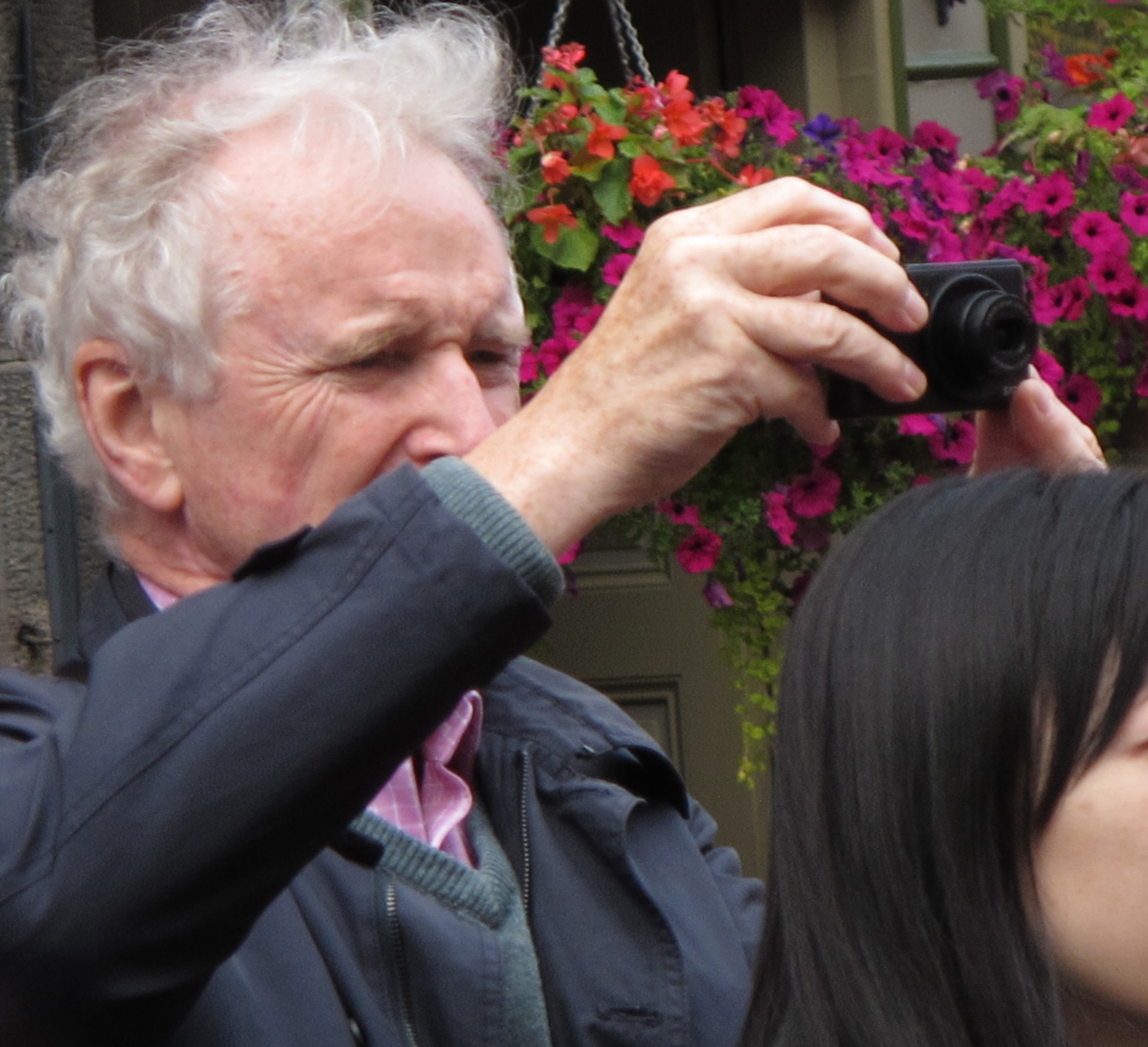
Guy with Camera, Watching a Street Performer

Guy with Camera, Watching a Street Performer

The Fringe is also a fine place to overhear conversations, and Wild Thing gives out an award, which the people who win it never know about, for the best overheard conversation. No one won this year, but last year’s winning conversation went like this:

“You know what your problem is?” Person A said. “You don’t take yourself seriously.”

“I do,” Person B said from inside his chicken suit. “I do take myself seriously.”

I don’t get a vote on the award, but if I could I’d give this year’s to a guy who was hawking the Scotsman, which pays people to call out to the crowds, “Buy the Scotsman and get a free Fringe gift pack.” The gift pack is, I think, a canvas bag, a bottle of water, and a Fringe catalog. Only this guy’d gone off script and was calling, “Four more days. Only four more days. Fly away home. Everyone go home.”

It took me a minute: The Fringe was ending in four days. Unemployment was beckoning, and he’d reached the point where it looked good.

Second Guy with a Camera

Second Guy with a Camera

The Fringe is also a great place to people watch. The street-theater areas are populated by folks watching the world through their cameras. Expensive cameras with lenses as big as I am. Palm-size pink cameras full of sparkly stuff. Phone cameras. iPad cameras. They watch a street performer only long enough to take a picture, then they move on, 80% of the time without leaving money in the hat. The picture matters. The performer doesn’t. We’re all our own performers these days, gathering up the scraps of our experience, arranging them, imagining the audience they’ll find, barely letting the other performers take root in our consciousness.

*

And having said I don’t do reviews—yeah, I lied about that too, but I’ll be brief. If you live in the U.K. and get a chance to see anything by Theatre Ad Infinitum, go. They’re amazing, and they’ll be touring. Out of five stars, I’d give them six.

 __________

*Punter: A customer, client, or audience member. Also someone who places bets or a prostitute’s client. Aren’t you glad to know that?


Bloglovin

<a href=”http://www.bloglovin.com/blog/12775915/?claim=44xejq8mffm”>Follow my blog with Bloglovin</a>

Don’t bother clicking that. It looks like a link but in fact those words are the magic code that will let you follow me on Bloglovin if you want to. I’m not sure following me that way make your life any easier, but then I’m not sure it won’t, so I thought I’d try it. I know, I know: I’m supposed to sound all excited about this, so imagine a fifty-voice chorus in the background, singing “Hype, hype, hype” in four-part harmony. The lead voice that’s strikingly off key? That’d be me.

Taking the Train to London, or Adventures in Choice

I took the train to London.

That shouldn’t be the opening sentence of a tale, but bear with me, because I had choices to make.

Arrival time. Okay, sane enough thing to choose, but arrival time wasn’t so much about the time I needed to be in London but how much time I needed to allow for delays so I could be sure I’d get to London by the time I needed to be in London. Train problems? Let’s say half an hour. Tracks? Same. Signalling problems? File that with tracks. No floods at the moment. Someone throwing themselves on the line? Hours. Everything stops while the police do the whole crime-scene routine and finally release the train and its traumatized driver to finish the run.

Wild Thing and I were on a train once when this happened. After that, it’s something you calculate. Or decide not to calculate, which is what I did. I’d take my chances.

Irrelevant photo. The coast near Fowey, Cornwall.

Irrelevant photo. The coast near Fowey, Cornwall.

Having weighed all of this and chosen a time, I had to choose a website. Google offered me over 40 million results. I confess, I didn’t check them all, but every one of the promotions I did read claimed to be cheap, cheapest, cheaper, or more discounted, better looking, and thinner than all the others. I compared. I contrasted. I did my best impression of a careful shopper. But this wasn’t just about comparing sites, because trains on a single route are priced differently. Why? Because the train companies want to make us crazy. Not to mention because finding the cheapest possible ticket is a full-time job and most of us don’t have the time and dedication, so—hmm; they wouldn’t be making money from making us crazy, do you? Anyway, the question wasn’t just what time I wanted to be in London, allowing for as many delays as I was willing to allow for, but how much I was willing to pay to arrive at the time I wanted to arrive, or how willing I was to get there earlier or later if I wanted to save a few quid.

On the train I chose, the 11:40, the cost of an advance ticket with no rail card ran from £46 to £46. I was grateful to have done my comparison shopping, because it was going to save me big bucks. That was, of course, before taking into account that many of the web sites charge for using a credit card, using the web site, using your own keyboard, and breathing air. I bought my ticket from the train operator, First Great Western, which is what I would have done if I hadn’t done my comparison shopping.

Another confession here: I do have a rail card, and I use it, which reduced the cost of the ticket by quite a bit. It had damn well better, because I have to pay to have it. But that’s a whole ‘nother story.

I made more choices: Quiet coach? Noisy coach? Morris dancing coach? Forward facing or rear facing seat? Aisle or window? Inside out or upside down? Enter your credit card details and prepare to be boarded by pirates.

My tickets came the next day.

On the day I was traveling, I left an extra half hour to get to the station because I live in the country and it’s easy to get caught behind a tractor or a herd of cows. I got caught instead behind a garbage truck, which is less romantic. It lumbered its way along the highway at ten miles under the speed limit, but eventually I found a straightaway and passed. But in Exeter, traffic was backed up to—well, it was backed up to where it’s always backed up to and I thought I’d allowed for it but I hadn’t.

If you miss your train, you can always buy a last-minute ticket for the next train, I told myself.

This was supposed to spread inner peace throughout my being, but I’ve read about the cost of last-minute tickets, so it didn’t. No one understands the pricing system, but we all understand that buying last-minute tickets is insane. Everyone complains and agrees that we’re getting ripped off.

I fretted about the traffic, reminded myself that I could buy a last-minute ticket, fumed about the cost, bumped forward a few car lengths, checked the time, rehearsed parking problems I hadn’t had yet, and generally enjoyed my tour of Exeter. Which, if you’re in the mood for it, is a beautiful city.

I wasn’t in the mood. It was ugly.

At the station, I used a phone-in/credit card system to pay for my parking. The alternative was to plug the machine with more coins than any normal human is physically able to carry. The phone-in system gave me another choice: I could pay for 48 hours and be pissed off because I needed—allowing for brake problems and signal breakdowns on the return trip—let’s say 28 hours, or I could pay for 24 hours and risk a ticket. I wasn’t offered the choice of 24 hours plus four. Having chosen to measure in days, I seemed to be stuck measuring in days.

I paid for 48 hours was pissed off.

I had ten minutes before the train was due and stopped at the departures board. Where I didn’t find the 11:40.

Now, I raise numerical incompetence to the level of high art, so the night before I’d checked the departure time on my ticket at least three times. It might have been more. I don’t really trust myself to remember the number three. Still, I was almost sure my train left at 11:40, but there I stood before a board listing exactly two London trains, and one at 11:55 and the other was at 12:13.

Fine, I thought. Either I’ve mixed up the time or it’s been rescheduled. Just get on the 11:55 and don’t worry.

And even as I heard myself think that, I remembered newspaper articles about people catching the wrong train for one reason or another and having to pay the full, absurd, last-minute fare as well as a penalty fare. Punch “wrong train ticket” into Google UK and you get 3,480,000 results. Approximately. The 8 or 10 thousand (okay, the 1 or 2) that I checked personally are testimony to how intricate and incomprehensible the system is. People write in and ask, “What happens if I catch the wrong train?” and are warned about penalties and unpaid fare notices and the possibility of prosecution.

Do not get on the wrong train, the saner part of my brain warned.

It’ll be fine, the other part said. I’m always being taken for a tourist. I’m expected to be an idiot.

The last two statements were true—my accent is unchangingly American—but the first was not, so I thought I’d ask the man at the ticket barrier about my train. He’d helped me and half a dozen other people get through when we put in the wrong ticket and the barrier didn’t open. You should understand that every passenger gets two tickets, and they look almost identical, but only one of them opens the barrier, so it makes sense to pay someone to stand there to keep people moving through.

Sort of. I seem to remember reading the privatizing the trains was going to get rid of inefficiencies. And give us choice, which is a good thing because it gives us choice. But those are serious issues, so never mind.

Before I had time to bother him, I spotted another column of numbers on the board. Numbers are like that for me. They can be right in front of me and stay invisible.

The new column was the time the trains were scheduled, and there was my 11:40, delayed until 12:13. I left the man at the ticket barrier in peace and made my way to track 5. Which I checked twice, although the London train’s always at track 5.

The later train, the 11:55 pulled in, but those of us who were booked on the 11:40 couldn’t get on without incurring the wrath of First Great Western and of the Great God of Railway Tickets, who is an angry god and afflicted with obsession-compulsive disorder, so lo, although we looked on longingly, we waited.

The train doors closed. The train sat. It sat a while longer. A man got off, pursued by the angry and, I should mention, invisible God of Railway Tickets.

“I got confused,” he said to the milling crowd.

He was not fined or penalized or beheaded, presumably because the wheels hadn’t yet turned.

I have no idea how he found out he was in the wrong train. Maybe he tried to claim his reserved seat and found someone else had a better claim.

A couple with tickets for the later but earlier train—that’s the 11:55 in case I’ve confused you as much as is appropriate to this tale—appeared but weren’t allowed to board because the doors had closed. The platform guard told them they were required to be on the train two minutes prior to departure.

They argued: They’d used the elevator that allows the disabled to cross the tracks, and it was slow.

It is slow. I’ve used it when my partner was recovering from ankle surgery.

“The doors close two minutes prior to departure,” the platform guard said.

The train started to roll, ending the argument. They now had two useless tickets. They could return them for a refund, minus a booking fee, but they couldn’t use their tickets on our earlier but later train because they weren’t for that train. They either had to go home and forget the whole thing or buy two outrageously expensive last-minute tickets.

Thank god privatization freed us from the stranglehold of bureaucracy.

I don’t know what they did because I headed for the café, where I bought a cup of tea to take on board, because the café on the platform gives you a full cup but if you buy it on board a full cup is too dangerous—you get about three-quarters.

Don’t ask.

I passed a man whose tee-shirt said, “Forever Delayed.” I figured him for a regular rider.

Our train pulled in. My seat was in the last row, just in front of the train manager’s compartment, so I got to eavesdrop on the conversation when a woman knocked on the door and asked if he’d sign her ticket so it would be accepted on a later connecting train.

He did. What would happen, I wondered, to all the people who hadn’t ask him to do that? Maybe, knowing a train was delayed, the train managers would be kind. And maybe not. Maybe since the system is now broken up, they wouldn’t know that a train run by another company was delayed.

Two women ahead of me began a cross-aisle conversation about whether one of them would get to Gatwick in time to catch her flight. She was Spanish-speaking, and I got into the conversation half to help out and half for the pleasure of speaking Spanish. Her connection was tight and she was worried.

I knocked on the train manager’s door, and he talked her through the two trains she could catch—one direct but later, the other a involving a transfer but earlier. He recommended the later, easier train, but she was too worried about her flight to take the risk. We discussed platforms and staircases and the name of the stop where she had to change trains, all in a mixture of English and Spanish.

Mercifully, we the gaps in our vocabularies didn’t match.

Although she lived in Spain, she was from Colombia and her Spanish was as beautiful and easy to follow as any I’ve heard. She was also extremely tense. If she missed her flight, her ticket would turn to ash.

The train manager printed out two bits of paper that looked like cash register receipts, detailing her route. I asked if he needed to sign her ticket and he said no.

I didn’t ask if he really needed to sign the last woman’s.

After the Colombian woman left the train, I got into a conversation with the man in the seat next to me. He lives in Plymouth and his wife travels to London for two days each week. He’d become a ticket geek, he told me. The cheap tickets are released twelve weeks ahead of time, so he’s up early on Saturdays to buy one before they sell out. We’d both read that it’s sometimes possible to lower the cost of a trip by booking separate tickets on a single train—Exeter to Reading, say, and then Reading to London, all without getting off the train. He’d never gone that far. It’s a system that begs you to make mistakes. I’d end up putting myself on different trains, or on the same train on different days.

“Choice,” he said, shaking his head.

It is indeed a wonderful thing.

The Emmits Come to Cornwall

Summer in Cornwall and the place is full of emmits.

What’s an emmit? A tourist—or in British English, a holidaymaker. And it’s not a compliment. In Cornish, it means ant, and when I asked a friend why tourists were ants she said, “It’s because they line up on the cliffs and look out to sea.”

I’ve never seen ants line up on the cliffs and look out to sea, but I’ve only lived in Cornwall for eight and a half years and all sorts of things happen around here that I don’t know about, never mind understand.

I can’t remember who told me that, but I suspect it was the same person who, when I asked what twee meant, said, “It means”—brief pause here—“twee.”

After that, I bought a dictionary of British English, and just to be on the safe side, one of British slang. Twee, they tell me, means “affectedly quaint.” They don’t mention this, but it does also means “twee.” You just can’t argue with that.

The beach at sunset

The beach at sunset

Anyway, the place is full of emmits. And that’s good, because now that the mines are closed and the seas are damn near fished out, the tourist industry makes up a huge part of the Cornish economy. Emmits rent cottages and flats and rooms. They buy art and ice cream and little plastic spades for the beach. They buy groceries and funny hats and touristy stuff that they’ll throw out in six months. So we need them.

They also drive us nuts.

Wild Thing was driving to Boscastle last week, on a narrow road that for most of its length is too narrow to have lane markings. But that doesn’t mean it isn’t wide enough for two cars to pass. In the winter, we barely slow down to pass each other. But summer brings us traffic jams. The car in front of Wild Thing stopped every time it saw an oncoming car.

This isn’t a bad thing to do, really, and Wild Thing and I are the last people who should be snotty about it, although that doesn’t stop us. When we first came here, we snuggled our rented car into many a hedge and cowered there while other drivers judged the width of the road for us. Not because we’re not timid drivers—we’ve both driven cab for serious lengths of time—but because we weren’t used to the roads. The lanes (where there were lanes) were narrow and almost every turn was blind, on top of which we were driving on the wrong side of the road. It was better to pull over and annoy everyone than to scrape another car.

Now that we’re part of the everyone who’s being annoyed, though, it’s easy to forget all that.

Eventually, the emmit-driven car ahead of her met another emmit-driven car and both of them stopped, each waiting for the other driver to judge the distance. For several long minutes, it looked like a World War I battlefield, with both sides dug into their trenches and no one able to gain ground. Wild Thing was about to get out and ask if she could drive the closer car past when, finally, someone inched forward and, at long last, the deadlock was broken.

She told the story yesterday, when M. and M. and J. all dropped by our house, and J. said that there was plenty of room for two cars to pass. Except, she added as a sort of footnote, in a couple of places.

That’s what we’re like, the everyone the emmits annoy. There’s plenty of room except where there isn’t. What’s the problem? A car and a bus can pass in most places, we agreed, and so can a car and a tractor. You’d have thought it was a highway, the way we talked.

I should now confess that when I’ve written for Americans planning to drive in Britain, I’ve suggested pulling over on the narrowest of roads if the driver’s not sure there’s space to pass. It may drive us nuts but we don’t want an accident either.

Do you notice how neatly I’ve slipped into saying we? Wild Thing and I, with our unreconstructed American accents, don’t think of ourselves as emmits anymore.

When I put emmit into Google to double-check the spelling (I worked as an editor for much longer than I worked as a cab driver, so yeah, I would do that), I was first led to a Wikipedia entry that claimed the word was ancient British. I wasn’t sure what that meant, since ancient British was several languages, so I looked further. Under the spelling emmet, though, I found an entry that defined it as (and I’m quoting from memory), “Holidaymakers who sit their fat asses down on our beaches.” I thought about providing a link but figured someone would edit that out pretty quickly. It now says nothing about beaches or fat asses, but it does say some of the “local Cornish Folk” use the word to describe anyone who hasn’t lived here for twenty-five years.

It’s okay. I drove cab. Believe me, I’ve been called worse.