Bloglovin

<a href=”http://www.bloglovin.com/blog/12775915/?claim=44xejq8mffm”>Follow my blog with Bloglovin</a>

Don’t bother clicking that. It looks like a link but in fact those words are the magic code that will let you follow me on Bloglovin if you want to. I’m not sure following me that way make your life any easier, but then I’m not sure it won’t, so I thought I’d try it. I know, I know: I’m supposed to sound all excited about this, so imagine a fifty-voice chorus in the background, singing “Hype, hype, hype” in four-part harmony. The lead voice that’s strikingly off key? That’d be me.

Taking the Train to London, or Adventures in Choice

I took the train to London.

That shouldn’t be the opening sentence of a tale, but bear with me, because I had choices to make.

Arrival time. Okay, sane enough thing to choose, but arrival time wasn’t so much about the time I needed to be in London but how much time I needed to allow for delays so I could be sure I’d get to London by the time I needed to be in London. Train problems? Let’s say half an hour. Tracks? Same. Signalling problems? File that with tracks. No floods at the moment. Someone throwing themselves on the line? Hours. Everything stops while the police do the whole crime-scene routine and finally release the train and its traumatized driver to finish the run.

Wild Thing and I were on a train once when this happened. After that, it’s something you calculate. Or decide not to calculate, which is what I did. I’d take my chances.

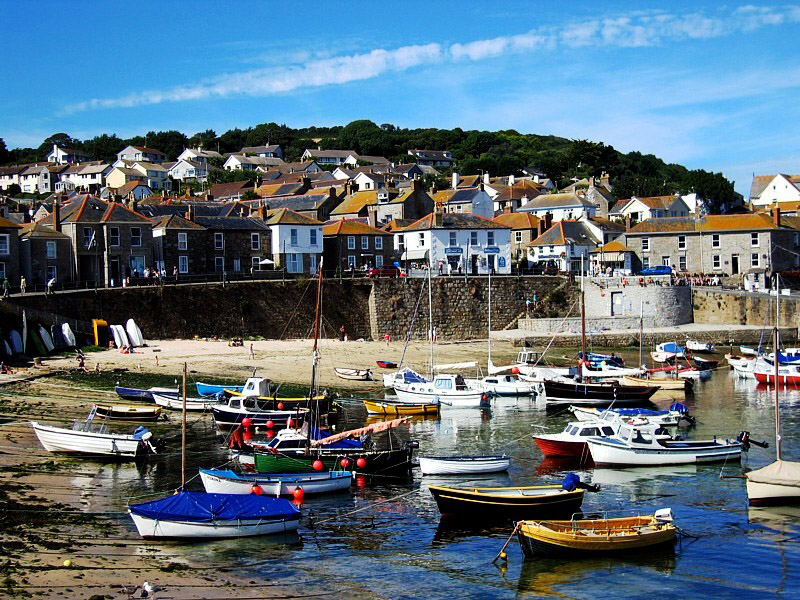
Irrelevant photo. The coast near Fowey, Cornwall.

Irrelevant photo. The coast near Fowey, Cornwall.

Having weighed all of this and chosen a time, I had to choose a website. Google offered me over 40 million results. I confess, I didn’t check them all, but every one of the promotions I did read claimed to be cheap, cheapest, cheaper, or more discounted, better looking, and thinner than all the others. I compared. I contrasted. I did my best impression of a careful shopper. But this wasn’t just about comparing sites, because trains on a single route are priced differently. Why? Because the train companies want to make us crazy. Not to mention because finding the cheapest possible ticket is a full-time job and most of us don’t have the time and dedication, so—hmm; they wouldn’t be making money from making us crazy, do you? Anyway, the question wasn’t just what time I wanted to be in London, allowing for as many delays as I was willing to allow for, but how much I was willing to pay to arrive at the time I wanted to arrive, or how willing I was to get there earlier or later if I wanted to save a few quid.

On the train I chose, the 11:40, the cost of an advance ticket with no rail card ran from £46 to £46. I was grateful to have done my comparison shopping, because it was going to save me big bucks. That was, of course, before taking into account that many of the web sites charge for using a credit card, using the web site, using your own keyboard, and breathing air. I bought my ticket from the train operator, First Great Western, which is what I would have done if I hadn’t done my comparison shopping.

Another confession here: I do have a rail card, and I use it, which reduced the cost of the ticket by quite a bit. It had damn well better, because I have to pay to have it. But that’s a whole ‘nother story.

I made more choices: Quiet coach? Noisy coach? Morris dancing coach? Forward facing or rear facing seat? Aisle or window? Inside out or upside down? Enter your credit card details and prepare to be boarded by pirates.

My tickets came the next day.

On the day I was traveling, I left an extra half hour to get to the station because I live in the country and it’s easy to get caught behind a tractor or a herd of cows. I got caught instead behind a garbage truck, which is less romantic. It lumbered its way along the highway at ten miles under the speed limit, but eventually I found a straightaway and passed. But in Exeter, traffic was backed up to—well, it was backed up to where it’s always backed up to and I thought I’d allowed for it but I hadn’t.

If you miss your train, you can always buy a last-minute ticket for the next train, I told myself.

This was supposed to spread inner peace throughout my being, but I’ve read about the cost of last-minute tickets, so it didn’t. No one understands the pricing system, but we all understand that buying last-minute tickets is insane. Everyone complains and agrees that we’re getting ripped off.

I fretted about the traffic, reminded myself that I could buy a last-minute ticket, fumed about the cost, bumped forward a few car lengths, checked the time, rehearsed parking problems I hadn’t had yet, and generally enjoyed my tour of Exeter. Which, if you’re in the mood for it, is a beautiful city.

I wasn’t in the mood. It was ugly.

At the station, I used a phone-in/credit card system to pay for my parking. The alternative was to plug the machine with more coins than any normal human is physically able to carry. The phone-in system gave me another choice: I could pay for 48 hours and be pissed off because I needed—allowing for brake problems and signal breakdowns on the return trip—let’s say 28 hours, or I could pay for 24 hours and risk a ticket. I wasn’t offered the choice of 24 hours plus four. Having chosen to measure in days, I seemed to be stuck measuring in days.

I paid for 48 hours was pissed off.

I had ten minutes before the train was due and stopped at the departures board. Where I didn’t find the 11:40.

Now, I raise numerical incompetence to the level of high art, so the night before I’d checked the departure time on my ticket at least three times. It might have been more. I don’t really trust myself to remember the number three. Still, I was almost sure my train left at 11:40, but there I stood before a board listing exactly two London trains, and one at 11:55 and the other was at 12:13.

Fine, I thought. Either I’ve mixed up the time or it’s been rescheduled. Just get on the 11:55 and don’t worry.

And even as I heard myself think that, I remembered newspaper articles about people catching the wrong train for one reason or another and having to pay the full, absurd, last-minute fare as well as a penalty fare. Punch “wrong train ticket” into Google UK and you get 3,480,000 results. Approximately. The 8 or 10 thousand (okay, the 1 or 2) that I checked personally are testimony to how intricate and incomprehensible the system is. People write in and ask, “What happens if I catch the wrong train?” and are warned about penalties and unpaid fare notices and the possibility of prosecution.

Do not get on the wrong train, the saner part of my brain warned.

It’ll be fine, the other part said. I’m always being taken for a tourist. I’m expected to be an idiot.

The last two statements were true—my accent is unchangingly American—but the first was not, so I thought I’d ask the man at the ticket barrier about my train. He’d helped me and half a dozen other people get through when we put in the wrong ticket and the barrier didn’t open. You should understand that every passenger gets two tickets, and they look almost identical, but only one of them opens the barrier, so it makes sense to pay someone to stand there to keep people moving through.

Sort of. I seem to remember reading the privatizing the trains was going to get rid of inefficiencies. And give us choice, which is a good thing because it gives us choice. But those are serious issues, so never mind.

Before I had time to bother him, I spotted another column of numbers on the board. Numbers are like that for me. They can be right in front of me and stay invisible.

The new column was the time the trains were scheduled, and there was my 11:40, delayed until 12:13. I left the man at the ticket barrier in peace and made my way to track 5. Which I checked twice, although the London train’s always at track 5.

The later train, the 11:55 pulled in, but those of us who were booked on the 11:40 couldn’t get on without incurring the wrath of First Great Western and of the Great God of Railway Tickets, who is an angry god and afflicted with obsession-compulsive disorder, so lo, although we looked on longingly, we waited.

The train doors closed. The train sat. It sat a while longer. A man got off, pursued by the angry and, I should mention, invisible God of Railway Tickets.

“I got confused,” he said to the milling crowd.

He was not fined or penalized or beheaded, presumably because the wheels hadn’t yet turned.

I have no idea how he found out he was in the wrong train. Maybe he tried to claim his reserved seat and found someone else had a better claim.

A couple with tickets for the later but earlier train—that’s the 11:55 in case I’ve confused you as much as is appropriate to this tale—appeared but weren’t allowed to board because the doors had closed. The platform guard told them they were required to be on the train two minutes prior to departure.

They argued: They’d used the elevator that allows the disabled to cross the tracks, and it was slow.

It is slow. I’ve used it when my partner was recovering from ankle surgery.

“The doors close two minutes prior to departure,” the platform guard said.

The train started to roll, ending the argument. They now had two useless tickets. They could return them for a refund, minus a booking fee, but they couldn’t use their tickets on our earlier but later train because they weren’t for that train. They either had to go home and forget the whole thing or buy two outrageously expensive last-minute tickets.

Thank god privatization freed us from the stranglehold of bureaucracy.

I don’t know what they did because I headed for the café, where I bought a cup of tea to take on board, because the café on the platform gives you a full cup but if you buy it on board a full cup is too dangerous—you get about three-quarters.

Don’t ask.

I passed a man whose tee-shirt said, “Forever Delayed.” I figured him for a regular rider.

Our train pulled in. My seat was in the last row, just in front of the train manager’s compartment, so I got to eavesdrop on the conversation when a woman knocked on the door and asked if he’d sign her ticket so it would be accepted on a later connecting train.

He did. What would happen, I wondered, to all the people who hadn’t ask him to do that? Maybe, knowing a train was delayed, the train managers would be kind. And maybe not. Maybe since the system is now broken up, they wouldn’t know that a train run by another company was delayed.

Two women ahead of me began a cross-aisle conversation about whether one of them would get to Gatwick in time to catch her flight. She was Spanish-speaking, and I got into the conversation half to help out and half for the pleasure of speaking Spanish. Her connection was tight and she was worried.

I knocked on the train manager’s door, and he talked her through the two trains she could catch—one direct but later, the other a involving a transfer but earlier. He recommended the later, easier train, but she was too worried about her flight to take the risk. We discussed platforms and staircases and the name of the stop where she had to change trains, all in a mixture of English and Spanish.

Mercifully, we the gaps in our vocabularies didn’t match.

Although she lived in Spain, she was from Colombia and her Spanish was as beautiful and easy to follow as any I’ve heard. She was also extremely tense. If she missed her flight, her ticket would turn to ash.

The train manager printed out two bits of paper that looked like cash register receipts, detailing her route. I asked if he needed to sign her ticket and he said no.

I didn’t ask if he really needed to sign the last woman’s.

After the Colombian woman left the train, I got into a conversation with the man in the seat next to me. He lives in Plymouth and his wife travels to London for two days each week. He’d become a ticket geek, he told me. The cheap tickets are released twelve weeks ahead of time, so he’s up early on Saturdays to buy one before they sell out. We’d both read that it’s sometimes possible to lower the cost of a trip by booking separate tickets on a single train—Exeter to Reading, say, and then Reading to London, all without getting off the train. He’d never gone that far. It’s a system that begs you to make mistakes. I’d end up putting myself on different trains, or on the same train on different days.

“Choice,” he said, shaking his head.

It is indeed a wonderful thing.

The Emmits Come to Cornwall

Summer in Cornwall and the place is full of emmits.

What’s an emmit? A tourist—or in British English, a holidaymaker. And it’s not a compliment. In Cornish, it means ant, and when I asked a friend why tourists were ants she said, “It’s because they line up on the cliffs and look out to sea.”

I’ve never seen ants line up on the cliffs and look out to sea, but I’ve only lived in Cornwall for eight and a half years and all sorts of things happen around here that I don’t know about, never mind understand.

I can’t remember who told me that, but I suspect it was the same person who, when I asked what twee meant, said, “It means”—brief pause here—“twee.”

After that, I bought a dictionary of British English, and just to be on the safe side, one of British slang. Twee, they tell me, means “affectedly quaint.” They don’t mention this, but it does also means “twee.” You just can’t argue with that.

The beach at sunset

The beach at sunset

Anyway, the place is full of emmits. And that’s good, because now that the mines are closed and the seas are damn near fished out, the tourist industry makes up a huge part of the Cornish economy. Emmits rent cottages and flats and rooms. They buy art and ice cream and little plastic spades for the beach. They buy groceries and funny hats and touristy stuff that they’ll throw out in six months. So we need them.

They also drive us nuts.

Wild Thing was driving to Boscastle last week, on a narrow road that for most of its length is too narrow to have lane markings. But that doesn’t mean it isn’t wide enough for two cars to pass. In the winter, we barely slow down to pass each other. But summer brings us traffic jams. The car in front of Wild Thing stopped every time it saw an oncoming car.

This isn’t a bad thing to do, really, and Wild Thing and I are the last people who should be snotty about it, although that doesn’t stop us. When we first came here, we snuggled our rented car into many a hedge and cowered there while other drivers judged the width of the road for us. Not because we’re not timid drivers—we’ve both driven cab for serious lengths of time—but because we weren’t used to the roads. The lanes (where there were lanes) were narrow and almost every turn was blind, on top of which we were driving on the wrong side of the road. It was better to pull over and annoy everyone than to scrape another car.

Now that we’re part of the everyone who’s being annoyed, though, it’s easy to forget all that.

Eventually, the emmit-driven car ahead of her met another emmit-driven car and both of them stopped, each waiting for the other driver to judge the distance. For several long minutes, it looked like a World War I battlefield, with both sides dug into their trenches and no one able to gain ground. Wild Thing was about to get out and ask if she could drive the closer car past when, finally, someone inched forward and, at long last, the deadlock was broken.

She told the story yesterday, when M. and M. and J. all dropped by our house, and J. said that there was plenty of room for two cars to pass. Except, she added as a sort of footnote, in a couple of places.

That’s what we’re like, the everyone the emmits annoy. There’s plenty of room except where there isn’t. What’s the problem? A car and a bus can pass in most places, we agreed, and so can a car and a tractor. You’d have thought it was a highway, the way we talked.

I should now confess that when I’ve written for Americans planning to drive in Britain, I’ve suggested pulling over on the narrowest of roads if the driver’s not sure there’s space to pass. It may drive us nuts but we don’t want an accident either.

Do you notice how neatly I’ve slipped into saying we? Wild Thing and I, with our unreconstructed American accents, don’t think of ourselves as emmits anymore.

When I put emmit into Google to double-check the spelling (I worked as an editor for much longer than I worked as a cab driver, so yeah, I would do that), I was first led to a Wikipedia entry that claimed the word was ancient British. I wasn’t sure what that meant, since ancient British was several languages, so I looked further. Under the spelling emmet, though, I found an entry that defined it as (and I’m quoting from memory), “Holidaymakers who sit their fat asses down on our beaches.” I thought about providing a link but figured someone would edit that out pretty quickly. It now says nothing about beaches or fat asses, but it does say some of the “local Cornish Folk” use the word to describe anyone who hasn’t lived here for twenty-five years.

It’s okay. I drove cab. Believe me, I’ve been called worse.

Pronunciation and British Geography

Let’s start out by all agreeing that English spelling is an invention of the devil—a being whose existence can only be confirmed by studying the way English is written.  The experts tell us that English spelling was systemized at a time when the pronunciation was still changing, so it’s correct enough for the way words were pronounced at the time. And I’m sure that’s true (sort of—it doesn’t allow for regional variations, but let’s keep this simple), but honestly, did we ever a letter like C when either an S or a K would have done just fine? If we needed it to spell chunk, couldn’t we have assigned it the CH sound and saved it for that alone?

Mousehole02

Mousehole, in Devon. Photo by Waterborough


So let’s agree that the spelling of a word isn’t a trustworthy guide to its pronunciation. Place names, though, are the real killers. Along the north Cornish coast is a town called Widemouth Bay, pronounced WIDmuth. Drive northeast and you come to Sandymouth and think, Right, that’s SANdimuth. Wrong. That’s SANdymouth. Go figure. (That’s an Americanism, by the way—something I found out only recently, when I used it and was met with a blank look.) Keep driving and you come to Woolfardisworthy, which has gone so far out of whack that the road sign actually gives the pronunciation: WOOLsery, only they don’t capitalize the accented syllable, so presumably you could think it was WoolSERRy. Or WoolserrEE. It makes as much sense as anything else. Go to the south coast and you’ll find Mousehole, pronounced MOWZul. A couple of years ago, I drove through a town called Towster (we’re not in Cornwall anymore, Toto, but the pronunciation problems carry over), which is pronounced TOASTer. Yes, the spelling and the pronunciation both make sense, in an English-language, devilish sort of way, but that only points out how little sense the spelling of toaster makes.

I expected to reach Coffee Pot in a few miles.

No one thought a town called Towster was funny except me. I was grief-stricken to be left alone with the joke.

Turn the British loose on American place names and they fall victim to their own language. Michigan becomes MITCHigan. (For all you non-U.S. readers, it’s MISHigun.) Houston becomes HOOSton. (It should be HYOUSton.)

Guys, you have no one to blame but yourselves.

Getting Organized in Britain

Clubs are a big thing in Britain. Introduce two people with an obsession in common and they’ll form a club. Introduce two people who find no meeting ground and they’ll form a Random Interests Club.

In our village, we have a camera club, a surf/lifesaving club, a table tennis (that’s ping pong) club, a tennis club, a crafts group, an allotment society, a fair-weather walking group (motto: “We’re not too proud to cancel”), a club of people over fifty who rent a bus once a month and go on day trips, the Women’s Institute (a branch of a national group), a very local women’s discussion group, an allotment society, and I’m not sure how many other clubs. Someone will let me know as soon as this goes online. Plus a proposed biking club that may or may not have taken off, and yoga and art classes. In a village of some 600 people.

Wild Thing and I were at a party last month and the talk turned to wild swimming, which is swimming outdoors, regardless of whether there’s a lifeguard or a beach or anything other than clean(ish) water.  J. said she enjoyed it. T. asked if she was going to form a club.

“Right,” J. said. “Like I need officers and a constitution to throw myself in the water.”

Semi-Relevant Photo, by Rufus Nunus

Semi-Relevant Photo, by Rufus Nunus

She had a point. Clubs get formal very quickly here. Officers get elected. Minutes get taken and are read at the start of the next meeting. Dues are set and collected. Bank accounts are set up and need signatures and countersignatures and approval and disapproval and gossip.

I’m part of a countywide group that just organized to defend the National Health Service against privatization, and we immediately elected officers, adopted a constitution, and wrote a manifesto setting out our goals. All of which are good things to do and will help keep us on track, although I tend toward more chaotic approaches myself. What tipped me over the edge was when R. suggested we might want to adopt standing orders.

Standing what? I thought that was what the regulars had at the pub. You know: You come in the door and the bartender sets your drink on the bar before you ask. But no, it’s a set of procedures: The chair will consult with the secretary about the agenda; every meeting will open with the members singing “I Left My Heart in San Francisco” to the tune of “The Twelve Days of Christmas.” Things like that, which everyone can agree are a good idea.

We decided against standing orders, but after two meetings we are well constitutioned and manifestoed. Now all we have to do is defeat privatization and get enough funding for the NHS to do its job. It should be a cinch.

A Cornish Beach Loses Its Sand

The winter storms of 2013-14 flooded homes here, destroyed sea walls and boats, and cut the Cornwall’s rail link to the rest of the country. It glued us to the 6 o’clock news. We’re all disaster hounds at heart, as long as we’re not underwater ourselves.

Our village wasn’t underwater. All the storms did was steal our beach.

Once upon a time, a village in Cornwall had a beach and everyone was happy. Children played in the tide pools, cafes sold ice cream, and the sun shone every day, or even if it didn’t we all remember that it did, and isn’t that almost the same thing? Drivers paid to leave their cars in the parking lot, and everyone but me called it a car park, as if the cars went there to enjoy nature and restore their souls. Then the storms came and took the sand.

In a tourist area, losing your beach is worse than the sun not shining, and the sun not-shines a lot here.

A neighbor of ours is a geologist, and she swears the sand’s just off shore. It’s being held hostage by the currents, or the angry gods of global warming, or sea creatures seeking revenge on our species. (You should probably understand here that this is not exactly the explanation our geologist neighbor gave me.) Now, revenge is probably justified but it’s inconvenient as hell. I mean, come on sea creatures, I know we’ve done horrible things to you and your kind, but couldn’t you do this in the off season?

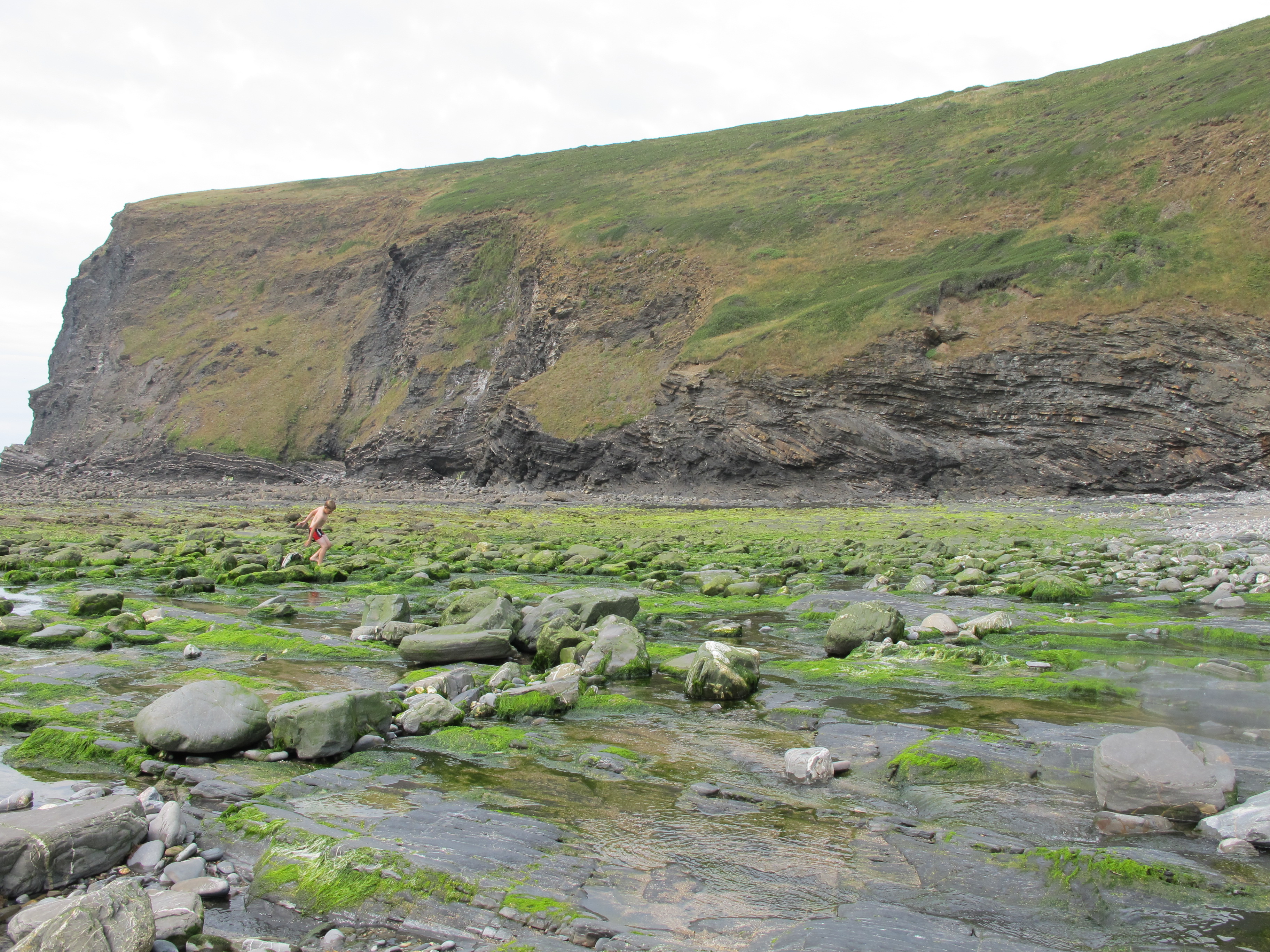
No, they couldn’t, and here we are, at the height of the tourist season, and at low tide our beach is a strip of small, rounded rocks, a long stretch of green, slimy rock, then, at last, a strip of sand. And getting across that slimy bit is lethal.

A kid picking his way across green slime

A kid picking his way across green slime

Our neighbor swears the sand will come back, but not many of us want to wait. Like anybody whose loved ones are held for ransom, we’re trying to solve the problem in various and occasionally crackpot ways. We’re creatures of a high-tech culture, which is another way of saying that when something bad happens in the natural world, we think we should fix it. The sand’s gone? Well, we’ll just march out there and take it back, thank you very much. Or if not us, someone. All we have to do is activate the Sand Authority—that bunch of lazy bureaucrats sleeping off a nap when they should be out there Fixing Our Beach, in capital goddamn letters.

One suggestion (to the Parish Council, which unlike the Sand Authority actually exists) is to dig a channel through the green slimy patch, creating a path to the water. This means moving rocks aside. Huge rocks. Bedrock-type rocks. What’s under the rocks, though? Well, either it’s more rock, in which case we’ll have traded green, slimy rock for rock that will quickly turn green and slimy, or it’s birthday cake, in which case all current geological theories need rethinking.

The beach’s lifeguards aren’t thinking much about the birthday cake theory—they’re practical people and not interested in life’s Large Questions, in more capital goddamn letters—but they do worry that digging a channel could create a permanent rip current. What’s a rip current? A current strong enough to carry unwary swimmers out to sea. Now I’m no expert, but this strikes me as a problem. Wouldn’t the tourists be more likely to come back if we let them go to Spain for a season than if we let them get pulled out to sea?

But we want to Do Something, and digging a channel is Something. Sorry about all those capital letters, but this kind of battiness demands them. I can only hope an expert comes along and puts his or her flipper down. Or that we argue about it long enough that the sand escapes captivity and comes to rest once again on our shoreline.

*

Interested in what else the storms did? At Mount’s Bay, they revealed the remains of an ancient forest that is now underwater (http://www.bbc.co.uk/news/uk-england-devon-26263856). At Dawlish, they undermined the railroad tracks so completely that they hung in the air like strands of steel spaghetti (https://www.google.co.uk/search?q=storms+dawlish+line&newwindow=1&rlz=1C1SFXN_enGB503GB541&tbm=isch&tbo=u&source=univ&sa=X&ei=4DPaU9D0GcKO7QaGjIDICA&ved=0CFQQsAQ&biw=1280&bih=909). In Norfolk, they first revealed 800,000-year-old footprints—the oldest ever found in Europe—and then covered them back up (http://www.archaeology.co.uk/articles/news/earliest-human-footprints-outside-africa-found-in-norfolk.htm).

Britain, Tea, and Hot and Cold Running Stereotypes

Am I calling up a lazy stereotype when I say that Britain’s a nation of tea drinkers? I know: This isn’t the most important question you’ll face today, but stay with me. I’ll make it worth your time (she said rashly).

A while back, someone read part of an as yet unposted blog entry I’d written about tea and told me I was indulging in stereotypes. She mentioned beer (people do drink a lot of beer here; I’ll give her that), and Starbucks, and the country’s changing habits. She urged me to go deeper into the culture. She didn’t mention Starbucks’ untaxed profits, and I admit they’re not what everyone’s mind would race to in this context, but if you want to go deeper into the culture, they’re sitting there like the Titanic’s iceberg and I can’t type the company’s name without mentioning them. And don’t even get me started on Amazon.

A cup of tea, in motion. Photo by by ŇÄĵŵÅ Ă. Мǻŗǻƒįę.

A cup of tea, in motion. Photo by by ŇÄĵŵÅ Ă. Мǻŗǻƒįę.

She signed off by saying her husband had just made her a cup of tea, which either means she has a sense of humor (she hadn’t noticed mine, so I did wonder) or undercuts her argument, or possibly both. Either way, she left me thinking about stereotypes. Because they’re hard to resist if you’re trying to be funny—and the longer I work on this blog, the better I understand how deeply trying and funny dislike each other.

But I don’t want to stereotype stereotypes. They’re not all the same. Off the top of my head I can break them into two categories. And as soon as you say something like that, someone else comes along and breaks them into seven categories, and someone else comes up with forty-three. Settle down, everyone. It’s not a competition. All we need for this discussion are the harmful kind and the harmless kind. Think of them the way you’d think of spiders, or snakes: Some of them are venomous and some of them aren’t. Remember at the start of the Iraq War, when the French said, Guys, I don’t think this is an entirely good idea, and suddenly the geniuses who (as it turns out) helped destabilize the Middle East were calling them cheese-eating surrender monkeys? That’s not only a very weird stereotype, implying, among other things, that Americans think there’s something suspect about eating cheese, but it’s ugly. (I know, it started ironically, on The Simpsons, but by the time I’m talking about it had cut its ironic moorings and was loose in the world, untethered.) It’s not the most harmful stereotype I ever heard, but it’s surely one of the stranger ones in its category.

Now compare that to the claim that Britain’s a nation of tea drinkers. They’re different, aren’t they?

Is Britain a nation of tea drinkers? We have two cafes in our village, and both have invested in coffee machines. You know the kind. Huge silvery things. You stand behind them and you might as well be piloting a spaceship.

“Potential customer on the road, Captain.”

“Deploy the tractor beam, Lieutenant.”

So customers are tractored in, and they’re grateful. They order lattes and americanos and mocha half-decaf double skim vaguely Italian-sounding whatsaccinos, and they sit at tables in (if they’re lucky) the sun and sip them. But what they’re sipping are indulgences—the kind of thing people will invest in and think, I really needed this, or, Isn’t this nice, sitting here with a coffee? because it’s something special. Follow them home, though, and most of them will drink tea. If they have coffee in the house, it’ll be instant. How do I know? By what people offer me in their homes. By what they choose when they’re in mine.

But forget the cafes. Go to a village event—the kind the village has been holding since caffeine first came to these shores, raising money for the hospices, or the air ambulance, or the church—and you’ll have a choice of tea or coffee. And the coffee will be instant. Because that’s how it’s always been done and that’s how it’s still done. Any place has a tea pot. Any place can boil water. Not every place has a coffee pot.

What happens in the U.S.? Park yourself at the counter of any greasy spoon in the country and ask for coffee. The waitron will turn, grab a pot from a coffeemaker and pour. It’s already made, it’s waiting for you, and most of the time it’s no older than you are, so it’ll taste—well, it’ll taste like coffee. Whether that’s good is a matter of opinion. But it doesn’t matter. They go through enough of it to keep a pot on hand.

Two pots, actually: regular with a black (or is that brown?) handle and decaf with an orange one.

Ask for tea, though, and the waitron will have to check with the boss, because it’s been six years since anyone ordered a cup. I worked in a place like that. The boss probably kept a box of teabags stashed somewhere, but I never had a reason to ask about it.

That’s what life’s like in a nation of coffee drinkers.

But I hate being called superficial, so let’s consider countervailing trends: Before I left the U.S., I’d begun to worry about the younger generation’s moral fiber, because so many of them were getting their caffeine from soft drinks and energy drinks and cold bottled coffees or (yes, I admit it) teas with vacation-sounding names and enough sugar to fill a bathtub, condensed somehow into a fist-sized drink. This struck me as childish—self-indulgent, even. Adulthood involves learning to drink things that don’t taste good, and then learning to like them, and teaching other people to like them, and judging people on the basis of whether they like them. Weren’t these kids ever going to grow up? And more to the point, when it came time to give them house-warming presents, was I ever going to be able to give them coffee mugs?

I should probably pause here and say that I’d stopped drinking coffee by the time I passed this judgment on an entire generation, but I didn’t get my caffeine from cold, sugary drinks, so it was different. And I had once been a coffee drinker, so whatever I did after that was okay, because I’d survived the initiation.

I never claimed that this made sense. What I’m trying to do is make a point, which is, defensively, that I’m capable of going deeper into a culture. And still exaggerating. Which is the essence of stereotype. And the essence of humor. Or, yeah, I’m exaggerating again. It’s the essence of some humor.

If you go deep enough into any culture, you’ll find something to laugh at. Without dismissing it or being ugly.

The Cornish Heatwave

It’s hot in Cornwall. For days, everyone’s been telling each other that. And the papers agree. “Heatwave!” they write. Shock! Horror! Remind the elderly to drink liquids!

The elderly have been drinking liquids all their lives. That’s one reason they lived long enough to be the elderly. So unless we’re talking about the demented (in which case, don’t be shy, just say so), mind your own damn business. And drink your own liquids, while we’re at it.

What’s a heatwave here? Temperatures are soaring into the low 80s F. Yes, all you Minnesotans, you New Yorkers, you sweat-soaked Southerners, the low 80s. You’d count that as a nice summer day, wouldn’t you? Not a heatwave but relief from a heatwave.

Mostly irrelevant photo. The cows are probably hot too. Photo by Ida Swearingen.

Mostly irrelevant photo. The cows are probably hot too. Photo by Ida Swearingen.

Before I go on, I should say that I live about a mile from the ocean, so “hot” here is cooler than it is inland. And temperature’s relative. To anyone used to the British climate, the heat’s real. Take our dog, for example. I mention her instead of a person because she’s not what you’d call imaginative. She doesn’t fancy herself hot or cold or put upon or much of anything else, she simply is what she is, at whatever moment we’re talking about. If she wants attention, she doesn’t complain about the heat, she brings a goobery old chewy and dumps it in your lap. And she’s been hot. When we walk, she pulls for the shade. She lies down in it if we stop. She perks up if we soak her down. So yes, I accept that by the standards of this time and place, it’s hot.

But still, I swear the British have a strange relationship with hot weather. They crave it. They talk about it. They wilt in it.

M. stopped by. She picked up the village newsletter and fanned herself.

“It’s so hot,” she said.

“Mind you, I’m not complaining,” she added, in case someone tried to do her a favour by canceling her subscription.

This spring, before the heat set in, J. said, “I want to go someplace hot.” She said it with the kind of longing people usually reserve for life-changing wishes.

I don’t want to descend into national stereotypes here (and isn’t that just the kind of disclaimer you find before someone dives right in?) but it’s not just J. Sometimes I feel like every single person in Britain wants to go someplace hot. Except Wild Thing and me (or I, or both me and I), and maybe one or two other immigrants and weirdos. The rest of them, though, want to pack up and move someplace hot. They want to push poles into the ocean and shove the whole island south so they can sit by a pool and wait for tropical fruit to drop into off the trees and into their mouths.

The facts that (a) fruit trees don’t grow beside pools and (b) if they moved they’d have to work and wouldn’t have time to sit by a pool tell you something about the nature of the fantasy.

And then it hits 80—and they wilt.

“It’s so hot,” they say.

Umm. Yes. This is the price of hot weather.

Wild Thing let herself get lured into a conversation about hot weather a while ago. “This isn’t hot, she said,” she said, and she tried to describe a Minnesota summer. Hot, sticky, the air so thick you expect schools of fish to swim past. Wild Thing’s from Texas. She can’t help herself. And no, I would never stoop to relying on stereotypes. I can only refer you to a favorite phrase of hers: Never let the truth get in the way of a good story. Me, I tell the truth, and the truth is that I’ve made up the opening lines of this particular conversation because I want to get to what the other person said, which was this:

“But you all have swimming pools in America.”

Sure we do. Every sweaty one of us. If we have four people in a family, we dig four swimming pools. If we live in apartments, we dig them in the bathrooms and call them tubs.

You can tell when people have been watching too much TV.

Anyway, it’s hot in Cornwall, and people aren’t complaining but they are spending a suspicious amount of time talking about it.

Giving Directions in Cornwall

Britain’s as romantic as it is confusing. Outside the cities, British house are more likely to have names than addresses. You want to name your house Island of the Floating Feathers? As long as you work it out with the local council, you can. Although I don’t know how the council would react to that one. They’re more used to The Smithy, The Old Schoolhouse, Oak Tree Cottage, Trelawney. Every village in Cornwall has a house called Trelawny (or Trelawney), after John (or Jonathan, depending on your source) Trelawny, a Cornish national hero who got in a wrangle with James II back in the 17th century and had a song written about him in the 19th, by which time it was too late for him to appreciate it. That’s the sad bit about being immortalized.

But going back to the Island of the Floating Feathers: The council might agree to it. You can be pretty sure there won’t be a duplicate in the village, which is another reason to nix a name. And it’s not as if you’re calling it My Neighbour Painted Her House an Ugly Colour, which any council could find a reason to turn down.

Rock Cottage, by Geography 2013

Rock Cottage, by Geography 2013

The advantages of house names are romance, atmosphere, self-expression, and tradition. Ah, tradition. There’s a lot of that over here. I don’t know when houses were first given names, but it was long before civil engineers were invented. Naming houses is as natural as naming people. You have a bunch of these things, and you have to distinguish one from another. As soon as a settlement got too big for everyone to know everyone, a medieval village, say, might start informally talking about the manor, the blacksmith’s cottage, plum tree cottage, river cottage, bridge cottage, the old lady with the wart’s cottage. Eventually those became the houses’ names, only sooner or later the old lady with the wart’s cottage would be shortened to Wart Cottage, until someone new moved in and said, can’t we change this to Island of the Floating Feathers? And the person in charge at the council replied, “Please state your reasons for wanting to change this house name.” In triplicate and black ink. If you have to file a paper copy of anything official in Britain, they’ll want it in black ink.

Except for the black ink and the business about the wart, of course, I’m making this up. House names probably started much earlier than the medieval period. But it’s good to remember that everything started somewhere, at some time, with some set of people who had no idea what they were setting in motion.

The down side of this arrangement is that anyone from outside the village is immediately lost. Say you’re driving a delivery van with a package for Craken Wartha, and you’re new on the route. You’ve found the village, but after that you have two choices: Drive around aimlessly and hope you see a sign that says Craken Wartha or stop and ask directions. Or you can do both, one after the other after the other, with increasing degrees of frustration. Anyone marketing a sat-nav system with all the house names programed into it would make a fortune, but no one’s done it yet, so imagine you spot two women walking a small, silly dog. They look local, by which I mean they’re not carrying the beach or hiking gear that would mark them as visitors. Salvation, you think, and you roll down the window and ask where Craken Wartha is.

As it happens, the two women are Wild Thing and me (which should, grammatically speaking, be I, but c’mon, who actually says it that way?). And we smile and point and say, “Go down the hill, cross the ford, go up the hill, take a right at the chapel,” and so on, but you’ve stopped listening because we don’t sound like locals.

Have I mentioned that Wild Thing and I have American accents? And that we came by them honestly? No one who asks for directions believes a word we say. Their eyes glaze over and their faces get this look that says, There has got to be someone else I can ask.

Sometimes we don’t know the directions. It’s surprising how many times you can pass a house but not remember where it is when someone asks for it. It’s tempting to spew out a string of lefts and rights and obscure landmarks, since no one’s going to follow them anyway, but we don’t. We say what anyone else would: “Ask at the post office. They know everything.” And we point them to the post office, knowing that if they see anyone else on the road, even if they’re staggering under a load of beach gear or a snootful of alcohol, they’ll roll down the window and hope to hear the right accent.

Sports Talk in the U.K.

I’ve been the victim of sports talk recently. To sympathize properly, you have to understand that I have a sports allergy, and it’s severe.

At singers night at the pub last week, K. was oblivious to my condition and talked—not to the world at large, but to me specifically—about the World Cup. The U.S. team, he said, was his idea of what a team should be.

At this point, I plugged my ears to keep from breaking out in a rash, so I missed part of the conversation. Which wasn’t a conversation, both because I had nothing to contribute and because my ears were plugged. Still, I’d heard enough to wonder how a U.S. team could play world-class football. (And if you’re American, you have to understand here that football means soccer, not that game with the funny-shaped ball and the beefy guys running around in the modern-day equivalent of armour.) I mean, when I left the U.S., soccer never gave me a rash because I never heard about it. I’ve been gone for eight years now, but surely it takes longer than that for a sport to take hold of a culture and attract obscene amounts of money.

Of course, K. might have been messing with me. It’s hard to tell with him.

I took my fingers out of my ears long enough to hear him say that if the English team played well it would upset the natural order of the universe. So being an English football fan must be something you do to build character, not to enjoy yourself.

I went home scratching my rash.

Tour de Yorkshire. Photo by Dave Pickersgill

Tour de Yorkshire. Photo by Dave Pickersgill

But it hasn’t just been the World Cup. The Tour de France, for reasons I can’t explain, ended up in Yorkshire this year. Is this the Second Coming of the Norman Invasion, using bikes instead of horses? Did someone post the route wrong, tricking the riders into hundreds of miles of wrong turn? If so, how did they get the bikes get across the Channel?

Whatever the explanation, swarms of bike riders zipped through the English countryside in a race with a French name. The Tour’s director suggested that close to 5 million people from Yorkshire had turned out to watch. If that’s true, it’s amazing, because the official population of Yorkshire is 5.3 million, and some of them surely had the flu, or a sports allergy serious enough to have kept them home.

Fortunately, Yorkshire’s a long way from Cornwall, and if they ever hold the Tour de France here they’ll be hard-pressed to get 5 million out of our population of 532,000 lining to roads to watch.