Why young adults don’t have a get-out-of-Covid-free card

As the pandemic lumbers onward, we’re hearing more about long Covid–the debilitating long-term effects that some people experience after the disease has passed. Here’s what I’ve been able to scrape together:

No one who catches the virus knows what card they’ll pull out of the Covid deck. Some people have no symptoms, some people get sick and recover, and some people die. As far as most discussions are concerned, that’s it. Cards distributed. Can we play something else, please? 

Well, no, we can’t, because that middle group isn’t done drawing cards. Some of them recover fully, regardless of whether they had serious cases or mild ones, and some–even people who had mild cases–don’t go back to being the people they were before they got sick. And that includes young adults, the people we thought had a get-out-of-jail-free card for this disease. 

The symptoms of long Covid range all over the place. They can include exhaustion, brain fog, memory problems, breathlessness, depression, hair loss, concentration problems, loss of the senses of taste and smell, joint pain, muscle aches, chest pain, chills, sweats, digestive issues, coughs. Trouble going upstairs and trouble walking to the end of the street (the road, the lane, the whatever) get mentioned a lot. Fatigue sounds like the most common symptom.

Some people slowly get better and move on. Some improve a bit and slip back a bit and improve again and slip back again. Some seem to be stuck at the bottom. And it goes on for months. 

Does it get better? We don’t know yet. 

Semi-relevant photo: This is called honesty. I can’t recommend it highly enough, especially to politicians in the middle of a pandemic. It’s out of season at the moment, but let’s not draw any overarching conclusions from that. 

The Covid Symptom Study app–that’s not the official British test and trace app but it’s been downloaded by 3 million people and one cockatoo–says one person in twenty has long-term symptoms. Another app, this one in Scotland and Wales, comes up with one in ten having symptoms for longer than three weeks, some of them for months.

An article in the BMJ quotes Tim Spector, of the Covid Symptom Study, saying that if your version of Covid includes “a persistent cough, hoarse voice, headache, diarrhoea, skipping meals, and shortness of breath in the first week, you are two to three times more likely to get longer term symptoms.” 

Long Covid seems to be about twice as common in women as in men.

Or in one Paris hospital, four times more common. The same hospital said the average age of the long-haulers they saw was forty.

I know. The numbers are all over the place. These are early reports, a lot of them involving a small number of cases. They’re not carefully designed studies. It’s too early for that.

Another study said a third of patients who had mild symptoms hadn’t gotten back to their pre-Covid health after two to three weeks. The older the patient, the more likely that was, but a quarter of the people between eighteen and thirty-four hadn’t bounced back.

Many long-haulers report that many doctors don’t take them or their symptoms seriously–especially if they’re women. And gee, no, we wouldn’t want to draw any overarching conclusions from that either.

*

Meanwhile, back at the Journal of the American Medical Association, a study reports that older people are underrepresented in trials of both Covid vaccines and treatments. 

Why’s that when they’re the most vulnerable to the disease? Because participation often depends on not having other diseases, or on having smart phones or internet access. 

That causes a problem, because older patients may need higher or lower doses of a vaccine or a medicine. Get it wrong and a cure or vaccine can be either toxic or useless.

Dr. Sharon Inouye said, “To be sure, some exclusions are needed to protect the health and safety of older adults—such as poorly controlled comorbidities. However, many are not well-justified, and appear to be more for expediency or convenience of the trialists.”

Did you say something about overarching conclusions?

*

Okay, how much do masks, handwashing, and keeping a distance from people limit the spread of Covid? Considerably, according to a study in Thailand.

Wearing a mask all the time lowers the risk by 77%. Wearing it only part of the time you’re with someone does fuck-all. So that business about putting on a mask at a restaurant when you head for the toilets, then taking it off so you can sit back down and shovel food into your face? Useless. 

Keeping a meter away from people reduces infection by 85% and keeping contact down to fifteen minutes or less reduced the risk by 76%. Frequent handwashing? That reduced it by 66%. Add those all together and Covid will end up owing us. Or doesn’t it work that way?

If you’re wondering whether they’re talking about reducing the risk of passing on the disease or of getting it, I wondered the same thing.

*

Researchers at Oxford University suggest that the best use of limited Covid testing resources would be to test people who are the most likely to pass on the disease–healthcare workers, transport workers, social care workers, delivery drivers, people who go to large gatherings, people in large cities–and to do it at regular intervals.

Random testing, they say, wastes resources.

Are we going to listen to them? Probably not. What do they know anyway?

*

An anti-Covid nasal spray that’s been tested ferrets looks promising. It interacts with cells in the nasal cavity, waking up the immune system, which then kicks in and–

Okay, let’s not pretend I understand this. I’ll quote: It “kicks in like a defence shield which is broad-sprectrum and non-specific.” So presumably it slaughters anything it finds that looks suspicious. It’s odd how a moderately nonviolent person like my own bad-tempered self turns bloodthirsty when we’re discussing the immune system.

It’s too early to know if it’ll translate to humans. Or cause us to grow a glossy fur coat. 

“The hope is that it will reduce the duration and severity of the symptoms and if you reduce the number of viral particles in the nose, the hope is that it would reduce transmission – although they haven’t done those studies yet.” 

Hang onto that word hope. We need as much of it as we can get these days.

Stay well, people. I don’t have so many readers that I can afford to lose any.

Math, medicine, and research: It’s the news from Britain–and elsewhere

Martin Hairer won the $3 million 2021 Breakthrough Prize in Mathematics for explaining the math involved in stirring a cup of tea, which is also the math involved in several other things that don’t sound as silly. It’s complicated stuff–180 pages worth of complicated, involving regularity structures. 

Never heard of them? Neither has anyone else. That’s what’s so impressive. They tame the randomness that throws disorder into equations involving the way forest fires grow, the way a drop of water spreads on a tissue, or the way that cup of tea you’re stirring–

Would you stop that stirring? You’re upsetting an otherwise ordered univer–

Damn. Now see what you’ve done.

Regularity structures may be the genuinely impressive element of his work, but if you want an impressive phrase to use when you’re pretending to explain this to someone who’ll understand it even less than you do and isn’t listening anyway, the phrase you want is stochastic analysis. Or better yet, stochastic partial differential equations. From those words on, everything you say will be nothing but a background hum to whatever’s going on inside your alleged listener’s own head.

If you want complicated math, though, you could try explaining why a bunch of mathematicians are giving out a 2021 prize in 2020.

*

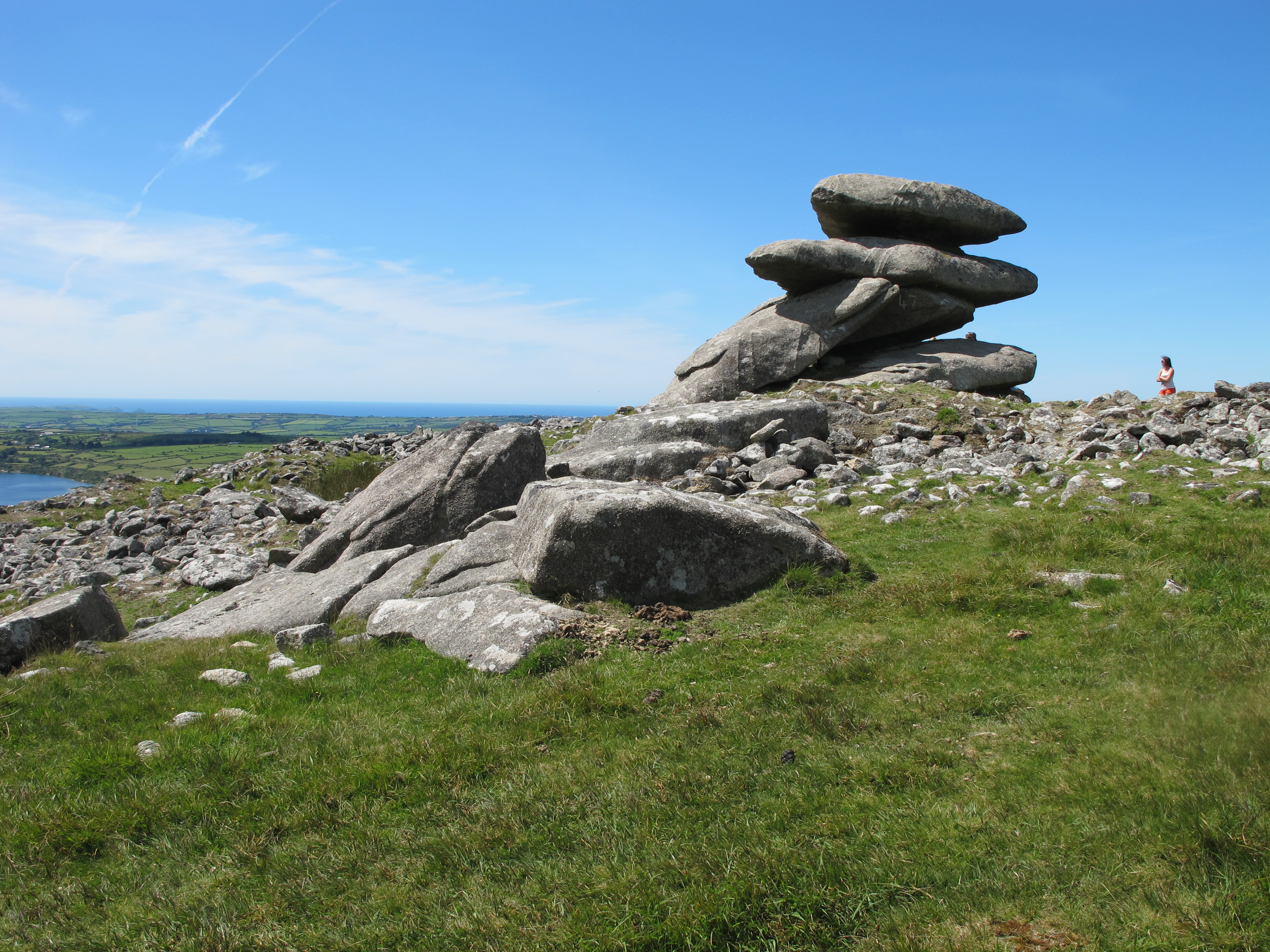
Irrelevant photo: Wind-carved rocks at the top of Rough Tor, which is pronounced Ruff Tor. No, don’t ask me.

If you’re British inflected instead of American inflected (yes, there’s an L in there: infLected), that’ll be maths, not math. I can only assume that the British are better with numbers than the Americans, since they wrestle with them in the plural  and we only have one to fight with. 

*

The Breakthrough Prize is also awarded in the sciences, and Catherine Dulac won one for showing that the neural circuits that govern the behaviors involved in both male-specific and female-specific parenting are present in both sexes. I have no idea what the implications of that will turn out to be, but they should upset a few apple carts. I look forward to hearing more.

*

As long as we’re on the subject of medicine and male/female differences, Rebecca Shanksy, a neurologist from Boston University (no, it’s not in Britain, but never mind) is calling for stricter requirements for medical research to include both female and male animals. 

For decades, researchers have used both male animals and male human subjects on the grounds that the fluctuations of female hormones would–forgive me if I use complicated scientific language here–fuck up their results. 

They did that even when they were studying conditions that mostly affected women. Because you know what women are like. Hormonal. Unstable. Unpredictable. Lots of un- words. 

It turns out, according to Shanksy, that male rodents–the go-to subject of many experiments–are less stable in terms of both hormones and behavior than females.

Shanksy is, by way of full disclosure, a female and therefore likely to be biased and unstable. Unlike males researchers, who are entirely objective and don’t have hormones.

The result of the male bias in research subjects is that drugs are likely not to work as well on women as on men. Ambien, which did its trials using both male mice and male humans, turned out to be metabolized  more slowly by women, and therefore (don’t ask me) more powerful in them. 

Women tend to experience more side effects and overdoses for all drugs. 

The U.S. and Canada now require female test subjects to be included (Britain doesn’t yet), but experiments are often done first on male subjects, with female subjects used later, treating the female subject as a deviation from the male standard. The article I read didn’t go into whether or how that biases the results, but I can see that if the first set of tests establish a standard, you could easily close off avenues that might be open if you worked differently.

*

Were we talking about sexism? The Musee d’Orsay in Paris–a museum with walls full of nudes–wouldn’t let a woman in because an official decided her dress was cut too low. 

And if that wasn’t bad enough, they followed up their decision by telling her, “Calm down, madam.” 

So she did what any good citizen of the twenty-first century would do: She went online and called them out on their double standards and sexism. The museum has apologized, both by tweet and by telephone, but it’s not the first time the museum’s had a problem with women’s real-life flesh as opposed to the artistic depiction of it. It called the cops on a performance artist who posed nude next to a nude painting. She was in jail for two days before a judge threw out a charge of public indecency.

*

An eighty-year-old hiker who’d been missing for three nights turned up not at his own funeral but at a press conference, held in a pub, where his family was about to appeal for help finding him.

Harry Harvey got separated from an organized walking group during a heavy hailstorm and spent three nights wild camping. He had camping gear with him but ran short on food. He described the area where he lost the group as desolate.. 

He eventually spotted a wildlife photographer, who called a rescue team and they brought him to the pub just in time for a dramatic reunion. 

The quotes from his family make them sound a bit on the crabby side about it all. 

*

A research trial that put robots into care homes has been defended on the grounds that the robots aren’t intended to replace humans, only to help fill times when, because the care system’s overstretched, staff don’t have time to spend with residents.

Which is commonly known as replacing humans with robots, only the humans were taken out before the robots were put in and no one had any intention of filling the gap they left–not even with robots.

The robots have wheels and a name, which they all share–Pepper. Also arms and hands. With a bit of programming, they could hold basic conversations with the residents, learn what they’re interested in, play them music, teach them languages, and remind them to take their medicine. 

This could go wrong in so many ways. In Japan and Singapore robots are more widely accepted and have been hacked to intercept phone calls or let the hacker use the robot’s camera and microphone. I don’t find any mention of medication reminders going wrong, but I doubt many of us suffer from the delusion that technology is flawless. 

The two-week trial found that residents’ loneliness levels decreased–not hugely, but a bit. 

*

Britain’s home secretary, Priti Patel, called Extinction Rebellion “criminals who disrupt our free society and must be stopped.” Other cogs in the government chaos have talked about classifying it as an organized crime group, which takes a bit of mental mechanics, since XR is decentralized and I suspect you’d be hard put to find an overall organization. 

The police, interestingly enough, see XR as nonviolent and committed to civil disobedience.

*

We’ll end with some more science awards, the Ig Nobels. This year’s include an one for determining that many entomologists–those are the folks who study insects–are afraid of spiders. Which aren’t insects, so it seems fair. Another went to a study that tried to spot narcissists by the shape of their eyebrows. A third went to a study that looked for a correlation between a nation’s income inequality and the prevalence of mouth-to-mouth kissing.

Oh, no you won’t: A quick history of the British panto

Nothing except the curry is as British as the panto. 

I’ve made that claim about a lot of things, and it’s true of every last one of them. And I didn’t even make up the comparison, so lots of people have made the claim about lots of things.

Nothing is as unoriginal as comparing an British / English whatever to a curry.

But if I’ve destroyed my own opening thoroughly enough, let’s move on and talk about the panto. Having grown up in the US, I thought pantomime meant silent acting. You know: Marcel Marceau. That kind of thing. We call it mime for short.

But for the British–well, they grabbed the opposite end of the word, we hung onto ours and between us we broke the thing. So forget mime. What they do is panto, and it’s full of words.

How British is it? Exactly as British as the curry: In other words, it came from someplace else–in the case of the panto, Italy and from there, France–and embedded itself deeply in British culture.

Irrelevant photo: No fall–or autumn, if I’m pretending to be British–is complete without a photo of gorse and heather. They’re everywhere. They’re behind you, probably.

It started as sixteenth-century Italian Commedia dell’arte, which was traveling street theater, although the better troupes weren’t above performing in a palace if one wandered past. The shows involved music, dance, dialogue, and a heavy dose of mayhem. 

Italy wasn’t a united country at this point, and it had many very different dialects. So how did they handle dialogue when the troupes traveled? According to one source, they made a virtue of the differences. One character spoke Spanish (no, that’s not Italian or a dialect, but somehow it’s on the list). One spoke Bolognese. One spoke gibberish. And so on. What pulled it all together was the physical communication–clowning, acrobatics, dance, music. One character, Arlecchino (are-lay-KEY-no–he’s the origin of our word harlequin), had two sticks that were tied together so they’d make a loud noise and he whacked everything available with them, including the scenery and the other characters. And that, children, is the origin of our word slapstick

The women’s roles were played by women, and since the European tradition had banned women from the stage, this was radical.

The sets were basic–they had to travel–and many elements were predictable, including the characters, which were fixed types, recognizable from play to play, from troupe to troupe. A lot of them were played in masks. (The lovers–because what’s a play without lovers?–weren’t.) So forget deep characterization. What mattered were the tumbles, the slapstick, the chases, and the jokes, which were also recognizable from play to play. 

All of that, though, was scaffolding for the improvisation. The actors played off each other and the audience, so the play would never be quite the same twice. 

From Italy, the form moved to France, and from France it moved to England, and from the sixteenth century time moved to the seventeenth. In England, Commedia dell’arte collided with masques, which had started in the 14th century as musical, mimed, or spoken dramas put on in grand houses. By the seventeenth century–or so says one source–they were basically an excuse for a theme party. 

Commedia d’etc. may also have had a small collision with a medieval (or Tudor, depending on who you want to believe) Christmas tradition, the Feast of Fools, which was run by the Lord of Misrule, because before too many centuries had passed the panto became as tightly connected to Christmas as brussels sprouts (don’t ask–it won’t get us anywhere). 

In the eighteenth century, the word pantomime took hold and the form began gobbling up existing stories–Aladdin, Robinson Crusoe, Cinderella, you name it. 

By the Victorian era, the principal boy’s role was played by a woman. In the Victorian era, that would’ve been pretty racy stuff, involving ankles and legs and all sorts of body parts no one knew women had. The dame was enthusiastically overplayed by a man. If you were inclined to take anything too seriously, that would knock the idea out of your head.

Then they added some dancers and an audience, which got to yell out some stock phrases: He’s behind you. Oh, no you won’t

It’s an odd thing, but after you repeat those a few dozen times, they begin to be funny. In fact, they’ve cut loose from the panto and become free-floating punchlines in real life.  

In some stories, they got to add a pantomime horse–two people in a horse costume. Hold onto that thought.

These days–or before the pandemic, anyway–pantos were performed in grand theaters with professional or semi-professional actors and in village halls with hangdog ten-year-olds who delivered their lines as if they’d been strong-armed into taking part because they had been.

Many theaters relied on pantos for a heavy portion of their year’s income. The could reliably fill the seats.

By the time a panto ends, good has conquered evil and the lovers have been united. And where I live, until there’s been a raffle. You don’t get to leave a village event until you buy a ticket, and if you win something you want look happy with your prize, no matter how odd it is.

Why am I writing about this in September? In part because the British government’s running like a badly written panto:

“We will get control of the corona virus.” 

“Oh, no you won’t.”

“Oh, yes we will.”

“Oh, not unless you get your act together you won’t.”

But also because a bit of the panto has broken loose, abandoned the Christmas season, and become the panto horse race: pairs of people in horse costumes in a race. Ask Lord Google about it and he’ll tell you they take place (at the very least) in Colchester and in Catterick. Here’s one that was won by a cow. 

The London panto horse race seems to be the same as the Greenwich one, and it goes from pub to pub, stopping at each one. By the end, the horses are looking a little the worse for wear. Or possibly for beer. The front end of one horse was having a drinking problem that had to do with the length of a horse’s muzzle and the size of a pint glass of beer.

For the best of the videos, I couldn’t find anything outside of Twitter or Facebook, but if you enjoy pictures of people falling over, horses coming apart, and scenery being destroyed, it’s very funny. 

Go on, click the links. You know you want to.

Oh, yes you do.

Flags and rust: It’s the pandemic update from Britain

The government tells us we have a great system of Covid testing. World beating. So let’s check in on it. Again.

If you live someplace that’s not a hotspot and want a test, you’ll be chasing all over the country to get one. Take, as a purely random example, me. The website where you register for a test wanted me to drive 86 point something miles to I’ve forgotten where. And back, although that wasn’t their problem but mine. It didn’t sound like a great idea, so I followed a link that took me to a page that promised I’d have a test in the mail the next day. 

The next day came and went, along with many of its friends, who followed in a line, as days will. I still haven’t had a test in the mail and have stopped expecting one. Fortunately, I’m fine. I had a sore throat–not the most Covid common symptom but not an impossible one–and a fit of paranoia collided with a sense of civic responsibility. It’s possible that I got downgraded because I had the wrong symptom. It’s also possible that they dumped everyone into electronic limbo. I have no way to know.  

What I do know is that the priority is being given to high-risk areas. That makes a kind of sense, but it also leaves clusters to build up, unspotted, in new areas. It also means the people allegedly in charge of the country have once again let us run short of tests–the number of people requesting them has gone up–leading them to set up a kind of triage-by-determination system. If you’re willing to drive 65 point something miles, you can have your test. If you’re too sick to do it, you can’t. 

You can also (or so the radio tells me–and yes, it was on at the time) log back into the website later and you might be offered a perfectly sane location for a test. Or you might not. Nothing is guaranteed.

In calculating the distances between the person using the website and the nearest testing center, they seem to have assumed that they’re dealing with crows rather than drivers. According to a BBC calculation, a 109-mile trip would’ve involved 206 miles of driving. I suspect mine would’ve as well, because I think they wanted to send me to Wales, and I’m not much of a swimmer.

This is happening just as the schools reopen. So will there be testing to make sure the kids don’t all infect each other and bring the bug home? Of course not. It’s not a priority.

*

The Notting Hill Carnival–usually the largest street party in Europe–went online this year. It’s director, Matthew Phillip, said, “For more than 50 years, carnival has been a statement that black lives matter. That’s normal practice for us, it’s not something that we’re just jumping on now because of the current global climate and what’s going on. Carnival has been making these statements for 50 years.”

*

The Edinburgh festivals–that includes the International Festival, the Fringe, and the Book Festival–also went online. This was the first time they’d been canceled since 1947, and that was done–touchingly–in honor of my birth, even if they were a few months late. 

As far as I can figure out, its offerings ended in August, but if you want to mess around and see if I’m wrong (it happens), start here.

*

In another heartwarming sign of unity among the four nations that make up the United Kingdom, England and Northern Ireland are telling travelers from Greece and Portugal that they don’t have to quarantine after they arrive in Britain but Scotland and Wales are (sort of) telling them that they do.

The sort of is because it’s not that simple. It involves parts of Greece, mainland Portugal, and–oh–Gibraltar. Have we mentioned Gibraltar? But that’s only for Wales. Scotland’s list is a little different. It’s complicated.

Complicated enough that a BBC TV show used a graphic with four flags to show who had to do what if they were landing where–or going there after they landed. Only instead of Northern Ireland’s flag, they substituted the Republic of Ireland’s. It’s easy to do. Northern Ireland doesn’t have a flag. All that symbolism and passion that people pour into their flags is too explosive for a divided nation and they’ve (probably wisely) decided to live without one. They’re stuck with the Union Jack.

The BBC made the appropriate straight-faced apology, but I can’t help thinking that someone’s giggling uncontrollably behind a closed door somewhere. 

Or maybe normal people don’t react to embarrassing mistakes that way.

*

Since schools have opened, this might be a good time to announce that vomiting and diarrhea may be key signs of Covid-19 in kids

I almost reported that as “voting and diarrhoea.” It was a typo, but they might do better than we adults have lately.

*

Tony Abbott, Australia’s former prime minister, is being considered for the position of UK trade envoy. He’s a man of great compassion, having argued that since Covid meant it cost the Australian government up to $200,000 for an extra year in an elderly person’s life, families should be able to let their eldery relatives die of the virus the natural (not to mention cheaper) way if they want to. 

I’m happy to report that Mr. Abbott is not one of my relatives.

*

After that, we need something that isn’t about the pandemic: The earth is making the moon rust.

The problem with that is that rust only happens in the presence of oxygen, and the moon doesn’t have an atmosphere. It spent it all when it was a kid, buying candy and sugary drinks. 

Ah, but it does have trace amounts of oxygen hidden away, and it’s all due to Earth’s magnetic field. Oxygen molecules, it turns out, can hitch a 385,000 kilometers ride on the magnetic field and land on the moon, needing a shower and a change of clothes but otherwise none the worse for their travels. 

It’s also possible, although less fun, that the oxygen got there when the moon and the Earth were closer together. Or that it’s released when dust particles hit the ice hidden under lunar craters. 

How does dust hit something hidden under a crater? Dunno. There’s a third theory, but I understood even less of that. It has to do with hydrogen and solar winds. You’re on your own. I really should stick to topics I understand, but I couldn’t resist the idea of the moon rusting.

*

And finally for the heartening spectacle of someone who understands social media less than I do: A Scottish member of parliament, Annie Wells, has two Twitter accounts. One is her own and the other is Women2Win Scotland (“Leading the campaign to elect more Conservative women to Parliament”). 

Using her own account, she tweeted something snotty about a political opponent. Then, thinking she’d changed accounts, she tweeted, “Spot on@AnniewellsMSP,” adding a thumbs up, a Union flag, and a Saltire to make the celebration complete. 

Only she hadn’t switched accounts. She was praising herself from her own account. She deleted it, tweeted it from her other account, and hoped no one had noticed.

They had. Of course they had. They always do.

The Saltire, in case I lost you back there a ways, is Scotland’s flag. It’s not to be confused with Ireland’s. Or Northern Irelands. Or, most especially, England’s. Or Britain’s. You probably won’t confuse it with the Welsh flag, because that has a dragon.

*

WP in its wisdom dumped me into its glorious new editing experience–which of course I hate. Anyone know how to resize photos or add captions?

Lizards, sewage, antisemitism, and Rembrandt: It’s the non-pandemic news from Britain

Is anything happening in Britain other than the pandemic?

Why yes, and thank you for asking. 

A fake Rembrandt has been hiding in the basement of a museum. It’s a small picture of an old man with a beard, looking unhappy (the man, not the beard). When it was first stashed down there, the man was young, clean-shaven, and hopeful looking. 

The painting was given to the museum in 1951 and spotted as a fake in 1981 by the world’s leading authority on the subject, the Rembrandt Research Project. 

Then a new curator came along and the picture just bugged her. It looked too Rembrandtish to write off. 

It’s now been analyzed by dendochronologists. Those are people who, um, analyze dendos. Or possibly dendons. In time–that’s the chronology part. 

Oh, never mind. You don’t need to know what they do and I don’t either. What matters is that they’ve figured out that the wood the old man’s painted on came from the same tree as an acknowledged Rembrandt. So it was, at least, likely to have been from his workshop. And may be by the master himself.

It’s a pity it couldn’t have happened when the man was young and optimistic, but at least it’s happening.

*

Utterly irrelevant photo: A castle ruin near Edinburgh. Photo by Ida Swearingen

A seven-year-old with cerebral palsy climbed Ben Nevis, Britain’s highest mountain, raising over £17,000 for the National Health Service and a disability charity. 

When he was born, his parents were told he’d never walk, sit up, or talk, never mind raise money for the NHS. 

*

It was always going to be hard to make importing sewage sludge for farm fertilizer sound appealing, but it’s being imported anyway. It’s happening quietly, though, so no one has to take on the job of explaining why it’s a good idea. 

Why is it a good idea? Well, its use on farmland is effectively banned in the Netherlands, and the Dutch water authorities had problems incinerating it. And the stuff has to go somewhere, so they looked across the channel and saw Britain and said, “Hmmm. Betcha they’d pay good money for it.”

Only in Dutch. 

The sludge could contain E coli and salmonella, persistent organic pollutants, heavy metals (not the musical kind–no one’s complained about it causing noise pollution), and microplastics. And it could be a source of antibiotic-resistant bacteria.

Other than that, it’s nice stuff and does return nutrients and carbon to the soil. 

Yum.

*

The rapper, singer, and songwriter Stormzy has donated £500,000 to fund scholarships for kids from disadvantaged backgrounds. They’ll go fifty students of any age–and not just university students. 

The plan is to give £10 million over ten years to groups fighting racial inequality in Britain. 

*

The street artist Banksy donated we don’t know how much for a refugee rescue boat, the Louise Michel, which is now sailing the Mediterannean. Last I heard, it had picked 219 people out of the water and the deck became so crowded that the boat was effectively stranded. The most vulnerable 49 (along with a man who died before being picked up) were transferred “to safety” (I’m not clear where), and the remainder were put aboard another rescue ship.

Finding a port willing to accept refugees is a serious problem. Plucking them out of the water is, relatively speaking, the simple part.

The International Organization for Migration says more than 7,600 people have been picked up at sea and forced back to Libya–a policy of both the Libyan coastguard and European Union states. Another 500 are known to have died in 2020, trying to make the crossing, although the actual number is likely to be higher. Libya has been accused of mistreating refugees at sea and of selling them to militias. 

Banksy explained why he wanted to get involved when he wrote to Pia Klemp, who’d captained several rescue boats: “I’ve made some work about the migrant crisis, obviously I can’t keep the money. Could you use it to buy a new boat or something?”

Klemp initially thought someone was putting her on, but they soon settled down and worked together. She summed up the arrangement this way: “Banksy won’t pretend that he knows better than us how to run a ship, and we won’t pretend to be artists.”

*

Local governments in Bournemouth, Christchurch, and Poole have proposed, in their wisdom, fining homeless people £100 for sleeping in doorways or leaving their belongings in the street. If they don’t pay up, that can go up to £1,000. 

Which of course they have. That’s why they’re living on the street.

*

Emma Cownie and Doug Jacquier have clued me into–

Guys, I don’t know how to break this to you, but it seems the royal family are actually lizards. Shapeshifting lizards.

I know. I couldn’t have imagined it either. And it’s not just the royal family. The whole world, it turns out, is run by lizards. It explains a lot, doesn’t it? 

This isn’t new news, but then this isn’t a newspaper, I’m not a reporter, and I only just found out about it. It rose from the depths of the conspirosphere in April, when a former broadcaster, David Icke, did a TV interview in which he left the road way, way behind. 

This wasn’t the first time he’d talked about it. You can find him here, explaining everything to us. “Much of it,” he says, “is backed up by hard factual information.”

And the rest of it? Oh, hell, who cares?

Okay, I confess: I haven’t listened to the interviews, relying on the writeups instead. How much time do you think I have here?

Icke’s life moved from sports to broadcasting through the Green Party and alternative medicine to spiritualism to–well, he did predict that the world will end in 1997. As far as I can tell, he was wrong. He’s been accused of antisemitism, which he denies, but he also says that whoever wrote The Protocols of the Elders of Zion (an antisemitic forgery) ”knew the game plan.” 

I’m working from WikiWhatsia here. I normally hold out for something marginally more reliable, but with a topic like this, why quibble?

The lizards are from the Draco constellation and have been breeding with humans. And the scientific method is bollocks and climate change is a hoax. 

Um, yeah, I think he’d broken with the Green Party by the time he announced that.

Anyway, it all gets complicated. Have a good time. It could almost make a person go back to the pandemic for a little rest. 

What people really want to know about Britain, part who’s counting?

Let us enter, once again, the depths of the internet, whose current wash strange questions to the shore here at Notes.

But you need to know a few things about the process before we go on: First, no feelings were hurt (or so I tell myself) in the process of turning me loose on these questions. They come from people–or I assume they’re people–who flit through here, driven by whatever whim propelled them at 2 a.m. to ask Lord Google for information on subjects they may not have actually cared about, and then flit right on out, leaving behind their questions but not their consciousness. Second, the questions appear in all their original oddity, except that I’ve italicized them. Third, I used to answer them seriously. It didn’t take long to get boring. 

*

Irrelevant Photo: The view from Castle Point, where there is no castle. The flowers are heather and gorse.

double space after full stop uk

For the sake of American readers, I need to explain this before I answer it: The question isn’t about social distancing at two stop signs. In Britain, a full stop is that tiny dot you put at the end of a sentence: a period. Back in the old days, when we used typewriters and that seemed like a perfectly reasonable thing to do, we were taught to double space after a period. That pool of wide-open paper made it easier to spot the end of one sentence and the beginning of the next.

In my school, by the way, only girls learned to use typewriters. They were considered too technical for boys. 

Then word processors came along and spoiled the fun by introducing proportional spacing.The divisions between sentences now jumped out without the help of an extra space. So the second space went the way of the typewriter and the quill pen, although 30% of the people in a survey (which may or may not be representative of I have no idea what population) still think it’s correct to double space.

If you want to know more about this (and who wouldn’t?), here’s a link

I can’t explain why Lord Google thought this was the place to send people for information about that, but now that I’ve written about it, he’ll send more.

Now let’s double back and explain my second sentence for the sake of non-American readers: In most (possibly all) states in the U.S., failing to come to a full stop at a stop sign will earn you a traffic ticket. But only if you get caught, which mostly you don’t. 

difference between anerican beeband british beer

You drink one in America and the other in Britain unless you want to pay extra for an import. One’s spelled with an R and the other with an extra B and no space at all before the and

berwick and russia at war

This is the longest non-war in history, and it has the biggest following. 

how do you pronounce river teign

Teen.

Teignmouth, though, the place at the mouth of the River Teign? Logic says you’d pronounce it the same way. 

Logic is wrong. This is England. Those are place names. Abandon hope. It’s Tinmuth.

And the government of the area, which is called the Teignbridge Authority? We’re back to teen.

widemouth

Most people call me bigmouth, but widemouth is far from the worst thing anyone’s called me. The place name, though, is pronounced Widmuth.

english holiday with sprouts

Back in the old days, this was known as Christmas, but the world changes and we have to change with it. It’s now known as English Holiday with Sprouts. 

These are brussels sprouts we’re talking about, for those of you who aren’t clued in to the oddities of British culture. I don’t answer questions about either bean sprouts or that hairy fuzz that grows out of alfalfa seeds. 

The sprouts holiday–

Let’s capitalize that: The Sprouts Holiday falls on Christmas, and folks gather around to eat brussels sprouts (and possibly other things, but the presence of sprouts obsesses a category of people who buzz around this blog like flies). 

Sorry, I got sidetracked. The people gather, eat sprouts, and wear silly paper hats. They place two desserts on the table and set fire to one of them.

That is–however strange it sounds–true.

The question should probably be about a British Holiday, though, not an English one, but I’ve never spent the Sprouts Holiday in Wales, Scotland, or Northern Ireland, so I don’t really know how integral sprouts are there. I’d be happy to hear reports from the other nations on this crucial topic. 

Don’t you love that people turn to me to learn these things? Who better to explain the intricacies of the British Christmas tradition than an American Jewish atheist? This, my friends, is the true meaning of multiculturalism. 

Whatever that was you just threw at me, you missed. 

But let’s go back to the question and make sure we cover all possibilities. It might have been about taking your sprouts on holiday with you, which in American would be taking your brussels sprouts on vacation. Because, hey, it may be a holiday (or vacation) for you, but if you leave your sprouts at home, what kind of time are they having? The world would be a better place if we all took our vegetables into account when we made our plans. 

You’re welcome, and a 50-page position paper on the subject will arrive in your inbox tomorrow. Please get back to me with any changes by Monday. 

how did carriages pass on narrow english country lanes in olden days

This is, surprisingly, a good question. I don’t know what it’s doing here either. English country lanes are narrow. So are British country lanes in general, but let’s not get into that. Horse-drawn carriages didn’t have a reverse gear.

The partial answer is that country lanes aren’t an even width. They have wider spots, where you can pull over, swat horseflies, check your phone messages, and wait for that oncoming carriage to pass.

The rest of the answer? What happens when you’ve got a blind bend in the road and no wide spot? Your guess is as good as mine. What I can tell you is that I live in an area with lots of narrow lanes and blind curves and I’ve seen the shipwrecked remains of abandoned carriages or the bones of the horses that pulled them, so they must have figured out a way to go on.

debtors prison england

Where we’ll be if we don’t break down and admit that we need to tax those who can best afford taxes.

why call great britain

Because it’s running this fantastic ad campaign: Do you want your tea hot, your weather cool, your history complicated, and your spelling unpredictable? Call Great Britain! We deliver. 

parky used nineteenth

This is our mystery question. There’s always one. [Warning: I’m about the offer the world a bit of misinformation. In my defense, I was repeating what I’d been told by someone who seemed to know what he was talking about. The more fool me. See the comments for a correction or three.] Parky comes from a bit of Cockney rhyming slang: It’s parky in the mold means it’s cold. Mold is the rhyming bit, so it gets dropped because otherwise the phrase might make sense to people who didn’t already know what it meant. 

Nineteenth, though? Used? All suggestions, however bizarre, are welcome. 

Boris Johnson’s minders, & other pandemic and Black Lives Matter news from Britain

Somebody in government let the prime minister out on his own and before anyone could shut him down he’d blamed care homes for the nearly 20,000 Covid-19 deaths on their premises.

“Too many care homes didn’t really follow the procedures in the way they could have,” Boris Johnson said. 

All the predictable hell broke loose, along with reminders that: Care homes hadn’t been able to get protective gear. What guidelines they were given were unclear. They couldn’t get either staff or patients tested for the virus. Agency staff–that’s British for temporary workers–spread infections between homes because (guess what) they couldn’t get tested. The government rejected a proposal to lock down care homes before the infection entered. 

And did I mention that 25,000 people were discharged from hospitals into care homes without being tested?

Sorry, I meant to mention it. It’s a detail. It slipped my mind.

As soon as Johnson was bundled back out of sight, a government spokesperson said, “The PM was pointing out that nobody knew what the correct procedures were because the extent of asymptomatic transmission was not known at that time.”

Which sounds almost exactly like what Johnson said if you took away his words and replaced them with other, more coherent words on a slightly different subject.

FYI: Asymptomatic transmission was known at that time, and at several other times, but let’s not pretend we’re talking about reality here.

Johnson’s minders are under strict instructions not to let him wander loose that way, but you know what it’s like. They can’t keep an eye on him every minute of every day. And he is the prime minister, so he gets to give the orders, at least when Dominic Cummings is out of the office.

They don’t have an easy job.

*

Irrelevant photo: a red hot poker.Not an actual one, you understand. A flower by that name.

The health minister has said that in all but  “certain circumstances” the government will be scrapping free parking for National Health Service staff members once the pandemic eases. No one’s told us yet what he really meant to say, but the shit is flying thick and fast. By tomorrow, someone should step in to explain that he really meant there’s been some concern about people parking on the white lines that divide their spaces and would they please exercise a bit more care.

Clapping for NHS workers, which the top government ministers did dutifully on many a Thursday, doesn’t cost anything, but it did have an unfortunately way of focusing the nation’s attention on NHS staff. And the next thing you know, people are looking asking why it’s been so long since they got a pay raise. And why they were charged for parking in the first place? 

It’s not easy, placating an entire country.

*

The committee of the Morris Federation–an organization of morris dancing groups–has written to its members calling for a halt to the use of blackface.

One strand of morris dancing has a tradition of appearing in blackface. No one’s sure when or how that started, and some dancers argue that it isn’t racist, it came out of the dancers’ need to disguise themselves. Other dancers have stopped arguing about origins and dropped it.

The committee writes:

Our traditions do not operate in a vacuum. . . . We must recognise that full-face black or other skin tone makeup is a practice that has the potential to cause deep hurt.

“Morris is a living tradition and it is right that it has always adapted and evolved to reflect society. . . .  We welcome the fact that many long-standing teams who used to wear full-face black makeup have chosen to use masks, alternative colours, or other forms of disguise.  We now believe we must take further steps to ensure the continued relevance and inclusivity of the tradition.”

They’ll be asking the group’s annual general meeting not to renew the membership of teams that continue to use blackface.

An annual general meeting? It’s a British thing. All you have to do is say AGM and everyone will know what you mean. It’s an–um, well, it’s complicated. It’s a general meeting. Held annually. And you have to have one or your right to call yourself an organization will be revoked. That’s enforced, with no mercy and no appeal, by the laws of physics, a handful of which apply only in Britain.

My thanks to @amuddleofmorris for keeping me up to date on this. 

*

I keep promising myself that I won’t report on coronavirus studies, possibilities, and assorted carrots dangling in front of us as we look for a way out of the hall of Covid mirrors. Most of them will come to nothing. That too is enforced, with no appeal, by the laws of physics. 

They’re ruthless bastards, those laws of physics.

Then I see a mention of another promising study or three and I break my promise. Because promises aren’t governed by law. And because we all need shreds of hope as we stumble through, bumping our noses into exits that turn out to be more damn mirrors.

So, here’s what I’ve found. I don’t promise that any of them will ultimately work, but they might. They just might.

1. A proposal to try the MMR (mumps, measles, rubella) vaccine against the coronavirus in the hope that it will reduce lung inflammation and sepsis, two of the body’s most dangerous responses to the disease.

2. A synthetic antibody that may be able to neutralize Covid-19, both preventing any initial infection and helping people who’ve become infected to recover. Basically, it works as a decoy, drawing virus particles away from cells that could become infected. It was developed in mouse models. 

Mouse models? They’re improbably good-looking mice. The scientists give them the drug and photographers take pictures.

The less than great news is that if it works it would have to be injected into the bloodstream every two to four weeks.

They’re working toward human trials.

3. A test of canakinumab, a drug no one can pronounce that’s used to treat juvenile rheumatoid arthritis. It damps down the body’s immune response and could prevent the cytokine storm–the immune overreaction–that occurs in some severe cases.

I was going to say it works by being so hard to pronounce that the disease goes into a state of paralysis, but I was afraid someone would believe me.

*

Madrid’s Teatro Real became the first European theater to stage a live production (as far as I know, which isn’t all that far; it’s a big continent) since the continent locked down. That doesn’t include the concert that was staged in Barcelona for an audience of live plants. That one’s in a category of its own. 

The Madrid production was Verdi’s La Traviata.

How’d they do it? They doubled the size of the orchestra pit so the musicians could keep a safe (we hope) distance from each other. The intermission lasted forty minutes so everything could be disinfected. The conductor was behind a plastic screen. The production was semi-staged, presumably to keep the singers at a distance from each other. And the audience wore masks and was half the usual size.

The production opened with a moment of silence for the victims of the virus and a statement from journalist Iñaki Gabilondo: “Nothing is simple now, including being here tonight. “ 

My thanks to Max Burrows for sending me a link to this article.

*

If you’re still holding out for herd immunity to protect us from Covid-19, prepare to accept a lot of dead bodies and damaged survivors along the way, because we’re nowhere close. A large study in Spain, which was hit hard by the virus, found that only 5.2% of the population has antibodies. The standard estimate is that 60% would need antibodies before you could talk about herd immunity.

If–and it’s a big if–anyone develops immunity to the virus. That hasn’t been established. We may, we may not. 

*

A group of 239 scientists from 32 countries urged the World Health Organization to give more emphasis to the use of masks and to acknowledge that the virus is spread not just by the big droplets we breathe out but by the aerosols we breathe out along with them–those tiny, near-weightless bits of breath that surf the air currents more gracefully (and more to the point, for longer) than their clunky droplet cousins.

WHO seems to be taking it on board. Its latest statement says there’s emerging evidence of aerosol transmission but it’s not definitive.

If the 239 scientists are right, it means that we may need to do more than keep two (or one, or however many) meters (or yards) apart. It means that especially in crowded, badly ventilated space, we need masks. 

Yeah, you too, cowboy. 

And there’s some evidence that wearing a mask does give the wearer a bit of protection. Which is a bit better than no protection.

*

York Minster’s been the center of a debate over whether a statue of a Roman emperor, Constantine, should be removed because of his support of slavery. Two newspapers, the Daily Mail and the Telegraph, have run articles. Comedians and politicians have tweeted in the statue’s defense. It’s Black Lives Matter gone insane, they say.

The only problem is that no one proposed getting rid of it.

“We have not received a single complaint about Emperor Constantine’s statue,” a minster spokesperson said. “Nothing is happening: there is no discussion, action, intention or even thoughts about it.”

It’s disappointing. Just when you get a good lungful of outrage going–

*

That’s it for the moment. Stay well. I don’t have so many readers that any of you are expendable. 

The pandemic update from Britain: hope, hype, and a tiger running loose

At the risk of injecting a dangerous note of optimism into these updates, a new blood test looks promising. It might–emphasis on might–be able to pick up traces of Covid-19 a day after a person’s been infected. That would be several days before symptoms show up and most importantly (there may be a small question mark involved here) before a person’s contagious.

That’s four days sooner than any existing test can pick up the beast.

It’s been developed by Darpa–the U.S. military’s Defense Advanced Research Projects Agency–by the folks who usually work on diagnosing germ and chemical warfare poisoning. The test’s been rushed to the Food and Drug Administration for fast-track approval. If it is approved, it’s expected to be available in the U.S. in the second half of May.

Possibly. The fine print is that approval isn’t guaranteed. And they won’t know how early it can pick up an infection until the test gets approval and they can gather data. And I don’t know what the plan is about making it available elsewhere. But if it works and if it’s approved and if it’s widely enough available, it would mean pre-infectious people could be quarantined and the transmission chain could be broken. And I could finally do my own damn grocery shopping.

*

Irrelevant photo: A whatsit plant. We got it last year and whatever is it, it survived the winter.

Two other antibody tests are in the works, one from Roche and one from Quotient. The Roche test has gotten FDA approval. Quotient is in the U.K., so the FDA is irrelevant. It says its screening machines could process up to 36,000 tests per day and give results in 35 minutes with 99.8% accuracy. The snag? Both tests are lab-based. They can’t be done at home.

*

With a whole lot of fanfare, the British government announced that it had met it’s (completely arbitrary) goal of testing 100,000 people a day by the end of April. Some of those tests hadn’t been processed yet, mind you. And others hadn’t actually reached anyone. In fact, some were sent out without return envelopes. And only 7% of the 31,000 for care home staff and residents had been used by last weekend.

I mentioned that in an earlier update, but the details have gotten more absurd, so I thought it was worth repeating.

And you know, a number’s a number, so sound the trumpets, please, bandmaster.

When last sighted, the daily test number had dipped below 80,000.

*

One of the mysteries of Covid-19 is being called happy hypoxia: It involves patients whose blood oxygen levels are so low that they should be unconscious but they’re talking, checking their phones, and generally saying they’re comfortable. Which doesn’t make their blood oxygen levels less dangerous, only mystifying.

*

How are people coping with the pandemic? Some 300,000 people in Britain have quit smoking.  And online searches for puppies have gone up by 120%. The Dog’s Trust is begging people to think about how they’re going to deal with the dog when real life picks up again.

*

In a rare display of good sense and global cooperation, a global alliance is expected to pledge $8.2 billion for Covid-19 research and the equitable distribution of vaccines and treatments. Stay tuned. I’ll let you know more when and if I hear about it.

*

Can we talk about something else?

Police in Kent got a call about a big cat running loose, so they called up a helicopter and an armed response team and went looking for it. They found an 85-year-old sculptor and the life-size tiger that’s been in place for 20 years without scaring anyone until now.

One cop figured it was all because a of a recent Netflix series about big-cat ownership in the U.S..

In the interest of making fun of English place names, I should really mention the location. This happened near Underriver, in Ightham. According to all the laws of the language, Ightham should be either  unpronounceable or leave your tongue twisted back on itself and begging for rescue. How do they deal with that locally? They pronounce it Item.

And yes, English does have laws. It also breaks them anytime it the mood takes it.

And Underriver? How are we supposed to understand that? According to Wikipedia, which may or may not know what it’s talking about at any given moment, the name comes from old English and means under the hill.

That makes perfect sense.

If I really had to, I could also tell you how to report potholes in Underrriver. It’s very useful having me around.

The U.K. star count 2020

If you live in the U.K., you can help the Countryside Charity take a survey of how dark the nighttime skies are. They’re asking people to go outside after 7 pm between February 21 and February 28, wait till their eyes adjust to the dark, and report how many stars they see inside the Orion constellation. You don’t need binoculars or telescopes or anything other than yourself and the skies and a clear night.

That last part–the clear night–is going to be hard. I can’t remember the last one we had.

It’s as useful to report from a city where you’d be lucky to see a single star as it is to report from the darks of Bodmin Moor. It’s all information. Follow the link above and you’ll find the instructions (there aren’t many) and a way to report your count.

*

As long the weather’s come into the conversation, I might as well tell you that as soon as Britain’s hit by a storm big enough to earn itself a name, it will be Storm Ellen. Batten down the hatches.