The fun hasn’t gone out of British politics yet

Once Britain’s Conservative government was booted out, it looked like the grownups, in the form of a shiny new Labour government, were in charge at last. In other words, it looked like the fun had gone out of politics, but have hope: humanity’s most absurd qualities haven’t been banished. 

This is admittedly gossip and rumor, but it’s credible enough for a responsible paper, the Guardian, to have trusted it: low-level guerilla warfare is going on inside 10 Downing Street between Sue Gray, the prime minister’s chief of staff, and Morgan McSweeney, who was his election strategy wizard and is now his head of political strategy. 

The plan was for McSweeney’s desk to sit outside the prime minister’s office, since he would be in and out of there more than Gray, but apparently Gray has moved McSweeney’s desk away from the prime minister’s door. Twice. Which implies that he’s moved it back at least once. She’s also (allegedly) tried to block his access to a secure computer system that would let him get security briefings.

There’s hope for humanity yet.

A nearly relevant photo, but you’ll have to read to the end to find out why. This isn’t the cat in the news but our own Fast Eddie in the foliage.


Exit Liz Truss, pursued by a head of lettuce 

Admittedly, though, the Conservatives were more fun. Watching them run the country was kind of like watching a classroom full of six-year-olds try to make a pie from scratch after the adult’s been called away: a lot to laugh at, but now that their parents have taken them home and, we hope, washed their clothes, there’s a real mess to clean up.

I’m not on the clean-up crew, so allow me to call your attention to Liz Truss, who was prime minister for 49 days. During the final stretch, disaster was so clearly headed her way that a newspaper put a livecam and a blond wig on a head of lettuce and asked if it would last longer than Truss.

Or maybe she was in office for 45 days. Or 50. For reasons that I won’t try to understand, different sources are coming up with different numbers. Whichever one we pick, she still holds the record for the country’s shortest-serving prime minister and the lettuce outlasted her, but that hasn’t stopped her from publishing a book, Ten Years to Save the West–an ambitious goal for a politician who couldn’t save her own premiership. And more than a quarter of that first year is gone already. 

Modesty prevents me from making fun of anything more than the title since I haven’t read it. 

The reason she’s back in the headlines is that she walked out of her own book event in August, which must also set some kind of a record. A crowd-funded group called Led by Donkeys had installed a hidden banner above the stage. When they lowered it by remote control, it read, “I crashed the economy.” Inevitably, it included a picture of a head of lettuce. 

Truss said, “That’s not funny,” and walked off stage. End of event. She has since accused Led by Donkeys of stifling free speech, although nothing they did kept her from speaking and a banner can also be considered speech. In fact, interrupting someone can be considered free speech. 

Led by Donkeys calls itself an accountability project and says the new government will inevitably “disappoint us in some, if not more, respects . . . so it’s inconceivable that we won’t turn our attention in a really direct way to what the government is doing.”

I can hardly wait.


What’s it worth to be booted out of office?

In the year after she stepped down as prime minister, Liz Truss made £250,000 in speaking fees. In one speech, she took in more than most of her fellow citizens earn in a year.

Suella Braverman made £60,000 as a speaker, although I’m not sure about the time period on that. She also made £14,000 for newspaper articles in the Telegraph and accepted an all-expenses paid trip to Israel worth £27,800. A mere nothing, but then she wasn’t prime minister. She never got past home secretary.

The top earner is Boris Johnson, who made £4.8 million in the six months after he stepped down, £2.5 million of which is an advance on some unspecified number of speeches. I haven’t seen a breakdown of the rest of his income, but I’d think twice before paying him an advance on so much as a piece of toast, even if I was looking at both bread and toaster. He got an £88,000 advance (or “a rumoured” £500,000–go figure) in 2015 for a book on Shakespeare.  

What does he actually know about Shakespeare? Indications are, not much. In 2021, a leading Shakespeare scholar was approached to help him with his homework by answering questions for Johnson. “The originality and brilliance, his agent assured me, would lie in Mr Johnson’s choice of questions to ask and in the inimitable way in which he would write up the expert answers he received,” the scholar said when he went public about it.

The book has yet to appear–or from what I’ve read, make its way to the publisher, but that hasn’t stopped him signing a £510,000 deal to write his political memoirs–for a different publisher. 

And I still don’t have my toast.

*

To prove there’s no justice in this world, the lettuce–which, you’ll remember, outlasted Truss–ended up on the compost heap. 


Meanwhile, in Cananda . . .

 . . . a totally separate Conservative Party aired a feel-good election ad, full of patriotic hoorah about how much they love Canada. You know the kind of thing: a Canadian father drives through the suburbs, only it turns out that was shot in North Dakota. The kids in school? That was from Serbia. The university student? Ukraine. The kid in the park with her grandparents? London. The two jets on a training mission, “getting ready to defend our home and native land”? Russia.  

And the sunset with the words “we’re home”? Venezuela. 

The ad has been pulled.


And in nonpolitical news . . .

. . . Larry Richardson is the author of a dozen academic papers on mathematics that have been cited 132 times. Larry Richardson is also a cat and, disappointingly, his papers are gibberish. 

Larry was boosted into academic stardom by his person’s grandson, a grad student in metascience and computational biology, who had run into the academic trick of getting your papers cited by either writing the papers citing you or paying someone else to do that for you. This matters, because the more a scientific paper is cited, the more important its author becomes. It influences hiring and tenure decisions. If you’re a cat, it gets you headlines.

Not that you care about headlines if you’re a cat. 

The papers that cite you can be gibberish as long as they have a plausible title. In fact, a program, MathGen, can produce them for you if you can’t be bothered writing your own nonsense. And  they can be written by long-dead scientists and mathematicians. 

Ever wanted to have your paper cited by Galileo? It can be arranged. 

The papers can also be written by your grandmother’s cat. You upload them to ResearchGate, let GoogleScholar do its work, then delete them. Or leave them. What the hell, it’s your call. 

GoogleScholar doesn’t sound overly cautious about what it accepts as a scholarly paper. Someone got it to accept a cafeteria menu. The authors are C.S. Salad, P. Pack, B. Noodles, C. Fajitas, and R. Beans. If the hyperventilating comments on Twitter are to be believed, the paper’s been cited multiple times.

R.  Richardson’s goal was to make L. Richardson the world’s most-cited cat. It took two weeks but only one hour of that was actual work.

The cat whose record L. Richardson broke was E.D.C. Willard, whose human was theoretical physicist Jack Hetherington. Hetherington added E.D.C. to a single-author paper because he didn’t want to go back and change all the we’s to I’s. E.D.C.–also known as Felis Domesticus Chester Willard, or Chester to his friends–racked up a mere 107 citations. He went on to drop his coauthor and write a paper and a book chapter under his own name.

R.  Richardson assures the world that L. Richardson–who goes by Larry–has been compensated in some unspecified way for the use of his name. R. Richardson did not comment, but you can find his profile here

Britain enters the contest to be second best

Britain’s Conservative Party, masters of social media that they are, have done it again. They posted one of history’s stranger political ads on Twitter–or at least on the site that used to be Twitter. It opened by saying, “Don’t let the doomsters and naysayers trick you into talking down our country. The UK is as strong as ever.” 

And how did it follow that up? By bragging that Britain’s the second most powerful country in the world and illustrating it with

  • A US fighter jet
  • A Canadian-owned car
  • A football team whose photo was taken just before it lost a game to Brazil
  • King Charles, looking overwhelmed by an outsized crown, although the royals aren’t supposed to be dragged into politics
  • A second fighter plane, this one developed by a European consortium back when the UK was in the European Union
  • And Rishi Sunak, who is, in fact, Britain’s prime minister

I’d link to the ad but it’s been taken down.

If anyone tells you politics are no fun, they’re following the wrong stories.

Irrelevant photo: I have no idea what this is but I am certain it grew in the right country. Whether that’s where it originated is a whole ‘nother can of worms.


So is Britain really the second most powerful country?

It depends who you ask and on how you define power. Also on how you go about measuring something that’s not as easy to measure as you might think, but I’ll give the Conservatives this: they didn’t make up the claim. It comes from a report by BrandFinance that ranked the UK second in something it called the Global Soft Power Index.

The what? 

It measures–or at least tries to measure–countries’ “ability to influence the preferences and behaviours of various actors in the international arena (states, corporations, communities, publics, etc.) through attraction and persuasion rather than coercion. Each nation is scored across 55 different metrics to arrive at an overall score out of 100 and ranked in order from 1st to 193rd.”

Did everyone survive that barrage of corporate-speak? Good. We’ll stagger onward.

“The report has found that at a time of global uncertainty and instability, economic credentials are increasingly important contributors to a nation’s soft power. Nation brand attributes such as ‘strong and stable economy’ and ‘products and brands the world loves’ emerge as key drivers of influence and reputation on the global stage.”

In my official capacity as a non-expert on just about all topics, I wouldn’t have said Britain’s economy was in great shape. We’ve been living with inflation and a cost-of-living crisis for long enough that the government’s started to brag when inflation slows down a bit. The cost-of-living crisis is present enough that it’s part of real people’s conversations–not to mention real people’s lives. We’re post-Brexit, post-Covid, post-14 years on Conservative government and the view from my couch doesn’t show me a country in great shape. But hey, what do I know?

Besides, in some tellings soft power is partially about a thriving cultural scene, and the ad did include a picture of the director Christopher Nolan, which gives me an excuse to mention that the Conservatives just cut arts funding. 

I’m telling you, the Tories–in case you live in a country that isn’t Britain and need a translation, that’s another word for the Conservatives–are an underappreciated party.  I admit that they’re despicable, they’ve wrecked the country’s infrastructure, and they do horrible things, but they’re so transparently bad at just about everything that they’ve become an art form. 


How are they doing in the polls, then?

According to a recent poll, only four out of ten people who voted Conservative in the last election plan to vote for them this time around, and Rishi Sunak–the Tory leader, remember–has a personal approval rating of -33%.

Labour’s leader, Kier Starmer, on the other hand, has a personal approval rating of -3%, which is roughly what mine was in high school, or to put that another way, nothing to brag about. 

How can someone have a minus approval rating? I tried to find out how they’re calculated but got nowhere, so I’ve randomly decided that–well, an explanation threatens to fall off the edge of the English language, so I’ll give you an example. Let’s say you’re a politician in a country with 100 voters and have an approval rating of -10%. Surely that means 110 of those 100 voters hate you. Or else  100 of the current voters plus 10 of the ones who’ve died hate you. The dead traditionally vote in Chicago, and the US has been in the business of exporting democracy for as long as I can remember, so I don’t see a problem with that.


Let’s switch to some non-political news 

This is brought to you by the Emperor’s New Clothes Department:

The company formerly known as Standard Life Aberdeen decided it was a good idea to rebrand itself after it sold off some pieces of the business, and that probably made sense, since one of the pieces was Standard Life. So they gave an unknown amount of money–I wish I knew how much but nobody’s saying–to a branding agency, which came up with a reinvention.

Hands up anyone who knew branding agencies existed. 

No, me neither.

Anyway, in return for that unspecified but presumably large amount of money, the agency came up with a new name: Abrdn. And the company said, Yeah, that’s great. We love it. Because if they called themselves Aberdeen, they couldn’t claim intellectual property rights on the name–the entire, rude city of Aberdeen got there first. 

The nerve of these people.

Cue all the predictable jokes in the media (“rlly stpd,” etc.) and at least one unpredictable one about “irritable vowel syndrome.”  Recently, the company’s chief investment officer’s accused the press of “corporate bullying.” 

“Would you do that with an individual?” he said in an interview. “How would you look at a person who makes fun of your name day in, day out? It’s probably not ethical to do it. But apparently with companies it is different.”

Well, um, yes. For one thing, they’re not individuals. And the company not only chose their name, they spent a lot of money to choose it. 

The media is filled with remorse. The Financial Times posted, “Lv Abrdn aln,” and City AM put “Abrdn: an apology” on the front page. It read, “sry we kp tkng th pss ot of yr mssng vwls.”

*

If that last item was about things that have gone missing, this next piece is about extras:

A guy who worked at a German art museum, Pinakothek der Moderne, smuggled a painting of his own into an exhibition and hung it in a hallway. It lasted eight hours before the gallery spotted it and took it down, gave it back, fired him, and in case it hadn’t made itself clear, banned him from the gallery. 

It doesn’t always work out that way, though. A woman smuggled a piece of her work into a different German art gallery and no one spotted it until they took the the exhibit down and found an extra painting. They put up a post on the site that used to be Twitter and now has a silly name: “We think it’s funny and we want to get to know the artist. So get in touch! There’s no trouble. Word of honour.”

The artist, Danai Emmanouilidis, said she’d always wanted to get one of her paintings into an exhibition and “smuggled it in with a giant hoodie over my leggings.”

The gallery auctioned it off and the money went to an art charity called ArtAsyl in Cologne. I don’t know how much it sold for, but I’ll bet a cinnamon bun that it was less than Abrdn paid for its new name.

How many prime ministers does it take to destroy a party?

Is anything more fun than watching a political party you despise come apart in slow motion? This isn’t innocent fun, I admit, because the Conservative Party’s woes risk tearing the country apart as well, but as long as it’s happening I see no reason not to enjoy the spectacle. 

What’s going on? The most recent news is that a section of the Conservative Party seems to be plotting the overthrow of yet another prime minister. That’s a prime minister who belongs to their own party, remember. Who leads their own party and who they put in office to replace a prime minister from their own party who they put in office to replace a prime minister from their own party who–

Et cetera. 

Irrelevant photo: primroses and lesser celandine.

What’s the latest plot?

A group of MPs (Members of Parliament; you’re welcome) met to discuss replacing Rishi Sunak with Penny Mordaunt. The group comes from the right wing of a party that has no left wing and whose anatomically awkward center wing is increasingly hard to spot (at least from the vantage point of my couch). Still, they seem to have located a few moderates to meet with and discuss their plotlet.

When I talk about the party’s right wing, mind you, I’m not talking about some unified group. They split apart as easily as mercury. This particular group could, if they’d wanted to, have backed Mordaunt in the last battle over who would be prime minister (she did run) but they wouldn’t because they didn’t like her views on trans rights. 

What are her views on trans rights? Good question. Two years ago, she either did or didn’t want to make it easier for them to transition. And she either did or didn’t make a U-turn on whatever her earlier position was. Or wasn’t. But since she hasn’t denounced them as a threat to women, weather, and western civilization, the culture warriors consider her woke.

Am I work? I got up at 5:30 this morning, walked the dog, and had two cups of tea. I’m writing this at 7 a.m. and I’m about as woke as it’s possible to be in that situation.

But we weren’t talking about me; we were talking about important people. If the right wing of the party–or this winglet of the right wing of the party–is going to back Mordaunt, the papers say she’d have to agree to farm out culture war issues to them. That way she could protect the purity of whatever she turns out to believe while still letting people who believe the opposite do whatever they think will earn votes from the rabid wing of the country’s electorate. 

Am I biased? I do have a few biases. They’re like accents: everyone has at least one, whether they know it or not. I like to take mine out and waive them around once in a while–it keeps them as fresh as if I’d dried them on the line–but my posts are as accurate as I can make them and I do my best to link to reputable sources. 

Will Mordaunt bite at the bait the plotters are dangling in front of her? She hasn’t said so, at least as I write this, but she also hasn’t said she wouldn’t, although her supporters make it sound unlikely.

This is political maneuvering, though. We can’t expect what people say to always match what they mean. Polls predict Mordaunt will lose her seat at the next election. It’s not out of the question that she’d rather wander out into the allegedly real world as ex-prime minister than as a lowly ex-MP.


Why choose Mordaunt?

The plotters have several reasons to have taken Mordaunt off the hanger when they chose their outfit for the day. One is that, as I’ve said in multiple posts, the Conservatives have an extremely shallow talent puddle and they’ve pretty well splashed all the water out of it. That’s what happens when you give kiddies rubber boots and turn them loose in wet weather. But the most important factor may be that during the king’s coronation she carried an eight-pound sword, upright and well in front of her body, for fifty-one minutes. 

The newspapers all agree that this is no easy trick. Since I’ve never tried it–we don’t have a lot swords at my house–I’ll have to take their word for it. The articles were written by serious journalists who wouldn’t just close their eyes and trust Mordaunt’s publicity machine on something this important. They will have borrowed eight-pound swords and tried it themselves.

If any of you have relevant experience, I’d love to hear about it. A reader who drops in to Notes from time to time is a weightlifter and has pulled a truck in competitions. Is she a good candidate for prime minister? She’s looking better all the time.

Sam, if you’re out there, we need your help here, at least as a sword-carrying consultant and quite possibly as a candidate for prime minister. Our slogan will be, Our candidate can pull a truck. Can yours?


Does the sword really matter?

Maybe not. Some people in the know are speculating that it isn’t Mordaunt the plotters want. They’re using her to hide their real plan, which is to trigger yet another leadership contest in the Conservative Party before the next election. Then they could put her in as prime minister and when she leads them into what pretty much everyone expects to be a disastrous defeat at the next election, they can blame her. That will clear the path for candidates who are further to the right to really, really lead the party, because waiting in the wings and oozing ambition are Kemi Badenoch, Suella Braverman, and Grant Shapps.

Will anything come of this? Anyone who thinks they can predict where we’re headed is delusional. 

As for Rishi Sunak, our prime minister du jour, he says his party’s united and life is fine. I have no information on how long he can hold a sword upright.

When will the next election be? Best guesses at the moment are that the election will happen in November. Or October. Or some other month. The latest possible date is January 25, 2025–five long years from the last one–but prime ministers can set earlier dates if they get lonely. 


What’ll happen at the next election?

Polls suggest a disaster for the Conservatives, although they’re hoping that if they postpone it long enough the economy will improve, all the gods I don’t believe in will descend from Mount Olympus to intervene, and they’ll scrape through. One of many wild cards, though, is that the main challenger, Labour, has divested itself of almost everything it ever stood for. That’s supposed to make them bulletproof. You know: if you don’t hang up a target, it’s hard for anyone to hit a bullseye. 

Whether that will get people to vote Labour is anyone’s guess. It’s hard to work up much passion for a party whose slogan is We’re not the Tories. Vote for us and we’ll all find out what we stand for. If anything.

As for the Liberal Democrats–the other major nationwide party–no one ever did know what they stand for. Or at least no one I know.

In the meantime, multiple MPs–whole flocks of them–are announcing that they won’t run again. Many have taken phone calls from reality and realized they can’t win, but it’s not just Conservatives who are giving up. Across the political spectrum, many are saying, essentially, “I can’t stand this anymore..” 

As Carolyn Lucas, a Green Party MP, put it, “In any other walk of life, if people behaved as they do here, they’d be out on their ear. . . . It is utterly, utterly dysfunctional. I mean, really, it’s loopy.”

The latest thing in conspiracy theories: It’s the news from Britain

The latest thing in conspiracy theories: It’s the news from Britain

Britain has a special relationship with the US, although Hawley’s Small and Unscientific Survey indicates that only Britain is knows about it. But never mind that. It’s so important that Britain sometimes gives it capital letters: the Special Relationship.

In fairness, Britain hands out a lot of capital letters, so Americans, don’t let that go to your head.

But special relationship or no special relationship, Britain doesn’t like taking second place, even in the production of conspiracy theories, so we’ve come up with a nice one that’s all our own: The security guards who attended King Charles–that’s the monarch formerly known as Prince–at his mother’s funeral used fake hands so they could keep their real ones on the weapons hidden under their coats. 

Well, of course they did. I’ve seen photos circulating on TikTok, and they show the security guys keeping a tight grip on their hands, as if they were afraid they’d drop off. 

Yes, people do stay up nights to work this stuff out.

The paper I found this in seems to have found it credible enough that they trotted out a security expert to explain why that wouldn’t happen in the UK, although it might, of course, in the US.

Isn’t it interesting what people think of the US? We’re a nation where people could, imaginably, hide an extra pair of arms under their coats.

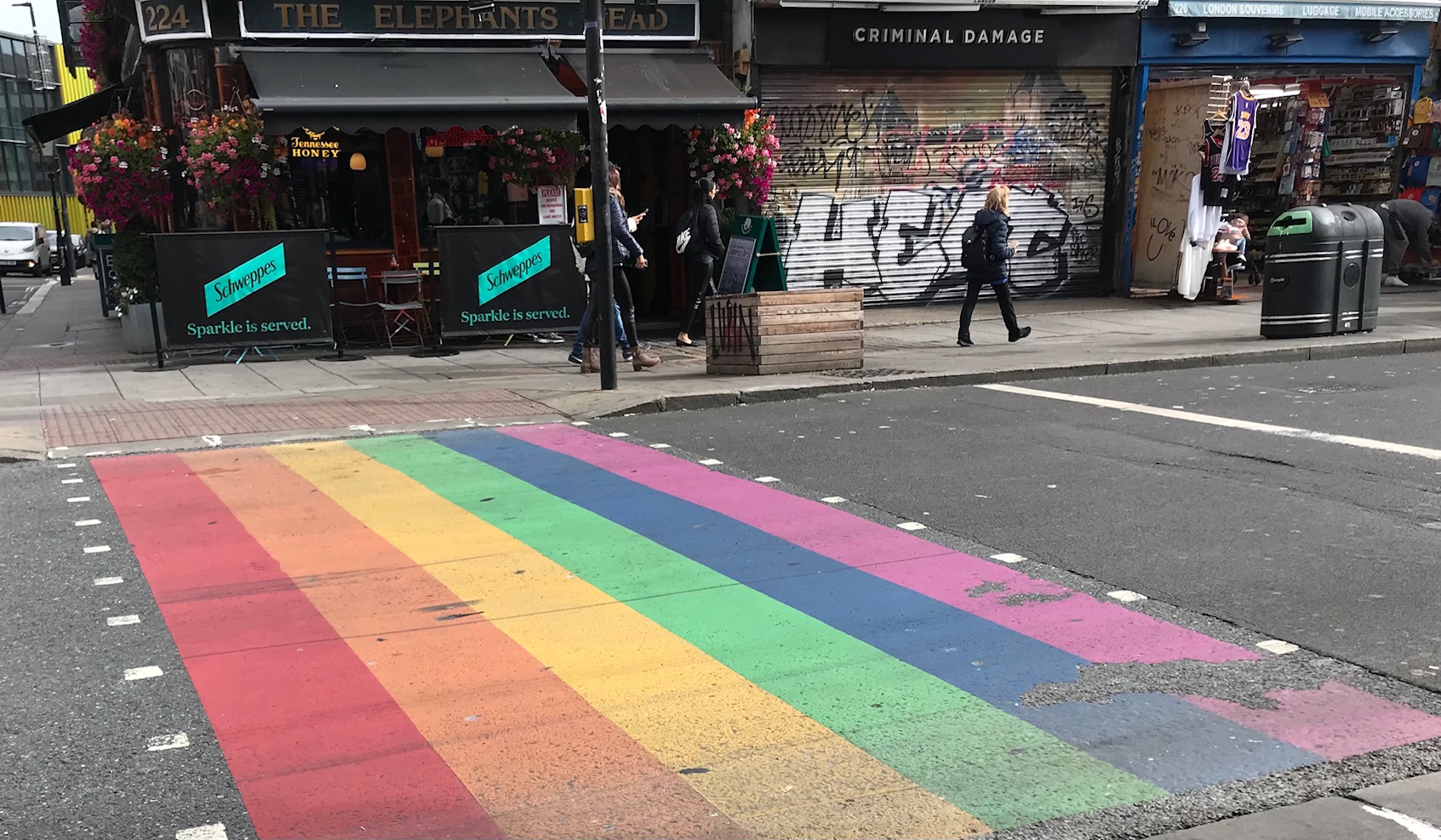
Irrelevant photo: A pedestrian crossing in Camden, London.

But that’s not what the expert addressed. In the US, he explained–and this comes in the form of an indirect quote from the Metro–“close protection officers are more ‘trigger happy’ . . . but the ‘risk is too high’ in the UK.”

In other words, you might be able to run around shooting people at royal funerals in the US (assuming, of course, that you can find a royal funeral), but you can’t do that in Britain. 

No one seems to have asked how long it would take security guys in any country to break their real arms loose if they did need to get trigger happy, but before I’m going to get on board for this one I need an answer. 

But let’s move on

Do you ever wonder why so many conspiracy theories are on the loose lately? It’s a desperate effort to make sense of a  world that’s falling apart. 

That’s not meant as a joke.

So what’s the British government doing to hold it all together? Well, we have a brand new government, cobbled together by the Conservative Party, which still has a hefty majority in Parliament. Already, though, the shine’s coming off it. It–this is the government we’re talking about in case you’ve lost track–announced a new mini-budget that, in the face of a population increasingly desperate about inflation, promised a tax cut for the richest eighteenth of a percent of the population. It would fund that by borrowing money that it would pay back when pigs fly in formation past the Houses of Parliament waving lion-and-unicorn banners and singing “The Marseillaise.”

Why “The Marseillaise”? Irony, that’s why. Their long and less than happy relationship with humans has led pigs to develop a sharp sense of irony.

The pound promptly tanked. That’s the vote that really matters, so the political world came to a rolling boil. MPs in the government’s own party publicly attacked the idea, attacked the prime minister, attacked the chancellor, and attacked Larry the Cat, who in fairness isn’t even in the cabinet. 

Cabinet ministers accused MPs of staging a coup. 

Larry the Cat accused the government of being stingy with the cat treats.

The prime minister said she wouldn’t back down. 

The prime minister repeated that she wouldn’t back down.

The prime minister backed down, but only on the most controversial tax cut, not on other problematic parts of the budget, which I’ll skip over. Come on, do I look like a newspaper? When the details overwhelm the humor, I have to move on.

The prime minister won’t rule out reinstating the tax cut. 

Larry the Cat upchucked a lightly used mouse head on the steps of Number 10.

In the meantime, the government that won’t commit to increasing benefits (Americans can translate that welfare and similar programs) in line with inflation. People–and not just the poorest ones–are seriously worried about how to heat their homes, food banks are deluged, and the National Health Service is coming apart at the seams. 

And we’re hearing a lot of talk about power cuts this winter. 

*

But compassion isn’t completely missing. I recently stumbled over an expensively printed flier with advice on reducing fuel poverty. Some sponsors are in small enough print that I’m not sure if it’s only from the Cornwall Council or if it’s national as well, but hey, if I had anything to do with it I’d want my name in small print as well.

What does it advise us to do?

  • Keep warm
  • Have regular hot meals and drinks
  • Keep moving 
  • Look after yourself
  • Take care of your neighbors

Thanks, guys. I don’t know what we’d do without you.

To be fair, they also give us a handful of phone numbers to try, but I wouldn’t hold my breath about any of them solving people’s problems.

So what does the Department for Fiddling While Rome Burns say?

The government’s addressing the important stuff, though. Therese Coffey–the new health secretary who sports an accent in her first name but I can’t be bothered searching the depths of Word to find it–has taken a tough stand on the Oxford Comma. 

The what?

I’m not exactly British, so I’m not the best person to ask, but back in that big country on the other side of the Atlantic, I learned to call it a series comma. By either name, it’s the comma you either do or don’t use before the final item in a list. You know, when you write to the health secretary and say either, “I find your advice odd, patronizing, and trivial,” or “I find your advice odd, patronizing [no comma, you’ll notice] and trivial.” 

C’mon, this stuff is important.

I won’t try to explain why that’s called the Oxford comma in Britain, mostly since  I don’t understand it either, but Coffey’s agin it. (She wouldn’t approve of agin either, which is why it made its way in here.) She’d no more than located her new office and hung up her coat than she told civil servants to “be positive” in their communications with her, to avoid double negatives, and to not use the Oxford comma. 

After that hit the headlines, her departmental flak-catchers jumped in and acknowledged that the memo was real but said Coffey hadn’t written it. 

“There may have been a bit of over-eagerness” in the content, he, she, they [Oxford comma ahead], or it said.

Wouldn’t it be nice if they were half as eager to shorten the lists of people waiting for medical treatment, fill the National Health Service’s job vacancies, or fix hospital roofs? But those things take money. Oxford commas? They come cheap.

Yeah, but why’d the Conservative’s get a reputation as the Nasty Party?

Gee, I don’t know. I wasn’t here when it happened, but it’s not helped by people like Daniel Grainger, chair of the Young Conservative Network, who arrived in Birmingham for the party convention and tweeted that it was “a dump.” 

He’s stepped down pending an investigation, although that may be over a different tweet–one that, sadly, hasn’t hit the headlines.

How’d the party conference go?

Well, a recent study reports that dogs can sniff out whether people are stressed. I haven’t read that the conference center was surrounded by stress-trained canines, but then I haven’t read that it wasn’t. And for all I know, those hands really were fake. Can you prove they weren’t?

Can we go back to economics, please?

Sure. The Ig Nobel Economics Prize went to Alessandro Pluchino and his colleagues for a mathematical explanation of why success so often goes not to the most talented people but to the luckiest. 

Irrelevantly but irresistibly, the prize for medicine went to Marcin Jasiński and colleagues for showing that patients treated with cryotherapy–a form of chemotherapy that dries out the mouth, gums, and tongue–have fewer harmful side effects when ice cream replaces the ice chips they usually suck on.

They used Ben and Jerry’s, although I expect the improvement would carry over to other brands. 

How no-confidence votes work in Britain

Boris Johnson, Britain’s alleged prime minister, survived a vote of no confidence this week, and we could get all mopey about that if we wanted to, but instead let’s take the opportunity to have a good old crawl around the dusty corners of the British political system and see what we can find. Old coins? Abandoned rulebooks? Spiders? 

Nope, sorry. We find the no-confidence vote, in all its convoluted glory.


What is the no-confidence vote? 

The one Johnson just survived was an internal party affair, run by the Conservatives, the party with a majority in the House of Commons. That’s because what they’re voting on isn’t just the leader of the country but the leader of their party, and what takes precedence is the party, since–as should be clear to everyone–that’s more important. So it was only Conservative members of parliament who got to vote.

The same was true last time they held a no-confidence vote, back when Theresa May was prime minister. We could go back further, but I’m getting full of cobwebs so let’s head off in another direction. 

Screamingly irrelevant photo: a peony

While Conservative MPs cast their votes, the rest of the country got to sit back and wonder how many would vote which way. It’s like catching the clowns crawl out of that tiny car at the circus and wondering how many more there’ll be. Except the clowns are running the country.   

If it strikes you as odd that a single party gets to choose the head of the country, we’re nowhere near the center of the issue yet. The party also gets to set the rules on when and whether there’ll be a vote and how it’ll be run.

Yes, this business of having an unwritten constitution’s a barrel of laughs. I recommend it to any country that feels like the fun’s gone out of politics. 


The rules

Under the party’s current rules, if 15% of the Conservative MPs send a letter of no confidence in the prime minister to something called the 1922 Committee, then the committee has to call a vote.

At least I think it has to. What I’ve read goes a little hazy there. Maybe they have to and maybe they don’t but always have. So far, they’ve always called a vote.

The 1922 Committee, by the way, is called that because it was set up in 1923.

We’ll move on before we get upset, okay?

The committee’s an arm of the Conservative Party in the House of Commons and seems to insert its nearly-hundred-year-old hand into every Conservative leadership battle. It meets weekly, gathering up the backbench Conservatives–and by backbench I mean the MPs who don’t hold government positions, the ones down the food chain who aren’t personally in power even when their party is.

So the committee gathers the backbench Tories (Tory means Conservative but takes less time to type) and gives them a forum, allowing them to “air their concerns” and be a pain in the keyhole of Number 10 Downing Street, where the people who really have the power both govern and (since we’re talking about the current bunch), drink, fight, party, and vomit. 

To repeat myself, since I’ve wandered: Once the committee collects the letters from 15% of the Conservative MPs, it calls for a vote. Given the current breakdown of the House, it took 54 letters to trigger a vote. Once that happens, a prime minister then has to win a majority of the Conservative MPs plus one–in the current situation, 180–to stay in office.

The letters can be anonymous or the writers can make them public. They can also withdraw them if a) they decide the timing’s wrong, b) they were threatened thoroughly enough, or c) they were offered a juicy government post. 

Government posts? Johnson had already handed out 173 government jobs, making his MPs everything from members of the Cabinet to junior ministers to dog wranglers to extras who don’t have any lines but do hang around the edges of the scene in costume and then hope they don’t get edited out of the final cut. 

If you happen to hold one of those jobs, you’d think two or three times before voting yourself out of it.

Johnson carried 60% of his MPs–211 votes–which was a smaller-than-expected number according to at least according to one newspaper.

The party’s rules say that, having survived the vote, a prime minister is safe from another challenge for a year.

So is he in the clear? Well, no. The last time the Conservatives held a no-confidence vote, Theresa May was the prime minister and she scraped together a larger proportion of her party than Johnson has, but within eight months she was out on her ass.

How’d that work? Well, the committee threatened to change the rules and allow another vote before the year was up unless she set a date for her resignation. 

Better to jump than be pushed, she figured. Johnson, however, will need to not only be pushed, he’ll need to be wrapped in canvas, tied, and thrown overboard.

But there’s talk that the MPs who voted against Johnson may not wait for that. If they refuse to vote with the government–not necessarily voting against it but abstaining–they’ll deny Johnson hte powerful majority he’s had in Parliament, paralyzing him. Since they represent all the available wings, feet, and claws of the party and refer to themselves as a coalition of chaos, it’s hard to know if they’ll do anything that coordinated.


What happens when a prime minister loses a no-confidence vote?

They limp on as prime minister until they’re replaced, because the country has to have a prime minister, however vague and ineffective. Meanwhile, the party that tossed them out selects a new one–according to its own rules.

But that’s if it has a majority. If it doesn’t–say if two parties governed as a coalition–or if the party’s so badly split that it can’t come up with a candidate, it gets messy.

You thought it was already messy? Ha. Shows what you know.

I’ll simplify this, but basically if someone–anyone–can gather enough support for a new candidate, there’s a confidence vote held in 14 days. If they survive that, they’re the prime minister. If not, there’s a general election and all the MPs have to run for their seats again–something they very much don’t want to do unless, of course, they think their party can come back with a big majority, but that’s always a gamble. It’s hard to make predictions, especially about the future, as Yogi Berra is said to have said.

If no candidate emerges, then somewhere along the way the prime minister has to advise the queen that there’ll be an election, because the queen needs to know stuff like that.

The queen says, “Oh.”

Then everyone involved tears off their clothes and runs around Westminster Palace playing either banjos or tubas and throwing confetti.

Okay, I made some of that up. If you want a full (and sane) explanation of how it works, go look at the BBC’s graphic.


How other parties run a no-confidence vote

So far, I’ve only talked about how the Conservative Party holds a no-confidence vote, but since each party sets its own rules, they have no bearing on what other parties do in a similar situation. So let’s take a wider look.

Labour: Okay, this is awkward. I haven’t found a clear explanation of how the Labour Party holds a no-confidence vote. Possibly because it doesn’t really hold them. When Jeremy Corbyn led the party (which was the opposition then, not the government), his fellow MPs held a no-confidence vote but he didn’t resign since the party doesn’t have any rules governing what that meant or what to do about it if it should happen. He argued that his support among the members outweighed his lack of support among MPs. And you know what? Why shouldn’t it? When your party doesn’t have any relevant rules, it doesn’t have any relevant rules.

Liberal Democrats: I couldn’t even find that much for the Lib Dems. 

Other Parties: I gave up, leaving a few parties floating free.

What does it all mean? I haven’t a clue. A party being able to dump its leader, as the Tories can, sounds democratic but in practice it seems to give a lot of power to small groups within the party, such as the extreme Brexiteers. If that’s true, you could argue that the forms of democracy are giving a great deal of power to a minority at the expense of the majority, but I’m raising that as a question rather than offering it as an analysis. 


Parliamentary votes of no confidence

It’s also possible for parliament as a whole, not just the majority party, to hold a no-confidence vote, and if the government loses, that would, once upon a time, have triggered a general election. But the rules changed when David Cameron was the prime minister. He introduced a new system called-fixed term parliaments. Since then, nobody has a clue what happens. 

As the House of Commons Library explains it, “The consequences of a government losing what would have been considered a question of confidence before the Fixed-term Parliaments Act have not been tested since the Act was passed.”

In other words, it hasn’t happened since the rules changed. Maybe everyone moves one seat down the table and cries, “No room, no room.” Maybe we go back to the scenario with the confetti and the musical instruments. We’ll all just have to wait and see. 

Remember what I said about how much fun an unwritten constitution is?


The important stuff

Can we get to the stuff that really matters now? Sooner or later, Boris Johnson will be carried out of Number 10 kicking and screaming and wrapped in canvas, and the question on everyone’s mind is, What will happen to the wallpaper? 

What wallpaper? The horrible and very expensive wallpaper that Johnson and his wife paid for, but only after they were caught trying to have a major party donor pay for it.

I’m not prone to imagining myself in public office, for oh so many reasons, but I can’t help putting myself into  his successor’s comfortable slippers–you know, the ones she or he puts on after work when he or she tries to turn back into her or his real self if (could we use the plural here, please?) if they still remember who that is.

Where were we? I was putting myself in that person’s slippers and  looking at the wallpaper that Johnson will leave behind (but only because you can’t take it with you). On the one hand, it was ruinously expensive–£840 a roll. You can’t just tear that down, can you? On the other hand, it’s awful. Who could live with it? And what sort of impression does it give other heads of state? You couldn’t have a serious conversation in front of it. I’m not sure you could eat a frozen pizza in front of it either.

I’m not sure what you can do in front of it other than run.

Is the next prime minister going to have to break with tradition and live somewhere else? I wouldn’t rule it out.

By now, of course, you want to see it. You’ll find a couple of photos here, along with a discussion of the money and who’s related to who in what way. It’s all deliciously scandalous and, except for the occasional wallpaper joke, has been pretty much forgotten by now.

British prime minister fires British prime minister’s brain

On Friday, Boris Johnson fired Dominic Cummings, who’s functioned as Johnson’s brain since Johnson took office. This leaves a major gap not just at 10 Downing Street but between the prime ministerial ears, since we’re doing body metaphors.

Everyone in government will be rushing to fill it. 

This all started with Cummings’ ally, Lee Cain, resigning. Johnson had been about to promote him but seems to have been shoved onto a different track by Allegra Stratton and Johnson’s partner, Carrie Symonds, a woman with a considerable political background of her own. 

They had some help, and we’ll come back to that, but first: Stratton got into the picture when she was appointed to lead government press conferences and came into conflict with Cummings and Cain over whether they should be real press conferences or what they’re calling White House-style briefings, where no real questions are answered. She considered the White House-style briefing cosmetic and pointless.

Potentially relevant photo: Cummings and Cain will have plenty of time on their hands. They could take up a fine old English tradition and join a morris dancing side. You don’t actually get to hit anyone with the stick, which I suspect will disappoint them, but you do at least get to pretend.

Symonds’ influence raises an interesting issue. She’s not an elected member of government, which makes it easy to rear back and think, Hold on. Who the hell is she to have so much influence just because she’s in a relationship with the prime minister? And some of the cheesier papers are doing that. What the hell, she has no job title and she’s a woman. Women make a tempting target. 

One the other hand, Cummings and Cain weren’t elected either. Who the hell were they to have so much influence? We could argue that Symonds is saving the country a lot of money by not drawing a salary. Or we could skip making that argument. My point is that we can’t draw a clear line between Johnson’s special advisors and his fiancee. It’s murky–and interesting–territory, full of  moral ambiguities.

Johnson is said to  have been furious that Cummings and Cain were briefing against him and Symonds. “Briefing against” translates to undermining their reputation.

Assorted other personalities and factions within the government and in the Conservative Party also got into the push-and-shove over who was going to have the prime ministerial ear. Factions seem to be the latest thing in the Conservative Party–something I’d thought only Labour was good at. Backbenchers–

Hang on. Time for a definition. Backbenchers are Members of Parliament who haven’t gotten the top government jobs (or the shadow jobs that the opposition party hands out). They sit at the back of the room when parliament meets, playing with their phones and throwing spitballs. Every so often, they get to jeer the opposing party, which has the virtue of waking everybody up, but otherwise they’re supposed to vote as instructed and shut up (or say what’s expected) the rest of the time. 

They don’t actually throw spitballs. They do jeer and carry on as if their development stopped at spitball-throwing age.

With the explanation out of the way, we’ll go on: Backbench Conservatives have been forming pressure groups. It worked for Brexit, they figure, so why not start groups opposing Covid lockdowns or accusing the National Trust of having a Marxist agenda because it’s acknowledging that role of slavery in creating the properties it manages and opens to the public?

Cummings and Covid are taking the blame for Johnson not having kept good relations with his party’s MPs. As one backbencher said, new MPs never got a chance to know Johnson and “they have spiralled off into orbit, and if the party isn’t careful, they will become serial rebels, never to be seen again.” 

With Cummings going, some of them are hoping for a fresh start, but a former staff member said, “The contempt for MPs does not come from Dominic Cummings, he’s just a harder version of the smiling frontman. The basic contempt comes from Boris Johnson.” 

What happens next? Don’t I wish I knew. Cummings and Cain are old political pals of Johnson’s from the Brexit campaign, and they formed the hub of the hard Brexiteers in Number 10. With them gone and Brexit looming, it’s hard to say which way things will go. Britain’s still in talks with the European Union and there isn’t much time left to put together a deal before we leave the EU without one.

The same staff member I quoted a couple of paragraphs back said about Johnson, “This is a guy who gets blown around by whatever storm; he has no political compass.” And advisors–presumably Cain and Cummings–had complained about Johnson not being able to make big decisions. 

That makes it particularly important who’s getting to whisper in his ear.

Whee.

And did I mention anything a pandemic? Somewhere in here, some actual work needs to be done. 

Whoever’s left at Number 10 is expecting Cummings to take public revenge and is–or possibly are; surely there’s more than one–preparing responses. One official was quoted as saying, “It’s the last days of Rome in there.” 

I’m’ sure the most interesting dirt hasn’t been dished yet. Have patience, my friends. It will leak out eventually.

Feeding hungry kids: the English public strikes back

After the government voted to deny £15 vouchers to low income families in England so that their kids wouldn’t go hungry during the school holidays, a local pub banned the chancellor, Rishi Sunak, from its premises.

For life.

It did the same to three other local MPs who voted against the vouchers with him.  Pubs can do that here, but they usually reserve it for the kind of customer who sets off fireworks on the bar or pulls the plumbing out of the men’s room. But I guess it’s a question of who does more damage in the long run.

The ban was posted on the pub’s Facebook page, which also reproduced a menu from one of the House of Commons’ many restaurants, where steak and chips are going for £11.77–a price subsidized by the taxpayer.

Don’t usually do politics but here goes,” the Facebook page said. “I have never known a Government which is consistently the wrong end of every argument.”

*

Irrelevant photo: The Cornish coastline.

In tweeting about against the vouchers, Conservative MP Ben Bradley wrote, “At one school in Mansfield 75% of kids have a social worker, 25% of parents are illiterate. Their estate is the centre of the area’s crime.

“One kid lives in a crack den, another in a brothel. These are the kids that most need our help, extending FSM doesn’t reach these kids.”

FSM being free school meals. This is shorthand for the voucher program. Which is also shorthand.

Don’t worry about it.

When he started catching flak for that and a few other tweets, he complained that they’d been taken out of context. I’m still trying to figure out how to squeeze any context at all into 280 characters. Short of writing in Japanese, Chinese, or Korean, where a single character can be a whole word. 

*

In the meantime, players from Leeds United donated £25,000 for kids’ meals over the school break, and the club they play for has announced that it will match that.  

Businesses, restaurants, and local governments (including at least a few led by the Conservative Party–the party that voted against the £15 vouchers) have also stepped up with offers to help, and Conservatives are beginning to say that the government misjudged the feelings of the country. Not that kids need to eat and they want to do the right thing, but that people are mad at them.

They don’t even know how to say, “Ooops,” right.

All of it goes a good distance toward restoring my battered faith in humanity, but it’s worth remembering that whether kids get fed will depend on where they live. In some places there’ll be multiple offers and in others there’ll be none.

*

This morning, I listened to Matt Hancock, the secretary of state for health and social care, interviewed on the radio. I was driving and it was him or nothing. We eventually realized that nothing was much better, but before we did I was interested to hear that he’s not singing Ben Bradley’s tune. I doubt even Ben Bradley’s singing Ben Bradley’s tune anymore. It didn’t go over well. What he said was that of course the government’s making sure every child gets fed, but local governments are better at that than central government and we’ve given them money for it.

But, the interviewer said, that was way back when and it was spent long ago.

We’ve given them money, he said in seventeen different ways.

It’s an approach I’ve heard a lot in the last few years. Ask a government minister why the NHS / social care / the schools / fill in the blank is so short of money and they’ll tell you how much money they already spent on the NHS / social care / the schools / fill in the blank. It doesn’t answer the question, and sometimes they’re talking about money that was allocated before William the Conqueror’s boat first touched England’s southern shores, but it sounds like an answer and can usually be counted on to derail the conversation.

*

Since as a nation we’re not handing low-income parents £15 to waste on feeding their kids, let’s review another spending program. No one tweeted that the £12.7 billion program to help the self-employed through the pandemic was pouring spaghetti sauce into crack dens, but a study from the Resolution Foundation says it gave £1.3 billion to workers who hadn’t lost any income while successfully missing 500,000 who did. The study blames a combination of strict eligibility rules and weak assessment. Basically, they excluded lots of categories of the self-employed and then didn’t ask people in the categories they accepted to document their losses. 

The  study also said that the self-employed were hit even harder in the first six months of the pandemic than employees were. Three out of ten stopped working during the worst of the crisis, and one in six is still out of work. 

About 5 million people count as self-employed in Britain, although some of them, inevitably, will be the mythically self-employed. It pays for corporations to offload the expenses of employing people by calling them freelancers, and people are desperate enough to accept that.

Do you remember when life was going to get endlessly better? 

*

The lockdown in Wales is tighter than England’s, and it’s closed shops that sell nonessential goods, which has had the odd consequence of restricting supermarket sales of the same items. They’ve had to have had to cover shelves to hide the socks, the decorative hair thingies, the–

Actually, it’s hard to decide where to draw the line. The cake decorations? They’re edible, so maybe they can stay. The birthday candles? Non-edible but on the same shelves as the cake decorations. The mugs that say, “You’re the best”? The ones that say, “I changed my mind. You’re a cockwomble”?

Let’s turn to the experts: Nonessentials include electrical goods, telephones, clothes, toys and games, garden products, and homewares, and the decision on individual items depends on what part of the supermarket they’re in rather than their inherent essentialness. So forget the cups, but you can probably buy birthday candles.

Supplies for the “essential upkeep, maintenance and functioning of the household,” such as batteries, light bulbs, and rubber gloves, are okay. Because who could function without rubber gloves?

It’s easy to make fun of, and I’m having a hard time holding myself back, but there is a logic to it. To slow the virus, you need to shut down everything you can, but they don’t want to hand supermarkets the business they’ve denied to small shops. Yes, it’s crazy. And yes, it makes sense anyway.

*

While we’re talking about the odd places that rules lead us into, England’s rule of six limits gatherings–indoor, outdoor, underground, and hallucinated–to six people unless they’re all from a single household (it’s slightly more complicated than that, but close enough for our purposes). But some of London’s fancier restaurants have discovered that if people are talking business they can gather in groups of thirty.

Wheee. Take your foot off the brake and don’t be such a scaredy cat. 

One of the restaurants emailed its client list to let them know that “when the topic is business you can still meet over a fabulous working lunch or dinner without the restriction of the ‘single household rule.’ ” 

You will, however, need to employ at least one overcooked adjective and a full set of quotation marks, however unnecessary and aesthetically offensive they may be. 

At one expensive restaurant, the Sexy Fish, caviar sushi sells for £42 a piece, and you can buy a £16,000 Armand de Brignac champagne if you really need to. The reporter who scouted the place and asked diners if they were discussing business got himself thrown out. Which was lucky, because I doubt the Guardian’s budget stretches as far as the sushi, never mind the champagne.