Messing with British Baking: Chocolate Chip Cookies

Since moving to Cornwall, I’ve made it my mission in life to mess with the Britishness of British baking. Not because British baking is bad. It isn’t; it’s fantastic. Have you eaten shortbread? Or scones? Or pain au chocolat? Or—wait a minute, that last one’s French, isn’t it? (And in case you’re not familiar with the stuff, it’s not pronounced like the English word pain, it’s closer to pan, and it’s basically a croissant with chocolate inside. Mmmm.)

So okay, we’re not talking about a tradition that goes back, unmixed and unmessed-with, to Alfred the Intolerable. British cooking has done what pretty much every culture does: it’s adapted, stolen, borrowed, and claimed as its own whatever bits happened to work—so much so that now people ask, with an almost straight face, “What’s more English than curry?”

How am I carrying out my mission? I’m baking, and I’m feeding my friends and neighbors. It all sounds so harmless, doesn’t it?

Irrelevant Photo: Fountains Abbey

Irrelevant Photo: Fountains Abbey

So here’s my recipe for chocolate chip cookies, because chocolate chip cookies are even more American than Mom and apple pie. They’re probably more American than the flag. The recipe’s in imperial measures. (Shouldn’t we start calling them American measures, by the way? The empire’s gone and—does any country other than the U.S. still use them these days?  And I’m not sure how many people know what imperial measures means.) But back to my point, I’m not going to try translating it into anything sensible like the metric system because the last time I did lost three weeks of my life and didn’t get it right anyway. So forget it. Besides, what’s more American than an irrational and antiquated system of measuring that we inherited from a country that’s since abandoned it and which we will fight to the death rather than give up?

Am I off the topic yet?

The recipe was adapted from one my friend J. found in the Duluth, Minnesota, News Tribune. The introduction explained that the more sugar a cookie has, the more it spreads out in the oven. The original minimized the sugar, which suited me because my chocolate chip cookies had been turning into chocolate chip wafers and I like a thick cookie. I’ve cut the sugar back even further and substituted oatmeal for some of the flour. If that sounds healthy, don’t kid yourself, they’re lethal, but you can increase the sugar if you like. I’ve left the amount a bit vague (a scant ¼ cup, in one place) for exactly that reason. Not to mention because I’m exactly that sort of cook—a bit vague, probably even a bit scant.

If you want the cookies to turn out well (and why would you make them if you didn’t?), you have to find really good dark chocolate—preferably chocolate chips. In the U.S., that means semi-sweet—none of that milk chocolate mess. In the U.K., I’ve had a battle to find good chocolate chips. For years, all I could find were brown waxy things that tasted like buttons that had popped off an old-fashioned shoe. If that’s all you can find, don’t buy them. Chop up chocolate bars (I’ve used 70% chocolate) with the back of a knife and make chocolate chunk cookies, but chunks of chocolate bars don’t keep their shape the way chips do. They’re good but not the same. For some time now, friends have kept us supplied with American chocolate chips, which is a real luxury, especially when you look at the cost of postage, but recently I’ve discovered that Dr. Oetker’s make decent chocolate chips, even if they come in itty bitty bags and are overpriced. In the U.S., you can buy chocolate chips in industrial-size bags. We’re seriously serious about chocolate chips.

If you’re in other countries, I have no chocolate chip advice to offer, but I do know this: If you open the bag and taste them and they don’t taste like much, they won’t get any better when you stir them into the batter and bake them.

The recipe makes an insane number of cookies. (I did warn you that, as a cook, I’m a bit vague.) I freeze whatever we don’t eat on the first day and take them out when we have company. They’re good frozen. Maybe even better. Honest. I discovered this the time I hid them from myself and—surprise surprise—found them. And ate them on the spot.


Chocolate Chip Cookies                               

1 c. whole wheat flour

2 1/3 c. plain white flour

1 ½ c. rolled oats (any thickness will do)

2 tsp. baking soda (that’s bicarbonate of soda)

2 tsp. salt

12 oz. (that’s 3 sticks if you’re American) butter

Scant 2/3 c. brown sugar

Scant ¼ c. white sugar

4 eggs

2 tsp. vanilla

Lots of dark chocolate chips  (about 2 ½ c.)


Cream the butter and sugars. Beat in the eggs, one at a time, and the vanilla. Mix in the dry ingredients, then the chocolate chips. Drop spoonfuls onto greased cookie sheets, leaving some room for them to spread out.

Bake 9 – 11 minutes at 375 F.,  or 185 c., or 165 c. with a fan oven.

Cool 2 minutes or more on baking sheets before removing.
True Lemon Drizzle Escapes the Comments Box

Belladona Took sent a link to a traditional lemon drizzle cake recipe, and it deserves to be let free of the comments box so anyone who reads only the posts can find it. It uses plain flour, so it should translate reasonably well to any country. Judging from the comments on the recipe I published, no two readers share any single measuring preference, so I’ll warn you that it’s measured in cups and so forth and let you decide in the privacy of your own kitchen whether it makes sense to follow the link.

In case it changes any minds, 4 cups of flour equals a pound, so you can still weigh it.

http://www.epicurious.com/recipes/food/views/Lindas-Lemon-Drizzle-Cake-51159200

Enjoy. Or run like hell. It’s up to you. Thanks, Belladona.

Autumn in Cornwall

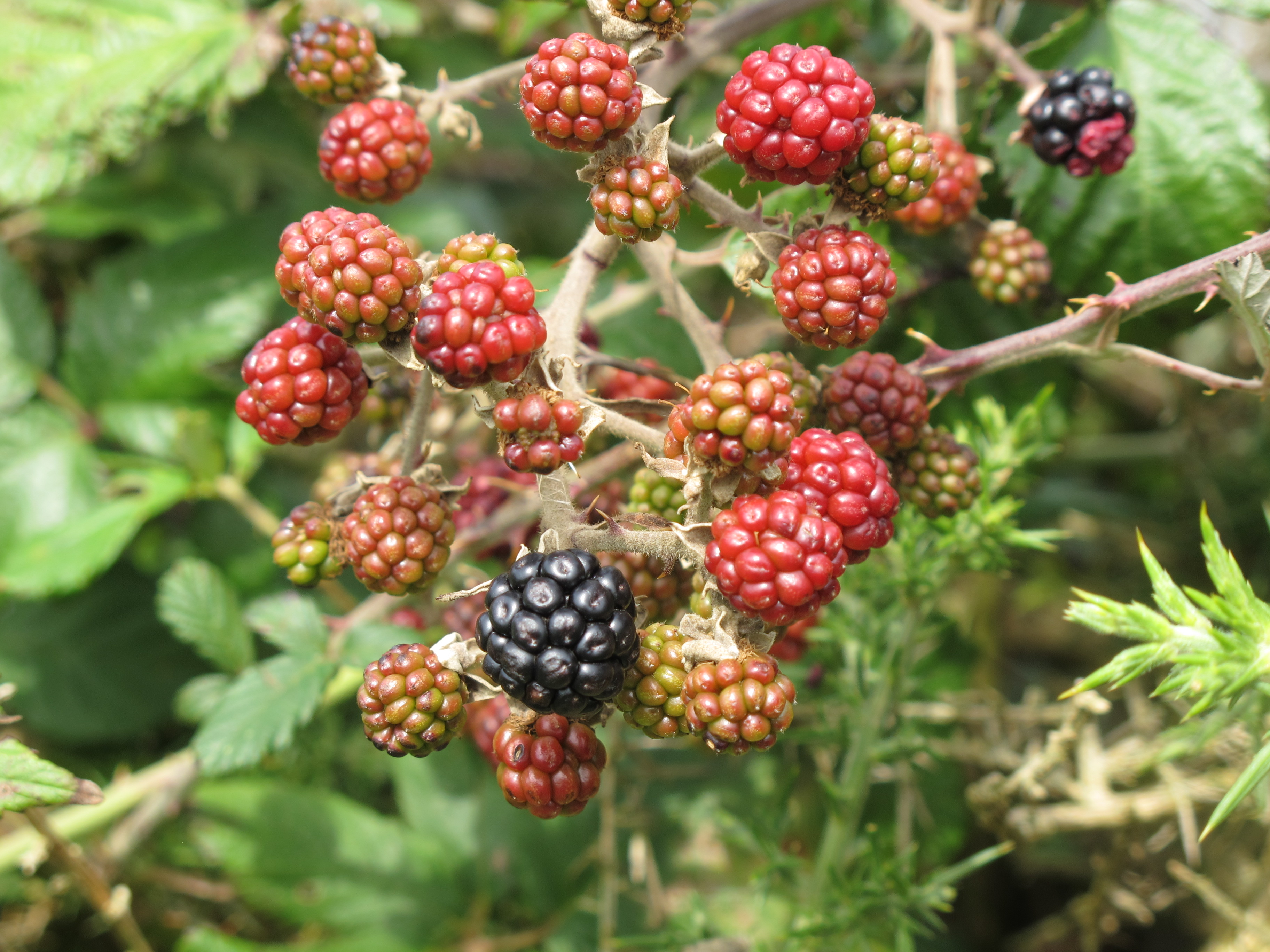
Irrelevant Photo: Wild Blackberries Ripening in the Hedge

How to Bake a Scone

I can’t keep writing about life in Cornwall without posting a scone recipe. And not just any scone recipe, an English scone recipe.

You should understand that there’s no single, definitive English scone. Not only do scones divide into plain, fruit, and cheese (or savory, which is spelled savoury), but any one of those three will vary. You can also find griddle scones and drop scones. They’re like the brownie that way. Or religion. Lots of variations; lots of recipes; lots of people damning each other to hell for doing it wrong. You’ll also find regional variations. I could be wrong about this, but I believe scones get larger as they go north. It may have to do with the weather, or the longer O in the northern accents.

Some recipes include eggs, which is any right-living person would tell you is heresy, so this one doesn’t. I have no idea where I found it, or how much I’ve tinkered with it over the years. Whoever developed it, I’d give you credit if I could. All I can give instead is my apologies, and my thanks, because it makes a damned good scone.

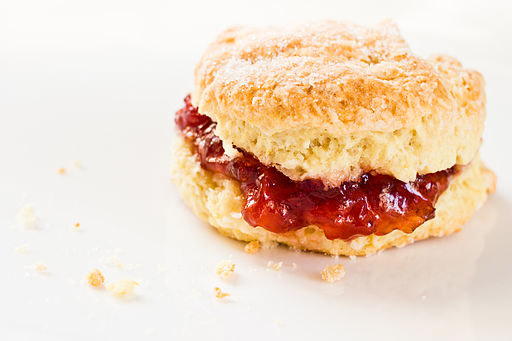
Scone with jam. Photo by Benson Kua, and it's from Canada, not the U.K.

Scone with jam. Photo by Benson Kua, and it’s from Canada, not the U.K.

Scones: Makes 5 or 6

1 ½ cups flour, unsifted (see below)
1 Tbsp. cold butter
1 Tbsp. sugar
½ tsp. baking soda
1 tsp. cream of tartar
½ tsp. salt
[raisins if you want them]
Enough milk to pull the ingredients into a ball

Sift the dry ingredients. (I was taught to sift flour before measuring, transfer it grain by grain into the measuring cup, then sift it again after measuring, but I can’t be bothered. Half the time I can’t be bothered sifting it at all, I just mix the dry ingredients together. If we’re talking about kitchen heresies, this is a big one, but my baking comes out fine, thanks. Just don’t whack your measuring cup down on the counter to make the flour settle, because it will and you’ll end up with too much.) Cut in the butter. (You want to keep the butter cold, which will keep the scone from being heavy, so if you can cut it with a pastry blender, do. If you use your fingers to crumble it into the dry ingredients, handle it as little as possible.) If you want raisins, this is the time to add them. Stir in just enough milk to form the dough into a ball. Roll out to about ¾” thick on a floured surface and cut with a biscuit cutter or, if you don’t have one, the rim of a glass. If you twist your cutter, the scones won’t rise evenly. If your scones don’t rise evenly, it won’t make the least bit of difference, so don’t lose sleep over this. Place the scones on a greased cookie sheet and bake 12 to 15 minutes at 400 degrees. (To make sure they’re done, take the cookie sheet out of the oven, pry one open partway, and peek inside. If it’s gooey, put the cookie sheet back in for a couple of minutes.) Eat with butter—lots of butter—or jam, or both. They’re fine cold, but they’re better hot.

This is the real thing.

English Food: Cheese

The last time I wrote about English food, it was to make fun of baked beans. So let’s talk about a good part of English food: The English are known for their cheese, and justifiably. Cheddar takes as much space in the cheese aisle as baked beans do in the canned vegetable, only it tastes good. And it’s not just connoisseurs and food snobs who go in for the strong stuff, it’s normal people—kids, adults, people who eat baked beans on toast. Cheese turns up in soups, in sauces, on baked potatoes. Okay, everything turns up in baked potatoes, but still. If a store only sells one vegetarian sandwich, it’ll be cheddar. And it’ll be grated, not sliced.

English Blue Stilton. Photo by Dominik Hundhammer

English Blue Stilton. Photo by Dominik Hundhammer

Every year, at Cooper’s Hill in Gloucester, people race—or slide, or roll—down an insanely steep hill chasing a wheel of double Gloucester cheese. The winner gets to keep the cheese. And a generous portion of mud. The race’s official site says of the 2013 race:

“Due to warnings from the police … a substitute, plastic cheese was used this year, so a real cheese was not in fact rolled*.

“This did not seem to matter to either contestants or spectators, but it was a failure as it just did not have the weight to roll properly! In the ladies race, one lady (not the winner) picked it up and carried it down to the finish line.”

“*Upon careful analysis of the movement of the cheese in the videos of the events, it appears that the “cheese” in the first event was significantly heavier than the ones used in subsequent races, it was the only “fast cheese” of the day, it also bounced a lot higher. There is a strong suspicion that this was a ‘real Cheese,’ the ones in the remaining races were made of foam plastic and were much slower, in most cases being passed by the contestants.”

The only injuries that year were a dislocated shoulder and a broken leg. It took more than two hours to get the guy with the broken leg off the hill, with the rescuers walking backward and held back by ropes. It’s that steep. But, hey, the prize is a cheese, right?

One winner said publicly that she didn’t like cheese and was going to offer her prize on E-bay. The bids didn’t come up to reserve price and I hope she learned to love the stuff, because she was the proud owner of an eight-pound wheel of the stuff.

English Cooking: Baked Beans

English Cooking: Baked Beans

The English aren’t known for their cooking. Or they are, but not in a complimentary way. And I’ll admit they have some odd habits, one of which is eating baked beans on toast. But who am I to criticize? I grew up begging my mother to buy a kind of white bread that I could, and did, squish down to the size of a packing peanut. Which hadn’t been invented yet, but I was ahead of my time. And yes, I did eat it. She’d never have bought it again if all I did was squish it. And I’d have sworn it was good, so I know first-hand that there’s no accounting for taste.

Still, it throws me to see an adult sit down to a plate of baked beans on toast and, with every sign of pleasure, eat it.

Beans on Toast. Really.

Beans on Toast. Really.

But that’s not all that happens with baked beans around here. You can buy a baked potato topped with baked beans. (Or with cheese, or cole slaw, or curry, or roast vegetables, or shrimp, which are mostly called prawns unless they’re small, even for shrimp. And the potatoes are called jacket potatoes.) A full English breakfast includes baked beans, not to mention a grilled tomato. A single can of baked beans includes enough salt and sugar to cover Wales to a depth of half an inch. In spite of which, people eat baked beans in industrial quantities and live to ask for more, and why not? They’re full of fiber, which for all I know mops up the salt. Half the canned vegetable aisle is taken up with baked beans. I’m sure there are all sorts of subtle differences among the brands, but I’ll only do just so much in the name of research, and tasting them lies on the far side of an extremely thick dividing line.