Cambridge University and the women suspected of evil

Let me take you back to the good old days, when men were men, kings were kings, and things weren’t at all the way we imagine. Those manly men of the court? They wore ruffs and earrings. And the king in question was a queen. 

Shall we start over? Back in the days when Elizabeth I was on the throne, she granted a charter to Cambridge University that allowed it to arrest and imprison any woman  “suspected of evil.” I don’t know what happened behind the scenes to bring that about, but if she’d set out to prove that a woman wielding power doesn’t necessarily improve life for all women, she did a pretty fair job of it.

irrelevant photo: Men-an-Tol, in Cornwall.It’s from the Bronze Age and your guess is as good as mine what it was for.


What kind of evil did she have in mind?

Do you need to ask? Sexual evil, of course. 

The university was a perfect set-up for out-of-bounds sexuality. Until the 1880s, its dons (translation: the men–and they were all men–who taught there) weren’t allowed to marry. That meant they weren’t allowed to have socially (and university-) approved sex. With anyone–presumably including their own lonely selves. 

Admittedly, there’s always a massive gap between the rules and real life, but Cambridge was an all-encompasing institution whose fellows ate, drank, slept, played, prayed, and taught in one fairly limited space. They wouldn’t have expected or found much privacy. 

Into that claustrophobic container, pour half a gallon of hormonally driven adolescent males, also single. Into a series of separate containers, measure out a full gallon of parents worried that loose women would tempt and corrupt their babes. 

Now stir, being mindful to keep the parents at some distance from their offspring but close enough to press their worries on the dons and the university. 

The resulting mixture was combustible, so while both dons and undergraduates could and did keep mistresses, the university had to make gestures in the direction of protecting the undergraduates from sin, temptation, and anything else that might worry a concerned parent or a church.

In other words, it had to arrest any young woman who might represent the forces of sin and temptation, because it sure as hell wasn’t going to arrest its students. 


How Cambridge differed from the rest of the country

Under the ordinary laws of Liz’s time, a woman could only be arrested for prostitution if there was something at least vaguely resembling proof that she was, in fact, engaged in prostitution. Under its shiny new charter, though, Cambridge University didn’t have to bother with proof. Its proctors–senior members of the university–could arrest any young woman who was out of the streets after dark. And they did. 

The woman would then be tried by the vice chancellor in a private court, which required no witnesses and no witness statements. The woman had no right to legal defense and wasn’t allowed to say anything more than her name. The university could then imprison her in the Spinning House, a repurposed workhouse. It was cold and damp and the food was bread and sometimes gruel. In 1846, a 17-year-old, Elizabeth Howe, died after spending a December night on a damp bed in a cell with a broken window. She’d been arrested for walking with a friend–another woman–near a brothel, which was enough to demonstrate that she was up to no good.

A friend–possibly the same one but I’m not sure–described her as gentle and kind. The friend tried to get a doctor for her but was stopped by a proctor and threatened with arrest herself. She went home and Elizabeth died.

Women were held for two and three weeks at a time, and anyone who didn’t go along quietly when she was arrested was given a longer sentence. Once inside, anyone who raised hell was held in solitary confinement. In 1748, the vice chancellor paid the town crier 10 shillings to whip “10 unruly women.”

 There’s no way to know how many of the women held there were in fact prostitutes–surely some; prostitution was one of the few ways desperate women could make a little cash–but also surely not all. At one point, the wife and daughter of a councillor (that would be a local politician) were stopped because they’d walked ahead of him and were on the street un–ahem–chaperoned.

I’m going to assume he was able to get them released. No woman could match the power of a respectable man intervening for her, especially when he was aided by a respectable explanation and a bit of local power. Intervening for herself, though, would only get her into deeper trouble. 

Basically, any woman on the streets at night was fair game. Their crimes were listed in the committal books as “street walking” or “suspected of evil.” Over the course of the 19th century, more than 5,000 women were held there.

All this comes from a book, The Spinning House: How Cambridge University Locked up Women in Its Private Prison, by Caroline Biggs. 

“The town,” Biggs says, “was run for the benefit of the university, not the townspeople. The women in my book represent the ultimate example of how the University wanted to run things to suit themselves. They were so frightened of the undergraduates being tempted that they treated the townswomen, mainly working-class women, with great cruelty.”

Semi-relevantly, the university also controlled the sale of alcohol, the licensing of pubs, and how much credit students were allowed, although how they managed that last one is beyond me. 


Then it all fell apart

In 1825, parliament gave the university the power to maintain its own police force, nicknamed bulldogs, who patrolled the night streets alongside the proctors. They were supposed to go after women found in the company of members of the university but Biggs says they pursued any rumors–”every morsel of tittle-tattle”–about young women in Cambridge.

That situation held until 1891, when a 17-year-old, Jane Elsden, was arrested although she was alone on the street, not with a member of the university, and a few months later another 17-year-old, Daisy Hopkins, was hauled in although a man admitted he had solicited her, not the other way around. 

At this point, it all gets a little hazy–possibly not in Biggs’ book but in the articles I’ve found. Sorry–I’m not even using secondary sources but tertiary ones. Someone brought a case of habeaus corpus involving one or both of the women, which meant a judge got to rule on whether she or they were imprisoned legally and ruled that she/they wasn’t/weren’t. One or both of them was or were released.

When I looked for more information on the first woman, Jane Elsden, I found the blog of a distant relative who tells the story that’s come down through her family. It holds that Elsden and Hopkins were friends and were both prostitutes. They’d been arrested and the students they’d been with were given only a mild rebuke. Somehow Elsden escaped from the Spinning House, breaking windows in the Wesley House Chapel as she went. 

“She aroused such fierce debate that eventually the power of the University was challenged and changed.”  

Take it for what it’s worth. If you pass a story down through enough generations, it will evolve, but it will probably still carry some bits of truth. Somehow or other, the two cases caused a public uproar and after 1891 women arrested by the university were allowed legal representation. Then in 1894, parliament revoked Elizabeth’s charter and with it the vice chancellor’s right to arrest women. The Spinning House was torn down not long after that and in a sour little bit of irony a police station was built on the site.

Anne Wentworth, feminism, and the spirit of prophecy

When did feminism start in England? If you’re in the mood, you could start with Boudicca–warrior queen who took a hefty bite out of the Roman army and turned Roman towns to cinders–but let’s start with Anne Wentworth instead. She was fiery but not in as literal a way. 

Admittedly, Wentworth’s a random place to start, but so’s Boudicca. The real answer is that feminism doesn’t have any single starting point, so I’m almost playing fair here.

Anne Wentworth was born in 1629. Or 1630. Close enough since we’re too late to send a birthday card. The Romans were long gone by then and she was no warrior, but she fought the good fight. 

Even more irrelevant photo than usual: Madron Holy Well, Cornwall. The strips of cloth (and hair scrunchies, and dog bags) represent– Well, they represent whatever the people who left them there wanted them to represent: prayers, wishes, respect, anything else you can think of. I found them oddly moving.


Anne Wentworth steps out of line

Her story starts off conventionally enough: She married William Wentworth–probably a glove dealer–in her early twenties and they had a daughter. They lived in London and were (this gets less conventional) Anabaptists, a small and persecuted religious group that was a forerunner of (improbable list warning here) the Baptists, Mennonites, and Quakers. 

For eighteen years, the Wentworths lived together unhappily. Or at least Anne was unhappy. She later described herself as suffering “great oppression and sorrow of heart.” I don’t know the details, and I’d be surprised if she published them. They weren’t the point, but she did write about being “grossly abused” mentally and physically and she described William as a “scourge and lash,” so that she “lived in misery.”

That’s not the misery memoir we expect today but it was shocking at a time when women were expected to put up with whatever situation their marriages had landed them in and shut up about it.

In 1670, when their daughter was about ten, Anne had what she considered a visit from god.

As she later described it, she came down with a “hectic fever,” nearly died, and came out of the experience believing god had spared her for a reason. It was time to stop living a lie and to start–yes, folks–prophesying. And prophesy she did, which neither her church nor her husband welcomed 

The sequence of events may be clear to the experts but they’re not to me, so let’s throw any attempt at a timeline out the window. What I can piece together is this:

  • She and the church parted ways, although it’s not clear whether she walked out or was pushed.  
  • Her husband locked her out of the house and destroyed her writings,
  • in spite of which, she published four accounts of her experience, including: A True Account of Anne Wentworth’s Being Cruelly, Unjustly, and Unchristianly Dealt With by Some of Those People Called Anabaptists (1676; no one went in for understatement back then) and A Vindication of Anne Wentworth (1677).
  • Anne and her daughter hid from William for a while. 
  • A year after he pitched her out, with the help of her supporters she got back into the house and changed the locks.


Giving the church a right of rebuttal

I’m not sure what document we’re quoting here–that’s a problem when you work with secondary sources–but her church considered her a “proud, passionate, revengeful, discontented, and mad woman,” (you may have figured out by now that proud wasn’t a compliment, especially for a woman). She had “unduly published things to the prejudice and scandal of [her] husband” and had “wickedly left him.” They charged her with “rejecting and neglecting their church” and with “dissatisfying” her husband.


Gender and timing

If that doesn’t convince you that gender was an issue, I’m not sure what will, but gender doesn’t entirely account for why Wentworth’s prophecies weren’t a smash hit. Her timing was off. The high tide of prophecy had passed. After the execution of Charles I, Cromwell’s Protectorate, and the religious upheaval associated with all of that, a lot of people were nervous about inventive religions. They figured the world had received all the prophesies it needed, thanks, and everybody could just make do with what they had.

Still, if you have a visit from god–or if you’re convinced you do, anyway–you’re probably not going to say, “Couldn’t you have told me this twenty years ago?” Wentworth was sure she was living in the end times and god had chosen her as his “battleaxe,” so she did battle with her pen.

Her timing was also bad in that she predicted the would happen apocalypse before New Year’s Day 1678, even thoughtfully warning Charles II and London’s lord mayor about it. 

Then it didn’t happen, which will lose any prophet a bit of credibility, not to mention popularity, but she kept on writing and continued to have supporters–see above about the people who helped her get back into her house. 

She wouldn’t be the last prophet to get the timing wrong on the apocalypse, and probably not the first either. Let’s not hold it against her.


So what makes her a feminist?

The word didn’t exist, so she wouldn’t have considered herself one. The first recorded use is from the 19th century and it was used to mean nothing more than the state of being feminine.  

How the world has changed.

But in the face of opposition from husband and church, she claimed the right to speak and publish the truth as she saw it, and at a time when the idea that a woman shouldn’t be dominated by a man was almost unthinkable, she thought it. And went public with the thought. 

It must’ve scared the hell out of her. She wrote, “Here is a case that cannot possible be brought to an end without coming into the publick view of the World, though it is so contrary unto my nature, that I would rather suffer unto death than be in any publick way; but am constrained now, & thrust out by the mighty power of God, who overpowers me, that I must no longer confer with flesh and blood, and yield to my own reason of my weakness, foolishness, and fearful slavish nature, that am daunted with a look of any terrible, fierce, angry man.”

After that, the passage gets so religious, not to mention so 17th century, that I wandered off to feed the cats, but even if Wentworth and I pour our passion into different molds, I have to respect hers.

Was Iron Age Britain matriarchal?

No one can give us a solid answer, but we do have some hints. A group of geneticists and archeologists have analyzed a cluster of burials in Dorset and report that they show a matrilocal society. In other words, the women stayed in the village and the men moved out when they married, being replaced by men from outside, who married in. 

The tribe–the Romans called them the Durotriges; we don’t know what they called themselves–didn’t cremate their dead, which was unusual for the time and place. From around 100 BCE–more or less 150 years before the Romans invaded–they buried them in the hills around their farmsteads, leaving an important resource for archeologists.

Who cares? Pretty much everyone who was involved in the arrangement, and I can’t think why we shouldn’t as well, because it tells us a lot about the roles of the men and women. Or–hell, let’s throw out a patriarchal habit that’s so deeply ingrained it’s damn near invisible and say “the roles of the women and men.”  

Semi-relevant photo: This is Fast Eddie, who’s relevant only because we’ve been told (sort of) that women with power become childless cat ladies.
Okay, I’m stretching it, but hey, he’s a great cat and I needed a photo to drop in here.

Does it matter who stays and who goes? Yup, it does. The partner who stays in place has the unbroken support of an extended family. The one who comes in comes as an outsider and an individual, without that built-in support. They may acquire it over time, but they may not. And if the tribe considered land as something a person could own–they were farmers, so let’s guess that they did–then land ownership is likely to have been held by the person who stayed in place. It’s awkward, taking land with you. So it would presumably have been passed down through the female line.  

Matrilocality also means–or at least hints–that women would have the primary shapers of the group’s identity. 

It’s kind of mind-boggling, isn’t it? 


How do they know any of this?

DNA. Mitochondrial DNA is passed down from mother to daughter, making matrilocality relatively easy to trace. The Y chromosome is passed from father to son. Everything else is a grab-bag.

Geneticist Dr. Lara Cassidy, said, “This was the cemetery of a large kin group. We reconstructed a family tree with many different branches and found most members traced their maternal lineage back to a single woman, who would have lived centuries before. In contrast, relationships through the father’s line were almost absent.

“This tells us that husbands moved to join their wives’ communities upon marriage, with land potentially passed down through the female line. This is the first time this type of system has been documented in European prehistory and it predicts female social and political empowerment.”

The find casts a new light on smaller samples from other cemeteries, where the same pattern shows up: most of the individuals trace back to a small set of female ancestors. Dan Bradley, a professor of population genetics, called it “a widespread phenomenon with deep roots on the island.” 


This changes the way earlier information is interpreted

The first thing it changes is the earlier discoveries of Celtic women buried with what archeologists call rich grave goods–what we might call stuff–mirrors, combs, the occasional chariot. The standard interpretation is that these were the burials of high status women. Fair enough, but that tells us nothing about why they had high status and I’d bet a chocolate cake that most people reading it will think, Right: wives of important men, just like most people would write men and women, as I started to in the second paragraph, instead of women and men. Old, nearly invisible thought patterns, underlining the importance of men, the peripheral status of women. But if the village’s continuity was in the hands of its women, it’s not unlikely that much of the power was as well. Or–let’s go out on a limb and see if we fall off–possibly all the power. 

It’s a safe limb to go out on, because we can’t know. So don’t take the possibility as fact but don’t dismiss it either. We do have some facts that make it look likely. The Durotriges men were buried with a joint of meat and maybe a pot with something to drink on their way to the  afterlife. Many of the women were buried with mirrors, combs, jewelry, and the occaisonal sword. 

All this comes with a reminder that being buried with expensive stuff may or may not indicate that the person was a leader. To make that leap, we need to go back to those Greek and Roman texts, which takes us neatly to the next paragraph:

The second thing the new findings change is how we read what Greek and Roman writers said about pre-Roman (or Iron Age if you prefer) Britain. The Britons, inconsiderately, didn’t develop a system of writing, so yeah, they didn’t leave written records. We have to depend on what outsiders wrote.

The written sources tell us the Romans were shocked to find women in positions of power. They inherited wealth, led battles, and practiced polyandry–the flip side of polygamy, with the woman having more than one husband. Going both further back and to Celts outside of Britain, ancient Greek writers said women’s and men’s tasks “have been exchanged” and Celtic women acted as “political judiciary.” (That last quote is from an article in The Conversation, not an ancient Greek source. I’m leaving you to figure out what political judiciary means.) 

For a long time that was widely dismissed on the theory that the Romans overstated British women’s freedom and power to make the country sound barbaric. Because surely we can’t take that literally? It upends too many of our assumptions. But this latest find makes it look like they were reporting accurately. It undermines the idea that pre-Roman Britain was a land where men were hairy-chested warriors and women stayed home and did what a much later culture expected them to do. You know, look in their mirrors, comb their hair, and stay the hell off those chariots.

Were all early societies matrilocal or matriarchal, then?

Nope. Early Bronze Age Orkney was patrilocal: the men stayed put and the women moved to other communities. And early iron age Hallstatt graves in Austria showed men and women equally achieving high status. Middle Iron Age British burials show men and women having equal status. Age seems to have been more important than gender in giving them status.  

A rampage back through 150 British and European genome studies in light of the Dorset findings shows the diversity in mitochondrial DNA declining over a period that spans the Stone, Bronze, and Iron ages. To translate that, increasing numbers of women stayed in place as time went very slowly on. 

None of this gives us a simple picture, or even a decisive one, but it does mean that patriarchy hasn’t been in place since forever and isn’t built into our DNA.

Who were the Bluestockings?

You’ve just been dropping into the 18th century. You are a) privileged, b) clever, and c) female. That letter C) is going to cause you trouble. And you can expect some grief from the end parenthesis as well. You’re expected to be mindless, pretty (if possible), and above all, childbearing. After that–well, there is no after that. That’s your role. Abandon hope, ye who expected more out of life.

The rational creatures in your world are all male. Just ask one if you don’t believe it. If you think you’re also rational, you’ll have a hard time convincing anyone of it, and you’ll cause all sorts of social embarrassment by trying. 

Any form of ambition will also cause embarrassment.

You will, of course, have been educated, but only to be a wife and mother, to manage a prosperous household, and to be decorative–fashionable, demure, graceful, and several other adjectives. You will have learned reading, embroidery, music, dancing, drawing, a little history and geography, maybe a bit of French. Just enough to make yourself agreeable to men and above all, marriageable.

Irrelevant photo: Montbretia. It’s pretty but it’s invasive.

Those are the limits of your expectations, so let’s shift to the past tense. I don’t want to trap you back there for too long. Or myself. I’m about to hyperventilate.

Did I make any of that up because I’m a childless cat lady? Sadly for the people who lived through that era–and sadly for our era, which inherited a surprising number of assumptions from theirs–no. By way of example, the statesman Lord Chesterfield wrote to his son in 1748 that women “are only children of a larger growth; they have an entertaining tattle, and sometimes wit; but for solid, reasoning good sense, I never knew in my life one who had it, or who reasoned and acted consequentially for four-and-twenty-hours together.”

With a bit more generosity, Dr. John Gregory wrote in A Father’s Legacy to his Daughters (1774), “If you happen to have any learning, keep it a profound secret, especially from men, who look with a jealous and malignant eye on a woman of cultivated understanding.”

This is the world the Bluestockings came from and whose conventions they both broke and stayed within. 


The conventions they broke

The Bluestockings were never a formal organization. They were a social and intellectual circle made up for the most part of affluent English ladies, and they’re best known today for having hosted gatherings where men and women spoke on equal terms about literature, art, history, philosophy, science, foreign affairs, and pretty much anything except politics. And as Margaret Talbot puts it in the first article I linked to, England made room for them with, “a kind of condescending, self-congratulatory gallantry.” 

They hosted some of the age’s top talent, including Samuel Johnson, Edmund Burke, David Garrick, Horace Walpole, and other men of letters, aristocrats with a literary bent, diplomats, painters, politicians. In short, people who mattered.

But they were more than simply hostesses. These were highly educated women at a time when the doors of any serious school were closed to girls and women. Some were self-educated. Some were educated at home by unconventional parents. But having attained an education against all the odds, they were shut out of most of the public spaces, such as coffee houses, where men discussed the issues of the day. The only way they were going to be part of those discussions was to bring the discussions into their homes. Hence the hostessing.

The men they invited had something to gain as well. Gatherings that discussed serious subjects were in sharp contrast to the usual social evenings of their class, which involved drinking, cards (of course for money, silly), and, as Talbot puts it, getting up to “sexual shenanigans.” That helps explain why the Bluestockings offered lemonade and tea instead of booze.

But the Bluestockings did more than just host salons. Many of them went on to write novels, criticism, history, classical scholarship, and endless letters. Letters were the social media of the day. Others worked as translators. One of them, Elizabeth Montagu, published an essay that was influential in establishing Shakespeare as a central figure in England’s national identity. The essay first appeared anonymously and after it became a smash hit (in the small circles where these things could be smash hits) it was republished under her name. 

Publishing was more than just a way to participate in the national conversation. It was one of the few fields where a woman could keep the money she earned. She couldn’t go into business or own property in her own name, but she could publish. 


The conventions they kept

But far from throwing all conventions out the window, they lived the conventional lives of ladies of their class, running their households and caring for aging parents, as women were expected to. Elizabeth Carter, whose translation of Epictetus held its place as the standard translation for the next century, is described by Gibson as “always careful to present herself as the perfect woman: meek and modest, diffident and self-effacing, completely unthreatening to male authority.” 

She could make a pudding as well as she could translate ancient Greek.

And then there was class. As ladies of their class were meant to be, they were snobs. One, Hannah More, had helped a working class woman publish her first book of poems, and when the book was successful enough to bring in some money she pressured the author to put her money in a trust administered by More and another upper-class Bluestocking, because how could “such a Woman” be trusted with her “poor Children’s money?”

(As you can see from the quotes, they didn’t break the conventions around capitalization either. They capitalized anything they damn well pleased.)

Another tale involves conventions around both class and women’s bodies. And religion. When the widow Hester Thrale married her daughter’s music teacher, her Bluestocking former friends were toxic about it. He was of the wrong class, he was foreign born, and he was Catholic. She was giving in to passion, and they were above passion. As one wrote, “Overbearing Passions are not natural in a ‘Matron’s bones.” 

Part of the problem with passion was that their intellectual claims rested on their respectability. One whiff of scandal and the whole structure might collapse. The rest of the problem was that in their world women were thought of as physical and men as intellectual, and in order to emphasize women’s rationality, they saw themselves as standing outside their bodies. That made them refined and respectable. That was the basis for equal treatment. Lose that and they were back to being just babymakers.


Their name

The name Bluestockings came not from what the w\omen wore but from a single man at one of those salons–or so the story goes. A botanist, Benjamin Stillingfleet, was invited and didn’t bother to change from the blue worsted stockings he wore in the field to the white silk stockings upper class men wore to formal occasions. Or else he was invited and declined because he didn’t have the appropriate clothes and his hostess told him to come “in his blue stockings.”

Or else–as one article claims–the respectable stockings were black, not white. It doesn’t matter and I can’t be bothered chasing that down. My money’s on white. Believe whatever version you like. Believe them all if you can manage. Either way, the story has nothing to do with what the women wore. The women accepted and used the term. 

Later, when their time had passed, Bluestocking became an insult–something to call a woman with intellectual ambitions and unbecoming opinions. And the radicals who might would’ve been sympathetic to their inherent feminism overlooked them as elitist and conservative. 

Still, history didn’t erase them. The Bluestockings had an effect on Jane Austen, Mary Wollstonecraft, and much later Virgina Woolf, and through them, on us.

Nothing is lost. I swear it to you. 

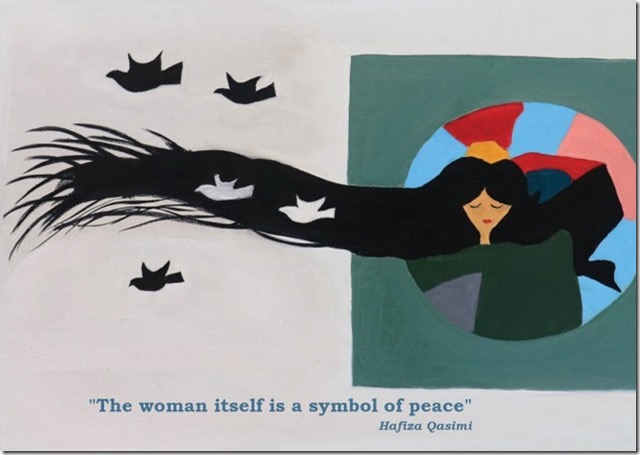
A woman artist in Afghanistan dreams of letting her hair fly free

This isn’t what I normally post, but I hope you’ll give it a bit of your time. A young Afghan artist, Hafiza Qasimi, whose work and studio were destroyed by the Taliban, is trying to leave Afghanistan for Germany, where her brother lives, so she can work freely, and after seeing an article about her in the German press a group of German artists and feminists have rallied to her cause–which is how I heard about it.

At this point, I’ll get out of the way and let Qasimi speak for herself, as she did in the German publication Chrismon (which I offer  you with the help of a bit of AI magic, which Englished the German in its own slightly odd way):

 “Before the Taliban took power, I had a gallery where I exhibited my paintings. I had students that I taught drawing. I earned my own money, I could live from my work as an artist. If I needed something, I could buy it. Now I have to ask my brother, with whom I live in Kabul, for money. I wanted to go to art school, get better, get really good. All of that is now completely out of reach. 

“My brother in Germany, Anosh, encouraged me to paint my feelings and thoughts about life under the Taliban. Almost intoxicated, I painted 13 pictures in February. A photographer friend of mine took pictures of them and sent them to my brother. I immediately burned the originals. Just in time, because in March the Taliban came to search our house. If they had seen the pictures, they would have killed me. I painted women without veils, as dreaming, strong people.

“Since then I’ve felt paralyzed. To continue painting would be life-threatening. This morning I made breakfast for everyone, washed the dishes, what you do as a housewife. It’s hard for me to describe how terrifying I find the idea of ​​having to do this my whole life. I’m an artist, I have all these things in my head that I want to express. And now I do housework and take care of the children – who knows for how long, maybe forever.”

Right now, “Kabul is my prison and . . . my pictures in Germany dream for me.”

From a painting by Hafiza Qasimi.

The photos have not only been dreaming in Germany, they’ve been speaking there at exhibits, and what  stands between Qasimi and joining them there is a visa, and to get one she needs a German bank account of 10,000 euros, which the government requires as proof that she can support herself. When I checked, her supporters had raised over half the amount. Small donations are welcome. Large donations are welcome. It all helps.

Her supporters are also working to get her an art school scholarship.

Of course I hope you’ll donate, but no guilt, please. People have their own struggles with money, and I respect that. Others simply won’t want to. I’m only free to ask if you’re free to say no. 

If you do want to donate, though? The donation website starts out in German and doesn’t offer a translation, but you can see by the painting of the woman with long black hair flying free that you’re in the right place. To donate, press the button that says “spenden,” which is German for spenden. Then fill in the amount and the means of payment (credit card, debit card, or Klarna). 

What’s a Klarna? Something that translates as Klarna and seems to be as untranslatably mysterious in German as it is in (don’t ask me to explain this) Swedish. When I made our donation, I decided to give Klarna a miss and use a credit card. At some point it noticed how befuddled I was and switched to English. Don’t ask me to explain that either.

*

Update: Since I wrote this, I’ve learned that Qasimi has left Afghanistan for a central Asian country, where she is safe and can apply for a German visa. Exactly how she got out is unclear. All I know is that it was risky, and that a woman is not allowed to travel within the country or to leave it unless she has a male chaperone. She is safe, but she still needs our support.

Suffragists, sufragettes, and votes for women

English women’s fight for the right to vote began in the nineteenth century, and it started out politely enough. Bills were introduced in Parliament. Bills were defeated in Parliament. 

What could be more polite than that?

In 1897, the National Union of Women’s Suffrage Societies gathered local groups into a national organization and by 1914 it had 54,000 members. Most of them were respectable and middle class, and it’s not too much of a leap to assume that the campaign made a huge difference in individual women’s lives and in how they saw their role in the world. We can make a wild guess and say that many a couple argued about it over their respectable breakfast tables. Or didn’t argue and just let the tension build. 

They also made the issue part of the national conversation.

Irrelevant photo: a red hot poker. Not, obviously, a real one. A flower.

The organization was efficient and nonviolent and the members were, for the most part, dedicated. And you know what? Women kept on not getting the vote. 

Their work played out against a complicated background involving political parties and a lot of wrestling over not just whether women should vote but which men should. So as usual, we need a bit of background: 

From as early as the 1830s, the Chartists, a working-class movement, had been pushing to open the vote up to all men. They presented petitions to Parliament: 1.25 million names on the first one, 3 million on the second, and nobody I checked with says how many on the third. In response, Parliament blew a raspberry and ignored them.

Before the First Reform Bill (that was in 1832) only 3% of adult males could vote. Your right to vote (or not vote) depended on how much you earned and what your property was worth.

After the bill, the vote was broadened but not to all men. Shopkeepers, tenant farmers, and small landowners got the vote. That’s in the counties. In the boroughs, householders who paid at least £10 a year in rent could vote and so could (gasp) some lodgers. 

What’s the difference between counties and boroughs? Beats me, but that comes from Parliament’s own website, so it must be right. It’s probably about the difference between cities and the countryside, but don’t take my word on that. I’m a stranger here myself. The point is that more people could vote, but only a safely respectable kind of more. And since women had come into the conversation they were, for the first time, specifically excluded. 

Isn’t progress a wonderful thing?

The Second Reform Act in 1867 did more of the same, doubling the number of men who could vote in England and Wales from 1 million to 2 million.

Leave Ireland and Scotland out of it, will you? This is complicated enough already.

By 1885, 8 million people out of a population of 45 million could vote–two-thirds of adult men. (Any numbers that don’t add up here can be blamed on women and children being left out of the accounting.)

So when women started pushing for the vote, the first question that popped its divisive little head up like a jack-in-the-box was, Which women? If all women had the vote, then presumably all men should as well. Or should only women who could meet the same property qualifications as men vote? Or how about unmarried women who met the qualifications, since married women were–or so the argument went–represented by their husbands. Or should it be only married women, since unmarried women were at best faintly embarrassing.

Or only women with those huge, amazing hats.

And this is where party politics came into it, because different choices were to the advantage of different parties. 

And if that wasn’t complicated enough, the women’s suffrage movement  was pulled between the women who wanted a single focus for the organization–votes for women–and those who wanted to address other issues too, because wasn’t the purpose of voting to have an impact on issues?

As women’s suffrage gained momentum, the Conservative Party could see the value of having propertied women vote: Well, of course they’d vote Conservative. And you could see why both non-propertied women and working-class (and presumably non-Conservative) men might oppose that. If the country allows only a small group of campaigners into the hall and they go in, closing the door on the rest of them, the people left outside might well ask themselves why they’d bothered supporting the ones who went in and didn’t return that support.

In 1893, the Independent Labour Party was formed–the forerunner of today’s Labour Party. Its goal was to represent the interests of the working class–a tough job at a time when large parts of the working class were still disenfranchised. 

In those conflicting currents, the suffragists bobbed around, lobbying politicians and campaigning for candidates who supported women’s suffrage, getting their hopes raised and crushed with each new bill. But the question of whether women should vote was, increasingly, an issue that couldn’t be ignored. Even people who made fun of it couldn’t ignore it. The Liberal and Conservative parties formed party women’s groups. They weren’t where the power lay, but they involved women in the machinery.

In 1894, women who met the same qualifications as men gained the right to vote in local elections.

In 1897, a women’s suffrage bill that had looked promising was defeated. You probably know what follows when a movement with a lot of momentum runs into a wall. Either it collapses or it explodes.

It exploded. The Women’s Social and Political Union was formed in 1903. The names you might recognize here are Emmeline Pankhurst and her daughters Christabel, Sylvia, and Adela. The group appealed to working-class women, not just respectable ones, and they were called suffragettes by a hostile press. The name was meant as an insult but the group adopted it. Why not? The words Tory and Whig had originally been insults, and both groups ended by embracing them.

In 1905, Christabel and Annie Kenney got themselves arrested when they interrupted a political speech and unfurled a Votes for Women banner. And when I say “got themselves arrested,” I mean that Christabel had to work at it. The police threw them out of the hall and were going to let it go at that until Christabel spat in a police superintendent’s face and hit an inspector in the mouth. 

That did the trick: They both got arrested, they refused to pay a fine, and they were jailed, one for three days and one for seven. 

When they came out, they were met by a thousand supporters and the press, which got them national publicity. 

By 1909 the WSPU was a national organization, selling 20,000 copies of its paper every week, and it had a genius for attention-grabbing actions. Members disrupted political speeches and by-elections. They tried to rush the House of Commons. They broke windows, blew up pillar boxes (which in other versions of the English language would be called mailboxes), attacked paintings in galleries, and bought gun licenses not so they could use guns but to scare the authorities into thinking they might.

They also chained themselves to railings, getting the grill that sectioned off the House of Commons Ladies Gallery removed by chaining themselves to it.

They took advantage of a Post Office service that allowed postmasters to “arrange for the conduct of a person to an address by an Express Messenger,” posting two women to the prime minister, Herbert Henry Asquith, so they could talk with him.

The delivery was refused. 

The sad part was that social media hadn’t been invented. 

It was the eye-catching actions that gave them their reputation, but most of what they did was legal and even peaceful. They drove (at the time that involved horses) around town with placards on carriages. They carried placards themselves, on foot. At a time when women were supposed to be quiet, passive, deferential, and to the best of their ability and training to imitate doormats, this was shocking enough, but they also addressed crowds in theaters and restaurants–crowds who hadn’t come to hear them and were often hostile. They threw leaflets from theater balconies. Many of them were roughed up by crowds of men or by the police. 

In 1913, Emily Davison tried to stop a horse race and was hit by the king’s horse. She died of her injuries a few days later.

In a lot of these actions, women were arrested, and when they were released they were greeted by supporters, who sometimes pulled them through the streets in open carriages, increasing the visibility of their actions. And in prison, many of them went on hunger strikes and were force fed–a brutal and very painful process. 

In The English Rebel, David Horspool asks whether their militancy delivered or delayed votes for women and answers that it probably did both. If you have trouble working that out, go argue with him. I’m not sure both are possible at the same time, but I can see his point anyway. The same argument goes on, although the parallels aren’t exact, when Black Lives Matter demonstrations spill over into rioting or looting. Does it help or does it hurt? It depends on where you do your counting and how. In the case of the suffragettes, even a century later historians can still argue over it.

Whatever the answer turns out to be, it won’t be a simple one.

In 1910, a bill that would have given unmarried women the vote failed. The Liberals thought it might harm their interests. The Conservatives weren’t strongly enough in favor. Militancy had been winding down, but the bill’s defeat wound it up a notch. Asquith’s car was attacked. 

Somewhere in here, the Suffragists’ leadership–and the Pankhurst family–split over tactics. Should they work with men? How violent should their actions be? Should any bill introduced expand the vote for both men and women or should it only be for women?

I’ve been around political activism long enough for this all to sound familiar. If you get deep enough into politics, it can get very crazy very easily, but the alternative is–or at least seems to be–what someone I once knew called crackpot realism, where you dial your goals down to fit what looks possible, accomplishing somewhere between less than you wanted and nothing at all. 

And there things stood when everything was interrupted by World War I. Gavrilo Princip assassinated the Archduke Franz Ferdinand, the European powers all dug trenches and shot at each other, and 20 million soldiers and civilians died. Another 21 million were wounded. 

That was the war to end all wars. 

Yeah, they really did say it would.

The more radical branch of the Suffragettes (that was Emmeline and Christabel’s) suspended their activities, partly, according to Horspool, because Emmeline and Christabel were exhausted but also because they were realistic about how much political oomph women’s suffrage could have in the circumstances. And they did something I find more interesting: They moved to the political right. They suspended the campaign for the vote, backed the war, changed their paper’s name from The Suffragette to Britannia, and diverted the organization’s funds to the war effort, but many suffragettes were pacifists and the organization broke up for good. 

Their support for the war, according to Horspool, consisted of making speeches and editorializing in the direction of industrial workers, who were probably looking for their news and editorials elsewhere.

 Sylvia’s branch of the Suffragettes had become the East London Federation. Its membership was working class and it aligned itself with the Labour Party, campaigning for both workers’ and women’s rights. And–since changing newspaper names was in style–it changed the Woman’s Dreadnought to the Workers’ Dreadnought.

In 1916, the government faced the prospect of an election in which most servicemen wouldn’t be able to vote because of a residency requirement. 

Crisis. Conference. 

The moderates (remember the suffragists, working politely away in the background?) made a pitch for women’s suffrage. The former radicals (remember half the Pankhursts?) withdrew their support for women’s suffrage in case if ended up disenfranchising servicemen.

Aren’t humans strange?

A compromise bill passed in 1918. It gave the vote to women over 30 who were qualified to vote in local elections or whose husbands were qualified. That was about 8 million women. And there it sat for the next ten years, when the voting age was dropped to 21 and all other restrictions were lifted–in other words, women voted on the same terms as men.

Christabel ran for Parliament as a Women’s Party candidate and lost. Later she became a born-again Christian and lectured in California. Emmeline moved to Canada for a while and lectured on social hygiene until the winters drove her out.

I know just how she felt–minus the social hygiene part.

What is social hygiene? “The practice of measures designed to protect and improve the family as a social institution; specifically: the practice of measures aiming at the elimination of venereal disease and prostitution.” 

Bet you didn’t see that coming. 

Math, medicine, and research: It’s the news from Britain–and elsewhere

Martin Hairer won the $3 million 2021 Breakthrough Prize in Mathematics for explaining the math involved in stirring a cup of tea, which is also the math involved in several other things that don’t sound as silly. It’s complicated stuff–180 pages worth of complicated, involving regularity structures. 

Never heard of them? Neither has anyone else. That’s what’s so impressive. They tame the randomness that throws disorder into equations involving the way forest fires grow, the way a drop of water spreads on a tissue, or the way that cup of tea you’re stirring–

Would you stop that stirring? You’re upsetting an otherwise ordered univer–

Damn. Now see what you’ve done.

Regularity structures may be the genuinely impressive element of his work, but if you want an impressive phrase to use when you’re pretending to explain this to someone who’ll understand it even less than you do and isn’t listening anyway, the phrase you want is stochastic analysis. Or better yet, stochastic partial differential equations. From those words on, everything you say will be nothing but a background hum to whatever’s going on inside your alleged listener’s own head.

If you want complicated math, though, you could try explaining why a bunch of mathematicians are giving out a 2021 prize in 2020.

*

Irrelevant photo: Wind-carved rocks at the top of Rough Tor, which is pronounced Ruff Tor. No, don’t ask me.

If you’re British inflected instead of American inflected (yes, there’s an L in there: infLected), that’ll be maths, not math. I can only assume that the British are better with numbers than the Americans, since they wrestle with them in the plural  and we only have one to fight with. 

*

The Breakthrough Prize is also awarded in the sciences, and Catherine Dulac won one for showing that the neural circuits that govern the behaviors involved in both male-specific and female-specific parenting are present in both sexes. I have no idea what the implications of that will turn out to be, but they should upset a few apple carts. I look forward to hearing more.

*

As long as we’re on the subject of medicine and male/female differences, Rebecca Shanksy, a neurologist from Boston University (no, it’s not in Britain, but never mind) is calling for stricter requirements for medical research to include both female and male animals. 

For decades, researchers have used both male animals and male human subjects on the grounds that the fluctuations of female hormones would–forgive me if I use complicated scientific language here–fuck up their results. 

They did that even when they were studying conditions that mostly affected women. Because you know what women are like. Hormonal. Unstable. Unpredictable. Lots of un- words. 

It turns out, according to Shanksy, that male rodents–the go-to subject of many experiments–are less stable in terms of both hormones and behavior than females.

Shanksy is, by way of full disclosure, a female and therefore likely to be biased and unstable. Unlike males researchers, who are entirely objective and don’t have hormones.

The result of the male bias in research subjects is that drugs are likely not to work as well on women as on men. Ambien, which did its trials using both male mice and male humans, turned out to be metabolized  more slowly by women, and therefore (don’t ask me) more powerful in them. 

Women tend to experience more side effects and overdoses for all drugs. 

The U.S. and Canada now require female test subjects to be included (Britain doesn’t yet), but experiments are often done first on male subjects, with female subjects used later, treating the female subject as a deviation from the male standard. The article I read didn’t go into whether or how that biases the results, but I can see that if the first set of tests establish a standard, you could easily close off avenues that might be open if you worked differently.

*

Were we talking about sexism? The Musee d’Orsay in Paris–a museum with walls full of nudes–wouldn’t let a woman in because an official decided her dress was cut too low. 

And if that wasn’t bad enough, they followed up their decision by telling her, “Calm down, madam.” 

So she did what any good citizen of the twenty-first century would do: She went online and called them out on their double standards and sexism. The museum has apologized, both by tweet and by telephone, but it’s not the first time the museum’s had a problem with women’s real-life flesh as opposed to the artistic depiction of it. It called the cops on a performance artist who posed nude next to a nude painting. She was in jail for two days before a judge threw out a charge of public indecency.

*

An eighty-year-old hiker who’d been missing for three nights turned up not at his own funeral but at a press conference, held in a pub, where his family was about to appeal for help finding him.

Harry Harvey got separated from an organized walking group during a heavy hailstorm and spent three nights wild camping. He had camping gear with him but ran short on food. He described the area where he lost the group as desolate.. 

He eventually spotted a wildlife photographer, who called a rescue team and they brought him to the pub just in time for a dramatic reunion. 

The quotes from his family make them sound a bit on the crabby side about it all. 

*

A research trial that put robots into care homes has been defended on the grounds that the robots aren’t intended to replace humans, only to help fill times when, because the care system’s overstretched, staff don’t have time to spend with residents.

Which is commonly known as replacing humans with robots, only the humans were taken out before the robots were put in and no one had any intention of filling the gap they left–not even with robots.

The robots have wheels and a name, which they all share–Pepper. Also arms and hands. With a bit of programming, they could hold basic conversations with the residents, learn what they’re interested in, play them music, teach them languages, and remind them to take their medicine. 

This could go wrong in so many ways. In Japan and Singapore robots are more widely accepted and have been hacked to intercept phone calls or let the hacker use the robot’s camera and microphone. I don’t find any mention of medication reminders going wrong, but I doubt many of us suffer from the delusion that technology is flawless. 

The two-week trial found that residents’ loneliness levels decreased–not hugely, but a bit. 

*

Britain’s home secretary, Priti Patel, called Extinction Rebellion “criminals who disrupt our free society and must be stopped.” Other cogs in the government chaos have talked about classifying it as an organized crime group, which takes a bit of mental mechanics, since XR is decentralized and I suspect you’d be hard put to find an overall organization. 

The police, interestingly enough, see XR as nonviolent and committed to civil disobedience.

*

We’ll end with some more science awards, the Ig Nobels. This year’s include an one for determining that many entomologists–those are the folks who study insects–are afraid of spiders. Which aren’t insects, so it seems fair. Another went to a study that tried to spot narcissists by the shape of their eyebrows. A third went to a study that looked for a correlation between a nation’s income inequality and the prevalence of mouth-to-mouth kissing.

Annie Besant does Cristianity, secularism, socialism, and Theosophy

Annie Besant was, in more or less this order, an intensely religious child, a minister’s wife, a campaigning secularist, a brilliant public speaker, a writer, a socialist, a champion of everything from trade unions to birth control to feminism, a Theosophist, a Briton in colonial India, and a campaigner for Indian home rule. She adopted (sort of) an Indian son who she promoted as a new messiah and the incarnation of Buddha.

Along the way, she won exactly zero awards for consistency, so maybe we’ll want to slow that down a bit.

Irrelevant photo: a day lily.

She was born in 1847 (her birth name was Annie Wood) and she got, for a woman of her time, a good education. She married a clergyman, Frank Besant, who’s described by the only article I found that bothered to describe him at all as stiff-necked and charmless. He’s basically a prelude to her story and most articles drop his name in and move on. She married him because he proposed and she didn’t want to hurt his feelings. She wouldn’t be the first woman who married someone because she couldn’t think of anything else to do that afternoon. We can inch out on a thin limb and say that the relationship didn’t get off to a good start.  

They had two kids, and both were difficult births. When she suggested doing the limited things that were possible then to keep from having a third, he beat her. Which was perfectly acceptable at the time, at least to the world at large if not to her. Whether that was the first time I don’t know, but it wasn’t the only one.

At some point, she began to question her religious beliefs and in 1872 she heard  Charles Voysey preach. He was a dissenter who challenged the authority of the Bible and the perfection of Jesus. Through him, she met Thomas Scott, whose beliefs were even more radical and who encouraged her to write a pamphlet on what she believed, which he then published as On the Deity of Jesus of Nazareth: An Inquiry into the Nature of Jesus.

All hell broke loose at home and Frank presented her with two choices: Take communion publicly and regularly at his church or leave home.

She chose, as she put it, expulsion over hypocrisy. 

She moved to London with one of their kids, a girl, and continued to write pamphlets for Scott. Frank stayed in Wherever with their other child, a boy. 

In the 1870s, Besant joined the National Secular Society, and here we need to stop and make sense of why secularism was a thing:

The Church of England, as the established church, had the power of the state behind it. It didn’t rule as many aspects of life as it once had, but it still ruled plenty of them. Divorce had only been taken away from church courts in 1857. Paying church rates–basically a tax you owed to the church–had been made voluntary in 1868. It wasn’t until 1871 that religion stopped being a requirement for university admittance. A non-believer still couldn’t be an MP unless he–and he had to be a he at this point–was willing to put his beliefs in his back pocket and swear a religious oath. In 1888, atheists and people whose religions didn’t allow them to take oaths were first allowed to solemnly affirm instead of swearing a religious oath. But church doctrine still influenced a wide assortment of laws, including one forbidding cremation, which didn’t become legal until 1902. And, of course, it influenced people’s thoughts and assumptions. Didn’t the Bible say the man was the head of the household? Didn’t it give him permission to beat his wife? 

All this meant that being a campaigning secularist wasn’t just for those pains-in-the-ass who couldn’t pass up the chance for a philosophical fight over dinner. It was for people who wanted to change society. Until you uncoupled religion from law and everyday life, any change you proposed could be challenged on religious grounds. Cremation? Birth control? Women’s right to own property and keep their own wages? It wasn’t enough that a change was harmless or life saving or entirely sugar free. If you could throw it out on religious grounds, it wasn’t valid. 

Being a campaigning secularist was also for people who couldn’t make themselves pretend to hold beliefs that didn’t come in their size or style. And it was for scientists, who couldn’t use the Bible was the one and only authority. They had to explore the world on its own terms. This was an intellectually fertile time, and secularism was a necessary ingredient.

Besant began to write for the Secular Society’s paper and to speak in public, and forget what she had to say, a woman speaking in public was in itself shocking. She was by all accounts a brilliant speaker, and it didn’t hurt that she was small and pretty. Yeah, you can speak as a feminist and call for equality, but a certain number of people will go right on judging you by the old standards. 

What number? Something along the lines of 99.7% back then. In today’s enlightened world, we’ve gotten it down to 99.4%. 

You could argue that she was using the patriarchy’s weapons against it: You think I look like a woman should look? Good. Now listen while I set your brain on fire.  

Of course, you can make an argument for just about anything. I haven’t a clue what her attitude toward her looks was, but they didn’t give her a free pass in any case. Beatrice Webb–who broke a few taboos herself–said that to “see her speaking made me shudder, it is not womanly to thrust yourself before the world.”

Besant quickly became a key figure in the Secular Society, denouncing religion as a force that kept women down and writing on the contentious issue of birth control. One of her arguments in its defense was, “We think it more moral to prevent the conception of children than, after they are born, to murder them by want of food, air, and clothing. . . . The wage which would support the parents and two or three children in comfort and decency is utterly insufficient to maintain a family of twelve or fourteen, and we consider it a crime to bring into the world human beings doomed to misery or to premature death.”

After she had a hand in publishing a pamphlet on birth control, her husband went to court, challenging her right to have custody of their daughter, and won. 

In 1887, she joined the Fabian Society, a socialist group, where again she quickly became a powerful force, co-founding a weekly newspaper, the Link. At a Fabian Society event, she learned about the working conditions of the women who made Bryant & May matches. They worked fourteen hour days, faced fines that could cost them as much as half a day’s pay (and their pay was already miserable), and worked with phosphorus, which caused bone cancer and killed them by horrible stages. Sweden and the U.S. had banned its use, but the British–holding out, nobly, for free trade–declined to.

I do so admire politicians with principles.

Besant wrote about their conditions in the Link, and the company demanded that workers sign a statement saying they were happy with their working conditions. When one group refused, they were fired and 1,400 women went out on strike. The Link campaigned in their support, calling their conditions white slavery.

Have you ever noticed how white slavery shocks polite (and, yea, even impolite) society in an entirely different way than black slavery? That can even be true of people who you’d expect to know better. But let’s acknowledge Besant’s limits and remember that she was a person of her time and place. Being an idiot in one way (or several ways, come to think of it) doesn’t take away the wisdom she showed in others.

Crucially, the Link also raised money to support the strikers.

After three weeks, the company agreed to end the system of fines and met several of the strikers’ other demands. The women went back to work, forming the Union of Women Match Makers and electing Besant as its first secretary. The union soon opened to men as well and continued until 1903, inspiring the unions to organize the lowest paid workers, not just skilled craftsmen.

In 1889, Besant was elected to the Tower Hamlets school board with 15,000 votes more than the next highest candidate. She initiated reforms that included free meals for undernourished students and free medical exams for all students.

In the 1890s, atheism be damned, she started to be influenced by Theosophy, a religious movement based on the Hindu ideas of karma and reincarnation, and again became prominent, serving as its international president from 1907 until her death in 1933.

She moved to India and from 1913 on she became active in the struggle for independence, running a campaigning newspaper, New India, and starting the Home Rule League and the Women’s Indian Association. She drew back from Gandhi’s passive resistance campaign, though–he was  breaking the law and she couldn’t go that far–and her popularity waned.

And here we drop into the seedier side of her life

A Theosophist, C.W. Leadbeater, spotted two young boys in Chennai and announced that one of them had an aura that would make him the World Teacher–the person who would bring enlightenment to the world–and he convinced Besant to take the boys in. She eventually gained custody from their father. (Yes, they had a father. She didn’t rescue them off the streets.)

It ‘s not irrelevant that the Theosophical Society had expelled Leadbeater over a sexual scandal involving adolescent boys and had only just reinstated him. More than that I can’t tell you. People didn’t talk about those things then. 

Yeah, I think so too, but we don’t actually know.

Whatever did or didn’t happen behind the scenes, the Theosophists raised one of the boys, Jiddu Krishnamurti, to be the World Teacher, and the money rolled in. And Hindu-influenced as Theosophy may have been and supportive of home rule as Besant may have been, they raised the boys to dress and behave in the European style. 

Krishnamurti and his brother, NItya, remained close to each other. They both studied law in England, where Nitya passed with honors and Jiddu didn’t pass at all. Nitya died of tuberculosis in 1925.

In some of his early talks, Krishnamurti claimed to be the reincarnation of the Buddha, in others, the vehicle for the messiah, and in others still the messiah himself. But in 1929 he broke with Besant, the Theosophical Society, and the idea of being a World Leader. He returned the gifts he had control over to the people who’d given them. There’d been plenty of them, but the Society had control of the majority. 

He did become a teacher as well as a writer and lecturer and he promoted, among other things, the need for spiritual freedom, including freedom from teachers–something he knew a bit about.

Besant went on to promote Rukmini Arundale, a dancer and the daughter of a Theosophist, who took a style of traditional dance, bharata natyam, that was practiced by lower-class temple servants whose role included prostitution, and turned it into something to perform on stage, making it a respectable form for upper-class women.

Whether that satisfied Besant I can’t tell you. One article about Kristnamurti and Besant says she died heartbroken. Others just say she died. 

We all do, sooner or later.

*

My thanks to Bee Halton, of The Bee Writes, for bringing Besant to my attention. 

Everything we don’t know about Aphra Behn

The first English woman to make her living entirely as a writer was Aphra Behn. She’s known to have been born, to have been a spy, to have been a writer, and to have died. After that, information about her ranges from the sketchy to the questionable. 

What could be more fun than writing about someone nobody knows much about?

She was born in 1640. Her father might have been a barber and her mother might have been a wet nurse. They might also not have been. 

Her last name might have been Johnson. She might have been adopted. 

Since we can’t sketch in her family, let’s sketch in the times she lived in: The English Civil Wars ran from 1642 to 1651. In 1660, the Stuart kings settled their hind ends back on the throne they’d been lusting after. So she grew up in turbulent times and was twenty at the start of the Restoration, which is a fancy name for the aforesaid Stuart hind end settling back on that throne.

Irrelevant photo: This is one of about a dozen big, flat wildflowers that don’t look alike but are similar enough that I doubt I’ll ever learn their names.

She may or may not have spent some time in Surinam.

Suri-what? A small country in South America. It was an English colony until 1667, when it became Dutch. Under the English, it evolved into a place of sugar plantations and slave labor, which gets an early mention because it feeds into one of Behn’s books. 

(It’s irrelevant but interesting to note that the Parliamentarians–the folks who threw out the Stuart kings–were no more opposed to slavery than the Royalists were. That won’t be on the test. In fact, there won’t be a test. This is a blog. You can stop reading right here if the mood takes you.) 

If Behn had been a man, an aristocrat, or a religious nonconformist, she’d have left more information behind, or so say Abigail Williams and Kate O’Connor in an essay. The surprise in that, for me, is the nonconformists. They were prone, both the men and the women, to keeping spiritual journals. 

In 1664, Behn married a merchant named Johan Behn, although the marriage might not have lasted long. He might have died the next year. He might not have. Either way, that’s the last we’ll hear of him. 

She was a royalist spy in Antwerp during the Anglo-Dutch War. If she was in Surinam, she might have been there as a spy. 

Of course, she also might not have been in Surinam as a spy. 

She might not have been in Surinam at all. 

Don’t you love history?

Spying wasn’t a good way to get rich. According to one source, she wasn’t paid at all and had to borrow money to get home from Antwerp.

That leads to our next questionable statement: She ended up in debtors prison, according to one source (a different one this time) for “debts she incurred in service to the crown.” None of the other sources I’ve found mention the reason for her debts. In fact, the British Library entry on her says there’s no documentation that she was ever in debtors prison.

If she was, though, either somebody ponied up the money needed to break her loose or she started writing as a way to get herself out. Either way, write she did, and back then it was a better way to make money than it is today. Writing was still the hot new medium. You know how parents yell at their kids to get off their phones and turn off their computers? “Go read a book and learn something,” they say. Well, back then parents yelled at their kids to put down their books, get out in the fresh air, and be ignorant.

Yes, every last parent. Every last kid. That’s how you can tell what the hot new medium is: Parents are appalled by it.

Now we’ll take a quick step back. Bear with me. Before the Restoration, the theaters were closed. They were frivolous and led to perdition and fun. Then the king sashayed back to London, the party began, and theater companies were licensed. It wasn’t exactly a new medium, but it was hot all the same.

Behn started working for two of the theater companies that had started up, first as a scribe, then as a playwright. Fittingly, the timelines I’ve seen are contradictory, but her first plays either were or weren’t commercial successes, but either a later or the first one was. But forget which play it was, one of them ran for six nights, and that counted as a smash hit. The income from the third day (and the sixth if there was one, and the ninth if miracles should occur) of a run went to the author, so she got the income from two nights. 

She went on to write and publish an assortment of other plays, some successful, some not, and one–now lost–a complete disaster, involving an arrest for an abusive prologue (or epilogue–take your pick) attacking the Duke of Monmouth. She was (probably) let off with a warning. 

Nope, I have no idea what it said. It’s lost. Sorry. 

Some of her plays were definitely her plays. Others might have been her plays but might have been someone else’s. During her lifetime, a lot of her work was published anonymously, which helps explain the murkiness over what was her work and what wasn’t.

She also published novels and poetry. 

She had a couple of lovers. One of them, John Hoyle, is believed to have written the epitaph (not to be confused with that troublesome epilogue) that’s on her tombstone: “Here lies a proof that wit can never be Defence enough against mortality.”

She died in 1689, at forty-nine. 

So what did she have to say? Well, in her novel Oroonoko, the narrator swears the story’s true, that she either saw everything in it  or was told it by its hero, thus muddying the autobiographical waters by pouring fiction into alleged fact. The book’s unusual in English literature in its choice of hero, an African prince sold into slavery in Surinam. Behn wasn’t not free from the prejudices of her time and place–who is?–but she allowed him his humanity, something it took European writers and their descendants centuries to find their way back to.

She also wrote about sex–about women enjoying sex and about men sometimes failing to enjoy it, much as they would have liked to. “The Disappointment” is full of seventeenth century roundaboutness, but it’s also frank: The man couldn’t get it up. 


      . . . In vain th’ enraged Youth assaid

      To call his fleeting Vigour back. . . .

      In vain he Toils, in vain Commands,

      Th’ Insensible fell weeping in his Hands.


After Behn died, Memoirs on the Life of Mrs Behn. By a Gentlewoman of her Acquaintance was published, further blurring the line between fact and fiction. The gentlewoman was probably a man named Charles Gildon, who drew heavily on her fiction, along with her letters, to piece together a life, leaning heavily on sex to sell the story.

Behn went out of fashion in more prudish centuries and–well, Restoration literature doesn’t draw a mass audience anymore, but feminists since Vita Sackville-West and Virginia Woolf have been rediscovering her, reinterpreting her, re-appreciating her, and in Sackville-West’s case reimagining her from the ground up. 

Which given the gaps in her story is easy to do. You have no facts to lean on but you also have none to contradict you.