Looking American: On culture, nationality, and immigration

A few months ago, M. told me, “You’re looking very”—and here you have to imagine a short pause— “American today.”

When I stopped laughing, I asked what American looked like, and you can insert another, somewhat longer pause before you go on, because he had to think about it. Or else he was looking for a gentle way to say it.

“You walk as if the sun always shines on you and you own the world,” he said. Not unkindly, I should add, although from someone else it might have sounded like a complaint.

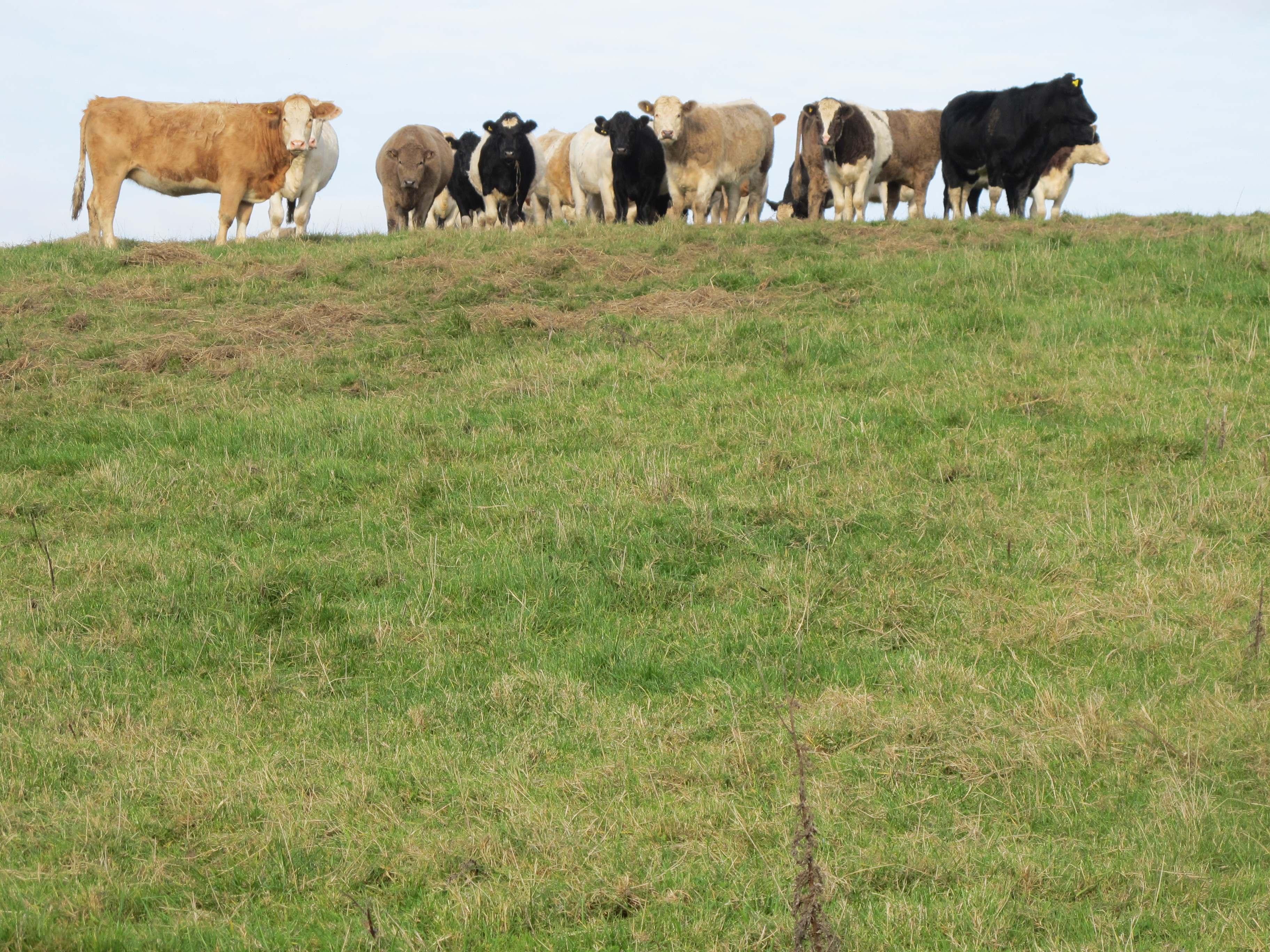
Semi-relevant photo: The sun shining on a herd of cows. (Actually, they were making sure we left their field, and I can't remember if the sun was shining on them or not--it looks like diffuse sunlight. Does that count?)

Semi-relevant photo: The sun shining on a herd of cattle. Actually, they were making sure we left their field, and I can’t remember if the sun was shining on them or not–it looks like diffuse sunlight. That may or may not count.

The sun wasn’t shining on me that day. I’ll skip the details, because they’ll take me off in a whole ‘nother direction, but I’d been shaken by some bad news a few hours earlier, and I was still feeling it.

What does it mean to be so American that I look like I own the world, even (or particularly) when I’m don’t feel that way? Well, what does it mean to belong to any nationality?

The question’s been rattling around in my head lately, at least in part because of the anti-immigrant sentiment that seeps into so much of British politics these days. And into American politics, while we’re at it. You could probably drop any other more or less solvent nation into that sentence, because trouble drives people to immigrate, and the world’s a troubled place these days.

Part of the anti-immigrant feeling is about jobs: If immigrants come over here (wherever here is), they’ll work for less and wages will drop. There’s some logic to this, although what’s really undermining wages is that jobs, and whole industries, have moved overseas, where wages are ruinously cheaper. On top of that, unions don’t have the clout they once did (those two aren’t unrelated), and they were a major force driving wages up.

But another, more emotional, strand of complaint is that immigrants don’t blend in. Basically, the problem with immigrants is that we’re foreigners, and couldn’t we please stop that? Stop talking our languages in public. Stop eating funny foods. Stop dressing differently. Stop running around with different-color skin. Stop cheering for foreign sports teams or holding to foreign religions or using all those alphabets that no decent person knows how to read. I mean, who knows what we’re writing in them?

But once you grow up in a culture, you don’t get to leave it behind—not entirely, even if you want to. No matter how much you work at blending into another one, you carry some part of the original. I walk, apparently, like an American, and I know I sound like one. I even eat like one. The American way of eating involves juggling the fork from the left hand, where we hold it if we need to cut something with knife and fork, to the right hand, which we use to bring the food to the mouth. The British way leaves the fork where it started, in the left hand. This is great, because it lets you use the knife to push food onto your fork—and it’s perfectly good manners when you do. That solves a problem built into the American approach: How do you get the last bits of non-spearable food onto the fork without sneaking a finger onto the plate and hoping no one’s looking? Although it doesn’t solve another problem, which is how to keep the food on your fork, because the British hold the damned thing with the back—the hump—facing up, so that you can’t use the fork’s valley to cradle your food. I haven’t a clue why they do this, but it may explain why mashed potatoes are so popular: you can use them as mortar to hold the rest of your food on your fork.

So I’m a partial fan of the British method, and periodically I try to eat that way—usually with the curved part of the fork facing up, but never mind, I’m compromising here and I want some credit, damn it. All you anti-immigrant campaigners, are you listening? I’m making an effort.

What happens, though? The minute my mind wanders—and it doesn’t take long—my fork’s magically moved itself back to my right hand and I’m eating like an American again. And the sun shines on me.

At this point, while the sun’s shining on me alone, I have to interrupt myself, because I read this post to my writers group and they told me that holding the fork with the hump facing up is posh, presumably because it makes you eat more slowly. Holding it valley-side up is working class. Who’d have thunk? I swear, you have to be born here to figure this stuff out. On the evidence of that alone, though, I ask you: Who should be running the country?

Because of my (sometimes absurd) efforts to publicize both my book and this blog, I’ve written a lot of bios lately (I will post just about anywhere, about almost anything, as long as I get a bio and a link), and I keep describing myself as an American living in Cornwall. That reflects the reality of who I am culturally, but it ignores the fact that I’m a British citizen as well as an American one.

For me, becoming a British citizen was about security, not love or allegiance or culture. I do love the country, but I’m not romantic about citizenship. I wanted to be a citizen because it’s harder to get rid of a citizen than a resident alien. Since the U.K. government had already changed the rules once before Wild Thing and I got the right to stay in the country for the long term,and since we just about got kicked out of the country because of it, we were touchy on the subject. It may be crass, but we wanted the safety that comes with citizenship. We’re grateful for it, but it hasn’t, and can’t, change who we are.

So when I hear someone say that the problem with immigrants is that we don’t acculturate, I can only suggest moving abroad and seeing what happens.

*

A final note: Before my writers group before we fell down the conversational rabbit hole of what it means to have a constitution that isn’t a written document, I learned something else about forks and nationality: More and more of the British are acting like Americans and shuffling their forks from hand to hand as they eat.

And we’re not even the immigrant group anyone’s upset about.

If you want to blame someone, you can blame movies or television, because there aren’t enough Americans here to have that big an impact.

How do foreigners change a culture? Sometimes it’s from a distance.

Beer and British politics: The Pub Landlord runs for office

British politics just got a bit less depressing: A new candidate just entered the race for a parliamentary seat, a comic named Al Murray running under the name of his comedy character, the Pub Landlord. His party’s logo looks a lot like the one the U.K. Independence Party (Ukip) uses, and although I hate to give Ukip any space in my earth-shatteringly influential blog, the joke doesn’t work unless you know a bit about who the Pub Landlord’s making fun of.

Ukip wants to take the U.K. out of the European Union and get rid of all of us pesky foreigners. Or maybe they don’t want to get rid of quite all of us, because Ukip’s leader is married to a woman from Spain, so presumably they’ll make exceptions, but basically they don’t like furriners coming over here, taking British jobs and speaking funny languages on their streets. Last I heard, the party leader’s wife had a paid job in his office, but I guess that wasn’t a British job, it was some other kind of job, so it must be okay.

Irrelevant Photo: Mulfra Quoit, an ancient monument in West Cornwall

Irrelevant Photo: Mulfra Quoit, in West Cornwall

What else does Ukip stand for? Well, it sort of depends when you ask and who you ask and what sort of mood they’re in. And whether they’re still in the party, because periodically one of their candidates goes too far and gets thrown out. One proposed banning Islam and tearing down mosques. Another posted anti-Semitic and anti-Muslim statements on his Facebook page. A third was convicted of assault. Let me quote the Mail Online here: “The Ukip official charged with vetting the party’s election candidates has revealed he spends half his time ‘weeding out the lunatics’. . . .

“The remarks come after one Ukip candidate was recorded making homophobic, racist and obscene comments—while another was exposed as a fantasist after becoming embroiled in a public sex scandal.”

Ukip does stand for a good pint of beer, though—that’s been pretty consistent and to date no one’s been thrown out for it. And they’re polling well considering that they’re a minor and basically bonkers party. Well enough to scare the bejeezus out of the major parties and drag them all into a discussion of what to do about immigration, as if everyone agreed that immigration is what’s wrong with—and probably the only thing wrong with—the country.

But back to the new party: Its name is Free United Kingdom Party, or FUKP. (Yeah, go ahead and pronounce it.) And what’s its platform? The Pub Landlord promises to burn down the Houses of Parliament for the insurance and brick up the Channel Tunnel to keep immigrants out. His most inspired proposal is revaluing the pound so it’s worth £1.10. About cutting immigration, he says, “This is the greatest country in the world and people want to move here. We need an MP to make things worse. Look no further.” On corporations and globalization, he says, “Blah blah blah paradigm blah blah blah, blah blah dialectic blah blah blah blah blah blah game-changer.” Which is pretty much what all the politicians are saying.

Finally, he pledges that the U.K. will leave Europe by 2025 and the solar system by 2050.

Politics hasn’t made this much sense since Screaming Lord Sutch ran on the Official Monster Raving Loony Party ticket.

Celebrating a Bulgarian British Christmas

Since my recent posts were about Christmas in Britain, I should send you to Not Another Tall Blog for a post on what it’s like to keep your original traditions–in this case Bulgarian–when your children are growing up British. Every immigrant has to find a balance between the two cultures they live with, and when you’re raising children in a new culture the issue must be even more pressing.

Angie’s post drew my mind to my grandparents, my father’s parents–Russian-Jewish immigrants who raised eight children in New York City at the beginning of the 20th century–and the decisions they were faced with. There’s a long story there, or may stories, but let’s save them for another day.

Again, happy holidays.

A Recommendation

I just read a post on speaking with an accent on Not Another Tall Blog, by Angie K., and I want to recommend it to you.

Yeah, it’s true that we all have an accent of one sort or another, but when you’re the possessor of one that stands out, suddenly you don’t just have an accent, you have An Accent, and that changes things. Her post makes me want to write about the issue, but it’ll take me a while to catch up with that. In the meantime, do take a look at what she’s written.

The Life in the U.K. Test

British_Flag (1)It was 2006 when Wild Thing and I left Minnesota for a village in Cornwall. It’s ridiculously beautiful and it’s also—well, British. And we’re American. Actually, by now we’re both British and American, but we’ve been Americans for a lot longer than we’ll ever be British, and these things don’t leave you.

When we applied for permanent leave to remain in the UK, I had to take the Life in the UK test to prove that I was fit to stay. Or maybe what I had to prove was that some ministry or political party was sufficiently tough on immigration to appeal to the anti-immigrant vote. The test is silly, but politics makes people silly. Wild Thing is eight years older than I am and didn’t have to take the test. If you’re past a certain age, you can keep your foreign ways without threatening the country’s integrity. Or something along those lines. The logic of it got lost in the twists and turns of some politician’s brain and if you think about it too much it’ll only upset you.

I bought a government booklet about the test and studied it. Since I worked as an editor before I retired, I couldn’t help tracing through the book’s logic, and I’m prepared to testify that there wasn’t much. A part of it explained how to deal with officialdom, and that was theoretically useful, although by the time I had to take the test life had taught me most of it, as I expect it does to other test-takers. It included information on emergency phone numbers, libraries, the National Health System, that sort of thing. But sandwiched in with that were pages and pages of data: what proportion of the population belonged to which religion, for example. I think I’m right in remembering that Jedi had enough adherents to show up on the list. The patron saints of England, Wales, Northern Ireland, and Scotland, and the days on which they’re celebrated, which are no longer official (and are barely unofficial) holidays, so the information is of no earthly use. I suppose if you belong to a religion that believes in saints you could argue that it’s of some unearthly use, but I don’t know if calendar dates remain relevant in heaven, should such a place turn out to exist. But I duly memorized them, and they weren’t on the test. I have now duly forgotten them. (The test is computerized and the questions vary; not everyone takes the same test. So someone somewhere may get asked about them.) The populations of England, Wales, Northern Ireland, and Scotland. Since there’s nothing involving numbers that I can’t screw up, I spent a lot of time on this and forgot every bit of it ten minutes after the test, which is okay because, unlike the religions, which were in percentages, these were in absolute numbers and  will have changed by now. Although, come to think of it, the religious percentages may have as well.

They also had a list of popular sports. Cricket, which I would have thought was the most British of British games, wasn’t included, maybe because the game takes so long that none of its followers had time to respond to a survey.

Sports weren’t on the test. The only question I still remember had to do with the television license—something along the lines of whether people renting a room in a house would have to pay for a separate television license if they had their own set. The television license pays for the BBC and is, essentially, a tax dedicated to that specific use. Think of it as a toll booth, only it’s not on the highway, it’s on the TV set and pays for the programming, not the road.

All that mess about populations and saints’ days? As far as I know, it’s either in there either to fill out the pamphlet or to distract applicants from learning the information they’ll actually need.

It’s a hell of a way to welcome a person to the country.


Fighting to Stay

In 2009 my partner, Wild Thing, and I almost got thrown out of Britain. Not for any failure to adapt, although when people here complain about immigrants sooner or later they get around to foreign habits and languages, which make them uneasy. But we speak English, in a reckless, American sort of way. And we not only drink tea, by mid-afternoon we’re convinced that the world’s rotation has slowed and can only be cranked back up if we dunk a teabag in very hot water and add milk. Admittedly, when it looked like we were going to be thrown out of the country, we were as loud and brash and American as we’d ever been, but already Wild Thing had started to say GARE-age instead of grr-ADGE. And if we didn’t listen to The Archers—BBC radio’s popular and endless rural soap opera—we’d heard enough conversations about it to nod significantly and ask, “But what will happen to Rory?” (Answer: Haven’t a clue. He seems to have disappeared. For all I know, he moved to Minnesota.) We helped collate the village newsletter, which dunked us, like the teabag in the last paragraph, into the hot water of village gossip. (And no, I’m not going to repeat any of it. I live here. I want to keep on living here.) I could even make a decent cup of tea.

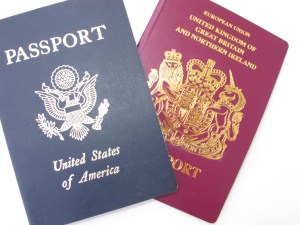
passportsWe moved here with visas in a category that should have led to indefinite leave to remain, but they had to be renewed. Trusting that the category we were in was safe and that—well, the truth is we didn’t stop to think about what we were trusting; it all looked simple—we burned our bridges, bought a house, and built a life. When it came time to extend the visas for the second time, we weren’t worried.

Silly us. We hadn’t reckoned with rule changes, and with the dislike of immigrants that’s swept the developed world. The government was on the defensive about the number of immigrants coming into the country, and it had reconfigured the rules so that fewer people would be eligible to stay. Our original category included writers, artists, and musicians. Now, though, artists, musicians, and writers weren’t worth encouraging, although sports figures (who were, weirdly, in the same category) still were, as long as they made enough money. Those of us who’d come in under the old rules were given a window of time during which we could apply for extensions, but guess what? They didn’t tell us. They didn’t tell anyone, so by the time we applied for our extensions it was too late. The window had been slammed shut and bricked over. Besides, we hadn’t said “Mother, may I?” (Or where I grew up, “Captain, may I?” And since I’m nowhere near where I grew up, no one in my writers group has heard of either phrase and want to know what I’m talking about.)

I’ll spare you the details, as my mother always said before she told me the details. The short version is that we ended up with more lawyers than cats (we have two cats, and they eat less than your average lawyer, although so do we, so I shouldn’t complain), and they prepared us for an appeal hearing in Newport, Wales. That’s the lawyers, not the cats.

The time leading up to that hearing was achingly awful. We’d built a life here, and we were looking at losing it. We reminded ourselves that many people whose lives ran afoul of the immigration rules face torture and death if they get thrown out of the country. We’d be safe, but we felt grim all the same.

One of the things that helped us through that time was the village we live in, and the people who live here. It’s a small village on the north coast of Cornwall, where we, umm, stick out a bit but where we’ve been accepted all the same. Every day or two, someone would ask us how the appeal was going, or wish us luck, and it was amazing how that support buoyed us up. A friend circulated a petition supporting our appeal. Neighbors and friends wrote letters of support. The parish council (a parish is the smallest level of local government) passed a resolution of support that we would never have thought to ask for. All of that became part of our appeal. A neighbor said he’d prayed around all sides of our house for our protection. That wasn’t part of our appeal and I’m not religious, but I do believe in goodwill, and I was, and am, deeply moved. A friend offered to organize a busload of people to attend the appeal, but our barrister vetoed it. (Lawyers here come in two flavors: barrister and solicitor.) The hearing rooms are small, he said, and the judges don’t like to feel pressured. But the fact that someone wanted to do that meant a lot.

Three people came up to Newport to testify for us, and two more came as support. The hearing was, by the standards of the British courts, informal, meaning nobody wore wigs or gowns, but it felt formal to me, with lots of your honors and the barristers calling each other my friend. One of our witnesses who knows court process and, more to the point, knows us, warned us beforehand: no swearing, no talking, no whispering, no reading. The government’s lawyer didn’t bother to present an argument—he just sat there looking lumpish and depressed— which convinced me that the government uses appeals as a way to filter out anyone who can’t afford a busload of lawyers. It’s all about numbers: The more people they get out of the country, the better they think they look.

We’d been told we wouldn’t know the judge’s decision until we got a letter in the mail, but at the end of the hearing the judge said he didn’t know what grounds his decision would rest on (our lawyer, who was wonderful, had given him several) but that we had nothing to worry about. Wild Thing turned to us and said, “Holy shit!”

She swears she was whispering, but they could hear her all the way to Cardiff. We got to stay anyway.